
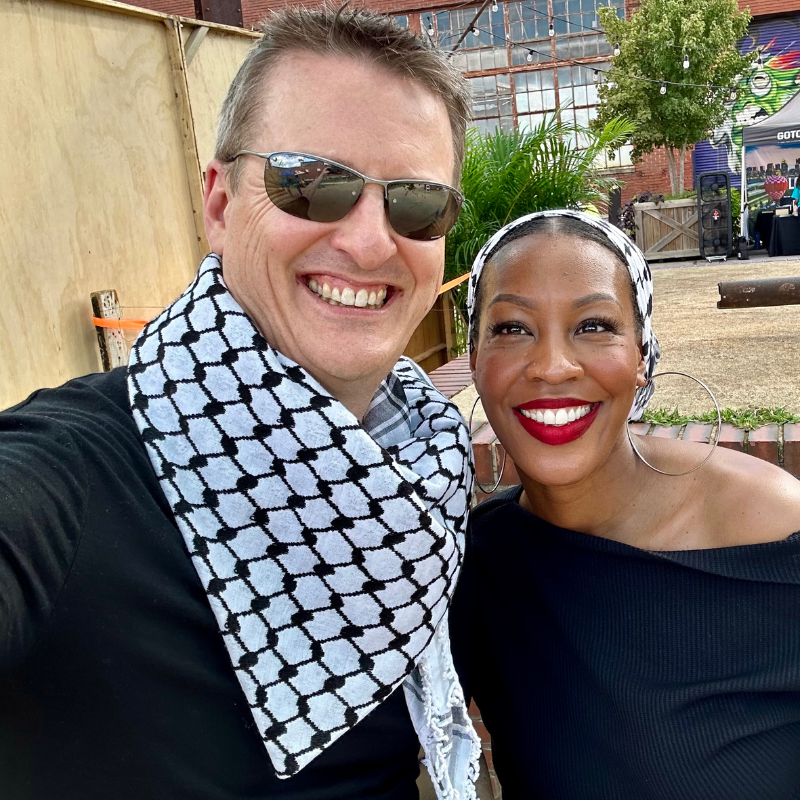
INTRO: This is part two of my interview with Imani Bashir. If you have not yet listened to part one, I highly recommend you go back and do that first because it provides some really important context for this episode. If you have already heard part one, then please enjoy the conclusion of my interview with Imani Bashir.
Matt Bowles: So, after Cairo, you went to China. Can you talk about what prompted the move to China?
Imani Bashir: So, while I was in Egypt, I met my ex-husband, who was coaching American football at the American University in Cairo, which was literally up the street from where I was. And we actually met at. So, the NFL had a program called Football Without Barriers, and literally Marshawn Lynch and a bunch of other ex-NFL guys were going to be there. And I’m like, I love Marshawn Lynch because prior to me moving abroad, I was a sports broadcaster. So, I was like, what? I have to be there. So, it was literally a closed event for high school students. But I fast talked my way into the event and my ex-husband was actually there and we met. I’m like, finally, another black American. He’s from Buffalo, New York. Finally, somebody who understands culturally things.
And because he lived not too far from me. I was like, cool, we can go to the mall, we can do these things, or whatever. And then when we decided to get married, we came back to the States for a small stint, but he had a contract for a new arena football league in China, and so he was going to be coaching the Dalian team. So, we got a chance to do a six-week, six city tour, which was probably one of the most fantastic things I’ve ever got a chance to experience, because it gave me the opportunity to see a greater portion of China in a short amount of time. So, every week we were in a different city, and so you got to see somewhere that was as rural as you can possibly get to, as big and robust and city like as Shanghai. So, it was a fantastic experience because I’m like one, when you think of China, there’s so many things that you can think about. But obviously, as a black person, people are like, don’t go there. They don’t like us, they don’t this. Whatever. It was not my experience.
Now, obviously, people are going to look at you, they’re going to want to take pictures and things of that nature. I’d never had an issue with that. But for me, it was like culturally and then it was the architecture and it was the history. I was so entrenched in that. The food, my goodness. Being able to see so many different sides of China. It was really pivotal in our move back because we eventually went back for two years. But initially that’s what brought us there. But I stopped teaching and started getting into freelance writing. So, I had been freelance writing while I was still in Egypt, but then once we got to China, I was freelance writing full time. And so, where I was, most of the cities that I was in, I lived in Chongqing and I lived in Wuhan. Those are southwest, southeast. China is huge, by the way. And I lived in cities that were three, four, five times bigger than New York City, with millions of people.
Matt Bowles: Well, I know you also went to Poland, which is where you gave birth to your son. Can you talk about your experience in Poland?
Imani Bashir: Yes. People are often taken aback when I tell them that my son was born in Szczecin. And they’re just like, wait, how did you even get there? So again, you know, my ex-husband, he’s having the opportunity to take two contracts Poland. And at this time, we were in Thailand. We had been spending time in Pattaya. Oh, God, it’s a beautiful place. It’s a really a party retiree town. You see very old veterans that are There that have been there forever and they’ve just been enjoying life and kicking back. So, after the six-week tour that we did in China, we decided to go to Thailand for a month and just kick it there. My first time ever in Thailand and absolutely beautiful, beautiful place, beautiful people.
And so, we were trying to decide because I was pregnant with my son and I was like, I don’t necessarily want to give birth in the States. However, we did want support and we were like, if we go to the States, family will be there, etc. And so, he had two contracts, one in Illinois, southern Illinois, very white, and one in Poland and the Illinois one, it just didn’t make sense because I think they would have tried to like room him with someone and he’s like, well, I have a family, I have a child come in. Like, that wouldn’t make sense. And so, we chose the Szczecin and we get there, it’s the widest place on earth and it’s cold. And I remember looking at the buildings because Europe is smaller in comparison to the U.S. and even smaller in comparison to China. We lived in a big high rise building in China, but the buildings in Poland are very small. We had a studio apartment, probably our first studio ever. And the people were just so lovely.
And that’s the most interesting thing about it because the expectation is people are like, you’re black and you’re Muslim and you’re here and whoa, they’re, you know, whatever. But they really enveloped us. And I would take the bus and people would see that I was pregnant and they will help me on the bus. And I remember next to our building we had a pharmacy and I would sometimes go get snacks and things or whatever. And it was the first time culturally that I saw a place that people count out their change. And I’m sitting there and I’m like, this is interesting. And they put all their change out and they just count it. And then eventually, similar to in Cairo, your kind of just immerse yourself culturally. I’m like, well, I got all this change, I’m going to count out my change too. But prior to us coming, I had reached out to a midwife that I had found.
When we got there, she was in Canada. And my son’s due date was actually March 5th. So, I was like, okay, she should be back by that time. Well, I went into labor on February 26th. It had to be because I had a 22-hour labor and he was born on February 27th. So, we literally had our son in the middle of the living room in our house. Because I didn’t know that I was in labor. Because your first pregnancy, you have no clue. So, he’s born. And at the time, my ex-husband had someone who helped with his team there, and his wife always helped me, whatever it is that I needed. Translations, anything. So, I call her and I tell her we had the baby, and she brings a midwife and she takes me to the doctor. I mean, all the things we were cared for in such a way. But the most special moment in this whole ordeal of having my son there was we get back to our apartment and the midwife is there, my ex-husband’s there, and my, I call her like a sister, auntie, big sister Camila. And they’re like, hey, the priest from the church is downstairs, but he knows you’re a Muslim woman, so he’s going to wait for you to cover. And he just wanted to bring you all some gifts. And this priest speaks no English. He brings us all of these community goods in trash bags, full clothes, shoes, diapers, wipes, toys. They bought us a car seat. We didn’t even have a car. I mean, all the things.
And I was so overfilled because I’m like, these people don’t know us from a can of paint. They just know that we had a baby here. They just know that we’re new here. And that’s the things that I’m like, if you don’t travel, you never get a chance to experience something outside of just, oh, they don’t like these people, or they don’t like that people. Well, they treated us with the utmost respect. And I remember big sis Camilla shout out to her because, love her to today, still connected. She found me a gynecologist, which is actually a Palestinian gynecologist, a man. And so, she was like, I wanted to find you a muslim doctor. In Szczecin Poland, you find the only? But, like, what is happening?
And obviously he doesn’t check me, but he has a woman nurse that comes and does my postpartum checkups to make sure everything was okay. And all of the things. And it was probably one of the best experiences I’ve ever had in my life in terms of humanity, in terms of really seeing that all the things that keep us divided in terms of race and identity and all of that is bs because humans are humans, and they will absolutely rally around you just in a very human way. And people always ask me, no, my son does not have Polish citizenship because they don’t have birthright citizenship. But he does have a Polish birth certificate that is still in Polish till this day and we had to get it translated and notarized into English. But he still has his original Polish birth certificate and then he also has a United States consular birth report as an American citizen.
Matt Bowles: That’s so amazing. I have not yet been to Poland, but I have so many dear Polish friends. My business partner is Polish from Poland and I’ve been going to watch with him the Polska football matches and root for Polska. And I have all of these Polish friends as well now that I’ve developed over the years of nomading and I have yet to go. So that is yet another amazing endorsement for Poland. And so, it has officially moved even higher on my list now.
Imani, another place I want to ask you about that I know you have spent time and lived in for a bit is Malaysia. I lived in Kuala Lumpur for probably about four months I spent there. And so, I have a lot of love for KL especially. But what was your experience like in Malaysia?
Imani Bashir: Obviously I mentioned a little bit earlier that we lived in Wuhan, China. So, Wuhan is where they claim was the epicenter of COVID 19 and covet hit while we were still living there. But we didn’t know exactly what it was. They hadn’t named it yet, but it was requested that people started wearing more masks. And then you started seeing outside of the malls these big bottles of hand sanitizer, which if you’ve ever been to China, is an anomaly. What is this doing here? In other areas, because China has a lot of smog. You will see people wearing masks just because smog is a thing. And so, you want to wear a mask to just protect your breathing, etc. But during that time, it was wild.
And I remember our landlady sending us a message, she sent me a message in Mandarin and it was something similar to the effect of there’s a pneumonia outbreak or something. And I was like, well, pneumonia is not contagious. You know what I mean? And I just remember that being one of our last, like messages because it was right before Chinese New Year. So, if folks don’t know Chinese New Year is the biggest holiday in China and the year prior was our first year in China and we didn’t know you’re supposed to book your holiday early. So, we ended up staying in China the first year. But the second year we had booked and all that. So, we booked to go to Malaysia right when this whole thing was happening. We don’t know what’s going on. So, we’re like, okay. We get to the airport, they’re doing the test on the forehead, check temperatures. And we’re like, okay, no big deal. Get to Malaysia. We’re in the Borneo region, so not necessarily ‘mainland’ part of Malaysia, but it’s an island that’s set off and it’s absolutely gorgeous. It is a gorgeous, gorgeous place.
So not too bad to be there, but literally within maybe 48 hours, they close the borders of China. And we’re seeing the news, and we see that the borders are completely closed. They’re not allowing anyone in, anyone out. Well, our two years’ worth of living in China is still in China. My ex-husband had left his wallet. We had pictures, toys, a whole apartment, right? And I remember my landlady sending me a text message on WeChat, what would you like me to do with this stuff? Because we had our lives in China and we were like, we don’t know, because we can’t get back in. We didn’t have residency there. He just had his work visa that permitted him to work there. But they’ve closed the borders and its Chinese New Year, so we’re stuck. So, we were pretty much stuck in Malaysia at the time.
And at one point, I remember it going from not knowing what it was to epidemic to a pandemic. And it was just like, what does that even mean? Where do we go? So we were there for a little while, and it was absolutely gorgeous. One of the things that I loved was I went to the masjid there, which is massive. It’s beautiful. And because Asia has one of the biggest Muslim populations, you’re going to see Muslims everywhere. And I remember talking to a taxi driver, and the man was like, I’ve never seen a black Muslim before and one from America. And we’re just having this whole conversation of how Black Muslims came to be in the United States. And it was just such a very rooted conversation that you have as a traveler when you are getting to know people and people are getting to know you. And it was just one of those things. Malaysia is one of those places. I often say, you can put me anywhere in Southeast Asia and I’ll be great.
Anywhere in Southeast Asia feels like a very warm hug with people who are just lovely and beautiful. So our experience, unfortunately, was during that time, it wasn’t an intentional move to be there. It was, well, since we’re here, we’re just going to be here until we can figure out where else next to go. But the experience of being there was phenomenal because the people were just absolutely beautiful. The food is.
Matt Bowles: Insane. It’s ridiculous.
Imani Bashir: We talk about the food all day long. And then we were on the beach, so you can’t fault it too much. And then we also were not there at the height of COVID where things got shut down. So I don’t know how it shape shifted, but the time that we were there, we still had some what people would call normalcy. It was still good to us to be there, to be able to just breathe fresh air and not be confined to a space.
Matt Bowles: Yeah. If anybody’s not been to Malaysia and you’re into anything at all relating to the culinary scene, Malaysia needs to be at the tippy top of your list. Kuala Lumpur is one of my most favorite food cities on the planet. And it’s really interesting too because KL is just ethnically, it’s about 1/3 Indian, mostly from South India, from Kerala and Tamil Nadu, about 1/3 Chinese and then about 1/3 indigenous Malay. And so, the culinary scene in Kuala Lumpur is just magical. I mean, it’s a thing of beauty. So, I go back whenever I can and I have so much love for Malaysia. Another place that I want to ask you about that you have lived is Mexico. Can you talk about what brought you there, where you were and what that experience was like?
Imani Bashir: Mexico, I think, saved our lives because after Malaysia, my ex-husband actually got a contract in the Czech Republic. And at the same time we were still trying to figure out, well, what does that mean? How is this going to work? Because everything wasn’t shut down. It was almost like Covid was literally moving from east to west. And so, as it was spreading, he got this contract. But I’m like, we’re probably going to need something more. And so, I ended up doing some interviews for a travel writing position at a publication. And at the time I was like, I want to actually meet them in person. And so I actually got the opportunity to speak at Women’s Travel Fest at the same time. This publication was like, hey, we would like to interview you in person. Was like, okay, this could be a double stop. So, my ex-husband and my son went to the Czech Republic right after my son’s third birthday. I think he had just turned three.
So, it was the day after his birthday. They headed there, I headed to New York City. So, I went there, I met with the ladies, I got the job, which was great because in hindsight, if I hadn’t got that job, I don’t know what we would have done because everything had shut down. And again, my ex-husband was coaching football and nothing was open. Everything was closing down. And so, in my quest to try to get to the Czech Republic, I get to the airport and get to my layover in Amsterdam and they announce over the PA system, if you do not have residency, please come to the check in counter. And the lady tells me, we are not going to allow you to, to board this flight. Now mind you, I’ve just told my 3-year-old, Mommy’s coming. And every time I would FaceTime them to let them know, every he would run to the door, I have to put my shoes on and stuff. And so, I was crushed. I was absolutely devastated because I’m like, I have to get to my son. Like, I have to get to my son. And so, in the time that they went to the Czech Republic and I went to New York City, it was three weeks that I did not see them. So eventually they were able to get a flight back because obviously everything started shutting down.
We ended up meeting in London because I was like, I’m not going all the way back to the States. I will stay with my brother in London until I get to my family. And so, they flew into London and then we came back to the States. But I was like, I cannot stay here. We both had agreed we could not stay there. So back on Facebook, I went to my expat groups and I was like, hey, like, who’s open right now? And somebody’s like, well, Mexico’s open. So started doing a little research, the same research that we would always do. And I was like, we’ll just go to Cancun and we’ll just feel it out. We were there for three years. Mexico, Cancun, specifically outside of the hotel zone, is a very family friendly and family-oriented place. And then we put our son in school and so he went from not knowing any Spanish to learning Spanish at a very early age.
And we got a chance to build in community. And because, you know, my son was in school building that community for him as well. Now he’s got friends and now he’s got birthday parties and piñata, all that fun stuff. And so, Mexico was our first semblance of a home place for him because he was too young to remember China and Egypt and other places. And so this was his first grounding place of where he started building community and where we got a chance to actually be rooted in community in that way.
Matt Bowles: Can you talk about parenting in a lifestyle of world travel and the impact of raising your son in multiple countries?
Imani Bashir: I think that is probably the best example that we have given him to date. He’s a very well-rounded kid. He’s a very outspoken kid. He could talk to just about anybody. And I remember meeting kids, like when we went to places and asking them, would you want to be back? And they’re like, heck no. This is the best thing ever. I would never, you know, and I never met a kid that actually hated living abroad. And I would always talk to the older ones that had lived abroad for some years. And so, I was like, okay, just making sure. Because one of the things, obviously, especially as a black person, is like, you want your kids to see themselves. That black American ness and the history that we have and all that is very nuanced and very special. And so, I thought about the ways in which he wouldn’t necessarily get that in school or see himself in that way. And so, I’m happy that he had the experience of Mexico. And it was hard coming back to the States. It was hard bringing him to the States.
But now, like last year he was like, mom, my birthday is in Black History Month, right? And so, he’s like, I have the most special month because my birthday is in Black History Month. And so now we get to also teach him about. And we have before, but now it makes sense because he’s on the ground in a place like Washington D.C. where he can see a monument of Martin Luther King Jr. And he’s like, oh. Whereas in other places you don’t necessarily, necessarily see your own history and things of that nature. And so, I think travel has really done that because even his friends now, they’re from all over. He’s got a friend from El Salvador; he’s got a friend that’s from this place and that place. And he talks to all types of kids, but he has a knowledge of things that are culturally this or that. And it’s not an anomaly to him. He understands what it is that people are different and that people speak different languages because he’s gotten the experience to live abroad and learn different languages and speak different languages.
Matt Bowles: And for you personally, you were talking earlier about how for Malcolm X and James Baldwin and a lot of these people that chose to go abroad, how that travel and living abroad really fundamentally shaped them as people. So, for you, now that you’ve lived in Africa and Europe and Asia and Latin America, can you talk about the impact of that and how that has shaped you as a person?
Imani Bashir: Again, I’ve seen how we’re more alike than not when you hear different things like, oh, black people are so loud. I’m like, have you ever heard an Arab woman? Have you? You know what I mean? I’m like, I ain’t never heard anything louder than that. Like, when people have just certain things. I remember one of the best fried chicken spots that I’ve ever been to was in a hole in the wall in Egypt, in Cairo. I’ve gotten a chance to really experience the opposite of what it is that we’re constantly taught about other people. I’ve gotten a chance to learn other people through them, not through colonialist lenses. I’ve gotten a chance to be right up on people and Anthony Bourdain, some stuff. I can try your food and I can taste your coffee and I can have a conversation with you about life and parenthood.
And I remember being in Poland and Camilla’s mom only speaks Polish, or both her parents only speaks Polish. And we go into their home and they have African masks along the wall. And I’m like, what the heck? And her father was a sailor for years, and he said, whenever I would go to Africa, I would stop and I would buy masks. Well, my ex-husband had a collection of. Of African mask. And so, they’re having these conversations in Polish, English about travels and culture and just things that you don’t get when you don’t meet people up close and you have misconceptions about people. And I think that’s the biggest thing is that I don’t necessarily think I was so. Just vastly ignorant of folks, I think, in some ways. Yeah, because you don’t see it and so you don’t know. But I was always willing to learn and I was always willing to and have been always willing to immerse myself in the things that I don’t know and be willing to correct myself if ever I was, like, wrong about a thing or about a culture or about a place.
Matt Bowles: I want to also talk to you about your activism. I think you are one of the most important people doing political commentary today. I want to encourage everybody to follow you. We’re going to link up your social media handles in the show notes. But a lot of times I will be going through my Instagram feed and I will come across your post and I will listen to it and I will be like, that is what I needed to hear and it’s the way that I needed to hear it. And I think you’re doing really incredible and really consistent political activism. You’re also now working with Resist, which I want to talk about as well. But maybe just as a little bit of background in terms of your activist journey, can you talk a little bit about how you don’t develop such a politically principled consistency in terms of your support for collective liberation, not only for the groups and communities that you’re a part of, but your understanding of allyship and solidarity.
Imani Bashir: That started at home. My father was very big on rooting us in who it is that we were, but also letting us know that didn’t make us better than anyone else. My dad is from the projects of Elizabeth, New Jersey. I have a different experience being a suburban kid, but he would always take us back to his hood, his home, and have us understand that we don’t need to be scared of our own people because they’re in different circumstances now. I didn’t live like some of my friends live, with the five-bedroom house and two car garage. I wasn’t living like that, but somewhere in the middle and not as close to the poverty line as many other people. And so that rootedness of making sure that I knew who I was, to not separate myself from my own people, starting there, to not look down on my own folks and whatever conditions that they were faced with, and understanding that it is imperative that we advocate for them to be able to unlock whatever resources that we were able to unlock.
And I remember my grandfather and I having this conversation in Egypt where he was telling me one of the benefits of us being American, even though we’re black, is that we can move up. We can always move up in our society. You can get a degree, you can get a better job, you can marry up, societal wise. But somewhere like here, if you’re born to a certain family, a certain socioeconomic positioning, you stay there. And when you learn those things, you do your hardest to advocate for the folks that don’t necessarily have the privileges that you have. You recognize that even if you have marginalized identities that in some way you still have privileges. I have a college degree; I have a passport. I have a different socioeconomic circumstance than some folks.
And so, in those ways, I know I can advocate for the poor, I can advocate for the LGBTQ+ I can advocate for women, I can advocate for mothers, I can advocate for whomever is whatever subjugated group because I understand what it takes for us all to be able to have. There’s so much in the world. And you recognize that. Yeah, if you just trickle a little bit more down, we’d all be okay. But you want us to fight for this crumb and I’m not going to fight for the crumb. I’m going to fight the folks at the top who need to spread the wealth, who need to give us the access to the things that they are withholding from everyone.
Matt Bowles: How do you balance or interweave the more confrontational aspects of your actual advocacy with the tenderness and empathy and love in which your politics are so clearly grounded?
Imani Bashir: It just depends because sometimes I feel like some things need to be a straight on conversation. Let’s cut the BS and let’s get straight to the point, let’s have this conversation. And then some things are more educational where it’s like, hey, I think it’s better if I just educate you on this thing and maybe that’ll bring you a little bit more over this way to want to learn more or want to ground yourself or root yourself more in the educational part. Because I think that that’s sometimes the part that’s missing is that people just have their stance but they’re unwilling to educate themselves on something outside of what it is they know. So, I think it’s really just a matter of do I just want to educate somebody really quickly or do I want to yell at folks and tell them cut the BS and get outside and do your part. So, I think it’s really just a matter of how it is that I feel in the day and what it is that I feel is needed in the moment.
Matt Bowles: I want to ask you about the current historical moment that we are in, as we, you and I are both in not just the U.S. but DC right now at the very moment. And we are watching the rise of fascism in the United States. So many different communities being targeted in so many different ways, authoritarianism lurching on the so many different fronts. And then there’s of course the foreign policy stuff, the genocide in Palestine and all sorts of other things that are going on as well. And I think for a lot of people it can feel overwhelming because there are so many fronts and so many things that are happening at the same time, which of course is the point. And I want to just ask if you have any tips or advice for people that are feeling overwhelmed by all of the things that are happening at all of the same time now and how we can rise to meet this historical moment, make a positive contribution in spite of feeling pulled in so many directions and overwhelmed.
Imani Bashir: I’m overwhelmed. It is overwhelming. That’s the reality of it. It is overwhelming and it is set to be that way to keep you from making any changes. And so, we get into these silos of Where I’m so overwhelmed. I’m just going to focus on me. That’s the easiest go to is like I’m just so overwhelmed with this. I just rather pacify myself with consumerism or I just rather pacify myself with whatever the talk of the town and entertainment is because that’s so outside of me that I don’t have to deal with the realities. And for me it’s like if you’re unwilling to change anything about your own circumstances, nothing will change. And so, I think it’s a matter of, I always see myself in a situation. I saw myself in Sandra Bland, I see myself in the Palestinian people, I see myself in the people of Congo. I start there. I’m a mother. I could never imagine my child having to be sent to a mind to have to mine materials that go into my phone or my laptop.
I could never fathom the idea of that. I could never fathom that the average age in full steam. Now I don’t know what it is to date, but where we were a couple of months ago was the average age was like 22. We have lost generations of people. My history knows what it is to lose generations of people. We know what it is to lose our history. We know what it is to lose our culture and be separated from that. You have to pull from your own. And I think unfortunately what United States has done when it comes to social media and when it comes to our culture is that it gives us this like carrot that it dangles in front of us that says you can be the next Oprah, you could be the next Beyonce if you just do these things, if you just work hard, if you just whatever. So, nobody’s willing to jeopardize their crumb.
If I just keep on this track and I’ve had conversations with people that are in some very well to do positions at companies etc. and they have expressed to me, hey, you would never be able to partner with a brand with content like that. And have also expressed to me the ways in which they will toe the line in their roles, in their jobs and their day to day because they don’t want to jeopardize is their thing. But what about the greater portion of the world? I’m a mother, I’m looking at the world that I want my son to have and he won’t have it. If we continue to try to gatekeep our own privileges, we try to gatekeep our own level of wealth, we try to gatekeep. That’s not what’s going to get us better. So, I think yes, it is overwhelming. Start there and know that it is very much overwhelming. But you have to treat human things in a human way. If it’s happening to you, if it’s happening to your people, if it’s happening to your family and your friends, if it’s happening in your area of the world, what would you want people to do? Would you want people to go about it by going to brunch and sipping their coffee and acting like you don’t exist and the problems that you experience don’t exist? Probably not.
Matt Bowles: I want to also ask you about long-term activist stamina and what you do for emotional self-care as we’re watching a live stream genocide in Palestine unfold on our phones every single day. How do you emotionally manage paying attention to the horrors of something as extreme and sadistic as a genocide without becoming completely debilitated, which I feel can oftentimes happen to people. And I’m seeing that happen to people. We say pay attention to this, look how horrible this is. And then people start paying attention to it and then sometimes people fall into despair. I’m curious because you show up so consistently, it is so inspiring to me and I’m wondering if you have any tips or advice on how to do that in this climate.
Imani Bashir: Yeah, I think a great part of resistance is rest. Do you drink your water? You take your naps? There are some days where I was meant to go to a rally, but I have a migraine and I just need to lie down and rest because also if your physical body is not in the condition to show up for people, it’s just not going to work. I’m a mom and I have to ensure that I have enough of me to give to my son. And so going to his martial arts practices and his tournaments and watching him ride his motorbike with his bonus brothers and being with family and checking in with my loved ones like the people who also love me. That’s the only way that we can actually do this work, is that we have people who actually love us and hold us and care for us and give us the space to scream. If you ask my dad right now how many times, I call him in a day to where I’m just screaming at the top of my lungs. It just allows it. And I’m like super grown, but I just need that moment to vent in a way that I cannot do on social media or in a public space.
But those are the ways in which you have to find your grounding. This is why also in movement work, specifically black radical tradition, you do things in groups. We have a chant that we say, who keeps us safe? We keep us safe. I usually am outside with an organization called Harriet’s Wildest dreams here in D.C. and one of the things that we have a slogan that we go together really bad. We go together. We do this together. We walk this walk together. We hold each other together. Rest is important. Making sure that you are taking care of your mental capacity is important. But that is the work. The work is hard. And nothing worth having comes easy. And so, when you recognize that and understand the toil of our foremothers and our forefathers and the hard that they had to deal with and endure, you are willing to say, I am willing to still put it on the line because it is worth putting it on the line.
Matt Bowles: You are currently working for an organization called Resist. Can you share a little bit for people that have never heard of Resist, just about the history of the organization and what they’re doing today?
Imani Bashir: For those who haven’t heard of Resist, it was founded in 1967. So, we’re nearly a 60-year organization. Some of our founding members were Noam Chomsky and Howard Zinn. If you don’t know those names, please feel free to look them up. They’re very important. But the core of Resist actually started as resistance against the Vietnam War. And so, when they mobilized and came together, they were like, hey, what ways in which can we equip grassroots on the ground organizations with what they need to do the frontline work? So that’s what Resist is. That’s what it is that we do. We provide our community members across the nation with the resources needed for them to do their work. And its amazing institution from the history and the legacy of who it is that we are to how it is that we’ve been able to see the work through the resources that we’ve been able to provide the grant funding that we’ve been able to provide. Organizations that probably more than likely wouldn’t receive federal funding. And so, we stand in that gap to say we see you and we know that you’re doing the work and we want you to continue to do the work that you’re doing.
Matt Bowles: Yeah. And salute to Chomsky and Howard Zinn. Did you know that Howard Zinn taught at Spelman?
Imani Bashir: You know what? I did not know that.
Matt Bowles: And he got fired from Spelman for supporting the student activists as Spelman.
Imani Bashir: That’s too good.
Matt Bowles: Yeah, if anybody does not know Noam Chomsky and Howard Zinn we’ll link them up in the show notes as well. Howard Zinn has written a number of books. Probably his most famous is called A People’s History of the United States, which you should definitely read. And. Noam Chomsky is one of the most prolific writers of the last century and you should definitely dive into his work as well. But can you talk about your role at Resist, the communications and the storytelling work that you’re doing there?
Imani Bashir: Yeah. So, our goal with the storytelling is really to tell the story of resistance and the organizations that are pushing back, that are doing the heavy lifting. It’s fun because we don’t have a hierarchical system. So, everyone’s a co-director. I have another black co director, I have a Palestinian co director, and I have a Puerto Rican co director. So, we literally all people that represent the people, right? The people that are in the most marginalized groups that are really about the work. And I am in community and in work with people who really believe in what it is that we do on a day-to-day basis. And our radical philanthropy is really the goal and how it is that we communicate that. We just revamped. Shout out to Kathy, who was the prior co-director of communications, but we got a new logo and we’ve got a new look.
And the goal is to just modernize the work that we’ve been doing for these nearly 60 years and to really communicate the importance of the fight to stand up against these oppressive systems. Communicating that through our website, communicating that through our social media and finding other avenues. We just recently had a community event with our board members, with our grantees in Boston. It was absolutely amazing. Just communing with people in real time, in a real way. And so those things are going to be actually put on social media soon for people to see how it is that we were able to come together.
Matt Bowles: If people would like to learn more and maybe get involved in some way or donate to Resist or support their work, how can they learn more?
Imani Bashir: Yeah, absolutely. You all can go to resist.org if you want to learn the history. You can go to resist.org/history. Our donate tabs are everywhere, so please feel free to donate. We thrive off of small donations. We are the institution that thrives off of the person that’s donating $5 a month or $10 a month. We have donors that actually bequeath to us and put it in their wills that they want a portion of their money to go to us upon their death. And so those are ways in which we get funding so we do not get those billion-dollar benefactors and all that. We get the money from the people who really believe in the work.
Matt Bowles: At this point in your life, can you talk about how you intertwine your travel and your activism and how those two things are so interconnected?
Imani Bashir: I know that travel is activism because there is a layer of education that I find that they don’t want you to know about others. And I think that was the brilliance of Anthony Bourdain is because he brought a humanness to groups of people that were traditionally third world or othered in some way. And so, the mastery of what it is that we get a chance to do as travelers is really communicate who the people are. Unfortunately, I think that travel content has shifted more into where to eat, where to play, where to stay. And it’s lost the human aspect of who are these people. And I remember going to Fiji in January and I was just floored. And my want to go to Fiji was as a result of going to Hawaii and going to Fespac. And I had no idea that Fijians were black. I had zero idea that Fijians were.
And when I say black, I mean from an American perspective, if we would call them culturally, you know, racially black. And they’re black people and the women wear afros and they are beautiful. They look like probably the first people that ever existed on earth. And I learned then that like, yeah, I can show you where I stayed and I can show you all of that, but I can communicate the culture of the people in and of itself. And that will make you want to come here. How tight knit they are at as community, how in the villages, it’s not a whole bunch of access to Internet and all the other things, but they have pointed out every single aspect of a tree that can either be turned into medicine, food or shelter.
And how it is that they communally come together and how they sing and how they dance and how the food, oh God, the food is amazing. And that’s the way that I try to use my travels to communicate who are the people? Because the people are the destination. And how do the people make it to where you really want to see this place and come to this place? Because if we continue to forget about the people in these destinations, we ain’t going to have many places to go to, to be honest with you, because they’re all going to look exactly the same. Carbon copies, McDonald’s and Starbucks and, and all of these westernized things. And it’s going to be almost pointless to go to these areas if we continuously overlook the culture.
Matt Bowles: I also want to ask you about raising activist kids. Can you share how old your son is now and how you are talking to him about what’s going on in Palestine and some of these other issues at his age? How are you communicating that to him?
Imani Bashir: It’s interesting because with me, I feel like I was getting these things at such an early age. But for him, I was very reluctant because part of it was there’s an innocence that’s stripped from black children at very early ages. Research has often shown that black children are often looked at as older, specifically black boys, prior to the age of like 10. And so, you’ll see it in things in the news where they’ll call a teenager. Mr. And you’re like, wait, that’s just a kid, that’s a baby. Part of me has wanted to keep a level of innocence with him where the things that he loves he loves Roblox and he loves his motorbike. And depending on what day it is, he might like the color blue, he might like the color green. And then also recognizing that there’s a level safety of him understanding the world around him. So, I’ve taken him to rallies for Falasteen and we’ve chanted and we’ve held up our flag. And I’ve also showed him pictures and things to show him that there are some really bad people in the world that subjugate people, and we don’t do that.
We support people and we love them and we fight for them. And I’ve showed him pictures of me at rallies or at marches or on the bullhorn and things of that nature. And so, I’ve unrolled these things as I feel like I need to, especially with being in D.C. now with this occupation of the military. We’ve had conversations, but I don’t lead the conversations. I kind of ask him a question and I kind of see where his mind is and what he understands and what he doesn’t understand. And I remember last year I was a chaperone for one of his field trips, and one of his best friends is from El Salvador. And I remember we were in the line and we were about to get on the bus, and he says, now that Trump is in office, I think I’m going to have to move. And so, we had to sit down and we had to have a conversation about immigration, and we had to have a conversation about what it means to be undocumented and why that’s not a bad thing. And why some people need to migrate to places and what that means and all of that.
And so, we had those conversations especially because is with the type of school, and I’m going to be a little bit vague here, but with the type of school that he goes to, the threat of ice, especially where we are, and so having to have those conversations as well, and even the conversations of what he’s supposed to do if he’s ever encountered with police or someone who presents themselves as such. So, there’s a lot of layers, unfortunately, but also fortunately because I think it just prepares him and in a way that, like I said, unfortunately, I think children shouldn’t necessarily have to at this stage. But also, there is a level awareness that he has to have because of the level of threat that exists out there. So, it’s just that balancing act of trying to figure out what makes sense and when it’s appropriate to have that conversation and then also in the moments to allow him to be a kid and to do kid things and to live and laugh and be full of joy.
Matt Bowles: So, do you have any tips in general for parents who are thinking about this and wanting to raise their kids in a way that is ensuring that they’re socially conscious and aware of the things that are going on and they’re trying to navigate those dynamics that you mentioned? Because some folks, I mean, I think, you know, to your first point, your first inclination is I want my kid to be sheltered from all this. I don’t want them to, to know about it. I want them to just live in innocence and joy and things because they deserve that because they’re a kid. And then there’s, well, they are a kid that lives in this world and they’re going to grow up and be an adult in this world and I want to make sure they have the right values. So do you have any tips just for parents, I guess at different age groups maybe. And as they’re thinking about the long-term parenting project of raising their kids, on how to raise socially conscious kids and maybe even reflecting back on, on how you were raised?
Imani Bashir: I think the reality is you can want to shelter your kids, but at some point, as my mother would say, the truth is going to smack them in the face. So, would you rather them get that education at home or that education on the street? And so, for me, that’s something that I had to reckon with is that I can’t bubble this kid from the reality that he will face eventually, whether that’s from the police or whether that’s because he’s black or whatever that means. And so that was the reality that me and his dad had to say, well, we got to tell him these things because he needs to know how it is that people see him versus maybe how he sees the world. I think also in really instructing your kids to understand that, like, they’re not better than anyone, one thing that you realize with kids is they like the basic things, and then it’ll be the silliest things that divide them.
You don’t have to have the new shoes, or you don’t have this, and you don’t have that. So even explaining some of those things to my son, we do things together. Like, we’ll go and donate clothes, and I will put them together intentionally. And I’m like, okay, you pull some things out. Let’s get some toys. You haven’t used these toys in a while. Around Christmas time. And I don’t even celebrate Christmas, but around Christmas time, we do it every year, and we’ve done it since he was in Mexico. We will take whatever toys that he’s not using. Nothing that’s broken, but something that it can kid can still play with. And we’re saying this is how we get our blessings, is that we bless others. Because there may not be a kid that has what you have, or their parents may not have a lot of money to be able to get them something. And maybe this will make them smile just like it made you smile before.
And so, I think it’s really a matter of bringing it to a kitty level. It doesn’t necessarily have to be all mayhem, but it can be at a level where they understand that the reality is, yes, there are people out there that harm kids. And so, you can decipher, as a parent what level of that harm you want to be able to exchange with your child at whatever age that they’re at. But explain to them that that is a real thing. And also explain to them that we do live in a world that tries to divide us, but we love people that love us, and we treat people well, and we treat people with respect and decency, no matter what.
Matt Bowles: I also want to ask your advice for travelers and how we, as world travelers, can develop a socially conscious travel lens and how we can do a better job of standing in solidarity with marginalized and oppressed communities around the world.
Imani Bashir: The same way we will educate ourselves on the weather so that we can figure out how to pack is the same way that you should, at least on a basic level, educate yourself on the economic side of where people are, to be intentional about how you spend your dollars. So, in this particular place, do I want to stay at a resort or can I stay at maybe like a mom and pop, or should I give my money to this high-end restaurant that’s been all over TikTok or can I go to maybe a hole in the wall that’s owned by this particular family that might need that $10 from the meal that I’m spending? So, I think it’s really a matter of intentionality about how it is that we approach it.
And I remember doing a video which cycles its way because I think I used the hashtag for daddy to say December. And I was explaining to people this was maybe like two years ago that Ghana was going through an economic crisis. And I was like, I understand that you all may want to go to Detty December and get your kicks, but understand that during the economic crisis that people are literally fighting tooth and nail to survive. And I remember so many people saying, I’m going on vacation. I don’t care about none of that. And I’m like, the issue with that becomes then your safety because now you’re coming over there with U.S. dollars.
And because you don’t care about that, you’re not aware of the potential harms that you’re bringing, number one, because you’re not supporting the local community. And then also the vulnerabilities of people who are really in need right now. And when people are in need of things, they will find a way to get those things. And so that’s where I’m like, you have to be present with knowing how to really show up for people in a way. Our U.S. dollars unfortunately are impactful in many places around the world. So, figure out a way to better utilize them and also communicate that to other people who are looking to do the things that you’re doing.
Matt Bowles: And for black women, or Muslim women in particular, who might be at the earlier stage of their travel journey, what specific tips would you have for them?
Imani Bashir: Don’t listen to anything where people are like, here are the safest places for black women. Here are the safest places for Muslim women. That stuff is all subjective. I have had situations where Italy is always on people’s hit list. I’ve never had a terrible time in Italy. I hate to say that, but like, I’ve never had the experience where some people are like, they didn’t speak to me at a restaurant and I’ve always ended up in Italy by myself on a solo situation. And I’ve been to, at least at this point, nine cities in Italy and have just never had that experience.
So, I don’t do the type of content where I tell people this is the best places to go in Italy because I may have had a great time, but you may get pickpocketed there. So don’t listen to those blanket things that are very subjective to one person’s personal experience. I think also just be very aware there are certain things that even in the States, I don’t do. I don’t go places by myself after a certain time in the States, I ain’t doing it abroad. That’s just my rule of thumb. I’m not going to no bar. And then also a rule of thumb because, you know, we have this situation where a black woman that’s from the D.C. area was recently beaten up in Tunisia. She says that she was kidnapped and she was able to make it back home.
One of the things that I do not do as a precautionary measure in the times that I’ve traveled is that if I’m going somewhere solo, I do not stay in the same accommodations for more than three days. They will only have me for three days, and then I’m moving to another accommodations. Because people will get accustomed to seeing you go in and out of places by yourself, and they will believe you to be by yourself no matter if you wear the fake wedding ring. People do that no matter what it is that you do. They will look at your patterns and they will see that you are alone. So never let people number one know that you’re alone. Change your accommodations if you need to, and always ensure that at least somebody knows your location, whether at home or wherever it is that you are. But safety is one of those things that are very subjective. And I always just say, just be aware of your surroundings.
Matt Bowles: Imani, let me ask you one more question, and then we’ll wrap this up and move into The Lightning Round. At this point in your journey, why are you so passionate about continuing to travel? What does travel mean to you today?
Imani Bashir: Oh, it means education. You never stop learning. One of the things that is an Islamic principle that we were taught about the prophet Muhammad, Sallallahu alaihi wasallam. was that one of his first commandments was ikra, read, right? And I think people bypass that. Even in the Islamic tradition, people who consider themselves Muslim. Islamic tradition teaches us to seek knowledge from the cradle to the grave. As long as you are here on this earth, you have a moment and moments to be educated on. Something that you did not know. And travel gives me that. I always go somewhere and I’m like, I did not know that.
And I like that feeling of not being the smartest person in the room. Give me something that I did not know, so then I can now educate somebody else on. And something else that we believe in the Islamic tradition is that once you’ve passed, it’s the things that you taught people that are going to help you in the afterlife and. And help you get on the journey of where it is that you ultimately want to go in the afterlife. And like I said, it’s Islamic tradition. Not everybody believes that, but I do. And I hope that. That if that does exist for me, that whatever it is that I was able to educate people from through the education that I receive, that that will help me in the next life.
Matt Bowles: Well, I think that is the perfect place to end the main portion of this interview. And at this point, Imani, are you ready to move in to The Lightning Round.?
Imani Bashir: I’m ready.
Matt Bowles: Let’s do it. All right. What is one book that you would recommend that people should read?
Imani Bashir: The Alchemist by Paulo Coelho.
Matt Bowles: All right, who is one person currently alive today that you’ve never met that you’d most love to have dinner with?
Imani Bashir: Goodness.
Matt Bowles: Just you and that person for an evening of dinner and conversation?
Imani Bashir: I would have to choose Solange Knowles, Beyonce’s sister. She is someone I just want to get inside her mind because she’s so much more radical that I think people see and very artsy with it. And I would love to just have a conversation here and she was also born in 86, so she’s a millennial. So, I was like, I get it. I get it, sis. But I would love to just have a sit down with her and just chat it up about all the things.
Matt Bowles: All right. Knowing everything that you know now, if you could go back in time and give one piece of advice to your 18-year-old self, what would you say to 18-year-old Imani, Slow down.
Imani Bashir: The world’s going to catch up. So, you don’t have to rush through the things. You don’t have to know who you are. It is okay to not understand the things that you don’t understand right now. Take your time. So, it is okay that in this time that you take your time and you really get rooted in who it is that you are and become comfortable with that person.
Matt Bowles: All right. Of all the places that you’ve now traveled, what are three of your favorite destinations you would most recommend, other People should definitely check out?
Imani Bashir: I would have to say Fiji. After going in January, that experience was, Fiji is literally a warm hug. It is literally a warm hug from the sun kissing you on your forehead to all of the greenery, to the people, to the food. It’s top tier. It’s far, but it’s worth the trip. Second would be, I would say Thailand and just the people. Before I’ve ever got to Malaysia, I went to Thailand, and every single time I would go, the people were just. It’s just indescribable how kind they are. And again, you’ve got the weather, you got the food, but the people, for me, is probably what made the travel destination the best. And then number three, I would say Johannesburg, South Africa.
Matt Bowles: Give some love to Joburg. I endorse that. What did you love about Johannesburg?
Imani Bashir: It was just black and beautiful and creative. I went to Soweto. I went to Maboneng. I even went to an area called Santon, which is like an upscale area. Johannesburg has left an impression on me. And then obviously, with learning about the apartheid and just seeing the correlation between Jim Crow and all the ways in which we are so connected to South African people. And then, like I said again, the culture of the people is just. It’s by far one of the most beautiful places on the planet.
Matt Bowles: It’s amazing. Yeah, totally endorsed Johannesburg. All right, Imani, last question. What are your top three bucket list destinations, places you have not yet been highest on your list. You’d most love to see.
Imani Bashir: Brazil, specifically Salvador. I want to get there. I have to get there. I’ve been wanting to go for a very long time. Number two, I would love to go to Monaco. That just has nothing to do with nothing. It’s just exorbitant luxury that I just want to see in real time. I just want to see what that looks like when you have a level of wealth that it’s like, whatever. And then three. So, I’ve wanted to go to Senegal, but not just the destination. I’ve wanted to surf in Senegal. So, I actually got my first surf lesson in Hawaii in the place. And then prior to that, I had learned about Senegal being this hub for surfers, and people don’t look at it that way that don’t know that are not culturally, like, tapped into surf culture. But I would want to go there to surf and eat and commune and all the things.
Matt Bowles: I will tell you this, Imani. So, Dakar, Senegal, is one of my favorite cities in the world. I’ve been three times for a month each. So, I’ve spent three months in Dakar, and it is right on the ocean, as you said. And you get the sunset every night over the ocean. And so, what I would do in structuring my days is I would plan to do whatever work I have to do and then be at the beach for sunset. Because not only do you get the beautiful sunset and have a cocktail or whatever, but as you just said, all of the Senegalese surfers come out at the sunset hour. And so, you’re watching the surfer’s surf as the sunset goes down over the beach.
Imani Bashir: Wow.
Matt Bowles: And I would do it every single day, like whatever else was happening in my day. “Oh, yeah, I can meet you here, we can do that, in the night we’ll do this…” But that sunset hour, I would just block, and I would just be there every day.
Imani Bashir: That’s awesome.
Matt Bowles: It’s amazing. You got to go. And I think the other picks are really good ones, too. I spent about a month in Salvador in December 2023. I keep going back to Brazil. It is just such an amazing place. And Monaco is an interesting pick, too. I actually did a day trip to Monaco. The less expensive way to do Monaco is to stay in Nice and then just go for the day and spend the day in Monaco and then go back and stay in Nice as opposed to staying overnight in Monaco. And you can go for the day and stay into the evening. And, you know, that’s where they have, like, the Grand Casino, you know, in Monte Carlo, which has all the Bugattis parked outside. And, I mean, it’s completely over the top and an absolutely fascinating place to see. So, I think that is a really good pick as well. All right, Imani, at this point, I want you to let folks know how they can find you, follow you on social media. How would you like people to come into your world?
Imani Bashir: I’m literally on every platform @SheIsImaniB. That’s YouTube, that’s Instagram, TikTok, Threads. You can find me on every platform @SheIsImaniB. I don’t write as much as I used to, and that’s obviously just the way that my politics in the industry just don’t often align. So, I do my storytelling via social media and my open platforms. I do have a substack, and you can find me there at ImaniB. And, yeah, that’s pretty much it. That’s my world. As transparent, as open and honest as I can be on there. So you’ll learn a little bit about me on the social media platforms.
Matt Bowles: Well, you are one of my favorite, and I think one of the most important, people for folks to follow on social media. So, all of that is going to be linked up in the show notes. Folks can just go to one place at themverickshow.com go to the show notes for this episode. There you’ll find all the ways to find and follow Imani, how to check out her writing, how to learn more about Resist and how you can get involved and donate there, as well as direct links to everything else that we have discussed. Imani, this was amazing. Thank you so much for coming on the show.
Imani Bashir: Thank you so much, Matt, for the invite. I really appreciate it.
Matt Bowles: All right, good night, everybody.