
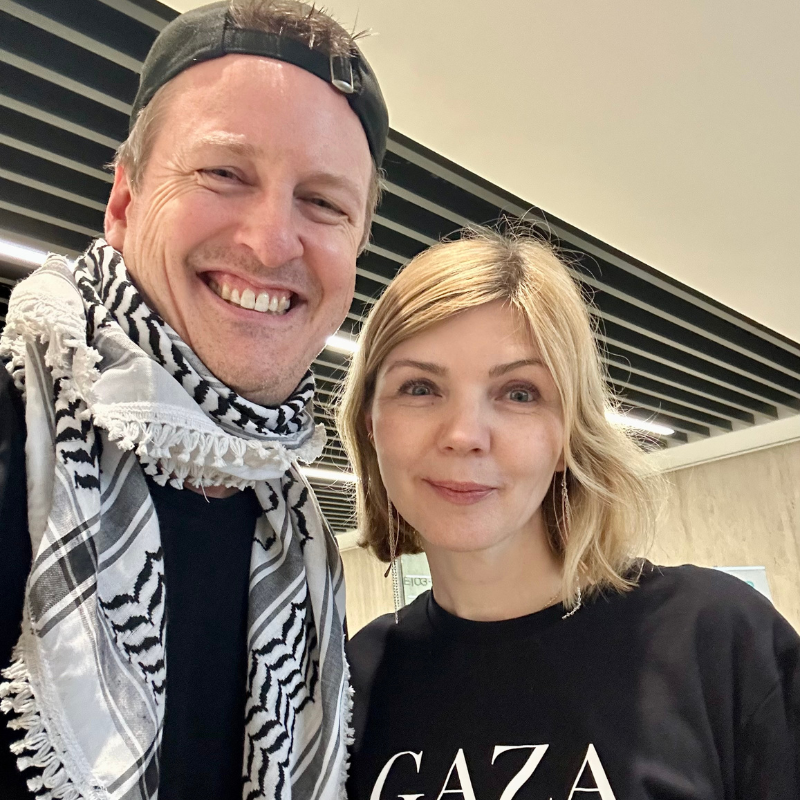
INTRO: On this episode, the tables are turned and I’m the one being interviewed by Yulia Denisyuk on her podcast; Going Places. Yulia is one of the most thoughtful and substantive travel creators I know. She has been very outspoken against the genocide in Palestine since day one, using all platforms to speak, educate, empower and advocate for Palestinian liberation, including on her panel at this year’s WITS Travel Creator Summit, which got a standing ovation from 600 people. And in that spirit, what you’re about to hear today is Yulia interviewing me about lessons from my 25 years of Palestine solidarity work, including specific action items that you can take today to help stop the genocide. Now, I interviewed Yulia on The Maverick Show, back on episodes #282 and #283, and her story is very powerful and inspiring. So, I will link that interview up in the show notes if you haven’t heard it and I’d encourage you to check that out for more background on her. But if you like this episode today, and you enjoy Yulia’s interview style, I want to encourage you to subscribe to her podcast; Going Places. This is one of my very favorite travel podcasts. It’s been running for five years and has over 200 episodes with incredible guests, so you can dive right in. And it’s perfect timing because the new season of Going places is starting October 1st, and she has some fantastic interviews in the pipeline. So, wherever you are listening to this podcast, just type in Going Places and there you can subscribe to her podcast as well. And now please enjoy Yulia Denisyuk interviewing me on the Going Places podcast.
Yulia Denisyuk: Hey, it’s Yulia. And this is Going Places, a show about fascinating places near and far and the people who make them better. Welcome back to the show, everyone. This is your host, Yulia Denisyuk. Today we’re speaking with Matt Bowles, a longtime Palestinian human rights activist. In his own words, Matt is your typical Irish American hip-hop DJ turned human rights activist turned location independent entrepreneur turned minimalist world traveler and podcaster. With a master’s degree in international Peace and Conflict Resolution, he has over two decades of human rights and activism experience. He led activist delegations to monitor human rights abuses in the north of Ireland, co-founded an organization to stop U.S. Aid to Israel, organized solidarity delegations to the west bank and Gaza, and did Solidarity work with the indigenous Zapatista communities in Chiapas, Mexico. Matt is also the host of The Maverick Show podcast where he interviews diverse world travelers and digital nomads who share their journeys to location independence. As well as their reflections on identity, the power dynamics that shape our world and how we can be more thoughtful, conscious travelers as we move through it. I was a guest on Matt’s podcast as well and you can find a link to his great show in our show notes.
On our show today, we’re sharing a primer on Palestine. In the past few years, many more people around the world have tuned into the injustice that’s been happening in Palestine for the past 75 years. If you want to understand the origins of this injustice and what you can do to join the movement, this episode is for you. In it, we discuss the settler colonial project of the State of Israel, how to navigate claims like Israel has the right to defend itself or it’s complicated, the origins of the Palestinian struggle for human rights, the long history of nonviolent resistance of the Palestinian people, and what’s at the core of Israeli government’s impunity and zero accountability for the many atrocities and human rights violations it’s performed over the decades of its apartheid system. Most importantly, we’re going to share what you can do right now, today and every day with the levers we have as regular people. It’s easy to feel like there’s not much we can do at the face of this ongoing genocide in Palestine and the failure of the international community to stop it. But Matt reminds us that that’s not the case. There’s a lot we can do and he gives us very manageable steps and actions and we can adopt today.
I first became immersed in the struggle for Palestinian liberation in 2017 when I visited the West Bank and saw the Israeli soldiers at checkpoints, the humiliation of people, the treatment of Arabs like second class citizens, and the Israeli system of apartheid with my own eyes. Matt has been working on Palestinian solidarity since 1998. And it’s been so helpful for me to hear the perspective of someone with a much longer view on the struggle and someone who has a peace and conflict resolution background. I hope this episode will be helpful for you as well. All right, now onto our conversation with Matt.
Matt, welcome to the podcast. I’m so excited to have you on today,
Matt Bowles: Yulia, it is always exciting to be in conversation with you. I appreciate you and everything you stand for and everything you’re doing so much. So, the privilege is all mine to be here today.
Yulia Denisyuk: Oh, wonderful, wonderful, Matt, for our listeners. I’ve had the pleasure of meeting Matt several times now, ever since we first connected. I don’t remember how we first connected. I think it was through Instagram.
Matt Bowles: I remember how we first connected.
Yulia Denisyuk: You do?
Matt Bowles: Yes, because you were involved with authoring the Travel Industry for Palestine petition.
Yulia Denisyuk: Yeah.
Matt Bowles: And I saw that and I read that and I immediately, number one, signed it. And then immediately after I signed it, looking for who the author of this petition was. And that led me to reach out to you. And then I had you on my podcast on The Maverick Show. And you and I have been in conversation and activist solidarity ever since.
Yulia Denisyuk: That’s correct. Thank you for reminding me, Matt. But that’s how it started. And for me, it’s been so wonderful to get connected with you and get to know you and become friends with you because again, for our listeners, Matt is the OG in the activism space. He’s a very knowledgeable for me, starting on this journey alongside. And what I appreciate about you, Matt, is that you have probably one of the longest insights into particularly the Palestinian human rights issue, but many other ones as well, because you’ve been advocating for Palestinian human rights since the 1990s, which is probably more than many of the folks who listen to this podcast have been super aware of this issue. So, my question to you, I guess, to start us off would be how would you characterize this moment with respect to the advocacy for Palestinian human rights, given your long context and involvement with it?
Matt Bowles: Well, this is definitely the most extreme moment, the most dire, the most severe moment that has existed in terms of Israel and Palestine in my lifetime. No doubt, over the last 20 months, we have been watching a live streamed genocide happen on our phones on a daily basis. And so, what’s happened over the last 20 months is for sure, without a doubt the most extreme moment since I have been involved in doing advocacy and peace and justice work around this issue since, as you said, 1998.
Yulia Denisyuk: And I guess what I’m trying to get at is with respect to the West’s awareness of it, with respect to how many more people are showing up and protesting. For me it feels like the awareness is at the all-time high. But then again, in the 90s and early thousands, I wasn’t as aware of this whole thing. So maybe we were here before. I guess that’s my question to you. Were we here before?
Matt Bowles: That’s the bright spot is that we also have more people in the streets and advocating around this and applying political pressure and doing nonviolent direct actions and all of those things to try to stop the genocide than has ever happened before in the history of Palestine solidarity work. And so that has been really heartening for me to see. And not only has that happened, but 20 months on, there are still more people in the streets than ever before. We’re seeing millions of people around the world mobilizing around this issue and not just forgetting about it and not just letting it fade away into the news cycle. They are keeping Palestine front and center and demanding an end to the genocide. And that has been for me one of the most heartwarming things to see. People becoming aware of this issue, getting involved in this issue and those numbers and the passion for human rights around this issue continuing to increase.
Yulia Denisyuk: Yeah, absolutely. The same for me. It’s been really heartening to see that. You know, it’s interesting, I had a conversation with someone in the travel media space recently because both you and I are in that space in different ways. You have your own podcast, The Maverick Show, which we’re going to link to, where you interview a lot of very intrepid travelers, I would say. But I’ve had this conversation recently and I shared with that person that my frustration with mainstream, let’s say travel media is that it presents the sanitized version of seeing the world. Because it talks about seeing the world, but it doesn’t go into any of the issues. It continues to be sort of this escapism version of the world. I don’t think I can abide by that philosophy any longer because I feel like to be a real engaged traveler in the world, you need to know the issues of the place that you’re going to or the region or how the U.S. politics actually affects everything in every corner of the world. So, I wonder what your take on that is or why would you say to a person like that,
Matt Bowles: Yeah, I think that’s right. But I also think that that’s the case in the non-travel space as well. I mean, I don’t even think that that has anything to do with traveling or not traveling? I think that just has to do with how we live our lives. I mean, for example, as a white male, hetero, cis, all of the privileged categories that I am in, I can walk around the United States and intentionally not look at a whole bunch of things that aren’t immediately and directly adversely affecting my life, if I choose to do that, because that’s how privilege works. Or I can open my eyes and actually make an effort to pay attention to marginalized groups that are being oppressed in the United States. And I can actively make a choice to stand in solidarity with those groups, to learn about their struggle and to get involved and do what I can to support their struggle for justice, for liberation, and so on and so forth.
And so, I think the exact same thing is true with travel. I mean, when we’re moving around the world, we can choose to go to a resort and choose what to look at and not to see and not to read about and not to look into. Or we can make an effort to learn about the history of these places and to understand how the history of these places and the contemporary dynamics that are going on have all shaped the reality that we are stepping into. So, for me, as someone who was born and raised in the United States, I think it’s really important when I go to, say, South America, to be aware that it was my government that overthrew democracies and installed dictators and trained death squads on American soil and then sent them back to destroy those countries and kill workers and indigenous people and others. Because that has fundamentally shaped these countries that I’m now stepping into.
Or in Southeast Asia, what the United States did there in Cambodia and Laos and Vietnam during the U.S. war against Vietnam and that whole era and how that has fundamentally shaped the present day reality of those places, like, that’s really important if you want to have an actual understanding there. And then of course, the contemporary dynamics, which are the most important to understand, because those are the ones that are happening now, and those are the ones that we can actually stand up, get involved and do something about today. So, this, for me is just simply about making a choice.
Yulia Denisyuk: I love that. I think we need more travelers like you out there who are so aware of not only the privilege, like you say, but also of the impact that the U.S. politics are making abroad and how they’re being reverberated all across the world. So, we’re going to talk about the Palestinian struggle today, and I want this conversation to be a Primer for people who are newer to the struggle. And we’ve talked on this podcast, we’ve talked about Palestine in different ways, in different times, but never actually sat down and had a real primer on the origins of the struggle that we see today. And I thought you are the person to talk about that because of your own background, because of again, how your decades long activism work in this space. That’s why we’re talking today. But before we start, can you just give us an overview of your own involvement with the struggle? How did it start for you?
Matt Bowles: Yes. So, let’s see, where shall I begin? I would say my consciousness or my awareness of injustice and liberation struggles and all that kind of stuff probably began initially with learning about the African American history and struggle. I probably got into that through hip-hop music. I started listening to conscious political hip-hop music. I started asking questions, reading books and learning about the black liberation struggle in the United States. And this would probably be like high school era, right? Then I got to college and my advisor, I studied sociology, my advisor was Native American and I started taking his native nations class and learning about the history of the genocide over native nations in the United States. And then I studied abroad in Ireland, and I’m of Irish American heritage. And Ireland, as your listeners may know, was Britain’s first colony. And the British developed a lot of their colonial techniques over the Irish that they then went and used and expanded all over the world, right?
And so, the Irish decolonial struggle has been going on for hundreds of years. And as a matter of fact, the northeastern six counties of Ireland today remain Britain’s last colony. So, Ireland was the first and the northeastern six counties remain occupied by the British as their final colony today. And so, I studied abroad in Ireland and I learned a lot about that colonial and decolonial history and about that struggle when I was actually there. That was my junior year of college, which was 1997-98. And that was the year that the Good Friday peace agreement was negotiated and signed. And so, I was able to follow that process pretty closely. I was in Belfast the day that that was signed. And then the following semester I did a peace and conflict resolution semester program, which was also a study abroad program. And this one focused on the Israelites Palestine conflict, which I knew virtually nothing at all about when I started this program. Like really didn’t know much about it at all.
And so, I said, oh well, I’ll go take this class and learn about it. Because the class was based in Washington D.C. but included a trip to the region where we would take three weeks and we would visit Israel, the West bank, the Gaza Strip and Egypt. And we would meet with the whole spectrum of people and political views there. And then we would also go and see what a settlement looks like, what it’s like to walk through a checkpoint. We would go to a refugee camp in the Gaza Strip and talk to people that live there and see what that is like and all of those things. Once you do that, it becomes very clear what’s happening. You see what the apartheid apparatus looks like. You see what the settler only bypass roads look like. You see what a refugee camp in the Gaza Strip looks like, one of the most densely populated areas on earth. You see that some people have not enough water to drink and other people have swimming pools in their settlements and things of this nature. And then you hear the different discourses and so forth that these different people have in terms of their perspective towards the conflict and you’re able to engage them and interact directly.
And so, for me, that was a really powerful initial exposure to the conflict. And it also made it very clear what the situation was, which is that this is a settler colonial enterprise that is administering apartheid regime and is actively engaged in an ongoing campaign of ethnic cleansing and land theft as the colonial expansion is continuing and ongoing since the State of Israel was established in 1948 and of course before that as well, leading up to that. So that was my immersive take in that and my really profound understanding of what was going on there. And then the really important takeaway for me is that my government was funding and backing and supporting all of this with my tax dollars. Those are my elective representatives that are enabling this to happen and backing this. And so, then I felt that it was then incumbent upon me to be involved in trying to challenge the human rights abuses that are going on there.
And so then in the year 2000, that’s when the second intifada broke out in Palestine. And when that happened, we in the United States, I connected with some other people as well that wanted to do something. And we began doing activist work in the United States. So, we founded a group. It no longer exists, but at the time we founded a group called sustain, which stood for Stop U.S. Tax Funded Aid to Israel. Now with the very basic premise that we should not be funding and arming a regime that is committing human rights abuses and that we should stop all U.S. Aid to Israel until Israel complies with its obligations under international law. And then we started doing nonviolent Direct actions and teach-ins and education work and all of that kind of stuff around the United States. And then my activist work just sorts of continued from there in various capacities. So that’s how things started for me with regard to Palestinian solidarity.
Yulia Denisyuk: You know, something you said about once you’re there on the ground and you see things become clear immediately in the sense that there is no denying that it’s an apartheid state. There is no denying that it’s a violent occupation. And it really breaks my heart to know that those of us who have been to the region and who have seen it with our own eyes, there is such a gap between that understanding and what people who have never been to the region who just see the headlines or see the long-standing narrative of what this is, there is just such a gap of understanding there. And it really breaks my heart because I feel like if everyone had the chance to see with their own eyes, although I don’t know, that line of thinking kind of is flawed now too, because now we do have the chance to see with our own eyes through the screen and still the gap of understanding is so high.
Matt Bowles: Well, I think that’s actually a significant difference because in the late 90s, the period that we’re talking about, we didn’t have social media. And one of the reasons we were doing a lot of this education in the U.S. is because the narratives that people were getting from the U.S. media, which has been consistent…
Yulia Denisyuk: And still the same.
Matt Bowles: Still the same. But the difference now is that people have Instagram and TikTok and all of this social media. And so, the Palestinian genocide that has been happening that we’ve been seeing for the last 20 months, has been able to be live streamed into people’s phones around the world as it’s happening and does not have to go through a corporate media filter as was the case previously, right. And so, I think that is one of the reasons that you’re seeing that the, this can actually get out there, right? Real time documentation of what is actually happening in this genocide. And this, I think, is one of the main reasons that you’re seeing these millions of people around the world, you know, continue to mobilize.
Yulia Denisyuk: Yeah, for sure. Well, let’s dig into this, the origins and give people better understanding of sort of what we’re dealing with here. So, power asymmetry is one term that sort of gets brought up often in this. And I know that with your background in peace and conflict resolution, power asymmetry is a very important concept. So how does that apply to Palestine?
Matt Bowles: Yeah, I mean, I think that’s really at the core of things, that if people are trying to come to this issue initially and trying to get their minds around this issue initially to understand the power disparity between the State of Israel and the Palestinians, that is exceptionally important. So, we talked about that this is a settler colonial project. And then we also talked about that this is an apartheid regime. Okay? And it is a military occupation in the West Bank, Gaza, and East Jerusalem. So, the State of Israel was founded in 1948 in what is called the Nakba, which is the great catastrophe, the great disaster, which has gone over 700,000 Palestinians were killed or displaced and pushed out of their homeland. And the State of Israel was established on about 78% of historical Palestine. Those were the recognized borders. And then the remaining 22% are the Gaza Strip, the West bank, and East Jerusalem.
Those remaining 22% of the territories have been militarily occupied in an illegal, we should emphasize, military occupation since 1967. So, this is the longest military occupation in modern history. And those people that live in those territories have no rights at all. I mean, they literally live under a military dictatorship. That’s what an occupation is. They are given no rights at all. And those occupation forces are facilitating the ongoing colonial expansion into those territories, in the ongoing land theft of Israeli settlers who will engage in things like pogroms, where they are killing Palestinians or violently threatening them, burning their olives groves, chasing them out of their house, and then taking their land. So, there’s an ongoing process of settler colonialism, expansion, and land theft that is happening under that military occupation. So that is the basic framework.
And then the power asymmetry is really important to understand because Israel has, I think it’s somewhere around the 11th most powerful military in the world, including a nuclear arsenal. The Palestinians have no state, no protective institutions to defend themselves with. And in a place like the Gaza Strip, you’re talking about an impoverished territory which has been intentionally impoverished and malnourished by Israel. But you’re talking about 70% refugees, 50% children, and no protective institutions to defend themselves. And so, this is the type of power asymmetry that is very important to center when we are understanding this, because one of the narratives that I studied, I did a master’s degree in International Peace and Conflict Resolution. I should have probably mentioned that after I did that trip to Israel and Palestine as part of my undergrad study abroad, I then did a master’s degree in International Peace and Conflict Resolution. And this was also one of the main Issues that I centered in my studies, and I had gone back to the region as well since then. But much of the peace paradigms, because this is kind of important, because you have different discourses, I think, that people will be exposed to.
So, one of the main peace paradigm discourses that there’s a lot of resources put into is attempts to extract the conflict framing out of a settler colonial framework, out of a power disparity framework, and to reframe the conflict as something akin to, for example, an ethnic conflict or a religious conflict or an interpersonal conflict. And when that is done, what you’ve done is you’ve taken it out of this context of extreme power asymmetry, out of this context of settler colonialism, out of this context of apartheid. And you now just have two groups which are presented basically as having maybe equal fault at best and on equal playing fields, just disagreeing or having a dispute of some kind. And so those types of narratives you want to be on the lookout for, because those are really, I would say, pretty intentionally designed to reframe the conflict for the benefit of the dominant group and the existing power arrangements.
Yulia Denisyuk: Yes, and such an important point, Matt. And I love that you brought it up because that is the lens through which you can look at basically most of the narratives that you see in the media, most of them fail to bring it into that settler colonial structure. They also talk about the apartheid and the occupation, and they really just abstract it out into an Arab versus Jew conflict or religious conflict, which is such a gross misrepresentation.
Matt Bowles: I think that’s really important. And it’s really important for anyone that’s new to this to understand that, that particular framing that there is a “Jewish perspective” on this is something that needs to be really confronted and dismantled. And it’s very easy to do that. Because, for example, in the United States, if you look at many of the organizations that are leading the organized activist opposition to the genocide and to the apartheid state, you will see Jewish organizations, front and center groups like Jewish Voice for Peace, Jews for Racial and Economic justice, if not now. And the list goes on. Of all of these Jewish organizations that are simply principled human rights activists that support collective liberation, and they understand that Palestinian liberation and Jewish liberation are directly linked.
And they are putting their bodies on the line and organizing large scale, nonviolent direct actions, occupying congressional offices in the United States, shutting down train stations. They just occupied the Maersk offices to try to obstruct the weapons shipments going to Israel and things of this nature. And these Jewish groups are specifically wearing shirts that say not in our name. And they’re really defining that, that as Jewish people they are opposed to all genocides and they’re opposed to apartheid and they support a principled politics of collective liberation. So don’t let anyone ever tell you that it is a, “Jewish position” to be supporting Israel’s genocide or their apartheid or any of their other human rights abuses, because that’s simply not true.
Yulia Denisyuk: And by the way, that plays into stalking the antisemitic fires. Because when you say this is Jewish versus Arab issue, that is what is fueling antisemitism, right? Versus when you say this is a human rights issue, this has nothing to do with one group being Jewish, one group being not. It’s very important for us, like you say, to stay centered on that. And by the way, for folks who are listening, I’ve shared this before too. Once you start talking about Palestine and about advocating for the human rights of the Palestinian people, very likely you’re going to start getting a lot of hate mail and a lot of commentary from people from all over. And I’ve gotten those as well. And I’ve been called an anti Semite, both by strangers on the Internet and also by people who I thought were my friends. Which just goes to show how that narrative has been co-opted and really has stolen that unwavering focus on this is a settler colonial project, not anything else.
Matt Bowles: A hundred percent. And I think that it’s important as well because you and I also, Yulia, have studied many genocides and we’ve gone around the world and we’ve been in places, I know you’ve been to Guatemala, you’ve been to Rwanda, you’ve been in places where other genocides have happened. And you know, when I go to those types of places, Cambodia, and I study the history of those genocides, in all of those places, there were really aggressive attempts to intimidate people into saying nothing about the genocide and opposing it. If you were from, let’s say, the dominant group, you weren’t from the group that was being, being targeted, you’re from the other group. There are very aggressive attempts to try to intimidate you into saying nothing.
And so, in Rwanda, for example, as you know, because you and I both spent time there, the genocide was against the Tutsis. And also, any Hutu that would stand up and try to defend the Tutsis, they would also be killed. And so, you know, right now, when we look at our situation in the United States, there are attempts to silence us or intimidate us into not speaking. But they’re not nearly that extreme. We’re not under penalty of death for speaking, right. We’re under penalty of, like you said, like, somebody’s going to call us a name or say something negative about us. I mean, that’s actually, you know, our privileged position to actually speak out about that is incredible with respect to, like, other groups in other situations in terms of what would happen to them if they spoke out against the genocide.
But there’s always these attempts in any genocidal situation to try to pressure people into saying nothing. Like, if you are not going to support this genocide and you’re not going to be involved with it, then you should at least say nothing and just allow it to be carried out. You are seeing a lot of that now. And a lot of people are perhaps intimidated to say something. They’re being pressured not to say anything, that they’re going to be labeled. Whatever they’re going to be labeled if they say something or that they’re told that it’s too complex or too convoluted or they don’t know enough about it to say anything about it or any of those types of things. We need to just distill this down really simply, which is that genocide is always wrong. It’s always wrong, no matter who’s ever committing it. And you can stand up against this genocide and all genocides because this genocide, like all genocides, is wrong. And we, as the human beings that inhabit this earth, have a moral obligation to try to do what we can to stop genocide.
Yulia Denisyuk: Full stop. There is nothing to say after that. Bravo. I mean, thank you, Matt. Thank you for saying that. I think that defense of, oh, it’s too complicated. I’ve heard that so many times, you know, in conversation, in private conversations with people. That’s one of the things that I really hear is that it’s too complicated for me to say anything or to do anything. So, what would you say to that? Because if you’re sort of looking in. Right. We just sort of started covering. We mentioned the Nakba. We mentioned 1967 a little bit. We mentioned apartheid, the west bank settlements. I can see how for somebody on the outside looking in, in this can feel like such a complex issue. What would you say to them?
Matt Bowles: Yeah, I mean, that’s certainly part of the framing of it, right. Like we talked about. But I think what you can do is you can distill it down to first principles, which is that you can say that I, as a human being am opposed to all genocides. No matter who’s committing the genocide, I’m opposed to them all and I’m going to stand up against them. So, if there’s a genocide against the Rohingya in Myanmar, I’m opposed to that. If there’s a genocide against the people in Tigray in northern Ethiopia, I’m opposed to that. If there’s a genocide against the Palestinians, I am opposed to that. I am a person who is opposed to all genocide on principle.
So, distill that down to first principles You can say I am a person who is opposed to apartheid, whether it’s apartheid in South Africa or whether its apartheid being opposed on the Palestinians. I am opposed to apartheid in general. And so, you can at very minimum just simply say, as a result of the consistency of my moral humanitarian views on these issues, I’m opposed to this genocide because I’m opposed to all genocides. And I’m opposed to this apartheid regime because I’m opposed to all apartheid regimes. And I don’t believe that regimes should be receiving aid and weapons and political support if they are committing human rights abuses. I believe that Israel, like all states, should be required to abide by their obligations under international law. And until they do that, I am going to oppose military weapons going to further their human rights abuses. I think that’s a very simple, very straightforward, very principled thing that you can apply in this situation, exactly the same way you would apply it in all other situations. And you can take a principled position where you’re supporting human rights and you’re supporting the collective liberation of all people.
Yulia Denisyuk: You know, it’s crazy to me that we live in a world where we treat states and we give states more rights than we do people. We live in a world where the well-being of the state takes precedence over the well-being of the people. Because that’s also one of the ways in which this narrative goes, right? For example, Israel has a right to defend itself. The state of Israel has the right. What about the people? Do the people have the right to live?
Matt Bowles: Well, part of that though also is an intentional obfuscation. You hear this claim repeated a lot. But does anyone actually interrogate that claim when they say Israel has the right to defend itself? You hear all of these American politicians saying Israel has the right to defend itself. Such and such as the beginning of their sentence. Even if they’re going to go on and say something else and critique some of their practices, they start with that. Does anyone ever actually interrogate that claim, because you’re talking about rights and we’re talking using a rights discourse. That right is tied to some body of law. That’s where a right comes from. So presumably here we’re talking about international law. And if you look at what international law actually says, it turns out Israel does not have a right to defend itself from threats emanating from territories that it occupies.
So that’s important to understand. If you’re engaging in an illegal military occupation or if you’re colonizing some other country, you do not have a right to defense against threats emanating from the territory that you are occupying. And in fact, countervailing. It is under international law the Palestinians who have a right to use armed resistance against the occupation forces as long as it is done within the laws of war. So as long as it’s done within the laws of war, it’s the Palestinians who have the right to use armed resistance. Israel does not have a right to defend itself from threats that emanate from territories that it occupies. So that is actually a really important thing. But when you repeat something so much, Has a right to defend itself, has a right to defend itself, has a right to defend itself, then a lot of times people just like, oh, I guess it does, or I guess I should say that, or I guess that thing, and they don’t actually look into what are actually the rights under international law in terms of who has what right, and so on and so forth.
So, yeah, I mean, I think that is an important thing, which is why anybody that is using a peace and conflict resolution framework and wants to move towards what we might consider peace and justice and equal human rights for all people in the region, which is certainly what I have spent 25 years trying to work for, so that all people, Palestinians, Israeli, Jews, people in the region, can live in peace and security and have all of their equal human rights, then the place that we need to start is ending the genocide, dismantling the system of apartheid that facilitates these human rights abuses, and advocating for the equal rights for all people. And I think that is a framework that people can lean into and talk about equal rights for all people is what I support. And I do not support apartheid. I do not support genocide. And that’s what I’m basing my position on. And I think that’s a very principled position that every person can take.
Yulia Denisyuk: Absolutely. I love that. So just out of curiosity, this international law that you mentioned, what do you actually mean by that, according to the UN or…
Matt Bowles: Well, there was, for example, international legal precedent that the Portuguese didn’t have the right to self-defense against resistance that was coming from their colonies in Angola and Mozambique and those types of things. There’s also specific international law around maintaining an occupation. If you’re going to occupy somewhere, you immediately usurp the response responsibility of protecting the civilians in that area, usurped the policing powers, you’ve usurped all of that and you then have the responsibility of protecting those civilians. Israel, as we know, is doing the exact opposite of that.
And they are using their occupation as a mechanism to collectively punish and target the civilian population there, to use withholding of food as a weapon of war against the civilian population. All of these are flagrantly illegal war crimes. People can absolutely refer to international law and the relevant conventions. I mean, that’s not in any way a controversial statement. All international human rights groups, including Israeli international human rights groups like B’Tselem, have documented all this stuff and, and condemned it.
Yulia Denisyuk: We talked about the origin of 1948 when the state of Israel was established. But let’s go even further back into the origins of the settler colonial state, because that actually goes back to the Balfour Declaration, which was in the 1920s, if I remember correctly, 1917 during World War I. One was the declaration by the British government that basically supported the need for establishing a home for Jewish people in historic Palestine. So, the origins of that project go back to the colonial aspirations and inner workings of the British Empire. Actually.
Matt Bowles: Yeah. And there were other locations besides Palestine that were considered for the Zionist project. So, the Zionist movement, which people can google some of the founders of that movement, Theodore Herzl and other people that were advocating for this colonial project. And then the British had presented to the Zionist Congress different locations. So, for example, Uganda, which was also under British colonial control, was one of the locations that was presented as a potential place where this colonial project could happen. That was considered. There were committees in the Zionist Congress that were considering Uganda. And then ultimately, of course, they landed on Palestine. And then that whole Zionist project with waves of settlers coming over started happening. And then there were all sorts of terror gangs of settlers you can Google like the Irgun or the Stern Gang or some of those groups.
And then ultimately in 1948 was the official founding of the state of Israel. But it definitely goes back further than that. There’s a book by Rashid Khalidi called the Hundred Year War which goes back and covers the last hundred years of this, if you want to go deeper into that history.
Yulia Denisyuk: Yeah. And even I don’t remember the year now. I think it was in the 1920s. There was an article from the New York Times with the headline Jewish Terrorists Terrorizing Palestine or something like that. And just to witness sort of the shift of the narrative right from the 1920s of the New York Times to where the New York Times stands today, it’s been pretty wild to see that as well.
Matt Bowles: Well, there’s been a lot of shifts, I mean, in terms of the United States and U.S. Policy and all that kind of stuff. I think it’s also important to say there’s been a lot of support for the Zionist project from very anti-Semitic sources from the very beginning. So, supporting the Zionist project and moving the Jews from Europe over to Palestine would have certainly been supported by European anti-Semites. I mean, exporting the Jews, getting them out, getting them out of our country, this kind of stuff. The United States did not want Jewish refugees from the Holocaust coming here due to anti-Semitism. And so, they would support Jews going over to Palestine. And then you look at the whole history of Christian Zionism. Christian Zionism is an incredibly powerful force in U.S. politics today. I mean, that’s a big part of the Israel lobby, the Christian Zionists. And that is about the most anti-Semitic type of view that you can get.
Because what they support and believe is that all of the Jewish people need to go over there to Palestine so that the second coming of Christ can happen. Who will then, in their ideological view, kill all of the Jews who don’t convert to Christianity? And so, this is one of the most anti-Semitic narratives out there. And yet this is one of the groups that is very aligned with other Zionist interests, right. And so, yeah, I mean, there’s a lot of these types of reasons why different folks would support that project who are also anti-Semitic. But if you look at the United States in particular, the big trajectory here, which people need to pay attention to and has been of lot, a lot of work done on this by people like Norman Finkelstein who have documented this very copiously, which is that everything changed in 1967 in the United States. 1967 was when the Six Day War happened and Israel defeated a combination of Arab armies and established themselves as a regional superpower. And at that point the United States decided that it really wanted to have Israel as its proxy army in the region, as its client state in the region.
And Iran was the other state at the time that was a U.S. client, so was Israel. And Iran would be the two “eyes in the Middle East”. Ninety-nine percent of all U.S. aid and support and military weapons and everything else to Israel came after 1967. And after 1967 is when you start having all of this narrative change about the stuff that you’re talking about, like the development of this discourse about how it’s anti-Semitic if you don’t support unconditional military aid to Israel and all of the crimes that Israel’s committing and everything else. And so, all of this stuff really starts to develop and become incredibly prominent after 1967 to align with the U.S. geopolitical interests of having Israel as a primary client state in the Middle East. They want to have that power because of course, the oil reserves, you know, in the Middle east and everything else that they want to make sure that they have a level of control over.
Yulia Denisyuk: Yeah Absolutely. Let’s talk a little bit about the non-violent resistance to the colonial project, the nonviolent resistance of the Palestinians people to the colonial project that we rarely hear about in the media. And in fact, a lot of the conversations that I’ve heard again in the mainstream media or I’ve read, none of them mention that. And of course, everything always starts with October 7th. It always starts with that event, the whole context of the occupation, the 75 years of that gets ignored. And the very important point about nonviolent resistance gets ignored as well.
Matt Bowles: Yeah, I mean, there’s a very long and very robust tradition of nonviolent resistance among the Palestinians. You can look at the first intifada, for example, in 1987, which was a largely nonviolent, largely decentralized popular uprising. And you can look at any number of initiatives since then. For example, the International Solidarity Movement is a Palestinian led initiative that brought internationals over to Palestine to do nonviolent direct action with Palestinians under the Palestinian leadership and direction, who are all already very organized into nonviolent resistance formations. And then you have all sorts of examples, such as the Land Day march that happened in 2018, where all of these people in Gaza from all across the political spectrum, all these different community groups and women’s groups and everything else who are going to march to the wall that imprisons them and do it completely nonviolently, just under the Palestinian flag, no party flags or anything else, and Israel just massacred them. I mean, they killed at least 60 people. They shot something like 1,300 unarmed people.
Yulia Denisyuk: Unarmed, they were just walking.
Matt Bowles: Yeah. Totally unarmed people. Yeah. But this is the International Solidarity Movement. There were multiple activists that were killed, including Americans. Rachel Corrie was someone who, I didn’t know her personally, but she and I actually had the same professor and same mentor in the same activist circles. She was 23-year-old American that went over to do nonviolent direct action trying to stop a home demolition in Gaza and they ran her over with the bulldozer and killed her. You can look at other examples of international solidarity as well, like the Freedom Flotilla, which just recently there was a boat that attempted to break the siege in Gaza of 12 people. But there’s a long history of these boats going to Gaza. And about 15 years ago there was a boat called the Marvi Marma, which the Israeli commandos attacked, boarded and killed nine human rights activists. And many of them were just shot execution style in the head. And so, when nonviolent humanitarian activist work is going on, whether it’s international solidarity work or whether it’s by the Palestinians themselves, Israel responds with extreme levels of violence. And so, it’s a very robust tradition, but they oftentimes are getting massacred when they try it. And then there’s very little media attention about it.
Yulia Denisyuk: What do you think is at the core of that zero accountability of the state of Israel?
Matt Bowles: The core of the zero accountability is the fact that Israel is a client state of the United States, which is the most powerful state in the world. And the United States has a veto in the UN Security Council. And so, you’ll regularly see the entire world attempting to hold Israel accountable, to pass a UN resolution of some kind that demands that Israel comply with international law. And the United States, often alone, sometimes there’s one or two other countries, but often alone it’ll be the United States and Israel versus the entire rest of the world. And the United States has vetoed dozens and dozens and dozens of these resolutions of the world trying to hold Israel accountable in some way, shape or form. And because the United States is ostensibly the colonial metropolis, I mean the patron of Israel, Israel is a client of the U.S. Israel is a military extension of the US in practice. And so, the United States, it just blocks all attempts to hold Israel accountable and force them to conform to human rights obligations.
Yulia Denisyuk: And that is actually a great point to remember for people who might be thinking, why is this my issue? Why should I get involved? I get this sometimes from my peers, from people in my industry, like Yulia. you care so much about this. Of course, you care so much about this. You have ties to the Middle East. And I always find it so jarring that. Well, that’s actually not why I care about this. I care about this because, first of all, I’m a human and as a human, I cannot not care about it. But also, because like you said in the beginning, it’s my government’s actions, it’s my own hard earned freelancer money, the freelancer taxes that I pay that goes towards supporting that, right? And you said something else here, that Israel is the client state of the United States. Right now, we’re seeing these protests where people are standing up to protect their neighbors from people other ice.
And I also want people to know that ice, FBI, the police in the United States have a long history of collaborating with and training with the Israeli occupation forces. A couple of weeks after October 7th happened, I received a press release from some PR company who obviously didn’t do their research because they had no idea which journalist they were talking to. But they offered me a press release and an opportunity to interview an FBI director, a sheriff from Texas, a police director from another state who were on the ground in Israel training and collaborating and partnering with the IOF. The press release was so proud to tout this point that they’re all training together and they’re using the same tactics in Ferguson and in Gaza. And. And that was somehow an excellent point that I was supposed to celebrate and interview the people, you know, so it’s very important for us to remember how deeply intertwined we actually are in what Israel is doing there.
Matt Bowles: Yeah, I think that’s exactly right. It’s really important to make these connections. And I think a lot of activists have been doing a really good job at that in terms of the people that have been organizing against COP City in Atlanta and the whole Black Lives Matter movement and organizing against police violence in the United States more broadly, was able to, I think, bring in some of these connections and really bring people’s attention to that so that people understand how all of these systems of violence are connected and how we need to collectively state stand against them all together.
Yulia Denisyuk: Yes, well, speaking of standing against them all together, when you say that United States protects Israel and has the veto power in the UN and often the only one who is overriding all those votes, it can feel so demoralizing. And so, what do you do at the face of that as one individual person who is sitting at home and who is so far away from the UN arena, what can we do, right? So, I know in your podcast episode about Palestine, which we’re also going to link to, by the way, because there you go in way more details than what we could cover today in a lot of different aspects of this, there you also talk about that there’s Actually, so many things that you can do as an individual person. So, can you share a few of those with us today as we sort of wrap up and leave people with some actionable steps that they can take right now to feel less hopeless?
Matt Bowles: Let me break this down into a couple ways that we can try to pressure, like a couple of the different lever points that we have to pressure for change, just to sort of frame this in a big issue, and then we can talk about some specifics. So, the first thing is that no social change has ever come about by an individual person doing one thing. All of it comes about by a lot of people working together and organizing. So that’s the thing. You’re not going to do anything as one person, but you’re not one person. Just look out into the streets and there are thousands and hundreds of thousands and millions of people around the world that are also doing something. And if we all work together, we can achieve change, because that’s how all of the different social change throughout history has ever been achieved. And so, the first thing to do is to look, I think, at history and to look at other examples of apartheid regimes that have fallen and genocides that have been stopped, because this can happen with a collective action.
So, let’s take a look at some of the different levers that we have to try to put pressure here. So, the first one is that we have domestic political pressure, right? In the United States, we live in a democracy, and the idea of a democracy is that our elected representatives are supposed to be responsive to us. And if they are not responsive to us, then and we have the electoral power to unseat them and elect someone who is responsive to us. That, in theory, is how it is supposed to work. You can say, okay, well, they’re being pressured from the other side, where the Israel lobby, let’s say AIPAC or those kinds of groups are threatening them and saying, if you don’t do what we want and abandon the wishes of your constituents, then we are going to put money into running someone against you and we’re going to unseat you. So, this is the political arena that. We are in,
Yulia Denisyuk: Which has happened, by the way. It’s a very real threat to these politicians because people like Cori Bush, for example.
Matt Bowles: People like Jamaal Bowman, that’s exactly right. And so, what we need to do is we then need to respond, we the people need to respond by electing 20 more people like Cori Bush because they can unseat Cori Bush, they can unseat Jamaal Bowman we have to just simply be more powerful than they are and we have to be better organized than they are and we have to center this issue and we have to be electing these people because they can unseat two people. They can’t unseat 150 people. So, we have to be working on campaigns to elect these types of people. And we have to be pressuring the people that are in office now so that they know that the pressure that we hold to unseat them and to elect someone else if they don’t oppose genocide, my gosh, that seems like a pretty low bar to oppose genocide. If they don’t do that, then we’re going to elect someone else in there. So domestic political pressure is one angle. And this particularly the case for people that live in countries that are militarily supporting Israel and this genocide, first and foremost the United States, but also the other countries that are supporting it as well. So, the first area of pressure is the political arena. And we should be doing everything that we can do in that arena. So, we can be donating to campaigns of people that are running on these platforms. We can be calling our representatives that are in office. Even if we don’t think that it’s, it is effective, we need to keep doing it. Because if everyone does it, then all of a sudden, the effectiveness increases. And as a matter of fact, there are two resolutions right now in the U.S. Congress, one in the House and one in the Senate that are demanding that the United States facilitate the immediate entry of humanitarian aid into Gaza. In the house it’s resolution 4, 73 and that the last time I looked at had 99 people that had already co-sponsored it in the House. And in the senate, it’s Resolution 224 and that had 46 people that have already co-sponsored it. Now there’s only 100 people in the Senate. So, 46 is almost half. If there’s five more people, that’s now a majority of the Senate. Now Yulia, to your point about thinking about progress and thinking about momentum, you will recall that in the early days of this genocide, in the first month or so of this genocide, there was only one senator and it was just Dick Durbin that was willing to even call so much for a ceasefire. Not even Bernie Sanders was willing to call for a ceasefire.
Yulia Denisyuk: Really? I didn’t know that.
Matt Bowles: In the first month of the genocide, only one senator was willing to do it. And then Bernie came around later and then others came around later. But you know the same thing with The House. You know, longtime progressive senators, you know, Maxine Waters and those kinds of people were not initially willing to call for a ceasefire. And then after about a month or so, Maxine Waters came around and called for it. And then others kind of started coming on. And now the fact that you have 46 senators that are supporting immediate entry of humanitarian aid into Gaza, that is the work of constituents and regular people pressuring the representative to change their position on this over the last 20 months. And it is important, I think, to emphasize that. And so, the political arena is one arena where we can impact change and we can exert pressure. And that’s particularly important for Americans because, of course, the U.S. government has the greatest amount of leverage, but also other governments, the UK and other that have been funding and supporting this.
The second arena where we can apply leverage is the economic and financial pressure. So, there is a boycott, divestment and sanctions campaign against the Israeli apartheid regime, which has been going on since 2005. I would encourage everybody to check out the BDS website. There’s an app you can get called BoyCat. And that app can tell you what products are on the BDS list, what alternative products you can buy, all that kind of stuff. There’s a lot of creative ways you can participate in that. The student protests that we have been seeing over the last two years, the encampments demanding that universities divest from Israeli apartheid, very powerful. And this for people that are sort of new to this kind of thing, this is how the South African apartheid regime fell, was that the South Africans called for an international divestment campaign where they wanted all of civil society around the world to force corporations to divest from the South African apartheid regime. Note that Israel was one of the primary supporters of the South African apartheid regime and was helping them to circumvent the boycott as best they could. So that’s an interesting historical thing, if anybody wants to look into that. But once there was enough financial pressure on the business community, then the United States government, under pressure from the business community, then abandoned their support for the South African apartheid regime and it was able to fall, and so on and so forth. So that’s really important history. And that’s largely what the BDS campaign was inspired by. And that’s largely what these students demanding the universities divest from the Israeli apartheid state in the same way that they demanded their universities divest from the South African apartheid state. There’s an important history there and there is an important track record there in terms of success, in terms of how we’re able to exert that financial and economic pressure to advance human rights.
And then a third arena is the disruption of the genocide supply chain. So, in order for Israel to carry out this genocide, it needs the weapons to carry out the bombings and the killing. And there’s a whole chain that those weapons have to go through to actually get in the hands of Israel and start killing Palestinians. And there are a number of points along the supply chain where they can be disrupted. So, for example, there have been a lot of protests at weapons factories that are manufacturing these weapons. But then after the weapons get manufactured, they have to get to Israel. So there have been a number of dock worker unions around the world in multiple different countries that have committed that they will not load weapons shipments on to the boats. They will not do it. Right. So, there are multiple points along the genocide supply chain which can be disrupted to try to prevent or obstruct or at least delay those weapons from getting to Israel. And so that is another important thing.
And then in the U.S. and all these other places, there are all of these nonviolent direct actions in general that are going on. One of the things you can do is either participate in those or donate money to the groups that are organizing them. Donate money to Jewish Voice for Peace, which are organizing high profile direct action. They occupy Trump Tower in New York. They occupied the Grand Central Station. They occupied the Statue of Liberty. I mean, they’re doing really high-profile stuff that’s really important and bringing attention to this stuff. And other groups as well, as I’ve mentioned, are occupying congressional offices and being disruptive to try to force change. And then, of course, there is the legal arena. Okay? So, we have seen the South African government charge Israel with genocide and take them to the World Court under a genocide charge, which helps to raise the profile of what is happening there. Even if there’s not an immediate international enforcement mechanism, having the World Court rule that there’s a plausible chance that Israel is committing genocide is very significant then for groups to take that and use that to apply political pressure on their own governments.
Same thing with these international human rights reports that are coming out from Human Rights Watch and Amnesty International and Israeli human rights groups like B’Tselem and others, right? So, donate to those groups. Support the work that those groups are doing, because the work that they do and the reports that they come out with can then be used by activists to pressure their governments to try to stop sending aid and sending weapons to Israel. And then the final arena that I will mention is the International and diplomatic isolation of Israel as a pariah state, which is what we want to move towards. And there’s a variety of things that can happen here as well. I mean, first of all, we want to get all governments to isolate Israel as much as possible and make them a pariah state. But there’s also historical precedent here for UN Member states. We talked about how the U.S. has been able to use the Security Council veto to veto things that come through the Security Council to hold Israel accountable and things like that.
Well, guess what happened to the South African apartheid regime. The South African apartheid regime was able to be effectively suspended from the UN General assembly just by the member states. Okay. So, there is a UN mechanism, I believe it’s done through what’s called the credentials committee, where they can have a UN Member state vote to effectively suspend Israel from the UN General assembly, which cannot be overridden by a Security Council veto. And if people want to look up how that went down with South Africa, that happened with the South African apartheid regime. So, there is precedent for that and we could work towards things like that with regard to further isolating Israel as a pariah state. So, all of those types of arenas are ways that people can contribute. And I think it’s important to know that there’s a lot of different ways you can contribute. So, some people are doing these high-profile direct actions. They’re out there, they’re getting arrested, they’re doing high risk stuff. They’re joining the Freedom Flotilla where they’re trying to get on a boat and take aid to Gaza and they know they’re going to be intercepted by the Israeli military and people before them have been killed by the Israeli military and they’re doing very high-risk stuff.
And maybe it’s not your role to be on that boat, or maybe it’s not your role to be on the front lines or to be arrested or something like that. But, but maybe you could donate to the groups that are going to do those things. Maybe you can amplify the voices of the people and the actions that are happening there. If you don’t want to be at the middle of the protest, maybe you can make food for people that are protesting, organize childcare for people that are protesting, contribute in some way. There’s a way for everyone to contribute that wants to contribute. And so, whatever you have, if you have time, if you have money, if you, you have whatever it is, there’s a way for you to make a meaningful contribution in your local area, wherever you happen to be, to help to stop this genocide.
Yulia Denisyuk: I love this, Matt. I love that we’re ending with this call to action for our listeners, because I think that’s one of the things that often paralyzes people because they think that resistance and activism is a certain way. But like you said, there’s so many different ways to resist and to act, and a lot of them don’t require you to be on the front lines. So, the important thing is for you to find something that you can do and start building that community around you. Like you said in your local area, start building that community. Start following local organizers, too, because almost in every state, there are organizers and activists who are doing a lot of different things. Support them, donate to them. There are so many ways in which you can be part of this big effort to stop the genocide, to stop this monstrosity from happening, and 10, 20, 50 years from now to say that, yes, I did something. I didn’t just stay on the sidelines. I didn’t just ignore this and went on with my life. I did something to help stop this thing.
Matt Bowles: Exactly right. Yeah. There are so many different ways that you can plug in. And so, the first thing is, if you’re sort of new to this issue, just follow certain accounts and continue to get updates on this. You can get updates directly from Gaza. You can follow Bisan Owda and journalists that are on the ground in Gaza live streaming this stuff every day. You can follow human rights activist groups in your city. So whatever city you’re in, there will be activist groups that are doing work around this. You can see what the local actions are and then again, just figure out what is your way to plug in. Do you want to donate to these groups? Do you want to cook food for these groups? Do you want to offer childcare for these groups? Do you want to be participating in the direct actions and willing to risk arrest? Do you want to donate money and support the jail support? Or maybe you’re a lawyer or you have some other area of expertise that you can bring that you can help in some way. Are you an artist? Can you help to design signs and banners and build things that can artistically convey messaging? All of these different things. There’s a million ways for people to plug in. The point is just to do something, get connected, become part of a community that is trying to stop this genocide and then just contribute whatever it is that you’re able to contribute.
Yulia Denisyuk: Yeah, and for me, that’s where I found hope in the last few years, is getting involved is finding people. Finding people like you, Matt, also, you know, because I think it’s so easy when we sit on our phones and we scroll and we see all this stuff and it’s so easy to feel first despair, but then disconnect. Because you just want to disconnect from all of this, right? You have enough worry in your head about all the things happening in your own life. Because, by the way, side note that we didn’t speak about today, the capitalism system that enables all of this and enables the apathy and enables this disconnect for people. And so, it’s so easy to feel that. And I will probably say what I’ve said on the panel that you mentioned earlier, Matt, which is that resist this urge to be apathetic, resist this urge to disconnect, because that’s what the system wants, that’s how the system wins, is when the people, the big majority population, when we are apathetic, when we are doing nothing. So, resist that urge. Do something, something that’s within you, your sphere of influence. It’s very important for all of us to find what that action is and to go through with that.
Matt Bowles: A hundred percent. Yeah. And if you’re just hearing this episode, I mean, one number, one step you can do is just go to the show notes as soon as this episode ends and check out some of the links that Yulia is going to put there and then dive deeper into this issue. Read more about it. Find your local groups that are doing things, follow them, join them, and just take some sort of action, like do one thing, even if it’s a small thing. Just go to the show notes, click on some stuff, and then just figure out what your next step can be. Just doing that today will be super helpful and super important.
Yulia Denisyuk: Beautiful. I love that, Matt. I love that. So, let’s close with this. We’ve talked today about a lot of very difficult and painful things that humanity has done to each other, to other humans. You’ve been in the activism movement for decades now, which is so incredible. What gives you hope in this particular moment in time?
Matt Bowles: Seeing all of these unbelievable people out in the streets, mobilizing in the millions and refusing to allow a genocide to go on and be wiped away with the news cycle. Twenty months into this, there’s still millions of people that are mobilizing around this and there’s a whole generation of new young people that are coming in to consciousness about Palestine, which is then going to also lead them into all sorts of other issues that are connected with Palestine, some of which you mentioned. And start to really get them into a mindset where they are standing up for justice and for human rights and to be taking consistent positions on that and make this world a better place.
Yulia Denisyuk: I love that, Matt. You know there is a friend of mine who lives in UAE. He’s a Pakistani born photographer, but he lives in the UAE and he had this post that he had up which said Gaza will change the world. And I truly believe that. Like you said, Gaza is not the only issue in our world, but it’s the issue of our time. I believe, believe. And it’s a way into seeing so many other injustices and understanding how they’re all connected and caring as a human being for the well-being of others. I think that the system in which we live in and the society in which we live in, it really encourages us not to care. It really encourages us just to focus on ourselves. And I think Gaza and all these other issues are reminding us that we are all connected and we have to care about what’s happening to people. And I find the same hope in the same things that you do, Matt, as well. And I’m really grateful that we were able to talk today and discuss this together.
Matt Bowles: I am as well, Yulia. Thank you so much for having me.
Yulia Denisyuk: And be sure to check out Matt’s podcast, The Maverick Show. We’ll link to it as well. Lots of very interesting conversations, stories and people featured on his podcast as well.
Matt Bowles: Absolutely. And if anybody wants to connect with me directly, you can just on Instagram follow at @maverickshowpod and shoot me a direct message if you heard this episode. Would love your feedback on it. So, feel free to just DM me there. I check all those and respond to them myself. So @maverickshowpod on Instagram, shoot me a DM there. That’s how to connect. And then yeah, podcast is on all platforms, The Maverick Show and you can find me there. And I’d love your feedback on the podcast as well.
Yulia Denisyuk: Love that. Thank you so much, Matt. Thank you for a wonderful conversation today. Very useful and helpful conversation, hopefully for our listeners. And I would love to hear from our listeners. What did you think of this episode? Let us know in the DMS or in the emails. Always open to that. Thank you, Matt.
Matt Bowles: All right, I hope you enjoyed that interview. I’m going to link up everything we discussed, including all the ways that you can take action for Palestine in the show notes I’m also going to link up The Maverick Show interview with Julia as the guest. If you haven’t heard that one yet. And I’m going to include all the ways to find, find and follow Yulia on social media, as well as the link to her website. Because in addition to being a podcaster, she is also a very talented travel journalist, writer, and travel photographer. So, you definitely want to come into her overall travel content ecosystem. But to get her podcast right now, wherever you are listening to this, just type in Going Places and there you go. You can subscribe to her show as well. Thank you for listening and good night, everybody.