
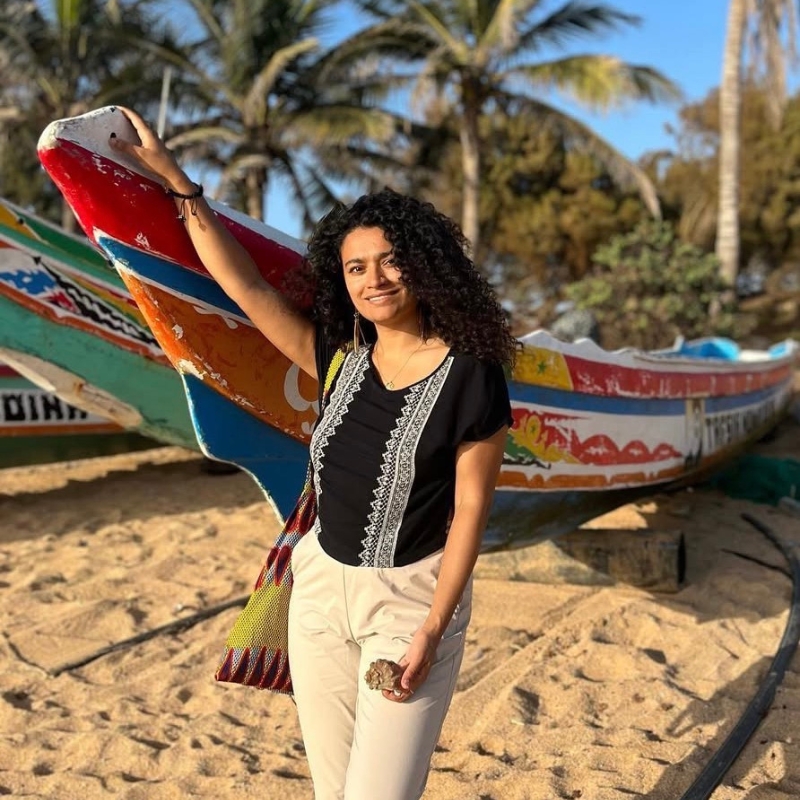
Matt Bowles: My guest today is Priyanka Surio. She is a sustainable and regenerative travel expert, two-time published author and full-time nomad with no base. She holds a Master’s degree in Public Health and has built a 16-year career focused on health, social care, climate action and economic empowerment. Born in Florida to immigrant parents from India and Hungary, her childhood experience with racism and poverty turned her into a lifelong activist and she views travel as a mechanism for activism to safeguard and advocate for a better world. In her books, she breaks down a sustainable travel formula and scorecard to help any traveler begin to intentionally design and assess how they can be more sustainable and regenerative on their travels. She has now traveled to all 50 U.S. states in almost 90 countries on all seven continents.
Priyanka, welcome to the show.
Priyanka Surio: Thank you so much Matt for having me. I’m excited to be here.
Matt Bowles: I am so excited to have you here. I am such a fan of everything that you are up to and super excited to dive into all of that. But let’s just start off by setting the scene and talking about where we are recording from and the fact that we have agreed to make this a wine night. So, let’s also talk about what we are drinking. I am actually in the Blue Ridge Mountains of Asheville; North Carolina and I have just opened a red blend. This is a Grand Reserva from the Rioja region of Spain. So, I’m going to be drinking through that tonight. But where are you Priyanka and what are you drinking?
Priyanka Surio: I am in East Hollywood, in Los Angeles, California on the west coast. And tonight, I’m drinking TÖST. So, a toast to this. And TÖST is actually a non-alcoholic wine beverage that has notes of white tea, ginger and elderberry.
Matt Bowles: I love that. Well, big up to Los Angeles. As you know, I lived in LA for about seven years. It was the last permanent base that I had before I embarked on my digital nomad journey. So, I have tons of love for LA. I would actually love to hear from you though, about Los Angeles. What are some of the things that you love most about spending time in LA, maybe for people that have never been to la?
Priyanka Surio: Well, I’m a cinephile so I love great storytelling, I love the big screen and there is something about watching movies In Los Angeles that just hits different. You have to at least experience it one time if you’re passing through or visiting LA. And so, there’s a larger-than-life energy about the place. Definitely a place where people come to make their dreams come true and to pursue their dreams. And so, the conversations you have here are just multi layered, full of depth, full of character and personality. And it does tend to have a laid back nature as well compared to other parts of the U.S. and of course it’s always sunny in Southern California. That is mostly the case. So, there’s a great weather, there’s great water and there are great vibes all around.
Matt Bowles: Well said. Well, the other thing I thought would be fun to start off with since we are drinking wine, would be to ask you about a wine experience that you have had somewhere around the world. I know you and I have both had many wine experiences in our travels, but what is one that comes to mind for you?
Priyanka Surio: This is a really meaningful one. We traveled to Budapest, Hungary and into the countryside with my mother for the first time in 2019. But it was very special because we finally got to experience her homeland with her there. And as we’re visiting some of our relatives in the countryside, they bring out a bottle of their homegrown palinka. Palinka is fruit wine or fruit brandy. And it is basically where you ferment fruits and water together to make a very delicious but strong alcoholic beverage. And it’s a staple of Hungarian hospitality and celebration. And we call that Egri Szégedi. And so, we got to do this palinka kind of celebration with my mother in Hungary for the first time. She’s not a big drinker, so it was exciting to toast as a family and see her get a little tipsy and very much in her element being back home. And I will never forget that moment. And it was close to Christmas, so the palinka glasses were full.
Matt Bowles: Well, listen, a lot of people don’t know about Eastern European wines or they sleep on Eastern European wines. But when you start to hang out in that region and you start drinking wines from Serbia and Bulgaria and Hungary and all these different types of places, there are some really, really impressive wines from that region and a lot of people do not know about them. So that’s a fun wine region to explore. But I would love to actually use this to talk a little bit about your parents’ origins and their immigrant story. Can you share a little bit more about your mother’s story, where she’s from and also your father, where he’s from and how they eventually immigrated to the United States and how they ended up in Mulberry, Florida.
Priyanka Surio: So, from global origins to local upbringing, Black to global origins, I think, is the thread that we’re going to uncover here with my story. But my mother essentially grew up between Hungary and America. Her father, my grandfather Nejapa, at the time, was exploring opportunities to bring his family there. So, she got a very dual country, global perspective early on. And she still has a lot of stories from her childhood and teenage years in Hungary and also exploring parts of Romania, which is also part of my grandfather’s heritage. So, she felt from the get go, coming to America initially, in her teenage years, in her childhood years, spending time between the two, never really part of one place or the other, and never fully fitting into the American experience either. Even though she was of Eastern European descent, her parents very much steeped her in Hungarian culture. And in that Eastern European culture, she spoke Hungarian growing up. And the foods and dishes that she ate and that she would take to school as her lunch were very much Hungarian dishes.
My father, on the other hand, grew up in southern India in the state of Andhra Pradesh, in a small beach town called Visakhapatnam, which we colloquially call Vizak. And it was a very small town, but it was also a town that was a put town and where the Indian Navy was headquartered. Many of the families there would often join the military in that way and take excursions across the Bay of Bengal. And I’ve come to learn since going back to India about my own Tata or grandfather on that side story of growing up in Burma, Myanmar as well, still something I’m actively exploring. But my father also had his eye on more global perspective and experience. And so, while he grew up in this small town, he definitely had his eye towards the Americas, whether that was Canada or the U.S. he initially got a study abroad scholarship to go to Canada, and then from there wanted to really make a way to America and ended up initially in the Delaware, Pennsylvania area.
My mother at the time was in the Pennsylvania, New Jersey area, and they ended up meeting in college by way of my mother going to the local community college in Philadelphia and my father getting another study abroad scholarship to go there. And that was their story of meeting in the city of Brotherly Love. I was born there, but my parents were young. They had me while they were in college. They were young parents. And my mother’s parents at the time her only family in America. And my father came alone, so he didn’t have family here. My only family in America ended up moving to Florida. And so, my mother really wanted that support for her children that she was having as my mother and father were trying to finish school. So, they ended up moving to Florida. And at the time, Mulberry ended up being the place that was most economical and affordable to them as young parents.
Matt Bowles: So, what was it like for you coming up in Mulberry, Florida? For people that have no idea where that is or what that was like, can you share your experience as a kid, what was the environment like, and what was your upbringing like there?
Priyanka Surio: Mulberry, Florida is in Polk County. It is two hours south of Orlando or Disney World. And that is how most people can recognize this place. But it is indeed a pretty rural and small town. I remember the last census that I looked up maybe captured 4,000 people in the town. And because it was so small, people essentially stayed in that kind of small-town thinking no one really left Mulberry. And we also grew up pretty low income, grew up under the poverty line for most of my childhood, actually, and for quite some time. And so, it was an economically depressed region as well. Most people were just working whatever jobs they could work. A lot of kids grew up in single parent households or in broken homes where the parents got divorced. Unfortunately, that ended up being the case for my story as well when my parents did get divorced a couple years later. And ultimately you just kind of struggled to be able to make it in any way, shape or form. Dreams weren’t necessarily encouraged.
And I think because it was Florida, in general Florida tends to at times and in some places be ignorant. And many people were ignorant about just my cultural mix. There wasn’t a large community of mixed-race immigrant children. There wasn’t a large Daisy community or a Hungarian community. And so, I was the one of one, along with my brothers, where we didn’t really have a community to look to or fit into. And so, I was automatically an outsider. That was one thing. But also, racism was pretty prominent in Florida as well. And based on how I look, how I appear, I would often be grouped as well. You’re not white. Yeah, you talk about Hungary. We don’t know where that is, but maybe. Are you black? Are you Hispanic? So, people will try to categorize me into these boxes. Very early on they would call me the same names that a lot of my black and Hispanic friends would be called as well. A lot of racial slurs. And again, it was that ignorance, but then just also trying to group me in a box because they didn’t understand me. And I think at first that bothered me a lot growing up, and then I didn’t care anymore. And I liked being different, and I leaned into that heavy, and I also leaned into the spaces and the places and the people that did welcome me, that did accept me, that didn’t make me feel bad for being different.
Matt Bowles: So, going back when you were very young and you were coming up in Mulberry, Florida, can you talk about the role of reading and writing and your thought process about wanting to travel or thinking about things that are outside of Florida and having a desire to see and experience, I guess, initially maybe other parts of the U.S. and then ultimately other parts of the world? Where did that come from?
Priyanka Surio: So, one thing my mother tells me is that when I was young and I was a baby, she would read to me often. And she said, I started picking up my first book when I was 2. I don’t know if I was literate enough to read that book, but apparently, I was picking up books and lugging them around at a very young age. And so, I’ll definitely credit her for instilling that love for reading and because of where I grew up. For me, books symbolized this exploration into things that were just not possible, into the outside, into what was more global, and in a way, represented an escape from that depressed environment and economy and just the hard life that we lived. And so, I very much embraced reading, and part of that also instilled my love for writing. So, when I was four years old, I actually wrote my first book. And I wrote a lot as a child, and I would write often these books about children going on adventures all around the world because I couldn’t. And so that was my way to imagine a life where maybe one day I could be traveling and I would have these children essentially go into to all of the farthest places I could think of. And again, it represented that form of escape, but also that form of imagination. And in a way also led to further opportunities down the line where I was able to go to college because of my writing abilities honed so young.
Matt Bowles: So, let’s talk about your early experiences actually getting to leave the state of Florida. I know that you got to go to Atlanta with the marching band. Can you talk about how that came about and then what that experience was like for you during high school?
Priyanka Surio: So, I had a friend, her name is Anna, and she was part of the color guard team in the marching band. And they got to dance, twirl flags and sabers, and it looked really beautiful and really cool. And I learned that she was about to go on a trip to Miami. I hadn’t been anywhere outside of that small town in Florida. So that was exotic and exciting. And I wanted to know how I could be part of this, because I hadn’t heard of any other student clubs or organizations traveling like that. And the reason the band got to travel is because we traveled with the football team. And at the time, our high school, Bartow High School, was doing really well in football and a couple of their sports. So, I looked at it as a ticket to travel and as a way to get out of Mulberry and out of Polk County and see other places. And I had always had that desire and a little bit of that itch to do that, especially because I knew my parents were from other places. And yet it seemed so odd that we were just stuck in Florida.
So, for me, this represented my own chutzpah to get out of Polk County. And I took on a job, actually, at the local, I would say, outlet near my house. I worked at a restaurant. I was waitstaff hostess so that I could pay the fees that you needed to pay to join the band. And then we got to travel to Atlanta because our band was so good during some of the different competitions that would accompany these football games, that we got invited to be part of an MLK Jr. Parade in Atlanta. And I remember that trip so vividly. It was so, so exciting to be able to go on this bus, packed with a bunch of other bandmates, and essentially take that seven, eight-hour trek on bus to the city of Atlanta and experience such a welcomeness and openness towards, I would say culture, towards music, towards creativity. For me, just represented such a bigger and wider expansion of what I had been exposed to and so much fun with the bandmates. We got to perform in this parade. And it also showed me the importance of celebrating as community and celebrating the people who have come before us, who have been lifelong activists, who have championed social and human justice and equity.
Matt Bowles: So, I know you eventually got to go to college in Miami. As you were embarking and going off to college, what at that point was your understanding of racial dynamics, class inequality, and then your immigrant identities, both in terms of your Indian side and your Hungarian side. How had you processed all of that at the time that you were ready to go off to college?
Priyanka Surio: As I mentioned, Florida was a pretty ignorant place and would always try to box me into these certain categories. And so, growing up, I was often welcomed, and you could see me or find me in a lot of the black communities or in a lot of the Hispanic communities, or a mix of both within my neighborhoods, within school, that was my people. That is where I felt welcome. That is where I felt accepted. And it introduced me to what that culture was, whether that was reggaeton culture and the culture of having parents who worked hard but were maybe undocumented and were experiencing the everyday fear of that. And also, for my friends who were African American, experiencing racial profiling, experiencing serious racism, but still finding a sense of pride and a sense of strength through hip-hop, rap, R&B music. And so, I gravitated towards these communities. And what’s interesting is, even though I was not of these ethnic groups, when I would be around these communities, I would also get racially profiled.
So, if we got stopped by police or if someone in the neighborhood was essentially thinking that we were up to no good, drawing on stereotypes, racial profiling, I would also get lumped into that group. I would be called the same kinds of names. I would be considered of that ethnicity, whether that was Hispanic or whether that was black. And I thought that was so interesting because I wasn’t that. And I would say that, oh, I’m not that I’m actually this. And they would kind of wave their hands away. Well, we don’t care. You’re with this group of people. You are of this group of people. And so, I grew up having a lot of similar experiences to that side of America. And in many ways, whenever I did get to meet people of the Indian diaspora who had grown up perhaps in two parent households or who had grown up a little bit better off than I had and or who had grown up in predominantly white neighborhoods, I could not relate with them. I did not have that same kind of understanding or experience. I did not want to be in the white rooms or the white spaces because I had always been in these spaces where I didn’t feel very welcome. I had experienced a lot of racism growing up from a lot of white communities, whether those were adults or children. I think Dr. Anutananath talked about having gum in her hair.
And I had spit in my hair from this white boy named Tyler. I’ll never forget his name. So, if he’s listening to this, he’ll hear this story. But he spit in my hair because he didn’t like my hair. He thought it was too big, too much of a frog. And I felt so ashamed of my hair for so long. And so, we entered this era of me going off to college very much not truly understanding and accepting of myself, but knowing that I’m welcome in some Spaces, not knowing how to connect the Indian diaspora, not really seeing a Hungarian diaspora. And even when I did connect with Hungarians, I don’t look Hungarian. I present. I’m a brown woman with big, thick, curly black hair. So, they often would not know what to make of me. And so, there was this complexity of who am I and who am I going to be now that I’m going off to college, and how can I connect these cultures that are my own, even though I don’t connect right now?
Matt Bowles: What was it like inside the home in terms of the extent to which your parents either did or did not raise you at home with elements of the Hungarian culture and the Indian culture?
Priyanka Surio: So, my father experienced a lot of racism coming to America. And for many years, he was still on a green card. And so, he didn’t have a permanent citizenship. Because of that, he leaned more towards assimilation. And so, we didn’t get to grow up in our Telugu culture or even in much of an Indian culture. He even converted from Hinduism to Christianity. So really deeply trying to immerse and fit in with what America was so that he could stay here, so that he could realize the American dream. So oftentimes, if I wanted to understand what it was like to be Indian, I had to try really hard to understand that in a place that didn’t have that community for my mother’s side, she wanted to introduce more of that Hungarian culture to us. At the same time, because there wasn’t a large Hungarian community either, other than her parents. And because I would tell her, no one’s speaking Hungarian in school, and everyone is telling me that I’m just hungry and starving, they don’t understand Hungary as a country. She fell back a little bit more in that space.
But I think because we had our grandparents there, we still got to have the Hungarian foods. We still got to speak Hungarian with them. We still got to see parts of their culture, and they liked to document their history of how they came here, what life had been like in Hungary and Romania. And so, in many ways, we were more steeped in the Hungarian side and a bit of that Romanian side than we were in the Indian side. And yet, at the same time, my mother was very cautious and wanted to align with my father at the time with, yes, I agree. Maybe assimilation is better right now because of what we’re experiencing, because people don’t understand, and our kids will have a hard time if they don’t assimilate.
Matt Bowles: So eventually you get to university in Miami. Can you talk about how you began reconnecting with your Indian heritage, talk about your sorority that you were involved with, and then ultimately your decision to want to go and study abroad.
Priyanka Surio: So, when I went to Miami for a college visit, the first thing that stood out to me is how diverse University of Miami was. The campus was super diverse. There were people of color everywhere and people were welcoming me. There were several different student organizations that were catered towards multicultural students or those students of the BIPOC ethnic background. And so, I already felt welcome there. I felt at home. It definitely helped that I got a full scholarship. So that was another component to really helping me immerse and embrace this university life. And then from there I noticed that there were so many people who looked Indian and I started making friends and learning about their own Indian experience as being Indian American or maybe even being from the Caribbean. So, I met a lot of Guyanese Trinidadians and they were also talking about how their grandparents or great grandparents were from India. So, all of a sudden, I am having this exposure to a lot of different types of Indians from the diaspora, even some who were immigrants as well.
And I found it all really fascinating. And I made a couple of friends who were female, who are women, and part of their inspiration for being at University of Miami was to found a sorority here. So, there were a couple of different chapters of our sorority across the different Florida schools because apparently there was a thriving diaspora of Indians across Florida that I did not know about. And they essentially tapped me because I had been very involved my first year as a freshman in different student organizations. They thought I would be a good addition to the sorority. And we ended up being part of this multi-year effort to find found Delta Phi Omega, which is a South Asian based sorority on our campus. Essentially, we were the founding mothers and then we were also tapped to recruit additional classes after us to build this sense of Indian sisterhood on campus as well as other South Asian groups as well. We had some folks who were from the Caribbean in that mix too. And it was a beautiful thing.
I think I learned so much more than I’d ever even been exposed to. Just being part of the sorority and having friends who were of the Indian diaspora and things that I hadn’t grown up with. And it was both a rejoice moment, a rejoicing of being reconnected, but also a bit uncomfortable, a bit of this loss of I never got to have that experience and there’s so much I don’t understand. And in many ways, some of my Indian friends would be like, oh, you’re really disconnected. Like you don’t understand these things or you don’t know your language. So many times, I would feel at a loss as well in these spaces, which in many ways made me want to explore even further on my own, reconnecting and wanting to go to India. And essentially, I decided to study abroad in India. It was my first time going to India as well.
Matt Bowles: So, let’s definitely talk about that in terms of the decision to want to go. If you can think back to before you actually went and got there, what were you hoping for from the trip? What were you thinking it might be like, why did you really want to go? And then share a little bit about the trip. Where were you based? What did you do, and what were the highlights that you actually experienced when you were there?
Priyanka Surio: India is forever a special place in my heart. And that trip really opened that up for me. And there were two reasons why I wanted to go. First was definitely to reconnect with my Indian side, with my Indian culture, which with what it meant to be Indian, and even to perhaps accumulate some of that language that I didn’t have, and some of the language, both in terms of the actual languages spoken in India, but also the language of the culture. There were so many things that within India, for those who don’t know, the culture is deeply tied and connected to the spirituality, into the religion. And so, there were so many things not growing up Hindu that I just didn’t understand. And I wanted to be able to understand better. So that was my first reason for wanting to go to reconnect.
But the second reason was a much higher task for me. I did not have family in India. When my dad moved out of India, his siblings shortly came to different countries and also left. They grew up in a very traumatic environment as well, and they lost their parents pretty young. And so, I understand why they left and why there weren’t these happy memories for them. But for me, not having family there also made it equally important. Can I build a sense of community here? Would I be able to come back in the future? The way that I have now learned from many of my Indian diaspora friends, they go back often. So, can I have that too? Even though I don’t have it now, can I build that myself? Very much of my journey is trailblazing, and that was very much the intention behind that second reason. Can I trailblaze a path to India and a place for me there? And can I be welcomed?
And then the trip to India was amazing. So, a big shout out to the State Department for funding that trip, I actually applied to the Gilman. It is very similar to some of the other scholarships like the Fulbright. And so, I applied, talking about these two reasons within my essays ended up being able to go. This was my third year when I was a junior in college and I went during the summer. So, I got to be in India for about four months in the summer, mind you. So, I remember so many people telling me, you’re probably not going to enjoy yourself because it’s monsoon season, it’s super-hot. And my response was, well, I grew up in Florida and I love the outdoors, so I will be just fine. And it’s India I’m going to go no matter what the season.
So, I ended up going. And immediately getting off the plane, I was hit with a thousand smells. And they were so overwhelming, but it was so distinct, extinct, not ever having understood that or experienced it or heard about it, that I embraced it. I loved it. I was like, okay, all these smells and some of them are bad and some of them are great and I just love it. It’s this land of a thousand senses. And essentially, I went through this program called India Studies Abroad and it was part of their cultural immersion project. So, they had us initially go to the Golden Triangle, which was Delhi, Agra, Jaipur, and we got to learn a little bit more about the history of India thousands of years back. We got to see a lot of palaces and grand temples that had been built and of course experience India traffic because we were driving to all these different places. And also experience the Indian Railway. Again, this is a study abroad program. So, our student leader, he was a grad student. This was very much budget travel for sure, before I even knew what that was. And we got to really see that rawness of India.
And then from there we ended up taking a flight to Hyderabad, which at the time was part of Andhra Pradesh, now it’s Telangana. But I was really excited because I knew my family was from Andhra Pradesh. And that was part of the reason why I chose this program because I knew it would be in that region in South India. And I wanted to deeply immerse in South India. And I studied at the University of Hyderabad and I got to take classes on culture, on the caste system and breaking that, and on Hindi language as well. And we had so many amazing teachers. We had a Dalit teacher who was from the northeast region of India, very close to Tibet. We had a gay activist professor as well who talked a lot about challenging the caste system because he was Brahmin as well. So, he talked a lot about how he represented not fitting within the boxes of the caste system and, and causing a riot because of his own identity. And then we also had a professor, the professor who taught Hindi. She was part of this effort of teaching a lot of migrant children at the time, Hindi and English, which was very interesting.
And she introduced us to another professor called Bhavani Abhimulam. She has passed away since then, but she was very active in this kind of social justice, social impact work. And she took a couple of the study abroad students who were interested in that to this school which was very much a makeshift school made of leftover materials from the parents who were working to do architecture and building out the university and building out other parts of Hyderabad. It was very much this makeshift school and basically it was a daycare for the parents, like, okay, great, my child can be here. But for the teachers it was very much about teaching them different things, teaching them skills for fundraising for them. And so, I got to have a very unique experience in India, studying about the culture, learning the language and giving back and lots at the tone for, I think every travel after that.
Matt Bowles: That is so amazing. I love that. So, you come back to the U.S. after that experience, you eventually move to Washington D.C. you and I have both spent a lot of time and have a lot of love for Washington D.C. I would love to hear a little bit about your experience in D.C. what you loved about it. I know one of the things that we share is a particular appreciation for the Ethiopian people and food and culture. And if anybody doesn’t know, Washington D.C. has the highest concentration of Ethiopian immigrants of any city in the United States. So, if you go there and you live there, you will immediately pay be immersed in that. So, I would love to hear a little bit about what your experience was like moving to D.C. and then also what your connection was like with the Ethiopian immigrant community there.
Priyanka Surio: Coming from Central Florida to Miami, that was the first culture shock. And then going to India was the second. Going to D.C. was the third. And it was on an even greater scale because of the fact that Washington D.C. being the capital of America, being this international hub of sorts of attracted so many people from all around the world, including Ethiopians. And I got to be exposed to all kinds of people, all kinds of immigrants actually who were mixed or who were balancing this multi layered identity. And I felt that I fit in. In addition to that having been exposed to social impact work in India and also orienting my own college career towards public health and towards social impact, I ended up in D.C. for that reason as well. I was very much an idealist. I wanted to change the world. I thought D.C. Is the place to do that. I had been able to do an internship while I was in college in D.C. and part of that was through the mentors who encouraged me to do that, because they saw that I had passion. They saw that I wanted to change the world. They saw that I deeply understood some of the injustices from my own upbringing.
So, they very much pushed for me to go to D.C. and so I end up in D.C. and. And I have this large international group of friends. And at the time, a lot of the work that I did was around policy work and working with congressional members, but a lot of the staffers were also Ethiopians. And so, I made a couple of good friends in that. And they told me all about the great Ethiopian restaurants across D.C. and so I got to sample the Ethiopian food. And in my mind, as I got to have the injera bread with all of the different dishes that you have, with some lentils, with some collard greens, with the spicy salad, Ethiopian food immediately reminded me of the Indian thali, which is also similar, where you have breads and you have all your different curries.
And so, I saw these similarities, and I would tell my Ethiopian friends, this is just like Indian food, and your spice is on point. And I came to love Ethiopian food because of that and develop even deeper bonds with my Ethiopian friends. So, in the back of my mind, I thought, one day I will have to visit Ethiopia. In that time, I also learned a little something about the origins of humanity. And I learned that one of the oldest, if not the oldest, human skeleton was found in Ethiopia, called Lucy. That also intrigued me. Again, as someone who knew my parents were from other places, who knew that I wanted to have this more global experience in my life, not yet knowing how, but also being intrigued by history, by culture. That in particular, made me even more so. Want to go to Ethiopia?
Matt Bowles: Priyanka, we have to talk about your very first trip to the continent of Africa. You and I both have a deep love for the continent, but your first trip was to Ethiopia, which is a country that I have not yet been to. So, I am curious to hear both your first impressions of the continent, but then also what was your experience like in Ethiopia?
Priyanka Surio: Ethiopia was a feast for just learning, for understanding. And in many ways, when I first got off that plane, it also reminded me of India, because I saw so many people kind of hustling, and I smelled all of the smells. And at the same time, I went to Ethiopia in 2014. So not a lot of people had gone unless you were Ethiopian. And I only gone with some recommendations from some of my friends, but I very much was going not with them. So, it was a bit of an experiment. Could I be here? What would it be like? And there were definitely some adjustments of trying to get around and trying to understand. And I ended up staying at a hotel that was actually close to the University of Addis Ababa. I was in the capital, and the hotel staff were so generous and so kind. The hotel owner, Giram, he invited me to enjoy some Tej, which is honey wine, and to basically overlook all of Ethiopia, all of Addis, from the rooftop of the hotel, and even gave me some extra Tej, all for free.
Just inviting me to experience this and to share his story about why he loved Ethiopia so much. And that set the tone off, right? So, then I leaned on him and his staff to help me navigate the country. They put me in touch with a couple of different tour guides with drivers, people that they knew would know about these places. I wouldn’t say that they were any official tour guides or anything of that matter. It was much more grassroots. And Gueram had a friend who drives and who has people out in the valley. And so, it was very much that organic more of the travel that you get when you’re just literally backpacking and just going with no agenda and no plan. And it very much leaned into that for me. The reason I chose that place is because I wanted to go to the museum to see Lucy, and that was mainly the thing I knew about. And then the university, I’d heard, also had some really cool artifacts in their own museum. So that was the only thing I knew. Okay, I’ll steep into history. That’s what I’ll do. But then through my connections and through my openness, really, to connect with the hotel owner and the different recommendations he gave me, I got to see much more. And he actually connected me with a female driver, which I thought was so badass, because so much of the tourism industry is sometimes dominated by males, or even when you’re in these different countries, it’s a male tour guide.
So, the fact that I had a female tour guide was extra meaningful. The feminist in me loved it. I loved that she was giving her own flavor and take on different things. And from Bill, I got to see the Blue Nile Gorge. I got to visit a couple of other areas nearby, some of the hut houses as well. And we got to go inside because, again, the driver had these connections. So, she asked if I could go in and see and talk to the families there. And even though they didn’t know English, they knew Amharic, which is their language. We communicated in a bit of that sign language, gesturing, smiling. And I learned this really beautiful phrase. And I would say it encapsulates just Ethiopia in general, which means your country is beautiful. And for me, that being the first place in Africa and seeing so much green and desert and city and so many people and just different types of living, it was all beautiful to me, and it made me definitely want to return.
Matt Bowles: Well, we almost crossed paths because in 2014, I was living in Cairo, Egypt. And Cairo, of course, is a very short, direct flight to Addis in Ethiopia. And I did travel around the region that year, and Addis was one of the places I almost went there. And then I ended up not going because I went somewhere else. And so, we were on the continent at the same time in 2014, and not too far from each other, but we did not cross paths. However, Fast forward to 2022. You and I were at Detty December in Accra in Ghana, at the same time we saw Burna Boy perform. Can you take us back there? Your first time in Ghana, 2022. What was your reason for choosing, of all places, to go to Ghana? Give a little background on the context there. And then what was the experience like in Ghana in December, in 2022?
Priyanka Surio: Well, since you mentioned Burna Boy, first thing that pops in my head is the anthem on the continent at the time, which was Last Last, his song. And really, it’s an invitation to live like it’s your last, to live life to the fullest. And that was certainly manifest in all of the energy that surrounds Detty December across the continent, but which is definitely prominent in West Africa. And so, for me, it was very much an embracing of that and an embracing of being on the continent again, being in this celebratory, joyous mode and energy and around joyous people, by the way, I feel that way all the time when I’m in Africa, anywhere, any country, I feel welcomed. I feel like there’s true joy that I can see and that I can experience. It’s a tangible thing.
So, what made me want to go to Ghana in particular? I had talked about it in my first book when I was talking about navigating different cultural complexities. And in my research, I learned about Ghana’s campaign for the year of the return. And I thought it was quite interesting that they were opening up their doors to the Diaspora, essentially anyone of African descent, you could be African American, you could be British African, you could be Francophone, you could be from somewhere else, but inviting them to come and experience Ghana and connect to their roots. And I thought this is such a beautiful and poignant blueprint for any diaspora. I wanted to learn more, especially because I had experienced my own Indian diaspora ness in college. And I also wanted to play a role connecting the Indian Diaspora a little bit more because we were also very disconnected and spread out in many different parts of the world. And so, I looked at this as an opportunity to do a little bit of that travel research is what I call it.
And I went to Accra and I also wanted to make connections. My intention was to be able to connect with different people. I have to say, even before I went there, I had a couple friends who had gone to the Year of the Return. I ended up going to the beyond the Year of the Return. So, they closed for a brief period during COVID 2022. They opened back up with this beyond the Year of the Return, which I thought was also, again, very brilliant marketing. And this time it seemed to be even more of an openness to not just those of the diaspora, but friends of the Diaspora, people who want to experience Ghana and what it’s doing and positioning itself as the center, center point of the world. And that’s really what that year was about. So, I wanted to experience that. And I had a couple friends who had gone to year of the return in 2019 and connected me to a couple of groups and people within Accra and within West Africa. And that helped, I would say, in many ways, ease my transition to come. It made me feel comfortable. It made me feel like I already had some people maybe I could connect with. I could ask questions of these different WhatsApp groups.
And there were also events that they were hosting so I could meet people. And my impressions when I first got there is that everyone is indeed very open. They’re open to making friends, they’re open to making connections. I networked like crazy during Detty December in a very fun way, though. We’re not talking about conference networking; we’re talking about organic. What brings you here? What’s your background? And I made friends who were both of the diaspora, both African Diaspora, as well as Ghanaian Diaspora, as well as. And Ghanaians too. So, Ghanaians were also interested in what was going on and wanting to play a role. And so, I actually have two communities of friends now when I do return to Accra, and I’ve been five times now. So clearly that first introduction was enough to get me going, I think, every year since that time.
And so, I have friends who are Ghanaian, and really, they know Ghana like the back of their hand. They grew up there their whole lives. And then friends who are of the diaspora learning how to integrate and how to play this bridging role between their home countries or where they were born, and now Ghana as well. And I think beyond that, gosh, I mean, daily December is not the only thing about Ghana. So, the only thing I would say is that if you’re interested in going, it definitely can be a very fun time. But Ghana is lit the whole year. There are pockets of it. You will still have fun in the middle of July, which is their winter, when it actually gets a light breeze and you’re not sweating, but you actually experience moments of vibrancy and of culture and of celebration, even without it being December.
Matt Bowles: 100%. And as you know, my first time going there, I went for a month, and it was actually the month of July in Accra, and that was back in 2019, which was absolutely amazing. And then I came back for dead to December in 2022 and saw not just Burna Boy, but everybody else. I mean, that was an unbelievable lineup that they had that year. And it was just such a special and amazing time to be there. So that’s so dope that we were both there at the same time. You had mentioned, though, that you were curious about studying and learning what they were doing in terms of the reconnection of the diaspora and what could be taken from that and potentially applied elsewhere. So, I am curious about what you took from that and how that impacted you.
Priyanka Surio: Well, first, like I said, there was this openness. And in Twi, which is the main language there in Accra, they call it Akwaaba, which is welcome. And there’s this welcoming energy. And so, part of it was like, even if you’re different, even if you grew up different, we’re welcoming you. And there were certain spaces and places where there was this invitation for those who were Ghanaian and those who were of the diaspora to share their artistry. So, there were a lot of different creative events, whether it was poetry, whether it was music, whether it was cultural dance and songs. I actually experienced Amapiano live for the first time there as well. So, I’d always heard it in music and different things, like in the digital world, but in the real world, to actually experience Amapiano was something else. And it really takes from nature’s sounds.
So, you got all of these different sounds mimicking animals and understanding the deep connection to Earth and to people. And I also was very intrigued by that. As someone who cares about social impact, as someone who is more sustainable and regenerative oriented, I found that the way that they express their culture was homage to that. And in many ways, I think we all work learning, and I think part of that was understanding that this is very much a learning experience for everybody. So sometimes if there was someone from the diaspora sharing some kind of cultural norm or how they do things or how they speak, or the music they listen to, you would get a Ghanaian either loving it or being really confused about it. Especially when it came to hip hop, they’re like, this is an interesting sound. I’m trying to understand. The words are very fast.
And then on the flip side, you would have people of the diaspora trying to understand these different sounds and these different mixtures of music coming together. And it was just very beautiful to witness that. And in my mind, I thought, okay, if I want to do this kind of work across the Indian diaspora, knowing that we are so spread out and that there’s been different integrations, that some people are farther along in integrating than others, some people are more connected to India, some people have mixed things together like in the Caribbean, then part of this is going to be a learning experience on both sides and an openness to learning and an openness to sharing, too. And I think that those were the things that I continue to try to apply to my own travels when I do go to these different places is I’m here to learn, I’m here to listen. I will share. If I’m invited to share, I will also ask them to share with me. And it’s going to be this thing that we’re building together as we’re bringing the threads of the diaspora together.
Matt Bowles: I’m super curious to hear some of your reflections on those different threads of the diaspora, because I know you’ve been around the world to visit your relatives in places like the UAE or Canada, but you’ve also been to a lot of different countries around the world, former British colonies that have substantial desi diaspora communities there. But a lot of those I know are quite different in terms of the dynamics from West Africa to East Africa to Mauritius to Fiji to the Caribbean and so forth. And I would love to just hear any thoughts or reflections on those different threads of the diaspora and how you’ve engaged or experienced that with the lens that you. You bring.
Priyanka Surio: So, you mentioned a lot of places there, and that’s right. Indians have been in and are in a lot of places around the world now. And some of that is by choice. Immigrants choosing to go to places for a better life, to maybe escape something, whether that’s war, poverty, or trauma. And others are where they are because some Indians were essentially taken from a lot of the southern regions to East Africa and also to some parts of the Pacific or where they had to go because they owed money. And so, there was a bit of that indentured servitude as well. And then another component of Indians was taken to South America and to the Caribbean. And so, you have these different pockets of why people have moved outside of India. And I think because of that, they have different and very layered experiences. And I find that it’s still very siloed.
So, Indians that I may meet in America and in Europe have gone there of choice, usually because they want a better opportunity for work, and they view the Western world as the pinnacle of success. And if you’ve worked there, you have. This is a state status symbol. Well, from India itself that you’ve gone there, you have this kind of status that you’re bringing with you now. I will say, though, when I went to London and I was living in London for a summer, definitely some of the best Indian food was there and some of the best chai was there. And I had only experienced that in a couple places in America. So not everywhere, but everywhere in the U.K. it seemed like you get a good Indian food, meal, chai, whatever. And I think that that is because there’s been so many Indians that have migrated and moved there. And it was really refreshing to see so many Indians. And yet at the same time, I could see similarities between the Indian American experience and the Indian British experience in that, okay, your kind of growing up more British than you are Indian. Was if I met Indians in Mauritius.
Now these Indians very much consider themselves Mauritian. And they were like, yes, I do have this Indian heritage. My grandfather came from India, or my great grandfather lived in India and worked there. But then he had to come over to Mauritius, or he ended up coming over with a group that was migrating over to this land. And now we’re very much Mauritian. At the same time, we also still practice Hinduism and we still eat the loti and we still have the curries. So, I could see certain things remain, even though at this point, their experience was very much about being on this island of Mauritius and what life was like. There and being part of this kind of eastern South African area region and very much integrating into what it meant to be African. But at the same time, they looked very Indian, so they presented Indian. They also asked me, are you from Mauritius? Do you have Mauritian in your bloodline? I’m like, actually, I’m Indian. And that oftentimes was more so part of the conversation, as we look alike. You look like my uncle, you look like my auntie, and you eat the same foods we eat. You have the same love of spice.
So, we found certain similarities in that way and would build off of that. But their experience was a bit more removed because of slavery, because of indentured servitude. I think probably one of the saddest things that I’ve experienced, and I experienced this both in childhood and even till present day, is that some Indians will consider those who are in these other diasporic communities, whether that’s Fiji or Mauritius or in the Caribbean, as not really being Indian. They haven’t really grown up in India. They’re many years removed. They’re more that than they are Indian. And I think that that is, again, the lie that colonization tells us and the damage that’s been done of dividing a community of people into these different places. And so, the work is more important now than ever. And I’m excited to be spearheading trailblazing that. But it’s also hard because when I have these conversations with people in India, they’re like, I’ve never heard this before. I’ve never thought about it quite that way. Or I’ve not quite thought about people in Mauritius or in Fiji or in the Caribbean. I’ve only thought about my cousins who went to America, who went to the U.K..
And so why don’t we give equal credence to the other narratives and the other threads and experiences of the Indian community? And then the last thing I’ll say is that there’s also Indian communities within some of these different places who are from India. So, they’ve also immigrated to perhaps Kenya. I also met, like, an Indian family in Senegal, and they’ve purposefully moved there because there is a bit of that diaspora, maybe from many years ago. And so, they’re looking to also integrate. Oftentimes it’s because it is cheaper to live there. There are more opportunities for them.
Many times, a lot of these individuals are opening up restaurants or specific services around, tailoring or doing specific things like having certain demonstrations, whether it’s art. And so, I find that that’s very Interesting to see, too, because it’s still a little bit in that bubble, and yet they’re also having to integrate and figure out how do I find myself at home both within the Indian diaspora here. If there is one in Senegal, it’s still growing, but also with the Senegalese community. If I’m in Senegal, like, how do I interact and engage with them? And for me, I always integrate with wherever I’m at. Who is here, who is here that is local, who has been here. And then also, if I meet Indians by going to an Indian restaurant, because I love doing that at least once, if I know that it’s in the country, I got to go visit. Also, what’s the Indian experience like here? How is it different? How am I maybe disrupting that too?
Matt Bowles: Yeah. I mean, I’m obviously not Indian by heritage, but I seek out the Indian food in every place that I go. And sometimes I’ll have, like, really interesting stories. Like, I was living in Da Nang, Vietnam, for a month, and I’m looking up Indian restaurants, and I find one, and I go into this Indian restaurant. So, I get into this conversation with the guy that runs the place, and he explains to me that he has the only tandoor oven in the entire city of Da Nang. Now, I didn’t independently verify that, but his claim was, I have the only tandoor oven in the entire city of Da Nang. And the reason I can assertively claim that is because I forget exactly what it was. But there was this whole story about how there was no way to import a tandoor oven to Vietnam for some reason. He had a whole story. He told me about this, and so he had to build a tandoor oven from scratch. And he shows me this picture. He opens his phone, and he shows me the pictures of his construction progress of him building this tandoor oven from scratch in the different phases, and he’s now got it, and he’s the only person that has it because he built it from scratch, and nobody else can import a tandoor oven or something of that effect. I was so enamored and impressed just with the story and with the effort and stuff. And he and I just clicked right away and just had a great time, and he took such good care of me and stuff. So, I was going to that restaurant on a very regular basis in Dang.
Priyanka Surio: Wow. Okay, you have to answer this for me. Do you like it spicy?
Matt Bowles: Of course. And I often have to negotiate my spice level, because if I’m in a place where there is majority white folks and it’s a desi restaurant. They usually do not believe me. And first of all, I ask, where is the chef from? Where in India are they from? And they might be like, oh, the chef is from Punjab, or they’re from, you know, where. I was like, oh, I’ve been to Punjab. I’ve been to Amritsar for Diwali, and I’ll try to build some rapport. I would like the chef to make my food exactly like they do in Punjab, the same way that they make it for his family. I know what the spice level is. I’d like it like that. And they’re like, okay. But I know what they wrote down. I know they wrote down white people spicy. Like, I know they didn’t believe me. And so, then I have to go the next level, and I have to explain. I like my Indian food to make me sweat while I’m eating. And when I describe it that way, they’re like, okay. And then they change it, and then they know that they can actually do it sort of the real way. So, yes, absolutely. I usually have to negotiate that, but for sure, I like it the way they do it in India.
Priyanka Surio: This make you sweat way, that’s the key. You got to make you sweat.
Matt Bowles: That’s it. And actually, when I lived in D.C. for my last few years that I was living there, I lived in a group house, and one of my housemates was Sri Lankan, and two of my housemates were not Sri Lankan, but they had lived in Sri Lanka for one to two years. And one of them was an aspiring chef and had studied Sri Lankan cooking while in Sri Lanka. And so, we would have house dinners. Like, we would rotate who would make dinner for the house, and everybody liked the same spice level. So, the standard was sweat while you’re eating is the spice level standard. But the fact that we had. I mean, the culinary scene people, we got coconuts, like, coconut graters, grading the stuff from scratch. I mean, it was this unbelievable. And so, if I can find a Sri Lankan restaurant, I will always go to a Sri Lankan restaurant. Those are much more difficult to find than an Indian restaurant usually or something. So, if I can find a Sri Lankan restaurant, I will always look for that as well and stuff. But the whole subcontinent, I just have all love for the food there. I’m curious for you, though. I would also love to hear a little bit about your reconnection with your Hungarian heritage. I know you’ve now been to Hungary many, many, many, many times. But I would love to hear a little bit about that journey and what that was like traveling there and reconnecting with your relatives and your Hungarian side.
Priyanka Surio: So, remember, I talked a lot about assimilation growing up. And even though I grew up learning and speaking Hungarian, when I went to school, no one was speaking it, so I didn’t speak it either. And I ended up just not speaking it much. And even when my grandparents would speak it, I would respond mostly in English, so I’d become a bit rusty. And after India, I knew I wanted to visit Hungary as well. For me, it was important that my first trips abroad were going to be to these places where my parents were from, so I could fully understand my place in the world. And so, I was a little nervous, but I had this goal, I’m only going to speak Hungarian, and it could be broken and it could be terrible, but I’m not going to speak a lick of English while I’m there unless a relative is asking me some English word. But I’m going to really lean into that. And I did. And my Hungarian improved tenfold.
So that when I came back, my grandmother was so impressed. And then we just only spoke Hungarian. So that was the first thing is it actually gifted me back my language. And the other thing is that everyone was just so enamored for meeting me the first time. Yes, my relatives had heard about, okay, their relative, my mother, met this Indian man, and their kids look Indian, and they’re brown, but they’re Hungarian. And so, they were all intrigued because I don’t look Hungarian. And even when I’m in major SAG or Hungary, most people do not think I’m a Hungarian. But now that I speak fluently and comfortably and I feel very comfortable on the land, I’m this challenge, in a way, to people’s preconceived notions of what it means to be Hungarian. So, I am part of this, like, very, I would say, minority of Hungarian diaspora. At the same time, was fun for me to share of myself. And they were intrigued by both the Indian side and the American side. Most of my relatives, I think we’ve only had one relative actually from Hungary who visited America. So, most of my relatives had never been. It was new to them, certainly. They’d never even conceptualized what India might be like. And they were endlessly intrigued by how I am this person understanding and speaking Hungarian to them.
I think the other thing that I realized is that my family was from all over Hungary, and that was manifested very differently. So, we have family in Budapest, which is a beautiful and Lovely city is the capital. It is just one of my favorite cities. It’s so walkable and so scenic. And I got to play tourist and go to all of the favorite haunts and bars. There’s a great bar scene in Budapest, so I got to go with some of my relatives and cousins and second cousins out, and we did karaoke nights, and we drank too much palinka, but it was great. And then I understood it’s kind of a part of our culture. You have to pass the palinka test. And so that was a very rowdy group as well, and very fun. And then I go out to some of the neighboring areas, like Szentendre or some of the other areas just on the outskirts of Budapest, even Debrecen, which is a little bit further out. And they’re a little bit more conservative, but they’re very rooted in their culture.
And one of the places my grandmother is from is called Karcag. And before she was dying, she told us that that was a land of the Kun ancestors. And I was really confused about what that meant at the time. But there were always these subtle hints that we came from a lineage of nomads. And a lot of the nomads came from the Mongolia, Kazakh region. And so, there were all these really unique cultural practices and norms. And even Hungarians, who looked also a little different in that region as well. They had more, I would say, East Asian features. And so that was unique to see, too. And then we had family who were out in the country who were farmers, and they were growing their own palinka. They were working on the farm, and. And they were very much closer to the border with Romania.
So, they had stories and memories from being in Romania and from my grandfather during his time there. And that was this old, very mysterious part, because a lot of my grandfather’s relatives had died, and he didn’t talk much about that time. But I got to hear a lot more about that side when I went out to the country, and it was quieter, and it was a little bit more mysterious and a little bit more different. And their Hungarian was even a slightly different dialect, too. And they had different slang than the city folks. Both the city and the country folks, they’re not very connected, so sometimes they’ve met. But when I came there and when I’ve come there, that’s when they meet more, which is very interesting to me. So, they kind of stay in, even in their silos. And so, in many ways, mine and my brother’s presence very much breaks some of these silos. Up like we’re shaking some things up by being Hungarian diasporans.
Matt Bowles: So, I’ve been to Mongolia and I got to meet and hang out with the Mongolian nomads, the OG nomads. And that was such a cool and special experience. Have you gotten to do that?
Priyanka Surio: I have been to the grassland, the Xilamuren Grassland and The Gobi Desert in the eastern part. And we actually share some language. So, I remember the first time I heard them speaking and I was like, that sounds like a Hungarian word. And I asked and it literally was the same word in Hungarian. And I was like, there’s a connection here.
Matt Bowles: What were some of the lessons that you took from interacting with those nomads that we as modern day digital or analog? I guess nomads can apply to our life from people that have been doing it for, for so many generations.
Priyanka Surio: So, like you said, they’re the OG nomads. And I was always intrigued by knowing that some lineage came from there, even if it’s thousands of years ago. So, when I decided to go to Mongolia and I went with one of my brothers, it was this introduction to what nomadic life was. We lived in yurts and it was in November, so it was cold. And they had these old jackets. They were actually from the Soviet era, which is quite interesting. If you ever do spend time in Central Asia and even on the Silk Road, you will learn a little bit more about the Soviet influence and that back and forth. And so, I learned a little bit of that there. But I also got to see the original Great Wall. And it’s not the Great Wall of China that you see in the pictures. It goes out way further into that Mongolian border and at this point it’s not really manned. But our tour guide, Zurigo, he knew all these things. His family had been there for thousands of years, had passed on these traditions and these stories, had seen the Great Wall be built.
And so, I got to learn a lot about that kind of world. And it felt like I was being steeped back into history, not just in the actual story of how these people came to be, but also in how they lived. So, like I said, we were in yurts, we collected cow and horse dung to make fire. We helped dismantle and build certain things that they needed help with on site. And we had to make our beds and we were kind of laying on the ground of the yurt. And it was just a much simpler way of life, but people were so warm. And I think that seeing that simplicity, but seeing how people were truly and genuinely still joyous and happy, had this profound impact on me. And they were not the only nomads I got to experience that life with.
I also got to experience the Berber nomads in the Sahara, and they actually span across a couple of countries. The tour guide that I had at the time, Ali, he was part Algerian, part Moroccan, and he talked a lot about that life in the desert and sometimes how they would go months without connection to the regular world or to Internet and to things like that. And I thought, how can you live like that? But yet they still found ways to enjoy their life in the desert. And you can live, but it’s also very simple. And they showed me a lot about minimalism. They showed me about ingenuity, being resourceful. I mean, they made this device that literally you could plunge into the sand and collect water from. And my mind was blown. And so, I think these two really pivotal experiences very early in my travel career inspired me and stayed with me until I decided to become nomadic. And then I thought back to how these people lived. Simply, they lived very resourcefully. They also lived very sustainably and also lived in community.
Matt Bowles: Yeah, I think the minimalist stuff for me also has been so impactful because when I initially left la, I left with a ridiculous amount of stuff. Like, it was completely absurd how much stuff I was lugging around the planet. But within my first year, I was like, you know what, there’s got to be a better way. And so, I started studying the art of minimalist packing, and I downsized to carry-on luggage only. And so, for over a decade now, all of my physical material possessions that I own fit into carry-on luggage. And for me, that has had such a substantial psychological impact in terms of my choice to focus on experiences and people and relationships as opposed to material objects.
And it really, I find, forces me to remove myself from the materialist consumption that we’re all socialized into, because I literally can’t buy anything because I have no place to put it. If I was to buy a physical object, I would have to take something out of my suitcase and replace it with that in order to have a place for it. Otherwise, I just can’t go shopping. And so that physical restriction from the materialist consumption, I find, just gives me so much more opportunity to focus on experiences and relationships. I’m curious for you how that change and that shift to the minimalist lifestyle has impacted you as a person.
Priyanka Surio: So, I will say that it’s a very sustainable way of being. And as you know, I care deeply about sustainable and regenerative travel. I weave it into my own trips. And so being minimalist is par for the course. But taking a step back, when I was doing my research on what is sustainable travel, one thing I learned is that as a world, as a global society, we’re not living very sustainably, both in the sense of, from our material possessions and our own footprint, but also in the sense of we can’t sustain this lifestyle where we have more and more things, where we have more and more stresses, we’re being more and more productive. I just learned that people burn out. And I think I saw so much of that happen during COVID I also experienced burnout to where that made me lean deeper into, well, what would it mean to not burn out? What would it mean to know what is enough? What would it mean to be happy with what you have? Like, we’re always pursuing something, we’re always trying to understand what it means to be happy. And we think that means more and it doesn’t.
As I started to learn that, I started to realize as I looked around my own apartment and how many things were just really weighing me down. And it was things and it was also people, obligations. I think maybe many of us shed some of those things during the pandemic year. But this was an opportunity for me to really take stock of what is the most important thing to me. And I pulled from a lot of principles, from essentialism, from Marie Kondo, like what still brings you joy, what has brought you joy, now you can pass it on. And so, I infused those into my own practice of let me take stock of everything and see what can I actually downsize, what can I minimize. And I knew at that time I was going to try to be nomadic when it was safe to travel again. And I didn’t have a van and I wasn’t going to purchase a van. I was just really going to start off with what I had at my disposal, which was my Honda Accord four door small car. And I knew that I wouldn’t be able to fit everything and I wasn’t going to pay for storage and I didn’t want to burden family or friends with my things. That’s not fair. I didn’t know when I would be back. I didn’t know how long my nomadic journey would be. I didn’t even want to have a timeline.
So, for me it was like, nope, now is the time for you to minimize radically. And it was a several months process. It was quite emotional actually. So many things came up for me revisiting things, getting rid of things, purging. It is an emotionally exhausting experience. And yet on the other side of that is this feeling of lightness and that you have let go and that you’ve really understood what you prioritize in this life, what does make you happy. You begin to have this clarity. And I think that clarity was so important to embarking on such a grand journey as being a nomad and going to all these places and putting yourself in uncomfortable and unfamiliar situations, which require a lot of bandwidth, mental, emotional, physical even. And I needed to have the bandwidth freed up. I didn’t need to be worrying about the baggage, whether it was physical or emotional.
So, in many ways, that minimalism journey was both a physical and a spiritual, emotional one that allowed me to be able to embrace being nomadic and sustain it for a longer time. And I say that because I often go through purges, actually every six months or so, where I’ve clearly accumulated lots of different things on the travels, and now it’s starting to overflow from my trunk into my backseat. I need to minimize again, or I’ve been in a place for six months and there’s too many things that’s not going to fit my car. And so, at that point, I’m like, okay, let me take stock of everything again. It’s time to do the purge. And it’s kind of like you’re spring cleaning, but it’s also that very cathartic moment again, allowing me to have the bandwidth for the next chapter of their nomadic journey.
Matt Bowles: Alright we are going to pause here and call that the end of Part 1. For direct links to everything we have discussed including all of the ways to find, follow and connect with Priyanka and how to get both of her books, all of that will be liked up in the show notes. And be sure to tune in to the next episode to hear part 2 of my interview with Priyanka Surio.