
INTRO: This is part three of my interview with Taylor Wallace. If you did not yet listen to parts one and two, I highly recommend you go back and do that first because it provides some really important context for this episode. If you have already heard parts one and two, then please enjoy the conclusion of my interview with Taylor Wallace.
Matt Bowles: Taylor, at this point, we have to talk about Skydiving. You have done over 200 jumps all over the world, and I want to start from the very beginning. Can you share the first time you ever jumped out of a plane and maybe even leading up to that, your decision for wanting to try this?
Taylor Wallace: Yeah. I had started dating someone in Brazil, so my boyfriend at that time was already skydiving. He had his license, so ex-military, and he was diving out of a drop zone and which is a town in the state of Rio, but it’s also where their military academy is. And so, the Brazilian equivalent of the Golden Knights. So, the Golden Knights are our U.S. Army’s exhibition skydiving team. Exhibition meaning the things that are citizen facing. So, when they have the military games or a big parade or an event or something. They’re members of the military, but their full-time thing is skydiving. And they also do some testing of gear and things like that. Because there’s a lot of branches of the military that have some component of para-activity, paratroopers and some humanitarian stuff.
So, my boyfriend was jumping out of this drop zone and it happened to be the same drop zone that a lot of the Cometas, which is the Brazilian army’s exhibition team, jumped out of and where they trained. And another Brazilian ism, if you are in the army or any branch of military in Brazil, it is illegal for you to have another job. So, you can’t make money any other way. And so, he’s ex, they’re still actively in the military and two of them are on the Cometas. And so, I was at the drop zone one time just watching him jump. It’s a whole vibe and party. Like on Saturdays and Sundays, whole families come to watch their loved ones jump. Largely because it is so expensive in Brazil in comparison to everything else. It may be a once in a lifetime thing. Of course, there are some wealthy Brazilians, but for a lot of people it’s like something really special. So, they’ll have like seven family members with them. There’s music and food. It’s a whole vibe.
So, I was at the drop zone with him on this one Saturday and he comes up to me, he’s like, do you want to jump? Can I just do that? Can I just throw in a parachute? And he’s like, no, you can’t do that. But Diego has offered to jump you as a tandem. And I was like, wait for how much? He was like, for free. Do you want to jump? So, I kind of had to make a decision in that second because in the U.S. at least at that time when I had like researched it about, I want to do this one day, it was $450. I was like, okay, I don’t think I want to do it that bad. So, to have this opportunity, to have this experience I knew I wanted to do one day, it was too special to pass up. But also, for better or worse, I didn’t have enough time to think that deeply about it nor freak out. Okay, this is happening as I’m getting harnessed and I got the full treatment. So, I’ve got the GoPro.
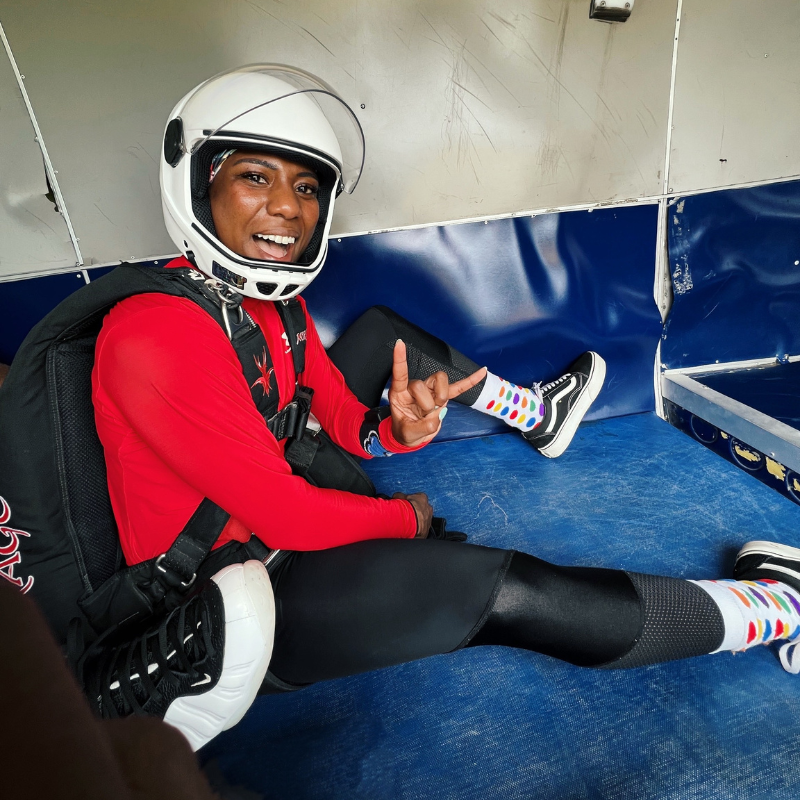
And so, I look back on the pre video of before we jump and he’s like, are you excited? I’m like, I don’t even recognize the person on that camera because the fear was setting in, and my body and everything was. So, you walk to this big plane and the propellers are going, and I’m walking up the steps into the plane, and there’s two benches. So, you sit down, you slide back, and you’re straddling the person in front of you. So, there’s a certain exit order on the jump run as determined by the safety of what each jumper or group is doing. So, there are different disciplines. You’ve got the belly flyers, and for the most part, they fall straight down because they’re either doing certain movements around a particular axis, or maybe they’re fucking around, but they’re still in their belly. So, belly folks fly pretty straight. Then you’ve got free flyers, which is my happy place now. So free flying is any orientation that’s head up or head down.
So, you can imagine that people that are free flying are going to be falling a little bit faster than the folks on their belly. And then you’ve got your wing suiters. So, in addition to the wing suiters, who are, of course, going very far horizontally. So, let’s say there’s two wing suiting groups. They have to, when they’re out of the plane, fly in different headings so they don’t interact in the sky. So, there’s all these things to consider. And ultimately, every time, the last ones out of the plane are the tandems, because they tend to take some time getting out of the door, and that could things up for other jumpers. But it’s fine on a tandem. It’s a lot of factors. So, me and Diego are the last ones on the plane. And I remember as we’re climbing to altitude, I’m watching all the skydivers. So, everyone has their helmet on. Everyone looks at their wrists, and everyone takes their helmet off at, like, a certain time. Then they’re just talking, like, shooting the shit and laughing. One guy’s eating a banana. I’m like, what the fuck? What is going on? And folks are looking at the wrist again, and now they’re putting on their gaiters and their helmets. I’m like, they’re so synchronized. Is there like a screen somewhere that I can’t, see?
And then there’s a light that comes on and its red. And I’m like, oh, no, something wrong? Okay, I guess we have to land. Oh, well, I can’t jump. And then the light turns green and the door comes up, and then people just start disappearing out of the plane like Ninja Turtles. And every time a group jumps, you can feel it on the plane as the weight redistributes. And I’m like, oh, my God, I don’t want to do this. I don’t want to do this. I don’t want to do this. And I thought so hard about just saying, fuck it, let’s ride the plane down. Which is a thing that’s part of how they get you in the plane. Okay, let’s go. We’re going to send it. I know you can do this. Worst case scenario, we land. So at least get on the plane and see how you feel. And so, I knew it was an option. In the back of my mind, I was like, just say it. Say we’re staying. Say we’re staying. But in my mind, I was, dude, I would be so ashamed considering all the effort and consideration that went into giving me this opportunity. After all that, I was, nah, I don’t think I could have lived with myself. So, I was like, fuck it. Okay, this might suck foot. It won’t suck more than the shame I would feel if I didn’t go through this.
And so, the way that tandems exit, I mean, you’re attached to a person like a little joey, like a kangaroo pouch. So, you’re waddling out with a human large backpack on you. And we get to the door, and he was like, you ready? We go in three. One, two. And then at two, he just throws us out of the plane. And I’m like. And then right after that inhale was like, oh, my God, this is so awesome. I think people have this idea, like, I know I did, that skydiving would feel like the massive drop on Superman roller coaster where your stomach is in your throat. You’re like, oh, God, this is horrible, but thrilling, but horrible. And that’s not the case at all. And that’s because when you’re on a roller coaster or jumping out of balloon or something that’s relatively slow, you’re falling into what’s called dead air. So, your velocity and momentum are just gravity, and you feel it versus when you’re jumping from a plane, when you’ve got the speed of the plane and you’re so high, the physical sensation is nothing like a roller coaster. There’s like no nausea or anything. You’re just fucking flying.
And I just remember this is the coolest feeling. I just want to be a bird and never touch the ground. And I mean, it was so awesome. Then he let me steer. It’s like if your parents have ever let you sit on their lap when you’re like, A little human. You’re like, oh, my God, I’m driving. I’m the king of the world. It was like that. And as soon as we landed, I was like, I want to do that again. How do I do that again? And he was like, well, you know, next weekend I will be teaching the AFF class, so that’s probably the best way. And then he laughed, and I was like, cool, sign me up. And so, literally, within a week of my first tandem, I took my AFF, which is your accelerated free fall. And that’s usually, I think, nine hours of ground theory. They gave you this big book, then test you in real time. But I was so excited that I studied the book in advance. So, when we actually got to the class, we were just moving through it quick, because I was just ready.
And so, once you learn the material, you start to get into the mechanics of the movement. And then for each skill, you jump right afterwards to demonstrate that you not only know it, but that you can do it. And so, the very first jump, it’s you and two instructors that are physically holding you. Because when you’re a student, you wear this jumpsuit that’s got all these handles so you can’t fly away. So, you’ve got two instructors holding you. And the whole way down, all you do is check your altitude, practice pool, check your altitude so you’re just touching your beanie, which is what you pull to release your main parachute. And that’s all you do for, like, a minute. And the reason is some people, when they get from the classroom to the sky, they just freak out. And the most important things in skydiving is maintain a safe altitude and pool. Let’s say, literally the ism. So that’s the first jump. And then fast forward. I’m turning left, I’m turning right, I’m doing a 360. And then there’s a jump where they throw you out of the plane and you’re tumbling and falling. And the skill there is showing that you can stabilize from disorientation. That one was fun.
And I cranked through my full AFF, because those jumps are part of that class. And then once you complete your AFF from those eight jumps, because usually it’s eight jumps, unless you’ve been in the tunnel or something. And some people can just rip and show all the skills and, like, two. But after those eight jumps, you have to do supervised jumps until 25. And at 25 jumps, you can take an exam to get your A license. And when you have your A license, you can jump by yourself, but you still have to wear a flight suit. You can’t jump near water. There’s a lot of restrictions, as there should be, because you’re very new jumper, and you need to just focus on being safe, not trying to catch up with other people or anything like that. It’s just safety. After 25 jumps, you’re A license. You keep practicing and maybe you do some coaching or different things like that. 50 jumps, you can take your exam for your B license. In order to get your B license, you have to do a water safety course where they throw you in a pool and you’re under a canopy. And you have to demonstrate that you know how to get from under safely. And it’s not as intuitive as you would think.
So, it’s great that it’s not a theoretical thing that you actually have to do it. You have to know how to pack your own parachute. You have to show that you know how to dock. So, you’ll have two instructors in the sky, and you have to find them and then get to the first one and grip their wrists. And then the two of you go find the other instructor and you do A bind. So, with your B license, you can do a lot of things. That’s when you can jump out of helicopters or hot air balloons or other things that aren’t a typical plane. You can do big ways, which, okay, they’re called zoo dives. And it’s just when a bunch of people are just in the air and you just fly. And maybe there’s one person in the middle with a hula hoop or something, but they can be dangerous, depending on where you are, are. I do make it a point to try to always be the most junior person on any group jump that I do, unless it is specifically geared at helping a lower student learn something, in which case my mindsets totally different.
So, yeah, I technically could test for my C license, but I’m not at all ready. I’ve got a lot of things to clean up. I had a bit of a hard landing in 2023 at a boogie in California. So, a Boogie is basically a skydiving festival. So, it’s over a period of days. A drop zone will bring in different planes, and there’s different themed jumps, and then they have what are called load organizers. So, you’ll have some of the best skydivers in the world or the country, depending on how big the event is, and they’ll have their pictures up. And so, for whatever your discipline is, you could sign up to jump with that person depending on the activity. If it’s angles and they have levels like beginner, intermediate, advanced, and then ninja. And it’s not beginners. Only coach beginners, no matter what. If you’re a load organizer, one day you’re a beginner, one day you’re intermediate, one day you’re advanced, one day you’re ninja. So, you can have a nationally ranked skydiver teaching you basic shit. You’re just so grateful.
So, I was at this boogie in California at one of the larger drop zones. And because it’s a larger drop zone, they have larger classes of students. I don’t know if by design or a fluke, the weekend of this boogie, they graduated 26 students. So, you’ve got all of these people from around the country that have flown in for this event and then sprinkled about. You’ve just got a bunch of folks that have less than 25 jumps. And I was on a particular jump. One of the most important things to not die skydiving is landing safely. I think that’s 95% of all incidents and fatalities. And so, there’s a few fundamental rules to never forget. So, the landing pattern is dictated by the wind. And they’ll have a wind sock or some drop zones will have a big arrow that blows with the wind. And you always want to land into the wind because that is how you fly. A predictable canopy. If you’re with the wind, you may have planned everything out distance wise, but you can think, oh, shit, I’m like moving really fast and crash into something. And I’m very particular. I always fly a very conservative pattern.
So, you’ve got your A point, your B point, your C, and then you land. So, your A, it kind of looks like half of a rectangle or three quarters of a rectangle. So, your A is the longest, and that’s from a thousand feet to 600. So now you’re at point B. And then you turn, depending on different drop zones, like, okay, we’re a left-hand landing pattern or a right hand. So, depending what direction you’re coming in, 1,000 to 600 in one direction, 600 to 300. And that gets you to point C. And then another right turn and you’re landing. So, you always want to land under a level canopy. You always want to look forward and not down at the ground to have better altitude awareness. And under 300ft, you do not turn your canopy because the way the canopy flies, so you got two toggles, and they’re basically controlling two sides of the canopy. So, the way that a turn happens. So, let’s say I want to go right, I’ll pull on my right side. My right side of my parachute will start to dip, and then my left side will correct down to meet the right side. It’s called your correction arc.
So, if you’re below a certain altitude and you try to turn, you will literally slam into the ground. Of the fatalities, landing incidents, 96% of them are low turns. And that’s not just because you don’t know better. There is an entire discipline called swooping, which I think is fucking insane. And the whole point is to maximize as much vertical speed as you come down to the ground so that you can pull your canopy in a way that converts that speed into horizontal drift. And so, you’re literally trying to see how far you can go, and you can do cool moves or a superman, but you’re literally accelerating as fast as you can towards the ground. And so how do you think you learn how to enter a discipline like that? All that is to say in 2024, I don’t know the statistic. For 2025 of the skydiving fatalities, the average number of jumps was 1200 and 10. Meaning for all of the people that died skydiving, all their jump numbers, the average is over a thousand jumps. Meaning the people that were most impacted by unfortunate results were a very high level of skill.
When I saw that, it became very clear that the worst thing that I can become in skydiving is complacent. And there is a very documented process, no matter what the skill is, of the rate of progress. So, whatever you’re starting as a beginner to early intermediate, your rate of progress is the highest. Because everything’s new. You’re learning, you’re asking questions. It’s really accelerated from that early intermediate to, some say, early advanced. But I feel like that’s so relative. Basically, there is this huge chunk, and it’s where the majority of skydivers are, where it’s just the danger zone because you’re no longer a student. So, you don’t necessarily have people going out of their way to be like, hey, you kind of fucked up on that landing here, let me take you into the classroom and tell you what you did wrong and how to fix it. That is the drop zone culture. But when you’re not a student, it becomes, you almost killed everybody. What the fuck? You kind of lose that grace.
And so, I think people stop asking questions because they’re embarrassed. That is not me. Anytime I have A question or a concern or I’m not sure if my heart. I am so humble in the sky. And I think the biggest significance for me is the fact that people ask, so when did the fear pass? When did you stop being afraid of the experience? And my answer is always the same. I’m still afraid. Literally every time I walk to the plane, my stomach is, oh, God. Because sometimes fear is there because it’s supposed to be there. You are doing something that on paper is totally illogical and at odds with every fiber of your evolutionary intelligence of staying alive. But we do it anyway. No matter if it’s skydiving or starting a company or starting a relationship or buying a house. There are all these things that are scary because it’s different, and you don’t know what could happen. But every time I make it out of the plane.
And every jump is awesome. Even if there are unexpected components or creative landing situations. When you land after a jump, your whole body’s like, fuck, yeah. Even if you fucked everything up. If you’re doing a group jump and you’re supposed to grip this person and then fly over here, you do what’s called a dirt dive. So, before you get on the plane, you and whatever group that you’re jumping with, you walk through what formation you’re going to do. And I fuck up the formation probably like three out of every five jumps. But I do it safely. So, if I quirk out or if I lose my heading or something, I know how to move myself so that I’m not a danger to the others as I’m flailing. And then when you get safe, there are certain rules, like you never fly above another skydiver.
So even if your group has left you and they’re now another 500ft under you, you never leave your slot. So, you’re still where you were supposed to be, but just a lot of feet higher. Because when everyone else eventually goes to break off to pull, if you’re over someone else, you. You will naturally track in the same direction. So now you and this other person, this person’s directly under you. So, when they pull, where do you think they’re going to go? And it happens because when you’re doing a group jump and you’re just excited and new people and you want to not fuck up or you want to impress them or whatever, you’re so focused on the jump that you might forget some of the fundamentals of safety. Oh, shit. I haven’t looked at my altimeter 10 seconds. Oh, it’s three, five. Oh, no. And you’ve got an audible altimeter in your ear if you free fly because you’re falling so fast and there’s a lot going on.
And so, you can preset the beeps, like, let, you know, 6,000ft. Okay, our break off for this jump. We’re doing a 5,000 foot break off, so. Okay, beep. Now I know I need to get as far away from everyone as fast as possible. And then 1, 2, 3, 4, 5. After I’ve tracked five seconds away, I’ll wave off, which tells everyone I’m about to pull. And then I pull and I’m like, awesome. Okay, cool, we’re good. I have an additional beep set for 1000 because I get so anxious. So, when you’re just navigating back to the drop zone, it’s so chill, it’s so peaceful. And the quiet in the sky. Oh, clouds. Like, oh, my God, there’s a river over there. I never knew that. And then they’re like, oh, fuck. Okay, let’s toughen up, Taylor. It’s time to land this thing. So, then it gives me that beep, which is like the Pavlov dog of, okay, toughen up, shit’s happening. It’s getting real. And so, I’ll go into my landing pattern because I’m in the process of downsizing.
So different canopies or different sizes, someone’s 200 pounds, they’re going to have a very different need for fabric over their heads. And so, there’s a formula. It’s called your wing load, and it is the ratio of the size of your canopy to your weight. So, my wing load is one because my weight and my canopy are the same size. So, I know my wing load. And I’ve been out of the classroom so long, I think higher wing loads will fly faster under the canopy, and in lower wing loads, they’ll descend slower. So, if you and another person are doing the same type of jump, they will spread your exit order out. So, two people have a very close wing load. You want them as far apart, but if someone’s a 4 and someone else like a 0.5. Oh, they’re going to be on the ground before this person pulls.
It is the most exhilarating and impactful experience that really tests my mind, body connection in a way that’s unlike anything else. When you’re flying, it doesn’t really matter how many benches squats you could do or, like, how many hours you spend in the gym. It’s Just awareness of. Of your body. The slightest movement of your hands or your arms or your leg or even your head will have an impact on where you go and what happens. And so, you have to think about everything, but you can’t overthink anything. And so, your brain just like in this constant flow of. It’s like a pendulum of. Okay, are we good? Checking my altitude. Okay. Woo. Okay, are we good? Checking my altitude. Okay. Hey, friend, I’m coming to you. Are we good? Checking my altitude. So, I love that about skydiving. Not only in the sky, but the community itself.
Matt Bowles: What are some of the most epic places around the world where you have jumped?
Taylor Wallace: Ooh, the first one that comes to mind would for sure be Baja, which is a town south of Rio. And I did this beach boogie there. And so, they had these old-World War II planes that had the wings that you could climb out on and all of these different types of planes that I’ve never seen in my life. And in addition to that, you’re jumping over the ocean. You know, to have the jump run, of course, is over the ocean because you’re landing on the beach. So, you’re already like, this plane’s so cool. Oh, my gosh, I haven’t jumped with this friend in so long. And then the beeping goes and the planes are smaller, so you don’t have 15 people in front of you to. Okay, let’s toughen up. Just the doors open and they’re like, go. I’m like, oh, my God. I don’t even know which direction to land. But it was beautiful. And it was one of those anchor experiences. Oh, my gosh. I did a balloon jump in Turkey, in Cappadocia. And that’s like. You know when you see those iconic photos of. It looks like a different planet and there’s all these balloons on the horizon. But I was there in February.
This is when I was doing that Hustle House in Turkey with my German friends. And I knew that I wanted to do a balloon jump there because once I saw that it was possible, I was like, oh, that’s going to be a once in a lifetime experience. But I was not aware that Cappadocia was at such a high altitude and such a barren part of Turkey. It was in the night; it was so cold. And because I was going to be in Turkey, it wasn’t like I brought any real coats with me. So, me and my friends at the first restroom stop, we had to go in the bathroom and put on our packed clothes because it Was so cold, even in the van, they had the heat on, and just the cold air from outside was just too strong. And so, once again, I was really excited about the jump, and I had done a fair bit of prep, so I felt, okay, I’ve been safe. I know that balloons cannot be steered, so I got to be prepared to be adaptable. If I got to land here, what do I need to consider? I felt like I had done all my research. And so, get on the balloon.
And there’s one company that facilitates skydiving in Cappadocia, but it’s not all they do. So, they’ll have people in the balloon that just want to see the sunrise or that are just passengers. You’re just chilling there with your rig, you know, people asking you questions. I’m like, shh. I need to focus. So, at a certain point, he’s like, okay, go. There was no prep, like, we’re coming up, because I think the winds were changing. I don’t know why, but I literally had to scramble out of the balloon, and it was so fucking cold, it shocked me. And that had never happened before. I jumped in cold weather, but I had me. Like, it makes sense that that happened physically, but I didn’t think it would happen so fast because balloons don’t get to the same altitude as the planes.
You jump from the balloon, and then it’s like basically a hop and pop, which is 5,000ft. You count to three, five if you’re a rebel, and then you pull right away out of the balloon. I’m like, my brain froze. Then I’m like, shit, how many seconds has it been? Doesn’t matter. I’m going to pull. And I was so cold that I didn’t have feeling in my fingers. So, I literally could not feel the hackie. I literally couldn’t feel it. But because I did my practice before I jumped, I knew where it should be. And so, I just trusted that this is where it was. And that shit was another humbling experience, because that was probably the second significant anchor moment that reminded me, you can prepare for every possible variable that you can think of, but there was a whole other bucket of shit that can happen that either would not have been even logical for you to think that it could happen, or it’s one of those unfortunate things where, you know, if it happens, you got to just cut away. There are certain things you can fix, and then if you can’t fix it by a certain altitude, you got to just cut bait and pull your reserve. But in a way, it gives me peace, knowing, okay, I’m jumping with gear that I maintain, with a parachute that I packed. I have controlled anything that goes wrong that can be fixed. I know. I know how to fix it.
Matt Bowles: I have seen video footage of you jumping out of a plane and doing forward flips over and over. Jumping out of the plane. Can you describe that technique and what that feels like?
Taylor Wallace: It’s funny you ask because it’s the exit that maybe looks okay. Gainers are pretty cool, but you need to jump out of a specific plane. A gainer is when someone runs forward and they grab their knees as they flip backwards, and that just looks pretty cool. But flipping out of the plane is actually the easiest exit because you don’t have to account for the relative wind of the plane. You don’t have to think about saying stable and all of these particular things. So, when you have to what’s called floating or something, or you’re doing a jump with other people, it’s like, very important that you are in your spot in the door and that the first person.
So maybe the camera flyer will jump first and then the lead will count it out. But you’re not just blindly jumping towards each other. It’s like, okay, you’re going to be the back floater. This person’s a front floater. The person in the middle is going to move. It’s meticulous. So, yeah, I flip out of a plane if I’m just jumping by myself. And I want to have fun. But knowing how to safely exit in different orientations is one of the most important things, especially for bigger and bigger group jumps.
Matt Bowles: That’s amazing. You did the balloon jump in Cappadocia. That’s incredible. Any other epic scenic global jump somewhere in the world that you just did it and you were like, wow, this is really spectacular.
Taylor Wallace: Skydive Chicago is the second largest drop zone in the U.S. and every summer they have this boogie. It’s called Summerfest. People come from all over the world for this boogie, so it’s huge. You’ve got exceptional load organizers. And because there’s so many people, there’s multiple planes in the air at different times. And if there’s enough people in certain situations, they’ll bring out what’s called the sky van. And that’s a really cool plane where the back just drops out and you just, like, fucking send it. And so, on one of the days, they had a costume jump because the theme of this boogie was Wild Wild West or something. So, if you brought the right costume or you had your props, like Toy guns or a cowboy hat or something. Then they let you go on this jump. So, we’re like two separate sky vans because one group is free flying. I was not skilled enough for that. So, I was like, I’ll hang out with the belly, folks. And then the sky van doors just drop. And then there’s just so many people in the sky because the door drops.
But you’re doing a zoo jump, which means everyone needs to be actually very close together. It’s like you are physically on the person in front of you, because a second delay in the door and you’re just away from everyone. And so that was my first zoo dive. But because this boogie is so special, the skill level is really high. So again, I was maybe one of two people that had under 500 jumps. So, I’m just like, wait for me, guys. Just like, trying to keep up. But it was just so cool to see so many people in the sky. They’ll have the yellow that has the wacky inflatable arm like tube thing, but it’s just like one long column. And so that person’s the axis. Then everyone’s just flying around them and shooting their guns in the sky. I was like, this is so fun. This is what I dreamed it would be like if I stuck it out and kept practicing and training to get to a level where they let me on jumps like this. It was one of those milestone experiences.
Matt Bowles: That’s so amazing. Let me ask you one more question, Taylor, and then we’ll wrap this up and move into The Lightning Round. When you think back now about all of the travel that you’ve done and the experiences you’ve had over the years, what impact do you think all of that has had on you as a person? And why are you so passionate about continuing to travel at this point in your life? What does travel mean to you?
Taylor Wallace: It kind of goes back to skydiving in a way. Doing dangerous things carefully. And it’s not that traveling is inherently dangerous, like someone’s going to kidnap or kill you, but it requires you to get out of your comfort zone in some way or another. Whether it’s a super long, uncomfortable flight or having to figure out how to communicate a new language, or the time zones where you can’t talk to your parents or something regular. Like, there’s always going to be something, some trade off. And it’s learning how to lean into that and reinforce to yourself what you’re made of, if that makes sense. So, it’s always a really special experience when something doesn’t go how I planned, but I’m able to adapt. And the more I travel, the faster and the more strategically I can adapt to setbacks.
And it’s just really cool being able to kind of track the process of. Oh, my gosh. I remember my first trip, I had my phone stolen or something that was, ugh, okay, I’m leaving. I got to go home. I don’t know how I can come back from this. Fast forward to a trip two years later. I was hospitalized with COVID at one point in Brazil. I was in a French hospital in Vietnam for three weeks. And so, it’s just really cool to see how this tracking your personal development progress. Not that it’s all about you. I think it’s really important to think about not only how an environment impacts you, but how you impact that environment. So, I’m very mindful, especially when I go to places where they’re just blatant opportunities to add value, I will consciously think about how I can do that. So, if there’s a nonprofit that’s hosting an open mic night and I see it in some group, I’m like, oh, what are you guys raising money for? Cool. Let me share it with my remote ear community. Or do you need help setting up? It’s just I am looking for ways to give back to the space that has given me these experiences.
And I think that’s a really special part of traveling as well, because it adds a whole other layer to how you connect with an environment or a community. And I have spent my life building these skills and specializations that could, instead of moving a needle from 0 to point 2, it could be a 0 to 20 when utilized the right way. My parents always say you’re blessed to be a blessing. So, you look at all of the fortunate things that you have and have access to, and the fact that you speak English and that you have this education and you know these people. You have so many factors that have come together to give you such knowledge or context or, you know, however you define your blessings. And it’s just such a waste to keep them to yourself. And so, I think that’s something that I think about a good bit.
Matt Bowles: Well, Taylor, I think that is the perfect place to end the main portion of this interview. And at this point, are you ready to move in to the lightning round?
Taylor Wallace: I’m ready.
Matt Bowles: Let’s do it. All right. What is one book that you would recommend that people should read?
Taylor Wallace: The Psychology of Money by Morgan Housel. I think it is essential reading. I think a big thing for a lot of nomads. And this is just based on anecdotal experiences of talking to friends that have tried or successfully repatriated after a long time abroad. America can feel just stupidly expensive unless you’re coming from Europe. The same crest toothbrush in Colombia is 15 cents. And then you come to the U.S. and it’s like $6. It’s just these principal things. I’m like, fuck that. At least for me, I had some learned behavior or stories around value and money and what’s fair. And it was kind of starting to impact my life a little bit. Specifically, you know, moving back to Chicago. And so, my brother actually recommended this book to me when I was just talking to him about my experiences so far. And it was awesome.
Matt Bowles: All right, Taylor, if you could have dinner with any one person that’s currently alive today that you’ve never met, just you and that person for an evening of dinner and conversation, who would you choose?
Taylor Wallace: There is an influencer. Her name is Taryn Delanie. And I think she won Miss New York or something. Maybe that was the origin. And she’s just so funny and not in like a stand up, comic way. It’s like all of the weird things that I think or do in my bathroom or walking down the sidewalk and seeing things, she just finds a way to communicate the ideas in a really funny, creative way. And there’s always been a part of me that wishes I was a bit more creative. I was definitely conditioned in a very like logical engineer’s household. I feel like I’m not good at creativity. And so, to meet someone that I kind of identify with, with a lot of the tangible thoughts and seeing her creative ways of expressing them or teasing them, she’s probably the only influencer I know, unless they’re a skydiver. So, one of my friends will share some of her funnier things in their stories. And that’s how I saw it. I was like, oh, I want to be her friend. So, Taryn, if you’re listening to this, let’s hang out.
Matt Bowles: All right. Knowing everything that you know now, if you could go back in time and give one piece of advice to your 18-year-old self, what would you say to 18-year-old Taylor?
Taylor Wallace: Fail with grace. When I look back at the timeline of 18 to now, there are a few specific experiences or setbacks that I really spent a lot of time ruminating on. Just overthinking and self-criticizing and just changing my whole disposition. The amount of time that I wasted worrying over things that I couldn’t change. I wouldn’t consider myself old now, but now that I’m older, I think I’m more aware of the value of my time. And so, I think if I could tell my younger self, it’s going to be okay, shit’s going to happen, and just let it rock.
Matt Bowles: All right, of all the places that you have now traveled, what are three of your favorite destinations you would most recommend other people should definitely check out.
Taylor Wallace: Brazil, Japan and Thailand.
Matt Bowles: Amazing picks. I have been to all of those multiple, multiple times because I dearly love them as well. All right, last question. What are your top three bucket list destinations? Places you have not yet been highest on your list you’d most love to, see.
Taylor Wallace: I think the first one would be India. It’s. It just fascinates me. I just feel like there’s so much culture there that there’s just so much to learn and see and experience, and there’s just so many different pockets of culture. So, India is high. Morocco is weirdly high, largely because I had the chance to go and all of the advice I got was, don’t go alone. As a woman, you’ll have a better experience if you don’t go alone. And so, when I was in Turkey and I had the opportunity with relative ease, I was like, ah, okay, I’m going to come back. So, it was like one of those places that I told myself I was going to revisit, and I have to honor the things that I say to myself. So, I want to go to Morocco. And then the third place, I think would be Petra in Jordan. I’m not super optimistic with the direction that part of the world is headed. And so, there’s just so much history and things that I would like to see while I can still see them. I feel like it’s one of the few historical wonders of the world that’s still hanging in there. So, I’d really like to get there someday. Maybe someday sooner than later.
Matt Bowles: And do you have a bucket list skydive jump. Either a particular place or a type of jump that you dream about doing someday. What’s at the top of the list?
Taylor Wallace: Maybe it will be the Palm in Dubai. I’ve seen some pretty fun jumps. I have a friend that’s an instructor out there, but I need to get my sea license to do that. And like I said, I’m not rushing that process. So, I guess that makes it a good bucket list because I have some work before I get there, but one day.
Matt Bowles: Absolutely. Well, Taylor, at this point, I want you to let folks know how they can find you, follow you on social media, check out what you’re up to. How do you want people to come into your world?
Taylor Wallace: So, my handle on Instagram is @taylorwallace. And then from my bio, you can see my website or get in touch or contact me in any other way.
Matt Bowles: And we also have a show notes page, so you can also go to themaverickshow.com go to the show notes for this episode, and there you’re going to find direct links to everything we have discussed in this episode, including Taylor’s website and her social media handles and all the other ways to connect with her.
Taylor, this was such a special conversation. Thank you so much for coming on the show.
Taylor Wallace: Thanks for having me.
Matt Bowles: Well, it was amazing to have you, and good night, everybody.