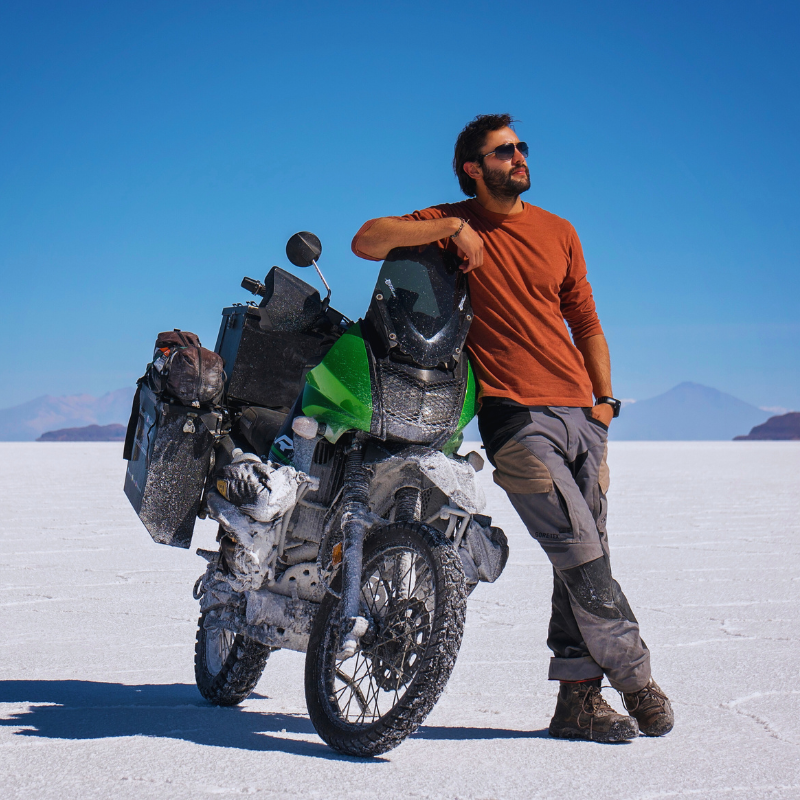
Matt Bowles: My guest today is Alex Chacon. He is a Mexican American motorcycle rider, adventure traveler and Emmy award winning filmmaker. In 2012 he took a break from medical school, sold all his belongings and drove his motorcycle solo from Alaska to Argentina and back in 500 days on an epic travel adventure for charity. He then made a YouTube video about his travels that got over a hundred million views worldwide and landed him on CBS, Fox, MSNBC and CNN. Since then, he has spent time in over a hundred countries on six continents including riding over 250,000 kilometers and crossing 75 borders by motorcycle. He has been featured on Netflix, Discovery Channel and was voted best YouTube travel vlogger. He is also the owner of around the World Unlimited Productions, a creative agency has produced travel lifestyle videos and award-winning short films for brands like Hanes, Ford, Progressive Insurance, PepsiCo, Kawasaki and the tourism agencies of over 20 countries.
Alex, welcome to the show.
Alex Chacon: Hey Matt, thanks for the invitation and great description. It makes me sound a lot cooler than I think I am.
Matt Bowles: Man, you are doing amazing things. I have gone through a lot of your content. I’m super excited to dive into this conversation. We got to give a shout out to Jordan Campbell for introducing us. Anybody has not yet listened to Jordan’s hilarious and amazing episode. We will link that up in the show notes. But big shout out to her for helping to put this together. Let’s just start off, though, by talking about where we are recording from today. I am actually in Rio de Janeiro. And where are you currently?
Alex Chacon: In Las Vegas, Nevada, after spending a whole month in China.
Matt Bowles: Alex, I want to start off talking a little bit about your background, just giving folks a little bit of your backstory. And before we even talk about your backstory, can you share a little bit about where in Mexico your parents are from and then what their experience was like immigrating to the United States?
Alex Chacon: So, my quick story is that I was born and raised in the United States in El Paso, Texas. My mom was also born there, but went to high school in Juarez, Mexico. My dad’s from Mexico City. They kind of met each other on the border in El Paso when they were 18 and I think had me three, four years later. And it was very interesting growing up on the border because I got the best of both worlds, I like to think. I always tell people I have the heart, the soul, and the spirit of the Mexican world, and I have the education, the language, and the business of the American world. I did to go to school in the U.S.
I consider myself an American U.S. citizen, but also a Mexican citizen at some capacity. I like to say half and half when I speak Spanish, people don’t really know where I’m from. When I speak English, sometimes you’ll hear my words get a little funky. So, I always like to think that that’s the reason I started traveling and doing everything is because I never really had an identity. I never had a group of people that I connected with, because I cannot connect with the American people, and I could not connect with the Mexican people. And this is one of the first reasons why I actually traveled and wanted to explore the world was because of that.
Matt Bowles: Can you share a little bit more about what it was like in El Paso? And coming up as a kid, can you talk about the role that soccer played in your life and what life was like there as you came of age with those different identities and just give folks a sense of the dynamics in El Paso in terms of the Mexican immigrant community there and what that’s like.
Alex Chacon: So, I always describe El Paso as the black hole. And most people who are born there stay there. It’s that kind of place where you’re four and a half, almost six hours driving away from anything. You are five hours from Albuquerque, you are nine hours from Austin, Texas, and you are six hours from Phoenix. And if you go south into Chihuahua, you’re four and a half, five hours from Chihuahua. So, it’s one of those places that is living in its own bubble. It’s one of the few Democratic counties in Texas and it’s really sets itself apart.
So, growing up there, you always kind of feel protected from the world and what’s going on a national level. On an international level, the most thing we got there is the Fort Bliss army base. But you don’t really see much, you don’t hear much. You sometimes see a jet here and there. But growing up in El Paso, you’re very sheltered, and I think that’s a big problem, because when you do get out in the world, you are a little too sheltered. It’s very Mexican dominated now. I think 80 to 90% have some sort of Hispanic heritage. When I was growing up, I was a minority. It was 20% Mexican, Latin or Hispanic. And then it was 80% white in that sense. So, it was very interesting. And now it’s the opposite. It’s completely inverted. And that’s what’s happening with the whole melting pot situation around the entire southern United States.
So, growing up there gives you a sense of safety. It’s also rated the safest city in the nation, next to Juarez, Mexico, which at one point was considered the most dangerous city in the world. Not anymore, but you kind of get that extremes of two different worlds, across the Rio Grande, across a river border which separates two very different places. So, growing up there gives you a false sense of things because you’re so much in a bubble. And I’m sure you’ve experienced that in some of your life, Matt. And you’re protected in some things, you’re really well versed in others. But then when you have to hit the real world and meet the real people, it’s shocking, especially at a young age. So, growing up was always that.
And I think one of the interesting outlets I had was soccer. I was fortunate enough to be a tall goalkeeper. I’m a tall Hispanic man, 6 foot 2. So, goalkeeping and long limbs is very useful. And I did very well up to a semiprofessional level. So that kind of got me traveling around the different turbinate to Colorado, to California, to Florida when I was in my young age. And that’s what’s interesting about growing up in El Paso, is that when you were able to escape, you said, wow, there’s things out there that are interesting. And that’s what really sparked at a very young age, my professional travel career that became later on.
Matt Bowles: Can you tell me, when you took your very first motorcycle ride, how old were you and what did it feel like?
Alex Chacon: I must have been two years old. My dad put me on his Honda Shadow, his 1985 Honda Shadow. And I have this picture in my room where he’s putting on the tank and he’s just riding around the neighborhood. And that was the first time I was introduced to motorcycles. I love my dad. Great dad. He never had a dad himself, but he’s done a really great job for all the things. And one of the main life lessons he gave me was a little strong lesson on the motorcycle world, which was when I was 15 years old. He had a Honda CBR1000. That’s a very heavy bike. It’s a very powerful bike. It’s the bike that can kill you if you don’t respect it and you don’t take care of your throttle control, your clutch control, and have some experience on things. So he said, look, I know you want to drive a motorcycle in the state of Texas. You can actually get a license to drive solo at age 15, which is very young.
So, I got my license, but he said, I’m not going to let you get your license until you do this. And I said, what are we doing? He said, we’re taking this giant bike, and you’re taking your dad on the back of it. And at this time, my dad was doing bodybuilding, and he must have weighed 230 to 250 pounds. I mean, he was all muscle. And he says, we’re going to do an uphill. And when I’m saying uphill, like San Francisco uphill situation, where it’s like, if you can do this and not stall the bike and get out of this incline with your dad on the back, the giant bike, then I’ll let you get your license and everything. I’m like, oh, my God, this is intense. So, I did it. I burnt the clutch, obviously, but I got it and I kept everything stable. And after we got out of that situation a few times, he said, all right, cool. You have my blessing. Let’s go get your license. Because if you can do that, you can do anything on the motorcycle.
Matt Bowles: Wow. And when did you first read or watch the movie of the Motorcycle Diaries by Che Guevara?
Alex Chacon: So, this is a very interesting story, and my relation to this thing, because I have no relation to it, but I have a lot of relation to it. Because when I did this whole trip, Alaska to Argentina, I was going to medical school, and I decided to quit. Sold everything I had. My car, my tv, my clothes. I was looking at how much kidneys were worth just that desperate of like, man, I got to get out of here. I can’t do four more years of medical school, plus three years of residency, plus specialty, and then get out of school when I’m 40, and then get out of debt when I’m 45, 50. And by that time I’ll retire at 70 and then I’ll be dead. So that whole concept was like, I don’t know, I need a break before I get into that. And so, I sold everything. I didn’t have a lot of money, obviously, because medical school is very expensive these days.
And I went on this trip and I really thought I would only get to Panama. I was like, cool, I’ll take three weeks, I’ll drive down to Panama. But no, it ended up coming Alaska to Argentina thing. Back and forth, driving. Quite literally, the distance from the Earth to the moon is that amount that I drove on the motorcycle in that year and a half. And I was doing this motorcycle journey and I was blogging every single day on my website. This is how it started. My old website was motorcyclesouthamerica.blogspot.com. it was very long. I didn’t expect anything to come of it later on. I got lucky with a lot of views.
So, I never wanted to be influenced by my motorcycle trip. I was out there to just be myself, not have any connections. I had no cell phone back then. This was 2011 to 2012. Most people don’t know this. I did an entire trip with paper maps. Not a single cell phone. Nothing digital. It was me, paper maps, and navigating myself all the way down to the tip of South America. It was wild. I mean, if you’re not mature after this trip, if you haven’t gathered all these life experiences from this trip, then you did it wrong. Because this is an extreme way to do it. And back then, that’s what I wanted. I also didn’t want to pay a thousand US Dollars back then for a waterproof GPS from Garmin. Then you had to buy all the map packs for $150. And they weren’t that great anyway. I’m like, I don’t have fifteen hundred dollars to spend on the GPS, so I’m just going to buy three hundred worth of paper maps and go down there anyway.
So, this is just my level of how I was trying to do that. So, I decided to not read anything on it. I said, you know what? I have the language, but I don’t have the motorcycle skills. I barely even knew how to change a tire at that time. So, I just took off and I did the whole trip. I got no influence from any books, nothing. I wanted that trip just to be organically mine.
When I got back and I was flying and this whole trip was over, and funny enough, the Motorcycle Diaries film was playing on the airplane. I said, oh, man, I avoided this the entire time. But here we are at the end of my trip. I finished it. I was successful. I did something that most people will never do in their entire life. Out of everyone who starts this trip, only less than 1% actually make it. And I’m like, man, I don’t know if I want to watch this, but I reluctantly sat there and I think it’s one of the first times where I don’t want to say I cried, but basically my eyes just kind of really were just. They were so close. I was like. Because it was so touching, because I just went through a spiritual, life changing experience.
And this film, the idea and concept that someone would sacrifice everything to just follow an idea or a dream of some sort. This person really said, I’m going this way. I’m not looking back. And I don’t know if I’ll ever go back. And that was exactly what I did, which was, I’m going to leave and I don’t even know if I’m coming back. So that’s how I relate to that film. Just the end product and the connection of, okay, I get it. All the scenes. I was, oh, I’ve been there. I was just there. Oh, I did this. Oh, my motorcycle was also broken down over here. Oh, this is so funny. But I was going, eh, quitter. You could have found another way. Yeah, whatever, but different times.
Matt Bowles: Well, it is pretty amazing that you and Che Guevara were both med students. You were both in your early 20s, you both did this route. I mean, it is amazing. And you never saw the film or read the book until after you had finished. And in the film, Che is played by Gael Garcia Bernal, who is Mexican actor as well. So that is pretty amazing. I’m curious though. Leading up to the decision to go on this trip, this was not your first long distance motorcycle trip. And I’m wondering if you can take us a little bit on your motorcycle journey and the progression leading up to this trip. I understand when you were 17, you drove your motorcycle from Texas, California, Canada, Florida. You went across 45 US states in 30 days. Can you share a little bit? Just take us back to being 17. You mentioned you got your license when you were 15. So, you had some motorcycle experience. But at 17 to do a trip of that duration, 15,000 miles or so. What prompted that trip?
Alex Chacon: So, I was dating somebody who was a year older. They had broken up with me in the worst way. I didn’t realize what I was doing until 30 days after is I needed closure and I didn’t know that’s what I was doing. But when I was 17, I needed answers. So, this festered with me my last year in high school. And I just said, it’s been four or five months of torture. I need answers. And I had no money, obviously, so I just had my motorcycle that I purchased with my own money. But I was like, oh man, this is going to be really expensive. I can’t take a bus, I can’t fly. I’m like, how much is gas? And I’m if you know anything about motorcycles, I had a Kawasaki KLR650. It’s a dual sport bike. It’s powerful enough to be on the highway, it can do a little off road, but you can carry a lot of stuff on it. And I’m like, cool. I have a $20 10 from Walmart. I have a leather jacket that I think will be fine and I have ankle high tennis shoes. That’s enough.
So, I drove across the country to go get my closure. I got my closure and it took me five days to get to California where she was at. Got my closure and then I said, well, what do I do now? No reason to go home now. I’m already here. I’m like, I’ll keep going. So, with $500, when I was 17 years old, I drove all those states and I just kept driving, driving because it was my way of healing. It was my journey of, ah, I’m feeling this, I’m, I’m feeling relief, I’m feeling happiness. I’m starting something new. What am I doing here? Am I crazy? And I just was camping at Walmart. Parking lots on the cold hot asphalt. I was drinking milk and eating canned beans the entire time. I luckily didn’t have a single flat tire in 30 days. And all it was paying for was gas and food and I was eating the dollar menu when that used to exist. I was not eating well. I was 17. I was burning calories like crazy. But it was my journey into receiving closure and healing. And after that I was, wow, that was pretty awesome. I might do that again sometime.
Matt Bowles: Were there particular moments on that trip that you can remember where you had that feeling of, I would like to do more of this.
Alex Chacon: I had those moments you see in movies where it’s like, imagine somebody you’re looking in from the back, they have a backpack on, they’re, I don’t know, in Iceland or Finland, and they got the northern lights and they’re just like, whoa. So, all I had was those amazing moments on that trip. And then I also had the moments where I’m like, wow, I’ve been driving 12 hours a day for the last two weeks. I think I’m a little sleep deprived. Maybe I’m going a little crazy. Do I dive into the stress or do I just relax? And then when I got super overwhelmed and stressed with school and everything, I said, oh, my God, I need to escape. And obviously the first thing in my young, inexperienced life and brain tell you is, what have you done before that worked. And I said, that worked. And I said, cool how do we do this a little more interestingly? Cool. Let’s drive down through Mexico in 2011-12, when it was the murder capital of the world. That sounds like a fun idea.
Matt Bowles: Had you spent much time in Mexico when you were growing up, how often would you go to Mexico? Did you have extended family that still lives in Mexico that you would go to visit? How connected with the country were you at that age?
Alex Chacon: Not connected at all. It was basically family functions, reunions, and obviously sheltered, because I’d always go with my parents. I always, never went alone. And then during high school, you can drink in Mexico at 18. So, what people used to do during my high school years, I never drank until I was much, much older. In fact, when I was 31 is when I started having a few beers here and there. And no, I would just go and join in for the crazy adventures of walking across the bridge. People would just get so drunk, and then they would walk back on the Saturday in high school, and then they would try to drive home. So that was the thing at the border growing up in La Paso was you saw a lot of that.
So, no, other than just the border town experience and family coming in and out and going to see family in Acapulco or Cancun or Mexico City or Cuernavaca. Yeah, it was basically, I didn’t know, which is a big reason I’m like, you know what? I also need to know where I’m from, where my parents are from, and how my dad grew up. And I’d only been to two countries at 17, so I kind of need more of that. But then when I was 22 and I did that huge trip, Alaska, Argentina, I was like, cool. Let’s discover Mexico for what it is. And, man, that’s the thing, though. When you travel on the motorcycle, you don’t get the resorts, you don’t get the pampered life, you don’t get taxis. You don’t get all these really nice things when you travel that make things more comfortable. You get eating the food on the side of the road. You get the bad drivers; you get the local people that have never seen a tourist their entire life or in six generations.
One little tribe in Peru saw me because I was taking this goat path on the edge of the Andes, off road, and they saw me with this motorcycle helmet, and I lifted it up and there was this. All this dust that came in. It literally looked like I landed from a spaceship with this giant bike in the middle of nowhere going, who are you and what do you want? Were the first reactions. And they literally said, we have never seen someone not from our community in six generations. And I said, oh, my God. Cool.
Matt Bowles: For Mexico in particular, when you rode on your motorcycle there as an adult and got to immerse and got to spend time there, was. What was that reconnection experience like? How did that impact your identity and your deepening connection with your heritage in the country of Mexico?
Alex Chacon: Well, you hit the nail on the head on that one, Matt. It’s identity. They didn’t have an identity in El Paso because, again, not having a community or a group of people, even though I was in the soccer team, even though I was in the track and field, even though I was in bands, even though I was in the chess club, all these different things, for some reason, I never connected with them. So, connecting with the Mexican heritage that I had was very nice. I said, oh, okay. This is the things my mom says to me, oh, okay. So, this is how you receive people in your home that you’ve never met before. My family did it the same way. Okay. So, it wasn’t just an isolated situation. It was the culture of, hey, how can I help you? Smiling, generally very happy. Happy to receive foreign people, curiosity of other places and cultures.
And that’s the type of people you meet on motorcycle journeys, is you meet the people from the farms, you meet the people that are working on the road. You meet the gas station people that just want to sit there and talk to you the entire time, take selfies with you. You meet those people that are just so interested in knowing who you are and what you’re doing, and so happy to give you candy to talk to you, to help guide you, to tell you how far from this to be careful with that? And hey, if you have time, we’d like to have a beer with you or something. So, I discovered that part of my culture that I didn’t know was so common within the Mexican people.
Matt Bowles: Well, I want to ask you about a range of experiences that you have had now traveling so extensively through Latin America. And I think I want to start by asking you about your experience going through Honduras and ending up in a jail cell. What happened there?
Alex Chacon: Oh, yes. Oh, the juicy stuff. So, there’s corruption everywhere. However, the corruption that you see in Honduras and Central America is a little more on the surface, let’s say. So, in Honduras, I was trying to cross the border. They do a little fun scam there. When you drive through Honduras, you enter through Guatemala or you enter through El Salvador, and then you exit the other side. So you go through two different border places to make some money off the foreigners. What they do, which is so mean, was taught me a great lesson, which helped me on later on in life and other travels, because I caught the mistakes. This one was deliberate. In Honduras, they stamped my passport with the right date but the wrong year.
So by the time I was seven days down the road trying to exit the country, they said, oh, you overstayed your visa by a year. I said, that’s a huge fine. Blah, blah, blah. I’m like, oh, that’s dirty. That’s a dirty trick. So that’s what they do. But we can work something out. You get the little spiel, whatever. And, you know, back then, I was a little, let’s say, naive to how street life goes. And I learned a lot on that trip. And one of them was, when you call out the bribe and you call out the corruption, it doesn’t end well sometimes. And what this one was, I said, I know what you’re doing. I have video evidence. I have a blog. I have geolocations on my SPOT GPS, which is a GPS location tracker for emergencies that I had. And I said, I have absolute, undeniable proof. I have not been in this country for more than a year. I said, this is deliberate. And I said, I heard some stories. I wasn’t sure, but yes, this is corruption. And I said, I will not be paying your bribe, and I need to speak to your boss.
So, what does a little low life do? Puts you in handcuffs, puts you in jail cells and tries to wait you out, and it becomes a little game. Any bribery situation for me on the road with police, with any transit officials, it’s always a game of time. How much time are you willing to lose? And that’s what I learned later on through. Having a situation like this multiple times, it’s just, how much time can you waste? And I’m like, you know what? I got plenty of time today. So, spending six, seven hours in the cell. Eventually I talked to some higher up and I basically talked my way out of it. There were some things that were true and some things that were not true. So basically, I said, look, I have a tour of 30 people coming into the other border, and if you’re doing this to every single one of them, I said, it’s going to turn out really bad for you. I’m politically influenced. You know, my dad ran for justice of the peace at some point in his career, in his life.
So, am I politically influenced? Sure, huge extent of the truth. But I was never lying back then. I was very naive. I hate lying, I don’t do it. But in that case, I was really extending the truth a lot, which is super uncomfortable for me at the time. So, I basically scared him enough to have him let me go, thinking that I did have a tour group coming in and I was politically influenced and blah, blah, blah, they let me go. I had a camera; I recorded all this. I then talked to the Tourism authority of Honduras and I got the whole department fired because I was not putting up with corruption. But you know what, they replace those guys with more corrupt guys and years later, I’m kind of like a big authority on the Latin American motorcycle scene. So, a lot of people reach out to me saying, hey, I’m going, I just saw you did this. Or hey, I know you’ve been through here. So, at some point in my last 15 years, I kind of knew everyone doing a big motorcycle trip from Canada or Alaska, the U.S. down to South America because they would just follow my blog.
And I happen to be on that train of first one to do it on social media. I’m not the first one to do it ever, but. But I’m certainly the first one that published it on social media, YouTube, as extensively as I did. I was really the first one in line to do that, luckily. So, people knew who I was and everybody doing the trip would know. So, they would tell me, hey, you were right, I got the same thing. I’m so glad I read your blog, because they tried doing the same thing to me or I got a few guys going, oh, yeah, they did the same thing to us. They tried to sweat us out. But we just paid them the $50 or the $20 and blah, blah, blah. So, you get all these stories later on. And then they said, oh, yeah, they replaced the guys. And we heard the stories because we crossed that same border you did six months later. But we also got extorted, you know, so did it make a difference? Probably not. What did it make a difference? In my brain, yeah. I stood up for something that I thought was wrong.
Matt Bowles: Well, you also had a serious situation where you were managing a medical emergency on a boat sailing from Panama to Colombia. Can you explain what happened there?
Alex Chacon: Well, there’s a few medical emergencies I’ve dealt with. Saved a few lives. Not sure I saved the guy’s life on the boat, but it was just a really bad bleeding situation where he stepped on coral. So, a backstory is there’s no road from Panama to Colombia. You have the Darien gap, which is 80 miles of the densest rainforest in the world. People have crossed it with vehicles. It’s taken them four to eight months to do it. There’s plenty of broken-down motorcycles, whatever. It’s a very expensive thing to do because you’re just hacking your way through the jungle. So, to transport vehicles, you basically put the motorcycle on a boat and you cross three days over the ocean and you could drop off in Colombia. So, in one of these three-day trips where there’s really no help, you just have little islands off the coast that have a bunch of indigenous tribes of the Kuna people. This guy just sliced his foot open and it hit a really big vein and he was bleeding out.
And basically, nobody knew what to do. And everybody was freaking out. The boat captain didn’t know what to do. Everybody was drunk and doing drugs on the boat, so they were out of their mind. And basically, I had to stop the bleeding and calm everybody down because I didn’t drink and I’ve never done drugs. So, it was a wild experience to kind of be the leader, honest, in a life crisis situation, trying to find the nearest medical facility in a place that you’ve never been to and try to navigate a boat that you’ve never navigated in your life. And it just became a situation where staying calm in a very excitable and crazy not knowing what to do situation where everybody was feeding off each other’s fears and just screaming their heads off. I said, everybody needs to shut up and listen, you know?
So, yeah, managing that was very stressful. But again, it matured me by five years. It matured me in ways that I. I never thought and a lot of this trip did that for me. I like to tell people that when I came back from this trip at 23 years old, I felt like I was 35, 40, with all the experiences that I had. There was another situation in Peru that some guy actually had appendicitis. And we were in a very remote part in Peru, in the Andes, and there’s no medical facilities. And that was a situation where we had to dump his bike, leave his stuff, all his valuables, and I had to strap him onto the back of my motorcycle. I drove six hours through the night on a goat path on the side of the Andes to get him to not even a hospital, to just a vet clinic. And we had to do some horrible surgery and he ended up getting an infection, the whole thing, but we saved his life.
Matt Bowles: That’s amazing, man. Well, you mentioned also that you were navigating this entire trip with old school maps. So, I have to imagine that you got lost once or twice. I understand one of those times though was if in Bolivia.
Alex Chacon: Oh God.
Matt Bowles: Can you share what happened when you got lost in Bolivia?
Alex Chacon: So, here’s the context. In Bolivia, there is a section in the south of the country that everybody goes to, everybody goes to see the Uyuni Salt Flat. Because it’s beautiful. During the dry season, it’s the world’s largest salt flat. During the wet season, it is the world’s largest mirror. Because the water is still, it’s not an ocean where it moves. So, at certain times there is just a complete pane of glass on the floor where the sky paints itself on your feet. And it’s the only place in my life I’ve had an out of body experience. You don’t need drugs and have certain experiences in life and this is one of them. Because when I drove out to the very middle of it, I couldn’t tell where the sky ended. The floor started and I lost my balance and I got vertigo just by standing, looking at absolute infinity. It was crazy. It’s not easy getting here, by the way.
So, this area, there’s no GPS whatsoever. Now there might be something, but back then there was nothing. So only doing paper maps. Usually, you pay a tour to do this. You pay somebody. You go in this vehicle with six other people. You have a guide who’s been doing this his whole life. And they know the tracks, they know the mountains, they know the whole things. But the area is so, so vast. It made no sense for me to pay for a tour one because I don’t want to spend the $150 to do the tour. I also would slow them down because I have to stop to refuel. I need to stop just to relax. I need to stop to eat. I need to stop. So just go, go, go. They drive and you see them just go, you know, 130 kilometers an hour down these volcanic dirt gravel places where there’s a thousand different lanes that you can choose from and if you’ve seen a picture, you’ve ever been, you know what I’m talking about. And you can get easily lost.
So, it was a wet season unfortunately and some sections people don’t drive through because you get stuck. So, I got stuck for two days. It was very frustrating. My bike was very heavy. Obviously, I didn’t have the proper off-road tires. I was carrying a lot of camera gear to record everything. And the thing is that it’s like 350 to 400 miles for any gas. So, I failed multiple times. I tried going, I got lost. I came back four days later to Uyuni and the hotel guy was like, I thought you left. And I said I got stuck for two days and I had no gas and I wasn’t going to make getting to Chile and I just, I had to turn back. He says, oh, okay, well don’t do that again. I’m like, no kidding. So yeah, it took me multiple tries. I failed miserably. All I had was a compass. I had to navigate through some of the most difficult off road that you can imagine when it’s wet, crossing rivers, lakes, running out of gas. I found one of the tour guys luckily that gave me some of his gas. I’ll never do that again now. GPS is so cheap. You got your phone. That doesn’t happen to anybody anymore. But back then that was a whole different animal.
Matt Bowles: Well, I completely agree about the Uyuni Salt Flat being one of the most spectacularly beautiful and amazing places in the world. I recommend Bolivia to people so highly. It just has otherworldly landscape. You really feel like you’re on a different planet. I’ve never seen anything like it. And I have to say you have captured some extraordinary footage on your YouTube channel of the salt flats. And so, we’re going to link that up in the show notes. I want people to go check it out because you’ve got the drone footage from above. I mean you really have some spectacularly beautiful footage of that area.
I also though in Bolivia, I have to ask because when I went to Bolivia I mountain Biked the world’s most dangerous road, which was one of the most special travel days of my life ever. It was one of the most beautiful and incredible and amazing things that I have ever spent a day doing. For people that don’t know, the reason why it’s called the most dangerous road is because there’s a thousand-foot sheer drop off with no guard rail on about a one lane wide road. And back in the day, the cars used to try to pass each other and one would go over the edge and that would be lights out. And so, they used to have hundreds of people dying on the road. Nowadays they have a bypass road. So, it’s mostly just mountain biking guided tours that go down, which is how I went down with a professional guide and it was safe enough for me to do it.
You though, and I have seen your video, you rode your motorcycle on the world’s most dangerous road. Can you share what the experience was like for you and what it felt like riding a motorcycle on that road?
Alex Chacon: The world’s most dangerous road to me is one of the world’s most beautiful roads because you go from very high altitude, fog, cold elevation, and then by the time you get to the bottom of it, you are in a tropical sauna. And then you see the cliffs, you see the views, it’s really quiet a beautiful. So, I’ve actually done this twice now on the motorcycle. And the first time I did it, I learned a very interesting lesson. You never want to start at the bottom and work your way up. Ideally for me, visually, for a motorcycle road trip situation, it’s the best way to experience the road because you go from the jungle, you go to the mountains, you go slower, you don’t burn your brakes, you don’t mess up with your clutch, the whole thing.
However, we have people like you doing the mountain bike thing going downhill that don’t stay on the side of the lane that they should because it’s a very small one lane situation, off road gravel. And most people are looking around, doing their thing, taking the pictures, riding as fast as they can because they think it’s fun and they never expect a motorcycle to be on that road. So, I had to basically dodge the cyclists like that. And I got yelled at by one of the tour guides, whatever. And he said, oh, you got to come down. It’s like number one, 2012, no one told me. Number two, there’s nothing that says I can go up. Number three, there’s no warnings, there’s just, there’s not even a guy with a gate Back then. Now there is. But if you do your mountain biking thing, you can get a really cool shirt that says, I survived the death road, which is the number one selling product that these people have. And let me guess, you got one, right?
Matt Bowles: I have one. Indeed.
Alex Chacon: The marketing gimmick worked. That’s a nice $25 shirt right there.
Matt Bowles: It absolutely worked. Well, I imagine also on a trip of this duration that you also have breakdowns. And I understand that you had a breakdown in Patagonia in Argentina. Can you talk about that experience and what happened?
Alex Chacon: Yeah, so the Patagonia, for those who don’t know, is kind of like saying it’s the Canadian wilderness, you know, or the Colorado Rockies, you know, it’s a giant area. So, the Patagonia is the southern part of Argentina towards the tip of South America. And it’s also in Chile. If you look at a map right now, if you go down south to Chile, the road eventually ends and then you got to cut into Argentina and you have to work your way down south. However, when you go down through Chile in the Patagonia region, you can take boats and you go from peninsula to peninsula to island, and you can work your way down pretty far down, but then eventually you got to cut in. So, I was doing this thing where I was down there and I was in the Argentina side, and I was going from mainland to a peninsula that kind of crosses kind of remote part, because it looked really beautiful. And I said, cool, I’ll do that.
However, the ferries in these areas sometimes run every single day of the week. Sometimes they run three days a week, sometimes they run once a week. I didn’t know this was the whole case until I got there. But in this particular situation, I had taken one that was only doing it maybe three, four times a week. What happened is that the boat broke down and there was nobody for five days. So, my motorcycle. I did this trip to this little peninsula thing and it was maybe like 200, 300 miles to go across the peninsula and get to the other side. And I broke down halfway through, and I was 100 miles from anything. And I knew if I walked, I wouldn’t make it. So, I was stranded for four days without food. All I had was water. And if you know anything about the Patagonians, that’s cold and it’s very, very windy. So, I was dealing with 50 to 60 mile an hour wind gusts all day long. I was freezing my ass off. And it was one of those moments where I thought I would die because nobody had passed on the road. I was the only one on the ferry. And I said, oh, something went wrong here. They should have been here a day ago.
Two days ago, the first day was fun. The second day was concerning the third day that said, this is it. The fourth day. I had one GoPro HD2 back then, a GoPro 2. Imagine there’s like 18 Go Pros now. And that was GoPro Generation 2 that I had. And I filmed a video that I still have but I will never show anyone. I basically said, okay, this is my last video. I’m going to die because I started hallucinating. And I said, oh, okay, this is lack of food. I’m not going to make it. My engine broke down. The oil got so used up because I was fighting a headwind of 60 miles an hour that the engine just seized. So, there was nothing I could do. So, survival situations tell you that you should just stay put unless it’s like, extenuating circumstances. Anyway, so I ran out of food. So, after about two, three days, I started hallucinating and I said, oh, this is bad. And then I was running out of water too. And I’m like, oh, I’m not going to make it. So, I filmed this video saying, this is my information. Mom, Dad, I love you. Make sure you get this to them. This is the situation, blah, blah, blah. And I said my goodbyes and I accepted death in that moment.
And the next day, could barely walk. I know it sounds extreme, but after five days of not eating food and being cold and shivering and trying to burn calories to stay warm and just sitting there, it just, you know, it wasn’t looking good. And I had run out of water. So, I started walking on day five. And within an hour of walking, somebody passed by. And I saw that. I was like, no, that can’t be right. And I just threw myself on the floor and I said, you stop. Just. Just, you’re going to have to stop. You know, you either kill me, run me over, or you stop. So, they stopped and I said, oh, my God, this is my situation. It’s like, oh, the ferry broke down, whatever, cool. And I got rescued. And I had to find a very creative way of getting that motorcycle somewhere and finding parts for it. And I got stranded for a month and a half in Argentina in a little town. And I had to rebuild the entire engine.
And now I know how to rebuild it by hand, almost any motorcycle engine because of that. So, I learned, I adapted. I found a mechanic that helped me and guide me through it and learned a skill, accepted Death. And I know what that feels like. And ever since then, I have set myself free from being afraid of dying. And that was really quiet the experience.
Matt Bowles: Wow. Well, I know that there was also a charity component of this trip. What were some of your most poignant memories of the volunteering that you did and the local, cultural, immersive experiences that you had along the way?
Alex Chacon: So, back in 2011, 2012, when I did this, I would be blogging daily. And I think this is why I had such good success in the past. Starting this journey was because I was doing it every single day. So, every single day, somebody had something to look forward to after their day of work. And like, oh, what? What did Alex do today? Let me see his pictures. And what crazy adventures is he on? So I eventually ran out of money on this trip, and the only reason I was able to finish it was because I started getting followers and subscribers back in 2011 for my blog, and they donated money. So because of the kindness of the followers that I had and family members, I was able to complete the trip, but only by their generosity, because I ran out of money.
So, on my website, I had two things. I had a PayPal for myself. I said, hey, if you enjoy this whatever, and you want to maybe help buy some gas or food, this is the only thing I’m spending on. I’m not spending it on ooze. I’m not spending it on frivolous things. But it’s only for my travel logistics to keep this trip going because I am running low. I was very honest, and people would donate to me at the same time next to it. I said, and I’m kind of making this trip kind of a charity thing. So, if you feel like donating to this specific charity that I had on the website at the time, they could donate there as well. And that was one of the first ways they did it.
Then during the trip, I would go to churches. I would volunteer for half the day. I was a medical translator in some countries. I would help the physically disabled in Colombia, helping them get home. If you know anything about Colombia, is that there’s no infrastructure for people that are disabled, especially those who are on wheelchairs or on crutches when they go home. Imagine San Francisco, the inclination of a hill in San Francisco. Imagine having to go up that in a wheelchair, because there’s no sidewalk, by the way. It’s just a street. And there’s giant stairs that the regular people use that don’t have physical disabilities. And then there’s the people who are basically cutting in a zigzag motion all the way up the hill that sometimes takes them an hour to get home, every single day pushing.
Anyway, so I just found a random guy and I said, hey, are you going all the way up and do you need help? He goes like, yeah, I do this every single day. I’m like, how long does it take and can I help you? And he goes, sure. And so, I pushed him up the entire thing. I got a huge leg workout and a back workout, and I got an education on the challenges that he faced. And I was able to educate people later on and he was able to pass legislation. He was involved in this community, and it was a really cool story. So, then I started helping that community. And then I helped people babysitting and doing other stuff in Argentina to doing some conservation work. And so, I was trying doing different things in different countries. And it was little bits and pieces here and there, and I would do as much as I could. So, it was a website component. It was a physical on the boots, on the ground component. And that was part of that trip.
Matt Bowles: In the Motorcycle Diaries book film by Che Guevara, his motorcycle trip, in addition to being a personal growth journey, his experience also became a moral and political awakening as he was exposed to and immersed in the inequality and injustice that exists across the continent. I’m wondering if you experienced that on your trip and how the trip impacted your worldview.
Alex Chacon: Yeah, I mean, I see this every country. I go, there’s the inequality. There’s not a single place I haven’t been to where I go, oh, wow, India has really amazing people that are really friendly, really nice. Then you look over and there’s the slums, and you look over and there’s the rich neighborhood. Same thing in Brazil where you’re currently at. In Rio de Janeiro, you got the favelas. The richest part of town is next to the poorest part of town. And there’s crime. There are all these horrible things happening in these favelas. And you got these rich homes which they say are owned by the people who have dirty money and they live in harmony because they know they don’t mess with that guy or that that guy’s a big thing, whatever.
So, you see this everywhere you go. It doesn’t matter. It happens on the streets in Guatemala to. I was just in China. Happens in China everywhere. So, this particular trip changed my perspective on a lot of things. It was a social, economic situations, the discrepancies, the political corruption, the on the ground corruption to the nationwide corruption. But here’s one thing I never thought I would learn that really kind of changed my perspective on the world was when you live in a country that is not well educated, that doesn’t have a good medical system, a lot of interesting things can happen. One of them is my first experience to this was in Guatemala, where I saw a guy on the streets of Antigua asking for money. And he had his two feet next to this thing, and they looked like the size of elephant feet. Because he had a condition known as Elephantiasis, which is just the abnormal growth of different parts of your body. And I’m sure you might have seen this in medical books, you might see some documentaries on it. If you watch the network TLC in the United States, you’ll see all these, like, medical mystery things. It’s Elephantiasis, a gigantism. It’s something that your body, it’s like cancer. It may not kill you, but it’s going to cause things in your body to go very wrong.
So, this guy, I started talking to him and I got his life story and I started chatting with him. And I figured out that he was outcasted from his family, from his society, from everyone in this because they didn’t know what he had. They consider him a bad spirit. They considered him not a freak of nature, but they consider him a bad omen. And they didn’t understand that what he had was a medical condition. It was more of a spiritual, religious view of him. So, the one thing I’ve seen around the world consistently in these types of places that live their life strictly on religious ideology or in places that are not well educated for biology is the misunderstanding of other humans, of other situations, of other details. And it was really sad for me they stay away from you because they think you’re contagious. They stay away from you. You’ve lost your network and your family because they consider you a bad, that they don’t understand why you have this and you’re just a bad egg that could affect them. And I said, that’s so sad.
So that was my first experience to something that I never thought I would learn. And that’s something I see all over the world in different capacities and a lot of different derivatives where I feel like it’s my duty. And if you go to my social media, my Instagram that I post all my travels on, I do these little stories, I’m like, hey, this is the situation here. This is what I thought I used to know about it, but this is what I learned by being here and, and your perspective on it should maybe be a little different through somebody who’s actually been here and somebody you’ve watched travel a hundred countries and hopefully somebody who has a little more life experience to things that what I’m saying about this particular situation. Maybe you should reevaluate your thoughts and feelings on it because my ideas and the things that I’ve learned about this particular thing have changed and I hope you’ll look at it differently.
Matt Bowles: All right, we’re going to pause here and call that the end of part one for direct links to everything we have discussed in this episode, including all of the ways to find, follow and connect with Alex and check out his video content and his short films. All of that is going to be in the show notes. So just go to themaverickshow.com and go to the show notes for this episode and be sure to tune in to the next episode to hear the conclusion of my interview with Alex Chacon. Good night, everybody.