Matt Bowles: My guest today is Amena Bakali. She is a travel content creator, speaker and blogger who specializes in Muslim travel, family travel and personal finance. She is also a consultant on award travel who educates her audience on how to optimize points and miles to travel more for less. Born and raised in Dallas, Texas, to immigrant parents from India and Pakistan, she is now a wife and mother of three kids ages 16, 12 and 4. And her 4-year-old has already been to 11 countries.
Amena, welcome to the show.
Amena Bakali: Thank you for having me. What an honor. I really appreciate it. Super excited for our conversation today.
Matt Bowles: I am super excited for our conversation as well. Let’s just start off though by setting the scene and talking about where we are recording from today. I am actually in the Blue Ridge Mountains of Asheville, North Carolina today. And where are you?
Amena Bakali: I am in Dallas, Texas.
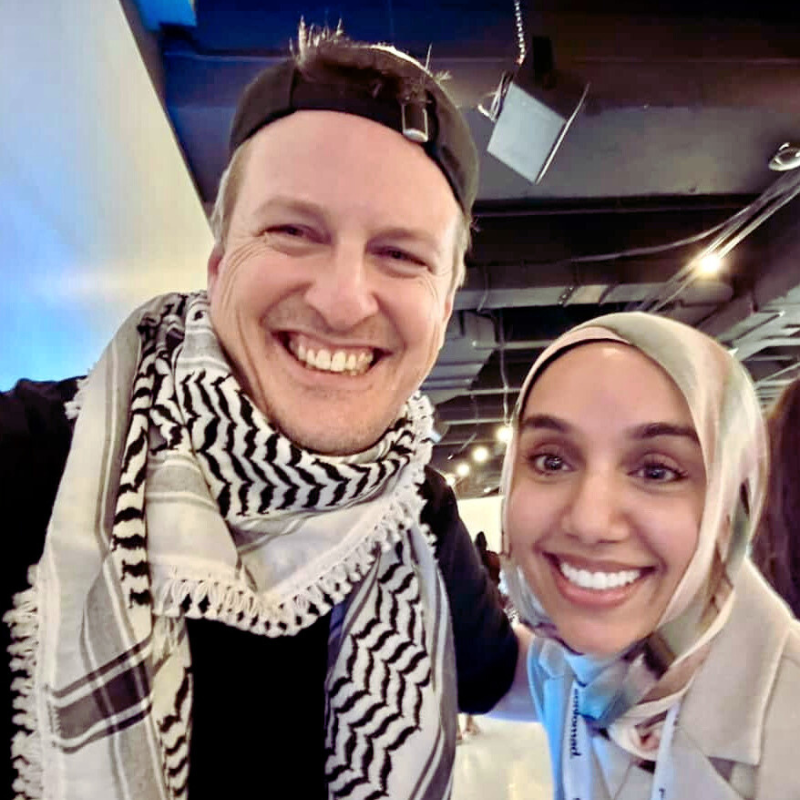
Matt Bowles: Well, I feel like we need to start off this conversation by talking about where and how we met, which was at the WITS Travel Creator Summit in New York City. What are your recollections of how you and I initially connected at WITS?
Amena Bakali: This was my third year for WITS, so I was kind of familiar with how the last afternoon the closing ceremonies go and I just vaguely remember looking up and seeing this white male with a Palestinian flag on his shoulder. And given the times and the circumstances we’re in now, I was like, okay. And I think I was just really excited to see that show of support, number one. And also excited for that afternoon’s sessions that we’re focusing on more mindful travel and speaking up about what’s going on in the world today and how we can use our platforms not Just for what we do in our individual respective spaces of travel, but also more community, more collaboration, and just traveling in a world that’s on fire right now.
Matt Bowles: 100%. And that keynote panel included Maverick show guests like Yulia Denisyuk and Dr. Anu Taranath. And after that panel, we all together, including you, went out for lunch, and we got pizza in New York City. And we got to hang out and debrief what was an incredibly powerful panel that got a standing ovation from 600 people and clearly and passionately and emotionally spoke out against the genocide in Palestine. And was a very emotional panel, both for the people in the audience as well as the panelists themselves. And so, you came with us, and we all went out for lunch and sort of debriefed that panel and spent some quality time together afterwards, which for me was one of the most special moments of the whole conference.
Amena Bakali: Right. And I do remember being in tears before meeting you guys and even afterwards, just to take a deep breath, because while it wasn’t my first travel conference, I haven’t been in this space where they’ve actually talked about this. Right. Listening to some of the stories, it’s different when you hear and experience it in your own community where you grew up. It was just a different experience seeing people and meeting people from all over the U.S. and some even from outside of the US and just hearing your stories about what they may be doing to speak up.
Matt Bowles: Well, I want to talk a little bit about your background. Can you share a little bit about where you grew up? And before you even talk about where you grew up, can you share a little bit about where your parents are from and what their experience was like immigrating to the U.S.
Amena Bakali: My dad is from, so he has family in Hyderabad and Mumbai. And so that’s where he grew up. And that’s where he was there up until his graduate studies. And my mom’s side of the family is from Pakistan, but they did kind of shift over to India as well. So, we have family in Karachi, Pakistan, and Hyderabad and Mumbai. So, my dad immigrated here when he was doing his graduate studies. He did his master’s at Georgia Tech, and after that, got married and has just been in Dallas, Texas, since then. So, my parents got married, they settled here. I was born and raised in Dallas, Texas. That is home. Always lived here. And I remember growing up. It’s interesting now, being a parent, I find myself saying the same things that my parents would tell me, except we grew up way more privileged than they did. And our kids are growing up way more privileged than we did.
And I remember my dad telling us stories about how literally he was one of five kids and he studied by candlelight. And we’re like, what? Whatever, you know. And I remember thinking like that. He literally taught us the importance of work ethic and hard work. My aunt was here in the summer visiting from India and some of the stories you would hear, he’s like, I would beat my siblings to get them to study by candlelight because you don’t know what opportunities we have available. And I remember hearing that growing up. And again, we didn’t go back home every summer or every few years. We didn’t have any of that to relate to, if that makes sense. But that’s how he grew up.
Matt Bowles: So, can you talk a little bit now about your experience growing up in Texas and navigating your Desi immigrant home life and community experience and coming up in the U.S. and how you navigated those identities?
Amena Bakali: As we were growing up, we were straddling this—we’re Muslim, but then we’re also half Indian, half Pakistani, but we’re American. We resonated more with our American identity. But my grandmother lived with us at home. And if there’s any one person who’s going to try to instill still that culture, you, it’s going to be a grandparent who doesn’t understand how to relate to a 16-year-old or a 17-year-old who has never really been back, who doesn’t have a country to relate to or go back to, even though that’s where they’re originally from. And it’s interesting because 911 happened when I was a senior in high school. So, I think I grew up in a world where my fate was being attacked. It was scary. My dad did a lot of volunteer work in the community. He worked with organizations that spoke up for Gaza, for Palestine, for other charitable causes in the community. And I still remember when 911 happened, we had a knock on the door. They were interviewing active community servants and that was scary for my dad.
So, when 911 happened and I’m just a senior in high school and just want to go about my regular 17-year-old life, right? What do I know? And he’s like, come home, stay indoors. Even after that, don’t engage too much, just do what you need to do. And me and my sister being in high school, like, we don’t understand this. We’ve never lived like this before. We’ve always been here. Yes, we are visibly our faith and we wear our hijab, but we never had to deal with something like this before. So, I think the first few years after that was living in his fear. He was very scared of his two girls being out and trying to be adults, so to speak. And what if something happened?
Matt Bowles: And also, when you think back growing up, how did your politics and your worldview and your activism develop, your commitment to Palestine and other struggles against injustice?
Amena Bakali: I think it was just being in rooms with my parents sometimes and not knowing why. It was being in local mosque events and local rallies. And my dad did a lot of service work. He had a busy job, he traveled for work at times. My grandmother also lived with us. But even in that, he found time to serve the community and serve on nonprofit boards and middle school, high school. We just remember a lot of times it was me, my sister and my grandmother at home, and he would be out serving. And a lot of times we were in rooms with him. Come with us to this fundraiser. Come with us. There is a speaker speaking on this cause. I don’t think it really hit us until we became young adults ourselves. And then now, as a mom of three, as I see my older two grow up now, I’m kind of finding myself the last couple years, as they’ve been getting older, kind of going down that same path. But it just started with being in spaces, being in rooms, being in communities, not knowing why I was there, because I’m in middle school and I’m in high school and my parents made me. That’s how it started, to be honest.
Matt Bowles: Well, I also want to ask you about your experience going back to India as an adult. And I know that that trip was also the same trip where you went to Saudi Arabia for Al Hajj. Can you talk about, I guess, both of those things? Because those are both really significant trips. And I think that was your first time even leaving the country in general, which is yet another really significant thing attached to that. So can you think back to that moment and that trip and describe the trip, but also the impact and maybe even start for people that are not familiar with El Hajj and what that is and the significance of it. Maybe just describe that and who you went with.
Amena Bakali: So, we went in winter of 2004. So, Muslims follow the lunar calendar, so it shifts every year. And at that time, I was in college, about 19, I want to say it fell right in my winter break. And so, we stopped in India first, Mumbai and Hyderabad. And it was a little bit of a culture shock. We had grown up here. We hadn’t gone back every summer or even every few years. Even when we spoke, the foods, the culture, the mannerisms, everything about us just said American. And so that definitely could be hidden. And of course, people have no filter. And my parents had taught us that, look, you’re probably going to be meeting relatives for the first time that they talk to on the phone all the time. And they’ll be like, here, hey, say hi. Say salam. Like, talk to them. And we’re like, hi, I don’t know you. And, you know, we’re meeting these people probably for the first time. Culture shock is the best way to describe it.
So, we spent about one to two weeks in Bombay and Hyderabad. After that, we did Hajj. And Hajj is like, so for Dil Hijjah, it’s the last 10 days or so of Dil Hijjah followed by Eid al Adha. And so, we did Hajj there. And Hajj is also considered a longer pilgrimage. And so, there’s different rituals and different elements of the trip. It’s physically straining, it’s very exhausting. But there’s different elements, different holy sites that you visit in Mecca and Medina. And I had the chance a few years ago to repeat that in a smaller pilgrimage called Umrah of my family two years ago. And it just brought back memories of going to Hajj with my dad. And it was significant because a year later I was set to get married. And for my dad, my dad’s intention was Hajj, if also, if you’re not familiar, it’s required once in your lifetime for a Muslim if you’re able to afford it. It’s obviously very expensive. Expensive. And it was me, my sister, my mom and my dad.
And this was after our Alia trip. So, we were already a little bit tired from then, but it was just interesting. We were there, we were able to just be together as a family as we knew it probably for the last time before I got married. That was also very important and special for my dad.
Matt Bowles: So, when you think about the impact of that particular trip, both the Hajj experience in terms of your Muslim identity and faith, and also in terms of the India visit in terms of that aspect of your heritage and your identity, what do you think the impact of that trip was on you when you got back and moving forward?
Amena Bakali: You know, the impact at Hajj, I have to say, was I want to go back sooner than later. And that’s where Umrah comes in. If you’re familiar with that in Umrah can be done any time of the year. It’s not as long as Hajj. And you simply go for the purpose of. You visit Mecca, you visit Medina, but you’re not tied to a particular time in the calendar. You’re not tied. You know, you can go anytime. You’ll see. You often hear this. People go during the cooler months, like November, December, you know, whenever you have time or breaks. I just couldn’t wait to go back. And I didn’t make it back until 2022 because life just kept on happening.
And I just clearly remember we had stopped for a day in Dubai on our way home, and I just remember sitting there thinking I was at 19, maybe on the verge of 20, and I was like, when can I go back? I didn’t realize what was so special. As Muslims, we pray five times a day and we face Makkah, right? And you hear these stories and you see these pictures. And it didn’t really hit me until I saw the Kaaba in front of me, until I went through the stories that I had read about the prophets and the significance of the direction that I’m praying in every single day. And then life just happened. And then I didn’t make it back with my own family until 2022.
Matt Bowles: Well, you’ve done a bunch of other traveling as well. I think the first place I want to ask you about is the 2019 trip that you did to Italy and Spain. And I know you spent some time in the south of Spain, which I have as well. And for people that haven’t been there, when you go to a place like Granada and you see the Alhambra, which is one of the most spectacular pieces of Islamic architecture in the world, and then you’re learning about the history of the Moors and all that kind of stuff, I’m curious for you what that experience was like.
Amena Bakali: This was one of my first countries with Islamic architecture and Islamic influence. My legit first thought was, I can’t wait to bring my older two kids back. At that time, we had two, now we have three. And I told my husband we had been fortunate enough at that time to spend two weeks in Europe, Spain and Italy. Seven cities for two weeks. And my very first thought was, oh, my God, I have to bring them back. They have to see this. We have to get out of our bubble and see the culture, the history, the richness, the foods, the stuff that you read about in the history books. Sometimes not even that was really my first thought that came to my mind is, how can I come back here with them? How can I show them this? Because a lot of that is just lost in messages. It’s lost in translation. And we were able to do that a few years later.
Matt Bowles: So, then I want to hear also, when you took the kids there, what was the impact of that trip on the kids?
Amena Bakali: I want to say they were, what, 12 and 9 maybe at that time, maybe a little bit younger. I’m not going to say that they’re in love with museums and history, but when they saw that, I think my older one expression was like, so this is what you were telling us about. These are the pictures that you were saying. This is what this means. But again, tweens, teens, how much of that actually registers? It’s interesting, like I said, about being in spaces and being in rooms. I don’t think they registered until after the trip because that month in Europe that we spent in 2021, when we took our kids back to Granada and spent a week plus in Granada, now they actually register. Now they’re like, oh, well, that’s what that’s about. And that’s why you guys chose to spend a week there.
Matt Bowles: Yeah, it’s a really special place. And if folks haven’t been, it’s very different from other parts of Spain. One of the really interesting things about traveling around Spain, as you know, is there’s all of these different regions which are so culturally distinct. And then when you go to Granada and if you stay in the Albaicin Quarter, there are parts of it that really look just in fact, feel like North Africa. And I know you’ve been to Morocco as well, and it’s just this really interesting place in Europe to go and immerse and spend time. And that’s really amazing that you were able to bring your kids there as well. I want to also ask you about your trip to Istanbul in Turkey, which is also one of my very favorite cities, and talk about Islamic architecture. My goodness. But you also got to spend Eid in Istanbul, so can you share what that experience was like?
Amena Bakali: So, Eid away from home, that was a bucket list item for us. Our youngest reference was about six months at that time, and we spent about 10 days there. And we purposely did it around Eid Al Adha time because we also wanted to experience Eid in a Muslim country, something we had never done before. I want to say we found community in a place where we knew no one. We prayed in a mosque where we knew no one. We spent Eid day trying to figure out where to eat. It was just our little family of five. And then my sister had actually joined us as well and surprised the kids for eat. So that was nice. A little bit of a culture shock there as well. But it was just an experience that I haven’t ever had before.
And we just sat with the locals, we prayed with the locals and we just sat there and did a little bit of people watching and just seeing. How do you celebrate the holiday there? And our Airbnb was by Galata Tower and so a lot of the youth were out there and just buying gifts for each other and taking pictures and selfies and just enjoying good food and similar to just whatever customs and rituals we have here. But the only difference for us is we just didn’t know anyone. We didn’t have our normal. We go to our local mosque and we see people from our community and take pictures and we catch up and we exchange gifts for our kids. None of that was there. And while we missed that, we just had a totally different experience that we still talk about to this day because that was our first-time experiencing Eid’s just away from home.
Matt Bowles: Yeah, I can remember going to Istanbul for my first time and just being absolutely blown away by one thing after another. Like, I have memories just standing in that grassy area between the Blue Mosque and the Hagia Sophia and then you just hear the call to prayer and it’s just like this angelic. It’s like unbelievably gorgeous. I mean, you’re just there and you’re in the middle of this. In just architecture that’s just mind blowing is all around you. And I’m just like, where am I? What is even happening? So, I have so many incredible memories of Istanbul going up and down the Bosphorus. I mean, it’s just such a special place and I’m in the food. I know you are a fellow foodie. Talk to me about the food in Istanbul.
Amena Bakali: Oh my God, where do I start? Where do I start from? The restaurants, the food. I’m not even a baklava person. I kid you not. We came back home with so much baklava and me and my husband were like, since when did we become baklava people? The food is so good. We literally tasted anything and everything. We’re a little wary about maybe more street food now as we get older, but other than that, man, we are looking forward to redoing that trip maybe next summer.
Matt Bowles: Listen, I’ll tell you, even the street food in Istanbul, I would be coming home late at night and ordering an Adana kebab, which is kind of a little bit of the spicier one, right from one of the street vendors at midnight, like a late night one. I still think about that. So amazing. And then if you go to some of the restaurants, the food in Istanbul, it’s one of the most incredible food cities that I have ever been to, such a spectacular place. And I as well want to go back and spend more time there. Speaking of food cities, I want to ask you about your Japan trip.
Amena Bakali: This was our first country in Asia. It was completely different. It’s one of our favorite trips. Our son loves Asian food, He loves Thai food, he loves Japanese food. And as he’s getting older, he loves his steaks like his dad. He loves his steaks and he loves his meats. We also wanted to try halal foods, and so that was a little bit harder. It wasn’t just easily accessible. Maybe in Istanbul or even in Dallas. Like, we have so many halal restaurants around every corner. That was a little tough because we were trying to find halal ramen. My husband is a big foodie, and so I’m like, you figure that out. So, we had to travel a little bit for that. But I just remember the breakfast at our hotel, the buffet, I don’t know what it was in those eggs that they made fresh, so delicious. So, it was great.
Matt Bowles: And you also spent time in London? I was in London about a month ago and I hadn’t been to London in a while. But for me, when I go to London, the culinary scene is tippy, top priority. And specifically, the desi immigrant culinary scene was my focus of this London trip. And so, I went to Shoreditch and I went to have Bangladeshi food on Brick Lane, and I went to Tooting and I went to a Pakistani restaurant and I actually met up with a bunch of Maverick Show guests in London. And we all went to this Peshawar spot in Tooting and we got like the traditional posh tuned floor seating. It was like this amazing thing. But then I was going to Sri Lankan restaurants. For me, desi food is my favorite food in the world. And so, when I am in a place that has amazing desi food, that all of a sudden becomes my top priority. But I’m curious for you, how is your London experience? And I’m also curious as well. When you go to a city like that, that has a really substantial Desi immigrant population, what is your experience like connecting with the Desi diaspora in other countries?
Amena Bakali: You know, it’s interesting. We joke with my husband; he is from Bangladesh. And I joke with him and I tell him, your people find this everywhere. It’s so true. We went through Manchester. We spent two days in Manchester. And then we also he has some family in London. And it’s just interesting to see the way the community is there. We’re just used to the community here. And there’s so many Desis here. There are so many Middle Eastern communities, Lebanese, Egyptian. There’s just so much here. Dallas is growing, right.
I think I just like seeing how people live and work and shop. And it’s just nice to see that. As far as food, we have some of our favorite restaurants. I’m sure you’ve heard of Dishoom. That’s one of our favorite ones there, I believe we try even maybe sell us that food. We got a lot of the mithai, which is the sweets. My husband obviously had to look up the Bangladeshi area as you would have a little bit of that homemade food, the fishes for him and seafood and the shrimps and the papas, a lot of that. I am still not that good at cooking, but yeah, breakfast, lunch, dinner, we have to try different things. I kid you not.
Matt Bowles: Well, I want to ask you more about the Umrah trips that you just mentioned that you were able to take your kids on. Can you clarify one more time, just for folks that are not familiar with other Umrah, what it is, how it’s different from Hajj and then also what your two now trips were like with your kids and how did your kids experience and what was the impact of the trips on them?
Amena Bakali: So Umrah is a spiritual pilgrimage is the best way to put it. It’s different from Hajj is that it’s not Thai. You can go any time of the year. Those of us with families, you’ll generally see them going around Thanksgiving break or spring break when it’s going cooler. But you can go any time of the year. I’ve fortunately had the blessing to go the last three years in the fall of 2022 is when we left our youngest with family. She was about two at that time. And it’s not that you cannot take kids. It’s just that we were going for worship and not leisure. And so, we are grateful to have a village to give us that type of support, especially for a trip that ended up being about 10 days because we went through Istanbul as well. So, Dallas to Istanbul and then Istanbul to Makkah, Makkah to Medina.
And our older two are about 12 and nine. And the stories that we talk about or the direction we pray in the Kaaba and the significance. And it was a little bit tough for our son. He was about nine at that time. That was a little bit tough. There’s certain attire if you’re familiar, if you’ve seen videos or pictures, and the point of that is simplicity. It means Muslims from all over the world, from all different demographics, but when you are standing and circling the Kaaba, in the eyes of God, you’re all the same. And so if you’ve seen the images and the pictures, you’ve seen the men wearing like white towels, so to speak, is the best way to describe it. And so that was a little bit difficult for our son to kind of handle that. But they loved it.
And I remember my older one too, at times just being in tears that we’re here, we’re here in Makkah, we’re seeing a Kaaba with our own eyes. And then you visit Medina, you visit the Prophet’s mosque, like we say in Medina. And it’s so difficult to wake them up early here for early morning prayer, or even just for school for that matter. But when you’re in Makkah, when you’re in Medina, it’s not hard at all because everyone around you is doing that. Everyone around you is waking up at 4 o’ clock because they want to go and pray at the Kaaba or they want to be one of the first in Medina. That was our first trip with them. We did have the privilege to go again last fall when they were a little bit older.
So, In November of 2024, a little bit better understanding this time, and there was no shortage of being a foodie there too. My husband did have to find the Bangladesh area there. And while me and my daughter stayed back to just pray in Medina, my husband did take my son and they went to the Bangladeshi area and they found some local Bangladesh food. So, whether we are in one side of the world or whether we are first built spiritual pilgrimage, you better believe I have my coffee. And he will find this Bangladesh food, I kid you not. And my son’s like, mom, dad took me to the Bangladeshi area and I’m like, that’s great. Let’s get to know your heritage a little bit better because you are half Bangladeshi
Matt Bowles: Well, one of the things that you have done with all of this family travel around the world is you have figured out how to optimize points and miles to do this travel with a family for far less money than a lot of people think that it might cost. And I want to ask you for some specifics, but maybe can you just share a little bit about how. How you initially got so deeply immersed in studying and optimizing these points and miles strategies, and then maybe give some examples of how you’ve been able to radically reduce costs of international family travel using points and miles.
Amena Bakali: Funny story, my husband switched jobs about 2017, 2018. We had two young kids at that time. And this was, I guess, before remote work was all the rage and way before the pandemic. And the intention was, hey, I’ll be able to work remotely. Of course, they’ll come with a little bit of travel, but at least this will give me more time to give to the family, and you will have time to pursue other things as well. And when he would travel for work, I slowly started getting down the rabbit hole of loyalty programs and points in miles, because I would see these rewards adding up. And I was like, this is great. He’s gone for a couple days and things are stacking up. And I found myself looking into local airlines, and he would be flying and hotel programs and slowly would kind of add up.
And then I was like, hey, I booked us a ski trip, or I’ve got four tickets on Southwest, because you earn us all these points. And that’s how I started going down the rabbit hole. And I was like, how can I leverage our everyday spend to earn points and miles? Because I don’t want to wait for him to have to travel to these points. How could I just do this and just optimize? At that time, we were a family of four. 2020. We became a family of five. Now it’s 2025, and our youngest has been about to 10 to 11 countries, simply because I leaned into just leveraging our everyday spend.
Matt Bowles: So, I think that’s a really important point, because a lot of people, like, especially back in the day, this concept of frequent flyer miles was like, oh, if you’re traveling on airplanes all the time, you get miles for the amount of distance that you travel. And so, the perception was that if you don’t travel a lot, there is not really an easy way to rack up enough award credit to be able to fly your family all over the world for free. But in fact, there is, right? I mean, people do not need to be traveling a lot in order to accumulate these points and miles. So, I’m wondering if you can break down, maybe even give some specific examples. If you want to talk about how you took your entire family to Umrah and Saudi Arabia on Points and miles or things like that, if somebody was like, wow, I have a family of five, so traveling to the other side of the world for a trip sound like a financially not possible thing for me to do. How might somebody want to reshape their thinking on that? And how would they go about actually accumulating points and miles to be able to do that for a lot less money?
Amena Bakali: So, for reference, in 2022, when we went, like I said, this was our first family, Umrah, and my first time going back. So Hajj I did in 2004, 2022, I did Umrah, and we paid the hefty 7 to 10k price tag. But it hit me that I’ve been booking all these other trips and points and miles. I don’t have to because I don’t want Umrah to be once in a lifetime trip. And that’s where it lit a fire in me. How can I do this specific trip again? When we went back in 2024, our cost to book four tickets, flights, and then also hotel stays, our total cost out of pocket was just $500. And that’s because for one year, I leveraged any expenses that came up. Whether it was my husband’s work trips, whether it was some responsibilities to our parents or any other financial obligations or any other expenses that come up, I leveraged watching out for those credit card offers and lining them up with those unplanned expenses that sometimes come up.
And looking at those daily multipliers, we are big foodies. Dining groceries is a big one for us, right? So, looking at those multipliers and really making sure, am I getting the most back for every single type of purchase? And I want to say that it does take time to accumulate those points and miles. It doesn’t happen overnight. I like to remind everyone about that is that when you see it on social and when you see it on the Internet, just know that there is a little bit of time and energy goes into it, but it’s totally worth it, especially if you want to take a trip like Umrah. Any trip that would be special to you, for that matter.
Matt Bowles: So, let’s go a little bit deeper into this and talk about when you reference multipliers, what that means. And then let’s also start off with the credit card award bonuses. But then once you have the credit card and the multipliers, lay out the strategy. If somebody wanted to think about this, a year from now, they want to go on a really special trip and take the whole family somewhere super far to the other side of the world and see something epic and stay somewhere nice. How should they be thinking about planning for that in terms of points and miles accumulation so that it’s really leveraged and optimized to the max.
Amena Bakali: So, the way I teach my individual clients that I have is working backwards. So, the way I say is think 12 to 18 months out, especially if you’re traveling with a family or loved ones or friends or whatever first. For example, I live in Dallas, so I love going to Google flights. I look at the routes. I want to go from Dallas to Istanbul. For example, for Istanbul; from Istanbul I fly into Jeddah because you can’t fly in to Dhaka. So, I fly into Jeddah and I need to do a little bit of working backwards. So, I’m in Dallas. I am luckily in an American Airlines hub. So, let’s say I want to fly American Airlines. That’s how I flew last November. So, I need to earn American Airlines miles. And then I see, are there any elevated offers out right now? That’s probably the best time to go for an offer is when its time is elevated. I also like to match it with any expenses we have.
Obviously, you have your daily expenses, your monthly expenses that you need to just survive. But that’s where I start. And then how many people are there with me? I’m a family of five. I need two rooms. I know that I want to stay with Hyatt for example, because that’s the hotel program I frequent. But if you’re not loyal to one or if you’re just trying to choose one that’s just close, in this case in Makkah and Medina, the priority for most people is just walking distance to the local mosque there, right? So, you can, you don’t have to walk too far. So, then I would see, okay, is there an IG hotel there? Is there a Hyatt hotel there? Which hotel brand is there where I can earn points for that? Which card offer is going to give me those points? And there’s also something in that we refer to in the points and miles world called Player 1 and Player 2. So, let’s say I’m Player 1. My husband is player 2. When you leverage another partner or a spouse or a friend, anyone that you may be traveling with, it’s a chance to not just earn referral points. It’s a chance for them to also earn their own setup points. That all comes in handy because it’s just more points to trot altogether.
Matt Bowles: All right, so we’ve got the credit card bonuses, the sign-up bonuses. So, you get a new card, they have a special offer and it might be 75,000, 100,000 points or miles that you get. Once you spend a few thousand bucks in the first few months or whatever the criteria are, then boom, that triggers and all of a sudden now you have a hundred thousand or so points or miles in your account. And a lot of these cards allow you to apply those to a number of different airlines, whichever one is going to the place where you want to go. And then as you mentioned, if you have a spouse or someone you’re traveling with, if they also get a card and then now all of a sudden you have 200,000, right?
Amena Bakali: Correct.
Matt Bowles: Now then you want to route all of your expenses, whether they’re your personal expenses or they’re your business expenses. If you have a business card and routing everything through this so that you’re getting points and miles for every dollar that you spend on the normal things that you’re already paying for and buying. And then talk about the multipliers that you mentioned in terms of how to get even more leverage on some of that.
Amena Bakali: So, we say multipliers. We mean travel, dining, gas, shopping, streaming services. Those are considered multipliers. So, there are some cards that I have in my wallet for these types of expenses. By now I know that we drive a lot. So, I need a good card that’s going to earn me the most miles on gas. We are also big foodies. I need something that’s going to give me the most back for my dining. So that’s how I know I’m maximizing each and every purchase as best as I can. And there’s multiple cars that can offer you that. So, you just need to choose. So, for example, we are loyal to World to Hyatt simply because they give us the best family service and they give us the best award rates. Award rates, meaning in points and miles. And sometimes if we do end up having a cheaper cash stay, that also works well. Another reason it works well is because we’re a family of five.
So, when you are in this space long enough, you start to understand which airline or which hotel program will serve your lifestyle and your family style the best. Another reason I say to start early is because you’ll notice when you’re looking at cash rates for flights. And yes, you can sometimes jump on a good last-minute deal. But my reality, and maybe someone else’s reality could be different is that the further out you book. So, I accumulated points for about a year, earning them and then redeeming them. And just availability, especially for peak travel time for these types of trips, can go fast. So that’s one advice I tell everyone, is to start early, look at your home, airport, look at your destination, and be willing to be flexible. We may not have stopped in Istanbul for two or three days, but that was the best route when I was trying to book through American Airlines files. Hey, I love is sample and I would love to stop, but when you’re leaving a little one back home and you have a limited time and you’re going for purpose for Umrah, in this case, you have to be flexible.
Matt Bowles: And then there is also the opportunity to double or triple dip, because when you’re using your card to buy something, you’re getting points just because you use your card to buy something. But depending on through which channel you buy the thing, it’s possible to get additional points on the other side as well. For example, most of these airlines have shopping malls, right? Online shopping malls. So, if I’m going to buy, let’s just say a pair of Bose headphones because I need a new pair of Bose headphones instead of ordering them from the Bose store online, if I go to the Delta shopping mall, let’s say, and I click through the Delta link to the Bose store, Delta is going to give me Delta miles for the amount of money that I spend just because I went to their store. So now I’m going to get the miles and points from my credit card because that’s what I use to pay with it.
And also, I’m going to get these additional Delta miles because I went through their link to this particular store for the product that I’m buying. And you would be amazed how intertwined these airlines are with these portals for a massive range of things. For example, I am a digital nomad. And so instead of paying my utility bills at a house, like most people do that own a house, I’m traveling around the world. Well, what does that mean? I’m booking my accommodations, let’s say through Airbnb, okay. And I’ll book for a month or two at a time through Airbnb. Delta has a portal to Airbnb.
So, every time I book an Airbnb, I get the points that my credit card gives me for paying the money. But I went through the Delta portal. So, every dollar I spend on the Airbnb, I also am accumulating Delta miles in the Delta account. And this can be the case for a massive number of things, probably Whatever it is that you pay for, you can find a way to route it through one of these airline portals and be double and triple dipping on all of the stuff. And so, when you set up this whole network and you do a bit of research and you set up your strategy in a year from now, just by spending money on the normal stuff that you’re already spending money on without anything additional, you would be amazed how much award travel credit you, you can accumulate to do really amazing things.
Amena Bakali: And I’m so glad that you mentioned that and reiterate that this is money that we are already spending day in and day out. People consistently ask me, but how do you earn so many points? I’m like, we are a family of five. We also have additional responsibilities. In this economy, to be frank, what travel budget? Our travel budget is maybe getting lunch or dinner. That is our travel budget. There is no budget for flights and hotels because everything is just so expensive. When you mentioned the shopping portals, it’s so key because we live in an American Airlines hub. So, we always try to have an American Airlines card between the two of us. Especially my husband travels for work a lot, flies American Airlines a lot.
But another thing is we are a family of five. We are shopping online a lot. I am routing my expenses through the American Airlines shopping portal because I know that rather than going in the store, I can save time and do it online and I’ll earn two, three, sometimes four times stuff. Whether it’s my kids back to school expenses, whether it’s beauty expenses for me or my teen or whatever it could be shoes. My son needed Nike shoes the other day and I compared the prices, always making sure because at the end of the day, if it’s cheaper in person, sure. But most of the time it’s the same. So yes, always do that comparison. I’m not going to try to pay more to earn points. Generally speaking, it’s always the same. So, we looked up, made him try it in the store, I came back home, bought it online, little bit more effort, one more step. But it got us the points, got us additional points. Those little steps, those minor efforts that you don’t realize it just goes a long way, especially when you are 3, 4, 5.
Matt Bowles: Well, I know that you have actually put together a guide on how to do Umrah on points and miles and you also offer award travel consulting services for individual people, one on one. Can you share a little bit about that and how folks can get more information on that?
Amena Bakali: So, I have a 30-page Umrah guide that I have put together and it does a little bit of what we’ve talked about today, but it goes more in depth. I have video tutorials starting with how to search on Google flights, how to think about where you’re flying from, where you want to go, what are the best offers that are going to allow you to stay at some of the major hotel loyalty programs, if that is not your cup of tea and you want to stay at more boutique properties, how you can even cover some of those expenses. I also talk about we know Umrah can be a very tiring journey just to get there.
And then once you’re there, you still have a journey ahead of you along the journey. Many of us want to access lounges. We need to change into what’s called our ihram, which is for women, it can just be a board car and abaya. But for men, like we mentioned, it can be a towel. And so how some of these credit cards, some of these premium cards, lounge access can help you with grabbing a meal, changing into your ihram, taking a shower. I talk about how to access these experiences, how to access the lounges through cars you may or may not already have. So, I walk you from not knowing anything to how you can end up booking the trip, how to plan it, how to search. There are video tutorials. When you look at Umrah, there’ll be a few popular routes that come up. And also thinking about, hey, I don’t live in a major city. I don’t live in Chicago, I don’t live in Dallas, I don’t live in New York. The flight options don’t look that great for me. We talk about positioning flights.
Positioning flights means, hey, I live in a small town, I need to position myself, I need to get myself to Dallas, which is a major city. And then from Dallas I’ll fly out to Istanbul. Those are some of the things that I talk about. I do individual consults as well regarding whatever your personal concerns or your questions may be, whether it’s Umrah, whether it’s a little bit of trip planning, whatever it may be, I help you, walk you through that process. I don’t know what card’s going to work for me or how does all this work, or also tackling some of the myths and the taboos that come with this space. As someone who is Muslim and talking about personal finance, if you’re familiar, there is a lot and lot of just taboo and misconceptions as Muslims, we do not deal with interest.
And I think that was one reason why it was so important for me to get in this space and I didn’t realize it when I was getting in early on and tackle it and show, show that this can be done in a healthy and in a manner that’s also aligned with our faith as well. A woman talking about credit cards and personal finance and money, all of these are very hot topics in the Muslim world and a lot of that is maybe more so outside of the U.S. there’s different understanding of how to handle this space. I’ve noticed with some of the comments and some of the engagement that I get from my audience. And it just comes down to your understanding of what dealing with credit, how to keep a healthy relationship with credit, what that looks like and how you can use that to your benefit.
Matt Bowles: Well, I also want to ask you a little bit about parenting. Can you talk about how you are being intentional about integrating travel into your kids’ lives, how you’re thinking about that as a parent and what impact you’re seeing that the travel is having on them as they’re getting older?
Amena Bakali: I want my kids to see how other people live. I want my kids to experience different cultures. I know a lot of that comes with being in nice hotels and being in nice, cushy, comfortable areas and doing a lot of the touristy things. But as I delve deeper into the personal finance space and learning how to be a little bit more savvy whenever we can, I do try to stay within the local community. We visited Costa Rica a few years back and we did not stay at a hotel. Instead, we stayed at an Airbnb and we stayed with the locals. And I remember every morning sending my kids down on the street and I said, I’m watching you. Use your Spanish. Go get us breakfast. And they’d look at me like, what? What did you just ask us? No one’s going to bring it to us. Or signal, no one’s going to bring you breakfast. Here’s Muddy.
And they were about 12 and 9 at that time. They’re old enough. We were watching them down the street. They weren’t too far from us. Trying to just get them out of their comfort zone. There’s one thing that I teach them is that travel teaches you to get out of your comfort zone. We’re always in comfortable areas. We’re always so blessed, so grateful. I was like, we need to experience and see how other people live. And I want to do more experiences like that where they are in more of the local community and not doing just the touristy things. I still remember that this day I was like, go, go, experience. Say hello. Go get us breakfast. Don’t wait for mom and dad to do it. And I see them slowly building independence. I see them slowly getting out of their comfort zone. I see them slowly become comfortable with whatever the trip may bring for us. We are five. We are a crazy bunch. It’s not always smooth.
Matt Bowles: Well, I want to ask you a little bit more as well, in terms of how you’re raising socially conscious kids to care about the world. You told me something so sweet that meant so much to me the other day, which is that you were playing The Maverick Show episode where I had a conversation with Yulia Denisyuk, who we talked about at the beginning of this podcast, who was on that WITS panel. She had interviewed me on her podcast right after that WITS panel. And I published that episode also as a Maverick Show episode. And the whole episode we were talking about Palestine and the history of the Palestinian liberation struggle and how we can get involved and try to help stop the genocide. And you mentioned to me that you chose to play that episode in the car with your kids, and that meant so much to me. And I’m wondering if you can just share a little bit about maybe that specifically choice to do that, but also even more broadly, how you’re choosing to. To expose your kids to injustices in the world and raise them to care about those things and to stand in solidarity with oppressed communities.
Amena Bakali: I think a lot of that goes back to my own upbringing and being in rooms and being in spaces and efforts where I didn’t honestly always understand why I was there. Our kids are not on social media. They are not inundated with all the news that is coming. That being said, their father and I can only talk to them so much about the injustice. We have taken them to local rallies here that had happened our older two, that is our youngest 3, too young. We have taken them to programs and efforts where people way more knowledgeable than us and people who have been on the ground and have actually seen these efforts when I’ve been there to help with their own eyes.
I chose to have them listen to that episode as well. Because sometimes hearing mom and dad’s voice only goes so far, but sometimes hearing it from another person, hearing someone else kind of break it down step by step, give the history. I don’t know if everything registered, but I know it will register at some point. They will remember it and hopefully thank us later for sharing experiences and talking to them about stuff that makes them uncomfortable because we live so comfortably and as a responsibility. We should speak up for those who don’t have a voice. And again, I can only talk about it so much. They’re not on social media. They’re not seeing the images that we are seeing day in and day out. So, it doesn’t hit them like it hits us. And so, I remember them being in the car. I’m talking to them about this episode.
And I’m just briefly, do you guys understand what’s going on? Do you hear someone else’s experience? Do you kind of hear that it didn’t just start two years ago on October 7th. This started decades ago? Does that make sense? And again, they’re older, so some of this might come up in school as well. And our eldest is also in hijab. And so, we also straddle that line of speak up. But then she’s in high school. Carefully, speak up. Mindfully, speak up. What are your friends saying? What are your teachers saying? And so, it’s tough because I want to teach them to stand up. I want to teach them to speak up, but they’re young and they’re in high school. And I also teach them to respect as well, even if the person on the other side does not have your point of view, it’s a constant balancing act.
Matt Bowles: Let me ask you one more question, and then we’ll wrap this up and move into The Lightning Round. When you think back about all of the travel that you’ve done up to this point in your life, what impact do you think all that travel has had on you as a person? And why are you so passionate about continuing to travel? What does travel mean to you today?
Amena Bakali: It just makes me feel so grateful for the opportunity to experience cultures, to kind of get out of my comfort zone. I want my kids and I want our family to have these experiences together because I think it’s so important to see how other people live, how other people don’t live, what they experience, what they don’t. And I think that that’s also a part where you just grow to have empathy for someone that doesn’t look like you. Because I want that too, right? I want that. But as much as I want that, I have to also be able to give that. And I think that only comes when I get out of my comfort zone. As someone who didn’t go back home every summer. For someone whose home is tall sexes. It’s hard.
I straddle the Muslim American identity. I feel more than the Indian American identity, if that makes sense, especially because I am living in times where my faith has been on a tap. And so, I feel more tied to that identity than I do maybe to wear. My parents are from or my grandparents are from. My kids being half Bangladeshi, a little bit Indian, a little bit Pakistani. I’m not sure what’s to come for them. But I hope to pass that down as much as I can. And I feel like that’s my biggest reason for travel is yes, to have these fun experiences, yes, to taste different cultures, yes, to see how people live in different parts of the world. But if I want that empathy, I also have to be able to get that as well. And that doesn’t come from staying in your comfort zone.
Matt Bowles: Well, I think that is the perfect place to end the main portion of this interview. And at this point, Amina, are you ready to move in to The Lightning Round?
Amena Bakali: Let’s do it.
Matt Bowles: Let’s do it. All right. What is one book that you would recommend that people should read?
Amena Bakali: I do a lot of self-help and memoirs. I love those kinds of books. I recently read The Most Powerful Woman in the Room Is You by Lydia Fenet. It was just a reminder to me that everything I want to do, everything that I hope to achieve, everything that I’ve done. I know it sounds so cliche as I’m saying it, but the power to do it is within me and I don’t need to look any further for validation.
Matt Bowles: All right, who is one person currently alive today that you’ve never met that you’d most love to have dinner with, just you and that person for an evening of dinner and conversation?
Amena Bakali: I would say Muhammad Yunus, the advisor in Bangladesh. And I would say maybe. Is my husband allowed as well? Maybe me, him and my husband. And I say that only because my background is in the nonprofit and social impact spaces. A few years ago, prior to the pandemic, prior to having our third, my husband and I, we had made a trip out to London and we were meeting with some top, top Muslim philanthropist in the world. We had tinkered with the idea of starting a microfinance platform. It’s still something we kind of tinker with today too. And we hope to do that one day. Kind of like a micro endowment platform, if you will. And if we know his background in that space, I would love to just be able to sit down and pick his mind with that.
Matt Bowles: All right. Knowing everything that you know now, if you could go back in time and give one piece of advice to your 18-year-old self, or what would you say to 18-year-old Amina.
Amena Bakali: Don’t overthink it. Whatever you want to do, just go for it because the time’s going to pass anyway and you don’t want to look back and have regrets.
Matt Bowles: All right, of all the places that you have traveled, what are three of your favorite destinations you would most recommend? Other people should definitely experience?
Amena Bakali: Spain and we love it so much. We are actually going again this winter to southern Spain for our 20th anniversary with our family. We loved Japan. Definitely want to explore more of that side of the world. And one place that my husband and I went to actually last year, early 2024, was Malta. So, we definitely want to experience a little bit more of Europe as well. But that was nice.
Matt Bowles: All right, last question. What are your top three bucket list destinations, places you have not yet been highest on your list you’d most love to see?
Amena Bakali: I want to see more of the Stans, more specifically Uzbekistan. A lot of history there, a lot of heritage, a lot of richness and culture there. Haven’t made it out there yet. Thailand has also been on the list. One of our favorite types of food, we love Thai food. And so, Thailand’s been on the list. And also, just more of Eastern Europe. We haven’t been able to really tackle any of that. So that’s definitely on the list.
Matt Bowles: Great picks. All right, at this point, Amena, I want you to let folks know how they can find you, follow you on social media, get your Umrah guide, learn more about your consulting services. How would you like people to come into your world?
Amena Bakali: You can just slide into my DMs, as they say. You can find me. I’m hassansonholiday on Instagram. My email is there as well and feel free, you can email me, you can DM me and just hit me up with your concerns.
Matt Bowles: All right, we are going to link all of that up in the show notes so you can just go to one place to find direct links for all the ways to find and follow and connect with Amena as well as everything else we have discussed in this episode. It’s all going to be at themaverickshow.com just go there and go to the show notes for this episode. Amena, thank you so much for coming on the show. This was such a special conversation.
Amena Bakali: Thank you, Matt. It was such a joy, such a pleasure to talk to you. When we just briefly met at WITS and then it was so short and sweet at that time. So, thank you for having me. I really appreciate this.
Matt Bowles: All right, good night, everybody.