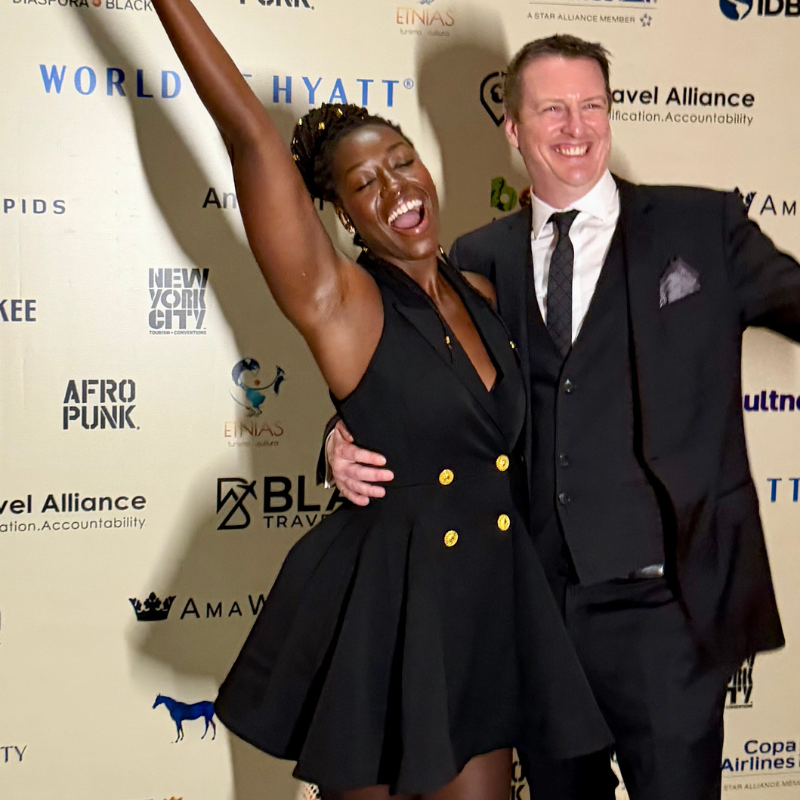
Matt Bowles: My guest today is Nicole Phillip. She is a travel creator, social media strategist and journalist who left corporate America to explore the world and help others do the same. Born in New York City to immigrant parents from Trinidad and St. Vincent, she grew up mostly in Orlando, Florida and is now a world Traveler with over 250,000 followers on social media. Through her content, she empowers Black travelers and people of color to navigate the globe safely and confidently. She’s all about making travel accessible, authentic and unfiltered, with a dash of wit and a healthy dose of humor. You can find her work in the New York Times, The Daily Beast, ABC News, and many other outlets.
Nicole, welcome to the show.
Nicole Phillip: Thank you. You are so kind. That is such a nice bio. I have to use that one for myself. I appreciate that.
Matt Bowles: I am so excited to have you here. As you know, I am such a fan of content, and I am so excited for our conversation tonight. But before we get into that, let’s just set the scene and talk about where we are recording from and the fact that we have agreed to make this a wine night. So, let’s also talk about what we are drinking. I am actually in the Blue Ridge mountains of Asheville, North Carolina on the east coast of the United States this evening and I have opened a Spanish red wine. This is a Bobal, which Bobal is apparently of the top three most grown grape varietals in Spain, but it is not nearly as popular or well known as other red wines in Spain. But somebody put me onto this so I thought I would try it. So, I’ve Just opened that and I’m going to be drinking through it during the episode this evening. But where are you, Nicole, and what are you drinking?
Nicole Phillip: All right, so I am inside of my house in Orlando, Florida. I’m drinking Winking Owl Merlot.
Matt Bowles: Amazing. I want to give a shout out to your city. I feel like on this podcast we give a reasonable amount of love to the state of Florida. I’ve had people from Tallahassee, I’ve had people from Duval, I’ve had people from Miami who are from those places. I’ve interviewed a lot of alumni from FAMU. So, I feel like Florida gets a decent amount of love. But I want to say you might be the first person I’ve interviewed that is from Orlando. So, for people that do not know about Orlando, beyond Disney World and conventions, can you share a little bit about your city? What would you put people onto?
Nicole Phillip: So, I would say that if anyone thought that Orlando was just Disney, you probably would have been right prior to maybe five, six years ago. A lot has changed. I used to think Orlando, it’s so boring. All we do is go to the mall, have that kind of small-town feel. But so much has changed, particularly with the beginning of the pandemic. So, you know, a lot of people have started moving here from cool cities like Miami, New York City and all that. And so, we had to get cool here in Orlando. And I actually did leave, went to New York for about eight years through college and stayed for a little bit and came back. But yeah, when I came back, I was like, wow, this is a completely different Orlando. In 2023, it was voted best foodie city in the United States. There are a lot of food options. You might not think of Orlando for food, but there are a lot of great food options from Michelin star type restaurants to the hole in the walls. And so, I think that’s why it might have gotten that rating. There’s also a lot of nature y things and stuff like that to do outside of Disney, even though the parks are great too.
Matt Bowles: Well, let’s go a little bit into your background. Now. You mentioned New York City. I know that’s a big part of your story, including your original story, where you were born. So, can you share a little bit, maybe just taking it back even a step further, and sharing a little bit about your parents’ story, where they’re from and their experience immigrating to New York?
Nicole Phillip: Yeah, so I’m a first generation American. My mother came here in the mid-70s, I believe, and she had her first child in 1978, the way my mother came here, her mother first came. And so, her mother worked very hard on her own to start bringing over her three children and her husband as well. And so, while my mother was here, she did have several kids, including myself, my sister, two brothers who unfortunately passed away, I should say that. But now it’s me and my sister. And I was born in the 90s to my mother, who was from Trinidad, and my father, who is from St. Vincent.
I grew up mostly with my mother, so she raised me in a very religious household. You asked me earlier, when we were preparing for this, do I feel very connected to my Caribbean identity? Was I raised, you know, very Caribbean? The thing is, I feel very connected to my American identity, mostly because when my mother had me, she was done with the whining and the party, and I got the religious. Serve the Lord. Changed your ways, Mom? My sister used to tell me she was like. When I was eight years old, I was making screwdrivers for people at the parties because my sister’s 15 years older than me, so she had a completely different mom. So, my mom was more like that Brooklyn backyard Caribbean party that’s going to Floria, more of that type of person. And I got very religious. You can’t watch Harry Potter. You can’t watch the Simpsons more. I wouldn’t say to the point of religious trauma type of mother, but just a lot more strict. You’re going to church on Sunday, Sunday school, we go to Wednesday service, that type of woman. So, she was more focused on the, I guess, religious aspect of the culture and not a lot of anything else.
So, I never knew how to dance. Unfortunately, People used to make fun of me for not being able to dance. I had to teach myself. I knew nothing about the music. I knew nothing about, like, dance hall, anything, because my mom was blasting gospel. She was not blasting Buju Banton. She wasn’t blasting anything like that. So, yes, I had to really teach myself to learn a lot about that. Those are aspects of Caribbean culture that are really just part of our melting pot of culture here in the United States. So, there are probably generational Americans who grew up in Crown Heights or Flatbush who know more about the Caribbean than I do or, like, grew up much more Caribbean than I did, to be honest. I had to learn a lot more about that to just be on the up and up. So that was the main focus now.
I grew curry with everything. So, there was parts of the Trinidadian influence in there. There was still a lot of roti, all that, like, I still got a lot of that. But a lot of things that make people feel very connected to a Caribbean identity for me was kind of replaced with more with the Christian identity. And I’m thankful for it because today I am still a woman of faith. It led me in the direction that I wanted to be in to become the person I am today. I’m good at it. I watched Harry Potter though she couldn’t take that from me. I started doing my own thing.
Matt Bowles: I was going to ask, how did you eventually find Buju Banton and other Jamaican dance hall artists and so forth? Like, how did that start to become part of your life?
Nicole Phillip: So, one day I was like 11 years old and like I was blind. A bunch of other kids, we were all dancing or trying to dance and everyone made fun of me because I could not whine, I could not dance. First of all, I was 11, I didn’t need to know how to whine, nothing. But still, like all the kids, I knew how to dance, and I didn’t. And then it was like, that was my villain’s origin story. From there I was like, I got to learn how to dance. I got to start listening to music. So, I think probably around middle school time, I started listening to LimeWire and stuff, listening to like Beanie man and stuff like that and really getting into the music and then teaching myself how to dance and then other non-religious aspects of just popular culture not specific to the Caribbean.
I just always was a very, I’m a do what I want type of person. And that was just always my childhood. I was very type A whatever. So, like my mom’s like, don’t watch Harry Potter. I’m going to watch Harry Potter. I’ll watch all the Harry Potters there were to be seen. And I told her I also wasn’t a liar, but I did what I wanted to do. Not to say, oh, I rebelled and stuff like that, because I don’t really think that’s what it was. I think I was just becoming my own person. And then I was able to find God for myself and have my own relationship. And then I was like, I don’t have to do things your way. I can do things my way.
Matt Bowles: And how did your interest in travel start to develop? When you think back, what types of travel experiences did you have as a kid?
Nicole Phillip: I know we’re going to get to this, but my interest in travel did not start until I had the absolute worst travel experience that I’ve ever had in my life. And I know that that’s Ironic. And you already know what that experience is. I know we’re going to get to it. But that’s when my interest in travel really started, I should say. You know, I came from humble beginnings, as they say. We didn’t have a lot of money. We weren’t poor, I guess, even though there were sometimes where I’m like, I don’t know how my mama did it. You know, I’m like, I didn’t feel poor but then, like, when she tells me the stories, I’m like, we were po. Like, you know, that. That joke. We couldn’t even afford the other letters. We were pow.
So, we didn’t grow up with much money. But my mother did what she could because her thing was, and this is a very Caribbean thought process. She said, I never want a man to make style on you. And what that means is I never want a man to feel like he’s the one who introduced you to a good life, to travel to things like that. So, she did what she could with what little she had to make sure that we went to nice restaurants. Not nice for the amount of money we had. It’s probably like Carrabba’s, you know, but it was something. Teach me how to eat properly, have experience. So, when we could travel, we went on cruises. You know, it’s a little bit more affordable way to travel. And we’re already in Florida, and we’d go to the Caribbean, mostly Mexico, like that. And so those are my first travel experiences.
Matt Bowles: Can you talk about how old you were when you moved from New York to Orlando, and then your choice to go from Orlando back to New York for college?
Nicole Phillip: So, I was about four years old when we moved to Orlando. So, Orlando’s a lot of what I know. We would go back and forth to New York. So, I wasn’t only ever in Orlando and never saw New York again because I still have family there to this day. So, I did go back and forth, but when it came time to go to college, I really wanted to go back to New York. I just felt compelled to go to New York. And so, I applied to NYU, and I got in. Now I let other people convince me not to go because it was expensive. I had a lot of conversations, and people were like, why won’t you just stay in Orlando? Just do that.
I had a full scholarship, or at least in some way, it was like, fully paid for me to go to UCF, the University of Central Florida. So I went to UCF, actually for a year. So now I’m at UCF for a year. And it felt like the 13th grade because I was raised here. So, I’m like, I’m seeing the same people from elementary school, middle school, high school, and now I’m here. And then also, mind you, where my family home is, I can hear the drums and the music from UCF during their games. That’s how close I lived to UCF all my life. And then I went to UCF, and it was still a true, I guess, college experience in that you have a campus. Going to college parties, meeting people but I just felt like I was meant for. This is going to sound so corny.
But I felt like I was meant for something more. I hate that those words came out of my mouth, but I felt like I was meant for something more. And I had went to school for journalism and I just felt like, what am I supposed to do? Like graduate from UCF and then go work for like the Weather Channel or like Golf Channel, whatever they have here? What am I supposed to do with a degree from journalism at UCF? So, I said, bucket, I’m going to go to NYU. I applied to transfer and then I went there to finish off my last three years of school.
Matt Bowles: And going back to New York as an adult on your own and living there independently in New York City, what was that experience like?
Nicole Phillip: When I first got there, it was kind of like, ‘Neeeew Yoooork, concrete jungle…’. That’s kind of like, wow, New York. And you’re looking around. And everything’s just so great and amazing and the light and then, you know, you have to go through regular life now. My first year in New York was amazing because I lived in dorms and I was living in Manhattan in a two-bedroom dorm and I was staying in a room with three people because I was po, as we mentioned, so that’s all I can afford. But I was in Manhattan, so I got to experience my first year of New York being in Manhattan in the NYU dorm. So that was really nice.
But as I started to realize New York is great when you can afford New York. But I was really broke. And so, what I would say New York did for me was there is no Nicole without New York. And I will say that because New York shaped me. New York opened my eyes to new cultures. Because back then, like I said, Orlando was a very small townie. I didn’t really know much beyond what me was around. I was very ignorant and didn’t even realize. So, New York really opened me up to seeing new cultures and having new tastes for different foods and different things and just feeling like a more well-rounded person through living in New York.
I will say that I could not afford to love New York. I simply could not. I feel like if I just had money, it would have been just a much better experience for me. But there are a lot of things I wanted to do that I couldn’t. I had to focus on paying my rent, which is always a pain. But New York did for me what it needed to do. As I said, shaping me as a person and teaching me how to climb a ladder, how to really stand out when it comes to the corporate world. I truly believe that had I not gone to NYU, I would not have had the opportunity to work at places like the New York Times or ABC News and all of that.
Matt Bowles: Alright, so let’s talk about your worst travel experience of all time, which you wrote an article about in the New York Times, which we will link up in the show notes so that folks can go and read the article. But just setting the scene for this experience. Can you share a little bit about you’re in college, you decide to study abroad. Can you talk about what went into that decision, what expectations you had and hopes you had for that experience and then what it turned out to be like.
Nicole Phillip: All right, so setting the scene. So, I am a 19, 20-year-old freshman in New York. I’m staying in that room with two other roommates and at least in that specific room, but within our whole dorm there’s like four of us. I was interested in studying abroad, but I just didn’t know where. And I also thought maybe I couldn’t afford it just because of my financial circumstances. Then I realized that studying abroad would actually be about the same cost for a semester as staying in New York. And in certain cases, it was actually cheaper for certain people, depending on where you were going. So, I was looking into a couple different destinations. I think there was like a short-term program in Aqua Ghana, but I wanted to do something long term.
And so, I started hearing about Italy. You should go to Italy. NYU has a campus in Florence, Italy. So, I talked to two of my roommates who did a program in Florence, Italy. So, they did it for about two years there and I asked them how was it. They were like talking about the sandwich shop that’s right around the corner from the school and you have to go there. It’s so great. All the fun that they had. I think one of them might have had a little, a little lever or something in Italy. Yeah, just about the Nutella Croissants that they loved. And it was just like they were painting this magical picture that we all have in our minds of Italy. This is the Italy I saw on tv. Okay, of course I have to do this. So, I went ahead and was like, all right, let’s do this. I’m going to Italy. I’m going to use my refund. You know, you get that refund every semester. I’m going to use that to buy my flight and buy a couple sandwiches while I’m there. And I’m going to Italy.
The only thing that my 19, 20-year-old mind was not focused on because of just the world in which I lived in at that time. And the way I saw the world at that time was that the people I was getting my information from did not look like me. That the people who had this great time who were telling me how awesome Italy was, were two white girls. And it never occurred to me to think, would my experience be any different? So, I have these expectations and I remember we went to an orientation, and I remember one of the first things they told us is, you know, just so you know, Italians are bold. They’re not super politically correct. So that’s just. We’re just letting you know. And I’m like, okay, I don’t know what you like. Sure. Like, I didn’t really think about what they mean by bold or politically incorrect or whatever. So, I just moved on with my life.
Now even the kids on the campus were not very open and kind. I remember specifically seeing a girl with a Tri Delta bag. And I was like, oh, are you Tri Delta? Because I just remembered that I remembered the symbol and I was like, oh, this is like a way to spark conversation with somebody. I was like, oh, are you trying Delta? And it was just kind of like, yeah. And like, that was it. I did slowly start finding friends, but I just never felt fully comfortable there. And I couldn’t really figure out why. Why weren’t people as open and nice, why people were kind of cold. And it was one day that everything just like the light switch went. If there was a light bulb moment in my life, it was when we did a fall break trip to Cinque Terre, and I was with a bunch of white girls and one Black girl.
And we were on a beach. There’s this man who’s standing on a flipped over boat and the girls are talking to him or he’s trying to flirt with them. The white girls, he’s trying to flirt with them. I guess he gets turned down. The girls did they were never really interested. So, they kind of like, write him off, whatever. He starts hurling insults. America’s so gross, so nasty. I’ve been to Miami. Your place is so dirty. You guys don’t know how to keep things. So, he starts going off on them. And then at some point, the girls start going back at him, and he starts saying some really insulting things. I’ve already tuned it out. I’ve moved on. Whatever. And then the one other Black girl in our group goes up to him and she goes, hey, you do not talk to women that way. And now she’s, you know, telling him, like, that’s not how you speak to women.
All of a sudden, I see that he grabs her, and he’s a decent sized man, and she is tiny. Imagine the slimmest frame you can. And also, in a tall body model Esque body. And then imagine an average size man of maybe 5’8 or 5’10. His whole hand could wrap around her arm. He grabbed her and he starts jerking her around. And I’m there, and I’m like, what the hell? And I’m looking around. There are so many people on this beach. Not a single person said a thing. There are so many white people on this beach. Not a single person said a thing. Then there are the girls that we came with. She’s defending you. Why aren’t you saying anything?
Which is also, like, a common theme throughout much of the world and what we see in history of Black women speaking up and everyone else being quiet. So, it was me. I go up now, and now I’m like, let her go. I’m going off on him, and then I punch him in his arm. And he finally lets her go. And I’m looking around and everyone’s just looking at us. And I was like, y’all were going to let him beat her up. Y’all were going to let him beat both of us up. So, I look around and I lock eyes with someone whom I believe to be a migrant from Africa, because he’s, like, selling items and they’re draped on his body. He has a hat on, and he’s just looking at me. And it was just like, I wish I could do something. Like, the consequences for him just stepping in were worse than they would be for me because I’m an American citizen. They might think someone’s going to be looking for me. You know, different things.
It was just a mutual understanding. Like, I’m sorry that’s happening to you. And I wish I could do something, but I can’t. At least that’s how that moment felt to me. Now this girl is bruised. I believe she even had bruises on her fingers, now that I’m thinking about it. And she was in so much pain. And we go back and we’re talking to the girls in our group. We’re talking to, I believe there were like two tour guides that either left us for the day and we were supposed to meet up with them, whatever. Nobody really had words to say, but there was just such an obvious lack of understanding from the other people in our group. And you know, they’re young, so like maybe they just, you know, they don’t. Maybe now, maybe in todays, because this was like maybe 12 years ago, maybe today they would do something back then, maybe they didn’t know, they didn’t have the words, I don’t know.
So that was that moment where the rose-colored glasses came off and I saw the world for what it is. Like in that moment, not only did I see Italy for what it is, I saw the world for what it is. I had never knowingly experienced racism until that moment. I didn’t know if I noticed it, I didn’t register it. But then after that moment when everything transpired, I started thinking back on things my mom would say to me. Like when I’m in Walmart and I’m wearing a hoodie and she’s like, take that hoodie off. You don’t know how people are looking at you. And I’m starting to realize, like there were certain things that were said to me or that now made me understand, oh, these are things I’ve been experiencing. Things like, you talk like a white girl, you don’t act black.
Little things like that that I didn’t realize were microaggressions or coming from a place of racism or things that were happening to me. Like my mother saying people are looking at me a certain way as I’m wearing my hoodie in Walmart and I’m not even noticing. Maybe it’s just like this, I don’t know. Is veil of innocence the proper word? Sometimes I’d be saying stuff and I’m like, is that right? I’m going to look it up later. I’m just saying words, innocence. There’s innocence over me. That’s probably not the right phrase. And American racism is also very much covert, which was the opposite of my experience when I got there. And then after that, there was just a series of moments that I understood to be wrong. I remember I was getting a caricature done in a city in Italy. And obviously caricatures are supposed to be like, wild, whatever. But there was something about this particular caricature that even made my white friend uncomfortable.
And it was because, first off, the guy just started calling me over. He didn’t make me pay for it. He just was so fascinated, I guess, that he wanted to do a caricature for me. And as he’s doing it, he just keeps saying, tomato, tomato. Your lips are like tomatoes. They’re like just tomatoes. And he just draws this like really hyper racialized, big, lipped caricature of me that even as I can. I remember distinctly seeing my friend because she was, I guess, on the other side. Yeah. And she’s just like, oh my God. I remember her looking down, hand to face like, I cannot believe this is happening to this girl like that. And here I am smiling like an idiot too, for this caricature. I didn’t realize what was happening. Embarrassing moments in life.
That was another moment I remember also, I’m walking down the street, broad daylight, blue skies, maybe eight, something in the morning, heading to school. And shop owners are putting out their signs and whatever. And I’m walking behind a woman. I’m looking down at my phone. They’re probably like maybe two, three feet between us. I’m looking down on my phone. I’m not paying any attention to her. And she turns, she stops abruptly. And so, like, you know, when someone stops abruptly, you end up with them a little bit. I wasn’t on her, but I got closer to her. She turned around and screamed in my face. Mind you, I have my phone in my hand. I’m looking like, I look completely not pained. I’m distracted. I’m just on my phone. She screams in my face. She jumps off the sidewalk. She continues to scream. She refuses to get back on the sidewalk until I pass her. And I’m looking around at all these shop owners again. Broad daylight, eight in the morning, busy street with stores. And I look like I was trying to rob this woman, the way that she’s screaming.
Matt Bowles: So, you have this experience for your semester abroad, your first time living on your own outside of the country. And earlier in our conversation, you mentioned that it was this experience that actually got you interested in travel. So, can you talk a little bit about how you processed this entire experience? Because I feel like for some people it might be off putting, and it might be I, as a result of this, do not want to have more travel experiences. But for you, what was the impact of this experience and how did that relate to your future travel trajectory.
Nicole Phillip: I separated the people of the country from the country itself. There are reasons why people do love Italy. There are reasons why people, there are other Black travelers who never have a bad experience, and they’re like, I love it so much. There are good things that the country does have to offer. And even though there were so many terrible experiences, there were so many things about history and culture. Like the first bank. I was in Florence; the first bank was started in Florence. So, you know, the concept of going bankrupt, Bancarrota, things like that. Like, things really just that were so fascinating to me that I had to learn more about not just the history of this country, but others. So being broke, I was in a perfect situation to see other countries.
So, while I was there, I was able to go to Spain. I was able to go to Manchester, which was an accident. I was trying to go to London, didn’t read the airport code, and went to Manchester. I was able to go to Barcelona. I was able to go to Paris. For the first time in my life, I’m going to these cities, these major cities that I actually, first of all, just never really imagined I would ever see. And now I’m on an hour plane ride, two-hour plane ride away from them. So, when I had opportunities, I was going, and it felt great. And I was a solo traveler, so I also started my whole solo travel thing. The reason why I was a solo traveler is, again, because I was po. So, I didn’t really have no money. So, when my rich NYU friends were taking more extravagant trips that cost hundreds, I was like, Ryanair cost $20. This hostel costs about 45 for three or four days. So that’s where I’m going to be.
And so, I was able to have these experiences. I met some really great people in Barcelona that actually happened to be living in Florence. I will say that they actually changed my entire Florence experience, meeting these people, because I no longer had to mess with those rich people I could not relate to. I didn’t really have to hang out with them anymore. I could hang out with these cool people that were just, like, so nice. They were there for art school, and now I have a whole new group of friends, and they got it. They actually understood the racism that I was experiencing. They weren’t black, they weren’t people of color, but they just understood it more. I just had a much better time hanging out with them, and they really just changed the rest of the trip for me, just having them. I was actually with them on my last night in Florence, and they had invited me to a dinner with some Italian folks that they met. And that was the first time I had met kind Italians in that country. And it was like, wow, why didn’t I meet y’all, like, months ago?
And so, it was great. And then I was supposed to go meet up with some friends at a bar, and so I had to leave them. And while I was trying to find this bar, I used up all the minutes on the phone, you know, when you used to make the pay as you go phones when you travel. So, I’d use up all my minutes because it was my last day. So, I was like, oh, I’ll just ask people for directions. I speak Italian at this point. Like, I can say bar or whatever. You know, I’m walking around, I’m asking people for directions. They’re turning their noses about me. And I remember distinctly asking one couple for directions. Just for background. I’m like wearing, like, an oversized sweater, and a skull cap. I have my cat eyeglasses on.
I’m saying this to say I do not look like a sex worker walking the street, because people have mentioned that that’s what it seemed like they thought I was when I was going up to them. I remember that’s something that the editor mentioned when I was at the New York Times writing that essay. She was like, how are you dressed? Because they’re treating you like you might have been a sex worker or something. And so, I realized, oh, it’s probably important to mention I’m just wearing an oversized sweater and a skull cap. And I swear that sweater was like, bad luck in Italy, because every time I wore it, I felt like something because I was wearing it too. When that woman screamed at me on the street, I’m like, something. This sweater is like, bad luck. And so, I go up to this couple, and I say, excuse me, where is the bar? I say it in Italian. And then the guy grabs his girlfriend, or whoever she is he said he’s with, and pulls her behind him, like, defensively, as if I was going to do something to her, and is like, no, we don’t know. No. And I was like, wow. Wow. Did that just happen? Did you really just treat me like I was some gang member on the street who was about to mug you? Is that really how you just treat? And so that was it. The night was done for me. I said, fuck that bar. I’m going home. I was like, I know that direction. I was like, give me the hell out of this country. And that was it. I went home, went to bed, woke up next day, airport. That’s it.
Matt Bowles: So now, looking back over a decade since that happened, what lessons did you take from that experience? How did that shape your travel lens moving forward and lead to the content that you create today?
Nicole Phillip: For one, it taught me what racism looked like. It taught me what racism, what microaggressions, what it truly looked like. It opened my eyes. And once your eyes open, that’s it. You can’t shadow. And that’s why there’s been an attack on the concept of the word woke. Because, yeah, once you have been awakened, you are awake. That’s it. And you see everything for what it is. Once the. What is it? The veil. I’m going to say veil again. Once the veil has been lifted, you see everything for what it is. And so, it didn’t just change how I moved in whenever I traveled. It also changed how I moved in the United States. I just became much more aware of things that were always happening to me, but I didn’t register for it or couldn’t put a name on what was happening to me. It also made me hyper aware of the fact that so many of the travel narratives that we are fed, so many of the travel narratives that we see on TV and the stories that we hear come from that of a white lens.
And that is not indicative of a whole picture. Because when white people travel, they travel with a huge amount of positive stereotype. To be honest, when white people travel because of colonization, things like Eurocentric ideals are prized. Eurocentric beauty standards are prized. White people, because of how just things have shaken out, people tend to put white people more so on a pedestal than others in certain places. And I’m saying this because, yes, Italy is a predominantly white country, but I’m talking about countries like in Asia too, in India, things like that..
Matt Bowles: And Africa. This is actually a really important thing, right? I’ve spent probably about two and a half years on the continent, and I’ve had discussions with other white travelers because it’s interesting because a lot of white people have never in their life been in an all-black space where they’re the only white person. Like, a lot of white people have never experienced that. And there are ways to go to the continent also where you don’t experience that, but assuming that you do go to sub–Saharan Africa and you do experience times when you are the only white person in an all-black space. I’ve had other conversations with white travelers where they might say something like, oh, you know, this is the first time I’ve experienced this. Now I have a greater appreciation or understanding of how Black folks must feel in the United States or in some other majority white space.
And I always say to them that the main difference there is that white privilege is maintained by you even when you are in an all-black space. So, for example, I can be in a city like Lagos, Nigeria, where I lived in Lagos for like a month, amazing city, and I saw pretty close to zero white folks the entire month that I was there. However, when I would go to a restaurant or something like that, I would often be treated better than the local Black folks that are also going to that restaurant. Furthermore, I am not, well, I do try to stay away from the Nigerian police in general. I try to stay away from all the police in general. However, I am not concerned that I’m going to be murdered by the police and so on and so forth. So, there’s all these different ways where white privilege travels with you, even when you are a numerical minority in certain situations. In the same way that anti blackness is globally ubiquitous, white privilege is also globally ubiquitous. And I think it’s important for white travelers to be aware of that. So, I think it’s good to go to spend time in sub–Saharan Africa and put yourself in all black spaces and like have those experiences, but just be aware of these dynamics that are also going along with it.
Nicole Phillip: Wow, you are the first white person that I’ve heard articulate this in this way. And this is something I’ve been thinking about all the time. And I’m always trying to get people to understand because this is something that it comes up a lot within the comments, especially in my videos where I talk about different, you know, I give my reviews about different cities and things like that. People often say, well, why don’t you just go to Africa? You spend all this time in all these white countries. You could just go to Africa or this won’t happen. Or like the Caribbean or wherever. And I’m like, I know of Jamaican people who talk about going back to Jamaica and watching white people get hurt before them. Just because you’re in a predominantly black space does not mean it was not touched by colonialism. It was not touched by white supremacy. And you can see that in the colorism that you can still see in Arts of Africa.
You can still see that in the way that people treat other Black people. As you said that you witnessed yourself, you were being served before others. The best, or what should I say, the most powerful tool perhaps within the world of white supremacy is convincing each minority community that white people are even better than them. So, people will look at other Black people and even have their own internalized anti blackness within that. And I also always often tell people there’s also anti-Black American sentiment because everyone’s, when it comes to this perceived hierarchy within white supremacy, there’s always this desire to be as close to whiteness as you can. So even within blackness, you start having different subgroups. Well, I’m Caribbean, I’m African, this is a Black American. And then you go to Africa, and you might experience some anti-Black American sentiment which you’ve probably heard online. You know, the so called ‘diaspora wars’ that go on with very loudly within the larger black community on the Internet.
Not to say other cultures don’t have diaspora wars, they probably just don’t hear about it as much. But then, yeah, so then you have, even within I go there as a Black American, there could be some anti-Black American sentiment that I experienced there. As a person who, as I mentioned, I’m a first generation American. I have heard firsthand the things that people from the Caribbean and other places say about Black Americans. I know what is being said. So, I know. No one could tell me, oh, that’s just the Internet. I know what people think. And I am a Black person who was raised in America. When I go to these places, I am just, I’m Black American. No one cares about where my family is from. And so, there’s, that’s another layer. So, I always tell people like you just be people who they are just like, just go to Africa.
Obviously, I would love first of all to go to West Africa and experience that period. Let’s say that I want to go, I want to experience it. I want to go to Detty in December. I want to be there. Okay. I want to be there. Okay. But at the same time, I’m not going there to escape anti blackness or racism. I went to Colombia, and I went to Cali. One of the blackest countries is Colombia. One of the blackest cities is Cali. And that was the first time I had experienced racism in Colombia, was in Cali at a restaurant owned by Black people. Like, I wouldn’t be going to these places to escape any sort of racism. I don’t want people to be under this impression. And that’s what’s going to happen.
Matt Bowles: Well, let’s talk about Colombia because you let into it, it is one of your favorite countries. I know it is also one of my favorite countries. So, let’s talk about Colombia. You’ve spent time in different parts of Colombia, as have I. You have love for Cali, as do I. You have actually been to the Petronia Alvarez Festival in Cali, which I have not been to, and I want to hear from you. So maybe just start talking a little bit about Colombia. What makes it special for you. What do you love about Colombia? And then I would love to hear about your Cali experience, your positive Cali experience in particular.
Nicole Phillip: When I first went to Colombia, that was in 2019, Cartagena, that was my first time in all of my travels where I just felt so welcomed. And I don’t know how to explain it because like I said, I’ve been to the Caribbean. So, it’s not necessarily about it being majority black or having a large black population, but it was the first time that I actually felt like the people wanted me there. I felt so appreciated as a Black woman. So, if you’ve been to Cartagena, you know there’s a district called Gethsemani. You go to Getsemani and all you see are Black women depicted in the art everywhere. And that was the first time I had been traveling someplace and saw that.
And I was like, what? Like, so you see me as the standard of beauty here. Like I, and rather than Eurocentric ideals of beauty, and not just light skin, curly hair, you see kinky hair, head wrap locks, dark skinned Black women as your center of beauty. That’s what you see as beautiful. That’s what you’re painting in your art. I bought art for the first time and I’m not really an art person. This is the first time the art spoke to me. I later found out he stole that art. But anyway, I bought my first piece of art there. That’s none of my business. I bought my first piece of art there and I talked to the painter who stole it, and I said, why? There are so many Black women in the art. Like, what is the reason? He said in Spanish, he was like, Black women are the style, like the fashion. I was like, whoa. That just to me was beautiful. To me, it was just such a profound statement. And so that was the moment I fell in love with Colombia. In Cartagena, that was the first time I felt embraced, I felt welcomed, and then I was just like, I have to go back.
Matt Bowles: So, when you went back, where did you go and what was that experience like?
Nicole Phillip: So, then I went back to Medellin because I was trying to find a place that I could stay for an extended period of time. I went to language immersion to practice my Spanish. So, I am a 20-year Spanish learner. I was a practitioner. And that Makes it sound real. Like, I don’t know, like a real witchcrafty, 20-year Spanish language learner. I really started getting into the language beyond a basic level three years ago, I should say like around 2022. I wanted to do some immersion within Medellin. And this was an amazing experience. So, Medellin is in Antioquia, and it’s not necessarily the blackest area, but the feeling that I had in Cartagena was the exact same feeling I had in Medellin. Nothing had changed. Even though I wasn’t seeing as many Black people around me, nobody was staring at me. I didn’t have to feel uncomfortable. That’s also the main thing about Colombia.
No one’s being weird toward me. No one was ignoring me at restaurants. You know, I just felt really great. And then the great thing also is that there’s a large community of black travelers and locals and immigrants in Colombia in all the different Cities or like WhatsApp groups, you can find them on Facebook. And so, I got connected with one in Medellin. I’m not quite sure how, maybe from through Facebook or something, but I got mixed in with that group and I just had an amazing time. I had instant friends, instant friends. And I’m going to all these great group meetups and stuff like that. And I just felt like a Colombian. I felt like I was living there. I was like, I’m ready. I’m ready to sign the papers. Let me. Let me be here. Let me be a Colombiana. So that was like, just solidified for me. Like, okay, Colombia is my country.
Matt Bowles: So, I feel like a lot of people go to Medellin, and I feel like a lot of people go to Cartagena. I feel like fewer people go to Cali. I was in Cali for about a month in 2022 and absolutely fell in love with this city. I have been talking about it. Tell me about your experience in Cali and tell me about this festival, because I haven’t been to it.
Nicole Phillip: So, the reason why I don’t feel like a lot of people go to Cali is…I was scared of shit to go to Cali. I’m not going to lie to you. I was scared. I was so scared. Oh, my gosh. Cali and Bogota. Because if you are getting robbed, it’s Cali or Bogota. From what I understand, if somebody go steals something from you, if you gonna get scopolamine, whatever that thing is, it’s going to be Cali or Bogota. So, I was scared of shit, mind you. That’s why I put it around the Petronia Alvarez festival. So, it’s like, I have a place to be. I have something to do. I’m not wandering around. And on my first day I went to, I think San Antonio was the area, I went to a restaurant and they had to lock the doors. They was locking us in and locking us out. I was like, where am I? What the hell? Like, oh, my God. I’m like, They got to lock the doors to keep people in and out. I think I posted on Instagram, I was like, Cali got seven days to prove to me why I need to be here. Cause this is not it. This is not it. I was ready to be like, let me just be in my hotel, go to one night of this festival and go right home. Because locking doors is wild. Thankfully, that was my only questionable night. That was my only questionable night in Cali. Everything else was amazing. I went to the festival and I was hyper vigilant. I had my theft proof bag on. I was holding my phone for dear life because Cali Escali, you know, no Dar papaya. We understand how Colombia is. You know what I’m saying? Like, we understand that you just have to be careful, but you can have a great time.
So, I was just really careful as I was maneuvering the streets and stuff like that. But then also, I’ll say it, I’m Black. Sometimes I feel like ain’t nobody is trying to steal from me. I’m not going to lie to you. They probably like, she ain’t got no money. Her phone probably full of cracks. And now sometimes I’m okay with leaning into a little bit of a stereotype. I’m like, you know what? If the stereotype’s gonna save me and my phone, the racism going to save me and my phone, then so be it. You don’t want to kidnap me. I ain’t got no money. You are right. You don’t want to kidnap me, my family ain’t got no money, you are right. So sometimes, I’m not going to lie, I was a little risky because I was just like, I’m Black.
I’ve actually made a couple of videos referring to that one. Like, when I was in Guatemala, people often ask, like, are you afraid of getting robbed? And I’m like, you know, there’s that sound on TikTok that’s like, you do know that I’m black, right? You do know that I’m black, right? You do know that I’m black, right? So that’s kind of the mindset I had a few times. But, yeah, so I had an amazing time in Cali again, connected with the community of locals, travelers, immigrants. And I had, like, an amazing friend slash tour guide that, like, had my back the entire time. She’s from Cali. She hosts tours in Cali and Medellin. I call her the president, de la presidente. I call her la presidente of Colombia. She’s that girl when you know her, you’re good. She’s the person to know. Especially as a black traveler, she’s the person to know in Colombia.
And so, she made sure I had a great time, felt comfortable and all of that. And so, yeah, the Petronia Alvarez Festival was amazing seeing that much of an embrace of Blackness. Afro culture. Obviously, the main focus is Afro Colombian culture. But then it extends to, like, Afro Latinidad. And then I’ve heard that they’ve even had bands from Louisiana come in. So, it’s like just black diasporic culture in general. People call it a big family reunion, and it feels a lot like that. You know, even though it was my first time, it still felt like a big old family reunion. I know none of them dances. I know none of them songs. I got that conversational Spanish down, but there were certain accents I haven’t, you know, I haven’t got to that level yet.
And then you are singing, and now you get melody with it. It was a little hard, so I didn’t really know what they were saying all the time, but I was into it. I was feeling it. And, you know, the food is also really great there. And it just felt like it was like the best place to be black. Like, that’s just. I don’t know how to explain it. I mean, I haven’t been to Detty December yet, so I’m sure that’s great too. But at least on this side of the world it felt like the best place to be Black. And I’ve been to, like, the Afropunk Festival, but that got very, we’ll say, gentrified really fast. So, it kind of lost what it once was in certain ways. But the Petronio Alvarez Festival was just. You have to go. You just have to experience it for yourself.
Matt Bowles: Amazing. Well, I’m excited for you to go to Detty December. I was there in 2022, and that was the year that Burna Boy headlined it. And it was absolutely unbelievable. I mean, in terms of what you’re talking about, it was really incredible because it was, I mean, probably, I would say, maybe half the people there are Ghanaian local folks, but at least half the people that are there are from the diaspora from all over the world. Black folks from the U.S. from London, from South Africa, from Nigeria, I mean, from all over the place. And what’s amazing is that the DJs at these parties know exactly who is in the crowd. So, they’ll play like a hip-hop song from Atlanta, and they will shout out Atlanta and Atlanta will go wild, you know, but then they’ll play like a song from South Africa, and they’ll shout out Johannesburg would go wild. And then they’ll play a song from Lagos and shout out Nigeria.
And then Nigeria, Nigerians would go wild. And I mean, it is really quite an amazing experience in terms of just seeing the African diaspora from around the world just converge in one place. And then, I mean, it’s just like the parties are just absolutely incredible because you have like the festival, and you have the performances and all the Afrobeat artists and everybody that’s there. And that goes till two or three, but then you have the after parties that go from three till seven, and then you have the day parties that go from seven till, you know, it’s around the clock. So, it’s like whatever hours you keep, you can do that at Detty December, and you can go to whichever things you’re awake for at that time, and that can be you. But it’s a really special experience. It was interesting too, because the first time I went to Ghana, I went in the summertime, in like the June, July time, which is very much the not touristy season. And. And I was just blown away by Accra, like just in general as a city. I was there and I was at the, they had a Sunday party on Labadi beach in Accra, and I was at that. And DJs just start setting up, lining the beach, just different DJs all the way down the beach. And then as the sun starts to set, the DJs are all playing and then people just start showing up. There were probably 5,000 people at this outdoor party on Labadi beach on a Sunday. This is not a festival. This is just Sunday. And this is all local Ghanaian folks. And I’m there and my mind is like blown. And the people I was with, I had a Ghanaian friend of mine who was there with me. And these folks were like, you got to come back in December. I was like, what? I was like, how can it possibly be more lit than this? And they’re like, just trust me, coming back in December. I was like, okay.
So, then a couple years later, I went back, and that was 2022, I went for Detty December. And sure enough, it was really something to behold. So, I hope that you get there eventually. It’s a super special experience. But while we’re talking about the continent, let me ask you about your experience in Morocco. That is another country I’ve been to multiple times. I’ve probably spent about a month or so there and been to different cities. But what was your experience like in Morocco?
Nicole Phillip: So, I was in Morocco in 2019. First of all, I’m really happy about this deal. I first flew to Spain for, like, $230 and then flew to Morocco for $60. And I was like, oh, perfect, because I’m about a deal. How many places can I hit for, like, the least amount of money while I’m over here? So, I went to Morocco for Marrakech, specifically for about two to three days. And that experience was kind of my first time being immersed within Arab culture for the first time. Like, I’d never bound to a country, a Muslim country at that, or, you know, any country with a large Arab influence like that. So that was very new for me. And when I was driving down the street, when I walked through the streets to get to my hotel, I was like, am I in the Bible? It felt really biblical. Like, real, you know, 2000 BCE for real. But I loved it. It was just felt, wow, that sort of feeling.
The Riad that I stayed in, turquoise, oh, my gosh. It was also just beautiful. I was in there, like, wow. I feel like I’m in a genie’s bottle. It was just beautiful. It smells like heaven. Like, everything was just, like, divine. The incense, like, that’s like. I’ve never been to a place that smelled so good. Just the city, because there’s incense everywhere. He smells amazing. So, you know, there’s like that violet, that gardenia. They put me on the orange blossom. I’m not going to lie. I don’t think I had ever smelled orange blossom until I entered into my Rakesh. And then now my I got an orange blossom perfume that I use regularly. I had to get some potpourri. I bought orange blossom essential oil. And so that was a really wonderful experience. And it was a great way for me to understand how to move about in that sort of culture, especially as a woman, because I was solo, right?
So, I was a little nervous going solo female traveler. But I felt very safe. I did take one risk one time, and I was leaving, I went on a tour and I had to leave early because I had to catch my flight. And so, I just got in a car. I don’t even know if he worked there. Just got in a car with somebody, and he was driving me to my riad, but he could have driven me anywhere. I don’t know. I’ll live here. I don’t know what the turns he’s supposed to make. And for the life of me, I could not keep my eyes open. I was, like, so tired, you know, like, we’re whining, you know, it’s hard enough. You’re in the backseat; you want to fall asleep. And I was asleep. I was like, wow, for the life of me, I cannot keep my eyes open. This man can take me anywhere. Dear Lord, don’t let him. Please let him take me to where he’s supposed to take me.
And he did. I’m here. Nothing went wrong. You know, that was a little bit of a risk. Not that I met at all. Didn’t even know his name. And so, and then I gave him a little tip afterward. But, yeah, one thing I did notice about the culture of, I don’t know if it’s just that city or of Morocco in general, was the very aggressive tipping culture there. Very aggressive tipping culture in Marrakesh. And I wish I had known about that because, like, you can’t take a picture of someone’s stand without offering a tip.
I remember there was, like, a snake charmer. He was doing his performance in the middle of a whatever circle. When he was done, he went to, like, everybody in the crowd and was demanding payment from everybody. I was still living in New York at the time. You know, in New York, you just walk away. You’re like, all right, that was cool. Showtime. All right, it’s over now, and you walk away. He was not having that. So thankfully, I tried and failed to take a photo. I had come at the tail end, and I was, like, fumbling, and I’m like, where’s the app? You know, trying to. So, I didn’t end up actually taking a photo. So, when he came to me, I kept telling him, I didn’t take a photo. I didn’t take a photo. And so, I just. I had to, like, show him my camera roll before he would leave me alone. And I was like, oh, y’all are not playing here. So that’s, like, one thing I realized.
And then also, they be hustling, too. Like, I got hustled for some henna, and I wish I knew about that before I got there, because this woman, she talked to me, and she asked me if I wanted henna. I said no. Then she just starts having a conversation. I’m like, okay, this is nice. We’re bonding. She goes, you know what? For you, I’ll do it. She’s like, give me your hand, I’ll do it for you. And I hear, I’ll do it for you. So, I heard I’d do it for free. So, then I handed her my hand, and she does the whole henna. And then in the end, she goes “$20”. She’s just smiling, looking at me, and I’m like, well, I can’t not pay her because then I look like I’m stealing. And I don’t know how they deal with people who are stealing in here. I can’t just steal look like I’m stealing from this old woman. So, I gave her my money, and then I was very upset. And then I had a henna on my hand that I did not want. And I’m walking through the bazaars with a wet ass hand with henna. And I’m like trying, like, not to get it on things. And I definitely got it on somebody’s something. And I was like, oh, he gonna charge me $7,500 now, act like it’s made of gold, and now I pay my whole paycheck or something. But he was good about it. He ignored it and then let me go. And so, yeah, that was kind of my experience in a nutshell.
Matt Bowles: Well, I also want to ask you, Nicole, about some places that you have been to that I have not yet been to. One of them that’s very high on my list is Guatemala. Can you share a little bit about your experience in Guatemala?
Nicole Phillip: Guatemala! Yes. The thing about Guatemala is if you’re going to Antigua, you got to be a hiker. And I am not. Like, it’s a great place if you love to hike, like mountain hiking. Not just through the wood, because that’s what people do, that they go hike up the volcanoes. Those are like bucket list things for people, like active volcanoes. I did do an ATV up on the Calla volcano, and that was a really awesome experience. The food is also really great. The people were so kind. That was another experience for me where I was like, you know, I feel really comfortable here because oftentimes when I go to places where they don’t have a large black population or there aren’t a lot of black people, I get a lot of weird photo requests and stares and things like that, that happens a lot in Mexico.
But in this particular situation, like when I was there for about. I want to say I was there for like five to seven days, that didn’t happen at all. People were really chill. And so that’s why to me, it was a really good experience for that, hands down. And also, if you’re trying to practice your Spanish, that Guatemalan accent is very. At least you don’t understand, at least in my opinion, because I think the. Some of the easiest accents to understand and the Mexican and Colombian accent and Guatemala is definitely up there.
Matt Bowles: All right, so I now have to ask you about your trip to the Arctic Circle. I have been going through your content on this, and I was like, yo, that’s crazy. I have not been there in just this past December for my very first time. I did go to Helsinki, Finland, but it was only for a couple of days. I was actually doing a trip with my sister. So, my sister is single and in her 40s and loves to travel. So, she and I try to meet somewhere and do like a brother sister trip each year somewhere. And so, this year we did the Baltic region, and so we met in Vilnius, Lithuania, and then we went to Riga, Latvia, and then we went to Tallinn, Estonia, and then we took the boat from Tallinn across the water to Helsinki, Finland, and spent a couple days in Helsinki. It was a great time of year. We did the Christmas markets and all of that kind of stuff. I have not been up to the Arctic Circle, and I just want you to share this trip with people because I was absolutely inspired by your content. So, start from wherever you like, but definitely take us through and share some of the highlights of your experience in the Arctic Circle in Lapland, Finland.
Nicole Phillip: So, this whole trip was inspired by the fact that so many people in the northeastern United States in November got to see the northern lights. And Nicole in Orlando, Florida, did not. And I was so upset that I was like, hold up, I’m not going to just go to no Maine or whatever to see some northern lights. I’m going to go all the way to the Arctic Circle. Y’all not about to see the northern lights without me. Nicole will see these lights and I’m going to do it better. I’m not lying to you. That was exactly my mindset, I promise you. It just so happens that my birthday is also in January. So, I was like, I’m going to do a birthday trip. And so, I found a friend who was able to go with me.
And we went to Stockholm, Sweden first and from Stockholm, Sweden, we went to Rovaniemi, Finland. So that’s in the Lapland area of Finland, in the Arctic Circle. I think that’s the outermost city. The city right as you get to the Arctic Circle is Rovaniemi. When we get there, we’re told it’s. They were in Celsius, so we’re told it’s negative 22 degrees Celsius. I have never in all my days experienced any type of cold such as negative 22 degrees Celsius. So, I didn’t really know what to expect. Mind you, I was buying so much stuff prior to this trip. But the first excursion that we had was pretty much like right after we landed. And it was a northern lights trip, basically, literally just take you out to some open field to go look at the northern lights.
So, I think it’s negative 16 degrees Fahrenheit. So, very cold. We go to this place, you get some deer, they give you overalls, they give you shoes, they give you a balaclava if you need them, depending on what you’re doing. And I think, like, scarves and gloves, they work. They might as well have given me absolutely nothing. They ain’t do anything for me. I might as well have been naked outside, and I had my own clothes. You’re supposed to put all this on over your clothes that you already have on. I already have one. All the y’all lied to me who gave me these lists. I got silk layers, merino layers, wool, everything. And I went outside, and I was the coldest I have ever been in my life. They take us on what’s called the snow train, and they take you out too. I think it’s either a frozen swamp or a frozen lake. Fun fact. So, I think the indigenous name for Finland is Suomi, and Suomi means swamp, because Finland has a bunch of swamps. It’s a very swampy land.
So, they take us out to basically a field. There are a couple of teepees out. And inside the teepee there’s a fire in one the fire and do not nothing. It might as well have been a light bulb. The fire did absolutely nothing. And then there’s like, some food and, like, hot berry juice. And so, you basically sit inside the tent until someone tells you that the northern lights are out. It’s a beautiful clear night sky. We go out, we’re just sitting in the tent waiting. We’re eating hot dogs and marshmallows, freezing our butts off, only for not a single northern light to be seen. Not A single one. And that’s something you have to prepare for if you’re going on an Arctic Circle trip, because you could very well freeze your butt off and see absolutely nothing. That’s why you’re supposed to book multiple days, because it is basically every other day that you’ll see it. So, you have to book multiple days of experiences to go out. So that first day was the worst day because it was just so awful and cold, and we all just had to end up going back. It felt like a walk of shame. And I was pretty much over it. It was to the point where I had to call my mom and I said, mom, you got to pray for me, because if every night is like this, I’m going to regret this entire decision.
And then God must have heard my prayers, because every other day after that was between 20 and 40 degrees. The fins themselves were like, man, because it was so hot. And I was like, thank the Lord, because that’s what I need. Like, not me thanking God for a 20-degree day, but I’m like, I need 20 degrees. It actually did get so warm at one point, we were able to, like, walk outside without jackets on. But that’s also, like, relative. It was like 40 degrees. But when you are in negative 16, 40 degrees feels like summer. So, the next day, we did dog sledding on a much warmer day. And that turned around everything. The dogs were adorable. I’m like, this was just a really nice experience to be able to dog sled in the Arctic sunrise. They’re very energetic dogs. Huskies, they just have a lot of energy. They’re made for the snow. And this is basically what these dogs do. So that was a great experience.
The day after that, we did snowmobiling. We took these snowmobiles out to another frozen swamp. And for the first time in my life, I finally saw the northern lights. They were so bright, so vibrant, you could see it with the naked eye. And it’s something that just has to be experienced because photos don’t do it justice. Like, photos truly don’t do it justice. So, they slowly started peeking out. And then it just went all the way across the sky. Just clear across the sky and beautiful green aurora. And it was so bright. You could also catch it on video, because usually you can’t catch it on video. Usually, you need photographs. You can let in as much light as you can. But I was able to capture it on video. It was rainy, but it was there. And, man, it was just. I was like, this is what I came for. I was Like, I’m so glad.
Matt Bowles: You have got to tell people also about the Arctic Snow Hotel. For people that have never heard of this, they don’t know anything about this, explain what this is and what it was like.
Nicole Phillip: Yes. So, the Arctic Snow Hotel, I did the day before my birthday. So, we go out to this hotel. It is exactly the way it sounds, a hotel made of snow. Like, actually, they make molds, and they pack it with snow, and then the snow hardens and this whole hotel is made of snow. And then the beds are made of ice. And they have so many different rooms, and each room is completely different, designed completely differently because there are actual snow carvings in the walls. And so, each room looks very different. It’s still beds on ice. I don’t know how comfortable they would actually be in practice, you know, to lay on these hard beds. I don’t know, because people. You can rent those rooms, or you can book stays in those rooms. But they’re beautiful to look at. I would not book the stay in those rooms, but they are beautiful to look at.
There’s also an ice chapel. When you walk in, it does feel like the place Anna or Elsa would have been married. Right. You walk through and there is ice benches covered in moose skin pelts, I guess, or reindeer skin pelts. And then ice sculptures in the background at the very front where you would stand as you’re getting married and you’re reading your vows. And rather small, but they did a lot with the space in terms of the decoration and all that. So, if you’re really into that sort of vibe, like that would be so beautiful. They even have a dining area made completely out of ice, which I don’t know how practical that is, just because your food gets cold really fast. But, like, it’s. Everything’s made of ice. And I think they serve one of their dishes on an ice plate. It is a work of art. It is definitely a work of art.
And so, I was in awe when I saw that. Then they have a sauna experience where you can be inside of a snow sauna, which is literally a sauna made of snow, which is a very Finnish way to do a sauna. And then they have, like, you throw water on the hot stones and the steam emits, and it’s just so beautiful. There are obviously indoor activities as well, so you can be warm. There is a restaurant inside. I think there might be one or two. And that’s where I ate. And then there’s a bar that’s also inside. There’s also an ice bar. Inside the hotel, it is completely made of ice. The shot glasses are made of ice, and you’re supposed to take a shot, and when you’re done, you throw it at the wall. Like, that’s the tradition.
And for those who are not trying to sleep on a bed made of ice, they have glass igloos. And that is what was really cool to me. So, we stayed in a glass igloo. Now, mind you, all of this was part of, like, the package that we paid for. So, I don’t necessarily know how much it cost, but, like, to do this was, like, just such a unique and cool experience. And they look like they would be small, but they’re relatively spacious for a night or two. There’s a whole shower with hot water, and there’s an alarm that lets you know when you can see the auroras. Because, like, the point of it being a glass igloo is that you can see the auroras on a good night.
And so, we didn’t necessarily see any. It wasn’t a very clear night. I did randomly just snap a photo. Like, I just looked up and snapped a photo, and I did get a little glimpse of an aurora. So that was, like, my first time seeing. Seeing the aurora. So, this must have happened before the snowmobile experience. That was my first time seeing that. And I was like, wow. It was so amazing. Having my bottle of wine, I turned up. It was great. And then the next day, that was my actual birthday was less fun. And so, I’m glad that I got to celebrate the day before.
Matt Bowles: That’s so amazing. Well, we are going to link up in the show notes to the video that you have made of this, so folks can actually see what this stuff looks like. It is absolutely incredible.
All right, we’re going to pause here and call that the end of part one for direct links to everything we have discussed in this episode, including all of the ways to find, follow, connect with Nicole and check out her content. All of that is going to be linked up in one place. Just go to themaverickshow.com, go to the show notes for this episode, and there you will find it. And be sure to tune in to the next episode to hear the conclusion of my interview with Nicole Philipp. Good night, everybody.