Matt Bowles: My guest today is Diva Green. She is the founder, and CEO of I Got Your Black, a platform highlighting global black culture and black businesses around the world. As a destination storyteller and content creator, Diva seeks to amplify the histories, lived experiences, and stories of the African diaspora in each destination she visits. In addition to creating culturally relevant content and resources, she also organizes small group travel experiences to help you connect with and immerse yourself in black communities globally.
Diva, welcome to the show.
Diva Green: Thank you so much for having me. I’m super excited.
Matt Bowles: I am super excited to have you here. Let’s just start off by setting the scene and talking about where we are recording from today. Unfortunately, we are not in the same location. I am actually in the Canary Islands. I am on the island of Tenerife off the coast of Morocco recording this today. And where are you, Diva?
Diva Green: Well, that sounds lovely. I wish I was at a warm place like that. I’m in New York right now. It’s actually been a little while since I’ve been in New York since probably about last November. And so, my family’s from here. I came for the Thanksgiving holiday and yeah, I’m here in Brooklyn in my sweater, trying to stay warm.
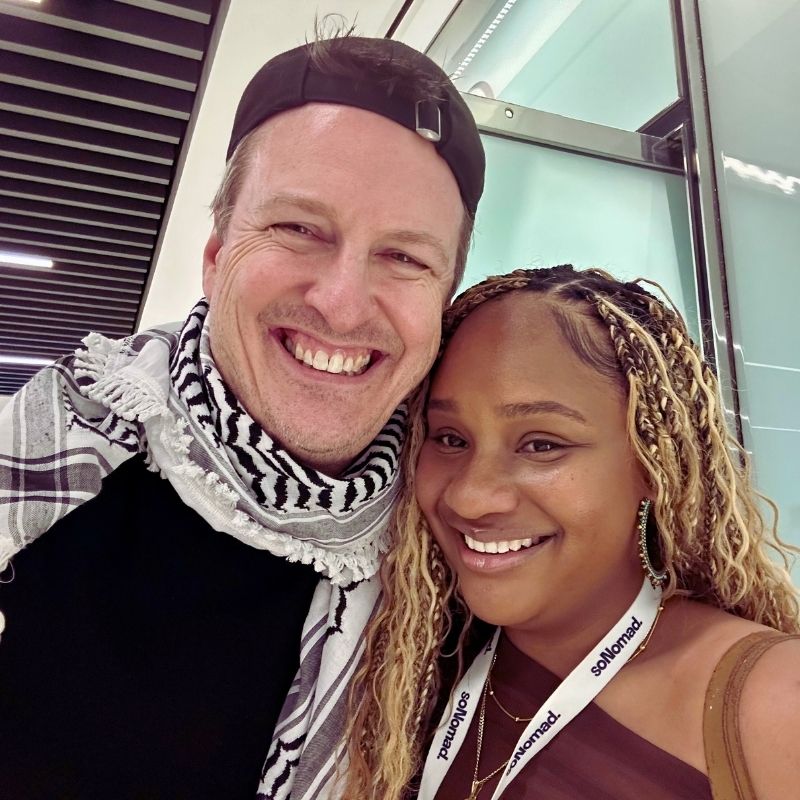
Matt Bowles: Representing BK to the fullest had to get the burrow in there for sure. Love that, Diva. Well, you and I actually met relatively recently. At the Nomadness Fest. And I thought that would be a really cool thing to just start off talking about for people who have not heard of Nomadness. Can you talk a little bit about what it is, your experience in the community and what the fest was like for you?
Diva Green: Yeah. So Nomadness Fest, I would call it a family reunion and I just became a part of the family because this was my first time going to Nomadness Fest, essentially a festival for travel content creators and people who are basically digital nomads and things like that. Folks of color who want to essentially come together and learn but also get to know each other spend some time. And so, this was actually my first Nomadness and it was really fun I went to like I would say for me very random Kentucky and had the best time That I can imagine in Kentucky.
And actually, I want to go visit. I keep telling my boyfriend, like, we’re going to go back and we’re going to go to Kentucky. I would have never thought that I would love it as much. And so, shout out to Nomadness for bringing us to, was that Louisville? If you’re from Louisville, you got to say it like that.
Matt Bowles: And we drank all the bourbon while we were there. It was an incredible weekend, and it was super special for me because I probably had about 10 or 11 Maverick show guests that attended Nomadness Fest, most of whom I had never met in person because I had interviewed so many people virtually throughout the pandemic.
So, there’s all of these people there, like Evita Robinson, who founded Nomadness, knew her quite well, interviewed her, never met in person until the fest. Libria Jones, Jeff Jenkins, Gabby Beckford, they’ve all been on the podcast. Had not met them in person until the fest. So, it was a really, really special in person experience for me as well.
So, and I got to meet new people like you. So, it was amazing.
Diva Green: It’s so funny you say that same here, because there’s a bunch of people that I’ve been following and connecting with online and to actually meet them in person, I feel like Nomadness Fest was like the perfect opportunity for me to connect with folks who do the same, same work as me, which is pretty cool.
Matt Bowles: Exactly. Really amazing community. Highly recommend people check it out. We’ll link it up in the show notes for sure. If you’re not already part of the Facebook group and part of the community, so you can learn more about it.
Diva, I think a great place just to start this interview would be talking a little bit about your background, which I know has played a large part in your travel journey and your professional journey as well. Can you share a little bit, maybe just going all the way back and talking about your parents’ background, where they’re from and their experience coming to New York city.
Diva Green: So, my parents are both from Panama on my mom’s side and my dad’s side.
They’re from a park called Colón, which is like a port city. And then on my mom’s side, on her mother’s side is they’re from a place called Bocas del Toro, which is like for some people a like beautiful surfing island for others, just like a great place to relax and enjoy the water. So, two beautiful places in Panama.
And so, my parents came to the States, I think they were both like around 18, 19, right? My father actually has a really funny story about why he came. He came to watch a boxing match with some boxer named Laguna. I don’t know, but if you say Laguna to somebody in Panama, like, they know exactly who you’re talking about. Yeah, he came and decided to stay and enrolled in the military. The story kind of goes on. And so, I think from the, my mom originally went to Jersey, and she said Jersey was just boring and cold and she just was not, she did not enjoy it. And so all of her friends, the Panamanian community, they were in Brooklyn.
And so, she made her way to Brooklyn. At some point met my father way later. And so here I am, I would say just growing up, I’ve been very much connected to the Panamanian community my entire life, just because there’s such a large community here. And so, whether it was like the Panamanian parade or being in like these Folkloric dances that we would do. My mom has, and my, both of my parents have really grounded me in the Panamanian community.
Matt Bowles: Can you talk a little bit about your experience navigating your Afro-Latina identity and the Panamanian identity, as well as what it means to be black in the United States and you know, how that evolved as you grew up?
Diva Green: Yeah, so. I went to a school called a bilingual center, which is like the predominant folks were people who are of Latino descent or of Haitian Creole, they spoke Haitian Creole and of Haitian descent, right? And so, it was again, bilingual school. And for me, I think I was very grounded because I went to a school where I was used to seeing folks who look like me, but when I went to high school, so that was like K through eight.
When I went to high school, similar situation in that there were Latinos, but there weren’t any like Panamanian folks. And so, me being able to speak Spanish, me being someone who is a Black woman, but also like not looking like the other Latino kids who are probably from the Bronx and probably had lighter skin, looser hair and things like that.
It was kind of like a double take when I would speak Spanish. Some of my African American friends, or even I would say, Caribbean American friends who weren’t from a Latin country would kind of be like, why is she hanging out with the, you know, Latin kids. So, it was kind of like, you know a weird kind of situation, but I think over time I was fortunate to be in New York.
And so, when I say I’m Panamanian, you can, some people could kind of get it, but others are kind of confused. But I think I was very much grounded in that, in the, in a way that people who are probably from, I don’t know, other States where there isn’t as big of a huge diaspora of Afro-Latinos, they didn’t necessarily have that. So, I was really fortunate to grow up in New York, I think.
Matt Bowles: Now, the other question I have to ask you is you grew up in the legendary borough of Brooklyn during the golden era of hip hop. Can you talk a little bit about that? And sort of when you think back to that cultural dynamic at the time, when you were coming up, what was that like and what impacted hip hop and hip-hop culture have on you?
Diva Green: Yeah. So, for me, I think growing up in a household that was very much focused on our Panamanian culture, though I am African American first generation and was born here in the U.S. I definitely grew up in a household that was focused on like Salsa soca, you know, reggaeton and things like that. My mother listened to everything, but hip hop was not a part of what she was listening to.
I got that by way of my sister who was a big Jay Z fan and really put me on to I would say hip hop and rap as a whole. She would listen to all, she had all of the CDs, and I really couldn’t touch them. So, it had to be when she was listening to it. And then for me, just, I would say that really helped me out in high school because there was a point where I was like, okay, I’m trying to hustle.
And I was going to school in New York city, specifically in Manhattan. And so, for me, I felt like I was like going to the grind. It was like a mode that I would put on. It felt like, this is how you get to things. This is how you really pursue what you want. Do you put this music on, you get into your zone, and you get it done.
And so, yeah, that’s what I was doing. It started from high school, kind of grinding and through college, definitely fell in love with the J Cole’s, but yeah, that, I would say that’s kind of my intro to hip hop is through my sister.
Matt Bowles: So, I also want to ask you about how your interest in travel started to develop when you think all the way back, where did that come from?
Diva Green: I’ve been traveling since I was a baby. My first time traveling, I went to Trinidad Carnival at two years old. And while I have no recollection of this, I did see videos of it. And it looked like a great time. My mom, she is like, I would say when it comes to travel, I’m so thankful for her because that’s the person that like, she was always down to go somewhere every year.
We would travel to whether it was going back to Panama or going to a different country, visiting a different state every year. My mother made a point for us to go and travel. And so, yes, she kind of sold that bug. And then when I even think about it recently, uh, for DLS, what those, um, we were celebrating and honoring our loved ones who have passed on. And my grandfather, my grandfather, he went to Brazil seven times with his wife. They knew how to have fun. And so, yeah, I think it’s kind of ingrained in us, even like, again, my mom on her side, her mother, her grandmother would take her all around Panama. So, she’s been like, she’s been able to see, you know, the country, probably not as much as an adult, but as a kid, her grandma took her everywhere. So, I think it’s, yeah, it’s very much a part of my, who I am.
Matt Bowles: And then can you talk about when you started traveling solo? I know your trip to Europe in 2014 had a really big impact on you. Can you share a little bit about that?
Diva Green: Yeah, that was such a time traveling solo. So basically, what actually happened is I got into a car accident.
And so, I had some accident money from that accident. It was very unfortunate, you know, back problems, whatever. I’m since much better. But the blessing of that is that I was able to take that money and say, I was going to go and travel and explore the world. I would have this reoccurring dream where my cousin would come and like, say, “Hey Diva, you know, I got six months for you to go to Europe”.
And I didn’t have my passport in the dream. I’d wake up and be like, “Why don’t I have my passport, right?” So I went, made sure that I renewed it. And the moment I got that, I said, I’m going to Europe. I’m going to go and explore. And I think Europe felt like an easy kind of transition. I don’t think that like, yeah, I was nervous about solo traveling, but similar to me moving to Mexico, it didn’t feel like a huge transition.
It felt like exciting and seeing things was very like, it was fun to explore a place that I hadn’t been to, but it never felt like, oh my goodness, I’m doing some crazy thing.
Matt Bowles: And then how was the trip in Europe? What did you do there? And then what was the impact of that trip upon returning?
Diva Green: I went to Barcelona. I went to Rome, Milan, Budapest, and where else? I think I did like a brief day in London, and that was like a real quick stopover. For me, it was like, I think the first time where I traveled to a place that wasn’t a Caribbean country or like a place in Latin America. So that was one thing. But I would say that summer specifically, I had been dealing with a lot of cis college.
So, I’m dealing with a lot of like learning about race relations in a way that I hadn’t known from a like systemic level. I could experience it and see what that was like just from a personal anecdotal space, but I’m in college like learning about how these systems are created and enforced to essentially oppress black people.
And so as during that entire summer, I wasn’t paying attention to any kind of news that was related to race relations from like the black community. The only thing I was focused on, I always say this is what was happening in the Gaza because my best friend is Palestinian. So, I was like, okay, I’ll look at this news for you, but I’m not looking at anything else outside of that.
And so, when I came back, the first thing I saw on my screen was Mike Brown. And it was jarring because I think I was, I remember being in the airport, which every time I go to the airport now, I’m like, where would I have seen that? Cause it felt like immediate. It may have been like, maybe I came out and went somewhere else or maybe I was transferring and that’s how I saw it.
But I saw it on the screen. I was like, wow, I’m immediately back in, into this shit. Like that’s, that was just. You know, the kind of the, the feelings around it and so fast forward to maybe like a few months later, I’m feeling very kind of like, it was such a great time being in Europe and exploring. I think even one time when I was there, I went to this area that was a part of Paris.
It’s near this area called Gare du Nord. I didn’t know I was in Hood. That’s what they told me later when I came back, whatever. I had the best time when I was there because I was like, “Oh wow. This place looked like Pickett Avenue”. And if you know, Pickett Avenue in Brooklyn is like, it used to be an area where people go and shop and you see all these vendors and I’m like, wow, I didn’t know Paris had these things.
I didn’t, I just didn’t know. It wasn’t, I really was just going to Europe, and I wanted to go and explore and see what I saw on TV, right? But later on, I’m realizing there’s black people everywhere. I would say coming back to the U.S. and engaging with the race relations in the way that allowing myself to read it and to because it’s really hard you know for me at the time I was using Europe as a break, a way to kind of separate but you can’t do that because even when I was in Europe, I’m seeing the Black vendors in Barcelona running from the cops and stuff.
So, there were moments where I had to kind of fuck up with it. But at the time I really was trying to distance myself. And so, coming back and seeing Mike Brown, it kind of just threw me for a loop because I hadn’t seen anything like that on the TV.
Matt Bowles: And just for folks’ context, just cause we have listeners in a lot of different countries and stuff.
Michael Brown was murdered by the police in Ferguson, Missouri. So, I just wanted to sort of set that context. One of many unarmed black men that has been murdered by the police in the United States. So that happened right when you came back and then go ahead from there.
Diva Green: Yeah. Here’s what I’ll say. Mike Brown, that, that happening for me, it made me feel like, okay, what can I do to support the Black community in a way that doesn’t deplete me. Part of the reason why I had to separate from focusing on race relations is because it really was stressing me out in a way that I personally couldn’t manage.
I just was like, okay, all of this news just makes me want to curl up in a ball and stay there. And so, when I came back, I think it happened maybe around like 2015 ish, I said to myself, “Okay, your ministry or your way of supporting the black community is going to be through travel”. It took me essentially, I was um, I was in some art studio, my friend had an art studio at the time and there was a march going on.
I said, okay Why aren’t you at this march? I was feeling very guilty. Eventually at some point while we were while we were there. I drew a fist, that’s like a black power fist and it was mixed with this Panamanian design. I won’t go into the details of that but essentially it was showing my solidarity between as a black woman of Latin descent, but also connecting to the struggles that happen here in the States.
And so, for me, I think that realization that travel would be my ministry definitely has propelled me, whether it’s been influenced by the experience of just learning about Mike Brown and seeing that on the screen, and then also for years, I didn’t necessarily. Execute in the way that I wanted to with I Got Your Black until with George Floyd and that kind of pushed me again. So yeah, I would say it’s unfortunate that these horrific incidents have happened But I will say that they’ve definitely been something to say to me “Hey diva, like you have to do something”, and so my something was really using travel as a platform to how people learn about the global black community.
Matt Bowles: Well, I know another person historically that influenced you has the same last name as you, Victor Hugo Green. Can you share for folks that are not familiar with that name, who Victor Hugo Green was, what he did, and how that influenced and inspired you as well?
Diva Green: Yeah. So, Victor Hugo Green is the creator of the Green Book. And the Green Book was essentially, a book that helped black people navigate travel and the Jim Crow essentially when people were trying to travel. They needed a way to stay safe and so knowing where sundown towns were was something that was listed in the green book knowing what businesses were owned by black folk, what businesses were owned by allies so folks could stop and get gas. Like simple things that we take for granted as travelers the green book helped the folks during that time really navigate and explore or not even to explore, because a lot of times folks were traveling by way of necessity, going from one place to another, whether it was to visit family or to, you know, just navigate the U.S.
Yeah, the Green Book essentially helped folks do that. And I would say for me, it’s interesting just sharing that last name because I didn’t know about Hugo Green until probably like, I would say, a year or two into creating I Got Your Black. And so, yeah, I would say that’s like my spiritual, spiritual uncle.
Matt Bowles: Hahaha. Well, you have created some incredible guides for black travelers and Afro-Latinx travelers. The first one I want to ask you about is just your home city of New York City. You put together an Afro-Latinx travel guide for New York City. Can you share a little bit about the process of creating that and then also some recommendations that you have?
Diva Green: Yeah, so creating the Afro-Latinx guide to New York City, I, for me, I would say I was trying to show my version of blackness. So, I think like, oftentimes when we think about black-owned, it’s kind of one big group, which is, you know, great for us to be supporting all of our communities. But I think also, I just wanted to show a little bit of the Latin flavor.
I would say just the process of doing it. I had to explore. I had to reach out to friends and ask them about places in their borough, because, you know, Brooklyn people, like, we go to two places, Brooklyn and Manhattan. Outside of that, we’re not going there. But I went to the Bronx. I was able to learn about this place that had just opened up, probably, maybe that year or maybe a year before, called Beach Stroll.
It’s like a hip-hop-themed restaurant. If you’re in the Bronx, definitely highly recommend you go and visit there. And then places like my cousin’s bookstore, Cafe con Libros, which is a feminist bookstore in, in Brooklyn. It was just really wanting to showcase the history of the community, but also the thing about the guides is they really focus on helping you navigate these spaces from a historical context.
So, like learning about Carlos Cooks, he was a leader in that would be in Harlem and talking about buying black. He was one of the first folks to talk about buying black and, really just stressing the importance of that. And so, the guides definitely help you explore a place, help you know how to go to what restaurants, what are the important things of the different streets that you’re going to, but also just the history of the people who live in these spaces.
Matt Bowles: Well, I also want to ask you about another travel guide that you created, which is called the Black Travel Guide to Havana, Cuba. Can you share a little bit about your experience in Cuba? And by the way, I’ve never been, it’s super high on my list. So, tell me about Cuba and then tell me about your experience and some of the highlights that you put in this guide.
Diva Green: Well, first of all, we need to get you to Havana. That’s like a month. I haven’t been post-pandemic, but Havana will always have a special place in my heart. I definitely want to go. Hopefully, I can make it back there next year. I have some primas and some cousins that are waiting for me and missing me.
So, this guy took three visits. This guy was not like, you know, you just go take a train up to the Bronx and you know ask questions because the thing about Cuba is that first of all ownership in Cuba that’s a complicated conversation, like, ownership in general is very much politicized and so to find places that were owned by Cubans of African-descent was just like looking for a needle in a haystack.
It was challenging but they have these things called, I think they’re called Paladores if I’m not mistaken, and they’re essentially restaurants that people would have in their homes. And so, I found a bunch of different Paladores that people would have in their homes. And then even just like, I wanted to find art spaces.
When I travel, I like to explore art. I’m really, I’m there to eat and to see. I want to see the dances. I want to listen to music, you know, that’s what I do when I travel. And so, I was able to visit this place called, there’s this art studio by this man named Generoso Betancourt and he had like, just like pictures and paintings that literally looked like my grandma.
Like, it was the weirdest thing. Like, yeah, it still blows my mind because I saw a photo that looked exactly like my grandmother and I just was like, how is this possible? But I think at the time that was me, learning more about the African diaspora abroad because I know that there were Afro-Latinos all over because I am one, but I think just seeing how blackness spans and just the different variations of blackness going there, I was like, people need to come and see this.
And so, I had created that guide and help people find the black communities in these spaces so that they can go and directly support. The visa that I used was support for the people. So, I wanted to do that, that very, very explicitly.
Matt Bowles: Well, we are definitely going to link these guides up in the show notes so that folks can go and read through the full guides.
You have more recently developed not only a guide, but you have developed a group trip to Mexico to experience the Afro-Mexican culture. And it looked unbelievable. I was following very closely on social media, the recent trip that you just did there, which looked incredible on every level, including the experience that you and the participants were having while you were there. I mean, everything just looked amazing. And I want you to talk about that. I thought they’d maybe just start off contextualizing for people and sharing a little bit about Afro-Mexican history and identity, and then talking about How you decided to structure your trip.
Diva Green: So, the Afro-Mexican community are folks who are African descendants who have been there essentially since the 1500s.
So, this is not like folks like myself who decided to move to Mexico and are either an expat or immigrants who decided to go and migrate to Mexico. These are people who have been there as a result of the slave trade. And then also, so that’s in the South in Oaxaca and Guerrero, I would say that that area is the highest concentration of Afro-Mexicans.
And then also, there was this informal Southern railroad. So, when we think about the underground railroad that went to the North, there was an informal one that went South. And so, these are all folks who, or actually, I mean, even add to that Texas, which is part of Mexico at one point was annexed.
And so there were people who lived there that were black, who suddenly became Mexican and, and there were folks who actually traveled there in order to get freedom in Mexico. And so pretty much it’s this community that are, that are African Americans, as well as Afro-descendants by way of the slave trade who make up the Afro-Mexican community.
Matt Bowles: And can you talk a little bit about how you designed the itinerary? What went into your selection of where you’re going to go, who you’re going to meet with, what type of experiences you’re going to have and what did the itinerary look like that you just went on?
Diva Green: So, the itinerary is designed to help you immerse yourself in Afro-Mexican culture.
Whenever I travel, I want to go where the locals go, meaning I want to eat what they’re eating, see what they’re seeing, and essentially experience their life. If somebody’s pia invites me to learn how to cook something in their house, that is like, Prime joy for me like that’s literally what I live for. And so I wanted the folks to have the experiences that I have but I know that everyone’s not going to show up to somebody’s house because somebody on Instagram gave them the contact like That’s just like I understand that and so for the past about what three years I’ve been going to La Costa Chica, which is a region in Mexico that is on the coast of Oaxaca and Guerrero.
And pretty much getting to know the community, learning about who are the local artists, what are the local foods that folks eat. And so, the itinerary was essentially designed. For folks to have that experience in a way that directly supported the local community. So, our hotel was owned by a person from Pinotepa Nacional, which is a part of La Costa Chica.
All of the businesses that we visited were either Afro-Mexican-Owned or indigenous-owned. And people were able to learn how to make the tortillas by hand using this device called the comal. They were able to go and speak to an artist, David Rodriguez, who is now becoming a world-renowned artist and learning about her story, going into the market and tasting the different foods.
The chocolate, they like chocolate is like a huge thing there. And being able to try that. Um, and really, the goal was each and every business that we visited was someone from the community. I would say, for instance, the very first night was a welcome night and we had a drink called Agua de Jamaica now in Mexico Agua de Jamaica is in the states people call it Hibiscus, in the Caribbean they call it Soru, uh some parts of western Africa they call it Bisab. And so, I wanted to be really intentional about folks trying things that connect the diaspora.
Um, and just that drink was like a great way to start with that. The person who made our food was of indigenous descent of that era. She’s a Mixteca woman and so kind of making sure that we pay homage to who was there before the Afro-descendants but also talking about the connections between the community tasting mole that is definitely of the indigenous folks there, but also you throw some nuts in there and that shows you the African diasporic influences.
So, I would say really showing folks the connections between the Afro community and the indigenous community in Mexico. I would say that’s pretty much what the goal was in Merciful.
Matt Bowles: And how did it go? What was the experience and reflections of the participants at the end of the trip and your reflections as well? How did the trip go?
Diva Green: So, I’m still reflecting. I can’t actually believe that I was able to do that. You know, imposter syndrome shows up in so many ways, and right before the trip, like a month before I was having panic attacks, like nobody’s business, honestly, because I really wanted it to be something that centered the community and felt like it was in support of the community, but I also want to make sure that I balance everything making sure that folks had a great time like my background.
I worked in events, but I was like girl, this is not just one day. It’s not a two-day quick little, you know this is a week and you’re responsible for you know, eight to ten people. And it went way better than I could have ever imagined actually it was I’m still kind of shocked that I was able to pull it off and nothing went wrong.
That’s I know people were like prepared for things to go wrong I mean, yeah, some flights were canceled when folks went back because of fog or something like that but in terms of the actual day-to-day of the trip everything went absolutely amazing. People sent me videos and posted reviews and they all were just so happy that they were able to experience it because I think this trip goes what did someone say?
You essentially, we’re saying it goes below the surface level. It’s not just like, we’re going to go and turn up and you get to turn up too, because we went to an area called La Punta, which is a great time. You know, you get to have fun and enjoy the Mezcal and, you know, have that kind of vibe, but we really prioritize immersing ourselves in the community and folks just loved it.
And I think I attracted the best group. I feel like those folks that came; they were divinely chosen.
Matt Bowles: That is amazing. And I, like I said, I was following it very closely online. I was watching all your social media posts and it just looked like an incredible trip. And I was like, I need to go on one of your future upcoming trips. Because I would love to experience that as well. Can you share a little bit? about when the next trips are and how somebody can join one of these trips.
Diva Green: We have one in March, July, and October, and each trip is specifically designed so that you can go during a time of celebration. So, in March, it’s like Holy Week, which is a time of turn up in Mexico.
It’s religious, but it’s also like a great time of like, fiesta. And then similar in July, there’s also a holiday for Santiago Apostal, which is specific to that area. And then in October, Dia de los Muertos, which is, you know, Day of the Dead. And that is like the biggest turn up all over Mexico. So yeah, it’s a good time.
Matt Bowles: Well, we are going to link up in the show notes, the direct links so that folks can get specific information on the exact dates of these trips, which are already set, and you’re able to sign up right now, and book them well in advance. You can see the whole itinerary and all that. So, all of that information we’ll be in the show notes.
Diva, I want to ask you now a little bit about some of your reflections on all of the travel that you’ve done over the years. And you talked a little bit about this journey that you’ve been on and sort of continuing to move towards centering the experiences of the African diaspora in the different places that you go and all of that.
And I also want to ask you about your reflections on navigating anti-blackness globally, because you mentioned that obviously, certainly in the United States, it’s really confronting, you know, and so forth. But also, when you travel around the world, there are some similar and perhaps some different manifestations of it as well. And I want to ask just if you can share a little bit about your experiences navigating anti-blackness globally. And also, any tips that you might have for black travelers, maybe that might be at the earlier stage of their travel journeys.
Diva Green: Yeah, I would say research. I always tell people to research what is going on the ground.
Even when I learned about the Afro-Mexican community, my biggest thing was how are the folks treated there? You might see folks talk about it, but I want to hear from the people how they’re treated in a space. And so, I would say doing research is one of the biggest things in terms of navigating and making sure that you know what’s going on other things about like how I’ve navigated. So, for instance, like I have my natural hair out and so I mean, you can’t always know the language I think you’re going to go a place and you may not always know the language but just be aware again of just like those interpersonal things. I find some folks who are part of the expat community say they never experienced racism and things in Mexico and that may very well be true.
And I’m happy that they haven’t had that experience, but you know, I’ve seen, and I think it’s because I know the nuances of the language and because I speak Spanish. So yeah, I would say, know how folks are treated and in place. But then when I think about solo travelers specifically, I would say, connect with other people who look like you there.
Whether it’s people who are of the Afro insert, whatever country, or if it’s like a fellow black traveler, I always find a WhatsApp group, Nomadness is a great platform to look up and say, “Hey, is anyone going to be in Lisbon?” “Is anyone going to be in Peru?”. And you’ll be able to connect with folks there. I always, the first thing I always look up to is Afro and then the country. And I just let Google take me down the ride and connect with the people who are in the area.
Matt Bowles: I also want to ask you if you can expand a little bit on what you mentioned earlier in terms of being aware of and attentive to and in solidarity with other struggles, other marginalized groups. You talked about indigenous people, for example, in Mexico, you talked about your consciousness about the Palestinian struggle for over a decade now.
And you and I have recently connected quite a bit in terms of trying to stop the genocide that’s happening in Palestine right now. Can you talk a little bit about the importance of obviously centering black narratives in the African diaspora and all of that, and also at the same time, being aware of and being in solidarity with other struggles of other groups as well?
Diva Green: I think that people like to play oppression of the Olympics, and I don’t believe in that. I think that the liberation of one group definitely lends to the liberation of another. And so, for me, you know, I have friends who are of various different backgrounds, and so it was just very important for me to know what’s going on in their communities and figure out how I could directly support them with Gaza and within Palestine specifically.
I will be candid and say, had I not had a friend who was able to humanize the people in that area for me, maybe I could have had a different experience, but I was able to directly see how my best friend was affected. And by the news, she had family that she was worried about their safety. And so, you can’t just be in a bubble and think that the only person and the only individuals experiencing struggle are people who look like yourselves.
We’re all going through having some experience. And so, I think it’s important for us to think about intersectionality and not operate as if we’re the only ones going through a struggle if that makes any sense.
Matt Bowles: Yeah, when you start looking into it, you’ll actually find that there are all of these incredible histories of Black and Palestinian solidarities that goes back so many decades and people like Angela Davis, you know, who’ve had relationships with Palestinians for so many decades and how these struggles are intertwined and all of these things.
And there’s a lot of that coming out now. I mean, online. It’s not difficult to find that because there’s so much awareness and information being able to spread about these really important histories and alignments. And you’re starting to see indigenous people all over the world, mobilizing in support of Palestine and everything else. And so, it’s really, really a beautiful thing, I think, to see all of these solidarity connections.
Diva Green: Absolutely. I’m just learning a really about. all of the different authors and political leaders that I love just by way of being someone who is of the Black community and in solidarity with advocates in the Black community.
I’m just learning about all of these connections. And I think that’s another thing. It’s kind of like we’re often put against each other, but there’s just so much history that is, it’s designed for us to look at each other as if we’re pitted against each other. When I even think about the Mexican community and the African American community, we are pit against each other so much, but there’s also been many instances of people working together for the bettering of our communities.
Matt Bowles: Let me ask you this Diva, just on a personal level, when you think back about All of the travel that you’ve been able to do now and all of the experiences around the world that you’ve been able to have, what impact do you think all of that travel has had on you as a person?
Diva Green: It makes me be curious. I’m always down to explore. I’m always down to learn and unlearn. It definitely is a process. I would say specifically with unlearning, if you kind of have things ingrained into you might believe something is one way, but I love realizing that what I thought, oh me shit. I got love figuring that out and being like, oh, so this doesn’t get me, this is actually was designed for me to actually learn this or believe this thing.
And actually, that’s all like, I got nothing to do with nothing. I love that. But also, being able to constantly put on a new lens and to be able to explore it. I just love learning about different places and to see how people experience life in different places trying New foods and cultures like I always mention food because it feels like the most accessible for anyone, like you can try new food in your house.
I always tell people to travel from home, go watch a video, and learn about a community through film or listening to music. You can start traveling right in your casa. But for me, anytime I go to a place because of how I was raised to be able to because I would spend my summers in Panama. So, for me, just being able to kind of do that, it allows me to be flexible.
That’s another thing. I think I’m very flexible in the way that I explore. And again, I go to places and think I know something and be like, “Oh girl, you don’t know nothing about this place”. And that’s fun. That’s fun for me, at least.
Matt Bowles: All right, Diva, I think that is an amazing place to end the main portion of this interview. And at this point, are you ready to move into the lightning round?
Diva Green: I hope so. I think so.
Matt Bowles: Let’s do it. All right, what is one book maybe that has significantly impacted you over the years you’d most recommend people should read?
Diva Green: This year I read a book called We Should All Be Millionaires by Rachel Rodgers. I just think that book, like, I sent it, I bought it for people. I sent it to all my friends. I think it’s just, it’s specifically about women and the, not just the path to how to be a millionaire, but really just the importance of why women specifically should be striving for this. I think that women are taught to think that we are not good with money, cut back on the lattes, don’t drink this or don’t go and spend this.
But really when women are in power and when women have the capital to have influences, we support our communities. We’re able to make changes in ways that you can’t do without money, honestly, in the capitalistic world that we live in. And so, yeah, I would say that book.
Matt Bowles: All right, Diva, if you could have dinner with any one person that’s currently alive today, that you’ve never met, just you and that person for an evening of dinner and conversation, who would you choose?
Diva Green: I would say probably Rachel Rogers right now. I’m like obsessed with this woman. She has a podcast too. And I just would love to kind of get into the mind of someone who, from New York, you know, got to support from Queens and who essentially is on their way to becoming a seven figure earner and specifically how she used that to support the communities that she loves.
Matt Bowles: All right, Diva, knowing everything that you know now, if you could go back in time and give one piece of advice to your 18-year-old self, what would you say to 18-year-old Diva?
Diva Green: Keep doing what you’re doing. Keep marching to be your own drum. It’s going to make sense at some point.
Matt Bowles: Of all the places you have now traveled, what are three of your favorite destinations you would most recommend other people should definitely check out?
Diva Green: Absolutely, Cuba. Us talking about the guide, Cuba is like, “Oh man, I got to get back there”. Cuba for sure. I would definitely recommend folks to visit Antigua.
I went to Antigua last year. I was surprised. I don’t know why, but I feel like that might be one of the most beautiful Caribbean countries I’ve ever been to. And then I think the third place is still out there for me, to be honest. I think that like; I’ve definitely loved all of the places I’ve gone to. And there was a point where I had like this love story with Cuba, which is my favorite place in the world. But I think that the next place is a place I’m going to visit next year.
Matt Bowles: All right. That leads us to the next question. I’m going to ask for three of your bucket list destinations, places you have not yet been highest on your list, you’d most love to see.
Diva Green: Peru, Lisbon. I really want to go to Japan. Yeah. I really want to go to Japan. I feel like that’s just going to be crazy for me. That’s going to be a whole nether level.
Matt Bowles: Those are amazing picks. I’ve been to all three of those places. So, when you’re ready to plan those trips, hit me up, Diva. I got you, but. Excellent choices.
Diva Green: I definitely reach it out.
Matt Bowles: All right, we have now come to the most important question of this interview. Diva. I’m about to ask you to name your top five hip-hop emcees of all time. But before you do that, can you share a little bit about just what hip-hop means to you and why you love hip-hop music and culture?
Diva Green: Hip-hop is hustled for me. When I think about hip-hop, I think about hip-hop. Get into the bag, take care of your business, and hip-hop definitely grounded me throughout high school, college, those were, that was what was in my ears. And music is super important to me in general. And when I turned on my whole, I unstoppable couldn’t talk to me about nothing.
Matt Bowles: All right, Diva, who you top five?
Diva Green: I said it already. Hov, Jay Z, always going to love the Jiggaman. Uh, definitely Kanye before all of this, whatever this is that he’s doing. Kanye before that J Cole, and Kendrick Lamar. Yeah. I might have to cap it at four.
Matt Bowles: All right, Diva, I want you to let folks know how they can find you, connect with you, follow you on social media, learn more about I Got Your Black and also learn more about these upcoming trips. And are you able to offer a discount to The Maverick Show listeners if they want to go on one of your Afro-Mexican experiences?
Diva Green: But of course! Okay, I’ll start with where you can find me. I am igotyourblack on all of the spaces. And my website is igotyourblack.co. You can find the Afro-Mexico experience linked on all of our platforms. And then, of course, I’m going to make sure that The Maverick Show gets 300 off on our upcoming experience, March, July, and December in October come through.
Matt Bowles: Amazing. We are going to link all of that up in the show notes. We’ll give you a code Maverick that you can use so you can get your discount on upcoming trips as well as the direct link. So, you can see the exact dates and the itineraries and all of that amazing stuff. You are probably going to find me on at least one of those trips because this looks like an incredible experience. So, everything is going to be in one place. Just go to themaverickshow.com and go to the show notes for this episode. And there you will find everything we discussed in this episode.
Diva, this was amazing. Thank you so much for coming on the show.
Diva Green: Thank you. We got to do this in person sometime.
Matt Bowles: Absolutely. We need to link up in person very soon. All right. Good night, everybody.