
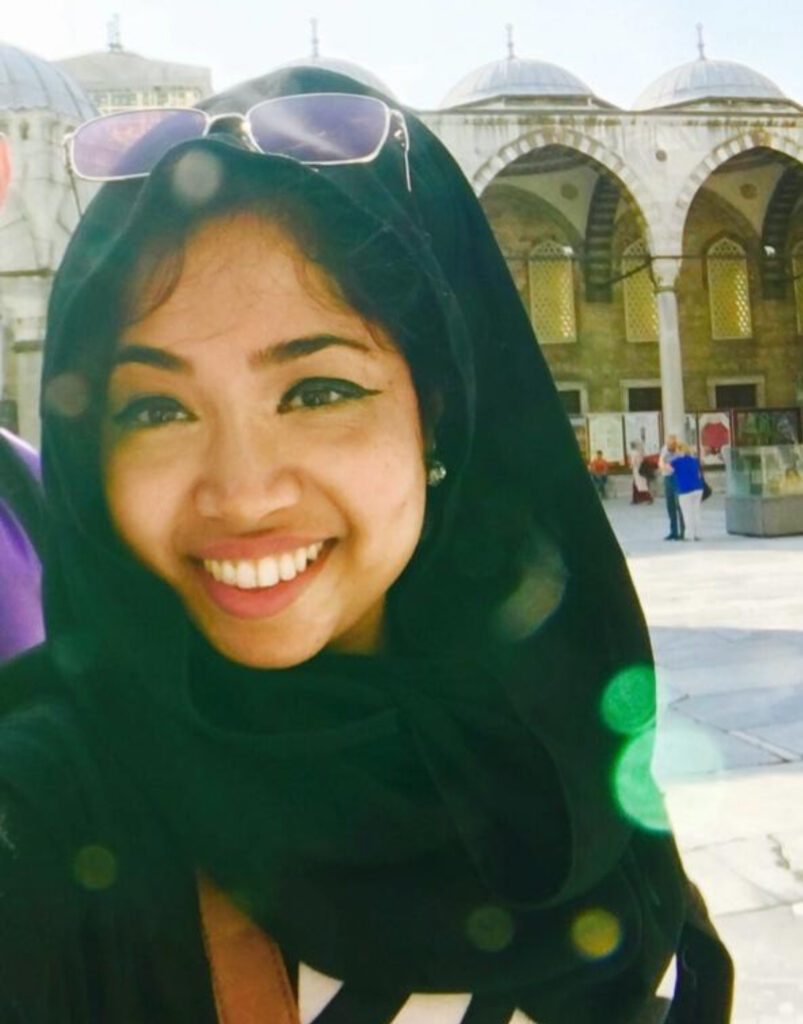
Matt Bowles: My guest today is Nusrat Mutmaina, better known as Roshni. She is a microbiologist and world traveler who grew up as a third culture kid predominantly in the United Arab Emirates with stints in Bangladesh, UK, Canada, and now the U.S. She speaks four languages and has blogged about traveling through the lens of a third culture kid about how different countries evoked a memory from childhood, traveling on her Bangladeshi passport before transitioning to a U.S. passport and volunteering with Doctors Without Borders. Roshni, welcome to the show.
Roshni Khan: Hi, thank you so much for having me.
Matt Bowles: I am so excited to have you here, but let’s just start off this episode by talking about where we are recording this from today. I am currently in Lisbon, Portugal. And where are you, Roshni?
Roshni Khan: I am currently located in Pennsylvania. Yey.
Matt Bowles: Where in Pennsylvania, just for folks that are familiar with the state.
Roshni Khan: So, I’m based out of Southerton, Pennsylvania, one of the Phillyburbs. We’re 40 minutes away from the beautiful city of Philadelphia. Yey.
Matt Bowles: I’ve spent a lot of time in Philly. I feel like it’s actually one of the more underrated cities in the U S and I always encourage people to check it out. Cause it has a lot of cool stuff going on.
Roshni Khan: It is. And I really wish people would come down for food tours more often because of the diversity of different neighborhoods and foods you’re going to find within the burbs, within the city, whether you want Bangladeshi food, you want Ukrainian food, you want Uzbek food. Like it’s, I will say Philly is very underrated.
Matt Bowles: Well, the next time I am in town, I definitely want to do Bangladeshi food with you and have you show me the best spots.
Roshni Khan: Well, in true Bangladeshi fashion, I will say my parents will very insist on hosting you. It’ll be a big family gathering. So, I will definitely be extending that invitation.
Matt Bowles: There are very few things in this world. I like more than homemade Bangladeshi food. So, I will never turn that invitation down. That is amazing. And I think that’s a great segue here to start off a little bit with your Background and your story. And I think even before we do your personal story, maybe just talk a little bit about your parents and your grandparents’ story and give folks a little bit of a sense of your family history and going back maybe for folks that aren’t familiar with the history of Bangladesh, maybe just starting back before the partition of India and Pakistan in 1947 and talking a little bit about your family history and what their experience was like through that period.
Roshni Khan: So, this whole digging into like family history, something that I’ve been doing for a couple of years because there’s a lot of untold stories. My mom was actually a history major and a lot of her passion for history came into me. So, I’ve been trying to put together a lot of untold stories because.
The generation is starting to move on in the sense that a lot of people who’ve experienced these are passing away. So, this became kind of like a passion project. So pre-partition, they were actually based in, what is considered now the Indian side of the Indian subcontinent at that time, or my parents still refer back then as Bharat.
My dad’s side, they’re living in this town called Balurghat, and when the partition movement started to take traction, they had a lot of Hindu neighbors around them, and unfortunately, you know, as the situation was unfolding and families started to move from the Indian side to the Pakistan side, my grandfather’s neighbors, they came to alert them that, hey, the situation is not looking good.
And we have like, for your own safety and security, we’ll help you, we’ll help you move from here. And that’s how he at that time moved from the Indian side to the, what was considered the Muslim side, which was then East Pakistan. There’s like lots of stories like this where of neighbors. We’re looking out for their neighbors and my mom’s side where my mom’s family was also located in this area called Hilly.
And when partition happened, it split into India Hilly, and it was called Pak Hilly. And again, when they were in the India Hilly side and their Hindi neighbors again, looking out for them, I came up to them and was like, “Hey, you know, the situation is not starting to look good. We can help you move to the other side”.
And they actually helped my mom’s dad secure property on the Muslim’s side. And they made their move, and these moves were not just like how we plan, like, you know, okay, get a moving truck and all that. This is a move of millions of people where overnight you’re just sometimes leaving with your clothes and just a few items and hide your money somewhere on you because you don’t know what you’re going to experience on your journey.
So, my grandmother, my mom’s mom had her, she was maybe like in her early teens at that time, and she had her younger brother on her back. He was really young, and she was holding on to another brother as they were crossing from the India hilly and going into Pakistan Hilly. And in the Pakistan Hilly side, this will play an interesting role later on.
Um, the house that they had bought. They had at that time, you know, some Muslim neighbors were living on either side, and they were Urdu speakers. And this was something that. Because it was more divided based on people are making decisions, okay, if they want to stay in the India side, whether they’re Muslim or not deciding they want to move to the Muslim side, but they didn’t differentiate.
Hey, they’re Urdu speakers or they’re Bengali speakers. It was like, okay, let’s move to the Pakil area. There are Muslims, there are neighbors who came with the news that something’s going on. And so, they moved to the Pakil area. So as this movement happened, and they settled into their home, their home was actually pretty close by to a train station.
And this was part of the British-built railways within the country, and my mom’s grandfather had to meet someone at the train station and go there for something. He was met with the arrival of a train filled with dead bodies as blood was leaking through the cargoes and dripping onto the railroads. And this is a lot of the result of communal violence that ensued during partition. So, a lot of heavy stuff.
Matt Bowles: Yeah, for sure. And then, can you talk a little bit then about how your family ultimately settled after the partition and then the lead up to 1971. And talk a little bit about the Bangladeshi liberation movement and the genocide that happened at that time as well and what their experience was like, I guess, in the lead up to that and then through that time period.
Roshni Khan: All these stories are my family stories, and these are their lived experiences. And what happened was that there was a push to unite East Pakistan and West Pakistan and one of the ways to bring the unification, one of the last things that came down was the language that was being spoken because East Pakistan had predominantly Bengali speakers and West Pakistan had predominantly Urdu speakers.
Prior to that there were growing grievances on the East Pakistan side over building of infrastructure, getting funding from the government. So East Pakistan was not developed as well as compared to West Pakistan because of how the central government was distributing money. And that led to a parliamentary election, and it was in 1969 and the majority of seats was won by East Pakistanis and who happened to be mostly Bengalis. And that led to like a series of historical and political actions where East Pakistan was going to move towards cessation and the West Pakistan government decided to take action.
And I’m not going into the details because there’s a lot of key details in the political movement. I just wanted to kind of share how, what my family faced during that time. And as word of unrest started to come around, the Pakistani military started to come into Bangladesh, and they set up checkpoints.
So now the military was trying to occupy key areas in Bangladesh because the movement for speaking Bangla gained a lot of traction, hat was the last straw. Bengalis as of today, I will tell you, we are very proud of our traditions. We’re very proud of our culture. We love our songs. We love our food.
We love our language. And we fought to preserve our language. And that I think marks the 21st of February. I believe that’s the mother language day. So now we’re at this point where the Pakistani army has set up checkpoints and a lot of what I’m going to share plays a role as I grew up, there was also this ideology that Bengalis were seen as lesser human.
We were considered almost like a lower caste type, even though we didn’t really have a caste system. Our language was seen as similar to Hindi, which was seen as a Hindu influence. And that kind of played a role in us being seen as lesser people. So as this was growing, like, you know, you have now East Pakistan that’s occupied by West Pakistani army.
There are military checkpoints that are set up. They’re checking people’s identity cards, they’re checking cars, my dad was, used to go through these checkpoints looking for ammunition, checking if anybody is part of the resistance movement, and then in addition to how they were seen, Bengalis were like at these checkpoints, they were beaten.
They were dehumanized a lot of the time, and then like the fighting started to break out. So, after I think martial law was instated between March to December, severe fighting started to break out. And from the checkpoints, uh, it started to spread to the army, started going to universities. They started to find high-profile individuals who were in favor of the liberation of Bangladesh.
And between March and December, it started to unfold into a lot of the leadership was being killed, and prominent Hindus and Muslims were being killed. We women were being kidnapped by the occupying forces and they were taken to, unfortunately, rape camps. So, my grandfather, during this time, he had four daughters and they had four sons.
And, even though severe fighting was more in Dhaka and Chittagong, my family is based in the north. And as fighting was starting to inch up, he decided to like to take everybody and they moved to the refugee camp in Balur Khat, which was on the India side of the border. And because of the situation in refugee camps, like, you know, food is scarce, there’s a safety issue, who are in refugee camps, you know, people who are not armed.
And what if the occupying forces came and attacked the refugee camps? There were definitely all these like insecurity issues and food insecurity issues that they were able to like to stay there for maybe like a month or a month and a half. And my dad at that time was actually working in a different area, and he was trying to come back to reconnect with his family.
He was working in this area called Jaipur Hut, and severe fighting started to break out. And the day that he was returning to reunite with his family, my grandfather came to pick him up because my dad is a young man in his 20s. He could be either swept up by the occupying forces or the resistance movement was also going around looking for people to join their forces.
So, he came with an individual who was an Urdu-speaking person to pick up my dad. And my dad was like, okay, you know, why is this person here to come pick us up? And it was then they realized that. If you have an Urdu speaker with you, they’re much less likely to pull you over. That was literally like, okay, don’t shoot me because I have someone who will vouch for me who’s an Urdu speaker.
So, there were a lot of like those instances. And once my dad met up with my grandfather, he had some friends who he had intended to like, see them the next day. And he caught up with one of his friends and was trying to convince him and his wife to like to move out of the area where they were staying in because the fighting was spreading really fast.
And what the occupying forces were doing was they were taking groups of men, taking them to the schools and just, you know, what they call brush fire, single-handedly killing like 100 people, and they’re throwing like mass graves. And my dad’s friend, he’s a very close friend of my dad, and he was like, no, you know, don’t worry, you know, we’re a family, they’re not going to like come to us, we’ll be fine.
And the next week, my dad found out that his friend had just seen him. at 10 p.m. the night before. The next day, the occupying forces invaded his house and broke into his house because somebody reported that, oh, they might be part of the resistance movement. They butchered him and they stuffed him into the steam engine of a train, and his body was found later, and his wife was to be taken to one of their rape camps, but somebody intervened because she was heavily pregnant and she’s still alive today. I have not been able to reconnect with her, but these are some of the horror stories that had unfolded during that time.
Matt Bowles: So how did your family make it through that period? Because that ultimately culminated in what is now known as the Bangladesh genocide, where somewhere between, I think the estimate is anywhere between 300,003 million people were killed in like nine months. So how did your family make it through? And then what was it like in the years after that?
Roshni Khan: My mom and dad said the family, they were on the northern side and because they’re close to the Indian border, the Indian government at that time was providing like refugee support. At the border, they were also providing support to the armed resistance against the occupying force. In my parents’ opinion, they felt that the fighting did not move as close to the border because now it’s possible you’re going to be pulling India into the situation. So, in their understanding, the fighting was to stay at a certain place, so it does not. You know, pulling out like a greater regional fight with my mom’s side of the family.
So, my, I will say this, my mom’s mom, I love her. She is my grandmother. She is the most stubborn person I have ever met. And I love her for that. She is a woman who stands her ground, and she will not bow down. And I’m saying this from the perspective of secure things that unfolded. So, my grandmother had, I think, three or four sisters and one of her sisters had come in to visit her as the fighting broke out and stuff.
And she was like, what are you doing here? Like you need to leave the town because the situation is not looking good. And they left, they left the town to go to one of the remote villages and they just left overnight and now mind you. Violent issues infrastructure was not the best at that time. You don’t have like, you know, the cars that are going through sometimes you’re going on like a car drawn by a donkey or like by an ox or, or with the horse.
So, they managed to escape that town and they went into the first rural village. And in these villages, it was hard. It was hard. Like when, when my mom talks about it, like, it was very hard to have like your grown three daughters with you trying to hide in the villages because now you’re deep in the village, but you also don’t have any like armed protection around you.
In a few days, they, uh, they were saying of the village, this man came running saying that the occupying forces are coming. Run. Like, just run. And I kid you not, all the girls, they just ran for their, like people scattered, but like my mom and her two sisters, they just ran. And my mom was saying that we ran.
We didn’t know where we were running. That fear of being captured and what they’ll do to you. They kept running. My mom fell into a tunnel, a sewage tunnel, and her sister jumped in with her because they just ran, and they looked behind her. They looked behind to see if they were like being followed. And so, so they stayed in that tunnel for a bit.
And this is like. you’re like in sewage now. And they apparently had some knowledge that the occupying forces, a lot of them did not know how to swim. So that was one of the things, okay, either we get into the water and hide and figure it out from there or just keep running further deep into the remote areas.
And as it was starting to get like a little dark, so they decided to like, okay, like they ran again. They probably ran like close to a mile, if not over just running for their lives and they hid in this little shed, which they later, it turns out that it belonged to like some of the beggars who would live in that area and that they’d had like a little underground thing dug into it.
And they hid in there a couple of hours later, my grandfather and the brothers, like the men came out searching for like, for all like the young girls that ran off, they were like located and then they were brought back. But the situation in the village was also not good, you know, I mean there’s no proper bathrooms, a lot of its outdoor bathrooms, access to food and stuff, so they ended up trying to like to find other relatives who are like in the different villages.
Before getting confirmation that it’s okay to come back. And then when they would come back again to the town, which is Naga they lived in, again, they were getting word that, okay, occupying forces were going to come and they left again. And it, so there was, there was a lot of this movement. So before, like, they decided to come back.
They sent, my grandmother sent her brothers to go see, okay, you know, go check what’s going on. Is it even safe for us to go? And this is my grandmother’s home, which I last visited two years ago. And her brothers, they came up near the doorstep and just, they just peeked over and, their home was occupied by the armed forces, the Pakistani forces.
I don’t know if they were just waiting for them to come back. What if the family had walked in and the situation did not look at any pay? My grandmother’s brother just ran. Like he just, he just somehow managed to not get caught and he just like ran and left the area. So that’s, that was with my mom and her sisters.
There was a lot of time hiding in the villages and also masking themselves to look like younger girls, because if someone is like noticeably in, you know, the teens and stuff, again, the situation does not look good. They are targeted to be taken to like these camps and stuff. So, there was a lot of that going on as well.
Matt Bowles: Just to give people context, there were hundreds of thousands of women that were raped in these rape camps as part of a campaign of genocidal sexual violence. So, what a terrifying time. I mean, that is it
Roshni Khan: It was absolutely terrifying because what the forces were doing is they were taking them to the camps, impregnating them and releasing them back to the public after badly beaten and perused.
So, it’s not like they were killing them mercilessly. It was torture. It was essentially form of torture, and they were released back into the public. The Bangladeshi government recognized the atrocities that were done to these women, and they were called national heroines. Because early on, a lot of women faced a lot of issues in society, but the government decided to elevate their status because what happened is not fair.
So those were like some of the incidents that happened with the immediate family. Before like the war broke out, it was not unusual for East Pakistanis to work in West Pakistan. So, there were Bengalis that lived also in Lahore and Karachi. Again, there was also a systemic issue where they weren’t really doing like high-ranking jobs that was usually reserved for other ethnic groups in of Pakistan.
So my Mom’s aunt was living in Lahore at that time with her husband and they just had a baby and this is again, as the tensions grew, they were living in an apartment building, uh, with other Bengalis and they had some, you know, Urdu speaking neighbors and friends as well, they made while they were living in Lahore and around like evening time, one of their neighbors came over and they were like, the news is not looking good for Bengalis in Lahore, you need to leave.
Like, it’s not looking good, it is very likely this building is going to be raided, and you will not make it out alive. And so, these neighbors, they’re Urdu speaking neighbors, right, like, they’re West Pakistan, Pakistani neighbors, helped them get on the next bus, and they went to the Afghanistan border. So, they fled to Afghanistan first.
And then from Afghanistan, they managed to get on a goods truck, like, that was transporting, like, commercial goods. They hid in the back of the truck. Now you have my mom’s aunt and her husband and their child and my mom’s son. And she dressed up in like traditional Pakistani clothes. And then she had the Afghan burqa on, uh, with her child in order to not be detected as Bengalis who are fleeing the area.
So, they were in the back of this truck. The truck had stopped as well at some point. And she told me that they were literally, they were in fear. They’re like, maybe this is the end. We will not make it, make it back to see our family. And because they could hear like people like checking the materials truck, like, you know, okay, what’s in there and stuff.
And luckily, they were not uncovered from the back of the truck and the truck was allowed to move on and made its way to India, and from within India, they managed to travel back into East Pakistan and made it. So, this was like a three to four-month journey. So, I wanted to give like a little bit of context to some of the fears that, uh, that a lot of people had in, in the East Pakistan time, there was a lot of the Pakistani occupying forces, they were mostly Punjabis.
And I’m saying that is because a lot of Bengalis over the years after Bangladesh became independent, there was, a deep-rooted fear of the association of Punjabis and how they looked down upon Bengalis, how they saw Bengalis as subhuman. And even though that was not something they chose; it was something that was brainwashed into them.
So, some of this has like transpired. hired into my parent’s generation, that fear. And, you know, when I used to hear these things, uh, from my mom, as I grew up and she’d ask, you know, who are your friends from school and stuff? And one of the questions they would ask, like, “Oh, are they Punjabis?” And I would be like, “Mom, you’re so racist. Like, why do you need to know that?”
And when I got older, I realized it’s because of this deep-rooted fear of the killings that were happening during the East Pakistan time and the people who were going after them, that’s what they identified as. So that’s what I understood. Now I understand that that’s generational trauma that’s speaking for them.
And I wanted to share like another story that’s where Urdu speakers were also targeted in during this time in East Pakistan because The Urdu speakers were, there was a group of Urdu speakers known as Biharis who were motivated by the West Pakistan government that, hey, if you know anybody who’s resisting, you know, let us know, and they were kind of seen as snitches.
So, when my mom’s side of the family moved during partition, my mom’s grandparents, they moved from India Hilli to Pak Hilli. And I mentioned earlier that their neighbors were Urdu speakers. So, what happened during now, now after partition, 1947, now in, during the 71-liberation war, because Urdu speakers were seen now as traitors by the resistance movement, they also were getting attacked.
Urdu speakers who had nothing to do with the resistance movement, they’re just families that’s just trying to live their daily life. Just, you know, survive this whole movement. And my mom’s grandparents, their neighbors, one day, my mom’s grandparents, they wake up and they noticed like a lot of like commotion and stuff.
And the resistance movement had come and killed all their neighbors and two children, a boy and a girl had escaped from one of the families and they ran, knowing that my mom’s grandparents, they were Bengalis, they ran up to their door and they begged for them to like, save them, like, like, please protect us.
So, my mom’s grandfather, he hit the girl inside a box. It’s called, I feel, I forgot, I think it’s a, it’s a box where they keep like a lot of blankets and he will, he hit the boy. So the resistance fighters, they turn up to the door and they’re like, we’ve seen traitors enter your house. Even though they’re children, they’re like nine and maybe 11 years old.
And they were like, if you don’t surrender, we will have to shoot you because you are collaborating with the traitors. And they started to ransack the house and they found the girl. And they immediately were like, we knew you were, you were hiding them. And, my mom’s grandfather, he fell to his knees, and he asked them like, please do not kill her.
You are, you are Muslim, marry her, protect her. And when I heard the story, I was like, wait, what? But this is in the heat of the moment were. Your family could be killed for collaborating with traitors, and the surviving members of your neighbors could be killed in the process. So, he just begged them, like, please, like, don’t kill her, just marry her, protect, keep her under your protection.
She has done nothing wrong, she’s a child. And then, you know, they took the girl, my mom’s grandfather, he kept the boy with him and adopted him like his own. His name was Jassim. Three, four months after the liberation war ended, like he raised Jassim as his own, sent him to school, gave him an education and stuff.
And life continued, you know, to move forward. Then one day they find that Jassim is gone. Where is Jassim? And, my mom’s grandfather was, he was, he was pretty devastated because this is someone he took up as his own to protect him from the chaos of war. And three to four months after Jassim had disappeared, he received a letter from Jassim.
Jassim had sent a letter from Pakistan. He had. got in contact with his sister who survived the war, and he reunited with his sister in Pakistan. So, from that, we essentially deduced that the resistance movement, the Freedom Fighters, had probably given her safety and taken her possibly to the Indian border so that she could make her way to Pakistan and reunite with her brother.
And her brother reunited with her years later. It’s, I feel like in the whole chaos of war, if there’s anything that I’ve learned, there’s always people who will provide some form of safety. There will be people who will help. There’s the human element of whether it’s the Hindu neighbors that helped that side of the family moved across the border into Pakistan or the Pakistani neighbors that helped my mom’s aunt leave Pakistan through Afghanistan and for their safety, or my mom’s grandfather, who took in a boy and a girl to save them from their own resistance movement. Like he doesn’t even know if they would even kill him, right? Like he doesn’t know, but he’s like their children. They did not ask to be a part of this. It kind of gave me an insight into, you know, the chaos that happens in war and not all people subscribe to the ideologies.
Or, to the, the hate that, you know, um, accumulates in war.
Matt Bowles: I think that’s such an important lesson to take away from all of this. And whenever I travel around the world and I go to places where there have been genocides or there have been, you know, any type of conflict with power asymmetry and, you know, oppressive power relations and stuff like that, I’m always looking for you know, who are those members of the dominant group that spoke out and that helped, you know, the low power group or the victims of the genocide, or they hid them or they helped them escape, or they, you know, stood up, you know, in certain situations and things like that, because you will always find those people.
And it’s really amazing and heartwarming to look for that in these situations, because, you know, as you mentioned, depending on the situation, you know, one group might be the high-power group, but another group is the low-power group. And then in a different. situation or another historical period or another geographical location, it’s switched around, you know, and, and a different group is being oppressed by another group and stuff.
And so, I think, you know, just being able to take those sorts of universally principled humanitarian stands, whether your group is. You know, doing the oppressing or being oppressed and being able to sort of take the upstanding position is so amazing and so inspiring.
Roshni Khan: Absolutely. And there are, whether it’s from the partition or the, the inhuman war that happened against like Bangladeshis to even now, like there will be people that will stand up even. Risking their own lives, right? They have a lot more to lose. And we see that even with the present-day political situation, people, allies, and people who are standing up still risking, right? Gives me faith that there is good in this world and look for the helpers.
Matt Bowles: A hundred percent.
Roshni Khan: Look for the helpers. It will keep your hope up.
Matt Bowles: I totally agree with that. So, Bangladesh was established by 1972. Bangladesh was officially a state. Can you talk about the period after that and what your family’s experience was like in Bangladesh and also your grandfather’s commitment to girls’ education and some of that stuff that happened after the liberation of Bangladesh.
Roshni Khan: So, my Dad’s dad, who I’m going to refer to as grandfather in the rest of the story, just because we use different, like gendered grandfather, where’s my Nana or my Dada. So, I’m going to talk about my Dada to any of my, to any Bengali speakers listening. And he was a very unique person. I, again, am another very stubborn person that I’ve encountered.
And it’s one of those things where, you know, his stubbornness, was for the right cause. This is someone who was born in the 1920s and he grew up during a time when women’s education was not really at the forefront of anything. I don’t even know if his mom made it to school when he got married. His wife, maybe like my daddy made it to maybe second grade because it wasn’t prioritized education, but he was someone who was a staunch believer Believer.
I feel like he was the socialist progressive of his time, seeing that a society will only progress if women are progressing. And how do women progress? You need to support them, and you need to provide them with education. He had a lot of struggles himself. With education funding, his education, he ended up studying, he did his undergrad, and he did a master’s in Arabic, and he did a master’s in English.
So, he also believed in the importance of learning English because you need to, at that time he was born during the colonial time, this is before India was independent of the British colonial rule. And in his ideology was that in order to beat the oppressor, you need to speak their language, which was English.
I’ve actually brought his books over from then. He has books from like 1920s, 1930s, and 1940s that he would order by mail from UK or from different parts of the world, stamped and his signature and date of purchase on it. So, he’s very staunch believer in education and reading, and it’s something that’s transcribed into our generation.
And after Bangladesh was liberated, there was definitely a lot of like chaos within the country as the country’s trying to stabilize and trying to, you know, build this infrastructure. One of the unfortunate situations that happened was. In 1974, there was flooding and bad mismanagement of rationing food to different areas that there was some famine, starvation.
And my dad would tell me that even like you would be traveling between cities and sometimes you see dead bodies on the side of the road, people who died from starvation. So that definitely created a lot of. social issues. My dad is also very pro elevating like women’s education status so that they’re not dependent on anybody for their survival, right?
One of the problems that happened in South Asian society is when there’s lack of education, there’s lack of movement, social mobility and economic mobility for women. So, my dad, in order to support his sister’s education, his brother’s education, he decided to move overseas. And my grandfather in this process, he actually started first I think this was actually before pre liberation. He actually started first. He converted a madrasa into a school, into a college, sorry. And what that meant was now this is going from like an all-boys system to a system that will, uh, educate women and men. He later on established his own college called Asanmula College and that was like in the 90s.
My biggest question is how is it somebody from a small village who did not have any access to like, you know, print media or anything like that started to think that You know what? We need to educate women. Because him being progressive in his views for like education and converting a madrasa to a college and then establishing like another college and then providing additional funding for girls who are coming from poor areas to support their college tuition.
He faced so much backlash. In the early parts of doing this type of social change, and I would hear stories from my dad, like, you know, he’d come so frustrated, you know, like, because the education department isn’t doing this, because that department isn’t doing this, because they’re blocking him from doing this.
And he was like, why is it that trying to bring education to the forefront is such a difficult and controversial issue? It shouldn’t be. And after the liberation war, he played a strong role in supporting all his daughters through education and he enforced that in my dad too. When my mom and my dad got married, my mom was not able to finish college, and both my grandfather and my mom’s sister-in-law, like my dad’s sister, they were like, we will support you in one way we can.
Because if you have access to education. It’s just your thought process and everything will evolve with them. Life will get like a little easier. So, he also had lost his eyesight in this process. He, I think he, he lost his eyesight on his left eye and he’s pursuing all these goals. He’s a voracious reader.
He built a library on his second floor. With lots and lots of books and just being able to read with one eye, fighting different organizations, different government entities, sometimes even like people who may not believe in sending their girls for like further education, whether it’s college or university or high school.
So, this was like his life, like his life cycled until he retired. His life cycles around pushing for women’s education and, he would always try to prioritize how to get funding for girls to, especially the girls who come from the poor areas because of the costs associated with education at that time and the access, right?
Like, okay, this is a girl from a poor village, she has to get on a cart, or she has to, a cart that’s run by a horse or by a rickshaw. Is it safe for her to take that rickshaw, come to the school? There were all these obstacles, and this was something that he was always trying to figure out how can we better support? How can we better support him? So many stories with that and it’s his legacy that he’s left behind.
Matt Bowles: All right, we’re going to pause here and call that the end of part one. Be sure to tune into the next episode to hear the conclusion of my interview with Roshni. Everything we discussed in this episode can be found in the show notes. So just go to one place at themaverickshow.com. Go to the show notes for this episode there. You’ll also find all the ways to follow and contact Roshni. Good night, everybody.