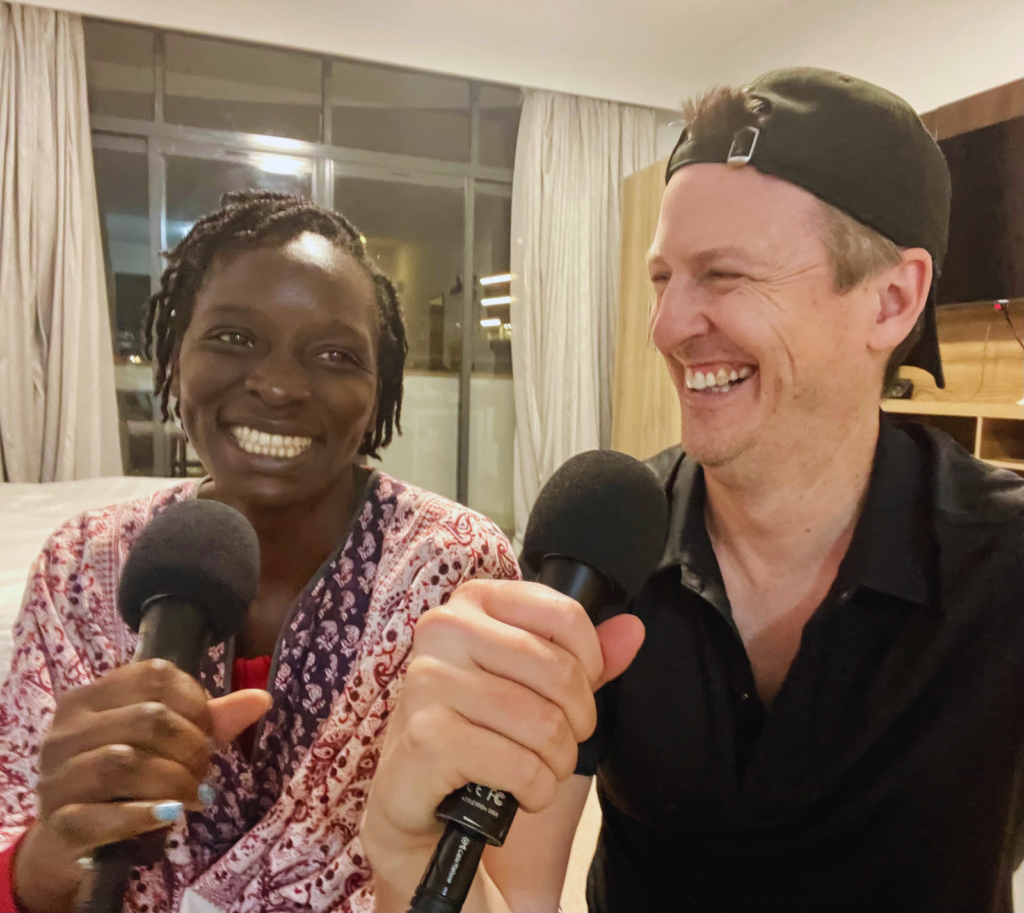
Matt Bowles: My guest today is Eva Adongo. She is a serial Internet entrepreneur, non-profit project manager, travel influencer and founder of the YouTube channel Travel with Eva Mtalii that has over 50,000 subscribers and aims to demystify the travel dynamics around getting visas to visit or relocate to other countries. Born and raised and currently based in Kenya, she holds an MBA and a master’s in international development. She has also lived in Afghanistan, Haiti, Myanmar, and she has now traveled to over 100 countries all on a Kenyan passport.
Eva, welcome to the show.
Eva Adongo: Thank you, Matt, for having me.
Matt Bowles: I am so excited to have you here. You are one of my favorite people. We should just set the scene a little bit. You and I have actually known each other now for over four years. We have been hanging out in a number of countries around the world many times, very late at night on the dance floor in various different occasions. And we are now hanging out in your home country of Kenya. We are in Nairobi today.
Eva Adongo: Yeah. Welcome.
Matt Bowles: Thank you.
Eva Adongo: I hope you are having a good time.
Matt Bowles: I am having an amazing time. It’s always so good to see you here. The last time I was in town, we hung out as well, which was in 2018 and we are now back, we’re hanging out again in Kenya. It is so good to see you. I would love to maybe just start this off by talking a little bit about Kenya because in your very extensive travels, one of the things that you have done is you have traveled a lot domestically around Kenya and done some of the coolest stuff in your home country as well as all this cool international stuff. And I thought that would be maybe a cool Place to start in terms of just sharing for you what are some of the highlights of your home country that people should know about and what have been some of your best experiences traveling around domestically?
Eva Adongo: Absolutely. So, of course, you having come back to Kenya two times is something that actually shows Kenya is a very cool place. And I love my country. Not because I am just being patriotic, that’s part of it. But it’s one of those places where if you are even just looking to tick off some things off your bucket list, then Kenya is the place to be. So, let’s just start with Mount Kenya, for example. It’s like the highest point in Kenya and I think the second highest in Africa. So, it’s one place you can start. I have been to Mount Kenya on the 1st of January 2021. Very scenic hike, very beautiful landscapes and everything. Yeah.
And then if you are looking for some sort of James Bond kind of airport transfer, you still have to come back to Kenya and go to Lamu. So, I think it’s probably the only other place in Africa where you get a boat transfer from the airport. How cool is that? I don’t know if you have done that. So, you get off the aircraft and you’re transferred to Lamu island on a boat. That’s really, really cool. It’s one of those places you will go to. Very scenic as well. It’s an island with only two vehicles on the entire island. Amazing food, very slow life. If you’re looking to just wind down and have a good time.
And then if you have a very short time in Nairobi, you have to visit Nairobi National Park. This is the only national park in the entire world in a city. Guys, I told you, Kenya is a place to heat up bucket list items. And then I know most of you guys have heard about Masai Mara, but I have a better place for you. If you are looking for a safari destination, you need to go to Amboseli. Amboseli is just maybe three, four hours outside of Nairobi. It’s one of our biggest, my favorite national park, actually. And if you are looking to see so many elephants in one location, you have to go to Amboseli National Park. And the best part, you’re going to have the elephant in the foreground. And in the background, you’re going to have the mighty Mount Kilimanjaro, the highest point in Africa. They say Kilimanjaro is more beautiful when you are in Kenya. It rests in Tanzania, but you see the beauty when you are in Kenya. So those are the top I would recommend for somebody who wants to visit Kenya.
Matt Bowles: Okay, we also got to talk about Mount Kilimanjaro, because, as you know, I just hiked Mount Kilimanjaro.
Eva Adongo: Congratulations, Matt.
Matt Bowles: Last month. Yeah, thank you. But then when I messaged you with my summit picture and told you that I had just climbed it, you congratulated me and then sent me your summit picture from when you climbed Kilimanjaro. And it wasn’t that long ago that you did it either, right?
Eva Adongo: Yeah, I did it in 2021, July.
Matt Bowles: So, what was your experience like hiking Kili? I just talked about mine recently on the podcast in detail. But I’m curious for you. What was your experience and what were some of the lessons and reflections that you had on that experience?
Eva Adongo: So maybe just talk about it. My inspiration for Mount Kilimanjaro was Mount Kenya. I’ve been to Mount Kenya, so it’s time to go to the next one, which was Mount Kilimanjaro. And on top of that, Mount Kilimanjaro was the first proper mountain I had hiked. So, I had to spend a lot of money. You know how expensive hiking gear is. And I kept looking at my hiking stuff, and I’m like, I spent all this money. I have to get a return on my investment. So, I quickly signed up for Kilimanjaro because I knew if I let it slide, then it’s going to be a while before I hit that as my bucket list destination. So, of course, signed up, like, two months after Mount Kenya, and four months later, I was on Mount Kilimanjaro.
And guys, oh, my God. Like, I knew I was a resilient person, but Kilimanjaro tested me on all levels. There are days I’d be like, why am I even doing this? And I just wanted to turn back, and I’m like, no. But on the last day of the summit, the last two hours, those were the worst for me. The oxygen levels are just nonexistent. I think we’re operating at 40%. And then I have a problem with my spinal cord, so my two discs dislocated, and I couldn’t find someone to fix them because the solution is just to snap them back. And everybody thinks they’re going to hurt you, but I was like, I’m just going to crawl to the summit. And I did it. And for me, the greatest lesson that Keely taught me was just keep going. And just when you think your hardest, darkest moment, it’s almost done. Although they say it’s almost done. And with Kili, two hours to the summit. That was the hardest, hardest, hardest point for me. But I am so proud of myself. I look back at that picture, and I’m like, is this me? You know? And now the challenge with that is there’s this thing about mountaineering. You just want to top it up. And now, because I did Kili, now there’s something like, okay, what’s next? What’s next? So that’s what I’m currently dealing with. And, like, I told you, Base Camp, Everest. Base Camp?
Matt Bowles: Is that in the Himalayas? Yeah. I mean, it’s amazing because once you’ve done Kilimanjaro, I mean, it’s definitely this incredible feeling of accomplishment, right?
Eva Adongo: Exactly.
Matt Bowles: And then you just sort of start deciding, what are the other accomplishments that you now want to try? Because you continue to exceed sometimes what you think you can do, and then you do it. You’re like, wow, what else can I do?
Eva Adongo: I know, right? And just the feeling like, there’s this tribe of all Kili people, so when you find somebody else who has also non-Kili, you kind of appreciate them because you know what they have gone through. And there’s just a bond between people who’ve been to the same places, you know?
Matt Bowles: Yeah. It’s amazing. Well, I want to go back now a little bit and talk a little bit about your backstory. Can you share about where you grew up and when you think back as you were growing up, what that was like for you and how your interest in world travel initially started to develop?
Eva Adongo: So, I grew up in Kenya. I was born in Kenya, grew up in Kenya, a good part of my life. And my dad was. Is still an engineer, so that means we didn’t have, like, one home base. We’re literally moving every so often to such a point that I was so fed up with the whole movement, I’m just like, I need a base. And I found myself in a boarding school. I was, I think, nine when I went to boarding school, because we move so much every two or three months because my dad has to go where the project is, and my mom was a teacher, so that means there’s a school everywhere. So, they didn’t have to worry about getting a job for her or getting a job for him.
So, wherever he found the engineering work, my mom would find a school there. And then over time, because of this moving, it became part of me because we’re constantly moving, so that’s the only life I knew. And then once you go through primary school in Kenya, a good percentage of the high schools are boarding schools. So again, I went through boarding schools. We’re basically in the same place. And then I went to Uni. And once you’re done with Uni, remember, you’ve been constantly moving, so you’ve pretty much visited the whole country. Like, we lived almost everywhere in this country, from the north into Rukana, all the way to Mombasa. My dad did projects everywhere.
And of course, the travel bug keeps biting because you’ve been everywhere in Kenya and now you want to go elsewhere. So fortunately for me, my dad now started working outside of Kenya, but within Africa. So, at the time, Zimbabwe had one of the best universities in Africa and South Africa as well. But South Africa, there’s visa issues in Zimbabwe. You don’t need a visa or anything. And so, I found myself doing my masters in Solusi and Zimbabwe. And with the travel bug still hitting, I started visiting the countries around Zimbabwe. That’s Botswana, South Africa, and all the other countries, Zambia and the rest. So, my interest kept growing and growing.
So, when I came back to Kenya after finishing my masters, of course I’m now working. I have this extra money, and I’m like, it’s probably time to pursue other destinations outside of Africa. And when I started doing my research, I actually figured it was easier for me and cheaper to travel outside Africa than it was to travel within Africa. And just like that, I started traveling outside of Africa.
Matt Bowles: So, let’s talk a little bit about some of your highlights from the continent. When you were traveling in Africa, what were some of the most amazing experiences that you’ve had? For example, I know you’ve been to Victoria Falls, which I have not yet been to. But for other folks that have never been there or maybe don’t know very much about it, can you describe what it is and what your experience was like when you went.
Eva Adongo: Yeah. So, Victoria Falls, that’s the English name, but it has a local name, Mosi-oa-Tunya, which basically means the forest that thunders. And that’s exactly what Victoria Falls does. 2km before you get onto the falls, you can actually hear the thundering of the water. You can get the mist on your face, like, you literally feel it before you even get to the falls. So, it’s something that you experience before you even get there. And I had heard a lot about Victoria Falls just by virtue of being around Victoria Falls, living in Zimbabwe, literally sharing a border with Zambia, and the falls actually are at the border of the two countries.
But I wasn’t hearing much about Victoria Falls outside these circles of where Victoria Falls is, and the curiosity was there. I was young in Uni, and it was just a bus ride to Victoria Falls. And I did a lot of visits to Victoria Falls, all the bungee diving and everything else that comes with going to Victoria Falls. But there’s a lot of Victoria Falls outside of banjo diving. For those who do not have the guts to do that, other than the scenery of the falls, when they are full during the rainy season and they are to full capacity, it is a sin to behold.
But also, during the low season, when it’s not raining and there’s not too much water, you can still do other activities. Like they call it the devil, something you go and literally hang on the falls. Those are things that people do. So, there’s a lot to Victoria Falls, and I would encourage everybody to visit Victoria Falls. I think they are the best falls in the world and have been to a couple of them.
Matt Bowles: All right, I want you to describe the bungee jump experience. And also, you mentioned that back when you were a student and you didn’t have a lot of money, you had a hack for being able to do this bungee jump. Can you share what that was?
Eva Adongo: So, for you to do bungee diving, I think it’s a hundred dollars then. I don’t know how much it is now. It was about, I think, a hundred dollars or something. And people who’d pay to do the bungee diving, and then they would chicken out when it’s time to actually go and dive in. And the rest of us students would just be there and waiting for that one person who’s going to chicken out and be like, I’m going to do it on your behalf, and then we’ll do the bunch of diving. So back then, I was very young and stupid. Like, I didn’t even think of risk as a thing. So, we just kept doing that. It was just for fun. But looking back, I would never go bungie diving today. But back in the day, it was actually a pastime for me. I would do it all the time for those people who chickened out. So, it’s something I used to do.
Matt Bowles: That’s amazing. What a hack. You have also spent time in Botswana, which is a country that I have never been to, but I’ve heard amazing things about what was your experience like in Botswana and what is it like there?
Eva Adongo: So, I went to Botswana as a student. Again, I was still in Zimbabwe. It was literally a bus ride to Botswana. And the things that stood out for me, especially as someone born and bred in Kenya is how beautiful the government takes care of its people. Literally at the time, the government used to cut the grass for their citizens. Like, that’s how spoiled those guys were. They would literally take care of their loans and cut them for them. And the other thing I noticed about Botswana was it’s a very small country and they’re not as populated as we were. And there’s a lot of freedom that I noticed in Botswana that we didn’t have in Kenya, for example, just the dress code alone. I mean, you can walk in a miniskirt in Botswana and nobody would bat an eye. Here in Kenya, things are changing, but we don’t have as much liberty and freedom as I noticed in Botswana. I mean, back then. I haven’t been in a while, but I went there, like more than 10 years ago. But those are the two main differences I noticed, and that is comparing between Kenya and Botswana and even Zimbabwe at the time.
Matt Bowles: And what about Mozambique? That’s another country that’s been on my list. I haven’t been there yet. What were some of your highlights from spending time in Mozambique?
Eva Adongo: So, Mozambique is the beaches. If you are looking for beach life, Mozambique is the place to be. So, there’s that side of Mozambique. It’s beautiful. The sceneries, mostly it’s beaches. So, one challenge that I personally had, I don’t know if other people would have that was the language barrier. So, in Mozambique, they speak Portuguese. We don’t speak Portuguese in Kenya and not too many countries in Africa either. So that was, of course, a challenge for me. But one thing I loved was the food. The food is amazing because of the Portuguese influence. But I’ve also noticed there’s a lot of nomads; digital nomads are actually going to Mozambique. So, it’s definitely something that is worth checking. And it’s a country I would definitely want to visit again at this time in my life.
Matt Bowles: Well, one of the things that I want to ask you about, you and I have been chatting about a little bit in terms of just coming up through the education system in Kenya. And you mentioned to me that a lot of your early learning was very independent, autodidactic, you going to the library and stuff. Because a lot of the educational curriculum was initially created and still is very influenced by the British colonial regime. And so, I’m wondering if you can share a little bit about that and how you navigated that growing up and were able to get a little bit outside of that British colonial curriculum.
Eva Adongo: Yeah, so some of us went to school back in the day when we didn’t have all this Internet and all these TV stations and Netflix’s and the like. So, we didn’t have too much in the form of entertainment. Once you come back from school or during the school holidays, you are literally navigating your time between playing and going to the library. And like I mentioned, my mom was a teacher, so she was very particular in terms of how you spend your time before you go to play. So, she encouraged us to go to the library and read and write book reports every time. And you would draft, write compositions and the like.
So, I got a chance to be exposed to different narratives, different books at a very tender age. And then when I went to Uni, I was also fortunate to go to an American system university. As much as I was studying a bachelor’s in accounting, I still ended up getting exposed to other non-accounting courses. So, for example, we had world history, world civilization, art appreciation, music appreciation, and a whole lot of them. So why this is important for me is because a lot of the education system in Kenya, and not even education, pretty much everything, our judiciary, like everything in Kenya, was just copy pasted from the British colonial times. And very little has changed. It’s just now they’re trying to change like the education curriculum, but there’s not much that has changed.
And of course, because it was copy pasted from the British, what was brought over is what the British wanted us to know, and they wanted us to be exposed to. And of course that comes with its limitations, obviously. But also, I am the kind of a person who always wants to learn more, wants to explore more. So, I got the privilege to learn a little more than what was available or what was exposed to me from the schools that I went to.
Matt Bowles: I also want to talk to you about your decision to start traveling outside of the continent of Africa. And you actually chose to do some longer-term relocations and to become an expat in different countries around the world. And I want to ask you first of all about your decision to go and live in Africa, Afghanistan. Can you talk about the context for making that choice and going there and then what your experience was like and how long you were there?
Eva Adongo: Okay, so just a little backstory. When I was growing up back in the day, we didn’t have too much leeway into deciding what you want to become. It was either you become a doctor, an engineer, a teacher, or accounting, you know, something serious. You had to pick one. So, my dad and we didn’t even have to pick, our parents picked for us. So, my dad looked at me and he thought I was very good at math. And he picked for me accounting. But from a very tender age, I knew I was built for the creative world. So, we didn’t question much back in the day. So, I was like, okay, I’m going to become an accountant to make my parents happy. So, I went through the entire bachelor’s in accounting, CPA and all that. And then I started working.
So, my first job was an internal audit for non-profit. I didn’t like it, so I decided to start working in Safaricom. And I didn’t go straight into accounting. I went to customer service, and I worked for like five months. And my supervisor was like, no, we need people in accounting, so we’re going to transfer you. So, I was transferred to the accounting department where I worked for about a year and a half. And when I got my son, I was just like, I can’t hack this life. You know, motherhood and all this stress that comes with accounting. And that’s the time I made a decision. I’m not going to go through this. But again, at the time it was going to be difficult for me to make that career transition.
So, I decided I’m going to study a completely different path. And I decided to go for international development. And when I looked around, I found one university in the U.S. and so I decided to quit my job so I could go and study for my masters in the U.S. It was going to be a two-year program and this was 2009. So, I decided I was going to resign. So, on the very day when I was going to resign, I had written my resignation letter. I went to my boss’s office and I’m like, okay, this is my letter, today is my last day and all that. Coincidentally, there was somebody from our partner institution based in the U.K. He came to my boss’s office. So, were the three of us in the office?
And my boss makes a joke like, hey, can you believe Eva is quitting? This is the best company in Africa and she’s quitting. And he’s like, it’s okay, I mean, if that’s her choice. And he asked me, so what are you going to do? And I told him, nothing. What plans do you have? I’m like, nothing. And so, he’s like, so where are you going to go? And I couldn’t think of a country. But the first one that came to my mind was Afghanistan. It starts with an A. And I’m like, I’m going to Afghanistan. He’s like, what? I’m like, yes. And he asked me If I have a job? And I said no. He asked me, do you need one? I said yes, because, I mean, I was just like, okay, can we just get over this? And I said, yes. And he said, okay, you’re hired, I have this job for you. So coincidentally, he was going to set up a telecommunication company in Afghanistan.
I was here quitting my telecommunication job, and that’s how I moved to Afghanistan. And I stayed in Afghanistan for two and a half years. And it’s one of those experiences that are very special to me because there’s a lot of cliche and people always say leave, like today was your last day leave, like this was the last day on earth. But in Afghanistan it was literal because you could be going to work and the car in front of you just explode. Or you could visit a hotel today and tomorrow you hear it was attacked by the Taliban. So, it was literally living one day at a time. So that was really something. And then basic things like electricity, things that we take for granted. We used to have three hours of electricity in a week total. If you added everything, it would come to three hours total. And we even used to have a joke like, that must be the electrician’s wife ironing her clothes.
So, we’d be waiting for when she’s going to put on the lights and start ironing. And then you can iron it, whatever you want to do. So basic things we take for granted, like security. Security. People always think, okay, Afghanistan is those dangerous places to be, but it’s also the one country that I never locked my house even for one day, because Sharia law is taken very seriously in Afghanistan. So, nobody steals something like forex bureaus in Afghanistan. The forex bureaus weren’t like buildings. They had an open-air money market. So, if you want to change money, you just go to the market. It’s open air and people have bundles of dollars and bundles of euros and bundles of pounds, whatever you want, it just exchanged. So, security took a different meaning in Afghanistan for me. But again, after two and a half years, I left.
Matt Bowles: And then what was the story you were telling me about the day that you were leaving Afghanistan?
Eva Adongo: Oh, yes. So, on my last night in Afghanistan, I remember so vividly. It was also the night before the elections. So, Afghanistan also happens to be one of those countries. I don’t know what they call them, but I think they call like seismic pathways or something. So, there’s a lot of earthquakes in Afghanistan. Now this particular night we have had an earthquake. It was an 8 point something magnitude earthquake. But also because of what was going on around at the time. The day after was actually an election day, and the Talibans were throwing rockets throughout. So, it’s sort of like being caught between a rock and a hard stone. There’s an earthquake. Your house is literally falling apart, but you can’t run outside because you’re going to get hit by a rocket.
So, my son at the time, I think he was three years old. And I was just like, God, I don’t want this child to remember any of what is happening, because he didn’t sign up for this life. And coincidentally, he slept through the entire earthquake, everything that was happening. He slept through it until morning. And by the time we woke up, all our walls had been sucked in. We didn’t even have ceiling boards. They used to put on, like, clothes for the same reason, so that in case of an earthquake, you don’t get hurt. But somehow, we found ourselves out of Afghanistan, and here I am today to tell the story.
Matt Bowles: And then after your time in Afghanistan, you went to Haiti, and you spent an extended period of time there. Can you talk about that decision and the context for that and then what your experience was like in Haiti?
Eva Adongo: Yeah. So, when I left Afghanistan, I think it was end of my contact. That’s why I left. And then it was around the same time when the earthquake had happened in Haiti. So, they were setting up mobile, money, telecommunication systems there, and that’s how I found myself in Haiti. And that was another experience. So, I remember my first day in Haiti. I landed in Port au Prince, and there is a massive, massive, massive rainfall. It was literally like it was flooding and backstory. So, when the earthquake happened, a lot of people were displaced in Haiti, and so many people were internally displaced, so they moved to Port au Prince, and they were camping right outside the airport.
And the reason is because when the relief food would come at the airport, because it wasn’t enough for everybody, so people moved close to the airport so that when the relief food comes, they would get access to it. So, we had all these sharks right outside the airport in Port au Prince. That comes with sanitation issues and all the issues that come around. And people are internally displaced, and there’s an earthquake and it’s raining and all that. And I remember everywhere was flooded the day arrived in Haiti, including the airport. We waited. I remember the water was up to knee level, and it was sewer water and everything water. And I’m like, what did I just sign up for?
And there was even though the aftermath of the earthquake was still there, but it also turned up to be one of those experiences that is very core to my values. Because in hindsight, I read so many stories about what happened in Haiti at the time. There’s a lot of donor money that was sent to Haiti to support the victims of the earthquake. But a good percentage of that money never made it to the intended beneficiaries. A lot of it was spent on administrative issues, on logistics, on all those non-core activities. And I was even sharing this with you that fortunately for me, and I used that word very loosely, at the time, I didn’t know much of what I know now. It was a matter of, hey, there’s a job here, I’m going to take it. But questions that I would ask today, for example, how does this job impact on the population that I’m going to work for? What are the ethical values around this and all that, those are questions I never asked.
But fortunately, again, for me, like in Afghanistan, like in Haiti, what I was doing was directly impacting positively what impacted positively the intended beneficiaries, or at least I’m proud of that. But it was purely coincidental. It’s not something that I sat down to think about the impact. I was just fortunate that I fell on the right side of things. But definitely that is something I would do differently. So, by virtue of being in Haiti, it also gave me a chance to visit a lot of the Caribbean islands. Everywhere was less than an hour’s flight from Haiti. So that’s how I got to explore a lot of the Caribbean islands.
Matt Bowles: And what were some of your highlights from the Caribbean at that time?
Eva Adongo: I think my favorite was Jamaica. Oh, my word. Those guys are something else. And I don’t know if that still happens. Like you go to Montego Bay, you spend all your nights having a good time in the club and all your days at the beach. I don’t know if that’s how those guys still live, but that was my life in Jamaica. And then Cuba, oh, everybody needs to go to Cuba before it changes, if it hasn’t changed. Cuba is one of those countries that I grew up reading about in books, listening to music about Cuba and then to go and experience Cuba in its rawest form.
At the time when there was all these sanctions from the U.S. government, which meant there was no proper Internet. You don’t have a lot of foreign currency, so you experience it in its rawest form. Like you’re having lunch and this bunch of 80 some year olds coming to sing for you those old Cuban songs you grew up listening. I don’t know what’s going to top up that and then go to Varadero and just have a good time at all the beaches. And I think Cuba and Jamaica take it for the Caribbean.
Matt Bowles: That’s amazing.
Eva Adongo: Yeah.
Matt Bowles: Well, I know that after you spent your time in Haiti, you eventually made your way to Myanmar, and you were based for a while in Myanmar. Can you share a little bit about what Myanmar was like, when were you there and what was it like at the time that you were there?
Eva Adongo: Yeah, so when I left Haiti, I went to Pakistan for a bit and then I found myself in Myanmar, where I stayed at the time, I think it was called Burma, I’m not sure, but some of you know it as Burma. And I was there from 2013, I think 2013 and 2014. And it was a time when they had U.S. Sanctions, so there wasn’t a lot of external influence happening in Myanmar, but it was still beautiful all the same. The people were amazing, the food was amazing, the different tourist destinations were amazing to visit because a lot of people didn’t know about Myanmar and there wasn’t a lot of interference like happens to most popular destinations.
So, you would go to a place, and you have it all by yourself. So that was one of the things that was really cool, especially from my perspective as a traveler, but also the fact that very few people spoke English, for example, so it was an opportunity to learn a new language. That’s one advantage that I had. And my son was very young at the time. He had started school at least. So, it was very interesting because in Myanmar they speak Mandarin and the Burmese language. So, in the school they would teach both Burmese and Chinese. And since my son was going to school, he was speaking both languages and it was just exciting to try and practice with them and all that. It’s also important to mention something as basic as Gmail because Google is an American company.
Of course, with the sanctions, we didn’t have Gmail in Myanmar, for example, because of the sanctions. So, something as basic as foreign currency, if you wanted foreign currency, you have to go to Thailand. But thank God for air Asia. It was, I think, $40. So, we could even go to Thailand for lunch and fly back to Myanmar. And that was one of the really highlights. And just the fact that it was, I think, an hour or less to fly to Thailand. It was also an opportunity for me to visit a lot of the Southeast Asian countries. And fortunately, again, at the time I wasn’t in full-time employment. I was mostly freelancing. So, I got a lot of opportunity to visit most of the Southeast Asian countries.
Matt Bowles: And what were some of your highlights from that region that really stood out and impacted you?
Eva Adongo: Yeah. So, in Southeast Asia, like in every other country, we have positives and negatives. So, I loved the food. If you are a vegetarian and you’re struggling to find a destination, I would definitely send you to Southeast Asia. That is something we struggle with here in Kenya, for example, getting a vegetarian lifestyle is really difficult because they’re going to be eating beans and more beans and beans and Sukuma weekend, all that. But one thing I loved about Southeast Asia, it was very easy to be vegetarian because the options are endless. The food is amazing, it’s tasty. A lot of street food and all that. And of course, the beaches. I don’t know how it is right now, but back then we had just started having an influx of digital nomads. You know what that comes with.
But there were still some hidden destinations in Southeast Asia. So, if you are looking for beaches and that was the place to be, Thailand or Bali and all that, you find the beaches and then the cheap travel. Southeast Asia was dirt cheap. I remember there’s a time I flew from Thailand to Singapore, returned for $1. Like $1 return. They always had this sale. So, I spent my entire one and a half years just hoping from country to country and even the hotels, you could get a nice clean three-star bed and breakfast for $20. So, if you’re looking for a budget destination with good food, good scenery, good everything, and the transport network was also amazing. They have a very nice bus service, the airlines, the trains.
And the other thing I love about Southeast Asia is these people get it. Like travel is not considered a luxury. So that means everyone you meet is probably traveling either within their country or in another country. So, it was very common to find a lot of Malays in Singapore or Singaporeans in Thailand and Thais in Vietnam and all that. Which brings me to my next point. If you’re looking for history, Southeast Asia, a lot of history, especially like in Vietnam, if you come all the way from Hanoi to Saigon, a lot of history is there. So those are the highlights. But it’s also important to mention that of all the continents, I have been to Southeast Asia, one of those continents that was very difficult for me as a Black woman, mostly solo traveler, it was very difficult to maneuver.
I felt a lot of racist attitudes towards me. For example, you could be queuing to at the airport, you want to check in maybe two or three white people ahead of you. They would never ask them for Anything like they would just give their passports, and they would be stamped. When it gets to your turn, you have to show $1,000 hard cash. And I was wondering who is traveling with $1,000 in hard currency and the one like in dollars, for example. So, such basic things, or even the treatment you’d get in a hotel, for example. So fortunately for somebody like me, because I used to travel so much and I didn’t really care about these subtle racial tones, but for somebody who’s just starting out, it’s probably important for you to be aware you may find such instances. I don’t know how it is now. It’s been a while since I was in Asia, but that was something that really stood out for me.
Matt Bowles: Let’s go a little bit deeper into that one of the themes that I think you’ve really gone into with your content and your YouTube channel and the community that you’re trying to provide value to is largely travelers or aspiring travelers from Kenya or from other places on the continent or more broadly, just from other countries that don’t necessarily have a quote unquote, powerful international passport and things of that nature. And so, you really, I think, do an incredible job of weaving and explaining and reflecting on and talking about it and helping people to navigate through a lot of the perceived challenges at the outset that might maybe prevent people from doing some traveling and stuff like that.
So, I would love to go into that a little bit now and if you can talk about some of your analysis now that you’ve had all of these experiences. There’s the racism at the very high level against Black travelers, let’s say. Then there’s the being from the continent of Africa and from a country that doesn’t have a powerful passport, which is yet another layer of discriminatory pretext for people to treat you in a particular way. And then there’s the female dynamic. Traveling as the Black woman is a particular experience that has very particular things about it in terms of the type of discrimination or racism that you might experience.
So, there’s all of these different layers. I’m wondering if, now that you’ve been to over 100 countries and you’ve been to all of these different continents, and you. You’ve experienced all this stuff. And I think you also have what I appreciate is a very nuanced view of these things. So, you just talked about, you loved all of these things about these particular places. And also, there were some really painful and frustrating and really problematic experiences in some of these places at the same time. And I think you’ve brought a lot of that complexity and a lot of that nuance into the way that you talk about travel. And so, I’m wondering if you can just share a little bit about your high-level reflections now that you’ve been to so many countries on tips for navigating that.
Eva Adongo: Yeah. Thank you. With time, I have come to learn that it’s not about me, it’s about them. So, for example, you will find if I was in Thailand, for example, and I had overstayed my visa, and you are in Thailand as well, and you have a stage, your visa, the treatment is going to be different. But I have also come to realize that if I went to Thailand and they let me into their country, I didn’t overstay my visa and I did what I said I went to do. I am making it easier for the next person who will come. So, I have taken it upon myself to be that change that I want to see. Because the moment I show up at a border officer’s desk, they’re not looking at me as Eva fast because our brains have confirmation biases. They’re looking at me as the other Black female solo traveler they attended to three hours before me.
So, I make sure that I am not that other traveler. I am Eva. And I also make sure that I have everything else that Eva is supposed to have. So, if there’s going to be 10, 20, 30, 40, 50 EVAs, then of course, someday maybe there could be a change. And also, that’s how I ended up having my YouTube channel. Because the more I started going to these different countries and started navigating these different challenges, a lot of people started asking questions like, hey, Eva, I want to go to the U.S. I heard that you went, how did you get your visa? Who did you know? Can you connect me?
And I’m like, I didn’t know anybody. I just applied. And people want to know how you did it and what questions were you asked and how did you answer them. And that’s how I started my YouTube channel. So, every time I visit a country, or I go to an embassy, I come and talk about my experience. And I also write it on my blog. So that’s pretty much how I started, mostly to demystify all this that is going on around getting visas and also to accept the fact that this is our reality, this passport privilege. And we can’t pretend it doesn’t exist. It exists, and we have to find a way to navigate it. And that’s the main reason why I do what I do.
Matt Bowles: Yeah, your YouTube channel is awesome. It has over 50,000 subscribers. Now. I have binged most of your videos, and it’s really a cool combination of travel vlogs. So, like, videos of you doing cool things like hiking mountains and showing the scenery and your experiences and all that kind of stuff combined with you doing specific educational stuff or presenting specific opportunities, particularly for Kenyans or people in a country like Kenya, to be able to, if they want to relocate abroad.
If they want to move to a country like Canada and get a job there and live there, or if they just want to travel to a place, how they can get a visa to go spend a shorter period of time there and helping them sort of to navigate through that process. So, what would you say would be any basic tips for folks that live in a country like Kenya or a country that does not have a lot of that global passport privilege in terms of ways to be able to get some of these visas and be able to travel the world as extensively as you have?
Eva Adongo: First of all, you have to really want to do it because as I’ve already mentioned, there are challenges that comes with having a less powerful passport, like a Kenyan passport. So, it’s sort of. I have a friend who says it’s more of like a pain, pleasure principle. You have to really be sure you are going to be able to handle the pain, because there’s more pain than pleasure when it comes to travel. So, you really have to want to do it. And then secondly, you have to try and be honest with yourself and with whoever you’re going to be dealing with. Because, for example, you will find on my channel, for example, I will share a position about a cleaner job in Canada. For example, if I don’t have any skills and I am in Kenya and I want to go to Canada, of course I don’t expect to get a job in the office, but by being in Kenya as a cleaner, I’m probably making $50 a month.
If I could make $50 and, I don’t know, maybe two hours, I think it’s like $20 an hour in Canada cleaning, then there’s probably an opportunity for me to eventually go up the ladder, go back to school and better my life and my children’s life, for example. So, it’s a matter of seeing, not like, let’s say, Canada as an end in itself, but how can you use that as a steppingstone, for example? And the reason why I talk a lot about looking at relocation as an opportunity is because I have a theory that not all of us were meant to thrive in our home countries. And just going by my own life, I am 110 sure if I hadn’t left Kenya and gone to work in Afghanistan, for example, I wouldn’t even be able to live the lifestyle that I live because just by virtue of working in Afghanistan I was working as an expatriate.
So obviously even though the salaries are different, the exposure is different, all that is different. So, it pushes me to a higher pedestal than somebody who’s probably working in Kenya. So, by virtue of working in all these countries outside of Kenya, I was able to build an investment early on. Like that path was made shorter just by me working outside of Kenya. And it’s now giving me an opportunity to pursue my other interests. So, for example, I have this goal of visiting all the 193 UN recognized countries. It takes money to do that. Unless of course you want to go the influencer route where you get sponsored travel, which again takes away from the real experience. Because by virtue of me traveling on my own merit, I document when I want to, how I want to. When I don’t want to document, nobody’s going to come for me. Like I paid for your trip, we need a report about it.
So, there’s all those advantages. So, you really have to decide why do you want to leave your country? Do you, for example, like in my case, just want to pursue this goal, which is mostly for fun? I think it’s a self-actualization kind of thing. So, you really have to determine where you are in Maslow’s hierarchy of needs. So, for me to travel, I am mostly doing it now for self-actualization. So, I can pretty much just go wherever I want to go on a whim if I have the money. But somebody else is probably still at the basic need. So that means you’re going to have to sacrifice more. For example, start from maybe a junior position in the UK for example, or in the U.S. or whatever you want to go. So, you really have to be honest with yourself. What do you have? Where are you in your life?
And just have an open mind. That’s something else I would say have an open mind. Find out from those who have gone before you. Yeah, like read our blogs and other similar blogs because we talk about things based on our own experiences. And of course you have to be aware of scammers. The moment you are so desperate, that’s when you fall for scams. So, you have to really make sure that you don’t act too desperate, like it’s not that serious. There are people making it in Kenya, there’s people making it in your home country, so it’s never that serious. And for that person who wants to travel for leisure like I do, it’s doable. You just have to start small, start somewhere. And the moment you start building those stamps on your passport, it gives you credibility. When you go to apply for a visa, do not overstay your visa. It’s important for us to not abuse the privileges we get, because I think it’s also important for us to become good ambassadors in the countries that we go to so that these countries will come looking for us.
Matt Bowles: When you think back about some of your expatriate experiences when you were living in intense places like Afghanistan and Haiti, what impact do you think those particular experiences had on you as a person and the way that you view the world today?
Eva Adongo: So, first of all, in Afghanistan, for example, I just realized how privileged I was just by being a Kenyan. And when you are in Kenya, you look at somebody, maybe in the U.S., U.K., and you think like, oh, my life is so miserable. But when you go to a country like Afghanistan back then, I don’t know how it is now. That’s when you realize how much privilege you have, especially even as a woman. I know, for example, something as basic as health care because of the religious institution there. As a woman, you couldn’t be treated by a man. Unfortunately, the same culture doesn’t allow you to go to school. So that means you’re not going to have that many female doctors.
And that means when I have an issue as a female, then there’s only so many female doctors, for example, it’s not easy to get health care. Something we take very casual here in Kenya, for example, something as basic as childbirth. In Afghanistan, I remember there was one area called Bamyan, and it was very cold in the winter, would get snow, up to three feet of snow. And remember, there’s no electricity. So as a woman, if you are in labor, they would literally tie your leg and put you outside in that freezing cold for you to deliver on your own. When you’re ready, you pull the string back and the people can know that I’m ready. Those are the things that women were going through in Afghanistan. I remember my nanny, she could not read, she could not write. And she was my age mate. She couldn’t read, she couldn’t write, nothing.
So, there’s those little privileges. The electricity issue, I’ve talked about three hours maximum in a whole week. And you’re in winter, for example, so you’re forced to have either if you’re privileged. You’re going to have a diesel generator, and you know that smell alone is horrible. Or you have to rely on firewood again. In winter, that means you kept the firewood for six months because winter used to go for six months. And Kabul, which is the capital, would be cut off from the rest of the country. When you get to the airport, for example, there’s no guarantee if you’re on a flight from Kabul to Dubai, for example, you’re going to make it there. I remember there’s a time I was on; they were calling it Air Ariana, I think that was the national airline. And we’re going to Dubai. And they told us there was a problem with. They said there was a security situation, and we have to be diverted to Pakistan.
Well, from what I heard, they were actually loading Poppy on the flight. That’s why they diverted us. And they literally, they took us actually to Kandahar and not to Pakistan like they had told us. So, all these small, small things that you don’t think about when you’re in other places. But it also showed me how brief life is after Afghanistan. I just changed my appearance. Procrastination is not a word for me. You’re not sure about tomorrow. So those little things like those and just trying to make the best of your situation in Haiti. The key thing that I learned in Haiti is that you can still be joyful even when things are really tough. I have never met people that love to party like Haitians. And it’s not like the youth, the entire family.
In Haiti, you could go to a restaurant, they don’t open until 10, so 10 o’clock, that’s when the city comes alive. And in fact, we used to have this joke and it’s really true, actually, you can’t even become president in Haiti if you’re not a musician. You have to be able to entertain the people. So even when I was there, I remember when I was very privileged, I used to share fence with the president. He was a musician, he was elected. He was actually having a band when they elected him as president and were invited to go to the party. And it was a big, big show. Those guys party hard and with all the things that are going around you fresh out of an earthquake. And if nobody told you, you’d never ever tell. So that’s one thing I really love about Haitians.
Matt Bowles: Well, I know you have definitely sought out some of the world’s top party destinations. One other one that I have to ask you about is when you finally made your way to Rio. De Janeiro for Carnival. When did you go, first of all? And what was that experience like?
Eva Adongo: Oh, my word, that was February 2020. So, I had been planning for this trip for like an entire year. The whole of 2019, I was planning for the Carnival because I have this bucket list things I want to do and I have two of them. There was the Brazil Carnival and the Trinidad and Tobago Carnival. So, I planned for the Brazil Carnival the entire year because it wasn’t cheap, and I wanted to do it in style because I was flying business class. I want to do this thing in style. And I knew when I came from Carnival, I wouldn’t have energy. I don’t want to be suffering in economic class.
So, during the Carnival that entire week, I knew that it was going to be awesome. But nothing prepared me for that experience. And I was fortunate to be staying in an Airbnb right in the heart of Rio and with this really, really amazing lady. She’s a local and she took me through all the corners of Rio during Carnival. And one thing I really loved about the Carnival is that it is an event that the entire country participates in. So, it’s not like we have this section of people in that section of people, like the entire country participates in the Carnival.
And the other thing I love about it is freedom. It doesn’t matter who you are. You’re gay, you’re lesbian, you’re straight, you’re whatever. Everybody’s having a good time. Nobody’s getting judged, everybody. And it goes on day and night. And then there’s a closing ceremony, which is amazing. I think it happened on Thursday, I think, and Friday, I don’t remember. But let’s just say it’s difficult to describe. You just have to experience it by yourself. But as they say, it’s the biggest party on earth, believe you me, it is.
Matt Bowles: It is indeed. I went in February of 2015, so five years before you went. And it was a mind-blowing experience that I also have been telling people you just have to go to experience is unlike anything else I have ever been to. So, Carnival in Rio for sure, put it on the bucket list.
Eva, let me ask you one more question and then we’ll wrap this up and move into the lightning round. When you think back now about all of your travel experiences to 100 countries and you are still so passionate about traveling to new countries and seeing more things and experiencing additional places at this point in your life, how would you describe what travel means to you?
Eva Adongo: At the beginning, I used to travel mostly for work and all that or I’m in school, I find myself around an area that I haven’t been to. But right now, it’s more of a self-actualization thing. And I’m kind of writing history when I am not here anymore. You won’t be able to mention Eva without mentioning travel. So, it is something that I do because it’s going to be a mark. I am living on the planet and the fact that travel has made me a tolerant person because just by virtue of traveling, I have seen how people live so differently from me. But when I went to Afghanistan, not a lot of people, even my nanny, had never seen a Black child.
So, I remember, for example, she would wash the baby like three times a day and it’s very cold. And I’m like, you just wash the baby. And the reason she was doing so is because he was so black, she thought he was dirty. And the only picture she had of Africa is this country where there’s no water, everyone is dying of hunger and drought because that’s all the BBC shows you. And I’m so glad we have YouTube and Instagram and Facebook and all these things because now we can show people other sides of Africa that mainstream media doesn’t show you. So that’s the only picture of Africa she ever had. And she thought my child was dirty and that’s why she needed to keep cleaning him.
So those little things are things I wouldn’t have learned, for example, if I didn’t go to Afghanistan, that I always thought everybody had seen a Black person. But not everybody has seen a Black person. So, there’s that aspect of exporting tourism when I travel. So, I am sure my nannies, because I stayed with her for two and a half years, I’m sure her outlook on life changed. She actually got to experience a culture in a way that she couldn’t have. And so many other places that I get to visit, they get to see a side that they wouldn’t have seen. So, for example, so many people think the only tribe we have in Kenya is Maasai, while it is the one tribe you will hardly see in this country. They are a minority, but they are the ones that everybody knows about.
People think every Kenyan runs. Not every Kenyan runs. It’s just a handful of Kenyans that run. So, every time you present yourself as a Kenyan, people ask if you’re a Maasai or if you can run. And for me, that’s an opportunity to tell them we actually have 42 tribes in Kenya. It’s an opportunity for me to even let people know something as basic as Africa is not a country. I used to think it was a joke, but there are people who actually still think Africa is a country. So those small, small things. So, for me, it’s an opportunity to entertain people, sometimes play along with their jokes, but it’s also an opportunity to meet fantastic people like yourself. If I didn’t come on that cruise, I wouldn’t be sitting here right now. So, there’s all those things that travel does to me.
I meet amazing people and most of the time I do solo travel. So that works in my favorite because I have also realized when you travel by yourself, you get to meet people you wouldn’t have met if you were with other people and it doesn’t matter even if you went to the same location, did the same things.
Matt Bowles: Amazing. Eva, I think that is a great place to end the main portion of this interview. And at this point, are you ready to move in to the lightning round?
Eva Adongo: Bring it on.
Matt Bowles: Let’s do it. All right. What is one book that has impacted you that you would most recommend people check out?
Eva Adongo: I think Crushing It by Gary V. I can’t pronounce his second name.
Matt Bowles: Gary Vaynerchuk.
Eva Adongo: Oh, yes, that one. For me, that was the book that changed my entire ‘ entrepreneurial life’. That’s what made me a YouTuber. That’s what made me start my YouTube channel. And mostly what I like about the book, Crushing It, is how Gary encourages you to make a strong personal brand of yourself and take advantage of the Internet. It has literally broken down the main barriers of entry. You know, in the past, you had to rely on a big brand and hide under its shadow. But right now, the Internet, he actually calls it mainstream Internet is mainstream media now, and you can become as big as you want as quickly as you want. And one thing I like about Gary is Gary is a fortune teller. I remember back in the day when TikTok used to call itself musically, Gary was already talking about musically, which is TikTok today.
But no one ever even imagined that musically would become what TikTok is today. But he was talking about it then and encouraging people, can you be on all platforms? Can you be on all platforms? And I am so glad that I followed his advice. And you will find Eva Mtalii on all social media platforms. Even when I’m not active, there’ll be Eva Mtalii on those platforms. And one thing I like that he talks about is you don’t have to change who you are to fit anybody. You just show the world, Eva, and talk about your experiences and that is your brand. So that’s a book that was a game changer for me and I would encourage everybody to read that book if they haven’t.
Matt Bowles: Awesome. All right, Eva, what is one travel hack that you use that you can recommend to people?
Eva Adongo: I’m going to talk about people like me who need visas and all that stuff. Don’t wait until you need to travel to get that visa. Get it when you don’t need it, because A, you’re not desperate at that point, B, you probably have the money and C, you have the time to prepare. And why is it important to have that visa before you need it? You get the advantage of taking advantage of travel deals. So, in my case, for example, I no longer just travel, I just follow the deal. Because if I want to go to wherever and there’s a cheap flight somewhere, I most probably already have the visa. So, I’m just going to hop onto the next flight and go there.
Matt Bowles: All right, Eva, if you could go back in time, knowing everything you know now, and give one piece of advice to your 18-year-old self, what would you say to 18-year-old Eva?
Eva Adongo: I would say, do you? The world will adjust. I have had a good time in my pre-40s trying to please people, make them happy. Sort of what they call lighting yourself up on fire to keep other people’s warm. But when I get into my 40s, I’m just going to do me while you adjust. And that’s what I would tell my 18-year-old self. I kept asking myself, where was this Eva when I needed her as a teenager?
Matt Bowles: All right, Eva, of all the places that you have now been, what are your top three favorite travel destinations you’d most recommend other people should check out?
Eva Adongo: Number one would be Cape Town and specifically Long Street. If you like to party, you need to go to Long Street, Cape Town. Number two is Switzerland. A very expensive destination, but it is worth it. I love Switzerland. If you like beautiful spaces and you love efficiency, everything works like clockwork. I think it’s the most beautiful place on the planet. Switzerland. Number three, I’m going to give a tie. I just love Cuba. In one country you find history, security, good food, good nightlife, good beaches, go to Cuba. And that one ties with Croatia. Croatia for the beaches. If you’re a digital nomad, I think it’s an amazing destination. The beaches, the food. If you like yacht parties, that’s the place to be. And then it’s very affordable. I Love. The public transport network is amazing, like the buses and everything. I was there and I use public transport all the time. I was on very amazing Airbnb’s. Very affordable. The food is amazing and very affordable as well. Those would be my top three with a tie or number three.
Matt Bowles: All right, Eva last question, what are your top three bucket list destinations? Places you’ve not yet been highest on your list you’d most like to see.
Eva Adongo: So, the number one is Antarctica, just because I have been to all continents in the world except this one. Number two will be Trinidad and Tobago because we need to settle this issue of Carnival. Which one is the best? So, I think Trinidad and Tobago, which the plan is for next year. Number three again, I couldn’t think of one. So, I have a tie between Saudi and Iraq, specifically Iraq for the marathon. I think it would be so cool to run a marathon in such a controversial destination. And Saudi. I believe as much as there’s a lot of controversy about Saudi, the has to be something good happening in that country and that’s what I would want to document. So those are my top three with a tie-on number three.
Matt Bowles: All right, Eva, I want you to let folks know how they can check out your YouTube channel, how they can read your blog, how they can find you and follow you on social media, learn more about you. How do you want people to come into your world?
Eva Adongo: So, as I’ve already mentioned, I am Eva Mtalii on all social media platforms. That is E V A M T A L I on Facebook, on Twitter, on TikTok, on Instagram and on YouTube. But for travel related content on YouTube it’s travel with Eva Mtalii.
Matt Bowles: Amazing. We are going to link all of that up in the show notes so folks can just go to one place at the Maverickshow.com go to the show notes for this episode. There you will find everything we have discussed in this episode including all of the direct links to follow and contact Eva as well as the books and everything else that she has recommended. You can find it all at themaverickshow.com
Eva, this was amazing. Thank you so much for coming on the show.
Eva Adongo: It was amazing as well. I enjoyed it so much. Thank you for having me.
Matt Bowles: All right, good night everybody.