Matt Bowles: My guest today is Nicole Phillip. She is an award-winning travel content creator and journalist who left corporate America to explore the world and help others do the same. Born in New York City to immigrant parents From Trinidad and St. Vincent, she grew up mostly in Orlando, Florida and is now a world traveler with over 350,000 followers on social media. Through her content, she empowers black travelers and people of color to navigate the globe safely and confidently. She’s all about making travel accessible, authentic and unfiltered, with a dash of wit and a healthy dose of humor. You can find her work in the New York Times, where she helped launch the 1619 Project, as well as in the Daily Beast, ABC News, and she was the winner of the 2025 Social Media Video of the Year at the Black Travel Film Festival.
Nicole, welcome back to the show.
Nicole Phillip: Ooh, thanks for having me. Happy to be back.
Matt Bowles: I am super excited to have this conversation with you, especially because we have just been hanging out in Rio de Janeiro for the last two weeks and we are doing this interview in person. So, our Airbnb, we have art all over the walls. We have a hammock in the living room, which we have both used to do some of our laptop work in that digital nomad lifestyle. And we are in the neighborhood of Santa Teresa, which is one of my very favorite neighborhoods in Rio. When I was here, the very first time I came to Rio, 10 years ago, I lived in Santa Teresa for a month. And it’s really the bohemian center of Rio, where there’s street art all over the different streets, cobblestones all over the place, music coming out of all the houses. It’s really one of my favorite communities.
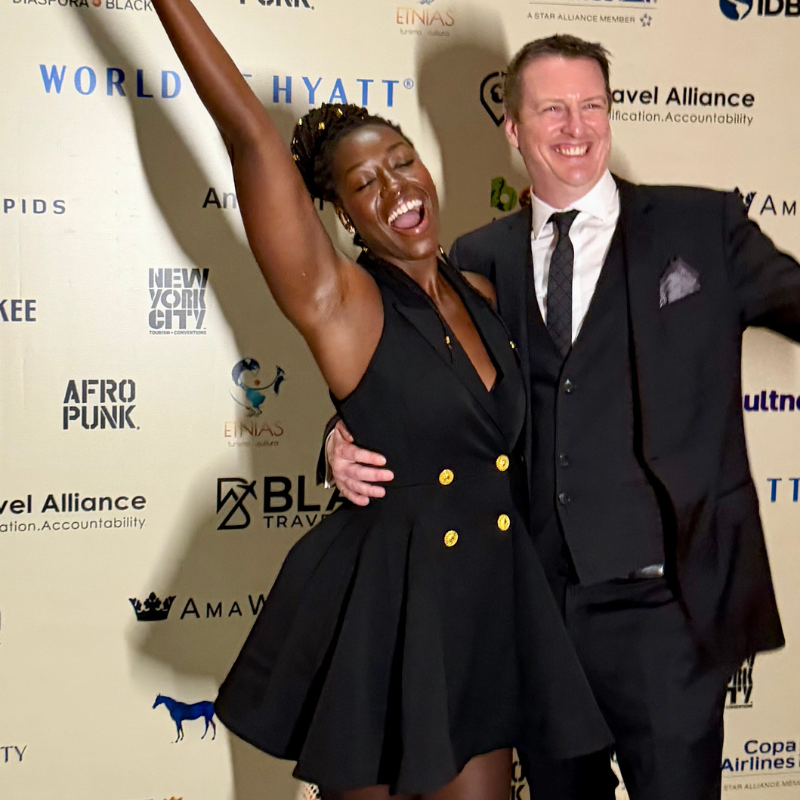
So, you and I are staying here and recording this in person, which is absolutely amazing, because the last time, when we recorded earlier this year, we were virtual, but we have subsequently hung out multiple times since then. You spoke at the WITS Travel Creator Summit in New York, and we got to hang out there earlier this year. And you were just nominated for and won The Social Media Video of the Year here in Rio at the Black Travel Film Festival, which was part of the Black Travel Summit. Maybe let’s just start with that night with the awards gala. Can you describe for people the theme of the event and then for you as a nominee, what it was like going to the gala?
Nicole Phillip: The theme of the gala was Afrofuturism. So, everyone looked very lovely in their Afrocentric attire. And then the head wraps and the gold, and they were adorning their heads with and their bodies that really gave futurism. But everyone looked so beautiful. It was a very energetic feel, an energetic vibe. Malik Yoba was in the crowd still. I was like, oh, wow. Because he was one of the speakers. So, to see him still hanging out with us and there in the crowd was really cool. He was really down to earth. And then he was partying with us at one point, too. He was really cool. He is a black actor, very famous within the acting world. But he was specifically at the Black Travel Summit because of his work in the development space. So, it made sense for him to be a speaker there. He also works with the youth, which I learned. He had a really great moment where he spoke to the students that were there, learning about other job opportunities that exist within the tourism space, hospitality space, so that they could broaden their horizons. And he pointed to one of the students and they called her up on stage.
Matt Bowles: That was such a special moment because the teacher who was chaperoning these high school students there was a whole bunch of black students from West Baltimore. They came all the way to Rio de Janeiro to attend this event, and they’re being chaperoned by, I assume, one of the teachers. And the teacher comes up and asks a question about what advice would you have for students that are 14 years old? And what he did was he flipped the whole thing around and he said, how about we have one of the students come up on stage? So, one of the 14-year-old high school girls went up on stage, he gave her the headset, and he started asking her questions about what was her experience like coming from West Baltimore to Rio. What is her experience like at the event? And really kind of empowering her to share her experience, which I thought was such a special moment.
Nicole Phillip: Yeah. And I also loved how he was able to help her to address the audience and really. Cause you could tell she was a little nervous. And he was really great at helping her to address the audience and get the thoughts that were in her head out and help her to be understood when she was speaking to everyone. So, I thought that that was also great. I think he works with kids as well, so he really knows how to work with kids.
Matt Bowles: Yeah, it was super special. And Maverick Show listeners know Ashley Company, who hosted a bunch of the sessions throughout the conference. And then Kelly Edwards was the host of the awards session.
Nicole Phillip: So very fitting. Kelly Edwards is the first black woman to have a show on the Travel Channel. I think it’s to have a travel show in general, actually. So, it was so amazing that she was hosting the show and she was the one to present me with my award. But she was a fabulous host. And I believe she was friends with the Chief Partnerships officer, whose name is Martinique Lewis, and she has a very great relationship with Martinique. And so, she was happy to come out and be a part of this. She’s a pioneer in this space. So, it was just so awesome to have her there with us.
Matt Bowles: Yeah. Super amazing and big shout out to Martinique Lewis, who Maverick Show listeners know because she has been on the podcast as well. And a dear friend of mine, always love hanging out with Marty. And an amazing job she did helping to put on this entire conference. So, we are there at the awards gala. You and I are sitting next to each other at the same table. Your category comes up. Take us through what you were feeling at that moment.
Nicole Phillip: The dress that I wore, my mother actually purchased for me because she was like, this is so big for you. And I just really want you to, when you go up there, I want you to look great. So, I’m going to get you this dress. And in my head, I’m like, oh, my God, my mommy’s buying me a dress for this. But, you know, like, no, mommy, it’s not that big of a deal. Because I’m like, oh, my gosh, like, now the stakes are higher. And so, when I get to the event a few hours before, I hadn’t prepared to win. I had not prepared myself to win. I was hoping. But then again, you know, you win some, you lose some. And that’s what I’m reminding myself. Even if you lose, it is okay. Because at least you were a finalist. But yes, at least you were a finalist. And I’m pretty sure that that’s still a huge thing because I’m pretty sure they had so many people who had.
Matt Bowles: Applied, and you were up against some amazing creators, including people like Eileen Ivette, who Maverick Show listeners know, who has previously won awards from the Black Travel Summit. I mean, really serious and impressive creators you were nominated with.
Nicole Phillip: Yeah. And I have so much respect for Eileen. Eileen is also a friend of mine. We joke because we had never met each other before in person. And the first time we did, it was like we were just old friends, just chit chatting. And then we got on Zoom at one point and we just were talking and we were like, aunties, be like, all right, I got to go now and then talk for another 20 minutes. And then, oh, no, no, no, all right, I got to go and then talk for another 20 minutes. And she’s someone who has inspired me and whom I’ve learned so much from. So, to see her also in the category, I was like, oh, yeah, these are he Eileen as so great at what she does in her space, which is why I was like, even to just be nominated and to be in the same category as her, that that means a lot because again, I’m sure so many people had submitted for this.
So, for it to come down to four to me was amazing. And so, I had not prepared any speech. And then a few hours before, I was like, go ahead and write something. Just be prepared. Go ahead and write. No one has to know if you don’t win. No one has to know that you had a whole speech ready. And when I said this prior, I was like, I am a firm believer that you do have to speak things that be not as if they were, which is, you know, speaking positively and having faith and things like that. And so, while everything’s going on, I’m noticing that I’m getting increasingly nervous. Like, I’m suddenly now, as everything started, I’m suddenly getting nervous and my anxiety is starting to rise a little bit. You Remember, I could not even eat. So, I was pretty anxious. And then it was time for the Black Travel film festival categories. And I’m sitting there and I believe there was the long form was first and now I’m really getting anxious here. And then it was time for the short form.
And the way that they did all of the awards was they gave a little background on the person. And so, who it was slowly got revealed. If you knew the person. And obviously I know myself. So, as they’re starting to read this person does this, this and that, and then they’re talking about, you think they mentioned my humor. And then they started mentioning interviews and like it became pretty clear that it was me. And I put my napkin on the table. Cause I’m like, all right, this is it. Like, this is my moment. And I burst out in tears once my name is said. I did not expect to cry. I am not a major crier. But that moment when it became real, and I’ll say that couldn’t turn the tears off for like another hour after that. But I just burst out into tears, messed up my makeup and everything.
Matt Bowles: What did winning that award mean to you? When you think back on it now in terms of why it was such an emotional moment, what did it mean?
Nicole Phillip: So, I did take some time to unpack exactly why it felt so emotional for me and why I started crying. And a lot of it was in what I said in my speech. And it was just confirmation that I’m doing the thing I set out to do. I’ve done the thing that I’ve set out to do, or there’s still more to be done. I set out to become a travel content creator. And about less than two years later, I. I am an award-winning travel content creator.
For those of you listening, you have to understand, when I started this, specifically being a travel content creator, I left my job with absolutely no plan in the middle of what we now know is a white collar recession. And I was working in the tech industry doing social media strategy. But you know, when it’s time to move, sometimes you just start getting more and more uncomfortable and the place that you’re in starts becoming more and more hostile. And it’s time for me to take this leap. And so, I took this leap with no plan. I didn’t have a bunch of savings. I didn’t map out how to become a travel content creator. I didn’t really know any travel content creators. I just knew that I had a voice, I knew how to tell a story. And so, I did it. And what’s even more significant is that when I started this time last year, I was doing, and I said this in my speech as well, I was doing green screen video reviews.
And that was because I had no money and decided to leave my job and want to embark on one of the most expensive niches that there are. I had no money to travel, so all I could do was take past videos and past pictures that I had taken from other places and just talk about them in a green screen. And this was before I was thinking like a content creator. So, they’re not the best videos and they’re not great. They’re the photos that no one was supposed to see. It was just supposed to stay in my phone. But these videos got hundreds of thousands of views, millions of views, because people weren’t coming for the aesthetics. And they still don’t come for the aesthetics and the vibes. They come for the story that I’m telling. But I had to learn as I go. I had to learn how to be a content creator. I had to learn how to be a travel content creator specifically because I was already doing content creation, just talking head stuff about any topic. Then I transitioned into travel. Didn’t know any travel content creators, didn’t know how to take the cool, cute aesthetic videos and travel.
And so, my style had to evolve over time because you can’t be a one trick pony. You can’t just do green screen video reviews, talking head style videos all the time. I still do them, but that couldn’t be the only thing I did. So, I started to evolve and I’m getting better cameras and learning how to take video. And so, the video that I created, it was a video that I made in Panama about the Panamanian origins of reggaeton. That video that I created in July of 2025 was kind of like the accumulation of all the things that I had learned in that year and a half on how to create a video. And then conversations that I’ve had with Eileen about her experience with video editing and things like that, and other people who have taught me things about video editing and how to be a travel content creator and taking all of that and putting it together.
And so, the thing that you have to understand, if you’re listening, is that it was just such a strong display of how far I’ve come and that I can go from grainy green screen videos to this polished, well produced, well edited, award winning video. And that this thing that I set out to do with no money, no plan, not knowing anyone, not knowing anything, and not even knowing what a BTS was like, what a Black Travel Summit was. And then to be at the Black Travel Summit, winning at the Black Travel Summit and seeing I’m on the right path, I’m doing the thing. And that all hit me in that moment when they said my name.
Matt Bowles: Let’s talk a little bit about that journey because you have done some unbelievably impressive things. Building up a social media following of 350,000 people in just two years is unbelievably unique and impressive. There is a ton of content creators, there’s a ton of travel content creators, there’s a ton of other people that are trying to do this. When you reflect back on the last two years, what do you think were the key differentiators and leverage points that enabled you to do what everybody wants to do, but unbelievably few people are able to do?
Nicole Phillip: I believe that one thing that helps is having a keen understanding of social media and how social media works, because I’m also a social media strategist and I did the social media rollout for the 1619 project. I’ve done social media for a number of brands, so I do also have the strategy aspect in mind and I do understand what performs, what doesn’t perform, so that helps. And a lot of people don’t have that understanding, so that’s a big deal. I believe that also what differentiates me in this space is something that I just kind of touched on before. I’m not an aesthetics and vibes creator. There are people, a lot of people, who are more focused on here’s what you can do and here’s where you can go, and they are great and they’re doing well and there are people who follow them for that, but there are less people in the space that are doing it from an angle.
Similarly, to me and Eileen Ivette, more of the educational angle and the this is what you’re going to learn angle and approaching it from that perspective. And then all of us have our individual personalities and ways in which we approach that topic. And for me, the way in which I think about things also tends to be very different because it helps me when I break down topics. I’m breaking it down in a way for other people to understand, but also in the way that helped me understand. I don’t preach down, I don’t pretend to know everything, but I am also at the same time, well researched because I do have that journalistic background. And if I were to mention my superpowers within the social media space, it’s something about finding a story.
For instance, I did a video about a black owned Bahamian resort. And sometimes when I sit down with people, they want to bring me in to review the resort, I’ll just ask them some questions about themselves, ask them about the resort and they’ll talk and talk and talk and then they’ll say something. I’m like, that’s my story. I hear the story and I don’t know how to explain how I know the story. I’m like, that’s the story. You said 7,000 other words. Cool, that’s the story. And so, for instance, I did that video about the black home Bahamian resort and she’s telling me a lot of great things. Oh, my mother, you know, she did this, she built this up on her own. Really cool, interesting things about the origin of the resort.
And then she’s like, yeah, so we’re on an island, there’s about a hundred of us. We’re all like cousins. You’re all what? Yeah, we’re all cousins. That’s my story. That’s what I led with. And then that video got hundreds of thousands of views on both platforms with a paid promotion label, which we all know. Any content creators out there, you know, it’s very hard when you, once you put that paid promotion label to get those views going. But I heard the story and that’s what I went with. And I think that that’s also one of my superpowers. And then this other superpower would be, I know, a hook. I’m really good at hooks.
Matt Bowles: Well, the other thing that I will say, just as a personal fan of your content and consumer of your content, is when I watch your videos, one of the things that stands out to me as being completely different from almost all of the other travel creators that I follow is the way that you use humor in your videos. And also, the way this is kind of related to that, the way that you are willing to expose vulnerability and awkwardness and a mild level of self-deprecating humor and being willing to laugh at yourself. I think that is an absolutely incredible intangible that you personally bring because you have this particular style of dry humor that you are able to deliver so consistently across your videos.
And so, from the very early ones that I started watching, like the green screen ones, that for me is what kept me watching each of them because I’m like, I know she’s going to make me laugh in this video. I can’t wait to see what she does in this video. And I’m clicking on them because there was an entertainment value there, combined with the smart, thoughtful, politically substantive, and historically interesting aspects of your content. There was this humor and oftentimes tied with a level of awkwardness or vulnerability that you’re intentionally sharing and exposing about yourself. And I feel like that makes it just so relatable to people.
Nicole Phillip: Yes. So that is something that I had to work to develop over time. Because the version of me that you see on the Internet, the things that I say, those are things I’m saying in person, and those are things that I’m saying in real life and before, when I. I will make certain videos. And I have a friend that I have worked very closely with on some of my videos. And she’d be like, this is boring. And she’d be like, where’s you? And that’s actually something that she’s pointed out to me. I think you’ve said similarly, Matt. She was like, it’s not that what you’re doing, nobody else can do. And it’s not you’re talking necessarily about topics that nobody else would ever think of. But she was like, but your personality is what sells everything that you’re doing.
So, she’d see some certain things that I was trying to do. She’d be like, where’s you? I mean, it’s fine. It’s a fine video, but where is you? She’s my. You know, we all need one of those friends. She’s that one for. But part of my problem was that because I have my journalistic background, when I did anything that was informational, it didn’t feel right to be funny. But then I’ve developed over time a way to appropriately insert humor at times when ain’t shit funny, because sometimes it’s not. But that is what you’ve probably picked up on yourself, is that the educational content. I’m obviously not going to make a joke when I’m talking about something very serious, but there’s an opportunity in the next 15 seconds for me to drop a little something that might bring a little levity to the situation.
And so, I had to kind of break out of that old school journalism mindset in order to allow more of myself to come through. And that’s also part of why this award, this journey, everything has meant so much because all of this has been me trying to find me and to be recognized for who I am. And in my speech, I said I wanted to be authentic and find a way to be authentic. And when you watch my Panama video, I’m dancing, I’m halfway twerking at 50% twerk, I guess I’ll call it. And being weird, quirky, and it feels good. It feels like me. Those are things I would have done in person if I was telling a story about reggaeton. And so, it took a while for me to find the version of me, be happy with my approach with myself and be like, it doesn’t matter what anyone thinks about me. Take me or leave me. This is me. This is what you’re getting.
And that, that’s not easy for everyone. It’s not. It takes a certain level of growth and maturity to be able to like make fun of yourself a little bit, laugh at yourself. The main thing is not taking yourself too seriously. My somewhat self-deprecating humor doesn’t come from a place of insecurity where sometimes people might make fun of themselves because they actually do truly believe these things about themselves and just let me beat them to the punch. I’m going to make fun of myself first. But no, for me it’s because I don’t take myself too seriously in the sense that I don’t care. This is really me. This is really how I thought. This is really something that I’ve done, did, would do. And I don’t care what anyone’s going to think about it. Take me or leave me. This is me.
Matt Bowles: So, I was a big fan of your content before you made this award-winning video. I first interviewed you on the Maverick show and we talked about your content before you made this award-winning video. So, I was following you and watching all of your content and then you dropped this video from your Panama trip, which is the one that eventually won the award. And the minute I saw it, I messaged you immediately and I was like, Nicole, omg. Because I mean, that was you going to a whole other type of level. Can you talk about? Well, first of all, give folks the background. Just explain the content of this video and what you were showing, like what the history was that you were actually demonstrating in the video. And then let’s give a shout out to Javier Wallace, who Maverick Show listeners know because he has been on the podcast, who you ended up linking up with in Panama and including in this video. So go ahead and just share what it was that you demonstrated and delivered in this video.
Nicole Phillip: So, when I went to Panama and I do this for all of my videos or all of the places that I travel to, I try to map out a list of 3 to 10 videos. I did 13 in Panama videos so I can milk the out of that location, you know, because travel’s expensive, I’m getting them all. I stretched those Panama videos for, like, two months. I’m like, strap, I’m going to squeeze as much as I can. So, one of the things that I had learned, remember I told you that I hear the story, I know what this where the story’s at. And one of the things that I heard, somewhere I can’t remember where I learned this, was that reggaeton, its origins, the root of it, came from Panama in something called Reggae en Espanol, which is a derivative of reggae but in Spanish.
And you can kind of hear the similar beats. And it can sound like in my video, I talked about Shabba. If you were listening to reggae in espanol, I think you were listening to Shabba up until you’re like, oh, wait, the lyrics are in Spanish. El General is one of the pioneers of Reggae en Espanol, and he has a song called Teves Buena. I think everyone should listen to that. It’s really good. And I started just digging into that and I started scripting. I have my scripts planned out. It could be subject to change, but I always make sure I have my stuff mapped out before I get somewhere. And I was already in contact with Dash because I had met Dash Harris, who works with Javier with Afro Latinx Travel. They do black travel around Latin America and black travel groups around Latin America. And I was already in contact with her because I met her when I was in Cali at the Petronio Alvarez Festival. And so, she’s the one who put me in contact with Javier, who she’s worked with. I was already familiar with him because you sent me his podcast episode, Matt.
And so, I reached out to him. It was about two videos I wanted to do. And I said I wanted to talk to him. He’s a Duke University professor. He’s a well-educated person. He is of Panamanian descent. He just happened to be there with a group trip from Duke. And so, I was like, perfect. Now, this was my second time creating a video in which I had an expert or third time, because at that same time, I also interviewed Dash for something else. But this was the second or third that I had actually published in which I interview somebody. And I really start leaning into this journalistic background that I have as opposed to letting myself be the main orator within the videos. And so, as I’m putting together this video, I’m talking to Javier and I’m like, okay, so I’ve never done this before. This is completely new for me. Because even other things that I had done in the past. I was talking about the point of interest, because I’ve done a video about the green benches in St. Petersburg that had a similar interview style that also did very well. It got hundreds of thousands of views.
But this is the first time where I wasn’t necessarily talking about a place. I was talking about a topic. I was sharing information about a topic within a country. And so, I was like, I guess I’ve never done this before. I’m going to really try something completely new, as you guys saw, if you’ve seen it. I was using historical footage. I was using images from the Library of Congress. Like, I was really taking it to a new place. And I was like, so bear with me. I’m not going to have you. I’m like, I’ve never done that. I’m trying this new style. I’m hoping that this works out in this way. So, let’s see. And he was such a great sport about it. He was really supportive. I’ve often found that people tend to believe in me more than I believe in myself sometimes.
And he barely knew me, but he was just like, you got this. He’s like, she’s all worried but he’s like, you got this. He was so great. And so, he answered all the questions that I had so well, so expertly and put it together. And then he was so happy to see that it became a finalist in the Black Travel Film Festival, which, by the way, Matt, thank you so much for encouraging me to submit for that, because I don’t know if I was going to on my own, but it was really great that you gave me that push, because I probably would have told myself, you know, there’s going to be so many submissions. Why bother? I probably would have done all that, but you really encouraged me to do that. And then I told him that we won. And he was also really happy to see that as well.
Matt Bowles: Well, the video is amazing. We’re going to link it up in the show notes. For anybody that hasn’t seen it, you can just go to the show notes and we’ll have a direct link so you can check out the video there. Can you talk a little bit about that Panama trip and what some of your reflections were on it? You’ve published now multiple videos from this, that trip. But going to Panama, maybe expectations you had going in and then new things that you learned in Panama while you were there.
Nicole Phillip: So, I had always wanted to go to Panama, and then I got a paid partnership to go really any place I wanted to, and I chose to go to Panama. The reason why I had not before is because it was too expensive. I’m not going to lie. It was a little expensive. But I got this paid partnership, and I was like, perfect opportunity, because with this partnership, I was able to stay for free. Didn’t have to spend money. I stayed in a really great location. So, my perfect opportunity. So, my main thoughts about Panama is I expected it to be, you know, very black country, expensive, as I said.
And when I got there, one of the things that I was curious about was the fact that I felt in the main city, in the main area of Panama City, I wasn’t seeing as many black people as I thought I was going to see, considering all the people I knew from Panama were black. I know they had other people because my family’s also from the Caribbean. And we look at, you know, Panama as the Caribbean because of the, you know, the Panama Canal. And a lot of Caribbean people went over there to build the Panama Canal. So, a lot of people are Caribbean descent. But anytime I thought of someone who was Panamanian, they’re black. And so, when I went there and I didn’t see as many unambiguously black. That’s the key there. Unambiguously black people in the places I was going to. And I remember I’m a tourist, I was a little surprised. And when I say this was surprising, I’m saying I’m going to stores and they’re not working the cash register.
So, I was like, how is this city so black have this history of black immigration from the islands, and I’m not actually seeing black people, at least where I’m at. So, I talked to Dash, and I’m like, what are black people at? Because I’m just who I came for. Where are they? And Dash laughed because she knows where the black people are, right? But then she understood why I didn’t know where the black people were because I didn’t know the history of Panama. And Dash is a wonderfully educated historian of Afro Latin history. So, she was explaining to me gentrification, essentially, and black people are in areas a tourist is probably not going to actually see. And so, I sat down with Dash and she explained this to me. That’s another video that I posted that got a few hundred thousand views. But she explained to me that black people started getting pushed out to the peripheries. So, I was understanding better what the situation was in Panama.
And so, I went to some of these areas. Some of these areas include, like, Rio Abajo. And that’s when I’m seeing black people. But you could really see the stark difference between Rio Abajo and the main touristy areas of Panama City. The areas that line the Cinta Costera, Casco Viejo, the causeway. You can see the difference in the condition of the areas. And in Rio Bajo and Santa Ana, that’s another place. There’s definitely a stark difference. Then I learned about the United States and their role, the United States role in what has gone on in Panama and the 1989 Mama Wing of the area that displaced many people. I met an elder, a Panamanian elder. He’s about 89 years old. A lot of people meet him. His name is Conrad. A lot of people meet him. He goes up to all black people when he sees you in the city center, and he’s like, come with me. Let me give you a tour. And I posted a video about him, and everyone’s like, I know that guy. Yeah. Because he literally was going to go up to every black person.
But Dash told me that he was displaced by the bombings and continues to live in an airport hangar. He’s 89. The bombings were in 89. And you can see not much has changed for the people in the area. There are places getting gentrified and, like, new buildings coming up. It’s not for them. And I was able to see more of the issues at play there.
Matt Bowles: Yeah. Super important. And then historically, rooting why those things are the way that they are and explain to people the whole dynamic. I think you do an amazing job with that. We’ll link up your Panama videos in the show notes as well. And by the way, the one you did with Javier and you talked about El General, that was actually the first time I was ever put onto his music. And I’m a huge, as you know, huge fan of Jamaican dancehall, huge fan of hip-hop and Al General for people that don’t know. And we’ll link him up in the show notes as well. When he was doing Reggae en Espanol, he was a Black Panamanian artist, but he came over to New York City, and so when he was publishing some of his biggest hits, he was producing them in Brooklyn. And as soon as I heard the couple of the tracks that you put me on to, I texted you right away. I was like, to me, that sounded like Super Cat. And then I looked it up and Super Cat, I think, dropped his album in 1992 and El General, all these tracks by him were like 1990, 1991, like they were prior to that. And then I just started going through his whole catalog and then I started sending it to people. I was like, have you heard of this? But you and Javier put me on to that and that was really, really dope. So, if anybody has not heard Reggae en Espanol or has not heard El General in particular, we will put it in the show notes because you should definitely check that out.
Nicole Phillip: Yeah. I also want to do my best to highlight little known or lesser-known Black history and things like that. Because when we think about reggaeton, we often think about. About bad money, daddy Yankee, people with lighter complexions. And this is always a controversial thing when I mention it because there’s always this talk of, oh, well, Puerto Ricans are mixed race, all this Latino, we’re all mixed race. We don’t believe black, white, whatever, okay? Black people aren’t the ones getting the record deals and the money. Somebody believes in black, white. Somebody up there is seeing black and white. And so, I do my best to make sure that black stories are known, that they are uplifted, that they are shared. I had a few people like, well, why didn’t you talk about the Puerto Rico’s influence more? And we know Puerto Rico’s influence. That’s not a story. That’s known. If you asked any random person in the street, where did reggaeton come from? Puerto Rico. No one’s going to mention Regan Espanol or Panama or anything like that and so, I am.
Matt Bowles: Yeah, 100%. And when I interviewed Eileen Ivette, I had her put my audience onto a bunch of Afro Colombians artists, which I have been banging on my playlist ever since that interview as well. And so, I think these types of things are so important both in terms of the history, but as well as the cultural production, like the music and all this kind of stuff, which as you said, is for a whole variety of reasons, not nearly as mainstream or well known, but is unbelievable when you start diving into it. And so, a lot of this stuff is currently what fills up my playlist.
I want to ask you also about your trip to the Dominican Republic, which you took since our last interview. What were your thoughts or expectations going into the doctor and then what did you find an experience there?
Nicole Phillip: My thoughts, before going to the Dominican Republic, I was thinking, okay, I know the Dominican Republic has a bad reputation for anti-blackness. It’s not a secret. There are times when I have spoken to Dominicans. I remember one that I worked with and she, she like me. And I’m like, oh, see, yes, black women. I’m not black. I’m Dominican. And so that was something that I had witnessed personally. So, while I was there, I’m like, I want to do a video about this community called the Samana Americans. I did my research prior to going there and I’m like, what is the story that I can tell about this? And then I landed on this story of the Samana Americans. Now, a little background on the Samana Americans, or Sameness.
This is a group of people whom migrated over from the United States. These are freed black people who migrated over from the United States in the early 1800s. But this was during the time that the Haitian president, Jean Pierre Boyer, was in charge of the whole island. It was about two decades that the whole island of Hispaniola was under Haitian wrong. And this president wanted to create a black republic. So, he’s like, where can I find some black people? There are some free black people in the United States. I’m sure they would love to be not in the United States. Let’s bring them over here. We black as hell over here. We. And we running things like, come on over here, right? And that appealed to about. I want to say it was 7,000 or so black folks in the United States who, a large portion of them are part of the African Methodist Episcopal Church. So, they brought that on over. They came to Samana and they spoke English. They were also able to keep their language because they didn’t mix much with the Spanish speaking population over there.
And also, because they were kind of isolated from much of the Dominican Republic, other countries, they were able to have maritime access. So, a lot of other English speaking Caribbean people, people were able to migrate over. But even if you go there now, it’s two hours from the airport, it’s a lot of twisting hills, and it is harder to get to from other parts of the island. And so, they settled there. Now some of them left because when they got there, they were asked to do field labor. And they’re like, I’m not. They were like, I’ve been emancipated or like, I’ve been free. I was in the north, not doing any of this. Y’ all not about to have me in the field. Fields. And so, some of them left, but some of them stayed and they became known as the Samana Americans. And even today, the oldest structure there is a church. And they still keep the practice alive with hymns and things like that. And they still call back to their roots. They don’t want to lose this, their history, because that’s 200 years of history coming back to the United States. And even when I did this video, saw a lot of Dominicans saying they’re just Dominicans, there’s no discrimination, they’re just Dominican.
And I’m like, that they’re just Dominican is the exact erasure that I discussed in the video. Because they don’t want to be just Dominican. They do have a black American history. Sure, they speak Spanish. There’s probably a lot more integration that has happened, but they do that. They celebrated a 200-year anniversary last year. They went out of their way to celebrate their arrival from the United States to this country. They want to preserve that history. They don’t want to forget it. Their last names are Johnson, Thompson, a lot of them, you know what I, what I’m saying? It’s there in their names, in their heritage. And there are many of them who want to preserve this. There are people who still speak that Samana English is just kind of like an English creole that you would hear in other English-speaking countries. And a lot of those people also, like I said from English speaking islands moved over too. So, there’s more of that integration there that keeps up the English language.
And so, I wanted to tell their story. Yes, it’s a very black island. So, it’s a black story within a black island. But it’s a lesser-known story of a discriminated group among I guess a majority black place because you can still have anti blackness or discrimination or whatever it is, even within those sorts of places. So, I wanted to make sure I said that story. I thought it was a very interesting topic. It was something I had never heard of before. I knew nothing about that. So now after I went to Samana, as you’re talking about like my thoughts on the Dominican Republic, my thoughts had changed. Once I saw Samana, I felt so comfortable. It was quite black. Much of the island is black, but there’s unambiguously black and then there’s other black Afro descended people. But these were unambiguously black people. And I felt so comfortable. It was not strange. I did not feel othered. And that changed a lot for me seeing that. And like I said, I’m fine with saying this is how I used to think and this is how I think now or I was wrong or my thought has evolved.
Matt Bowles: This is why we travel. I mean this is one of the beautiful things about traveling around the world and having firsthand experiences and encounters with different places and making the effort, which you did, to look for the nuance, look for the complexity, look for those types of things. And I think you do a beautiful job of that, and I think it’s really important. We’re going to link up your DR video in the show notes as well so folks can learn more about that. Nicole, at this point, I, of course, have to talk to you about Brazil. We have been here together for a couple weeks. It is your first time in the country of Brazil. I think maybe I want to start with your arriving in Brazil. Even before the Black Travel Summit started, you started going on historical tours in Rio, going to Little Africa. Can you share a little bit about what you learned and how your first couple days were in Brazil?
Nicole Phillip: So, Brazil was always on my list because people were like, if you loved Colombia, oh, you’ll love Brazil. And people had always said, come to Brazil, Come to Brazil, come Brazil. I was nervous about coming by myself because I’ve heard about safety in Brazil. So, I was nervous coming as a solo female traveler. And even as I’m here, people are always like, be careful, locals, not just gringo travelers. Locals are like, be careful. Put your phone away. Just make sure you get an Uber. So, there wasn’t an exaggeration, but I was nervous. But the Black Travel Summit gave me a perfect opportunity to come and know people.
I did come a few days early because I wanted to get the most out of being here. So, I came a few days before and I set up a few trips and. And being by myself was fine because it’s kind of. I say this all the time. Just being solo doesn’t always mean you’re alone, because I was solo, but I was on a group trip with strangers, but they were taking bomb photos of me. You go from strangers to friends by the end of the day tour. And so, I went on a few. I had all the price, the Redeemer, the Steps, the Sugarloaf Mountain, all the things you have to do. Then, yes, I did a Little Africa Tour, and I loved all of it. On the Little Africa tour I saw the largest slave port in Brazil. And I’d never seen a slave port before. And I was kind of shocked because I was just like, whoa. You kind of have to pause. And you’re like, millions of people in chains were dragged through this very spot where I’m sitting down right now and looking. Cause there used to be water. And I don’t know if it’s the city paved over. I don’t know how the mechanics of all that worked. But now it’s paved, and now it’s just the port that stays. And you can’t help but think to yourself, wow, the millions of people trafficked here. For those who don’t know, Brazil trafficked in more enslaved Africans than any other country and ended slavery last, like, 20 years after the United States. So, there’s a lot of black history here. There’s a lot of pain, suffering, souls that were brought over here. And so that was surreal.
I also learned about the history of samba. And as I mentioned before, whenever I go somewhere, I have a whole list of all the different topics that I want to cover in Samba is one of them. So, it was very interesting to learn about that. And one thing that I didn’t expect to be so fascinated by, and my respect for it has grown even more. Not that I ever had a disrespect for it, because I believe very strongly in everybody’s right to live as they choose. But the African spirituality here in Brazil, my perspective on things have widened. And I’m just so happy to have learned about candomblé and the origins of samba and how the African spirituality, the African roots that are there. And I’m simply so fascinated by it. And the more and more I think that I think about it, I’ve noticed that there are just so many things that we do in our everyday lives as black people from wherever you are across the diaspora, that are rooted in African spirituality that we don’t even realize.
And oftentimes, we’re taught to demonize African spirituality. And the things that these people here in Brazil and elsewhere, like voodoo and things like that, things that they do or things that they believe and stuff. And then I’m like, but y’ all are eating grapes underneath your table on New Year’s Eve. You’re throwing salt over your shoulder. You’re not stepping on cracks. You’re not splitting poles. You’re jumping brooms at your wedding. There are so many things that you’re doing that are rooted in, whether it’s African spirituality or otherwise, that are rooted in spirituality. And you’re just demonizing things because you don’t understand them. But then there are things that you’re doing in your everyday life that are also. If you knew more about it, you might. You yourself might call witchcraft demonic, whatever it is. But it’s okay, because you do it and you don’t know you’ve been doing it forever. And you don’t know anything about it. And so that fascinates me. And I just have an even greater respect for it and reverence for the African spiritual. I don’t know enough about it.
My next mission will be to demystify that and to help people have a better understanding of why they need to either I’m not saying start practicing it in your own life, but to have a greater respect for people who do and stop looking at them as, again, witches and all these other things that we’re taught to believe. But Brazil so far, and I’ve been to Sao Paulo and Rio, has been such a great example for me of Pan Africanism. And I say that because I’ve been to other places where they have black people, but they’re very much, their culture is that country black Jamaican. Very Jamaican culture country. I’m black Colombian. It’s a black Colombian culture. But something about Brazil has been different for me in that there’s black Brazilian culture, but then there’s also West African culture. That’s very clear. And then there’s the Caribbean culture. That’s also very clear. I saw Jamaican flag graffiti the other day. And then, oh, the black American culture is so much within the fabric of social life. And not even just social life, political life. Because as we’re looking around at certain places with artwork and stuff, we’re seeing Black American political figures.
Fun fact; I learned that they call their Afros “Black Power”; My Black Power, or my Mew Blackie, My Black. They thought that everyone apparently called that Black Power. I talked about it on my Threads and people were like, everyone doesn’t call it their Black Power? And I’m like, no, we just say Afro. They literally call it their Black Power because of the Black Power movements in the United States. And that’s what they use to relate the Afros. So, they say Black Power. And so, all these different aspects of the African diaspora are so clearly seen. That’s. And I say all this not to say, you know, before someone’s like, well, in Jamaica, we do this. I’m not saying that. That it doesn’t exist also. It’s just that it’s so clearly, it’s not just a Brazilian offshoot of that thing. They’re also just very clearly, this is African. But we also embrace this as well. This is Angolan. We also embrace it. This is Black American. We also embrace it. This is from this island. We also embrace it. And we. Yeah, I’m every woman. It’s all in me. It’s kind of like that I’m every black person. It’s all in me. Like that’s what I’m seeing here. And I’ve been to a lot of other countries that have black people, but there’s something about the way that it’s. The Pan Africanism is done here that’s just so unique to me. So far, I’ve only been to two cities, but yes.
Matt Bowles: Yeah, I had some really interesting conversations with people about some of that activist solidarity, particularly with black American activists. You and I talked about this. I went to a restaurant and they had pictures of Angela Davis and Huey P. Newton and Bobby Seale on the wall. And I started talking to people about that and they said, you know, particularly in that time period, there was an incredible amount of solidarity because one of the reasons, if people don’t know the history of U.S. foreign policy towards Brazil, the United States government supported the coup in 1960 in Brazil that brought a right wing dictatorship to power and supported that dictatorship for the 20 years that it was ruling in Brazil, including training them in tactics of torture at the U.S. school of the Americas and so on and so forth. And so, the resistance here in Brazil among the black community to the repression of the dictatorship had solidarity with those, particularly the more militant aspects of the black liberation struggle in the United States. And so, a lot of those connections were really profound and really important to talk to folks about.
One of the other things that you did is you went to a favela and got to experience a lot of the different intersectional dynamics with anti-blackness and economic class and a whole bunch of that. And I’m wondering if you can just share a little bit about your experience at the favela.
Nicole Phillip: You talk about the black areas; people don’t want to take you there. They’re like, be careful, don’t go there. And I noticed that in Panama and I see it here and I wanted to go to a favela. I went to the largest favela in Rio, it’s called Rocinha. And as we’re driving, we couldn’t understand what the driver was saying for the life of us. But by the end we realized he didn’t want to drop us off there. He was acting like the location was wrong, but we’re like, no, just follow the GPS. I don’t understand what you’re saying. Just follow the GPS. And then in the end we’re like, he didn’t want to take us to the favela. Oh, that’s what that was. So, we got to the favela and we booked a tour. Don’t just go to a favela. Don’t just go to any old neighborhood. There are rules to follow anywhere. You have to know what you’re doing. I want people to understand that I was not just going into this blind and walking up in there. Like when people go to La Perla in Puerto Rico and they get in trouble or like they’re harmed, and it’s not because just anybody who walks in there gets harmed, but you need to have a reason.
You need to know what you’re doing. You need to be smart. So we went with a guide, and she was great. She spoke very good English, and so it was very understandable. And so, we took a motorcycle ride up the favela. Now, this is a more commercialized favela. And when you go there, you realize this just people listen, living. It’s just, it’s a lot of black people, because of gentrification after slavery, they just get pushed out, and then they’re pushed up into these favelas, and this is where they live. But I learned a lot about the favelas, and it’s another video that I’ll be coming out with for y’all. But I learned a lot about the favelas that demystified them for me. And I was no longer. I mean, I wasn’t really afraid, but it helped me just think about them in a different way. Because I know that in any place that a country might or have that certain citizens would consider a ‘hood’, there’s always more to the story because there are areas of Orlando that someone might call, ‘the hood’ that I’m fine in, that I’ll walk up in, get some food, whatever it is. And other people might feel certain types of ways, but no, these are people living. Be respectful, do your thing. You grab your food, get head on out, get whatever you need, and it’s fine.
And so, I wanted to hear what the story of the favelas were. And what I learned was that there is danger in certain respects. When we were walking, we were told to put away our cell phones in certain areas, which is why I say don’t just enter favelas, because there are certain rules. We were told to put away our cell phones in certain areas because the drug dealers are there. They’re very suspicious of people with phones out. Take off your sunglasses, because now people got Cameras in their sunglasses. And one of the points we were walking down where the drug dealers were, there were several men lined up with AK47. And that we rely well, you could hear a pin drop the way all of our conversation stopped as we walked through with these men in. As we were walking down, we were silent because we didn’t want to cause no stir. We didn’t want anybody to be nervous. Y’all got your hands on the trigger. We’re good. Silence.
But that was it. To give a quick overview. The drug dealers run the favelas. It’s their rules. But because drug dealers run the favelas, some of the favelas are some of the safest places you can be. You’re not going to get your phone stolen in a favela because the drug dealers run it. And from what the tour guide told me, you’ll get your hand cut off if you steal the phone. You’ll get your phone stolen on the street, but in a favela, no, as a woman, you’re not going to be assaulted in a favela because the drug dealers are going to handle that. That on the street, it’s a different story. But the drug dealers are the law and they handle things in the favela. So just be cool is essentially what it is. And there’s kind of the unspoken handshake agreement between the police and drug dealers. You know, you’re good over there, we’ll leave you alone. Also because of the placement of Rocinha, it’s right next to the, where the rich white people live.
So, the thing that happened in that favela where there was a hundred and something people killed, that’s not going to happen in Rocinha because they’re not going to scare the rich white people who are next door. And the American school that’s next-door store, they don’t want to ruin the property value. So, horse is actually one of the safer places you can be. But what makes it dangerous? Because as I mentioned, the drug dealers run the favelas. One favela, one drug dealer. It’s when you have gangs, two drug gangs fighting over one favela, that’s when you have danger. And again, if you don’t know the area, you don’t know what the situation is, you could end up in that favela. So that’s what you. It’s important for you to know where you’re going and have the right people with you.
Matt Bowles: Well, another example of places that people tell you not to go in terms of Black neighborhoods.
Nicole Phillip: And it’s always the black neighborhoods where they say don’t go.
Matt Bowles: Is Madureira in Rio, which is the beating heart of Black Carioca culture. And you and I just spent the day there today. You have been there also at 2 o’ clock there in the morning, partying in the streets. Can you share a little bit about that particular neighborhood and your experience there?
Nicole Phillip: So that neighborhood is known as the heart of the black community of Rio. And yes, some people might think it’s dangerous because Black people are there. That’s just really the assumption that people tend to have: Black people…danger. And I felt completely fine. And I was there, as Matt said, two o’ clock in the morning and just now at daytime, in the afternoon. And the thing about it is, it’s a lively community with so much history. Two of the largest samba schools in Rio are in that area. And we went there one night. It was the night I won my award. And I hadn’t really partied any night, but I was like, tonight is the night. I am ready to shake my booty, throw it around in a circle. That’s what I’m doing tonight.
So, we get there and called Viaduto de Madureira. And it’s like a little outdoor party underneath an overpass. And there’s several of us, maybe like 10 of us. We’re all like individual groups that showed up to go from the Black Travel Summit. And we’re like, what’s going on? As we step out there, we’re like, is that choreography? And people are doing Backstreet Boys moves, as Boys II Men then are NSYNC moves. We’re like, what is? Because we know line dancing, Black Americans, like, you know, if you grew up, if you’re living in the United States, you’ve been to the cookout. We know line dancing. But, you know, you go to the cookout, that’s about five, six-line dances. It’s a section of the party. And then we move on to something else. The whole party is line dance after line dance. And it’s not just line dance. This is, you got served. Step up to the streets. This is different. And so, because I had a lot of people when I posted about this who were like, black Americans, we have blind dances, too. Yes, Black Americans, they got line dancing down, too.
What we saw was something different. They go to classes to practice this. And the best way I can describe it is of like if you went to a Zumba class every Saturday and they did the same. Which they tend to do the same dances in the same songs. And you just went to that Zoom class every Saturday so that you could prepare to do all those. That hour long dance, a back-to-back dance at the party the next Monday or something like that. That would be the equivalent. And they’re much more complicated than what we usually see in line dancing. They were spinning, they were doing a lot of stuff that we were like, oh, this is not the electric slide. This is not. To the left. To the left. No, there’s. They’re not shouting out any directions here. There’s none of that.
And by the time you figure out the dance, it’s another song with a new dance. And so, we were just like, y’ all got it. We’ll watch from here. We came to shake our behinds, but we see that’s not what’s happening here and we’re just going to watch. But it was fun. It wasn’t. We weren’t. It wasn’t a disappointment. It was a. It’s one of those cultural experiences where you learn and you’re like, oh, that’s different. Do they shake their behind too in Brazil? They sure do. They get down. It just wasn’t at this particular spot. What they did is called Bailey Shop and they do that in a few different places. I think that particular spot in Madureira is like the bigger area where they do that. I think they do it in Sao Paulo too. But that’s a particular cultural thing that they do. You got to go to other clubs if you want to take over for the 99 and the 2000. But you’re not going to do it over there.
Matt Bowles: Well, you also got to see Sao Paulo. You were there for almost a week. What were the highlights of your Sao Paulo trip?
Nicole Phillip: The highlights of my Sao Paulo trip, one of the big ones was I got to go to Quilombo, which is a maroon town, free Black town. We were in a Quilombo and it was hundreds of acres of land that I want to say in an ideal world belongs to these descendants, Afro descendants. But we don’t live in that world. So, there’s still a lot of bureaucracy and drama thanks to the government surrounding their ownership of that land. And there are multiple Quilombos. I believe there are like 5,000 Quilombos only. And I believe it’s only 1,000 that actually have proper documentation for their land. And the government, from what they said at the Quilombo was that the government has falsified documents and tried to take from them what belongs to them. But they live a very Afrocentric, African rooted lifestyle. They practice the Afro religions.
They have a huge sense of community. It’s very beautiful. And we were there for a few hours. We had food, we saw a capoeira show or display in Jungo, which is another Afro cultural dance that they do. And that was great. And we went to a favela museum in Sao Paulo where I learned more about the favelas. And what really stood out to me, as I mentioned, these are regular people living in the favelas, which by the way, another fun fact or interesting fact about the favelas is that there are multiple classes. It’s not all poor people in favelas. When I’m walking through the Rocinha favela, I’m seeing nice stores, nice establishments tucked away in certain of these places. But they have like middle class and lower class, even in the favela.
So, what I saw though, when I went to the favela museum were these photos, these adorable, beautiful family photos of these cute little kids blowing out birthday candles and just smiling. And it could be anybody. It could have been anybody anywhere. It could have been my cousins from Brooklyn. And it’s just a reminder that these are people like anybody else. And it’s just sad how they’re viewed because they live in favelas. But that, you know, it was really cute to see that. It was interesting to see the music scene, learn about the music scene within the favelas. And we had a little dance party in the museum too, where they showed us how to do Brazilian funk dancing, which I’ll also include in my video. I was breaking it down too. That was definitely a highlight of the experience. We went to a press conference because Brazil recently unveiled its second Afro tourism guide, because they are making greater efforts toward Afro tourism and embracing Afrocentric culture and the roots and all of that.
Because there was a law in 2023 that made a lot of changes when it coming to racial equality and this race within the country and how it should be treated and addressed and things like that, which is awesome. And so that’s why when you come to Brazil now versus when you, if you came to Brazil, like 2015, you might notice a difference in terms of how cultural, how much African culture is being expressed. I’ve been hearing from people who are like, I didn’t feel comfortable showing my Afro religious attire or jewelry or whatever it is. But now I feel comfortable doing it and showing it because it used to be more condemned before. So yeah, they unveiled that second guide. So, I was there on a fam trip with a few other creators. One of them was Sojourner. You might know as one of the train travel queens of the United States.
Matt Bowles: Big shout out. She’s been on the Maverick Show. We appreciate Sojourner White. If anybody hasn’t listened to that episode, we’ll link it up in the show notes as well.
Nicole Phillip: Yep. And Briony is a creator that I recently met. I had not met her before, but so it was us three on the trip and Briony is also an awesome creator and we learned a lot from each other. So, it was really awesome to be in that space where you can see how other people do their work, how other creators move and how they think and we could learn a lot from each other. And yes. So, they wanted us to basically experience this second Afro tourism guide. We were the first to experience the. We went to Liberdade, which is currently a very Asian community, but it used to be black. And we learned about the gentrification that happened there and all of that. So, it was truly a great experience. Sao Paulo was a great city. I really enjoyed everything that they showed me and I definitely have to return. It was a little chilly. So, you know, I do like being warm, but it was such an awesome city.
Matt Bowles: Well, Nicole, I am super excited to see your upcoming video content on all of this. I am sure the listeners are as well. So why don’t we close this out by letting folks know how they can follow you on all of your channels. And also, I guess as the last question, now that you have reached this milestone, you are an award-winning travel content creator with 350,000 followers as of today. What is next for you? For people that follow you starting with this interview, what is your vision? Where are you going with this moving forward?
Nicole Phillip: So, what’s next for me? I’m going to Martinique with Martinique Lewis, who invited me on this fam trip. So, I also have to start thinking about my stories for that. What can I dig into now for Martinique? Then I have a group trip coming up and in between all of that, I will be rolling out a ton of Brazil content that I have all this footage for to just dig into. There is so much in Brazil, so much rich culture, rich history, so much. So please follow for that because a lot of that will be rolling out and then I’m going to San Antonio as well. Pretty much right after my group trip in February, I’m going to San Antonio. So that’s what the next few months look like for me. But continue to follow because as travelers met, you know, things just pop up out of nowhere. We might not have a plan for two weeks and then suddenly we got somewhere to go within the next five days. So, continue to follow me and see what else is on the horizon.
Matt Bowles: We’re going to put all of your social media handles and direct links in the show notes. But for anybody that’s just listening on audio and wants to type in their Instagram right now, what is your handle?
Nicole Phillip: Yes. So, my handles on all platforms are @ncolphillip. And you can find me on Facebook, YouTube, Instagram, TikTok.
Matt Bowles: Amazing. Well, big shout out to Black Travel summit for bringing so many people and putting on such an amazing event. If people have not heard my interviews with the incredible team that puts on the summit. Anita Moreau, Martinique Lewis, Romie Robertson, we’ll link all that up in the show notes as well. Nicole, you have a plane to catch. So, we are going to wrap this up, but thank you so much once again. You are one of my very favorite people. Thank you for coming back on the show.
Nicole Phillip: Thank you so much for having me. Matt. Y’all don’t understand how great Matt is. Let’s so let’s just shout out to Matt. Matt has been so awesome throughout this entire journey. I want to say if there’s only if there was one person next to my mama who’s believed in me all this time, it is Matt. Matt will always reach out about some opportunity, some something. He’ll reach out and let me know. This was good. This is great. Matt has had the support for me and the encouragement when I didn’t have it to give to myself. So let me make sure that I give you your flowers and say that to you because everything that you have done, every kind word you have said has not just been gone off into the ether. It is much appreciated and I’m so grateful for you and so grateful to have met you because you are a kind hearted and supportive and genuinely just great person to know, to be around and to have in your in your corner.
Matt Bowles: Oh, well, the feeling is mutual. I think you are amazing. You’re one of my favorite people to follow. I want to encourage everyone listening right now to follow you on all of these platforms. Once again, we’re going to link up all of Nicole’s handles as well as everything else we have discussed, including some of her amazing videos that we talked about. It’s all going to be at one place. Just go to themaverickshow.com, go to the show notes for this episode. And with that we are going to close it out. Good night, everybody.