
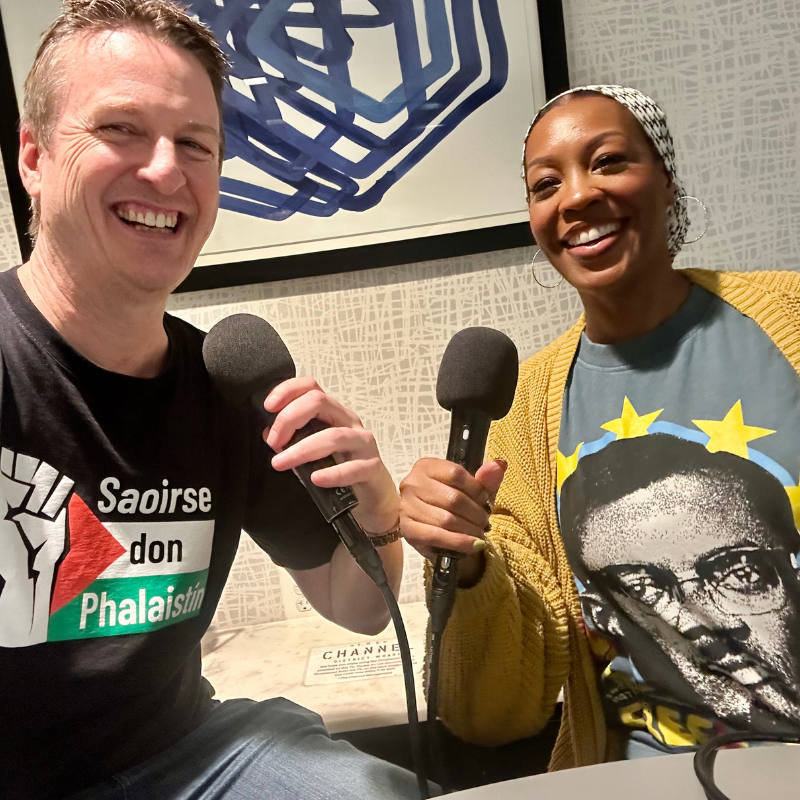
Matt Bowles: My guest today is Imani Bashir. She is a travel journalist, storyteller, mother, political activist, and the communications director at Resist, a nonprofit organization that provides funding to grassroots social movements that are building towards collective liberation. With over 400,000 followers on her personal social media, her travel content has focused on what it’s like to live abroad as a Black Muslim digital nomad and has consistently amplified the struggles of marginalized people worldwide. Born and raised in the U.S. Imani has lived in five countries, gave birth in Poland, and has spoken on stages around the world including Essence Fest, Women’s Travel Fest, Black Travel Summit, and was on the keynote panel together with me at the 2024 Nomadness Fest. She has been a longtime supporter of the Palestinian Liberation struggle and co-authored the Travel Industry for Palestine Petition. Her travel journalism has been featured in the New York Times, the Washington Host, NBC, BBC, Travel + Leisure, and many others that you would know.
Imani, welcome to the show.
Imani Bashir: Thank you so much for having me, Matt. I am very, very happy to be here and have this conversation with you.
Matt Bowles: This interview has been a long time coming and you are one of my very favorite people, so I am so excited and honored to have you on the show today and the fact that we have agreed to do this in person. We are actually at your home in Washington D.C.
Imani Bashir: We are.
Matt Bowles: So, this is super special. We try to see each other every time that we are in the same city and I’m so glad we are finally recording this conversation. I feel like we need to start off just reflecting on our time together last year at Nomadness Fest. We need to give a shout out to Evita Robinson, the founder of Nomadness Travel Tribe, who invited both of us to be on the keynote panel about travel and activism. Can you share what that experience was like for you? I guess both the panel as well as the event, and maybe just a little bit about your history with the Nomadness community?
Imani Bashir: Yeah, it’s interesting because someone told me to apply, literally sent me a DM and was like, hey, I think you should apply to speak at Nomadness Fest. And I was just like, just being in the travel industry, I was like, nobody’s going to want to really have the conversations that I want to have surrounding the travel industry. But I was like, let me just apply anyway and see what happens. I applied and specifically to have this conversation surrounding how it is that we use our privileges around the world, et cetera, and shout out to Sejal because literally she was so amped and like juiced. Yes. We loved it. We really want to have this conversation. And then to be the keynote conversation, I was like, whoa, okay, awesome.
And that was my first no Madness Fest. And I think because me living abroad for so long, I just didn’t get a chance to do as many in person events and go to the different conferences and festivals and things of that nature. So, for that to be my first and to be speaking on the stage and to be speaking on the keynote, it was an exciting time, an amazing time. And it was such a very well done and very well-run conference. Shout out to Evita. Shout out to the Nomadness team. For me, I was like, wow, to be in a room with the people that I’ve connected with online, but had never gotten a chance to meet in person. And then to have such a great conversation with you, it was just the cherry on top.
Matt Bowles: Well, let’s talk a little bit more about the dynamic that you mentioned about why those types of conversations are not being platformed at most travel events. Can you share a little bit just for folks to understand of the macro analysis of how the travel industry and travel journalism broadly is often contributing to neocolonialism and then maybe also what travelers and travel content creators can do to try to disrupt that.
Imani Bashir: When we think about this, and I also have to shout out to the Society of American Travel Writers, they actually invited me. I applied to speak there, and I applied to speak with having the conversation about decolonizing travel writing and how it is that we approach the storytelling in a way that’s very Christopher Columbus. And they were open to the conversation and was like, yes, ensure that I had an indigenous person on the panel. And so, there are, in small enclaves, folks ready to have the conversation, willing to have the conversation, but on a larger scale, that’s not what it is that you’re seeing. Because when we look at the travel industry and where it is now, it’s a lot more focused on ad spend, and it always has been. Ad spend is what drives the revenue and pays people bills, et cetera.
However, there’s no push to say, what about this side of the conversation? If we’re talking about the best hotels to go to in Bali, why can’t we have the conversation about what has been happening in Indonesia with the people and the government and the fact that folks are not making decent wages? And why can’t that be a part of the conversation, too? Because this is something that I’ve often talked about on my social media. If you don’t know where a country or a city in that country stands economically, it is not safe for you to travel into a place. So, imagine you go into Jakarta, which there was actually a, I don’t even know if he was a content creator or if he was just going to Indonesia to actually travel. And he ended up right in the thick of protests. And he’s white British guy, and he’s like, running. He’s like, I have no idea what’s going on. But he got a crash course because he was there, he was traveling there.
And I think that when we negate those sides of the stories, when we negate what’s happening in Madagascar right now, when we negate what just happened in Nepal, when we negate what is happening in Mexico City with the local people protesting gentrification, when we see what happened to the tourists in Spain, because the people have had enough and they’re like, our rent is too high. Get the hell out of here. There’s a level of safety that you’re also not taking into consideration because you’re negating the experience of the people on the ground.
So that way you can go and get your kicks and enjoy the beach or put your feet up and have a cocktail and so for me, it’s like there’s a duality in the industry that we do need. It’s not a matter of ‘being political’, because to me, everything is political. I don’t care if it’s the price of rice, it’s all political. So, it’s not a matter of that. It’s really just about humanity and the core of how it is that we treat the people on the ground versus using them as this picture-perfect place for us to be able to escape whatever it is that we’re looking to escape.
Matt Bowles: So, do you have any tips or best practices or things for travelers to keep in mind as we’re moving through the world? And then also if people are travel content creators or looking to become and build their brand as travel content creators, any advice for them in terms of approaching these dynamics?
Imani Bashir: Yeah, I think it’s important that, number one, we recognize that social media is one of the biggest tools to get information. I can find out what is happening in Madagascar on TikTok before I can find that out in the New York Times, because they’re not going to be as subjective as I need them to be to really report what is happening on the ground versus me getting it from a content creator who is boots on the ground and letting me know what is going on there. So, if you’re somebody that’s looking to be a travel content creator or a travel influencer, there’s a duality that you can have because we’ve had those conversations about, oh, hey, here’s the cheapest place to go. Well, why is it cheap for you to go there? But it’s not cheap for the people who live there.
That’s a conversation that you cannot negate because that lends to that neocolonialism of, hey, it only cost me $20 to stay in this hotel, but how much is the person that’s at that hotel that’s working for you actually making? And we’ve seen this example in Hawaii when the people were like, please do not come here, your U.S. Navy has poisoned our water. The fresh water is going to all of the resorts and the hotels, but the community is not getting any. And so, if you’re not willing to say, oh, my stay is contributing to somebody else’s subjugation, then what are we doing as travel creators?
So, for me, it’s like, you may not necessarily be the person that’s as boisterous as I am to call the thing the thing, but you can say to people, hey, been watching Kanaka Maoli content creators saying that these are the best practices if you’re coming to visit, that you can partake in. For me, I did go to Hawaii. I went for Fest Pack for the Pacific Islander Festival, was absolutely amazing. But I also planted trees when I was in Hawaii. And I remember my tour guide saying, hey, people usually opt out of this part of the tour. And I was like, excuse me. It was probably the best part of my experience there, outside of talking to the local people, to actually engage them in what they’ve been experiencing. The mass homelessness, the high, oh, my God, the cost of rent there. One of the guys that had driven me to one of the events at FestPAC told me to go to a grocery store and look at the price of eggs and milk. And I was absolutely floored at how much people pay for just everyday things.
And so, for me, that gives me the opportunity to say, hey, yes, I did go to Hawaii, but I spoke to the people on the ground. I engaged with them in what it is that they needed and what is that they require from us as travelers, as outsiders. And so, it’s not always necessarily just don’t go there. Sometimes it’s a matter of actually engaging with the people on the ground. Get outside of your resort and talk to people and engage with them and see what it is that they need from us. If we’re saying that, oh, our tourism dollars, well, they need tourism. No, they don’t need tourism. What they need is intentionality. And what they need is people that are going to go there and that are going to spend their dollars wisely and that are going to get back to the community the people that need it most.
Matt Bowles: Yeah. And I also tell people that the things we do when we’re traveling, really from a politically principled perspective, can and should be the same things that we can and should be doing when we are in whatever our home city may be in terms of the communities that are in struggle there and raising awareness around who is benefiting, who is not benefiting, at whose expense. What are the terms of the struggles that these marginalized communities have? How can I learn about them? How can I then stand in solidarity with them on their terms? And I think as we move around the world, it can be, if we choose to make it an amazing opportunity to get a political education about the things that are going on in our world, if we choose to seek that out, if we choose to listen and then we choose to take a stand and be in solidarity with those people on their terms.
Imani Bashir: Absolutely. I remember this was last year, people were at Trinidad Carnival and Tobago had this big, huge oil spill and, like, no one was saying anything about it. And I’m like, you all are in Trinidad right now at this very moment, but have yet to mention, hey, these folks are going to need some support. I’m in Trinidad right now. I’m enjoying Carnaval. It’s been an amazing experience. And also, this is something that I feel like as an audience, you need to know. For me, it’s like, what is so hard about that? And I’ve often been like, people try to avoid me at travel events and things of that nature because I’m just like, what are we doing? If you consider yourself an influence, where is your influence going? It shouldn’t just be, eat, pray, love. It should be also how it is that we contribute to the best parts of these places.
And I said it since Women’s Travel fest, this was 2019, just before the pandemic really hit the U.S. I said, your travel destination is someone else’s home. We cannot continue to disnify every single place that we go and treat it like a theme park. Somebody actually lives there. Spiritual practice is there, raises children there, has family there. And so, we have to bear that in mind that just because we are leaving our particular homes, that we are stepping into somebody else’s homes and we are guests. So as a guest, how do you show up? How do you put your best foot forward? How do you identify the needs of the people that are going to allow them to continue to be a host for you?
Matt Bowles: You know, one of the other really special things about that 2024 Nomadness Fest event that Evita put together was that she invited and hosted a fireside chat with Malcolm X’s eldest daughter, Ambassador Shabazz. And you and I both got to attend to that. We both got to meet her in person and have some private one on one words with her. And one of the things when I had my couple minute conversation with her, one on one that I said to her was that this was September 2024, that we were there. And I told her that had come to my attention, that it was exactly 60 years ago to the month that Malcolm X was in the Gaza Strip meeting with the Palestinians. And then he published his very famous essay later that month in the Egyptian Gazette on the Logic of Zionism, which I would encourage people to read to this day. And we can put it in the show notes if anyone hasn’t read it.
But I said to her that Malcolm’s international travels continue to inspire me. And I continue to refer back to his writings and his speeches about that. I told her that I just recently gone to Nairobi and some of the people that I was going with, I said, have you ever heard the Mau Mau speech by Malcolm X where he had gone to Kenya, he had learned about the anti-colonial resistance in Kenya with the Mauj Mau, and then had applied some of those concepts to the black liberation struggle in the United States. And he would go around and he would listen and he would learn and he would meet with these groups with the intention of building international solidarity and global. Global decolonial solidarity with these different groups and what we can all learn from each other and how we can apply that and how we can support each other. And I told her that I continue to refer back to that.
And when I go to these places that Malcolm has gone, I revisit, what did he say about these places? What did he learn from these places? And she told me that that meant a lot to her because she said that Malcolm’s legacy has largely been very domesticated and very focused on specifically things that he did or said in the United States, in a U.S. Context and at the international part of his life, particularly. That final year was so significant and such an important thing. And so, she appreciated that. But I’m curious for you, maybe you can even start off with what Malcolm’s work and legacy means to you and then what your experience was like meeting his daughter, Ambassador Shabazz.
Imani Bashir: So, going back to my lineage, one of the brilliant stories is if you see there’s a photo of a man standing in white in a thobe, and he is facing the casket of Malcolm. Now, Malcolm is shrouded in the white as we are buried as Muslims. And that man is Haji Sham. And he is considered a great uncle for me, but was a great friend to my grandfather. And so, when we talk about Malcolm’s impact, that is deeply rooted within my family and generationally even how it is that that community there specifically helped in orchestrating his burial because people did not want to touch his body, but our community wanted to give him his rights as a Muslim, to wash him and properly shroud him and properly place him in the ground.
And so obviously, the lineage, the work, being a black Muslim in America is very important as to who it is that I am and how it is that I show up in the world. So, the part about Malcolm and how it is that he shows up internationally is the part that is most pivotal for me, especially as a traveler, especially as someone who’s lived about the world. But when you study it and you watch how it is that he moved, he was learning so much more about himself to where he goes. Malcolm X, and he comes back El Hajj, El Malik Shabazz, right. Because all of what it is that he learned about himself, about his roots, and got really rooted and very grounded in his globalization in his international politics. And I think that’s what made him even more dangerous, to be honest and bigger. And so, to meet Ambassador Shabazz as someone who’s also an international traveler, she is someone is literally around the world and has been rooted in so many places, including Belize.
And so, to be able to speak to her from a traveler’s lens and her own politics and how it is that she approaches work with institutions abroad, that was extremely impactful for me because one of the things that I’ve often gotten online is, well, you’re not in the United States. You can’t have a voice about United States politics. Although, my Americanness will never escape me and the subjugation of who it is that I am as a black American, as a black American Muslim, as a black American Muslim woman will also never escape me. And Western imperialism will never escape the rest of the world, no matter where we are on the globe.
So being able to have just even a morsel of conversation with her and to just sit with her and to take a picture with her is something that was very exciting because as you said and as she has mentioned, that part of Malcolm’s politics, in terms of how internationally known he was, but also how he sought international knowledge and tutelage from folks in Sudan, you think about his imam was a Sudanese man. And we have to think about these things in terms of how it is that we form our own politics.
Matt Bowles: Can you share a little bit more? Just for folks that are not familiar with the historical context of Islam in Black America. And talk a little bit about the significance of your last name, Bashir.
Imani Bashir: Yeah, absolutely. So, my dad and I actually co-authored an article. It specifically talks about enslavement and how fasting during Ramadan was resistance for enslaved. So, for folks who don’t know, a good portion of enslaved Africans that were forcefully brought to the Americas were Muslim. And this is a documented history. These are things in which you can find some artifacts in places like Sapelo Islands in Georgia, you can find things about Omar Saeed and how it is that they would tell him to write biblical verses, but he will be writing Quranic verses in Arabic. And you can find that in the African American History Museum in Washington, D.C. you can find vicar beads. Thicker beads are similar. They look kind of like rosary beads, but they are something that we say during prayer, even during the day. But they have some of those. They have a lot of things historically that people are like, whoa.
And so, our history and our lineage are rooted here. Very much so. And there’s also aspects in which there has been work that have been done to correlate the call of prayer during enslavement with how blues music was created. And this is work that has been done over many years to show the correlation between the two. And so, you will hear the name Belal Muhammad in Georgia, and. And you will hear Belali people will say Belali people that come from there. There are multiple generations of families that come from people who kept their traditions. So, they prayed and they fasted during Ramadan, and they would wear a fez or they would wear a headscarf to try to keep as much of the Islamic traditions as possible in America. So that is very much important as to who it is that I am and my name, because my name, Bashir, means. Means bringer of good news or glad tidings, which is very interesting because I’ve been a journalist and I talk on the Internet and all those kinds of things.
So, I embody the name. But more importantly than that, my grandfather Yahya and my grandmother Sakina, which are my paternal grandparents, actually had to go to court to fight to keep our names because they weren’t considered Negro names. They actually went to court to have to fight to keep our identity, and they won. And so that is a very pivotal portion of my story, of my family’s story, of the many generations of resistance that exists in who it is that we are as black Muslims in America, that we would keep some morsel of identity of who it is that we are and continue in that tradition.
Matt Bowles: Can you talk a little bit now about where you grew up and what the dynamics were as you were coming up in terms of your connection with the local black community, the Muslim community, and how you navigated your identity coming up?
Imani Bashir: So, I have a duality in that growing up because both of my parents are from. My mother’s from East Orange, New Jersey. My dad’s from Elizabeth, New Jersey. Their parents all from the south, and obviously that migration of folks to the North. And so, they’re from New Jersey, which generationally have had a big black Muslim community. I’ve got thousands of cousins. Everybody says Salam Alaikum, when you walk into folks and things of that nature. But I was born and raised in Prince George’s county, which is considered one of the black affluent counties in the United States of America. And that also comes from enslavement. And folks that migrated, found different jobs and work and things of that nature, started moving into the federal government when that was allowed, and began to really grow and blossom Prince George County as what it is.
But in PG county, there wasn’t such a huge black Muslim presence as it was in New Jersey, where my parents are from. So, in New Jersey, that black American rooted Muslim presence was there. Here we have more of a presence of international communities. And so, it was often difficult for me, I would say, growing up, to find that identity because I have an Arabic name, I’m a black girl, I’m American multi generationally, not first or second generation. And then you have such an international presence in the masjid or just in Muslim circles as well, that aren’t very deeply rooted in our history and who it is that we are and how it is that we were very pivotal, even in terms of civil rights, in the allowance of people to have this religious identity here, in the spiritual identity here.
And so, for me, yeah, it was definitely difficult for a while because the majority of my friends were Christian. And it was like, oh, you don’t eat pork? Or just always the multitude of questions that you get in as a kid, you’re just, oh God, I don’t want to answer questions, I don’t want to play or like round robin of my identity. But then eventually I was able to step into that because I’m like, you know, there’s an area in which I get to educate people on who it is that I am, on who it is that we are and how we’ve been here for so long till this day that people just don’t know that we’ve existed. And I think that that’s obviously very intentional. But yeah, you deal with some anti blackness within those spaces and you navigate it in a way. For me, navigating in a way is like, I’m not going anywhere where anyone just won’t accept me or won’t pray next to me, or won’t see me as a human being. That’s your own issue. And you got to deal with that anti blackness.
But it also ties into this very real thing of where we have to explain to international Muslim communities that whatever it is that you exhibit towards us, you will never be considered white in the United States of America. No Matter how much you try to shorten your name, no matter if you take your headscarf off, your identity is always going to be what it is. And the example of black Americans and black Muslim Americans specifically, and how it is that we have continuously resisted across generations is a crash course for everyone that comes here, that wants to build communities and really understand how to resist the fascism of our government and how it is that they’ve continued to subjugate Muslims even prior to 911.
Matt Bowles: Well, first of all, salute to your father. I have seen you two do some video collabs together, and I have been so inspired and impressed. Can you share a little bit more about him and how you were raised, particularly in terms of political activism?
Imani Bashir: So, I think for my dad, when you’re growing up in the 50s, 60s with the name Muhammad, as a black kid, you know, you got to step into that role no matter what. Like, you’re either ready or you got to get ready. You know what I mean? And so, I think with him being the eldest of eight children, being raised in the 50s and the 60s, with the type of parents that he had that groomed him to be a titan in the world and to understand that you can’t be small. And it’s funny because my dad is considered a little guy, like a small man, but he’s such a big presence. He knows who he is, and he’s very confident in that. And my dad was a criminal trial attorney, a defense attorney for nearly 30 years.
And I remember I would go to court with him and I would sit and I would just watch him. And I just always thought he was a superhero because of the way that he attacked the justice system. And he would be at home and he would spread his court files all out. My mom hated it because he’d have crime scene photos and all the things, and I would sit with him and he’d just be. It was almost like a sport. When you think of Kobe, like mamba mentality, he was very intentional about how he attacked the work and where are the inconsistencies and what do you see here and where did this happen and this, that and the third, and that’s how he attacked every single case that he had to ensure that black and brown folks just steer clear as much as possible from the criminal justice system.
And so, when you’re raised in the household hold with someone who is constantly stepping outside into the world to fight on behalf of others, but not only just do the job because he could just make a whole bunch of money, but do the job because it was needed, it was needed for his community to have, have actual representation for someone who cared about their lives and who care about their livelihoods. And so, for me it was like no matter how much I might have wanted to hide from my identity and it was always there. My dad always reminded us who we were, how we were to show up in the world. My mom always had this saying, no matter where you run and hide, the truth is always going to smack you in the face. So, you either embrace it or you going to get hit by it. And so, it was just one of those things that we were always reinforce. This is who you are, but also this is what the world is. So, we’re going to prepare you now to be much more confident and much more, stronger to be aware of how it is that the world sees you, but how it is that you see yourself and how it is that you can better position yourself in this world.
Matt Bowles: What was your experience like in the aftermath of the September 11 attacks? PG county, just for folks that don’t know, is right outside Washington D.C. what do you remember from that period and how did it impact you?
Imani Bashir: So, what’s interesting to me is that you’ll hear from a lot of international communities where it was like, oh, we were so scared and we started getting surveilled and all that stuff, that stuff was happening to us before 911, I remember us having phone taps in my house. We knew what a phone tap sounded like. We could hear the tape click. We were always already heavily surveilled, I think because of the type of work that my father did, some of the cases that my dad, you know, took on. And so that was always a thing for us. And then also identity wise, you can never put down your blackness. So, after 911, where people were trying their best to shape shift and assimilate into this Americanness, to show that they were so safe and so palatable. And no, we’re not this. It was almost like Black Muslims were like, what’s new with the demonizing? What’s new with the subjugation? What’s new with the three letter organizations surveilling us and trying to find ways to demonize who it is that we are.
So, I think our approach as a community was a little bit different because it wasn’t, wasn’t a fear that we haven’t experienced. It wasn’t a level of surveillance or a level of even demonization that we haven’t already experienced. Right, we have already experienced that with the Nation of Islam. We have already experienced that with the death and the assassination of Malcolm X. And so, for us, it was just, oh, okay, this is just another layer of where it is that we’re going to have to be much more aware of how it is that we show up in the world. For me personally, it didn’t stifle me. I think it only was causation for me to be a bigger version of myself so that people understood what Islam is and what it’s not.
Matt Bowles: I also want to ask you about your history of Palestine solidarity work. And maybe if you could just start off for folks that are not familiar talking about the history of Palestine solidarity within the black liberation struggle, whether we’re talking about Malcolm X or Angela Davis or the entire list goes on, and then how that history impacted you and your personal consciousness in connection with the Palestinian liberation struggle.
Imani Bashir: Absolutely. I think when we think about black radical movement, we cannot leave out the international parts of solidarity, the Pan-Africanism. I have literally on my shirt right now, Patrice Lumumba, Cuz Free Congo. And so, for folks who might not necessarily be well read in black radical tradition, like you said, you named a few names. You named Malcolm X. He wrote literally an entire essay talking about the people of full esteem. We have people like Kwame Ture. We have people like Angela Davis. We have an entire black radical tradition that said their struggle is our struggle. And here’s why, they laid it out, like, here’s why these things are tied to us and intimately connected. When we look at Ferguson and we look at the uprising during the George Floyd movement, for those of you who missed that Twitter era, when it was people in full esteem that were teaching black activists and others who are outside that it’s milk that you pour when you get tear gassed. It was probably one of the most pivotal moments in our history to show that solidarity has no barriers, it has no borders.
And literally people were educating us literally from across the river in the sea to let us know how to protect ourselves in that moment, right. When we think of Hurricane Katrina, it was literally Palestinian, Palestinian refugees in the west bank who put their money together to donate to victims of Hurricane Katrina. People don’t know this, and I’m talking about thousands of dollars. These are refugees in the west bank, in Palestine that said, wait a minute, what is going on? And took their money, put it together and donated it to black residents in New Orleans, in Louisiana. And so, if you don’t know that, it’s easy for you to say, oh, well, whatever’s going on over there has nothing to do with us if you don’t know that the IOF is training our police departments. Which is why when you see cop city in Atlanta, you should be looking to stop that because Atlanta is still a predominantly black city. And that means whatever it is that they’re getting from isn’t real. They’re going to be continuously bringing down on us.
The occupations that you see with the militaries in D.C. in Memphis, in Chicago, in Cleveland, in LA. These are all things that have been positioned because of the alignment that we have with isn’t real. So, for me, it’s like we can’t not be in solidarity. We can’t not be in step with each other. And then outside of the human aspect, I wouldn’t care if one Palestinian never gave a dime, if one Palestinian never gave any tutelage on how to help us protest over here. Genocide is genocide. And I can never unsee the things that I have seen on my phone and the massacre of people via social media. It is ungodly, it is insidious. And it is absolutely heartbreaking to watch this happen in real time and to say that because for whatever reason, oh, they didn’t do this with us, we’re just supposed to turn a blind eye.
If you think that that can happen to a people and you can turn a blind eye or a deaf ear to that, what do you think will happen when it happens to you? Now, granted, as a black person, we have always been subjugated, but we have always had moments of solidarity with other marginalized groups. So, it’s not like that’s not a real thing. And we have restated the history over and over and over again of where it is that we’ve shown up for each other in lockstep because we understand that that’s what it’s going to take. It is more of us than it is of them. And so, yeah, I think it’s imperative to continue to reiterate that, and I do it on social media, of how it is that Palestinian and black folks have been in lockstep in solidarity with each other and how Pan-Africanists and international minds and in the black radical tradition have always advocated that we learn from each other and we learn from each other’s experiences to better than figure out how it is that we undo these systems of oppression.
Matt Bowles: Yeah, and if anybody hasn’t read Malcolm X’s article on that, as I said, we’re going to link it up in the show notes. It is as relevant today as it was in 1964 when it was published. And he of course was analyzing it correctly as a European settler colonial project. And then the resistance to that needs to be the same as any other European settler colonial project and ought to be an international decolonial solidarity in the same way that the Palestinians were in solidarity with the anti-apartheid movement in South Africa and were supporting all of these other decolonial movements, and those decolonial movements were supporting the Palestinians. And I studied abroad in Ireland and I’m of Irish American heritage. And you want to see some of the strongest Palestinian solidarity in the world, go to the occupied six counties in the north of Ireland. Britain’s first colony was Ireland, where they developed a lot of their colonial techniques that they would then go on and expand to the rest of the world.
And their last colony money remains the occupied six counties in the northeast of Ireland where there is still a decolonial struggle to try to regain the Sovereignty of all 32 counties of Ireland there. And so particularly in the occupied six counties in the rest of Ireland as well, but particularly there, if you go to West Belfast, you will see some of the most robust Palestine solidarity that you’ll ever see anywhere. And again, it goes back to this history of decolonial solidarity between all these groups that really understand and are committed to that principle. I want to ask you now, Imani, if you can talk a little bit about your college experience, your decision to go to an HBCU in Delaware State and what that experience was like, what the impact that had on you.
Imani Bashir: So, both of my parents went to Howard University. My dad a two-time Howard University grad. So, he graduated from School of Communications undergraduate school and then he graduated from Howard University Law School. And so, my whole upbringing was HBCU. I don’t think I even applied to any other type of institutions. And I originally wanted to go to Florida A and M. And my mom was like, that’s way too far. And so, I had an uncle who was an adjunct at Delaware State, he’s an alum of Delaware State and was like, hey, apply here and see. And so, I did. And I will say that that was one of the most pivotal parts of my adulthood because I don’t think I was mature enough to be at school because I was just as a kid, I didn’t know what I wanted to major in. I was just going just to go. But at the same time, it was seeing other folks really attack their education in the way that they did that really groom me to understand the college experience.
So, I remember the first time meeting the people in the SGA and meeting one of my friends, may he rest in peace. Mike Feeney, who grew to be an amazing journalist, but he was the editor in chief of our school paper and had always been about the work and storytelling and all of these things. And I was just like, wow, these people really know what it is that they want to do. And meanwhile I’m just here enjoying things. But going to a black institution, one, it shows you that there are so many people from so many places. The majority of people that I went to school with from the tri state area, a lot of people the first to go to college in their families, a lot of people that had a lot at stake versus me, where it was just like, okay, well I’m not the first to go to college in my family, so I don’t necessarily have to tick off a box. And I’m not really looking to excel at this thing. I just don’t know what else to do yet.
And then eventually finding my voice, finding my niche, understanding the power of communications, because that was my original major because I wanted to be an attorney originally. And my father was like, well, don’t major in anything law, because you’ll have four years of law school to be able to go through that. So, he was like, don’t major in criminal justice or pre law or anything like that. Just major in something that you’re good at. And I was always good at writing and then eventually learned the craft of broadcasting and getting on a microphone and being behind a camera and being in front of a camera and all of those things. And so, the creativity that you see at a black college, the way that we didn’t have all of the resources but folks made it work. Folks had reality shows, reality TV shows, they did rap battle at this college and they would put it on film and they would show it in the student center and things of that nature. And those were the things that I will constantly remember.
And obviously, yeah, college parties and all that stuff. But I think the pivotal portions were seeing how people made something out of not having the best equipment or not having the most expensive high end. This people were trying to figure out how to create and be creatives with having less of what it is that we have now and even less access the way it is that we have now. And I have so many people that if you see B. Dot from Rap Radar, he went to Delaware State. If you see Tony Anderson, he’s a correspondent, he’s been for Complex magazine and BET and many Other entities. A product of Delaware State University. You listen to the Breakfast Club and you see Lauren on the Breakfast Club, a product of Delaware State University. So, these are folks that have made their mark. That used to be our slogan years ago, make your mark on the world. And ironically, I feel like that is something that is groomed when you’re there to make your mark on the world. And a lot of people have, and I would say I have too.
Matt Bowles: Well, I want to ask you now a little bit about your world travel journey and I feel like a good place to start if you can share a little bit about your grandparent’s decision to move to Egypt and then your experience getting your very first passport and going to London.
Imani Bashir: So, my grandfather’s wife worked for the Board of Education of New Jersey for a very long time. A longtime educator and wanted to take students for this immersion type of program that they wanted to start. They would take the kids for a couple of months out the year, bring them back, etc. And then 911 happened. When 911 happened, the parents were like, please don’t bring them back. What do we need to do? How can we may be financially support you to just keep the kids there? You know? She was like, well, as long as y’ all are willing to pay because feeding kids ain’t cheap, then we’ll figure something out to where it became like a year-round type of thing. And my grandfather, who had a beautiful home in New Jersey at the time, he was like, well, I guess we’ll just sell the house and we can just head over there.
And that’s what they did. And his goal was never to come back to the United States. He actually passed there; he’s buried in Cairo. That was really huge because I had never had an experience of anyone in my life that I knew of to make the leap to live abroad. And then my youngest brother, who was I believe seven at the time, my parents allowed to go to do the study over there. And so, he spent some time in Egypt as well. And then when I got my passport, I always say that I was a late bloomer because I was in my 20s and I had never looked at international travel as something that was super necessary. It wasn’t on my purview; it wasn’t on my radar. And I think the United States has a very great job of keeping our world very small and boxy to where it’s like, oh, you don’t need to go to these places, you don’t need to go over there.
And I took a girl’s trip to Puerto Rico, which is a U.S. territory, but when you go to U.S. territories, you can see why they were invaded and colonized and things. Because they’re so not the 50 states. And even with Alaska and Hawaii, they are also so outside of the culture of Americanness and westernized things. You have indigenous cultures; you have some very rooted cultures in these places. So, when I went to Puerto Rico, although it is American territory, it was like, wow, this is beautiful. And I didn’t know much about it. And I got a chance to actually go to a home of people that lived there. And we ate and it was okay, this is fantastic. So that was like my first taste. And then my brother was getting married and my sister-in-law is Somali, but she’s from the UK, she’s from London, and with Somali tradition, they have three days’ worth of wedding. And so, my brother was getting married in London and. And I didn’t have a passport, I didn’t have anything. So, it was like, okay, cool, so I guess I’ll get my passport.
So, it went from that to actually getting to London. And it was so outside of what it is that I could conjure in what it is that were shown in the us I really thought that they had tea time and everybody looked at me like, girl, what? But then also they were like, well, do y’ all own guns? So, it was like one of those kinds of things, like a crash course about each other. But even just seeing the amount of internationally black faces in a place like London, didn’t know that existed. Didn’t know that they had ethnic food. I thought it was like fish and chips and Cheerio and all the goofy stuff that we just are ignorant about. And it was like the moment, an awakening of like, whoa, one, we’re everywhere. Two, this is pretty cool that people migrate in this way.
My sister in law’s mother had to flee Somalia to go to Kenya, and then from Kenya, wanted to seek better opportunities for herself and for her children and came to London. And so, there’s so much that’s wrapped in the stories of people that are there. And I’m learning about people. And the Somali aunties are trying to speak to me and Somali because they think I’m Somali. And I’m like, auntie, I don’t know what you’re saying, or they’re trying to speak to me in Swahili. And it was really just such a beautiful moment for me that showed that we were so far from understanding that we are more alike than we’re not. And Puerto Rico was my initial taste of life outside of the 50s, the 50-50-50s. But London was that international moment where I was like, wow, the world is so much bigger than what it is that American has given us the opportunity to experience. So now I want to see more.
Matt Bowles: You know what’s really interesting that you say that about London, is the very first time I went to London, which was when I was studying abroad in Ireland, which is back in 97, 98. Go to London, and then it’s like, oh, what are the tourist things to do here? I should see Big Ben. I should see Buckingham palace, whatever the sort of iconic tourist things is. And now that I’ve been traveling the world full time for over a decade, what’s been really interesting, because I hadn’t been back to London until I just went last week. As you know, I was in London. It was the first time going back in over a decade. And over the course of that decade, as I’m traveling around the world, and I’ll post up in places like Lagos, Nigeria, and I’ll start Shazamming all of these Afro beats and building all of these playlists of all these amazing Nigerian Afrobeats.
And I start looking up all these artists, and so many of them are based in London. And then I’m looking up all these different things, whatever it may be, right? Talking to folks in, like, the South Asian diaspora, and they’re like, yeah, some of the best South Asian food in the world, which is some of my very favorite, is in London. And you got to go to this place and that place. And one of my very favorite things to do around the world is when I’m in a city that has amazing street art to take a graffiti tour and really immerse in that. And people like, dude load, London has some of the best street art in the world. I was like, what? So, I have this list of things to do in London that are entirely totally different and unrelated than any of the mainstream tourist stuff that I would have done so many years ago.
So, when I went back last week, very first thing I did, I said, okay, I’m going to Rye Lane Peckham. I’m going to the Nigerian immigrant community. I’m having West African food. I’m doing that. And then I’m going to Brick Lane. I’m having Bangladeshi food in this section of the town. Then I’m going to Shoreditch, and I’m walking through all the street art, graffiti. I spend the whole day there and all these things. And so, I Think it’s a really important perspective on travel that I have gained through traveling the world. And I think we can even apply that in whatever city we happen to be in, right. Like, I’ll give you another example. I went to high school in Buffalo, New York, and I was just back there for my high school reunion union. Now, when I was in high school in Buffalo, I was paying no attention to any of the international dynamics of the city. The immigrant culture, restaurants, that kind of. I mean, it just wasn’t even something I was remotely conscious of.
I went back this summer and I was like, I am going to see what this city has going on. And I’m going to Yemeni coffee shops. I went to a Somali deli and this was like a super local hole in the wall thing where there are literally only Somali people in this spot, right. And I have them make me the breakfast that the other folks are making. And it’s like the fold out chairs in the parking lot on the table with the rest of the Somali immigrant folks. And just like me and my buddy eating with them. And I’m like, you know, this is really amazing because I travel the world for these types of experiences and if you’re willing to, to look for them in most major cities, there are extraordinary immigrant communities there and cultures that have been literally brought to you. I mean, that’s one of the things that I just, I tell people, like, with all this anti-immigrant, xenophobic stuff and everything, I’m like, I literally pay to travel the world to go and be able to have the privilege to immerse and experience these beautiful, extraordinary cultures. These people here have literally come to you. You have to pay. No money. You could just go and have it. It’s right there. And there’s like animus towards that. Like, I just, my brain can’t even fathom that.
Imani Bashir: Yeah, even now, like when I get on an airplane, you can tell who’s MAGA, but they’re headed to Mexico. And it’s like, like this is quite interesting. Like, even after these big protests with the white supremacists in the UK, there’s pictures of these folks at the Daisy food stand getting their naan bread and their butter chicken. But immigrants are bad. What are you going to eat? Beans on toast? Seriously, let’s be serious here.
Matt Bowles: It’s pretty amazing. Imani, I want to ask you too, before we get into your travel journey and you’re living abroad experience, can you share a little bit about the history of black expatriation and people like James Baldwin and Maya Angelou that chose to leave the U.S. for extended periods of time and live in other countries for extended periods of time. And did you have awareness of that before you left on your journey?
Imani Bashir: I didn’t. I didn’t know how many black Americans actually lived abroad. And I actually learned about Maya Angelou’s journey while living in Cairo. And so, then that became like a whole fun part of wanting to retrace her steps, trying to go to the newspaper that she was an editor at, trying to see. I wonder if she walked around here. I wonder if she did those things. And so, yeah, I learned as I moved along, like I knew about James Baldwin in Paris, because I think that’s probably one of the more infamous stories that you learn about. And then you also learn about how we had this almost black renaissance in Paris of so many creatives that went there, including Josephine Baker, including Paul Robeson, et cetera.
But I think I started to get into the meat and potatoes of black Americans and their expatriation journey in my own journey. And really understanding that, number one, migration is a very human thing. It’s a very human act that people are always going to be seeking better, whether that’s better accommodations or better quality of life, or lower cost of living, whatever it is, better weather, people are going to move where it makes sense. It’s just a natural, human thing. But people make it seem as though black Americans are just, we grew here in corn stocks and we just love it, and we haven’t been anywhere. And so, I even went so far back to see the very first passport that was issued to a black person that’s as documented as possibly can be. And it was in the 1800s, and he literally really had to have a white man advocate for him.
And I have this video up on my TikTok and my Instagram because he was trying to work overseas, and he had to have a white man write a letter to advocate for him to be able to get a passport. And so, since enslaved were forcefully brought to the Americas, they have always been trying to leave. But I think the power of stories like a James Baldwin and a Maya Angelou and Audre Lorde and even Tina Turner is the people that left on their own terms, terms with intentionality and seeking different things. You have James Baldwin, who talks about this throughout his work and how his living abroad shape shifted his civil rights work and how it is that he approached the work similar to how we talked about Malcolm X and his travels around the world and what it is that he learned and picked up when we look at Audrey Lord. Audrey Lord lived in Mexico. Audrey Lord lived in Germany. Her feminist work is still deeply ingrained in Afro Mexican and Afro German women.
In those places you will see Audre Lorde’s work and they will tell you she empowered us to really understand who it is that we were in the framework of our identity as Africans, as Germans, and how it is that we maneuver throughout this world and just the advocacy. So, for me, I look at their examples, but I also looked at the fact that as we talked about with Malcolm X, their international travels really raised them up in who it is that they were because they got a chance to see themselves in the world, but also, they got a chance to really advocate for other communities while simultaneously doing the work to advocate for their own.
Matt Bowles: I want to ask about your decision to leave the U.S. for an extended period of time. And I think I want to start, start this off by asking you about Sandra Bland. For people that maybe have never heard the name Sandra Bland, can you talk about who she was, share some of her story and what ultimately happened to her and then how that impacted you?
Imani Bashir: Yeah, so Sandra Bland was a 28-year-old black woman who, from what it is that I learned, she had been interviewing for jobs and I think she had just found her dream job of something of that nature. She’s driving on a road and she gets stopped by the police. Somewhere along the way there’s an exchange to where they lock her up. Now, we don’t know what the truth of the story is that happened to her while she was on lockup. What we do know is that she did not have enough money for the bail or the bond that she needed to pay, right. Which is a tale as old as time and something that we talk about when we talk about cashless bail. And so, she had to stay in lockup and someone where along the way she ends up being killed by police.
Now, they called it death by suicide. And obviously we call bullshit even till this day. If you in trigger warning, if you were to look at the picture that they have of her in the orange jumpsuit, people presume that she was already deceased in that photo. This was July 13, I believe, of 2015. And I remember hearing her story. And prior to me deciding to live abroad, I had already been doing a lot of work at that time. I was working in a nonprofit organization during the summertime. I would be broadcasting throughout the year because I was a sports broadcaster, but I would still be doing a lot of different movement work. So, prior to Sandra Bland. It was Freddie Gray in Baltimore and I was outside marching with students. And the year prior we had Mike Brown and we had Trayvon Martin. Then I think Sandra Bland was really my last straw because she was 28. I was 28 at the time. I was trying to find my dream job. I was applying to all of these big networks because I thought I was going to be like the black Muslim Pam Oliver on sidelines.
I just really thought that that was just going to be the thing. But as I’m applying, I learned of this. And obviously this is national news. I believe it might have been international as well. And I just continued to see myself in her. This could be me. This could be me. And it just felt like such a staggering and drowning experience outside of the fact that I have my degree, I have all of this experience in this broadcast industry, but nobody wants to hire me. And so just having to deal with that and rectify that. And I just moved back home with my parents. And all the things that they tell you about this American dream that I knew was a lie, but I still, you know, you still go through the systems and try to play the game as best as possible. And I remember it was as clear as day. I was sitting in my cubicle at the non-profit that I was working at and it was as if somebody whispered to me in my ear, you should move abroad. Never had I conjured that idea ever before then never thought about it.
And so, the first place I went was Facebook and I was looking up expat groups. And I remember joining black Americans living abroad. We call it BALA. And I’ve been in BALA for, for years, over a decade. And I remember just seeing conversations and asking people questions and things of that nature. And someone suggested Cairo because they were like, well, if teaching is an easier job to get abroad as an American. But there are stipulations in some places because I was looking to try to go to the United Arab Emirates because I heard they paid the most and tax free and all that. I was like, yeah, sign me up, whatever. But they usually look for a teaching license and all this stuff that I just did not have.
So, when it came to Cairo, I literally booked a one-way ticket. So, Sandra Bland happens July 2015. I was out of the country by August 2015. So, I planned my move in a couple of weeks. I bought a one-way ticket. I remember having enough money to buy a little HP pink laptop. It was 99 at Walmart. I bought that and I had $400 left of my paycheck and I left and I had no job lined up. And I literally lived with someone that had a two-bedroom apartment. And she was like, you could just stay here with me till you get on your feet and figure things out. And literally the day after I landed, I went to a school, it’s called Nefertari International School in Cairo, Egypt. I had a three-hour interview with multiple people, and they hired me to teach 10th and 11th grade English literature.
Matt Bowles: Well, you and I missed each other by less than a year because I lived in Cairo for about nine months in 2014.
Imani Bashir: Wow.
Matt Bowles: And so, I left right before you got there. It was my third time in Egypt, too. I had initially gone around 1998, which was my first trip to the Middle east as part of a study abroad program, which is my first time I went to Palestine as well. And then I went back in 2012, and I lived in Cairo for a couple months in 2012 in the Mehendi In community, and then went back for nine months and lived in Zamalek for 2014. And so, you and I just missed each other.
Imani Bashir: Yeah.
Matt Bowles: But what was your experience like in Cairo?
Imani Bashir: I tell people Cairo has that New York spirit. If you can make it here, you can make it anywhere. Cairo was my crash course on really surviving a place. Number one, not knowing the language. So, you have that culturally very different. Yes, I’m Muslim, but when people think like, oh, it’s a Muslim country, it’s not. Not that it’s not so stringent on things like, yeah, you’re going to experience Ramadan and Eid in a bigger way than you would experience in the United States. But it’s not so like, stringent on what you wear and that kind of thing. It’s not that there are Coptic Christians there and things of that nature, but it was my crash course for life. And I remember I would go to school and I had my 11th graders. To this day, I’m connected with a bunch of their adults now, but I can’t see them that way because. Because it would make me cry.
But I had one student, Maria, who literally anytime I go back to Cairo, we have coffee, we chat, we do all the things. And she would not speak to me in English. Now, I know that that sounds okay, well, why. Why you. But that was the rule for the class, because it was an English literature class. It was like, we want our kids to be better at the English language. So, it wasn’t so much like a colonialist mentality, like, you need to speak English in here. It was more so like, no, we want you to be better at speaking, writing, reading comprehension, those kinds of things. But she would not speak to me in English. But what I ended up really understanding was they would sit with me because I would sit and I would talk to them and we would talk about culture and we would talk about politics, things that they could not talk about outside.
Let’s be reminded that when you go to certain places, the ‘freedoms’ that we have as Americans, other people just do not mind. At the time when I moved there, Netflix wasn’t even allowed. Even if you had a password, an account, you could not get into Netflix in Egypt. So, I remember them asking me, what do you do the most here? And I was like, well, I shop. I like to go to the six. I like to go to the markets. And so, they said, okay, you need to learn your numbers, right? And they taught me my numbers 1 through 10, and then by the tens, all the way to 100. So, 10, 20, 30, 40, 50, 100. They taught me how to say, how much became miss. When you ask them how much it’s became. Okay, cool. They taught me how to tell people to F off. And you have to be aggressive and you have to use your hands, etc. And I remember the first time I went to go take a taxi because I’m like, I got to test this out.
So, I go up to the taxi and I put up the number five and I say, hamza. And the guy drives off. So, I’m like, what the fork? What is going on here right now? Back then, y’, all, I was going to Starbucks. This was 2015. Do not hold it against me, okay? So, I was like, well, the reason I was headed there was because I’m like, I know there’s somewhere I can find Internet, I can talk to my family, etc., right? So, I decided to walk. I’m like, okay, I’m just going to walk. And then I get back to school and I tell them. I’m like, y’, all, I told the taxi driver, I held up the number five and I said, hamza. And they start laughing, and I’m like, what? And they are like, miss is Hamsa. And not only were they teaching me the language, but they were teaching me how culturally to enunciate the language and how to use my body language and how to culturally immerse myself in the ways in which I said a thing so that people would respect me and take me seriously.
But what I also recognize is that they were teaching me a level of safety that I needed to survive there in teaching me the language, in how to get around, in being able to communicate with the community. But in a sense, I always felt like they were also keeping their community safe. Hey, you’re a foreigner. Don’t come up in here trying to speak English to everybody and expecting that they’re going to speak to you back. So, my best route was always going to the street. I like to go to the mall and other places, but I always wanted to test out the language. So, I will always catch a taxi. Even though they had Uber, they had a service called Kareem, which is like an Uber in the Middle East.
But I would catch the taxis and I would always go to the outdoor markets in the Sooks to test my language. So, yeah, it’s a very aggressive culture. If you’re not used to that, it could be off putting in some way, because some people who choose to. To move abroad, they want something that’s a little bit milder, a little bit slower. Cairo is not that. Cairo is very aggressive and you need to be on point, you know, going to somewhere like that. But it was my starting place of learning myself what it is that I was made of, what it is that I was willing to do and even endure as a foreigner in a place that I opted to come to. And it really, really helped shape my perspective on the world and how it is that I moved about it. And it holds a very special place in my heart forever.
Matt Bowles: All right, we’re going to pause here and call that the end of part one. For direct links to everything we have discussed on this episode, as well as all the ways to find and follow and connect with Imani on social media. All of that is going to be in one place. Just go to themaverickshow.com, go to the show notes for this episode, and be sure to tune in to the next episode to hear the conclusion of my interview with Imani Bashir. Good night, everybody.