INTRO: This is part two of my interview with Roshni. If you have not yet listened to part one, I highly recommend you go back and do that first. It was episode #260. And it provides some very important context for this episode. If you have already listened to episode 260, then please enjoy the conclusion of my interview with Roshni.
Matt Bowles: Can you talk about where you were born and how your upbringing was?
Roshni Kha: So, my dad actually moved to the UAE in 1977. So, he found out that, okay, you know, UAE, there might be opportunities for work. And he was able to save up some money and get a flight and landed in UAE. And at that time, they held his passport at the airport and did not issue a visa to him until he secured a job. So, he actually secured a job as a translator for English translator.
Again, going back to my grandfather’s vision that if you know English, the language of your oppressor back then, a lot of paths will open up for you. And from there, like he, my dad always says this, like people who have the least will help you the most. And he got help from a couple of people who were working, I guess, like as, uh, in construction or something.
And these people had a hard life in UAE doing this type of work, but they’re like, no brother, we will help you. And they helped him secure a position and he was able to start working in UAE. Brought my mom over in 1980 and UAE at that time was not very developed. Like it was a growing country. It’s a young country. It’s growing. They needed help with the infrastructure. They were bringing in a lot of like foreigners. Non-Emiratis as we would say to build the country. And so, I was born in the eighties, I don’t want to give my age away. I was born in the eighties, and we were in one of the, in one of the rural areas of UAE.
And the crazy thing is I actually grew up next to a beach. I grew up a couple of years until the nineties. We lived by the beach. And I know like over here in the U.S. like, “Oh my God, the beach is beautiful”. I’m like, no. You don’t want to be near those beaches. Sorry. Like It’s beautiful, but the high tide comes up, your house is flooded, there’s broken shells and all that stuff.
But outside of that, it was a very different time. It’s a very different time. And it’s a coastal town. We moved to UAE. Again, we moved from Fujairah to Abu Dhabi because Fujairah did not really have a lot of good schools. Like they were just like one school at that time. And my parents felt that, no, you know, we need to do more for our daughter’s education.
And they moved to a bigger city, Abu Dhabi. And I grew up in Abu Dhabi from like middle school, what’s considered now middle school to high school. And growing up as what I would consider as a third culture kid, you know, you are exposed to a lot of languages. You’re exposed to a lot of different religions as well.
And it kind of plays a role in how you see the world. Our regular routine of waking up was on the weekends. It’s like having a cup of tea and I’m reading the newspaper with my dad, it’s a chai in one hand and the newspaper in the other hand. And that was something my dad made time for, you know, reading with us, talking to us.
He had his challenges with work, but that was definitely a big influence on us growing up. And our social environment was also very diverse. You pick up a lot of languages when you live in a country surrounded by a lot of different cultures.
Matt Bowles: Can you talk about your experiences going back to Bangladesh and then how some of the history that you shared and your parents experience and you now integrating into the history and legacy of that, how all that impacted you?
Roshni Kha: My parents, both my parents made it a prior to make sure we visited Bangladesh during the summertime. So, summertime is when school is off for like three, three and a half months for us. And so, we would go to Bangladesh, we would go as a family. So, when I was like, you know, like in middle school, like I, I did not like it.
I will say that I was just not happy. It’s hot. And then as I got older, I think there was this one time we were sitting in this dense traffic in Dhaka city. We were going to this really famous shop called Aarong again, where I guess at that time, a lot of foreigners would go to go shopping and stuff. And I remember I looked out the car window and it’s not uncommon for people to come up to the windows to come sell you something or asking for like, you know, or they’re begging and stuff. And I looked out and I saw this girl when I was like maybe 11 or 13 years old. And it’s like, I saw her just yesterday and I see this girl, she looks about my age.
Her hair is still like her shoulders, her hair looked like the sun had like really, it’s like dry, brittle. Her eyes just look watery, and she had like roses, like flowers, not roses, like she had flowers in her hand. And I don’t know what happened. And I feel like for a brief moment, I almost felt like I was that girl looking into the car.
Right. It was just like a weird epiphany. What if I was born on the other side? Right. And I feel like it played, it did something to me. And I think that was probably the universe trying to conspire to tell me something. And from that onwards, like, you know, I started kind of like start like journal things that I’m seeing.
And as I got older, I realized that, you know, it’s all easy for us to like hit the drums and be like, Oh, you know, there’s poverty, you know, like we need to free all these people and stuff, but it’s not that easy. And it’s something that I decided to, like, research and see what I can do, and started to do more reading and stuff.
And that eventually led me, as when I grew up and I got a job, I started to support scholarships through my grandfather’s college because I don’t know why up until today, I’m like, what if I was on the other side of that car window? And that’s comes up to me very often that if I was that girl looking into the car in these people were sitting in the AC and I’m just trying to sell flowers.
Cause I just need a plate of rice today. It was just like a, uh, an epiphany of a situation. So, like, I’m glad my parents took me. They were foundational for my identity. Understanding why a culture, and language, play a role. As I got older, I realized why it’s important to my parents. They went through war to preserve this.
Their lives were at risk to be Bengali because of the mass killings, because of my, both my grandparents have had colleagues who don’t, who are not alive anymore because they were taken to these killing grounds, mass graves. Some of these schools are from the 71 wars. It gave me a better perspective now.
But when I, first started going, I was just like, why are we doing this? Right? So, I think like it’s a lesson for me in the future, like with my daughter. It’s like there will be things that she may not like that. That might be a learning lesson for the future.
Matt Bowles: Can you also talk about your experience growing up in the UAE? You mentioned that there was a lot of immigrants from South Asia and other places that were brought over to build the country. And obviously there’s a very notorious reputation for how a lot of those people have been treated there. Can you talk about your observations as a South Asian person living there and what you saw growing up with respect to that, as well as all of the other diverse people that you were exposed to and associated with and how sort of some of those observations shaped you?
Roshni Kha: The majority of the demographic, foreigners were actually South Asians at that time. You did have other nationalities coming from like UK, Canada, and Australia. So, our schools, and our English teachers were mostly from South Africa. So, I had a South African accent when I graduated high school. So that was definitely the beauty of it.
And UAE, back then was developed primarily by the foreign workforce that was there. And there was definitely a big difference between blue collar workers and people who did white collar jobs. People who did white collar jobs, they did have comfortable lives. There were certain like systemic things that you’d notice.
One of the things that I don’t know if the practice still continues, like the salaries of those who are like Arabs versus non-Arabs, they were, they were different. Our South Asians versus Arabs, South Asians earn less than their Arab counterparts. This was back in the 90s. I don’t know if it still is a practice today.
Some of the more glaring things that we would notice is also, you know, obviously, you know, the treatment of the people who did the blue collar jobs, who were doing construction, I will say specifically construction jobs, right? It was definitely frightening to see that. I remember, I think I was like 14, 15 years old.
There was a building that was being built next to us. I remember I was just like looking out the windows, they’re doing construction. And as I turned in the corner of my, I thought I saw a shadow fall. And it was a worker that had unfortunately fallen to his death because of lack of, like, safety standards.
And this was, so back in the 90s, there was highlights of it, so the newspapers were covering it. I think the government was trying to figure out, okay, like, how do you hold these private companies accountable without shutting down the full construction, or with, or by punishing them by shutting down construction.
There would be pauses. When I was growing up, I remember they had introduced this law that workers cannot work between 12 to, I think, 3 because of the high heat. A lot of these laws were starting to unfold and get implemented. Now, am I going to say it’s like, fully address. I don’t know because I left UAE in the 2000s, but I know it was becoming such a growing concern that there were like groups that were being either formed by the government or groups that were coming in to address the treatment of the workers.
Matt Bowles: Can you then talk about when you left and talk about some of your experiences in other places where you spent time like the UK and then Canada and eventually you’re coming to the US?
Roshni Kha: So, when we were growing up in New York, one of the things that my dad also wanted to do was travel, and I have inherited his travel bug.
And he had taken us when I and my sister were really young, he had taken us to like on our first like European tour. But you know, when you’re like four or five years old, what do you really remember right now? Visiting the UK and moving to Canada now as an adult was like, it was a different experience. First of all, you know, UK is very cold and wet, but when I moved to Canada, it was definitely a very eye-opening experience in terms of like, so I moved to a small liberal arts college and I feel like it changed me as a person.
I am not who I am. When I, the Nusrat that left high, the Roshni that left high school, it’s not the Roshni that graduated college. And there was a sense of independency, obviously, independency in thinking because growing up in UAE, there’s censorship of news. You just read whatever, you know, you get access to.
And when I moved to Canada, it’s like, wait, what? You’re. We’re criticizing your prime minister. Will you wake up alive? So that’s definitely there, you know? So, these were some things that the awareness that I can do more, I can say more, and the consequences for speaking on things are speaking for people who don’t have that ability, it’s minimal versus when I didn’t have that ability.
Matt Bowles: Can you talk a little bit also then about your decision to come to the United States in both apprehensions as well as decision for why you eventually did that?
Roshni Kha: A little, little bit more backdrop before I go into our transition to U.S. In UAE, my middle school, I actually went to an Islamic middle school and I wore a headscarf and my Islamic middle school was different.
I don’t know if it’s different or if this is the standard, right? We followed the British curriculum, and we had our activities. We had like the subjects, like we had like sports. So, I was engaged in, uh, in like the races, like short distance running and all that. So, I was engaged in a lot of different activities in an Islamic school.
So. this, I’m going to connect the story later as we moved to the U.S., so our immigration to the U. S. came through while I was living in Canada, and it took 12 years for legal immigration to come through. We petitioned through family, and I was very hesitant to move to the U.S. because A, of early stories about post 911 America being different towards Muslims, B, I already had, like, felt fairly subtle in Canada and I was like, okay, do I want to move there?
Eventually, I did. Around like 2009, I moved to the U.S. And few things that shocked me was poverty. I was shocked at the media’s portrayal of minorities, especially African American when it comes to crime, right? When it’s such a small group of people and they have so much news coverage when anything is associated with them in criminal activity, that was definitely something that really shocked me.
And I was shocked at the, and this is experienced just through work and through other like areas, shocked at the lack of basic knowledge of like world politics. Because again, growing up in UAE, you’re just very aware geopolitically where you are, the countries around you, the cultures around you. So, these are the three things that definitely shocked me.
So, you know, after moving to the U.S. you know, it did take us some time to like to acclimatize to the life here. And over the years I’ve learned, you know, because at the beginning I was very frustrated. I’m like, wait, what is going on? You know, why am I seeing this? You know, there’s a lot of, even at my workplace, you know, sometimes like people would ask me questions cause they’ve never eaten either met a Muslim before, or they’ve met, never really met a South Asian woman before.
Like, you know, you, so it was, it was a big learning curve, and eventually, you know, like I realized that the one thing that I love about living in the U.S. is there’s so much potential. Just because somebody asks you an ignorant question doesn’t mean it’s the end of the world. It means it’s an opportunity for dialogue.
So that is there’s definitely been a maturation in my thought process that just because this poverty here doesn’t mean this is the end of the world, right? Like it means we need to engage in civic action and have funds directed toward addressing some of these social issues. So, there’s, there’s a lot of opportunity for that versus the mindset that I came in initially. It’s like, wait, why isn’t, aren’t these problems taken care of?
Matt Bowles: You have been in the U.S. for a while now. I actually want you to talk a little bit about how you met your husband. And tell us a little bit of a love story. And also tell us about how you integrated travel into your relationship and then started traveling together.
Roshni Kha: I traveled a lot over the years, and I started to take special interest in some of the Political changes that were coming and Bernie Sanders, right? And as, you know, as this was happening, I also, you know, wanted to, you know, was looking for a partner, you know, to join me in this journey of life. And I really wish I had a really clandestine story, how we met, but we met online. Thank the gods of the internet.
So, we, we met online, we chatted for a bit, and it was, it’s really crazy that I don’t know if it’s unusual now to ask these questions, but like me and my husband, it was like, we asked each other very direct questions in the first conversation. Like, is that normal? Like, “Hey, since you’re single, you’re looking to get married?”
Like it’s literally on that line in the next one year, like, I don’t know, like just, just making sure we’re on the same page, right? Like those conversations, I don’t know if they happen anymore. And, uh, we met the first time, and I was so nervous. I was shaking and I wanted to give a little bit more context as to why that was the case.
Right. So, when I told my parents about my husband, I was like, you know, he’s, he’s American, but he’s of South Asian descent, they’re half Indian and half Pakistani. And their first question, this goes back to their fear is like, is he Punjabi, right? That fear, you know, sort of like playing in. And I was like, no.
And again, that back and forth, it’s like, can you stop obsessing over that? But outside of that, you know, they were like, they were nervous. But once they like met him and they, they came around to it. And so, we met the first time in Chicago and our second date was at the DNC. So, we ran into, I forgot her name, Amy, um, democracy now.
Matt Bowles: Amy Goodman.
Roshni Kha: Yes. We have a picture with Amy Goodman. I was like, fangirling, right? Elizabeth Warren was there too. We attended, and at that time, there was the Black Lives Matter rally. But yeah, so that’s, that was our second date, and I was like, is that unusual? Are we weird?
Matt Bowles: That’s so amazing. I love that. And then you started traveling together to amazing places. And I want to ask you about some of them because you’ve been to a number of places that I have not been to. The first one that I know you’ve written about extensively is Uzbekistan. Can you talk about your experience in Central Asia in general, and Uzbekistan in particular.
Roshni Kha: So Central Asia was like a topic of my interest. So, we have a family tree on my mom’s side and they track their roots, stop the moguls that were living in South Asia at that time. And a lot of the moguls were of Central Asian descent. So that was like a natural curiosity for me. I’m like, what is Central Asia?
We don’t like to talk about it. And then in my husband’s side of the family, even though they’re like, considered to be like, you know, from the India and Pakistan region, but there is a rumor in the family that they may have descended from Central Asia or particularly from like the Uzbekistan area. So again, it’s a rumor.
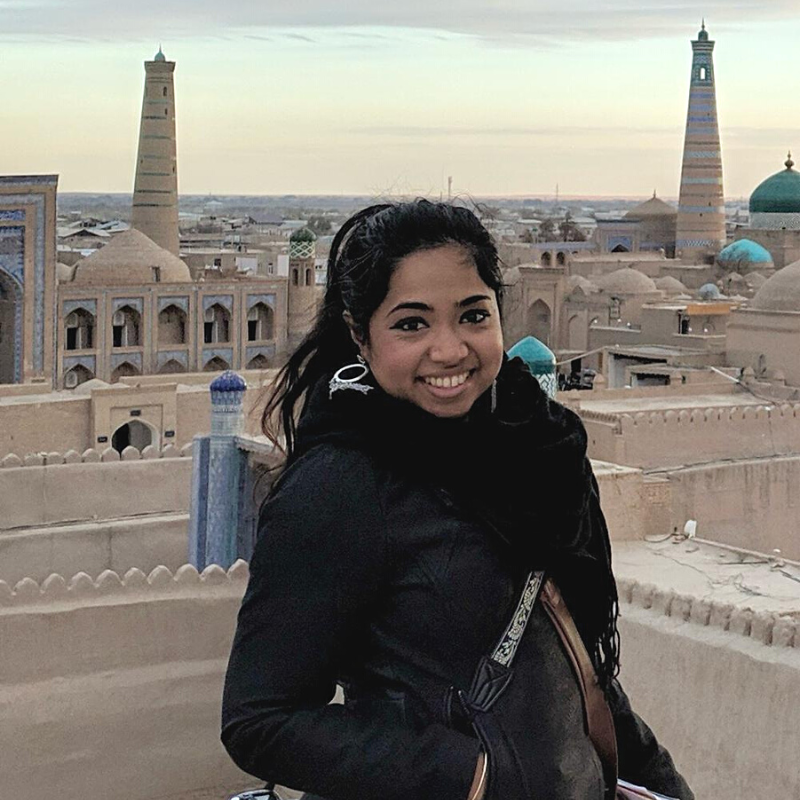
So based on a rumor, we made this trip, right? There’s still at that time, like, this is not even that long ago, 2018, but still like, there wasn’t a guidebooks on that. Uh, just a very few videos that were out. I literally like, I had to convince my husband cause I’m like, okay, I’m going to do a PhD thesis on why we should visit Uzbekistan.
He’s like, why are we going there? And then a side trip to Kazakhstan, right? And I will say Airbnb in those countries is such a beautiful experience because you are with the family that’s serving you what they’re eating, they’re very welcoming. They’re very hospitable people. Uzbekistan, I didn’t know that it was back I think like 200, 300 years, it was almost like the Harvard, Cambridge of that time because there was a lot of intellects there. A lot of art came from there. You know, the artists of Taj Mahal were rumored to be from like Bukhara and the Uzbekistan region and it’s reflected in their architecture.
There are some interesting things that we also noticed. I hope I’m not just coding this based on one experience from restaurants. Like we noticed the use of like a horse sausage in their plov. Again, hopefully it’s not just that one restaurant that did that, but plov. You know, it’s like their, their national food.
Um, and when we travel from Tashkent to Khiva, we took an overnight Soviet train. Mind you, like this is a train you can’t walk in. You’re just like the whole time, like shaking, right? Like she left it, right. And people were genuinely curious why we’re traveling in Uzbekistan. And we have pictures of like, people who are on the train and this family wanted to take a photo with us as if we were some celebrities and they handed their baby, their baby to us, right?
Like, here’s my baby. Take a picture with that. I was like, I love your baby. It’s cute, but okay. Like I’m a stranger. And you know that kind of goes to like, you know, the hospitality, the welcoming of the guests, such a beautiful experience. And when I dug deeper into Uzbek history, I mean, they have had their fair share of tragedy with, you know, the Soviet rule and how it’s destroyed the RLC.
Like it’s gone and you know, they’ve had their fair share of like tragedy too, but like the people are beautiful in the sense their souls, right? Like they’ll, they’re genuinely curious in our experience back then. Like they’re not jacking up the price of things to like, because you’re a foreigner, right?
Like the person who’s like Uzbek standing next to me is paying the same price for a Samsa on the side of the road as I am. So, it was really nice. And the interesting thing was. I didn’t realize because I’m in my head. I was like, oh, you know, it’s like Muslim majority country. There’s probably like, you know, foods are X, Y, Z.
You don’t have to worry about this. I was very surprised that drinking is part of like, they have like a pub culture type of thing, but it’s like very like males go and go get a drink and stuff. I will say it was vodka. Vodka is a big thing. Overall was an amazing experience. Like I would go back in a heartbeat.
I would absolutely go back in a heartbeat. And also going back to my point about, you know, third culture and being around people of different ethnic groups. Like I essentially, a lot of the countries we visited, I connected with people from my undergrad or from my high school. Uh, you know, you know, hey, you know, like we’re going to visit or, you know, we want to visit and then reconnect with them years later.
So, I am a big proponent of when you go to college, make as many friends as possible who don’t look like you, who don’t talk like you, who don’t think like you.
Matt Bowles: That’s amazing. Yeah, I have not yet been to Central Asia. It is right at the very point. Tippy top of my list. I want to kind of do the Silk Road and go all the way through Central Asia out to the Caspian Sea.
The closest I’ve been, I think I did the Trans-Siberian Railway in 2019.
Roshni Kha: Really? How was that?
Matt Bowles: Unbelievable. I was very lucky that I did it in 2019, right? So, we went from Moscow all the way through Siberia, and then we took the trans-Mongolian route. So, we went then down to Ulaanbaatar and Mongolia.
But one of the places that we stopped was called Kazan. Which is in the semi-autonomous Islamic Republic of Tatarstan, which was unbelievable. I knew very little about the Islamic history in Russia before going there, but they had these banging turquoise-colored mosques that are what I associate with, like the pictures I’ve seen of Uzbekistan where I haven’t yet been.
But then I’m there in Tatarstan and we’re hanging out with all the Tatar people and they’re taking us to these mosques. And I’m like, this is unbelievable. It was so beautiful.
Roshni Kha: Oh my gosh. I’m so happy to hear that. Cause that’s on my to go list. Like Kazan, that territory, Tatarstan, it’s like, you don’t hear much about that.
Matt Bowles: It was super amazing that people were absolutely incredible. So highly recommend that. But I also want to ask you about another place. I’ve spent a lot of time on the continent of Africa, probably about two and a half years or so. But one of the countries I have not yet been to is Sudan. And you have just relatively recently spent some time there.
Can you share a little bit about your decision to go there and then what your experience was like?
Roshni Kha: Going back to my point, making friends from around the world. So, one of my friends, she’s a very good friend of mine. I consider her, she’s like my daughter’s aunt, she’s from Sudan. She’s also a third culture kid like me, grew up in Saudi, is from Sudan.
And I got wind that her sister’s getting married and me being nosy. I’m like, “Hey, so you want some friends to join you?” That’s literally how that trip happened. Like, “Hey, you want some friends to join you? You know, like, it’ll be a fun trip”. And, Sudanese people are one of the most hospitable people. I will say about Sudan that you visit Sudan first for the people.
Very hospitable, very warm, very friendly. And there’s a thing called Sudanese standard time. And I love it. Laid back. It was really nice. So, we attended the wedding of my friends. I will say so after we landed at the airport, we were to take a taxi to go into our hotel and my friend’s brother greeted us at the airport and we get into the taxi and. We just sat in the taxi for some time of my friend’s brother and the taxi driver are talking.
And it was a big cultural, you know, learning at that time that, you know, you get in, you ask them, how are you doing? You know, how’s your family? You know, you establish like this, this connection, right? Like, you know, who you’re going with.
And it was like, you know, it’s later on, I realized this is a beautiful moment. Like, you know, you just don’t get in the, “Hey, take me there”. Right. Like, it’s like, respect the person that’s, you know, driving you that, that this person is also a man with a family and kids and stuff. So, I, I really liked the humanizing aspect of that.
And, you know, we get to the hotel, and we checked in and, you know, there was a lot of like curious heads, like, why are you visiting Sudan? Right. And I was just like, I felt like I was defending Sudan because I did some reading before going. I’m like, you guys have the first pyramids. Like, you know, unfortunately, some Italian guy came and stole a lot of what was inside the pyramids.
I don’t want to get into that, but they have the first pyramids, which then, like, you know, Egypt had their pyramids and stuff. So, I’m like, you know, why am I defending Sudan against, like, people at the reception in the hotel? But, you know, in general, like, you know, lovely people. And we didn’t realize that when we were in Sudan, this was November, uh, we had visited and there was a peace conference happening or some sort of conference happening between North Sudan and South Sudan.
And growing up also in UAE, so UAE also has a considerable Sudanese population, and we’ve seen them predominantly as Arab speakers. They also wear the Sudanese sari, they have like the dark henna on, so that’s what I was exposed to. And when we went, it’s a few years ago, we saw South Sudanese for the first time and they look so different, right?
Like beautiful people. Look, they’re super tall, very different features, very nice, very kind. Also, it was definitely interesting to see how different people within one country can look. It was very nice. So, we were there for a wedding. The wedding was very lovely. I forgot to write down the name of the hotel.
And we also visited the University of Khartoum where the British had built some parts of it. And I didn’t realize Sudan is one of the few countries the British did not really fully colonize. They left after a very short stint over there, which is like, yay, great for the Sudanese, absolutely lovely experience.
Um, I’m just, uh, to be honest, like I just currently with the current situation in Sudan, I just feel sad because people who I knew were friends, they’ve had to evacuate the area, the hotel that the wedding we had gone to has been destroyed. I don’t even know if it’s there anymore, but it’s, you know, been partially destroyed with like the ongoing conflict and stuff.
But I hope to go back to Sudan one day. I see there’s so much potential, you know, with the Nile running through. It’s not just the people, but just like the beautiful scenery that’s there in Sudan. Absolutely. I’m praying for return to Sudan one day.
Matt Bowles: Yeah, the situation there right now is absolutely horrible. I mean, if anyone’s not following the situation, highly recommend you look it up. And I’ve had Sudanese people on the podcast, and I’ve interviewed a lot of people that have visited Sudan, and everybody just says such amazing things. So yeah, sending love and solidarity to the people there for sure.
I also want to ask you about your experience with Doctors Without Borders, and I know you and I have connected on so many issues in terms of global politics, in terms of the stuff that’s going on right now in Palestine, terms of domestic civil liberties issues in the U.S. As you know, I was here, you know, in the aftermath of 911 and was working professionally and doing organizing around the post 911 targeting of Arabs and Muslims and South Asians and trying to organize against that and stuff like that.
So, you and I have had all of these amazing conversations, but one of them, I mean, and you particularly with your professional background is that you’ve been able to get involved with is the Doctors Without Borders. And I’m wondering if you can just share a little bit about your experience with them and then also what they’re doing today with regard to some of these global conflicts.
Roshni Kha: So, I volunteered with them at their office in Abu Dhabi. I had heard that they were doing a lot of work in conflict areas, especially like working with, like, they have like pediatric hospitals and children going back to my visit that one time in Bangladesh, where remember I was like, I could be that girl on the other side.
So that, uh, that stayed with me and stays with me up until today. So, Doctors Without Borders. So. Full background in UAE, you cannot really do like a paid job. This is back in the nineties. You cannot really do a paid job without like a visa. So, you have visa restriction. So, I could just do volunteer work because they had posted a job and I asked if they would consider a volunteer for that job and it was essentially doing like a lot of admin marketing stuff and fundraising.
So, it’s like a lot of roles that were consolidated into one. And. When I started working at the office, the staff were fantastic. And looking back now, having worked in a lot of other like companies and all that, they were one of the most efficient organizations I’ve ever met. They operate in small units.
Everybody was kind of, it was kind of like an all-hands-on-deck will help you out if you need help with anything and their dedication to the cause, right? There were always more discussions about, okay, allocating resources versus like where to get the most money from, where to get the, and back then I didn’t really comprehend why they were operating like that.
I’m like, but don’t you need money to do that? But now looking at it, they’re like resources as in like, how can we do pay? Like, it’s like a patient-first mentality. How do we serve our patients? As Doctors Without Borders, what resources do we need? How can we reach out to the suppliers? How can we reach out to our resources?
And then one of the resources required is like funding. But I like that aspect versus like other like nonprofits I’ve volunteered with. Sometimes funding is always such a priority in the conversation that like what your actual mission is, it kind of gets lost and diluted in the process. And then, you know, I was like, why am I even volunteering here?
But that was something that stood out to me with Doctors Without Borders. When I worked in the Abu Dhabi office, it was just a, it was like a very patient first, the civilian first priority in their work, in everything they did. Even like, you know, how we’re structuring like the expenses and stuff, you know, where we can allocate more of that. It really taught me a lot about their work ethic.
Matt Bowles: Can you share a little bit about how folks can support the work of Doctors Without Borders, because, you know, there’s a lot of people. I mean, with the genocide happening in Palestine right now, there’s a lot of people that are looking for ways to support.
And one way that they can support is to donate to Doctors Without Borders because they’re doing amazing humanitarian stuff there, as well as a bunch of other places around the world. So, can you share a little bit about how folks can contribute?
Roshni Kha: Yep. So, Doctors Without Borders, if you go to their website, doctorswithoutborders.com/donate, they have a current appeal for funds for Gaza right now.
They are one of the few organizations that work in active conflict zones when a lot of other organizations, if they are the last ones behind, will continue to provide for the civilians affected, for the patients that are coming through to them. They don’t discriminate. If you are able to, please consider donating to Doctors Without Borders at doctorswithoutborders.com/donate. The current humanitarian crisis in Gaza is appalling. It is frightening. It is unfair, and their boots are on the ground. They’ve also lost quite a few doctors recently in the attacks. So please, if you would consider doing something that would be the one thing I would ask.
Matt Bowles: Yeah, we are going to link that up in the show notes. So, folks can just go to one place at themaverickshow.com. Just go to the show notes for this episode. And there we will have a donation link for Doctors Without Borders and read a little bit up on what they are doing. I mean, it is truly incredible.
And as you said, I mean, medical professionals are being killed at staggering rates in Gaza right now. And the Doctors Without Borders are still there. They’re still trying to get more people in. They’re trying to help. They’re just doing incredible things. So read about what they’re doing. And then, yeah, if you’re looking to try to figure out how you can help. One of the things you can do is make that donation, which would be a wonderful thing to do. So, we’ll link it up in the show notes.
And I think that’s a great place to end the main portion of this interview. And at this point, Roshni, are you ready to move in to the lightning round?
Roshni Kha: My gosh. Wooff. I’m ready. I got it. Got my, got my gloves on. No, I don’t really have gloves
Matt Bowles: Let’s do it. Alright. What is one book maybe that has significantly impacted you over the years you’d most recommend people should read?
Roshni Kha: It’s more like an author. His name is Tamim Ansari, and he wrote two books, Destiny Disrupted and Games Without Rules. Very interesting historical analysis for Eastern history, like ours, that definitely gave me a lot of like perspective shifts on a lot of things that I’ve, and it took me a while to read the book and then I had to go back and read the book again because it’s like, it, it changes your thought process a little bit.
Matt Bowles: All right, Roshni, who is one person currently alive today that you’ve never met that you’d most love to have dinner with? Just you and that person for an evening of dinner and conversation.
Roshni Kha: So, again, I’ll give like two people. Sorry. I want to stress the question. Prime minister, former prime minister of New Zealand, Jacinda. She’s a working mom, a total badass. Would love to have dinner with her one day, her perspective on a lot of things. And I think the other person, I guess these are like two people, like the, it’s really the current and past. Two lady leaders of Bangladesh, Khaleda Zia, and Sheikh Hasina, sorry, I apologize, because under their leadership, the women’s movement situation has changed a lot for the better. Still, there is a lot of improvement to make, but I just want to know why, like, what is, and what’s the process?
So, I didn’t answer it with one. Sorry, but I gave three, but I’d love to have a chat with them. Yeah, but definitely Jacinda is on my priority list.
Matt Bowles: We’ll give you three. All right, Roshni, knowing everything that you know now, if you could go back in time and give one piece of advice to your 18-year-old self, what would you say to 18-year-old Roshni?
Roshni Kha: It’s okay to say no. You don’t have to say yes to everybody, even if they disagree with you, it’s okay. Like, you have to tell yourself, it’s okay. And this is somebody who was a people pleaser personality. I would tell her that and that confidence will come with time. Don’t let fear overwhelm you. Confidence will come with time. Yeah, those are two things I’d tell her.
Matt Bowles: All right. Roshni, of all the places you have now traveled, what are three of your favorite destinations you would most recommend other people should check out?
Roshni Kha: I’m going to sound like a broken record, but I would 100 percent recommend Uzbekistan. I would recommend Turkey as well. Very interesting history, given that it’s at a, it’s at a very interesting location, you know, being on Europe and non-European side, a lot of things to learn. And when Sudan does stabilize, I would highly recommend going to Sudan, visit Sudan for the people. If it’s, it really changed your life.
Matt Bowles: All right. Last question. What are your top three bucket list destinations? These are places you have not yet been highest on your list. You’d most love to see it.
Roshni Kha: So, I would love to see a lot of the countries in the African continent, with Mali being on the top list. I’m very curious, the country that brought forth Mansa Musa, has their first, like, library. So, Mali would be one of them.
Algeria has a very interesting history, a lot of Roman ruins, I did not know that. Former French colony that fought them for over a hundred years. Blows my mind.
And I would love to visit Mongolia, home of Genghis Khan. And why, why? What was his vision? Like, I’m just curious. Like, you know, visit three countries.
Matt Bowles: Great picks. I was, as I mentioned, I was in Mongolia, but far too briefly. I only went to Ulaanbaatar and then out into the Gobi Desert a bit, but there’s so much more of the country that everybody has been telling me that I need to go. And they just do amazing things there.
So, I literally have a list of Mongolian stuff on my list that I want to go back for. It’s just incredible stuff there. And the people were just so lovely that I really, um, want to get back there as soon as possible. So
Roshni Kha: I heard it’s also pretty family friendly. So, I’m hoping, hopefully once my daughter is a little older, I, we want to travel a lot more with her too and expose her as much as possible. So, these countries that I’ve listed, really the goal is to visit with family.
Matt Bowles: Yeah. So, talk a little bit about that maybe as the final thought, what is your vision? How old is your daughter now? And what is your vision for a year and a half? And what is your vision for integrating travel into her life as she grows up?
Roshni Kha: Honestly, like, I think first of all, travel is something that’s considered a privilege, right? I don’t want to sound tone deaf to that, but I feel like it’s a very necessary world education, especially when we live in like, you know, extreme political climates. I think travel is a way to break that down. Seeing that other people are just as human as we are being curious about that. And then, you know, how do other people live? You know, how do other people think? I think that’s very foundational. My dad did that with us. And he saw the value in it. And I see that if I continue to do the same, I can, hopefully, we can hopefully instill that in our daughter, people are people at the end of the day, and living outside the U.S. is possible.
You know, the U.S. is not the only place in the world to live. You know, it’s a great privilege to live here, but it’s also a privilege to live in a lot of different countries where you encounter different languages and cultures and religions, right? My parents were very open about being around different people of faith, you know, whether you go to church. We recently took my daughter to a Durga Puja right before Diwali, and there are lots of plans to expose her and make it seem like it’s normal, right? It’s normal to have people of different backgrounds around you.
Matt Bowles: Amazing. We are going to link up in the show notes everything that we’ve talked about. I would highly encourage folks to look more into the topics that we discussed, look more into the genocide in Bangladesh and the history of Bangladesh, and learn about that. Definitely look more into what’s going on in Sudan. If you are interested in learning more about the genocide that is currently happening in Palestine, I recorded an entire episode on that. It was episode 257 of The Maverick Show. So, I’ll link that up in the show notes as well. And we’re going to link up all of the books and everything else that Roshni recommended, including the link for how you can donate money to Doctors Without Borders. That’s all going to be in one place. Just go to themaverickshow.com, go to the show notes for this episode and you will find it all there.
Roshni, this was amazing. Thank you for coming to the show.
Roshni Kha: Thank you so much for having me. This was very fun to do. I will say like, it did force me to start consolidating all the family stories because I had it like all written here and there. And I was like, no, you know what, this is a sign I need to do that. And I hope people learn that these are just our lived experiences. And this is a crazy thing, right? It’s, you know, you learn through each generation, right? Like, you know, my parents had the trauma that they lived through, and they were trying to teach her some things, but, you know, I married someone who is of half-Indian and half-Pakistani descent. So, you know, with each generation we learn, we evolve and, you know, why don’t you share that, you know, why a lot of Bangladeshis also feel for the Palestinian movement is because, you know, we were all, my parents were living under previously occupied forces.
So, this was me also learning about myself and my history and my family history and, you know, and thoughts to, you know, what can I do to be a part of the change in this world?
Matt Bowles: I think you’re absolutely amazing. And if people want to connect with you or follow you on social media, how can they contact or reach out to you?
Roshni Kha: So, I am on Instagram and my Instagram tag is Biryani and chow. I love to cook and I’m a big tea person. I’m known in my, amongst my friends as somebody like I’m that lady that will turn up to your house with tea if you’re not feeling good and with a tray of biryani. So that is, I pride myself in that. And if you’re ever in town, Matt, I promise you that my husband and I love hosting. Uh, we love having people over and having interesting discussions. So that’s where they can reach out to me.
Matt Bowles: Amazing. We’re going to link that up in the show notes as well. Thank you so much for coming to the show and good night, everybody.