INTRO: This is part 2 of my interview with Jason Wang.
In part one, we talked about his background, growing up in the Bay Area in a Chinese immigrant home, becoming an entrepreneur, selling a successful business in his twenties, and deciding to build a life of travel with his relationship partner, Grace, that was initially centered on culinary travel and later evolved into adventure travel.
I pulled out some of his best food recommendations and then went into some of the most epic places to spend time in China, from the Harbin Snow and Ice World to the 8D cyberpunk city of Chongqing, and why Jason now feels that China is the best country in the world to spend time as a traveler.
Finally, we talked about some of his travels in Africa to Burkina Faso and Mali, including attending a music festival in Timbuktu, and his experience connecting with the Chinese diaspora on the continent of Africa and elsewhere.
So, if you haven’t yet heard part one, you can go back and listen to it after this episode.
But right now, we are about to jump into his recently completed quest to summit the tallest peak on each of the seven continents, including what it really took to summit Mount Everest. He explains the most dangerous part of the climb, describes what it actually feels like to be above 8,000 meters in the Death Zone, and tells the story of the scariest moment of the ascent.
He then reflects on the life lessons from the climb, what it meant to him to complete the Seven Summits together with his relationship partner, Grace, and what life now feels like after summiting Everest.
So please enjoy the conclusion of my interview with Jason Wang.
Matt Bowles: Well, I also know that your quest to do the seven Summits also began on the continent of Africa. Now I have summited Mount Kilimanjaro as well. I did it in 2022. You did it years before I did in 2018. Can you take us back to that experience and how that sparked the choice and ultimately the quest to do all seven summits.
Jason Wang: So, I wasn’t much of even a hiker when I was working in San Francisco. I think I only hiked like once or twice in my whole life. This dream of the Seven Summits and everything, it just seemed impossible.
So, remember how, when I left the company in August 2016, we went to the Rio Olympics? But we also went to Norway for the first time, and Norway’s all about hiking. That was kind of the first trip where I got some serious hiking done, and I’m like, wow, we love this. It’s good exercise, you can take epic photos, and it’s super scenic. And then once you burn all those calories, you can go and eat more food. So that was awesome.
So, we decided there were going to be a couple of bucket-list hikes or treks that we were going to do to challenge ourselves. The first was Everest Base Camp. So, I did that for the first time in 2017 with a couple of friends. And unfortunately, Grace couldn’t join because she broke her foot rock climbing. But that was kind of my first multi-day trek.
Then about a year later, we went to Africa. We stayed at this safari lodge called Ol Donyo. And what’s special about that lodge is you can see Mount Kilimanjaro straight from the lodge. It just looks so crazy. We’re like, wow, do people really climb up this thing? It seemed really popular. Next time we come back here, we’re going to have to go climb it, and then we’ll go on safari afterwards to relax.
About a year later, like 2018-ish, a friend joined us and we went and did Mount Kilimanjaro. And then we’re both people who, when we’ve accomplished one challenge, we’re just not satisfied. Like, what’s next? Then someone brought up there’s something called the Seven Summits. Like, wow, this is really cool. People do this. You can go climb the tallest mountain on every continent.
It just seemed impossible. Like the ones like Denali and Everest. Like, who can do that? Certainly not us. But we’ll try one more because another friend wanted to go do Aconcagua, which is the tallest mountain in South America. It was like 23,000 feet or something, so it was really tall. Never been to an altitude that high.
So, we ended up doing that, and we said, wow, we’re a couple of mountains into the Seven Summits. Let’s try one more. We’ll go do Elbrus in Russia. That was our first-time using crampons and being on a mountain that had ice. So, it’s very different. It was a little bit more technical. We had to learn how to use an ice axe, walk on crampons, and use ropes. First time. We’re like, this is really fun. It’s a great experience, and we can actually do this.
By that time, we were halfway through, but then COVID hit. So, it kind of shut things down for a while. Okay, put this on the back burner.
Then, when the world started opening up again, we’re like, okay, let’s get back into shape and finish off the rest. Let’s see how far we can get. Maybe if we don’t accomplish it the first time, then maybe we’ll take a pause. But let’s go do the others.
We went and did Vinson, which is the tallest mountain in Antarctica, and that was awesome because it’s such a unique place. You have to take a plane to get there. You’re just surrounded by pure whiteness. The sun never sets, and it’s just so remote. But that was the first experience for us where we had to pull a sled and carry some of our own stuff on it, and a very heavy pack. We’d never had to do that before. And you just keep incrementally getting better and better to a point where the next mountain seems doable.
So, from there, we went to Denali. Like everyone had told us, Denali is going to be the toughest challenge of your lives. And it’s okay if you don’t summit because it’s just so difficult. You have to carry everything. You can’t hire porters. It could take 21 days, and you’re just completely disconnected from the outside world. There are no chargers, there’s no Internet, nothing. And you have to be self-sufficient. So, it’s like a mountaineer’s mountain.
And that’s when we started training seriously, physically. Then we went to take a mountaineering course in Alaska to prepare, just to see what winter camping would be like. Can we carry like 70 pounds on a sled and 50 pounds on our pack for up to three weeks and survive? And how do we do all this?
We ended up making Denali as well. And that changed everything. That’s when it opened up the conversation for Everest. We’re like, okay, maybe it’s time.
Matt Bowles: All right, so before we get to the Mount Everest experience, I want to talk about the Antarctica experience, which I know is a very special place for you. You’ve been three times now. Can you share your evolving relationship with Antarctica and Your evolving experiences, why you went back three separate times and what each of those experiences was like for you.
Jason Wang: So, the first time I did it the typical way, it was actually in January of 2020, as COVID was taking over the world. We were one of the last cruise ships to kind of sail out, and I actually took my parents as well. I wanted to go somewhere really special with family and decided on Antarctica.
It was a 23-day journey. We also went through the Falkland Islands, South Georgia, and Antarctica on a cruise ship. It was just really nice. You only see the tip of Antarctica, but it’s still an amazing trip. You get to see a lot of wildlife.
Years later, I had to go back because one of the Seven Summits is in Antarctica. There’s no way to avoid it if you want to complete the Seven Summits. There’s pretty much one logistical company that can take you to that mountain. So, you fly in, then there’s a camp there, and then you take another smaller plane to go to base camp.
That was just a very different experience because it wasn’t luxury or anything. You’re camping in tents, and it’s very physical. You’re just up there to climb a mountain. That’s your goal.
But a couple of experiences were still missing. We’d never seen emperor penguins and hadn’t been to the South Pole, so we gathered up some friends to do that as well. There was one company that could take you to these experiences that had launched, and it seemed really nice. We discussed it with a group of friends, and we did a buyout of the camp and just had an amazing time.
So, three very different experiences in Antarctica, and they were all amazing in their own way.
Matt Bowles: What was the South Pole like and seeing the emperor penguins and all of that when you finally got there?
Jason Wang: The South Pole was a little anticlimactic because you just fly for six hours. It all looks the same. You don’t even know you’re at the South Pole. But they land the plane, and the only thing you can see are these poles with flags marking the South Pole and then a smaller pole marking the geographic South Pole.
So, it’s more of a travel bucket list thing. You go there, take your photo, and that’s the experience.
We actually had another experience there, which was awesome. The U.S. base opened up to us. They let us go in and do a tour inside. These people, like geologists and other researchers, live there for months at a time. They told us we were the only group that had been able to go inside for years. We just got there at the right time when they weren’t sleeping, and they allowed visitors. So that was really cool.
Emperor penguins were extremely special because there are only two ways to see them. You either take an icebreaker ship and hope it can break through the ice far enough to reach the emperor penguins. Even then, you may have to hike for about an hour, and it’s hit or miss every year. You just don’t know if you’ll be able to get that far.
Or you have to take a plane and land nearby when the weather is good, and then you can go see the emperor penguins. They’re the penguins you see in documentaries like National Geographic—the super cute ones that are a little different from king penguins or gentoo penguins.
So those were definitely the two highlights of the latest trip I did.
Matt Bowles: Okay, so for the quest for the seven summits, you mentioned that Denali was expected to be significantly more difficult than the previous five treks that you had done. Did that turn out to be the case? Can you describe what it was like and how you pushed through it and eventually summited despite the difficulty?
Jason Wang: Absolutely. One of the hardest, because the other summits, there was always a porter you can hire. Especially for Kilimanjaro, we had a staff of 22 people, including a kitchen staff and porters, our guides.
You don’t get that for Denali. It’s just you and your team, a couple guides. You pretty much have to pack everything you need to survive for up to three weeks, and you’re carrying it up the mountain with no support. And then you’re building your tents every single night as you move.
But what I think really helped us, so often when you do Denali, you have to do these carry days, which means you go from point A higher up to point B. You drop off some stuff, you dig like a hole in the snow, put your cache in there, plant a flag, and you go back down.
I mean, if we had done that, I think it would be very different. It’s just kind of demoralizing to have to go back down and go back up again.
So fortunately for us, because we were a smaller group and we’re kind of a strong team, we were able to go from point A to point B to point C to point D without having to do any carry days.
So instead, we would just rest for a day or two at each camp to help acclimatize. So that was a game changer for us because I had a friend that also went a couple weeks after us. It was just so tough doing the carry days. You just waste so much energy.
But that’s the normal way to do it. So, we kind of got lucky with our team in that we didn’t need to do that. We just kept pushing, pushing, pushing, resting until we had enough energy and a good weather window, and went for the summit.
Matt Bowles: All right, so Mount Everest. You summit Denali, you decide you’re going to do Everest. Can you just start off by talking about what does it take in the way of planning and training?
Jason Wang: So, for Everest, you kind of have to know way in advance that you’re going to do it because the company needs to prepare for everything, right? So that’s why, when you arrive, the tents are already built-in base camp, and your permits are already secured.
So, you have to know way in advance because they recommend you need to train for six months to a year to prepare physically for Everest.
So, we took about three months off of travel, had a private trainer in California. He’s also trained us for other mountains. And literally six days a week, we would go in there and do conditioning work, strength work, cardio, just to prepare us for Everest.
Almost no days off. That’s all we thought about. We ate clean, trained, and our mental thinking was all about the day we go fly to Nepal to do Everest. And nothing else mattered.
And so that was a good time.
Matt Bowles: All right, so set the scene here for context. How long is the trek expected to take and what’s the financial expense? And what type of gear are you planning to pack for this expedition?
Jason Wang: It took us, from the day we landed in the mountain from Kathmandu in Nepal, which is the capital of Nepal, you fly into the mountains, until the day we got off the mountain, 45 days to climb Everest, which is pretty typical.
Because you need to first trek to base camp, which could take seven to ten days. Your body acclimatizes. Then you have to do a couple of rotations up the mountain so you can acclimatize more. And then you have to rest, wait for your weather window. And then, once the weather looks okay, you’ll have, you know, five to six days to go from base camp all the way up to the summit and back.
But way in advance, you have to prepare everything, right? Your training and also your equipment. There’s a very detailed list. It’s like four pages long of stuff you need to survive up there.
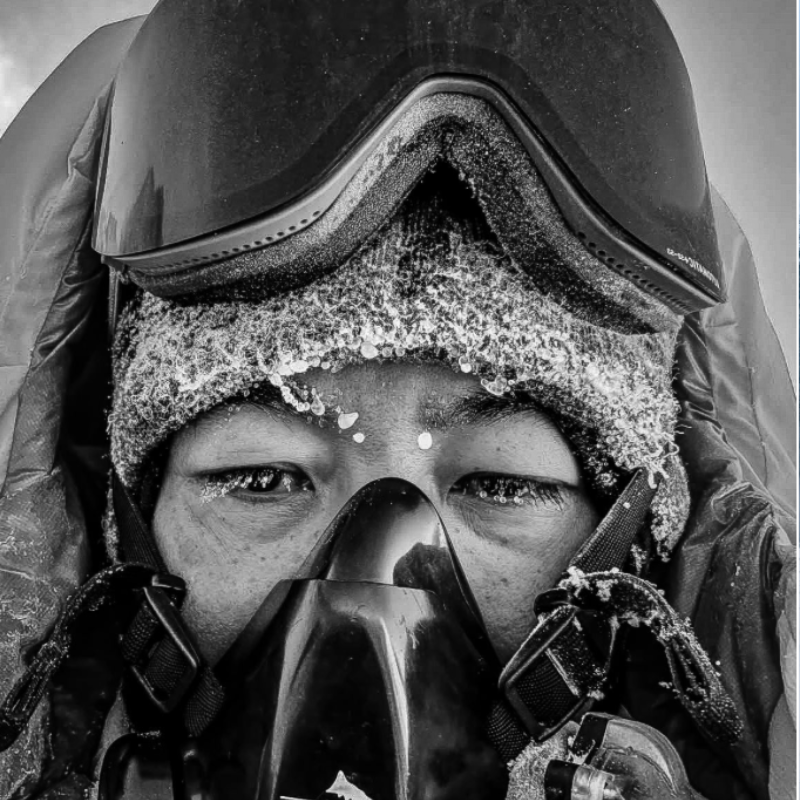
I think temperatures could reach negative 40 or 50 with wind chill. I actually ended up with frostbite on my left cheek. There’s no way around it, even with all the equipment and gear that I had.
So, not even looking at the training, the flights, or the equipment cost, if you go with the local outfitter where they have a bunch of people, like you could be on a team of a dozen or more, and they have dozens of people on their team, I’ve seen as low as like 40K per person.
And some other outfitters, where you might get like five Sherpas to yourself, plus a cinematographer who will film your entire journey and get helicopter unlimited access, I’ve seen that at like 500,000 to 750,000.
Matt Bowles: Wow.
Jason Wang: Yeah. So, some people pay that amount.
So, the company I went with, Mountain Professionals. I’ve actually climbed with them before on other mountains. They’re great because you’re in a small team. You’re paying closer to the $40,000 range rather than half a million dollars. You get all the benefits of a team that would pay so much money.
It was a very comfortable base camp. We had a private chef, a lot of Sherpa support. And the guy has summited Everest like seven or eight times. He’s one of the premier guides, a North American guide named Ryan Waters.
And amazing. All around, amazing. So having the right team helps.
Matt Bowles: So, in preparing for this, obviously the altitude level is extremely dangerous.
So just explaining, I mean, I went up Mount Kilimanjaro to the summit, and we were taking Diamox the whole time, which was really crucial for us to not get altitude sickness. And then, as soon as we reached the summit, we took our pictures, and then they’re like, okay, we got to go down now. And then they zipped us right back down because that was a dangerous altitude level.
Everest is, I mean, a whole different ballgame.
So, when you’re thinking about and planning for being at that incredibly dangerous altitude level, what is the plan? How do they prepare you, you know, in advance that you’re going to be doing certain things to survive that altitude level? What are those things that you’re prepared to do to get all the way to the summit?
Jason Wang: The first couple is to do a couple of rotations up the mountain. That’s why it took 45 days. We go slowly, right?
So, the first one, we went back down to another part of the mountain called Lobuche and summited a mountain there. So, it helps increase your red blood cells for later.
And then the second rotation, we actually went up Everest, touched Camp 3, which is also really high, and went back and slept at Camp 2. But nothing prepares you for beyond that. It’s all unknown. You don’t know what’s going to happen.
One of our teammates just didn’t make it. He was the strongest the entire time until the week we decided to go for the summit. Something happened to his vision. Unexpected. We also lost a couple of Sherpas due to snow blindness and their oxygen tank not working. You can never predict that. And one of the Sherpas has climbed Everest more than a dozen times.
And the day we went, we were pretty much the only team up there. You see those photos of Everest where there are hundreds of people. It looks like a parking lot. Ours was the opposite. We had no one during our climb.
But it was the last chance for us to climb Everest because we already were at Camp 4, which is literally the last camp before the summit, for multiple nights running. Out of oxygen, no more food. And that’s the death zone. You’re right at 8,000 meters, so you can’t stay up there too long.
We had one shot. The climate and the weather weren’t the greatest. It was overcast most of the time. It was windy, super cold. I didn’t know if I was going to make it at a certain point. But I just kept going.
And I eventually lost my Sherpa as well during summit day. He was so far behind, and Grace was 40 minutes ahead of me as well. So, I was by myself for a long time. I couldn’t check my oxygen, which was on low flow, so it’s harder for me to breathe. And this wind just kept hitting my left cheek. I couldn’t do anything about it. So, I got frostbite starting to form.
My goggles were frozen up. Couldn’t see. Literally couldn’t see more than a foot ahead of me. I had two goggles, but I was so cold that my second goggle, which I had inside my down suit, never unfroze because my trick was, when one froze outside, I was going to swap it. Couldn’t do it.
So, I couldn’t see. My oxygen was on low flow. There was no one around me because Grace was ahead. My Sherpa was behind. But at that point, I thought about turning around a few times, but just kept going. Just kept going, one step at a time. My water was frozen. I was thirsty. Couldn’t drink anything. Just didn’t know if I was going to make it.
And I think we were way past the turnaround time. We didn’t make it to the summit until the afternoon. And you never want to arrive at the summit that late because the weather can change. And it did.
On the way down, it was just blizzardy. And I recorded footage of it where, like, the wind just blew Grace down and she fell. And wow. It was insane coming down.
We had nothing to eat or drink pretty much for 21 hours. It was a 21-hour summit day from when we left Camp 4 until we came back down. In my mind, I was hoping for 12 to 15 hours at most. It was way, way, way beyond.
So, just really happy we made it.
Matt Bowles: How did you and Grace get separated? What was the dynamic there where you were like an hour apart?
Jason Wang: So, on Everest, you don’t wait for people. You can’t. You go at your own pace, and you almost never turn around to see who’s behind you. You just don’t have the energy for that.
But you’re just yourself. It’s just you and the rope. You’re just taking step by step. And she was just so far ahead. I can’t say anything about it, can’t shout. You have no energy.
This is you versus yourself at a certain point in time. And that’s all it is.
Matt Bowles: I want to ask you about a couple of the different parts of the climb, and in terms also of the psychology going into it, starting with the hike up to Everest Base Camp. And I want to read a quote that you wrote about that portion of the hike.
You said; “Every step towards Base Camp was a step farther from everything we thought we knew about ourselves. The summit gets the headlines. There are the moments before that. The dusty trails, the children in doorways, the prayer flags fraying in the wind. That first heart-stopping look at Everest through a break in the clouds. The mountain teaches you long before you ever stand on it.”
Can you talk about that initial part of the journey? What did the mountain teach you before you stood on it?
Jason Wang: It’s all about preparation. So, your success will depend on how well prepared you are.
The most unprepared teams, they’re the ones that turn around because they didn’t train hard enough. They didn’t have enough discipline.
I had a game plan going in that I was going to follow no matter what. I needed to sleep a certain number of hours. I needed to eat a certain number of calories, even if I couldn’t, and just stay focused.
You learn how to really separate all the stuff going around you and you versus yourself, which is all that matters on the mountain because you came here for one goal, and you prepare all you can for it. One mistake can cost you your entire summit bid. You get a stomach ache, you’re probably going to get sent back.
So, we were just very careful what we ate, how we slept, and just not being around too many people. You get sick, like, it could be over as well.
So, I’ve heard too many stories. We planned extremely well for our expedition. And again, it comes from the team that we hired and the expertise of our guide, who’s done this many, many times.
Matt Bowles: So, once you embarked from Base Camp, on your way up, can you describe the Khumbu Icefall for people that have never heard of this, explain why it’s considered so dangerous, and then take us into that moment and what it was like for you to cross that.
Jason Wang: The most dangerous section of Everest is where you sleep at Base Camp. It’s right at the beginning of the Khumbu Icefall, and then getting to Camp One because you have to climb through this. It’s like a valley of ice, but it’s constantly shifting and moving. And that’s where a lot of accidents happen, right? If you’ve ever seen photos of Everest or a movie where there are ladders going across crevasses, it’s at the Khumbu Icefall.
And literally, when we went up the Khumbu and when we got back down, even during rotations and after the summit, it looked completely different because it’s constantly shifting around. Like one wrong step into falling into a crevasse, that could be it. And sometimes you just don’t know. So, you have to be extra careful and fast getting through some parts of the Khumbu Icefall.
It’s like going through a maze, and right around the corner, an accident could be waiting to happen. And it’s just one of the more difficult parts to climb because some parts are like straight up. If there’s no ladder, you got to, like, literally climb up it.
And depending on certain days, you can be stuck behind other people that are slower, and then they’ll slow you down, and it becomes really dangerous. If, like, an accident happens or an avalanche, you’ll be stuck.
Matt Bowles: Well, you also mentioned what’s known as the death zone. And I’m curious what your experience was like there. What actually changes inside your body once you get above 8,000 meters?
Jason Wang: You’re literally dying. Your body just can’t function up there.
We had to spend more than two nights in the death zone. Just had, like, bag food. There are no toilets. So, when you got to go, it’s just extremely hard. And mentally, too, you’re just in your tent 24 hours with nothing to do, really. So, it’s a mental challenge. While your body is dying and wanting to get lower, we have to sleep with oxygen because we know something really bad could happen.
So that’s actually what happened to me on the way down from the summit. I spent another night in the death zone. My oxygen tank stopped working. So, I slept that night without oxygen. I was okay, fortunately, but was just way too tired. I couldn’t yell for help. I just passed out and then didn’t know if I was going to wake up the next morning. But luckily, I did.
Matt Bowles: So, can you feel yourself thinking more slowly and how does all of this impact fear, does it make it more scary or does the fear start subsiding because of what’s going on mentally? What is that like?
Jason Wang: At a certain point, it could be a mix of both. You don’t really know what’s happening at certain points in time. Not enough oxygen gets into your brain, and it’s very, very hard to breathe.
You see a few dead bodies on the way, and there’s no way around it. Like, a couple hang off ropes. They were fresh from the season. And there’s another guy. You can see his face, his suit, backpack, everything, right below the Hillary Steps. And you have to walk over him to start up the Hillary Steps. No way around it.
And at that moment, your judgment could be clouded because you’re in the death zone with not much oxygen. Even when you have an oxygen tank, it only takes you down a few thousand feet. So, it’s not like you’re suddenly at sea level. You can breathe, but it’s still extremely hard to breathe with an oxygen tank.
And you have to be conservative too. If you use too much oxygen, you’re going to run out. And then what do you do if you run out of oxygen? Very bad things can happen.
So, the entire time when you’re in the death zone, the only thing you can do is move one step ahead.
And at a certain point, you either turn around, or the next step could be really bad. If you decide to continue, and if you don’t have anyone around you to tell you, your judgment could be clouded, and you can continue on when you shouldn’t have.
That’s what the death zone does to you. You lose judgment.
Matt Bowles: So, for you, what was the scariest moment of the entire ascent?
Jason Wang: When I was by myself, I see Grace as a tiny dot ahead of me, no one behind me. And I couldn’t see. My goggles were fogged up, and my oxygen was going really slow. I had no one to help me, like, crank it up. I just didn’t have the energy to take it off and do it myself. At that moment, I didn’t even know if I was going to make it back down. I had to make a choice. Do I keep going, go back down?
It was the closest, I think, in my life where I came facing a possibility of death. That was my own doing, right? Because I decided to go up there. I felt like, okay, if this is it, this might have been a good way to go out because I’ve accomplished what I needed to, and it’s here on Everest. Thoughts like that start going through your head. Even today, I don’t know how I found that energy to keep going.
And actually, my parents thought I died, and some friends, because I gave them a Garmin link where they can track my status on the mountain. And six hours in, the Garmin died. Even though it was in my backpack and everything, it’s supposed to withstand the elements, but it completely died.
So, I looked like I was just a dot on the mountain that didn’t move for the next 15 hours or so until I got back to Camp 4. I found an external battery pack and started charging it, and I was able to send a text message saying, “I’m still alive.”
Matt Bowles: So, when you finally stood on top of Everest after all of this preparation, what surprised you the most about your emotional reaction?
Jason Wang: Unfortunately, it was so cloudy, I didn’t feel like I was on the top. I couldn’t see a thing except for some flags.
Normally, there’s an epic view of all the mountains and the curvature of the Earth, but unfortunately, up there, it just seemed like I was on… it could be anywhere. I’m skiing, and there’s just a mountain there with some flags.
So, I didn’t have that crazy emotional outburst that I had for other mountains. I didn’t really know where I was. So, I sat down. We were there for over 30 minutes. Grace had been there, at that time, almost two hours waiting for me so we could take a photo. I couldn’t even get a photo. The camera took one photo of Grace, and then the camera died.
I brought my drone up there too, getting ready to fly it, but too windy. Too windy. So, I was just bummed. Couldn’t see anything, couldn’t get a camera photo off, and couldn’t fly my drone.
I was prepared to get this super epic shot on the summit of Everest, but then I was just relieved that we made it and wanted to get down as soon as possible.
Bowles: So many people think that the summit is the finish line, but statistically, it’s actually where the most dangerous part begins. More people have died on the way down Everest than on the way up. So, for you, at what moment did you truly feel you were safe again?
Jason Wang: When we got back to our tents at Camp 4, because we started going down, it became dark, pitch black. At one point, I lost my headlamp. Couldn’t even find it. So, I was going down pretty much in the dark. Couldn’t see anything, and it was so windy. And I just didn’t know. I just had to trust that nothing bad would happen until I got back to the camp.
But even at the camp, we were really bummed out because the zipper on our tent broke, and there was a pile of snow inside, like half a foot.
So, the last thing you want to do is clean up that snow after a 21-hour summit day. You just want to lay down in your sleeping bag, get some hot water, some instant ramen, and then go to bed. But that sucked too. And then I had to clean out the snow. My oxygen tank wasn’t working. It was just rough.
Thirty hours or so. Very rough. Probably the roughest patch of my life. Toughest, toughest part. Toughest 30 hours.
Matt Bowles: Does accepting that level of risk and attempting something that hundreds of people have died trying to do make ordinary life feel different afterwards?
Jason Wang: You just appreciate everything a lot more.
So, when we first started traveling in 2016, even though, like, 2021, everything was super luxurious and comfortable. And then we hit about a hundred countries, and we started seeing more of the world and how people lived, how humble, but yet happy and content, a lot of people were around the world, whereas a lot of rich people that we knew just aren’t happy. They’re stressed. Like, what’s going on?
And that’s when we knew we had to accept we don’t want to live 24/7, 365, a comfortable and luxurious life. We find meaning through discomfort and challenges.
And Everest is taking it to the extreme. You get through that, any other obstacle that you could think of in ordinary life, you’ll find a way around it.
Now I look at any challenge and be like, okay, I can do this.
It really opened up my mind to what I can accomplish, both physically and mentally.
And I have no fear anymore. No fear.
Matt Bowles: Did Everest make mortality feel more real? I know you’re now very passionate about longevity. Is there any connection there?
Jason Wang: Yeah, it’s kind of like the opposite, right?
Because people would never go and risk their lives forever. So that’s, like, my one vice. I’m so into adventure and doing some crazy things, but I also really want to have a very long health span so I can keep doing this stuff.
So, they’re kind of opposites, and they constantly tug at each other.
Some days I just focus strictly on longevity, morning till night. Then other days I’m on a crazy adventure where I look back like, wow, I could have died.
But those were the moments that make up life and that you look back upon and say, “Hey, you know,” like very memorable and meaningful.
Matt Bowles: I’m also curious, what advantages are there to climbing these summits with grace with your partner? Are there moments when one of you becomes the emotional anchor for the other? Did either of you have doubts that the other helped overcome? You’ve done seven of these now, culminating in Everest. How is that dynamic doing it as a couple together?
Jason Wang: I think having that emotional support is amazing, especially since we know each other. We know our strengths and where our weaknesses are.
She’s really good at stuff I’m not good at, like hands-on stuff. She can pack a tent, cook, and just be very efficient with packing. I’m the opposite. I can’t do any of that stuff very well.
So, she’s very adept at that, and I’m very good at planning stuff and making sure we’re on track. It’s a lot of the more digital stuff, the cerebral stuff.
So, we’re a good team. She’s really good at photography and can help take photos and capture moments, and likewise for me, for her. So, it’s a very good dynamic.
Otherwise, if we don’t go together, we’re going to be sleeping with a stranger in the tent. You don’t know who you’ll get. They could be a snorer or someone you don’t mesh well with, and that can really ruin your climb.
Matt Bowles: So how does it feel to be standing on the summit together as opposed to standing on the summit alone?
Jason Wang: We needed that photo of us together on it. We said, “We’re going to do this together.”
Everest was the culmination of our Seven Summits journey. There are not many other couples who have done this, so we wanted to really memorialize that moment.
It was just extremely meaningful because this was a large part of our lives leading up to this. And that year was everything. That’s all we thought about: eat, sleep, and breathe Everest.
So, we had to finish the journey together. The fact that she waited almost one extra hour at the summit for me was extremely meaningful.
Matt Bowles: I want to read another quote from your content. As I was going through your Everest footage, you wrote. “I climb because in these moments of struggle and beauty, I discover who I really am. Not the version of myself I present to the world, but the raw, honest person who emerges when everything else is stripped away except determination and the mountain ahead. The cold burns. The altitude challenges. The exposure demands respect. But in return, the mountain offers clarity that no office, no city, no comfortable space ever could. They remind me that growth lives on the other side of fear.”
Can you share some of the clarity that you got and what you learned about yourself?
Jason Wang: The big one is you kind of figure out what’s important in life. Is getting a nicer car, a nicer house, clothes, a watch that important, or the people around you?
So, when you’re faced with a situation where you might not have tomorrow, you start to figure out what’s really important in life. And for me, that’s creating moments with family and friends and sharing that joy. Everything else is secondary now.
I can care less about any material things. Comfort, luxury is secondary now. I built my life just having memorable experiences with people you care about, and being in these difficult situations really taught me that.
Matt Bowles: You had already traveled to something like 175 countries before you summited Everest. Looking back now, which experience taught you more about yourself? Seeing the world horizontally across cultures or seeing it vertically through the mountains? And why?
Jason Wang: I would say places like Syria, Myanmar, places like that really changed me because you go there. These countries have been going through war. People have lost everything—their homes, their family members.
My guide, for example, in Syria, had a huge loss in his family. And going around seeing all this destruction, they still have hope. And in my mind, like, wow, this is amazing. How can you have hope after all that has happened?
And yet they’re willing to give you everything they have, even though they don’t have anything. You get invited to what’s left of their homes, and they cook a meal for you, and they never ask for anything in return. You’re like, “Oh, let me pay you for this.” But no. “No, I don’t want it.”
That just gave me so much perspective, change, and hope for humanity. The people in some of the places where they’ve gone through devastating loss are some of the kindest and most hopeful people on the planet.
Matt Bowles: How has experiencing all of this together with grace impacted your relationship as a couple?
Jason Wang: I think we’re stuck for life together. We found the perfect match. If I asked anyone else to go travel the world, climb the seven, I don’t think anyone would do it.
Matt Bowles: That’s so amazing. Do you have any tips for people who would like to start traveling full time with their relationship partner? Since you’ve been doing it now for a decade plus.
Jason Wang: At a certain point, you should go take uncomfortable trips. Then you’ll see what you really like.
If you’re just staying in five-star hotels and resorts, eating fine dining, and being comfortable, you won’t get to learn about each other, and it won’t strengthen the relationship as much as if you put yourselves really out there in something challenging that you’re working on together to solve.
Climbing a mountain, for example, going on a multi-day trek, and going to a place where maybe it’s less traveled but it’s more meaningful. I think all of that helps in a relationship. And then you may realize that you’re perfect for each other, or maybe not.
But going on a trip together really can help determine that.
Matt Bowles: If someone listening to this right now feels trapped in the life that they accidentally built instead of the life that they actually want, what would you tell them?
Jason Wang: In today’s world, it’s never too late to change because everything is just so accessible now. Anyone could be a digital nomad. Anyone can spin up a business idea now with next to nothing costs at extraordinary speeds. So, if you’re not content, it’s easier today than ever to make changes. So, the only thing stopping you is yourself.
Matt Bowles: And I think also immersing yourself in communities of people that are charting some of these unconventional courses and doing some of these unconventional things is really important as well.
And I think that’s a great pivot to the fact that you and I are both going to be at the Extraordinary Travel Festival, which is coming up in Bangkok, Thailand, in October 2026.
You are going to be giving one of the keynote speeches. I’m going to be moderating one of the networking sessions.
Can you just share a little bit, for people that have never heard of the Extraordinary Travel Festival or the travel community that shows up for that, a little bit about what the event is like and also why that community is so important to you?
Jason Wang: A couple years ago I was also in Bangkok and it’s really a chance to meet like-minded people because I guarantee you in your hometown probably very few people who also travel this extreme. And it’s very rare to find a time and place where hundreds of us that love to travel and seek new experiences gather in one location and they can hear stories, do networking, get ideas, make friends and go on future trips together. That’s just really awesome and I’m excited for this year. I’ll be talking about my experience climbing the seven Summits.
Matt Bowles: So, if people would like to hang out with you and me in person, we are going to put a link in the show notes.
Maverick Show listeners can get a $100 discount on their ticket. You can actually just go to extraordinarytravelfest.com, get all the information there, buy your ticket there, and just use the code Maverick at checkout to get your $100 off.
We are also going to link that up in the show notes as well. So, everything we have discussed on this episode will be available in one place. Just go to themaverickshow.com, go to the show notes for this episode, and there you’ll see the link as well as the code for where to get your discount on your ticket.
And if you are going to come through, definitely shoot me a DM on Instagram and let me know, @maverickshowpod, so we can plan to link up at the event. And then you can hang out with me and Jason and a whole bunch of other Maverick Show guests that are going to pull up. It’s going to be an amazing time in Bangkok in October of 2026.
And at this point, Jason, I think that is the perfect place to end the main portion of the interview. And are you now ready to move into The Lightning Round?
Jason Wang: Yeah, let’s do it.
Matt Bowles: Let’s do it. All right, what is one book that you would recommend that people should read?
Jason Wang: For me as an entrepreneur, The Hard Thing About Hard Things by Ben Horowitz was really good because it kind of kicked off my entrepreneurial journey. It was a lot of insight in that. So, if you’re thinking about becoming an entrepreneur, that’s a great book to read.
Matt Bowles: All right, what is one travel hack that you use that you can recommend?
Jason Wang: Credit card points. So, I fly business class free almost everywhere in the world because I’ve learned the credit card points game and I’ve been doing that for almost 10 years.
Matt Bowles: All right, who is one person currently alive today that you’ve never met that you’d most love to have dinner with just you and that person for an evening of dinner and conversation?
Jason Wang: Thor Pedersen.
Matt Bowles: Well, Thor Pedersen is going to be at the extraordinary travel fest in Bangkok. So, I feel like this dinner is definitely a possibility and we can try to make that happen.
All right, Jason, knowing everything that you know now, if you could go back in time and give one piece of advice to your 18-year-old self, what would you say to 18-year-old Jason?
Jason Wang: Stay the course and challenge yourself. You just keep going and don’t give up. You can make something of your life.
Matt Bowles: All right, what are three underrated or maybe lesser well-known destinations that you would most recommend, people should definitely check out?
Jason Wang: Turkmenistan, Western China, in the Xinjiang region and Eritrea.
Matt Bowles: Nice. Okay, what are your top three bucket list destinations or experiences, places you have not yet been highest on your list, you’d most like to see?
Jason Wang: North Pole, Wrangel island in Russia and space.
Matt Bowles: I love that.
All right, Jason, I want you to let folks know how they can come into your world, follow you on social media. And folks, let me tell you something. The photography and the videography are absolutely next level. You are one of my very favorite people to follow, not only because of the places that you go and the thoughtful things you have to say about them, but just the stunning visuals that you’re able to capture through your photography and your videography. It’s really amazing.
So, for other people that would like to experience that, check you out. How can people come into your world?
Jason Wang: So just look up @jwang815, on Instagram and Facebook. I post on both platforms pretty much every single day.
Matt Bowles: All right, we are going to link all of that up in the show notes, folks. So once again, you can just go to themaverickshow.com go to the show notes for this episode. There you will find direct links to find, follow and connect with Jason, as well as the link to join us at the Extraordinary Travel Festival in Bangkok and get your $100 discount as well as links to everything else that we have discussed in this episode.
Jason, this was such a special conversation, brother. Thank you for coming on the show.
Jason Wang: Thank you for having me.
Matt Bowles: All right, good night, everybody.