
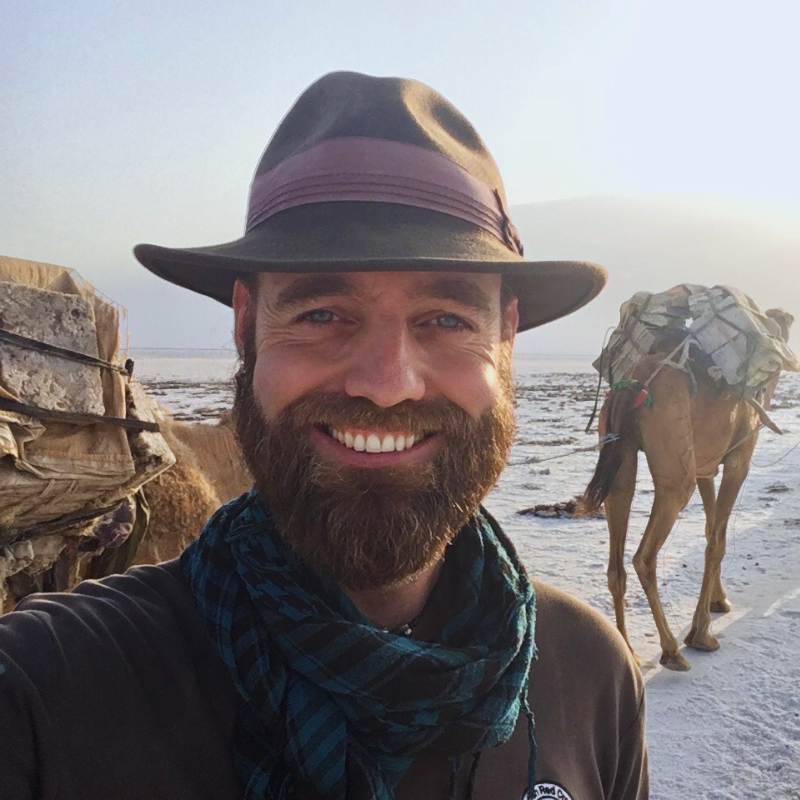
INTRO: This is part two of my interview with Thor Pederson. In part one, we talked about his upbringing in Denmark, his experience serving as a UN peacekeeper in Eritrea and Ethiopia, his career in logistics, and his lessons from living in Libya for two years. He also explained what led to his decision at age 34 to embark on the impossible journey, what became nearly a 10-year quest to try and become the first person to travel to every country in the world in one unbroken journey without flying. He shared his experience traveling on container ships and told some of the stories that convinced him that a stranger is just a friend you’ve never met. And part one ended with Thor opening up about the emotionally devastating day on his journey that forced him to reckon with fundamental questions about borders and global inequality. So, if you haven’t heard part one yet, you can go back and listen after you hear this episode. But right now, in part two, we’re going to talk about some of the most dangerous life-threatening moments on his trip that happened in Central Africa. He also describes the moment in Cameroon when he was at his lowest mental and emotional point on the trip, ready to throw in the towel, call off the project and head home. And he shares the heartfelt moment of how a local moto taxi driver helped him in that moment to find the perseverance to keep going. And we talk about his epic love story, including the incredible place where he ended up proposing. And finally, I asked him to reflect on what it felt like to complete the impossible journey and what it taught him about himself and the world. So please enjoy the conclusion of my interview with Thor Pedersen.
Matt Bowles: One of the other things about the book that I was particularly appreciative of is how candid and vulnerable and honest you were about the psychological toll that the self-imposed constraints of this trip started to take on you, especially when you got to regions like Central Africa. Can you share a little bit about that and take us into the day in Cameroon when you got the closest to throwing in the towel and calling off the project.
Thor Pedersen: So Central Africa turned out to be my nemesis. And I tend to think that nothing in my life will ever come close to getting as hard as my life was during the many months in Central Africa. And it was particularly hard because I was trying to accomplish something. So, if you travel to that part of the world and you’re on holiday, you might have a completely different story. And it is a fantastic part of our world and it’s beautiful and people are friendly and funny and there’s good food and history and culture and the list goes on. There’s so much good which can be said. But for anyone who’s trying to accomplish something in Central Africa in particular, if they are not willing to pay out any bribes, it is a nightmarish landscape of Kafkaesque proportion. I entered Africa from Morocco and went down the west coast through West Africa. And I felt I’d seen a good chunk of Africa and I knew what I would be able to expect and I knew a thing or two.
And I was warned about Central Africa even before I reached this guy Terry working for the Red Cross in Benin. He was a really experienced guy and he had been living in DRC, Democratic Republic of Congo. And he said that the hardest part of my project was about to come. I travel into Central African countries and have good experiences as well from Central Africa. I really remember a lot of the not so good experiences. And the one you’re referring to is months in when everything is falling apart and has been falling apart for a long time. My long-distance relationship to this amazing woman back home in Denmark is falling apart. I’d lost my financial sponsorship so there’s no income. I’m just living off the last of the money I have on my bank account. I was recovering from cerebral malaria. I started getting migraines. I was living a double life on social media. I was smiling and trying to promote these countries and looking for the good and the good experiences. But I was so miserable, so miserable and nothing was working.
So now I’m in Cameroon and it’s 31st December 2015, so it’s New Year’s Eve and it’s the last day of my visa. I have to cross the border into Congo for That current plan to function. I was working on different plans now in Cameroon, heading south into Congo and I’m in a vehicle, Toyota Corolla together with a driver. And we’re just heading through the night and people are out partying with big speakers out on the road and people are dancing and it’s the French part of Cameroon. People are shouting Bonne Année is Happy New Year. And it’s everything from Afro beats to Taylor Swift dead, drinking, dancing, having a good time. And you drive into the countryside and there’s nothing. And then through a small village and people are dancing, screaming bonnet. And you come into the forest and there’s nothing. And we come into the forest or the jungle and we’re on a dirt road all of a sudden. And it’s a road which has been prepared so that they’re going to put tarmac, they’re going to seal the road, but they haven’t reached that point.
So, it’s just smooth and then a thick layer of dust. And this dust is flying up around our vehicle and it’s dark and the headlights are burning out through the dust and into the darkness. And there’s a wall of thick green bush, trees, jungle on either side of our vehicle. And we’re going relatively fast, certainly considering the conditions. And once in a while we have to stop this vehicle because there’s just too much dust pouring in. It’s in our noses, our eyes, our eyes are watering, it’s in our ears, it’s in our throats, we’re coughing, we can’t breathe. So, we stop and we open the door and get out and we try to breathe. And then after a while we get back in the vehicle and we keep going. And every so often you’ll see cat eyes or something cross the road really quickly in front of us, but other than that you see nothing. No people, no houses, no nothing. And around 3am in the morning, we see three thin shadows up in the headlights and we slow down for that and it turns out to be a checkpoint and it’s three men that are drunk out of their mind and they’re armed to their teeth and they come over and at gunpoint command us out of the vehicle. And they have a finger on the trigger and you can smell this sweat and alcohol of these guys. And it’s really, really tense. It’s really tense.
And from the moment they get me out of the vehicle and they see what I look like and they recognize I’m not local, but in fact I look a lot like the people that have ruled over and have sucked their countries dry and have destroyed their countries. This entire weight of colonialism was just pushing down on my shoulders. And in particular, one of these guys got really aggressive. You see hate coming out of his eyes. And at gunpoint, finger on the trigger. Alcohol, emotion. I have to say, I’ve been through hundreds of checkpoints, and they come in all sorts of sizes, and most of them aren’t really scary or not even intimidating. This one, by far is the most dangerous checkpoint I’ve ever stood at. I was 100% convinced that was the end of the line. I thought I had seconds, maybe minutes to live before they would shoot me by accident or shoot me out of rage. So, I thought that was it. It was a rough night that went on for about 45 minutes, which could have been forever. But after 45 minutes, they just let us go in a very aggressive fashion.
They let us go, but they just let us go. Get out of here. Go, go, go. And I don’t know why I stayed calm throughout all of that. I tried to stay as professional. You can’t do any quick movements when your gunpoint and finger on the trigger. Anything you do, you risk them squeezing that trigger just a little bit more. Anything you say, anything you don’t say. It’s so high risk. They let us go. And we got into the vehicle halfway, thinking they’ll start shooting at the vehicle just for sport. And we roll out of there. And when we’re at a certain distance, he floored it, and we’re just out of there like bats out of hell.
Matt Bowles: So, you tell a story in the book about the moment when you are ready to literally go to the airport. You are ready to leave, get on a plane and go home. And then you end up not taking the trip to the airport. Can you take us to that particular moment? And then what stopped you from going to the airport?
Thor Pedersen: So that was in the south of Cameroon, at a different border than the checkpoint story when I’m on my way to Congo. Just west of Congo, you have Gabon. And I was trying to go to Gabon. I’d been to Gabon already once within the project, and I just needed to get back and retrieve my bag and hopefully enter Equatorial Guinea. So, I was having the hardest time crossing this border from Cameroon into Gabon. I had all my paperwork in order and had far more paperwork than what I needed. I just had extra paperwork just in case. Extra vaccines, extra everything. I was so well prepared, and they were just toying with me, and I was not willing to pay a bribe that was perhaps a part of it.
Sometimes a part of it is also just a power play that on that day they get to control if I cross or if I do not. And they kept sending me back to Yaoundé, which was two days away, through perhaps 20 checkpoints, riding a bus up to Yaoundé, running a marathon between seven, eight, nine different offices, finding people who are out for lunch and not coming back for the rest of the day to get stamps and signatures and forms filled and this kind of stuff. To come back to the border with Gabon to get denied crossing yet one more time because they want some other paperwork from you and you go back again. I had done that trip four times the two days back to you and the two days back together through 20 checkpoints each way, going through government office. I’d done that four times with my migraines, my long-distance relationship in shambles, with no sponsorship, with no one caring about what I was doing, with no respect about what I was doing with my social media and low numbers. Just nothing was going my way. I was so frustrated; I was so broken.
And I had met this man in Yaoundé who promised me that he would help me when I reached the border. I should call him and he would help me. And I was so sure he was going to do this. And when I was at the border and I needed his help, I called him and he went like, now he changed his mind and he hung up. I was just alone. I was so alone. I’ve never felt this alone in my life. I wasn’t doing this for me anymore. I thought it had value that I was promoting these countries in a positive light. I thought this is something that the world needed and that people would want. But I didn’t feel I was succeeding in any way. I wasn’t really getting likes or shares and it wasn’t growing, so I wasn’t successful with it. The stuff I was doing for the Red Cross is the goodwill ambassador. It wasn’t catching on. It wasn’t working. And this entire overall goal of becoming the first to reach every country without flying, I couldn’t care less. This was two years in and I was so thinly spread out on a piece of bread, it was just hopeless. And Central Africa was just breaking me apart minute by minute.
So now I was at this border and they denied me crossing one more time. You check out of Cameroon, you go to Gabon, they deny back to Cameroon, you check into Cameroon again and then you go and try to solve whatever they have asked you to solve or whatever you can Think of. I just couldn’t take it anymore. So, I broke. And I was sitting in the Cameroonian immigration office. There was a waiting area before you go into the proper office. There are no windows, just gray walls and there are moist gray walls. And then me sitting in there in this half-darkness, twilight almost. I don’t know if I was physically crying, but I was crying on the inside for sure. This is the most broken I’ve ever been in my life. I had to come to terms with that. I was not the man I thought I was. I did not have it in me to keep going and continue this crazy, crazy journey of mine that nobody cared about me. I would have to return home a failure to myself and to everyone else. And at that moment, my hands are between my legs and I’m holding my phone and I brush across the screen and the camera comes on and I see myself mirrored in my phone. So, I have a picture of that moment of my life that was pretty bad.
So, I see this taxi and I decide it’s over. This is as far as I got. This taxi is going to take me to the airport. I don’t care about my bag. I don’t care about the project. I don’t care about social media. I don’t care about any of it. I’m going home. I’m going to see if I can save whatever’s left in this relationship to the woman I love. But it’s over. This taxi is going to take me. I’ll pay whatever. I don’t care about no corruption or anything. I’ll pay whatever just to get home now. So, what happens is that Abdul Karimou shows up. He’s a motorcycle taxi driver. Anyone who’s been to Kenya, Tanzania, Uganda will know about the Boda bodas that go from border to border. This is essentially what he does between Cameroon and Gabon. So, we did not speak a common language, but we could communicate that I need to go this way. I’ll give you money and this kind of stuff. And I’ve ridden on the back of his motorcycle a number of times. So, he kind of knew me a little bit. And he saw me in the state that I was in and drove his little motorbike over like, this is Mr. Positive.
There’s no one on this planet that’s as happy as Abdul Karim. He’s the kind of guy who whistles when he’s on his own. He’s just one big smile. Not just his eyes and his lips and his entire body and his movement. He’s just Happy. The police told him that he needed to wear some headgear and he got a Bob the Builder hat and he rode around with that. He’s just really a character. And he comes over and he’s the happiest anyone can be. And I am just pseudo darkness personified. My life is over. I’m a waterfall of tears. I’m completely destroyed. There’s just extreme contrast between who I am and who he is in that moment. He’s the last person on the planet that I needed in that moment. Just go away with your happiness. Let me sit here and be miserable. But somehow, he gets me up on his motorbike, which was ridiculous because he took me just a few meters away on his bike. And then there was a tea stall and there were some plastic tables and plastic chairs, and he sat me down in a plastic chair and he ordered some tea.
And I’m just miserable and defeated and lonely and my life is hopeless and a failure and how can I ever recover from this? And he’s talking to me in a language I do not understand, and he’s so happy and he’s talking, talking, talking. And after about 15 minutes of drinking tea and having him speak to me in a language I don’t know, I see this taxi and I look at the same vehicle and I decide the system’s not going to break me. I will find my way through this. I’m going to fight until I die, until there isn’t a drop of blood left in my body. I will fight for this. And we go out through the landscape and into the dusty road and into the checkpoint, that checkpoint where I thought I was going to die. My life was at risk two more times within 48 hours.
Matt Bowles: What was the other one?
Thor Pedersen: So, the next day, I get into a bush taxi. It’s another Toyota Corolla. We’re about eight or 10 people in this Toyota Corolla, plus luggage, plus whatever. And we’re going really fast on the road. And there’s a cliff on one side and there’s a rock wall on the other side, and no airbags, no seat belts, none of this. And everyone starts falling asleep. Eventually, it’s just the driver and me, we’re still awake. And I see the driver starts nodding and we’re going fast, we’re going like 70, 80, 90, we’re going fast. And then suddenly drifts off and starts going right towards the cliff. And it goes a little bit off the road. And without thinking, I’ve thrown myself at the steering wheel and I correct us back up on the road and the driver wakes up and he’s pissed because I have my hands on the steering wheel. And then he realizes what happened and he gives me this silent nod. And he didn’t fall asleep again. And everyone else was still asleep in the vehicle. No one knew what happened.
Matt Bowles: Unbelievable. Well, one of the other major themes throughout the book over the course of the entire journey was your epic love story. You just mentioned the moment when things were closest to the bottom in terms of your relationship. Can you share a little bit about that moment, how you got out of that moment, and then please tell the story of where you proposed.
Thor Pedersen: In Cameroon, I was so busy with making things work and nothing was working. So, I was working overtime. And the migraines and the corruption I was trying to deal without paying any bribes and everything, I was working overtime and she was busy. She had now become a doctor and she was starting her residency and working her way towards her PhD. And long-distance relationships are hard. Don’t let anyone tell you anything else. It takes work. People say, oh, if it’s meant to be, it’s not supposed to be work, but it’s not true. It’s work. You have one person somewhere and the other person somewhere else and you’re communicating through a screen and texting and this kind of stuff. You can’t be a thousand percent intimate all the time. That relationship won’t hold. It will be too intense. But you can’t be too far away. You can’t be too superficial. Also, you need to have this harmony.
So, what had happened for us was we were just superficial all the time. And then couples tend to drift away from each other. And in Cameroon, we had come to a point where we really had to make a decision. Are we staying in a long-distance relationship? This was clearly not a four-year project anymore. It was at best a five-year project at this point. Or are we going separate ways and we have a call in the morning where we talk about exactly that and decide we will think about it throughout the day and then in the evening we’ll have another web call. And this is not 20, 26 web calls. This is, I’m going to a room where they have 12 or 20 computers and big hard disks and logging on and sitting between people and having this conversation with this woman. The day passes and somewhere throughout that day I decide, no, this is the woman for me. And I write down 30 reasons why we should stay together and email her that and say, let’s talk about this in the evening. And she painfully has me read out all 30 reasons. But we decide to work harder and we decide that she should come out a little bit more frequently and visit me and more web calls and this kind of stuff. And it works and we get back on track and it gets better and better and better.
And it gets to a point where I decide I’m going to propose to her. And I get two rings done in Tanzania. In Tanzania they have this material called tanzanite, which is unique to Tanzania. It’s a thousand times more rare than diamonds are. It’s fantastic. It has this violet, blue, purple color, depending on how you turn it in the light. So, I get two rings done and then I’m due to meet her when I reach Kenya. So, she’s coming to Kenya to meet me. For many years I’ve wanted to go on top of Mount Kenya. So, I decide I can combine the two. And also in Kenya, the Red Cross has a five-star hotel. And I’m talking to the Red Cross and they love the story and they give me a couple of nights with my wife at their five-star hotel. So, I pick her up at the airport and take her to the five-star hotel which is already out of the ordinary. And she’s a little surprised. I said, yeah, I know people. And then a vehicle comes and picks us up and takes us to Mount Kenya National Park. And at the park entrance we meet our guide, his name is Laban. And we point at the peak and go like, that’s where we’re going. And she goes like, you guys are crazy. She doesn’t have any equipment; she doesn’t have mountaineering experience. This is nuts. They go like, no, you’ll be fine. Laban is here, I’m here. Here’s a jacket. It’s going to be okay.
And it’s a three-day hike to get up on top of Mount Kenya. And for three days I’m going back and forth on am I really going to ask her, is this really going to happen? Is this really, really the one? Is this what I want to do? And these rings are just burning a hole in my pocket. And it’s a beautiful hike. And we come up the mountain and I’m thinking Hakuna Matata. I’m thinking Lion King, the roof of Africa. Looking across this majestic landscape. And the sun will come up over the horizon and beautiful sunrise. And the animals will kneel and I love this. And we walk into a snowstorm. It’s just, everything is just covered in ice. The flowers on the mountain are covered in ice. The Rocks are covered in ice. It’s slippery, we’re sliding about. We get up on top. It’s so windy. It’s crazy windy. It’s a complete whiteout. There’s no view whatsoever. Laban is gesturing to me that we have to get down. We have to get down now. We can’t stay up here. And I’m looking for the optimal conditions to ask her to marry me up until this mountain. So, I signal to Laban, just give me a few seconds here. And I look around and there’s a big rock and I get her behind the rock and we get out of the wind for a second and I go like, well, I better get on one knee. And there’s a 400-meter drop on one side of me. So, you know. And then her. And I fumble with my frozen fingers. I get the ring out and I ask her the question and present her with the ring. And she says yes. And she’s smiling and she’s crying and her tears freeze to ice. And she has the energy of 10 horses. And we walk down the mountain, she’s dancing down the mountain and yeah, all good.
Matt Bowles: Well, you ended up marrying this woman multiple times, Thor. And I want to ask about why that was the case, but let’s start off with the first time you got married and why it was in Hong Kong.
Thor Pedersen: So, we had decided we were going to get married before the project was over, before I reached the final country or certainly before I come back home. We will get married. And as it turned out, New Zealand would be a really good destination. Legislation made it super easy, good connections in New Zealand, we could make it happen. So, we were gunning for that. And then we have the global pandemic. All of a sudden. COVID 19 pandemic. I’m down to the last nine countries in this project. And mind you, I’ve been wanting to go home ever since Central Africa. No more waterfalls, no more nothing, no more nonsense. Just anything I need to do to get through this project, get to the last country and go home. And it goes from two years to three years to four, five, six years. And then we have a global pandemic and I am going bonkers. And I only shave my beard when I see my then fiancé. So, my beard is growing out in length and then coming back in when she comes to visit and growing out at this point, it was down on my chest. We hadn’t seen each other for a year and a half because of this pandemic.
And now it’s seven years in. Nobody knows when it’s going to end and you have anti vaxers and whatnot. And it’s just one big headache in the shipping industry and quarantine periods, and it’s just a nightmare. And there’s no way I can get her to come to Hong Kong. Hong Kong is tight as a drum. Except if we’re married. If we’re married, then I can seek a dependency visa. But how on earth are you going to get married when one person is in Hong Kong and the other one is in Denmark? Well, I talked to a security guy in Hong Kong. His name was Max. He had a girlfriend and two daughters, and he hadn’t seen them for a long time. And he found out that in Utah, there’s an agency where you can get married online. It’s called Web Wed. And their business prior to the pandemic was marrying people where one was in prison and the other one was not, and they wanted to get married.
But now they had a pandemic and business was booming. So, we set this up. It’s not as straightforward as you might think, and certainly the paper trail afterwards in Hong Kong, not straightforward at all. But we got married online. We’re married on two different dates due to the time difference. So, she’s married on December 19th and I’m on the 20th. And it took place at 10pm for her in her lonely apartment in Copenhagen and at 4am for me in my lonely apartment in Hong Kong. And then eight or 10 people logged on as well. And as soon as it was over, everyone shut down the app and everyone was alone again. That was our first wedding.
Matt Bowles: So, you get stranded in Hong Kong for two years, right as you’re approaching the end of this journey, you don’t know how long it’s going to be, you’re indefinitely in limbo in Hong Kong. How did you keep yourself motivated and inspired in Hong Kong while you were just waiting this thing out for a time period that just kept going and going and going and share a little bit maybe also about what your life was like in Hong Kong and what you’ve learned about Hong Kong by being there so long.
Thor Pedersen: So, I was scheduled to be four days in Hong Kong, and I’m being hosted by a wonderful expat family. The husband is from the UK, the wife is from China and two young boys. And I’m staying in their home and life is pretty wonderful. I just want to get home. But this is not as bad as many other situations. I’m staying with a wonderful family. They’re cooking for me. Hong Kong is really cool. So, four days turn into five days, six days, and then suddenly Palau closes its border to China and Greater China, which is also Hong Kong and Macau. So now I cannot go to Palau anymore, and Taiwan closes its border. So, everything is like dominoes that start falling over. And then eventually they call it a pandemic. Now, within that period, I realized I have no control. So, once I lost control, once it was a global pandemic, I had to regain a sense of control. And what I did was I set myself a goal. And the goal would have to be hard enough to be rewarding, but easy enough that it wouldn’t push me off balance and things would get worse. So, what I did was I looked up what’s the tallest mountain in Hong Kong.
A lot of people might not know that Hong Kong is 75% nature and only 25% urban territory. And it has mountains that are four times higher. The highest point in Denmark. Denmark’s pretty flat as is, but they’ve got pretty high mountains. Hong Kong. And the highest one was just short of a thousand meters. So, I decide my goal is I’m going to make it up on top of that mountain and back down again today. And I did it mostly just riding buses up to the mountain and walking the last little bit up. So, it wasn’t this big mountaineering expedition, but I did that. And then this led to the next task I set myself, and the next task and the next task. There was an evolution within that which led to me running an ultra-marathon covering a distance of a hundred kilometers, going up and down an elevation equal to half the height of Mount Everest, and clocking all of that in less than 20 hours, it just got crazier and crazier and crazier. Somewhere in between all of those challenges, I set myself.
While everyone was reassuring me that the pandemic would soon blow over, or that vaccines were about to come, or that they would be able to get me on a ship and we could negotiate with governments and get me inside countries and all this stuff. CNN heard about me and did a story on me. And when CNN did a story, I didn’t do anything else than interviews for a good three weeks. That really boosted my profile internationally as well. And that opened a lot of opportunity in Hong Kong. Suddenly I was collaborating with Hong Kong Tourism Board, various hotels in Hong Kong. I was doing online talks across schools and companies in Hong Kong. And, yeah, it was pretty good. And then 11 months into my stay in Hong Kong, immigration was far less accommodating than what they had been prior to that. So, in the initial months of the pandemic, everyone understood that this was out of control. No one could do anything. We were trying to help each other. Eleven months in immigration, they were really pushing me to leave Hong Kong. This is our job. We’re here to make sure you do not overstay. We cannot keep extending your visitor’s visa.
So, long story short, I got a job in Hong Kong and switched status so I could have a work visa. But that was also a part of being able to get my temporary residency card so that when I was married to my wife, our online wedding, I could push the paperwork which was needed to get her into Hong Kong. I end up working 13, 14 months maybe for the Danish seafarer’s church in Hong Kong servicing container ships. The seafarers cannot come ashore, but they have long lists of whatever they need. E-cigarettes and PlayStation consoles and all sorts of stuff. Shaving foam and whatnot. So, I go shopping in Hong Kong and I bring this to the ships and organize hikes across Hong Kong for the Danish people living in Hong Kong. And I do all sorts of stuff. My wife comes and stays a hundred days with me in Hong Kong, goes back home, but now she gets a temporary residency visa while she’s there. So, she makes it back to Hong Kong for a second time for a shorter period though. And then eventually, after two years, I get to go on a ship to Palau.
Matt Bowles: So, you are eventually able to complete this journey. Your final country is the Maldives. Take us back to that moment as you are approaching the Maldives, having been through everything that you have described, are you trying to slow time down, speed it up? Is there any part of you that feels empty at the moment you succeed? I’ve heard some ultra-endurance athletes describing that, for example. Or, what are you feeling and experiencing as you’re approaching the Maldives after nearly 10 years of this journey?
Thor Pedersen: I was running on empty for years. The latter years of this project. I was exhausted, so tired, and I so wanted this project to be over. I could smile through pain; I could smile for social media and at meetings when I needed to smile. But it was just one long push. And in particular, the last two countries, the penultimate country being Sri Lanka, and then the final country, the Maldives. When I reached Sri Lanka, it was so robotic that I need to take a picture that I’m now in Sri Lanka. I need to post it on social media with a comment. I need to start writing a blog. I need to meet with the Red Cross. I need to do This I need to do that. That the emotions were just pushed out of the way. And throughout the entire journey, I would feel joy in achievement. Crossing a border, coming into a new country would always feel like progress and achievement, and I would feel joy within that.
Sometimes also, getting a difficult visa or crossing a difficult checkpoint or getting on board a ship, all of that would bring me some joy. And I reached Sri Lanka and I felt nothing. Not sadness, no joy, nothing. I felt nothing. And I was immediately worried about that. I felt something had broken. And then Mike Douglas, who is the director of the documentary film about my journey, he came to Sri Lanka to film with me there and then joined the final ship to the Maldives. So, I had a great time with Mike in Sri Lanka. It was just on my arrival, I didn’t feel that boost of reaching a new country, but I had a great time. Sri Lanka is magic. I love Sri Lanka. And we had a great, great time, and we had a lot of success filming there. We had a long, complicated list of things we needed to get done, and everything worked out. It’s just the kind of place where things work out.
We get on this ship and we go to the Maldives, and I’m not feeling it. I’m not feeling the joy. I’m not feeling anything. I think it’s comparable to someone doing a long sentence in prison somewhere, and they really want to get out, but when the day comes, they’re a little bit worried about what happens when they walk out through the gate, when they come back out on the street. I kind of had that a little bit that now I’m reaching the final country. Plus, the final three countries were all tricky. Either was immigration or something else. There was no red carpet ever. I thought I would be cruising the last 10 countries. I thought I would just be welcomed on the beaches, on the shores by ministers. But this never, ever, ever happened. It was hard work up to the very last moment. Even the Maldives, I was advised that I couldn’t leave the ship. I go, like, this is ridiculous. We’re here now, and I can’t leave this ship.
So, we’re going through all these loops, and then finally I come to the Maldives, and friends are there, family. Very good friend Jesse had arranged for me to have a celebration at a resort, and the resort was sponsoring it. And it was all magical, but not so much for me. I felt nothing. Reaching Maldives, no joy. Not bitter, not scared, felt nothing. It was just very mechanical. And immediately everything that I needed to do started meeting with the Red Cross. Then there were so many Interviews, smiling for cameras. Now, everyone who came to visit me, they had a great time at this resort. Beer and drinks and diving and flying in the sun. It was just work for me. I had reached the final country in the world without flying. The project was successful at this point. I would say it wasn’t completed. It kind of felt completed when I returned back to Denmark. But it was successful at the point I reached the Maldives and the story broke and I was doing so much media. So then at the point when I reached the Maldives, there was still an open question. Am I going to go to the airport and fly home from the Maldives, or am I going to make my way home over land and sea?
And I really wanted to get home as fast as possible, but I was seriously concerned that my mind would crack if I went to the airport. And then within 48 hours, I was suddenly back in Denmark. I was not sure that on the back of nine and a half years of traveling through this tunnel of countries, being in a prison of my own making under these strict rules, brainwashed into doing what I was doing, and then suddenly just being back home, I was so worried that I wouldn’t be able to take that mentally. So, I decided it would be healthy to go home slow. And I had this option because Maersk, which is a Danish shipping company, they offered me they could take me all the way home without flying. So, I went back to Sri Lanka with one ship. From Sri Lanka, I went back to Malaysia with one ship. And then from Malaysia, I joined one ship for 33 days, which was magic. You can just slowly count down 32 days, 31 days, 30. And they are scheduled. There is no delay with these ships.
So, you know, you’re going to be back in Denmark and you could plan a party and have people come and receive me in the port when I came back to Denmark. So that was very healthy for me. Plus, on board the ship, I had an Internet connection and it gave me plenty of time to reply to written interviews, which there were plenty of. And then it was nice, slowly going across the Indian Sea, coming into the Red Sea and going through the Suez Canal for the second time and coming into the Mediterranean. The Mediterranean was tricky. The moment we reached the Mediterranean, that triggered my Libya experience. And I had a hard time looking at the ocean. I was worried I would see floating bodies. And it just all came back to me. But after a few days, that went away, and then just passing European countries, and then we came around Spain and Portugal and then across the Biscay and then we were in the English Channel and the temperature changed. The temperature dropped to something that felt homely and familiar. And also, there were wind farms at sea. You don’t see that a lot around the world. Usually, you see land-based wind turbines, but up around Europe and some places around China, you have these huge turbine farms at sea. And it started to look like Denmark and the humidity dropped. Finally, I was home. And then I felt happy.
Matt Bowles: Well, since you’ve been home, one of the things that you’ve done is a TEDx talk, which I have seen. And the way you open that TEDx talk is you say that if I could go back in time to 2013, you would tell yourself not to embark on this journey. Why?
Thor Pedersen: It came at an extremely high price. I had no idea how much work was involved in pulling off a journey through every country in the world without ever returning home and without ever flying. It’s an unbelievable workload. I had no idea it would take so many years out of my life. And my life has been at risk several times throughout all of this, from cerebral malaria to being at gunpoint, to being on ships. Three of the ships I have traveled on are confirmed to be at the bottom of the sea today. So how about that? Why would I ever let myself embark on something like that? And even to this day you have people debating if this was a vanity project and if this was self-centered and if I could have served my country better by taking a job and paying taxes and this kind of stuff. So, the value of what I did is still debate it. It’s a paradox, right? I wouldn’t be the man that I am today if I had not gone through everything I had gone through. And I happen to like the person that I am. And the knowledge that came with everything that I went through, the confidence in some areas that I have gained as well. But my goodness, the price has been high.
Matt Bowles: When you were on this journey, you took a picture of the sunset in every country. You also took a picture of a set of eyes in every country. And you also took a gift to someone in every country from the previous country. Can you talk about why you did those things?
Thor Pedersen: So, I mentioned that I had helped to create this project. There’s a small project group, myself and three friends. One of these friends is Park Niavaran. He’s originally from India, he lives in Berlin and has been living in Germany for quite a few years. And he’s probably a legit genius. He’s like a muse. You sit across from him and he’s just start spitting out ideas. And I have no idea where all these ideas come from, but they’re all great and you want to do every single one of them. So, he got involved in the project and we were trying to say, well, we could do things that would add value. It couldn’t just be me sitting in buses and trains. Of course, there was the Red Cross element and eventually it was me promoting countries on social media. But we could add value to it. So, he said, do something for every country. So initially there was one more thing apart from the three that you mentioned, which was that I would film my feet walking in every country and then we would edit it together.
But it just became ridiculous because most time you couldn’t see which country, I was walking in. You just see my feet moving when I was filming down. And I forgot to do it for a few countries. And also, just the numbers. You couldn’t edit together some 200 video clips and have someone watch that. So, I stopped doing that with the eyes. That was a really good idea. It is truly the window into the soul of another person. And some people are not classical beautiful, but then you come close enough and you take a picture of their eyes and you have the most beautiful set of eyes in the world. And you zoom out and you look at their face and you go like, how? And the other way around, sometimes you spot someone you think is really, really beautiful and you ask if you could take a picture of their eyes. I take a picture of their entire face and then I crop the photo to their eyes. And I was so shy taking those first photos of people’s eyes.
And at the end of the project, I was just moving people around saying, let’s take another one and can you move over into the light? And this kind of stuff, taking a gift from one country to the next was also one of parts ideas. It’s fantastic. So essentially, I have rotated something between every country in the world. How amazing is that? I brought a coin from Denmark to Germany and then something from Germany to the Netherlands and from the Netherlands to Belgium and I kept it going. And it was everything from a newspaper to a rock to a small carved out turtle and so on. I did that and took photos of all of it. And I have that somewhere. And the sunsets were kind of parallel to the eyes photos that you would get something from every country in the world, something we can all relate to, but the eyes are far more powerful.
Matt Bowles: I think you mentioned at the very beginning of our conversation that when you went through your military service there was this whole indoctrination, brainwashing and sort of wiping out of critical thinking. And there’s a line in your book that I wanted to read here. You say, “There is a great deal that the Danes do not understand because they are not interested in understanding it. Our sympathy for others is incredibly parochial”. Can you expand on what you mean by that and explain how and why you came to that conclusion? And then for you, how has this trip impacted your sympathy for others?
Thor Pedersen: I’ll do that in reverse. So, I find it really hard to listen to the news today, international news in particular, because it’s all bad. There aren’t many sunshine stories. It’s all earthquakes or bushfires. And I know people in those countries, and I have a connection to those countries. And it’s rough. I find it really rough. There isn’t much I can do to help people in Venezuela right now, but I can wonder if some of the people who served me a meal or helped me out or I went for a walk within a park or some of the people who drove me or the guy who took me on the boat, if some of these people were lost in these horrible earthquakes. It’s just difficult. And it goes across the planet because then, of course, you can talk Sudan, you can talk Myanmar, you can talk Haiti. The list is quite long. Unfortunately, there’s Ukraine, Gaza. So, I feel very connected to people. And the Maria story, which we discussed earlier on, changed something within me to a degree where I recognized that I would not have done what Maria did up to the point when I met her. But having met Maria and many other people, I’m far more open to helping a stranger and opening my doors.
The other element about Danes not being interested in things far away from Denmark, I could probably say this about most people in most countries. It’s just far easier for me to speak about it as a Dane, being one myself. But it stood quite clear to me when I reached Nigeria and the countries around Nigeria, because people would time and again ask me if we could connect on Facebook. And then, yeah, sure. And then I connected with people on Facebook and then I would see their profile photos. And I remember when there was a terror attack in Paris at Charlie Hebdo, which was they did cartoons with satire and someone rushed their office and shot a lot of people. And all of a sudden everyone I knew changed their Facebook profile picture to reflect the French flag or somehow reflect Charlie Hebdo. Shisui Charlie Hebdo. I am Charlie Hebdo. And this kind of stuff in sympathy with them. And that was a very normal thing to do for people in Denmark.
But time and again we hear about Boko Haram in Nigeria and we hear about these horrible attacks, and there was a particular horrible attack where they killed some 200 people, children and women. And nobody in Denmark changed a social media profile picture to reflect sympathy for Nigeria because Nigeria is so far away and it’s difficult to connect to them. It’s different culture, language. People don’t even look the same, don’t eat the same. Everything is just very, very different. So, no connection. But all the countries around Nigeria, these people, they changed their profile pictures to reflect the green and white Nigerian flag. It just stood very clear to me that we live in these bubbles. There’s not this overview effect that astronauts, they talk about. I feel to some degree I have the overview effect, having gone through the world in the way that I did. But Danish people relate to Germans and Swedish and probably not even really to the British. It’s a little bit too far. And it’s the same. You know, you live somewhere and you know your neighbors, but maybe you don’t know who lives 10 houses down and you probably don’t know who lives in the next village. We are very much like that.
Matt Bowles: Well, you are a father now. Congratulations. And I’m curious about your parenting style and these types of values and lessons that we’re talking about that you’ve learned from these incredibly unique experiences of spending time in every country. How are you planning to raise your daughter with those lessons about the world? And also, what role would you like travel to play in her life as she grows up?
Thor Pedersen: Well, I’m going to be the toughest father that any child has ever experienced. Because when she says, I’m cold, I’ll tell cold. I’ll tell you about cold. I was in Ulaanbaatar in the wintertime. She says, I’m hungry. Daddy says hungry. I was on a sailboat for four days without food. You don’t know what hunger is, and so on and so forth. So, she’s not going to have an easy time. No! Listen, I want her to be safe, but not too safe. I want her to go out and challenge herself. I want her to travel. Travel can be many different things. We can travel in Denmark and explore our country and meet different types of Danes in our little country. But I truly believe that it’s when we cross borders and you go into a different culture and a different country and different rules that you get to grow as a person. Especially if you do it with your eyes and your ears open.
And I want to teach her to be tolerant and open and critical at the same time. I want to teach her to accept that there’s more than one way that things can be done. And I want her to go through the world with an open mind. If you cross a border, you instantly become an ambassador of your own country. You might meet someone who’s never met anyone from your country before, and whatever you portray, the way they come to see you is going to reflect directly on your country. So, if I’m the only Danish person that someone in, let’s say, Nigeria again has ever met, and I behave and I’m kind and I’m smart and I’m funny and I’m helpful, then they will think of Danish people like that. But if I’m a complete asshole, they might think of my country like that. So, I want to instill that in my daughter to remember that wherever she goes, she’s an ambassador and she should be on her best behavior.
Matt Bowles: What did you learn about yourself as a person over the course of this journey? Who is Thor Pedersen today compared with who he was in 2013?
Thor Pedersen: I know that I can push through tough times like I never knew before. This was an education beyond anything I’ve gone through before. I have my formal education. I have a lot of knowledge from my work life prior to this project. But this was so many things. So, Thor Pedersen is a well-educated individual. It’s someone who’s very tired, still very tired, says someone who has become unbelievably ambitious. I don’t think I recognized how ambitious a goal was when I set out from home, how ambitious it actually is to say I’m going to go out into the world. I’m not coming back until I’ve gone to every country and all of it has to be without flying. But it is very ambitious. So, the bar is very high and it continues to be high. And I don’t know how to lower that bar. So, I’m in a position where my book is out in two languages.
In Germany, it has sold more than 10,000 copies, which is fantastic for most people. And I’m looking at a hundred thousand or a million. It’s never enough. I get speaking engagements, but I want more speaking engagements and in more places around the world. You have NomadMania and most travel people MTP. And you can go and measure yourself up against the most traveled people in the world because one thing is reaching every country. But then there’s also a list of destinations throughout all of the world’s countries. And the list is beyond 1300 locations you can visit, places you can go to. And I’m trying to climb that ladder as well. And I’m trying to tell myself that I don’t need to be number one on that list. We’ll see as I get closer. I think I’m a humanitarian. I do want to look out for the less fortunate people, especially having seen what I have seen. I am a person who can speak positively about every country in the world, even the countries that people do not want to hear a single positive word about. I have positive stories and knowledge which is positive about those countries. So, I’m that person as well. So, Thor Pedersen of 2026 is a lot of things.
Matt Bowles: Well, you mentioned your book, which is out now and available wherever you buy your books. Folks, I want to put in a strong recommendation for this book. Whether you like to read it, whether you like the audiobook. It’s available everywhere. I flew through this book. It has incredible storytelling. It is very well written. And if you like the stories that you heard us talk about here today, there are many more where those came from. So, we’re going to link up in the show notes where you can get the book the Impossible Journey. You also have a documentary, full length feature documentary that I am going to see in person with you, Thor, at the Extraordinary Travel Fest in Bangkok, Thailand in October of 2026. I haven’t seen it yet. What can I expect? And anybody else that would like to come to the Extraordinary Travel Fest to meet you in person and see your film, tell us about the documentary.
Thor Pedersen: The documentary is a bit of a masterpiece, I think. And I’ve gone to a few film festivals now and I’ve learned to say that I am the subject of a full feature. I think that’s the way to say it. I’m the subject of a full feature. The one who made it a masterpiece is Mike Douglas, the Canadian. He’s a legend when in his own right he is just Mr. Magic and he works so hard on this film. He got so much out of so little because I truly did not film a lot. I took a lot of photos but I didn’t leave much video behind. And he put it together and the storytelling and he has managed to take a nearly decade long story covering every country in the world and summarize it in a one hour and 40-minute documentary.
People are complimenting the humor within it, the storytelling that you’re never bored from the beginning to the end, you’re just following through the entire film, the music of it. I can tell you that when you do a film, a professional has to sit and work through sound to make sure that when it switches from one scene to the other that the sound doesn’t go very high or very low. And this kind of stuff. Someone also does color grading to make sure that it kind of looks nice. It has a nice look throughout. And the one who did the color grading for our film is the same who does color grading for Taylor Swift’s music videos.
Matt Bowles: Well, I am super excited to see the film. If anyone would like to join us at the Extraordinary Travel Festival, which is a super unique gathering of some of the most well-traveled, widely traveled people in the world, we will put a link in the show notes. You can get a $100 discount with the code Maverick and then shoot me a direct message on Instagram. Let me know you’re going to be there. We can link up in person. You can meet Thor in person. Ric Gazarian, who’s been on The Maverick Show, organizes the event. You’ll be able to meet him in person and a whole bunch of other super interesting people. Thor, at this point, I think that is an excellent place to end the main portion of this interview. And are you now ready to move in to the lightning round?
Thor Pedersen: Oh, you better believe it. I’m so ready for The Lightning Round.
Matt Bowles: Let’s do it. All right. What is one book that you would recommend other than your own that people should read?
Thor Pedersen: I would recommend Guns, Germs, and Steel by Jared M. Diamond. Changed my life.
Matt Bowles: What is one travel hack that you use that you can recommend?
Thor Pedersen: Bring a scarf.
Matt Bowles: All right, who is one person currently alive today that you’ve never met that you’d most love to have dinner with? Just you and that person for an evening of dinner and conversation.
Thor Pedersen: I would choose David Attenborough.
Matt Bowles: Alright, if you could go back in time, knowing everything you know now and give one piece of advice to your 18-year-old self, what would you say to 18-year-old Thor?
Thor Pedersen: Tell him to look at the bigger picture and question, what are you spending time on which is well worthwhile?
Matt Bowles: All right, you have been to every country in the world. Thor, I want to ask you to recommend three underrated or maybe less well known travel destinations that you would most recommend? People should definitely check out.
Thor Pedersen: I would send people to Greenland, to Cuba and to Ethiopia.
Matt Bowles: All right, you’ve been to every country, but you haven’t been to every place. Some of these countries you move through pretty quickly. So, I am curious, at this point in your life, what are your top three bucket list destinations or experiences that you haven’t yet been to that you would most love to see?
Thor Pedersen: I would love to do the Kokoda Trail in PNG. I’m going to do that someday. And I have never been to Easter Island. I would love to go to Easter Island and likewise, I’ve never been to the Galapagos Islands. So that’s on my list as well.
Matt Bowles: Amazing. All right, Thor, at this point, I want you to let folks know how they can find you, follow you, connect with you on social media? If they want to check out your blog, if they want to buy your book, how would you like people to come into your world?
Thor Pedersen: Come to my website. My website is thorpedersen.dk. Come to my website. You’ll find everything you need.
Matt Bowles: All right, we’re going to link all of that up in the show notes. You can just go to one place at themaverickshow.com go to the show notes for this episode. There you will find links to everything we have discussed in this episode, including how to find Thor, how to follow him on social media, how to buy his book, and your discounted ticket to come and join us at the Extraordinary Travel Festival in Bangkok, Thailand, October 2026 and see Thor’s new documentary film, which I am super excited about. Thor, this was such a special conversation, brother. Thank you for coming on the show.
Thor Pedersen: You know it. It was my pleasure. Thank you for having me.
Matt Bowles: All right, good night, everybody.