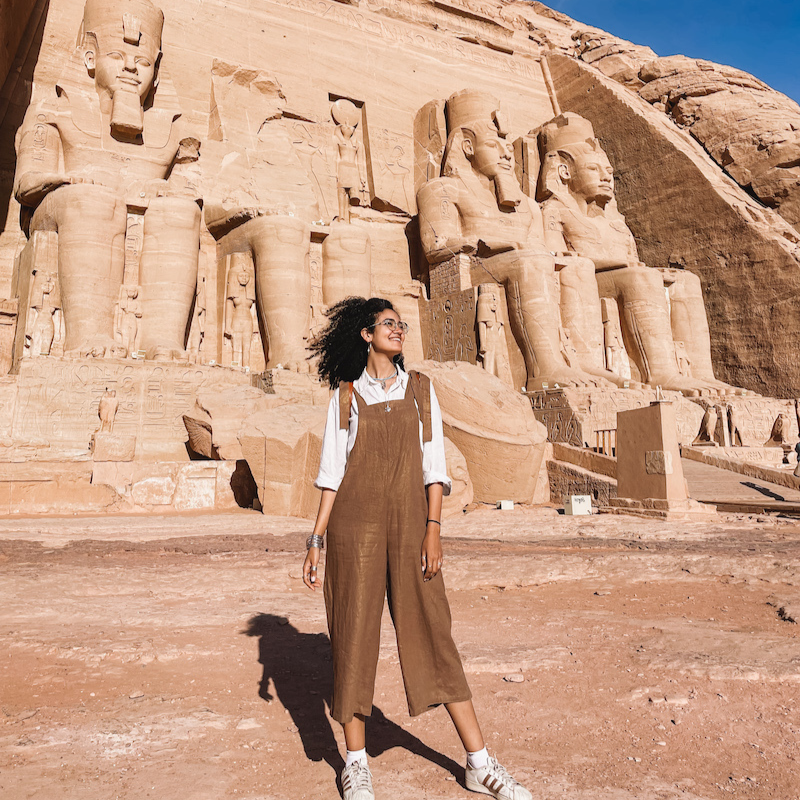
Matt Bowles: My guest today is Nadine Arab. She is an Egyptian travel writer, blogger and entrepreneur with 10 years of experience in the travel industry. Originally from Alexandria, Egypt, she quit her 9 to 5 job as a magazine editor to pursue her dream of becoming a full-time travel writer. She is the founder of the blog Curls en Route where she aims to empower aspiring solo travelers by documenting her travels across the world and around her home country of Egypt.
Nadine, welcome to the show.
Nadine Arab: Hi Matt, how are you?
Matt Bowles: I am wonderful because you are here and I am so excited for this conversation. You are doing such amazing and inspiring things. I have been following you for quite a while and I’m so excited we were able to put this together. But let’s just start off by setting the scene and talking about where we are recording from today. I am actually in the Blue Ridge Mountains of Asheville, North Carolina on the east coast of the United States today. And where are you?
Nadine Arab: This sounds very interesting. Thank you for the beautiful introduction. I am in my living room in Cairo. I hope I was sitting somewhere with a view, but yeah, super-hot to go outside today. Over 100 degrees here. So, it’s just a home sweet home kind of night for me.
Matt Bowles: Well, I relate to that because as you know, I lived in Cairo for an entire year. So, I got the full scope of all of the seasons, including the summer heat of Cairo.
Nadine Arab: It’s not even summer yet. That’s the crazy part. It’s supposed to be spring.
Matt Bowles: You never know what you’re going to get. But it brought me right back because before we were starting this interview, I heard the call to prayer coming in your window and I was like, oh, I remember that from Cairo. And it was so nice. So, I, I have so much love for Egypt and it was such a special year and subsequently, I’ve just talked about it so much, and it’s been really such a special place for me in my memory and the impact that it had on me that year. But I would love to hear a little bit about your story. What was your upbringing like? Because you grew up not in Cairo, you grew up in Alexandria, which I also have amazing memories. Because when the heat in Cairo gets super-hot, I would just go up to Alexandria, which is this absolutely gorgeous city for people that don’t know is right on the Mediterranean Sea. And you can walk along the cord niche and get the nice breeze. And I would go to my favorite coffee shop, Brazilian coffee. I still remember it in Alexandria. So, I have amazing memories from your home city as well. But I would love, just from your perspective, what it was like growing up there and what you remember from your childhood.
Nadine Arab: Alexandria is a metropolitan city with a lot of different influences. So, growing up in Alexandria definitely influenced my creative side. I think most people that grow up by the sea or somewhere where there’s a little bit of nature, it makes them more Zen, I think. Totally different from the experience in Cairo, at least back then, at least back when I was a child. I don’t know if you’ve met a lot of Alexander, but we’re usually more artistic, more creative, more in touch with that side, especially because we had a lot of the Italian and Greek diaspora. Specifically, growing up in Alexandria is very different from Cairo in terms of it’s a bit slower, it’s not as fast paced as life in Cairo. And that really helps you take a moment to take in a lot of things from your surroundings.
So, I think what life in Alexandria influenced the most is my creativity and my interests in different kinds of arts, be it photography or writing, things that I’ve been actually doing ever since I was very young. Or even different kinds of arts that have nothing to do with my job, like dancing. I used to be a ballerina. I played ballet at the Alexandria Opera House. Actually, growing up, my childhood in Alexandria was mostly influencing my creative aspects of life.
Matt Bowles: And what were your earliest perceptions of the outside world growing up in Egypt? Did you get to travel much as a kid?
Nadine Arab: I actually did, but I think the earliest perception was shaped by everything I basically saw on TV. Growing up, I watched a lot of American TV shows and movies. I had a very basic perception of how the west looked and sounded like. And I became relatable, I think, in a sense, during my travels, especially to Americans, because whenever I meet Americans, they’re always like, how do you have this accent or you get our sense of humor, you get our jokes, how? And I’d be like, I just grew up watching friends. I think it eliminated the culture shock aspects at least when I traveled in the west.
Matt Bowles: Growing up, what types of travel experiences did you have, either around Egypt or outside of Egypt?
Nadine Arab: So, I did travel inside Egypt growing up, of course. But I think what was most memorable, I was lucky enough and privileged enough to travel abroad at a very young age. I remember my first trip ever was a trip to London that I took at the age of three with my family. Even though I was very young, to this day I still have core memories from that trip.
Matt Bowles: And then from there, when you were traveling around Egypt, as you were growing up and coming of age and becoming adult, I know you’ve traveled extremely extensively now around the country. So, at this point, what parts of Egypt feel most personally meaningful to you?
Nadine Arab: I would say definitely Nubia and Sinai. Both destinations have a very special place in my heart because both of them are actually two out of three phases or triggers, as I like to refer to them. In my whole solo travel and blogging journey, the Nubian village of Gharb Soheil was where I went on my very first solo trip. I was only 19 at the time. I went there with no plan. I just thought Nubian villages look so pretty. I wanted to experience them myself, especially because the Nubian culture is very famous, especially here in Egypt, Nubians are the most hospitable of people. Their culture is very vivid and rich in so many beautiful ways. So, I wanted to go experience that first time hand. But my trip wasn’t so lucky. I felt incredibly sick the whole time and they took really good care of me. They could have discouraged me, but it didn’t. It actually sparked the very first love or passion for travel, especially solo travel.
Everyone thought I was crazy for going there alone, especially because it wasn’t a popular tourist destination back then. I was basically going to an isolated village alone at the age of 19. I haven’t traveled alone before. A lot of people thought I was crazy, but whenever I made plans with friends, they never really meant it, I think. So, I was like, you know what, just going to book a flight and I’ll just go. And Sinai, this is where I knew this was the third trigger, I think. And I went on a trip to Sinai right after coming back from France. I was there doing my Erasmus. I’d spent a semester abroad. And the summer after I came back, the travel bug was itching so hard. I knew I had to travel somewhere. So, I was like, you know what? I’m going to go to Sinai.
I went to Dahab and Saint Catherine. I remember I was sitting on the beach in Blue Lagoon this one evening, and right there at this very moment, it hit me. I knew I wanted to do this for good. I knew I wanted to do something related to traveling. I was majoring in media management at the time, so I also knew I wanted to do something creative. I loved driving, I love photography. So, I was like, you know what, I’m going to start a travel blog. And right after this trip to Sinai, I came back home and I started thinking of the name Curls en Route, which is obviously, it has the French influences and obviously I have big curly hair. That’s part of who I am. A lot of people link my hair to my identity. That was where I knew. And to this day, whenever I go back to either of these destinations, I feel incredible. I feel very warm in my heart.
Matt Bowles: That is amazing. I also very frequently talk about Nubia as one of the most extraordinarily hospitable destinations I have ever been to with some of the most incredible people. But I have to say I want to talk to you about Cairo as well, because Cairo is where I was based and that’s where I spent the most time in Egypt. And the people in Cairo were also so kind to me. This was 2014 that I lived in Cairo. I still am Facebook friends with my kebab guy who was a Syrian refugee named Faddi. Shout out to Faddi. And I can remember Nadine, my sister, came to visit me when I was living in Cairo and it was her first time in Egypt and she flew in from New York and I can remember the very first day that she arrived. I would go every day for my own lunch. I would go to my foul and ta’amiya cart and I would go there every day and they knew me.
And then one day I show up and I bring my sister and I explain to them in my broken Arabic, this is my sister. She’s just flown in from New York. This is her first time in Egypt. Now this is a foul and ta’amiya cart where you just order and you stand there and you eat it. Somehow when I told them, this is my sister, they found a pull-out chair and a table and they’re behind the cart and they’re dusting it off and they’re putting it there. They’re opening the chairs for her to sit there and then they bring her over the food and then she finishes and I go to pay them and they say, no, we will not accept your money. Your sister is a guest here. This is her first time in Egypt. Welcome to Egypt. It’s on us. You know how a lot of times in Arab culture they’ll just say it as a gesture and then you got to fight to actually pay and stuff.
So, I’m like, no, take the money, you know, and this whole thing and they refer to, refused to take the money. They said, you sister is a guest here. Welcome to Egypt. And I will always remember moments like that from Cairo because there were many of them of just true, genuine kindness and genuine feelings making me feel welcome and my family members feel welcome and all of that. So, I have a lot of love and a very special place in my heart for Cairo. And since you are now based there and you now live there, I’m curious, from your perspective, what do you think that first, foreigners often misunderstand about everyday life in Cairo?
Nadine Arab: First, I want to actually acknowledge what you just said. I think it’s very beautiful what you’ve experienced and I’m really glad that you got to experience it. The culture itself is very family oriented and there’s a lot of generosity and hospitality and it comes so naturally to us that we like to showcase it and help other people experience it as well when they visit. So, it often comes off as genuine and beautiful as you just described it. And this is something I really hope everyone who comes here would get to experience it. But if I would talk about something else, I would have to say, say the day-to-day experiences in general, I think maybe you got to live this experience a bit because you lived here for a whole year. But most travelers and tourists, the longest they stay here could be a week or two tops. And they only get to visit tourist attractions.
And sadly, what I noticed is that when tourists visit Cairo specifically, they’re mostly focusing on visiting the pyramids, which is great and amazing and everything. But they often spend just one night in Cairo to do so and then travel somewhere else to Botswana, Aswan or other destinations. And the longest I’ve seen a typical tourist stay in Cairo; it was just for a few days. And there’s just so much to see and experience here. Egypt in general, not just Cairo, it has way too much to offer more than just the typical tourist attractions. And even the ancient Egyptian historic side of travel in Egypt. There are different kinds of travel in Egypt. And I think in Cairo specifically, because it’s the Greater Cairo, which consists of Cairo and Giza, is the biggest city you’re going to visit in Egypt. And therefore, it’s the place where you get to experience the culture as a whole. Because we’re over a hundred million people here and there are so many subcultures.
And when people come to Cairo specifically, they tend to visit tourist attractions. So, their local experience is limited to what they see in these areas and the surrounding areas. And little do they get to experience other neighborhoods and other day to day activities like something as silly as going to the mall, for instance. That’s why whenever I take a foreigner out in Cairo, I almost never took anyone to an attraction unless they needed a local to accompany them or something. I take them partying, for instance. That’s something they wouldn’t normally think of doing, especially if they’re traveling solo, if they’re into it, of course, or show them around my neighborhood.
I live in Maidi. I’m not sure if you’ve been, but it’s literally my favorite place in Cairo. It’s one of the very few places that are green. I also love taking people out to dinner because when people come to Egypt, they usually go on tours and. And what they’ll mostly be eating is grilled chicken, rice and vegetables, which is pretty basic in comparison to what the Egyptian cuisine truly has to offer. I’m pretty sure you got to indulge in many Egyptian dishes. So yeah, I have to take them to a typical Egyptian restaurant and they could have the full-on experience because honestly, Egyptian food is very underrated in my opinion.
Matt Bowles: So, you mentioned your first solo trip to Nubia. Can you talk about the lasting impact that solo trip had on you and how you decided that you wanted to start solo traveling the world and seeing other places outside of Egypt?
Nadine Arab: I just fell in love with traveling and solo traveling and it just started there. The second trigger that led me to where I am today was my Erasmus experience in France. I lived in Rennes in Brittany in France for a full semester. And during that time, I also got to travel around Europe alone and with the friends I made there in school. And you probably know how easy traveling in Europe is. I think if someone wants to start traveling alone, Europe would be a great start for someone who is not well traveled because the ease of movement and how easy it is to just book a ticket and go, it makes it very beginner friendly. So yeah, I traveled around Europe during my time there and the travel bug bit me and when I came back, I just couldn’t stop.
Matt Bowles: And how did you eventually make your transition out of your 9 to 5 job in into becoming a full-time travel writer and solo world traveler.
Nadine Arab: Okay, so I was already travel writing actually when I was still working full time. I started my travel blog right after graduating. And then right after graduation I moved to Cairo because I already had a part time job at an online magazine based in Cairo. And I got a promotion to be junior editor. I just started writing for my blog. At the time, I knew it would take time to take off. I knew it needed consistency, so I was like, okay, I’m going to take the job as a plan B. Actually, I’ve always known, but I wanted to be a full-time blogger. Unfortunately, I wasn’t able to be as consistent as it required because my job was also very demanding, especially because I kept on getting promoted. I’m so grateful for that. I had made it to managing editor by 23 at another online magazine, but because of how demanding it was, I had very little time to dedicate to the blog.
So, it actually took a toll on my mental health because it kept me away from what I really wanted to do. During COVID we all had to stay at home. All the writers were unfortunately laid off. I had to be the only one writing and editing for the magazine at the time. Me and someone else, they were pretty flexible, especially because our salaries were also cut during that time. My boss was pretty flexible with what kind of time I had to give the magazine. So, during that time I have plenty of time on my hands and I just dedicated 99% of my time to the blog. Even though I wasn’t consistent and sometimes I wasn’t active for months. It had actually caught the attention of big publications and I would do commissioned work for them on the side. But during COVID the blog started showing so much potential because I actually put in the time and energy.
It was a risk that had to be taken. I was really miserable at my job and I was like, you know what? I’m going to go on a trip. I went to Sinai again. Actually. I did a solo road trip camping trip. A break from everything that’s going to help me recharge and start again and regain motivation I need for work or it’s not going to work. And then this is going to be a sign from the universe that I need to hand in my resignation. And from the very first day of the trip and I started receiving very weird signs that this is not going to work anymore. As soon as I came back, I visited the office and I handed in my resignation and I never looked back.
Matt Bowles: Did you experience any resistance from family or Society around traveling the world solo as an Egyptian woman?
Nadine Arab: I was lucky enough to have a different experience. Unfortunately, not a lot of women are as privileged. They probably wouldn’t have understanding parents or their social circles wouldn’t be as understanding. But I’m very grateful that I had a different experience, to be honest. So, I think at the very beginning this is something that I need to acknowledge. In my case, the resistance that I faced from my family was due to some safety concerns, especially before going to France, because this generation’s perception of Europe is that it’s very unsafe, especially at night, unlike the other way around. Western people usually look at countries like Egypt or the whole swan or region in general, they’d be like, don’t go there it’s unsafe for us. For our parents’ generation, they’d be like, Europe is unsafe, especially at night. Everyone gets super drunk and you can’t walk along.
And honestly, it is kind of true. To be quite honest, I have felt unsafe in France way more than I ever felt unsafe in Egypt. But the resistance was mainly out of safety concerns. But I was also lucky because they wanted me to have the opportunity to rely on myself more and become more independent. As for my surrounding circles, I think my friends thought it was weird, but not weird in a bad way. More like they thought, who in their right mind would want to travel alone? You must be bored. I’m actually very grateful that this was the kind of resistance that was in my circles, especially at the time. Now maybe people are more understanding, a lot more women are taking the step to travel alone. And I think it’s very beautiful, very empowering. This is one of the reasons why I started my blog, because I wanted more people, especially women, to experience what I’ve experienced.
Matt Bowles: What is it like constantly seeing your home country portrayed through those Western media narratives? And do you feel a responsibility to represent Egypt differently through your own work?
Nadine Arab: Absolutely. I think someone just needs to tell the colorists in Hollywood to tone down the sepia effect a bit because yeah, sure, we live in a desert climate and all, but it’s not that dusty unless there’s a sandstorm, okay? I really hate how the entire swan or region is trapped in this box. Sepia effect, of course, along with other stuff like the stereotypical desert background music and portraying all characters as if they have this one rigid mindset. I also don’t like how all Arabs between quotations are portrayed as the same because they’re not. That’s not the case at all. Arabic speaking countries do share a lot of similarities, a lot of cultural similarities due to speaking the same language and common history and all. But we’re not all the same because we’re pretty diverse in so many ways, because we have different historic and ethnic backgrounds. And the experience in every single one of these countries, completely different, even though they do share some similarities. So, I feel that this Western portrayal erases a huge chunk of our identity.
Matt Bowles: And in terms of travel specifically, how differently do you think people experience freedom of movement depending upon where they were born, what passport they travel on, and how has being Egyptian shaped the way that you move through the world and your experiences?
Nadine Arab: Passport privilege is definitely a thing. It saddens me that not everyone would get to travel and see the world. People don’t get equal opportunities to do so. And I also find it extremely sad that there are also a lot of other people who do have this privilege and have no idea that they have it. I’ve seen a lot of people who never knew that there’s something called applying for a visa. It’s not that they haven’t experienced it themselves. They didn’t even know until they had to apply for a visa in a very specific situation. Passport privilege is real. And I think in my case, this is the main form of discrimination that really stood out in my experience. But I think I’m incredibly lucky because I never found myself in a position where I have to face direct racism myself. I witnessed it against others, unfortunately, which was very horrible. I think I’m incredibly lucky because I haven’t faced something so extreme, even though my last name is Arab.
But so far, I was usually met with fascination and intrigue rather than racism. But that’s my experience. That’s not everyone’s experience. I think the situations where I felt uncomfortable. There was this one time in Turkey, I was going through passport control and they wouldn’t let me go through because of my name, even though they let my dad and brother go through. But apparently there was a fugitive who had a similar name as mine. Luckily, I was only 13, so it couldn’t have been me, so they let me go. And then another time, I don’t remember where, but I was going through airport security and they had to look through my big curly hair. I felt this was a time where I felt uncomfortable. They were disappointed. They didn’t find drugs or anything. I find myself incredibly lucky in so many ways, to be honest. And I have to acknowledge that, and I have to be very grateful for that.
Matt Bowles: So, I saw that you were at an Arab party in Paris, and I’m curious what it has been like connecting with the Egyptian diaspora specifically and the Arab diaspora more broadly in different places around the world when you travel.
Nadine Arab: It was during the Fête de la Musique festivities in Paris and I just stumbled upon this Lebanese restaurant. They were playing Arabic music and I just couldn’t leave. It was also mostly Egyptian music. We have really good music; you probably know that. But the Lebanese and Egyptians specifically are very well known in the region. Everyone loves our music. Not flexing at all. You can’t just listen to Arabic music and not shake it. And there were a lot of people from a lot of places around the world. Sure, there were a lot of Arabic speaking people, but we didn’t really connect in that way. I don’t remember talking to anyone at all. All of us, we just danced and vibe and I remember I stayed in that party for hours. I didn’t just stay for 30 minutes and leave. When I arrived there, I was like, okay, this is the party where this day is going to end. Music has this magical way of transcending cultural barriers and it’s just amazing and so beautiful.
Matt Bowles: And have you been able also, just in other places around the world as you’ve traveled, to connect with Arab diaspora folks that are maybe born and raised in another country and how those interactions have gone with people that might have Egyptian heritage or Arab heritage from another country, but were maybe born and raised somewhere in Europe or in the U.S. or somewhere else that you’ve traveled. How have those diaspora connections and those experiences been?
Nadine Arab: The times where I met Egyptians the most, or Arabs in general, were when I visited other Arab countries, places like Jordan or Lebanon. I really connected with the locals there and I made a lot of local friends. While traveling around the world, I actually did meet whether other Egyptian travelers by pure coincidence and the most unexpected places, like Cape Town for instance, I met an Egyptian guy from my hospital. He joined our group for my birthday dinner. During my time in France, there were a lot of Egyptians in my school and I think we really connected. I don’t want to say over homesickness, but when you’re away from home, especially for a long period of time, you often miss somebody who can relate to some things, be it missing a particular dish or missing holidays.
I remember when I first went to France, it was my first during my Erasmus two months. I was traveling with friends and I was like, I don’t want to speak English anymore. I don’t want to speak French anymore. I miss the sound of Arabic and it’s great to have people around you that would understand you because sometimes, especially when you’re angry, you just want to let it out in your mother tongue and express freely, maybe cuss a little. I think during that time, that was when I got to really benefit from the connection. Other than that, during my travels, I remember I was in Portugal, in Lisbon specifically, and we were going on this pub crawl and I was waiting for other people to get together and this guy was standing right next to me and I couldn’t help but notice that he pulled out his phone and it was in Arabic. And I instantly asked him, oh my God, you speak Arabic. And he was like, yes, he was American, but his parents were mix of Egyptian, Sudanese, Eritrean.
And we really bonded to the extent that he actually joined the pub crawl and we made friends with other people and we had this very little group. It’s very fun because you get super excited just because you found someone somewhere that speaks the same language. And by language, it doesn’t necessarily have to mean actual language like Arabic. They can relate to a lot of different things. Even if it’s just punchlines from movies, you usually get super excited and it’s usually very fun.
Matt Bowles: Well, I want to also talk to you about your brand, Curls en Route and how you have built and evolved your business over the years. Can you share a little bit about the mission of the travel blog and what people can expect and then also some of the other aspects that you’ve incorporated into your business over the years and including some of the meetups and in person networking events that you’ve hosted and that sort of thing.
Nadine Arab: Curls en Route is originally a travel blog dedicated to solo travelers and people who want to start solo traveling, but they’re just afraid or don’t know how to start because solo traveling can be a bit intimidating at first. I wanted to make it as seamless and as accessible. I also wanted to inspire other people, especially women and young girls, to embark on this adventure and try it at least once. Because solo traveling can be very healing and incredibly life changing. And I wanted people to try it for themselves and experience it at least once in their lifetimes. And this is why I wanted to start Curls en Route. So, this was my main mission.
I also dedicated a huge chunk of my content to Egypt travel, as you probably noticed, for different reasons, because Egypt is often portrayed differently in media and I wanted to help provide the right image and help travelers set the right expectations before they visit so they can have a seamless experience and probably a memorable one too. I wanted to shed light on different aspects of travel in Egypt, not just historic tourism. We have adventure travel, we have religious tourism, we have lots of leisure kind of destinations, we have even medical tourism. And I wanted to shed light on all these beautiful things that Egypt also has to offer, aside from its incredibly rich history. So, the blog is the main thing.
In 2022, shortly after Covid, I registered Curls en Route as an LTD. I launched Curls en Route the shop. The vision at first was to have a travel shop that’s a one stop shop for people who love to travel. A place where they could find practical things or even just fun. The first product I actually launched, which was Rome Syndrome, a travel themed card game that I created myself. The idea just came to me during lockdown. I wanted to create a travel card game at first to promote my blog, but I ended up doing things the other way around. I wanted other travelers to be able to experience travel from their living rooms if they weren’t able to travel, just like everyone was at the time. And I also wanted some sort of tool to help people connect or break the ice with other solo travelers if they were traveling alone and if they were traveling with friends or family for them to have something to keep them entertained when they’re on the road. This is how Rome Syndrome came together.
And when I created it, I wanted to do everything by the book. So that meant registering the game. Because I didn’t want anyone to steal the idea or the designs. I went ahead and started a company and registered Curls en Route as a limited liability company. The whole idea for the travel shop came from there. I had to make this sustainable somehow. So, I started experimenting with different things. I was already a writer, so I niched down to travel clients only and put that under that umbrella. I started creating experiences. I actually found that I really enjoy designing experiences. I started by hosting trips just like most content creators are doing today. But I came up with this slightly different concept. It was called Travel with Curls en Route.
And the whole idea behind it was this solo travel concept, like group travel for solo travelers. The whole idea of it was to help solo travel newbies start their journey without really having to worry about the logistical hassle, or without experiencing all the scary bits and pieces about solo travel the first time. So basically, they’d be traveling alone, but within a group of strangers. And it would also be a means for frequent solo travelers to meet other people with similar interests or simply just save money. Because solo travel can be very expensive sometimes, and by splitting the costs with other solo travelers, they would get to save money.
And then I started hosting social gatherings and social events for travelers in Cairo. The first one and the one that I actually held multiple editions for, it was a fan favorite. I think it was a travel game night. This was a game night that I think I launched it during Ramadan because most people were bored at night. There aren’t so many things to do. So, I think they wanted some sort of new hangout ideas other than the typical gatherings and Iftar and Suhoor gatherings in Ramadan. And I was like, you know what? Okay, I’m going to host a travel theme game night. I’m going to teach people how to play my game. It was also some way of promoting it because it was something that I invented and created from scratch. So, promoting it wasn’t that easy because you needed to convince someone to get the game when they actually know how to play it. It wasn’t a conversational game. It was a strategy game. So, I wanted people to experience it first.
And it was some sort of community building as well. Most people who came also came alone. So, I was trying to mimic the experience of solo travel. But here in Cairo, whether to local travelers or people who are just passing by or even expats, and people would just bond over the love for card games and travel. My favorite social event that I designed was the Travel Tribe Mixer. And that was basically a mixer that consists of different activities that are designed to help people get to know one another and connect with other travelers with similar interests and maybe similar travel styles as their own. It had things like storytelling circles and speed dating for travelers. It was super fun, super engaging, and a lot of people came through.
Matt Bowles: That’s so cool. All right, Nadine, real talk behind the scenes. As a travel content creator, someone who has been doing this for years, what is the hardest part of being a travel creator? Because this is the dream for a lot of people. This is the fantasy. I’d love to just travel the world and create content about it. But what have you found to be the most difficult part about that lifestyle?
Nadine Arab: I think the toughest part in my experience, also no this is definitely not everyone’s experience. This is mainly my experience as an Egyptian travel creator is that I create content in English. And one of the reasons why is dedicating a huge chunk of my content to Egypt travel. And I found a gap. And I noticed there wasn’t so much reliable content in English on traveling in Egypt. It was usually the copy pasted standard itinerary. I often posted about destinations that a lot of people messaged me and told me they never heard of before. I shared a lot of local insights and posting in English really helped me get that message through. And that meant also that I have a big portion of my audience outside of Egypt.
Mainly because when I first started out, I honestly wasn’t targeting people demographically. I’m not targeting travelers from a specific destination or of a specific nationality at all. I was targeting people psychographic ally based on their interests. So, I wanted to reach as many people as possible who were interested in this specific form of travel. And I think what makes it challenging for me is that making this sustainable in terms of it becoming an income source was challenging. Even without going to a brand or a sponsor or whatever you want to call it, someone who would work with me or attract an Egyptian entity, normally they wouldn’t pay. It’s not a very well-paid sector. The travel industry doesn’t pay much here in Egypt. They often pay in kind or fringe benefits. Unless you’re a mega influencer of course.
And on the other hand, I received a lot of emails in the past from international or foreign brands who wanted to work with me, but they wouldn’t pay me as much or as fairly. Especially because the majority of my Egyptian audience didn’t translate to or don’t translate to much in terms of dollars for them. Because every follower or engagement or every person usually counts or translates into money. When it comes to thinking about content creation as a business, the Egyptian follower or the Egyptian like was not equal to the American or Canadian like, for instance.
On the other hand, on my blog, because SEO is completely different than social media, I personally love blogging more because it’s much fairer. Like one plus one equals two on CMS and when you give SEO the time it needs to kick in. But on social media, and I’m pretty sure you’ve experienced this yourself as a creator on social media, you go by the book and you put in investing so much time and energy into putting this new strategy and then the next day the algorithm changes because it was fairer on the website. The majority of my readers are actually based in the us but the majority of my followers are based in Egypt. And to brands, that doesn’t translate into something that’s worth investing in.
So, most of my sponsored work is actually on the blog and not on Instagram, just like a lot of creators. Which is fine, to be honest, because I’d rather be authentic. Not that sponsored work isn’t authentic. I usually take it very seriously and I only work with brands that allow me to be fully myself and promote their products. If I do believe in it in the first place, the way I see fit and the way I see suitable for my personal brand and for my audience. I think for someone like me, it’s not that fair. Maybe that’s the kind of discrimination I face in the travel field. I face it more online rather than while traveling.
Matt Bowles: What are the things that you have done in your content and relating to your authenticity and not wanting to compromise that that I have so appreciated is your outspoken solidarity with the Palestinian liberation struggle and against Israeli apartheid and against the genocide. Just for context on me, Nadine, the first time that I went to the west bank and the Gaza Strip was in December of 1998. And so, I have been doing Palestine solidarity work since right after that time, because the second intifada was in the year 2000 and we started organizing in the United States in solidarity with the second Intifada to try to stop U.S. aid to Israel and those types of things.
So, I’ve been in that space doing that activist work for 25 plus years now. And so, I have been so appreciative of you speaking out about that. You were very vocal about that. So, supporting the boycott, divestment and sanctions campaign before the genocide started. You’ve been very vocal in public since the genocide. And I’ve really appreciated that because I think that there’s a lot of travel creators that have chosen not to do that or have compromised on that, even if they believe in that and so forth. And really just wanted to tell you how much I appreciated that. And I’m also curious for you how it was growing up so close to Palestine for people that don’t know. Egypt, of course, shares a border with Palestine. And if you can just share a little bit of your background story in terms of what that was like and how your solidarity with Palestine developed.
Nadine Arab: I actually wrote a personal essay on this back in 2023, I think a month after October 7th. Around that time, I was trying to understand why my solidarity came from. Because for some reason I constantly found that I was on an unconscious level, constantly trying to justify my solidarity to Western travelers that I met during my travels, whom I had too sometimes tiptoe around. Not because I was scared, but I knew I would be misunderstood because of people’s ignorance above anything else.
So, I opened my laptop and I started writing in hopes of figuring out where my solidarity and empathy came from. And while I was writing, I remembered my earliest memory of the occupation. I was only four when Muhammad al-Durrah was killed back in 2000, which led to the second intifada that you were just referring to. And I was just a child seeing another child. He was 12 at the time, I think, being brutally murdered on screens. And just like the Western media completely blocked these horrific scenes and this whole narrative from its viewers. On the contrary, I grew up seeing it on television. This was also my first memory of death. And it wasn’t death of a close loved person that came naturally. It was a result of occupation and ethnic cleansing.
The second part that I would also refer to as an answer is that I think whenever you ask any Egyptian how their solidarity developed, it requires a deep dive into Egyptian history because we’ve also experienced colonization ourselves by the Brits and the French and also Israel. Thankfully, there was no ethnic cleansing, it was just occupation. But we’ve tasted this poison, we know how it feels, even if the current young generations haven’t lived it. It’s a huge part of Egypt’s modern history, and it includes massacres like Bar Bahar, where a lot of school kids were killed, and wars that our family members have fought and some of them have lived to tell us about. I think modern history plays a major role in my solidarity as an Egyptian and having family members survive wars to tell me all about it and obviously watching it on screens every day.
Matt Bowles: Why is it so important for travel content creators to speak out about Palestine now? And do you have any tips on how to integrate Palestine advocacy with travel content?
Nadine Arab: Personally, I’m a strong believer in the fact that travel and politics go hand in hand. In fact, I think that in so many ways, travel in itself is a political act. As travelers and as travel creators, we get to become witnesses of this interplay between travel and politics. And in our travels, we get to experience the warmth of hospitality, we get to experience the diversity, we get to experience shared humanity. And we also witness and see the struggle of resilience of some people and some nations by learning about their histories. So, at such point, we can’t really turn a blind eye when something like humanity is at stake.
And it’s very important and very crucial to speak out for Palestine and to continue speaking out and to keep the conversation going about all the monstrous things that are happening, whether in Palestine or in other parts of the world. I think it’s very important to also shed light on what’s happening in Sudan, what’s happening in Congo, what’s happening in so many other places. They don’t get enough media attention, just like Gaza is getting right now. And for the longest time, Gaza and Palestine haven’t been even receiving enough media attention. And I think it’s only thanks to social media that they have been able to get that attention, because unlike mass media, it’s not as controlled, even though they tried to control it.
Matt Bowles: So, in addition to talking about Palestine and amplifying voices and educating and raising awareness about the situation, what are some action items that people can actually do to support Palestine and to help stop the genocide?
Nadine Arab: I think actionable steps really differs from one person to another due to inner politics, of course, and depending on where you come from, for Western nationals, for instance, they can go on rallies, they can pressure their congressmen and whatnot. For other people, that’s not something they can do. But there are plenty of other ways to support the cause and amplify Palestinian voices, like you mentioned. I think the most important thing one needs to do is to continuously seek knowledge and educate oneself and follow Palestinian activists and help share their message and amplify their voices. Boycotting is also very influential. You mentioned BDS, and I would like to take a moment here to explain what BDS actually is, because a lot of people think boycotting is boycotting everything altogether, especially here in Egypt. Actually, there’s a common misconception.
A lot of people that are boycotting or whenever the topic is brought up, they think that you have to boycott everything that isn’t local or anything that’s Western, which isn’t true at all because obviously you’re going to hurt other businesses that might even be pro-Palestine without you knowing it, just because it’s western. But the whole point of BDS is it’s a campaign created by Palestinian activists and it stands for boycott, divest, sanctions, and the whole idea of it is targeted boycotting. They’ve compiled a list of the companies that have the biggest influence on the genocide and occupation. And the whole point of it is when everyone who’s boycotting would boycott this small group of companies, only then true change or true influence can be felt. These few companies will be affected. Unlike, on the other hand, if every single person boycotts whatever companies they want, the effect wouldn’t be as felt as it would be if it’s targeted. So actually, the smartest way and the most effective way to boycott is to boycott it. Very targeted companies. The lists and everything is on their website and on social media, and it’s very accessible.
Matt Bowles: Nadine, when you think back about all of the travel that you’ve done over the years and the places you’ve gone and the people you’ve met and the things that you’ve learned, how do you think all of that travel has impacted you as a person?
Nadine Arab: I think it made me more accepting, not that I wasn’t before. The trait that stands out that came out of this whole experience is that I’ve become much more accepting of differences. When you live in a bubble, when you’re not really exposed to many differences, even within your own country, I think it’s so easy to be resistant to anything that’s different. And I think that’s very dangerous and very sad. And whenever I encounter this kind of behavior, it actually physically hurts me. I wouldn’t be exaggerating if I say that because we’re all human at the end of the day. As cliche as this sounds, I know we can coexist. When you look at these major differences like skin color or religion or whatever, we’re not very different at the end of the day. These differences don’t really matter when you really think about them. What really matters is our core values and our morals as human beings. So as long as we both don’t believe in child murder or any horrible things, then we can definitely coexist. At the very least, we can become friends and our beliefs won’t really matter. So, yeah, I think this was the way travel impacted me the most. It made me more open to all the differences around us.
Matt Bowles: I feel like that is the perfect place to end the main portion of this interview. And at this point, Nadine, are you ready to move in to The Lightning Round?
Nadine Arab: All right, let’s go. Let’s do it.
Matt Bowles: Let’s do it. All right, what is one book that you would recommend that people should read?
Nadine Arab: How to ADHD by Jessica McCabe. I know you were probably expecting a travel book, but this is the book I’ve been recommending to everyone over the past year. It’s an amazing read, and I usually actually recommend it to neurotypical people, not neurodivergent people like myself.
Matt Bowles: All right, who is one person currently alive today that you’ve never met that you’d most love to have dinner with? Just you and that person for an evening of dinner and conversation?
Nadine Arab: John Griffin. He’s the creator of this sci fi horror thriller series called From. It’s a series I’ve been obsessed with for a few years now and season four is currently airing. And I think I would just want to have dinner with him to ask him, what the hell are you doing? Like, what do you want? Also, to ask him to maybe just air all episodes at once because now they’re five episodes in and I still couldn’t watch. I’m itching every single Sunday for the past five weeks. I have to wait five more weeks to watch because I can’t with the cliffhangers. I think this is the person I would choose to have dinner with.
Matt Bowles: All right, Nadine, knowing everything you know now, if you could go back in time and give one piece of advice to your 18-year-old self, what would you say to 18-year-old Nadine?
Nadine Arab: This is the perfect age actually, to tell her not to be afraid of taking risks.
Matt Bowles: Awesome. All right, of all the places you’ve now traveled, what are three of your favorite destinations you would most recommend? Other people should definitely check out.
Nadine Arab: Okay, I’m going to be biased I’m going to say Egypt and then add three destinations. I think the destinations I personally enjoyed the most were Indonesia, Italy and Jordan. Jordan specifically surprised me.
Matt Bowles: In what ways did it surprise you?
Nadine Arab: Okay. I’m such a desert gal. I love the desert. You probably understand why since you came to Egypt before visiting Jordan. I always wanted to visit because their desert was very different and I really wanted to experience it there especially. And when I went there, Amen really surprised me and I fell in love with it in a way that I hadn’t expected at all. It was this beautiful fusion between Cairo and Beirut. I loved it and the people were amazing and I made a lot of friends there traveling around Jordan in general was a very beautiful experience.
Matt Bowles: I love that. All right, what are your top three bucket list destination places you have not yet been highest on your list you’d most love to see.
Nadine Arab: The first one would be Uganda because I’ve been trying to plan a trip lately and it’s not happening for some reason, but I’m very determined to make it happen. I really want to go gorilla trekking, so I want to go to Uganda. I also really want to go to Alaska. I know it’s a very unexpected answer. I think I really want to go to Alaska. I don’t know if it’s the cold or the nature there looks incredible. Very different from what we’re used to here. So that’s definitely at the top of my list. And number three would be Socotra. Definitely an amazing, mind-blowing destination off the beaten path. I’m dying to go there. But it’s also not easy to make it happen. So hopefully soon. If you’re someone who appreciates nature, it’s mind blowing. It’s worth going completely off the grid. It’s not for the faint hearted at all. It’s at least a week of camping, completely off the grid, but the nature is absolutely worth it.
Matt Bowles: I have interviewed a number of people who have been. For folks that don’t know, it is a Yemeni Island and truly sounds spectacular. So that’s an amazing pick. I have not yet been. I have been to the other two places that you mentioned though, so whenever you’re ready to plan those trips, feel free to hit me up. And the one thing I would say, I’ve actually not gone gorilla trekking in Uganda, but I have hung out in Kampala, the capital city and it was such a spectacular time.
Nadine Arab: I actually heard a lot about it.
Matt Bowles: Yeah. So definitely plan to spend some time in Kampala when you go. It’s a really amazing place and incredible people.
All right, the last thing I want to ask you to do, just because you mentioned earlier how amazing Arabic music is for listeners that may not be familiar with Arab music. I want you to put some folks on to some artists that they can go and get on Spotify. And if you want to do a mix and you want to do Umm Kulthum and Fairuz and then you want to do some newer Spotify and if you want to do a mix and you want to do like dance music, all of that, however you want to do it.
Nadine Arab: This is so hard and I can tell from what you just said that you know how hard it is because there’s so many genres, not just Egyptian music. And the music scene in the region is just absolutely amazing. And I’m someone who listens to a lot of different genres. So, I have so much to suggest and I think the easiest thing is just message me. I’d send you a playlist with a whole full 360 experience.
Matt Bowles: Do you have a public Spotify playlist?
Nadine Arab: Actually, I do. They’re private, but I do. Part of the Curls en Route the shop. One of the products I created were Destination Candles. Actually, made them myself. And the scents were supposed to mimic scents that would remind you of certain destinations. That’s not it. It doesn’t stop there. There’s a QR code on each candle that takes you to a Spotify playlist that I curated myself that’s also inspired from this destination. And two of the candles, one was called An Ode to Palestine and all the prophets went to sending menstrual products to women in Gaza. And the other candle, there were five total. But these are the two Arabic candles and other one was obviously gypsy candle. I was having a lot of fun curating and putting together their private playlists. You can only get them if you got the candles, but they’re sold out, actually. But yeah, if someone messages me and told me, hey, I’m here from The Maverick Show, I’m friends with Matt, I’m going to gladly send them a link to the playlist and they can enjoy so you can listen to the sound of Egypt and the sound of Palestine.
Matt Bowles: Amazing. Okay, so let’s talk now about how people can send you that message, how they can contact you and how you would like people in general to come in your world. Check out your blog, follow you on social media. How can people find you in these Internet streets?
Nadine Arab: Definitely check out the blog. It’s the main thing, it’s https://curlsenroute.com/. On social media, you can also find me at curlsenroute. I’m mostly on Instagram and I think if you want to stay up to date, you just need to probably subscribe to my newsletter. I send out emails every Tuesday with new stories, new blog posts, different community announcements, and even sometimes travel deals that I stumble upon. If you want to stay connected, the newsletter is definitely a good place to be.
Matt Bowles: I’m going to be the first one to send you a DM on Instagram requesting those playlists, so get ready for that.
Nadine Arab: I’ll send them right away.
Matt Bowles: But we are going to link all of that up in the show notes. Everything that we have discussed in this episode is going to be in one place. Just go to themaverickshow.com, go to the show notes for this episode. We’ll have all the ways to find, follow and connect with Nadine there as well. This was such a special conversation. Nadine, thank you so much for coming on the show.
Nadine Arab: Thank you for having me. I had a lot of fun. This was a very interesting and fun conversation to have. Definitely love connecting with another fellow traveler. Thank you for having me and hopefully wouldn’t be the last time. Maybe next time you’ll be here in Cairo and we’ll have that cup of coffee we were talking about earlier and we’ll have an even longer conversation and we’ll talk about travel and beyond.
Matt Bowles: We need to hang out in Cairo for sure and hopefully other places around the world as well. So, I will definitely look forward to that. And good night, everybody.