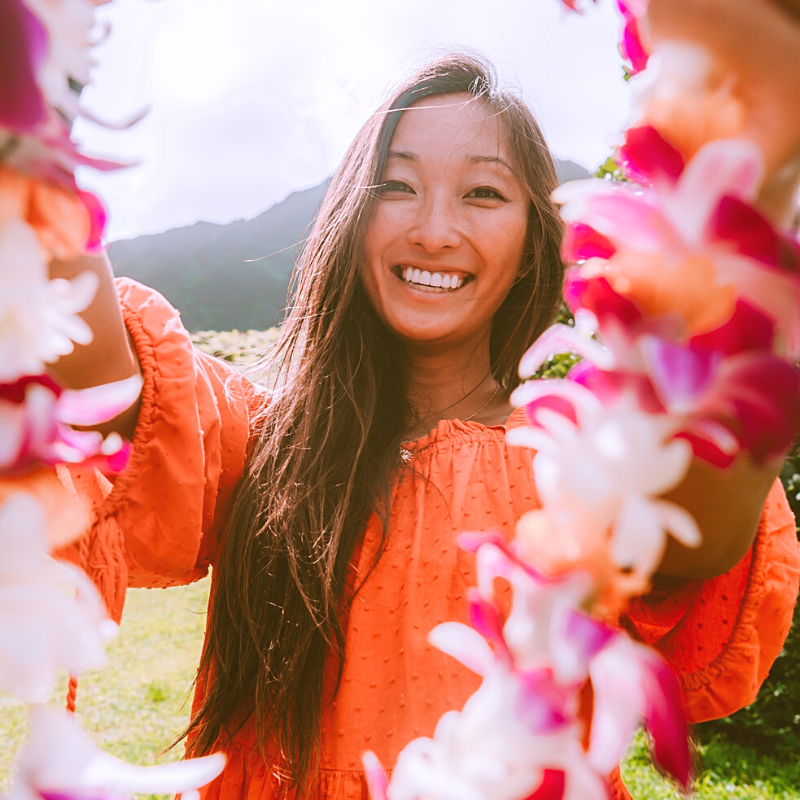
Matt Bowles: My guest today is Danielle Hu, she is a content creator, online business mentor, and the host of the Wanderlover Podcast. She has worked with hundreds of clients, customers, hotels, and tourism boards all while traveling through 60-plus countries and surfing around the world. Born in China and raised primarily in New York, Danielle has been a full-time digital nomad since 2017. Her mission is to enable you to design a life of time, freedom, location, freedom, and joy. And financial freedom through starting and scaling your online business.
Danielle, welcome to the show.
Danielle Hu: Hi, thank you for having me. I’m so excited to be here.
Matt Bowles: I am so excited to have you here. Let’s just start off though, by setting the scene and talking about where we are recording from today. Unfortunately, we are not in person. I am actually in the Blue Ridge mountains of Asheville, North Carolina on the East Coast. of the United States today. And where are you?
Danielle Hu: I am currently in Cornwall, England. It is in the Southwest corner of the UK.
Matt Bowles: Love that. Well, I’m super excited for this conversation because you just interviewed me on your show, the Wanderlover Podcast. We are going to link that up. In the show notes of this episode, so folks can go hear that. And now we’re turning the tables today and basically just continuing the conversation. Cause I definitely wanted my audience to meet you. As soon as we were done with that interview, I was like, you got to come on The Maverick Show because my audience needs to meet you.
So, I’m super excited for this convo. I think a great place to start just diving in would be with surfing. Can you talk about what surfing means to you, how you connected with the sport and take us a little bit on your surfing journey?
Danielle Hu: So, I picked up my first surfboard on a little trip I did to Nicaragua while I was still working in corporate.
And I took a lesson and it was one of those things where growing up as an Asian American Immigrant, I always thought surfing was reserved for pros in Hawaii, or it was an extreme sport. And as a person who didn’t really love sports growing up, it was something I would never do. So that in itself, for me to have picked up a surfboard, and stood up on my first lesson, it was enlightening. And I knew that it was something I wanted to continue, but A, it’s really cold in New York. It’s really hard to do. And B, I didn’t really have the time freedom to do that because I was working in a corporate job.
So, I took a lesson and fell in love with it and it wasn’t until I quit my job and then booked a one-way flight. I was in Indonesia where it’s basically the best waves I’ve surfed in the world and that’s when the consistency was able to develop, and I was able to get better. I met my community of longboarding women around the world and it’s just something that clicked. I can say that it’s one of the first hobbies I picked up as an adult.
I always love traveling, but something with staying consistent, doing what you love without any monetary reward for it, and something you purely do because you want to, it’s so magical.
Matt Bowles: Can you talk a little bit about how that has impacted your travel destination choices and share a little bit more about the women’s longboard community?
Danielle Hu: Yeah, so definitely since I picked up surfing, I mainly travel to surf destinations. So coastal areas where I don’t necessarily have to wear a wetsuit. I don’t like getting into a wetsuit, but a lot of my travel destinations for the past four years have been where there are waves. And what I found is people who are passionate and committed to surfing, we go to the same destination.
So, there are people who I’ve met in Hawaii, who then I meet in Portugal, and then we’re meeting up again in Indonesia. And it’s just really cool because I feel like I’ve found people who are traveling the world the same way as I do, and you really get to find the people who align.
Matt Bowles: I love that. I think there’s so many examples of that of hobbies and passions and things that you can pick up as you travel around the world and then do them around the world and then travel for them and then have that overlap with the communities that you’re building. I mean, it’s such an amazing experience when you start to do that.
Well, Danielle, I want to go back now and give folks just a little sense of your backstory and your journey into the nomad life before you became the wander lover that you are today. Can you start all the way back and maybe even before you tell your story, just give folks a little bit of context, maybe about your parents’ story and then lead into where you were born and how you grew up.
Danielle Hu: So, my parents were born in China, and they had a really interesting childhood. They were actually born under the rule of the Chinese dictator Mao Zedong and lived through the communist revolution. So, there’s a bit of, I would say, generational trauma behind that where the government took my grandparents’ land, they split up my family, especially my mom’s side of the family, forced them to move into the countryside.
There was a lot of struggle and misfortune in their childhood. So, the fact that they were able to pull themselves out of that, get an education, then immigrate to America, it’s where I draw a lot of my inspiration from seeing how far that they’ve come. And so, they immigrated to America in 1995 when I was two years old. And so, I was born in Beijing and I grew up in New York.
Matt Bowles: And can you talk a little bit. about how that experience was for you, navigating your Chinese identity and growing up in America in an immigrant home.
Danielle Hu: Well, what’s interesting is when we first immigrated, we were in Queens and there were so many other Asian immigrants who kind of, that was their first point to settle and it was kind of easy to navigate. It wasn’t until I was eight years old, my parents moved to upstate New York to the suburbs, and it was very American. And I think that was my first glimpse of like all American schooling system, families around me who I felt really different from, and I didn’t experience that until I moved upstate.
But I really appreciate that because it taught me about resilience, it taught me about opening up my mind to new cultures and adapting to my environment. And all throughout that, it was like this constant push and pull of wanting to be different, but then also really wanting to fit in and hold onto my roots. So, I think my childhood was somewhat different in the fact that I came from China.
Matt Bowles: How did that evolve as you grew older and as you came of age and eventually started traveling? How did that Chinese and American identity dynamic evolve?
Danielle Hu: Well, I think mainly it’s because the mindset that I want to be different and I’m proud of being different, right? And for so long, I tried so hard to fit in. I remember just things that I found really traumatic as a child. To me now is like, that is amazing. My parents used to pack me Chinese style lunches and everyone would be like, what is that? All the counselors were like, what are you eating? Right. And it was really traumatic for me as a child.
But now I’m like, that’s amazing that my parents like a loved me to pack my lunches in that manner. And now I want to be recognized for how I’m growing up with two cultures and to empower others who are feeling like they’re either feeling left out, or they don’t fit in. That is their power. Right. And that is my power.
Matt Bowles: I love that. Can you talk a little bit as you were growing up and as you think back about how your interest in world travel initially started to develop?
Danielle Hu: I would say the first time I lived away from home, well, I went to school in upstate New York. But I studied abroad in Italy my junior year and that was a first glimpse of time freedom and location freedom I had because I was working an online job. I was a teacher assistant for these online courses.
And so, I was able to travel, study and have income coming in and I just felt like I experienced so much freedom. Like that was a freedom that kept me going even after I was like, I need to experience that again and again or permanently. Right. There was no way I was going back to anything less than that. And when I found myself in situations where it was less than that, I knew I wanted to get back. I knew I wanted more freedom.
Matt Bowles: And how was Italy? What was your experience while you were there?
Danielle Hu: Oh my god, I loved it. I took Italian lessons. I ate so much Italian food. I traveled all around Europe because, as you know, the budget airlines in Europe are nowhere near as expensive as the ones in America. So, it’s very accessible and it completely transformed how I viewed travel. I loved it so much that I studied abroad in Hong Kong my senior year because I knew I wanted to go elsewhere and see more of the world.
Matt Bowles: How was the experience in Hong Kong? Obviously very different from Italy, but how was that for you at that time?
Danielle Hu: What I noticed was a lot of Americans study abroad in Europe. So, I met a lot of international students from America during my time in Italy. But the majority of people who study abroad in Hong Kong, they’re European. So, what I loved about that was I didn’t learn, it’s like funny to say, but I didn’t learn through my European friends while studying abroad in Italy. But in Hong Kong, I really made a group of international friends.
So being in a big city, being in Asia, also meant connecting with my roots a lot more because it was another kind of who am I situation where I would look Chinese, but I don’t speak Cantonese. I speak Mandarin. And it was this whole questioning of, Ooh, this is cool. Like, how do I navigate this scenario? And that’s what I love about traveling. Just putting yourself in those situations where you really get to figure out who you are.
Matt Bowles: Can I tell you that the very first time that I went to East Asia was in 2016. And the very first place that I went was Hong Kong. And it was so amazing. I mean, I loved it. I mean, I just loved everything about it. I was only there for a reasonably short period of time because I then went on to other places, but I was so enamored by it. And I was just like, I must come back here, and I must spend more time. So it’s kind of on my tippy top of my must return here and spend more time. But I loved Hong Kong.
Danielle Hu: Yeah. And I would say the skyline in Hong Kong is like 10 times more magnificent than the skyline of Manhattan. But I honestly had no idea before actually stepping foot there where I was like, how come no one’s talking about this? This is incredible.
Matt Bowles: Yeah. I was very enamored with Hong Kong. I really liked it. I have not though, been to mainland China yet, other than just transferring through the airport in Beijing, I’ve been to Macau. I’ve been to Hong Kong. Can you talk about your experience going back to Mainland China and what that was like for you?
Danielle Hu: Yeah. So, most of my family is still in China. And it’s funny because when I go back, I’ll like walk through the markets and people will automatically start speaking to me in English. So, something about me obviously looks different. I don’t even say a word and they just know that I grew up where I speak English, right? So that was the first interesting thing that I noticed.
The second one that I noticed, the difference between, you know, mainland China and Hong Kong is I would say how liberal people are and a lot regarding political views, but then also just like outlook on life. Where I feel like in Hong Kong, I met so many more people who had like-minded thoughts and who were super creative and ambitious and open minded to things where I could relate to them more. And China, I think because of its history and the way it opened up more recently, it’s been harder for me to feel like I “belong”, even though I was born there.
Matt Bowles: Well, I want to talk a little bit about your career trajectory. After the study abroad programs, you mentioned you got the love for travel and the freedom and all of those types of things, and then you landed a more traditional corporate job type situation. So, can you talk a little bit about your career path and trajectory after this study abroad experience?
Danielle Hu: Yes, for sure. And it’s funny because now looking back, it’s clearly what I mentioned before, the push and pull between American values and then my really traditional Chinese parents’ kind of whispering their whole lives, become a doctor or a lawyer, like get a corporate job.
And so, after I graduated, I worked at Pink of America where it was a very traditional cubicle 9 or eight to six lifestyle and immediately, I knew I didn’t want to be there, and I didn’t belong. How do I get out? And so, what really helped was finding other people in the world whose lives I admire. And that’s something I still do until this day, but you know, when you like look at someone else’s life and something about them, you just know you admire, and you want that for yourself. That was me with people working from coworking spaces in Bali, I would be at my cubicle working on Excel, but then I would scroll on Instagram and I’m, how are these people in this tropical paradise with that time freedom and the location freedom and the financial freedom that I wanted and why am I here?
And that’s when the wheel started turning. If I stayed on my current trajectory, I would be where my executives and managers were, and I do not want that. In 10 years’, time in five years’ time, even, but those people that I was seeing from my phone, I knew I wanted their lifestyle. So how do I do that? And similar to you, I picked up the 4-Hour Workweek by Tim Ferriss, where it showed me the roadmap.
And now it was like, what do I start? So, on my lunch breaks after work on weekends, I would be starting online businesses. I learned about drop shipping, Amazon FBA. I started blogging. So, all of these things that I had learned, I implemented when I had the time to.
Matt Bowles: So, let’s talk about your transition, because there’s a lot of people, maybe they’re listening right now to this very podcast who are in that cubicle and that job, and they are curious about the path in terms of what to do while you’re still on the job and then what that entrepreneurial leap looks like when you actually make the transition. Can you talk about that?
Danielle Hu: Yeah. So, I gave myself a quit date. So, I knew on July 11, 2017, I would quit my job. And when you give yourself that date, it’s really important to work backwards. So, I knew that I wanted to be making at least 5, 000 a month.
I knew the lifestyle I wanted for myself; it would equate to less than that. So, I could kind of sustain myself, especially if I wasn’t living in New York City. So, if you know where you want to go, how much it costs, then you can give yourself that metric. How much do I need to be making? And how am I going to be making that right?
And I think once you hit all of those financial goals, it’s a lot easier to make that move. And my move was actually sparked by a breakup. with my ex-boyfriend because that was the other reason why I was living in New York. But once we broke up, I was like, there’s really no reason for me to stay. And that’s when I booked a one-way flight. I knew I had the money coming in and it became a lot easier and achievable that way.
Matt Bowles: And how did the transition go for you? What was your plan for that date? You were going to leave your job and then what was your first move? How did you set that up your new location independent life?
Danielle Hu: Well, so I stayed in New York for, I think, around like six more months until the breakup. But then as soon as we broke up, I booked a one-way flight to, well, first Sydney and then to Bali. And I had no idea if, how long I wanted to stay. I thought I wanted to move to Sydney at first. But I spent a few weeks there and I was like, you know what? Let me check out somewhere else. I’ve always wanted to go to Bali.
I went to Bali. That’s when I first started surfing again and I found a community of other digital nomad entrepreneurs, went to my co working spaces like I had always wanted to do. And so that was the easier transition. Whereas in Australia, I felt like I didn’t find that community. So, I would say if you are thinking about booking that one way flight, be open to what life brings your way, right?
Your original plan may not always work out and that’s okay, but with this newfound freedom that you have, you can’t go wrong.
Matt Bowles: I also want to talk about how you actually built your business and go behind the scenes a little bit to understand that process. Maybe just start off by talking a little bit about what the Wanderlover offers today in terms of the business coaching services. Maybe just describe a little bit about the business that you run today and then go backwards and take us behind the scenes and talk about how you built it.
Danielle Hu: So, the Wanderlover would say has gone through a few iterations currently with online coaches and creatives. I help you start and scale your online business. I call it the quote unquote business side of creativity because when you’re good at something that’s one thing, but to be profitable and make money off of it and to excel online, that’s another skill set, right? So, I do that through private coaching, mastermind courses, and eBooks. And when I first started the Wanderlover, it was purely a blog to document my travels.
I started an Instagram. I hated being in front of the camera, so I actually was reposting other people’s travel photos and telling people to tag the Wanderlover to be featured. I was really stubborn and reached out to at least 10 to 50 hotels and brands every single day to partner with them, wanting to promote them.
And it wasn’t until COVID hit that I When I realized, “Hey, I can’t travel anymore”, but I know how to make money online. Let me expand into business coaching instead of just content creation and promoting. So now I would say there’s two kinds of avenues for me personally for income, it’s the content creation side and the coaching side.
Matt Bowles: All right. So, let’s dive into this a little bit. Can you share some tips? Let’s just talk about the content creation side and the audience building side. First, you have over a hundred thousand followers on Instagram at this point. Can you share some of your audience building techniques that you’ve used to do that.
Danielle Hu: So, I feel because the social media scene is constantly changing, what worked back then isn’t necessarily working now, but I’ll share both. So, when I first started, it was when influencer marketing was relatively new and you really could build a following just by engaging with other people by following them, liking them, commenting on their posts and forming relationships.
Back then there were also what was known as quote unquote engagement pods where you were grouped into a DM of 20 other creators. You would network with them. You would meet up with them to create content. I had my group of content creator friends in New York over time. And I think what really helped me in the beginning because I was working in corporate was, I had the capital to invest into my business.
So, I was learning from other people. I was investing in courses, hopping on one-hour calls with them to really learn the business side of creativity. And over time, when I implemented the paid advertising, when I implemented organic strategies, and nowadays it’s really about reels and getting your content in front of people who aren’t already following you.
And reels are now the new strategy where you post on Instagram, your post is only shown to your current followers. But on reel, if you really get a sustainable, consistent workflow around that every single day, your reel is being shown to hundreds of thousands of other people who will then potentially follow you.
But ultimately being consistent and finding a strategy that works and sticking to it. That is so important because I see so many people focusing on something that isn’t working and hoping that it works, right? So, testing it all out, seeing what works and then being consistent.
Matt Bowles: Well, I also want to ask you about the Wanderlover Podcast, which is another content medium that you have been doing extremely consistently. I listened to the show, of course. I think you’re putting out some great content there.
I want to ask you, first of all, how you selected podcasting. As a content medium of all of the different avenues that you could choose to produce content and be consistent in, why did you choose podcasting? And then I would love for you to share any audience growth tips for podcasters as well, in terms of how you’ve grown your audience on that platform.
Danielle Hu: So, I had always been a content creator and over time, what I felt is, A, I was getting the same questions over and over from my community and Instagram because how limited it is in terms of character count and how much you can really engage or teach people. I knew I wanted another platform where I could share more, and I could be consistent.
Thought about YouTube, however, I tried it out. It is a lot of work. And for me at the time, it just didn’t work out. So, I looked into podcasting because I was like, I love talking. I love speaking to my community. I don’t have to show my face. I don’t have to edit out the videos, right? So, this seems more doable.
And podcasting is really, you know, I’ve been doing it for the past three years. And I admire you because you’ve been doing it for even longer. So, you know that when you love something and it works, you know, you’re motivated to continue creating on it, right? Like there’s no barriers to, oh, I have to record an episode. Most of the time you want to do it, and you have a list of episodes you want to record. It comes easy and it’s natural for you. And that’s how I knew that this is something I wanted to continue.
In terms of growth, we do have a separate Instagram page for the podcast, the Wanderlover Podcast. And we actually transcribe all of our episodes into blog posts on the vlog, and then they go to Pinterest. So, the whole point is to just get each episode as optimized for SEO, for searchability, and to distribute it to as many people on the internet so you can reach your ideal audience.
Matt Bowles: I like that strategy a lot, creating one longer form piece of pillar content and then repurposing it on all of these different platforms because the reality is that your followers, whether they’re followers of the Wander Lover or Maverick or whomever, are not going to follow you on every single platform because they’re not on every single platform.
Your Pinterest followers are not just going to transform to podcast listeners and your podcast listeners are not just going to transform to Instagram followers, right? People like the platforms that they like. And so, I love that strategy of let’s just give people the content on the platforms that they’re on.
And if you can create one piece of pillar content and then just repurpose it in a format that works for those different platforms, you can build audiences on those different platforms without saying everybody, you got to come over to YouTube now. Cause that’s where I am. You have the slog of trying to get your Instagram people to YouTube and they’re like, I don’t like YouTube. So just putting it all of those places, I think is a really, really good strategy.
Danielle Hu: Yeah. And email is marketing. That is also key. Just all the new pillar pieces that you do create. Don’t forget about email. People are on there too. A lot of times they’re not following you on these other platforms. So, implementing that into your weekly workflow as well.
Matt Bowles: In terms of building the podcast listener base though, for the show of people that like podcasts, how have you gone about doing that and growing audience of listeners on the actual podcast platform over the years.
Danielle Hu: So honestly, it’s been mostly just organic through the Wanderlover Podcast Instagram, people will reach out there. They’ll tag me in their stories, nurturing those, and then trusting that by growing and creating new content consistently. Also, cross pollinating with my current audience and people I bring onto the show. Also, promoting it on my main account, the Wander lover, having the buzz around that and the marketing strategies over time, it has definitely exponentially increased as expected.
So, with everything that I just mentioned in five years’ time, I’m confident that it’s going to be even larger. More people are going to know about it than currently.
Matt Bowles: You have now coached a lot of people and helped them build their remote businesses. And I want to ask you just in terms of reflecting now on the clients that you have worked with, what are some of the most common themes in terms of obstacles that your clients come to you with that remote entrepreneurs are facing. And then what have been some of the biggest breakthrough is where people have smashed through those obstacles and really taken their business forward.
Danielle Hu: So, for people who want to get started, but don’t know how the most common theme is feeling stuck. And it’s more so themselves that are getting in the way, as they’re reaching, you know, their first 5 thousand, ten thousand dollars a month.
A lot of the times it will be very time intensive, and they feel like they’re getting burnt out. So, what we work on there is to really outsource, hire team members, really free up the time, maybe think about some digital products that they can implement. So, restructuring that, but they have the business side down.
And then as they’re trying to scale, it’s really about this lifestyle business alignment. Where maybe they want to have kids, maybe they want a completely remote or passive business, right? Aligning their income goals to their lifestyle goals. Do they want to continue traveling forever? Do they want to buy a house in the near future?
So, I feel at every stage, it’s a different set of problems. But once they realize what’s actually holding them back, that’s when we can work out a plan to get them to the next level.
Matt Bowles: And for you personally, as you’ve built this coaching practice over the years, what have been some of your personal leverage points that have really taken your business to the next level when you are grinding and grinding and grinding and trying all this different stuff and then you really see like, whoa, like that worked.
What have been kind of some of your personal leverage points in terms of your business success?
Danielle Hu: I think for me personally, finding where I can have the most time freedom, location freedom, financial freedom, and I’ve found the most success with digital products. So, products that I have funnels up for that just sell in my sleep, make a positive return on investment every single month, predictably.
That has been my greatest success because surfing is a really time intensive sport because it depends on the tides. It depends on how often you can go in the water. And I really prioritize that in my life. So, I kind of designed my business around that because if I have a lot of coaching calls on my calendar, I can’t serve. Right.
And when I realized that I could technically take on more clients but let me really make sure they are my ideal clients before working with them because I value my time so much. So, when you’re honest with yourself, what kind of business you want to create and what kind of life you want to be creating, maybe you’ll find it’s not only the location freedom.
Maybe it’s not only the time freedom or the financial freedom, but it’s, it looks different for everyone, and you really have to honor that.
Matt Bowles: Well, I know you have experimented with a lot of digital products and refined them and tweaked them and tested them and all that kind of stuff. So, in that process, what have you found have been the most successful digital products?
Maybe give some examples of your own that have performed the best. And then for folks that are interested in creating a digital product, what are the elements of a successful digital product?
Danielle Hu: Yeah, well, the first is definitely a digital product that people need and want, right? So, I always encourage my clients to follow the demand. You never want to create something before proving that there is demand for it. You don’t want to assume what your audience wants, right? So that is number one. Number two is really building an authentic relationship with your audience and focusing on audience growth, whether that’s just having conversations in the DMS or using paid advertising to grow your reach.
Having that in place will allow more and more people to see your digital products. And then over time, it’s optimizing. It’s really seeing what is working, what isn’t working, analyzing it, using numbers and data to drive the decisions instead of just giving up after the first month when you’re like, I didn’t get as many sales as I wanted. Right?
So, having a long-term plan of how you’re going to scale the marketing. I think when you follow that, you’re going to have the audience, you’re going to have the product in demand and over time, it can only scale.
Matt Bowles: Well, I also want to talk to you about this lifestyle of time freedom and location freedom that you have been living for six years now. Let’s start off just basically, I’m curious, how do you structure your lifestyle in terms of selecting the location that you’re going to go to next? Selecting how long you’re going to stay at that location. What is your general lifestyle look like?
Danielle Hu: So generally, I will go somewhere for at least two weeks, see how I like it, and then choose whether to book somewhere for a month or move somewhere else. And most recently, it’s been driven by life changes. So, I’m in England right now. There is surfing, but I’m here planning our wedding that is going to happen in September. Just got engaged last month. So, I am able to stay here for a few months so that I can meet with vendors and spend time with Rags’ family and friends.
So, most of the time it’s dependent on surfing. I’ll go somewhere and I’ll do what I want to surf this wave for the next three months and it’ll sometimes be a year or nine months. So, it’s really flexible. And as long as there’s good Wi-Fi, we can both run our businesses from wherever. And once we do pick a location, my main thing is getting a routine down.
So, what times of day am I going to surf? When am I going to work in the business? Who am I going to hang out with and find the community that way?
Matt Bowles: Well, first of all, congrats on your engagement. That is so exciting. And I have to ask you about dating and finding love in the nomadic lifestyle. It is one of the questions that I get a lot from people.
If you become a digital nomad, how does dating work? How does finding love and partnership work in this lifestyle? You have obviously done that incredibly well. So, can you share any insights or tips on that for folks?
Danielle Hu: Oh my God, of course. Yeah, I actually just recorded an episode about manifesting my dream partner who also travels full time with me. But it’s funny because when I was single after my last breakup and I was traveling the world, my mom actually sat me down and she’s like, if you want to find a partner, you need to be in one place. This isn’t going to work if you’re trying to date and everyone else won’t be able to keep up with you.
And I literally told her, no mom, I’m not listening to you. I have a history of rebelling against her. So, this isn’t any different, but I know that they are out there. And I think what I had to be honest with myself at first was that I wanted to be in a relationship, and I was looking for a partner. The second question was what characteristics are non-negotiable for me?
So, I literally took out a piece of paper and a pen and I was like, they need to surf, they need to be traveling full time. I’m not stopping this lifestyle for them. They need to be caring. It would be a bonus if they’re into photography so we can create content together. And the feeling of feeling aligned in life goals was really what I was looking for.
And after I wrote all of that down, I put it away. And within the next year was when I met Rags. And in the back of my mind was like, he checks off like most of these boxes. And I feel like when you have that list to operate by, you see people with different filters. You’re so clear on what your filters are and you’re honest with yourself.
Like I want to meet someone like that. So that’s what happened. And I also think it’s really important to go out and meet other people because if you’re looking for a relationship and you’re not in one, chances are the person you’re going to end up with isn’t going to be in your current circle of friends. Maybe they will be, but most of the time they probably won’t.
So go out there, meet new people, go on the dating apps and get yourself in front of as many people. You’re kind of like marketing yourself. You’re like, I’m out in the market and this is what I’m looking for. So, I think being super clear about what you want, being really stubborn about it and not stopping to meet people until you find them. That’s what I would say would work best.
Matt Bowles: I love that. And I’m so happy for you guys. I love nomad love stories. So, thank you for sharing about that. I also want to ask you how you structure your days in terms of work, optimizing your productivity. And maybe this is even an extension of the relationship question because both of you run businesses.
And so maybe share a little bit about as you travel the world together, running your businesses, what do your days look like? And how do you optimize your productivity and your output.
Danielle Hu: So, I think for both of us surfing, depending on the tides, if we want to surf that day, that will be our number one priority. What’s really helped me is getting organized. So, I use Click Up as my project management tool. It’s where I have all my daily deliverables on there and all the projects I’m working on. So I have this tab open right now. It’s called morning reset. Every morning when I’m ready to get to work, I click on it, and it literally tells me every single thing I need to do for the day.
I also have a brain dump section where any new ideas that come to me it’s automatically recorded on there. So, I basically can rely on Click Up to remember things for me. And having that is such a game changer because I’m not forgetting things. I’m a very forgetful person but recognizing that and developing your own way to work around that is life changing. And that’s what worked best for me, being on top of all of my deliverables and my team.
Matt Bowles: And I want to ask you two about traveling with a relationship partner. My first three years of nomadding, I was actually in a relationship, and we embarked together from living together in LA into a nomadic lifestyle. My first three years of nomadding, I was doing it with a relationship partner and then we ended up breaking up a while ago, but I have that experience. And I tell people that it was amazing, but it was very different from living in one place together, right? For a number of reasons, right?
The first thing I tell people is like, listen, even if you’re not getting into the nomad life, you’re just like dating someone locally and that’s your thing. And that’s what you’re going to do long term. Go on a trip together. Because when you travel with someone in general, under any circumstances, that is entirely different. And you learn so much about the person when you travel with them.
But the other thing that comes into play, I found is that when you’re living together in one place, you’re both going off to your separate jobs during the day or whatever you’re doing, and then you come back at night and you spend some time together in the evening, talk about your day when you’re traveling together. Oftentimes you have the potential to be together 24/7. We’re working together. We’re surfing together. We’re eating together. We’re going out together. We’re doing this. We’re going to socialize together. That’s a potential possibility. If you choose that, which is so different from living in one place together and having your lives that way.
So, I’m curious about how you have optimized the partner travel dynamic in a way that is optimal for your relationship. Yeah.
Danielle Hu: Yeah, so it’s funny because so when I first met Rags, we matched on Tinder, by the way, in Bali, and I was living there. He was on a surfing trip. My profile said, ‘I’m living here. Please swipe left if you’re just visiting’, and he liked the challenge, so he still swipes right. But he was working a full-time job in England, and he had his online creative agency, which I kind of saw. It was, you’re doing this online already. You technically don’t need that full-time job. I didn’t say anything.
But we went from that and six months later, he had quit that full-time job to work on the creative agency, exclusively booked a one-way flight to meet me in Argentina. And two months after that was COVID. So, we went from long distance to being quarantined. We were in Brazil for carnival and quarantine was implemented.
We had to literally stay in our apartment. And I had many panic attacks cause I was like, I can’t travel. Like I have to be in this house all the time. But then like, what is my life? What is happening? But I feel so many people experience that, right? Just because of the way the world works. So that wasn’t by choice. It was almost by the universe saying, go from long distance and see how you guys do nine months in the same house together. And we managed to make it out from that. So since then, it’s been a lot of designing what works for both of us, which is everywhere we go, we have at least two bedrooms because we each need our own space.
We have our own social schedules. We surf at different times because he likes different waves, but I think we also find our independence a lot. So, like, I just had my birthday trip with all of my girlfriends. I uninvited him. I was like, this isn’t going to be a fun trip, right? So really setting those boundaries, because I know I need my space.
I need my time alone and honoring that or voicing it and then having your partner honor that and vice versa. That’s what’s worked the best for us.
Matt Bowles: Well, you have been a full-time itinerant digital nomad for six years now, and I want to ask you just broadly what some of the key pillars are to sustaining that type of lifestyle
over the long term in a way that is still joyful, exciting and fulfilling. Can you share a little bit about that? Cause I feel like some people they’re like, I want to get in the nomad life and then they get in. And then a year later they’re sort of back where they started it. And then it’s just like, oh, it wasn’t for me.
And a lot of times what happens is, let’s be honest, they don’t adequately nurture All of the key pillars to, that are required for this lifestyle, right? So, in some people, it might be they partied too much, and they didn’t work enough, and they didn’t make enough money. Or other people, it might be like, maybe they worked too much, and they didn’t socialize enough, and they got lonely.
And they needed to go back home because of that, right. I mean, there’s all sorts of reasons. And so, I feel like to sustain this lifestyle for as long as you have, there’s a lot of things that are important pieces. To being able to do that in a way that is really fulfilling. Can you share what some of those keys are?
Danielle Hu: Yeah, that’s such a great question. And I actually think the key for me is to have passions and goals outside of just this quote unquote location, independent lifestyle, because those passions and goals are so much greater and grander in a way. And my business gives me the freedom to enable me. To be the best at what I do.
So, for example, this year I am getting married, and this is taking the number one seat. Like I have all this wedding planning, and my business enables me to be here. But every year I kind of have like a different goal. Last year it was, I really wanted to hang 10 on my longboard, which is when you walk up to the top of your surfboard.
And so, I relocated to this remote Island where they just have perfect longboarding waves. every single day. And then the year before, I really wanted to meet a community. So, I went to a place where I found other digital nomads, and I made really great friends. And that’s what I was craving at the time. So instead of thinking about it as location independence or traveling is the end goal, I kind of see it as it enables me to do such greater and grander things in my life, and that’s why I would never go back because going back to a corporate job would mean I’m sacrificing all of that freedom I have. Does that make sense?
Matt Bowles: Totally makes sense. I also want to ask you how you think about the concept of home. What does that term mean to you at this point in your life and your journey?
Danielle Hu: So home still to me is New York cause that’s where my family is. And that’s where the friends I grew up with are. Home this year has expanded into England because that’s where Rags grew up and that’s where his family is and I’m just so thankful I get to spend more time with them. In the future, I can imagine home expanding even more into the different bases we’re going to set up for ourselves around the world.
I can imagine my family being integrated in all the different communities that we’ve kind of filtered out, right? Like I’ve gone to so many places, I wouldn’t call every single place home, but I can see some of them being future homes, Hawaii or Indonesia or in Spain. So, I have a vision for how I define home in the future. And every day we are slowly working towards that.
Matt Bowles: I would love to hear any thoughts you’d be willing to share on raising kids. In this type of lifestyle, if you’ve given any thought to that kind of family planning. Yeah. What do you envision as an ideal way to raise kids?
Danielle Hu: Oh my God. Yeah, for sure. I have thought a lot about this. Well, first tip that I’m planning, I don’t have kids yet, full disclosure, but I do want to have my first child in Mexico, birth a child in Mexico. When you do that similar to America, your child automatically gets citizenship, and the parents get permanent residency. And so, that is where we’ll probably have one of our bases because we both love Mexico.
They have amazing hospitals. There’s a lot of good surf, so it ticks all the boxes. There’s good internet, there’s Starlink. And up until I would say our kids are maybe like five or six because I have a lot of friends who do have young children who also travel. They say you’re able to sustain this lifestyle until they have to go to school.
So that’s when you really have to think about settling down or homeschooling. But for me, homeschooling just isn’t an option. So, we’re thinking either Hawaii or Portugal is where I’ve met the most young families.
Matt Bowles: I also want to ask you now, six years into this journey, how have your thoughts about travel safety evolved from when you started traveling until now?
Danielle Hu: I always say, if you want to go see a place, go and check it out for yourself. Do not research the news because the news is always fear mongering, there’s so much. If you want to find bad news, there will be bad news out there, right? A 100 percent of the time, at least from my experience and many of my friends’ experiences, it’s going to be nothing like what someone else experience.
And being on the forefront of this, prime example was when I studied in Hong Kong when they had the umbrella protests. So, there were so many protests on the streets. Every single one of my friends and family members were texting me like, are you okay? It looks chaotic. The police are tear gassing everyone.
And I was literally like, safely tucked into my dorm room overlooking the ocean and I knew nothing about what was going on in the center of town, right? But everyone in America thought I was in danger. So, taking myself out of that, that is what the media portrays. They’ll pinpoint one story, and they’ll make a full story out of it, but it doesn’t highlight what most of the country is going through.
I had one Uber driver in New York who was from Syria and back then. Then I was like, Oh my God, it’s so dangerous. And he’s like, no, a good chunk of the country is very safe. And it’s just normal. But for me, I was like, I can’t believe you still have family there. So as long as you do your due diligence, travel safely, but don’t let the news or someone else’s experience dictate how you should experience somewhere or whether or not you should go.
Matt Bowles: Awesome advice. When you think back about all this travel that you’ve done at this point, what impact has all of that had on you as a person? What does travel mean to you today?
Danielle Hu: I love that question. I would say when I first started traveling, it was how it opened my mind up to what is possible in life.
And over time, it’s really the blessing of travel. Being able to connect with humans around the world and learning that we’re all the same, we have the same interests, we love the same things, we want the same things in life, and you are able to quote unquote humanize everyone, right? So, you don’t see different countries with the same filters that everyone else has.
You don’t see countries the same. It’s really understanding that we’re all one and being able to connect with those communities that you once thought something of, like, for example, I spent almost a year in Indonesia last year in a really Muslim community where I was woken up at four in the morning because they had mosques.
And at first it was very daunting to me. I was like, how am I going to find my community here? It’s just so different. But over time, it’s like the people are the loveliest people. We all serve, we all have the same interests. And what was once so scary to me is now just my day to day and I don’t see anything of it.
And I think that is just so special when you’re able to experience what it truly is rather than just believe your mind of made-up stories.
Matt Bowles: I love that. That’s a great place to end. The main portion of this interview. And at this point, Danielle, are you ready to move in to the lightning round?
Danielle Hu: I am so ready.
Matt Bowles: Let’s do it. All right. What is one book that has significantly impacted you over the years you’d most recommend other people should check out?
Danielle Hu: So, we mentioned this on our interview, definitely the The 4-Hour Workweek, but if I can add another one, I love The Alchemist by Paulo Coelho. That was the book that really taught me the balance of having adventure in your life but also commitment and then also when you want something, all the universe conspires in helping you to achieve it.
Matt Bowles: Who is one person currently alive today that you’ve never met that you’d most love to have dinner with? Just you and that person for an evening of dinner and conversation.
Danielle Hu: I would say Gary Vaynerchuk. He also has spearheaded my thirst and passion for entrepreneurship, and it would truly be an honor.
Matt Bowles: I was just at his VCon conference a few weeks ago.
Danielle Hu: Oh my god, how was it?
Matt Bowles: Oh, it was amazing. It was the second one that I’ve been to of his. It is for people that own his NFTs can get access to these super conferences that he’s doing for three consecutive years. So that was the second one out of three. And I recorded a podcast episode with Nora Dunn, who also is a holder of his V friends, NFT.
And we were there together. She’s a full-time nomad as well and stuff. So, we had a blaster, but yeah, super amazing. And I agree. I mean, Gary is definitely somebody that people should be following and paying close attention to, and that would be an amazing dinner.
Danielle Hu: Yeah. And so ahead of his time, I aspire to be like him when I’m his age, just not caring what other people are saying, but forming his own ideas and not getting trapped in that ‘old mindset’.
Matt Bowles: Yeah, I have been following him for a while, for sure. All right, Danielle, knowing everything that you know now, if you could go back in time and give one piece of advice to your 18-year-old self, what would you say to 18-year-old Danielle?
Danielle Hu: I would say to trust to the process. I am very impatient, and I think knowing that everything works out at the end, knowing that it’s all coming my way would have saved me a lot of stress and anxiety in times where I didn’t know if it was going to work out, right?
Or if I didn’t know I was going to make it. So really trusting that sometimes it gets worse before it gets better.
Matt Bowles: All right. Of all the places you have now traveled to in 60 plus countries, what are three of your favorite destinations that you would most recommend other people should check out.
Danielle Hu: If you love surfing, definitely Indonesia. I recommend the islands Nias, Mentawai, Batu Cadas, all amazing surf destinations. I love Hawaii. It’s somewhere I do want to have one of my bases and Ibiza just because it means so much to me. I first went when I was 20, went back for my 25th birthday, just celebrated my 30th there and it’s always a great time.
Matt Bowles: All right, Danielle. What are your top three bucket list destinations? These are places you have not yet been highest on your list. You’d most love to see.
Danielle Hu: Number one, I would say Tahiti and I am planning to go there for my honeymoon somewhere I’ve always wanted to go. Number two, Rio for Carnival. That was the year that COVID hit, and we were supposed to make our way up there, but we spent most of our time in Floripa, so I didn’t get to make it to Rio. But the carnival there looks incredible. Have you been?
Matt Bowles: I have. I went in 2015, and it is absolutely unlike anything on the planet that I have ever been to. And I tell everybody, definitely put it on your bucket list. It’s very special.
Danielle Hu: Oh my God. Yeah. I’m dying to go maybe next year. And then number three, I would say Japan for snowboarding because yeah, snowboarding is another sport that I would love to get better at. I’ve been to Japan a few times, but never for snowboarding. And I think it would just be so cool to experience that side of the country.
Matt Bowles: I agree with you. That’s actually exactly what’s on my bucket list. I’m not a snowboarder. I’m a skier. I mean, I say I’m a skier. I mean, I’m an intermediate level skier. I can get down the hill, right. I don’t do like the helicopter skiing and all that kind of stuff, right? But it’s a functional enough skill that I can go to unbelievably epic locations and enjoy the beauty of the experience. Go to the Swiss Alps and do the incredible gondolas up and then ski down the mountains down and enjoy it. I mean, that’s kind of the type of skiing that I do, right?
I’m not the double black diamond off piste, kind of through the trees and all that kind of stuff. That’s not my vibe, but I so appreciate the beauty that you can access through skiing of some of these extraordinary places in Japan, same as you, I have I’ve been three times. I’ve spent many months there, but I’ve spent them all in cities, right?
In Tokyo, in Osaka, in Kyoto. And I’ve traveled around a little bit to the islands, been to Hiroshima, I’ve been out to the island of Naoshima and Miwajima and some of these places, but I have not yet been skiing and it is unequivocally regarded as some of the best in the world and a really different part of Japan. So that’s an amazing pick.
All right, Danielle, I want you to let people know at this point, first of all, a little bit about your coaching program and how folks can work with you, what the experience would be like, who the program is for. Maybe start with that, like the ideal type of person, and then what the process would be to come in and actually work with you.
And then also just how folks can find you and follow you on social media and come into your world.
Danielle Hu: So, if you are a coach or creative and you either want to start your business or you want to make more money, you can find me at the Wanderlover Podcast and just send me a DM. We customize our programs to what you work best with.
So, whether that is one on one or whether that is a course, we’ll let you know. You can also listen to a few of my episodes to see if you would want to work with me as a coach. So, you can find that at the wanderlover.com/podcast, or just check out the website, the wanderlover.com, but I will give you the link to include it in the show notes.
Matt Bowles: We are going to put all of that in the show notes for this episode. So, folks can just go to one place at themaverickshow.com. And there, you’re going to find all the different ways to find Danielle, follow her, listen to her podcast and come into her world. Your podcast, by the way, is super awesome. I’ve been going through a lot of your episodes and one of the things that’s great, I just want to recommend to people wherever you’re listening to this podcast, just type in the Wanderlover Podcast with Danielle Hu, and you’ll find it and you can just scroll through the episode titles and click into ones that seem the most interesting to you. So, you’ve got them really clearly organized. So, when I’m scrolling through your a hundred plus episodes, I’m able to say, Ooh, that’s a topic I want to learn how to do this, how to do that, how to do this. And so, it’s really clearly organized by topic.
And so, I want to encourage people that wherever you’re listening to this, just go to the one to lover, scroll through, check out some of her episodes. She’s doing really good stuff and then leave her a review, whatever platform you’re listening and give some love, but we’re going to link up everything else in the show notes, just go to themaverickshow.com. Go to the show notes for this episode. You’ll find links to everything we’ve discussed and all the ways to contact Danielle.
Danielle, thank you for coming on the show. This was amazing.
Danielle Hu: I love this conversation. Thank you so much for having me.
Matt Bowles: Good night, everybody.