Matt Bowles: My guest today is Becky Gillespie back on the show. If you haven’t listened to the first episode with Becky Gillespie, that was episode #92, highly encourage you to check out that episode. We talked about all kinds of amazing things. If you have not yet met Becky, she is a full-time digital nomad. She is the host of the School of Travels podcast and she is the author of the book Shimokitazawa – A Tokyo Beginner’s Guide to the World’s Most Walkable Neighborhood. Originally from Cincinnati, Ohio, she lived in Tokyo, Japan for 12 years and became a full-time itinerant nomad in 2017 who has now been to over 70 countries. She’s also been investing in cryptocurrency since 2018 and just gave a keynote speech in Buenos Aires on why cryptocurrency is for everyone.
Becky, welcome back to The Maverick Show.
Becky Gillespie: Wow, Matt, thank you for that great introduction. Thanks for having me back.
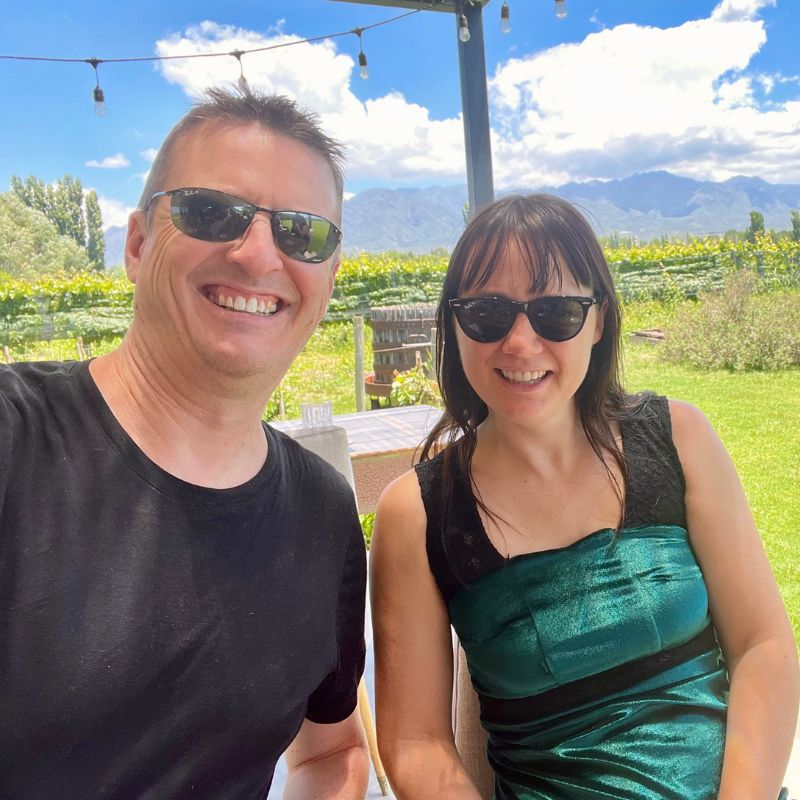
Matt Bowles: I am so excited to have you back on the show. You and I have just spent an amazing week hanging out in Mendoza, Argentina. My first time here and that’s where we are recording this in person together. Can you share a little bit about what this week has been like?
Becky Gillespie: Well, first of all, like, I’m so glad we’ve been able to record this in person because the first time I was on here, it was early on in the pandemic and we were doing it remotely and so it’s so great to sit across from you and do this in Mendoza, which we’re in Argentina in the first place because we came for the Nomad conference and that was now a few weeks ago. And you and I decided with a lot of other people that we’re going to be here about another month. And so, we said we should leave Buenos Aires and go somewhere else. And Mendoza is a two-hour flight away and it is wine country here.
So, we met someone in the group shout out to Chris, and she booked all these wineries. There’s eight of us that are doing this together this week. And we have just been going to winery after winery. We were just at another epic winery earlier today. But it’s incredible. The weather’s incredible. It’s the perfect temperature, perfect time to be here in December. And it’s very cheap right now if you bring dollars into Argentina.
Matt Bowles: Yeah. The Mendoza wine region has been incredible. It is my first time here. I have been to Buenos Aires a couple times before, but I never made it out to Mendoza. So, I was so excited to come and I knew that you were going to be here in Buenos and some other people were, and we just put a really cool crew together and we just been walking through wine vineyards and drinking wine for a number of consecutive days now.
Becky Gillespie: Yeah. And this is my second time here, but the first time I didn’t have nearly as much money or the sense of abundance of money, let’s say. So, I was here two nights in a hostel and I went to one wine tour. And so, this is so different. And I’m here with friends and we’re not on a tour. It’s a very intimate experience. I really love it. I can’t wait to come back.
Matt Bowles: Yeah, it’s awesome. You’ve actually spent more time in Argentina than I have. And I would love for you to share a little bit about your experiences in Argentina prior to this and then what it was like to come back to Buenos Aires this time for the conference.
Becky Gillespie: Yeah. So, I first came in 2008 and I came for a month to do a program to learn how to teach English to speakers of English as a second language to adults. And it was a certificate course. And on that course, I was in a group of 10 other people. And so, I had immediate friends, which I think changed my whole experience of Argentina. I also left Ohio in January to come down to Buenos Aires to take that course. And it was beautiful. It was summer. And I think from that day on I said, if I ever come back here, I’m always going to come in the summer. And it was funny because you told me you’ve never come here in the summer and it’s a whole different experience. And this is now my fifth time. Every time I’ve come back to Argentina, I always come in the summer and I always come for at least a month because it’s so far away from everything and, and it’s such a big country that you need time. And I really love exploring the country. But I could also spend months in Buenos Aires without leaving. There’s so much to do there.
Matt Bowles: Yeah, it’s a really special city. It was actually the city where I started my nomad journey all the way back in 2013, the first place I went. And as you said, I went there right in the middle of the wintertime. Now, it’s not a very severe winter here. It doesn’t usually even snow or get quite that cold. But I have never been here in the summer until this particular trip. Now, I will say one of the advantages of coming into winter, which I did in 2017, is you can go skiing in the Andes, which is the best skiing in South America, is right here in Argentina. We went out to Bariloche and skied in the lake’s region of Argentina in the Andes Mountains. And it was just spectacular views, just amazing. But you’ve been down to Patagonia as well, right? What was your experience there like?
Becky Gillespie: So, I haven’t been to see the penguins. I haven’t been to Ushuaia, which is like the furthest south you can go before you get on a boat to Antarctica. But I have taken a flight from Buenos Aires to El Calafate, which is a glacier town. And you get there, you do a glacier tour, you put on crampons, you walk on the glacier even in the summer. And a three-hour bus ride from there is one of my favorite towns in Argentina. It’s called El Chaltén. And that is basically a base station camp, a base town to take all these day trips out to climb these spectacular mountains. And so again, it’s a beautiful place to go in the summer.
Matt Bowles: That’s so awesome. You’ve had so many amazing travel experiences. This time when we were in Buenos Aires, I remember we were out eating dinner one night. We’re at Don Julio, which is one of the best, if not the number one rated restaurant in the country of Argentina. It’s this incredible Parisha, which is a steakhouse with an insane wine list, an insane, insane wine cellar that we got a tour of, which was incredible. And then we’re just out there and we had some really cool folks with us and we’re just having this incredible dinner outdoors and we’re just talking about travel experiences.
And all of a sudden, as well as I think I know you, you just come up with all of these travel experiences that I never even knew that you had. And of course, you’ve been to 70 countries, so I’m sure you’ve had a lot that I haven’t known about. But I wanted to ask you about a couple of them because you’ve really gone to some very interesting places and sought out some very interesting experiences. Can you talk about your time in Colombia where you went to Ciudad Perdita and talk a little bit about what that is, first of all for people that have never heard of it and then how that experience was for you?
Becky Gillespie: Sure. So, I was traveling at the time with a friend who really loves to go hiking, as I do, and she shout out to my friend Anna, she had been interested in this first. I looked into it and I realized if you fly to the city of Santa Marta from Bogota, you can reach this place called Ciudad Perdida, which means lost city in Spanish. And it’s actually older than Machu Picchu. It was a four-day tour. And when I was on that trek, they said, you know, this used to be like a two-week tour. It was so dense in the jungle and there was like nowhere really to stop and nothing was set up. So, a lot of like river crossings. So, you had to take a lot more time. But now they’ve got it back like down into four days if you want. And it’s just eventually you reach a lot of stairs at the end, like stone stairs leading up to these different platforms where this ancient civilization was. And you can actually see the sea from that civilization. And it was just incredible.
Matt Bowles: That’s amazing. I feel like there’s so many things in Colombia. As much as I love Colombia and as much time as I’ve spent there, I’ve been their multiple times, there’s so much more. And I keep learning about all of these incredible things there is to do. I mean, definitely one of my favorite countries in South America, another country that I have been to multiple times, and yet I haven’t done. All the stuff that you have is Nicaragua in Central America. And I’m wondering if you can talk a little bit about your experience in Nicaragua. I would love to hear both about your experience of volcano boarding and also about your experience going out to Ometepe island and what that was all about.
Becky Gillespie: Sure. So, I went to Nicaragua also with my friend Anna on a different trip. By the way, that this is like a cheat sheet for life here. Find a friend that’s really adventurous who can frequently go on trips with you if you share the same interests. We went there around Christmas time and we had these ideas. I told her I wanted to go to Ometepe island, which I’d read about in a travel blog. And first we went to, well, I think I was in Leon, Nicaragua, on my own, and then we met later. But you can do volcano boarding in this city outside of the city called Leon. It’s a one-day thing. You get in a mini bus with a bunch of people on a tour and they take you out and you end up volcano boarding. You just go down once. It takes probably about 10 or 15 minutes to get to the bottom of this volcano, but the scenery around you is incredible.
Matt Bowles: So, you, I know, Becky, are a snowboarder and you have snowboarded all around the world in Japan and all these other epic mountains. And you’ve also been sandboarding. You and I have both been sandboarding and did massive desert dunes. So, since you were an experienced snowboarder, when you went volcano boarding, did you have that option to do like the snowboard style where you’re standing up and boarding down through the volcan ash? Or was it one of those more where you’re like sitting down on like a toboggan style thing?
Becky Gillespie: This was more sitting down. I mean, if you want to get excited and try that position for a little while, you can, but really you should sit down for that, which is different from sandboarding. But it was cool in a way. You know, you’re closer to the ground when you’re sitting down doing it. So, you felt like almost like you’re more part of the volcano and like, oh, what’s behind me kind of thing. Less control, but more control at the same time.
Matt Bowles: Right?
Becky Gillespie: But yeah, it’s really cool. I’d recommend it to anybody. It’s such a unique thing to do.
Matt Bowles: That’s awesome. And then tell me about Ometepe Island. What is that and how was it?
Becky Gillespie: Talk about really unique places in the world. It’s. So, did you know everyone? There’s an island in the middle of a lake in the middle of the country of Nicaragua. This is actually the biggest island in the world in a lake. And also, they have two volcanoes each on one end of the island. One of the volcanoes is active and the other one is dormant. And you can hike. Both of them actually but the one that is dormant has a crater lake. It has a crater on the top and a lake there. So, you can actually be in a lake on an island that’s in a lake in a country. It’s very interesting. But I had found a hostel that was started by two Italian brothers on this island of Ometepe. And to get there, it’s crazy. You have to, like, take what we call a chicken bus. It was a very rustic bus to a port at the lake.
And then you have to take this fast boat and a slow boat, and you take this boat out to the island. And I love those things that are a journey like that to get there, because it’s like, this is worth it. And I went there. There’s a lot of wellness resorts, eco resorts, there’s yoga retreats. And I stayed at this hostel, which is crazy. Like, I recommend it. It was called El Zopilote, which I think means the vulture. But it was a series of different types of accommodation on this really big property. The first one being an old school bus at the front of the property that was. Had been converted into a store selling lots of different trinkets and snacks and things like that.
And there was the first thing I was asked when I entered this space, one guy asked me, what’s your sign and what’s your rising moon? And if that gives you an idea of where you’ve ended up here on this property. But they do, because it’s started by Italian brothers. They have a big pizza oven on the property, and I think twice a week they cook pizza in these ovens for everybody there. And people were getting out the poi. There were like, fire dancers. You’re eating pizza in the middle of an island, in the middle of a lake, in the middle of a country called Nicaragua. And that’s just a taste of Ometepe Island.
Matt Bowles: That’s amazing. Well, one of the other places that you and I both share a love for is India. We actually had Indian food last night together here in Argentina, and we’re reminiscing about some of our experiences in India. Can you share a little bit about the Rickshaw Challenge that you did in India, what that was all about and how that experience was?
Becky Gillespie: Yeah, so that was me. Actually, my third time to India, and it was the first time I’d been to the southern part of the country, like the Deep South, as they would call it. It was around Christmas time, and I flew into Chennai, which I believe is the third largest city in India. And I got there and was meant to meet two guys I’d never met before who were going to be my teammates in the Rickshaw Challenge. And we were going to spend 10 days together going 1000km in a motorized Rickshaw. And we were going to do a series of challenges every day and finally reach the city of Trivandrum at the end, which is in the state of Kerala. And we were meant to fly out from there. I mean, that’s the only time I have done a Rickshaw challenge. It turned out that one of those guys ghosted us and he never showed up. So, it was me and a 52-year-old Australian bricklayer from the bush that I’d never met before. Him and I shared this 10-day journey. There were many other people that we’d see every day on the challenge. There were, I think, 32 Rickshaws in the group. But yeah, I did it with someone I’d never met before. It was pretty interesting.
Matt Bowles: That’s so amazing. India is such an incredibly special place. I’ve been twice and I feel like it’s such an enormous country and it’s so diverse depending on what state in India you’re going to, right. Different languages, different styles of food, all sorts of different cultural dynamics. You know, as you go across India, I feel like I need to keep going back because each time I go to India, I go to a different part. And when you go to Kerala, that’s unbelievably different than when you go to Delhi or Mumbai, which is unbelievably different than when you go to Amritsar in Punjab in the north, which was absolutely incredible and totally different from all these other places in India. So, I’m so excited to go back and see more of it.
Becky Gillespie: And I would encourage people either go and meet a friend there, meet locals, like do something like the Rickshaw challenge. So, you can really go deep into the country and meet locals in a very unexpected scenario, because that’s how you really would get in touch with this country to go with, like on an organized tour with fellow travelers. You’re not going to get as much of a taste. This is one of those countries that requires something like that if you can arrange it.
Matt Bowles: And you would be amazed with how kind and sweet and thoughtful the people of India are. When I was there, Becky, in Amritsar and Punjab for Diwali, I didn’t know anyone there locally. And my Airbnb host said, oh, you know, you’ll be here over Diwali, you know, fantastic. Do you have friends and family here that you’re spending Diwali with. And we speak, we said, no. He said, oh, well, then you’ll be coming to my house to spend Diwali with my family. And I was like, what? Really? He’s like, absolutely. So, he picks us up and takes us to his house for Diwali, and it’s just us and his extended family. So, it’s him and his kids and his mother and all this stuff. And we went through all the whole sort of traditional thing, the prayers part of it, the massive feast part of it, and then up to the rooftop to light off fireworks and light up the whole neighborhood part of it. And we just became part of their family. They said, you don’t have family here. Well, now you do. You’re part of our family for Diwali. You’ll be at our house celebrating with us. It was one of the most heartwarming travel experiences I think I’ve ever had.
Becky Gillespie: Yeah. I feel like in India, it’s all about the family. And really, doors aren’t even closed very much in the villages. Everybody just visits everybody else, and that’s exactly how they’ll treat you as well.
Matt Bowles: Yeah. Just amazing to go there. Now, you have been to some other places in South Asia that I have, been, that I want to ask you about. Because Bhutan is a place that has been very high on my list for quite some time. You have been to Bhutan? Can you talk a little bit about, first of all, for people that really are not familiar with Bhutan, where it is, what it’s all about, you know, the context in which you went there and then what your experience was like.
Becky Gillespie: Yeah. So, Bhutan is a kingdom. It’s a tiny mountain kingdom that’s nestled between the giants of India and China. But it’s actually never been conquered before, for it’s always maintained its independence somehow. I think being in a mountain less location, of course, helped it. Well, they’ve recently maintained quite a strict tourism policy. They charge each tourist, like, a relatively sizable daily fee to make any tour you would book there. Be quite expensive compared to other places you’re going. I think Indians can go without a visa, but a lot in a few other neighboring countries. I don’t know exactly the. The rules on that, but if we try to go, we can’t go on our own to Bhutan.
You have to book an organized tour, and through those tour companies that have been registered with the country, you will get a group visa. You won’t have to do anything ahead of time. You will just arrive and they’ll take care of that visa. As you’re going through the airport, I will say landing in Thimphu, the capital of Bhutan, is one of those landings that’s exciting because you’re landing between all these mountains and it’s just beautiful. And your kind of. It’s such a small airport. You get out and you can already see pictures of the king everywhere. And the king is pretty attractive, but he’s got a young wife, he’s a young monarch. His dad was a very popular king, and he’s the one who came up with this concept of Gross National Happiness, which Bhutan became very famous for.
And he also wanted to write the constitution for the country and really give a lot of rights to the people, despite being the king. So, it’s a pretty peaceful country at this point. And it has some of my favorite food in the world, which I was introduced to in Tokyo, because Tokyo, I found a Bhutanese restaurant there. Very spicy food, a lot of peppers, cheese and potatoes and this really nice red rice. But I love spicy food, so I recommend if you can find a Bhutanese restaurant in your town. If you’re listening to this, try it out. It’s really good.
Matt Bowles: You and I both, Becky, we’re at that Indian restaurant last night asking them about the spice continuum and how you and I could max out the level of spice that they offered at that particular Indian restaurant. Because in Argentina, the food is not spicy at all. So, you really have to negotiate, even at an Indian restaurant, to get the spice level up. So that’s amazing. What were some of the highlights in Bhutan, though? If someone was to go there when, what types of things would they see? What were the standout experiences for you?
Becky Gillespie: The number one attraction is the Tiger’s Nest Monastery, as it’s known. And it’s that famous picture you’ll see if you start Googling amazing places of the world. It’s like a monastery hanging off the side of a cliff. And you can do the trek there. It’s not very long. It’s like an hour up a very nicely paved trail to the monastery. You cannot go into all sections of it, but you can go inside along, like, an outer section of it, if you’re not a monk there. But it was really great. You also feel the spiritual vibes in the air and, as I said, the food. But also, I was not ready for some of these gorgeous monasteries they have all around the country. And I went in May, early May, and there’s beautiful purple. I think they’re jacaranda, like these beautiful purple trees everywhere. Actually, about 70% of the population still wears the national dress. And so, it’s interesting to see, like, most people wearing traditional clothes, but you can immerse yourself there.
Matt Bowles: That’s so awesome. Well, because I have traveled with you now multiple times on different continents, I know that one of the things that you travel with is a ukulele, and you sing and you play the ukulele. And last time we were doing this interview remotely. This time we are in person and you are traveling with your ukulele. And I was wondering if you would be willing to perform a song live on The Maverick Show.
Becky Gillespie: Sure. Well, I am a big fan of Adele, and Adele just released her first album in six years. And so, I can play you a couple of verses from one of her songs, which is called I Drink Wine, which I think is very fitting for
Matt Bowles: where we are very apropos to play in Mendoza. That would be amazing.
Becky Gillespie: How can one become surrounded by choices that somebody else makes? How can we both become a version of a person we don’t even like? We’re in love with the world, but the world just wants to bring us down by putting ideals in our heads to corrupt us somehow. When I was a child, every single thing could blow my mind? Soaking it all up for fun. But now I only soak up wine. They say to play hard, you work hard, find balance in the sacrifice. Yet I don’t know anybody truly satisfied. We better believe I’m trying to keep climbing? But the higher we climb it feels like we’re both none the wiser. So, I hope I learn to get on over myself? Stop trying to be somebody else. So, we can love each other for free. Everybody wants something, you just want me, me? Why am I obsessing about the things that I can’t control? Why am I seeking approval from people I don’t even know? In these crazy times I hope to find something I can clean on to? Cause I need some substance in my life, something real, something that feels true. You better believe for you I’ve cried hide eyes cause I want you so bad? But you can’t fight fire with fire. So, I hope I learn to get over myself. Stop trying to be somebody else so we can love each other for free. Everybody wants to something from me. You just want me. Listen I know how low I can go I give as good as I can. You get the brunt of it all? Cause you’re all I’ve got left. Oh, I hope and time we both will find peace of mind. Sometimes the road best traveled is the road best left behind. Oh, So I hope I learn to get over myself. Stop trying to be somebody else. Oh, I just want to love you love you for free and everybody wants something from me. You just want me.
Matt Bowles: That was so amazing, Becky. Thank you for playing that.
Becky Gillespie: Thank you for listening. And I love bringing the ukulele around. It’s such a great way to connect with travelers and locals everywhere you go.
Matt Bowles: Totally incredible. Yet I was trying to think the last time you and I saw each other in person before this, we were in Dubai, and we were sandboarding in the desert and doing all this stuff. It was pre Covid. We had no idea what was coming in the pandemic. And then we haven’t seen each other for the whole pandemic. And as you. You said, we did our last interview remotely. You were in Tokyo, I was in the U.S. and I was so excited that you were going to be here in Buenos Aires, keynoting the same conference that I was coming down here to keynote and your presentation. I would love to go into a little bit of the content there. I was so impressed. I was captivated the entire time by it. And I thought that my podcast audience could really get some value from your presentation.
So, I would love to talk to you a little bit about that now. Your presentation was basically about cryptocurrency being for everybody and sort of a crypto 101, how to start, how to get involved with crypto. And it was a really accessible presentation, especially for people that are not already investing in cryptocurrency. And so, can you talk a little bit about crypto now and maybe just start off the very basics, what is cryptocurrency? And why is it significant and important, and why are you so passionate about it?
Becky Gillespie: Yeah, so cryptocurrency is really a digital form of money. And as I said in the presentation, money is just the value. Like, we give something value because we agree that it has value. So right now, we’re agreeing that banknotes have value, although, as we know, here in Argentina, they don’t have a lot of value. And the value for these banknotes is changing all the time. And so, yeah, cryptocurrency, I believe, is just the next innovation of money. And it really has in the last, especially two years, let’s say it’s really starting to catch on with big institutions, and it’s being adopted for real now.
And I think that was one reason I wanted to give the presentation, is because there was a lot of fear about this digital form of money being something that could just disappear like that if it wasn’t tangible, if you couldn’t touch it, it wasn’t going to really exist. And, oh, maybe you could get hacked or you could lose it somehow. But it’s the same if you think about it as giving your money to an actual bank. Because once you digitally send your money from your bank, who’s ever paid you for, your employer sends you money now into your bank digitally, and then you’re moving into a bank account. I mean, you got to trust that bank that they’re going to take care of your money. And once you give them money, they’re not going to keep that money in their vault. It’s not really there. They’ve done something else with it and it’s.
So, I don’t see what the big difference is there. You just have to decide that you’re going to be in control now of your money. You become the vault, if you choose to do so. You have to learn how to securely store your own money in what is called a wallet. Or there are exchanges, there are centralized exchanges where you can buy cryptocurrency, and that is kind of like an online bank. And you can let them store your money as well, just as you might do with a traditional bank.
Matt Bowles: So, let’s talk about the first steps here. For people to get involved in cryptocurrency, let’s say they want to put a toe in the water, maybe put a little bit of money into crypto, buy a little bit, try it out, at least experiment with it a little bit. What are the first steps? How do you access cryptocurrency? How do you buy it? How do you store it? If somebody’s listening to this and say, I’d like to start investing in crypto, I’m not really sure what the first steps are. What do you recommend?
Becky Gillespie: There are two exchanges that I would recommend starting with the first one being crypto.com, because it’s accessible to people from all countries. There’s not a lot of restrictions there. And also coinbase.com. Coinbase is one of the biggest and older exchanges in the space. And basically, you just need to put in your ID details with these exchanges. You need to have a phone like that you can get an SMS text message to when you first sign up, so they know it’s you. And you can prove that you own this account through that SMS that they’re checking you for. And you need to hook up either your credit card, debit card or a bank account.
So, you are going to use your, what we call fiat money or your traditional Money from, issued by a government. You’re going to hook that account up to this new account you’re making at Coinbase or crypto.com and then basically you just make sure your bank accounts hooked up and you transfer an amount of fiat money into this crypto account. And then you choose, you click down which coin you want to buy with that amount of money that you’ve, that you’ve put in. That’s it, right?
Matt Bowles: Okay, great. So, we’re going to link up those two that you recommended. We’re going to put those URLs in the show notes so folks can just go and click on them right there. You set up an account, they verify, you go through the security process, all that kind of stuff. It’s a secure account. Then you just hook up your bank account, you transfer in however much money you want. So, if you have a US bank account, you just connect that and then you transfer your U.S. dollars into, into this crypto account and then that allows you to start buying cryptocurrencies.
Becky Gillespie: And one thing you will do, and this is for people that are just starting out, because there’s a whole other issue of how much information do you want to give the exchanges or not? But if you get verified on this exchange, you will offer your ID document, usually your passport or a driver’s license. And as you’re signing up with this, let’s say it’s Coinbase, they will ask you to use your webcam to take the picture of the passport. You got to wait a little While. Could be 4 hours, could be right away, it could be the next day. Then they’re going to check that passport, make sure they can see the information. Then they will say, okay, you’re verified. Usually, you need to do that before they’ll let you play with a bank account. But a lot of these exchanges will let you use a credit card or a debit card, like right away. And again, they’re going to send you an SMS text message at first to link your mobile device with your account. And that’s going to give you like a six-digit key that you’re always going to use when you’re logging in to send money to just again, make sure that a hacker or somebody else can’t get into your account and send your money.
Matt Bowles: Right. And people are familiar with two factor authentication and how that works these days for a lot of different things. And so, once you establish the secure verified account and you transfer your money into it, can you talk then a little bit about investment strategy? And how do you actually make money in crypto? Because you have made a good amount of profit in crypto. A number of my friends have as well. How are they doing this? What is the concept? How do you make money in crypto as an asset class?
Becky Gillespie: So, it is a bunch of speculation right now. I was telling you yesterday that investing in the different cryptocurrencies, most of these coins are like startups. They’re all different startup companies that you’re putting your money into. And a lot of these companies, they don’t have a long track record yet. They have news coming out about what they are working on. And that’s where the price of the coin can increase or it could be a decrease if it’s a long time, if there hasn’t been any new news, that’s really what these prices are moving for except bitcoin is the move the like, it’s the music of the market. If bitcoin, if that music stops and it starts to go down, then the rest of the market often will go down with it. So, I would always tell people, start with Bitcoin, buy some bitcoin. It is a store of value. Most people consider it as the gold. Keep it, it’s going to keep its value and likely go up over time because it’s a scarce asset. There are only 21 million bitcoins that will ever be created. And because of that, we think supply and demand, that the price will go up over time.
Matt Bowles: And then in addition to bitcoin, the other cryptocurrencies that you can buy, there is a whole giant range of those, right? Some of which would be considered more, you know, for it to use stock market terms, blue chip type currencies and others would be more like penny stock type currencies. Is that right?
Becky Gillespie: That’s right. But the history of cryptocurrency, we know there were a number of founders of some of these coins that came after Bitcoin. The second coin that was ever created was Ethereum and it is the number two coin at the moment in market capitalization. And so, I would always tell people, buy some Ethereum if as a blue-chip coin that has the ability for people to write code and do projects on top of the blockchain layer of the coin, which bitcoin cannot do. It’s only a currency serving as like you can buy it and sell it, that’s what it does. But you can actually make projects that can for your listeners that have heard of NFTs, NFTs are mostly using Ethereum to buy and sell them and things like that.
Matt Bowles: Can you talk a little bit? You mentioned the blockchain. Can you give folks a little bit of a sense of how the cryptocurrency world works? What is a blockchain? How does that piece of IT function?
Becky Gillespie: So, the blockchain is like a ledger, a digital ledger of all the buying and selling that ever happens on the network. So, there are a number of different blockchains and they work in different ways, but basically this is a public ledger. So, all of these different computers are verifying transactions, which also means it’s a decentralized network because the computers are all over the world checking and verifying all the transactions that are happening on this public record. And so, it’s that powerful technology of having this public financial record of everything, and the fact that different devices are checking together, that this transaction happened. Once the transaction is in the record, it cannot be deleted. So, you have this level of transparency around the world that we all can see that does not happen with banks in our traditional system.
Matt Bowles: And can you talk a little bit also about the investing opportunities? So, the one component, as you mentioned, is the speculation on the value of the currency you buy going up, right? So that’s a piece of it, right? You buy it, and if it goes up, then there’s a way to make a profit from that. But there are also some other opportunities, right, to do things like earnings, interest and that kind of stuff. Can you talk about those pieces of it?
Becky Gillespie: Sure. So, as I said, there’s a lot of different blockchains and they function in different ways. So, Bitcoin is working on a system, a blockchain system called proof of work, that is basically making a bunch of computers do increasingly difficult mathematical computations to solve these mathematical problems. And they get rewarded with Bitcoin. And that is how all these transactions are verified and continue to be verified on the bitcoin blockchain. But there’s another type that’s called proof of stake. And instead of the mathematical calculations that are required, you have different people put their coins that they buy. So Ethereum, for example, is trying to get to proof of stake but for example, there’s a coin called Solana and they use proof of stake. And if I buy Solana and I put Solana into the system, then that’s helping the network become more secure. And by me giving them my coins in exchange, they’re going to pay me an interest. And that is, it can be a Solana is about 7% a year right now. So, a Lot of coins are moving over to proof of stake, but there are still quite a few proofs of work as well.
Matt Bowles: So, you can earn interest through staking. And then you also talked about earning interest through lending. How does that work?
Becky Gillespie: So those exchanges that I was talking about, and there’s others, there’s Celsius, there’s Nexo, those are some of the ones I use. We can put the links on your website. And these are exchanges that I, I’m going to go on to. I’m going to put my coins; I can see like what interest rates they’re paying on the exchange. If I have that coin, I can put it on the exchange, keep it there, and then I will get in exchange some interest backs in that coin. So again, if Solana was on that exchange, I can put my Solana there. The exchange is going to use that Solana however they want and I will get 7% paid back to me in Solana coin.
Matt Bowles: You mentioned you can also take out a loan against your crypto. How does that work?
Becky Gillespie: Yeah, so actually Nexo and Celsius both do this as well. Instead of selling my coins to get money, I can go to these exchanges and put the crypto I have into that exchange as a collateral. I need like let’s say $10,000 worth of, let’s say it was bitcoin. I can put $10,000 of Bitcoin onto the exchange and in exchange I can get a $5,000 loan. And that means I don’t have to pay taxes because I’m not selling the coin. And I do have to pay an interest rate and that varies. That’s agreed upon at the moment you take the loan just like if you did it with a bank. And it’s really great because it’s instantaneous. At most it might take like three days to get the money. And I don’t need to have a credit score or any kind of credit check that does not factor in. I just need enough collateral for them to give me a loan. And I think that’s really cool because it’s not such a biased world anymore for getting loans right.
Matt Bowles: Now you mentioned NFTs. Can you talk a little bit about what NFTs are for people that are not familiar with them and why really you need to have crypto in order to participate in buying NFTs.
Becky Gillespie: They have really come into popularity since early 2021. Also, a bit in 2020. But man, this has been the year for NFTs to really go big and they’re non fungible. Tokens, and they are a code, basically, that is in the code. It is like, it’s guaranteed that you are officially an owner. You’re basically buying a piece of code. But the code has this image associated with it that is displayed. And you can put these into a digital wallet. You know, some wallets will actually let you see the image, some won’t. But the use cases for these NFTs are just growing and growing every day. A lot of people are making fun of the market because they’re like, you are literally buying a JPEG picture and you are holding it and then you’re selling a JPEG picture. But of course, it has a code connected with this jpeg so you can show people like, no, look, I really own this. It’s in the code. You can see that I bought it at this time, you can see it’s mine now in my wallet. And eventually it’s going to be used to like get you into concerts, get you into events. This technology will be used for owning real estate. I do believe we’re going to have NFTs as the contracts in the future.
Matt Bowles: Right. So, it could be anything ranging from literally just a piece of digital art.
Becky Gillespie: Which is where it started.
Matt Bowles: Which could increase in value the same way that any other regular piece of art in the tangible world increases in value and you sell it for more money, right? Or it could be a digital piece of art that also has all sorts of other type of value layered over it. As you mentioned, this could be a digital admission ticket to an event. This could be some other thing where you exchange this token or you show it, you still own it usually, right? But it has this value where you get this additional thing in the real world for possessing this digital token, right?
Becky Gillespie: Also, music, I mean, the copyright is going to be in that NFT. And now it’s going to be easier for musicians to get their own money from these things and they can code whatever they want. They could say, if you buy my song this NFT, you can like every other song I write in the future, you’re going to make 10% of all the sales I get. Like, there’s so many things you can do with the code, right? That’s making these unique NFTs and you buy them from marketplaces. If you’re wondering where you get them, opensea.io is the biggest one that mostly uses Ethereum as the motive.
Matt Bowles: Right. So, opening your crypto account to start being able to buy and own and control cryptocurrency is step one. And then with your Cryptocurrency, one of the things you can buy with it is these NFTs, right? And then you can start owning NFTs, right? And all this kind of stuff. One of the other questions, though, that I have for you, Becky, is how to buy tangible items in the real world with your cryptocurrency. Can you talk about that?
Becky Gillespie: So, 2020 is when we mostly saw these things starting. Visa has paired up with some of these exchanges and they have made credit cards and debit cards. So, I actually have a debit card with crypto.com and it’s a Visa card as well. So, I use an app, and it has crypto in part of my app and fiat money in part of it. I can use either one. But I can make purchases with my crypto anywhere that Visa is accepted. And I can also, as I pay for purchases, I can get cash back percentages in the native coin of the credit card. So, I have crypto.com. the native token is CRO. CRO, as we call it. I’m getting crowded when I make purchases with that. It’s cool. You can really buy so much now with crypto.
Matt Bowles: That’s so awesome. So why would you say people should definitely at least get a little bit into crypto, open the account, get some crypto, start getting into this world? Why are you so passionate about it? Why is it so important? Why would you encourage other people to at least take a step and dip their toe in.
Becky Gillespie: I am not that young anymore, Matt. I’m 39. For everybody out there, listen, I’m going to turn 40 really soon. So excited. But I am old enough to remember missing out on the early days of the Internet. I was in college when my professor walked in and said, there’s this company called Google. It seems like it’s going to be pretty big. If I had gotten familiar with Google, Google Ads, Google search, if I had bought Google stock shortly thereafter, I would not have to worry about inflation in the U.S. now or much of anything. I think if I would, I’d be familiar and I would be comfortable financially. And that’s all it would have really taken is like, buy Google then.
And then all these other companies came around that were at the beginning of the Internet, not everything made it, but being there at the beginning of something that, you know is going to be a part of everybody’s everyday world. And here we’re talking about the way to use money. Everybody has to use money and spend money all the time. And I can just see it. And now we really could see it in 2020, 2021. The amount of adoption happening from all these big companies around the world. You just know that it’s going to be the future. And it makes sense because it’s the next level of what you can do with money, because you can code it now. You can code money. It’s not just a piece of paper that you hand to the merchant.
Matt Bowles: Let me also talk to you about what you’re doing right now with your residency and your second passport initiative. You are just for people’s context; you are an American citizen by birth. You are still one. And you have lived in Japan for 12 years, which allowed you to get residency.
Becky Gillespie: Permanent residency.
Matt Bowles: Permanent residency, yeah. So, you are a permanent resident of Japan. You are a full citizen of the United States, which is the passport that you currently travel on. But you are now in the process of getting residency and getting a path to citizenship and a second passport in the country of Portugal. Can you talk a little bit about that? I mean, first, your decision to do that, why you’re pursuing a second passport, and then I would love to hear a little bit about why you selected Portugal in particular.
Becky Gillespie: Yeah, so I had the permanent residency in Japan. I had gotten to a point in Japan where I had been there about eight years, and I knew, okay, after 10 years, you can try to apply for this. And I just stayed on. I wanted to see if I could get it, and then I got it, which means I could now work for any company in Japan if I want. I thought, that’s pretty cool. And I could also get a mortgage to buy property in Japan with the Japanese banks. But as I got to a certain age, and I’d been there long enough. One thing I didn’t like is they were not giving affordable health care to people who were freelancers. To get the really good prices for healthcare there, you have to work for an actual company. And I was like, oh, this is. I’m paying as much for healthcare every month as I’m paying for my rent. And do I want to do this all the time, many years down the road?
And so, I started thinking about health care. And I think there’s a lot of countries in Europe that offer very affordable health care for everyone. And so also, Portugal was a lot closer to my family in the U.S. and over time, I wanted to be closer to them. They were getting older, and I didn’t want to take such long flights back. So, Lisbon seemed to be such a great location. And to hear also that it’s often offering freelancer visas to people and especially Americans as well. I thought, okay, I can become a freelancer in Lisbon, and after five years, I can apply for a passport, which I’ve heard takes about another year to get. I’m on a visa that would require me to be there six months a year. So, when it got cold, I decided to come down to Buenos Aires for a couple months, do some traveling for six months. And then now I based in Lisbon, like six months a year.
Matt Bowles: And can you talk about the value of a second passport and to you in particular, motive for getting the second passport?
Becky Gillespie: To get more options for you for where you are, for where you can go, and also what you can get by coming from that country or being based in that country. So, as I just told you, and a lot of people know, it’s very difficult to get affordable health care in the U.S. and the prices are unpredictable. Whereas in Lisbon, as I get older, I think I’m going to have a much more affordable path to getting the health care I need.
Matt Bowles: Right? Yeah. And once you get a passport from Portugal, now all of a sudden, you’re part of the EU. You’re also part of the Schengen region.
Becky Gillespie: There’s a lot of property rights you get once you become an EU citizen. For example, some countries in Europe, I can’t buy land right now, but once I become an EU citizen, I can by land.
Matt Bowles: And when you travel around the world, there’s some countries where it’s more or less advantageous to travel on an American passport. So, if you have a Portuguese passport and you’re able to go in a lot easier than an American in certain places. So, what is the process going to be like? Let’s just say there was somebody that wanted to get a second passport, and Portugal sounded like a compelling place to do it. What is, generally speaking, the process to get one?
Becky Gillespie: Do it from your home country? That’s rule number one. I went to Portugal in 2020 thinking I could do it from there, and that was not the case. I needed to fly back to the U.S. in the middle of a pandemic, basically because it was difficult to get digital fingerprinting in Portugal. So, I went back, and everyone should go to their home country, even if you haven’t been there in a while, but get the documents together as soon as you can. I needed some things notarized. They wanted me to buy the plane ticket and show that I was going from my home country into Portugal. When I first went in on this, what they call the temporary visa, usually it lasts about four months. So, I went back in October 2020. I did the paperwork within three days. It didn’t take long. And then I mailed it off to this company that is called VFS Global. And they have offices in many countries helping people for a few fees. Not too much of a fee, by the way. You send your documents to them; they’re going to check them for you. If you’re missing something, they’ll let you know. And then they mail those documents to the consulate in your country.
And then when the consulate says, okay, we accept, they’ll say, all right, send your passport now to the consulate and they will put the visa in your passport. And then when you’re ready, you can fly into, in this case, Portugal and start the residency on the four-month visa. Eventually you will have a meeting with an immigration official in Portugal. I already knew the date my meeting was going to be before I even went to Portugal. That comes when they accept you. And so, yeah, I had a meeting and one week later they gave me a residence card which is good for two years. I will need to renew it, get another two-year card, and then we’re going to get to that fifth year and I will apply for a passport which is going to require a basic language test, maybe an intermediate language test.
Matt Bowles: Right, okay, cool. And then over the next four years or so, there is a physical presence requirement that you’re in Portugal for six months of the year and then you can travel and nomad around for six months of the year and you just do that for the next four years and you meet the physical presence requirement and then you get to a certain level with the Portuguese language and you pass the required test. There’s a. And then you can be eligible for the Portuguese passport after about a five-year process.
Becky Gillespie: Yes. And right now, there’s another important thing I should mention. Portugal has a 10-year NHR tax program, which is the non-habitual resident tax. So, I’m basically exempt from income tax, most of my income tax for 10 years. It depends on what kind of thing you’re doing there, by the way. Some business cannot be excluded. So, I’m doing something that is considered like a specialist job. I’m a proofreader, which requires some specialist skills. And so that qualifies as being exempt from tax in Portugal for 10 years. But I am going to be paying Social Security tax, which I think is 10% of your income from the second year.
Matt Bowles: Awesome. That is really cool. All right, Becky, at this point, are you ready to wrap this up and move in to The Lightning Round?
Becky Gillespie: Yes.
Matt Bowles: Let’s do it.
Becky Gillespie: Yeah.
Matt Bowles: All right, I have already asked you some Lightning Round questions in the previous episodes. I want to ask you some new ones. You are an English literature major in college. You read a lot of books. I want to ask for your top three recommendations specifically for travel related books.
Becky Gillespie: Yeah, I love. Don’t you love a good travel book? I think that one of my favorites is by Pico Iyer. It’s called The Lady and The Monk and it’s about Pico going to Japan to try to be a monk for a year. But it doesn’t quite go as he expects. It’s a really great book. Another one would be by a man named Terzani is an Italian writer and he wrote a book called A Fortune Teller Told Me so look that up by the title. And that is just fabulously written. Both Pico and Terzani are journalists, so they write very well. And the third book would probably be I don’t know, I’m still a sucker for Eat Pray Love. I loved that book. That really affected me when I read it as a woman reading about a woman going out traveling alone. I really like that book.
Matt Bowles: Awesome. We are going to link all of these up in the show notes, by the way, so folks can just go to one place at themaverickshow.com just go to the show notes for this episode. You’re going to see everything that we’ve talked about and everything that Becky recommends. I also want to ask you this because you are a podcaster and you listen to podcasts as well. What is one of your favorite podcasts that you listen to that you’d recommend people?
Becky Gillespie: Check out The Maverick Show with Matt Bowles.
Matt Bowles: Okay. Other than The Maverick Show and other than the School of Travel which you host, which we’re also going to link up, what is another one that you listen to that you personally really enjoy?
Becky Gillespie: One of my first ones ever was called The American Life with Ira Glass. He’s been doing it for years and years and they curate these different stories based around a theme. So, for example, one was about escape and it was all these different angles on escape and I just love, I never know where the stories are going next or what theme it’s going to happen next week. So, I love that podcast.
Matt Bowles: That’s amazing. We’re going to link that up as well. All right, Becky, what is one travel hack that you use that you could recommend to other people?
Becky Gillespie: So, I love getting lounge access and because I’m American it’s been pretty easy for me to get lounge access, but recently I joined another lounge program through having my crypto.com credit card that I mentioned earlier. And basically, to get this card you need to buy a certain amount of the token which is CRO for crypto.com and that will give you access to lounges all around the world. And it’s great for non-U.S. citizens because they are the ones who really struggle to get lounge access unless they’re like a gold member of an airline.
Matt Bowles: Awesome. Very cool. All right, Becky, I want to ask you how people can find you. Follow you. I definitely want folks to listen to the School of Travels podcast which you host, which I have been on by the way. So, let’s also link up my interview where you are interviewing me on The School of Travels podcast. We’re going to put that episode in the show notes. But in general, how can folks find your podcast to listen to? Because it’s awesome and how can they find you on social media and how do you want them to come into your world?
Becky Gillespie: Sure. So, you can go to the School of Travels. Also, I have two different Instagram accounts at theschooloftravels or tokyobecky. That is what I update more often, but I think both of them. Yeah, connect with me on there. Easy to find me.
Matt Bowles: Awesome. It’ll all be linked up in one place. Just go to themaverickshow.com and go to the show notes for this episode and there you will find links to everything we talked about. Becky, this was amazing. Thank you so much for coming back on the show.
Becky Gillespie: Thanks for having me Matt. So cool to be here with you in person.
Matt Bowles: All right, good night, everybody.