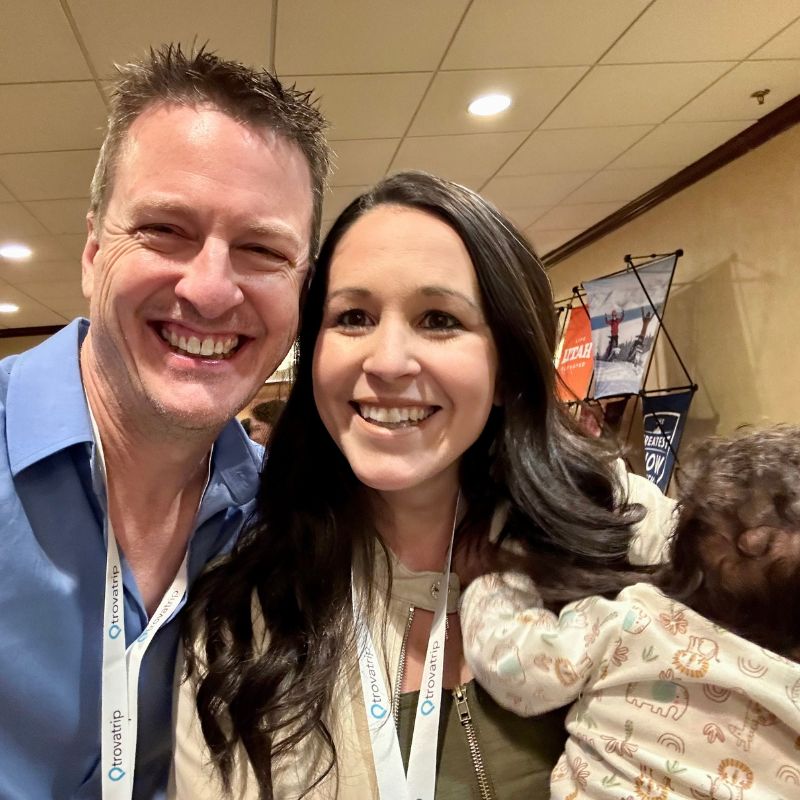
Matt Bowles: My guest today is Beth Santos. She is the founder and CEO of Wanderful, a global lifestyle brand and inclusive community of thousands of travelers and travel content creators. Wanderful reaches over 45,000 women each year through a thriving online membership network, local chapter events in 50 cities, global summits, and small group trips.
In 2014, Wanderful launched the Women in Travel Summit, a leading event for women and gender diverse travel creators to use their voices to champion change in the travel industry. Wanderful is also the creator of the Moving Forward: An Anti-Racism Town Hall for the Travel Industry as well as the first anti oppression toolkit for travel and culture creators. Wanderful is also the creator of the annual Bessie Awards to honor women of impact in travel and the creator of Wanderfest, the first major outdoor festival for women travelers.
Beth was named one of the 17 change makers shaping the future of the travel industry by Business Insider. And she was recognized as one of the top 100 travel bloggers in the USA by the Obama administration. And when she’s not traveling, she maintains a home base in Boston with her husband and two daughters.
Beth, welcome to the show.
Beth Santos: Oh my gosh. Thank you for having me, Matt. And can you from now on do that every time I wake up in the morning? Because I just feel like so pumped up right now.
Matt Bowles: Well, you deserve to feel pumped up because you are doing absolutely amazing things that I’m so excited to dive into. But let’s just set the scene and talk about where we are and the fact that we have agreed to make this a wine induced interview in the middle of the afternoon, mind you, not even the evening. So, props to us for that. I am actually based in the Blue Ridge Mountains of Asheville, North Carolina, today, and I have opened a bottle of Cabernet Sauvignon from Chile that I will be drinking through during this episode. But where are today and what are you drinking, Beth?
Beth Santos: Oh, my God. I am in Boston in the city of Boston, Massachusetts. I am much less fancy than you, Matt. I am drinking a rose’ that comes out of a can. Yes. Down East Cider, which is a Boston local company, they got canned. They made canned wine. It didn’t work because everyone got way too drunk on it, and so they just gave it away to a bunch of people they knew who planned events. And so, I have, like pallets of this canned rose, and I am just enjoying it myself today.
Matt Bowles: That is amazing. Well, I know you refrigerated it in advance of this interview, so I appreciate you preparing to come prepared to The Maverick Show interview for this climate and environment. And hopefully this will improve your podcast experience.
Beth Santos: I hope so, too.
Matt Bowles: That’s amazing. Well, Beth, I want to start off just by saying how impressed and inspired that I am by the extent to which you and Wanderful have chosen to permanently center intersectional anti-oppression politics in your travel content and your community building. And I think it’s just so important, and I think you are such a standout in the industry for that. So, I just want to open this up by appreciating you for that.
Beth Santos: Oh, thank you, Matt. No, I appreciate that.
Matt Bowles: So, I’m curious about your background. I mean, a little bit about your backstory. And as you share a little bit, if you could, about where you grew up and all of that, I am curious, how did your social and political consciousness develop? What were sort of the origins of that, when you think back?
Beth Santos: Yeah, that is a great question to kick off. And I’ll tell you a little bit about the origin story for me, which is also kind of coinciding with the origin story of Wanderful. I am Portuguese American. My father’s family is from Portugal. My mother is a whole mix of different things, kind of typical American story. And I grew up in New England, went to Wellesley College and studied art history, graduated in 2008, which was a terrible time to graduate. And on top of that, a terrible time to graduate with an art history degree because nobody was hiring. And if you wanted to be a museum curator, that’s about all you could do with an art history degree.
And so, what did I do with that? I had studied abroad in Portugal to reconnect with my roots. I had an amazing year where I came out of it just really fluent and ended up moving to D.C. after college and working for the embassy of Portugal. And that’s when I started to get really involved in not just international relations, but diplomacy and then eventually international development. And I think that’s where I really found my niche for a long time, which was not just traveling. I don’t even think travel was a thing I thought about so much. I was traveling to do certain things and I loved going to places and being very active there. And so, I think that was kind of the beginning of where it all started.
I mean, it was living in D.C. I know you’ve done time in D.C. I say done time because it’s literally like we do time in D.C. and was super involved in like the incredible cultural undertones of D.C. the thing that makes that city different from other cities in the U.S. is that people are so temporary there. And because we’re all so temporarily there, we’re all really like freshly from the places that we came from. So, we all like really embody the places that we’re from when we’re all together in D.C. and because of that, it had this really cool, like, very vibrant, like West African hip-hop scene and it had like this really cool Latino culture and it had a little bit of Portuguese culture. And it was just a really neat way to feel like I was living in the world.
And I started to do a lot of work in the international development space. And because of my Portuguese, which a lot of people don’t know is actually still spoken in five African countries, one of them, a small country called São Tomé and Príncipe, is also where I ended up living on and off for two years. I met a friend of a friend at a picnic in D.C., and he used to be the head of the Peace Corps in São Tomé. Like, this is how this stuff just happens. He was like, “You’re Portuguese American, you speak Portuguese. I live in a Portuguese-speaking country. If you’re ever looking for something to do, I have an extra spare bedroom and can give you three meals a day if you want to work for my nonprofit.”
And I, at 22 years old, was like, “That sounds like a good idea,” and just got up and moved to São Tomé, a country of 160,000 people, a two-island nation in the Gulf of Guinea off the west coast of Africa. And I think that was really the beginning of being so hyper immersed in the world.
And, you know, is that really where this social consciousness that you, that you say is starting? I don’t know, I think it’s kind of over time that that really evolved. And I also have to say that it’s not just me, but an incredible, Wanderful team. Our team is based in a lot of people with big social justice backgrounds who have taught me a lot. And when it has come to speaking up about politics, speaking up about what the travel industry should be doing, I’ve learned a lot from them. And it’s really steered the direction of what Wanderful is.
So, there’s like a whole bunch that I’ll throw at you right there. But it wasn’t a one-time thing and it wasn’t a. I’ve always been this way my whole life. It’s been in my travels that I’ve built this awareness and in bringing in other people’s voices to help really guide that direction.
Matt Bowles: That’s so amazing. And I relate to so much of what you’ve said in terms of my own journey. One of the things that I want to start with is your study abroad experience because you’re a Portuguese American, I’m Irish American and we both made the decision to go back to those countries to study abroad. I went to Dublin, I lived there for a year. I studied at Trinity College. You went to Portugal. And I’m curious if you can share how that experience was for you in, you know, at that age, at that time. And what was that like?
Beth Santos: Oh, it changed everything for me. I mean, it completely redirected my whole life course. And I mean that, like, I am not exaggerating in any way. When I was growing up, I actually had very little interest in my identity as a Portuguese American. I thought Portuguese people were weird and the food was kind of smelly, and I thought it was strange that they sat down under vines all day and just enjoyed the day. You know, just things that are like the typical kind of Portuguese immigrant story. But then something changed for me in high school, and I was very curious about it.
And my father actually has a very typical story of Portuguese Americans in the 50s. He was actually born in the U.S. to a family of recent Portuguese immigrants, his sister included. And in an effort to assimilate, even though his first language was Portuguese, they really tried not to speak it to him very much. So, they spoke it to each other. And it was his first language in terms of comprehension, but he had a hard time speaking it back.
And my whole upbringing, honestly, I thought my dad just chose to not show this side to me. I thought he was just… I was like, “Hey, Dad, teach me Portuguese.” And he said, “No.” And I’d be like, “Why?” And I didn’t realize that actually he couldn’t. And so, it was later in high school and then in college that I sort of thought to myself, if I want to understand this part of my background, I have to go there myself.
And I ended up… I found the one study abroad program in Portugal, which was at the University of Wisconsin at Madison. Way to go, University of Wisconsin. It was the only program that was going to Portugal during the academic year. It went to the University of Coimbra, which is a beautiful university town that actually used to be the palace of the king. So, where you’re taking classes is where the king used to walk around in his palace, and now you’re taking classes there.
And I was supposed to stay for six months, and I stayed for a year. And in my first few months there, I actually stayed with family, family that I had met once before but never understood them. At the beginning of my study abroad experience, I did not speak any Portuguese. They did not speak any English. And it was like this really weird, crazy period of time, right, of just adjusting.
And I think, as somebody… And this might have been how you felt, too, studying abroad in Ireland, but I felt a lot of pressure to really know that part of myself. Like, it was this… If I had been catching up with 20 years of information that I hadn’t received, and I really wanted to digest as much as I could—the language and the culture and the geography and the history and everything. And I put a lot on myself to do that.
But it was like I just connected with this part of me that I didn’t even know existed. And after that, I truly say it set a different course for my entire life because that became a huge part of my identity and still is today.
Matt Bowles: And how did that impact the rest of your life? So, what from that experience and that evolution of your identity, how did that impact you moving forward?
Beth Santos: Yeah, well, first of all, it opened up travel for me. I mean, that was really my first time traveling alone. And I think it gave me that… when you have that first really meaningful trip, especially by yourself, you feel like a citizen of the world. You feel like a real representative of the globe. And that’s how I felt. I felt so much more of that citizen of the world mentality than I ever had. And I really loved it.
And I think the other thing, too, is that I had taken Spanish in high school, but I think it’s a whole other thing to speak the language of your ancestors in a lot of ways. And when I came back home from Portugal, I got very involved in the Portuguese and Portuguese American culture. I mentioned I worked at the embassy of Portugal. I also took a job at Voice of America, which is a huge international broadcaster. I had a show in Portuguese to the Portuguese-speaking countries of Africa that I ran in my early 20s.
And it was those things… It was through that experience in Portugal and through the language I had acquired that I then took this very international direction with my life and started to connect with people on a different level. And I think from then it was, you know, it’s always kind of starting with language and starting with my language ability, and then into, you know, job opportunities, travel opportunities, and just ways that I see myself that I never would have had otherwise.
Matt Bowles: And did you connect with Brazil as well?
Beth Santos: I did. So actually, after DC, I lived in North Carolina for a little while. Then I moved to Chicago, where I worked for Rotary International. And I was a grant officer. I was what I like to call a venture capitalist for the non-profit world, which is what a grant officer is. And I basically worked in Latin America and the Caribbean, primarily Brazil. And so, I worked with Rotary clubs all around Brazil. I traveled there regularly to evaluate their service projects for sustainability, for local impact. And Portugal Portuguese and Brazilian-Portuguese are very different in pronunciation.
Matt Bowles: Yes, they are.
Beth Santos: I like to compare this to if Brazilian Portuguese were American English. Portugal-Portuguese is. And this is where most people try to fill in and say, it’s like British English. And I said, no, no, it’s like deep Scottish. It’s like when an American hears somebody from Scotland speaking, we’re like, what the fuck are they saying? But when a Scottish person hears an American, they understand us perfectly. Because there’s American movies and TV shows, and that’s kind of how it is with Portugal Portuguese and Brazilian Portuguese. So, I would go to Brazil, speak my Portugal Portuguese. Everyone thought I was from Portugal because that accent is just so thick. But I had a great time. Yeah, and I spent a lot of time going down there and doing it. And I think that was where my kind of international development art history, to international relations, to diplomacy, to international development, to starting an international company kind of took its course.
Matt Bowles: That’s amazing. So, did you work on speaking with the Brazilian accent when you were in Brazil, or did you just resign yourself to the Portuguese accent? You’re like, I’m from Portugal. This is me. I’m going to do my thing.
Beth Santos: It’s funny because I think accents are so funny because it’s like, if you, as an American, traveled to London. You hear other people speaking to you with a British accent. Maybe you want to reply with a British accent, but it would just sound like you’re mocking them if you did, you know? And it kind of felt the same way in Brazil, where I was so ingrained with my Portugal-Portuguese that even though I’m actually an American… Actually, I don’t speak as well now. But it had gotten to a point where my Portugal-Portuguese was almost completely flawless. Like, a native-speaking Portuguese person could not tell that I had an accent.
And so, because I was so connected to my Portuguese side, it felt a little bit like that going to Brazil. Like, if I put on a Brazilian accent, it would just be like putting one on. And so, I just kind of leaned into my Portuguese accent and just went with it, and it was pretty funny.
Matt Bowles: Yeah. The other thing that I found, because I spent time in Brazil before I ever went to Portugal, and I thought, you know, I think this would be a great idea to spend a couple of months in Brazil and then go directly to Portugal, because then I’ll have the kind of Portuguese language immersion, right? And I’m only in Brazil for a couple of months. I’m, like, working on my basic phrases and stuff like that. And by the way, in Brazil, for folks that have not been to Brazil, I found that unless you are staying in some super touristy, like, hotel situation, which I intentionally was not, you better know some Portuguese, because there is not a lot of English spoken at all. Like, you need to know some basic stuff to get by.
And so then after that, I go to Portugal and I’m in Lisbon for, like, you know, a month or so, and I’m like, oh, I’m going to try to use my porch. I, like, roll into restaurants. I’m like, bono, you know, in my Brazilian accent. And they would literally just look at me and they’d respond, good evening, sir. Would you like a table for two? Like, they would just speak to me in English, and it was probably some combination of, like, one, who is this white dude with a Brazilian accent? And number two, my Portuguese was just so bad. They’re like, let’s just skip it, dude.
Beth Santos: And speak English, thinking he can come in here and speak Brazilian Portuguese because we don’t have our own Portuguese, which is the original one, you know, like. But it’s true. I mean, it really is different. I think people don’t realize that until they hear it. But, like, Portugal Portuguese is, like, a very Slavic. I’ll give you an example my last name, Santos. In Brazilian Portuguese, it’s Santos. In Portugal’s Portuguese, it’s Sancho. So, it’s like very, like, closed, very garbled, and we basically don’t pronounce our vowels at all. And hard. I think it’s hard for, like, an untrained ear to understand what they’re saying, so. Props to you for even trying, though, Matt.
Matt Bowles: Put in the effort, you know. But yeah, and Portugal is actually one of my all-time favorite European countries. And Brazil may literally be my favorite country in the world, bar none. I mean, I just… I revere it. Like, I mean, I’ve been multiple times, and each time I go back and I go to a different part because it’s so enormous, you know? So, my experience in Rio, the first time I went to Rio, I was there for two months, and I literally didn’t leave Rio to see any other part of Brazil because I was like, I don’t want to miss a day of this. Like, who would leave Rio, you know?
And then all of a sudden, I’m traveling around, I’m meeting travelers that are telling me like, São Paulo is their favorite city in the world. I was like, “You’ve been to Rio?” They’re like, “Yeah.” I was like, “What?” And so, then I go to São Paulo and my mind is blown again with a totally different type of city. And then I go back again and I go to the northern beach towns, and it is a magical place. Can’t say enough about Brazil, but I am really interested. I have never been to São Tomé and Príncipe. I’ve been to West Africa. I’ve even been to Cabo Verde.
Beth Santos: Oh, so close.
Matt Bowles: So close right there. But I haven’t been to São Tomé and Príncipe, and you spent a lot of time there. So, I’m really interested in terms of that next step for you. After you studied abroad, you learned Portuguese, you reconnected with that part of your culture. What was that experience like for you?
Beth Santos: Yeah, I mean, and São Tomé, it’s amazing. A lot of people have not been there, and I’m not surprised because if you look up… A lot of people have not heard of São Tomé. Actually, I’ve had full conversations with Nigerians, for example, who have been like, “This country doesn’t exist.” And I’ll go, “It’s literally off the coast of your country.” And it’s so small and oftentimes just left off of maps. It’s one of the world’s smallest economies. I mean, literally, like, number one, number two, there. And I mentioned it at the time, it was a country of 160,000 people.
It has a fascinating history. It was colonized by the Portuguese. It was populated by the Portuguese, and it was populated with enslaved people from Cape Verde. So, it was uninhabited up to that point. And Portugal, who, you know, had been really dominating in a bad way the world, discovering the world, and had enslaved Cape Verdeans, basically promised them free life if they came and worked for pay in São Tomé. A bunch of people opted in. They were like, “That sounds better than what I’ve got here.” They went on a ship, came over to São Tomé, and got there, and the Portuguese basically went, “Gotcha. We weren’t actually going to pay you after all. We’re just going to enslave you again.” And that’s what started São Tomé.
And so, São Tomé starts from not a great history, but it is an incredible country of predominantly a lot of people from Cape Verdean descent, a lot from Angolan descent, now other places, too. And its largest exports are coffee, chocolate, and fish. I think those are the three. I mean, it’s literally still a very small economy. You get there to the airport, and there’s not a whole lot of hospitality industry there, so you better know somebody to pick you up. And in fact, that’s what I did.
So, I mentioned I met somebody, friend of a friend, at a picnic. He was the director of the Peace Corps there. The Peace Corps pulled out in the ’90s because they had kind of achieved their mission again. São Tomé, because it’s so geographically separated from continental Africa, had actually avoided a lot of the challenges that the rest of the continent had gone through. And they’d also had extremely successful public health campaigns. So, they were able to do things like eradicate malaria deaths under the age of five because of these incredible public health campaigns. Everybody knew everybody, and they were so isolated.
So, when I decided to go there, I was working for—his name was Ned’s—nonprofit that he started after the Peace Corps pulled out, called STePUP, São Tomé and Príncipe Union for Promotion. And I show up, and my first day in the country, I have no idea what I’m doing. Never been anywhere in Africa before. And Ned says to me, “There’s a middle school down the street. I think they’re having some trouble with some computers or something. Do you want to go and just say you’re representing this nonprofit and come and check it out?” And so, I was like, “Sure.” Literally, first day in the country. Had been at the house for maybe an hour.
Fueled up, took a taxi to the primary school, secondary school, and the principal is standing outside waiting for me. And keep in mind, I didn’t think anybody knew I was in this country. And the principal had been standing there for hours, and he says, “We’ve been waiting for you. Come inside.” And I go in, and there is a classroom of 100 students. Literally everyone has been waiting for me to arrive. Me not knowing what my job is, being 22 years old. And I meet the class, you know, it’s like a few classes mixed together, the teacher standing in the back. And then the principal goes and takes me to his office and he says, “I’m so glad you’re here. We have this problem.”
And he shows me, lined in the back of his office—which is, by the way, the only room in the school with a door—and it is lined, floor to ceiling, side to side, with brand-new, mint-condition computers. He has a hundred of these laptops, and he’s going, “We don’t know what to do. We don’t have security for these. We’re afraid that somebody might come and try to take them, maybe violently. We don’t even know how to use them.” The computers are all in English. They were donated by a university. It was actually the University of Illinois that had donated these laptops. They’d gone down and done a quick training for two weeks. They left, and the school was kind of left like, “We don’t know what to do.” So, for some reason they heard I was coming, and they just assumed that I was with this organization, even though I wasn’t. And they were like, “Fix this.”
And that’s what I did in São Tomé. From day one, I just learned how to use the computers. Turns out they were from One Laptop per Child, an MIT project that created these super durable, energy-efficient laptops to be deployed by the tens of thousands to the developing world. It was this kind of really crazy, pie-in-the-sky idea that mostly failed, but also kind of worked in other ways. And I created these laptop learning programs, and I taught these kids how to use the Internet, and we did some light programming classes. And it was a really weird and wacky experience that I just kind of dove into and look back on with mixed reviews, definitely with more international development experience now under my belt.
But that’s kind of where it all started. And from that moment, it was like I wasn’t even a tourist for a second in São Tomé. From the moment I got there, I had a house, a job, I got my motorcycle license, I learned how to ride my bike to school every day, and I just lived the life of, as much as I knew, a local São Toméan.
Matt Bowles: And how did Wanderful begin? What were the origins of that? Because that goes all the way back to São Tomé, right?
Beth Santos: It does. It’s actually where I started. And it was in that time again, like I had studied abroad, but this was a whole different kind of showing up in a place and just traveling there and being immersed. And I had a lot of thoughts and a lot of questions. And really, even now, to be honest, you look up women in travel on Google and the types of information you find and the narrative that you’re served is either A, what I like to call the Eat, Pray, Love narrative, which is like, I’m going to wear this really timeless bikini and travel to gorgeous places and eat tons of pasta and find some good-looking person to spend my life with, et cetera. That’s the Eat, Pray, Love story for the solo female traveler. And then there’s also the Taken story, which is like you’re going to get stolen somewhere and your family’s going to be looking for you and you’ll be left for dead. That’s the other story.
And we’re not really given any sort of middle ground. And I had a lot of questions about gender norms and expectations, how to dress appropriately, to be respectful, power structures. Now as a mother, you know, maternity and pregnancy abroad, having small children abroad. And by the way, the answers to these questions change wherever you go and change over time. And there wasn’t a lot of information out there.
And so, I did what I knew best, which was to just write about it. And I started a blog. It was called Let’s Go Girl. And I was sharing my stories of living overseas. I posted on Craigslist a couple of job descriptions for other people to share their stories. And I kind of built an online magazine of women sharing their experiences as women of the world.
And, you know, through that, kind of solving this problem of not just lack of tips and advice, but also lack of that emotional support network and that community for people for whom travel was this huge part of who they were, but they had been told by somebody else at some point in their lives not to do it.
Matt Bowles: I want to ask if you can go a little bit deeper into sort of breaking down and deconstructing the dominant narrative around travel safety, especially as applied to solo female travelers. One of the quotes that I want to read from one of your blog posts, because you’ve done a lot of amazing content on this is you say that one example of this is a commonly used question of how safe women feel walking alone at night in different cities. This question is a breeding ground for stereotypes centered around race and class that may have nothing to do with the actual reality of that city. This question often leads to, to automatically flagging lower income communities which tend to also be communities of color. Can you expand on that?
Beth Santos: Oh, absolutely. So, let’s take a step back here. The other thing about Wanderful, it’s not just helping women travel the world, it’s helping all women travel the world. And that all is very important because when we talk about solo female travel, oftentimes we’re talking about young, able bodied, white, western solo female travelers. And oftentimes they’re going into countries that are not those, you know, that are places of color that are non-western. And I think that’s very important for us to talk about this and to lean in to the different intersections of travelers and their experiences and not only your own travels, but how you as a traveler have an impact on the places that you go.
You know, looking at travel is two sides here as well, right? It’s not just somebody visiting a place and sort of one sidedly taking things away from it. It’s also the unique impact that you’re having through your spending, through your presence, through how you interact with people, through what accent of Portuguese you choose to use when you’re traveling somewhere all of that. It affects other people too, right? So, there’s impact there on both sides. So, let’s talk about that narrative being kind of only focused on this very tiny niche of traveler to begin with and the need to expand upon it.
Now a lot of times, I mean, this is clickbait. If you look up solo female travel, there are thousands, thousands of articles on places for solo female travelers to go, places to not go. You know, world’s rankings of safest countries. And there’s so many problems with that. And the first problem with it is that you can’t rank an entire country. It’s not possible. I mean, try ranking the United States of America. You know, try putting Chicago next to the backwoods of Maine next to Hawaii. Places are so different in terms of everything, in terms of geography, in terms of culture. So, you can’t rank entire countries.
But also, a lot of these statistics that are used are subjective statistics. They are just like you were reading. It’s, you know, rank how you felt walking around at night. Well, why does somebody feel a certain way walking around at night? Are there biases that are already embedded in there to say, oh, a place is low income, oh, it’s more dangerous, or oh, you know, I’m in an unfamiliar area, this is more. I see more people of color. However, it is that registers triggers to me. Second of all, who are you asking that they would give you that information? A lot of these countries that are ranked are white English-speaking countries are ranked as the safest ones. Is that because you’re asking white English-speaking people, is it possible that a person of color would not feel safe in one of those countries because there’s such a minority?
You have to start thinking about the poll takers as people too. And what is the demographic of that person being surveyed? Because all of us have our own different lived realities and lived experience experiences. And so, there’s a lot that’s really problematic. And I think it’s so tempting to try to take a shortcut and just say, you know, especially for. Because in solo female travel, safety is a huge priority. And the reason that a lot of people come to our community is because they’re looking for resources and support or their family are worried at any point in time. Forty percent our community at one point has canceled a trip because of safety, because of their own safety concerns, because of family concerns.
So, it is a real problem, this concern about safety and this fear. But how much of that fear is real and how much are it projected on us by the media? How much does it of it does it come from a place of bias and a place of stereotypes that we’ve built? How much does it come from one very specific opinion without actually surveying larger populations or looking at real data? And because of that, I’d say the vast majority of those articles should either be A, taken off the web or B, the writers of them should really consider what you’re saying when you’re putting that stuff out there.
Matt Bowles: Yeah, I think that’s super important. I remember a few years back and this of course didn’t get a lot of coverage in the American media for precisely the reasons that you’re saying, but the government of the Bahamas issued a travel advisory to the citizens of the Bahamas saying that our citizens should be advised that it is dangerous to go to the United States because you could be assaulted or murdered by the police.
Beth Santos: Yes, I do remember that. Yep. There’s that fear of the unknown that plays in, especially with Americans, I think. We think anything outside of the U.S. is dangerous. But you have to also look at the statistics of our own country, because it might be that you’re more likely to be attacked in my home city of Boston than a place that I’m traveling to. We automatically think that the unknown is more dangerous. It might not be, and places in our own home could be more dangerous for other people. So, absolutely.
The other one I’ll tell you about, and it was actually one of the things that really pushed, you know, we have these moments that kind of push us to really lean into our startups and lean into our businesses. And this one moment for me was in 2013. The New York Times and a number of other publications published the story of a woman named Sarai Sierra, who was a mother of two from, I think, Staten Island, who went to Turkey and was killed there.
I remember this because I remember reading this story, you know, woman reported missing. Then we find out she was killed. And you scroll down to the comments. This is back when we didn’t know not to read comments. Now we know not to do that. But scroll down to the comments, and the comments are like, “What kind of husband would let his wife travel alone to Turkey?” Or like, “What kind of mother would leave her children and travel by herself?” Basically, saying she deserved it.
And it just blew my mind because here we were, a woman is dead, and we’re literally saying she shouldn’t have gone. She’s a bad mother. She should have stayed by her husband. What kind of story are we telling women if that’s the thing? Not, like, why would a person kill somebody? That should be the first question we’re asking. Why did that person kill somebody? And how do they get punished for it or whatever? It was like she had made the wrong choice by leaving her children behind. That just got me so angry.
And I think that it was what had kickstarted this whole… because there is so much, we expect from travelers, and there’s so much we think women are supposed to do and say and feel when they travel. And it is not considering the reality of their needs. And on top of that, the realities of a variety of intersections of women, and not just, you know.
And by the way, in that same town, four Turkish women were also killed that weekend, but they got no press. It was the white American who had gotten all the press. And there’s a lot of problems with that, too, in a society that really elevates the narrative of white women traveling alone and the things that happen to them.
Matt Bowles: Well, the other thing that I want to dive a little bit deeper into that you mentioned is this sort of narrative that homogenizes the dynamics of an entire country. I have actually just pulled up the U.S. State Department travel advisory website, and I wanted to just read this to you, especially because I know that you and I both have a lot of profound love and appreciation for West Africa and West African culture and people and all of that.
And I spent about three months in West Africa in 2019, and one of the places that I was most excited about going, that I did go and had an amazing time, was in Nigeria. And I went to Lagos for about a month. Then I went to Ghana and Senegal and the Ivory Coast and other places. But I spent at least a month in Lagos. And the whole time I was traveling with female friends of mine as well while we were going through Nigeria.
But I want to just read you this. When I pull up the State Department travel advisory, what does the State Department say about Nigeria for the entire country? Level three, reconsider your travel. And then when I read the country summary… Now, I want to also contextualize this for people. I’m kind of just doing this on the spot. I hadn’t even planned to do this. But I want to contextualize for people that Nigeria is by far the largest country on the continent of Africa. I think it’s something around 15% of the entire continent lives in Nigeria. And Lagos is the largest city on the continent of Africa. So that’s just for context.
Now here’s what the State Department website says. This is the country summary of the entire country for Nigeria. It says, “Violent crime such as armed robbery, assault, carjacking, kidnapping, hostage taking, banditry and rape is common throughout the country. Kidnappings for ransom occur frequently, often targeting dual national citizens that have returned to Nigeria for a visit as well as U.S. citizens. With pursuit received well, kidnapping gangs have also stopped victims on interstate roads. Terrorists continue plotting and carrying out attacks in Nigeria.”
And it goes on and on from there. And these are generalities about the entire country, resulting in the entire country having a level three, reconsider your travel. Basically, don’t go to Nigeria.
Beth Santos: What do you say to that? Like when you read that, does that make you want to go anywhere? No, it makes me want to go home and crawl into a little hole. And it is terrifying. And I know I have love for the State Department, actually. I’ve met some incredible people that work there, and I know they want to encourage travel. They really do. But these tools are not doing them a service. And for the State Department, which is the number one diplomacy organization, right, you would think that you would want to have more specific data. And I think that there’s a lot missing here, and it’s terrifying.
I mean, I’ve seen in a lot of these rankings, I’ve also seen overall rankings of, you know, the incarceration rate, for example. Well, if you’re judging a country based on incarceration rate, you have to look at the United States. I mean, we have the most, and people are still coming here, you know. So, I think sometimes this data is used in a way that is incredibly misleading.
And it’s also not taking into consideration… The other thing it’s not taking into consideration is that it’s suggesting that we all have the same concerns. And somebody… I had written in the article that you quoted, I said there are certain people for whom different places are going to have a different impact for them. If you’re Muslim, if you are a person with a physical disability, it might be harder or easier for you to go to other places based on the accessibility there, based on anti-Muslim law or culture there. If you’re a Black person in the U.S., you might not want to go to some US states right now. I’ve had a lot of people who have said to me that they won’t go to certain places in their own home country.
And these broad strokes are such huge generalizations that it becomes really hard to actually separate the reality of the data and for it to be useful. And we have to kind of pick that apart. And I think it’s important for us. It’s hard for us to take the time to actually weed out what information is useful.
And I think we have a responsibility to do that for the people who are reading these articles because they’re coming to these articles because they’re looking for a quick answer. And we have to explain that those quick answers don’t exist, that every place has its challenges and every place has its strengths. And you have to look at this as more than just, “Hey, let’s rank every country by most to least safe to visit for women in general, because all women are the same.” It’s just absurd.
Matt Bowles: So now that we have sort of deconstructed and broken down a lot of the problems with this narrative, what in your opinion is the appropriate sort of nuanced approach to looking into and discussing and assessing safety when traveling and not just for women, but for anybody that is going to travel?
Beth Santos: I think the best thing that you can do… First of all, let me say there’s no perfect way. Everybody’s perspective is going to be different, again, based on your history, based on your identity, based on what you’re looking for, based on what is safety to you and what is not. And then based on that culture’s politics, based on who you happen to encounter walking down the street on any particular day. You know, if they’re friendly, not friendly, they speak whatever it is. And so, I think that’s the first thing.
And the second thing, by the way, is to keep in mind that, going back to a lot of those rankings, when they talk about friendliness, again, that’s like a very Western thing that, you know, you should be a certain level of friendly, you know, or talkative or something when you’re interacting with somebody. If you’re not friendly, it’s like a bad thing or whatever.
But what should we do? So, this is partially why Wanderful exists, because our goal is to create a space where you can show up into any airport around the world and instantly have access to somebody who can guide you, right? Somebody who can take you out for a cup of coffee, who can host you in her home, who can give you advice. I think the people who know the most about a place are the people who are from there and the people who live there. And the best thing that we can do is meaningfully connect travelers with locals who can provide that guidance, who can provide that context, who can give real, live information about the place that they live in.
And, of course, everyone is subject to bias. Everybody has their own subjectivity. So, nothing is perfect. But I think you’re going to get the closest information from people who are actually there. Not people who have traveled there for a little bit, not people who have, you know, spent a little time there—people who actually live there. And I think that’s a really key component to what we do, is recognizing that we all may be travelers, but everybody is from a place as well. And who better to get that information from than someone who can give you a little bit of that context?
Matt Bowles: Yeah, I love that. I love that you provide that as well with Wanderful. I mean, one of the things… I mean, going back to the Nigeria thing, right, in terms of planning that trip, is that I knew Nigerians that lived and were based in Lagos, right? And I had also known a number of people that had been there, but I knew people that lived there, right? And so, when you read something like that from the State Department, you’re like, “Wait a minute,” you know? And then you’re juxtaposing it with what you know.
This country is the heartbeat of Sub-Saharan Africa. This is the center of Afro beats and the music scene and the film scene and Nollywood and all of these things that are coming out of Nigeria, with this amazing artistic creation and this music pulsing through the streets and all this kind of stuff. I was like, “That’s what I want to see.” Why does this website that I’m reading just talk about the opposite of that and all of this stuff? Like, there are two different types of things being represented here. So, what is the actual situation? Right.
And of course, as you mentioned, the actual situation is complex and nuanced and not one simple thing. But to talk to people there that are from there, that live there and all that… So, I love that you are providing that with Wanderful.
The other thing I want to ask, just to sort of build on what we’re talking about, is the concept that you have written about in terms of understanding travel as a political act. And I want to just read a clip from one of your blog posts on that topic. And you say, “We believe that as travelers, we must consistently interrogate our privilege. We must question how our presence affects the places we travel to and move through. We also believe that as creators in positions of relative power, we have a responsibility to use our platforms to also ask and respond to those questions.”
Can you talk a little bit more about this concept of traveling as a political act?
Beth Santos: Absolutely. And this relates so well to your last question, because one thing I wanted to say to follow up on that too was, yes, there’s these solutions for travelers as well. But remember, the industry isn’t just the travelers, right? We also have the travel companies, and we have, in the last 20 years, content creators and influencers and small business owners. And I think content creators have a very high responsibility to talk about these places. And a challenge, because content creators aren’t from all the places that they’re writing about.
And so, there comes a time when we need to know when is the right time to take a step back and to give somebody else’s voice that limelight on our platforms, right? Know when is the time for you to speak about something and when is the time for somebody else to speak about something. Whose voice are we giving to talk about this?
And so, I think when I talk about travel being a political act, when we think about travel, a lot of us think about it as an escape, right? It’s a vacation. It’s a beautiful sunset. It’s a picture that we took and posted on Instagram of this delicious meal that we ate. We don’t like to think about all of the stuff behind that.
But whenever you go into a place, you are automatically signing up for however that country is run—everything. The thousands of years of history, hundreds of years of history that have accumulated up to this point to get you whatever you’re eating based on import-export regulations and politics and employment law, and your own passport, and if your passport is able to go to a place or not. Think of the so many people who have to get a visa every time they want to go somewhere, compared to how relatively easy it is for an American to go pretty much wherever we want to go, having that passport privilege.
When you travel to a place, you are… In few other industries do you spend so much money in one experience as you do in travel. When we travel, we spend thousands of dollars, right? We buy the flight, we buy the hotel, the tour, the restaurant, all of those things. We spend thousands of dollars. And this is very different from buying, like, you know, a pen at the drugstore or whatever.
Because of that… You know who else spends thousands of dollars? Investors. Startup investors. They’re also spending thousands. You are literally an investor in the travel ecosystem every time you travel. And you are voting with your dollars of how you want things to be run, how you want people to be paid, how you want communities to be represented, taken care of, or not taken care of. You are voting for how you want the treatment of animals, the treatment of the environment. You are voting for the leadership that’s there and the government policy that has gotten up to that point. I mean, everything.
And because of that, you have to be very conscious about how you’re spending that money and where that money is going. And it can be tiring and it can be really exhausting. But I think it’s also really important for us to have much more of that awareness as we’re not just travelers sort of passively taking things in and not playing any part. We are actively supporting the communities that we’re going to.
And this also… One thing I didn’t really talk about in that article was how this relates to voluntourism. I mean, again, coming from the space of international development and that world, you know, I used to do a lot of voluntourism. And the thing that I learned over time, actually working in international development, is sometimes the best thing you can do for an economy is to just go there and be a tourist and spend money. It’s not going and trying to build something or trying to donate a bunch of hairbrushes or whatever. It’s actually going and just investing in the things that are working and encouraging more of that and spending your money and keeping the economy going. And I think that’s a really important part of it all.
So, you know, this article came after we spoke up about Black Lives Matter. And we had a lot of people—we had a lot of unsubscribes. So, we really learned who valued our community and who was not right for it. And we got a lot of responses of, “What does this have to do with travel?” And we were like, “What does this not have to do with travel?” Travel is your place in the world. It’s how you interact with other people. It’s your own identity. It’s how entire countries are run; how entire economies are run. You know, this has everything to do with travel. And if we can’t look into our own selves and challenge our own country, what are we doing going into other people’s countries? So, it’s absolutely important, and I think something that we all need to do more of.
Matt Bowles: Yeah, I mean, first of all, I think the Black Lives Matter statements in terms of culling and curating your client base was one of the best things that ever happened.
Because, I mean, same thing with us, right? It’s like I own a real estate brokerage, and we help people buy cash-flowing rental properties in the United States from anywhere in the world. And we built that as a location-independent business. And I run that business as I travel the world. And we issued a statement saying that we at Maverick Investor Group stand in unconditional solidarity with the Black community. And furthermore, we are committed in every way that we can be, including financially. And we’re going to donate 10% of all of our net revenue to causes that support the dismantling of institutionalized white supremacy and systemic racism and things like that. And we put that statement out to our entire list.
And the number of unsubscribes or negative responses that got an immediate unsubscribe on our end… We were like, “Wow, this is a great way to curate the people that we want to be working with and interacting with as part of our community.” I mean, it was amazing.
Beth Santos: Yep, absolutely. It was a very successful way to weed out the people who you wanted in your network. But it’s so important. And I think again, especially in the travel space, that’s something you know… When we think about travel as a vacation, we have to stop doing that because somebody’s travel is somebody else’s home. That’s just a fact. That’s just a reality of this. And if you think about it any other way, you’re not doing yourself any service.
And so, if you’re not interested in getting politically involved and standing up for anti-racism and standing up for justice, what are you doing trying to learn about somebody else’s culture and somebody else’s life? I mean, those things go hand in hand.
And for me, I’ve always said that travel really only consists of three things. Travel consists of challenging your preconceptions, trying something new, and putting yourself in a position of discomfort. If you can challenge yourself, if you can try something new, if you can get uncomfortable, if you can do that five minutes away from your house, in my opinion, that’s much more of a travel experience than going 2,000 miles away and not feeling any of those things. Travel is about challenging yourself, about stepping outside of the things that you know, about being willing to lean into things that make you uncomfortable.
And what better place to do that than talking about these social justice issues that are happening in our own country? Getting yourself in a position of saying, “I don’t know all of the answers here, but I’m going to find out. I have done something wrong, and I want to do better at this.” To me, that is a form of traveling. And I think anybody who wants to travel, that’s the muscle that you need to work, is putting yourself in that position over and over again and making yourself better for it. And that’s the only way you do make yourself better for it—is by exercising it.
Matt Bowles: I think that’s a really important concept about the fact that as we travel, we are absolutely not simply observers or simply people that are taking things in. Everywhere we go, we are making some kind of contribution, positive or negative or perhaps, perhaps both at the same time. But we are making an impact on the places that we go. And even if folks are well-intentioned, right, they’re not intending to do something. But we have all kinds of things that are ingrained in us through our years of socialization and, you know, the cultures that we come from and all that kind of stuff.
So, what tips do you have for folks in their world travels to be more thoughtful and just conscientious of, you know, travel as a political act?
Beth Santos: I think the first thing you want to do is do your research. Do your research about the organizations that you’re supporting, that you’re purchasing from, and make sure that you’re aligned with the way that they do business. I’m not necessarily just talking about, like, look into their politics and, you know, what political party they’re affiliated with. That’s not what I’m saying. I’m saying, how are they running their business? How are they supporting the local community? How many locals are they employing? Are they employing them gainfully? You know, make sure that this is a company that you feel really good about supporting. And there are all sorts of places that you can go and look, whether it’s message boards, whether it’s websites, whether it’s social good websites. I think that’s the first thing that you can do.
The second thing I would do is encourage people to slow down in their travels. You know, I think sometimes we get so caught up in seeing every single little thing that we miss all of the little, very important details along the way. And if you give yourself time to go to a place and just digest it for a little while, even if it’s just a day, you know, give yourself a day to just sit and people-watch and observe and put yourself in that position of just looking around you. I think you can take in so much information about what that place is really like and learn a lot more.
And by the way, I think it’s also important for us to… You know, we’re talking right now about the fact that when you go places, you’re not just going passively, that you have a role. I also believe, at the same time, that when you go to a place, you are only there temporarily. And if you feel like you’re going to be able to completely change a culture that has existed for hundreds or thousands of years, you’re probably wrong. You’re probably not going to change pretty much any of it. So, the best thing you can do is have conversations and learn from them and make yourself better and open yourself up to different ways of doing things that you might not have seen before.
Because that is going to be so much more for you than going in kind of guns blazing, trying to fix something or change something or rebuild something or do something differently because you think it’s the right thing. I think challenging your own upbringing and your own perspective and your own reality is half the point of traveling to a different place. It’s just seeing how somebody else might have lived a life completely different from yours. And still, here we are, all alive and all, you know, meeting each other. And so, a lot of that has to do with just your perspective and how you’re going into a place and how you’re evaluating it from day one.
Matt Bowles: Yeah, I mean, I think that is the other thing to consider, right? We just talked, on the one hand, about folks that are, you know, not comfortable somehow supporting Black Lives Matter and other types of progressive causes.
On the flip side, though, is the concept of the white savior complex, right? And some of these types of things that are oriented toward what you’re talking about. And I’m wondering, for that kind of thing, how do you talk about that and approach that? And what advice would you give to travelers that might have those sorts of ingrained tendencies?
Beth Santos: Such a great question. And so many different places that we can take that. So much good literature about the white savior complex that I could not even begin to summarize. But I think that a lot of it comes from a place of wanting to help. And if you can take a step back and think about, you know, why is it that I want to help? Why is it that I think my way might be better? And sometimes the best thing you can do to be helpful is to support systems that are already working, that are on the ground.
And that’s where, you know, talking about voluntourism versus just giving money. I worked for many years in Haiti when I was doing the One Laptop per Child program, actually. So, after São Tomé, I ended up doing more work for One Laptop per Child. I went to Haiti. The first time was just after the 2010 earthquake. My husband is Haitian American. So now I travel to Haiti not for volunteering, but to visit family.
And a lot of my perspective has changed over the years of working in Haiti, which is a country that has been so filled with charities and American service projects and well-intentioned, what they call “do-gooders,” that have actually, in a lot of ways, paralyzed the country from being able to pick itself up. And I say this all very cautiously because I’m also not, you know, here to pass a full judgment on an entire country. We already know how problematic that is. But to say that there are incredible organizations in Haiti that are Haitian-born organizations run by Haitian entrepreneurs, that are employing Haitian people, that are changing their communities from the ground up and making them better.
Haiti Partners, based out of Pétion-Ville, is one of those, actually, which I think everyone should look up. An incredible organization. And it is supporting those kinds of organizations that makes a really big difference. Recognizing what you’re capable of, what you’re good at. Just because you have a Western education or a college degree doesn’t mean that you should be practicing medicine or running an orphanage or constructing something if you don’t have those skills. I think sometimes we think, “I’m just going to help.” Sometimes your help can be very hurtful. And not just emotionally hurtful, but it could physically hurt somebody.
Instead, finding those grassroots organizations that are on the ground, that are focused on locals, and supporting them—financially supporting them—that can be the best thing that you can do for a place in order to help. But yeah, it’s very tricky because I think there are a lot of times when we as travelers see something that’s sort of shocking or contrary to what we’re used to. The first thing we want to do is help.
And I remember my first time in Haiti, we were sitting down with the founder of Haiti Partners, and he said, “You wouldn’t believe how many shipments of sweaters and hair dryers we’ve gotten.” And he’s like, “It is 95 right now in Haiti, and nobody has electricity. We don’t need sweaters and hair dryers. If you had just sent us the money that you had used to ship those things, that would have gone way farther. Because now we have all this garbage that we have to do something with, and we’ve just paid all these customs fees for these materials, and it’s such a burden for us.”
And I think we’re so in the space of, “My good intention,” and passing it off to you, we don’t think about, “What do you actually need?” And the importance of that.
Matt Bowles: That’s so awesome. Really, really, really important framework there and insights.
And I want to also ask you now to talk about Wanderful, which is a community that you have been building since all the way back in your time in São Tomé. Although I know it didn’t start as a community-building project, it has evolved into one. So, can you just sort of give us the mission, the purpose, the vision, and what it has now evolved into, and all of the different amazing aspects of Wanderful and the different components of what you offer and provide?
Beth Santos: Wanderful helps all women travel the world. That’s the basic definition of what we do. Now, here’s how we do it. We don’t do it by arming women with pepper spray and sending them on their way. We do it through a really interesting three-pronged approach.
The first is through travelers. We connect travelers to each other. We give them a forum to share their experiences. We have a global membership community that you can tap into with women from all around the world, where you can get tips and advice. We have daily virtual events where you can meet other women from around the world and build your travel savvy. We have chapters in 50 cities, so any place that you travel to, you can tap into the local chapter and have instant access to somebody to have dinner with. We have a global hosting network with people that you can stay with. We’re making it easier for you to go somewhere, whether on your own or with somebody else, by accessing a live network of other women in real time who can guide you.
But that’s not all we’re doing, because just helping the traveler is not going to make travel better for all women. We also have to look at the industry side. What are some of the roadblocks in the travel industry that are keeping women from being appropriately represented? Women of all intersections, not just white, able-bodied, Western women—all women.
And so, because of that, Wanderful does a number of things on the business side. We run the WITS Travel Creator and Brand Summit, which is a leading conference for content creators, influencers, and people with grassroots voices to speak directly to the industry about topics that matter and to build partnerships so that they can work together and amplify these powerful voices. We do a number of activism and consulting initiatives, along with speaking engagements. You mentioned the Moving Forward Anti-Racism Town Hall and our Anti-Oppression Toolkit. These topics, which are often given just one breakout session at a conference, are the main stage of our conferences—how we can make travel more inclusive, how we can disrupt the travel ecosystem to make it better for all of us, move travel forward, and make travel better.
And so, by combining our industry efforts and our content creator efforts with our traveler and consumer efforts, we’re creating a world where women are lifted up, where women are supported, where we feel like we have access to the resources we need, and where we have access to each other whenever we need one another.
Matt Bowles: That’s so amazing. I’m such a big fan of what you’re doing. I think your content is amazing. I think the team and the community that you have assembled are amazing, and the work you’re producing is so inspiring.
I also want to ask you a little bit about your entrepreneurial journey, especially your journey as a recent mother. I know you have blogged a lot about being what you call a “startup mama” and how that has helped your entrepreneurial career. You’ve also shared a lot of great content about being productive and efficient as a startup mama, as well as how people can be better allies to startup mamas. I’d love for you to share a little bit about that part of your personal business journey.
Beth Santos: Absolutely. Well, a couple of things you might not know, Matt. Number one, I just bought a café. Number two, I just launched a coaching program. So, I’m running three businesses right now. I also have two kids—a four-year-old daughter and a five-month-old daughter.
It’s funny because, operating in the startup ecosystem, we often think about startups in a certain way. I actually remember when I was pregnant for the first time, I had an investor who said, in a very friendly way, “Beth, I’m a mom too. But I want to tell you right now, being an entrepreneur and being a mother is really hard. You’re going to have to pick one. Pick one to focus on.” And I was like, “Pick one to focus on? I can’t just magically not be a mom. It’s not possible to pick one.” And if we’re living in a world where that’s the reality, that’s not the world I want to live in.
I think when we think about startups, the predominant narrative is that you’re going to work around the clock, eat ramen because you won’t have money for anything else, have no free time, and never see your family. Well, when you’re a parent, you can’t do that. You’re raising your family. You have to feed them. To suggest that this is the only way to build a business is incredibly problematic and irresponsible. It means that only certain people can start businesses, and those people are incredibly privileged. They’re often men. They’re often white. We’re going to keep perpetuating that narrative and blocking out anybody who doesn’t fit into that category. So, first of all, we have to stop talking about entrepreneurship as though this is the only way to build a business. If that’s what we’re expecting people to do, we’re never going to have truly innovative businesses because they’ll always be created by the same type of person.
I actually think becoming pregnant launched my entrepreneurial career for a few reasons. First, it taught me to delegate. It taught me to think about things from a bird’s-eye perspective. The day I found out I was pregnant, I realized I had eight months to figure out how to make this business run without me. I would physically not be able to run it for at least a couple of weeks, if not a couple of months. So, I needed to engineer a business that could exist on its own. That’s the holy grail of entrepreneurship anyway, right? You’re supposed to build a business that can continue without you.
Becoming a parent gave me a different perspective. Instead of asking, “What can Beth do to build this business?” it became, “What can Beth engineer that other people can do to build a business that works independently?” What kind of people do I hire? How do I work with them? What products and services do we offer? What do we not do? What isn’t a priority right now? And now that my kids are actually out of the womb, that perspective has only grown stronger because I do have limited time.
Somebody asked me in a recent interview, “How do you do it all? You’re running a café, three businesses, and raising two kids.” And I said there’s one mixed blessing about running multiple businesses while raising children: you’re forced to prioritize. You have to become a prioritization machine. You have to know exactly what is important and what isn’t in every moment. I wish everyone starting a business approached it with that level of prioritization because we spend so much time on things we don’t actually need to do. We think we’re supposed to do everything because we haven’t identified someone else who could do it. We waste a lot of time that way. When your time becomes limited, you have to decide what truly matters.
If running a business is something you genuinely care about, you have to figure out how to prioritize it. And in that way, entrepreneurship can actually be one of the most forgiving careers. Because I run my own schedule, if I’m having a rough day, I can reschedule something. If I have to feed my baby during a meeting and somebody has a problem with that, I don’t want to do business with them anyway. They don’t understand the reality of the life I’m living. So, I think there’s a lot of power in that. Not every career allows you to approach work that way, but entrepreneurship does.
Matt Bowles: And on that note, let me appreciate the fact that you have prioritized being on The Maverick Show today. That actually really, really means a lot to me. And out of respect for your time, let me ask you one more question before we move into The Lightning Round and wrap this up. Beth, at this point in your travel journey, why do you continue to travel? What do you get out of it? What does travel mean to you?
Beth Santos: Travel makes me better. I think it’s so easy to get lost in yourself—to think about the way you see things, the way you process them, what your life is like, the challenges you have, the shortcomings, the successes, and etc. Travel is one of the few times when you can step outside of yourself and learn about somebody else’s reality, somebody else’s world, somebody else’s priorities, and somebody else’s way of living. And yes, that experience comes back to you because you’re constantly learning, growing, and expanding your perspective. There are so many things in my travels that have made me a better person, given me new insights, and, in many ways, made me less stressed about things I once thought was so important but later realized really weren’t.
So, I think travel gives us a chance to improve ourselves. I’m one of those crazy people who truly believes that travel has the power to change the world. I really think that. At the same time, I also believe travel can be a force for harm. Bad travel can support the wrong organizations, exploit people, be dangerous, and hurt local communities.
But travel can also lift communities. It can connect people. It can connect us to each other’s experiences and give us first people perspectives on other people’s realities. In my experience, it’s one of the greatest tools for diplomacy and one of the best ways to build understanding and even peace. I genuinely believe that things like world peace are made more possible through travel and through seeing the world with our own eyes.
And that’s why I think everybody should do it. Because to be able to step into somebody else’s life for a day and to see how they run a beautiful life in a completely different way from yours, it gives you so much more tolerance and acceptance for other people that I wish all of us could have. And that’s why I think travel should be something that we’re all able to do.
Matt Bowles: What an amazing answer and a great place to conclude and move on to the final part of the interview. Beth, at this point, are you ready for The Lightning Round?
Beth Santos: Let’s go. Let’s do it.
Matt Bowles: Let’s do it. All right, what is one book that has significantly influenced you over the years you’d most recommend people check out?
Beth Santos: Okay. Beyond Guilt Trips: Mindful Travel in an Unequal World. It was recently put out by Dr. Anu Taranath, and it will completely change the way you look at travel. One hundred percent recommendation to read.
Matt Bowles: Amazing. I’m going to read it right away. All right, Beth, who is one person currently alive today that you’ve never met, you’d most love to have dinner with?
Beth Santos: Richard Branson. That is a person whose mind I just want to dig into for like five seconds.
Matt Bowles: That’s an awesome answer. If you could go back in time, knowing everything that you know now and give one piece of advice to your 18-year-old self, what would you say to 18-year-old Beth?
Beth Santos: I would just say keep doing what you’re doing. Don’t worry about what other people are thinking so much and be really patient with yourself.
Matt Bowles: Awesome advice. All right, of all the places that you’ve been, what are your top three favorite travel destinations you would most recommend other people check out?
Beth Santos: Okay. I completely agree with your assessment of Brazil. I think Brazil is an amazing place to visit. I also really loved traveling to Turkey, especially. Istanbul, I think is a fascinating destination and place to learn. I also went to southeastern Turkey, which I think is amazing. Urfa and Marden particularly are incredible places. And then I think when the time is right and when the politics make it safe enough, right now is not the best time. But traveling to Haiti I think should happen. Every American should go there. It’s our neighbor country and we should all see it.
Matt Bowles: Amazing. Last question, Beth. What are your top three bucket-list destinations? These are places you’ve never been, highest on your list, that you’d most love to go.
Beth Santos: Japan, Nepal, and I think India. I’ve never been to any of those three places.
Matt Bowles: Awesome picks. All right, Beth, I want you to let folks know at this point how can they find you? Follow you, connect with Wanderful, come into your amazing community and what kind of stuff does Wanderful have coming up that people can plug into?
Beth Santos: Yeah. So, find us at sheswanderful.com it’s Shes Wanderful on all of our channels.
If you are a content creator or member of the industry, sign up for WITS. You can visit the website at witsummit.com. That’s our travel creator and brand summit.
We have a major festival that we have just launched called Wanderfest. the first time we’re doing this. We’re doing it in downtown New Orleans in March 2022. It’s the first major outdoor travel festival for women. We have amazing speakers on stage like Patricia Schultz, the author of 1,000 Places to See Before You Die; Onika Raymond; Chef Crystal from the TV show Chopped. She is the first Indigenous chef that was on Chopped.
We’re doing yoga. We have a woman owned business marketplace. We’re doing a parade down the French Quarter. All really fun. It’s called Wanderfest. Wanderfestevent.com is the URL for that.
And Matt pointed out that we also are doing a trip to Antarctica in 2023 and it’s a woman and allies’ trip so anyone can go. We have a hundred spots reserved on the Ocean endeavor with Intrepid Travel, which is an incredible organization to travel with. They’re very socially minded. They have a whole carbon offset that they do for everyone who travels. They have scientists that are on board that tell you all about the geology and the biology on Antarctica.
So, join us for that. If you go to sheswanderful.com/antarctica you can sign up. It’s expensive because it’s a trip to Antarctica, but it’s actually very affordable for what Antarctica is. It is. And you’ll go with 99 other amazing, wonderful people that you can see. So, check that out.
If you want to follow me. I am Maximum Beth on all social channels. My website is bethsantos.com and there you can find out about the prosperity circle that I run which is a weekly coaching and accountability circle for travel businesses or community-minded businesses.
And if you’re ever in Boston, come stop by Ula Cafe in JP. That’s it.
Matt Bowles: Amazing. We are going to link all of that up in the show notes. So just go to themaverickshow.com go to the show notes for this episode. You’re going to see all of that in one place. Beth, you are amazing and you are doing amazing things. Thank you so much for coming on The Maverick Show.
Beth Santos: Thanks for having me, Matt. This has been really fun. Appreciate it.
Matt Bowles: All right, good night, everybody.