
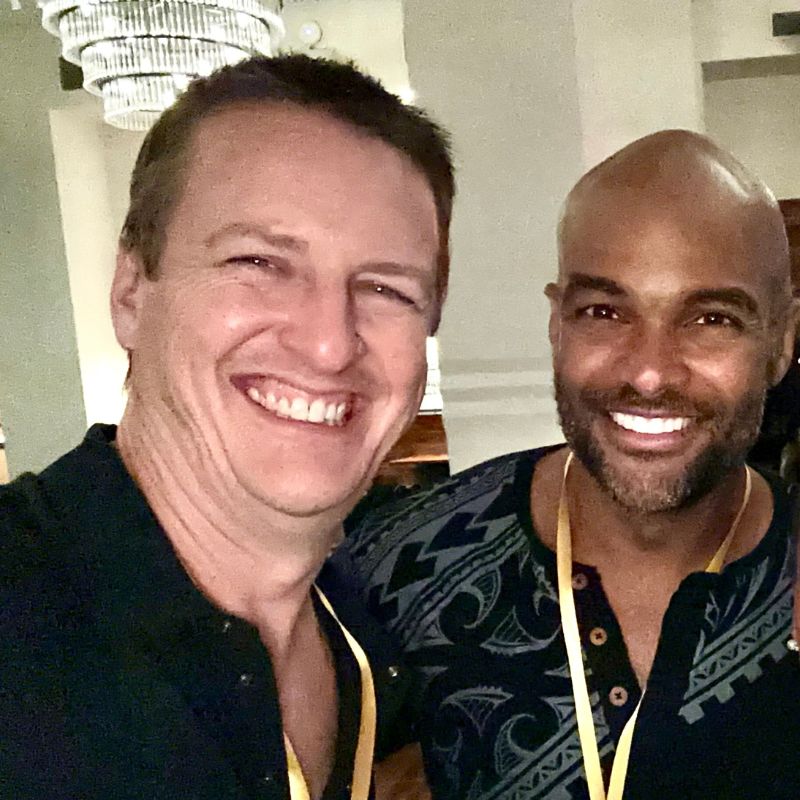
Matt Bowles: My guest today is Ernest White II. He is a producer, storyteller, world traveler, and the founder and CEO of Presidio Pictures, a film, television and digital media studio centering BIPOC, LGBTQ+ and senior elder narratives. He is also executive producer and on camera host of the award-winning travel docu series Fly Brother with Ernest White II. Now airing on U.S. television and streaming worldwide at PBS.org Ernest is also the nonfiction editor at Panorama, the Journal of intelligent Travel, and his writing has been featured in USA Today, National Geographic, the TravelChannel.com and many other publications. Originally from Jacksonville, Florida, Ernest has now traveled to over 70 countries and is a passionate proponent of global community building and transformational travel. He currently serves on the Conde Nast Traveler Advisory Board and the board of directors for the Impact Travel Alliance, a non-profit organization focused on sustainable travel. He also serves as an advisor for Travel Unity, a nonprofit organization dedicated to increasing diversity within the travel and tourism industries.
Ernest, welcome to the show.
Ernest White II: Hey, thank you very much, Matt, for having me.
Matt Bowles: I am so excited to introduce you to my audience today because you are just doing so many amazing things that have been personally inspiring and motivational to me and I’m super excited to dive into all of those. But let’s just start with where we are recording this from today. We’re doing coffee and tea for this interview. I’ve got an espresso here. I am actually in the Blue Ridge Mountains of Asheville, North Carolina today. And where are you, my man?
Ernest White II: Oh, beautiful man. I am sipping my green tea in Vancouver, British Columbia, Canada. So, I also have a lovely set of bluish greenish mountains off on the horizon here as well. So, we’re in mirrored locations.
Matt Bowles: I love it, man. Perfect scenery. You and I actually, it turns out, have a whole bunch of really similar commonalities. As we started talking. We both went to graduate school at American University in D.C. we within a couple years of each other. We’ve both now been to over 70 countries and have, as it turns out, a lot of the same favorite cities and places and all of that. So, I’m super excited to dive into a bunch of that. But I want to just start off at the very beginning. I think the best way to start this is reading an excerpt from one of your travel writings. The article is called At Home in the World. The host of the new PBS show Fly Brother reflects on how his parents raised him to be a global world traveler. And I want to just read an excerpt from this piece and then I’m going to link the whole thing in the show notes because I want people to read the entire thing. But I think this is a really powerful place to start off with this interview in terms of your upbringing in Jacksonville, Florida.
You say, “As I grew older, I became aware of two things. One is that I lived in a society where people called me the N word that followed me around in stores, that stopped me for invented infractions. It was a society that allowed my school to have raggedy facilities and secondhand textbooks, that defunded education, privatized health care, criminalized poverty. It was a society that continued the extermination of young Black women and men, now by bullet, if not by rope. The other is that my parents, who grew up in American apartheid, who have been stereotyped and judged by their skin color, zip codes and cultural attributes, have always led their lives with love, a love of people, a love of service, a love of possibility, a love of life, a love that overpowers the pain of prejudice”. I just wanted to open up with that and I’m wondering if you can expand on that, but maybe start with talking a little bit about your parents’ background even before your upbringing, the environment in which your parents grew up and their experience in the Jim Crow American South.
Ernest White II: Sure, man. So, both of my parents also grew up in Jacksonville, Florida. My mother was born in 1938, my dad in 1946. And that is a large difference. You know, my mother was born in the interwar years in the shadow of the great depression. My father was born in the baby boom, you know, post war baby boom. And they both had different experiences in Jacksonville, which was a segregated city. But I don’t think the pressure cooker was as hot and as powerful in a place like Jacksonville as it was in other places that were much more rural or places in the deeper south where the only doctor that Black citizens could see would be a veterinarian. It wasn’t to that level. In Jacksonville, there was enough room for people to have a modicum of a relative success. And therefore, just listening to the stories that both of my parents talked about, the access that they had to their own spaces, their own safeties, their own communities that were insularly supportive, and also occasionally, when they would engage with white society that was not always as oppressive as it may have seemed to be.
But still, at the same time, there were the unwritten and written codes that could not be transgressed. My mother grew up going to all black schools when she was a young child. They would go to American beach, which was one county north of Duval County, where Jacksonville is located, where the beaches were off limits to the Black citizens. But in American beach, there was a resort there owned by the president and founder of the Afro American Life Insurance Company. I believe his name was Al Lewis. He started a resort there for people to go. And so, there was access to the beach. There was the black swimming pool, black public pool on Jefferson Street where Black kids in Jacksonville learned how to swim. So, you know, even the notion of Black people not knowing how to swim, quote, unquote, I had never heard of that until I got to college when I started hearing about other places where people didn’t have access to the water. But in Jacksonville, Florida, and a few other places, that just simply wasn’t true.
And so, yes, she grew up in segregation, but she didn’t grow up in deprivation. She didn’t grow up with an understanding of lack in that way, because whatever was missing from a financial perspective was made up for with community support, with engagement with everyone looking after each other, and just to have the blessing of a parent that grew up in that era, my father as well. The difference, though, is that my mother graduated high school in the mid-50s, and so she ended up going off to school to an HBCU in South Carolina, historically black college in South Carolina. And she started creating a life outside of Jacksonville. And so, during the throes of the major kinds of convulsions of the civil rights movement, as the 50s led into the 60s, she was living in other places in north and New York.
My dad, however, was coming along, and he was about to Graduate high school, when there were sit ins, when there were all kinds of just events that we kind of have seen on television, because, again, television was a relatively new medium as the civil rights movement was coming to the forefront in the mid-20th century. And so, my dad, who also had a lot of that, the same level of community support, was also young and in his teenage years when things came to a head, when people were being attacked for attempting to integrate the Woolworths lunch counter, and they were simply sitting there wanting to be served when people would pour coffee on them and that kind of thing. And there was an event downtown in Jacksonville called Axe Handle Sunday, where there was abuse at the hands of the police, as well as white citizens who were being physically violent with any Black person that happened to just even be walking through downtown at that time. And my father was there during that time.
And so, they bore witness to the changes that were happening in society. And at the same time, I never knew them to speak ill of an entire group of people based on the actions of one person. Most people that I grew up with, they’re naturally loving people, folks who just wanted to have an opportunity to be everything that they wanted to be and raise families and live in peace. And it doesn’t mean that people won’t do what they need to do in order to get to that place of peace. But at the same time, I think that there’s an unrealistic kind of assumption that, oh, it’s equal on both sides, there’s racism everywhere, and everyone’s a little bit racist. I kind of don’t believe that to be the case, actually.
I believe that most of the folks in the Black community that I grew up in are kind of just trying to get on with their day and don’t want your foot on their neck. But I will say that that foundation of community support, but also just understanding that people, in the end, are just people. They just want to feel seen and empowered and loved. They never phrased it that way, but my parents have always engaged with people from that way. And their teachers, retired school teachers, they’ve always treated their students, at least with what I observed as a child growing up with equal care and concern, no matter what their background. And so that was the model for me in how one goes about living life.
Matt Bowles: And can you talk a little bit about your experience then? Growing up in Jacksonville, man.
Ernest White II: So, I grew up in Jacksonville in the 80s. It was still relatively segregated, like most of America. At the same time, I grew up middle class. My parents, again, were teachers. So, we had all of our needs met. We had more than one TV in the house. We had a timeshare condo in Orlando when those things started becoming accessible to middle class people. And so, I wouldn’t say I was really aware of racial disparities as I was growing up. It was only when I would go visit another high school and see the kind of equipment that they had, the number of AP courses that they had offered to their students. The high schools looked like universities when I would go visit for school meetings or other kinds of activities. And so that was when you start to think like, wow, what’s going on? I also remember would always have jobs at like call centers and other kinds of work. When I was a teenager, those jobs would be 25 miles away from where I was growing up, not really realizing at the time that I was having to go across town to a neighborhood that was mostly not black and or just have a job, have access to services.
And so, you start to see what institutional racism looks like sometimes after the fact, after you’ve already kind of been in the system for a while. So, to say that I’ve felt oppressed growing up was just not true. I didn’t feel oppressed growing up. It was only later, when I was able to look at things from a macro level, that I realized that we had lived in a society that was a caste-based system. The other thing too is I knew Black police officers. I knew there are people in the community that have all kinds of jobs. And so, my relationship to law enforcement was not contentious until I was in college. So, I think it’s important to point those things out. You don’t always feel like you’re under the yoke of oppression until you start realizing that something in the milk ain’t clean, as we say back home.
Matt Bowles: And as you were growing up in Jacksonville, though, at that time, how did your interest in world travel and your desire to see the world, how did that start? What was the lineage of that?
Ernest White II: So, man, I’ve always been a geography geek. I’ve always been interested in flags and languages and national costumes and maps and posters and airlines. So, anything that had to do with going somewhere with different cultures and cities, I was a nerd. Just, bottom line, like, I was a nerd. There was no getting around it. I was a nerdy kid. I didn’t like sports. I wore glasses and got fat. So, all of that to say I was essentially maybe feeling called to a life that was different than the one that I was living. And with my parents having been teachers all of my interests in terms of books, in terms of travel, in terms of knowledge, were stoked by them. My dad, I remember him asking me what I wanted for my birthday one time and I said a Rand McNally Road Atlas. And they were probably $4.99 at Walmart. So, he was like, you want two? Like, are you sure that’s all you want?
And so, I collected maps. Growing up in Florida, man, you stop at any restaurant back then, you had these pamphlet centers, information centers by the doorway with all these like hotel pamphlets and attractions and Cypress Gardens and Circus World and Weeki Wachee. I would collect all that stuff. My mom, she brought home a file, raggedy file cabinet that was hard to open for me to put all my pamphlets and things in. So, there was already kind of the seeds there. And I remember one of the pivotal moments was when I grew up in church like everybody else in the South. The wife of the preacher at my church, Mrs. Estelle McKissick, who was also a schoolteacher, she gave me a book for Christmas called I might have been six or seven years old called free stuff for kids. And in it you could order little trinkets and toys. But I was always interested in the section where you could order information from the tourism boards and convention and visitors bureaus of cities, states and countries from around the world.
And I would like sendoff these postcards and I remember getting a viewbook from the Principality of Monaco which was sealed with a wax seal. I’d never seen anything like that in my life. The book from Singapore was like a huge poster sized book like you would get from the circus, Ringling Brothers and Barnum Bailey back in the day. And it was just these huge photographs with these magical worlds I was having access to. I would call the 800 numbers of airlines in the phone book and order timetables. British Airways never flew to Jacksonville, but they were listed in the phone book and I would get a British Airways timetable. So, I’m looking at three flights from London to Lahore. It was incredible the information that you could access before the Internet. I was doing it, man. I was just like a Hoover. And of course, I’m remiss if I don’t say that at Disney World, which you could go to for back then, $21 a ticket. Florida resident special. I was more interested in Epcot than I was in the Magic Kingdom.
And I was that kid that was standing there Talking to the 18-year-old from Mexico who was in the Disney internship program and working at the Mexico Pavilion at Epcot. Like I Loved going to those different countries. And so, when I had the first opportunity, I was 16 years old. And I remember actually a little bit before that, there was a table at the mall, Regency Square, and it was an organization called Youth for Understanding. It was an international exchange organization. And they were there placing students in homes. And I asked my parents if we could host a foreign exchange student, and they were like, no, but you can go. And so, like, I got the information, and I think it was maybe $2,500 to do a summer in Sweden that was the cheapest. Like, France and Spain were all like 35,000. And you had to have a couple years of the language to be placed in a family in France and in Spain, but not Sweden. You could go there with just English. And so, the summer between my junior and senior years of high school, I did a foreign exchange trip to Sweden with a family. Six weeks that summer, and my life has never been the same.
Matt Bowles: What was that experience like for you? And especially at that age, and what was ultimately then the impact that that trip had on you in shaping the trajectory of your life from there?
Ernest White II: Just to be out of my not only comfort zone, but just my knowledge zone, my realm of experience. Up to that point, I had to fly from Jacksonville through Atlanta to New York City, already a thing I’d never done. I then met with other kids from other parts of the country who were then going from New York to Stockholm. And just that whole experience of going through portal after portal, of being expanded with every single moment, every minute forward, hurtling into the future, on one hand, it was powerful, was stupefying even. But on the other hand, it felt normal. It felt like, okay, well, I’m here, so let’s do it. But, you know, I was really just leveling up in so many different ways just by being there, just by showing up, by saying, I want to do this, and remembering my mom driving me to the airport and saying, I said I wasn’t going cry. And of course, she dropped me off at the airport and meeting other kids.
And then all of a sudden, we’re going to Sweden, and then we’re there, and I’m remembering how the air smelled different, how the butter tasted different, how they had four different or more than that, probably types of milk, and it was in a box. How different but the same we all were. I was in a town called Råneå, which was a half hour outside of Lulea, which their biggest claim to fame at that time was being the birthplace of Maude Adams. Yes, I’m of Age. So, it was so far north, you could drive over to Finland. It was north of the Gulf of Bothnia, so we were within driving distance of the Arctic Circle. I remember there being mosquitoes and that the sun didn’t go down. So, in a lot of ways, it was like Florida and mosquitoes and perpetual sunshine. But there was also the quietness of the place. There was also the ease, the fact that there was not much hustle and bustle even in Stockholm. There was this kind of calmness that I remembered that I appreciated that I tapped into. I was there during 1994.
So, it was the World cup in the U.S. happening. They had an Afro Swedish star player on the team. Two, actually, one with dreads, like blondish dreads. So, in Sweden, even at the same time, they were kind of engaging with conversations about multiculturalism and what it meant to be Swedish and what it meant to represent Sweden on the world stage in the World Cup. I also remember that there were many movies that I enjoyed that were available there in Sweden, including the Distinguished Gentleman with Eddie Murphy was one of the films that was out around that time. And I think in Swedish they called it Varning Washington. And so, I watched that with my host sister as a representation of Black American culture. Sixteen, you know, so I have no clue about. And I was fat too, and a nerd.
So, like, I have no clue what. How I was received by people. I do remember that one of the host sister’s friends, she was a big Toni Braxton fan and she knew all the words to Another Shade of Soul. And I was like, another sad love song. And she was like, oh, yeah, okay, I got the words wrong. But even her mistaken words were so good. Like, so it was just an amazing cultural exchange, an amazing experience. We were all teenagers. None of us knew anything about anything. We at least were probably going deep on topics that otherwise we wouldn’t have gone deep on simply because we were from different cultures.
Matt Bowles: That’s amazing. And then for college, you went to Florida A and M University. So, first of all, big up to FAMU. I have traveled to so many different places around the world with FAMU rattlers and have so much love for basically everybody I’ve ever met from FAM. And somehow, they. I mean, I just meet them all over the world and have some very dear friends from FAMU. But I’m wondering if you can talk a little bit about, first of all, your choice to go to an HBCU in general. And also, maybe you could contextualize the significance of HBCUs because our listeners are in 140 countries around the world. So maybe just talk a little bit about the significance of HBCUs in general and. And then your choice to go to FAM and what that college experience was like for you.
Ernest White II: Sure. Well, let me just start off and say I didn’t choose. I was sent there by my father. So, he chose. And I think that’s an important distinction. I am happy that he made that choice for me, but it was not something that I had much agency in. However, it worked out, as all things do, exactly the way it’s supposed to. Historically black colleges and universities were institutions established most in the 19th century. Some are public, some are private, but they were a way of giving Black Americans after emancipation from slavery an opportunity for higher education. And I think it’s important to note that during slavery it was illegal to educate slaves. It was illegal for slaves to be able to read and write. That is by design. It was, you know, because Black Americans were initially meant to be nothing but farm equipment, period. Just so very clear on from whence we’ve come.
And so those institutions were established sometimes by the states themselves and often by churches and other kind of charitably focused institutions, benevolent societies, and they were often supported by non-Black people and institutions. Andrew Carnegie, the billionaire, you know, the industrialist, he placed, funded and built libraries on many college campuses, including a lot of HBCU campuses. So FAMU has a Carnegie library. And so again, portals for opportunity, many of which were limited in terms of their resources. They were limited in terms of the kinds of studies that could be done there. However, they were not limited in terms of the imaginations and the passions of the people that were engaged in the educating of a nation, really. And so, you had some of the best and brightest intellects and educators in the world who also just happened to be black. And sometimes not, because there’s Albert Einstein taught often at HBCUs and gave physics classes and other things.
So that was something that was very much a part of upward mobility for Black Americans specifically. But America as a whole from again the 19th into and throughout most of the 20th century. And then also what you’ve got are countless powerful, impactful, mission driven people who are graduates of HBCUs, many of whom are known and others not so known. Martin Luther King, but also in the more recent. Kamala Harris is a graduate of Howard University in Washington D.C. or just the impact of HBCUs on me, in particular, my experience at FAMU, which stands for Florida Agricultural and Mechanical University, because it was Established as a school where you could study basically agriculture or the antecedents to engineering. I studied political science, but coming from an all-black high school where I was an outcast, a nerd, I had some friends, but I was kind of a social pariah, which is fine. It is what it is.
But to go to FAMU and to be in a situation around other Black kids who had diverse interests, who were from all over the country, all over the world, international students there, and it was historically black, but in majority black. But we also had other students who were not black who studied there and participated in the activities on campus, you know, to engage with students from different places around the world who had different interests, who loved Riverdance as well as R&B, who had experiences that were much different than the kinds of experiences that I was having back home in Jacksonville. It really helped me feel good in my own skin. It helped me re-engage with my own community in a way that I wasn’t doing when my peers were giving me such a hard time, Bless their hearts, because they didn’t know any better for being different. You at an HBCU, you have, it’s a place for you to be different and still be supported.
Matt Bowles: You mentioned earlier in this conversation that your views or understanding of institutionalized racism, particularly with respect to state violence and policing, evolved by the time you got into and through college. Can you talk a little bit about that and the extent to which that was either a combination of your personal experiences and interactions with those systems and. Or your studying of political science at FAMU, but can you just kind of talk about how that college experience shaped your understanding of some of those structures?
Ernest White II: Oh, man. It was certainly the experience of being there, being in Tallahassee State capital in Florida, also home to a very large public university, Florida State University. I think they had maybe at that time 50,000 students. We had about 12,000 at FAMU, which is not small. And then there was also Tallahassee Community College, which had a large student population as well. So, lots of young people in a city of about 150,000 again at that time. And then also state government was based there. So, there was a lot of interesting confluences going on there. However, you also had many different police organizations in the city. You had Florida Capitol police, you had Florida State University police and Florida A and M University police, and Tallahassee Community College police, and City of Tallahassee police, and Leon County Sheriff’s Office.
And that was when I started to notice who was being stopped while driving, who was being stopped while Walking in the mall or hanging out in the mall. I mean, we’re college kids. You hang out in the mall. But who was being stopped and who wasn’t being stopped? Who was falling out drunk in the middle of Tennessee street, the main drag in Tallahassee, and who, when there were three of us gathered was all of a sudden, we were broken up because of, you know, what could possibly happen just because we’re standing together. So just the difference in enforcement during our homecoming celebrations at FAMU versus the homecoming celebrations over at Florida State, or the fact that I was as a state university student, had access to every single library in the state of Florida university system, and yet was questioned from my ID multiple times, every time I’d walk on Florida State’s campus to go research, to go do nerdly school things, you know.
So those experiences kind of woke me up to the reality of what a lot of people were experiencing. And I say this too, because Tallahassee is a relatively progressive city. You know, Tallahassee because of its high level of formal education, because of its relatively, relatively international outlook, because of bringing international students in and professors and experts, and also again, being the seat of government, it’s very similar to like an Austin in a lot of ways. And still there was the structure of how we were to be engaged with. And I would say yes, there was awareness, increasing awareness, not just with studying political science, but with having conversations with other students, you know, who had had rougher upbringings than I had in Miami, Atlanta, New York, Oakland, Chicago. They were there talking about things. My upbringing was not rough. I dealt with things that high schoolers deal with. But I grew up in a two-parent household with both parents being employed, with lights constantly on, with food in the refrigerator and in the pantry, and wherever I needed to go, I was taken and my needs were met.
And so, in that regard, yeah, I would have had experiences with law enforcement, but I didn’t have to watch my father, for example, be harassed by cops, even though he told me a story later about run in with some police. My brother has told me stories and then I have had my own. But I think it is based on personal experience, I’ll say that because you can be aware, but when you are experiencing it yourself, it just makes it that much more real for you and you’re able then I would like to think, to start to analyze, start to see where transformation can happen from a place of optimism and not bitterness. I say that though, after having been bitter for many years, moved abroad because of it, so I can’t sit here and say, oh, I’m Zen and om and love and all that kind of stuff and not acknowledge the fact that I went through many years of rage and of despair.
And this was again in the early 2000s. We’re not talking about last year when people just all of a sudden realized, oh, we’ve got a lot of issues in the U.S. with regards to race and class and immigration status and all these other things, you know, no, it’s been there. And so, I would tribute my professors and other students that I went to school with and the material that I was learning to helping me have a global understanding of the caste system in which we live and how we can maneuver and transform it.
Matt Bowles: And you also studied abroad while you were in college. So, within this context, can you talk about your experience studying abroad in the Dominican Republic at that time and what that was like for you?
Ernest White II: Sure. I mean, that was an experience that. I’m laughing because one of the words I would describe is kooky. I say that because there were so many amazing, like, just offbeat, random, funny things that would happen in your day-to-day experience that are the norm in hot tropical places. And so, it was just kind of everybody packing into a little someone’s car that they’re driving along predetermined routes. They call them carros públicos or public cars. And you just catch one at one point and it’ll drop you off down someplace else and the cars are just going all over the place. And there’s like the merengue plan. It’s really upbeat. You’re driving past people in the street, everybody’s kind of packed in and folks are just talking to each other. And it is almost like you’re in a movie.
And at the same time, because of my phenotype, everyone just thought I was Dominican. And of course, also because I’m taking this public transportation as opposed to taking private cabs and other things that people who may have a different level of wealth. And I say that because wealth is relative in so many different ways. But I may be paying 50 cents for my ride in a carros públicos versus $5 in a cab. Would I have had the $5 to spend every day? Sure. But why do that when I can just pay 50 cents and just hop in and work on my Spanish? It really was just kind of, again, another portal stepping into a world that was different and not better or worse than the world that I was coming from, but one that really was stimulating in so many different ways. I was there as a part of a study abroad program with Florida A and M where they brought other students from other HBCUs. There might have been eight or nine of us or maybe not even, maybe like six students that were in the program that summer.
We all stayed individually with different families where it was a homestay situation. We were speaking Spanish and or English with the family members. The son of the parents that I stayed with, he went to an English-speaking school and super nice family. But then I got to see that they had employed a 13-year-old girl as their maid. 13-Year-old Black girl who could have been in school, who should have been in school. And so, they were very nice to me. The family was wonderful. And here I am now looking at a young girl who’s because of the system, because of the institutional structure of everything, because of the caste system, she’s not being given the same opportunities as her age mate who is the son of the family that I’m staying with. And so, it was very eye opening in a lot of ways to see kind of how these things are structured and how people don’t fancy themselves as supporting inequality, supporting blockages to growth and development because they figure, hey, we’re employing this person, we’re giving her an opportunity to make money and send money home to her family.
And here I am being an outsider, who am I to judge? But at the same time, I care. I am seeing this person as someone who is not necessarily living into her truest, fullest self. It wasn’t that I was aware of that at the time that I’m seeing this person who’s not living into her fullest, truest self. No, I was like, it’s just something wasn’t right again, something in the milk ain’t clean. And it really is kind of the aggregate of all of these awareness’s that kind of brings us to a place of insight and understanding. And then from there the transformation, the action, the choosing differently.
Matt Bowles: I want to ask if you can go a little bit deeper on the part about being able to pass for in this case Dominican and other countries, perhaps other things. And I wanted to actually read another excerpt from one of the excellent articles that you wrote with some of your travel reflections. And I’m going to link this article up in the show notes as well because I want people to go read the whole thing. But one of the things that you say is, “I learned that many people, most people in the world who looked like me often didn’t think like me. I learned that the comfort found in going native relied explicitly on an official, if unacknowledged, foreignness, backed by one of the world’s most powerful passports, which would allow me to abort the entire mission at once and at will should the fire get too hot”. Can you expand a little bit on that concept?
Ernest White II: Sure. I am technically biracial, half black, half white. In a sense, I know we’re moving away from saying half a Black father, a white mother. And I was adopted at three months old and raised in a family of amazing people. My experience has been one of physically occupying an interstitial space. And that changes wherever you go. You know, race, ethnicity, nationality, they have differing meanings based on society, based on the language that you’re using, based on the other person’s understanding of what those words mean. I’ve had people say, what’s your nationality? American? No, but I mean, like, where are your parents from? Jacksonville. There’s part of the challenge is just in the fact that people don’t know what words mean. But in my description of myself, I would say that my race is black and white, my ethnicity is African American or Black American, and my nationality is American.
And when I’ve gone to places where, let’s say there’s been a lot of mixture, there’s been a lot of racial mixture in the society, like many places in Latin America, Dominican Republic, Cuba, Puerto Rico, Venezuela and Colombia, and Brazil, South Africa. And then you go to other parts of the world where there’s been more recent mixture. Germany, France, even Sweden. Or I can go to a place where people are different shades of brown. India, the Arabian Peninsula. I have never been there, but I’ve been to places where folks from those places have gone to have moved to Europe, for example. And the assumption is that my family might be Yemeni or something like that. There is comfort in knowing that I can go to Egypt, not open my mouth and not be the object of attention, not be seen, not have to be vulnerable, not have to answer questions, not have to answer for my very presence. That’s something that we don’t often get to experience in the United States as people of color. We have to answer for why we’re in someplace. We have to give a reason for why we’re walking into a bank, for why we may be at a table, at a board meeting, why I may have had a job. I’ve been asked how I got a gig updating a guidebook before, and I’m like, well, how’d you get your gig?
And so, there’s a freedom in that anonymity. And There is still the fact that that comes with an incredible amount of privilege. The fact that I’ve got a U.S. Passport, but to be able to know that I could always pull the cord. So, I remember one time being in Brazil at Carnival in Salvador, and the police will sometimes walk through there swinging their batons at people who get in their way. And I remember just being yanked out of the way by people. It’s a blessing to know that I’ve been looked after so much and so often by people who don’t know me, who’ve been observant. And they just pulled me out of the way as some police were going, were walking down and kind of like hitting people with clubs. I can always fly my behind back home if I was in any true danger.
But Brazilians couldn’t necessarily do that. The Brazilians who look like me couldn’t do that. They would be subject to whatever repression was handed down, was meted out by those officers of the state. And in my case, I had a get out of jail free card. It’s not a complete kind of beam me up, Scotty kind of moment, you know, you can still get in trouble even with a U.S. Passport, let’s be clear. But I’m saying that it gave me an out in a lot of ways. It was almost. Almost as powerful as whiteness in some cases where I was able to speak English as a native speaker and as one who has a high level of formal education and talk my way out of situations that would not have been able to if I were native to the place that I looked native to.
Matt Bowles: Well, I want to talk more about Brazil because I know that Brazil holds a very special place in your heart.
Ernest White II: It does.
Matt Bowles: And it is also one of my favorite countries in the world. And I want to talk about Sao Paulo because I know how much love you have for that city in particular, and also how much time you spent there. I’ve been there twice, both ways too short. It is a city that I revere, but you’ve spent so much more time there. And I’m wondering if you can just start off by talking about what it is that you love so much about Sao Paulo, Brazil, and maybe also just kind of giving folks that have never been or don’t know very much about the city, just a little bit of the historical background and sort of the cultural milieu that makes up Sao Paulo.
Ernest White II: Sao Paulo is thrilling. It’s exhilarating. It’s exciting. It’s buzzing. It’s got this irrepressible, incredible energy coursing through it. It is organic. It is a city of 20 million people that are just abuzz with engagement, connectivity. You meet someone and then you move on, and then you meet someone else and you move on and you circle back. There’s just so much movement, so much trivial happening. And a lot of it is survival. A lot of it is people doing what they have to do. It’s an expensive place. It’s a place that can be grinding, can be unforgiving. It is not Rio de Janeiro, which also has its issues. You know, Rio is beautiful. It’s a picture postcard. And it’s also got incredible social issues. And we’re talking pre-pandemic for everything. I haven’t been since the pandemic started and nor have, I been during the Bolsonaro administration.
So, I think it’s important to note that as well. But when I lived there at a time when the country was on an upswing, it was such promise, such excitement about the future of Brazil. From between 2010 and 2012, when I was living there. Before that, I had visited twice or three times a year for seven years prior to moving there. And it’s a place where you’ve got people from so many other places, other parts of Brazil, many people from the northeast of Brazil. And when I say many people from the northeast of Brazil, the northeast of Brazil culturally is very much like the American South. So, you’re talking about people of mostly African descent and a lot of indigenous mixing and some European, but they’re mostly Black and Brown people because of a legacy nutritional apartheid that also existed in Brazil. Shorter coming with some malnutrition. This is generalization. I mean, there are not everyone from that part of the country is that. But you see it. There’s a physical difference that you can see often in a lot of people from the northeast of Brazil who end up working in construction.
They end up working in some of the lower end jobs and they keep Sao Paulo running. And that is the economic engine of Brazil. And you’ll see people who are descendants of the European immigrants who’ve come there, descendants of the huge Italian, Spanish and even German diasporas that have moved there from the 19th and the 20th centuries. From the Syro-Lebanese diaspora. You’ve also got people; it’s got the largest number of people of Japanese descent in one city outside of Japan who were brought over as agricultural workers from the south of Japan after the end of slavery in 1888. They were brought over in the first part of the 20th century to work in Sao Paulo and Then more recently, you’ve got immigrants from Korea, you’ve got immigrants from Haiti, from Venezuela, from West African countries, Angola, of course, as a Portuguese speaking country. And so, there’s such a powerful cultural mixing that goes on in Brazil because of its permeable barriers, because of its fluidity in so many different ways. And you see that in different ways in different places in the world.
New Orleans is a place where you see that cultural fluidity. The Caribbean is a place where you see it. It’s not just Brazil. Brazil just happens to be a place that’s got a lot of people and a lot of soft power, and it’s exported a lot of cultural elements that are directly resulting from that cultural fluidity. And Sao Paulo is a place where you see it come together in a mega city. You see it come together in a city that is just as impactful, at least on a national level, as a New York. It holds its own weight, but it’s a star in a lot of ways. It pulls people in. It’s like the center of a galaxy. And I know it’s esoteric, but that’s just the energy that you feel when you’re in Sao Paulo. And you get it when you’re out at a restaurant, when you’re at a nightclub, when you’re at a museum, when you’re taking cabs around town or when you’re on the subway, when you engage with people, when you watch how people engage on the street, when people laugh and joke and beautiful woman or a beautiful man, and they just kind of like walk down the street. And so, I’m just like, oh, my God, like, I love it here. I don’t care that I don’t see the beach. I don’t care that I don’t see the mountains the way you do in Rio. There’s just. You have to love cities. And I do love cities. And that is what Sao Paulo gives you. The forest city is Sao Paulo.
Matt Bowles: Yeah, it’s really amazing. I can remember my first day or so in Sao Paulo. I landed. I went by myself, didn’t know anybody. And I do. I was just like; I just want to immerse in the city. Just like walking around and I walk into a street party. This is not carnival; this is not a festival. This is not a special thing. This is a Saturday in Sao Paulo. DJ spinning dancers, just taking over the street, partying, some giant block party. And then the street art in Sao Paulo. I am someone who pays very close attention to graffiti art around the world, in all the cities that I go to. I think it is just. Just such an extraordinary medium to see, first of all, how the street artists see their own city and the narratives that they want to share and represent about their own city through the medium of street art. And I just pay very close attention to it. Sao Paulo, oh, my goodness. I mean, you’re talking about graffiti crews that will repel down high-rise buildings to do like epic pieces in the city. I mean, like, unbelievable stuff. There are so many places around the city that have such extraordinary graffiti art. They even have now an open-air museum in the northern part of the city where the street artists sort of do their thing out there. I couldn’t believe how amazing Sao Paulo was.
Ernest White II: No man. Sao Paulo just, again, it gives you anything that you would want in the city. You can get anything there. There’s such a respect for culture, there’s a respect for creativity. There’s a desire and a yearning for it. And the fact that the city and the city’s leaders have kind of leaned into the street art, leaned into what many other places consider to be ugly, considered to be a blight. The thing about Sao Paulo is that people were going to scrawl on buildings anyway, so you might as well embrace it. And they did. And there were so many surfaces upon which people have found possibility and opportunity for creation. And that’s what I think street art really reflects.
Matt Bowles: The other thing that I observed in Brazil, and I want to get your take on this. I lived in Rio for about two months, and I was there over Carnival, and I went to Carnival in Rio, which is, I mean, that is a bucket list experience that everyone should experience. I think one of the things I wanted to ask you about that I was observing, especially during Carnival in Rio, in terms of the gender and sexuality dynamics, is that that was perhaps, I mean, literally, of all of the countries that I’ve been to, which is probably over 70 now, like you, I saw perhaps the most gender, bending gender fluidity. I mean, straight men, cross dressing, I mean, just all of these things sort of going on. There were giant floats, entire samba schools that were part of the carnival, that were thematically dedicated to critiques of patriarchy and hegemonic masculinity and the street parties and everything. There was so much gender bending and fluidity there. I’m curious about your reflections on that and the gender and sexuality dynamics in Brazil in particular.
Ernest White II: Well, I think a lot of it has to do with just the religious and colonial components that go into the societies. You know, if you’re looking at Brazil which was a Portuguese colony. The Portuguese people were already mixed. There was already a mixture. I mean, no one really is any one thing. I mean, obviously we’re seeing that when you get your little DNA analysis. But the Portuguese were already a society that was an interstitial space between Europe and Africa. And so, to be the colonizing power and to do so with a religion that was already one that was built on syncretism, that expanded by incorporating local traditions, local deities, local celebrations, and turning them into socially and societally acceptable ones, that gender fluidity isn’t any different than any other type of cultural fluidity. You just happen to see it in Brazil when you’re coming from us, which is a country built on puritanical Protestantism and one kind of type of engagement that is very much so in alignment with the patriarchy. And not to say that Catholicism is not heavily patriarchal.
However, Catholicism also elevates the Virgin Mary, but then of course, you’ve got that virgin whore dichotomy. So, it’s not to separate misogyny and patriarchy, because those show up very much so in Brazil, and particularly outside of Carnival. And so, yes, you may have an expression of gender fluidity within a celebration at that. Supposedly once a year when you’re able to throw caution to the wind and just be who and how you are, but the rest of the year, you have to pay for that. There are still gender expectations. There is Brazil’s high number of attacks against transgendered people. There is the fact that you’ve got plenty of ostensibly straight men who enjoy sexual relations with either other men, cisgendered men, or with transgender. You know, there’s all kinds of stuff that happens that’s going on that people don’t admit to. Carnival is just an opportunity for that to be expressed. Whereas in the U.S. outside of, again, New Orleans, which colonially was established from a different pattern, you don’t have those moments of expression. And so, what you’ve got is more repression.
And obviously we’re talking about things that as time goes on, there’s a changing, there’s a softening. 20-year-old these days are not bound by the same kind of societal codes that we grew up with as Gen Xers or that our parents grew up with, et cetera. So, we’re seeing that fluidity even in what people are wearing these days, more and more in a society like the United States. So, I just think that with regard to Brazil, again, it’s just a cultural difference that comes from the top down. In a way, it’s how much did that colonizing power allow for those cultural elements that were already in the world they were exploring to live within themselves? Were they repressing it or were they allowing it? And in Catholic societies, there tended to be more than allowance, than a repression. But again, I’m generalizing. It’s one of many different reasons why we see what we see.
Matt Bowles: Well, I want to ask you a little bit more about GLBT travel in general. And you know, you and I both have, for example, a lot of appreciation for a country like Morocco, just an incredible country on so many levels. But in a country like Morocco, homosexuality is officially illegal. And I’m wondering, how do you approach that? How do you navigate that when you travel?
Ernest White II: Well, I’m blessed to be tall and to be really adept at performative masculinity. You know, most guys, most dudes, it’s a performance regardless of your sexuality. You’re trying to impress other dudes, you’re trying to not get beat up, you’re trying to feel cool, you’re trying to be included, you’re trying to not be rejected or abandoned or banished in some way. And so that does not differ amongst men in general. And so, because I’m able to put on whatever costume I need to put on, I’m able to travel to places and not even be assumed as gay or perceived as gay. And so, when I went to Morocco, I hadn’t even thought about it. That is privilege. That’s huge privilege to not have to think about that when I go to certain countries. And so I remember I couch surfed my first time there and made friends with two young doctors who one, I kind of do get ahead of the conversation and just let people know, mostly because I don’t want to be set up on dates with young ladies. Young ladies are amazing. They’re wonderful.
And it’s always really awkward when I’m set up on a date with a young lady because the assumption was straight. And so, in order to not have to do that or not have to have that experience happen, I would have a conversation early on with my host. And generally, I mean, and even in Morocco it’s like, okay, cool. Like occasionally I may have to have an exploratory conversation with someone who would want to know more. But these guys were non-judgmental, were very welcoming, we had a great time. And I again recognize that that’s a very privileged position. You know, there are some people, like James Baldwin and others who were less able to camouflage their sexuality and therefore are often at the forefront of positive and negative engagement with regard to LGBTQ issues and cultural issues, safety issues, and all of that.
So, I am a believer more in having the conversations and going places and engaging with people. Yes, there are countries where it’s legal to be gay. There are also places in the United States where you will be attacked, harassed, if you are holding hands with a person of the same gender as you, at least presenting as the same gender out in the streets. So, it’s a matter of doing your research. It’s a matter of how much risk you personally want to assume when you go to a place. It’s a matter of engaging in conversations with people in the community in those places that you’re going to. That’s the beauty of the technology that we have now, that you can create community any and everywhere and remain in contact with these people. There’s information that’s out there and available that was never there before. And now I think there’s never been a better time to travel as a gay person or as a member of the LGBTQ community.
Matt Bowles: You mentioned James Baldwin, and you and I both have a really profound reverence for James Baldwin. And I’m wondering if you can just talk a little bit about the interview impact that his work has had on you, including his reflections on his own travels.
Ernest White II: Oh, man. James Baldwin was one of those heroes early on. Well, first of all, let’s just, again, recognize his singular brilliance. And I think that’s what it boils down to. I mean, the man was just incredibly intelligent, and his way with words was unmatched, you know, as a weapon. And you use a knife sometimes just to chop up onions for food, you know, so it doesn’t mean that it was always to attack. And the thing about James Baldwin was he did care so deeply about people he loves on into infinity. He loves people. He believes in the inherent goodness of people, no matter what. And he wrote about how he could, no matter how much the oppression, no matter how just impactful other people’s behavior was on him and on society. He never could completely hate white people because he’d had so many examples of white people showing him love. His teacher in elementary school who took him to museums and wanted him to be his biggest, brightest self.
And I say that because that is very resonant with me. It’s not excusing people for making choices that are regrettable or for behaving in a way that’s regrettable. There are always consequences. It’s just a recognition that people are often acting out of pain, and that’s what I appreciate about James Baldwin. He wasn’t afraid to call it out. He wasn’t afraid to say what needed to be said, but he also was not afraid to put his neck out. He was not afraid to go out and have new experiences, even if he was running away from worse in his home country of the U.S. and so having gone off to Paris in 1949 with like $40 in his pocket and having the gumption, the oomph, the moxie, the verve, the chutzpah, the jojones, the whatever you had to say to be a very obviously gay Black guy in the early 20th century and make a life and a name for himself, that to me is just incredibly impactful. And I could only hope to have an nth of the impact that he’s had on bringing people together.
Matt Bowles: That’s amazing. So, when you talk about being a proponent of transformative travel, what does that mean to you? So, reflecting back on all of your travel experiences up to this point, what has been the transformative impact of travel on you, and what is the transformative impact of travel in general, would you say?
Ernest White II: I think that ties into what we were talking about with James Baldwin. What reading Baldwin did for me was show me that my experiences were not so unique. They were unique to me, absolutely. And they were very specific to me in the way that they unfolded. But at the same time, the prevailing energy, the prevailing experience is human. That prevailing desire to connect, to not feel alienated, to feel safe and loved, empowered, seen. That’s what he writes about, and that’s what everyone wants in life. And that to be able to get to that place of feeling seen, empowered and loved is what transformation is all about. And travel is one of those activities in life that many of us have been blessed to be able to access. And it can be a powerful tool for recognizing ourselves and others, for understanding the world better, and for then making choices that allow us to help people to be of service and to be loving to other people, which is only being loving to ourselves. That is where the transformation to me is most resonant.
Matt Bowles: I also want to ask you about your travel writing. I’m wondering if you can talk a little bit about, just for you, what do words in writing mean to you, especially as relates to travel?
Ernest White II: Words are doorways. You know, they’re doorways to different worlds. They’re keys. They’re little tiny airplanes. They allow us to travel without having to go anywhere. That’s the beauty of being able to read. That’s why it’s so precious. That’s why it was such a sin and a shame to make it illegal for people to know how to read. They activate our imaginations. You know, they don’t have to be written to activate our imaginations. And so, writing, it’s an opportunity to paint. It’s an opportunity to love. It’s an opportunity to transform ourselves, to be new and different, expand in all the ways we want to expand, to play, to be.
And so, for me, I think it’s an incredible blessing to kind of have access to that, to be so drawn to writing, to be so drawn to storytelling that I can’t do anything else. I have to have it in my life. I have to live it. I have to live in it. I thrive on it. I love a great turn of phrase. I love a great pairing of words together that just gives me an image that I can’t shake. I love when I hear an unexpected $10 word drop out of somebody’s mouth. I love when there’s just the opportunity for people to go deep with their language and then go deeper and deeper, to weave an intricate pattern in a way that you just want to live in. You know, a great line of poetry, you just want to live in it. You want to be it; you want to embody it. You want it aflame within you.
And I think because of the way technology has gone with visual storytelling, you know, TikTok is visual storytelling. Social media is visual storytelling. And it’s interesting and it’s amazing and all of that. And at the same time, we are kind of shifting away from the beauty of the written word and the beauty of literature in that way. The fact that they’ve always been immersive experiences. Any story is an immersive experience. From a campfire story to your grandma telling, you had to walk barefoot in the snow, to school, two miles uphill, both ways in Florida.
Matt Bowles: Like what?
Ernest White II: Snow? That’s an immersive experience. And now we’ve got technology that’s caught up with our imaginations in that way. What I’d like us to do is retain the immersive experience of great literature, the immersive experience of allowing your brain to broadcast or project the words onto the screen of your mind and not have someone else’s interpretation do that for you. That’s the beauty of literature. You know, you decide who the characters look like. You decide the world that they’re living in based on what shows up in your head, as opposed to the interpretation of a director or a producer or a content creator, all of which are valid interpretations. And Many of which we resonate with. So, it’s not to say that. But what about your own. But about seeing your own thing? I remember watching one of the additional materials on a DVD set of To Kill a Mockingbird, the film.
And they interviewed a woman who was alive around the time that the book was written. And she talked about back in the day when they had two sticks and they would create worlds with those two sticks. Those two sticks were a teacher and a student in the play classroom. Those two sticks were husband and wife or whatever pairing you want to make playing house. Those two sticks were you and your friend on the telephone. Those two sticks were a battle in a war. Those two sticks were worlds, and you created the world. So, it was a way of engaging in your greatest creativity, your imagination. And I think we’re losing that when everything has been imagined out for you already. The human mind is incredibly adaptable. So, I’m not saying that this is the death of the imagination. Not at all. I do think, though, that when you’re not stoking great literature, there’s a dimming of the imagination.
Matt Bowles: You are the nonfiction editor for Panorama, the journal of intelligent travel. Can you talk a little bit about what Panorama is and why it was created and what people can find when they go there?
Ernest White II: Panorama is an amazing literary travel journal that was. It’s digital. It was created by Amy Gigi Alexander, a phenomenal writer author who just believed in the power of the written travel experience. You know, travel log, travel narrative. Just the journey that you can take again when you’re able to do the projections in your own mind. That’s the other thing. With film and television and other forms of storytelling, you are experiencing the story at the pace that is set for you versus literature and reading and good writing that you can take as long as you want. You can reread something that resonated. You can kind of pause. You can go do something else and come back to it. And Gigi really believes in the power of that kind of engagement with travel literature. And she also wanted to rectify the historical inequity with regard to who was telling the travel story, who was writing the narrative.
It had mostly been white, colonial kinds of narratives that had been being published and reprinted and, you know, rife with dehumanization in their exoticism of people and cultures and places. The idea was to kind of rectify that by bringing on board not only writers who represent just the variety of humanity, but also editors, decision makers, gatekeepers, if you will, who were able to relate to the material that was being presented to them and massage and even fertilize it in a way that brought out the colors, brought out the taste, brought out the flavors of it. And so that’s the beauty of Panorama is to be able to kind of immerse yourself in the world without having to go anywhere and just really experience the many different ways that travel shows up for human beings in all these different cultures.
Matt Bowles: I want to read a clip from the website, from the Panorama website. I was looking at their sort of what type of writing they’re looking for in submissions and things like that, and it says, “We are looking for exquisite, rich, surprising work capable of unbinding readers from their expectations and routines. Most of all, write evocative, experiential, descriptive prose that takes our readers with you and confirms our belief in the power of place. We have a particular interest in travel memoir, but we invite memoir with an edge. This is not the place for traditional travel memoir. Give us something different”. Can you talk a little bit about memoir with an edge? And for you, what does that mean exactly? What makes great travel memoir?
Ernest White II: Memoir with an edge, to me, would just refer to memoir in which that internal transformation is evident and not where it has occurred, because transformation is never ending. It’s where it’s evident in the story that we see someone realizing something that they hadn’t thought about before, that they hadn’t known before, that they’re the ones being changed by the place, that they are not necessarily imposing themselves on the place, but the place is bringing the writer into its caress, into its fold, into its fictive dream, even if that’s a jolt, even if it’s a knock on the head, even if it’s something that has been even traumatic. But coming out of the other side with an appreciation for life, with an appreciation for the unexpected turns that bring you closer to yourself and therefore closer to each and every one of us. That’s memoir with an edge to me, be it travel or otherwise. But again, travel memoir, specifically, you’re looking at how that kind of journey relates to a place that’s different than the one that you’ve become accustomed to or that you might call your home space.
Matt Bowles: I want to ask for your tips for current travel writers or aspiring travel writers, people that want to work on this craft, that want to become better travel writers, that want to become great travel writers. What tips do you have for honing the craft?
Ernest White II: I would say reading, number one. And I don’t mean reading listicles, I mean reading literature. What’s literature, man. You can Google it, do your research. That’s number two. Research. You don’t know everything about everything. I don’t know everything about everything. I know a little about a lot of things and a few of the things I know, I know very well. I know what I know. I also know that there’s a ton that I don’t know. Asking questions, talking to people on the ground, making sure that you are triangulating an experience in a way to see if your own biases, your own filter isn’t tainting the story too much.
And I say that because there’ll never be anything that’s unbiased. You know, you do have your own perspective and experience and there’s nothing wrong with that. It’s just checking it, gaining some perspective and then also learning another language, learning another language, starting another language. Language, attempting to think in a way that is different than what you’re used to thinking. Because when you start to learn another language, you’re able to hear other perspectives that you weren’t able to hear before. And that’s important when you’re trying to write about another place. You need to know what it’s like to be foreign to a place and why that’s okay.
You need to know what it’s like to not get to exert your will on a place. You need to know what it’s like to hear and feel. No, all of those things are essential when you want to write travel writing that’s resonant with people, what’s it like to not get what you want? I don’t mean we want to know about suffering necessarily. We just want to know how you’ve had to adapt, how you’ve had to transform, how you’ve had to pivot it, how you’ve had to figure it out and what the magical moments were that that showed up, that helped you do that with either in the form of another person or the place itself or just an awareness.
Matt Bowles: Definitely. And I want to also build on that now to talk a little bit about your personal journey and evolution as a content creator into the space of video and television production, on camera hosting, and your latest show, Fly Brother. Take us back a little bit and let’s talk a little bit about how Fly Brother came about and what can people expect from the show.
Ernest White II: So, Fly Brother is a television travel docu series about friendship and connection around the world. In every episode, I visit friends who bring me into their communities, show me what they love about the place, and we show the audience the whole world is our tribe. And we filmed season one over. It took us about three years to pull that thing together from start to finish. But we filmed in 11 different destinations. It’s 10 episodes. It’s currently available on public television stations and create TV around the United States. And also, you can catch it globally via streaming at pbs.org and Revry, which is a streaming service that centers queer stories. And we just actually finished filming season two, which is an all-American season that we filmed.
Season one again was 11 destinations in different countries outside of the U.S. season two we did between April and July of 2021. So, kind of in the throes of the pandemic in the U.S. we were filming 10 destinations there and really focused on how we are a nation of nations, just how varied and diverse and amazing and phenomenal the people are that make up the United States of America. And we started off in San Francisco. We went to Puerto Rico, Natchez, Nashville, Newark, Detroit, the Adirondacks, Kansas, Alaska, Hawaii. And we were able to really go deep with stories from so many different people in all those places. It’s a blessing and an honor to have been able to do that. And season two is set to debut a premiere in January of 2022. The show kind of came about as an outgrowth of the blog that I was writing as a traveler when I first moved abroad outside the United States.
I moved to Colombia back in 2005. I started off writing emails, updates to people who wanted to know what it was like to live abroad and all that kind of stuff. And then as blogging became a thing, I started a blog. It was called Fly Brother. And you know, if you know, you know. But the idea was to kind of help engage people more, to enlighten, to show people that they really could live a life different than anything that it had ever imagined. And this was before Instagram, this was before the kind of photo heavy push when it came to showing people that they could travel right. And so, the blog did decently. And eventually a buddy of mine from college reached out to me. I was living in Brazil at the time. And he was like, listen, man, I’m affiliated. And he a brother from Florida, A and M. Chester Jones, he was like, man, listen, I’m co-owner of a small startup cable network.
We need content, we need programming, and we want to get. You want to commission a show from you. We can’t pay you, but we can give you all kinds of insight into how to bring in advertising and it’ll be non-exclusive. And you can go from there. And I was like, no, no tv. I write literature. And. Eventually every other doorway in my life closed until there was nothing left for me to do but step into it. And at that point, I had been working as a journalist, freelancer, and editor at Timeout Sao Paulo magazine for about 15 years in the space. And so, I was able to really kind of leverage that community and connect with people in the PR space and destinations to create a season. And also, I was able to connect with an initial group of seed investors who believed in what we were doing.
They believed in storytelling and the creation of culture. And they were like, yeah, like, here’s some cash to get you going and thinking about what we wanted to do. I mean, it’s like, you have to have a niche. Anthony Bourdain was the pinnacle at the time. And I was like, I’m not really a foodie. I mean, I was a fatty. Like, I eat, but I’m not going to sit there and analyze the food. I don’t have time. Like, there’s no food that is so. Is too beautiful to eat right away. Like all y’ all that take pictures of your food, I’m eating by that point. So, I knew that food was not going to be the niche. And my love for architecture is not easily translated to television show format and certainly not everybody’s cup of tea. I could imagine that that might be a little boring to some folks. So, in figuring out what the niche would be, it was like, what? Not niche, but just framework. What is something that’s very resonant. That was always kind of a theme for my travels. What did I take away from every place I’d gone? And it was community, it was friendship. It was just wonderful.
People that I’d met and had connected with so deeply and had been blessed to be traveling in the late 20th, early 21st centuries where we actually can stay in contact. Yes, it started off with postcards and $6 a minute phone calls twice a year, but now everybody’s in your phone, they’re in WhatsApp, they’re on Instagram and social media and email, and you still can call them. And all of these different ways to maintain contact with people. And so, I felt like that was the biggest takeaway that we should really kind of go deep on. And highlight is the way that you can build a community of amazing people, people everywhere you go. And that is what the crux of Fly Brother is. And so, we feel incredibly blessed and amazed to be able to do this work, to connect People across background and boundaries.
Matt Bowles: Well, I will tell you that I have been binging Fly Brother ever since I learned about it from you. And I’ve been rocking through the episodes, and I’ll tell you the order in which I’ve been doing them, which I might recommend for the listeners as well, is I look at the dropdown of 13 episodes, and I’m like, ooh, I love that place. I want to see how Ernest rolls in that city, which is one of my favorites as well. And so, I rocked through a bunch of those, and then I started going to the cities that I’ve never been to, that I want to go to. They’re on my list, and I want to see, you know, what you’re going to be able to show me and teach me about that.
And, of course, you inspire me to put them even higher on my list when I watch you go to Addis Ababa in Ethiopia or places that I haven’t been. But in terms of the place that I have been, I mean, the other really cool thing, one, we have a lot of the same favorite cities, which is amazing. But the other thing that I think is really unique, like you talked about, how is Fly Brother going to be different from all these different types of travel shows? One of the things that stood out to me immediately that I had never seen to this depth before in any travel show is the familiarity that you had with the places that you’re going and the people that you’re meeting.
So, people, watch your Sao Paulo episode or your Bogota episode, and these are. You’ve lived there. You’re like, this is my hood. This is my favorite restaurant. I’m going to meet up with my homie from. You know, and you’re like, rolling. You’re introducing us to your crew. You’re introducing us to your hood. Like, you have a level of familiarity with the places you’re going and the people that you’re meeting that I think is very unique in the space.
Ernest White II: Thank you, man. I mean, that was also part of it, too. It was like, my world is amazing. I’m not saying that to say, oh, look at what I did. I created this. No, I’m saying that I am so blessed to have had the experiences that I’ve had to engage with the incredible people that I’ve engaged with. Listen, Matt, like, we met this week because we were supposed to speak at a conference. This is our second time chatting. We’re going deep right away. That’s how it works, to just be open to the connection as it shows up. And so, to think back and be like, wow, I’m 43 now.
When I was in my late 20s, you know, I moved to Columbia from Washington, D.C. when I was in my early 30s, I was living in Sao Paulo as a magazine editor and going out to some of the most phenomenal nightclubs and literally getting home two days later. Like, I have had phenomenal experiences in life that I think need to be shared with people because I want people to have those same kinds of experiences. I want people to know what a life that they love feels like. Because maybe if they know what a life they love feels like, they won’t try to keep that from other people. They won’t try to bar other people from being their most expansive, most self-expressed selves. And I’m talking about maybe their own kids or maybe their own spouses or maybe themselves.
So that’s kind of my job. And to have gone to places where I’m able to really that are interesting and that are photogenic enough to build out a fun, exciting episode, that’s kind of why I think those things resonate with you.
Matt Bowles: Yeah, man. One of the other things that I loved about Fly Brother that you’re doing in each of the episodes is that you’re pulling back and giving people information about the history of the city that you’re in, the history of colonialism and the different immigration waves and all of the different components that make up the cultural context of the city that you’re currently walking through. And I think that’s a really important piece of information. And then the people that you’re hanging out with in these cities. I watched your Cape Town episode and your homie that you’re rolling with, he’s like this cool, fun, interesting dude. And then he’s also, oh, by the way, an economist who’s like spitting all of this incredible knowledge and I’m just.
Ernest White II: Like, okay, Charlie, in the Cape Town episode, that brother is brilliant. I love talking to him about everything, but again, that he’s someone who’s done his research, he’s someone who reads, he’s someone who is naturally curious. Not everybody has to be intellectual like that for us to hang out. But he gives me so much depth and insight into the places that I’m experiencing. And then I can turn around and do more research and kind of create that bubble of understanding for myself. And that’s kind of what I try to do for the audience in pulling together history and pulling together the context of a place, that’s really what it is. History is all is context. It lets you know why a place is like it is right now, for better and for worse. And so, it’s important to me, as an educator, as a foreign historian, as a teacher’s kid, to make sure that the information is correct and that we’re giving people enough context. So, what they see not only spurs them to think more deeply about the place, but to do more research about it, to find out more on their own.
Matt Bowles: You are also on the board of directors of the Impact Travel alliance, which is a non-profit organization focused on sustainable travel. And I just want to ask you a little bit about sustainable travel. My first question is how do you balance inspiring people to travel the world, which is of course, as we’ve been talking about the entire episode, so important and transformative and you’re doing so much incredible work with your content to do exactly that. How do you balance that with the reality that there are environmental consequences for more people doing more traveling?
Ernest White II: Absolutely. The thing is, it’s how do we live more sustainably? It’s not just how do we travel more sustainably. Engaging with people across the planet is a way of spurring sustainability because it creates empathy, it creates engagement, it creates a feeling of global community. And this is our home, this is our home planet, and each of us belongs everywhere on it. So, I think there’s incredible synergy between encouraging people to engage with others and to travel more and traveling better, traveling more sustainably, living more sustainably, traveling more slowly, stopping and smelling the roses, talking to people. Because sustainability isn’t just about the environment, it’s about all of us. It’s about how we engage with each other and the environment too. It’s looking at how we can support local businesses, how we can give people an opportunity to participate in the travel and tourism industries. And they are industries, you know, and in a lot of ways, it is tough.
I fly to different places and I’m not going to tell someone, don’t do it, because I do it. I’m going to say, how can you do it more intelligently? How can you pay your carbon offset if that’s what’s offered, or take a train or maybe go to a place and again, be there for a week, as opposed to three days here, three days there, three days someplace else. You know, go to one place and be there for a week and make a routine out of it and possibly even see if you might want to move there. Those, I think, are ways that we can be more aware of how we engage in the world. And in doing so, we’ll naturally be using less waste, will naturally be making choices that kind of. And it’s the awareness as well. How can we make people more aware of what a particular brand or company is doing in the way of recycling, in the way of making sure that their carbon footprint or physical footprint is much smaller than it would have been historically? The ocean is made up of tiny drops and every drop matters.
Matt Bowles: And as remote work becomes a much more common thing and more people are able to get that location independence and more people are able to work from different parts around the world. They are moving to different places and a lot of them are staying there for more extended periods of time. I want to ask about your thoughts on this concept of sort of the expatification or the touristification of certain places as these sort of nomad hubs kind of start to develop. What is the gentrification related challenges to that type of phenomena and what do you think is the socially responsible approach to dealing with it overall, as well as what we can do as individual travelers and how we should think about that?
Ernest White II: I think one of the things is not really looking at it from a macro level of, oh, there’s a McDonald’s and a Starbucks everywhere and we’re doomed because I think it’s easy to see that and to see that that is a thing and kind of feel like there’s nothing to be done, so we’ll just keep going business as usual. It’s important for everyone individually to think about how they’re engaging with a place and who they’re engaging with. If you’re drawn to an expat hub, there’s nothing wrong with that. But when you get there, it’s about who else you’re engaging with. Are you engaging with the community that has existed since well before you showed up? Are you figuring out ways? Are you learning the language? If you move to Bali, are you learning Bahasa Indonesia? Not are you learning French? It’s great, but that’s not the language of the place that you’re living and it’s recognizing that you’re a guest until you become a community member. You can become a community member by showing up as someone who cares about the community.
Otherwise, you’re simply a guest and you need to be respectful of the place that you’re in now. I grew up getting spanked when I was disrespectful, and I recognize that that has played a huge part in my awareness of other people. I was taught consequences and I was taught boundaries. I was taught responsibility. I was taught awareness of others in My immediate vicinity. And I’m not saying that it requires that nowadays, but those are the things that we need to be aware of when we go anywhere in the world and certainly if we’re a part of a community that is kind of centered on a type of lifestyle.
So, in these expat communities, I mean, people are out there, they’ve got their Internet businesses and they’re partying. And that’s great. Like party, clean up after yourself. Make sure you’re not throwing the dog. Some of the basic things. That’s how you can be more sustainable. Did you throw your beer can out on the beach? Are you participating in beach cleanup activities after the party? Are you just being a better citizen in general? Are you just being a more aware person? Are you cleaning up after yourself? I think that’s actually really the crux of it. Are you cleaning up after yourself? Start there. Then we can get to the bigger questions of like, gentrification and globalization.
Matt Bowles: Awesome advice. All right, Ernest, at this point, are you ready to move in to The Lightning Round?
Ernest White II: My brother, I am ready to do anything you want to do, man.
Matt Bowles: Let’s do it. All right, what is one book that has significantly influenced you over the years you’d most recommend people check out?
Ernest White II: Caste by Isabel Wilkerson. It’s a phenomenal book about the hierarchical structures in which we live in the United States, but also globally with regard to what we think is race. But it’s really about a system that’s set up to deny opportunity. And while that exists, even if you’re in the cast that has the greatest mobility, you’re still shackled to fear.
Matt Bowles: All right, who is one person currently alive today that you’ve never met you’d most love to have dinner with?
Ernest White II: Ms. Oprah Winfrey. I feel like, at least professionally, there’s a lot of overlap and I would love to engage with her.
Matt Bowles: Knowing everything that you know. Now, if you could go back in time and give one piece of advice to your 18-year-old self, what would you say to 18-year-old Ernest?
Ernest White II: You’re never going to do it wrong.
Matt Bowles: Awesome. All right, of all the places you’ve been, Ernest, what are your top three favorite travel destinations you’d most recommend people check out?
Ernest White II: South Africa, Brazil, Mongolia.
Matt Bowles: Amazing picks. All right, what are your top three bucket list destinations? These are places you’ve never been highest on your list you most want to see.
Ernest White II: Greenland, Nigeria, Iran.
Matt Bowles: Amazing. I just did Nigeria for about a month in 2019, so definitely hit me up when you’re ready to plan that trip. It is an amazing place.
Ernest White II: Will do.
Matt Bowles: All right, last question. In addition to James Baldwin, who are three writers that you would definitely recommend, people should read their work.
Ernest White II: Faith Adiele, she has a phenomenal book called Meeting Faith where she talks about having been the first Thai Black Buddhist nun. So, she’s. It’s super interesting and very well written. Faith Adiele is number one. Edith Wharton, who wrote The Age of Innocence, who wrote a lot of phenomenal fiction. Just her turn of phrase, just her way with words is breathtaking to me. I aspire to have the deftness that she does. And Langston Hughes, as a travel writer, people don’t necessarily think about that. They think about him as a writer of poetry and short stories. Langston Hughes wrote a travelogue called I Wonder as I Wander. Well, he didn’t write the travelogue. He wrote about his travels and they were compiled in this travel log. I Wonder as I Wander, which is actually the name of a gospel song. And he traveled around the world in the 1930s. He went to Soviet Central Asia. He went to China and Japan in the 30s as a Black American traveling and meeting Black expats in the world. At that time, he met a woman that was a performer for the tsars of Russia. And she would make pancakes and soul food for people in St. Petersburg, Russia, in the first decades of the 20th century. So, Langston Hughes is a travel writer I would definitely recommend as well.
Matt Bowles: Amazing. All right, Ernest, I want you to let folks know how they can find you, follow you, connect with you, read your amazing work and definitely watch Fly Brother. Check out all of your awesome content. How should people come into your world?
Ernest White II: Oh, man. Thank you. Thank you for saying that. Our website for the show is flybrother.com so you can go there and sign up on our mailing list. You can follow us on YouTube. Is youtube.com/c/flybrother. Please like and subscribe. We’ve got Instagram flybrother. There’s our Fly Brother Facebook fan page, which I think is Fly Brother. But if you just Google that, you can find it. Then there’s also my personal website, ernestwhite2.com there’s the Ernest White II Instagram account and you can connect with me all of those places.
Matt Bowles: All right, we are going to link all of that up in the show notes so folks can just go to one place at themaverickshow.com just go to the show notes for this episode and there you will see everything that we talked about during this episode, including the pieces that I quoted from Ernest’s writing, all of the different ways to contact him, how you can watch Fly Brother for free from anywhere in the world. You can stream it, so be sure to go to the show notes and check out his amazing content. Ernest, this was incredible brother. Thank you so much for being on the show.
Ernest White II: Thank you for having me, man. I’m just My network is your network, my brother. My community is your community. And to be able to say that is a blessing. And I want everyone to be able to say that that my community is your community. It’s what we’re here to do man. Love each other.
Matt Bowles: Right back at you brother. I reciprocate that sentiment 100% man. And thank you so much for coming on the show today and sharing all of your amazing experiences and wisdom. So, appreciate having you here and good night, everybody.