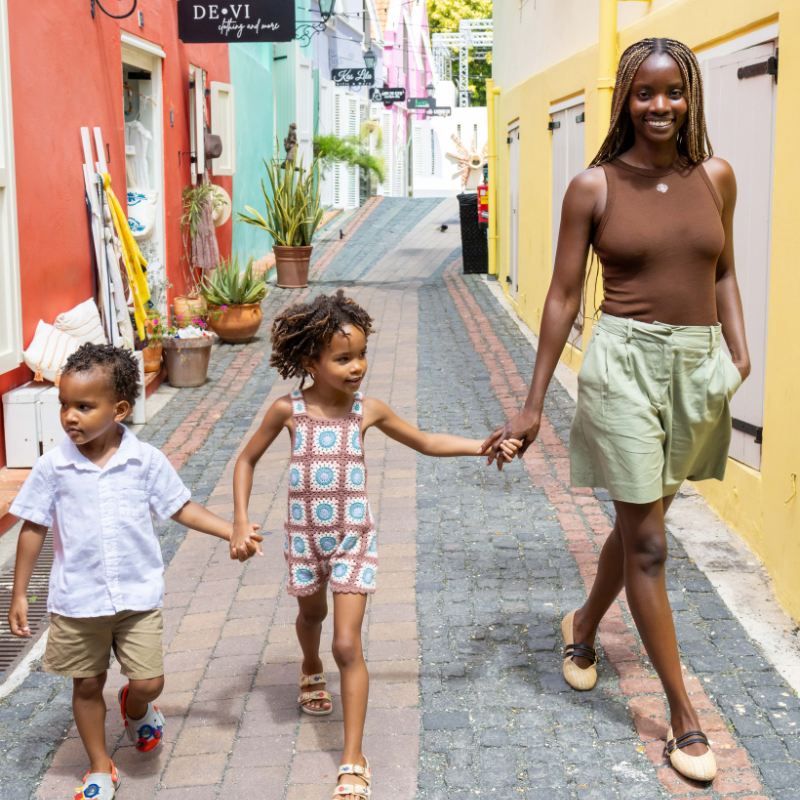
Matt Bowles: My guest today is Joanne Paul. She is the founder and CEO of Ileo, a place-based learning ecosystem for world schooling and homeschooling families rooted in Curacao and built on local partnerships. Born to Haitian parents and raised between the U.S. and Haiti, Joanne brings a uniquely Caribbean perspective to the world schooling space. She is one of the only World School hub founders native to the region she serves.
Joanne, welcome to the show.
Joanne Paul: Hi, Matt. Thank you. I am excited to have this wonderful conversation with you today.
Matt Bowles: I am so excited to have this conversation with you and I’m super excited also that we have agreed to make this a wine night. So, let’s start off by talking about where we are and what we are drinking. I am actually in the Blue Ridge Mountains of Asheville, North Carolina tonight and I have just opened a red blend from the Côtes du Rhône region of France. So, I am going to be drinking through that tonight. But where are you and what are you drinking?
Joanne Paul: I am in the north suburbs of Chicago in Cary, Illinois. Usually when I say Cary, Illinois, nobody knows where it is. So, I kind of have to say Crystal Lake, Argo Queen area. And then people are like, okay, I get it. Tonight, I opt for some red wine. I am not a big drinker, so I go for something smooth and sweet and here we are.
Matt Bowles: Here we are. That sounds perfect. And as you know, I was born in the northwest suburbs of Chicago. You though, were actually not born in Chicago. And I want to talk about your backstory right out of the gate. But before we even talk about your story growing up, can you share a little bit about your parent’s story and what their life was like back in Haiti in the 1970s?
Joanne Paul: Both of my parents are Haitian born and my dad founded one of the first orphanages in the region of Kenscoff down in the hills of Haiti. And he was a community leader and he did a lot of food distributions and stuff. I have to say that my mom, without her, none of that would have been possible because she was the backbone to all of this. On paper, it’s my dad, but it’s really both of my parents that put all their sweat and tears into all of this. And then when my dad started to get sick, he had a stroke. And I believe it was early 90s. And one of my brothers took over. His name is Jean Lix Paul. And now he was able to open up a second orphanage in the north side of Haiti in Cap-Haitien. In 2003, my late sister, she passed away, but they together opened up a school as well in Kenscoff. And now there’s about 400 kids that attend the school. And both orphanages are still up and running in Haiti. And my brother is doing an amazing job kind of carrying on the legacy of my father. We all kind of contribute to it in our own way, but it’s big ups to my brother.
Matt Bowles: So how did growing up around that type of long-term community work shape the way that you thought about responsibility and belonging?
Joanne Paul: I think that my parents did amazing job not explaining their work to me, but just putting me into the environment by default. So, I lived in Port Queens, in Delmas area that is 30 minutes from Kenscoff. And then the orphanage was up in the mountains. It’s like 30-minute drive if there’s no traffic. And every weekend I would head up there and my parents would just open the door to the car and I would be so excited because it’s just a fill of kids and I’m just playing with them and having fun and not ever knowing the difference between, oh my gosh, my family are helping you, or any that. So, my parents did not explain any of that. And I think that that helped shape who I am today in the way of being able to relate to anyone and connect to everyone. Funny story about that, I think when I was in third grade, one of my teachers was having a field trip and. And they decided to pick a place that had mango distribution and happened to be owned by my uncle. And when they were trying to plan where to go, I was like, oh, I don’t want to go to my uncle’s job. Let’s go up in the mountains in the orphanage. That’s fun. And everyone kind of turned to me and looked at me rudely. And that was the first time I realized I was like, oh, this is what an orphanage is. Because they were like, who goes to an orphanage for fun?
Matt Bowles: So, when did you first, realize how unique it was, what your family was doing. And thinking back now, what impact did that type of upbringing have on your understanding of what meaningful work looks like?
Joanne Paul: That’s my first glimpse of realizing the work that my parents were doing at that time. But also, when I came to the U.S. and my sister was working on opening up a school, and then later on myself, I ended up doing a few fashion show benefits for the orphanage myself. And during that time, I was kind of, like, digging into the research and finding out more about my dad, because my dad passed away when I was about 11 years old. So, I was really digging into my roots and trying to know him more and what he did in Haiti and going back to Haiti myself to visit in that region, how people talked about my father and all the things that he used to do and stuff, and how they remember him still to this day. I remember going to a market in the city and. And there was a lady that said that she was from the Kenscoff region. And I happened to be like, oh, my dad founded an orphanage up there. And she was like, wait, are you Edner Paul’s daughter? And I’m like, yeah. And we had this great moment where she was like, oh, he did so much for the community. So, it’s still to this day, I think, that his legacy lives on.
Matt Bowles: Can you talk about your experience now, your childhood, what it was like growing up between the U.S. and Haiti, how old you were when you lived in each place, and how moving between those worlds shaped your identity?
Joanne Paul: Because my parents were humanitarians and doing the work of the orphanage, they had a lot of meetings in the U.S. And I like to say I was kind of born by accident. I think my mom was coming to a conference, and. And then they were like, we got to keep you. And then here I was born in the U.S. and then whenever she got the green light to take me back, she took me back. And then around the time I was born, my dad started getting sick. So, then I had an aunt who lived in Highland Park in the north suburbs. And they felt, at that time, with all the responsibility, mind you. I come from a large family. I have six brothers and five sisters. So that was a lot for my parents to handle, plus my dad being sick at that time. So, I was with my aunt from, I would say, two to seven. And then there was another conversation that they wanted me to be a part of my dad’s life, just to get to know him. So, I moved back from 7 to 13, and then from 13, I came back to the U.S. again.
Matt Bowles: What did Haiti teach you that the United States did not?
Joanne Paul: Community. Being able to walk outside and, you know, all your neighbors and everyone has each other’s back is something that I think I will always carry. And when I’m back in the U.S. I’m not used to it, especially in the suburbs. I’m just not used to that. If you have any issues, have any questions, you can just go to your neighbor’s house like that and just knock on the door and they’re there for you. And as well as Haiti is the first black republic in the world and the first Latin country in the region of the Caribbean as well. Haiti has left out a lot when it comes to being Afro Latino. But technically, Haiti was the first Latino country in the Caribbean. It has such rich history and the music; the food is amazing.
Matt Bowles: Can you share a little bit about that cultural element, the dynamics, what Haitian music has meant to you and for people that may not be familiar with it, maybe just share a little bit about Haitian music and then put people onto some artists.
Joanne Paul: I would say Haitian Creole in general, just so people can understand, is like a blend of African languages, native language, and a bit of European languages mixed into that. So, all of that is within the culture and within the music. So, when you hear Haitian Kompa, you will hear a little bit of Afrobeat, but you will hear a little bit of Latino sound in there. But it’s very unique and smooth, and it’s something when you hear it, you just cannot dance. I think the main Haitian artist right now that is breaking records is Joé Dwèt Filé, and he has recently done a collab with Burna Boy. Even if you’re not familiar with Kompa, I guarantee you, if you’re into Afro beats and all of that, you have heard this song. It will make sense once you do the research and listen to it, I’m pretty sure, because last year it was everywhere. For me, personally, I really love Alan Cavé. Alan Cavé is a legend and Haiti. And there’s a song, Se Pa Pou that I love, and there’s Tabou Combo that is very popular as well. There’s a bunch of different artists that if you just put kompa in there, Kompa, you’ll find a lot of good Haitian music there.
Matt Bowles: I’m also curious, when you were growing up in Haiti and living there, what you observed in terms of watching foreigners come to Haiti and live in expat bubbles, and what did you observe about that dynamic as a Haitian living There.
Joanne Paul: Yeah. So, after the earthquake In Haiti in 2010, there was a big rush of NGOs that kind of opened up in Haiti. And so, you ended up having a lot of expats coming and doing work after the earthquake. And what I noticed is that most of the time they would be in their own bubble and even if it’s for seven years, that it would be there. Not really making the effort to learn the language and really knowing the people too much, unless the person spoke English. So, I did befriend a lot of expats during that time. So, it kind of gave me a good idea of how they viewed the country. And for me, I feel like some of them would have enjoyed the country more if they integrated with the locals.
Matt Bowles: Can you talk more about what, what they were missing and what your observations of that taught you about cross-cultural engagement?
Joanne Paul: I think Haiti is very misunderstood, especially to the West. Like I mentioned before, it’s the first black republic. It holds a lot of history there and we have a lot of places that you can visit to learn. And there are historians there that are still alive talking about the history of Haiti. I love Bayyinah Bello; she is a historian that put me onto Haitian history. I think that if they took the time to really not only learn about the history, but really immerse themselves into the culture, they would enjoy it. And not see it only as a place that is just, we need humanitarian aid. It’s also a place that has beautiful white sandy beaches. Jacmel has so many beautiful waterfalls, and there’s street art everywhere you go. That’s amazing. You can see vendors out, always hustling and selling something. Because a lot of the time I feel like in the west, they sell us this idea that Haiti really needs us and this and that, but life is moving on. People are hustling and it’s very busy and stuff. And I think that to take the time to do the research about the country and get to know someone that is Haitian, that has lived or been to the country and love the history of the country, then I think that would make a big difference.
Matt Bowles: What responsibilities come with entering another culture, especially with privilege or economic mobility.
Joanne Paul: I think that when you’re coming in with that, you have to in some ways give back and work with the locals. I’m very big on working with the locals to bring sustainability to the economy in the country that you’re visiting, not only through staying in a five-star hotel, but also getting out there and trying to reach out to the locals and getting to know them in that way. I think that’s the best way to immerse yourself into the culture and understand what privilege you’re bringing in.
Matt Bowles: So, when you think back, how did growing up in Haiti shape your worldview and your politics and your understanding of global inequality?
Joanne Paul: It helped me to not necessarily believe what I’m seeing 100% in the media and to do my own research on things and also reaching out to people who have knowledge in that area and educate myself as much as I can. Because there is a lot of misinformation when it comes to Haiti. I think it’s one of the most beautiful places and people there are super nice. But what I’ve seen the media have done for the last few decades, when it comes to promoting Haiti, the media portraying a country in a certain way, I pause and I educate myself.
Matt Bowles: Can you talk a little bit more about how watching outsiders interpret Haiti shaped your understanding of power and narrative?
Joanne Paul: I think that it’s not only for Haiti. I would say even the continent of Africa as well. It’s all of those regions. History is told by the perceptive of the victor. Haiti has just a lot of history and has been treated unfairly, mostly because one, it’s the first black republic. And they were never given the chance to really fully be free, even though they fought for their freedom rightfully. France came in and told them, if you don’t pay this amount for damages from the war, we are going to come back and invade. So, Haiti at that time had its hands tied and it had no choice but to pay. I think now it would be equivalent of $33 billion. And all of that money could have gone to building hospitals, building roads, building infrastructure for the country to thrive. But all of that went to France. And the U.S. came and occupied Haiti in the 1920s as well. And they were there for, I believe, 19 years and did a lot of damage in Haiti. And of course, with all of that, there is going to be some type of corruption that births through the government. After all of that, and understanding that, I don’t just view Haiti as, oh, this is a corrupt country. I understand the complexity of everything that affected it to make it be where it’s at right now and it going back to what I said before, it’s the same. When I see another country struggling, I also pause and I’m like, what really happened here?
Matt Bowles: So, when you look back now, what parts of Haiti most deeply shaped you as a person?
Joanne Paul: For me, I grew up in Delmas Port-au-Prince area. Like I said, I had a pretty bright childhood where even in my neighborhood, I befriended a lot of the neighborhood kids. And we all were outside barefoot, playing soccer and making music out of nothing. One of my brothers who live in Canada, he recently came, and then he played a song that I wrote when I was 10. But it’s just so natural there in Haiti that you don’t even think of it. People there are just talented by default. And I was listening to a song, I was like, I should record this. But it’s the level of talent there. There’s a lot of art. And Haiti, it’s a big thing. Music is really big. So whatever struggle we’re going through, we use a form of art to help us get by.
Matt Bowles: I also want to ask you about languages. Can you talk about the different languages that you speak and the importance and significance that speaking different languages has played in your life?
Joanne Paul: Oh, huge. First of all, I do speak Creole. Haitian Creole. There are different variations of creole. There’s Creole for Martinique, Guadeloupe, because we were all colonized by the same person. So, we have variation of the creole. But if somebody’s from Martinique, I can kind of understand a bit of their creole, and vice versa, I think Dominica as well. So Creole is one, and then by default, French is one, and then by default, as well, Spanish. I don’t say that I speak Spanish fluently. It’s just a language I kind of know just because of the region that I live in. And it’s a Latin language. So, once you know a couple Latin languages, then it’s easier to navigate the others. And right now, because I’m spending a lot of time in Curacao, I am beginning to learn a little bit of Papiamento. And my kids are half Russian, so I know the basics of Russian.
Matt Bowles: Do different parts of your personality emerge in different languages?
Joanne Paul: Oh, yeah, for sure.
Matt Bowles: How so?
Joanne Paul: I think more of my sassy side. And I’m very funny and Haitian Creole. I find that when I’m speaking Haitian Creole, people just crack up. Whereas in English, I don’t know what it’s about, but I’m more serious when it comes to it. I don’t know if it’s because my education has always been in English. Even when I was in Haiti, I was in an international English school, so I learned English through that, whereas Haitian Creole was kind of spoken in the household, and it was just part of the culture. And the best way I could express myself if I really needed to say something.
Matt Bowles: Well, you mentioned that your kids are half Russian. Can you talk about their upbringing? I know, they’re super young. They’re five years old and three years old right now. But can you talk about how you are raising them, the role of language and the role of the different cultures in their lives?
Joanne Paul: So, they are half Russian and technically Russian, Polish, but mostly Russian. And they are fluent in English, they’re fluent in Russian. And I do put an effort to make sure that they know the language by simple things of going out of my element of the fresh, friendly in a lot of Eastern European women. And sometimes it can be hard because they are gangster. You’ll smile at them and they’ll look at you like, uhhmm. But once you get to know them, they are the sweetest. And once they, oh, Russian has your back. They have your back for life. But I remember one of my daughter’s closest friends, now, they had hundreds of play dates. Now, his name is Misha. The mother of Misha met me at a mutual friend’s birthday party, and she had just come from Russia, and somehow, she felt like our energies aligned and she went out her way to ask our mutual friend for my number.
And I remember when we had our first play date, she knew not a word of English, and we were just Google translating, so it became kind of that. But we both put in the effort to get to know each other in whatever capacity we could. And now she’s one of my best friends. And we used to do mama play dates together where the kids would be playing and we would do TikTok dances because that’s the only way we could bond. So, I go out my way to do that, and I immerse my kids into different activities and play dates. That kind of connects them to their Russian roots. For me, my side is by default. I have family that are in the U.S. So, it’s pretty easy to get them to kind of emerge themselves into the Haitian culture. But for the Russian side, I understood that that’s something that I needed to put in effort for them to be around, because it’s something I also want them to be proud of because that’s half of them.
Matt Bowles: So, your kids are growing up Haitian, Russian, American, and Caribbean all at once. How do you think about identity for your kids?
Joanne Paul: First and foremost, they’re Black children because that’s how the world is going to see them. So let me put that out there. But apart from that, they also have the Eastern European side of them, so I don’t want to deny that part. So that’s why I also put in a lot of effort in there. And one of the reasons why I chose Curacao as the place that is our second home, they kind of pride themselves of being multicultural and multilingual, and they welcome everyone there. And when my kids are there, I feel like I can have a sense that they feel more free because they can see themselves through where they are walking. They can see somebody that looks like their mom, they can see someone that looks like them, look like their dad, and everything in between. That is one of the reasons. Even in April, I invited one of my nieces to come for a couple weeks. And she’s also mixed race, and she grew up in the north suburbs of Chicago. And she told me, oh, it’s the first time in my life, I think I feel like I’m free and that I don’t stand out. And she’s very tall, so she’s like sometimes I could feel like a zoo animal because I’m the only Black person in the school, Black person in the team, and whatever I’m doing. So, she really appreciated visiting Curacao with us.
Matt Bowles: What benefits are you seeing or do you hope that your kids will get from growing up across languages, across cultures? What kind of worldview do you hope will emerge for them as they get older?
Joanne Paul: I feel like language is very big into understanding a culture when you can speak the language. I found that just knowing a Latin language has gotten me far and sense of being able to connect with somebody. So, I think that language can be a way of them being able to connect to different cultures wherever they go.
Matt Bowles: So as a family with so many cultural threads, how do you think about the concept of home? What does that word mean to you?
Joanne Paul: Home is…I think it’s planet Earth. Wherever we are, I don’t necessarily view it as a four-corner house, but I would want my kids to know that they feel at home anywhere that they are.
Matt Bowles: I’ve heard you say that your first choice for raising your kids would have been Haiti if circumstances allowed. What emotions come with that reality?
Joanne Paul: I think hope when it comes to Haiti, I just have hope that one day things will get better and one day they will be able to experience the culture. I could still take them up north. I know in the media the perception is the whole country is under fire. But really a lot of the violence and the gang violence is mostly in Port-au-Prince area. The downside to it is that Port-au-Prince is kind of like the hub for everything that moves through the country. So, it’s very hard to get to different regions, but the north is pretty Safe, that is somewhere. And it has the big citadel there. It’s very big historical monument. So, I would love to have them visit there and go to the different beaches, eat the food straight out from the water. So that’s on my bucket list. And I will take them. I probably will wait till they’re six or seven just so they can understand it more. But to be able to take them to the orphanage, that will be difficult because it is in Port-au-Prince. But I do have hope that one day things will get better.
Matt Bowles: What does it feel like to love a place deeply while also feeling unable to safely build your life there?
Joanne Paul: Frustration. Just because I know that there are things that could change to make it better. I know that there are outside forces, let’s just say that is making sure that Haiti stays in the condition that it’s in. So, I would say frustration.
Matt Bowles: How did you initially think about integrating travel into your kids’ lives and then ultimately think about world schooling? How did that come about? How early did you decide that you wanted to prioritize that? What was your thinking around the importance of that as an aspect of your parenting?
Joanne Paul: I moved back to Haiti to build the atelier and it was doing well for a while. But due to the political violence in Haiti, I kind of had to move back. But even then, I moved to Montreal, Canada for about a year and then I met my kid’s father here in the north suburbs. But I never felt like, okay, my foot is in the U.S. But I think that when we moved to Cary a couple years ago, within three months of moving there, my daughter kind of had a little bit of complex about her hair and her skin tone. And it really destroyed me as a Black mother. And I was trying to find solutions and did my research and I realized that I’m not sure if, if I would want them to go to the public school, at least near where we currently live. And I was looking for different options. And my daughter was thriving in homeschooling and I wanted to keep that that way for as long as I could. Although it took me a while to kind of accept that I’m homeschooling. And I would always say, oh, when she goes to kindergarten, we’ll put her and public schooling. But then when I did my research about world schooling, I was like, oh my gosh, this is possible to actually continue this and have her learn through places that we love. So, I was very interested in not only world schooling as just hopping from one place to another, but also place based learning. Immersion ourselves into the culture, getting to know the locals, getting to know everything about the culture. So, every time we go to Curacao, we have a very big immersive experience and they’re learning Papiamento. I make sure that they’re around locals there. So, there’s a lot that I integrated to make this possible.
Matt Bowles: So, can you talk about why you chose, of all places, to go to Curacao the very first time and what you remember as your first impression when you stepped off the plane the first time in Curacao?
Joanne Paul: Curacao happened by accident, to be honest. We had gone to the DR the year prior, and I enjoy it. We went to a town named Las Terrenas. There is another friend of mine who is also Haitian that lives in Las Terrenas. We visited her. We stayed there for a few weeks, and then we were supposed to go back to Las Terrenas for about three months. But around that time, there was a lot of discriminations against Haitians and there were even Americans being deported accidentally to Haiti during that time. It just didn’t align with my views. So, I decided that I would rather go somewhere else because everything was booked. The housing was booked, even the school. There was a tiny world schooling hub that was there. We booked everything. We were ready to go.
And then last minute, my heart wasn’t there. So, I was just like, I know I’m going to lose some money, but I’m not going. So, I decided to look through different regions in the Caribbean and that’s when I really did my research of finding out regions in the Caribbean that kind of has unity within multiculturalism and accepts everyone from wherever you are. And then that’s when I stumbled upon Curacao and I was like, wow, this looks too good to be true. I need to experience it myself. And then literally within few days, I book the tickets, book the Airbnb. And we were there for three months and we fell in love with it and we’ve been going back ever since.
Matt Bowles: Why did you fall in love with it? What was so magical about your first experience?
Joanne Paul: It is very peaceful there and the people are very welcoming and very eager to share their culture with you. And if you have any questions and if you need anything, they are very open and being able to walk in Curacao and openly hear even Creoles spoken, because there’s a small population of Haitians that live on the island and a lot of them are vendors. And being able to just walk and being able to just know that I’m also contributing to my people as well, that felt amazing. So, we bought some dresses, we bought some fruits and vegetables from some of the Haitians that we met there. I’ve asked them questions about their experience in Kras because I understand that I’m also coming from a more privileged place than them. They’re coming there just to work and they in some ways getting a better life. So, it was good to also talk to them to get their experience. And they had nothing but positive things to say about Curacao.
Matt Bowles: Can you talk more about how different languages and cultures are not just tolerated there, but woven into daily life?
Joanne Paul: There’s this place called a floating market and there’s a lot of Venezuelan vendors that come every morning with a boat. I don’t know if they come every morning, but they at least spend a month there. And they have the boats there. They bring the fruits and vegetables from all over the neighboring islands. And when you’re there, language flow like a wave in some ways. So, if you speak English, they will speak English to you. If you want to switch it to some Spanish, then they will switch it to Spanish, switch it to Papiamento. They got you Dutch. They got you. Like I said, I found a lot of Haitians there. Don’t switch it up. It’s just normal to them. So even the taxi drivers, sometimes I will look at them, I’ll say a word in Creole just when I’m not sure and they’re like, oh. And I’m like, yeah. So, language is just woven into it. So, you can find somebody there naturally that just speaks four to five different languages.
There was one time I took my daughter and my son to the playground and there was another child who came up to her and she started speaking Dutch. And then my daughter looked at her like, I don’t understand you. And she switched it to Papiamento and my daughter still couldn’t understand. And the mom was like, wait, I think they’re American. And naturally this four-year-old child was able to switch it to English and was like, oh, what I was trying to say to you. Do you want to come on the slide with me? It’s one of the few places that I visited that’s been able to do that. So, I love it and it’s safe for the kids. As someone who solo travels with my kids and as a Black woman, it’s very important for me to feel safe and for my kids to feel safe. Safe when I’m walking down the street. And Curacao is one of the few places I think around the world where it can be 9pm and I could just walk along the bridge with my kids and go to the carnival and watch the parades and walk back home and not feel that I’m going to be discriminated against or being attacked.
Matt Bowles: So, for your kids in particular, in terms of the experience for them and in Curacao, what aspects of being there have made them feel seen?
Joanne Paul: When it comes to multicultural, you’ll see just different people there and different mixes of people. You’ll see a mix kid that has curly but it’s super blonde. And you’re like, what’s going on there? And then you see the grandma and you’re like, okay, I get it. You get different levels of mix and everybody coming from a different culture and everybody is integrating and welcoming and fusing together. I think for them to see that, it gives them a lot of confidence. My daughter does judo. Whenever we go to Curacao and when we go to a classroom, every single child looks different. And I think that that’s beautiful. And they’re super sweet to each other. And I’m like, wow, that’s amazing. No one is creating cliques with each other.
Matt Bowles: Well, I want to talk to you about your amazing place-based learning project for world schooling and homeschooling families called Ileo. And before we dive into what that project is about, can you just share a little bit about your professional background? I know you’ve worked in education in the Chicagoland area. I know you’ve worked in the modeling industry. Can you just share a little bit about your professional journey and what led you to decide that you wanted to be the founder and CEO of a project like this?
Joanne Paul: Well, I feel like I describe my life as an abstract puzzle. Nothing looks like it should fit. But once you put everything together, there’s a clear, beautiful picture that comes out of it. All of the skills that I’ve learned throughout the years has helped me to build Ileo and to be at the place that I’m at right now. But my first introduction to everything was in fashion modeling. I started modeling as a teen and then during the modeling, I also ended up finding a job at the high school that I graduated from. I was doing research on children with autism and I was just visiting the school and I asked if there’s any way, I can volunteer to learn more about these kids. And then they were like, well, we don’t do that, but we do have a position open if you’re brave enough to come and do an interview. And I was like, okay, I’m going to come.
And I got it. And I was a TA for three years and it was the most rewarding job I’ve had so far. And it helped me to really meet kids where they are when it comes to learning. And I think now that I’m homeschooling my kids and they’re learning differently, that has come in handy when it comes to that. After being in Holland Park High School, I ended up going back to Haiti. And I really wanted to be in Haiti to learn about my culture, reeducate myself on a lot. And I felt like the best way to do it is to go back home. And I did that. And while I was there, I built an atelier with some amazing seamstress sewers and fashion designers down in Haiti. And we built a manufacturing company there. And our goal was to build sustainable jobs for these people. It’s technically still open, but it’s only open to the locals. So not internationally, but internationally, we’ve just done a pause on it until things get better in the country and then we’ll start over.
The main people who work with me are mostly in the U.S. trying to get a better life, but I’m still in communication with all of them. Some of them are my best friends. Then motherhood happened. And I think that that’s when all of these skills, the abstract puzzle, started coming together. And I kind of used all of that to build Ileo. And so, I started homeschooling my kids and not knowing that I was kind of part of the world schooling niche. And I fell in love with Curacao and bringing them back over and over again. And I’ve met families while I was there doing the same thing. And then I started hearing the buzzword about world schooling. When I did more research on it, I realized, oh, I think that is kind of what I’m doing. Although mine is more like a place-based learning, kind of immersing myself into the culture for a little bit longer period of time. But it is the same thing.
And through that the idea of ELO came because that’s something I did not see happening in Curacao or Aruba or Bonaire. So, I said, let me take the chance and try to build something here. The partners that I’ve had so far, they’ve been amazing and responding. So, all of my partners are local. We partner with two of the biggest management companies when it comes to housing on the island to ensure that the people when they come for the cohorts, that they are comfortable, safe. And we partner with local co working spots on the island as well. And then I have a partner with the Children Museum that does the educational part of it as well as locals who will take the kids into the immersive field trip experience, going to the ostrich farm and learning about the African ostriches that are on the island. And the kids will get to even eat an ostrich egg if they like. So, I’ve worked really hard on this in a short period of time, but I’m very grateful to the locals in Curacao that make it happen because I kind of had the idea and I put it together really in two months it all came together and finalized all the partnerships and all of that. And here we are in March, we did our first trial and it went very well. We had people who came from Canada, Venezuela participated in it. And our official cohort will start in the fall.
Matt Bowles: Well, I think it is first of all absolutely brilliant how you have been so strategic and thoughtful about integrating your passions for travel and business and motherhood and family life into this project. I’m wondering if you can start from the very basics and just explain what Ileo means, what that word means. And then if you can explain, I know you’ve now done a lot of research into the world schooling space and all that. What makes this particular project so unique?
Joanne Paul: The word Ileo, ile means island and o is for our global families that are going to come to the island. And so Ileo, there you go. And I think that for us, we create a full ecosystem for families who are visiting Curacao. And our goal is for people to experience Curacao and its entirety. And that’s why I really put an emphasis that I partner with locals to make that happen. And we provide housing, co-working space, community. I think the difference would be that I am aiming to not have a lot of the families be in just the cohort bubble, but to integrate them into the local scene. And if there’s a workshop, I will make sure that it’s a workshop that also involves some of the locals that live there. Because if you’re going to experience the country and culture, that’s the best way to experience it in its entirety. Not just in a bubble, but also through the people who are living there.
Matt Bowles: How did you think about building something that that contributes to a place rather than extracting from it?
Joanne Paul: Having come from a family that was humanitarians that were giving back to community, my aim is always to give back to the people from that region.
Matt Bowles: Okay, so let’s talk about exactly what the offer and the experience is. Who is this for and then how long is it for and what is the day-to-day experience like, like what exactly is the offer?
Joanne Paul: This is for homeschooling parents, world schooling parents, place-based learning parents that want to come to Curacao to emerge themselves into the culture. And like I said, we provide the housing, the community access, the co-working space and all of that in there, but also the education with the partnership of the Children Museum. And they do theme related projects that is also based off of the island as well. So, the families get all of that in the curriculum. But our first cohort will be in the fall. We will have a fall cohort, we have a winter spring, and we will have a couple camps during the summer, in July and August and from December 2nd to January 2nd. That is our most flexible time where we welcome people to come in if you want to experience it for a week to see if Ileo is for you or not. A week, two weeks, three weeks, four weeks, however long you want to stay, that’s the best time to come. If you just want to dip your feet into Ileo and see how the water feels, you can do that. But most of our cohorts are from a month to three months. So, you have a choice of staying for 30 days, 60 days or 90 days.
Matt Bowles: So, tell me about the first trial cohort that already happened. Who pulled up and what was it like? How did it go?
Joanne Paul: It was something that we came up together with the Children Museum. It was very quick, so I wasn’t even sure if we were going to have anybody that participated in it as much as we did. But within two weeks we had a family who came from Canada, one from Venezuela and one from Mexico. And I’ll just count myself in there because my kids enjoyed it. So, Haiti, shout out to Haiti. It was a great day for the kids because we usually started the day with free play to just get the kids to feel comfortable. And at the children museums, they have several rooms that is very interactive and it mirrors the island. So, I think in the beginning of the conversation I mentioned the floating market. They literally have a room that mirrors the floating market. And the kids can go with the carts and put the fruits and vegetables on a boat there. And we do STEM a lot of engineering. And that day our team was rangers and they got to make some badges and go treasure hunting for whatever they can find in nature. And one kid found a leaf that is the shape of heart. And it was great to see the kids’ kind of teaming up together. And we’re excited for any little thing that the other one found and they were cheering for each other and it was just a happy day. And we got wonderful feedback from that. And you guys can check it out on our social media.
Matt Bowles: Well, it sounds amazing if folks are listening to this right now and they’re thinking this sounds like something for them that they would love to participate in. Can you share the details about the upcoming cohort, what the dates are for the fall of 2026, and also if it’s possible for Maverick Show listeners to get a special discount?
Joanne Paul: Yes. So, our first cohort will be in the fall. It starts September 1st but you can arrive starting the last week of August if you like, from September 1st to December 2nd. And you have the option of staying for 30 days, 60 days or the full 90 days if you like. The Maverick Show listeners will get a $250 registration fee waiver per family when you book with us from any of our cohorts between 2026 and 2027. And that includes our fall, winter, spring, December, and even our camps. And all you need to do is just mention it when you book a consultation with us. The code is MAVERICKPODCAST. That’s it.
Matt Bowles: Amazing. We appreciate that. We’re going to link all of that up in the show notes, folks, so you can just go to themaverickshow.com. Go to the show notes for this episode. We’re going to have the direct link where you can see all the details about the upcoming cohorts as well as your special link to get the $250 fee waiver for your family.
Joanne, I want to ask you just now about a couple reflections. When you think about what you’re building here and what you’re creating, what part of your parents’ legacy do you recognize in yourself through Ileo?
Joanne Paul: I think for me it would be always being about community. That is the big one. And also getting the locals to be involved because that is their country, that is their culture, and they need to benefit from this as well.
Matt Bowles: And how do you think that that travel and moving across different cultures affects your children’s sense of belonging and culture and identity?
Joanne Paul: I think it affects them in a positive way because since I was pregnant with them, I’ve been flying with them. So, they’re pros right now. And I always make this joke. I feel like they behave better when we’re traveling or when we’re out than when they’re in the house. So usually for most parents it’s the opposite, but for me it’s when we’re out and about traveling and exploring. They’re just super excited to be on the plane. They’re super excited to land, no matter what time it is. And wherever we are, they feel very comfortable. And they jump in to integrating with the culture right away.
Matt Bowles: And as they continue to grow up and get older, what values do you hope that this lifestyle instills into them?
Joanne Paul: That this world is for them to explore and they belong wherever they go. And as long as they are respectful to the culture and do extensive work within them to give back to the culture that they’re learning from, taking the time to learn about each place and getting to know not only the culture, but the people that make up that place, I think that they will be fine.
Matt Bowles: Well, I think that is actually the perfect place to end the main portion of this interview. And at this point, Joanne, are you ready to move in to The Lightning Round?
Joanne Paul: Ooh, I am ready. Let’s do this.
Matt Bowles: Let’s do it. All right, what is one book that you would recommend that people should read?
Joanne Paul: I think that it would be The Color of Emotional Intelligence by Farah Harris. I believe that she’s Haitian born. Her book is amazing. It is groundbreaking and it talks about background of identity and influence of our emotional intelligence, how it shapes our relationship with others. So that would be the book I would recommend. It’s a good read.
Matt Bowles: And who is one person currently alive today that you’ve never met that you’d most love to have dinner with? Just you and that person for an evening of dinner and conversation?
Joanne Paul: Lauryn Hill.
Matt Bowles: That’s an amazing pick.
Joanne Paul: Lauryn Hill, for sure. Her lyrics as a Black Woman has gotten me through so much, and I would love to have a conversation to see who she is and as well as dig into her brain, how do you think that way? You’re just a genius. And I know we talk a lot about her album Miseducation of Lauryn Hill, but even though it did not get good reviews at that time, when it came out, the Unplug album that she did, I think with VH1, that album right there really was amazing. I think it was just before its time, but I think if you go back to listen to it, you will say this woman is a genius. And if I get the chance to just be able to sit with her and talk to her, I think I would just be a listener.
Matt Bowles: That would be an amazing dinner. I love that pick. All right, if you could go back in time, knowing everything you know now, and give one piece of advice to your 18-year-old self. What would you say to 18-year-old Joanne?
Joanne Paul: I feel like if you asked me that question a few years ago, I would have had a bunch of answers for you. But I think my favorite quote by Sidney Poitier, it says, I would not change anything because one change would alter anything that follows. With that said, I would just say, well done with what you had. You did an amazing job with what you had. I have no advice for her.
Matt Bowles: All right, of all the places in the world that you have now traveled, what are three of your favorite destinations in you would most recommend other people should definitely check out?
Joanne Paul: I think that Montreal, Canada, I really like the scene just because it is very diverse and in the West, I think it’s one of those places where you can see that people really integrate with each other and they are very welcoming for the most part. And you can walk down the street and there’s different restaurants from different regions of the world. And I have a few nieces and nephews there and a lot of their friends, when they become best friends with them and vice versa, they learn the Creole language. I like that vibe. So, I like any country that does a little bit of multilingual within it. So, I would say Montreal is one, of course, Curacao. And I know right now Haiti as a whole is not the best to go to, especially in Portuguese. But Cap-Haitien is open for anyone who want to try it. There are still some amazing historical sites down there. I will try to make it out there this year if I can. So that’s my recommendation.
Matt Bowles: All right, and what are your top three bucket list destinations? Places you have not yet been highest on your list you’d most love to go?
Joanne Paul: I think Haiti, outside of Africa is an extension of Africa. We hold a lot of the culture of African culture. Rather, if it’s in our voodoo, what if it’s in the way we dance? We have a Racine type of dance that stems from Africa. And we really pride ourselves and have a lot of black pride in that sense. And because of that, I need to make it out to the continent of Africa. And a lot of my best friends are from the continent of Africa, so that is big in my bucket list. But mainly in Senegal, for sure. I need to make it there. And Ghana for sure. And Nigeria, even Benin and Togo. I would love to visit those places. I’m adding more, but yeah.
Matt Bowles: All right, we’ll give you five.
Joanne Paul: Yeah.
Matt Bowles: Well, as you know, because you and I have talked about this, the West Africa region has a super special place in my heart. I have returned many times and spent over a month in Ghana. I’ve been there a couple times. I’ve spent a month in Nigeria. I’ve been back to Senegal three times and spent about three months.
Joanne Paul: I know you said that you went to Dakar.
Matt Bowles: It’s one of my all-time favorite cities. As you know, there’s a whole bunch of Haitians in Dakar and I’ve hung out with them and it’s just a super special and amazing and wonderful place. And so, I know you’re going to love it at least as much as you imagine you’re going to love it. So let me know when you’re ready to plan that trip and happy to give you some tips on that. I also know, speaking of the continent, that you are a big fan of Afro beats. You and I have bonded over that as well. So, for the next lightning round question, I want to ask you to name your top five Afrobeat artists.
Joanne Paul: Ayra Starr for sure. She’s amazing. Tems. I have Tems on replay. Her voice is, I don’t know, it’s from another world. I love every music that she creates. And Burn Boy, I really enjoy Burna Boy. And Davido to me was one of the original artists that introduced me to Afro beats, his first Single. And then Mr. Eazi.
Matt Bowles: Amazing. All right, Joanne, we are going to close this out by asking you to name your Top 5 Hip-hop emcees of all time. I love that little prelude that you just gave that beautiful ode to Miss Lauryn Hill. I thought that was an excellent lead in to this conversation. Now before you name your five though, can you share a little bit more about what hip-hop music has meant to you and why you love hip-hop?
Joanne Paul: As you can tell by the conversation we have, I love art, I love music, I love any form of expression. So, the hip-hop is one of the most expressive genres of music that you can listen to and its impact in the world is unmatched.
Matt Bowles: All right, last question. Who are your top five?
Joanne Paul: Of course, Lauryn Hill and I gravitate towards emcees that are lyricists and have a bit of poetry in there. So, I would say it would be also the Fugees, Wyclef Jean as well. Their impact internationally as a group was just amazing. I remember being 8 years old and I was in Haiti and they actually visited Haiti and did a concert in Haiti. I remember the room. I’m still looking for that tape because it’s iconic. It was a room full of 20 of my cousins and my brothers when they came to Haiti and it was black and white screen and we were all dancing and it was just a different vibe in the island when they came. And Wyclef has meant so much to the Haitian population. So big ups to him and the Fugees. And then the next one would be Nas for sure. One of his albums I really love that impacted me the most is the one that he did collaboration with one of the Marleys. I believe it was Damian Marley. That album, it was on repeat for a whole year. I love history, I love poetry. And it had all of it in one. So, if you guys haven’t listened to it, go listen to it. You will not regret it. And then right now, currently, I would say, of course, Kendrick Lamar To Pimp A Butterfly that to when I’m working out, I listen to all the time and I will give one that is not American. I believe they’re from Montreal, Canada and I think the Fugees influenced them a lot. I think they’re descendants of Haitian as well. So, they have a little bit of Creole in it. But it’s called Muzion and they’re from Montreal. Their music is amazing. It would be great to check it out.
Matt Bowles: Amazing picks. I finally got to see Wyclef perform live about four years ago. And just like you, I can remember when the score dropped. I literally remember when the carnival dropped and I just listened to that album just over and over and over and over again.
Joanne Paul: Masterpiece.
Matt Bowles: I have been such a fan and I finally got to see him perform live four years ago and it was in a bit of a smaller venue, so you get really close, and so, it was really special. But I love those picks. We’re going to link everything up that we have discussed in the show notes. It’s all going to be in one place, but let folks know how they can find you, how they can follow you on social media, how they can learn more about Ileo. How do you want people to come into your world?
Joanne Paul: Okay, so Ileo.life. You can go on our website. That’s where you’ll get more concrete information about us. It has all the information about how we learn how we live and our community and it has all that information up there. But if you would like to check us out on social media as well. We are on Instagram. You could check us out @ileo.life as well.
Matt Bowles: Amazing. It’s all going to be in one place, folks. You can just go to themaverickshow.com, go to the show notes. For this episode we’re going to have direct links to everything we have discussed, including all of the musical artists that we have mentioned. So, you can go listen to them all. All of the ways to find, follow and connect with Joanne, as well as your discount code how you can get your $250 registration fee waived. If you and your family would like to try a cohort in Curacao, which sounds amazing, all of it is going to be linked up in the show notes. Joanne, thank you so much for coming on the show. This was such a special conversation.
Joanne Paul: Thank you so much for having me. I know it happened so quickly, but I’m glad it did.
Matt Bowles: Absolutely. And I’m excited to hang out together somewhere around the world. Maybe in Senegal, maybe in Ghana.
Joanne Paul: Yeah, you should come to actually Curacao during winter, the carnival season. That’s the best time to be there. I will for sure be there during that time. That’s the best time to really experience Curacao as a whole. But like you said, if not then maybe Senegal or something.
Matt Bowles: I have not yet been to Curacao so I would love to go. And if you’re going to be there and that’s the time to go, that actually sounds like a pretty amazing offer. So, let’s definitely be in touch and maybe we will link up there. But this was such an amazing conversation. I appreciate you coming on the show and good night, everybody.