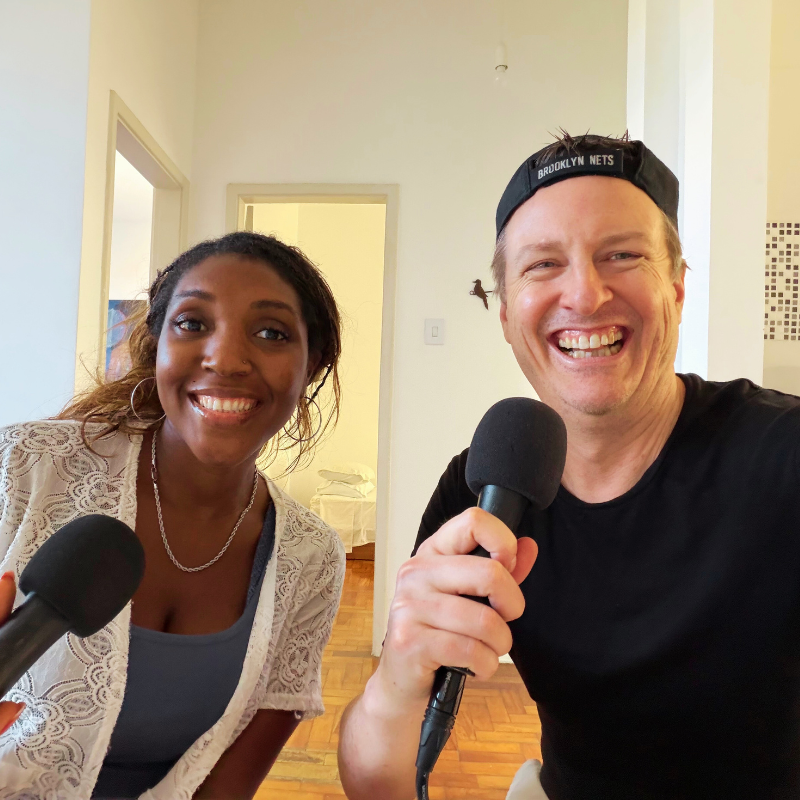
Matt Bowles: My guest today is Courtney Orgias. She is a global mom, world schooler, and travel advocate who believes family life doesn’t have to fit inside one zip code. She and her family slow travel around the world, working remotely and building community with other families living abroad. On her platform, O Family Adventures, Courtney shares the real side of global living, from finding childcare to choosing the right neighborhoods to jug work and play. She also showcases how being a global citizen helps to develop broad compassion and gives her children the gift of a borderless future. She is on a mission to make a global lifestyle accessible for more families, with an emphasis on those in marginalized and vulnerable communities. She and her husband Justin are the founders of the Village Abroad, which organizes global retreats for digital nomad families and those who dream of living abroad because raising global citizens takes a village.
Courtney, welcome to the show.
Courtney Orgias: Hi. Thank you for having me. You made me sound good just now. I’m like, ooh, who is she? I want to meet her.
Matt Bowles: You are doing amazing things in this world. Maverick Show listeners, of course know your husband, Justin Orgias, who was on the show about a year ago. We all just hung out in person and you and I are doing this interview in person today in Rio de Janeiro.
Courtney Orgias: Which is so fun. It’s such a treat.
Matt Bowles: And we we’re here because, well, you are based here now, but I came because we both just attended the Black Travel Summit. Can you share a little bit about how the summit was for you. And I know that you spoke at the summit last year, so maybe share a little bit about Black Travel Summit, what the event and the community mean to you and then how the event was for you this year.
Courtney Orgias: Yeah. So Black Travel Summit’s amazing. It’s always nice. And I’m sure this is something you appreciate when you have a curated space where you can show up authentically and there’s action and there’s resource and there’s community. And it’s not just putting on airs and taking pictures. You know how content creation and some of these events can be. What I love about Black Travel Summit is that the organizers and the people behind it really put their all into making sure that if you’re coming, you’re getting something out of it. So, this year, Justin actually took part in the accelerator program for the Village Abroad, which you just mentioned, which was exciting. He got mentorship and had calls. He was connected with all these other founders and he actually took place in the pitch competition and he won second place.
So, he brought home a big check, which was very exciting. The kids ran around the living room holding it up over their heads and it was huge. This was our second summit. The first time we were able to give a workshop when we were in Fort Lauderdale about living and moving abroad with kids. And that was great too, to be able to connect with other people. My favorite thing is always that it’s a situation. If you come to Black Travel Summit, you’re going to leave feeling connected and fed and on a little bit of a high, to be honest. And it doesn’t hurt when it’s in Rio de Janeiro.
Matt Bowles: Well, you are now based in this amazing city. It’s actually my first time back to Rio in 10 years. I’ve been to Brazil multiple times. I think this is my fifth time in Brazil. But the first time I came to Brazil, I came to Rio and I came for two months and I did not leave Rio for a single day because I was like, I don’t believe any other part of Brazil can be as amazing as Rio. I stayed here for the full two months and then subsequently I came back to see other parts of Brazil. And now I am back in Rio for five, five weeks. But I know your family has lived in a lot of different places. Why are you currently choosing to be based in Rio? What do you love about this city?
Courtney Orgias: Oh, my God, there’s so much to love about Rio. There are the obvious things, right? Like it is gorgeous between the beaches and the Mountains and the people. And there’s so much culture here to dive into, especially for black people. With the Afro Brazilians and the black culture here, it’s actually happy Black Consciousness Day. That is today, while y’ all are hearing this on the other end of the microphone, it will have passed. But to you, happy Black Consciousness Day. But I think with Rio de Janeiro too, there’s something in the air. They’re the practical reasons.
So, there are a lot of parks, there are a lot of bilingual international schools for the children. It’s very walkable, the public transit is great, right. So, it hits the practical boxes, which Justin loves. And then there’s the boxes that I care about, which is the vibes. So, I’m actually sitting right on a Jupiter line. Some of the Astro cartography here in Rio de Janeiro, which is amazing for me. I wake up every day feeling great, great. I think that the food is good and the music is lively and the air is fresh and I don’t know, there’s just something about being here that’s so captivating.
And we were here at the beginning of 2023. My daughter actually took her first steps here and when we left, we went all over the place, went back to Mexico, we’re in the us, we’re in Canada, we went over to Portugal, we spent time in Spain. And every day I woke up and I’m like, ah, but it’s not quite Rio, is it? When that little thought nagging, I think in the back of my mind, what drove us to come back and we said, we have to see, you know, is it really that great or was it really just a great couple of months that we spent there? It wasn’t conflated. This really is just one of the most amazing places on earth.
Matt Bowles: How is it for raising kids in particular? Can you start by introducing your kids, Xavier and Whitley, how old they are, talk a little bit about them and their passions and then how is it for raising kids in this particular city?
Courtney Orgias: I have two beautiful, perfect, smart and I will gush about them all day if you let me, babies. Xavier is six and Whitley is about three and a half. They are both very sassy. Xavier and Whitley are both also very smart. Zay likes to build things with his hands. He’s left-handed. He’s very creative. He likes to make play doh sculptures and then dry them in the sun. Whitley loves to move. She’s always running and jumping, gymnastics, the capoeira—the dance fighting. She sees people do it at the park and she’s trying to jump in. And they both just love to run around. They’re full of energy and they are the lights of my life and I love them so much. They were both born in the us, but actually Whitley was almost born in Mexico. Justin and I went back and forth and back and forth and back and forth about it. He wound up winning, which I won’t let him live down ever.
But they’ve been traveling all over the world since Whitley was 10 weeks. That’s how old she was when we left the U.S. and took off for the first time after selling everything. So, they’re also just incredibly flexible, curious, adaptable kids. Nothing really surprises them or like knocks them, you know, they’re rarely are they taken aback because they’ve seen a lot for their ages. And that’s part of what makes raising them here a lot of fun, is because the culture is so vibrant, because you can go to the park and there’s going to be a festival or a concert or people are running around in different costumes or so much different music. I think they really thrive being in a space that is so lively and so just turned one all the time.
Matt Bowles: And as parents, can you talk about the city in terms of the schooling and the childcare and living here as a family and how that has been for you in Rio?
Courtney Orgias: So, it’s been a fairly easy adjustment. I think the first thing when we came here the first time, and the first question everyone always asks that’s top of mind, is about the safety in Rio. How about the safety and the favelas and the SAT and the third. And I will say that both times that we’ve been based here, we’ve lived in three or four different neighborhoods and we’ve never had any safety concerns. No one’s ever tried to snatch my phone or snatch my kid or do anything weird, which is nice. I’m not sure how exactly the social inequality here that’s so stark is balanced in such a way that that’s the reality, but that’s our lived experience.
And the acclamation, yeah, is pretty easy. We toured a few different schools for the children. We always try to find when we do a brick and mortar, because we do a mix of schooling, but when they’re going to be in a brick and mortar, we look for a curriculum school that is bilingual, English speaking, just because that makes it simpler. And while they have some Spanish, they don’t have any Portuguese, so we don’t want them completely drowning in that. And then after that, it’s just about the practical steps of being able to line everything up. So, making sure that we’re doing our proper scouting to know what neighborhood we want to be in, where are the grocery stores, where are the parks, all of that sort of stuff and just putting those pieces together.
Matt Bowles: Well, I want to talk a little bit about your background now and give folks some context on your story and how you eventually got to live this digital nomad lifestyle. And I feel like a good place to start would be all the way back. Can you talk about where your parents are from? And then we got to represent for where you were born because your county is more famous than your city, Courtney.
Courtney Orgias: I know, we get to a point where everyone hears do all and they already know what’s going on with me and the Jags. I was just saying maybe not, not this year for the super bowl, but for sure next year for the Super Bowl. Don’t quote me on that, but I am American, unlike my husband who is a Canadian. And my father was born up in Cincinnati, Ohio, a product of the second great Migration. And my mother was born on a naval base in Virginia, so she was a Navy kid, but she grew up in Jacksonville, Florida and the Duval, my hometown, 904. And I was primarily raised post elementary school in the Atlanta area.
Matt Bowles: So, what was your experience like coming up in Atlanta? How did your interest in travel start to develop growing up?
Courtney Orgias: We road tripped a lot. We did some cruises. I had some pretty typical experiences of driving around, whether it’s up to Ohio, down to Florida. We did that quite a bit. And then even being a Florida kid, you know, you’re going to Disney and Busch Gardens and taking cruises because the cruises are always leaving, heading down to the Bahamas. But I would say that’s also a lot more like vacation. And so even breaking up the notion of what is vacation and what is travel and getting into the semantics of that, I didn’t really have a heightened interest in travel until I got to college and I did a study abroad for my psychology degree in Denmark because it’s a blue zone for happiness even though they consume more antidepressants per capita than any other population in the world.
But there is some evidence to suggest that that’s because of the sun and seasonal depression and they’re very up north and blase blah. They’re happy though, and they have great pastries. And being able to get over there, I think was the first time that I was really immersed in a different culture. And I looked around and it’s a very obvious thought, but it shifted everything regardless. And I was just like, wow, people do things differently in different places. That was really the only thought. I was like, huh? In different places things are different. And it’s very much like one plus one is two. But it’s sort of like that little bit of thread on the end of a sweater and once you pull it, there’s so much that follows and everything starts to unravel. And then you have questions and you’re like, what are things like other places? And like, are they happier and is this better and what should I be doing and can I do that?
And it just brings you to a place where you’re like, well, I won’t know unless I do, unless I see, unless I go. And so, I think that’s the thing that kind of really just kicked off the bug for me. I grew up with a dad that was very much one of those people where it’s like you can’t just accept what you see and believe what you’re told, what you read or what you’re presented with. You really have to go seek knowledge and information for yourself. You’d say you never take anything as pure gold. And I think that with travel and lifestyle and starting to see how just different pieces of what was already in my head and what’s going on socio politically and things that are happening in other parts of the world start to come together. It really does put you in a mindset of, no, I’ve got to see what’s out there and I’ve got to talk to people. I’ve got to get boots on the ground so I can start asking some questions and finding some answers.
Matt Bowles: How long did you live in Copenhagen and did you get to travel to any other countries in the area while you were there?
Courtney Orgias: So, I did a month in Copenhagen and I went up to Sweden. I got terrible food poisoning in Sweden from one of those open-faced sandwiches. That was my first time in life ever getting food poisoning. And I was so confused. And I guess everyone else on the trip, they’d had it before. It’s not uncommon to have food poisoning. And I was crying, I was like, I’m going to die here. I got so dramatic. I’m not used to being sick. I don’t get sick. And they’re like, Courtney, please just go lay down. That was fine. Like, you know, it was a 24-hour thing. But I did get to Sweden and some of the other kids stayed and they took a who extra month off of school and they’re like, we’re just going to go backpack through Europe. Bye. And I was like, oh, my. I remember thinking like, oh, my God, that’s so cool. Like, I wish I could travel more. But yeah, I did the month in Copenhagen and I got to visit Sweden as well.
Matt Bowles: So, you come back, you finish college, talk a little bit about your professional career trajectory, how you met Justin. Tell us a love story, Courtney, how you started a family and then what ultimately led up to this decision to become a digital nomad family.
Courtney Orgias: So how I met Justin, we’d actually have to go backwards before we can go forwards because Justin and I went to high school together. We did not date in high school. I was entirely too cool for him. I didn’t know he existed, and I could not pronounce his last name until we started dating. I actually thought it was a Origas. My brain just flipped around the eye. But we did have mutual friends and we were friends on Facebook back when Facebook was cool. So, we were kind of in the same sphere. But after I graduated from college, I didn’t know what I wanted to do. I thought I wanted to be a therapist. And then I went and got the psychology and the sociology degrees.
And my last year, we got the opportunity to actually shadow some therapists before deciding if we wanted to pursue a higher degree in psychology. And I was like, ew, I don’t want to do that. No, it’s not for me. I thought I would get to tell people what to do. And that’s actually not what therapists do, at least not the good ones. And my sociology professor was like, well, I think you’d be really good if you went into advertising and marketing. And I was like, yuck, that’s so dishonest. I don’t want to, like, trick people into buying things. And I’m not saying if you’re in advertising, if you’re in market, I promise I’m not demonizing you. But to me, as a young 20 something, I was like, doesn’t sit right with my soul. So, what I did was I swung hard in a different direction and I went to finance, and I was actually a stockbroker for a little while. Then I was like, wow, I hate that. I was like, this actually sucks, but I have a couple financial licenses to show for it.
So FINRA has my fingerprints to make sure I don’t do any insider trading, I suppose. And after that, I found something else. I went into customer success and professional services. So that’s still what I do today, primarily with onboarding and implementation. So, I’m in tech and I teach people how to use software. I get them to value, they purchase the software, and then I’m the person immediately afterward who’s like, hey, this is how you use this. This is how you set it up for your use cases. Blase, blah. Nice to meet you. I do a lot of training and things like that. And it was actually just post college that I reconnected with Justin. And so, he was also working at the time. He had a job where he got to be remote one day a week. And I remember being like, oh, my God, that’s so cool. Like, you get to do this and that and the third, and we just started hanging out. It was very casual and innocent at the beginning. And then one day, he looked at me and I looked at him, and, like, he blinked and I blinked. And it was like in the cartoons where, like, the hearts start, like, floating up from the bottom of the screen. And we’ literally just been stuck together ever since. Which sounds corny, but I promise I could see the heart floating up between us when we were looking at each other.
Matt Bowles: That’s so amazing. Well, you have such a beautiful family. Your account is one of my very favorite to follow on Instagram, because there is clearly just so much love in your family, and I love that. And I want to ask you about the choice to become a digital nomad family. A lot of digital nomads that are out there, that are single, think of it as, oh, I’ll be a digital nomad now while I’m single. And then eventually I’ll get married and settle down and start a family and be in one place. You did exactly the opposite of that. You started a family, your kids were born, and then you embarked on your digital nomad journey as a family. And I’m wondering if you can talk about that decision. Both maybe push factors in terms of why you wanted to leave the United States and raise your family elsewhere, but also pull factors in terms of why that was alluring and enticing and desirable to raise your family while traveling around the world.
Courtney Orgias: I know it’s a lot to think about it now because I look back and I’m like, was I absolutely insane? The answer might be yes, but I don’t regret it. As far as push factors go, it’s a few things, and. And I think it’s layered. And every time I think about it, I feel like I kind of unearth something else. But I think it’s pretty simple. The U.S. was not moving in the direction that I had hoped. When I was in college, there was the Charlottesville thing. And I feel like for anyone who’s politically active and aware, there are, like, a few points, some of them we all share Trayvon Martin. I feel like, is one where we all are. You know, it’s like, you know, where were you when was it MLK was shot?
But I remember for me specifically, the footage came out of Charlottesville, and I called my dad, because he’s always going to be the first call, I called my dad. And what was happening in my brain was that I was realizing that it was young people. I was raised in a predominantly white environment, and I think I had always wanted to believe, or maybe had to believe or chosen to believe, that once all. All the old white people died, all the old bad, racist ones died, that it would be fine and everything would be better. And that was not a delusion that my father let me sit comfortably in. I remember once I was like, daddy, it’s like, you know, gay is the new black. It doesn’t even really matter. You know, my friends don’t care that I’m black. And he just, we had words and we had talks or whatever.
But I don’t think it was until Charlottesville that it really sunk in for me because I was like, these are people I sit next to in class. These are people that I’m going to have to work with. These are my colleagues, these are my peers, these are my age mates. And that just had never clicked for me before, just how unsafe I was. And that sort of changed things. And I think then when I had kids, and especially I had a son in 2019 and then going into 2020, that was another shift for me because I’m like, wow, it’s not just me. This is so much bigger now. And I think that watching things not be resolved and watching Trump come into office, and not even just him, but the emboldening that happened among the masses, like, wheels just started turning in my brain. And I say that to say, the spark was always kind of there, right? It was always sitting in the back of my mind of like, you know, I don’t have to be here. And I think it starts with a lot of us of like, well, maybe I’ll move to California, you know, and you’re like, oh, maybe I’ll move to Canada. Because that’s like an easy thing.
And then, you know, all of a sudden, dating a Canadian and I’m like, you know. I married him for more than the Canadian citizenship, but it did not hurt his case. But I think the other things, too Even economically in the cycle of empires. And again, I’m into Astro cartography. And the U.S. hit its Pluto return in 2022. And for a lot of people that are astrologically inclined, that that’s very significant and means something. And then coming out of the pandemic as well, we hit this point of like, okay, well, we have the American dream, we have the six figure jobs, and we have the house and its fenced in. There’s a place in the back, and we’ve got the cars and we have the two kids, the one boy and the one girl. And now we’re sitting staring at each other. Is this it? Is there more? Like, what are we supposed to. We can climb the corporate ladder now? And it just seemed unreasonable. Everything that we’d built up around us that we were told we were supposed to want started to almost feel like a cage.
And I think all of those things came together and it was just like, you know, what if other people are out here being free and traveling and living and you can take your laptop with you, someone can watch the kids, we can figure things out. And when we were on our baby moon, when I was pregnant with Whitley and Aruba, that’s when we really had the conversation. And at first Justin was like, yeah, we can think of like a five-year timeline to make it work. And me being delusional at the time, I thought, well, maybe like two years, you know what I mean? Two years sounds good. And we wound up leaving six months later. Whitley was 10 weeks old. So that timeline really accelerated. But part of that too is paying attention to what was going on in the housing market. And it’s like, if we’re going to cash out on this, we should really cash out on this now, because we’re anticipating a dip. But those are the push factors.
As far as the pull factors go, I have never been far from my family. Even my dad is the furthest. He, my parents got divorced when I was in elementary school, and when I was in high school, he had to move down to Florida to take care of my grandmother. He’s an only child and she had cancer and it was a whole lot of medical stuff. But even that’s only five hours by car. So that was a big deal. My sister was 10 minutes away, my mom was 10 minutes away. Justin’s parents were 10 minutes away. And we had a brand-new baby. And that was the one thing where people are like, you’re going to take a newborn and just go to Mexico and you don’t know where you’re going after Mexico, you’re just going to leave. And to sit there and look someone in the eye and be like, yes, that’s exactly what’s happening, felt very insane.
But Justin’s dad said at our wedding, actually, he was like, one thing about Cory and Justin is that they are going to do whatever they see fit. And I think that’s beautiful because they’re a real unit in the way that they move. And no one’s coming in between them and their dreams and their plans and their goals. And this was a situation just like that. So even things trying to pull us back, I think it’s really only family, but also our family has passports and they’ve actually visited us in Italy. You met Justin’s mom here in Rio, in Mexico, all over. So that’s fine.
Matt Bowles: So, can you talk a little bit about how you were initially thinking about this lifestyle when you left, what was the plan? And then how did you structure your family life with childcare and your work? And maybe explain also the concept of world schooling?
Courtney Orgias: So initially, I think, admittedly, our plans were a little lax because at the time we had a two-and-a-half-year-old and a newborn. And newborns, they’re fairly easy, except for at 2am So I was like, finding a nanny to hang out with Whitley when I have to go back to work will be fine. Because we left while I was still on maternity leave so that we could kind of get settled. And then as far as Xavier, we thought maybe a nanny could hang out with both kids and we could work on sort of like a homeschooling thing and maybe take a look at some other schools once we got settled. So that was what we thought, right? We’ll get somewhere, we’ll find a nanny, and then we’ll figure out childcare.
As it turns out, Whitley turned into an incredibly demanding baby, and Xavier has always been an incredibly demanding child. So, we actually wound up in an apartment in Guadalajara with two nannies, one for each kid, because they both just required so much attention. When I started working again, and it was at that moment point that we were like, you know what, let’s actually take the school thing seriously and see if we can’t get Xavier in somewhere. And that’ll help him with the Spanish anyway. So that was a little fluid. But we wound up putting him in school then initially, and then also working on structured homeschool activities with him. So, for education for the kids, we’ve always done sort of a hybrid model. I’m one of those people where I believe, at the end of the day, my children’s education, education, it’s on me. Regardless of what kind of school they’re in or program or whether it’s, you know, virtual learning or blasé blah, I need to make sure that they’re thinking and questioning and exposed to new things.
So, we went to get them settled there. But from the educational component and even the differences in, you know, what is homeschooling versus world schooling versus unschooling versus all of the other things, I think homeschooling can look very different. I know people that at homeschool and they sit their kids down in desks, in rooms with workbooks, and it looks like a structured school environment, and that works for them. One of my friends does that. Her kid is excelling. He’s so cute and sweet and smart. I love him. His name’s Levi. And then I have friends too, that are so free range. And they’re like, today for pe, my kid chased a chicken around the backyard. And I’m like, yeah, like, I love that for them. They’re out there, they’re moving their body, they’re learning skills. And then for us, I think when it comes to world schooling, I taught Xavier how to count in the grocery store with apples and bananas as you’re putting them in the bag. It’s the little things like that. We’re doing hopscotch at the park, but we’re doing our numbers in three different languages.
Even the way that I was identifying the mango tree before we sat down talking, if you’re only hearing this, there’s a mango tree outside. We do horticulture. Like, he can point out a sansevieria he knows the name of, you know, allocation different plants. So, as we travel, what I make a concerted effort to do is to. To just teach them anything and everything that we come into contact with. We’re going to Google stuff, we’re going to look it up, and then, you know, we’ll go to the park and gather some leaves, identify those and then trace them and color them. I’m just putting activities together so that they’re coming into contact with different things. And then, of course, it helps to travel. You go on tours and stuff. And then the tour guide can just do the lesson for the day and you don’t have to worry about it.
Matt Bowles: And how about their social life and interaction with other kids? I think one of the maybe concerns or objections of parents, parents about traveling around and being mobile and stuff like that is, oh, maybe they wouldn’t have a stable social life and immersion in that normal, traditional way. How have you found that their social experience has been and what have you done intentionally to ensure that they’re having a community of other kids?
Courtney Orgias: You know, when we first got out there, it’s always been very important for me and for Justin to build community and to be able to connect with people. And the same way that the kids need a social life, we also need a social life. I can’t just talk to Justin. Justin just talks to me. We just talked to Whitley and Zay’s talking to Whitley, and we’re, you know, it’s four of us and three of us are incredibly high energy. My poor husband, he deals with it. So, we do have to get out there. We make a concerted effort to really spend a lot of good time at the parks and the playgrounds. And even if it’s in a foreign language, I try to do my best to connect with the other parents that are there. I found especially, like, at the parks in Mexico, because I do speak Spanish, so that’s easier.
People are so nice and they want to play, and their kids want to share toys and they want to reach out. And we would have some park play dates that we hold together, like, oh, you’re going to be here tomorrow at 10. Okay, let’s go. You know, I’ll bring snacks, and you kind of put things together that way. And also, we’ve spent a lot of time talking to people on Instagram. If you’ve ever DMed me, there’s a 99% chance I’ve DMed you back. And we’ve actually had a conversation. We’ve made friends that way. You know, I’m in Facebook groups. We get to a new country, and I’m looking for people in that country, and I’m seeing if they look cool and want to hang out. And we try to build that up and then even making sure that we stay in contact as much as we can afterwards.
So, the Carters, the culture Carters, are friends in Columbia. They have two little boys. And when I was leaving to come here, Justin was actually on the phone with Fern, the dad. The kids talk, we stay in contact just like anything else. And Xavier was FaceTiming his friend from Italy earlier. I think it can be a concern, and I get that it’s something that people do get worried about, but I think that if you’re going to make the intentional choice to be abroad and to set up a life and to bring your children with you the same way you have to make an intentional choice to build community around you and to keep in contact with people and to be open minded to reaching out and meeting up and trying to talk in a different language, even if it’s a little awkward. Because one thing that I’ve seen is when those kids are running on a playground, it doesn’t matter what language they speak. It doesn’t matter at all.
Like that’s the thing too, that I think is encouraging and beautiful. I’ve watched my children run around and play with kids on playgrounds all over the world. They don’t know what those kids’ names are, they do not speak the same language, they have different rules for tag, but they’re having a great time and they walk away from that interaction feeling like they made a friend, even if they never talk to that kid again.
Matt Bowles: How do you think about building community and social connections with other travelers, expats in a particular place versus local folks in a particular place? Because I feel like for any travelers, I mean, single people, families, there tend to be these expat or digital nomad bubbles where a lot of travelers go to a place and then they end up only hanging out with other travelers. Which on the one hand is great to meet other travelers. I mean, I interview travelers on this podcast every single week. I love talking and hanging out with other travelers. And also, one of the reasons I’m traveling is to experience a local place and connect with local people that live in that place. And so, I’m curious both, I guess, for you and Justin, but also in terms of the kids and the experience that you’re giving them, how do you think about community in terms of terms of other travelers versus local folks and building connections in both places?
Courtney Orgias: It’s a good question. And I’m not sure that there are enough conversations, at least nuanced conversations around this. I understand the notion of I’m going somewhere and people that understand me or people I can speak to or people that have similarities with me as far as language and culture go, like meeting up with them is important, especially when you first get there, you want to be understood. If I need to just whine to someone about how much I miss shrimp and grits, there’s only a small amount of people in the whole entire world that are going to understand what I mean. That’s valuable. And also, when you’re having your expat brunch, you have to look around the table and say to myself, if we weren’t in a foreign country where we’re just a group of people that speak the same language, would we be hanging out right now?
I think that it’s really, really important whenever you travel, wherever you go, to make a real concerted and intentional effort to immerse yourself in the culture at least a little bit, so that you can understand, so that you can grow. So, you know, you can go to a resort if that’s not what you’re interested in. Like, they have places already for people that don’t want to do that. You can just go to a resort, you know, in Aruba. And that’s not to say that it’s bad to be in an expat group or that you shouldn’t seek out friends that only speak your language. But I would ask, where are you pushing yourself to grow? And do you actually want to be a member of your community, or do you just want to be someone that’s dropped into somewhere foreign? Do you think that it’s emotionally and psychologically sustainable to stay separate from your environment and from the people that are in it?
So, for me, and I’ll be honest with you, I’m not the most social person. I never have been. And you’re probably thinking, but, Courtney, what do you mean? I’ve seen you floating around, social butterfly. You just said you’re a Libra. I know. I’m also incredibly introverted, and interaction makes me exhausted. But I try to make friends. I made a friend with a woman at the nail salon the other day. She’s Brazilian, and she’s like, oh, I’m practicing my English. I’m like, oh, I’m practicing my Portuguese. And she’s like, a coffee. We should get coffee. And she’s like, yeah, yeah, yeah. And we exchanged numbers. It’s that simple. I try to talk to my nail tech. She kind of talks fast. But I think that making sure that you’re at least open to engagement with your environment and you’re not walking around closed off with this foreigner expat chip on your shoulder, where those are the only other people you interact with is really important.
Matt Bowles: Well, I know you guys have also participated in some work-travel programs. There are a number of them ow, I’ve participated in programs like Remote Year, which no longer exists, and Hacker Paradise and various different ones over the years. But they have some for families as well, like Boundless Life. Can you share your experience participating in some of those programs?
Courtney Orgias: So, it’s really interesting. I’m sure if you told most people 10 years ago that there would just be communities of thousands of families who are just traveling all over the world with kids that they’d look at you, well, that’s okay, right? And pigs are flying. But yeah, we’ve gotten a chance to work with a few. We’ve worked with Boundless. That was really interesting. We were in Tuscany with them just earlier this year. And then also Noma Collective. They primarily hold trips, I think, for singles, couples, friends. They don’t really do a whole lot of families, but they did a couple of family additions.
And so, we were with them in Belize and that was great. It’s a really new market. It’s a really new thing. And when you’re thinking about length of time and people’s kids and having to work, there are a lot of considerations there. I do think that it’s really great though. It’s showing you what is possible, especially if you’re someone who’s maybe you don’t want to commit to fully being a digital nomad, but you’re like, yeah, I want to do a couple of months out of the country here or there you are in a gap year situation or something. Those really structured programs are great. They provide a very soft landing. Especially Boundless. It was phenomenal. They take care of everything. We got there and there was like food in the fridge and everything was comfortable. We knew what to do. You know, there was a go like, oh, like, ah. You know, it felt like a nice break for us. So, we’re constantly having to just figure everything out ourselves.
Matt Bowles: I’d love to hear about some of the places that you have spent extended time with your family. You mentioned Mexico, of course. Can you share a little bit about what the experience was like with the family in Mexico and what some of the highlights were for you there?
Courtney Orgias: We lived in Mexico. We lived in Guadalajara for six or eight months. We lived in Mexico City for almost a year. And then we’ve spent a lot of time in both Tulum and Playa del Carmen. And it’s actually really interesting. It’s varied because the cities are so different and also because we were in them at such different points in our kids development. So, Guadalajara when Whitley was a newborn was very different than Mexico City when she was 2. I think a lot of the highlights of Mexico, though Mexico is really great because you’re going to get culture shock unless you’re Mexican. But it’s not that bad, right? This is like our neighbor to the south if you’re from the U.S. so I think one of the best things about beginning a digital nomad journey or international lifestyle journey or move abroad journey or whatever Terminator terminology we want to use in Mexico is that even though it’s very different, it’s also very familiar.
A lot of things feel the same. A lot of the infrastructure set up the same way. We love the park culture in Mexico. I love how sweet and friendly people are in Mexico. I remember the abuelas coming up to me and questioning me about, like, why I didn’t have Whitley’s ears pierced when she was a baby. They came over, it’s like three of them, and they’re like, let us see the baby. And I’m like, okay. And I pulled the thing back and they’re like, oh, precio Samoa. And then they’re asking me if she doesn’t have her ears pierced. I’m like, no. And the one was like, put socks on her and the other one like, pulled the blanket up and then they just left.
And these are the kinds of interactions where it’s. This is like the culture that I want to be in. You know what I mean? This is what I want. Did that. Where was that a bit much? Yes. Did you have to touch my new infant? You did not. Is it okay? It is. You’re an abuela. You know what I mean? You’re my abuela. You’re her abuela. You’re Evan’s abuela. I get it. And I think that’s the really nice thing too. You’re to going to get a different vibe and a different feel for the different areas. But Mexico has been so good to us over the years, and I think because of that, Mexico’s home away from home. You can drop me almost anywhere in Mexico and I’m going to feel like I belong there, like I’m good there.
Matt Bowles: I’ve heard you talk about the digital nomad gentrification dynamics that are going on in Mexico, and I wanted to just ask for your perspective as a traveler, as a digital nomad, when you arrive in places and are confronted with things or encounter things or learn about things like that, how do you think about that? How do you process that? And then how do you navigate that in terms of your own decision making to try to add value and cause as little harm as possible to the places where we choose to spend time?
Courtney Orgias: You know, candidly, we were supposed to be in Mexico City a lot longer. But like you just said, Mexico City has a gentrification crisis. They have a water crisis. These two things are happening in tandem and they’re linked. And a lot of the local youth led movements very much want foreigners out, especially foreigners that do not have residency, foreigners that are not paying taxes and really contributing. And like we said a minute ago, they’re staying in those bubbles. So even within the economy and the dollars that they’re spending, going to other little businesses that other foreigners or expats own and complaining about how spicy the salsa is and running the street vendors off because they want to get their eight hours of sleep. What Justin and I talked about a lot and what we had to realize is, like, even if we’re not, the hyperbole of problematic behavior like I just outlined, just being there really is enough.
And it’s easy to get it into your head, be like, oh, but we have kids and I shop local and I’m going to the Mercado, and I’m not buy bothering anyone. And I like that. It’s also spicy. We had to get to a point where we’re like, they’re very clearly saying, y’ all are messing things up for us here. There were protests and there’s stickers and there’s street art. And these are the things I pay attention to because this is boots on ground information about what’s going on. So, yeah, we had to pack it up and go. I think similar things have happened in Medellin. I think that as we travel and as we learn, as we take in new information, we have a responsibility to course correct in real time and to be vocal and candid about that course correction.
I’ve wanted to get out to Dubai for so long. I just found out that the UAE is funding the genocide in Sudan. I didn’t know. People knew. I didn’t know. And now that I know that, what am I going to do? Am I still going to go to Dubai? It’s very simple things, but I think that taking that accountability in real time and fighting the discomfort of the cognitive dissonance, because when you come across new information that’s in confidence conflict with what you are doing or what you want to do, it is so easy to make excuses and to talk yourself out of having to sit in that and having to change and having to do something. But if you fight through that, it gets easier to fight through it the next time and easier to fight through it the next time. It’s a muscle you build, and I believe that it’s a muscle you build that makes you a better person and a better human.
Matt Bowles: Yeah, I appreciate that so much, and I appreciate what you said about Sudan as well. One of the really amazing things, I don’t know how close of you paid attention to this. But over the last couple years, the rapper Macklemore has become one of the most prominent voices for Palestinian liberation and has put out some unbelievably important tracks to that effect. And his first track that he put out was called Heinz Hall, which was named after the student occupation of one of the buildings at Colombia University when they were doing the encampment. And they renamed it Heinz Hall after Hind Rajab, who was murdered by the Israeli occupation forces. And that was the name of Macklemore’s song. And then he became involved with producing a film called the Encampments about that student activist movement, and really has been a major voice for that.
And when he was doing his world tour, one of his stops was Dubai. And the student activists at Colombia who had occupied Heinz Hall wrote him a letter. And they said, we are these students that occupied Heinz Hall, and this is why we did it. And we appreciate all of your support and everything we that that you’ve done. For the same reason that we’re doing advocacy around Palestine, we wanted to raise your attention to what is happening in Sudan and the role of the UAE government in funding the RSF, which is committing the genocide. And we want to make a specific request that when you play your show in Dubai, you do not play Heins Hall. And Macklemore received the letter, and he started doing his research into Sudan. And then he came out publicly and he said, not only am I not going to play Heinz Hall in Dubai, I’m canceling all of my shows in the UAE.
And he came out and he talked about his personal journey, and he talked about his learning journey on that particular issue. And then he shared resources so that other people could learn about the genocide in Sudan. And I feel like that was just such a beautiful example of exactly what you’re talking about in terms of real time being open to things. And then once you’re given the information and you do your own research, you can then course correct in accordance with your moral compass.
Courtney Orgias: And I feel like sometimes, at least for me, that’s all I want from celebrities. I don’t want much from them. But I’m like, if you have to be in my face and you have to be on my feed, if I have to consume your content, like, just be decent. Because it would have been really easy for him to just not play the song. It also would have been easy for him to be like, oh, I get it, but contractually, you know, I’m obligated. There are so many other pathways that could take, but to stand up and to say, hey, I’m learning in real time, I have my hand raised, and if you want to come learn with me, come on, let’s do the thing together. I think that that type of humility with people that have platforms and people that are in leadership positions is just it’s critical. We have to have that.
Matt Bowles: Can you trace this back a little bit in your own life in terms of the development of your social and political consciousness, and your worldview, and maybe just talk about your own personal experience growing up Black in the American South and what that was like for you and how that was formidable in terms of shaping your understanding of racism and power, inequality and so forth.
Courtney Orgias: It’s easy to think about blackness as a monolith. And I think that one really interesting dynamic and view to take from it, especially in the U.S. is when we look at not even just socioeconomic status or predominantly white versus more diverse areas and where people come from, but it’s really breaking it down almost in a county-by-county way. I grew up 10 minutes from the Fulton Forsyth borderline, and for anyone who see it, there’s an Oak Bridge special and a sundown town thing. There’s a whole thing with Forsyth County in Georgia, and being in a very white environment for the vast majority of your life in the suburbs, in a very high SES socioeconomic area, that does a number on your psyche as a black person.
And if you reach adulthood and you don’t feel like it has done a number on your psyche as a black person, I would argue that it’s repression. You can take that up with your therapist. You can DM me about it. I would argue, argue it’s repression. And it’s interesting because my father, very much politically minded, comes from the black power movements of the 70s. He was born in 1955, and he got his journalism degree up in Ohio at Bowling Green State. He was writing for the student newspaper. I still have a lot of his articles and boxes in the garage. It’s all very cool. So very much like black power. And then I have a mother who comes from a naval family and her father’s a preacher. And she’s always approached things more from a very politic of respectability, esque, light, right? And I think that growing up that I rejected because I hit a place where I’m just like, even if his pants were pulled up and he had on a blazer, the cops still would have shot him. Your worldview doesn’t make sense.
But then some of the stuff that my dad had, I was like, you know, and then everything’s not all about race and gay is the new black, and you don’t know what you’re talking about. You know, I went through, I was a very, if you can’t tell, I’ve always been a very outspoken, strong willed, free thinker. But I think it was nice growing up with that balance and being able to see things from a bunch of different vantage points. It taught me, once I really started synthesizing what was going on in my environment, to look at things with more nuance because then you grow and you say my ancestors adopted respectability politics because they thought at the time it was the best strategy, they had to keep themselves safe and therefore make sure I could be here. And that’s something that needs to be respected, even if it’s not going to work.
And then you also have to say without people that were a little bit more radical, a little bit more loud, that weren’t really heard, and it felt like they were shouting into the void. If they had been done that, it wouldn’t have evoked the kind of fear and concern in the oppressing class that even caused them to hear out the people on the other side. You know what I mean? You have to have all aspects of a community and the various voices that come out of it in order to have an effective movement. And so, I think it was really helpful to have a bunch of different angles presented because then as I do start to gain social consciousness and I am looking at things that are happening and we’re talking about all kinds of stuff. Philando Castile and Trayvon Martin and Occupy Wall Street. I was a little young for that, but, like, as I was growing up, I got to see it and hear people talk about it.
And I think even things that a lot of people my age, we don’t really remember. Like, I wasn’t impacted by the recession. Really my strongest memory of the recession is Jeezy’s album Jeez, just because fortunately I was insulated from that from a socioeconomic standpoint. But I grappled a lot with race and I grappled a lot, especially as I got older and I saw political things playing out that were clearly linked to race. And I looked around at the people around me and they didn’t seem to think so, or they didn’t seem to care, or it didn’t seem like a big deal to them. And I think that that’s part of when that bubble shattered and I had to understand there are differences between me and the people that I thought I was gang with. I was buddy. I thought we were all the same in this room, but apparently, we’re not. And I think then even especially going into college and now you’re at a place.
My dad has always said everything starts with the students. It starts with the students. It starts with the students. And we talk about student led movements and youth led movements and being in a place where there’s so much synergy and ideation, access to or resources, a lot of people for the first time in their lives where they can really expand their awareness of the world. I got to college and as perpetually curious someone who was already involved, always thinking my brain was really fast, if you can’t tell. I just gobbled up every bit of information about everything that I possibly could. I was debating teachers in class and I was yelling at classmates. I discovered sociology and I was off to the races, wealth, power and inequality, the bourgeoisie, your plebs. And I’ve always really also loved dystopian anything and everything.
My favorite book when I was a kid and one of my favorites to this day is The Giver. And I really love the Giver because the simple concept of you’re missing something, that’s obvious. There’s a whole layer to your reality that’s been taken away from you intentionally with the intent to control you. You have always just rattled me to the core because none of those people know that they don’t see color. They don’t know what’s been taken from them or why, and they can’t miss it. And like the way that that haunts me on a spiritual level anyway, I digress. But I think that, you know, with the two different sort of vantage points around politics that I was given growing up and then being thrust into this Internet age of watching people be hunted down and murdered in cold blood by the police and coming to awareness about things happening all over the world, it was just a lot happening. Everything was a mess and a dumpster fire. And I think that coming out of it really solidified a few core truths and things that are important.
So, at this point in time, I’m one of those people where I’m going to tell you that Democrats and Republicans are two sides of the same coin. No one’s going to save you. Nobody cares about you. Nobody wants what’s in your best interest. And the only way that any of us are free of us, all of us are free. We have nothing to lose. But our chain. And it’s nothing that revolutionaries haven’t said before, but reading it in a book and then watching politics play out and then coming back to it, you’re just like, yeah, they’ve been new. Like they knew in the 70s what we’re just rediscovering in the public consciousness today. I was saying when Gaza started getting attention, everyone running around yelling free Palestine. And it’s like they’ve been yelling Free Palestine. Y’ all just weren’t paying attention because Tel Aviv has great vegan food, apparently. And that just was the magic trick that distracted everyone from what was happening.
Matt Bowles: All right, we’re going to pause here and call that the end of part one. For direct links to everything we have discussed in this episode, including all the ways to find, follow and connect with Courtney, that will all be in the show notes, just go to themaverickshow.com go to the show notes for this episode and there you will find it. And be sure to tune in to the next episode to hear the conclusion of my interview with Courtney Orgias. Good night, everybody.