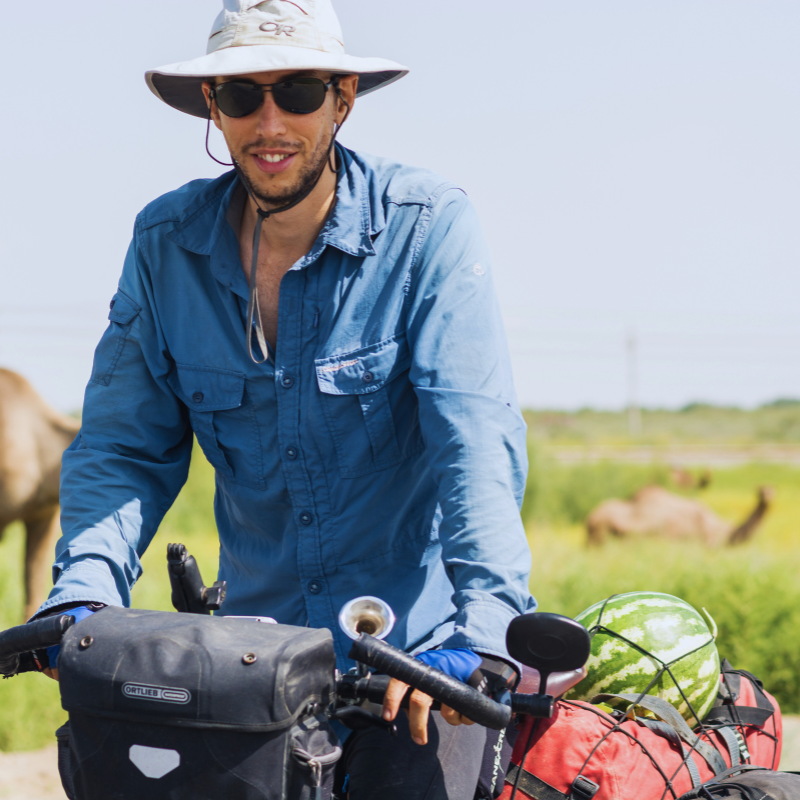
Matt Bowles: My guest today is Pablo Mandado. He is a hyper minimalist traveler, photographer and cyclist who completed a five year-round the world bicycle journey from London to New York, crossing 30 countries while living on just €3 a day. Prior to that, he spent two years backpacking, hitchhiking, wild camping and couch surfing across Europe, Morocco and Southeast Asia. He has now traveled to 78 countries and learned to thrive on minimal resources, spontaneity, problem solving, and has built a life completely outside the conventional path. Originally from the Aragon region of northern Spain, today when he’s not traveling, he maintains a base in Lisbon, Portugal.
Pablo, welcome to the show.
Pablo Mandado: Thank you very much.
Matt Bowles: I am super excited to have you here and get into your travel stories. We got to start off giving a shout out to our mutual friend Sean Tierney, who introduced us. Maverick Show listeners know Sean because he’s been on the podcast four times and anybody that he introduces me to, I immediately get them on the podcast because he knows some amazing people and what an incredible community that you have there in Lisbon. Are you in Lisbon today?
Pablo Mandado: Yes, I am at home.
Matt Bowles: Amazing. One of my very favorite cities. I try to go through there at least once a year. So, you and I will have to hang out the next time that I come through Lisbon. I am actually on the east coast of the United States today in Asheville, North Carolina recording this. But you are not originally from Lisbon. I would love to start just giving folks some background on you. For people that are not familiar with the Aragon region of Spain. As you were growing up there, what was your experience like? Did you travel around Europe very much? How did your interest in the world start to develop? And then what led up to your decision in 2011 to start traveling the world?
Pablo Mandado: I grew up there. I was born in Zaragoza, in Aragon, in Spain is the main city in the region. My parents, they will take us on holidays, but it will always be more or less the same places. Always inside the space, never too far. I don’t think we ever took a flight. It was very traditional. We would just go to the beach and we will stay in the same place. My parents were both teachers, so they will have long holidays, which was nice, and they will rent a house for a month and we would just be somewhere more or less in the same location every time. So, you will make a group of friends in the area and you will spend the summers together and that will be it. I never really experienced much change, much discovery of new places. So, I was just doing a very traditional life. Just play it safe. Okay, get the job, make some money, make sure that you have work to sleep. You have like a home that you can get some of the stuff that you want. At some point I decided I need a change. And I was just thinking to go for a different kind of job. But I just decided, well, while I am waiting in between jobs, maybe I do like a little trip to Greece, like just go there for a week. And that trip is what changed everything.
Matt Bowles: So, what was it on that trip that made you decide to keep going and not go back to the traditional job? What was that moment that changed everything for you?
Pablo Mandado: For me, it was arriving to Greece, first time having to speak in English, first time having to communicate in a different country, first time going to a hostel by myself, just standing at dorm, meeting some people in the common area. And there I started to meet people who were traveling maybe for two, three months. Like going from one place to another to another. And it was like, oh, I didn’t really even think of it. You would just go somewhere and come back. Return ticket. And it’s like, yeah, this makes a lot of sense. If you want to go to places, you are not limited to the connections from your city. You can just go one place from there some other place. You can take the cheapest flights. At that time, Ryanair flights were super cheap in Europe. You could fly for €12, €10. I took a flight for €5. It was ridiculously cheap. And that’s when I realized about this. You were like, okay, I opened the Ryanair map of flight connections. I just literally booked like the next 12 flights for the next couple of months from one place to another to another to another, just anywhere that I had not been yet. Sometimes it was not particularly efficient in the map because it was just cheaper and it was cheaper to go to the other corner of Europe instead of just going somewhere near. But if I have not been, why not? But yeah, I made a plan on the spot and I decided, why not? Let’s just go and see how it goes.
Matt Bowles: Well, I want to ask you about that spontaneous style of travel as well as the way you were traveling and the hyper budget techniques of hitchhiking and couch surfing and wild camping and backpacking around on a really low budget. Can you talk about just the transition from the traditional lifestyle that you were living to this new lifestyle when you started that? Did you have fears and concerns? This was very different. How did you push through that?
Pablo Mandado: For me, it was all progressive. It was not like suddenly I went to Greece and I was traveling like this. I have no idea of how to travel. I have no idea of how to do this. I was a bit budget conscious. I wasn’t blowing money left and right, but probably in that week in Greece, I spent as much money as I spent in the next month and then as much money as I spent that month, I spent it in the next three months. And it just kept going down very quickly. So, at the very beginning, yes, I was going to hostel. I was going to different restaurants, I was going to some museums, I was still cooking some stuff in the hostel. But it was just like when I started to fly from Greece, I started to change the trip a lot when I realized that this was a long-term thing and not just one week off. I was still going to hostels for the first two months, I think.
But yeah, I was keeping it simple, just going to the supermarket, checking which supermarket is cheaper. I was still taking some local bus and local train. When I was moving around, I was walking a lot. I was barely taking any public transport. I never took a taxi. I will just walk through the city, which is for me the best way of discovering a city. Just to cover the whole ground and not just go from point A to point B and miss everything in between. And that applied later on as well when I was. Well, that’s how I ended up traveling by bicycle, I guess. I really enjoy what is in between and not just the destination.
But when I was staying in the hostel after a couple of months, I met a guy and he was telling me, oh yeah, I’m hitchhiking. I like what? Hitchhiking? Really? That works? People pick you up, you haven’t been and like, yeah, no, it’s fine. People is nice, people is friendly, all great, nice. He was telling me some stories and it sounded convincing. It was like, okay, why not? I was finishing my last flight after that destination; this was in Prague. I was like, okay, so I will give it a try. I will see how it goes. At the same time, someone else was talking in that hostel about couchsurfing. I had already been using cat surfing for going to some meeting. At that time, couchsurfing had liked quite a community.
And there will be events organized by cat surfers, normally by local people that wanted to meet foreigners. And they will just meet in a bar or organize a board game night or any kind of event. Sometimes will be more casual, more relaxed, other times will be a full-on party, but there will be all kind of events. And that was my first introduction as well to kitesurfing. But it was more or less around the same time that I decided, okay, I’m going to start to use my profile to actually stay at people’s houses and to just contact some people, see if they are going to set me to stay at their place and see how that goes.
Matt Bowles: And as you started to do those things, hitchhiking and couch surfing, how did you negotiate trust and hospitality and reciprocity across cultures as you start moving through the world in that way?
Pablo Mandado: So, at the beginning, especially for example with couch surfing, I always felt like I wanted to give something back. So especially if you arrive for one night, normally they often are preparing some dinner and at least I try to help with preparing the dinner. But if I’m staying a second night, I always try to cook. The second day I will go to supermarket, buy some vegetables, buy some meat. I will try to make something Spanish. Maybe I will make like a Spanish omelet. That was always quite easy. I never felt like it was complicated at all. Everyone was really welcoming and everyone really just wanted to chat and to meet someone else.
And with the hitchhiking you will have to get the feeling of the person. Because when you’re in couch surfing, it’s more curated. You have the profile, you can read a little bit about them, you can read the reviews and you can already do the cutout. If it feels the reviews are a bit fishy, a bit strange, maybe move on and ask someone else. The same works, of course, from the host point of view, they can check the reviews of the guests. Check how you write to them. I will write them. I will always tell them all what I am doing, why I want to go there. I want to actually spend time with them and get to know them and see how they live and all this stuff.
Matt Bowles: Was there a hitchhiking experience? A particular one maybe that stands out in your mind, that changed you? Maybe one time when you felt really outside your comfort zone?
Pablo Mandado: I guess there are multiple ones. Okay. There was one time I was hitchhiking in Germany. A Russian truck driver picked me up. He didn’t speak any English whatsoever. Of course, no Spanish, but yes, Mike, he said, come up. I went up because I had already been waiting for a little while and I didn’t want to wait any longer. When I sit down, I just got very serious and just kept driving. And I was just like, trying to see if we could communicate somehow. But he wasn’t really trying much later on, I just see he has like a massive knife next to the gear. After that, the whole drive, I was like keeping an eye on it. It was a bit weird, a bit. But nothing happened. It was totally fine. But that was one of the first time I was hitchhiking and one of the first times that I had something a bit more worrisome, something that you are a bit more cautious about and that you are keeping an eye. But it was totally fine. He dropped me somewhere further up on the road, like 100, 200 kilometers farther. And that’s it, I continue hitchhiking from there.
Matt Bowles: And as you continue to do this travel style over the years and encounter more and more people, is there one moment of connection maybe, that stands out with a stranger, maybe a host or a driver that surprised you and turned what some people might consider a risk into something really special?
Pablo Mandado: There has been many, many times. Really, I was in Lithuania. I stayed with a host, Agnes. She invited me to her home. I stayed there for a couple of days and we were chatting a lot and I was saying, oh, I’m planning to continue hitchhiking this way. And she was like, oh, I wouldn’t mind hitchhiking. It has been a long time since I do it. And it was like, okay, if you want to join me. And she ended up just coming with me. We ended up hitchhiking together for four or five days. Not a long trip or anything, but it was like really genuine. From the first moment that we saw each other, we kind of clicked and it was super simple.
It was like we can read each other’s minds. We had a very easy traveling. We met some more people on the road who were hitchhiking as well. We were four people at the same time hitchhiking. At some point we were hitchhiking four, and he was like, oh, well, it’s going to be complicated. Let’s split up. Because which car is going to have a space for four people? They were in front of us. So, a van stopped, he picks us up. And they’re like, oh, can you pick these guys as well? Like they fit here. So, the guy stops and we are the four of us. In the end, we ended up in the Regardless. It was like a very quirky band with bear decorations, with hippie. It was nice. It was a funny experience.
Matt Bowles: Well, I know during that time you eventually got over to Southeast Asia. I’ve spent a lot of time there as well. And one of my very favorite countries that I know you spent at least a month in is Laos, and you’ve written about that on your blog. Can you share a little bit about your month in Laos, what the highlights were and why that country turned out to be so special for you?
Pablo Mandado: So, I have been in Laos twice. The first time was when I was backpacking. The second time was during the trip by bicycle. So, in this first time when I was backpacking there, I ended up renting a motorbike, a scooter really. And I was just driving through some off roads. It was completely out of the normal path. I don’t think most people go through there. I didn’t see anyone really. You will just see some little gas stops, which is basically a standard with some bags with gasoline or some bottles or something. Normally you fill it up from some bottles when you were there. It was quite funny.
As I was going through there, I have read somewhere, I don’t remember where, something about a town or a village inside a valley surrounded by mountains, with an access that is just through a cave. So that sounded very exotic, very interesting, very isolated. Of course, I was like, oh, let’s give it a try. So, at that time, I was traveling with my ex-girlfriend. I met her during the backpacking trip. So, we were in this trip. We arrived there to the cave. There is some guy with a little boat, like a canoe. He’s like, yeah, you can go through here. There is river. It goes 8 km through the cave. On the other side you will reach Ban Natan, which was the name of the village. And he was like, okay, cool. Sounds fun. Of course, all of this actually was without speaking in English.
It was a lot of sign language. But we understood it enough to do it. So, we cross there, we arrive to the other side. As you cross to the other side, it feels like a civilization from many, many centuries ago. People was living in very, very simple wooden houses. They had some electricity, but no one had any sort of computers or. There will be a couple of phones in the whole village, mobile phones, of course. No, not fixed phones. They will just eat a few things. They will have a few greens. They will have some chickens and some eggs. They will put loads of salt on everything. It was sometimes a bit too much. They would just spend the whole day looking after the animals, looking after the gardens, hanging out. It was very relaxed, extremely relaxed. By the time that we were leaving, before we came back to the cave a couple of days later, we stayed there for a couple of nights. The elder of the town will make a ceremony to protect us from the spirits of the cave.
So, they made a fire and they were cooking on the fire some rice and some chicken and saying some chance. And then they will just literally like put us the food on the hull. Like they will grab it with the hand, the chicken. They will poke the meat out of the chicken, mix it with some rice and put in our hand for us to eat. And the thing is, my ex-girlfriend, she is vegetarian, she was getting this chicken half cooked in her hand and they were all looking at her for her to eat. And she would just put it next to her mouth and eat some of the rice and pretend. And there was a moment and no one looked and she just chucked all the chicken and all the stuff on my hand so I could eat her thing and sit. Have to give explanations because of course no one understood that. Why would you be vegetarian right in the middle of little village where all you have is some chicken, eggs and some grass.
Matt Bowles: Well, I’m curious how you met your girlfriend, if you can talk about that story. And I know that she would play a major role in your travels and your cycling journey. And you two saw a whole bunch of the world together. Can you share a little bit about how you met and then how the relationship, a travel context, how did that nomadic, minimalist lifestyle shape your relationship?
Pablo Mandado: So, we met while I was hitchhiking. I was in Latvia, so I open couch surfing and I just saw that in Riga, there was something that they call “Riga Good Times”, which is a massive event in couch surfing. People were coming from different places to join where there were different events going on, like going to bars, saunas, going to the forest, all kind of Things through the whole day. You will have three or four different activities at least, and you could just pop in or do whatever you were interested in. It was completely free to join. It was very nicely organized and there was a very nice crowd. So, I saw the next event that was happening. It was called Free Hugs. So I just went there. I was like, oh yeah, free hugs. Yeah, sure. Like, I don’t mind giving hugs. This is a fun activity, cheer someone up.
So, I show up and I show up maybe 10 minutes late, like Spanish style. And they had already started because this was Latvia. So, when I arrived there just to join them, they were already giving hugs. So, as I walked in the street towards them, this girl just looked at me, opened her arms and came running to my arms to give me a hug. This is my ex-girlfriend. That’s how we met. So, she just asked me like, what I am up to, what I am doing. And I was telling her about my travels and I was telling her I plan to continue going through Ukraine, through Hungary, going to the Balkans, etc. And she was telling me how she was going to have holidays in a month and a half and she didn’t have any plans. And I was like, oh, well, if you want to join me. And she said, yes, I will join you. I was like, oh, okay. That was easy. I don’t know, very straightforward. But at the same time, I just thought it was just in the moment. She said, yes, but of course she’s not going to come, right, I just met this girl.
So, one month and a half later, she writes me, “hey, are you still planning to be in Budapest”? Yes, I am. “Okay, I will meet you, and from there we can hitchhike to wherever you were planning to go afterwards”. I was like, oh yeah, I’m planning to go here. So, we met in the city. We stayed couch surfing somewhere. Then we hitchhiked. We went to Ukraine. We crossed the border in the middle of a massive rain. It was raining cats and dogs, could not see anything. It had already gotten dark. This guy just picked us up with no lights in his car. He was literally putting his face in the windscreen, trying to see something while he was touching with his hand the glass to try to clean the glass to be able to see something through the condensation.
Eventually he dropped us in some motel in the side of the road that had deals like €1 per night. And it was with cockroaches and stuff. We spend the night there. We continued going, the weather turned bad, we went through the Carpathian Mountains and we ended up going all the way down to Croatia instead because it was going to be raining, so what’s the point? We just went to some islands in Croatia instead. We had a great time. By the time that she was supposed to come back home to her life and I was supposed to continue traveling, she managed to miss her flight. I don’t know if it was accidental or not. I feel like it wasn’t. She was really not putting any effort on trying to get to the airport on time.
So, we ended up arriving, we were 200 km from the airport hitchhiking and it was already pretty much boarding time. So, we were like, well, we are not going to be making this, so what do you want to do? We ended up hitchhiking together back to her place in Riga and we stayed there for a month while she quit her job. I did some riding, fighting, and then we continue traveling together from there. She decided that okay, yeah, after one week, more or less staying together at her place, she decided that, yeah, she’s fine. Like she’s quitting her job and she’s traveling with me. So, we ended up just continue traveling through Europe, Asia. We ended up going to England together afterwards and then we did the whole trip by bicycle.
Matt Bowles: So, let’s talk about that. How did the two years of unplanned minimalist travel that you were doing set the stage for this five-year round the world bicycle journey? I know you took a break, as you said, and you were living in England for a little bit. How did you then decide that you wanted to go on a journey of this magnitude? How did it come about?
Pablo Mandado: So, on the trip by bicycle, the idea was that I wanted to do it because it was the culmination of all the different things that I enjoyed while I was traveling. I wanted the freedom of not depending constantly on infrastructure, transportation, accommodation. So, if I am traveling with my bicycle, I can carry a tent, I can carry a stove for cooking, I can stop anywhere pretty much. You can always find somewhere to pitch the tent. You don’t have to be going just to cities, which is normally where you are going to be dropped off if you are hitchhiking or taking public transportation. For me that was like a big plus.
The other reason I felt the more and more I traveled that I enjoy traveling slow, spending time in the place I was going through, meeting the people on the towns, on the villages. I was feeling like you really discover a country when you are in all these little villages and towns. I feel like the main cities and capitals, they are too similar nowadays. Everything has gotten quite globalized, quite a more unified culture. Of course, you still have differences, but you don’t feel the real culture of the country until you go to these little towns is where people still live more close to their traditions. Without the Starbucks and McDonald’s everywhere. They still do things in the traditional way, in the way that they have always done.
Matt Bowles: Well, the map of the exact route that you took for this round the world journey is on your website. And we’re going to link that up in the show notes so that people can go see exactly where you went. Departing from London, going all the way across Western Europe, all the way through Eastern Europe. You went through Turkey, the Caucasus, Armenia, Azerbaijan, you went through Iran, then you went through the Central Asian stan countries, basically along the old Silk Road route into China, all the way through China, and then down through Southeast Asia, all the way down through Indonesia and then Australia, New Zealand, and then you hopped the ocean over to the United States. And people can see exactly and precisely where you went on that entire journey. The map is amazing and we’re going to link it up in the show notes and I want to ask you about some different parts of this journey. I feel like, though, we should start just day one. You are leaving London. What do you have packed for this journey? You’re going to go all the way around the world. You’re going to take five years. What are you starting off with on your gear? And also, what is your mindset? How are you feeling on day one when you’re about to leave a London?
Pablo Mandado: So, I was really looking forward for it. It has been quite some time planning because already when I was in Southeast Asia, I was thinking of it the whole time. The moment I went to England. The whole purpose was to save money to buy the bicycle, to buy all the gear, to get it all ready and to go. So, the year and a half that I have been in England was just waiting for this. What I had in my bicycle, I had four panniers. Two in the front, two in the back, the handlebar back bag, a dry bag on top in the back. I was carrying all kind of camping gear for four seasons camping gear. Because of course I’m going to be traveling in winter, I’m going to be up mountains, I can be in the middle of any kind of weather. So, I need to carry something that will work. I was carrying a stove and some pots and pans. I was carrying tools to fix the bicycle.
I had a bit of everything that I may need. I have bought a bicycle that was relatively simple to fix. It was not, not particularly light, just a sturdy bicycle that is going to hold on, it’s not going to break apart and that it has all quite a standard part that are relatively easy to find or to at least patch up until you find something more optimal. I was carrying all kind of clothes, a lot of merino clothes that are supposedly less stinky when you are sweaty and when you cannot tower and wash every day. I was carrying my camera, tripod and lenses on my laptop to be able to do some photography, process the photos.
Matt Bowles: Well, I know that you did not choose every single location and route at the outset before you went and you left a lot of this to spontaneity. And I want to ask about that particular decision. Why did you choose such a loose plan and how did that openness to uncertainty influence what you learned about the places and cultures and people you encountered?
Pablo Mandado: So, the trip itself was not planned at all. The idea was to head east and see how it goes. I didn’t know it was like, oh, either going to China or to India. You kind of have to choose because of borders and passports and visas, but you can either head to one or the other. At the beginning I was thinking I was heading to India maybe and then I will see. The idea still was to go around the world, but there were no any hard commitments. I always refused any sort of sponsorships that require any sort of serious agreements. I didn’t want to owe anything to a company just because they gave me something or they sent me some money. I didn’t want to depend on someone or the trip become that is not mine anymore.
For me, my trip, it was my life. And I didn’t want to just be obligated to do something in particular with it just because I agree in advance with someone else, with a company or to sell my soul. Let’s say the planning of the trip was at the beginning, just head south. Let’s cycle to the summer because we have been in England. It was January when we started. It was snow, so we just wanted to cycle to the sun. So, we just cycled through France all the way down to Spain and Portugal.
And as soon as we crossed the Pyrenees is that was already summer, even if it wasn’t. But it felt like it. It was nice weather, it was sunny, it was warm enough. It made a massive difference. At the same time, I felt like, well, if I’m going to cycle around the world. Maybe I should cycle around Spain and Portugal, since I’m from the peninsula. It felt like I needed to discover this part of the world before I go to the rest of it. Because, yes, I have been a bit around, but I have not been everywhere in Spain yet. So, it felt like it was just right to do it.
Matt Bowles: Okay, Pablo, you did a five year-round the world trip living on an average of €3 a day. That sounds unbelievable to me and probably to most of the listeners. Can you talk about how you did that, break down that budget? What were you spending the €3 a day on? What was getting sacrificed? What was getting prioritized? How did you do that? What did that look like?
Pablo Mandado: The main thing is we were never going to restaurants. We were cooking our own food. We were eating quite simple. We were just buying eggs, which they used to be cheap. We were buying some rice, some pasta, some lentils, some chickpeas. We were cooking in our pot every night. We were making eggs in the morning we will have some bread. And the other part of this is that we were barely spending on anything else. We have everything we needed with us. Never paid for accommodation. It was basically just sleeping in the tent every night. We never paid for a campsite. We always wild camp. Once we ask in a campsite if we could pitch a tent because we could not find any empty land. It was all urbanized. And they say, oh yeah, sure, stay for free, no problem.
So that was the only time we were using warm showers quite a bit. It’s similar to kite surfing, but specific for people who travel by bicycle is really nice because most people there have done their own trips by bicycle or at the very least, they have like interest on it. You find people that are more alike than when you are couch surfing. Couch surfing is of course nice as well, but there’s like even bigger connection. You will arrive there and they will be like, oh my God, yes, I remember that night. I arrived tired, wet, there was a fire. I was so happy. Someone gave me a hot plate of some food and you were like, oh my God. After all day, outside, in the rain, in the wind, it was the best meal of my life.
So basically, every night was something like that. When we were staying with someone, I would think, like when we were in Europe, I don’t know, maybe 40% of the time we were staying somewhere like couch surfing, warm showers, etc. 60% of the time we were wild camping. Once we got out of Greece into Turkey, we stopped using warm showers mostly after Istanbul because there was not that many people. We stayed in a few places when we were staying in a big city. We will do couch surfing or warm showers, but the rest of the time we will be wild, camping all the time. But because you were staying with people, you will normally stay for one or two nights most of the time.
You will get fed every time, whenever I offer to, oh, yeah, I can cook something. Like sometimes I will, and sometimes I will go to a supermarket and buy and cook. But most of the time they would say, no, don’t worry about it, you have to cycle tomorrow, just relax, take a break. So, we were not doing it just because we were not spending money. But of course, that had an impact on our budget and our expenses, since we don’t have to spend any other money on accommodation, on transportation, everything was already paid. Of course, we spent a lot of money on the bicycle and all that, but once that’s paid on the trip itself, we were not spending any money on these kinds of things.
Matt Bowles: Well, I imagine one of the challenges of doing a trip like this by bicycle is running into weather issues. And I want to ask you about that. I understand as you were cycling through northern Turkey, you happen to run into the biggest snowstorm they had had in 30 years. Can you talk about that experience and what happened?
Pablo Mandado: We were climbing up some mountains in northern Turkey. The weather has already been funny for the previous days and it just started to snow. It was snowing and snowing and eventually the cars will be stuck on the sides of the road. The snow kept going up. It was a meter and a half at least to. I was literally just following some massive lorry that had gone some time before us. So, I was just following. My bicycle was just going through the wheel of the big lottery. My panniers will be touching the sides of the snow as I’m going. And I’m just trying to find somewhere to hide from the snow because I was thinking, okay, if I put my tent here tomorrow, we might have 2 meters of snow on top of us and that cannot be good.
So, as we were just trying to figure it out, what to do, and we would just keep going because there is no point to stop definitely in a situation like that. We just saw a building on the side of the road. It was the middle of nowhere. So, I just left the bicycle on the side of the road, went through the snow until the building checked what was going on there. What kind of building was it? It was just some abandoned restaurant. And I saw the door was actually open. I checked inside, everything seemed fine. It was just abandoned. So, I came back for the bicycles. I basically carry both bicycles on my shoulder one by one, both bicycles on my shoulder all the way until the restaurant. And we put the bicycles inside. We found a there and we just spend the night there.
Matt Bowles: So then after Turkey and going through the caucuses, you cycled across Iran. I have not yet been to Iran. It is one of the countries that is the highest on my list. I would most love to see it. But what was it like cycling across Iran?
Pablo Mandado: So, Iran was amazing people. Was so incredibly open, so curious, was so friendly. The first morning after we had arrived to Iran, we were in a city. We had pitched our tent the previous night somewhere near the beach, behind a couple of trees. We just packed up early in the morning because we felt it might be a bit funny in Iran, a bit more of an urban space if you are camping there. We pack up everything. We went through the city, went to a shop to find something to buy for cooking breakfast. There was just some youngster, he was maybe 13, 14 years old, he was telling us, why don’t you come for breakfast to my grandma’s? He was the first person we met in Iran who was speaking a nice conversational English. He was very young, but he was like, oh, yeah, well, why not?
We just went with the teenager and he just guided us to his grandma who was living nearby. We arrived there; the whole family is there. We felt so welcome instantly. Everyone was so happy. So, smiling me, they were like, oh, yeah, leave your things, we want to put a washing machine. I was like, no, but I mean, we just came for. Oh, don’t worry about it. You can stay as long as you want. Three days later, we were still there. We have become part of the family. Like after the first day we were okay, yeah. Next morning, we are leaving and they’re like, no, but you cannot leave now because our other son, he’s on a bus, he’s coming back. He’s in the university, a 12 hours bus from here and we told him you are here.
So, he just got on the bus and he’s just coming to me meet you. Like, okay, I guess we are staying. They were so friendly. The day that we were leaving, they were like, are you sure you need to leave? Because we own the plot of land next to our house. So, if you want to stay here, we can build you a house there and you can just live with us. It was amazing. It was incredible. It was genuine. They actually meant everything they were saying. It was amazing.
Matt Bowles: That’s so special. Well, after Iran, I know you went through Central Asia, basically the old Silk Road route from Iran all the way over to China. You went through Uzbekistan and Turkmenistan and all of those countries. I understand though, when you were going through Uzbekistan, you had to evade the special police. Can you talk about the situation that was going on there and what your experience was like?
Pablo Mandado: In Uzbekistan at the time, I don’t know how the situation right now, but as a foreigner, you are meant to stay in hotels every night. They have some specific exemptions. If you are on the go, then you may not need to spend the night in a hotel that night. But every time that you go to a hotel, you are going to get a paper of registration into your passport. And the police at any point may request for these papers. If you don’t have them, they are going to detain you. They are going to interrogate you. You’re going to spend a few days there and eventually they are going to tell you that you had to pay a fine. I think it was a thousand or $2,000 fine. So, you definitely don’t want to pay the fine. After that, they will make you pay for a flight out of the country, or if you don’t have the funds, they will deport you. And they basically just take you to the next border.
So, I didn’t want to do hotels and I didn’t want to pay the fine. Technically I was on the go all the time, right? I was not staying anywhere, I was moving through. So, I was just taking a photo a day of the location. So, like, I don’t know, of course, they were not going to accept this, but at least I had my proof that I was moving at the same time. Every time that we were spending the night, we needed to hide. We are camping. So, every night, because there wasn’t really nowhere to hide, most of the time we would just ask in some house. Most of the houses there are like courtyards, so you have the outer walls and the outer building and there is a garden in the middle, middle.
So, every night we just go to a house, knock the door and like, hi, could we stay the night in your garden? We have a tent. And pretty much every single time the answer will be like a tent. We have a house just come in. So, we will end up spending most of the nights at someone’s house as guests that just invited themselves apparently. And of course, there will be a lot of stories about that as well. But every night was an experience. It was amazing. People was very friendly. It was maybe not as genuine as it felt In Iran. Iran, it was like everyone was super curious.
Everyone wanted to know about you and to share and for you to have a good experience and to transmit what Iran means to them as well, because they are very aware of the image that they have in the world with their government and everything. So, they will be much more no, like, look, the people are like this. Don’t judge us by the media. In Turkmenistan, it felt like it was more just. They felt an obligation of hospitality to the traveler. And as well, it was a little bit of showing off to the neighbors that they have a foreigner with them and a traveler. They invited me to funerals. Not to weddings, to funerals. Oh, we have funeral in the morning. Why don’t you come? It was a bit funny sometimes, but it was very nice.
Matt Bowles: Well, eventually you make it to China and you cycled across mainland China. I would love to hear about that. China is another country where I have not yet spent time in mainland China. It’s also super high on my list. But how was your experience and what were some of the highlights of cycling across China?
Pablo Mandado: I arrived to Chengdu and I actually stopped in Chengdu. I spent six months living in Chengdu and then from there I continue going and the part after Chengdu for me is the nicest part of China. I cycle into western Sichuan, which is basically like the Tibetan region, but out of the Tibet region itself. But it’s all the Tibetan culture or the Tibetan monasteries or the Tibetan people. The mountains were amazing. As I left Chengdu, I made 12 mountain passes over 4, 000 meters high. So, I will be going up with my heavy loaded bicycle. This part of the trip as well I did by myself. My ex, she stayed in Chengdu for another month and a half or two months, and then she took a bus to meet me further up because she was like, I’m not doing that. That’s just for you.
So, I was carrying a bit of extra stuff, even more weight than usual, because of course I could not sell any of the common things because it’s more of a remote area. I probably ended up carrying like extra food and extra water here and there. But it was amazing. I don’t know, it was like the solitude, the harshness, the difficulty, the landscapes. I dealt with nice, beautiful mornings with the sun and above the clouds. I had like days where it was raining cats and dogs, where I had to climb a mountain and I don’t know how much farther it is. You start to feel how you are getting higher and it’s harder to keep cycling, not just because you are tired, but because of the altitude. But it was very rewarding. It was amazing. That part of China for me was really nice. It was very enjoyable.
Matt Bowles: Was there a moment on this entire journey when a local person changed your perception of a country that you were traveling to? Maybe you had a preconceived notion of a country or you didn’t know much about it, and then interacting with a local person really changed your perception of what a country was like.
Pablo Mandado: I never had any preconceptions of what to expect in any country through my travels. I always felt like the main thing that you can find everywhere is that people are actually good. My impression is that 99.99% of the people is good, 99.99% of the time. You may have bad interactions with people at some point in your life and you might have confrontations, but given the situation and given the standard dynamics of society, and just your life, your work, the frustration of something going wrong with your life and you maybe lash out on other people. But because of the way that I was traveling, everyone that I was meeting was like, oh, this is cool. So actually, everyone was nice all the time. I barely had any bad experiences. And even when I had like some weird confrontation most of the time it was very easy to solve just with a smile, just laughing it off and not giving it importance.
Matt Bowles: What impact did this particular mode of traveling, actually bicycling through these places as opposed to, for example, taking a road trip on the same route or traveling through some other mode? How did cycling itself as a mode of transportation impact the travel experience? And what were some of the most unique benefits of traveling in that way?
Pablo Mandado: Well, the first one is that everyone tries to stop you all the time to talk to you, to see what the hell are you doing, to offer you food, to invite you to stay at their place. I’m just cycling on the side of the road. People will just park their car in front of me. Stop. Selfie. Oh, here, do we have some cheese? Please take it. Everyone will be taking, rolling the windows down, slowing down next to us. I like, where are you from? Oh, from Spain. All of these in countries where they don’t speak much English and they, oh, Madrid, Barcelona or Messi-Ronaldo, I don’t know. It will be like very fun interactions. Sometimes at some point it can get quite repetitive, but it was really funny. It really brought you close to so many people that ended up always leading to some really memorable experiences with people.
People that you just walk into in a park where you are just sitting and they tell you, oh, come to my house. You should have dinner at my place. Every week, pretty much, something like that was happening in some part of the world. It was every day when I was in Iran, I literally had to fend people off because I will get offers to stay at their place seven times a day on average. I was counting. And the first one will already start at 10am in the morning as I start cycling after I have had breakfast, pack up the 10, start going, blah, blah, blah. Someone is, oh, hey, what are you doing? Just stay at my house. And you’re like, I mean, I might need to get going somewhere at some point.
Matt Bowles: That’s so amazing. How did traveling in this style with a relationship partner impact your relationship?
Pablo Mandado: Well, we spent, what, five years traveling around the world by bicycle. We were together besides the time in Chengdu, we were 24/7 together. If you take away the time that people are sleeping, most people might end up spending, okay, the weekends, you might spend more time together, but during the week you spend 1, 2 hours together most of the relationships. So, I feel like we speed around through our relationship. We experience everything that people do through their whole lifetime. So, when I was traveling with her, I guess we both fall into a bit of roles. So, I was normally the planner, the one who was organizing everything, the one who was making sure that we were safe and especially that she was safe, making sure that we had enough food, that we had enough water, that we were going to find a place to sleep, that we were going to be okay, that we were not going to be eaten by bears that night.
So. even when I was asleep, she will sleep with earplugs and I will be the one who gets awake when some animals start to pass near the tent. And for her, she was more the one who was preparing some of the food. She would get up slightly earlier than me sometimes and she will start to prepare breakfast or something. And she was doing a few more of the chores with the cooking, while I was doing more of the pitching the tent, packing the tent, fixing the bicycles, maintenance, and all these kinds of things. I guess we weren’t team. We were both doing things towards our strength and we felt like we were a team, like we were doing this together and this was us.
Matt Bowles: Well, I also want to ask you about your photography journey. I have seen your Instagram and I was blown away by so many of the photos that you’ve been able to capture on your travels. Can you share a little bit about how you got into, into the photography, what it means to you and how you were able to develop that into a business as well.
Pablo Mandado: I like to dig into things and research and learn by myself a lot of things. So, photography was one of those things that while I was traveling, like, oh, it would be nice to take some photos. I got some simple camera and I was taking some photos. But then I started to, oh yeah, maybe like a DSLR camera would be nice. Of course, I haven’t used one before, I will have to learn how to use it. So, when I was in Vietnam, I bought like an econ camera with a couple of lenses. In a few weeks I went from not knowing how to use it to knowing pretty much everything that there is to know technical wise about how to do any kind of photography based on like using different apertures, focus bracketing, like any kind of techniques. Both from the just taking the photo to some processing with lightroom, I really like really went deep into it. I read everything I found. I read lots of books, watched some tutorials, I read some specific manuals, specific for my camera, which actually was really nice.
At the beginning I found that it was quite intuitive for me as well. The creative part I always found very simple. The composition, rules on how to find a nice way to frame the photo and visualizing. If I am in this location, I want to take this photo, it’s going to be nicer from this other location. All this kind of stuff always felt very natural. That’s how it started. I just kept taking photos, of course, and I was publishing some of those photos mostly on my website at the time, some social media. While I was doing the trip, I got some photos published in different magazines. I will start to get offers to buy photos for different magazines, sometimes to write something with the photos as well. Because it was like some bicycle magazine that wanted to make some section about the trip. Then there was when I was traveling through Turkey and Georgia, I started to think, okay, like if I want to take a break in winter, like a little break just for a month because the snow is going to come, the mountains are going to be closed off and I cannot do the roads I want to do, maybe I could set up some sort of photography workshops and teach some photography.
So that’s what I ended up doing. I took a break in Georgia. In Tbilisi I set up a photography business where I was just teaching photography. We will do like walking tours around the city. I will teach them how to do different stuff. We will do more individual Sessions. I was doing a bit of everything, but it worked quite well. I did that well in China when I stopped there. And it was very enjoyable experience and it was very nice to see people understanding and discovering and learning some new things feels quite nice.
Matt Bowles: So, after you completed this five-year journey, I want to ask you about the reintegration experience, if you want to call it that, the lifestyle transition from that itinerant mobile world traveling, cycling experience to getting a base. You mentioned you lived in Latvia for a few years, now you’re based in Lisbon. Has been when you reintegrate from a journey that’s that long, where you’re moving and moving and moving into reestablishing a base somewhere. Can you talk about how that went for you? Was there reverse culture shock and getting back into that, what was that acclimation period like?
Pablo Mandado: So, as we were doing the trip, it felt a bit like we time travel warp. We were a bit disconnected from any sort of cultural changes that were happening during those five years. And I felt like when we came back to Europe it was a bit of a shock. It was like, oh wow. Oh, like things had changed. The way that people look at things, judge certain things, what matters, what doesn’t matter how you perceive what is right and wrong. Even the morality of society, I feel like has changed in some aspects, of course. What is trendy, what is not trendy, all this kind of stuff. Everything has changed a lot in five years.
It felt like we were frozen a sudden woke up and it’s suddenly like, wow, I don’t recognize this wall anymore. That was the first thing that it was kind of shocking. One thing that I was missing while traveling is the kind of relationships that you can make. So, when you are traveling, you are meeting people and you know that you are going to live in one day, two days, one week doesn’t matter. This is temporal. It’s not going to last. So, it’s nice. I really enjoy the short encounters where you meet someone, you get to learn about them, all the interesting bits. And you kind of leave this before it can get boring. It never becomes routine.
At some point it was a routine to meet people like this, but it was still very enjoyable to do. But after so long doing this, I started to feel like I was missing building longer relationships with people. I was missing the sense of community. I was missing in the sense of belonging, that having friends and knowing that they are there. There are people that I keep in touch and I have made really good friends during the travels. But a lot of the people that I met. I met them once and that’s it. I never heard from them again. So, for me, that’s something really important. When I finished the trip, I wanted to have the sensation of belonging and to have friends and to have some sort of community.
Matt Bowles: Even though you’re not still traveling in that way. When you think back about your long, hyper minimalist travel experiences, what do you think has been the lasting impact of that on you as a person?
Pablo Mandado: One of the main things is I truly believe that everything is possible, that you can do anything you want. There is, of course, physical limitations, etc. But in general, pretty much anything that you think that you may be able to do, you can do it if you really think, try. And if you don’t, you might fail a few times doing something. But you will find what you really want to do, what you really enjoy, what really brings you success and enjoyment in your life if you don’t try. For things that are a bit out of reach, life can become too routine and too monotonous.
Matt Bowles: All right, Pablo, I think that is actually the perfect place to end the main portion of this interview. And at this point, are you ready to move in to The Lightning Round?
Pablo Mandado: Sure. Definitely.
Matt Bowles: Let’s do it. All right. What is one book that you would recommend that people should read?
Pablo Mandado: I like science fiction and I like some specific genre where it’s witty, funny. So, there is a bunch of different books like that I enjoy, but the one that I particularly enjoy is called We Are Legion (We Are Bob). It is the first book of the Bobiverse series. I particularly enjoy it. I like that series. I like the character. I like what he has to deal with and the extreme change in his life that he has to deal with.
Matt Bowles: All right, who is one person currently alive today that you’ve never met that you’d most love to have dinner with? Just you and that person for an evening of dinner and conversation?
Pablo Mandado: I probably will go with Rafael Nadal.
Matt Bowles: Nice.
Pablo Mandado: The Spanish tennis player.
Matt Bowles: That’s a good pick. That would be a very interesting dinner. All right. What is one minimalist travel hack that you use that you can recommend to people?
Pablo Mandado: Always take one of these travel towels. They are super practical. You can do so many things with them. Of course, you can use them as a towel, which is often needed. You don’t know where you’re going to end up. It’s great to be able to just dry up anywhere you are, but they can end up being like a little blanket they can serve to sleep on places that are kind of gross and maybe you put it on top and then you sleep there. They are quite versatile. They are super quick to clean, wash and dry. They can be used for anything really.
Matt Bowles: All right, knowing everything that you know now, if you could go back in time and give one piece of advice to your 18-year-old self, what would you say to 18-year-old Pablo?
Pablo Mandado: Do anything that you may want to do, go for it. Don’t worry too much about it. Just try, discover, decide later which path you want to follow.
Matt Bowles: Okay. Of all the places you have now traveled, what are three of your favorite destinations you would most recommend other people should definitely check out.
Pablo Mandado: I will definitely recommend Iran as we talked. It’s amazing. I would recommend New Zealand, especially the South Island. The landscapes are unbelievable. For the third one, I must suggest the Tibetan mountains in China. It was a great experience.
Matt Bowles: Amazing. All right, what are your top three bucket list destinations? Places you have not yet been highest on your list you’d most love to see?
Pablo Mandado: I would love to go to Iceland. I was in Norway recently and it was really nice. I would definitely want to go to Iceland. I would like to go to Kenya, Tanzania, some safari areas, climb up some mountains there. I think it would be amazing. Amazing. I have not been in that part of the world, so it will be very different. And I would like to travel in the Patagonia. I haven’t been there either, and I think it will be really nice.
Matt Bowles: All right, Pablo. I have spent probably two months in Kenya and I have been skiing in Bariloche in Argentina in the Patagonia region, which was absolutely spectacular. So, yes, hit me up when you’re ready to plan those trips, my friend. And at this point, I want you to let folks know how they can find you, follow you, connect with you. If they’re interested in seeing your amazing photography on your Instagram, if they’re interested in coming to your website to see your trip route and all the gear that you brought and everything else that you have documented there on your blog. How can people come into your world?
Pablo Mandado: My website is thecrazytravel.com. There is an English version of it as well. The content in English and Spanish is different. So, I barely ever translated a post. It was all either I wrote in English or I wrote in Spanish, depending how I felt that day. So, you can kind of go between one and the other using some Google Translate if you feel like it. My social media is the crazy travel on Instagram, on X (Twitter), I think on Facebook as well.
Matt Bowles: All right, we’re going to link all of that up in the show notes. So, folks can just go to one place at themaverickshow.com go to the show notes for this episode. There you’ll find direct links to everything we have discussed on this episode, including all the ways to find, follow, and connect with Pablo.
Brother, this was amazing. What a great conversation. Thank you so much for coming on the show.
Pablo Mandado: Thank you very much, Matt.
Matt Bowles: All right. I look forward to hanging out the next time in Lisbon with me and you and Sean Tierney and that whole amazing community that is there. So hopefully I will see you in person very soon. Good night, everybody.