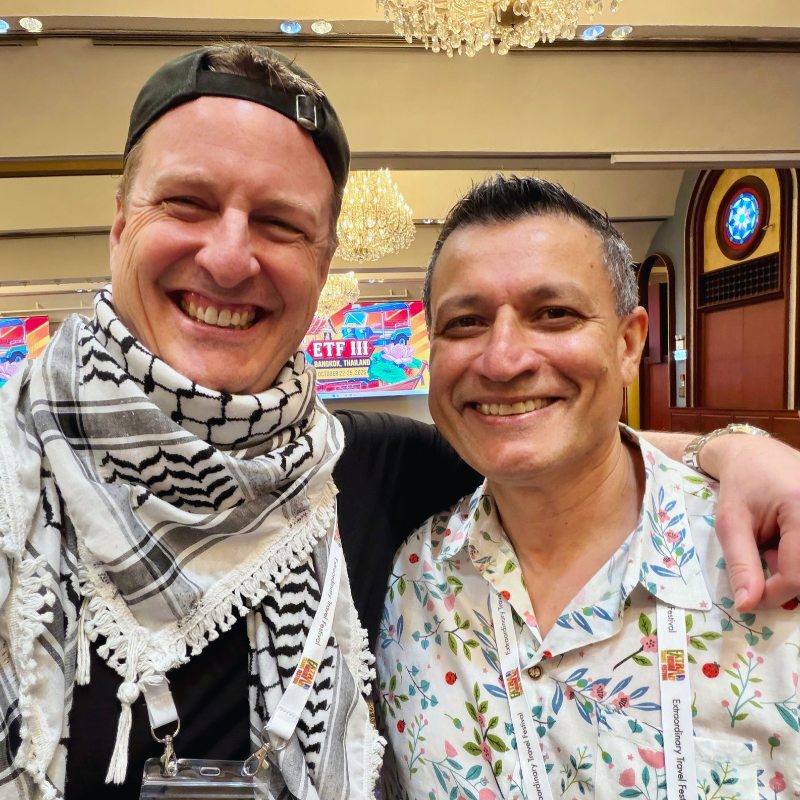
INTRO: This is Part two of my interview with Nabil Kazi. In Part One, we talked about his incredible career living around the world and working at Disney, Pixar, 20th Century Fox and Illumination, helping to bring iconic films and franchises like Toy Story, The Incredibles, The Simpsons and Despicable Me to global audiences. I pulled out his best storytelling advice for world travelers on how we can turn our travel experiences into powerful stories. We also discussed his experience running 18 marathons, summiting Mount Kilimanjaro, trekking to Everest Base Camp and finishing two Ironmans in Brazil. He then explains why he decided to step away from his incredibly successful Hollywood career and start traveling the world full time. So, if you haven’t yet heard Part One, you can go back and listen to it after this one. But right now, in Part two we discuss some of Nabil’s incredible travel experiences in Libya, Afghanistan, South Sudan, and how he tracked down and spent time with the extended family of Steve Jobs in Syria after working with him at Pixar. He also explains how he gives back to the people and communities he meets on his travels and shares his experience making the Hajj pilgrimage to Mecca. Nabil also reflects on his first visit to Palestine. Then we talk about his current role at Watermelon Pictures, a film company dedicated to amplifying Palestinian and other underrepresented voices. And we discuss some of the recent films he has worked on, including American Doctor and the Oscar-nominated film The Voice of Hind Rajab. Finally, I asked him to reflect on the role of film and storytelling in preserving historical memory. And I asked him about the power of communities being able to tell their own stories. So please enjoy the conclusion of my interview with Nabil Kazi.
Matt Bowles: So how did the reality of long-term travel compare with what you had imagined? And also, how different was traveling without a corporate assignment or professional agenda?
Nabil Kazi: It was good and bad. Working for a big studio or any corporation, you obviously have the perks. You’re making money, had an assistant, whatever. There are so many things that you have access to and when you don’t have that and you’re just on your own and living off your savings, you’re just doing everything. And so, you’re learning to live again in a way that is different than the way you were living. And for me, I also wanted to live within a budget because if I’m living off my savings, I can’t stay in really beautiful hotels and go business or first-class. I had to figure out that I also want to see every country in the world in the most basic way that helps me to experience the country with a little bit of hardship and not on a red carpet. And that was really important for me. And so, I had to have that adjustment because I think if you talk to some of my friends, they’ll say, I can be a prince. And so, I had to adjust that lifestyle. And I have to say, making that 180 in that lifestyle also helped me evolve as a human being and going from having perceptions of people or only talking to certain types of people, because in your industry you tend to do that. But what you realize when you travel the world and you are in small towns and you are in places where people just have $5 a day that they’re making, yet they’re opening their homes up as a guest for you to come and have a meal with them. And the simple life that people live is so much more meaningful than sometimes we wake up in the morning, we’re on our phones, we have to be data filled in the morning before our coffee, and then it’s just nonstop all day. We’re not living when we’re doing that, we’re becoming robotic in how we’re living our life. And so, I think that’s what traveling the world has taught me is that you don’t need a ton to live. And when you do, you also find out that the friends that you make along the way, the ones that sometimes don’t know your background or where you come from, they don’t care. They really don’t care. They just know you’re a traveler. And those are the shared experiences versus, hey, I worked on this movie or whatever.
Matt Bowles: In terms of that evolution that you’re describing personally, is there an interaction or a conversation that comes to mind that really started to change that perspective?
Nabil Kazi: I think it’s just being on the road alone. You do a lot of that soul searching in your body and you have a lot of nights by yourself. You’re on the road all the time. It isn’t like you’re on vacation and you’re out with friends every night. You’re in your Airbnb or in your hotel and you’re trying to figure out what you’re doing. And sometimes you’re entertaining yourself and sometimes you’re in places where there is no TV. I find myself watching less TV, less media than I’ve ever in my life. I watch it more when I’m in the U.S. than ever. But when I’m overseas, I’m really trying to be part of the culture. But then I also was trying to remotely work. And so, what? I would find myself seeing the city or wherever I am during the daytime and then at night being on Zooms and trying to develop my projects that I have.
Matt Bowles: Has pursuing a country-counting goal, meaning a quantitative, achievement-oriented travel objective and ever conflicting with your preference for slow, meaningful, immersive, local experiences?
Nabil Kazi: No, I don’t think so. I think for me, I know the countries that I want to spend more time in. Countries like Somalia, Yemen, Libya, Afghanistan. I know if I’m going to make the effort to go there, I want a meaningful experience. Now, if I’m going to a micro country, I don’t really need to be there for more than a day. And that’s just me. I remember going to Montenegro. It was only planning to be there three nights in an Airbnb and I ended up being there for 10 nights. And it’s just because I fell in love with it. And I could go back and stay for a month and just be by the ocean and do absolutely nothing and work from there. And I think that’s the beauty of it. What we learned to adjust is you’re in a different time zone, but you can work any hours.
Matt Bowles: What has your experience been like connecting with the Desi diaspora around the world as you travel through Africa, particularly the former British colonies and places like that have substantial Desi communities, but often with very different cultural backgrounds and experiences than you have had. What have those conversations been like?
Nabil Kazi: Once you all realize that you come from the same, you know, it’s good. I think you just connect instantly. And I’ll be honest, in Africa, I eat a lot of Indian food and a lot of Lebanese food. And for me, those are my preference in Africa. It’s just easy to get. There’s huge populations of Lebanese and Indians in each African country. And sometimes the food is just a lot more flavorful. And I know what I’m eating. It’s always good. And look, I will say there’s always that connection of music and culture with the Desi community.
Matt Bowles: Okay, so I have to ask you about your travel experience in Syria. I understand that you actually sought out the extended family of Steve Jobs that still lives in Syria. Can you describe that experience where? Why was it important to you to do that? How did you go about tracking them down? And then what was it like when you showed up?
Nabil Kazi: I was a little obsessed because everyone said, oh, Steve Jobs is Syrian. He’s Syrian. He’s Syrian. He’s adopted, and all of that. And so, I was like, all right, if I’m going to Syria and I’m already having this incredible experience, I was going through the whole country. I told my fixer, I said, hey, one thing that could be really cool if you can figure out, is that if there’s any extended family of Steve Jobs in Homs, where his father grew up, it would be really cool to have a coffee. And he took it upon his mission to figure out how to connect with Steve Jobs‘ family. And it was really nice. I think they were a little surprised that somebody went out of their way to figure out who they were and how to get to them, but they were really open to meeting. And we met at a coffee shop, and we had an incredible conversation about how they knew Steve Jobs and what it meant and what he’s done for their family. And so, yeah, it was a really special moment.
Matt Bowles: Well, I know one of the most meaningful travel experiences that you had is when you went to Mecca and Medina for Hajj in 2014. Can you describe that trip and what it felt like to make that pilgrimage?
Nabil Kazi: Yeah, as Muslims, we have to do it once in our life if you can afford it. And I think in 2014, I was at that crossroads. My mom was sick. She just found out she had cirrhosis of the liver, and she wasn’t going to make it. And so, I wanted her to see me do Hajj. And I felt like it was a good time for me to have that experience and have a fresh start in life. And you’re never prepared for it, and you hear about the procedures and stuff of what you’re supposed to do. And I went with the group, and it was just a really spiritual experience of starting the whole process and going through it. For any Muslim who’s been to the Kaaba, it’s extraordinary. I will say the whole area is, like, a wonder of the world, how they’ve set it up and expanded its footprint. And so forth, down to even the sound system, which is all provided by the CEO of Bose speakers. And they’ve got this control room that it’s like its own city. How they actually do the audio everywhere throughout the city. It was really special and I think I made a lot of new friends there. And Medina going down there, it’s the Prophet’s Mosque and it’s also expanded its footprint and so forth. Medina is more of a peaceful area where the foot traffic isn’t as chaotic as is in Mecca.
Matt Bowles: Well, I also want to ask you about the trip that you took to Libya. What was that trip like overall? And what is one of the most memorable moments from Libya?
Nabil Kazi: I was obsessed with Libya, first of all, in terms of Roman ruins. It’s the country that has the cleanest Roman ruins of any country in the world. I think you’re also surprised with how cool Tripoli is. Parts of it just feels like Europe with really cool cafes and restaurants. And the food is incredible because of its close proximity to Italy. The seafood and the pastas that you get there, and they have 10 different types of hummus and baba ghanoush. I didn’t have a bad meal. I was so surprised of how good it was. And then I think the surprising part for me was just really the overkill of security. Because when you land, they don’t tell you, but there’s a government car that follows you around. It’s usually a white car that follows every tourist. And I didn’t realize it was following us until the second day. And then they give you a security guard that has to be with you at all times. And so, unlike other countries in Somalia, I had two security guards. But if I wanted to leave my accommodations, I could leave and walk around Mogadishu if I wanted to. In Libya and in Tripoli, you can’t leave your hotel. That security guard had to be with you. And the last day our tour guide said, hey, I’m going to have you guys come over to my mom’s house for a home-cooked meal. But because we’ve got this dude with us, we’ll drop him off at his hotel. He wasn’t staying at the same hotel; he was staying around the corner. And then I’ll bring the car around and pick you up and I’ll WhatsApp you guys and we’ll go have a meal and I’ll bring you back. Very innocent; it shouldn’t be a problem. And he didn’t live that far away. We get rid of the security guard, we come down the car’s there and we hop in the car and we start leaving. And he gets a phone call from the security guard and he’s like, you better bring them back or they are going to be deported right now. And we were like, how did he know? And he had told the front desk that if these people leave the hotel, you called me and tell me. So, it was like, oh my God. Moment of what the hell is going on here? And it’s all because they say there’s four Norwegians that have been missing in Libya. And so, for our safety, there’s a security guard that’s given. But I think it’s a beautiful country. It’s one of those misread countries because of Gaddafi and what he stood for and the corruption that the country is just a bunch of terrorists. You couldn’t have nicer people with the landscape being just extraordinary.
Matt Bowles: Well, I also want to ask you about your experience in Afghanistan. What were some of the most memorable moments of that trip?
Nabil Kazi: Afghanistan was pretty incredible because we were the first Western group there as tourists after the U.S. left. And so, we were the first group that took the road between Kabul and Kandahar, which used to be one of the most dangerous roads to take. It takes about, I think it was eight or 10 hours to get to Kandahar with a ton of checkpoints with the Taliban, which is totally fine. It was safe and quick and you’re on your way. Kandahar surprised me because in many ways, very loosely say this, it’s like the Beverly Hills of Afghanistan. And I say that because there’s just these really beautiful big homes and nice curated streets. And we stayed in one of those big homes with this gorgeous backyard and just nice people. We drove a lot. That is the way to see Afghanistan, I think. So instead of flying, there are some scary tunnels and roads that you can get caught in. As you go up north into Mazar-I-Sharif, you have to go through this long tunnel that I forgot the name of it. You’re in it for a while and you could die. If it’s a traffic jam, you’re basically breathing the fumes of all the cars. You have to go there during non-busy hours to get through those sketchy tunnels that the Chinese built. But what ended up happening? We were in a town on our way up to Mazar-I-Sharif. I forgot the name of the town, but it was basically where the Russians had set up back in the late 70s when they had invaded Afghanistan. And there’s these beautiful minarets that are there centuries old. And we were There to look at the old Russian tanks, see the minarets. And we were going to spend the night there, and I was with a group of five, and we had one girl with us, and she wanted to have a real image of her coming behind the minaret. And these two local women came into the shot. And within seconds I heard somebody yelling at me, and it was like the CIA of the Taliban. And they were not happy that I did that. And so, we basically spent about 20-minutes going back and forth. Then my guide came and tried to calm him down, and the rest of the team went into the van, was waiting for me, and he had my phone, and I didn’t know what he was going to do. And I’ll just say, look, very isolated incident. The rest of the country is incredible and beautiful, but we just had a little bit of an incident. And any type of these incidents can happen anywhere in the world. I can be in LA and there can be some sorts of scare tactics and so forth, and I’ll leave it at that. But I was scared for a little bit, but we got through it.
Matt Bowles: Well, I understand on your trip to South Sudan, you did actually get detained. Can you tell the story of what happened there?
Nabil Kazi: For all of us who go to South Sudan, we go mainly to go see the tribes. If I know I want to take some portraits, I’ll take my nice camera with me. Otherwise, I usually just take my iPhone. And so, this trip, I brought my nice camera with me and I had it in my backpack, but I have a hidden compartment. So, coming into the country, they didn’t see it. And my fixer asked me if I was bringing a camera. I said yes to see the tribe. So, he knew I was bringing a camera in, but didn’t get a license. And in South Sudan, you have to have a license to bring a good camera in, so they know and identify you not as a journalist. When I was leaving the country through the X-ray, they saw the camera, and so they asked me and said, where’s your paperwork? And I was like, what are you talking about? What paperwork? And they said, you have to have paperwork for this camera. We’re going to keep this camera and you need to go over there. And the next thing I know, I’m being detained and asking why I didn’t tell them I was a journalist. And I was like, I’m not a journalist, and here’s my Instagram and I’m going to every country in the world. And it was just a long process. And then eventually I saw One of the fixers. And I was like, dude, come over here and get me out of this. And then it took another hour before I was the last person on the plane when I got out.
Matt Bowles: I know one of the things that you try to do on your travels is to give back to local communities in various ways. Can you talk about how you do that and share some of the most special moments for you?
Nabil Kazi: I think we all have superpowers, and for us, we’re privileged to be going to countries that most people can’t go. And we also have to think about whatever superpowers we have, we should try to help whoever comes into our world. So, whether it’s your fixer or guide who has their tour company or kids or schools or a family, whatever is meaningful for you, I feel we should be doing. And so, depending on where I am, for example, in Algeria, my guide had just started his tour company and knew nothing about marketing or creative assets or anything like that. I just spent a few hours helping him create his flyers and getting his logo together and working with his local graphic designer to just, hey, this is how Western people will be attracted to coming to Algeria. It’s so easy to do, and they can’t afford to hire agencies and so forth. So that’s my superpower that in a way that I could give back. In Guatemala, I spoke to a couple of groups of high-school kids. I think about altogether, it was probably 150 high-school kids and. And just inspired them of like, hey, after high school, follow your dreams and showed them, here’s how animation is done. This is what my Disney experience is, and this is what it’s like to do a marathon or an Ironman. And no matter what your goals are small or big, try to continue your schooling. And try to either do it here in Guatemala, or if you have a dream to go to the United States or Europe, figure it out and just do it step-by-step. And so, I think it’s important for us to pay it forward whatever way. And then I do try wherever I can to connect with children in a big way. So, whether it’s visiting an orphanage or just spending time on a playground with kids and in our own way, being able to communicate and inspire them. As a foreigner, I think that’s important and it’s fun. I learned from them.
Matt Bowles: Well, I want to ask you about your trip to Palestine in 2022, just a year before the genocide began. But as context, can you share a little bit about your historical solidarity with the Palestinian struggle and what planning this trip meant to you in the lead up to it.
Nabil Kazi: I think growing up Muslim, the earliest actually it’s a funny story, my connection to Palestine would be in Kuwait. My parents had taken us to a park one day and don’t ask me how, but they basically forgot me at the park and they started to drive away and I think they were like 10 minutes away before they realized I wasn’t in the car. Don’t ask me how that can happen with a two-year-old, but it did. And when they came back, it was a Palestinian lady that was taking care of me. And so, my dad always made this joke of if we didn’t come back and get you, you’d be living in Palestine. And I think from there, just growing up, going to the mosque, knowing this October 7th wasn’t when it started. We always say that’s like the middle of the book. It started decades ago in what has slowly become a genocide. And this has nothing to do with religion, some of my best friends are Jewish. But it has all to do with governments and land grabbing and humanity and treating people, no matter who you are, whether it be Palestinian or it could be Ukrainian, let’s just say. But every single person in this world should be treated equally and with respect and with humanity in a way that everyone should have shelter, everyone should have food and medical needs. You don’t blow up hospitals, you shouldn’t blow up civilizations of neighborhoods of just innocent people to land grab. And I think for me it’s part of my life growing up to be compassionate towards the Palestinians. In 2022 was really that opportunity for me as I was embarking on going to every country in the world that I wanted to go back. And always a dream of mine to see Jerusalem and really the crossroads of the three religions and being able to experience that. But also, at the time I had two little kids, 10 and 12-year-old influencers that were following me on this journey of traveling to every country and they lived in the West Bank. And so, I told them, I said, hey, when I come to visit, I’ll come and see you. And so, they were super excited. Talk about giving back. I actually stayed at; I believe it was the Jerusalem Hotel outside of the Muslim Gate. And that gentleman had not photographed any of his rooms during COVID His website was horrible. And so, when I stayed there, I photographed every single room for him. And then he had his website updated with all the new photos which was really great. But he giving back to me, became my tour guide and took me through the Old City. He was born and raised in Jerusalem, so he knew, knew all the side roads and all the history of what happens where. And he took me through the 14 Stations of the Cross, took me to the tomb of Jesus Christ, took me through all the Muslim quarters. And then he also showed me how things were incredibly unfair, where you saw for no reason; Christians were being spit at and young Palestinian kids who were just playing, doing nothing, and being shoved to the ground for no reason. And when you witness that, that and see that firsthand. And then I myself having an American passport and just trying to get to the third holiest place for Muslims, which is the Al-Aqsa Mosque, and trying to get through the security there and ask questions like, how do we know you’re Muslim and recite the Quran to us and we still don’t believe you? And things like that. It’s just disrespectful on so many levels. And I, at some point, just became more resilient to that stuff. And I can’t imagine living there. But you have this built-up anxiety of what it’s like to be there on such a small scale. From that to I took the bus into the West Bank to see these kids, had dinner with their family who made this incredible Palestinian meal. They showed me the Mandela statue that’s there in Ramallah. We went for Kunafa. And then the dad dropped me off right at the border and said, I’m putting you in a taxi here. Be prepared. You’re going to go through a lot of interrogation since you’re leaving the West Bank. I’m sorry, we can’t. They were not allowed to go into Jerusalem for the obvious reasons. And he was right the second I got out. Just interrogated, why were you here? Who were you meeting with? Why did you feel you needed to come here? It was just a million questions for no reason. I was exhausted by the time I got back to the hotel. And I just felt for them, I really felt for them. So, I think you just start to educate yourself more. I think it’s important for everyone, regardless of what side you think, you have opinions or don’t have an opinion, don’t make assumptions about somebody else’s place, of where they’re living, their land, until you understand the sacrifices and the things that they’re going to. When you hear of families losing any members of their own family, what that feels like, if you lose your grandmother, that’s a hard thing to lose. You lose 80 people in your family. I can’t even imagine that happening overnight. You really start to feel angry. It’s not my job in what I do to convince anybody, but if I have a platform that can story tell and showcase content that shows real life stories of what is actually happening on the ground and let whoever’s watching make that decision, if we’re able to persuade them by that storytelling, then that to me is powerful messaging.
Matt Bowles: So, let’s talk about that. You are now the executive vice president of marketing and brand development for Watermelon Pictures, which focuses on amplifying Palestinian voices and bringing Palestinian, Arab and other underrepresented stories to international audiences. But before we talk about Watermelon, I feel like we should trace another trajectory in terms of your story. I think back to when I was coming up as a kid in the 80s and Hollywood representations of Arabs or Muslims in mainstream blockbuster films were pretty much consistently either outrageous, derogatory, dehumanized representations as terrorists or whatever it was, or just completely not representing at all. I can remember when Anthony Bourdain went to Palestine and did his Jerusalem episode. This was a groundbreaking episode because it was literally the first time the Palestinians were shown as human beings on American television. And I’m wondering if you can think back over the course of 30 years in the entertainment industry. How have you seen the evolution and representation of Arabs, Muslims, Palestinians and so forth evolve over the decades and what types of contributions or impact did you attempt to have on that over the years?
Nabil Kazi: Yeah, I think 9/11 was probably a moment where it became very visible. I was still at Disney. I noticed at that point people did make references as all Muslims being terrorists and so forth. Then you did start to see more content to be so blatantly negative. When I was at ABC, I did look at scripts and look at episodes of shows that might have Muslims looked in a negative way to just give that feedback, but it wasn’t a ton. I would glance at them through the coverage group there when they were looking at scripts to make sure it goes through the FCC and so forth before they’re cleared by the network. Now there are Muslim groups that are in place that Hollywood studios rely on that look at all of that. I think it’s better. It’s always been there if you are an Arab or I don’t know if it’s specifically Palestinian, but I would say Arab terrorist. And especially after 9/11, I think there are systems in place now to try to change that stereotype, but I think it will always be there.
Matt Bowles: So, after decades marketing some of Hollywood’s most commercially successful films. What attracted you to Watermelon Pictures and why did you choose to work there?
Nabil Kazi: I knew the brothers just on and off. I was helping them with some marketing sound bites as they were in this phase one of developing their studio. And they reached out to me. I was actually in Uganda, of all places. And they said, hey, we’d love to talk to you. We’ve got an idea. And I said, hey, let’s just. Just do it now. And they were like, oh, you’re in Uganda. Just, we’ll wait until you get back. And not knowing that for us world travelers, we’ll just Zoom from wherever we are. And I got back to San Francisco and they asked if I would come on and help them lead their marketing efforts and build their brand. And for me, it was an opportunity to take such meaningful work that they were doing. And the roots start with Palestine, but they are really a studio that represent the 98% that Hollywood doesn’t. I have a nephew who writes for other studios, but when he tries to get his own projects greenlit, it’s a much tougher road. And so, you have to ask the questions of the talent is the same. Why is it harder for him to do it through his individual projects versus writing for a franchise that they have in place? And there’s a lot of those examples of it’s harder for us, who are that 98% to get things greenlit and out there, versus the 2% of, I would say, white entertainment, as they say. Watermelon Pictures brings that into play. We have a film called White Man Walking about a white guy who marches through the southern states with a Black Lives Matter T-shirt. There’s a movie called Sudan, Remember Us. We have a Spanish film coming out from Diego Luna. So, there’s this diverse portfolio of content that is coming out from a studio that started with Palestinian roots but really wants to give a voice to anyone that Hollywood won’t listen to.
Matt Bowles: How have you seen the barriers to Palestinian storytelling change since the start of the genocide in 2023?
Nabil Kazi: Night and day difference. What’s really interesting is Watermelon Pictures released the Encampments, which had so much resistance even now. When I came on board, I came on board with Palestine 36, All That’s Left of You, and The Voice of Hind Rajab, which if you look at mainstream exhibitors like AMC and Regal and Cinemark, they shy away from these documentaries. Whereas, as today, there’s a movie called Naza that just came out, which was picked up by Neon. Now, Neon is probably one of the more prominent independent studios along with a 24 in Focus features that wouldn’t necessarily pick up a movie like Naza. We have a movie called American Doctor about three incredible doctors from different backgrounds. One’s Jewish, one’s a Palestinian and one’s a Zoroastrian who spent time in Gaza doing humanitarian work. And for us this movie is about hope, humanitarian and accountability. And Naza is a story about this underground of interviews with the IDF. Very different. One is more Israeli, one is shown from the Palestinian side, but both are out there, very visible and that’s today. Three years ago, I don’t think you would have seen that. And there was a lot more resistance. Today if you look at the polls, more Americans are sympathetic to the Palestinian movement than what the Israeli government are trying to do. So again, it’s about educating yourself. It’s not preaching one thing or another, but just understanding and being able to be open-minded to humanitarian efforts for everyone in this world.
Matt Bowles: I know you’ve attended a lot of the screenings of American Doctor. What types of audience response have you been seeing?
Nabil Kazi: It’s incredible. A lot of times you see a diverse group of audience members there. White, Asian, Black. It’s really broad. People are crying. People come out of it with hope of, you see three really good doctors who risk their lives to save lives and what they are able to do, but what they aren’t able to do. How you have to be creative with limited, I would say supplies in the hospital that you get here in the Western world, things that were compensated while they tried to bring into Gaza something as simple as giving an IV or taking blood. Those are the type of stories that you hear and no human being in the world should have to go and suffer through that no matter what. It’s torture. And that’s I think a lot of people don’t realize because when you watch the news it’s a very different narrative that’s given of tunnels under hospitals, which is ridiculous. And it’s just bomb after bomb after bomb and what it looks like just full destruction. And you forget about the humanization of each building that went down had family and a history of grandparents and parents and they don’t have schools that the kids go to. They don’t have a doctor or a dentist, they don’t have food. I believe it was Dr. Feroze from American Doctor telling me an onion can cost $70 or some outrageous amount because you can’t grow anything there and they’re just starving to death.
Matt Bowles: Well, you mentioned that you also worked on The Voice of Hind Rajab, which is one of the most powerful films I have ever seen in my life and it broke the record at the Venice Film Festival for getting over a 20-minute standing ovation. Well-deserved and was then nominated for an Oscar. Can you describe the film just for people that don’t know the story of Hind Rajab and then circling back to our discussion on storytelling, why do you think that particular story from the genocide resonated so powerfully?
Nabil Kazi: Yeah, the story of Hind Rajab is just a five-year-old girl who was stuck in a car in the Gaza Strip with family members who were already shot in the car. So, she had dead family members in the car. She calls her mom to basically try to get out of this situation and get home. And so, the movie is real-life voice messages of Hind Rajab and her mom. While what you realize is that the IDF are listening to this conversation for the whole day and she talks about how scared she is that it’s going to get dark and she just wants to get home and her mother is comforting her and it’s a really hard movie to watch. But this is a real thing, this is a real movie, this is a real-life incident that happened and there was hope. While there’s a conversation of the paramedics are coming to rescue her and as the paramedics get close to the vehicle, the paramedics’ vehicle is blown up which is factual, then it’s all there, yet there’s no accountability of what happened. And Hind Rajab is one of 27,000 children that have been murdered there. So, it’s a powerful story but it also reminds us that it’s one of many.
Matt Bowles: Well, I know Watermelon Pictures has some additional new releases coming up now and you’re working on some new launches. What is coming up from Watermelon that people can look out for and try to support either in the theatrical releases or when they get to streaming.
Nabil Kazi: I’m super excited as the studio expands. It’s expanding its portfolio of meaningful storytelling and really excited about a movie called The Accompanist which is coming out probably spring, early summertime. It is co-written and directed by Zach Woods. You guys probably know him from The Office and Silicon Valley. More of a comedian, but has written this incredible movie about a young girl who lives with her grandfather who they find out has dementia, can’t take care of her, is put into foster care and then is taken care of by an older lady who was played by Susan Sarandon. The movie also has Aubrey Plaza in it and just a beautiful story of family connection, the themes of loneliness, dementia and foster care and how we all need to take care of each other. And just really beautiful movie. We have a Spanish movie called Ashes that is directed by Diego Luna, you know him from Star Wars: Andor which just had its debut at the Toronto Film Festival. That’s going to come out in the springtime as well. Just really incredible. So, we’ve got that and then we’ve got a special movie coming out that we haven’t announced yet. We’ll probably make an announcement early next year. It’s in the world of storytelling, of a powerful story coming out of Gaza by your journalists. So that’s all I’ll say about that one.
Matt Bowles: So, when you think about Watermelon Pictures and what you’re building and the direction the company is going, what would success look like? What do you envision or hope for five to ten years from now for Watermelon Pictures?
Nabil Kazi: I think we’re slowly breaking down barriers. If you think of The Voice of Hind Rajab is available to stream on Hulu and if you thought about that three years ago, that would have never happened. And the fact that we can have a powerful story like this sitting on a main platform like Hulu, even if it’s five people watching it and it changes the perception of one person, we’re doing our job. We’re doing our job by storytelling and expanding the messaging that the Western media is very one-sided on. And I think success is really about just telling meaningful stories and giving opportunities to our community. of the 98%, the incredible storytellers, writers, producers, actors within our community that development executives at some of these big studios won’t give them the opportunity with this merger of Paramount and Warner Brothers that Skydance now has, that’s a monopoly. And so, there are fewer people controlling the content that is coming out and dictating in some ways what you’re watching. So, it’s more important for independent studios such as ourselves, such as Neon, A24, and Focus Features, which is part of Universal. The diversity of content that these studios bring gives that portfolio of content that these big studios won’t.
Matt Bowles: What role do you think storytelling and film can play in preserving historical memory when the experiences of a particular community are being marginalized or contested?
Nabil Kazi: It’s a powerful one. And when you think about it, the way we watch now, we have so many different platforms that we get our content from. You can go to the theater, you can watch it on a plane, you can watch it and stream it at home. You can rent it, you can buy it, you can go to the library. There are so many different places and its worldwide. So, you can sit there anywhere in the world and get this content. And I think that is important for us to show diversification of not only just the history, but present day of what is happening. And when you think of Macklemore and the moment that he has created for other artists to really support him, which they wouldn’t have if this didn’t happen, and then goes off and does his own free Palestine tour, which is embraced surprisingly by some people that we never thought would say I support you is a step in the right direction. We still have a lot of work ahead of us, but the guy’s just amazing in what he can do and so elegantly.
Matt Bowles: He is amazing. And those types of solidarity examples I think are absolutely incredible and really create a great model. In terms of Watermelon Pictures as well, what does it mean for a community to have the power to tell its own stories rather than always being portrayed through the lens of outsiders?
Nabil Kazi: Look, Watermelon Pictures also has a streaming platform called Watermelon+ and it is the largest collection of Palestinian cinema. But it’s also a platform where we put short-form content of up-and-coming filmmakers. And there are diverse stories that are told there, not just Palestinian stories, but it is narratives of really important subject matters. It’s told in a really beautiful way. If we can provide platforms like this, more people will start to create more stories and feel more comfortable that they’re not just creating something that sits on YouTube for a small audience, but something that can have a global platform and a bigger reach.
Matt Bowles: How can people subscribe to Watermelon+ and stream all of these amazing films and support all of these amazing films?
Nabil Kazi: You can download the app. It’s available pretty much anywhere that any of the other streaming apps are available. You can also just go to the website either through watermelonpictures.com or Watermelon+. You can also go through the Instagram. There are so many ways. Just Google it. And we’re actually adding new titles up every week, so the portfolio of content is increasing rapidly.
Matt Bowles: Nabil, when you think back on all of your travels to 158 countries, how do you think all of those travel experiences have impacted you as a person?
Nabil Kazi: I think it’s humbled and grounded me a lot more. And you go to a small village in Africa and the kid is not wearing anything, no shoes or anything. Or you embrace someone simple as my guide in Algeria who has a family and knows nothing about tourism and just says, hey, I need to figure out how to put food on the table and create something. You start to realize the struggles and simplicity of how people become also very innovative to just make ends meet and find a way to make money. And we so many times take so many things for granted. And I think that traveling the world has taught me to be very careful with how I look at someone, what I think of them, their perception, but also myself. I used to be someone who had no problem spending $500 on a shirt from Gucci or whatever or staying at the Four Seasons. And then you think about it and go, wow, that shirt that I bought could have fed so many kids. Or that could have been a quarter of a water well. You just think differently. Like, I don’t really need that. I’m fine with my Primark or just a T-shirt and shorts and I’m happy. And your life becomes a lot simpler and you don’t start thinking about all that other stuff.
Matt Bowles: Well, Nabil, I feel like that is the perfect place to end the main portion of this interview. And at this point, are you ready to move into The Lightning Round?
Nabil Kazi: Sure.
Matt Bowles: Let’s do it. All right. What is one book that you would recommend that people should read?
Nabil Kazi: Alchemist.
Matt Bowles: What is one travel hack that you use that you can recommend?
Nabil Kazi: Put your money in an empty deodorant so customs can never find it.
Matt Bowles: All right, who is one person currently alive today that you’ve never met that you’d most love to have dinner with? Just you and that person for an evening of dinner and conversation?
Nabil Kazi: Angelina Jolie.
Matt Bowles: What would you talk to her about?
Nabil Kazi: Humanitarian efforts.
Matt Bowles: All right. Knowing everything you know now, if you could go back in time and give one piece of advice to your 18-year-old self, what would you say to 18-year-old Nabil?
Nabil Kazi: Be more humble.
Matt Bowles: Okay. Of all the places you have now traveled, what are three of your favorite destinations you would most recommend other people should definitely check out?
Nabil Kazi: Seychelles. If it’s an island, most people go to Maldives or someplace they think is exotic. But Seychelles, I highly recommend. I would say Angola. Angola is an incredible country. The north is very different than the south. It’s beautiful. It’s where the diamonds come from. It’s very rich in life and the landscape is incredible. And I would say any of the old Yugoslavian countries. Just go down, whatever it is, the five or six countries, they’re incredible. From Albania up.
Matt Bowles: All right, Nabil, what are your top three bucket list destinations, places you have not yet been, currently the highest on your list, you would most like to see?
Nabil Kazi: Iceland. Iceland is my last country that I’m saving, so I’m dying to go there. North Korea, just for the curiosity of it. And we had this incredible presentation of someone we met who escaped, told us her story. And Venezuela, which I’m going to next month, Angel Falls.
Matt Bowles: All right, Nabil, at this point, I want you to let folks know how they can find you and follow you on social media. How would you like people to come into your world?
Nabil Kazi: Follow me on Instagram. That’s my main form of social media @traveladventurer197.
Matt Bowles: All right, we are going to link all of that up in the show notes as well as how to subscribe to Watermelon+ so you can stream all of these incredible films that are on there now and continuing to come out. So, all of that as well as everything else that we have discussed in this episode is going to be linked up in the show notes. You can just go to one place, TheMaverickShow.com go to the show notes for this episode and there you will find it. Nabil, this was amazing, brother. Thank you for coming on the show.
Nabil Kazi: Thank you. Thanks for the opportunity.
Matt Bowles: All right, good night, everybody.