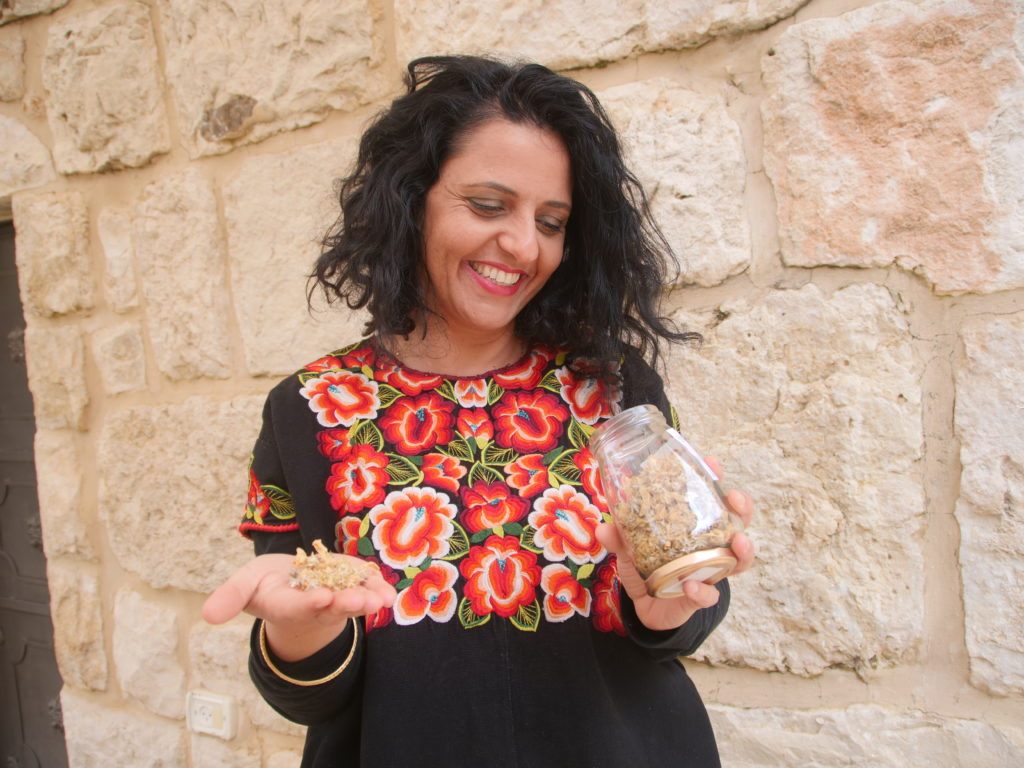
Matt Bowles: My guest today is Vivien Sansour. She is a Palestinian artist, storyteller, conservationist, and global vagabond. She uses image, sketch, film, soil, seeds and plants to enliven old cultural tales in contemporary presentations and to advocate for seed conservation and the protection of agrobiodiversity as a cultural and political act. Vivien founded the Palestine Heirloom Seed Library in 2014 as part of this work with local Palestinian farmers. And her work has been showcased internationally, including at the Chicago Architecture Biennial, the V&A Museum in London, and the Venice Art Biennial. Vivien is a culinary historian, enthusiastic cook, and works to bring threatened varietals back to the dinner table as part of our living culture rather than a relic of the past. This work has led her to collaborate with award-winning chefs including Anthony Bourdain and Sami Tamimi. She has a master’s degree in anthropology and is currently a fellow at Harvard University. Vivien, welcome to the show.
Vivien Sansour: Hey, Matt, how’s it going?
Matt Bowles: I am so excited to have you here. We must begin by setting the scene here. First of all, you and I have known each other for about 15 years now.
Vivien Sansour: That’s a long time.
Matt Bowles: That’s a long time. And you are one of my favorite human beings. And we are doing this interview in-person, which is so amazing because it’s the first in-person interview I’ve done since the pandemic. And you are such a ray of sunshine. And being able to be here with you in-person recording this is so amazing. And I feel like we need to tell people exactly what the setting is that we are in.
Vivien Sansour: Well, we definitely found ourselves in quite a special place. And we walked and walked in the roads of Hickory, North Carolina, which is a beautiful forest area. And we found ourselves being invited or maybe imposing ourselves on this beautiful, gorgeous tree whose shade is giving us quite the nice air conditioning right now. And it’s so gorgeous right above our heads. So, I’m so thrilled also to see you and to be under a tree and in-person sharing this moment together.
Matt Bowles: And in addition to the moment, we are also sharing a bottle of California wine from the Sonoma Valley, which we have just opened and we’ll be drinking throughout this episode, which is also significant because you and I actually met in Los Angeles, California, back in 2006. So, a lot of symbolic significance there as well.
Vivien Sansour: Yeah, California, my home state.
Matt Bowles: Your home state. Well, what I want to do at the very beginning here is sort of go all the way back. And you were born in Jerusalem. You grew up in Beit Jala in Palestine. And I was wondering if you can just talk about that a little bit and take us all the way back there and share a little bit about your upbringing in Palestine, what you remember, how it was at that time and ultimately how that shaped your trajectory and what you’re doing today.
Vivien Sansour: Yeah, I would say my upbringing in Palestine shaped my whole life. Like many of us, all of us, our upbringing does shape us. Although I do believe that we are born with a certain spirit, and then the environment either enhances that or oppresses it. I think for me, there are parts of me, obviously, that I was born with that were oppressed. But there were many parts of me that I was born with and were enhanced by being brought up in a gorgeous little village at the time with lots of hills and beautiful stone terraces and apricot trees and almond trees and peach trees and plums. So, I learned about flavor and scents and colors through crunching, you know, into a big plum or a big fat apricot. So, I grew up in an environment that really allowed me to be an explorer. I was truly an explorer like many of the other kids, obviously, who grew up with me around that time, because I had such a love for nature and exploration. So, climbing trees and discovering new tastes through, you know, tasting something that I probably shouldn’t put in my mouth or getting my hands in the mud and feeling that soil was really quiet an influential part of my life. And I would say that nature and every part of it were my true teachers. So, my true teachers, I would say, were non-human beings who I felt a big connection to. And that’s why being under this tree right now feels so calming and sweet to me.
Matt Bowles: And then we are also in North Carolina, which is a very significant place for you to be as well. So, can you talk a little bit about the trajectory that ultimately brought you to North Carolina initially?
Vivien Sansour: Yeah. So, my upbringing in Palestine was interrupted by a very harsh political reality, which is that I grew up under military occupation. And so, there was always the sense by my family and other families, like many places in the world, that we needed to immigrate, we needed to leave, we needed to find a better life. And, of course, my parents, like many parents around the world whose lives have been destroyed by colonial practices, sought to come to America. And so, we did. And it was North Carolina where we first came and where my parents still live today. So, I went to college in North Carolina. I have quite a love for rural North Carolina in particular, and the nature in North Carolina. And I love humidity and I love the heat, and I find it so magical when it’s so hot and suddenly it rains. So, yeah, I feel also very familiar when I’m in North Carolina.
Matt Bowles: Can you talk about how that experience was for you as a kid to immigrate from Palestine to North Carolina and what the experience was like for you here?
Vivien Sansour: Well, there are lots of romantic depictions of the immigrant experience, especially, you know, this capitalistic depiction of, like, oh, this is the story of coming with no money and then making it and having money, which I imagine, you know, initially, money is the idea of safety, you know, whatever. But sometimes, you know, I think it crosses a boundary of trying to tell a story of this triumphant immigrant who came to a new place and then made money. And so, there’s a lot of focus on that, which I don’t relate to in this way. Not that I wasn’t lucky enough to have comfort and to have a home. And not that I didn’t struggle either. But for me, the immigrant experience was and continues to be a very humiliating one. And I don’t think many people talk about that part. It’s also a very taxing experience because you really have to gather all your strength to survive. And so, as a very young immigrant, I mean, I think I was 10 maybe when we immigrated. And being in an American middle school was quite harsh because I came from a very humble town where, you know, what you wear wasn’t so important as much as what you do and who you be, basically. And then I would often be shocked when kids could. I mean, we were 10, talking about my clothing or asking me, oh, you wore this yesterday, why are you wearing it now? And I think maybe that was my true introduction to a hyper-capitalistic society where even as kids, people were trained to look at each other based on the material things that you have. But also, it was my first experience encountering people who didn’t know anything about who I am and where I come from. But worse, they had these horrible notions about who I am. So, I remember very vividly. And this is a story that I don’t think I can ever forget. Being 10 years old and being approached by two kids in school who just said, you know, they were laughing and pointing and saying, oh, you’re an Arab, you’re an Arab, show us your tail, show us your tail. And me being a 10-year-old, not having words or, I mean, I didn’t know what to say. You know, how do you respond to that except internalize it when you’re a kid? Internalize it that, oh, whoa, wait, do I have a… like, should I be wondering? And so, I guess throughout my travels around the world and throughout my life, now I’m in my 40s, one of the things I’ve noticed is that this is not unique to me, what happened, obviously, and that many children, most people in the world, grow up with this sense of shame that is presented to us and we internalize it. And thus, this is how we lose so much of our power and of who we are. So, I’ve dedicated my life basically to dispel these lies that I’ve been told about myself. Sometimes I was told those things about myself by myself, and I allowed the world for a long time to make me question. And so, for me, it feels like the greatest revolution in this is to know myself and to love myself and accept her and see her beauty despite all the lies. And this is a long answer to your question about being an immigrant, but definitely I don’t want to take away from how significant being resilient is in the immigrant experience, but I just don’t like the romantic notions about it because it is not romantic and it is not very sweet or pleasant to be an immigrant.
Matt Bowles: Can you talk a little bit about that journey and how you navigated through all of that to get to the place where you are today?
Vivien Sansour: I obviously didn’t have a very conscious plan as a kid, but I know one thing, and that is that I just never accepted reality the way it is. So, no adult could ever convince me that I should accept doing something just because this is how it’s done. And even though I’ve tried, I’ve tried in many ways. I’ve tried to belong to institutions. I’ve tried to belong to social norms and practice them. I’ve tried to belong to this dominant world. But I have failed, luckily, because I am realizing that probably what I did, somewhere in my brain, I decided that even if another world is not possible, I’d rather live and die trying to achieve a third way or a fourth way rather than accept these things that, you know, these ways, this dominant world that says to me, this is the only way. I just—I was never convinced that this was the only way.
Matt Bowles: I want to ask you as well about your connection and maybe reconnection and maybe multiple reconnections over the years with agriculture and seeds and plants. We started by talking about the beautiful tree that we’re sitting under now and how significant it was that we chose this particular location for the interview. And I’m wondering if you can just share a little bit about sort of the origins of that and then how that developed for you over the years and why that connection is so significant for you.
Vivien Sansour: Yeah, I love this question, because actually, the answer has multiple layers. One is, I lived all my life with a sense of longing, a desire to return to that childhood that felt so perfect for me because it was a childhood filled with diversity, with plants and soil and birds and all kinds of things. And because it was a childhood that was taken away from me. I was severed from this beautiful mountain that I grew up in such a harsh way, you know, just taken away from it with the idea that I couldn’t go back to it for many years was so painful, even for a child, or particularly for a child. And so, I always longed back to those trees and to those flavors and to those moments that I remember the first time we returned to Palestine after being in the United States. I ran as soon as we arrived to the house, and I ran to my grandmother’s garden. And I remember the way a chicken does. I literally dug the earth and I covered my body with the soil. And when I think of the way the chicken does, you know, have you ever seen a chicken in the heat? They dig for the cool soil. I just remembered this the other day, like, oh, my God, Like, I had this relationship with soil ever since. But then you start to understand that maybe the longing I’ve always had isn’t so unique to me, which I’m sure it isn’t, because we were all the children of the trees. I mean, this was our first human home. The tree. You know, before we were human beings, we were these climbing creatures, right? And the trees were our home. So perhaps there was always this longing for a home, which is such a contradiction to my life as a vagabond. But I always had this longing for a home. And so, the trees and the plants have offered me both the ability to imagine other worlds because they’re so diverse, and each one of them does something else. And so, I felt like the world of plants just has infinite possibilities. And that infinite possibilities gave me so much hope in the ability to create something new. Or when you think about breeding, of plant breeding, you know, plant breeding and the development of our crop varieties that we eat is a process of imagination. You know, it’s a process of someone also daring to say, I want to see another world where I have enough bread. I want to see another world where, you know, we have corned all year round, or whatever. Or, I want to see a world where I can grow tomatoes even when it’s not raining and there is no water. So, I think these innovative ways of our ancestors and the plants and the trees and everything being such an amazing tool. So, it was a combination of longing and also designing. So, I think my work with plants is a process of both.
Matt Bowles: And can you talk a little bit about the Palestine Heirloom Seed Library that you eventually founded in 2014 and just give some context in terms of what led up to that and then what exactly it is that you do?
Vivien Sansour: That’s a good one. Well, it kind of builds on everything I’ve been saying. The Palestine Heirloom Seed Library is a platform to tell stories, actually. And seeds offer this incredible platform. I mean, they’re practically really amazing because you give people a seed, and it’s something people really can watch grow through its full cycle, and they also can provide for themselves something to eat or flower or, you know. But it’s also a way to connect to who we are, because we are seeds, after all. And so, for me, the Palestine Heirloom Seed Library was my first very conscious attempt to cultivate and to save and conserve a lot of the foods and the crop varieties that I grew up with and that are disappearing. And so, I felt that there was an urgency, I still feel that way, to save these varieties as much as we can, but also to save the knowledge that comes with them. Because a seed lives within a system of knowledge, and this system of knowledge is disappearing because with each seed that is disappearing, with each elder that’s passing on, we’re losing this knowledge. And even when I meet farmers in California and they say, oh, I don’t know what to do because there’s no one to ask, I realized in Palestine, wow, it’s true, we live under harsh conditions, but we actually are so lucky because the generation that knows what to do is still alive. And we really need to act pretty fast in order to salvage these stories and this knowledge. So, I started basically going to villages, talking to people I don’t know, and then, you know, becoming friends with them and then going again and again. And eventually I found myself sharing more seeds and collecting seeds and sharing these stories. It was just a process of me falling in love over and over again with each story I heard or each crop variety. And then I found a lot of joy and fun in giving these stories a new kind of modern twist that was relatable to younger folks or folks even in my own generation who kind of been severed completely from nature. So, yeah, so the seed library sort of like sprouted in that way, and then it became this big operation. You know, it’s a humble operation, but in a way, it has big sounds because of the stories it produces. And that is significant because it is in the core of everything, I’ve been sharing with you, which is solicitude, the help and aid of these seeds to help us recover from so many years of oppression.
Matt Bowles: Can you build on that a little bit and just give some context about how the landscape in Palestine has been transformed through colonialism and violence and how the apparatus of Israeli apartheid is effectively severing people from their food source and the implications of all that?
Vivien Sansour: Yeah, and that should be a very easy story for Americans in the United States to understand, because the same apparatus, the same techniques with different variations were used against the native peoples of this land here. We’re sitting in this fancy park in North Carolina, but there were people here who are still here and are being denied the dignity of acknowledging their history. But how have these beautiful forests and these beautiful prairies in the United States been transformed into these European like or urban cities? It’s through the same policies, which start from naming places as state lands in the name of conservation, often severing the indigenous people from their food source. And this is not different for us in Palestine, where we have been severed from our food source. And this is a continuing effort, with violent actions by the state of Israel. Whereas you have farmers that we work with, for example, who are not allowed to reach their olive groves, who are not allowed to reach their valleys. So, for example, we were major producers of wheat. And we depended on ourselves for the production of wheat and barley and okra. So, we were quite self-sufficient in terms of our food production. Today our lands first of all have been confiscated. So, we have very small spaces to work with. And even those small places are threatened constantly by settler violence and by military expansion. So, for example, you may have wheat growing in a valley. The process for a farmer and their family to go to the valley to harvest this crop often becomes dangerous. Either the settlers will come and burn it, or it is dangerous to go there because they’re going to come with their machine guns and kick you out. Or one day you wake up and there are these settler trailers that have been put up and they’re protected by the army. In this very moment that I’m speaking to you, my colleagues and my friends in Palestine and in the village, we have a seed library in Battir, are staying up all night, making a fire, taking shifts to stay up, because we have settlers who have been coming and they have been carving through our mountain, cutting down ancient trees, carob trees, apricot trees, olive trees, in order to start a settlement and to establish themselves in the area with the protection of the Israeli army. So. And if you try to stand up for them, you can be arrested. Which one of the farmers we work with has been arrested with his child. And so, his kid, who has experienced this, who’s 12, is not any more interested in having a relationship with the land because now he associates the land with the army coming to beat up his dad or beat him up, or a settler pissing in their cistern or their trees being burned down. So of course, you know, this is a way to sever whole generations. This kid is not unique. Sadly, there are many kids like that. And so, we’re being severed literally from our food source. Going to the mountain has become really difficult and dangerous. I go forage. Foraging is a big part of our culture. And the places where I forage now, I don’t go by myself. And even if I went with someone, I’ll be worried for the someone I’m going with. So, I just don’t go. And so, the very act of just, I don’t know, picking some dandelion leaves or finding some wild thyme becomes actually a life-threatening activity. And the list goes on and on. You would have to have me on for three hours to explain to you also all the different systems from restriction on water to restriction on land, to restriction on building even a little shed to put your tools where it gets destroyed. So, there is a litany of restrictions that farmers are facing in Palestine, combined with, of course, a hyper neoliberal process in which farmers are being forced into loans, they’re being forced into becoming workers in the same settlements that have destroyed their farms.
Matt Bowles: Can you talk about the concept of Palestinian agro-resistance and how those fits into the work you’re doing with the Palestine Heirloom Seed Library and everything else?
Vivien Sansour: Yeah. So, when I first started working with farmers 11 years ago in Palestine, I was working for an olive oil company. And my job was to go and, you know, interview farmers and kind of tell their story, mostly about their practice when it came to olive cultivation. But in the process, I got to see all the hurdles they go through, all the challenges they go through, all the things they do despite all odds, like carrying the olives for miles on their backs just so they don’t lose the harvest, dealing with the army for the simple process of going to plant a little seedling. And so, for me, that was a very significant moment where I realized that the world sees these communities as, oh, just this kind of marginal, and I hate that word, and there isn’t really an appreciation of the amount of strength and true resistance that they practice. They’re not in the street demonstrating with signs. They’re not in the streets with whatever slogans, screaming slogans, but they’re actually working, you know, putting rock on top of another rock to terrace a garden that has been destroyed, or just even being willing to continue to practice agriculture and seek sovereignty as much as possible in the process. While the whole world, other than the Israeli occupation, we’re talking also about a global system that is telling farmers that the way they’ve done things is not good enough. So, for me, they were the great rebels. I mean, these are the great revolutionaries. It’s the farmers I work with. And I really surrendered myself to be their student because I understood the limitations of my understandings that came from a very removed, at some point, reality. And so, I found a great sense of liberation learning from farmers like that. So, for me, that was the resistance. And that’s why I started to call it agro-resistance, which is actually something that my great mentor, John Sabella, brought up to me. Like, he came to visit me in Jenin when I was working, and he also got to visit the farmers with me. And he’s like, this is agro-resistance. So, we started saying that, and it became sort of a term that people like to use. But then actually, I will say that in my work, I’ve kind of veered away from it. I don’t use it as often. And that’s because of my desire and commitment to focus my energy in creating something rather than resisting something. And I think this is the core value of the seed library. And what I hope the seed library does is kind of refuse to be put in a, in a corner of like I need to be in resistance all the time, which actually is another form of oppression because you’re always. Your energy is going to fighting something which is necessary, obviously, and we do that. But I wanted to focus a lot on reclaiming our energy for creation. And of course, like seeds offer that so simply and so easily. And so, it is still a form of resistance. But I like to think that it is also married with a concept of creation.
Matt Bowles: That’s amazing. I also want to get into talking to you about some of your travels and your vagabonding. But I feel like first, as a context that any discussion about travel, especially since we’re talking about Palestine and we’re talking about Israeli colonialism, I think we should start by talking about the concept of the freedom of mobility in general. And if you can share a little bit in the Palestinian context about the role of Israeli colonialism and the apartheid apparatus specifically in controlling and restricting Palestinian movement.
Vivien Sansour: Well, it’s everything. I mean, imagine being born, let’s say, in New York City. And there are streets in New York City that you are not allowed to be on because you’re Palestinian. Say you are from the Bronx. You’re not allowed to leave the Bronx. You know, you’re not allowed to leave the Bronx. There are checkpoints surrounding the Bronx. So, you can’t actually even take the train down to Manhattan. You know, you’re really restricted. And you’re not just restricted. Oh, you’re not welcome there are actually ways that this is being implemented systemically and very clearly. So, for example, I grew up in Bethlehem, even though I was born in Jerusalem. But we have different color license plates, we have different color IDs. We are surrounded by a wall. If it’s not a concrete wall, it’s an electric wall. And if it’s not electric wall, there are definitely army towers. There are army towers all around. So, we live in an open-air prison, basically. And in some places, it’s worse than others. Of course, Gaza is the worst because they can’t even get in basic foods and other things. Medical equipment in the West Bank. In Bethlehem, for example, it’s a little easier. But obviously we’re still in an open-air Prison, because we can still get foods in. But you have to remember we are in this open-air prison and we’re at the mercy of our prison guard for our food. Sadly now, because they’ve taken all our agricultural land. That combined with the fact that you can’t move around. But even within this prison compound that we’ve been concentrated in, we also have to sometimes face random checkpoints within even this prison. So, I could be sometimes going from my town to Battir, the village where I work, and there will be a checkpoint and then I have to stand in that checkpoint. And the army at their own will, we call these flying checkpoints, but because they’re not necessarily always there, but they can be there anytime. And so, our movement is extremely restricted. And even within the places we’re allowed to move, technically your life is always in danger because you could be too close, of course, they can decide that you’re too close to something or too much of a danger. And within that reality, we also have, even within our own prisons, we have these settlements which are a major part of this colonial project, which are houses, basically, suburbs built on top of our food source, but on top of our farms and on top of our villages. And they are guarded, of course, and they are inhabited by people who come from Europe or from the United States who have no relationship to the land. And so, our movement is extremely restricted. We live like, you know, I think about how sometimes me and my partner in Palestine, we drive around in my car, you know, just to kind of drive around, you know, just. And you can’t drive around, but so much, of course, in such a limited space. And it reminded me so much of this polar bear I saw once in the Central Park Zoo. And this polar bear, you know, it’s a bear, it’s a polar bear. And I hope this is no longer the case. I saw this 15 years ago, but this poor polar bear is in this tiny pool in the middle of Central Park. And he just keeps going in circles with his big body in this pool. And people come and just watch him and take picture. The way, you know, we have a lot of tourists come, they visit the Nativity church, they take pictures. And we’re just these objects that don’t really have the respect of being alive human beings. And so, this is how I think about the restriction of movement in Palestine. I feel like I am like a polar bear in the Central Park Zoo.
Matt Bowles: And I wanted to set that framework up just so that folks would have a really clear understanding about the reality for a lot of the folks that are in Palestine is that they’ve never left. They’re not able to leave, and things of that nature. You were able to, with your parents, immigrate to the United States and then had a different type of a platform from which to travel around the world. And I want to get into a little bit of that journey as well, and how some of your international travel has impacted you.
Vivien Sansour: Well, one of the things I should say, though, that I struggle with is sitting here with you. I’m sitting under this beautiful tree in this open space, and there’s not a day that goes by or a moment where I don’t think of the tens of people whom I love and I work with and I live with in Palestine who don’t get this very basic human right, which is to sit under the shade of a tree. And before I move to tell you about my travels, I should say also that one of the things that I am focusing my life energy on right now is to create a safe haven and a small garden in Palestine that we can turn into a public space for people to come and sit under a tree. I had a friend who witnessed their neighbor being shot and killed. And the next day he called me and said, I just want to sit under a tree. And he didn’t have that option after witnessing such a tragedy. So, I want to just acknowledge how unfair the world is that you and I get to sit here under the shade of this tree and other people don’t. And I don’t want to say how lucky we are, because we are lucky. But we’re only lucky because we live in a very unjust world. So, we’re participants. So, when I left Palestine, even as a kid, up until I was probably, I don’t know what grade I was in, but I went to Catholic school. And the nuns were always the people who traveled, because, you know, there were nuns usually coming from other places, and the Vatican would have them, you know, with special passports, and they could travel. And so, I’ve always had this desire to travel because I saw these nuns going wherever the heck they wanted. And so, I thought that I wanted to be a nun, but I think what I really wanted to be was a traveler. And so, when I grew up and I went to college and I then went back to Palestine, and I saw the restriction of movement, and I saw how the lands that produced our foods were disappearing. I really wanted to learn from the South American experience. Particularly, actually, I wanted to learn from the Cuban experience. During the embargo and how they were able to produce food in the time of the embargo. And I happened to meet my dear friend who became my life mentor, John Cebela in North Carolina, at East Carolina, who said, you want to learn about that? I have a farm in Uruguay. Why don’t you just go there? I’m like, what? Uruguay? And at that time, I should say I didn’t know where Uruguay was on a map. And I definitely didn’t have any money to put book a ticket to Uruguay, But I really felt the urgency of the matter. And I took out a Bank of America credit card and I booked my flight to Buenos Aires to Argentina. And from there I took a boat to Uruguay. But when I was in Buenos Aires, I also didn’t realize that it was wintertime. I was coming from North Carolina, it was summer, and I’m like, oh, nobody told me I don’t have any warm clothes. I don’t have any boots. It’s cold. And so, I went into a store in Buenos Aires to buy shoes because my friend John said, you can’t not buy boots. I mean, they’re famous for their shoes. You need shoes, go to the market, get some shoes. So here I am in the hustle and bustle of the Buenos Aires market, trying on these boots. And the lady at the shoe shop goes, oh, de donderes, where are you from? And at that time, I hardly spoke any Spanish, but I understood enough her question, and I said, palestina. And she goes, oh, pero palestinos no sisten, you know, Palestinians don’t exist. And I guess her desire to sell me shoes that day wasn’t as big as her desire to explain to me that I don’t exist and why people don’t exist. And this was one of the most remarkable moments of my introduction to this place. To understand that, oh my God, even in the very south of the Americas, the light continues, that I don’t exist, and that the world doesn’t seem to think that I exist. But what do I do with the fact that I know that I exist and I experience myself? I know where I come from. How can they say we don’t exist? So needless to say, I continued my journey to Uruguay, which was quite an amazing experience. It wasn’t easy because I didn’t speak Spanish and I had to learn, you know, the hard way. But what an amazing way to learn. And my first word in Spanish was zanahoria, which means carrot. Because when I arrived, Gladys, who was this amazing cheese maker, welcomed me and she wanted to know if I was hungry. We’re like using sign language to figure out what she was saying. And then she takes my hand, takes me to the greenhouse, pulls out a carrot and points to it. And she’s like, zanahoria. And I’m like, yeah, food, carrots, sure. And that’s how I learned the word carrot. And then I learned a lot more, obviously, in Uruguay, living on this farm in northern Uruguay, in Tacuarimbo.
Matt Bowles: Well, I know you’ve spent time in. a number of other Spanish-speaking countries as well, and I want to sort of ask you about a little bit of that journey. You know, what do you think was the impact from the Uruguay trip as you left Uruguay? What impact had that entire experience had on you? And what were your next destinations in terms of international travel after that?
Vivien Sansour: Yeah, it was very important because I wanted to go somewhere where people had a similar experience and to see how they dealt with it. So, I didn’t want to go to Europe. This was not a place where I wanted to cultivate my knowledge. We were always told that Europe is just the place to be. Europe. We have to look up to Europe. And for me, that wasn’t where I wanted to learn about autonomy or resilience. I knew that my teachers were in the Global South, and I’m so pleased that’s where I went. And so, what I took from that was, sadly, we all have sort of the same struggle. You know, I didn’t see myself any different than the women in Uruguay who were trying to build these little communal farms in order to feed their children because their men are not there. Because their men had to go to the United States to work, they had to leave their communities, they had to risk their lives. And these women were left alone the way Palestinian women are often left alone because their men end up being killed or imprisoned. And of course, in South America in general, there was that experience, especially like when I traveled to Colombia or in Chile, where you learn about the history of Chile and what happened to folks. And so, for me, that was so impactful because I understood that my struggle isn’t separated from the struggle of people around the world. And so, I took definitely that with me. And I definitely, obviously learned Spanish. And I obviously took with me the inspiration to know that it’s possible to grow food in small spaces and to have global connections that become your family.
Matt Bowles: Yeah, I always find that the international solidarity and the global connections around the world are so amazing. Like in Chile, for example, I spent probably about a month or so in Santiago, and you learn that the Chilean revolution against the Spanish for independence was not only fought by Chileans; there were also Irish people and Basque people there, and they were all organizing together against the Spanish colonial presence in Chile. And to this very day, you have Bernardo O’Higgins Boulevard and Park, named after some of the Irish revolutionary leaders in the Chilean revolution against the Spanish. And you have all of these amazing international connections between different groups that were struggling against the similar types of oppression from different places around the world that not only had an affinity for each other, but literally physically found each other and struggled together.
Vivien Sansour: Well, first, let’s start off by saying, which is going to please you very much, that the Irish are badasses and so are the Basque. But I will also say that in some ways now, it doesn’t surprise me. It actually makes so much sense, because what’s in common between someone from the Basque, an Irish person, a Palestinian, a Chilean, someone in Colombia is that we have a lot of pain. We carry a lot of history, and not just history and present time. Wounds that we’re trying to heal, we’re trying to confront. We’re trying to create another world for ourselves. And so, when you’re put in this situation where you have this kind of overwhelming pain, you’re kind of naturally going to be drawn to have compassion, because compassion comes from knowing pain. It doesn’t just come from the skies. So, I think it’s so natural. It was so natural for me to feel quite a connection also to, for example, Black folks here in America. When I first came to the United States and I lived in Greenville, North Carolina. And the idea when you immigrate to the United States is that, oh, you’re going to come to a place of equality. And then the jarring reality, the like, whoa, wait a minute. This is a segregated reality. How is this any different than being in Palestine? Black folks also have curfews. Black folks also don’t feel safe being on certain roads. They’re not welcomed. I remember in Greenville, I don’t know if it’s still the case, but there was one main road called Fifth Street where the university is. And Fifth Street becomes Martin Luther King Street when it’s the Black neighborhood. And then it continues to be Fifth Street when it’s the white neighborhood. And it was a clear way that kind of the obviously white folk who planned the city wanted to alert their other white folk. Oh, be careful. There are some Black folks here. And so, of course, I found a lot of connection with the Black community because they’ve been screwed over big time. And in their situation, I think the most horrendous thing I find is, you know, they haven’t just been uprooted from their homes and their ancestral lands. They don’t even know. Like, they’ve been deprived and severed from even being able to track it down and know, you know, like, we can say I’m a refugee from this village, but, you know, to sever someone so much that they can’t, even if they wanted to, easily find where they came from is the greatest violence you can exercise on any. Anybody. And obviously this is not a competition of who has it worse. But I can’t think of anything like, this is so bad. Like, this is one of the worst things that you learn about when you learn about the slavery and what happened to people from Africa who were forced to come here not as immigrants but as slaves who were severed from their homelands.
Matt Bowles: I think that particular solidarity connection is so important, and it’s something that I’ve observed so clearly and profoundly since my start of being conscious of the Palestinian issue and doing solidarity work around the Palestinian issue, which has now been about 20 years or so. And I remember when you and I were in LA together, you invited me to go to this event that we went to together in South LA, and it was an event organized by the African American community and talking about the struggle against the prison industrial complex and the struggles against police violence and, you know, organizing around these issues in South LA. And part of the event, which is what you were there to participate in and speak about, was a solidarity between the African American struggle in South LA, particularly with the Palestinian struggle, and the similarities between the apparatuses of state violence and control and incarceration and all of these types of things. And that was probably almost 15 years ago that you and I were there together. And I think the prominence of that solidarity alliance has only continued to grow and blossom with now the Black Lives Matter, you know, the movement for black lives officially taking very public positions opposing Israeli apartheid and Israeli colonialism and in solidarity with Palestine. And then, of course, over the last year, it’s been remarkable to see in Gaza and the other places around Palestine just murals of George Floyd and solidarity just sort of pouring out for the different struggles that African Americans have gone through with police violence and other types of state repression and vigilante violence, et cetera. And I’m wondering if you can just share a little bit about that and sort of what you’ve observed there and how significant that particular solidarity connection has been for you over the years?
Vivien Sansour: Well, yeah, it’s been extremely significant because I’m also very inspired by a lot of the amazing movements in black history, not just in the United States, but the Maroons in Jamaica, for me, are quite an inspirational story where they really managed to escape slavery and create autonomy for themselves. But also, when I hosted a couple of Black Lives Matter delegations in Palestine, it was so natural. Like, being together there felt so natural. And unlike when I would host folks from different communities who come from Europe or white communities in the United States, Black folks understood. It was, like, so easy. I didn’t need to explain much. So, of course, it’s sad that we have this experience together, but it was really powerful to have such solidarity. We were standing together knowing that we actually suffer from the same system. So, when you talk about incarceration and the prison complex or police violence, well, it’s the same apparatus, actually. The LAPD is trained by Israeli security forces, you know, L.A. TSA, whatever. They also go get training in Israel. It’s not so separate. In fact, we are kind of fighting the same monster. And so, it is for sure a very common ground for us. And so, I think it’s a very important subject that we must consider, continue to talk about, because as Palestinians, we need to learn more about the African American struggle. And we need to also learn more about that history. And I find, personally, a lot of inspiration in it. I find so much inspiration in it. And I would say also within my own both spiritual journey and my journey in kind of trying to sort of cultivate my own self in order to do the work I do. It’s been African American women who have come into my life, who have become my teachers. And so, I’m forever so grateful for them because they really taught me so much about strength and dignity.
Matt Bowles: It’s also amazing to see the amount of solidarity on the continent of Africa itself. I’ve probably spent now about two years on the continent of Africa in a number of different countries. I’ve spent about three months in South Africa, and it’s just inspiring to see the amount of solidarity for Palestine that there is in South Africa. Because, of course, it’s not just that they recognize an apartheid regime. It’s not just that they recognize that Israel is an apartheid regime, as the South African regime was. But in fact, the Israeli government was extremely closely allied with and supporting the South African apartheid regime during that period and helping them to circumvent the international divestment campaign in helping to prop up the apartheid regime. And so, the amount of South African solidarity for the Palestinian struggle against apartheid is amazing.
Vivien Sansour: Incredible. Yes. I sometimes tear up. I watch things, too. There’s a lovely artist friend that I met because we showed our work together in the Chicago Architecture Biennial. And her work is so brilliant. And she’s posting stuff also all the time, and it just makes me, like, want to cry. It’s also so beautiful the way it’s expressed all the time. And actually, South Africa is a place I’ve never been and I am dying to go. And I think as soon as an opportunity presents itself, it’s a place I definitely would love to go and connect with.
Matt Bowles: Yeah, it’s super special. And there’s a number of other places around Africa as well that express, again, solidarity with the Palestinians, not only because there’s sort of this kindred understanding about struggles against oppression and colonialism and all of that which is inherently understood, but the extent to which Israel has actively been involved in propping up repressive regimes in those particular countries. So, for example, in Uganda, Israel was a major supporter of the Idi Amin coup that took place in Uganda. And in fact, Idi Amin’s first official state visit after he took power in Uganda in the coup was to Israel to thank them for the support of his coup. Right. And people are very well aware of this. Right? People that live in Uganda are very well aware of this history, and such is the case in all of these other places. And so, as you travel around Africa to all of these different countries, it’s so heartening just to see the Palestinian solidarity, either because Israel was actively involved in their local form of oppression that their regime was administering, or just because it’s an affinity with another colonized people that are currently struggling against apartheid and things like that. It’s amazing. It’s really inspiring to see.
Vivien Sansour: Yeah, for sure. I think that, you know, sadly, birds of a feather flock together, so it is no surprise that most tyrant regimes find a way to befriend each other.
Matt Bowles: All right, we’re going to pause the interview here and call this the end of Part One. Please be sure to subscribe to The Maverick Show and tune in to the next episode #139 to hear the second half of my conversation with Vivien Sansour, when she tells more incredible stories, including her reflections on the time she spent with Anthony Bourdain in Palestine. In the meantime, to connect with Vivien and follow her and learn how you can support her work with the Palestine Heirloom Seed Library. Just go to TheMaverickShow.com and go to the show notes for this episode and there you will find all of that information as well as everything that we discussed in this episode and we will see you on the next episode for the conclusion of my conversation with Vivien Sansour. Good night, everybody.