
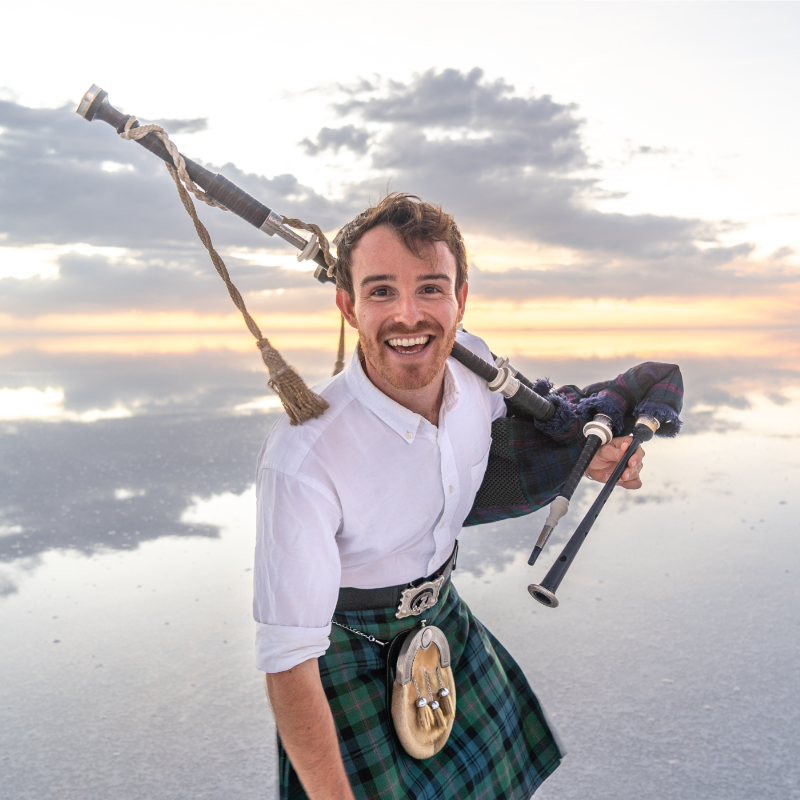
Matt Bowles: My guest today is Ross OC Jennings. He is a traveling bagpiper, world record holder, and cultural storyteller who has played the bagpipes in more than 117 countries and is working towards performing in every country on Earth. He is also the host of So Where’s It From? a documentary-style YouTube show exploring the origins of everyday objects, foods, and traditions. With both Irish and Scottish heritage, he was raised mostly in East Asia, educated in the UK, and speaks Mandarin, Spanish, and English. He has built a global career as a musical performer, public speaker, and content creator. He’s performed live for over half a million people, collaborated with governments and international brands, and used his bagpipes as an unlikely catalyst for cross-cultural connection as he travels the world.
Ross, welcome to the show.
Ross OC Jennings: Hello Matt. Quite an intro. I should have you as my hype man everywhere I go, every time I enter a room.
Matt Bowles: You deserve quite an intro, my friend. You are doing really amazing and inspiring things. I am super excited to have you here on this episode.
But let’s just start off by setting the scene and talking about where we are recording from today.
I am actually in the Blue Ridge Mountains of Asheville, North Carolina, on the East Coast of the United States today. And where are you?
Ross OC Jennings: I’m in the BGC district of Metro Manila, the Philippines. Less romantic and it is rainy season, so I’m looking outside and there’s another typhoon on the way.
Matt Bowles: Well, before we dive into this episode and talk about your traveling and your bagpiping, I want to start this off by asking you to tell me a story that I have never heard before.
I understand that you hold a Guinness World Record in cycling. Can you please tell the story of what record you hold, and then how and where you set it?
Ross OC Jennings: So, it was 31st December 2012. Just to set the scene, we’re in Freedom Square in Taipei, Taiwan. That’s right next to the Chiang Kai-shek Memorial.
And this siren goes off, and I’m on a secondhand bike which has a rusty chain, and I start pedaling like Billy-O straight underneath that archway. If you’ve ever been to Taipei, in Chiang Kai-shek Memorial.
And then, about 10 minutes later, I reached the finish line, and I’m handed this certificate awarding me with a Guinness World Record. With 89,000 other people, we were part of the world’s largest group cycle, and it had never been done before.
90,000 people across Taiwan had been coordinated to cycle at midday on 31 December 2012, at the same time, all the way around Taiwan. And Taiwan has this wonderful cycle network now all the way around it. Big cycling community, big cycling company. I think Giant is from Taiwan, and I had been asked by a friend to take part.
We had to sign up months before, and I became, in that moment, a Guinness World Record holder in cycling.
Matt Bowles: That is amazing.
Ross OC Jennings: A lot less epic.
Matt Bowles: Well, I know you have a deep and long-standing connection to Asia. And before we even get into talking about your background and your childhood, can you talk a little bit about your cultural heritage and then how your parents and grandparents ended up in Asia?
Ross OC Jennings: So, I am ethnically mostly Irish. My father’s from Ireland, 100% Irish. My mother’s Scottish-English. And so that’s the ethnic makeup.
And when asked where I’m from, I usually say UK and Ireland or Scotland and Ireland, depending on how I want to frame myself and what I’m wearing.
The reason I grew up in East Asia, primarily China, is because of my father’s work. He used to work for a small exhibition company, and this small company prided itself on small emerging markets. And prior to China, my family lived in Bahrain and Thailand as well. So that’s why we were mostly growing up on that side of the world.
But from my grandparents’ perspective, my grandfather was a judge, and he had been posted many years ago, pre-World War II, to Southeast Asia to work with the British Overseas Commission. And he was fully Irish, too.
So, I wonder if that played an impact in my father’s psychology or mentality in finding work abroad. Because being Irish back in the ’60s, ’70s, ’80s, or in the UK, there weren’t that many jobs going. The UK, I think, economically was going through a pretty tough time.
So maybe my father and my mother had the capacity, when they were looking at jobs, to be like, okay, the limit doesn’t just extend to this combination of islands that we work on. Perhaps we can look further afield. And they did.
So, the first place that my father and my mother moved to was actually Bahrain. I wasn’t born yet. I was maybe made in Bahrain, but my mother moved back to the UK to give birth to me.
So, I was actually born in England. And that was because back in the day, and to this day, as a weird nationality, birthright rule, and my parents were worried because my dad was born in Malaysia, they were worried that if I was not born in the UK and when I have kids, if my kids are not born in the UK, they would not get access to a UK passport.
So, she gave birth to me in the UK. My poor mother, I think, was on her own for a while, and then they moved to Thailand.
So, I spent the first three, four years of my life growing up in Bangkok, from 1990 till 1994, which is wonderful because that’s given me this instant connection to Southeast Asia and East Asia.
And although I don’t remember any Thai language, unfortunately, I hold Thailand quite dearly in my heart. And I often think it’s been a big part of my family’s life and definitely my upbringing.
Matt Bowles: So, you move to China when you’re about 6 years old and you grow up primarily in Shanghai. Can you take us back to what you remember at that age? Arriving in Shanghai, what was that like?
Ross OC Jennings: So in between Bangkok and China, we had a stint of a few years, three years or four years, back in the UK. So that happened first.
And then the same company my dad had been working for in Bahrain, exhibitions, was like, “Hey, do you want to go to Shanghai?”
And I remember that moment that we’d been told this, because me and my brother and my sister, we were in the garden, and we were imagining what our life would be like in Shanghai, being able to speak Chinese. And we could not fathom. I remember the plant pot we were standing next to, even. It’s such a vivid memory.
Then skip to moving there. And it was just very different to what it is now. So, December 1997 is when we moved there. So, it was cold as hell.
Shanghai was still quite industrial. Things in China were still not super—not that it wasn’t super open, things were quite limited. Buying foreign produce was quite limited. And not that that mattered, but when you’ve moved from a world that you’re familiar with and then moved to a country which is very, very different—language, culture, everything—when you wanted those old comforts and things that you were familiar with.
I know this is really random and super British, but I’m going to say it: baked beans.
There is this one department store in Shanghai called the Friendship Store, and it’s the only place where you could buy foreign produce. And it was on one end of Hongqiao Lu, near to where my dad’s office was, and you could go in and buy this foreign produce.
But it was bloody expensive. Nearly $20 for a tin of baked beans. Everything was shockingly expensive.
However, as a kid, you don’t know any different, really. I was just like, cool, I’ve moved from this to this. And my parents did a wonderful job of maybe shielding us from all those difficulties. And I don’t remember it feeling that difficult, really, because I was a kid. I didn’t know any different.
But I do remember it being very challenging in some cases for my mum and my dad, although my dad was away.
I remember at one point, in this department store, my mom was buying a CD player and people were circling us. And it wasn’t just a few people. A lot of the time in the ’90s when we were there, it was the first-time mainland Chinese had seen foreigners, so they were just curious.
But I can’t imagine how overwhelming that would have been on top of a day of work doing this stuff, just trying to buy a CD player. My mom, in her basic Chinese, just trying to get the point across, and there were, like, swarms of people around her.
And I think she had a bit of a panic attack because she was so overwhelmed, and then just peaced out, grabbed me, and we were gone.
And I do remember that moment, and I think that probably happened quite a lot for my parents. And they navigated it very well and navigated us through that very well.
Matt Bowles: Tell me about the first Chinese New Year that you remember. How old were you and what was it like, that first Chinese New Year?
Ross OC Jennings: It’s got to be 1998, so it’s still quite early on. And I remember staying in the Peace Hotel on the Bund. So, for listeners, just to give you some context, Shanghai has different districts, and this is one area along the river. The Huangpu River is called the Bund, and it is supposed to be a mirror image of one of Shanghai’s sister cities, which is Liverpool.
And this area used to be part of the British Concession, so it’s got these old colonial buildings. It’s quite bizarre. This scene is very un-Chinese because, if you know a bit about Chinese history, there’s some very unfortunate history that involves the British, as I’m sure lots of us are aware.
So, this waterfront is very British in its outlook. It’s got these different hotels. One of them is the Peace Hotel, this famous hotel. And we decide to stay there in one of the bedrooms.
And back then, there wasn’t a huge amount of holiday or foreign visitors in Shanghai. So, we managed to stay in this building, a big suite, which was crazy. Like, marble floors that had been built 100 years ago.
And I remember, as the fireworks were going off on one of the days of Chinese New Year, like, sitting on the balcony, peering over and just seeing fireworks all over Shanghai. And it was the loudest cacophony, a wave of sound hitting me in a way I’d never felt before.
And I also remember looking down onto the Bund, because there’s a long road, and the only color of car that I could see was red cars, back to back, as far as the eye could see.
And it was just such a strong visual because, back then, taxis and I think most cars had to be red, and they were a certain type of taxi. They were always the Volkswagen maroon-colored Santana.
That was my main memory from that Chinese New Year.
Matt Bowles: So, what was your experience like in school there as a kid? Learning Mandarin, studying Chinese culture, what do you do you remember as you got older and came up in the school system?
Ross OC Jennings: So, going to school in Shanghai, we were at an international school. And international schools, for a bit of context, they’re basically these private schools or charities that operate in different countries around the world. Some of them have groups, some of them are independent.
More often than not, they cater to a non-local community. In China, particularly the case, because they would offer, let’s say it’s an American school, American system; British school, British system; Singapore system, et cetera.
In mainland China at the time, in the ’90s, mainland Chinese people were not allowed to go to international schools. It had to be people with foreign passports, non-mainland Chinese passports. Hong Kong folks, Taiwan folks actually could go to these international schools, but mainland Chinese passports could not.
So, it was fascinating and weird all at the same time. I loved it because at our international school, we had an hour of Chinese language every single day and also an hour of Chinese culture, which I think is wonderful.
Because now, speaking to folks at international schools who work at them, et cetera, all around the world, often language is now pushed to the side, which I think is shocking. If you’re living in a country and going to school there and living there, you absolutely should be learning the local language. And our school made damn sure that we did that.
It wasn’t just Mandarin. We were sometimes learning Shanghainese. We were learning all these different aspects of not just the language, but the culture, because we also had an hour of culture class.
I say every day, but it must have been fewer than that because I don’t remember so many of the culture classes. But it was such a wonderful experience because we would learn everything from flower arranging in these culture classes, to cooking classes, to Chinese cooking, to very Chinese Communist songs.
So, like, I know a lot of Red Chinese songs, and also the Chinese national anthem off by heart, which, as we all know, is a very frequently played song during the Olympics, so it comes in handy.
Matt Bowles: So, what was your friend group like? If Chinese folks were not allowed to attend these schools? Did your friend group become mostly the international students at your school? Or did you have local Chinese friends from other places in the neighborhood or whatever? What was that like?
Ross OC Jennings: It was a mixture, primarily international folks. My two best pals when I was at school were one dude called Devon. He’s an Iranian American guy, and he was probably my best mate. Then another guy was a British guy.
But the overall ethnic makeup of the school was primarily South Korean. Then I think it was Japanese, and then it got smaller and smaller with different ethnic minorities.
The only ethnic Chinese friends I had were Julia from Hong Kong and Charles. Julia, I actually still keep in touch with. She now lives in New York.
Charles was very interesting because he was actually Shanghainese. However, his family also had Libyan passports, so that meant he was able to go to the international school.
Friendship groups were very small. You often found that you were friends with people much older than you because the pool of international people there, non-local Chinese, was very, very small.
I was friends with my brother’s friends and my sister’s friends. And because of that, it was really cool because this morning I had kimchi for breakfast. And I remember the first moment I had kimchi because it was at my friend Max’s birthday party in Shanghai.
And so, from a young age, I’ve been exposed to Korean food and Thai food and et cetera, et cetera. Not saying that you wouldn’t get that in the United States, Europe, or in other countries, but it was just in a very different way.
Matt Bowles: So how did you navigate your Irish and Scottish identity in Asia as you were growing up. What did your cultural heritage mean to you during those years?
Ross OC Jennings: I suppose I was lucky. As a kid, I didn’t really have to navigate it myself. It was navigated for me. And often as a kid, those kinds of things are guided for you based on your environment, which obviously involves your parents and your community.
Because of the small international community, there were often efforts to celebrate different things, like International Days. So, we would celebrate Chinese New Year, of course—Spring Festival, Lunar New Year—which we learned to love.
And then we would celebrate other nationalities’ celebrations, like Burns Night or National St. Andrew’s Day, the National Day of Scotland, and of course, St. Patrick’s Day, if you’re Irish.
And in those celebrations, it was a wonderful way for everybody, not just international folks, but Chinese mainlanders as well, to get a slice of what it was like to experience or learn a bit about that culture.
And that was really cool because the Irish community was tiny. And I remember it’s often centered around a pub. And of course, there was an Irish pub from the ’90s, whatever you want to call it, and it was actually owned and run by a Kiwi guy, who is just a clever businessman because he knew Irish pub equals good business.
Anyway, that was a wonderful center for people to gravitate toward. And I, from a young age, was exposed to trad music, Celtic Irish music. And there was always a band playing there. There were often events held there.
And so that was my first connection to what I was told was home, or that British-Irish culture. And that was lovely because it started to give me some sort of sense of identity.
And I think that is very important as a kid and now, as an adult, learning how very important that is. Knowing who you are, where you come from, really does give you a sense of self.
And it’s often quite a common theme around what are called TCKs, third-culture kids, not really knowing where they’re from, and then mental health issues coming as a result of that, and problems of not knowing who you are, where you’re from, and what it means to be you.
My parents were very good at giving me that strong foundation, so I feel very lucky in that way.
Matt Bowles: So, for you, did growing up across cultures make you feel more comfortable being an outsider or more aware that you were one?
Ross OC Jennings: Perhaps both growing up less aware that I was an outsider. Because when you’re a kid and when you’re younger, you’re like, I’m not an outsider. I’m one of you. You don’t know. Your friends are just your friends. It doesn’t matter how rich they are. It doesn’t matter if they don’t celebrate Christmas. You’re like, you’re my pal. Cool. What’s this? You celebrate Thanksgiving. Never heard of it. But I love sweet potato pie.
Oh, Lunar New Year? Great. You get to eat red bean cakes in autumn. Sick.
As an adult, I have become more aware of that, and I think that is important, especially if you’re from the Global North, you’re from Europe or North America, and if you’re white, to be aware of your place and maybe how much space you’re taking up, and how much of your voice you’re sharing, and how loud you are in certain rooms.
Sometimes a story is not yours to tell. And I’ve learned maybe to take a step back over the past 10 years.
Especially a friend of mine that I used to work with. I don’t know if he coined this phrase. The first time I heard it was through him, and he deemed himself as a “forever foreigner.”
And although ethnically we’re both very different, I do feel that in some sort of way. I’m not saying like, boohoo, poor me. No, not at all. I quite love being an outsider. It’s often reflected in my friendship group.
At university, maybe not at high school in England, I’m okay being on the periphery. I’m all right with that. And I love that because then I get to dip into things that tick my box or that appeal to me.
Matt Bowles: So how old were you when you returned to the UK for boarding school? And what do you remember about the cultural adjustment coming from China to the UK? Was there reverse culture shock?
Ross OC Jennings: Short answer, yes. For context as well, because I think it’s important, boarding school, for me growing up, that was just my normality. Now, as an adult, I know how crazy the concept of that is.
It’s only really familiar if, let’s say, you’re from a certain slice of society in North America, Europe, or, if I hear from Nigerian friends, it’s used as a threat. If you’re Nigerian, “We’ll send you to boarding school.” So maybe that’s the case in other places in West Africa, too.
So boarding school was a crazy experience because it was just so different to international school in East Asia. I know I’m very lucky to have gone to a boarding school. Ideally, my parents wouldn’t have sent me. But the international schooling wasn’t the best in Shanghai in the ’90s. It was a place where rogue teachers would go with questionable backgrounds, and now it’s super, super strict. But back then, it was a bit lax anyway.
Massive culture shock. Because I’d been told that lots of these boarding schools in the UK were actually quite international. Of course, the majority was perhaps British or European, but there was a sizable Chinese population, Russian, South Asian. You might get West African, too.
The school that I went to? None of that. It was honestly shockingly white. And that was pretty jarring for me, I think, coming from Shanghai, just because I had a bit of a weird international American accent to start with.
So, I definitely got teased because of that. And I didn’t like that. I was also a really fat kid, so that didn’t help. I was ripe for the picking.
And then I went and did the worst thing that you can do when you start at a new school, and that is to go and learn the bagpipes.
I’m a weird, awkward kid as it is. And then I do the weird thing because I was like, “Oh my gosh. Cool. I’ve always wanted to do this.”
Nah, not what you do when you join high school.
Matt Bowles: Take us back. Set the scene. Describe the moment when you decided that you wanted to play the bagpipes.
Ross OC Jennings: It was the first year that I started at this new school. We were sat in one of our assemblies that happened every Monday, and our head of year went through the regular announcements that he went through every single week.
And then suddenly, the bagpipes start. And in marches this bagpipe. My bagpipe teacher-to-be, this wonderful lady called Bernie, stood playing the bagpipes in front of all my year. And I’m sat there thinking, this is so cool.
And of course, I knew bagpipes. I’d seen them in videos, I’d seen them from afar. And in my mind, I’m like, this is my culture. Or so I’ve been told.
And, like, I don’t know if any of you listeners have ever heard the bagpipes. You might hate them, you might love them, whatever. You might get the sense that they give you intense goosebumps or hairs raised at the back of your neck. All of that in one.
And imagine me, this little fat kid, thinking, yes, this is so cool.
And they were offering us one year’s worth of free lessons because this was an extra thing you had to do. You had to pay for it. It wasn’t just included. And I was like, hell, yeah.
Because the school wanted to start a bagpiper band, and I was in. All in, a thousand percent.
But I was the only person in my entire year to sign up, and I learned why three or four months later. Because you become the most well-known person in the music department for the wrong reasons.
It wasn’t an escape or anything like that, of course. Eventually, it became a chore. And like anything you do as a kid, you have to practice, put in effort. So, there were plenty of ups and downs, but it was definitely more ups, because my teacher, Bernie, was wonderful.
She was this super chilled, very relaxed, different teacher. And when it comes to bagpiping and learning it, throughout my experience, many people have started but been put off because their pipe teachers are these old, grumpy dudes who just make you do boring shit.
Bernie was not that. She was wicked, and she would let me learn, like, cheesy theme tunes or stuff that would make me happy.
And it’s the classic example of, like, you have a great teacher, and a teacher has a passion, and you enjoy the teacher, and you’re going to enjoy this thing.
And I wasn’t the best. I was pretty bad, actually. It took me ages to get a proper tune out, but I stuck with it.
And that’s why I’m here today with you. Because of the bagpipes. Because of her.
Matt Bowles: So, while you were at this culturally homogenous school in the UK, how did you keep up your Mandarin language skills during that time?
Ross OC Jennings: So, my parents were adamant that I would keep up Mandarin, which is good. I’m glad. I wanted too as well.
I intensely missed China, and I remember finding it a bit confusing because there was not what I had before. I remember begging my parents to leave after the first six months at this school, and they just said, “Stick it out. You’ve got to stick it out.” And I just wanted to go home. I wanted to get home so bad.
And I feel bad for my parents because they—I forget this, apparently. I used to call every night just in tears. And that must have been so heartbreaking for them, being like, they’ve shipped their 13-year-old kid across the world.
Which, I know it’s not that big a deal, but I was just so intensely—sorry. Keeping the Chinese up.
My parents asked the school, and the school replied, and I swear we have this email from them saying, “Chinese won’t catch on.” The arrogance of this.
Because my parents were like, well, this is a damn expensive school. Why can’t you provide this as an extra curriculum? You’re teaching Russian, you’re teaching Spanish, French, German, all of these things, Japanese, even Arabic. Can’t you do one of the most widely spoken languages?
No.
So, my parents had to find a local mum, a Chinese mum from the nearby villages. And she would come and meet me a couple of times a week, and we would chat. And she was, I think, in the process of trying to become a teacher as well.
But I would basically have classes with her across the week. And I’m so glad I did, because that did help keep things up eventually.
There was one Chinese student that started at the school, Lillian. I think Lillian was a bit freaked out when she started. She started when she was in the final two years of school, because at this school you could join in your penultimate year or your last year.
And Lillian, I think, when I found out she was from mainland China, I was like, yes! I think she was a bit freaked out that I was so excited that she had started.
And other than that, no other mainland Chinese students joined.
But I’m glad I kept it up. The lessons were very useful, and I eventually went on and did the standard exams you have in the UK called GCSEs, to keep up Chinese.
And then ultimately, one of my big goals, leaving—I’m so obsessed, and I’ve been taken away from my home, which was China at the time—but I’m going to go study Mandarin and Chinese at university.
Matt Bowles: That’s amazing, man. So, talk about that. When you go back to China, you are able to parlay your bagpipe skills into paid gigs around China. Can you describe what that was like playing the bagpipes around China? What types of events were you playing at?
Ross OC Jennings: So, after I finished high school, I then decided to take a year out, which is—sometimes happens in the UK, sometimes happens in Scandinavian countries—a gap year, as it’s called. Or a gap many years.
And I went back to China to do work, keep up my Chinese, travel. And little did I know that the bagpipes would become such a big part of that.
This must have been, what was it, 2008, 2009? I moved back to China, and often, because of these international communities and holding different cultural events, like Scottish National Day and other stuff, often they wanted a bagpiper.
And more often than not, I was the only bagpiper available.
So, people would contact the British Embassy, who’d contact my parents, and then they would ask me, and I would then be playing the bagpipes at these gigs, cultural events.
Then Scottish whiskey was taking off in China. There was this brand called Royal Salute that wanted a bagpiper at all their polo, on-the-back-of-a-horse polo events. Royal Salute was sponsoring that, and they wanted a bagpiper.
So, I was like, okay, and they were paying me. So, I was this 18-year-old kid playing the bagpipes sometimes at these polo tournaments in Shanghai.
It was just so bizarre and wonderful because it paid for a lot of my travels and experiences when I was there.
So, I know this sounds ridiculous, but I’m going to say it anyway. In terms of bagpiping, you know how they’re like, “You’re one in a million”? I swear I was, like, one in a billion because often I was the only piper available.
And it carried on to the next year when I went to university. In my first term, I remember for one weekend, I was even flown back to Shanghai to play the bagpipes, which is just crazy. Absolutely crazy.
Matt Bowles: So, what was the reception like at these events when you were there playing the bagpipes? Can you describe one of the gigs, for example?
Ross OC Jennings: China was changing so quickly in the ’90s, and even without those changes, people are very hyper-aware of Scottish culture or certain aspects of it.
So, kilt equals Scotland. Or, actually, more often than not, people would be like, Ireland, Celtic. They kind of group it together, as that often happens in North America. And you will know because you are Irish American—bagpipes, too.
So, people are familiar with it, but I don’t think they were quite familiar with just how loud this thing was, especially up close. And, like, the wow factor was just kind of insane. So that hit people on another level.
And as a kid, I wasn’t quite sure how to navigate that because I often used to think, oh, like, you don’t like it? Rather than, like, oh, we love it.
Mostly positive interactions, though. I didn’t really have anyone negatively interact with it. And at the events, it was often like, oh, can we get a photo? Can we get a photo? Of course.
And then I think maybe it would shock people that I could also speak Mandarin and then give more context to it. So, it was doubly quite wonderful in that sense.
Matt Bowles: But you mentioned that you also traveled around China during that period. Where did you go and what did you observe getting to spend time in the different regions of China?
Ross OC Jennings: When I decided I was going to go to university to study Chinese and economics, as a joint honor’s, there weren’t that many universities in the UK that offered that. So, I was going to Edinburgh.
I applied to different unis, and I was told you have to read up about it, especially if you’re doing interviews for university. I then became very obsessed with Chinese studies and Chinese stuff.
So, I was reading different books, and there’s one book written by a journalist called Rob Gifford, and it’s called China Road. And he traveled from Shanghai all the way across China on China’s Road 312. I don’t know if that still exists, but he dubbed it as China’s Route 66.
And I read this book, and as an 18-year-old, I was like, this is so cool. So, I wanted to copy aspects of this guy’s travels, and I did that.
I invited a friend, asked if she wanted to come. Sadly, didn’t take my bagpipes with me because the bagpipe travel thing hadn’t quite started.
And we copied segments of this guy’s trip all the way from Shanghai to Xinjiang in the west, the western province of China, to Urumqi and then on to Kashgar, which is where the Silk Routes used to enter China.
Kashgar is very close to the border of Kyrgyzstan, Afghanistan, Pakistan, that side of China. And it was just the most wonderful journey as an 18-year-old because I found it obviously easy because I could speak Mandarin.
But through the lens of my friend Caris, who spoke none, we would often go weeks without her being able to interact with anybody apart from me.
And I remember us having this fallout because she was like, “Ross, you don’t understand how hard it is for me. Everything we do is navigated through you. The only person I can chat to is you.”
And I remember thinking, oh gosh, okay, like, how lucky I am to be able to speak and chat and just get on with folk and enjoy the trip, whilst my friend was like, totally none.
Because we were in, like, rural Gansu on these 14-hour train journeys, just shooting shit with someone in the bunk above us. And Caris had to listen in, being like, “What are they saying? What are they saying?”
I’m so glad I got to do that. And I’m doubly glad I got to do that in a time before smartphones.
Because as we know now, travel is dominated by social media and smartphones and a huge sense of awareness before you even arrive. And I’m not sure if that’s a good thing sometimes when you’re a traveler.
Many of the listeners here are probably travelers too. I often think our expectations now of a destination and a place when we travel there are so high because we’ve made the mistake of doing maybe a little bit too much research, or we’ve seen a highly edited photo.
So, when we arrive, we’re like, meh, not great.
I was so lucky to have none of that. All it was words on a page. And I got to see what it was then, like, in real life and form my own first impression of that.
And I think those first impressions nowadays are sadly taken away from us because of social media.
Matt Bowles: Well, I know you now speak Spanish as well. How old were you the first time you traveled through South America? What were some of the highlights of that experience?
Ross OC Jennings: For that same year that I took a year out after high school, that gap year, I also then went to South America.
I had studied Spanish at school, so I had a basic understanding. So that first travel experience, I was obsessed with South America, in particular Peru. I studied Spanish and then became fixated on Machu Picchu and the Incas, et cetera.
So being able to go there that same year as an 18-year-old kid was just crazy. Like, Lonely Planet guide booking it. Not like social media, “Go to this café” type stuff.
And again, with two other friends, it was a really wonderful way to experience the world. Guidebooks, Internet cafés to check in with your family every week, and then arriving at a hostel not knowing if they had a space or not.
Because you’d arrive and, you know, back in the day there would be like three recommended hostels, especially if you bought the cheapest guidebook, which covered the whole continent.
I remember the Lonely Planet we had was South America on a Shoestring. And this book intended to cover this whole continent. We were using that.
So, every city we went to, there were only like three recommendations for hostels or places to stay. And if those were full, too bad. They would often be like, “Just try the place opposite.”
Again, looking back, such a cool sense of adventure. Because I remember arriving in La Paz, Bolivia, and the one recommended hostel was full. And it was the first time it happened, and we thought, oh, like, where do we go next?
“Oh, we’ll just go next door.”
Another equally good hostel.
So, when you’re younger and that happens to you, I think, yeah, you do have this great sense of adventure. It might not sound that exciting now, but back when you’re young, when you’re a teen, it really is.
And I love that trip around South America because it was the first exposure to Latino culture, because I knew nothing of that. I was a lot more familiar with East Asia, aspects of Europe, and that’s it.
So being thrown into this world where I’d never visited before—food, culture, things I’d never been exposed to—was just so intensely wonderful.
Matt Bowles: So, after college you eventually decide to merge your passion for travel with your passion for the bagpipes. Can you maybe take us a little bit on your life journey where you were in your professional career and, and tell the story of how you arrived at the idea to play the bagpipes in every country in the world?
Ross OC Jennings: So, my final year at university, like many people’s experiences when you’re studying, is like, apply for jobs. What graduate job have you got? What are you aiming for?
I had done an internship the summer before my final year back in Shanghai. It was with Louis Vuitton. And by then, my Chinese was top-notch. I was writing emails in Chinese, and I remember even surprising myself because I was writing in traditional script because I had spent a year in Taiwan studying Chinese there.
And so, I was slightly showing up my colleagues, writing in traditional script, and they were like, “Wow, that’s cool, but please just use simplified script,” because there’s two different script systems there.
I’d done this internship, and then after the internship, I just thought, I don’t want to do this. I don’t want to work for luxury goods. This is not me.
I then did my dissertation on luxury goods in China, and it made me hate it even more.
So that final year, when everyone was solidifying what they were doing—working in finance, going to work for the government or whatever, being doctors—I was slowly pulling apart this idea of what my future would be like.
And then I was like, I don’t want to do any of this.
There was this competition to be a TV presenter in the UK to join Blue Peter, which is the longest-running TV show in the world, I believe. And as a kid in the UK, being a Blue Peter TV presenter was like the dream job.
So, I decided, with a friend—they were like, “Ross, you should go for it. Send in a showreel.” I’d never done that, done anything like that before.
And long story short, didn’t get it. But they were like, “Hey, you might be good at this. You’re just a bit too nervous on screen.”
So, there was this idea in my mind that I thought, hey, I’ve always wanted to do this presenting thing, travel. Why didn’t I try and go for it?
So, I stayed in Edinburgh. That was a disaster. Moved to London.
In London, January 2014, I then went to this adventure travel show, an exhibition slash conference where these really badass adventurers meet who had hiked across Antarctica or swum the Mississippi River, swum across the Atlantic Ocean.
You sit there listening to all their epic stories, and after sitting there in this one talk from this very normal guy called Dave Cornthwaite, he was a graphic designer from Wales and he was sharing his story, and I just thought, this isn’t just inspiring, it’s very relatable.
And I thought, if this dude can do it, so can I. And I’m only 24.
That afternoon, I cycle home. It’s a Saturday, and as I cycle home, this idea starts to formulate in my mind.
And by the time I get to my front door, I decide I’m going to be the first person to play the bagpipes in Antarctica.
And I was like, sick. This is amazing. There’s been loads of Antarctica chat all day. Everyone’s done Antarctica, but I’m going to do it with the bagpipes, and I’m going to be better.
So, as a young 20-year-old, I opened my door. I’m so excited. And I thought, first thing, I need to do research.
So, I pull open my laptop, type it into Google. Oh, I should check. Has anyone bagpiped in Antarctica?
Press enters, and up pops that damn photo of a bagpiper next to a penguin from the 1906 Scottish National Antarctic Expedition. Black-and-white photo, bagpipe next to penguin.
And I saw this thing, and I thought, damn it, this guy’s beating me by, like, a hundred years.
So, you know what? I’m just going to go another level, and I’m going to try and bagpipe in every single country.
Matt Bowles: So, when you go from that as a thought or a whim to actually seriously deciding to pursue the quest, what was that transition like? What changes did you make to prepare for a life of travel?
Ross OC Jennings: In a really naive way, because I’d just come from this conference, the next day I went back and I thought, to make it real, I’m going to start telling people what I’m doing and I’m going to pitch it.
Because everyone was talking about sponsorship. “This guy was sponsored to do this. Someone sponsored this.” So, I thought, oh, okay, just get sponsorship. Someone else will pay for it.
Which is crazy. That’s such a crazy thought. But that’s sort of what these other people were doing. So, I thought, let’s pitch it.
And everyone was like, no, this is so niche, but not that impressive. And also, you’ve not started it. You’ve not done anything.
So, there I was, as a young 20-year-old, thinking people were just going to hand me cash to travel with my bagpipes. No way.
So that was a good reality check.
I then saved a little bit, and I actually started pitching to Scottish companies, like kilt companies, bagpipe companies. And they were like, hell no.
But there was one charity called the Saltire Society, and they were part of preserving Scottish stories in Scotland and around the world. And they gave me 400 quid to write a blog.
And for me, that was the coolest thing ever. You’re giving me money to write a blog on travel? 400 quid. For me, it might as well have been like 40,000 quid, because that was something. It was like, a tick. Go for it.
I had this internship, quit the internship, I’d saved a bit of money, and I booked a flight to Tunisia.
Three months later, I landed in Tunisia. And the reason I went is because I had a university friend who was studying there, and she was like, “Come visit. You’ve never been. Why not?”
I took my bagpipes, and I treated that as my first bagpipe country. And although I had bagpiped in other places before, I see that as the official start of my journey.
And it was just, for me, a part of the world I’d never been to. I had never been to North Africa. I knew nothing about the culture.
I studied a little bit of Arabic in school, where I had basic, like, Fusha Arabic, but North Africa? Totally different. French, very different dialects, et cetera.
And even sitting on the plane, it was so wonderful because I moved seats for this guy so he could sit next to his wife. And I still remember his name. He was called Mahmud El Arbi, and he worked in London for many years.
And he, long story short, was just this wealthy Tunisian businessman who owned a football club in Tunisia.
And he then sits me next to another guy, a British photographer called Eddie Bozzio. And I was telling them about my journey and my plans, and that made it real in my mind and sort of in other people’s minds.
So, this British photographer, a week later on my trip, connects with me again and offers to take photos of me in Sidi Bou Said, which is a coastal neighborhood or town next to Tunis. Everyone says it looks a bit like Santorini—very Greek, white buildings, blue roofs, very pretty.
He takes photos of me when I’m there, and then I link up with Mr. El Arbi at his football club four or five days later, and I’m playing the bagpipes at their annual AGM in the south of Tunisia.
It was so friggin’ random.
Matt Bowles: That is amazing. I understand that on that Tunisia trip you also had a run in with the police. What happened?
Ross OC Jennings: Yes, I did. In my naive European mind, I was like, oh, I’ll just take public transport around Tunisia. No, rent a car.
And it was this little Renault. I’d never driven on that side of the road before, and it was manual, so it was like doubly confusing.
Again, smartphones weren’t really a thing back then, let alone eSIMs. No way. So, I was just winging it with downloaded maps or a paper map in my hand.
I drove out of Tunis through one of these small Tunisian towns, villages. I think it was on the way to Matmata, which I was going to because that’s where they filmed a lot of Star Wars. If you’re a Star Wars fan, you probably know this already. They filmed a lot of the original Star Wars in the desert in Tunisia.
And I wanted to go there to play the bagpipes. Random. So, I could play the Star Wars theme tune on the bagpipes.
I’m going through one of these towns, leave it, and there’s a police checkpoint. And I’m quite a friendly traveler anyway, friendly person. So, I’m like waving furiously because I thought, if you smile at police, they’ll smile back and be nice.
No.
They stand in the road, they beckon me over, and these three police people have got guns. And I hate guns. I’m not used to them, really, especially seeing them on police.
They’re standing either side of the car, they tap on my window with their guns. So unnecessary.
And it really hits me then, where I’m like, I don’t speak French or Arabic, and they’re hurling all these words at me. And the only thing I understand is “passports.”
So, of course, I hand over my passport and the standard documents from the car. They look at them. They look, turn them over backwards and forwards. And then one of the police people looks at the car registration document, all written in Arabic, and smiles.
And at that moment, they start to get super mad.
They open the door, drag me out, take me to the boot of the car, and they’re hurling words at me in Arabic and French.
And at that moment, I’m like, are they going to put me in the boot?
But no, they open it up, they point at my bags. I’m going through my bags.
And what goes through my mind, sort of, is I think I’ve missed the opportunity to maybe bribe them. I’d never bribed anyone before. Was I supposed to do it when I handed them my documents? Too late.
They’re going through my bags. They point at different things, and then I get to my bagpipe bag.
I open it up. They spot it, and they seem to recognize it. And they turn to me and they go, “Go, mezwed.”
And I’m like, “What?”
And they look at each other, and they look back at me, and they all go, “Yallah.”
And I’m like, “What?”
The one or two words I do know, “thank you” and “yallah,” which, if you’re listening and you don’t know, basically means, “Let’s go.”
“Let’s hear it.”
So, I’m like, okay.
I assemble my bagpipes as they’re staring at me, stone-faced. And on the first note that I play, all three police people are like, “Mashallah! Alhamdulillah!”
They’re clapping, suddenly dancing, they’re hysterically happy. And in my mind, I’m thinking, what is going on?
One guy’s clapping me on the back. They’re elated. They lead me back to the door, they let me put my bagpipes back in the boot, and they hand me back my documents.
And I’m about to head off, totally confused at what’s going on.
But before I go, they’re all like, “Photo!”
So, we capture the moment in a really ridiculous way on the side of the road.
And that evening, when I get back to my hotel, hostel, wherever I was, I’m trying to put two and two together. And I look it up online, and it turns out that one of the national instruments of Tunisia is also the bagpipes.
Matt Bowles: So, once you learned that, can you share a little bit about the journey that led you on and what you found out about the global history of the bagpipes?
Ross OC Jennings: I think from that point, that changed my perspective of this journey that I was going on. Now I can look back at it and say it so clearly, but it didn’t happen so immediately. Of course, it was a longer, like, maybe five- or ten-year journey of me putting things together.
But that made me question this idea that it was just Scottish. Yes, bagpipes were Scottish, but they were also part of other people’s cultures.
And to tie other bits of my journey in as I was traveling, I decided to include school talks and workshops in the different countries I’d go to. I worked out that was quite a good way of financing my journey. These international schools and schools in other countries would pay for me to come in and do a workshop or performance.
And they would often ask me different questions about myself, the bagpipes, the kilt. And that forced me to swot up on all of this culture, which actually I knew nothing about.
And one of them was, “Where do bagpipes come from? What are the bagpipes?”
And for me, that was fascinating. Like, where does this thing come from? Well, Scotland, of course.
Actually, no.
The more I traveled through Europe, the Middle East, and North Africa, the more I learned that bagpipes are part of a lot of people’s cultures.
Turns out there’s over a hundred different types of bagpipes from over 40 different countries. They’re a very popular folk instrument. And perhaps one of the last countries to get the bagpipes was Scotland. They were introduced by the Romans many thousands of years ago.
Bagpipes—where do they originate from? The more I traveled, the more I realized. And of course, I could have just Googled it, but there’s a difference between reading something online or on paper versus actually seeing it.
The more I traveled in the Middle East, the more I got to see how big bagpipes were in Middle Eastern culture. Iraq, Saudi Arabia, Gulf states like Qatar, the Emirates, et cetera. Everyone loves the bagpipes. Egypt as well. I could hear them on radio channels too.
But it’s a very different type of bagpipe nowadays. The general agreement is that bagpipes do come from the Middle East, which isn’t such a big surprise because a lot of things came from the Middle East, or what was Mesopotamia.
Some historians apparently, last year, decided, okay, actually, no, they might come from South Asia, India. Very plausible too, given how ancient those cultures are.
But I think the wonderful thing about it is that bagpipes are not just Scottish. And I think our association with this instrument is because, unfortunately, because of the British Empire, this very loud, noisy instrument was taken around the world by the British and shoved in people’s faces.
And that was a hard realization for me to grasp and swallow because I’m thinking, as a slightly more self-aware 20-year-old, oh God, am I doing this?
So, over the years, my bagpipe journey has changed from being this sort of cocky, adventurous young 20-year-old to maybe being this slightly older 20-year-old, 30-year-old, being like, okay, Ross, this is your journey. But bear in mind, not everyone wants your culture shoved down their throat. And so be sensitive.
I learned that in some very visceral examples, accidentally playing the bagpipes during the call to prayer. I was playing one day, I can’t remember exactly where, but it was in the Gulf, and the call to prayer had started and I hadn’t heard it.
So, someone was giving me the stop-playing gesture, and I couldn’t realize why. Like, why? Why? Because I couldn’t hear it. And then realizing that wasn’t the most respectful thing to do.
And in certain places and times, bagpipes are not right. And that’s okay.
I once played at Vatican City, and I probably wouldn’t do it now, but I’m glad I did it very early on because I knew I had one shot to play in the Vatican, and that was it.
And the police were involved, ceremoniously dragging me out into Italy. But before I left again, they all turned around and went, “Can we have a photo?”
Matt Bowles: Well, you mentioned the bagpipe history in India. I know you did play the pipes in India. What happened when you tried to play the bagpipes at the Taj Mahal?
Ross OC Jennings: So, I’m lucky enough to have gone to the Taj Mahal a few times. I went a couple of years ago, but I also went in 2015.
And I tried to take my bagpipes into the Taj Mahal, naively thinking I could just take a cheesy photo in front. But being one of the most popular UNESCO heritage sites around the world, they were like, “Absolutely not.”
So, I thought, right, I need to get this epic shot of me playing the bagpipes somewhere with the Taj Mahal in the backdrop.
So, I followed this road down to the side of the Taj Mahal. If you’re looking at it, the river is in front of you, too, to the right, and you walk down. And I got to this group of military men. There was, like, a barbed-wire fence. They were a group of dudes just sipping tea.
And I thought, gosh, okay, they’re not going to let me play either.
But I started to put my pipes together, and I did ask their permission because I learned that day that Agra is also home to quite a big military base. So, I thought, I do not want to upset too many people.
And instead of them just saying I could play, they were like, “Oh, just play on that boat there.”
And there was a boat right in front of us, and there was this boatman almost ready to take people out on the water. And I didn’t realize this was a thing.
And they negotiated the price for me, even. But they essentially got me onto this little paddle boat with this guy, and they floated me out onto the Yamuna River.
And I’m able to play the bagpipes on the Yamuna River early in the morning, with the Taj Mahal as a backdrop.
And I just thought, this is even better than going inside and playing.
Matt Bowles: Well, you mentioned that you have been doing performances and presentations around the world as you go. I want to ask you about your experience in Bhutan.
Ross OC Jennings: Pre-2018, I decided to start a bit of a travel media company with my partner and a friend. And we were pitching to different brands, left, right, and center. Like, “Hey, work with us.”
We got this Bhutanese company to agree to work with us. They weren’t going to pay for us, but they were going to handle all our flights, our accommodation, the trip, and our time there, which was just incredible. It was such a cool thumbs-up to us for the business that we were starting.
We wanted to try and get the bagpipes involved in some sort of way. And we were pitching to the royal family to try and get an audience with them so that I could perform for them in some sort of way.
As ridiculous as it was, we thought, why not? Let’s see if they say yes.
We didn’t hear anything back. And our now friend, Karma, was saying that he’s trying through his sister, who might have some contacts. And we do a whole trip.
And on one of the last days, Karma says, “Hey, we’ve actually got an audience with one of the princesses.”
And we couldn’t believe it because it was a wonderful way of wrapping up our time there. I had played the bagpipes already, but an audience with the royal family? Wicked.
So, my partner and the other guy, Chris, they had got decked out in Bhutanese traditional dress for men, which is called a go. And it actually looks quite like a kilt.
The bottom half is quite like a kilt, and the upper half is like a giant pocket. It’s almost like taking a kimono, putting it on, hoiking it up, and putting a belt on. The bottom half looks very kilt-like. And even the patterns are quite tartan. They’re quite plaid in their look.
So, it was visually so cool. And I had my kilt on.
No cameras at all. We weren’t allowed to take anything in. And we arrived at the palace gates, and then we walked in, and we have tea and an audience with one of the princesses and her son.
And she is so cool, super down-to-earth, wicked. We’re chatting, and then she’s like, “Right, going to go ahead and play.”
And I play for her. And I play one song which is now very popular. I know it as the Sky Boat Song, and many people might recognize it as the Sky Boat Song.
And as I finished playing it, she’s like, “Oh, I know that one. That’s the theme tune of Outlander.”
I remember being like, “What? How? Like, how do you know this?”
Of course, a Bhutanese princess knows the theme tune of a popular Amazon TV series that was online.
And I just thought it was the most bizarre but hilarious moment, where she was like, “Oh, cool. Yeah, I know that one. What else can you play?”
Matt Bowles: Well, the other thing that you do, because I follow you on Instagram and I see you all over the world playing the pipes, is you will hike up to extraordinary scenic locations and play the bagpipes in these unbelievable places. Can you share the experience of hiking up a volcano in Guatemala and what it was like to play the bagpipes there?
Ross OC Jennings: After visiting a couple of countries, I thought, what is my own internal criteria for bagpiping in a country or including a country?
Because it’s very easy to put your foot on the ground, play the bagpipes, and leave. And I wanted to do three things: play in public, perhaps do a performance at a school, and then also maybe some sort of physical challenge where I hike up a mountain.
Guatemala. The go-to things to hike up are volcanoes. And there’s this one incredible hike that’s very popular now. It’s called the Acatenango hike. And it’s a dormant, extinct volcano opposite a very, very active volcano called Fuego, like Volcano of Fire, which erupts every 15 minutes.
If you ever travel to Guatemala, you’ll know it is the land of volcanoes. A land. There are many countries that are the land of volcanoes, but Guatemala is a pretty good one.
And if you’re at Antigua, the tourist capital, you can see these two volcanoes, Acatenango and Fuego, and you can see Fuego erupting from the town square. It’s mad.
And as someone who’s never grown up around volcanoes, it’s just so epic. And this overnight hike that you can do up Acatenango is fairly—not saying easy—it’s fairly doable.
You hike up in a few hours. You spend your night at a camp, staring at this erupting volcano in front of you, spewing out lava and smoke.
And the first time I did it, in 2019, I took up my bagpipes and all my camera kit and drone, et cetera. And that evening, as the sun set, I was able to play the bagpipes at 3,900 meters.
And this thing—as I finished my tune, one tune called “Highlands Cathedral,” as I stop—this thing erupts from behind me.
And it was just such a cool moment because I’m with a bunch of people, and they’re like, “Wow, that’s so cool.”
Although I didn’t sound very good at all, because playing bagpipes at altitude sucks, and it’s quite difficult.
It was such a wonderful and quite a rewarding moment. I’m not a big hiker, so hiking up a volcano, being able to do that—so cool.
Matt Bowles: Well, you’ve also played the bagpipes on top of the world’s tallest building, the Burj Khalifa in Dubai. How does someone get permission to do that?
Ross OC Jennings: Very early on in my travels, in 2017, I started including some of the Gulf countries, so the UAE, Oman, Qatar, Kuwait.
And I thought, although it’s quite a big thing now, pitching to tourism boards, I started doing that, and the tourism board of Dubai were quite keen. And this was before videos were a thing.
And they were like, “Yeah, cool. Just share six videos, and we’ll sort out your hotel, transport, and also we’ll get you to play the bagpipes on top of the Burj Khalifa.”
And I thought, what the fuck? That is mad.
So, I got to cut all the queues, and they whisked me in that super-fast elevator right to the top, to this lounge at the top, which is this bougie lounge where you can get tea or coffee or whatever.
And I was able to play the bagpipes on the balcony of it. So, it might not have been like the top-top, but it was pretty high up there.
And they let me play for a couple of seconds, basically, before the security were like, “That’s enough.”
So, I’m lucky I had that wasta, as they say in the Middle East—wasta, contacts.
Matt Bowles: And Ross, is it true that you once played the bagpipes in flight on a commercial airline at cruising altitude 35,000 feet in the air?
Ross OC Jennings: It is true, Matt. Yes.
I wanted to save my 100th country for the United States. My partners from the States, he’s from Pittsburgh, and although I’d been a few times, I thought, you know what? Why not save the USA as country number 100?
Such an easy country to do, but let’s make something big out of it.
So, I marked my time there by planning my trip around the New York Tartan Parade, which happens at the start of April, I think, every single year. Much, much smaller than the St. Patrick’s Day parades. And I think that’s because the Scottish culture and community is a lot smaller than the Irish segment.
But it’s grown in popularity over the years, and it’s now becoming a thing. And you get different clans from around the States coming and marching down 6th Avenue with the bagpipes and in kilts, et cetera, et cetera.
So, I planned my trip around this, and I thought, why don’t I try and get a free flight out of this? Pitch to United Airlines.
And they said yes. They gave me and my partner some seats, and they let me play the bagpipes down the aisle, down this plane.
And I have this hilarious video of me doing it because half the plane is like, “How exciting! We’re flying to New York from Edinburgh!”
And then half the plane is like, “Mate, shut the fuck up.”
Matt Bowles: All right, we’re going to pause here and call that the end of part one.
If you would like to hang out in person with me and Ross, we are both going to be at the Extraordinary Travel Festival in Bangkok, Thailand, October 22nd to 25th, 2026.
Ross is going to be delivering a keynote address. I am also going to be moderating a session, and a bunch of other Maverick Show guests are going to be there, both as speakers and attendees.
If you’d like to hang out with us, you can get a $100 discount on your ticket. Just go to Extraordinary Travel Fest, and when you get your ticket, enter the code MAVERICK at checkout for your $100 off.
We’re also going to link that up in the show notes, along with everything else we have discussed in this episode and all the ways to find, follow, and connect with Ross.
You can see all of that at themaverickshow.com. Just go there and then go to the show notes for this episode.
And be sure to tune in to the next episode to hear the conclusion of my interview with Ross OC Jennings.
Good night, everybody.