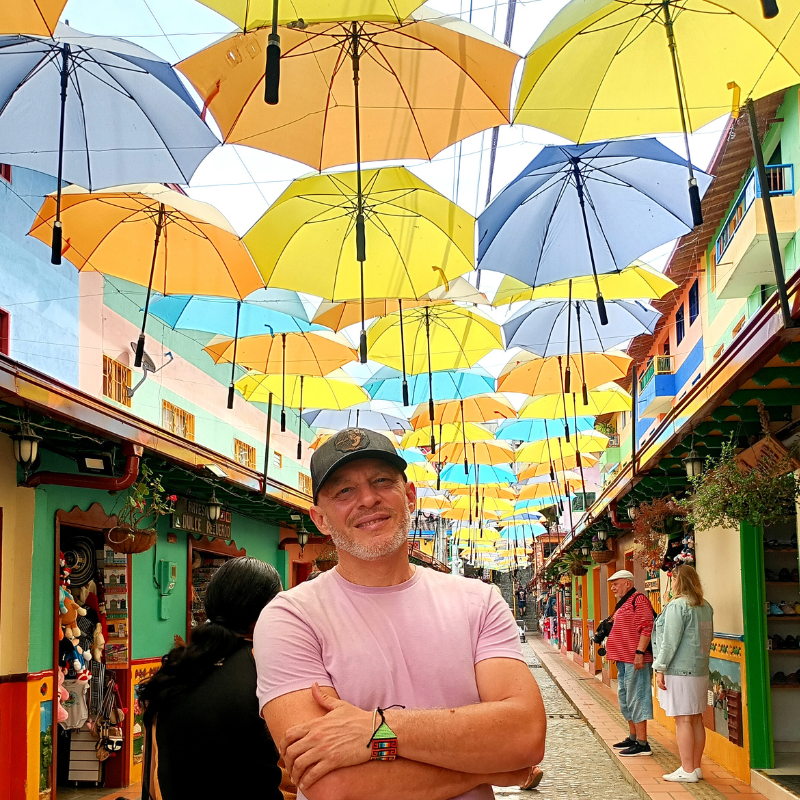
Matt Bowles: My guest today is Ocean Malandra. He is a widely published freelance travel writer and environmental journalist who divides his time between Northern California and South America, having lived in Colombia on and off since 2009. His work has appeared in over 30 different media outlets and he is the author of the latest Moon Colombia travel guide. Ocean, welcome to the show.
Ocean Malandra: Hey, thank you, Matt. Pleasure to be here. I love how you pronounced Colombia like a Colombian. I love it, man. I know you’ve been to Colombia, too. I got a lot to talk about. I’m happy to be here, man.
Matt Bowles: One of my very favorite countries, brother. And I am such a fan of your work and your writing. I am so excited to dive into this. But let’s just start off by setting the scene and talking about where we are recording from today. I am actually in the Blue Ridge Mountains of Asheville, North Carolina, on the east coast of the United States. And where are you?
Ocean Malandra: I’m in California. I’m in San Francisco city I was born in. I’ve been living back and forth between Northern California, as you said in your intro to my bio, I and South America for almost two decades now. And I tend to spend the summers here.
Matt Bowles: Well, let’s start off with the Bay Area because I know you did grow up there, and I’m curious if you can just give some background context. Even before we talk about your story, can you share a little bit about your parents, explain what the beatnik movement was and then what it was like growing up in your home as a kid?
Ocean Malandra: Yeah, so my Parents were part of what they call the Beat Generation, right? The beatniks, some people say America’s first counterculture. They were kind of a literary and intellectual movement that the hippies kind of came out of. And then the hippies became more musical and more popular. But the Beats were first.Some say the Beatles named themselves after the Beats. So, you had a lot of poetry and a lot of writers and a lot of stuff like that. And you had the first experimentation with psychedelics, and you had the first experimentation with things like Buddhism, too. So, it was experimental. It was a generation that was looking for an alternative and to mainstream American culture. And a lot of that had to do with this psychological fallout after World War II and the dropping of atomic bombs. That was like an existential kind of break in American psyche that I think cast that next generation into a trajectory where they were looking for a new way. And so, my parents remnants came from that. They’re both from the East Coast. My father’s second-generation Italian. He came to San Francisco. North Beach is San Francisco’s Little Italy. It’s also where the Beat Generation was centered. So, he felt very much at home in both ways. My parents separated, divorced when I was young. My mother moved to Oakland. So, I grew up on both sides of the Bay, which, if you know the Bay Area, it sounds like that’s a real simple thing, but it’s not, because those are two completely different worlds, man. And so, I grew up in East Oakland, California, which at the time was the second most diverse place in the country, next to Queens, New York. And then I spent all my weekends and a lot of time in San Francisco, North Beach, which is also super international, but in a different way. A lot of Europeans, a lot of people with money, Japanese. It was cosmopolitan, I guess you would say. I grew up with my feet in all kinds of different worlds, even though I was right here in the United States.
Matt Bowles: Well, you also grew up at an amazing time. You and I have bonded over our love for hip-hop culture. And you were coming up in the bay in the 90’s. Can you take us back to the early 90s and describe what that hip-hop culture was like in the early 90s and what it felt like to be there at that time.
Ocean Malandra: In Oakland, especially East Oakland, hip-hop, rap music was everything. That was the soundtrack to your life. And so, there were certain artists that stood out. This was. This is even the late 80s, right? I was coming into teenage years in the late 80s, and you had famous rappers, like, Too Short. They were coming up in a way that it’s totally alien to how people come up now, but they were selling cassettes in liquor stores. Next to the cash register would be a box of. Not bootleg, but somehow, like, almost homemade. I don’t know exactly how they’re doing them, but they were, like, stamped Too Short. Came up like that. Selling cassettes out of liquor stores. It was an amazing time. It was a rough time. The year I graduated from high school, and I went to Oakland High School. 92, I think it still is. The record murder rate for Oakland was 92. It was rough in Oakland, but the rap music was our medicine. You’ve heard it said before that hip-hop music, that rap music is the CNN of the ghetto. It definitely was trying to let the world know what was going on there. So, rap music helped instill in me a sense of social justice, as well as a love for music. Because early rap music had a lot of social justice in it. It was very much trying to let the world know what was going on in the hood.
Matt Bowles: And how did the cultural diversity of the Bay Area that you mention, impact your interest in other cultures and ultimately your interest in world travel?
Ocean Malandra: So, I went to a hippie school, right? My name is Ocean. I went to a hippie school from kindergarten to sixth grade, even though we lived in East Oakland. And then one day, I was friends with all the kids in the neighborhood. I said, mom, if we’re going to live here in East Oakland, I’m going to have to go to these local schools with my friends. Otherwise, I’m just going to feel weird. So, 6 through 12, I went to Oakland public schools. My best friend was Vietnamese. My other best friend was Mexican. I had some Nigerian friends. You just meet people from all over the world, and you go to their homes, and you eat the local cuisine, and you hear the language, and see the ways that they pray and they interact. Roosevelt Junior High, where I went to junior high in Oakland, they would send out a little notice that would be like, next Friday is going to be a half day for teacher’s meetings. Something that’s like two sentences that would be three pages long, bro. Because it would be like in 18 different languages. It was out of control. I think I had a global perspective from a young age because of that. And so, I always very much wanted to see more of the world.
Matt Bowles: And so, what type of international travel did you get to do? When did that start to become part of your life?
Ocean Malandra: I did like a European backpacking summer, maybe when I was in my early 20s. My father always liked to go to Mexico. My father was always into Mexico, and so he would just drive down across the border. And I remember sitting with him as a kid. We used to go down a lot, just the Baja, and it would be this thing. As soon as we crossed the border, he would just relax. He crossed that border, and he was. I absorbed that that was contagious. So, I just always had this feeling that crossing the border was almost an escape. And so, I always wanted to go as soon as I could. I did. It took me a while to get that together. I didn’t really start traveling full time until my 30s, but as soon as I could pull it off, I milked it.
Matt Bowles: So, take me back to 2009. You’re planning a trip to South America. What was the initial plan for this trip as you conceptualized it?
Ocean Malandra: So, like I said, I’d visited Mexico several times. And also, before that trip, I had also visited Central America. I had backpacked through Guatemala and down to Nicaragua, and I’d spent some time teaching English in Nicaragua. Actually, I knew some Spanish, but the continent of South America was beckoning, because that’s where when you haven’t been there yet, all you know is Mexico and Central America. South America’s like, it’s it. So, I had some money saved up. I knew I could take off a significant amount of time. I didn’t know where to start. I knew I wanted to do several things, so I just started at the top. To be honest, I just started in Colombia, but I knew I wanted to hit up as much as I could. As it turns out, Colombia kind of sucked me in. I did end up later traveling a lot of South America, and I’ve lived in Brazil, and I’ve lived in Peru. But Colombia, I did not want to leave, Matt. I just did not want to leave.
Matt Bowles: So, what happened when you got to Colombia that ended up derailing your initial plan for South America?
Ocean Malandra: I had just spent a month in Bogota, and I really liked it. And the reason why I liked it so much was the people I connected with. And so, in Cali, that happened again. I’m sure you’ve had this experience. Colombians are very open. They’re very friendly. You can connect really well. And Cali is, to me, the example of that. They’re just so open and friendly. But I ended up connecting with a really cool crew of both locals and foreigners. And one of the kids that I met was a guy named Biscuit, who’s from London. And—and he was a South African kid, but he was from London. And he had been hanging out in the Colombian neighborhoods of London and had a bunch of connections already and was there to do a documentary on the salsa of Cali. And I just clicked with him and helped him with the documentary. And because he had so many connections, we went to all these little barrios, salsa schools, and all this stuff, that there was no way I could have stumbled onto that on my own. And then we had all these local friends too, because he was friends with other dancers. So, I really have to give a shout out to Biscuit, who I’m sure will listen to this, for really making my initial Cali experience so cool and so off the hook. And that’s why I didn’t want to leave, Matt. I was just like, oh, my God. I was immersed in this Cali musical culture. It was incredible.
Matt Bowles: So, describe your life during that period. Can you take us into the salsa scene and paint a picture of the nightlife in Cali at that time?
Ocean Malandra: So, Cali wasn’t even getting that much tourism at that time. Colombia as a whole was just kind of emerging as a travel destination. Now it’s kind of blown up, and for good reason. Cali is not necessarily the most physically attractive city. A lot of times people are like, what’s up with Cali? A lot of times I say you have to close your eyes to love Cali. You got to use your ears instead, or use your taste buds. Just the way that there’s a Cali breeze and the way it feels on your skin is just divine. It hits your other senses more than it does. It’s not Cartagena. Cartagena is like, visually stunning. So, at that time, I was staying at this hostel, hooked up with Biscuit and—and this Egyptian kid, Farid, and we all loved it so much. We got our own apartment in the San Antonio neighborhood, which is this colonial neighborhood right outside of the center. And at that time, it was still pretty residential. It was still like an old school barrio. So, the longer we stayed there, the more we knew all our neighbors, because the neighbors were blown away that a bunch of foreigners would want to stay and live there at that time. Now San Antonio is full of hotels and all kinds of stuff. And a lot of my local friends at that time have turned their homes into hotels and are doing really well. That’s really cool, actually, to see that transition. It’s not so much a barrio anymore, but it was. And so that experience of kind of living in a traditional, historic barrio in a city like Cali, oh, man, it was just incredible.
Matt Bowles: Was there one particular night where you realized, I’m not leaving?
Ocean Malandra: Oh, man. Every night, I can’t believe how much we went out. We honestly almost went out every night. But there’s a famous district just outside of Cali called Juanchito. And Juanchito is kind of where the salsa was born. And because it’s just outside of city limits, there’s no mandatory closing time for the clubs. And it was an old school of salsa spots that has been there since the 60s. And there’s one in particular called Chango. Like Chango, like the African God of all kinds of things, but especially of dance. It was shaped like a giant turntable, like, had two dance floors, and each were round like vinyl’s. And then there were stadium seating around them. And I remember going there with a group of friends and getting lost in a trance in the dance floor and coming to. And there was this amateur dance contest going on. And somehow, I won it. And I didn’t even know what I was doing, but I was just so in love with it. I was kind of in love with this girl that I was on a date with. Dude, the whole thing, it was magical.
Matt Bowles: So, people need to understand about the salsa Calena. I mean, first of all, that don’t have context on it. So let me just give you an example from my perspective. I do not have a lot of experience salsa dancing. And so, the last time I went to Colombia, I went for two months, and I spent my first month in Medellin. And then immediately after that, I went to Cali for a month. And so, what I did while I was in Medellin is I took salsa dance lessons. And I signed up for this package where I would have a 90-minute private lesson every day for the entire month that I was in Medellin. And I was like, if I do that, then by the time I go to Kali, I’ll probably be at whatever. Let me tell you something. I did that every day for 30 days. And then I went to Cali. I was like, no, man, I can’t even step on the dance floor. This is a whole different level. The salsa calena is a whole different sport, man. So, people just need to understand that they don’t have context on this. So, I’m curious for you, how much salsa dancing experience did you have before you went to Cali? And then what was your life like there? Were you taking lessons? Were you just going out every night and learning by doing on the dance floor? What was that dynamic like?
Ocean Malandra: No, like you said, Cali style salsa is very special. It’s very unique. It’s very special to Cali because when salsa hit, coming out of New York, the history of salsa with these different Caribbean sounds. And Cali is a Pacific coast city. What happened was those vinyls came, and because Cali’s so heavily Afro Latin, salsa hit. But you’ve probably heard the story before, the Caleños played the records at 45 instead of 33. They played them at a higher speed, and they just thought that was the normal speed. And they developed a dance style to go along with this faster rhythm. And so, Cali style salsa is characterized by this really fast footwork, and it’s really hard to learn. Which brings me to point number two, though. The thing about Colombian salsa is if you can just move to the rhythm, you’re good. A lot of people think you have to master all these turns and the techniques and stuff. You really don’t. So, I just said I won that dance contest. It wasn’t because I was doing a bunch of fancy moves. I think it was just I was so into it growing up in Oakland. I have rhythm, and I was just so into it. You don’t even have to really study. Now that I’ve said that, I did. And I was with Biscuit, and we were going to all these salsa schools. And then I got teachers from the barrio to teach me a bunch of stuff. And then later I came back, and I lived in Cali again eight years later. And I joined a local school, went every day for three months, and I ended up performing at the Swing Latino with Mulatto and his orchestra. And so, yeah, I’ve done all that too. But I just want people to know, because people ask me all the time. Me, as a travel writer, specializes in Colombia. How much salsa class do I need to take? You don’t really need to take any salsa classes. It’s fun. Do it for fun, but don’t be afraid to get on the dance floor, even if you don’t know what you’re doing, because you know how it is in Colombia. It’s about having fun. And if people just see you having fun, they’re going to love you. Nobody’s going to look down on you.
Matt Bowles: So back in 2009, on this trip, you did eventually leave Colombia and get to Ecuador, but then you came back. What did Colombia have that made you turn around?
Ocean Malandra: More than anything, it’s the people, this feeling that you have a community, that you have friends. I think the magical thing about Colombia is A, it’s so diverse, that even though you or me are obviously not Colombian, the average Colombian is so used to people that look different that they are used to accepting people with differences into the group. And so that’s part of their openness, and that’s part of their friendliness. And I haven’t found that anywhere else, not to that level, not like Colombia.
Matt Bowles: What did living in Cali teach you that just traveling through it never could?
Ocean Malandra: It taught me a lot about how your average Colombian lives. Because Cali is besides being a musical mecca and all that kind of stuff, it’s also a very violent city. There’s a lot of poverty, a lot of social issues. And you really see that in Cali, you’re not protected from it. At least you weren’t when I was there. I still don’t think you are. While other major cities, Cartagena, Bogota, Medellin, all to a certain degree, you can be in a tourist or even expat scene where you’re kind of removed. That’s very hard to do in Cali.
Matt Bowles: How did that dynamic of the violence in the city compare with East Oakland?
Ocean Malandra: It’s very similar, in a way, and I think Oakland actually prepared me for navigating Colombia as well as I did. You get a certain level of street smarts, and you need a certain level of street smarts, especially did in Cali at that time. But there’s differences, too. The crime is different. People always ask me, which place is more dangerous. It’s a hard question to answer if you go by the numbers. Obviously, Colombia is more dangerous, and this is a deep subject. But there’s a level of danger that you feel in the United States in some places that I’ve never felt outside the United States. There’s a different kind of violence and different kind of danger here. You’re more likely to get killed for no reason in the United States is what it comes down to. You get killed in Colombia, it’s because you’re getting robbed or something. But you’re more likely to get killed for no reason in the United States than anywhere I’ve ever been. Maybe just for looking at somebody.
Matt Bowles: Is it true that you literally overstayed your Colombian visa because you fell in love with Cali? And if so, what was going through your mind?
Ocean Malandra: Totally, I did. And it’s also because I had heard from several people that had just come back from doing that, that all you do is pay, like, a $20 fine, which at that time was true. And then I did it again later, and it wasn’t so simple. I won’t get into that on this show, but I had to jump through some hoops to be able to even come back at the second time I overstayed my visa. I actually had to come back with a formal visa is what I had to do. And I did. I came back with a journalist visa and just showed that I was working on projects. And it was cool because then I got, like, a two-year visa, and I kept renewing that. So, I messed myself up, but it turned into something good.
Matt Bowles: So in addition to salsa, can you also talk about the significance of Cali in terms of Afro Colombian music and culture and political activism more broadly?
Ocean Malandra: Well, Cali is not right on the Pacific coast, but it’s close enough so that it is the major city of that area. And so Pacific culture is the roots of even the urban salsa culture in Colombia. And Pacific culture has its own music as well. I went to a whole presentation about this. It’s very, very West African marimbas and drums. And in this presentation, they were tracing the same marimbas that are used in the Pacifico of Colombia to these parts of West Africa. And in some cases, saying that the music is even more preserved in Colombia because that Pacific coast was just off limits and isolated. That music just kind of stayed preserved there. It’s a happy music. It’s a beautiful music. It’s a joyous music. There’s a big festival. It’s the biggest Pacific music festival in Colombia called Petronio Alvarez, takes place in Cali every year. I don’t know if you had a chance to hit that up, but that is just an amazing thing.
Matt Bowles: I have not yet been there, but a number of guests on my podcast have been and have recommended it strongly. So, it is super high on my list. And I was so impressed and appreciative when I was reading through your Moon Columbia guide about the level of attention that you gave to the Pacific Coast. Because I feel like a lot of travel writers and a lot of travel guidebooks do not. And I’m wondering if you can share a little bit of your experience spending time on the Pacific Coast. Is there a particular memory from El Pacifico that still sticks with you?
Ocean Malandra: There’s a little town just outside of Buenaventura, which is the port that’s about an hour and a half from Cali. Buenaventura itself, I would never recommend staying in. That’s actually the most dangerous place in Colombia. But the port area is safe enough. You take a bus there, and then you get on a boat and go up the coast to these little fishing villages. There’s a couple of resort towns, and then there’s this fishing village called La Barra. You’re just living in a fishing village with the locals, eating the freshly caught fish in the morning and eating the grandma’s cocadas, which are like these coconut sweets. You’re just living that life, that local life, with bonfires on the beach every night. There’s nothing really spectacular about it other than how just simple and gorgeous it is, and how music-oriented it is, and how community-oriented it is. I wrote an article for Vice there because it’s also the best food in Colombia by far. And you can get it in Cali. You don’t need to go to the Pacific. You can get it in any major city. There’s Pacifico restaurants because it’s amazing. All Colombians love it. It’s very African-inspired: coconut fish, curries, and coconut rice. There’s a special fruit called borojo, and you get a juice—boron ho. It’s this dark purple fruit. They’ll tell you it’s an aphrodisiac. It might be. It’s delicious. But that area, the Pacifico, most of it is collectively owned, the same way indigenous res guardos, or reservations, are. And that’s just because that whole Pacific jungle was a place where enslaved people ran away to and escaped. And it was so impenetrable, they kind of set up their own thing out there. And in many ways, it’s an example of what African Americans here in the United States often talk about when they talk about a separate African American nation within the United States. If there was some kind of reparations that gave African Americans a homeland that they could manage themselves, the Pacific of Colombia is that very much. And I just saw there’s some kind of worldwide Afro Diaspora conference coming up with all the different Afro Diaspora communities. And they’ve chosen this year to hold it in Cali because it’s such a center of Afro culture. And that Pacific coast of Colombia, I just think, is still underrated. It’s amazingly beautiful. The jungle there is actually the second most biodiverse ecosystem in the world after the Amazon. It’s this amazing jungle. It’s wilderness, beaches, beach. It’s beautiful. It gets looked over because it’s not the Caribbean. Colombia has the Caribbean too—white sands and turquoise waters. You don’t go to the Pacific for the beach because you got the Caribbean right there. But for culture and for beauty, it’s a whole another thing, and I think it’s incredible.
Matt Bowles: Well, I have not yet been to the Pacific coast, but as you mentioned, I’m a big fan of the Afro Colombian music from El Pacifico. And I’ve certainly heard of Cali as being the gateway to the Pacific coast, as you mentioned. So, for people that are particularly interested in the Afro Colombian music and culture and history and present day lived experience there, can you share some specific recommendations for how people can meaningfully experience Afro Colombian life on the Pacific Coast?
Ocean Malandra: Like I was saying, you don’t even have to go to the Pacific. There’s a lot of Afro, there’s a lot of Pacific Coast culture in all the major cities in Colombia anyway. In Bogota, Medellin, Cali, you’ll find restaurants, you’ll find cultural centers. Music from the Pacific Coast will be featured at music festivals in all the big cities. The Colombians love it. But if you do want to go to the Pacific Coast, the kind of musical heartland of it is just south of Cali, down the coast in places like Timbiquí or Guapi, and those are actually in the department of Cauca, and they require little flights to get out to. You might be able to take a little boat down from Buenaventura, but yeah, they require special missions. At Petronio, you’ll meet some of these bands. You talk to them. They’re all from Guapi. And how can this little town have 30 bands, and each one with 30 people in it? The whole village is basically a band. And then I ask them that, and they’re like, yeah, basically that’s how it is. That’s what we do every night, is we just play music.
Matt Bowles: Well, in the Moon Guide, you encourage travelers to first experience the Afro-Colombian coastal culture and then head further inland and learn from Indigenous communities. Can you share a little bit about that, and maybe a memory that sticks with you from spending time with the Indigenous people of the Southwest Pacific Coast?
Ocean Malandra: There is, in that town, La Barra, a river that comes down on the northern outskirts of that village, that comes down from the interior jungle. And one of the things the locals would do is take you up that river. And if you go up about an hour—well, if you go right into the river, there’s mangroves, and they’ll take you hunting for these Concha Negras, which are like these kinds of mollusks, like mussels, that live in the roots of these mangroves. If you go further up, they’ll take you to waterfalls. But if you want to go all the way up, there’s Indigenous communities up there. And these are of the most remote Indigenous communities in Colombia. They’re very fascinating. But to me, there’s something that is very similar to Amazonian people. They have a deep mastery over herbal medicine and stuff like that. Like, very in touch with their territory. And traditionally, the Afro communities of the Pacific lived on the coast and were fisher people, while the indigenous people were inland. And they’ve always been in trade with each other. The Afro communities would trade seafood and get herbal stuff, herbal remedies, fruits from the interior. And they’re very connected. And there’s a really cool documentary that came out. It was produced by Joaquin Phoenix and narrated by a guy from a Colombian band called Bomba Esterio. And it’s called Sonic Forest. And it’s about the Pacific, and it’s about the music there. And it’s about this kind of interchange with the Indigenous people and the coastal Afro communities. I highly recommend it.
Matt Bowles: Well, you mentioned the Amazon. That’s another region I have not yet been to. I know you have spent years reporting from remote parts of the Colombian Amazon. What is one day in the Amazon that you’ll never forget?
Ocean Malandra: I can give you six days. That was one long day, which is boat travel. In the Amazon, you can fly these distances in, like, an hour and a half. But I always choose to take the boat instead. And you’re just sitting in a hammock for six days, watching the Amazon go by. And that is honestly one of my top experiences in my life. I mean, you can bring a book and read a book, but I found that I didn’t even read the book. I just sat there watching the Amazon go by all day. And it’s the most amazing thing because the immensity of the place—to try to put this in some kind of framework—Colombia is three times the size of the state of California. One third of Columbia is Amazon. So, Columbia has a piece of the Amazon roughly equal to the size of the state of California. That is only 6% of the entire Amazon rainforest. That’s how immense the Amazon is. And so, when people are like, oh, so you know the Amazon really well? There’s no way I could know the Amazon really well. It’s so immense, and it’s all these rivers too. So, it’s slow travel, and it’s immense. It’s the most amazing place for me in the world. I’ve heard that there’s a dozen uncontacted peoples left on the planet. At least 10 of them are in the Amazon. The other two is like Papua New Guinea or something. But you just have places, the Amazon, where nobody from the outside world has still, in this day and age, 2026, still not been. And that’s incredible.
Matt Bowles: Who is one of the most interesting people you’ve met in the Amazon?
Ocean Malandra: Oh, man. There’s a father and son teenager in Leticia, and I put them in the book. They have a hostel called Hipilandia. They’re doing really well. But when I first met them, they were just starting out, and they had rented this falling-apart house. Fortunately, they were doing well, but unfortunately, they got rid of this tour that was called the Hippie Mobile. And it was this really janky, makeshift houseboat where they tied two canoes together and put a platform over it. And we did a three-day trip on the Amazon, visiting different Indigenous communities and just stopping at wilderness beaches and the sun. And I forgot his name. He was just the coolest kid ever. He was just the calmest, coolest kid. He had a spliff just smoldering in his mouth all day long. He was a tour guide. He was catching his fish, grilling up fish for us. That was just amazing.
Matt Bowles: One of the things that really stood out to me as I was going through your guide is that you don’t just encourage people to visit Indigenous communities, you encourage people to actually learn from them. And I’m curious, after spending so much time with Indigenous communities in Colombia, what are some of the biggest lessons they’ve taught you about our relationship with nature, conservation, and travel?
Ocean Malandra: Besides the Leticia area, which is covered in the book, Colombia has a lot of different Amazonian areas. Most of them are off the tourist path. There’s one that’s been opening up, and I was tempted to put it in the book, but in the end, I decided not to. It’s called Putumayo. I spent a lot of time there doing environmental work and working with Indigenous communities. As a matter of fact, I’m still working with the organization there. Just today, I was helping them put together a press release for a conference they’re going to next month. That’s because their territory is under threat from copper mining. They’ve discovered the largest copper mine on the continent, and it crosses over into this Indigenous territory, so their traditional territory is under threat. What I’ve learned from Indigenous people is that their identity is larger than themselves. Their identity encompasses their territory. And that’s something that’s very simple, but it’s hard to grasp, and it’s probably hard to cultivate if you’re not reared that way. There are studies that show that deforestation rates are lower in Indigenous territories than in national parks in the Amazon. They do a better job of protecting the forest than declaring it a national park, putting rangers there, and putting all this money into it. So, it almost makes sense just to give this money to Indigenous people and let them guard the forest because they’re going to do it. That’s what they do. And from what I’ve seen, from what I’ve learned, it’s because they identify with the place. It’s like damage to the territory is damage to them. It’s just how you protect yourself. That’s how they see it. And I think that’s just amazing. I think it’s beautiful.
Matt Bowles: Can you share some sustainable ways for people that would like to interact with and learn from indigenous communities in the Amazon? How can they do that in a way that supports community led tourism?
Ocean Malandra: Yeah, I love that. Well, I put in a blurb, one of these pop-outs, in the Amazon section about a couple of community-run tourism projects in the Leticia area where local Indigenous communities will bring you in. And I do think that’s the way to go. It’s difficult because a lot of Indigenous communities just don’t have the resources. And people travel a lot of times without having a lot of time. You do a search, and you go with whatever comes up. Indigenous people don’t have the marketing campaigns, but that’s changing. There are nonprofits that are recognizing that sustainable tourism is a viable form of environmentalism. If you can help an Indigenous community create, for example, a bird-watching experience on their territory where people come in, stay with Indigenous communities, and go out and see birds, you’re helping those people stay in their territory. And like I just said before, when Indigenous people stay in their territory, they preserve it. Community-run tourism in the Amazon is a form of environmental protection.
Matt Bowles: From your very first trip to the Colombian Amazon until now, how has spending time with indigenous leaders changed your worldview?
Ocean Malandra: So, I’ve been lucky enough to spend some time with Indigenous leaders. The organization I referred to a couple of minutes ago is actually made up entirely of spiritual leaders from five different Indigenous communities in the Colombian Amazon, in Putumayo, Caquetá, Cauca, and actually a piece of Ecuador, representing five different ethnicities that are all classified as being in danger of cultural and physical extermination by the Colombian government. And so, they’ve banded together and created an organization. I’ve been fortunate enough to spend time with them. I’ve written articles about them, tried to listen to them, and get their message out. And so, what I was just telling you, there’s a really simple formula—a formula that they broke down to me last time. And it went something like this: If you take care of the Buen Vivir, the common good, and the territory, your surroundings, then everybody can live the good life. And that’s just a real simple formula. But that’s hard to do.
Matt Bowles: Well, you have also spent a lot of time living in Bogota. And I’m curious about your choice of Bogota as a base after falling in love with Cali. What made Bogota feel like home?
Ocean Malandra: You know how many times I get asked that question, Matt? Because you know Bogotá, right? It’s cold, it’s gray, it’s dirty, it’s dangerous, and it’s even kind of ugly. But it is a cultural powerhouse and a progressive activism powerhouse. And the more I knew Colombia, the more I loved Bogotá. Because as the capital, you get all the different pieces of Colombia in one place, like any real capital. You get all the different foods from all the different parts of Colombia in one place. You have all the different music and musical styles, and you also have all the headquarters of these different environmental organizations and even Indigenous organizations. And you have a good salsa scene. It’s not Cali, but you have a good salsa scene. But you also have this whole intellectual scene. And I’m a reader and a writer, too. And then it’s also this bike-friendly city. And that cold weather is great when you’re out on a bike all day. Tropical weather is great when you’re on vacation. You’ve been to tropical beaches—the locals don’t lay out in the sand all day. That’s for tourists. They get up really early, get all their stuff done, and then they hide all afternoon. You don’t have to do that in Bogotá. It’s cold, so you can be out all day.
Matt Bowles: I feel like a lot of people who go to Colombia might spend time in cities like Cartagena and Medellin and skip Bogota. Why is that a mistake? What are some of the most spectacular things you need to do in Bogota?
Ocean Malandra: Yeah, it is a mistake. Bogotá is a cultural capital of Latin America, not just Colombia. It used to be known as the Athens of Latin America, kind of like how Buenos Aires is known as the Paris of Latin America. And that has to do with Simón Bolívar making it his capital and purposely investing in libraries and cultural centers. And so, it has this very high level of Rolos. You know, Bogotanos—that’s what they call them Rolos. Some people find Rolos derogatory, but that’s what they call themselves, Rolos. I tend to find them very well-read and very cultured. And if you go to Bogotá, 95% of the time, there’s some kind of free theater festival, free poetry festival, free dance festival. There are festivals always going on, cultural centers—the cultural calendar there is on par with New York, with Paris, and better in a way, different because you’re getting these musical acts from the Pacific coast coming in, and you’re getting theater groups coming in from Brazil and Argentina. And it’s nonstop. The cultural life in Bogotá is mind-blowing.
Matt Bowles: Well, as I was reading through your book, I will tell you this. What completely won my heart was the amount of attention you devoted to hip-hop and graffiti culture in Colombia. Can you just start off talking about why you felt that was so important for understanding Colombia?
Ocean Malandra: All of Colombia is really amazing in terms of street art, actually—every city: Cali, Medellín, even down in little pueblos. But Bogotá is really considered a world-class street art destination, and that’s for several reasons. One is that the people there are super creative. There’s this huge creative class in Colombia. There’s a huge community of artists and activists. And graffiti and hip-hop are one of those places where those two things come together, right? Art and activism. And in Colombia, you see it. The city I called my pop-up on the graffiti in Bogotá—the city is the canvas. And something happened back in the early 2000s where a local graffiti artist was killed by the police. In Bogotá, there was already a huge graffiti scene, but it was underground and it was heavily persecuted. People were seen as delinquents for doing graffiti. So, the police killed this guy, and there was a huge backlash. There were protests in the streets. And so, the next mayor actually declared graffiti as a heritage of Bogotá and allocated an annual fund to public works. And since then, you already had the talent, so they just invested in it a little bit. And there’s a whole graffiti district in Bogotá now, and tourists rarely make it there. I added it in that little blurb because you kind of have to take public transit or a long taxi ride out to this industrial area. You have these huge blank walls in this industrial area that are just full of masterpieces. It’s worth the trip. But even in La Candelaria, even in the tourist center of Bogotá, you’re going to see the most amazing graffiti.
Matt Bowles: Well, I lived in Bogotá for a month back in 2017. I was there, and ever since then, my number one recommendation for Bogotá has been the Bogotá Graffiti Tour in La Candelaria, which you do recommend in the book. However, you also recommend another tour that I have not been on, and I wanted to ask you about it: the Breaking Borders Social Impact Graffiti Tour, which is led by former gang members. Can you describe that experience and what makes it so unique?
Ocean Malandra: That’s an amazing experience. La Candelaria, for those who don’t know, is the historic center of Bogotá. And it’s full of hostels, and it’s also got seven universities around it, so there’s an active student life. It’s very bohemian. It’s full of little cafés, bookstores, bars, and graffiti everywhere. But just above it, there’s a barrio called Egipto, like Egypt, and it’s just as old, but it’s still a barrio and it’s still dangerous. So that Breaking Borders tour is mostly residents of Egipto who bring you up into that area and show you the graffiti up there, which is impressive, and you probably wouldn’t go on your own. And then, at the end, you stop at this project, this workshop where formerly incarcerated people or former gang members are learning things like woodworking and community gardening. And it’s a whole beautiful cultural center that’s going on there. And it’s a real inside look. And the first-person stories are going to change depending on who leads the tour, because you’re getting the real deal. I highly recommend that tour.
Matt Bowles: Well, the other thing, of course, I’ve been talking about since my time living in Medellín is the Hip-Hop and Graffiti Tour in Comuna 13. And you have a whole section in the guide about that. And I was so impressed and appreciative of how you gave the political history of that community and spoke about that community. And I’m curious for you, when you were there spending time there, what was one conversation, maybe, that you had in Comuna 13 that changed how you understood that neighborhood?
Ocean Malandra: Comuna 13 is an interesting phenomenon. I have friends from Medellín who are not proud of the fact that Comuna 13 is by far the most popular tourist attraction in Medellín. I think it gets double the amount of visitors as the next one. The next one is Parque Arví, which is this amazing park that’s been integrated into the urban framework that you can get to on these little gondolas by public transit. Twice as many people want to go to this favela. Basically, they want to go to the hood. And at this point, there’s so much tourism there that, yeah, there’s this whole cheesy aspect to it. It almost feels like Fisherman’s Wharf in a way. You know, it’s like souvenirs and selfies. But I also think the history of Comuna 13 is so interesting that it does warrant the visit. I haven’t really spent a lot of time in Medellín, to be honest with you. I’ve passed through. I visited for a couple of days. I think I spent a week there my first time. But I spent a month there researching this book because I was like, Medellín is my weak spot as a Colombian travel writer. I was also attending this conference about the coca leaf. So, I met some locals there who are kind of activist-y. And I met a guy who volunteers at Casa Kolacho, and he runs the community garden there. And so, he was explaining to me what this hip-hop culture is grounded in and why people should come. But they should do a tour with the locals, and they should do a tour with people who witnessed the different stages that Comuna 13 has gone through and people who are involved with the hip-hop community there, because it is strong. And you can’t help but feel that while you’re there.
Matt Bowles: For people that are not familiar with that story, what did you learn by spending time there about the role of hip-hop in community, empowerment and resistance?
Ocean Malandra: It’s very similar to Oakland, where hip-hop and graffiti give voices to communities that don’t necessarily have voices in the mainstream. It’s like the CNN of the ghetto, but it’s a canvas. A wall is a canvas. Hip-hop is a message. It’s very much the same thing worldwide. I think that’s why hip-hop has become so universal so quickly among lower-income communities that are urbanized all over the world, because it is a medium that gives a voice to the voiceless. What I learned in Comuna 13, though, is that it’s also an alternative to violent life. It’s an alternative, and that’s what I think a lot of people don’t understand. Like, why is this music so violent? Well, no, the life is violent. The music is a reflection of that. In a lot of ways, this lifestyle is an alternative to selling drugs, gangbanging, whatever else these people might be involved in. Have you kind of heard that, too?
Matt Bowles: Yeah. I actually got to go on a tour in 2017, and one of the main rappers who was from the community and who lived through all of the political violence and repression and everything else was giving us that entire history from his perspective, in terms of the political role that hip-hop played, community empowerment, resistance, and all of that. And so, it is a really amazing and triumphant story. And I’m curious, though, at this point, you started off talking about how the tourism in that community has skyrocketed. And I’m curious what you’ve seen about the political and economic impact of that. Do you find that it’s amplifying the voices and the story of that community, or is it sanitizing?
Ocean Malandra: It definitely does both. Tourism is a double-edged sword, no matter where you go. During the pandemic, I took this online course, Sustainable Tourism, from the University of Copenhagen because I was going through my own inner turmoil about what happened. You promote these places that haven’t been promoted, and then everything changes. And how responsible am I for this? I think our case study was Zanzibar, which had been totally wrecked. You know what I mean? It was like this paradise, wrecked. And here I am in Colombia, writing about Colombia. And Colombia is in this unique place where a lot of it has been off-limits for so long. So, when I’m writing about it, in a lot of ways, I’m bringing the world in for the first time. A lot of places, like this place I just talked about, Putumayo, have just really opened up in the last couple of years. That carries a lot of risks with it. And I’ve seen some ugly things. I think it’s just like anything else, though, Matt. I think it depends on who has control. It’s like we were just talking about with Comuna 13. If the locals have control of their tourism, they can use it to amplify their voices, to have a local economy, and to have a sense of meaning—to feel like they’re being heard and understood. That’s really what it comes down to. So, I took another course during the pandemic, too, from Universidad Javeriana, which is in Bogotá. And the title is some long Colombian title, like Gobernanza Territorial para-Turismo en Colombia, which just meant, like, local control, territorial control over tourism in Colombia. And that was just eye-opening and beautiful. And I’ve tried to implement what I learned into everything I write now about Colombia.
Matt Bowles: How do you deal with that tension? Where did you land on striking that balance? Because I’ve seen, of course, what you’re describing all over the world, where a place becomes so popular that it begins to lose the very qualities that made people want to visit in the first place. Not to mention what happens to the local residents there, which is often, as you mentioned, if they don’t control it—or if a certain portion control it but others don’t—that creates all of these types of negative potential dynamics. And I’m curious if you’ve seen that happening in places in Colombia, and how you think about and approach that as a travel writer.
Ocean Malandra: Everybody knows Cartagena. Cartagena is the poster child for over tourism in Colombia. Beautiful city that none of the locals can afford to live in, right? That’s what’s going on now. The saddest part, though, is there’s this barrio called Getsemaní, which is just as historic as the walled part. It’s right next to it. And the walled city was always for the rich people. It’s where the upper class lived. So, gentrifying a rich neighborhood is not as bad to me as gentrifying a poor neighborhood. Getsemaní was the traditional servants’ quarters. So first, a couple of hostels opened there 15, 20 years ago. And now it’s full of five-star hotels and all that. But I was there for a graffiti festival, and they had invited graffiti artists from all over Colombia, as far away as Ecuador, Mexico, and Venezuela. And they were doing the walls in Getsemaní. I was doing an article on it for a travel website about the graffiti festival. But I couldn’t help but notice that almost every piece was a Black face. Every piece was a Black face. And I started asking, “What’s the deal? Did you guys agree that this was a theme?” And you know what the answer was, Matt? “Well, if Black people can no longer afford to live in this neighborhood, at least we’ll put their faces on the wall.” At that time, it was like 2018, there was maybe one street left in Getsemaní that was still like local families and had a local thing. And it’s sad because that area, like I said, was the historic servants’ quarters. That was a place where those families had been there for generations. Those families had been there for like three or four hundred years. So, when you’re gentrifying an area like that, when people are being displaced over multiple generations, it’s hardcore.
Matt Bowles: Well, over the last 17 years you have, I’m sure, watched Colombia change dramatically. How do Colombians themselves talk about tourism today compared to when you first arrived?
Ocean Malandra: I think when I first arrived, people were so happy to see tourists. Now it’s more balanced, and especially with the over touristed places, there’s a certain jadedness. I also know a lot of people who are doing really innovative and really cool community and ecological projects, too. Tourism can be a double-edged sword. Some people are wielding it one way, and some people are wielding it another. Here’s the thing about tourism: I tell communities this. I do free tourism advice and counseling for, like, up-and-coming destinations in Colombia. And the first thing I say is, “Do not invest heavily in tourism infrastructure. Invest in your culture, and tourists will come.” But if they don’t, you’ve invested in your culture. Because the problem is, if you invest in tourism infrastructure and the tourists don’t come, you’re screwed. And also, you just kind of create this cheesy economy that’s trying to get money from people, and then it’s expecting that the tourists are going to come and spend X amount of dollars and this and that and this and that, and you’ve got it all charted out. No. Better to spend that money and throw a festival where all your local musicians have a way to actually make money from their music, and you’re cultivating the musical culture of your place. Guess what? Tourists are going to come to hear that, and all of your hotels are going to make money. You don’t have to invest directly in tourism. I think that’s really a mistake. Invest directly in culture, and tourism will come.
Matt Bowles: All right, we’re going to pause here and call that the end of part one. If you would like to get a copy of Ocean’s new Moon Colombia Travel Guide, it is out now. Just walk into your favorite bookstore or go to your favorite online bookseller and type in Moon Colombia. We’re also going to link it up in the show notes, along with direct links to everything else we have discussed in this episode and all the ways to find, follow, and connect with Ocean. So, you can just go to one place, at TheMaverickShow.com. Go to the show notes for this episode, and there you will find it. And be sure to tune in to the next episode to hear the conclusion of my interview with Ocean Malandra.