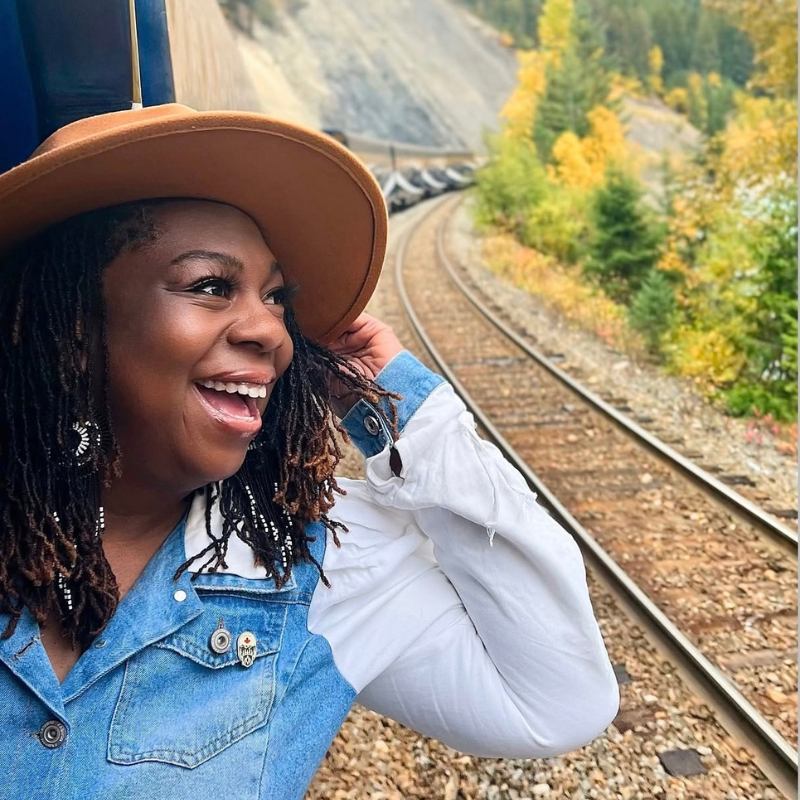
INTRO: This is part two of my interview with Lauren Gay, Outdoorsy Diva. In part one, we talked about her journey, falling in love with the outdoors and adventure travel, and how a pivotal trip to the Azores gave her a new vision for her life. She told stories of swimming with whale sharks in Mexico, exploring the landscapes of Kazakhstan, and dog mushing through the Arctic. So if you haven’t yet heard part one, you can go back and listen to it after this. But right now, in part two, I pull out some more incredible travel stories, from paragliding in South Africa to swimming between tectonic plates in Iceland. And I ask her, what is the most ridiculous thing the Outdoorsy Diva has ever agreed to do? Then we talk about the historical origins of the racial diversity gap in outdoor activities. Where does that come from? And why is there such a lack of black representation in mainstream outdoor narratives? She also talks about the responsibility of content creators, how the story of a place changes depending on who is telling it and why she co-founded the Black Travel Alliance. And then she takes us on her journey, becoming an environmental and conservation activist and shares some specific things that you can do to help protect the environment. So please enjoy the conclusion of my interview with Lauren Gay.
Matt Bowles: Of all the adventures that you have had now around the world, what was the most scared you’ve ever been on an adventure?
Lauren Gay: Really, honestly, truly paragliding in Cape Town. And I wasn’t scared until it was the realization that I had to run off of this mountain. It was not planned, so I went with a group, so no adventurous things were on the itinerary. I’m the person, though, who’s like, well, I’m going to go carve out my own time, because I paid to be over here, so I’ll do it by myself. So, during my lunch break, I called the paragliding people and we’re like, “Hey, can y’all get me in today or tomorrow? I’m only here for two days.” And he was like, “Can you get here today? Come at sunset. Winds will be good.” And I’m like, cool. And some other ladies at the table overheard me, so they wanted to come too and do it. But when we got there, the winds were changing, so he’s like, “We got to go now.” So, I didn’t really have time to wrap my mind around it or get a full briefing. And so, when he’s like, “Whatever you do, don’t stop running.” He instilled the fear of God in me. And so, you see on the video, my legs are still running well after we’re in the air. And he’s like, “You can stop running now.” But those moments running off that mountain, I was second-guessing my choices.
Matt Bowles: And it’s counterintuitive, right? Because I’ve done the paragliding in Medellin, Colombia. And this is a counterintuitive thing, because what you do is you have a parachute behind you and a pilot attached to you, and you have to run off of a cliff. And so, what you do is you’re running towards the end of a cliff, and they’re telling you, “Run faster, or the parachute’s not going to catch and we’re going to be in trouble.” So, you’re running faster off the edge of the cliff. It’s crazy.
Lauren Gay: It is. Your mind is not built for such a thing. But honestly, one of my favorite things I’ve ever done. I love being in the air. I’m a bird. I’ve done a lot of air adventures, and that’s definitely one of my favorites. And of course, the scenery, just incredible.
Matt Bowles: Didn’t you do hang gliding too? Where did you do that?
Lauren Gay: I did hang gliding right here in Florida. You can do aerotow hang gliding. I’ve also done a glider, not to be confused with hang gliding, which I did. I didn’t know what I had signed up for. So gliding is actually humans in a very small, basically plastic plane with no engine. And I did this in Japan. It’s a really big sport there. In northern Japan, in Hokkaido, we went to an airport and they air-tow you up very similarly to the hang gliding. And you get up there and they let you go. And like a paper airplane, you ride the thermals. There’s no engine, and you float down.
Matt Bowles: Lauren, what is the most ridiculous thing the Outdoorsy Diva has ever agreed to do?
Lauren Gay: You know what my number one podcast episode is? The time I visited a nude resort. It was a sponsored trip. I was invited by a PR lady I had met for something else. And I don’t know what made her think that that was up my alley, but I had this thing about saying yes. And so, I couldn’t very well tell other people to say yes to adventure and check in out of this. So, I convinced one of my really good friends, one of my sorority sisters, who’s crazy. I knew she’d have no inhibitions about it, and she’d make me be comfortable. And so that’s probably one of, to date, still, the craziest things that I have done. I might do it again. I don’t know. I might be convinced, but it was definitely crazy. And number two would be swimming in between the tectonic plates in Iceland. I thought my face was going to fall off. That is the coldest I’ve ever been in my life, and I would never do that again.
Matt Bowles: I have not been to Iceland yet. So, tell me this story. What was it like?
Lauren Gay: It’s miserable. Listen, it was something that I’ve been wanting to do. It was on my bucket list. You can snorkel or you can scuba. And none of the blogs I saw warned me of what this experience was really like. And so, it’s in one of the national parks, and it’s basically a fissure that opened up from an earthquake a long time ago. So, there’s this really cold glacial water that comes up, and it’s some of the clearest water in the world. Like, the clarity on it is honestly the clearest water in the world. And so, you do this snorkel experience. You got to walk a quarter of a mile with 30, 40 pounds of gear on you. Your flippers are metal, and I got in it. And of course, you have on a dry suit so you won’t get wet. And my body was fine, but the little piece of my face exposed out of the mask, it felt like needles. So, the shock of the cold, my heart started beating really, really fast. And then you look down, and it’s an abyss of nothing. And I had never been in an abyss of nothing water. I’ve snorkeled a lot of places, but there is no wildlife. There is nothing. And I actually had a panic attack, and I had never had a panic attack. I looked into that void of nothing, and I freaked out and flipped myself over to the safety position and called for my guide. I’m like, “William, help.” And he came and got me, but it’s one way because there’s like a little current, so you got to finish the swim. So, he dragged me along, like pulling a balloon behind him, and he coached me through it, and I breathed, and I finally felt brave enough to turn over. But I did get the shot where it’s me and two tectonic plates on either side of me. I’m straddling, literally swimming between two continents at one time. So, I am forever a badass for that, but I never have to do it again.
Matt Bowles: So, with all of these outdoor adventures you mentioned earlier that you’ve had, some people tell you some version of, “Black people don’t do that.” What exactly is packed into that sentence? Where does that come from?
Lauren Gay: Some of it is jokingly, because when you watch the videos and see things, particularly with people doing death-defying things, by and large, its white people doing these kinds of things, risking their life for fun. For some of you, paying to almost die is just really not something that we’re known for doing. But some of it is just pure marketing and what we don’t see in this space. And so, when you’re talking about things that are as simple as hiking or, you know, rock climbing or kayaking or rafting, whatever that is, you have decades of us not being included in what that marketing looked like. We weren’t the audience being targeted for it, and we weren’t the audience being depicted doing it. And so, you have this kind of innate ignorance on all sides of what people do and don’t do. And some of it in the Black community we’ve internalized, but a lot of us are breaking free of it.
Matt Bowles: The National Health Foundation published a study a few years back that concluded “A combination of economic inequality, legalized segregation, and other forms of historical and present-day overt and covert racial violence has perpetuated a diversity gap in the outdoors.” I know you speak on this topic a lot. Can you share a little bit about your family history and that historical context, and then your journey transcending that?
Lauren Gay: They are spot on. And one of the ways when I have these talks with people that I like to bring them into the reality of the situation. Right. I am a Millennial. I’m an elder Millennial. I am the first for my immediate family to have equal access to go to a national park. My mother was born prior to the Civil Rights Act, so my mother could not do that. Right. So, when you look at, I’m one generation removed from my mother being able to enjoy and do something and me being able to do it, and I’m only in my 40s. That’s not history, that’s present day. Even pointing out the access of that being so limited to, whereas Gen X and Millennials are your first generations of people with full access to these places. And of course, the second part being, I told you, I have family history in Louisiana, Arkansas, and Texas. It’s the South. And so historically, wilderness, the woods, our people were killed in these places. If you go into those places, you may not come back. And so, as a matter of safety, you did not go into those places by yourself or alone or at night. You had the sundown towns and all those kinds of things were real and present danger. And I know people, I have family history of brutality from the Klan and all those kinds of things. So that stays with you, that sticks with you, even if you don’t know about it. Trauma is proven, is passed down. It’s in your cells. And so, shaking that and trying to overcome that innate, real fear, it’s not fake, it’s not wrong, it’s not misplaced. But you have to be intentional about wanting to put yourself in these spaces. And even now, it’s not that the danger is completely gone, but you mitigate it like you mitigate everything else. I share my location, and I try to have a buddy who knows what I’m going to be doing and where I’m going. I’m aware of my surroundings. There are places I won’t go. There are places modernly still known as sundown towns. I won’t be there at night. There are places in Florida where I love to go to our freshwater springs. I’m going in the morning, and I’m going to make sure I’m back out of there and on the interstate before dark. So, you have to do things safely. If I go in a parking lot with an abundance of certain rhetoric on their cars, right? Bumper stickers, Confederate flags, that’s probably not smart to put myself in that environment. So, it takes a little more work and a little more effort if you’re in a marginalized community to be safe. But I do love that we are shedding a lot of that fear to go and see this beauty that we all have a right to. Honestly, it is an uphill climb a lot of times with my own community, and understandably so, in getting us to shed that fear. And often you’ll see people say, well, nobody’s keeping you from the park. It’s not about anyone standing there saying, you can’t come in the park. But it’s about people’s real feelings and real history that is still a present danger. And so, you have to acknowledge that.
Matt Bowles: So, in 2026 today, how much of the problem is actually a lack of Black participation, and how much of it is a lack of Black visibility and recognition within the mainstream outdoor culture narrative?
Lauren Gay: It’s shifted some, but I think Black depiction in the culture is still very much lacking mainstream. You know what I am. When I started, there was nothing. You know, there was Outdoor Afro, and that was it. And it was. And that’s how I even started my blog. I was looking for community, and I didn’t find it in some places behind it, but a lot of times it’s still very white-coded. So, it’s Black people still put into scenarios and clothing and environments where you just swapped us out. It’s still not indicative of our culture and how we experience some of these things because we are a culture, and it is a little bit different. We don’t see that depicted in mainstream. But I do love that, as all things, we make our own table, we make our own way. And now we have our own groups, and you have all of these fantastic affinity groups for whatever is your flavor, to hike, to kayak, to camp. And you couldn’t say that 10 years ago.
Matt Bowles: Tell me about the “Diva” in Outdoorsy Diva and why that’s such an important part of your personal brand.
Lauren Gay: I am a walking oxymoron. You cannot put me in a box. I’ll surprise you every single time. The Outdoorsy first is because I am not a hardcore survivalist type of outdoor chick. That’s not me. It’s never been me. I’m more so the soft adventure, is how I like to call it. I don’t need to hike 15 miles to do anything or see anything. There’s nothing I won’t see that much, but I’m cool for a good three to get the view, to see the waterfall. And if I’m tired or I don’t feel like it, I’m okay with that too. I don’t have to finish. I don’t feel any way about it. I have nothing to prove. So that’s why I’m Outdoorsy, because I’m in it. But I feel like I’m not all the way in it. I’m not a die-hard. And the Diva is because I still like nice. I like nice things. I want to stay in nice places. I want to stay in a bed. I wear makeup. I’ll have on lashes. Sometimes I’ll have on my Lip Bar. Rich Auntie is my favorite shade. I’m going to dress how I want to dress, and that’s been content. Unfortunately, I had to make to educate people about there’s no one right way to dress. Yes, there are times when specific gear may be best, but I can still put my flair on it. And if I’m not in danger or hurting you or me, then leave me alone. I can hike in whatever the heck I want to hike in. I will wear a kimono in a heartbeat to hike in because it’s nice and cool, it covers my arms. It’s serving a purpose from bugs and sunburn and rubbing up against stuff that’s cuter than me. Putting on your camouflage rash guard shirt? I don’t want to wear that.
Matt Bowles: When you talk about nature as therapy, what do you actually mean? What happens to you psychologically or emotionally when you’re in nature that doesn’t happen in your normal environment?
Lauren Gay: I feel closest to God. I am closest to the Creator when I’m in that space. And I discovered that in Muir Woods in San Francisco because I got away from the crowds, I was by myself, and I became a part of nature. So much so that they weren’t paying me any attention. I watched a doe and a buck frolicking, and he’s chasing her. And there were bees, and there were butterflies, and there were chipmunks. There was all this activity around me, and they were oblivious that I was even there. That was like the first time, the connection of, I am not a voyeur, I am part of it. I am nature. And so that feeling that you get, that oneness, that calm, that centering, being able to turn your mind off, especially as a Black woman in corporate America, my mind is always racing a million miles a minute. And that is a place where I can truly turn my mind off. And I feel better. And so, it’s therapy to me, and its church, because I feel better when I’m in it. I feel better when I leave it, and even when I can’t go. Just the sound of it. I have all types of playlists of nature on YouTube that I will listen to when I need to ground myself, even if I can’t get outside in that very moment. I started a garden on my little patio because I have turf. Feeling like I’m standing on grass. Being around plants, I feel like I’m in nature. I don’t say that’s a replacement, obviously, for actual clinical therapy. If you need that, by all means, please go do that too. But it is a great supplement. It’s a great way to clear your mind and get that feeling. Forest bathing is one of the best exercises I’ve ever learned, and I’ve been able to share that and teach people. One day I want to get certified, but it’s something I do on my trips and on my group adventures with people, and every time, they resonate with it.
Matt Bowles: Well, you have now traveled all over the world and seen a lot of very different, different types of landscapes. Have you discovered that different kinds of landscapes bring out different versions of Lauren?
Lauren Gay: I always used to think, because I love the water. So, I was like, I’m a beach girl. But honestly, the mountains do it for me too. And I still get the water. Because with mountains, there is always some kind of babbling brook running down from somewhere. There’s a waterfall and there’s lakes. We’ve recently discovered Snow Lauren, the Snow Princess. She’s a whole different vibe, and she’s figured out how to dress for it and dress cute. Oh, she’s ready. I can do anything now in the snow. I’m not averse to it anymore. I definitely have different outdoor personas, for sure. And then there’s Snow Black, and that’s the wildlife me. That’s when I channel my inner Steve Irwin, and animals tend to gravitate toward me. And so that has become a nickname, that I am Snow Black because the animals will definitely come say hi.
Matt Bowles: I love that. Well, you have been creating amazing content around all of this, and I know you were a co-founder of the Black Travel Alliance. I have interviewed a number of your amazing co-founders. But for people that are not familiar with the Black Travel Alliance, can you share a little bit about what BTA is all about and some context on what was happening in the travel industry that made you feel an organization like that needed to exist?
Lauren Gay: Black Travel Alliance was really born out of a need that we saw. So, it was the pandemic time. You had a bunch of Black travelers who couldn’t travel. So, we were all forced to be stuck in one place, and we were frustrated about what we were seeing with George Floyd and his murder and all of that. And there was a lot of performative action happening with brands and things at the time, which we know is performative because of how easily they were so willing to roll back all of those things they implemented back then. So that’s what was happening, and we wanted to do something about it. And we saw a lot of these brands who wouldn’t work with us. “Y’all don’t work with us. Y’all don’t work with people that look like us. What do you mean? Oh, now you’re in solidarity with this community?” When you don’t actually pay any attention to this community or put any dollars into this community, you don’t even value the money this community spends. We are hundreds of billions of dollars. I think the last number was $184 billion spent by Black travelers. And it’s not even given a thought. So, because of that, we came together. It started out as kind of a public call-out on social media, or call-in, some would say, about, “Hey, I don’t think you really mean this.” And then it grew into something much larger where, what can we do to facilitate the brands doing better and being better and getting more opportunities for Black content creators was really our main focus. And it was bridging that gap and amplifying our voices in this space and basically building our own table. Stop fighting for a spot at other people’s table. Stop fighting for brands who don’t want you. We want who wants us. And so that’s who we will focus our energy on working with and partnering with. If they’re serious about being true allies to this community, then let’s do this for real. And so that was how that was really born.
Matt Bowles: How does the story of a place change depending on who’s holding the camera and who’s telling the story?
Lauren Gay: It changes 1,000% because I’m not you and you’re not me. We went to the Galapagos and had completely different experience. Whenever you finally get to Central Asia, you’re going to have a completely different experience. I didn’t even touch on the novelty of being Black there. That was a whole other animal that I was not prepared for. So, a lot of people wanting pictures and genuine curiosity and admiration, but it’s a lot when you’re—I’m an introvert at my core. I can be extroverted. But it was a lot to have your personal space constantly invaded. You’re not going to have the same experience. It wasn’t because I’m American. It was because I’m Black. For example, I went to a conference with hundreds of other creators. I’m the only person that left Uzbekistan with a story about Black history and a Black history connection to Southern African Americans who went there in the 30s. Who else would have told that story? Who else would have been curious? Who else would have found it out? Who else would have done that research? It’s not that. Now, I’m sure you’re interested in it, right, once you read it, once you saw it. But innately, it wasn’t something important to you. It’s not your culture. That’s okay. It’s not your lens. And so being able to tell the stories of a place through my lens as a Black woman in America, it is always going to be different because I live and experience the world differently than you do. But you could say that for a tall person and a short person. There are things as a travel creator I care about. As a tall woman, 3% of people in the world are my height or taller. Someone else who is your average five-two, different. They don’t have to be concerned about the same things that you do as a tall person. So, whatever those differences are, they are superpowers. They make the stories better. You’re going to get better, deeper, richer, more varied stories by having diverse and different groups of people tell the stories.
Matt Bowles: What’s another example of a place that you visited where you realize afterward that the story tourists are normally told about that place is not the story that actually matters?
Lauren Gay: Even Harriet Tubman’s hometown in Auburn, New York, when we went, they were opening her official national park there, and some other things. And I was with the different groups of creators. But even still, the way I tell the story is so much different. When I went to her grave site and sat at her grave site and sat there, I just sat my tripod up because I was emotional. It wasn’t one of those like, “Hey, guys, here I am. It’s Harriet’s grave.” It wasn’t a moment for that, which is what some other people did. And that’s fine. It’s a different reverence. It’s a different respect. It’s a different feeling because I feel like I personally owe something to her. So, it’s going to be told and handled with a much different level of care than what someone else who doesn’t look like me would do. And even someone else who may look like me, but they’re not American. Someone who may be Black, but they are Black Nigerian. They may be Nigerian American, or they are Caribbean. Their appreciation for this history and these stories might be just a little bit different just because of our differences in the way that we grew up and our backgrounds.
Matt Bowles: What responsibility do you think travel content creators have to the places and communities they’re making content about?
Lauren Gay: We have to be good stewards of our platforms. We have to be good stewards of these people’s lives. We visit a place for a few days. These people still have to live here when we leave. So even Uzbekistan, I haven’t done the public content yet about my lens as a Black woman and that part of it, because I want to handle it with care. I still see them as human, even though at times I didn’t feel like they saw me as human. But I also don’t want to paint a picture of an entire culture and country and group of people in a way that is not nuanced and not fair and not taken into account—just the differences and the differences in culture and how people move. And when it comes to nature and outdoors specifically, you have to do that. You have to be a good steward of these places you’re telling people about, because we have to take care of them. So, a lot of times, I’m way more excited about a state park or a local park or a regional park than a national park. Who gets all the love? Y’all don’t need 10 reels from me on Yosemite. You’ve seen it. It’s being loved to death. Whereas there are some other places equally as beautiful, equally as moving, that maybe you don’t know as much about and don’t see as much traffic. And I feel better about showing them to you. I mean, I had a campaign with a major brand for last fall that I had to postpone simply because we were in a government shutdown, and I didn’t know what that was going to look like for visiting these national parks. Prior to that and another shutdown, horrible stories about the way people treated the parks, literally shitted on them and in them. So, I would never want to do that and put more burden on our park rangers, more burden on our parks and that system. We have nobody working and cleaning them up and doing the things that make them habitable and keep them clean and sanitary. So, I was like, I can’t in good conscience do a campaign encouraging people to go to this place right now. That just wouldn’t be right. Let’s wait till this is a better time.
Matt Bowles: Can you share a little bit about your journey, starting from when you developed your personal interest in connection with nature to now the environmental and conservation activism that you are so outspoken about?
Lauren Gay: This is actually some of my proudest work. I love advocating for my people, but also this work is really special to me, too, because there’s not a lot of people who look like me in that work. I have to shout out people like Teresa Woods, who’s been a pioneer in this space and being a voice for activism and the environment. I first really got called into it working with the Audubon Society in Florida. They contracted me to do some work to get more diverse people on panels and things like that. And so, doing that and finding all these people working in these spaces with doctorates and papers and published work, and I didn’t even know that they were in this space. And it’s like, okay, we need more visibility in this. And so, I will try to amplify their work as much as I can, and I welcome working with these flagship organizations to do that. I work with the National Park Conservation Association a lot on amplifying a lot of the work around supporting our national parks and funding. I got to go to Capitol Hill and actually lobby on behalf of the parks. One of the proudest things I’ve ever done, because that’s not a partisan thing, but find a commonality around that. And now the place we are now, a lot of them are not speaking up, and I’m quick to hold them to the fire, like, “Ah, ah, ah. Remember you said you actually do care about this. Stop being spineless and speak up. Why don’t you let this happen?” Because there’s a lot going on right now around our parks and our public lands that I’m having to be very vocal about. And I’m really trying to rally people to know because a lot of it is happening, and we don’t even know that it’s happening, and getting people to care and to use their voice. So, using my platform for this is one of my proudest works. I know that it has cost me money. I know it has cost me opportunities. I was very outspoken about our governor trying to do some very harmful things to our state parks here in Florida. And it went crazy viral. And I ended up speaking at a rally alongside state legislators and other local activists with the Sierra Club, which was crazy. Like, I didn’t even do it for that. I did it because people were tagging me, sending me the information as the story broke. And I was just trying to do my part to let people know, “Hey, this is happening, and it’s not right.” And so, I am very proud of being on this side of history and trying to leave the world in a decent shape. I can’t say better, because that’s hard, because we take, take, and take from the Earth, but at least leave it in decent shape for our future generations.
Matt Bowles: For people that would like to learn more, learn how they can plug in and contribute positively to some of these causes, where would you point people?
Lauren Gay: I would point them to the National Park Conservation Association. It’s a fantastic organization, and they’re really good about putting it in plain language for you and giving you templates. So, all you have to do is click the link and fill in your information. It’ll send it to the right place where the commentary is being held. Sierra Club also does really great work. I recently learned about the Black in Marine Science organization. They’re doing really great environmental work, and these are Black people and other people of color. And so, I’m excited to dive more into that and making more of those connections as well.
Matt Bowles: Lauren, how do you personally balance, on the one hand, inspiring people to visit these beautiful natural places with on the other hand, the reality that sending more people there can potentially contribute to over tourism or environmental damage?
Lauren Gay: I used to not worry about that because I started being, I was like, well, I’m for Black people, and I’m trying to get Black people to go there. And we don’t go. We’re overwhelmingly such a small part of the people who go to these places. So, we’re not the problem. That was short-sighted because I didn’t know my platform was going to have the reach that it has. And so, I do have to consider that. And that’s why I do try to highlight a lot of places that are less loved. And I’ve done content around being a good steward when you go to these places and visiting them the right way. But it’s the beast of social media. I never know what’s going to go viral, what’s going to fill up. I hope that as those things happen, the organizations are able to put the checks in place they need to, like reservations, whatever they need to do to mitigate that traffic. But it weighs on me. I can’t say that I have the right answer for it other than trying not to make places that I know are already over-loved even more so. But at the same time, if I don’t show these places, the people that look like me may never see them or ever even know about them.
Matt Bowles: As you’ve gone from your different life chapters of adventuring with your son to solo travel to now leading other people on adventures, how has your definition of adventure changed or evolved through those different chapters?
Lauren Gay: I’ve always had a very loose version of that word, adventure. And I continue to, to me, if you’re stepping out of your comfort zone, it’s an adventure, and it’s that simple for me. It’s not about difficulty. It’s not about distance. It’s not about domestic versus international. It doesn’t even have to be outside. If you are a person who builds your life around other people and you can’t even go to dinner by yourself or take yourself to the movies, and you do that for the first time, that’s an adventure to me. If you are a picky eater and you eat the same things all the time and you try a new food, that’s an adventure to me. Now, there’s levels to adventure. You might not go try horse meat like I did in Kazakhstan, but if you trying Greek food for the first time at home is an adventure for you, then it’s an adventure. I care more about the growth of the individual in pushing yourself to have a new experience. To me, that makes it an adventure.
Matt Bowles: So, at this stage in your life, are you still pushing yourself outside your comfort zone, or are you starting to become more selective about which discomfort is actually worth pursuing?
Lauren Gay: I absolutely push myself out of my comfort zone, but it still has to be something I want to do. The hike that I told you about that was beautiful, to those hot springs in Kazakhstan, I did not sign up for that. The way it was built was a leisurely walk-in nature. It said nothing about this very uphill, much more strenuous hike than what I signed up for. But I’m still glad that I did it because it was beautiful and it was worth it, and I had a reward at the end. But when it comes to things like backpacking, I’m pretty good on that. I don’t really need to carry my life on my back and do that again. I’ve done it. I’ve tried it. I’m okay. I’ll still camp, like real camping, from time to time. But I do prefer glamping now, and that’s just because I’m old and the ground hurts my back. So even now, it has to be hard camping where I can bring my air mattress and have that and blow that up so that I’m not sleeping on the hard ground just because I’m older now.
Matt Bowles: So, when you think back on the last decade, from the time you boarded that flight to the Azores in 2015 until today, how has all of that world travel impacted you as a person?
Lauren Gay: It has made me so much more empathetic. For one, seeing how other people live, seeing how other people’s own histories have impacted them, seeing other cultures, it has made me more empathetic, and it’s made me more curious. I think I was always a curious person, but there’s never enough. The more cool things I see, the more cool things I want to do. And so, it never stops. People say, “Oh, what’s on your bucket list?” I can’t answer that for you. My bucket list grows literally every single day, every single day. But this worldview that I have, I think has made me smarter, too. It’s made me more intelligent. I’ve learned a lot of things and been exposed to things that otherwise I never would have, and it’s made me more fearless.
Matt Bowles: And why are you still so passionate about continuing to travel? What does travel mean to you today?
Lauren Gay: We have to form these human connections. You have to see our neighbors as humans first. And travel does that for you. A lot of the hate and the stereotypes and the way people view each other, you can tell, “Oh, you’ve never been anywhere. You’ve never left your state. You’ve never left your county. You couldn’t possibly have that narrow of a worldview.” And so, I think we have to do that for the sake of being better humans. We need to have these different human connections and connections with nature to appreciate it and want to take care of it more than our corporate greed. You have to have a limit to stuff. And you only get that by experiencing these beautiful places and understanding how they’re impacted by these decisions.
Matt Bowles: Lauren, I think that is actually the perfect place to end the main portion of this interview. And at this point, are you ready to move in to The Lightning Round?
Lauren Gay: Ready.
Matt Bowles: Let’s do it.
All right. What is one book that you would recommend that people should read?
Lauren Gay: It’s called Rejection Proof and it is going to get you to stop being afraid of no’s and embrace them.
Matt Bowles: Awesome. What is one travel hack that you use that you can recommend?
Lauren Gay: If you got a lot of bulky clothes, using those vacuum seal bags really does work. And you just have to remember to pack it with you so that you can do it on your way back. And also, physics, the weight. Still the weight, but you will have the space in your suitcase.
Matt Bowles: All right, who is one person currently alive today that you’ve never met that you’d most love to have dinner with? Just you and that person for an evening of dinner and conversation?
Lauren Gay: Currently Alive, Michelle Obama, 1,000%. And I don’t think any explanation is needed.
Matt Bowles: Okay, knowing everything you know now, if you could go back in time and give one piece of advice to your 18-year-old self, what would you say to 18-year-old Lauren?
Lauren Gay: I would tell her that she’s stronger than she thinks she is. And to trust herself, trust her intuition.
Matt Bowles: Okay, of all the places that you have now traveled, what are three of your favorite destinations you would most recommend other people should definitely check out?
Lauren Gay: The Azores, for sure. Honestly, one of the most beautiful places on this planet, Japan. And not just Tokyo. Go into the other places. The countryside, particularly Hokkaido, is one of my favorite places in the whole wide world. And I’m going to say Iceland, just because Iceland is breathtakingly gorgeous. And if you like waterfalls and natural features and all that kind of stuff, it feels like a whole other world. And I’ll probably answer this question differently every time because there’s so many.
Matt Bowles: Of course. And the next one as well. I know your bucket list items change and evolve by the day, but as at this particular moment, what are currently the top three places you have not yet been highest on your list you would most love to see?
Lauren Gay: The Maldives, and not for what everyone else wants to go for, the floating resorts. I want to swim with the mantas, and I know there’s some amazing places to do that there with them, the mantis, and even whales. So, Maldives is very high on my list. I’ve also not been to Hawaii, and I’m trying to get to all 50 states, 50 by 50, so I got to knock that one out here pretty soon. I don’t have very many to go. And number three, Australia. I need to knock that continent / country off of my list.
Matt Bowles: All right, Lauren, we have now come to the most important question of this interview. I’m about to ask you to name your top 5 hip-hop emcees of all time. But before you name your five, can you share a little bit about what hip-hop music and culture means to you and why you love hip hop?
Lauren Gay: Oh, man, I love music, period. I actually have a music tattoo. But hip-hop in particular, I’m an 80s baby. I grew up in the heyday of 90s music in 90s and early 2000s. There’ll never be another time like this. I just don’t believe that. I argue with my son about this all the time. That mumble rap that he listens to, Hip-hop is a soundtrack, man, for a lot of pivotal moments in my life.
Matt Bowles: I was a hip hop DJ in the 90s and of course, when you’re living in the middle of it, you have no idea how lucky you are. We didn’t know in the 90s that that was the golden era. You don’t know that when you’re living in it, you’re just living in it and that’s the soundtrack of your life. So, for me, high school and College was the 90s, and I was a hip-hop DJ too, that whole time. And for me especially the East coast stuff, 1990s, New York City hip-hop, that is my love language. I mean like forever, right?
Lauren Gay: Do you have video of you DJing? I got to find that, Matt.
Matt Bowles: I probably got some mixtapes I could send you, but they’d be like the cassette tape, so you need a cassette tape player to play it right back in the day. I’m curious, though, about what you said about your son in terms of his music preferences. Because one of the things that’s been interesting for me, and I don’t know if you’ve seen this when you travel, but I have been to places. Like, one of the ones that comes to mind, for example, is Lagos, Nigeria. I went to Lagos for a month, and I went there largely out of love for Afrobeats, which, of course, are plentiful and ubiquitous. But one of the things that I found in Lagos that I was not expecting is all of these young DJs in their 20s. They’re all playing 1990s hip-hop.
Lauren Gay: Really?
Matt Bowles: And these people were born after Nas dropped his first album, after Biggie dropped his first album, after Wu-Tang dropped their album. Like, they were born after that. And yet that is the stuff that they’re gravitating towards. That is the stuff that they’re playing because they know what the best stuff is. That genuinely moved me emotionally. It was so heartwarming for me to see that. And they’re mixing it in with all the Afrobeats and stuff as well. But I was just like, wow, people know what the greatest of all time was, what the stuff, the golden era, was. But I’m curious, what are you finding with your son? Are you finding that he’s gravitating towards the current stuff that’s coming out now and is less appreciative of the 90s stuff? How does he view some of those artists? And some of those artists are still doing it. Nas is still doing it. Some of these people are still doing their thing. But what are you finding generationally with you and your son when you talk about music?
Lauren Gay: His taste sucks. I’m going to say it. He is a straight up Gen Z. I tried my best, I really did. Because he can’t say he hasn’t been excited, exposed to it because on road trips I intentionally would play 90s 2000s hip-hop and R & B. So, he would be well rounded. But he’s absolutely the mumble rap generation. And even over there in Kazakhstan met a young man who was 17 or 18 and he had perfect English because he listens to our music. And I asked him, who’s your favorite? And he was naming; Pop Smoke, Young Dolph, Stitches on. I was like, oh, dear God. And I said, what about the classics? What about, like, Biggie? And he was like, oh, I don’t like the 90s hip-hop. I’m like, oh, my heart, get away from me. I don’t want to talk to you anymore. But you know what? The number one song I heard over there every time I got in one of their Ubers and I think they would put it on for me because I was black. Gangsta’s Paradise.
Matt Bowles: Oh, no.
Lauren Gay: Bumping it. And knew all the words. Knew all the words.
Matt Bowles: Oh, that’s hilarious.
Lauren Gay: Which I still know all the words. And so, hey, I’ll vibe with you on that. If Coolio is your barometer, we’ll go with it.
Matt Bowles: That is hilarious. All right. With all of that context, background and preface, Lauren, who you top five?
Lauren Gay: Nas. Gotta go with K-Dot, Kendrick Lamar. Biggie, gotta be Notorious B.I.G. I have to put Jay-Z in there. I struggle, but lyrically, I can’t lie, he’s up there for me. And Pac.
Matt Bowles: Amazing. I love that. Lauren, all right, at this point, for people that would like to hang out with you and me in person, we are both going to be at the upcoming Black Travel Summit in Milwaukee, Wisconsin, October 15th to 18th, 2026. You are the keynote speaker. For people that are able to come through and meet you in person and come to your talk, what can they expect? What are you talking about this year?
Lauren Gay: I am very excited. I am talking about “Design to Grow With You.” And this is a talk to guide creators through how to accept the way life will inform the changes to their brands over time. And I think a lot of people quit, get burned out because they’re fighting to hold on to a version of themselves and content that’s not their life anymore. And so, as we’ve talked about, I’ve had quite a journey, and my brand is nothing like the way that it started. But that’s what we’re going to talk about: how to build that foundation and make it work for you instead of fighting against that.
Matt Bowles: I love that. Well, it’s going to be an amazing crowd at this event. A number of other Maverick Show guests are also going to be speaking, attending, hosting. It is just going to be an incredible crowd. If you’d like to come through, you can get a special 10% discount off of your ticket with the code MAVERICK. So, we’re going to have all of that linked up in the show notes. And then, Lauren, how can people find you, follow you on social media, check out your video content? How would you like people to come into your world?
Lauren Gay: I am @OutdoorsyDiva on everything. Instagram, YouTube in particular. Y’all come help your girl get those views before they change these monetization rules. OutdoorsyDiva.com. Outdoorsy Diva on Facebook, if that’s your jam. Also, come say hey. I like to be on Threads and cut up. I’m Outdoorsy Diva over there too. I really do actually talk to people and reply back. I’m a normal person. You can say hey, slide in my DMs and my comments. I’m a very personable person.
Matt Bowles: All right, we are going to link all of that up in one place in the show notes. So, you can just go to TheMaverickShow.com, go to the show notes for this episode. There we’re going to have the link to get your ticket to Black Travel Summit to come hear Lauren’s keynote, as well as your 10% discount code. We’re also going to link up all of Lauren’s social media handles and how you can find, follow, and connect with her, as well as everything else we have discussed in this interview. It’ll all be in the show notes. Lauren, this was such a special conversation. Thank you so much for coming on the show.
Lauren Gay: Thank you for having me, Matt. I’m so glad we’re connected.
Matt Bowles: Good night, everybody.