Matt Bowles: My guest today is Zaakirah Nayyar Muhammad. She is an author, TEDx speaker, photographer, disability advocate, travel storyteller and media entrepreneur dedicated to helping people see the world and themselves through a different lens. She is especially committed to helping black Muslim and disabled creatives build legacy driven brands rooted in authenticity. Diagnosed with a rare childhood eye cancer that resulted in both vision and hearing loss, she now travels the world documenting the intersection of disability, culture, identity and belonging. Her work focuses on making travel more accessible and inclusive and helping underrepresented voices reclaim their stories and shine.
Zaakirah, welcome to the show.
Zaakirah Muhammad: Thank you for that intro. You told me off camera and off record that you were a DJ and I definitely heard the DJ voice.
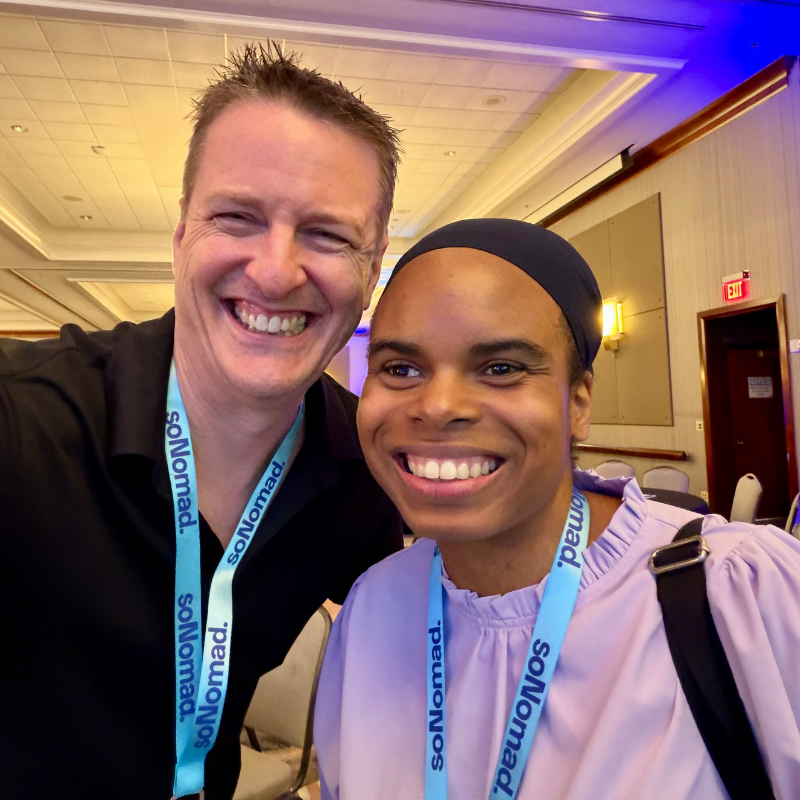
Matt Bowles: Well, I am so excited to have you on the podcast. You are doing such amazing things. We recently got to hang out in person at the WITS Travel Creator Summit in Chattanooga, which I know has actually some history from your childhood upbringing as well. So, it was super fun to spend time together. But let’s just start this off by setting the scene and talking about where we are recording from today. We are not in person. I am actually in the Blue Ridge Mountains of Asheville, North Carolina. And where are you?
Zaakirah Muhammad: I am in Maryland. So right now, currently in an area close to the National Harbor. If you have been to the D.C. area, this big old Ferris wheel. So, I’m currently near Maryland right now.
Matt Bowles: Love that. As you know, I lived in the D.C. Maryland, Virginia area. I was actually in the district for about seven years back in the day. A lot of great memories from that area. You and I have both moved around the country a lot growing up and subsequently, so we have that in common. But I want to start this story off with your photography journey. Can you tell the story about where you were born and how a single photograph taken when you were an infant literally ended up saving your life?
Zaakirah Muhammad: Yes. So, I am a Florida girl at heart, Fort Lauderdale, Miami, to be specific. That’s where I was born. And I see my mom from New York, my dad is from Tennessee. So that’s where you get the whole thing of, I’m from everywhere. I’m also the youngest. My parents had relationships before they conceived me, if you will. And so, by the time I was a thought, they were like, we’re ready for some warm weather. Let’s move to Miami, Florida. So, I’m the only one in my family from Miami, Fort Lauderdale, Florida. But while there, my mom’s capturing a picture of me. I’m the youngest. So, she captioned pictures of me because, hey, it’s my baby girl doing this, doing that. But she saw this white glow in my eye, if you remember back in the day of the other type of photograph where you would see your red glow, all the blood flow in your eye, instead she saw white.
So of course, this was the days of you had to take the camera to the convenience store and wait for it to develop. And when it did come out, she had that picture, took it with her to my six-month checkup. That pediatrician brushed it off and said there was nothing to worry about. She asked for a second opinion. That second opinion she got back home in New York at Sloan Kettering Memorial. And then at that time, they made a referral for me to have surgery to remove my right eye. Because if they had not caught that, if my mom did not trust her intuition, I would not be listening and talking and looking at you today.
Matt Bowles: Well, I know that as you grew up, photography continued to play a major role in your life. Can you think all the way back when you were five years old and you got your very first camera? What do you remember about that?
Zaakirah Muhammad: I know my mom introduced me to a camera because the teacher claimed that I was not talking at school. She’s told them that I was very chatty at home. So, the teachers encouraged her to introduce me to some kind of form of creativity, whether that’s going to be writing, whether that’s going to be photography. And photography ended up being the thing that I literally took it and ran with. So, the camera that I was introduced to was the original iteration of a Polaroid camera. And all she did was show me how to look through the viewfinder to see what I want to take a picture of, how to press the shutter button to take a picture, and voila. The pictures that would come out were decent pictures. Most times they’re blurry and of nothing but she’s like, whoa, this is an actual picture. She must have something. So then that camera upgraded into those same convenience store cameras that my mom used to take a picture of me. And those were the cameras that I just basically took with me. She always made a road trip out of my medical appointment. So, I was always taking pictures when we were going to the medical appointment, we were going to be with family or going for a vacation. And it’s really been a part of my journey, my life, ever since.
Matt Bowles: So how did your photography journey evolve as you got into middle school and then high school?
Zaakirah Muhammad: Yeah, I think it just. Because it never really left me. I think my mom was like, maybe this is a career you want to make out of it. So, there was a yearbook clubs in middle school, so I was unofficially part of a yearbook club because I was always having pictures taken of my classmates. So, I had that same camera with me. And every yearbook. At the end of every yearbook, not only are we signing each other a yearbook, but I’m giving them a picture that I snagged them. And then I also got to have my first international trip at the eighth grade as well. So, eighth grade going into ninth grade, I had my first international trip. So, I got to continue and evolve to a different type of camera. This was now like a first iteration of a digital camera that had video capability.
So, every time I would just enter a new school year, I would get a new type of camera, and it was always a side project, or else I would be a part of a yearbook committee at my school. And that’s really how it evolved. And then actually, my high school, I was able to finally combine both. There was a technical high school that I went to that had a professional photographer program. So I was in a yearbook, professional photography program. And then there was actually a program for seniors and juniors in high school to be a part of a student newspaper. So, I never stopped creating. I never stopped photographing.
Matt Bowles: Tell me about that first international trip. Where did you go and who were you with?
Zaakirah Muhammad: It was four students who were either hard of hearing, which is also one of the results of the radiation treatment of my cancer and my surgery. So, I did lose my hearing a little bit. So, my very first international trip which is a group of people who were hard of hearing or already completely deaf and cannot hear at all and only use sign language for all of us to come together and the people who wanted to learn sign language and learn what it was like to be a part of people of the deaf culture. So, we went to Costa Rica. We had a sustainable trip where we learned where the pineapples grow and where your Starbucks beans come from. And my first taste of cilantro fresh from the ground. And that was a wonderful spring break week going to Costa Rica. The travel bug bit me, as they say.
Matt Bowles: What was it like traveling with that particular community and that particular group of people? What impact did that have on you?
Zaakirah Muhammad: Before that, I was not going with my mom or my dad somewhere I did not want to go because I knew there was a sense of comfort because who am I going to trust and talk to when my hearing aid battery dies? Or if in a language I didn’t fully know Spanish. Yes, I grew up in Miami. I didn’t fully learn Spanish, so I had those fears of I don’t know anyone, I don’t know what’s going to happen if anything happens to my hearing aids and I don’t know the language. But because I was with other people who also had those same fear, which is why they chose this specific group, it was a nice leg up to helping me to advocate for myself and be comfortable with one more group trip because I did take a couple more group trips after that. But also, I was not afraid to go to other countries anymore.
Matt Bowles: And what was the first time being out of the country like for you? What impact did it have to be in another culture where they speak another language? Take us back to that moment. What did it feel like?
Zaakirah Muhammad: Yeah, I remember I’ve always loved mountains. And I learned as time goes on, there’s a reason why I love mountains so much. But I’ve always loved mountains. And that’s the first thing I remember, once we got out of the Costa Rica airport, going to wherever we were staying and there were so many mountains, there was so many curves. And I just remember being able to see that even as I couldn’t hear, like, say, I decided to take my hearing aid out and I wouldn’t be able to hear the wind against my ear because we had the open-air buses. But just knowing that it’s another country, but it still felt like home because there was a similarity of mountains and there was still that similarity of black wings and whites, Hispanic food in a different country. So, it was still nice to know that you can still have a sense of home in a different country.
Matt Bowles: And how did that start your merging of photography and storytelling with travel? What happened on that trip and what impact did that have moving forward?
Zaakirah Muhammad: We were given a journal to reflect every day of how do we feel? What did we learn? Is it a sustainable trip? So how do we want to improve the environment? But the improvement of technology for my next trip, that happened a year later. So, this was all in 2009. I had the opportunity to go to the UK and France and Italy and. And between that time, that was also email. Every trip that I take, technology was improving. So that trip was email. And then there was another trip that I took by the time I graduated high school, and that was when there was a blog platform called Tumblr. It’s still around at the time of the conversation, but it was hot back then. And I was taking from handwriting to emailing to blogging and the storytelling, they kind of shape form as far as who am I telling a story for? Before, it was just like, hi, mom. I’m okay. This is what happened today versus hi, world. This is what it’s like being in this country with me already. Not speaking a language, not hearing it well, not seeing it well.
Matt Bowles: So, I want to ask you about your very first time traveling to the continent of Africa. You and I have bonded over our shared love for Ghana. I have been a couple times. But you went way before I did. I went for the first time in 2019. You went in 2011. Can you talk about the context for that trip? Why did you choose to go to Ghana in particular, and what did it feel like when you first stepped foot on the continent of Africa?
Zaakirah Muhammad: Yeah, so by 2011, that’s when I graduated high school. So, I had already been to three trips on four country kids. The one from the UK, France and Italy was one student ambassador trip in two weeks. That was crazy. But then I’m like, I want to do something different. I want to go to another continent. I want to do something slower. And so, then an opportunity came up with an organization called Operation Crossroads Africa, which is pretty much dubbed as the Peace Corps before the Peace Corps or shortened version of the Peace Corps. And so, my dad had been road tripping up and down the east coast because he was a truck driver for most of my life. But he would always stop and go see his friends in the D.C. area. And so, at the time that he visited one of his friends, and his friend’s friend was having a recruitment for students to go to Africa.
And so, the application process is tedious. You have to explain how are you going to manage when things aren’t going your way and all of that, and you have to apply and send an application fee and get accepted, and then you raise the money to stay in an African country. You could choose three countries and depending on what’s available, is the country you got. So, I got Ghana, I put Ghana on my list, but I also got Ghana. And once I was there, I was volunteering as a primary education teacher and it was teaching English at the elementary school and I had my camera with me. So of course, I’m photographing life in Ghana. And I really didn’t even know how amazing it was. I mean, not only just being a woman of the diaspora, but stepping foot on the continent for the first time, it’s like, wow, I feel at home.
Matt Bowles: And what was your experience like living there? As you mentioned, very different from, you know, tourism and moving around and, you know, all of this kind of stuff to actually slow travel, to actually live there and immerse in the community. What was that like on a day-to-day basis?
Zaakirah Muhammad: We literally were living like a local. We were living on their salary; we were going to the market like a local. So, it can be humbling if you come from the world of, let me just go see all the world-famous landmarks. I went to London, right? I saw the London. I had stolen Buckingham Palace. And then you go to a place that’s so remote that it barely had Internet. You had to go to Internet cafes back then. So, it’s humbling. And it’s also. That’s what is cool of life. I feel like that’s where I define. I’m like, okay, this is the type of travel I want to do. Yes, it’s nice to go in and out and go see the popular landmark. But this really lets you understand people. And obviously the more you understand people, the better stories you’re able to tell.
Matt Bowles: Was there a particular person or an interaction or an encounter or memory that still sticks with you today from that first time?
Zaakirah Muhammad: I love the children. Children are the future for sure. And at that time, there were not that many smartphones out. So, I remember there was this one day where we were on a break from teaching, so it was like a recess, if you will. And so, I would just ask the teachers, I’m like, can I take pictures of them? They love taking pictures of them. They love seeing themselves on the camera. And so, moments like that just kind of stuck with me. It’s a simple thing. They didn’t have marriage and smartphones, but to see themselves reflected authentically and they’re so excited that it makes me smile on a rainy day.
Matt Bowles: Well, I also have to ask you, I know a few years later you went back to West Africa and you went to Senegal and the Gambia. Dakar, Senegal is one of my all-time favorite cities in the world. I’ve spent about three months there. I’ve been back three separate times and it just completely won my heart. But I also love Ghana. So, I’m curious for you, when you went to Senegal and the Gambia, what were your highlights from that trip? But also, what did you find different between Senegal and Ghana?
Zaakirah Muhammad: I definitely start off with the history of Senegal. Senegal was conquered by France, so a lot of the cuisine, a lot of the language, a lot of the way that they operate things are very French. So good thing I went to France years before. So, I had a sense and I had a little bit of French still in my memory because I don’t think Google Translate or Duolingo was out when I went. But that face was the biggest difference of okay, this is what it’s like when a country is conquered by France and how they live and operate. And so how I ended up getting there, it was still through operation CrossFit Africa again. By this time, I was hired as their communications associate. So, they had a group go to the Gambia at the time that I was already supposed to be there. I was going on a photography trip. I was going as the communication person for the organization.
And then I had a little personal endeavor as well. I had already bonded and met with other volunteers from my years before. And when I was ready to go explore a new country, I actually met my then husband. So, we bonded, met. I have a whole different story of just immigrating him to the U.S. and that culture shock. And although we’re not together now, we’re still cordial but just knowing that the border crossing is different too. Ghana is so big. You spend a whole we just going to see all of Ghana, but Gambia is just a strip of a country. Technically was Senegal back in the day, but the British was like, let’s just get this strip of a country and call it ours. So, you can cross the border now to the two different countries. So that’s different too. Just experience different visa processes, different border crossing, but it’s still West Africa so the culture is still the same as well.
Matt Bowles: So, I know a couple years after that you went to South Africa for your first time and I want to ask you about where you went in South Africa and what the context was for that trip and then what was your experience like there? What were some of your highlights from the South Africa trip?
Zaakirah Muhammad: South Africa was my first technically solo trip. So, by this time there are a lot of Facebook group with a lot of travelers sharing tips or if they’re going at the same time, they will share their dates in a Facebook group. So technically it was my first solo trip. My main intention for going was at the time Essence Music Festival had a partnership with Durban, South Africa. So, I went for the Essence Music Festival, but I flew into Johannesburg and spent a couple of days in Johannesburg, took the inter-country flight to Cape Town, spent a couple of days in Cape Town because of course historically we know that most of all civilization started in the continent of Africa. So, my brain has always been trying to understand that history of, well, which country, which one was first? And I really did feel like South Africa really started it all.
One thing that also stood out to me was how South Africa was on the real end of the apartheid. And it’s really just the exact flip end to me of the civil rights era. So, it was really interesting to see that comparison. And because it was the first predominantly English-speaking country, I kind of felt at home. I was in my first solo trip and I had a few digital nomad clients at that time. So, my first experience just doing work at the daytime of my time zone because it can be daytime in there by the time, they see my email and everything. So, it was really peaceful for me when I was there. It was fun, it was peaceful. I’m a water girl, of course, so it would lovely to be near the water again too.
Matt Bowles: And I’m curious also, since you’ve been to these different regions of Africa, from the north to the south, what your experience has been like as a Muslim traveler in particular and a visibly Muslim traveler, you wear hijab, and when you’re in a place like Senegal, it’s almost 90% Muslim. And then as you come down, you get to the Ghana, Nigeria, it’s maybe 50% or so, and then, then you’re all the way down in South Africa and it’s maybe 10% Muslim, but there are some amazing historic Muslim communities there. In terms of the Bo-Kaap in Cape Town, which is where I stayed the first time that I went to Cape Town for about five weeks and then Salt River and a couple of those other historic Muslim communities in Cape Town, which are really amazing. But I’m curious, just for you, as a Muslim traveler moving through the continent, what has that experience in particular been like?
Zaakirah Muhammad: This is an interesting question because yes, I remember some. I will say that you see that in most of my brand photos, however, because it’s such an identity crisis for me because I’m the only one out of my family out of all my siblings that are Muslim. So, I’ve always been, okay, I’m wearing a hijab. Let me just assume the Caribbean side of my family, right? So, I didn’t really fully immerse into it until I got to Kenya. Almost tenured after South Africa, because when I went to Kenya, I was initially invited to Kenya by an orphanage that was run by Muslims. So, they were literally looking at my feed of like, we see you are a powerful Muslim woman. We want you to come back, come here and mentor the girls and the boys. Where they are in Kenya is a very Islamic Muslim area. The separation, the identification of like half of the area in Kenya where I was Indiana, is the European tourists coming to the beach. The rest of them predominantly Muslims.
So that was really my first time just saying, okay, I’m here, I am a hijabi, I am a Muslim woman, I am traveling, I am a black American. All of that meshed into one pot. I felt comfortable there. Of course, then there’s the language. The minute I open my mouth, they’re like, oh, I’m at a county. But that was the most spiritually influential trip for sure. That ended up being a whole year. But also, my mom and I too, because she’s trying to strengthen her spirituality as well. So, I really didn’t connect it to my travel until Kenya.
Matt Bowles: Okay, so let’s talk about Kenya, because Nairobi is another one of my all-time favorite cities in the world. I’ve been back a couple times, spent a couple months in Nairobi. And I’ll be honest, when I go to Kenya, I have Kenyan friends that live there and everything. And people tell me about all these amazing places in Kenya. And I have been out to Masai Mara and I have done a safari there. But other than that, I just land in Nairobi and I’m just like, I love this city so much. I just want to stay and be an urban resident and live in Nairobi. And I have not actually seen much else of Kenya outside Nairobi. I just keep going back because I love Nairobi so much. But you have traveled more extensively than I have. You spent a lot more time there. You’ve lived for an entire year in Kenya. Can you talk about exactly where in Kenya you were and what your day-to-day life was like there?
Zaakirah Muhammad: So, we did land in Nairobi as well. And I felt the same way. I’m like, ooh, I want to buy an apartment here, buy a penthouse here and just stay, come and go. So, we land in Nairobi because there is a nonstop flight from New York to Nairobi, Kenya. Kenya has its own airways nonstop, but they have a train as well. They have this really fancy train. Think of it, even better than the Amtrak, they have these first-class seats that are like the first class of an airplane. So amazing. But we were on the coast of Kenya, so on a map, the bigger city that will show up on a map is called Mombasa. So, Mombasa is about an hour drive away from where we were in Diani. So, it looks like, like Diana, but with an “i” when you look at it. But that’s where we were.
And it was amazing to be in a country where you can have the mountains, the beach, city life, slow life, remote life, farm life, because the soil is so amazing over there. People are really focused on agriculture and it’s so advanced over there, technology wise too. So many creators, content creators, podcasters. And Nairobi is really ahead of its time and it’s a really different vibe from Southern Africa, East West Africa. Nairobi is definitely a soft landing. I always recommend it for those who are in my industry and they’re ready to go to the continent. I’m like, if you want to have fun, go to Kenya. If you want to stay involved in your tech lifestyle and your remote work lifestyle, go to Kenya, for sure.
Matt Bowles: It is amazing. Nairobi is a tech hub and an entrepreneur hub and it is just electric. You have rooftop co-working spaces and it is really epic. So yeah, if you are a digital nomad, Nairobi is one of the best places in the world to be for that for sure. Now you mentioned though that you went with your mother. Can you talk about that decision to go together and then what the experience was like living there together as a mother daughter experience.
Zaakirah Muhammad: So, for context, this was the end of 2024. So, we were there from the end of 2024 through the end of 2025. So, my mom and my dad were both the ones to introduce me to the fact that although we didn’t fully know our genealogy or our history, they knew and told me growing up all the time that our history is not in the us. It starts in the continent of Africa. So, I already knew that they’ve always wanted to go. So, I have been the one to open those doors. So, they live in vicariously through me from Ghana to Senegal to Gambia to the point that they got to go to, they got me themselves in the year 2022. And so, the minute that got back from there, they did that for two months. They tried to stay the whole three months. My dad was like, nope, let’s go back now. But they enjoyed it, though, to the point where they were like, let’s make a plan to be one of those that either move completely out of the U.S. or spend time slow traveling on the continent.
So unfortunately, my dad passed away in April of 2024. But my mom kept saying, we got to get out of here. That’s the only thing he wanted for us, is to keep going. So. So I was like, well, remember that orphanage that had an invitation for us to go to Kenya? Let’s go to Kenya. And she’s like, okay, whatever. I don’t know anything about Kenya, but all right, let’s go. So, we packed up our apartment, put it in the storage, and flew to Kenya. And it was the best spiritually healing and educating and empowering trip. And of course, this is my first international trip with my mom, intergenerational travel. She has her own physical disability. So, then that was really my actual first full on taste of what is it like to be a disability advocate in the travel. So, I’m the one that’s like, do you not see my mom in this wheelchair? She needs a wheelchair. Do you see her cane? So, it’s different. It taught both of us a lot about each other, about the industry, about the continent as well.
Matt Bowles: What aspects of Kenyan culture resonated most deeply with you?
Zaakirah Muhammad: So, for me, it was understanding the language of Swahili. And then I knew growing up in the U.S. that there was African American holiday called Kwanzaa. I always was under the impression that because it’s from the same language, it came from Kenya. I get to Kenya and we’re there during the time that Americans are celebrating Kwanzaa. And they’re like, what’s Kwanzaa? And I’m like, oh my goodness, what is this about? But it was still the same value, the same language that the African Americans were still practicing. It’s still something that people still practice in Kenya. It was just not a whole holiday or anything like that. So, the fact that the values of Kwanzaa are still what everybody practices in the country of Kenya is absolutely beautiful.
Matt Bowles: Well, the other thing I have to ask you about, you and I are both basketball fans, Zaakirah. And I want to ask, while you were living on the continent, what types of basketball games you were able to attend and experience for people that have no idea what’s going on the continent? What did you find out?
Zaakirah Muhammad: I don’t think people know that the NBA is actually investing in African countries. They call it Basketball Africa League. So, depending on how, when you look it up. It’s either NBA Africa or BAL, Basket Africa League. And Nairobi has an amazing team. So, they would blow out all of their games. They have games to kind of lead them to the championship, to be able to go to Rwanda, to be able to compete with all of the other African countries. So, they have such an amazing team and they’re so hands on. I’ve crossed pathways and following each other on Instagram, the coaches, the managers and some of the players, they’re really just that friendly. Kenya is definitely a friendly country. It’s so amazing now that there’s a Kenyan backyard in the WNBA. She just got drafted from South Carolina in the WNBA in the U.S. and she’s from Kenya. And that’s another small circle of interacting and at those game when she was getting trained before she even got drafted into the WNBA. So that’s so exciting to see that there’s some underdog player that could be your next Michael Jordan over there. And it’s an amazing vitality. The camaraderie at the game, just so amazing.
Matt Bowles: Well, when I first went to Kenya, it was 2018 and that was really the year that I. I became super immersed in the music and the Afro beats and I started hearing them in East Africa. When I was there, I was in Kenya and then I went to Kampala in Uganda. I have a Ugandan friend that invited me to come stay with her and she’s like, I’ll take you out. And she took me out to all these amazing places and I just completely fell in love with Afro beats. I was that white dude at the club Shazaming. Every song that came on and then I put it on my playlist list and then I would go look up these artists and then I find out they’re all from Nigeria. And I was like, I got to go to Nigeria. So, it was my East Africa trip that then inspired me to go to West Africa, where I’ve now spent many months in Nigeria, Ghana, Senegal, Ivory coast, all those kinds of places. And I know you went first to West Africa, then you came to East Africa, but I know you are a huge fan of Afro beats and I just want to ask you what the experience has been like, just musically, because I know music has been a big part of your life as well. Maybe you can share some of that context and then what it has been like just immersing in the Afrobeats and the music on the continent.
Zaakirah Muhammad: Music is a huge part of my life as well. And I even want to start off with. When I went to Ghana first, the music that was popular, it was interesting to see at that time of how music crosses the pond, if you will. So even when I was in Ghana in 2011, the hip-hop and R&B music from the early 2000s and 90s is popular at that time in Ghana. Because even back then I couldn’t Shazam actually. So, I had to figure out, who is this? I had to ask everybody, what is this? Who is this artist you’re playing all the time? So basically, way before today’s popular Afrobeats. So, to get to East Africa, they have these vehicles called rickshaws in the coast of Kenya and they can play their own music. And there’s a nightlife over there, of course. But there’s also some East African artists as well that are from Tanzania and Kenya.
And because of the fans playing the song over and over and over. And thank goodness for YouTube now too. I think they have an advantage now because there’s YouTube and there’s Spotify, but in a certain area and just hear certain songs being played over and over and just getting to understand how and why people gravitate to certain music. Of course, most of it is in their local language. So, when I ask them what do the lyrics mean? It’s always about social impact, empowerment, freedom, and they’re the same. Everybody’s inspired by Bob Marley for sure. I feel like Bob Marley really is the instigator for it all. So, they always are inspired by Bob Marley. They always are inspired by Fela. And so, it’s been amazing to really see what that music still unites people, you know, no matter what the language is. I like the beat, so I’m bobbing ahead to the lyrics too.
Matt Bowles: Yeah. And I feel like the more I travel around the continent as well, the more I’ve been able to really start identifying the different types of regional artists from the different countries and what they’re doing. And you go to Tanzania and they have the style of music they call it bongo flava is what comes out specifically of Tanzania. I actually did an episode with a Tanzanian guest. For people who haven’t heard the interview with Justa Lujwangana, that was one where we went pretty deep into some of that music. But when I’m in Kenya and I’m finding these Kenyan artists or I’m in wherever it may be. I can remember the first time I went to Nigeria and I was in Lagos for a month and I was Shazaming all the songs. And by the time I left Lagos after a month and I was going to Accra in Ghana for the following month. And I was like, I have the playlist. I’ve been in Lagos for a month. I have all of the latest tracks. I’m going to go to the club in Accra and I’m going to know every single song.
And I went to the club in Accra and I didn’t know any of the songs because you’re playing all Ghanaian Afrobeat artists. And I had all Nigerian artists on my list. I was like, okay, and then you go to Senegal and. And then it’s all this francophone Afro beats, right? And then it’s like, whoa. And so, then I start doing that. So now I have all my French language and all this kind of stuff and have all these different playlists from all these different regions. And it’s so special when you can just go and spend time in these different parts of the continent and just absorb the different music, which then becomes for me, the soundtrack of my journey and my experience in these places. Do you find that?
Zaakirah Muhammad: Yeah, absolutely. I do have to playlist of, for example, the girls at the orphanage, if it was just downtime or they had their own hair salon too, so they would use my phone to play it on the speaker. And the songs that they would find, I’ve saved them to my history. So, I have a playlist of certain genres of music and I remember it because I’m like, I went to this country, that’s why I made this playlist. So, absolutely.
Matt Bowles: I know you went back to Ghana earlier this year, and I want to ask you about returning after 15 years since your first visit, and why this most recent trip was a much deeper connection with Ghana.
Zaakirah Muhammad: So, I went to Ghana. Yes, for the first time in a long time. I think I had made it my goal. I’m like, I don’t want to come back here until I could buy a house or until I can claim this as my home. Little did I know that in 2023, I did my DNA test. When I did the DNA test, I had a percentage of Ghana, a percentage of Benin, a percentage of Gambia, a percentage of Mali. I could see both what came from the maternal, what came from paternal. And so, most of West Africa came from my maternal side. And then a bit of East Africa, like Zambia, Tanzania area, they call it the Southern Bantu tribe. And then the Cameroon side of Nigeria all showed up in my DNA test. So, it’s kind of like, oh, that’s why.
So, I told my mom this and she didn’t feel at home in Kenya. I did. She didn’t. Because I would do that in her DNA. That’s understandable why, of course. Among other things. But she was ready to go to different countries, so we thought we were going to buy an apartment, buy furniture and everything in Kenya. Then she’s like, nope, I’m ready to go. Let’s go west.
And so, she went to Ghana first on her own. Ms. Independent. We’re both December babies. So, all I did was make sure that she connected to my people that I knew from 15 years prior who were still there, still thriving. And I went to go visit her, essentially. And my visit, I felt like I was a tourist all over again, because Accra, the capital, just grows tremendously, especially after 2019, which was the Year Return campaign to have people of the Diaspora visit at least. And a lot of people chose to move back. And so that’s what the marketing is now of, like, you can still move here, you can still buy an apartment over here. So, my mom’s like, I’m at the last phase of my life. I don’t want to invest in nothing. But you keep looking, see what you want to do. So, it was still nice. I still felt at home. I think now that I’ve been to a few more African countries, I knew how to handle what they call the quote unquote, foreign attacks. So, I knew how to handle that now. But it was still just right at home. I still felt right at home.
Matt Bowles: So, you and your mother have different disabilities. And I’m curious, traveling around the continent or around the world, what are some of the challenges that you have faced moving through the world as a disabled traveler?
Zaakirah Muhammad: So, my mom’s disabilities are more visible than mine. So, my mom has always grown up with a certain disorder that affected her legs and her hips and the way she walked. So, she always had a cane. And so now that she’s getting older, we need a wheelchair a lot more. And especially if you’re in places where the roads are not finished, it can be a bit tricky. So, it’s been tricky because now not all of these resources are just out there and available as they would be in other countries. It’s still a matter of mainly me, because my mom says I handle people differently. She’s like, I got some kind of CEO energy about me that can she be like, can you please give me a wheelchair? And I’m like, get her a wheelchair.
So, I just talked to them differently, I guess, because I’ve been around the culture So I know how to quote, unquote, handle them. But you still have to ask for what you need. You still have to advocate for you and not all of the needs are there, because I think I also have a knack because I’ve been on social media for so long, to look really closely at the fine print. Is this Airbnb actually accessible? Does this Airbnb have a big enough bathroom? Does this Airbnb have a lot of steps? Is it on the first floor, the ground floor, as they call it, or not? So it makes it a little difficult because I have to do a bit more research, a bit more advocating, but it allows me to be more empathetic.
Matt Bowles: What are some of the biggest misconceptions that people have about disabled travelers? And how can non disabled people be better allies to disabled travelers?
Zaakirah Muhammad: Empathy really goes a long way. That’s my word. And if you need to look up the actual definition of it, do that. Just because it’s a disability you cannot see doesn’t mean that someone doesn’t have it. You really don’t know. It could be neurodivergent, it could be completely invisible. And simply, if you have the capacity, ask, how can I help? Sometimes you’re the person who’s been to that country a bit more. You have a bit more connection. You can talk to the immigration officer, the agent at the airport, or the specific tourism company a bit differently than someone who there for the first time. So, use your power to be more empathetic.
Matt Bowles: Can you talk about where your passion and commitment to social justice came from and how it evolved into supporting various intersectional struggles against oppression?
Zaakirah Muhammad: Yes, it really does start with both my mom and my dad. My dad was a Vietnam veteran. And then even after he got out the military, he was an avid entrepreneur. He was the City Commissioner of Transportation of Atlanta. He was the owner, if you will, of the taxi union for the African American taxi drivers. So it started with both my parents, and then I grew up also witnessing my mom open a resource center in Tampa, Florida. We lived in, you know, central Florida for a little bit, and she opened a resource center for immigrants who had just landed in the U.S. don’t know the language, don’t know how to get a job, don’t know how to finish their test to get their green card. So, I’ve always seen that as a part of my life. So, I knew to make that a part of my life.
Matt Bowles: Can you talk about how you’ve integrated those values in the way you’ve built your business? The clients that you work with and the way that you teach storytelling and brand building today?
Zaakirah Muhammad: Not only is it the value that I saw be of integrity and serve others, but I think it’s also being a Muslim as well. Growing up is those values. There are a certain five pillars that Muslims are supposed to follow regardless. So of course, two of them include be charitable, be honest, and always stay prayerful. So no matter what the type of prayer looks like, because traveling is not easy, so stay prayed up no matter what that looks like as well. Really kind of helps me to bring that same sense of listening when it comes to business, when it comes to traveling as well.
Matt Bowles: I want to also ask you about your book, which is entitled Seeing Life Through a Different Lens: A Survivor’s Memoir on Overcoming Adversity with Resilience. Can you talk about the book and also what the writing process was like?
Zaakirah Muhammad: So just like you said, it’s Seeing Life Through a Different Lens. The title of a book came to me. I woke up one night and it came to me and I actually wrote down. Most people, we get these thoughts when we sleep and we don’t write them down. I wrote it down and now it’s the title of a book. And so not only is it because I see life through one eye, because I wear a prosthetic eye, but it was the way that I thought about things, the way I thought about all the resilience of being a cancer survivor of a rare childhood eye cancer that, you know, most children, if it’s not detected early enough, it could be a cause of death. And then also there were a lot of times I was the only Muslim woman in school environments, work environments.
And so that book my mom and I wrote together, it was both about the cancer journey and how we overcame it and maintain faith, but also how I was able to utilize all forms of creativity to just tell my story. And so being able to tell my story, self-publish, it actually really led me to empowering others to tell their story. The book actually also started with my mom’s blog. I had introduced my mom to a blog. She was journal writing throughout my entire from the minute that she knew that she was pregnant with me until even through the cancer diagnosis, she was still doing it when I was 18 years old, but really my first few adolescent years. And so, she would turn that into a blog, a blog that became more successful than my blog. And I’m like, well, wait a minute now. But we took some of those blog posts and put it into the book.
So, the book became a mother daughter book, not on purpose because it was supposed to read her book because the publisher reached out to her and wanted to turn it into a manuscript. I didn’t like the deal of the publishing and so she’s like, okay, you do it. So that’s how we ended up of self-publishing. So, you can find the book on Amazon and I did outsource it. Just because I self-published it doesn’t mean I did it all by my loneliness. I had to outsource most of the things that I did not understand. But yeah, self-publishing the book really was also a healing process as well. We had to go back in time a little bit, but it was really that door opener for even more advocacy as well.
Matt Bowles: Well, I also want to put people onto your podcast which is called See Life Different has well over 100 episodes. I have listened to many of them. Can you share a little bit about what you are doing with the podcast and what people can expect from the show?
Zaakirah Muhammad: I haven’t been doing it as consistently as you, but I’ve been doing it also since 2019 and the original concept did come from the book was coming out. So let me have that first season to basically be story that mimic the book. So, I have a few solo episodes. Most of them are with other people who have also overcame adversity with resilience in any industry. You can choose from episodes about lifestyle, about travel, about marriage, about business, but the goal of it is to really empower you to tell your own story. I think now in the next season, as I’m in this new season of life of really fully advocating for disabilities, I definitely will be doing more to talk more about that, what that’s been like to travel with disabilities and how you can be more empathetic. Podcasting really is a door opener for sure to lots of conversation to lots of speaking engagements. So, keep listening to the podcast for sure.
Matt Bowles: Yeah, wherever you’re listening to this podcast, you can just type in See Life Different and check out Zaakirah’s show. Highly recommended that you subscribe to that one. I also want to ask about your consulting and coaching services for entrepreneurs. Can you talk about who you work with and what types of services you offer?
Zaakirah Muhammad: So, most of my audience lately is who I needed when I was first going. So, most people gravitate towards me because when they see my branding images, they immediately see that I am an African American woman, that I am a woman of faith. And so, most of the women who are brilliant at what they do, but they have not been able to articulate it in a manner that captured people’s short attention span or be able to take that expertise and put it on a book or a podcast. That’s one of the ways that I help people, to help them to confidently tell their stories and package up their expertise into to digital products or even a physical book or a TEDx talk, if that’s something that is on the goal of their thought leadership. But lately, because I’ve been blessed to go to so many countries and navigate it solo with groups with a disability, I now also advise and consult people on their traveling experiences.
Matt Bowles: And I also have to ask you about the founding of Sanaa Nomads. Can you talk about what that company is, who it’s for, and what upcoming trips you have that people can join?
Zaakirah Muhammad: It’s a baby company right now. So, it came about in Kenya. Sanaa is Swahili for art and nomads. We know what nomads is because I’m sure that’s what you want to be, right? So, nomads who are artists, whether you’re a photographer, podcaster, content creators, you deserve to go on a trip. Especially if you’ve always wanted to go to an African country to go on a trip and spend some time not just immersing into culture, slow traveling, but also going to places where you can still be that nomad, where you can spend that time working on that book, spend that time just being in an environment where you can safely record your podcast, record your video. So those are some of the trips that are in the works. Either come with me back to Kenya, come with me back to Ghana and eventually some other African countries as well.
Matt Bowles: All right, we are going to link all this up in the show notes, by the way, folks, because I know we are going through a lot of stuff right now, but it’s all going to be at one place at themaverickshow.com in the show notes for this episode. So, everything that we discuss and that we mentioned, if you’re listening to this on the move, you can always just find them in one place and we will have direct links. Zaakirah for people that are struggling right now and they’re in a really difficult place, what mindset and motivation do you have for people that are going through a challenging moment or perhaps a downswing in business or life?
Zaakirah Muhammad: Yeah, we all have that moment. I’ve definitely been through plenty of them. And the key thing that I always keep in my forefront is my why sometimes I have to remember who little Zaakirah was, who was a young girl, maybe between the ages of 7 to 13. That was constantly creating, constantly writing, constantly taking photographs. And how did I feel? That was before all the responsibilities. So sometimes we have to look inward and be in actual quiet and think about our inner child and remember our why, what the things that brings us joy, what are the things that we are passionate about? Sometimes you may have to be a little delulu, as they call it, because the current chapter of season that you’re in is going to pass. It is temporary. It’s not your life, even if it feels like a very long chapter. But as long as you look inward with yourself and remember your why, remember your purpose, and you keep going.
Matt Bowles: And what advice would you have for disabled people who may be acting at the earlier part of their travel journey?
Zaakirah Muhammad: I would say advocate for yourself. The resources are there, the help is out there. You just have to ask for it. But also sometimes, if you really have no idea how to ask for it, this is also where you learn about yourself. You wouldn’t know that you actually need a certain type of ID that could help people understand by simply reading what your disability is and how they can help you. So wanted to advocate for yourself, ask for what you need, but also use this experience to step outside of your own comfort zone to understand what it is that you need.
Matt Bowles: Are there any particular resources that you would recommend for disabled folks that are starting their travel journey?
Zaakirah Muhammad: There’s this amazing sunflower lanyard that was established in 2016. The company itself is called Hidden Disabilities, but now they’re continuously expanding to not just be recognized at airports and ferry terminals, but now at events venues as well. So, if you have a certain lanyard, you can wear it. For me, I’ve been able to use it almost as my equivalent of my TSA check. I can go through TSA because I’m going through the Special Assistance Line. But when you have that lanyard, and it does come with an ID card, that same card that can explain your disability without you needing to repeatedly explain it, sometimes that actually does help.
Matt Bowles: What has all of your travel taught you about the African diaspora?
Zaakirah Muhammad: We are resilient. The African Diaspora is resilient. The African Diaspora is nomadic. If you think back to my own DNA test, the fact that I have DNA from West Africa and East Africa, we really did travel. And it was also by choice, before it was by force. So, the African Diaspora is definitely resilient and nomadic for sure.
Matt Bowles: And when you think back on all of the travel that you have done up to this point, how has all of that travel impacted you as a person.
Zaakirah Muhammad: I didn’t even really realize it until, I think, officially until 2023, that I’ve been not necessarily searching for home, but going to places that feel like home. I intentionally am not choosing to go to more African countries than European countries because it’s such a different experience. They feel a sense of home, even though for me, I’m around people that look like me, even if the language is different, the accent is different, the food is slightly different. But I think being around other cultures helped me to continue to learn more about myself. I feel like I indirectly do genealogy trips.
Matt Bowles: Well, you mentioned your TEDx talk, which we’re also going to link up in the show notes. I want to encourage people to go watch that. It is entitled Seeing Life through a Different Lens. When you reflect back on your entire life and journey now, what does it mean to you to truly see life through a different lens?
Zaakirah Muhammad: Yeah, I think I’ve been in a unique opportunity and a unique middle ground to be empathetic for those who are not as disabled as me. I’ve been blessed to see the world through one lens and see humanity through one lens, and I can now empathetically advocate for others.
Matt Bowles: And why are you so passionate about continuing to travel at this point in your life? What does travel mean to you today?
Zaakirah Muhammad: Travel is still a sense of finding home, but it’s also checking off bucket list. I do want to go to more countries because I still like to see the difference between the cultures and the people, but also, it’s to establish more roots. I’ve always been one of those that knew. I’ve been following the people that have had homes in the U.S. and homes in the country in Africa and homes in the country in Asia. So, I think I’m one of those that want to find one place that I can keep going back and forth to. So, it’s great opportunity, still cultural immersion and as well as eventual real estate too.
Matt Bowles: Well, Zaakirah, I think that is actually the perfect place to end the main portion of this interview. And at this point, are you ready to move in to The Lightning Round?
Zaakirah Muhammad: Yes.
Matt Bowles: Let’s do it. All right. What is one book other than your own that you would most recommend people should read?
Zaakirah Muhammad: There’s a book called The Anti-Ableist Manifesto. It’s by Tiffany Yu. She became paralyzed as a result of an accident, but she had become a disability advocate. So, she literally wrote a book and featured a bunch of other disabled advocates about how you cannot be an anti-ableist and essentially be more empathetic to those with disabilities. It’s a short read. You can choose which story resonates with you the most, but it really just teaches you. Is it kind of like a manifesto literally to be more empathetic to those with disabilities?
Matt Bowles: All right, what is one travel hack that you use that you can recommend?
Zaakirah Muhammad: I really enjoy my space cubes. For example, I just came back from London and I was in a smaller than usual space. If you go to the UK and England, things are a bit smaller over there unless you get like a house. I’m so glad I have my space cube because I could just not make a mess in my luggage and make a mess in the space and take up all my space and just get exactly what I need. So, I’m so glad I have base cubes.
Matt Bowles: All right, who is one person currently alive today that you’ve never met that you’d most love to have dinner with? Just you and that person for an evening of dinner and conversation.
Zaakirah Muhammad: My favorite artist is Usher. I’ve been following his journey and he’s also worldly minded and I would be starstruck. But if I could just have a dinner with him, I feel like almost the equivalent of that. There was a quote that most people were thinking about. If you could have dinner with Jay Z or just get money from him, which one would it be? Mine would be Usher.
Matt Bowles: All right, knowing everything that you know now, if you could go back in time and give one piece of advice to your 18-year-old self, what would you say to 18-year-old Zaakirah?
Zaakirah Muhammad: I would tell her to be patient. She was so ready to get out of the house, go see the world, go be miss Independent and it ain’t going anywhere. Your time is your time. What’s meant to be, it’s meant be to be.
Matt Bowles: All right, of all the places you’ve now traveled, what are three of your favorite destinations? You’d most recommend other people should definitely check out.
Zaakirah Muhammad: Yeah, definitely check out Accra, Ghana. Definitely check out Nairobi, Kenya and check out London, England.
Matt Bowles: All right, what are your top three bucket list destinations? Places you have not yet been highest on your list you most want to see?
Zaakirah Muhammad: I still want to try to go to somewhere on the continent of any Asia. I have never gone to the continent of Asia yet. Not yet. So, Bali, Indonesia had definitely been on my list. I also have not gone to northern Africa yet. So, I think I can check that off by going to Egypt and I would like to go to more Caribbean countries. So maybe the Cayman Islands.
Matt Bowles: All right, I now want to get into the musical discussion to close this out. The first question I’m going to ask you is to name your top 5 Afrobeat artists.
Zaakirah Muhammad: Okay, Top five Afrobeat artists. I just saw Tiwa Savage perform. She was amazing. Wizkid. I saw a documentary by Wizkid on my recent flight, Burna Boy. He shopped with a lot of my favorite R&B artists. He’s up there. Tems, has such a unique voice. You know that it’s Tems. I’m playing the music in the background. I’m like, it’s not Tems. Alright, I said Burna Boy, Wizkid, Tiwa, Davido.
Matt Bowles: Great picks. I actually got to see Burna Boy perform live in Ghana at Deti December in 2022, which was an absolutely magical experience and time to be there. So, I love those picks. All right, Zaakirah, we’re going to close this out. I’m going to ask you to name your top five hip-hop emcees of all time. But before you name your five, can you just share a little bit about what hip-hop music has meant to you in your life and why you love hip-hop?
Zaakirah Muhammad: Well, my mom is from New York, so my oldest sister was born in an era of hip-hop. But with my mom being from New York, I understood the origin of hip-hop is just a different form of storytelling that was a different form of social justice, a different form of social impact, if you will. So, my top five are definitely personal to follow, choose lyrics or whose time era really resonated with me. So, in no specific order, but just off the top of my mind, Ja Rule. I’m a big Ja Rule fan. Eminem. I really resonate with Eminem music. Jay-Z, he’s my fellow December entrepreneur, and I think I want to stay. I like J. Cole if I want to get a bit more recent. And I like Kendrick Lamar.
Matt Bowles: Great picks. All right, Zaakirah. At this point, I want you to let folks know how they can find you, follow you on social media, check out your podcast, and then learn more about the upcoming trips you have, how they can buy your book, how they can work with you. Give folks the whole sort of Zaakirah ecosystem. How do you want people to come into your world? And everything you say, we’re going to link it up in the show notes.
Zaakirah Muhammad: I like that you said the word ecosystem because I’m a brand strategist. Sometimes for other people, I’ll try to make sure that it’s all just a few different clicks. So, the easiest place to start right now is if you look up See Life different with Zaakirah Nayyar, she brings up almost all of the things at this point. When you see that, usually that’s how you know that it’s me. There’s a few same here. Just make sure you have one that has a hijab on. Then you know that it’s me sometime if you look up my username, which is illuminous one. It’s actually the meaning of Nayyar. So bright light. And Seeing Life from a Different Lens is the TEDx talk. Seeing Life Through a Different Lens is the book. See Life Different is the podcast.
Matt Bowles: All right, we are going to link all of that up in the show notes, folks. So, you can just go to one place themaverickshow.com, go to the show notes for this episode and there you will find links to everything we have discussed and all the ways to come into Zaakirha’s world.
Zaakirah, this was such a special conversation. Thank you so much for coming on the show.
Zaakirah Muhammad: Great fun. Thank you.
Matt Bowles: All right, good night, everybody.