Matt Bowles: My guest today is Jimena Serfaty. She is an Argentina-born traveler, remote entrepreneur and process & systems strategist who’s been exploring the world solo since 2009. She built her own business in 2019, helping entrepreneurs map out their systems and streamline or automate their workflows. She became fully remote in 2020, has lived in five countries, studied five languages and has now visited 92 countries. Jime, welcome to the show.
Jimena Serfaty: Hi, Matt. Thank you for having me here.
Matt Bowles: I am so excited to have you here today. Let’s just start off by setting the scene and talking about where we are recording from. I am actually in Lisbon, Portugal today. And where are you?
Jimena Serfaty: I’m in London, UK.
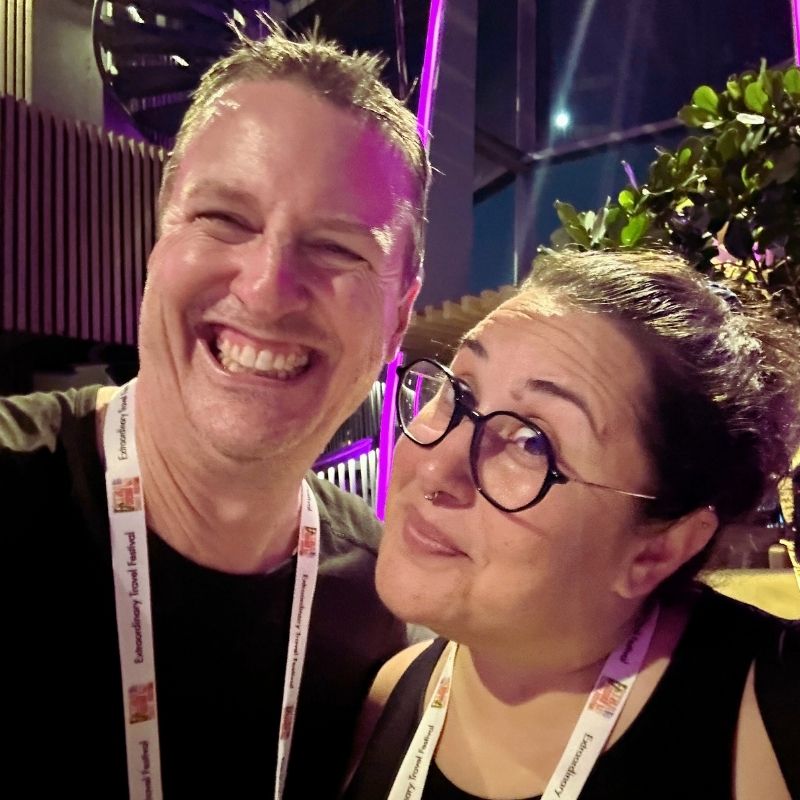
Matt Bowles: And I feel like also we need to talk about where we met. You and I met at the Extraordinary Travel Festival in Bangkok, Thailand, put on by our mutual friend Ric Gazarian, who Maverick Show listeners know. And we were hanging out with our mutual friend Hannah Dixon, who Maverick Show listeners also know because she’s been on the podcast twice now. But I would love to hear your impressions of people that maybe have never heard of the Extraordinary Travel Fest. What is the event about? Why did you choose to go and then what was your experience like in Bangkok at the conference?
Jimena Serfaty: I wanted to go because I wanted to be in a community of travelers. It’s great to meet other people that love traveling and geek out of it as much as I do because most people don’t understand me. So that was great. You got speakers of different places, there’s a lot of conversations going on. Great for networking, finding travel partners as well, and just getting to know new places, new people and new stories. And if you tell me that I need to go to Bangkok, it is going to be like, okay, let me buy a ticket and I’ll get there.
Matt Bowles: Does not take much convincing to get me to Bangkok either. But you and I, I remember, were just hanging out on the rooftop, having cocktails, a beautiful Bangkok night and talking about travel and we had such a lovely connection, and we have been remaining in touch ever since then. And so, I’ve been wanting to set up this interview and get you on the podcast. So, I’m super excited about this conversation. I feel like where we need to start this is in your homeland of Argentina, which is such a wonderful and important place in my travel journey. When I initially left the United States 12 years ago in 2013, packed up all my stuff, got rid of everything and left LA to start this now 12 yearlong itinerant digital nomad journeys.
The very first destination I went to Buenos Aires, Argentina for three months and I have been back multiple times since. I’ve spent at least six months in your amazing country, doing everything from skiing in Bariloche to drinking wine in Mendoza, to all of the amazing things that there are to do in Buenos Aires, which I tell people is the latest night city I have ever seen anywhere in the world. And I just continue to tell stories about your amazing country because it continues to surprise and delight me. I just go back to Argentina and then I’ll go to the Iguazu Waterfalls, and I’ll just have my mind blown yet again. I mean, these are massive waterfalls in the jungle, kilometers long, super high. They create all of these rainbows that are everywhere. It’s just like rainbows all around you and you’re just like, this is the most magical thing I’ve ever seen.
So, Argentina just has such a special place in my heart, and it just surprises and delights me each time I go. It’s a new, wonderful, special experience. But you’ve traveled the country super extensively and I’m wondering, as someone who’s from there, what would be some of your top recommendations for people that would like to spend time in your country?
Jimena Serfaty: Well, there’s so many places as it’s such a big country. I love the north, La Rioja, and Salta beautiful places. You have got some canyons that are really nice over there, so that’s just beautiful to visit. You got the seven-color mountain over there. So that’s very nice. There are other provinces that I haven’t been to, but they are on my list, like Catamarca, which has great places to go. You got sand dunes and things like that. You also got there’s a national park. We call it Valle de la Luna, which is the Moon Valley. It looks like you’re in space. So, who doesn’t want to be in space?
Patagonia, of course, is amazing. Bariloche is a very known place, San Martín de los Andes. I really enjoyed my time over there. Puerto Madryn as well, to go see penguins and whales. The whales are not as pretty as you expect them. That’s what happened to me when I was there. They stink. So that’s the reality of it. A place that I haven’t been, but it’s on my list as well, is Ushuaia, which is, as I call it, the end of the world. But it’s on my list, hopefully for my next trip.
Matt Bowles: That’s amazing. And if you want to do incredible wine tasting, the Mendoza region is a spectacular place. Gorgeous vineyards. The Malbec is just incredibly special. And I have lots of great memories there. Just kind of sitting out under these vineyards and just having some of the most incredible wine and great conversations with people just all day long for multiple days in a row. So that’s a really special region. And then Bariloche is the lakes district. But it’s interesting because I’ve never been there in the summer, which I’m sure is crazy gorgeous. I went on purpose in the winter so we could ski in the Andes. And it was just the view from the top of the mountains. When you’re skiing down in Bariloche, you see all of these lakes and everything below you and the landscape and the scenery, and it was just incredible.
Jimena Serfaty: It was so special, but it was just amazing. I went there with my family first. And then something that is very traditional in Argentina, especially from people from Buenos Aires, is when you finish your school year, like especially in the last year of your high school, you would go to Barriloche as the end of school trip. That’s where we go. But in reality, Bariloche is beautiful anyways. And all the chocolates that you can eat there as well.
Matt Bowles: Yes. And if you are in general interested in going to some of the best steakhouses, parillas in the world, Argentina is where to do that. And I will tell you, we found this one out in Bariloche that I would say our group consents, like, this is the best one we’ve Been to in the entire country, even better than anything in Buenos Aires. And so, we were just completely blown away. But if you are someone that enjoys steak, Argentina is a place that you must go, and you must experience because it’s about the best in the world. And it’s like the steak houses you can go to, but also, they have, like the parilla-rapidos, the sandwiches on the street, which will just blow your mind. So, it’s an incredible culinary scene there.
Jimena Serfaty: If you like meat, for sure, if you like carbs, pizzas, pasta, empanadas, all those things, that’s what we eat all the time. So, there’s a lot of that and sweet things. Because we got dulce de leche, which is a caramel spread. Very sweet. That’s what we got. When I first saw Nutella, everybody was like, you never tried it? And I was like, I never needed it before. I had the delicious dulce of my life. So, I didn’t know what it was. But we eat very sweet things. And we eat ice cream all year round. We got ice cream all around the city. Delivery before any kind of app existed for us. That was very common. So, ice cream, winter, under a blanket. Yes, Love it.
Matt Bowles: And when you stay in Buenos Aires, one of the things that I have really enjoyed is how distinct a number of the different neighborhoods are. If you’re staying in San Telmo or versus if you’re staying in Palermo Soho. If you’re staying in La Boca or you’re staying in Recoleta or these different barrios around the city are each so culturally distinct and so interesting. And the history of these barrios is just so incredible. And so, you can go there. And I’ve taken tango classes and just really try to sort of immersed. But then you learn the history of tango and how it came to be from there. I mean, it’s just sso important and it’s so culturally rich and it’s just so amazing. So, I just keep going back, staying in different places, learning more stuff. And Argentina just has an amazingly special place in my heart.
Jimena Serfaty: Where I’m from is just outside the capital. It’s where they used to have their weekend houses or holiday houses. So, you had all these big houses, big gardens and things like that. There’s a lot of history, like just 10 minutes from my house and a bit further you got Tigre, which we got the Delta. You got a lot of history over there as well. You got a market as well. So, there’s so many options and so many Things to see. It’s a nonstop city. Whenever you go, there’s always something new, there’s something, something different. There’s more history for you to learn and a lot of food to eat.
Matt Bowles: Well, speaking of history, can you share a little bit about your personal history? And maybe before we talk about your experience growing up and some of the recent historical events that you lived through growing up there, can you share a little bit about your family heritage, your family background and how your family got to Argentina?
Jimena Serfaty: Sure. So, I’ve been studying, you could say, my family tree for the last 23 years. And it’s been long to learn just because we didn’t know everything. I knew part of my family came from Poland, my great grandparents from my mom’s side after World War I. Then I had, from my dad’s side, two of my great grandparents. They came from Uruguay, but they met in Argentina. We didn’t know a lot of their background. We thought there was a lot of Spanish over there, but we didn’t know. And from my dad’s side, they came from Morocco, so that was also very different. And there were Jewish Moroccans, which was also very, very different. And the other bit, they were native Argentinian. We still don’t know from where, but we knew that. So, it was very diverse. Both of my families, both my mom and my dad, they come from half Jewish, half Catholic households. So that it’s also a big mix for me. It’s very interesting. I started digging, learning, finding paperwork and records and stuff like that. Eventually the one from Uruguay, we learned that they weren’t Spanish, they were actually Italian. And now we managed to get all the paperwork, we got all the records. And now my cousins got an Italian citizenship because of that.
Matt Bowles: That’s amazing. And I know you now have a Polish citizenship as well, and you and your family just recently went to Morocco together. What was that experience like?
Jimena Serfaty: So going to Morocco was great. My parents can visit, and my dad decided that he wanted to go to Morocco. So, we were like, you want to go, we’ll go. So, we went there just last month. It was great to experience it with them, just because it’s a place that is very different from what they’re used to. They’ve traveled a bit around Europe and around Latin America. But of course, Morocco is different in culture. What you see is how people do things in general, being in a Medina as well, that was very different from them. The food was very different, which they’re not very used to it, but they tried a lot of things. So that was nice.
But it was nice to connect to a side of the family that was there. And even though we learned just a little bit, because we only went to Rabat and Fez, it was really nice just to see people that my dad kept getting stopped saying, you look Moroccan. I got a guy stopping me and telling me I look Moroccan. And we had the owner of one of the areas we stayed at saying, do you know that your last name, it’s famous here in Morocco. And we were like, yes, we know. Our family is from here. So, it was very interesting. Just hearing stories, hearing a bit more. I’m not used to having anybody outside of my family that has my last name. So, it was nice just to meet people that were like, we know your last name. It’s known over here. So that’s always nice.
Matt Bowles: That is really nice. Well, I want to ask about your personal experience. Growing up in Argentina. You lived through some really high-profile global events that happened there. One of which was the collapse of the Argentine economy in 2001. I know you were a teenager at the time. Can you share a little bit just about your upbringing in Buenos Aires, what that was like to grow up at that time and then what when that happened, what was that like for you and your family during that time?
Jimena Serfaty: Growing up for me, my family, my dad worked always a lot. He still has three jobs. That’s what he does. He’s a workaholic, so he doesn’t stop working. They did send me to a bilingual school. It was a private school. And initially at that school there were a lot of kids from like very not rich people, but they had a lot of money. So, for me to have little money, because we didn’t have much money, we had an old car. I didn’t realize the difference. Now as a grown up, I can see it, but it was fine. Eventually we changed schools. When I was in third grade, I went to a way smaller school. And growing up, I didn’t realize anything different. We didn’t have or at least my parents didn’t show me that we were struggling much. I never felt that I was missing out on anything.
And December 2001 came up and everything got a bit scary. There were a lot of protests all around. There was a lot of looting. That was the scary part because they kept saying that people were just coming in and stealing and breaking everything. So, they were like, you don’t go outside, you stay at home. Stay safe here. My aunt lived next door to us and our garden’s connected, so it was nice to just go just behind the scenes because you had a protest, people were getting arrested. People were very scared of what we had going on during the dictatorship. We had before because people went missing. So, as people were getting taken, and you could see this in the media, they were repeating their ID numbers on and on to be like, I’m this person, I’m here, I’m getting taken. Just in case they went missing. So that of course was very scary. The process was a lot.
And also, money disappeared. Cash didn’t exist. There was no cash whatsoever anywhere. They started printing this monopoly money depending on the province, they had different names. Everything was either by card or you had this weird money that was printed. But it was just seeing that all through the 90s, it was one Argentinian peso, one US dollar. People had their savings in US dollars, and they couldn’t get it out of their accounts. They had to get that converted right into Argentinian pesos. So, they were losing their life savings. It was just insane. And then the peso keeps getting weaker and weaker, continues to get weird and weirder as the year passed. But it was crazy scary. The President escaping by helicopter. You couldn’t believe what was going on. It sounded like a movie, didn’t sound like a real thing that could happen to people. And that’s when a lot of families left, because I know a lot of people that left during that year. But also, when parents decide, I want to give my kids another option in case this happens again. That’s when my mom started looking into getting a different citizenship, just in case that was needed. And it was an option just for us to have.
Matt Bowles: When you think back to your childhood and things like that, how old were you when you started thinking about world travel or desiring to see places outside of Argentina?
Jimena Serfaty: So, I was five. My godfather gave me a kids atlas that was pretty much as tall as me. And I started sitting and looking at the map of the map, learning the countries, learning the flags. Love to this day, playing flag games all the time. And then I watched Alvin and the Chipmunks. And then one episode, they travel the world in a hot air balloon, and they go to China and all these crunches, and I was like, wow. So, then I decided I wanted to do the same. So, I started recruiting my sister and my friends to go travel the world with me in a hot air balloon. Later in time, when we were teenagers, my friend told me, do you remember you used to tell us this? I told you, yes. But I would cry and cry because I didn’t want to leave My mom. So, I was recruiting people to travel with me, and they were scared, but they said yes to me anyways. And that’s when it started. It was always finding a place that is different. And it continued through the years. I did a project for school when I was in seventh grade about New Zealand. And that stuck in my mind because there’s all these animals. They don’t exist here. They are only over there. I want to go. Anything that was different, I wanted to go and see it. So that’s where it all started.
Matt Bowles: Well, I know for your 18th birthday you have got to do a very special and impactful international trip. Can you talk about that, where you went and what you did?
Jimena Serfaty: Sure. So, after I finished school, I went backpacking with my aunt through Europe for a month. So, we got to Rome, that was the first stop. And just getting there, we arrived very late at night. We got lost as well. Next morning we take the underground, come out, and the Coliseum is just there. And I was like, wow, this is incredible. I studied Italian when I was younger, so for me that was already amazing. So we went to Rome, Gladiators, the movie, everything. Love it, all of it. Then we went to Florence, we went to Venice. We were there for the carnival because it was February. The masks, the capes. I went to buy a cape. I was with a backpack. Where am I going to put on a cape? Also, I wanted to buy a sword because I love them, but I can’t backpack with a sword either. I didn’t buy any of those things. And then I spent my 18th birthday in Paris. It’s very cold, February, but beautiful. It was just an amazing experience.
And then we moved into Spain. So, Madrid was very similar to Buenos Aires. Enjoying my time over there. It was the first time that anybody was like, oh, Jimena, this is a very important name. It’s a very old Spanish name. So, they were talking about that, and I was like, this is amazing. Nobody ever knows my name. So that’s great. And then we ended up in Barcelona, where we met up with family and friends. So that was the best way to end that trip. And after that I got back home, my parents picked me up and I told them, next time I’m going for longer. And I did.
Matt Bowles: So where did you go next time and for how long?
Jimena Serfaty: So, after that I went into uni, I studied. Once I was done, and I worked for a few years. I didn’t want to stay in Argentina anymore. So I went to that place that I made that project in school many, many years before. And I moved to New Zealand for a year. I did my working holiday visa over there and it was a great experience, new country, this country that I was waiting for so long. Ended up moving to the South Island, lived in a national park that had a glacier for nine months. It was a town with 300 people. We all knew each other. And it was the best decision that I made. And that was just the beginning of everything that came out. Fifteen years later, I’m still going, so I love it. It was the best.
Matt Bowles: Well, I know you also got to do some traveling from New Zealand to places that are a lot closer to New Zealand than they are to Argentina. And you’ve been to some places that I have not yet been to, including seeing the Komodo dragons. Can you talk about that trip and just contextualize it also for people that aren’t familiar about what the Komodo dragons are and where they live.
Jimena Serfaty: So, the Komodo dragons live in these three islands in Indonesia. There are these massive dinosaur like lizards that have claws that they can eat a whole water buffalo bones included. They have some kind of venom as well. So, they paralyze the animal. That’s how they hunt, and they eat. And they’ve been on my list just to go see them. I just wanted to go see these weird creatures. And I went to Indonesia. Some traveling over there wanted to go to Flores. Flores is a group of islands where the Komodo dragons are. So, this was back in 2010. No GPS on your phone, no Internet on your phone, hard to find WI fi anywhere. So, I just would go to the airport and just ask at the desk of the airline, I want to go to this place.
So, I kept saying, I want to go to Flores. And he kept saying, Kupang. And I was like, Flores. And he said, Kupang. Eventually said, okay. So, he sold me a ticket to Kupang and I flew to Kupang. Kupang is not in Flores. It’s West Timor. I ended up there. Nobody spoke English. There were no hotels, especially not budget hotels. There’s a lot of business going on there. So, I got stuck on this island for two days until I could finally go see my dragons. And I did get there. I had one day to go on this tour to go see them. I went to the national park. We walked around for three hours after I had food poisoning as well. So that was a lot of fun under the heat, and I managed to see a few dragons, baby dragons as well. And it was a great experience. And we ended with a snorkeling trip. So even better.
Matt Bowles: Amazing. Well, another place that I have to ask you about is your trip to India, which I know you did shortly after that trip. And you stayed there for longer than I have stayed in India. I’ve been a couple of times. But you have spent more total time there than I have. And I would love to hear what your experience was like in India and what some of the highlights were for you.
Jimena Serfaty: So, I was in India. I got there on the 24th of December 2010, Christmas Eve for me, because that’s what we celebrate. We were in Mumbai. We went to Goa. Goa wasn’t really my thing. Again, as I said, I like things that are different. We ended up going to Rajasthan. So, the desert. We spent a night in the desert over there. The blue city. Blue is my favorite color. So of course it’s going to be my favorite city. We also went to Jodhpur, just to learn about how they used to use all these buildings to measure stars and astronomy. Incredible. I went to Varanasi, saw ceremonies over there that were very impactful, just to see the ceremony in itself. What they do is burn bodies over there. That’s where they leave them to rest in peace. And also went to see the Dalai Lama give a conference there. So that was incredible.
And then I moved up north, and the north is one of my favorite parts. I went to Rishikesh, stayed there for like a week, lived with people, and walked around. I have never done yoga before. I wasn’t really interested in it. Met a Mexican girl that was doing it. She made me join yoga. And I was like, okay, this is what I’m doing now. And then I ended up in Ambedkar to see the Golden Temple. That was also really interesting. And by then I was traveling with a Swedish guy. And the difference? Before I was traveling with a girl, then I was traveling with myself, and then I was traveling with a guy. And now people wouldn’t talk to me anymore. They would talk to him all the time. And he wasn’t used to traveling. It was the first time he was out of Europe, so that was the whole thing. And I was like, we’re not paying for this. We’re not going here. We’re not doing that. You talk to me. Don’t talk to him. Why are you talking to him? So that was also an experience. And then I ended up in Makilogach, where all the Tibetans go. The refugees are over there. And I went to Tibetan museum. That was also very interesting.
And at least back in the day, as part of just paying the fee to go inside the museum, you would get a book. You could Pick any of the books that they had there. So, pick a book. And I love India. It’s chaotic, it’s dirty. There’s a lot of people. Oh, and I went to the Taj Mahal. Of course, I forgot about one of the main things. But no, I love it there. I come from Latin America. It’s not that strange for me to see people begging. It’s not good. But it’s not uncommon for me to see that or things being dirty. So, it wasn’t as much of a shock as I thought it was going to be. But I love it. There’s so much more to see as well. India is such a big country.
Matt Bowles: It is massive. I mean, people need to understand that. I think it’s something like 18% of the world’s population lives in India. So, each state has a different language, different cultural dynamics, and the food varies from state to state, all of these different things. So, saying that you’ve been to India is kind of like saying that you’ve been to Europe. I mean, it’s like you could spend so much time in India going to all of the different states. And in the same way that you can go through Europe and spend time in all of the different countries there and just hear the different languages and learn about the different cultures and eat the different foods and stuff. So, I agree. I mean, that’s why I say I’ve been to India twice, but they were both trips that were less than two weeks each. And I just feel like I need to just go and give India at least a year plus of my time and just really go through it and immerse.
But I did go to the Golden Temple in Amritsar in Punjab, and I was actually there for Diwali, and it was such a special experience. We had an Airbnb. Our Airbnb host said, oh, who will you be spending Diwali with? Do you have family and friends here that you’ll be spending it with? We were like, no, we don’t know anyone here. And he’s like, oh, well, then you’ll spend it with my family. I’ll come back and pick you up at this hour. And got to spend the whole Diwali with the Airbnb host’s family in their home. They made all this food, this huge feast, and we’re the only people that are there that are not from his family that are eating this. And the prayer ceremony and then up on the roof to, like, shoot off fireworks and do the whole lights in the sky thing and just us with the family, I mean, it was like the most unbelievable thing. The hospitality of people in India was just completely insane. Just over the top kindness at every turn. It’s just, yeah, India is so special. I can’t wait to go back.
Jimena Serfaty: They are super welcoming people, very helpful in general. Just as a woman traveling alone, it happened on the train, there were older women, they were like, are you okay? Do you need anything? Do you want me to tell this guy to move from your seat? And they will always help you with whatever you need. Super nice people.
Matt Bowles: Well, you eventually ended up moving to the UK and settling there for a number of years. You’re there right now, in fact. And so, I would love to hear, having spent so much time in the UK, what for you are some of the top highlights if someone wants to come and spend some time there. What are some of your favorite things about the UK?
Jimena Serfaty: Well, the main thing is when you’re in your twenties, London sounds amazing. And it’s a great place to live when you’re in your 20s, especially if you want a place that is diverse, that it’s open late, that you got things to do any night, date of the week, there’s always something, there’s always concerts, there’s always a musical that you can go see a different show. So, it’s a great place to be 20 something. The other thing as well is the food. Food in London, for example, you get food from all over the world. So, it’s. It’s nice to have that diversity. And the UK, is a beautiful country as well. Scotland is amazing. I’ve been to Edinburgh. I’ve been to the Isle of Sky last year, went hiking over there.
Matt Bowles: Can you describe the Isle of Skye for people that have never heard of it? Because I have never been there. But I have seen footage, I’ve seen drone footage. I mean, this is like a legendary place. I would love to hear what it was like for you there. And just for people that have never heard about it, just describe it.
Jimena Serfaty: Just picture these cliffs and everything as green as you can picture because it does rain quite a bit there. So, it is pretty green. And you have these mountains that look incredible. They do a lot of filming for movies and TV shows. I think they did the Outlander over there and it’s a small island. If you get a car, you will go around pretty easily. I ended up hitchhiking because I didn’t drive. But people would just drive you from one point to the other. There’s a loop. So, you either go one way or you go the other. There are not many options. You got distilleries as well for Scotch if you like. Going for a tasting. There are castles as well and they have got some springs that I didn’t get to go, sadly. But it looks like a fairy tale. That’s what you need to picture. Just a fairy tale. When you’re like, does this look real? Am I in a book or something? That’s how it looks like. Super green.
Matt Bowles: So amazing. People can do a Google image search for the Isle of Skye just to kind of get a sense of what this place looks like. Well, Jime, the other thing that I have to ask you about in 2015, you did an eight month long overland trip from London to Singapore without getting on an airplane. And I would love to unpack the different segments of this trip and some of your experiences along the way. And I want to ask you about the European portion first. As you left London and you were going through Europe, that was your first time going to Poland and you mentioned that you have the Polish heritage. You now hold also a Polish passport. Can you share a little bit about what your experience was like reconnecting with the country of Poland for your first time?
Jimena Serfaty: Yeah. So going to Poland was important. My family’s from a very small village, so it’s actually just houses on the side of the road. So, I couldn’t get there. And even if I get there, there’s not much for me to do. But I went to Krakow, which was just an hour and a half away, as my family was Jewish from the south. And a lot of my family passed away during first and we’re guessing from the Second World War as they lost contact. It was very important for me to go to Auschwitz and just see and learn a bit more about the history, the people. So, I did, and I went to Auschwitz. I thought I was going to be sad, and I know a lot of people get sick going there because it’s very shocking. It’s not that you have got that many things there. It’s just hearing and reading the stories that is a shocking thing to me.
It just made me angry. It made me angry to think about the kids and what they could have been. And we didn’t know they were little kids. They had nothing to do with anything. None of these people or seeing there’s a place where you got all the shoes and you see the amount of shoes that they had there or the suitcases and even the hair because they shaved their heads. So just seeing this pile of hair, it just Made me angry. That was a feeling that I had. And the other thing was, I went there during the summer because this was August. And especially when you get where the barracks were, where they were sleeping, and now there’s nothing, and everything was so green, and you had all these flowers. Seeing that contrast of this place, that was so painful and so many people suffer to now be this beautiful place, this land with flowers and butterflies just flying around. It was a lot. But I thought it was also very important for me to do it, just to understand a little bit.
My great grandmother left with my great grandfather, and she lost contact with her family. They didn’t know what happened to them. And I think it was like maybe 30 years later, she received a letter from somebody saying that they had family in Argentina and they wanted to reconnect. And the person writing to my great grandma was her little brother. She was, I think, 15 years older than him. So, he was maybe 10 or something when everything happened, or the last time they saw each other, and they reconnected. He eventually went to Argentina once to visit her, and they recognized each other. So, it was very nice just to see. Because he was sent to a concentration camp when he was a kid. People helped him escape. He moved to Israel at the beginning and then ended up in the U.S. and visiting something where my family was from. It was the first time. I was the first person in all those years that went back to Poland. And then I took my sister with me in 2022. But that was the first time somebody went back, and I was like, okay, they were from here and just learning a bit more because I didn’t get to meet them. It was really nice just to reconnect with my roots.
Matt Bowles: What was the 2022 trip like when you went there with your sister?
Jimena Serfaty: We did 10 days. We went to Gdansk, up north, close to the sea, during winter. Another place that looks like a fairy tale because it’s all these cobblestones and all these stone buildings. It was snowing beautifully. We did Warsaw and we also did Krakow again. And it was nice for us to reconnect. We did some tours just to learn more about Jewish people in these cities. Just because I think it’s important that we learn and we understand a bit better how their life was before and what happened to them. As when my great grandparents moved, they didn’t really talk about their life over there or their family or many things. I think for them it was just too painful just to leave everybody behind. So, it was just like, okay, this is what we got now this is what we do. And they started from scratch in Argentina because they all lived in one room in Comitillos. That’s what you had in La Boca in those places where you had families living in one room and they didn’t speak the language, they spoke Yiddish. So, starting from scratch over there and then having five kids, it was a thing, all of them living in one room. So, I think for them was just like, okay, let’s just make a living over here. Focus on these and focus on the kids. And that was that.
Matt Bowles: Well, I know that on that 2015 trip, as you went through Europe and then eventually got into Asia, when you got to Cambodia, you made a decision there also to go to the Killing Fields and to go to the S21 prison to study the genocide that happened in Cambodia. And I’m wondering if you can talk a little bit about that experience, but also the connections that you saw and why that was important to you to study another example of genocide as well.
Jimena Serfaty: Usually, before going into a country, I try to read a bit more about their history, especially if I don’t know much about it. So before going to Cambodia, when I learned about this, that it was pretty recent, you’re talking like late 70s, 80s, I was like, why have I never heard of this? We do learn a lot of things in school, we learn a lot of things that happen in Europe, or the US but we don’t learn that much about Asia. So, I was surprised that something so recent happened that I haven’t heard of it or at least had an idea of it. I spoke with my mom, but my mom was telling me, well, we had a dictatorship here, so hard for us to learn about these things. So, I decided to go, and I just wanted to learn more. I think it’s important to understand history, to learn about the people, the culture, and why they do the things that they do.
And when you consider that the Khmer Rouge killed almost 50% of the population, and there’s a big gap between ages in Cambodia, if you don’t learn about what happened in the Killing Fields, in the museum, then you don’t understand why things are the way they are right now, why Cambodia is still trying to develop and trying to recover because people were stealing their money for so long, and it’s still one of the poorest countries in Southeast Asia right now, just because of something that happened pretty recently. So, I went to the Killing Fields. Well, I went to the museum first, where it used to be a school, where they used to do horrible things to people and you go around each room, it tells you stories, just recollections of what people live through there. But at the same time, you can go and there’s survivors there that you can sit at a table and ask them questions. And that, for me, was so super powerful, I didn’t know what to ask them because I’m just so shocked, so sad and so sad that they had to go through this.
These people didn’t do anything like most people that get affected in wars are just bystanders that were just living there. And then I went to the killing fields. And in the killing fields, as part of the entrance fee that you pay, they give you an audio guide. And the audio guide tells you what you’re seeing all around. There’s this building full of skulls, which is very, again, shocking powerful over there. And you can walk around and it’s just people telling stories, all the recollections of things that they’ve seen and how their family died, what they experienced during that time. So, I just walked around this lake, and I would just walk, sit on a bench and cry because it was just so horrible. And something that they did as well was that they got very resourceful on how they were killing people because they said bullets were expensive. So, you can only imagine the horrible, horrible things that they did to people. So, for me, it was just important to go and learn and get to understand them a bit better. I know it’s horrible, of course. It’s not that I do it because I enjoy it, but it’s just important just to understand them.
Matt Bowles: I agree 100%. And it was so powerful because I’ve done that as well, gone to the prison, which is the museum, and then to the Killing Fields. And one of the things that’s so powerful to me that I find is consistently the case with genocide museums around the world—I’ve been through Rwanda and other places as well—and just like you, I find it incredibly important to really immerse myself in that history and really sit with that and really reckon with that. And one of the things that I consistently find is that, and you’ll remember this maybe in Cambodia when you’re leaving, they’re emphasizing that there is nothing culturally or religiously or anything specific about genocide. It can happen to anyone, at any time, by anyone. And here is a list of genocides that are currently happening right now as you’re standing here in the world. And they’re talking about that, but they’re also talking about the history of a list of others. The Native American genocide, I recall that they mentioned, which I was very touched by.
So, I think that those kinds of things are so important to go and see how this happened, and then to realize that this is still happening now in a number of places while we’re sitting here and that it could happen in any place in the future. And so, for me as well, when I travel, I always try to look for that history and sit with that and reckon with that and then think, what can I do today about the stuff that’s going on now? And what can I learn from this?
Jimena Serfaty: 100%. Because I think it is I think something that you just said is very important is understanding how did we got there, how did this happen? And just understanding that and understanding that it can happen anywhere at any point, at any time. It’s super important.
Matt Bowles: Well, I want to talk to you about some other places that you went on this trip as well, this 2015 overland trip, because you have been to some places that I have not been to that I really want to ask you about. One of them is that you have gone through Mainland China and gone to some places that not a lot of people go to. And China is one of those places, again, it’s like India, right? So massive, right? Close to 20% of the world’s population that lives there or something like that. Mandarin is the most spoken first language on the planet of Earth, more than English. I mean, it’s like once you realize this, you’re just like, wow. And so, again, China is one of those places where I feel like I need to take at least a year of my life and just spend it going around China, seeing all this stuff which I have not yet done. So, I want to ask you about it, Jimme. Can you share, first of all, just some of the unique and extraordinary natural landscapes that you sought out and visited when you were in China.
Jimena Serfaty: China, as you said, it’s incredible and it’s massive. There are so many things to go and see. You never have enough time. Never. But one of the places that I went to visit, and this is because I saw it on one of those posts of top 10 places to see before you die. Years and years before I had it on my list, it was the Rainbow Mountains. So, the Rainbow Mountains are in the Gansu Province to the west. I think it’s northwest. And I only went to that city to go to that national park. That’s what I wanted to see, the Rainbow Mountain. So, I think I was in Shanghai, and I had to travel for 26 hours to get there. Got There late. It’s not a province that is used to tourism. You have got some places like Beijing or Shanghai that they get more people, but there were’t as many people.
And I ended up in this hostel and nobody spoke English. I was like, it’s okay. I always manage. It’s fine. Slept, woke up the next day. They told me what I needed to do, or I think they signed what I needed to do. And I just went, and I got on the bus, and they dropped me there. And I’m on the side of the road. I’m like, where are the mountains? Because I can’t see them. And I’m like, okay. Somebody said like there. So, I just went to another little street until I found the ticket booth, purchased my ticket. And there were Chinese tourists. Because Chinese tend to travel a lot inside their country. They do a lot of domestic travel. There was two couples of Americans, older people there. And there was another guy that was staring at me, and I was like, weird. So, this guy’s staring at me and he approaches me and he’s like, I’ve seen you before. And I’m like, where? And he’s like, oh, in Mongolia.
So, I met this guy in Mongolia the month before randomly. And then we started going around the national park. Because you got a lot of different stations in China. The national parks have a way for you to move around, and they have very organized. You’ve got platforms where you can go stand and see what they want you to see. So, the national park was very interesting. It was very empty, which is weird in China because again, there’s a lot of people and managed to see everything in there and have a great time. Just one made a friend. So, these mountains were just amazing, you got all the different shapes, so they have different names. And it reminded me a lot of Argentina and like the seven-color mountain that we got up north. But it’s just so beautiful how Earth has all these different colors and what nature can do as well. It’s very impressive. And that was one of the most impressive things.
The other park is where you got the Avatar Mountains. Can never pronounce the name because there’s a lot of Js over there. But that place is incredible as well. You got all these just pictures, pillars where you just got some vegetation on top, very green and also gets foggy underneath. So, they look like they’re floating. They’re obviously not floating, but they look like they are. And you got so, so many of them. And I know there’s a lift that you can take to get to the top and get a view. I walked it up, it was fine. But it takes a long time to get up there and just walking around, it was beautiful. It’s an incredible place. It just looks like many others that I have visited. Magical. They look like they’re floating and they’re so, so high up as well.
Matt Bowles: Well, I now need to ask you about Mongolia for sure. And you and I both got to Mongolia the same way, which is that we took the Trans-Siberian Railway, and we took the Trans Mongolian route and went through Siberia and then down to Mongolia. Can you share a little bit about, first of all, what was your experience on the Trans-Siberian Railway?
Jimena Serfaty: Yeah, so I did it in two parts. First, I went from Moscow to Irkutsk because I went to the Baikal Lake. In Baikal Lake, you got an island called Olkhon. So, I stayed over there for a few days. That’s amazing. The Baikal Lake gets frozen during winter. I went during summer. But people can cross and walk around it. So that always makes it very interesting. And then I went from Irkutsk to Ulaanbaatar. But when I went from Moscow to Irkutsk, I was on this train for three and a half days by myself on third class with all these families. Nobody spoke English. I don’t speak any Russian. I wasn’t prepared for this kind of trip after that one I learned how to take trains and what I needed to take with me. But I just took like one bottle of water mistake, two packs of crisps and some cookies. I didn’t have food. I was just very unprepared for this trip. But it was a lot of fun.
There was a lady just across from me, just where she was sleeping. And she would feed me chocolates all the time. She would just put them on the table and just slide them over to me. So, I was like, thank you. And then there was this other very interesting lady sitting on the Ali. That’s where she slept. And she brought everything. She had all these plastic bottles and little like the cups of the bottles and clay. And then she started building things. And then she was sketching the people on the train. Then she would ask me with their broken English we were all speaking. And they were like, oh, where are you from? And I was like, Argentina. And she was like, oh, Irin. And I was like, Jimena. And that’s how we communicate. But it was a great experience. Russia is another country that is massive. So big, so many things to see as well in Russia. I do like Russia; the Russian people are very nice. They’re very helpful. So, I had a great experience in Russia. Most of the people that I met, especially those who took the train, had the same experience. People invited them to eat and to drink and to do all these things. So, the Trans-Siberian was on my bucket list since I was 15. So, I did it, and I was very excited about it.
Matt Bowles: All right, we’re going to pause here and call that the end of part one. For direct links to everything we have discussed in this episode, including all the ways to find, follow, and connect with Jimena, just go to themverickshow.com and go to the show notes for this episode. And be sure to tune in to the next episode to hear the conclusion of my interview with Jimena Serfaty. Good night, everybody.