
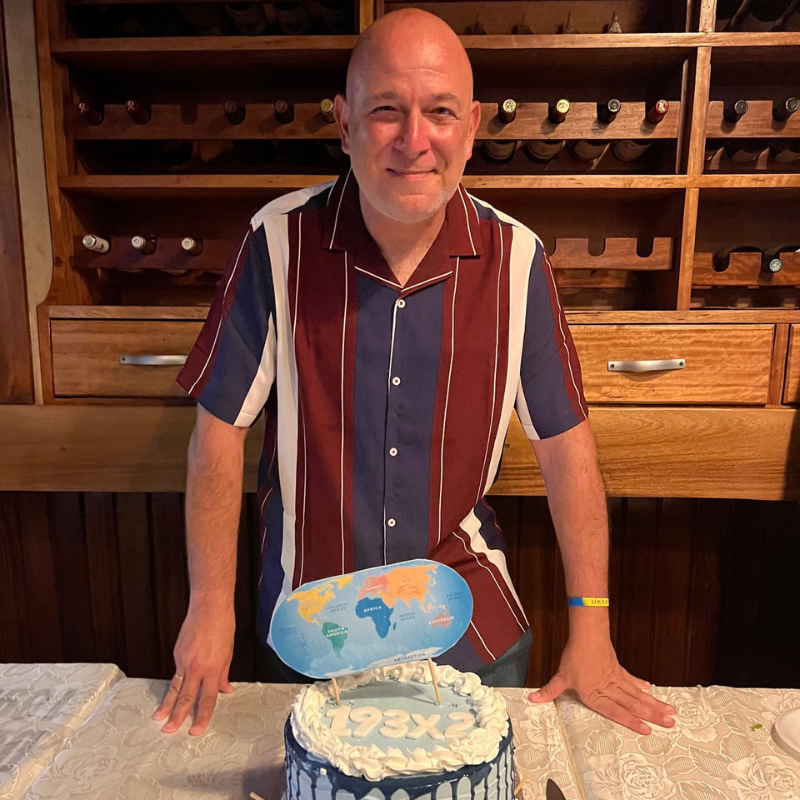
INTRO: This is part two of my interview with Harry Mitsidis. He is the founder of Nomad Mania and one of only three people on the planet to have traveled to every country in the world twice. If you did not yet listen to the first part of this interview, I highly recommend you go back and do that first because it provides some very important context for this episode. If you have already listened to part one, then please enjoy the conclusion of my interview with Harry Mitsidis.
Matt Bowles: Harry, how do you approach travel in terms of doing historical and cultural research and becoming aware of human rights abuses that are going on in certain places before you go, not for your own safety as a traveler, but to be a concerned human as obviously you and I have both talked about our sociology backgrounds. We’ve talked about our commitments to peace and justice in the world and things of that nature. So when you go to a place like DR Congo, which has an absolute horror show of human rights abuses going on, particularly around the mining of cobalt and other minerals that are being extracted by Western countries and so forth, how do you think about that, become aware of that, and then what impact does that have on you in terms of the way that you travel and the types of things that you observe when you travel? How do you navigate that?
Harry Mitsidis: Okay, well, I think partially as a Caucasian man, just I think the privilege That I have had and knowing where I come from and how easy my life has been compared to many of these people, I think naturally triggers a bit of guilt in me, but at the same time, I try to not be affected by it because this is my way of seeing it in terms of approaching the local people.
Again, I think always acting with kindness, always trying to show interest in what the locals have to say or the way of life. I think it makes you the best ambassador in that place. I think in many cases, I am aware. More or less of the history, I do read news daily. I’m very much into political and social development. So, if it is something that has happened recently or, you know, events that have happened, then I will be aware of them, and I’ll factor that in. I think a lot of the debate and travel has to do with whether you should be going to such places. Places where there have been abuses or where the local government is itself abusive, you know, whether we as people who travel should be making certain choices to travel or not to travel, where would you travel?
I’ve read a lot of people’s opinions. And if I always rejected governments who did things which are abusive, I’d end up not going anywhere, or maybe I’d only go to Iceland, say, or a country like that. So, what is that abusive that you may not want to even travel there because you don’t want to be part of the problem. And where do you draw the line? I think I don’t want to be prescriptive. I don’t want to be the one to tell people. I think ultimately everyone should have their own morality. I think it is important for people to be aware. You should not choose to go to North Korea. Without knowing what is going on there, as far as we know, I think it’s important to be aware of it and then whatever decision you make to make it and feel that it’s okay with your conscience.
Matt Bowles: Yeah, I think about these issues all the time. I mean, as I’m traveling, because I think about and try to reflect that I’m curious about your opinion on this as well, Harry. In terms of how you navigate this in terms of seeing certain things in certain places and trying not to fall into a voyeuristic or objectification of the people, or to put it more crudely, some people call it poverty porn. Where you’re paying money or going or even if you’re not paying money, going on a tour’, or going to see situations where people are in vulnerable positions, whether that’s poverty or something else. And I’m wondering how you navigate that dynamic ethically as a traveler, just for yourself personally.
Harry Mitsidis: Yeah. I mean, these are very complicated questions. I think the minute you decide to go to a country that is really poor, to a place like, say Central African Republic. That is a very poor country. You are inevitably going to face really difficult images and they will haunt you. But at the same time, if we pretend that doesn’t exist, aren’t we also Closing our eyes to the reality, there is a fine line to a certain extent, going there, seeing some things which are uncomfortable, then makes you also a bigger person. You can then crystallize some of your own opinions. You become more aware. You may change your own political or social beliefs in a certain direction.
So, I think in general, I believe as human beings. We need to be open to everything. And as a traveler, you want to see nice, natural landscapes. You want to see some great cultural achievements, but you also need to be aware that travel is not always about good news. You do want to go to Auschwitz because you need to go there. You need to remember that this did happen, and it’s one of the worst things that ever happened, but you need to be aware it happened. And by going there, in a way, you become part of this never happening again. And at the same time, when the regimes are really bad, you need to remember that there are very ordinary, normal people trying to live a daily life there.
Let’s say you’re going to a small shop with a local seller. He had not really seen the foreigner and you go and buy a bottle of water, and you have a bit of a conversation. There you as a foreigner in that country, you are helping this lone man. You’re doing something good for the average guy who has nothing to do with the bad regime, for example. So, I think one should always focus on what one can contribute. One should be aware of the limitations, because obviously, you cannot change the world on your own. Now, in terms of tours that do become voyeuristic, I think again, where the line is not always clear. Now, I think everyone needs to reach their own conclusion.
Matt Bowles: Well, and I think you gave a good example at the beginning of this conversation about going to Ukraine. Not in a voyeuristic capacity to tour a war-torn country but going with Ukrainian people in solidarity with folks and things like that. So, I think that is a good framework in terms of thinking about some of this stuff.
And when people are being oppressed or abused or in struggling ways that we can humanize those people and be in solidarity with them and so forth. So, these are all things that I try to think about but also, as an American. When I travel, one of the things that’s important to me is to understand also the history of my government’s foreign policy that has shaped the contemporary reality of so many places, whether we’re talking about Central and South America, or whether we’re talking about Southeast Asia. I mean, I obviously tell every American they should go to Hiroshima and spend a full day at the Peace Museum there and stuff. And so, for me, understanding the history, especially of what my government has done and how that has shaped the contemporary reality, like I know that one of the countries that you and I both share a profound love for is the country of Laos.
Harry Mitsidis: Oh yeah. Yeah.
Matt Bowles: It’s very important for Americans, especially who go there to know that Laos is the most bombed country in the world per capita. And that was done by the United States government during the American war against Vietnam. And the legacy of that bombing campaign has shaped very much about present day Laos and why things are the way that they are.
And so being aware of the sort of what we’re stepping into. And I think the same thing is the case, obviously for European travelers from colonial countries in terms of British folks going to the former British colonies or French folks going to former French colonies or things of that nature. So, I feel like there’s a level there of particularly as you were talking about, like privileged travelers, white male travelers from these types of societies to be aware of what we’re stepping into as we’re stepping into it.
Harry Mitsidis: Yep. I totally agree. Totally, yeah. I think you can’t really call yourself a traveler if you are not aware of some of the deeper contexts, historically and politically. And if you’re only going just to consume in a way and to take, then that is clearly not the right way to travel.
Matt Bowles: Yeah, I think that’s really important to sort of start thinking about that notion of extractive travel versus. Ways that we can be more socially responsible, ways that we can be more environmentally sustainable. And I know that Nomad Mania has taken that to be a really important and central issue of what you guys are producing content on. Can you give folks some general tips, Harry, in terms of, there’s a lot of information on the Nomad Mania site about this, but if you want to just maybe summarize some thoughts on how we can be a little bit more socially responsible and environmentally sustainable as we move through the world?
Harry Mitsidis: Yes, absolutely. Well, first of all, one easy tip is to always try to help the local communities. I mean, there are a lot of efforts going into our travels benefiting the locals rather than going into the pocket of some huge company in the West. And I think it’s very easy for a traveler to do this, to go directly to the source, get a local to help and then instead of sleeping in a chain hotel, go as much as you can to the local providers and the further away you go, the more you can do that off the beaten track. Now, in terms of overall sustainability, I see more and more people who are younger than me and I really applaud them bicycling around and there are ways, of course, you need a lot of time, and this is not something everyone can do.
Maybe we could consider a cycling trip, a healthy holiday instead of renting a car and going on a road trip. That is an easy way of making sure our impact is minimalized. And of course, I don’t think we can go from one extreme to the other. I don’t think there’s a magic wand and we can all suddenly say, “Oh, now we’re going to switch totally”. But I think it’s a gradual process. If we slowly become aware of these things, we can do as much as we can do. And if everyone did that, even a little bit, the effect would be big. I think it’s, again, very important not to gloss over these issues, but to take them very seriously. Because really, I mean, over tourism is becoming more and more of a problem. And eventually, I think the result will be certain places will just close their doors to tourism. So.
Matt Bowles: Harry, I know that you are not the type of traveler who’s just collecting passport stamps, stepping into a place and seeing the main site and then leaving. You’re someone who is intentional about trying to design culturally immersive experiences for yourself in places. Can you share a little bit about how to do that and what you do in terms of your travel style and how you design your local experiences when you’re going somewhere?
Harry Mitsidis: Yeah, well, it does depend a lot on the country because there are countries where I would say things are much easier. You can be much more spontaneous within Europe. I would say I’m not going to be so surprised necessarily, but I’m also going to be much more flexible and I’m not going to plan. I’ll just go with the flow and kind of allow the experiences to be created. I’ll find a detour, or I’ll look at what is there a few miles away and I’ll find something obscure and visited.
Now, when the countries are harder to go to, one has to do one’s research. At Nomad Mania now, we’re trying to offer trips to difficult countries in association with local partners, but what we do is try to create experiences which are unusual and which really enrich, not only in terms of seeing a famous site, but in terms of contacting locals. So, and I think this is more and more of a trend. For example, we’re offering a trip to Syria, and I told our local contact there, I want us to do things that people wouldn’t do. I want to go to school. I want us to have a masterclass in cooking. I would like us to try an activity of entertainment. What do locals do?
So, the end result of this is that the trip includes a karaoke session in Damascus, it includes a visit to a school with deaf children, and it includes going to the market, buying vegetables and what you need, and then coming back to a home and cooking with an old grandmother. Who is going to take you through the steps of making this meal. I mean, I don’t think you can get more immersive than that. And that is how you really contact local people. I mean, there you’re doing something useful. I don’t know how many travelers go to a school with deaf children in Syria. So, a visit there where presumably people with a basic humanity will leave a donation and contribute to the cause.
I think this can only be win, you know, and obviously the trip will also take place in some of the classic sites. Syria definitely has a lot of sites, so we do some of the classic things. But the idea of planning a trip, which is special, is to find ways to meet locals in special settings, I think, where first of all, the people are humanized because you can then put a face to the country. You remember that old lady you cooked with. You remember that kid who, I don’t know, danced or whatever, even though he couldn’t hear. And I think that then we’ll always warm you up. You will never be able to say, oh, Syria, this and that, it’ll be these people who will then shape your opinion of the country much more than what you hear in the news, much more than the ancient theater or the castle that you saw. Because of these castles and ancient theaters, they’re not as alive as the people we meet.
Matt Bowles: Harry, I want to do a deep dive now into Nomad Mania, your organization and platform that you have built because it is an absolutely extraordinary resource for travelers. I have been amazed at what you offer for free at no cost on the website. It is remarkable, and I really do want to highlight some of the different facets of what you’re offering here. I think a good place to start, though, would just be if you can talk about Nomad Mania in general, maybe just give folks a sense we’re very new to this concept, what some of the precursors were to Nomad Mania? And then what it was that inspired you to create this? Give us a little bit of the original story and what makes it unique.
Harry Mitsidis: Sure. Well, some of the listeners may have heard of the Traveler’s Century Club, which has existed for 70 years now. So, it is the mother of the travel clubs and what the Traveler’s Century Club aim was, at least back in the day, was to be a social club where people who like to travel got together and it divided the world into countries as they call them, but they were more than just countries. You had said a place like Gibraltar was listed separately compared to the United Kingdom. Well, now they have 330 such places. Now, if we think of countries recognized by the United Nations, we have 193 countries. So. I would say the TCC is the mother of the idea of dividing countries into visitable chunks, let’s put it that way.
Now at Nomad Mania, the idea was that it’s not enough to visit just one place in the country. And I mean, if we take the United States, which is huge, obviously, if you’ve only visited New York, you cannot really say, you know, the United States. And then, of course, you’ve got the smaller countries, say a country like Austria. Okay, so it’s much smaller. But again, if you’ve only visited Vienna, you haven’t seen the mountains and all these other things that are really spectacular in Austria. So, we thought that the ballpark number of about 1,200 pieces or regions is the right number in the sense of being challenging enough, big enough, but also small enough so you’re not going to get totally lost.
It’s not a number that is so huge that it’s totally unattainable, but it is big enough to keep most people on their toes for their whole lives. So ultimately, we have divided the world into 1,301 regions to visit. And this is our main master list. This is sort of the beginning of Nomad Mania 10 years ago. From there, we have expanded, and we have many, many different lists of all types with many different focuses. And of course, Nomad Mania is much bigger than just the list.
Matt Bowles: So, let’s go into that a little bit, Harry. And I also want to talk about what’s accessible to people for free, to just go onto your website and start using this. So can you share a little bit, I mean, I guess just step one with regard to the 1300 and one region that you have designated and clarified and laid out for folks, they can just go onto the Nomad Mania website, create a totally free account and a totally free profile. And then just start filling in their information. It’s all broken out by region and figure out how many of the 1300 and one places they have been, how many times they’ve been there and all this information. And they can start creating this lifelong documentation of their travel with incredible detail at no cost to them, right?
Harry Mitsidis: Yeah, there is no catch really. I mean, people sometimes may wonder, well, you know, what are they getting out of it? And I will say personally as the founder, what I am getting out of it. Well, right now I am in Atlanta with this Bosnian host whom I met, thanks to the community. So, I get these incredible people globally whom I’ve met. Thanks to this. I think what is really great is that if you really put in enough time into your Nomad Mania profile, you get all these cool maps. My favorite feature is if you fill in the year you visited a region, you can then go back, say, to 2006 And look at your map and how much of the world you had done in 2006.
And then there’s this little slider and it slides, and you can slide ahead to 2010 and then 2015. I mean, and you can like that kind of see your whole life and how much of the globe you have done. That has been my favorite feature since then. Yes, it’s all free of charge. There are many other lists. One of our newer introductions, and this is in line with our effort for sustainable travel, is our slow travel lists, because one of the criticisms we got is that you’re all about quantity.
You have this list of regions and it’s just about people going everywhere. And now with our slow travel list, we’re like, well, not quite. Because we are rewarding people who stay in the country for a certain amount of time. And that way, the more you’ve stayed, in other words, the more you’ve immersed yourself and know it, the more you get a higher ranking on the slow travel list.
So gradually we’ve been able to look at travel from a much more holistic perspective and take a lot of different aspects of travel and kind of incorporate them in this list. So, there is an element of a game. There is maybe a bit of an element of competition, but I think ultimately, it’s more competing with yourself trying to do as much as you can, rather than looking at what the others are doing.
You try to do as much as you feel you can in the areas that interest you most because no one can have All the regions and a very high number of slow travels. I mean, there’s just so many years we all live. So ultimately it has to do with what type of travel people like. And that is great.
Matt Bowles: I loved the slow travel feature on the website because you can go through, and I think there is that critique, Harry, among slow travelers that there are certain people and they’re just quantitatively oriented and they just want to check the boxes and get the passport stamps and say that they’ve done 193 countries. And then maybe after they’re done with that, they don’t even travel very much anymore because they’ve done it. And now they’re on to the next question. That was just something to do. And a lot of folks that are so passionate about living and spending real immersive time in these places around the world say, “Oh, that kind of quantitative stuff isn’t really for me”. Those are different types of travelers or something like that.
And what you’ve done is this remarkable merging of these things where you’ve created this slow travel thing. So, you are allowing people to create points and rankings and all this kind of stuff. And if you’ve stayed in a place for 11 nights, or if you’ve stayed for 31 nights, or if you’ve stayed for 101 nights, then you are getting more points for those longer stays than if you’re just the person that went through for two days and saw the sites and kept on moving and got your passport stamp. And I thought that was just absolutely incredible. So, I’m going through and I’m doing my profile and it’s like, okay, I’ve been to this region, but then it’s like, how long have you been to this region for?
And it’s like, “Oh, I’ve definitely spent over 101 days in this place and this place and this place at this place”. And so, all of a sudden now my slow, travel score is going up. And so, you have a lot of really cool stuff. The other thing that you do is the yes list. Can you talk about that in terms of the recency of the travel?
Harry Mitsidis: Yeah, that is another quirky list. So that one works. It looks in reverse. So, in the yes list, your lowest score is the best score. And again, with yes, we look at countries rather than regions. And we look at how long it has been since you last visited that country. So ultimately that looks at how dynamic your travels are. So, if you visited every country, but you did it 30 years ago, then you’ve got one nine three times 30, that is quite high a score for yes. But let’s say you visited every country last year, then it’s a much lowest score. Obviously, again, this is a bit of a game. But the idea is to yes, is almost like the counterbalance of slow.
There’s no way you can have a very great score on both low and yes because if you’re spending a lot of time in the country, there just isn’t enough time to have a low yes score on all the countries. You may have a low yes score only on the couple that you spent a long time in recently. So, I think given that our life is finite and that we only have so much time here. Having all these different lists allows people to travel in the way that they want. Nomad Mania, more than anything wants to be global and wants to show travel in. All its different guises. So, although initially we may have been more quantitative and now, we are looking at it in other ways through slow.
We also have one feature where we look at just geographical quadrants of the world. That’s a feature called knowing your earth. So that’s very visual and you just take the quadrants of the world you have been to base to latitude and longitude, and you get. That is as well. So yeah, there’s something for everyone.
And one thing I must say, we also have a list of fixers, as we call them in the local country. So, if you are looking to travel to, say, Sierra Leone, you can take Sierra Leone under fixers and you get the names of people there who can help you. And these people are generally recommended by our community.
So, someone has traveled with them, and they have found that person good. Or sometimes we even get to avoid this person. So, we have a way, and this is something we’d like to make it even bigger so that people help each other by recommending local experienced helpers from a country.
Matt Bowles: I was absolutely amazed at that section of the website when I was looking at the list of recommended fixers in these different countries. And again, folks, it literally costs no money. You just go to the website; you can click on the country. And there is the name, the email, the phone number, the specific testimonial recommendations from people that have used this person before. And all of this kind of stuff, if you’re looking to plan a local trip to a particular place, it is all there as a free resource.
So, I was just really blown away as I was deep diving into this, Harry. Another thing that you do, which is really interesting in terms of giving people ideas of places to go. So obviously, you’ve, of course, got the 193 United Nations country list, and then you’ve got these 1301 distinctive regions that you’ve broken out in terms of just the map, but then you have beyond that, you have created a number of these series lists. Can you talk about what some of those lists are and give folks an idea of that?
Harry Mitsidis: Yes. Well, the name may not be the most evocative, but series are basically lists curated by subject. Our first series was the capitals. It was still very simple. You’ve got the countries of the world and the name of the capital. And if you’ve been to the capital, you can tick it and then you will get the number of capitals you’ve been to, and that is it. But then we expanded, and we have a series for literally most things that you can imagine related to travel. So, if you’re into aquariums, you can have that we have a list of aquariums globally where you can go. One which we recently launched we have split museums by general theme we just recently launched museums of decorative arts.
Costumes and design, you know, so that is very specific if you’re a lover of that type of museum. We’ve got religious temples. Then for people who are into nature, we’ve got a whole series there. One of them is treks, another one is hikes. We’ve got mountains. We’ve got a world of nature, national parks, things like that. We’ve got one with windmills, lighthouses, one of my personal favorites is called Bizarreum, where we add all sorts of amazingly quirky stuff, and the United States does quirky stuff well. So yesterday I ended up driving to a place in South Carolina, which is called a small town, and it’s called the UFO Welcome Center.
And it’s this semi dilapidated structure that looks like a UFO, definitely on my must-see list. Again, this is playful, but it’s also extremely informative. And all these places are mapped because every region we have has its own map and then you go in, and you can see all these elements. So, you can see how far you are from them and you can say okay I want to go to the UFO welcome center and it’s that far from where I am so let me start. So yeah, I think this is extremely well organized in categories and people can choose the themes that are interesting to them and go ahead and visit.
Matt Bowles: Can you also talk about D. A. R. E., the Distinctive Alternative Remote Extremes list?
Harry Mitsidis: Well, D. A. R. E. is where we go totally insane, we can say. So, our 1,301 main regions are meant to be a rational division of the world where we’ve divided geographically into things that make sense. And then there is the antidote to that. So, we make no effort to make any sense. We’ve put in all sorts of geographical extremes, faraway places, quirks. Some of them may be, for example, let me give you an example, Point Roberts. It’s in Washington state, but it’s only accessible from Canada by car. So, with almost an exclave of the United States in Canada, it’s really quirky.
We’ve got islands which are very difficult to get to, almost impossible. And that’s why this is called DARE, because we are daring people to go to truly extremes where in most cases, the voyage matters much more than the actual destination. They may not be all that much to see in the dare region but getting there is the adventure. And it means that you are learning and experiencing in order to get that. So, we dare you.
Matt Bowles: Well, I want you also to talk a little bit about the whole gamification process that you’ve created and explain, I guess, first of all talk about for people that are really serious about it, the verification process that you’ve set up and then how the rankings and the badges and the awards and all that kind of stuff are structured.
Harry Mitsidis: Well, look, inevitably, when you have a project like this, one of the things that comes up is how do we know that people are being honest? For me, this is obvious. I can’t imagine that I would ever claim I’ve been to a place that I haven’t been to. But unfortunately, not everyone is that honest, and we have had examples of this. So we are, I believe, the only place on the Internet that we know of that verifies our high-ranking travelers.
Now, we cannot verify everyone because we’d need a little army of verifiers, but the people who are ranked high, which means that they really claim to be well traveled, need to prove that they’ve been to the places they claim, or at least a random sample of them. And that way we can ensure a certain amount of fair play. And then this is win also because the people then by getting the badge, that they are verified in a way get legitimated. We have a number of badges; one is just for countries, and one is for Nomad Mania regions. We also have what we call an authentication badge because we are an online project. So, we authenticate the people who we know are real people. The profile is real, and they really exist rather than being bots or virtual people.
Matt Bowles: You also have an app, which I have downloaded on my phone. And once you enter all of this stuff in on the profile, you can see it on the app, which is incredible. And you have a blog on the site, which has a lot of really substantive content, which I would also encourage people to check out as an amazing resource. The other thing I want to ask you about, Harry, is the in real-life events and the opportunities for people to meet other travelers, whether it’s going on a trip or conference or something like that. Can you talk about what you guys are up to?
Harry Mitsidis: We do live events, and we are going to be doing more of them. So, we are about to launch an envoy program where we have local expertise on people at a more local level, creating meetings where people can actually gather and have a social event. I think this is very important. We have realized that doing things online is great, and it was especially great during COVID-19 in real life, it’s always much better to meet in person.
We do have trips, but as I said, not that many, we will only have a trip to places where we feel we have a reliable local partner, where we feel our trip can make a difference and can be different from the trip everyone else is doing. So, if we can’t guarantee that then we’re not going to do it, but we do enough trips per year for people to feel they are part of it. Every other year we have a conference where we actually discuss the theme, and we invite some of our members over. We also have for the past three years had an award ceremony where we give the Nomad Mania awards in various categories, and these go to people, and these are voted for by our community.
For example, one of the awards is Best Travel Content Creator. Who do the people feel is best? And the nominees can be anyone. They don’t need to be Nomad Mania members, but the voters do need to be Nomad Mania members. So, these awards; best award ceremony was the first one we did live, and we did it in Ukraine at the end of our trip. This year we are partnering with the extraordinary travel festival.
And we will do our awards in Bangkok in November. So, from now on, I think we’re going to have this annual award ceremony, which is also another event where people can come together. And so along with all these, having the regional meetings, I think brings Nomad Mania really down to the level of more than just online social network, but really a social network.
Matt Bowles: Harry, I want to ask you just a couple final questions and then we’ll wrap this up and move into the lightning round. When you think back about all of your travels that you have done, how do you think all of that travel has impacted you as a person?
Harry Mitsidis: I don’t think I’ve changed much as a person. Believe it or not, I’m still inherently quite shy. I’m definitely still introverted. I think I was always quite tolerant. I have probably become more tolerant. I do think I’ve become more adaptable. I’ve definitely learned patience. And I think to a certain extent, I believe in people more. I’ve never had a really bad experience when traveling. And I think the kindness that I have received basically confirms my belief that generally human beings are not all that bad. And even though the media may make you feel they are, I think then when you’re out there in the field and you realize that people are actually quite kind, this is life affirming. And this just makes me want to travel even more and love life even more.
Matt Bowles: How has your conception of travel itself changed or evolved over the years, either in terms of your travel goals or your travel style, or how do you conceptualize the important aspects of travel?
Harry Mitsidis: Well, I think when I was younger, especially once I decided to do every country, that was a clear aim and I definitely rushed through it way too fast. I feel a bit guilty about that. And then once I had visited every country, I think that is when I slowed down, that is when I realized there’s no need to rush, and if you really want to understand the world and really want to realize what countries are about, you need to take much more time to explore these countries deeply.
You cannot whiz through them, so that is definitely a change in travel style. I have never really compromised my individuality in the sense that I still like to travel more alone than anything else. That’s not because I’m antisocial, I just feel I’m more open to the travel experience when I’m alone.
Otherwise, I feel my attention is split with the people I’m traveling with, and I cannot focus on the destination or on the place. I also feel that getting older I’m traveling quite often to places I’ve already visited and to a certain extent this feels a little bit like a pilgrimage to the older me. I kind of remember myself as I was when I first visited that place.
And that is interesting, you know, because you see yourself or your previous self in the same places. And you think, wow, my life situation was like that then. And look at where I am now. So, to a certain extent, that way, travel becomes a path to self-reflect and think of how my life has developed, and that is kind of cool.
Matt Bowles: There are some people that have done the 193 countries that are no longer super avid travellers. Travelers, they’re on to something else. You have done 193 countries twice. Why do you continue to travel, Harry?
Harry Mitsidis: I think when you’re curious about the world, genuinely, this is not something that will ever go away. I mean, I really want to see as much as I can. Luckily, the world is big enough so that I know I can never see everything, no matter how much I try. But there’s obviously no way that there’ll ever not be new places I can go to. So as long as it’s out there, I want to visit. And I’m trying to do as much as I can while still leading a semblance of a normal life, you know. I travel maybe 200 days a year, 220. But that still leaves me a third of my life, which is, quote unquote, normal. So, yeah, I will continue like this for as long as I’m around, I think.
Matt Bowles: All right. I think that’s a great place to end the main portion of this interview. And at this point, Harry, are you ready to move into the lightning round?
Harry Mitsidis: Let’s do it.
Matt Bowles: Let’s do it. All right. What is one book maybe that has significantly impacted you over the years you’d most recommend people should read?
Harry Mitsidis: I wouldn’t say it impacted me, but definitely a good read is the book that was voted Nomad Mania book of the year in last year’s awards. It is written by my friend and fellow traveler, Boris Kester, it’s called The Long Road to Cullaville. Now, Boris finished every country. I find that the way he writes is amazing, given that this is his first book. It’s a phenomenon. He has a way of taking you straight to the setting where he writes, and he does write about pretty unusual places like Nauru or Equatorial Guinea. So, this is definitely a travel book, but it’s also extremely personal. So, you have someone who’s literally bearing his whole soul through this book. And I think it’s really worthwhile
Matt Bowles: read. All right, Harry, what is one travel hack? That you use that you can recommend to people.
Harry Mitsidis: Okay. Well, I travel out of Europe and my travel hack is too when I’m traveling long haul put in every airport in a radius of about 500 kilometers in. As the departure airport, and sometimes the price differences are incredible. There was a time when I lived in Warsaw, and I was looking for flights to Brazil, and I ended up finding a flight out of Vilnius for half the price compared to everywhere else. I don’t know why, I don’t know how, but this is definitely a trick worth trying when you’re looking to book flights.
Matt Bowles: Knowing everything you know now, if you could go back in time and give one piece of advice to your 18-year-old self, what would you say to 18-year-old Harry?
Harry Mitsidis: Don’t worry so much because no matter what you plan, none of it is going to happen. And you’re going to go off in a direction that you can’t even imagine.
Matt Bowles: All right, Harry, what are three underrated or less well-known destinations that you would most recommend, people should definitely check out.
Harry Mitsidis: Okay. Number one is the country that is most likely to die soon. And that is the Pacific Island of Tuvalu accessible from Fiji on a flight of two and a half hours. It is possibly one of the friendliest places in the world. It’s also one of the most relaxing because there’s almost nothing to do, but it’s just an amazing little corner of paradise. And by going there, you may be more sensitized to the environmental dimension of it disappearing because of global warming.
Another country that I think is under-visited and deserves to get more tourists is my favorite is Sierra Leone. Sierra Leone does not get many tourists, but there’s no good reason for that because it has probably the best beaches in Western Africa. It is chaotic like you can expect from Africa, but at the same time, it’s much safer, I would say, than some of its neighbors.
It has got really cheap alcohol for those who like to drink. I don’t drink at all. So that’s not good for me, but I am aware of the prices. And it’s also extremely interesting if you are socially conscious because some of the uh, first slave trade centers were in Sierra Leone. So, for people who are interested in social history, there are at least two places worth visiting there.
One of them is Bonthe Island. This is quite difficult to get to, quite far, but definitely worth it. Yeah, Sierra Leone. And the last one, I’m going to go with Iran, uh, mainly because again, I like breaking the stereotypes and I think most people probably have the worst possible opinion of Iran. And I’m not going to comment on the politics of it.
But what I am going to say is that Iranians are among the most hospitable people ever. They are extremely warm, they’re going to be so happy that you’re visiting their country. And if you learn about 20 words of Farsi, you will be invited to every house possible. And it’s definitely a place with incredible culture and a lot of historical sites to see.
Matt Bowles: All right, Harry, last question. What are three of your Bucket list Destinations, or they could be experiences that you have not yet done or experience that you would most like to do and see?
Harry Mitsidis: Believe it or not, I have not yet been to Machu Picchu. It just hasn’t happened and given that it is the most well-known site that I have not been to, it is by definition on the bucket list. I’m not sure I’m super psyched about going there because I find it harder and harder to be in places with mass tourism, but I am excited because it is really a world-renowned site. Now, there is a tiny little island in the Pacific called Tokelau. No one knows about this. It’s not that far from Samoa. It is difficult to get to, and this is the only inhabited territory I have not yet been to. So again, by definition of it not having been visited yet, it is a place I would love to go to again.
And the third place on my bucket list, I love Japan. It is truly an incredible world. And there are so many places in Japan I have yet to visit that I think I want to be going to Japan every year just to experience every little corner of this country, but especially the northern island of Hokkaido fascinates me, and I haven’t done that any of the South of Hokkaido. So that is on my bucket list for a visit as soon as possible. That’s it.
Matt Bowles: All right, Harry. Well, at this point, I want you to let folks know how they can find you, how they can follow you, how they can get started with Nomad Mania. How do you want them to come into your world?
Harry Mitsidis: Okay. Well, for Nomad Mania, all you need to do is go to nomadmania.com or you download the app and which is available for both Android and iOS, just go for it. The desktop version is more complete. It has all the travelers, all the rankings. The version for the mobile phones is meant to be simpler to use while you are traveling. So, you know, a practical tool there. In terms of myself, I am As I said, quite shy, so I’m not one of these people who’s really out there. I do have Instagram, HarryNomad, 10 letters, and it is actually closed. You will have to ask for it, and then I will accept you. And that’s it, Harry Nomad. And I do post pictures from my travels. So, you’re very welcome to have a look.
Matt Bowles: All right. We are going to link all of that up in the show notes, folks. So, you can just go to one place, go to themaverickshow.com, go to the show notes for this episode there. You’re going to find direct links to everything we talked about in this episode, including, of course, the link to Nomad Mania, where you can go start your free profile, and start filling in your information. It is amazing the extent of the resources and the cool tools that they have there that are totally free. And you can make a friend request to other people on the platform. So, when you sign up for your profile, shoot me a friend request and I would be happy to accept that and become your first friend. So, we’re going to link all of that up in the profile at themaverickshow.com. Just go to the show notes for this episode. Harry, this was an amazing conversation, brother. Thank you so much for coming to the show.
Harry Mitsidis: Thank you so very much. And I look forward to meeting you somewhere one day.
Matt Bowles: Absolutely, brother. We have to make that happen. All right. Good night, everybody.