
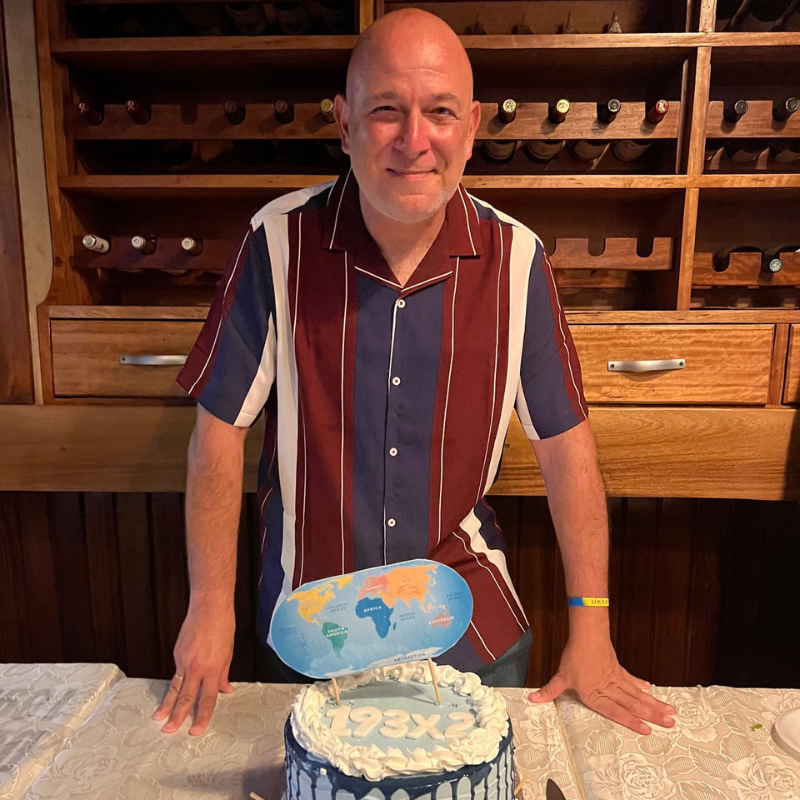
Matt Bowles: My guest today is Harry Mitsidis. He is one of only three people on the planet to have traveled to every country in the world twice. He is also the founder of Nomad Mania. Which is, first of all, a nonprofit dedicated to educating people about the world and helping those with limited means to travel more. Secondly, it is a free platform that offers tools, information, and resources that empower you to plan, execute, track, and document your travels and even get verified and ranked if you want to. And third, it is a global community that connects independent travelers and encourages them to discover the diversity of the world and create a positive impact through meaningful, sustainable travel that benefits both the traveler and the destination. Nomad Mania values, diversity, inclusivity, and integrity, and is committed to using travel as a force for good to broaden horizons, create connections, and promote understanding. Born in London, and raised mostly in Greece, Harry studied sociology, did a master’s at Oxford and an MBA in Rotterdam. Once he generated enough passive monthly income from his real estate investments to cover his lifestyle expenses, he dedicated his life to his primary passion of traveling the world and building Nomad Mania. And he is now conversational in ten languages.
Harry, welcome to the show. Hello there,
Harry Mitsidis: Matt. Thanks so much for having me. It’s a real pleasure.
Matt Bowles: I am so excited to have you here. Let’s just start off by setting the scene and talking about where we are recording this from today. We are not in person, but we are remarkably, unusually, geographically close to each other. We are both in the same country and probably only about four hours away by car. I am in the Blue Ridge Mountains of Asheville, North Carolina at the moment. And where are you, sir?
Harry Mitsidis: I am in Atlanta, Georgia. So yes, we are really close. And that doesn’t happen every day.
Matt Bowles: It does not happen every day. I want to give folks a little bit of your background before we dive into some of your travel experiences and the amazing stuff that you have built and created with Nomad Mania. Can you share a little bit, Harry, first of all, just your family background, your grandparents, your parents, where they’re from, and then how you grew up and how your interest in travel developed?
Harry Mitsidis: Right. Well, I have a quirky background, like many people. So, you know, I have parents from different countries. My father was born in Athens, Greece before the Second World War, but his parents were refugees from what is now Turkey. So there used to be a great number of Greek-speaking Christian populations in Turkey until 1922. After that that populations were exchanged, that’s a lesson in history in its own right.
So that is where my father hails from. My mother was born in Cape Town, South Africa. Her parents were originally from Poland, and they fled the war as well and ended up in South Africa. So, what is interesting is that I was born in London. My parents were born in Cape Town and Athens and then my grandparents on both sides were also born in different countries. What is now Turkey, and what is now Poland. So, I have never really figured out where I’m from. Uh, and I just prefer to say I’m European vaguely, and that’s as far as I like to go.
Matt Bowles: Well, you and I both have a background in sociology, and I want to ask, as your interest in travel was developing, can you talk about how your interest in studies in sociology overlapped with your interest in travel?
Harry Mitsidis: I realized early on that I wanted to study social science because I wanted to understand the world better, how societies function, and why we are the way we are, both our similarities and our differences. And I think you can do that either through studying sociology or perhaps more meaningfully through traveling. Those are the two ways you’re going to learn more about how societies function. And obviously, travel is more of a participant observation method where you reach your own conclusions. But I have found that ever since I studied sociology, I look at the whole world through the lens of a sociologist. So, during my travels, I am inevitably always thinking of these tools and imagining things, you know, and analyzing them through this perspective of sociology, of culture, of social inequality, racial inequality, and all of these things that one learns when one studies sociology.
Matt Bowles: Can you talk about how your travels began as you were growing up and as you were going through academia and everything else? Talk a little bit about your travel trajectory and the evolution of that passion.
Harry Mitsidis: Well, look, as a child, I was always fascinated by geography, also because my parents were from different countries and we lived in Athens, but I used to go to London where my grandparents lived. So, I was. quite well-versed in flying and airports and all of that. And also, we spoke English at home in Greece. So, by definition, I was kind of a bit different from everybody else speaking a foreign “language”. I think my parents liked to travel quite a lot. Of course, back in the seventies and early eighties, travel was not what it is now, it was much more difficult to travel, much more expensive. But given the times we traveled quite a lot, I do remember a trip to the States when I was nine years old and how impressed I was by Caesar’s palace in Las Vegas. I thought it was like the most amazing thing I had ever seen back then.
And then I remember another trip when I was 15, we went to the far East, to Thailand, Singapore, and Hong Kong. That was also, you know, an incredible experience for me. I had been to maybe 20-odd countries by the time I started studying, but I was always interested in seeing places and understanding people. So, a little bit here, a little bit there. I had more and more countries under my belt, but nothing incredibly impressive. And I don’t think throughout my twenties, I ever imagined I would become a big traveler or visit every country. You know, that was not who I was back then. I was quite a serious student, and I was also interested in film. And there was a point in time when I thought maybe I should become a film director, that didn’t happen.
And then gradually, I can’t really pinpoint how and why, but I remember once looking at a map of Europe and realizing I’m only missing about seven countries. And I thought, well, you know what, why don’t I go to every country in Europe? And that’s where it all begins because once you finish one aim, then you always place another aim and another one. And gradually by the time I was 30, I had been to about a hundred countries. And then I’m like, well, there’s fewer than another hundred to go. So why don’t I really aim to do as many countries as possible, if not all? And then before I knew it, I had done them all.
Matt Bowles: Well, I want to ask you about some of the countries. And I think the one I want to start with is Serbia because you are fluent or at least conversant in 10 languages, Harry. And I wonder if you could maybe speak a little bit about which language those are? Why did you choose them? And then specifically focus on Serbian and talk about the language, but also What the country means to you and your experiences there.
Harry Mitsidis: First of all, let me say that I am fully bilingual in Greek and English. And I think when you are bilingual, you know, which means in most cases, you learn two languages at a very young age, then it’s much easier to learn other languages. I think this is probably shared by most people like me. So, I learned French at school as well. And then later on, I also did a bit of German again at school. I would say I had those four languages by the time I was a teenager. Later on, I developed a bit of a fascination with the Netherlands, and I ended up doing my MBA in Rotterdam. And even though the course was in English, I still learned Dutch. Speaking German helped me learn Dutch. And at the time I was really quite good at Dutch. Then in the late nineties, I discovered Croatia, Serbia, Bosnia and those lands had just had a terrible conflict. The wars of the early nineties were just trying to recover from that. And then Serbia had the issues with Kosovo, and it was bombed by NATO forces and all that.
And somehow. I think I’ve always been interested in conflict, but I think it was then that I realized I was that interested in it. I don’t think I had crystallized it, but I realized somehow, I’m fascinated by these places which are neighboring Greece, where I grew up. You know, these people are European, and they’ve just experienced the war. And I thought, I want to learn more about this and the best way to do it is to learn the language because that is when you’ll be able to meet the people and actually speak to them. You can never do that if you’re just talking English. And I did. I started with old methods of Linguaphone cassettes. I found learning Serbian Croatian, as it was called, the time.
And I just persevered. And after three years, it took that long. It’s not easy. And the language is Slavic with a lot of complicated grammar and totally different to French or German that I already knew. But anyway, I persevered and after three years I had learned it. And I mean, Serbian, Bosnian, and Croatian are very much interchangeable. And some people may not like me for saying that, but I mean, the people can understand each other, no matter which variant they are speaking. I speak the Serbian variant now, or even though I started learning the Croatian variant. And I really find that of all the countries I have been to, thanks to speaking this language, I have managed to penetrate the societies there.
I really know the place as well. I have a lot of friends. The hospitality there is amazing. And especially when they realize you speak the language. Now, today in Atlanta, I had this amazing experience. So, I’m staying with a friend I met through the travel world. But she is originally Bosnian, and we became friends because she’s like, who are you? And why can you speak my language? And, and she lives in Atlanta, and she took me to a shop, which is owned by a Bosnian and specializes in foods from these parts. And I was really enthusiastic and buying all these things I know. And the guy just couldn’t believe it. And he gave me some stuff for free. And I was like, this is amazing. This just doesn’t happen, but these are the kinds of rewards you get when you invest in learning. Slightly unusual language where the people are, anyway, naturally hospitable.
Matt Bowles: I agree with that a hundred percent, Harry, that is amazing. I spent probably almost two months in Belgrade and just loved every minute of it. And I have been telling everybody that they need to go to Belgrade. They need to spend time there. I have been around the Balkans. I’ve been to Mostar and Bosnia. I’ve been through Croatia, Montenegro, and some of those other places, but I haven’t traveled really extensively around Serbia. Outside of just Belgrade because I was like, this city is amazing. I want to spend all my time here. And it was incredible. But can you give folks some recommendations for folks that want to visit Serbia and really want to experience it? What would you put them on to there?
Harry Mitsidis: Well, Serbia is amazing. It is, first of all, the only European language that has two official scripts. So, they use both the Cyrillic and the Latin script, and they are totally interchangeable. So that by itself makes it unique. Now, in terms of the country, it also has a very interesting history because of the Northern part used to be under the Austro-Hungarian empire. And then the Southern part used to be under the Ottoman Empire.
And these were obviously two very different worlds. And so even now visiting the North or the South, and I mean the distance from one end of the country to the other is probably six hours if you drive from the far South to the far North, but it’s like two totally different worlds, you know, in the South, you’ve got these sorts of ramshackle markets and it’s much more chaotic. And then as you move north of Belgrade to the area called Vojvodina, you get much more organized villages set out on a long street on either side. And the people are much slower. Much more goes by the flow. Novi Sad, which is the capital of Vojvodina of this Northern region is a gem on the Danube.
It’s got a very nice castle overlooking it. It’s really worth going to, and it’s only about an hour from Belgrade. So, it’s not very far further North, near Hungary. You have another beautiful town with some really interesting architecture. It’s called Subotica, which is right on the border of Subotica with Hungary. So that’s another town I could recommend. I would say Serbia has a lot of natural beauty, especially in Western Serbia, which means the areas that are closer to Bosnia now. There’s a lot of gorges that are really pretty. I would say that Uvac, which is a river area, sort of curves around the gorge. And this is like a postcard image of Serbia when you get that panorama. You have this river kind of curved three or four times around this gorge, beautiful there, and you can have a lot of very nice eco experiences, you know, in humble accommodation, but with very welcoming locals.
Then on the other side, toward the border with Romania, you have sort of foggy areas, sort of mountainous, foggy. It’s that area of Serbia, nobody would go to, but if you like off-the-beaten-track places where you can just have a car and get lost on small roads, that is the area to go to. And again, you’ve got the Danube again, which is going south toward eventually the Black Sea and that forms the border between Serbia and Romania. That area is very interesting with natural beauty. You also have Golubac, which is the fort that is worth visiting. Uh, Jed up is the border, which is a huge hydroelectric dam that is pretty, if you’re a birder or like wildlife, I think this area is very rich in that as well. So, this is just the tip of the iceberg, a few brief recommendations.
And then of course you’ve got the capital Belgrade, which is really vibrant. It’s known for its incredible nightlife. The people love having a good time and it’s really well priced comparatively. One of the benefits of Serbia is that you get more for your money.
Matt Bowles: Well, one of the other countries that I know is very special and important to you that I want to ask you about is Ukraine. Maverick Show listeners know Orest Zub, who is our mutual friend, and he’s also involved with Nomad Mania and actually introduced you and me. I had an interview with Orest almost a couple of years ago. And we talked about obviously his experience as a Ukrainian traveler, and then as a blogger who started documenting from the streets of Ukraine from the very beginning of the Russian invasion.
And we did a whole episode on that, which we’ll link up in the show notes. But I know for you, it’s also been a really important place and that Nomad Mania has really centered in some important ways. And I’m wondering if you can share a little bit about, first of all, your travels and experiences there. And then how it relates to Nomad Mania and what you folks have done there recently.
Harry Mitsidis: Yeah. Again, I can’t say I understand exactly why, but I always clicked with Ukraine. I found it a very interesting country. I think I always found a hint of sadness to Ukraine, even before all the current wars. I don’t know what it was about it. I think it’s vastness. It is one of the biggest European countries. So, it’s vastness was intriguing. And again, much like Serbia, it’s a country which is very different in its different regions. So, the West, again, that was under Austro Hungary, and the architecture is very much influenced by that. And then the East, which is, which used to be very heavily Russian speaking is like a totally different world.
So, these internal contracts within a country always intrigue me. And I had visited Ukraine a number of times, uh, long before the current conflict. Now, as I said before, I am. In a way, drawn to conflict, there’s nothing like conflict to make me more interested in the place to understand why it got there in a way to try to, in my way, get involved and maybe help people there as much as possible. And I also knew Orest long before this. We’ve known each other for about seven years now. And so, we at Nomad Mania all felt that when, uh, the invasion happened, we need to take a stand. We can no longer just sit and look at this passively and say, well, you know, this is not something that concerns us because it clearly was.
And what we did A few months ago, which was risky and daring, but at the same time, extremely rewarding is we organized a trip to Ukraine. Orest did a very good job in organizing it, making it as seamless as it can be under the circumstances. And so about 20 of us went all the way East. We went up to Izum, which used to be occupied by Russia for about six months, and to the village in the area, which was completely devastated. We talked to local people. We were given presentations. We met elderly grandmothers who were working together to build kind of vests, protective vests for the soldiers. That was an incredibly poignant moment seeing these elderly women who are working together in silence, you know, doing their bit as much as they can.
But this was a very meaningful trip. I think all of us there felt privileged to be the first group of foreigners who were there. I mean, I wouldn’t say we were tourists because we were not there for the pleasure of it, we were there more to understand what was going on, and we were welcomed extremely well. We felt that the locals really appreciated the fact that we had gone. And I think this is where one also realizes the difference between being a traveler and being something more than a traveler, where your trip already has a significance beyond just that. You’re seeing things and stuff; it becomes much more important.
And for me, this was a bit of a, even at my advanced age of 52, I feel that I learned from this, you know, I thought there are cases when you go somewhere where it really matters. And I think in terms of Ukraine, keeping the momentum, letting people know that it isn’t over, there’s still a lot of bad things happening there. And we need to keep being on the right side here. I think this is important as a message and needs to be perpetuated until this end, hopefully in Ukraine, restoring its sovereignty.
Matt Bowles: Well, in that spirit, Harry, I also want to ask you about your time in Palestine. This interview is being conducted while the genocide is happening in Palestine. And there is a very intense dehumanization campaign going on in the United States and many other Western countries towards the Palestinians. And so, one of the things I always like to do is to try to ask travelers who have been there and who have interacted with the Palestinians and had personal experiences there. What those experiences were like? Can you share a little bit about, first of all, when you went and then what was your experience like in Palestine?
Harry Mitsidis: Okay. I’ve been to Palestine and again by Palestine here, I mean the West Bank areas twice. I was there in 2008 when I went to Bethlehem mainly, and then I was there again in 2017 and that was a better visit. So, then I visited Ramallah, which is the capital, also Jericho, Hebron, and in the north, Nablus. So that was a better visit. That whole region is in many ways the cradle of civilization more than any other. And I’m saying this as someone who’s Greek, but I do believe that. In all those lands, you feel a certain holiness.
So those places are important for three major religions, you know, and there has to be a reason, you know, walking around Jerusalem, I kind of got goose pimples. I’m not a particular religious person, but I just felt a certain holiness, a certain spirituality, and, in Palestine, you cannot go to Bethlehem and not feel that. You know, the people are incredibly hospitable. They will give you food for free. You know, they will let you stay in their homes. They are extremely open, welcoming people. And I would say that they are among the most hospitable I have encountered anywhere. And I really am a pacifist. I hate war in all forms. What is happening to them is obviously a dark chapter in our human history, but one can only hope that after darkness, some light comes and hopefully a solution, a permanent solution, will be found.
Matt Bowles: Another place that I want to ask you about, Harry, that I have not yet been, that I know you have been a couple of times, or more is Yemen. Can you share a little bit about your experiences in Yemen? When did you go there and then what that was like?
Harry Mitsidis: Okay, I have been lucky enough to go to Yemen four times. I went for the first time in 2006. So back then Yemen was relatively safe compared to now. I visited the capital Sanaa, which is a UNESCO world heritage site for a very good reason. The architecture there is mind blowing, totally unique. It is very poor. I remember. Even as someone who was already quite experienced with traveling, I was surprised at how humbly people lived and also how conservative it seemed in some ways, even more so than Saudi Arabia. I visited them back-to-back at the time. So, I was kind of comparing, but it was, so now I was truly fascinated. Then the year after I visited Aden and now these two used to be different countries. So, Yemen was one of those countries that were divided a bit like Germany, and then it united in 1990 into one country, and that might have ultimately not been such a good idea given what has happened to the country now, because now it’s essentially once again split into an administration.
I then visited Yemen again in 2013, and I also visited Socotra, which is, uh, normally part of Yemen, but essentially, it’s a very different world. And Socotra is, I would say, a gem. I could totally recommend it to travelers. You can go there quite safely on a flight from Abu Dhabi and spend a week. And you know, it’s totally far away from a war zone. Now, the rest of Yemen already in the last visit I had there, it was, Clear that things were not going well, I felt a sense of gloom. Uh, it felt threatening somehow. I did not feel comfortable in 2013. I was actually scared that I might be kidnapped. And I did end up having a couple of nasty experiences, including my one night in jail. Which, uh, it may make a good story in retrospect, but going to jail in a place like Yemen is really scary.
Matt Bowles: Can you tell that story, Harry, in terms of how that came about, what happened, and then what the experience was like going through the prison system and spending time there?
Harry Mitsidis: Well, look, I just think the locals ultimately wanted A source of income and since there were no other travelers there and I was obviously a foreigner they thought well why don’t we pick him up and eventually make him pay something you know that is what I understood at the end when it all ended well with a minor financial contribution from me and a lunch in the sort of police station but you know I didn’t realize that initially when I was Detained and taken to the police station and it was really scary.
It was night. I found myself in this vehicle with four men with guns, you know, and I think at that moment it was almost like having an out of body experience. I was looking at myself from above and thinking, this is just. Ridiculous, you know, is this really happening now and you don’t really know what their intentions are and what’s going to happen and then you end up in this building and you hope it is really the police station of the legitimate authorities of the area because at least then you’re kind of safe but you’re not really sure that these are the legitimate authorities because the vehicle they’ve taken you in is Sort of a half battered car with definitely doesn’t look like an official police vehicle.
Yeah. And I ended up spending the night in the cell with lots of cockroaches. It was not fun. And during those moments, you just try to get strength by thinking of the people you love and the good moments you’ve had. And it’s interesting how, again, I am not a religious person, but you end up looking at the sky.
And it so happened that at one point they took me out of my cell and let me be in the courtyard. Which had an open view and, you know, you have this beautiful sky with the stars, but you’re in prison, you know, you can’t really leave. And you just look up and pray to some sort of force that everything will be okay. Well, in the morning they kind of convened and it became clear to me that they just wanted to get some money and that was settled. And then the whole police station, about 20 people, ordered a meal. And this takeaway came, which I paid for graciously. And then eventually I was let go. And I just fled the country.
Literally, this place was not far from Oman. It was like about a two hours’ drive. And I literally ran straight to Oman. Overall, though, Yemen is a truly fascinating place.
Matt Bowles: There are a number of places in the world where bribes are a pretty regular part of the economy, shall we say. Can you talk a little bit about that, Harry, since you’ve been to so many places, including, I’m sure, a number of places where that is the case, and how travelers might find it?
Be aware of when that is part of the economy, shall we say, and how to sort of navigate that, would you have any tips, because sometimes it’s a little bit subtle, like they don’t make sense? Actually, say it right up front so clearly, but you’re kind of supposed to know that that’s the solution to whatever’s happening. And you can get out of situations a lot quicker if you’re sort of aware of that. So, in all of your travels, do you have any tips on that?
Harry Mitsidis: Look, I think a lot of this situation depends on your character as a person. I think a bit of it depends on how much patience you have, how much time you have, how much you like to make things more of a game or how seriously you take everything or, you know, how annoyed you get.
So, I think there isn’t really a recipe. I know some travelers who say, I refuse flatly to ever pay a bribe, no matter what will happen. I can understand that. And usually, it’s going to be okay. I think unless you really land on a very, very mean piece of work, I think in most cases. These people, if they want a bribe, it’s because their salaries are terrible and the system in their countries is such that this is how it is, you know, and this may be very alien to us coming from more regulated places, but I think it’s what is not right.
And again, I speak as a sociologist, and we learn cultural relativism. So, I don’t think it’s, it’s always fair to immediately say these are bad people because you need to understand the context of why this is happening. So I think from there on, I have not really paid as many bribes as you may think I have this situation in Yemen was one where there was really no other way out, but I’ve given, let’s say a couple of dollars here and there when I was crossing Sierra Leone, but you know, it’s also, I mean, is 1 really a bribe?
I mean, I’m like, you know what, go ahead. I cannot even think of this as something in my case, but I know other people who are really going to fight for that dollar. And That’s fine. You know, I think a lot depends on the approach that you take in general. And I have never had an ugly experience. I mean, let’s face it. In reality, many of the countries where this is likely to happen are in Africa and in some of the countries of Asia. I guess I’ve been lucky. And I also tend to always try to smile. Sometimes I’ll talk about football and try to find something in common with the locals. In most cases, they will not insist. Not really.
I think a good attitude and not being defensive, not being aggressive, just being human will usually end up. I remember in, in Central African Republic, I was stopped. And that is one of the hardest countries in general. And the guy said, do you have a gift for me? And I just smiled, and I said, here, you have a smile and I’m giving you good energy. And I mean, there’s not really much that they can counter to without becoming mean. And I think deep down people want to represent their country well, unless you are really nasty as a traveler, they’re not going to be nasty back, but maybe I’ve been lucky. I don’t know.
Matt Bowles: I agree with you, Harry. I think that is a huge part of it. And being able to make people laugh and make people smile in different contexts and being able to de-escalate situations through good humor and good spirits and warmth and love and stuff is I think the best recipe that I have found for that as well. I do want to ask you about some of your travels in Africa. I have spent probably about two and a half years cumulatively on the continent.
One of the places I want to ask you about is Nigeria. I spent about a month in Lagos in 2019. I spent the entire month just in Lagos, as obviously one could spend a lot more than a month in the city of Lagos, but Nigeria is this massive country. I mean, it’s absolutely enormous population-wise. size wise and so forth. And I know that you have spent a lot of time going around the country and seeing different parts of Nigeria, which I certainly have not seen because I have not been outside of Lagos. Can you talk a little bit about your experiences in Nigeria?
Harry Mitsidis: I was just fascinated at every step in Nigeria, the best way to do it is in a small group and with local expertise. And we ended up having a road trip of 18 days throughout all of Nigeria, starting and ending in the capital Abuja, which is right in the center. So, from the center, we kind of went North and then Northeast, which is extremely dangerous. And I think it may well be one of the most dangerous things I’ve done is to go to my Duguri, which is really a place where bombs do explode frequently. And then we headed South, kind of as the border with Cameroon goes all the way South to Calabar. Which is on the sea and then Port Harcourt and back eventually to Abuja.
So, we got the whole experience. Now Nigeria is almost two countries. So, you’ve got the Christian south, roughly, and the Muslim north. And they are very different in how things work. They are actually different in terms of legislation. And each state there has its own regulations. I found the north more interesting, a little bit more laid back. There are very few tourists in sort of rural northern Nigeria. So, I think we appreciated the fact that we were able to be there.
Matt Bowles: Yeah, man, I was just hanging out in Lagos, which is one of the artistic Meccas of Sub-Saharan Africa, where the Afro beats music comes from and the films, they call it Nollywood.
I mean, it is just really quiet an extraordinary place. The nightlife is insane. So, I was just like, man, I was all about Lagos and I have not seen any other parts of the country. So, I appreciate you sharing that, Harry. Well, I also want to ask you about a country I have not yet been to, which is Somalia. I know you’ve been a couple of times. Can you talk about your experience there and what Somalia is like?
Harry Mitsidis: Okay. Well, again, Somalia is two countries essentially. So, you’ve got, for those who are not versed in this. When Somalia became a country in 1960, it became a country by uniting two different former colonies.
So, there was the part of Somalia, which was Italian and then there was another part of Somalia, which used to be British. And these two parts joined together to form the country Somalia. Now at the end of the 1980s or around 1990, Somalia started falling apart. I don’t really know the history behind it, but what I do know is that the former British part declared independence from the rest of Somalia, and it called itself Somali land. And since then it has been operating very much as its own country, even though it’s not recognized by anybody as independent, but it has its own flag, it has its own currency, and it is much safer. So, it also has its own visa, which is different from the rest of Somalia.
So many people in our community who want to do Somalia and count it as visited, but want to do it as safely as possible, opt to go to Somaliland and the capital is called Hargeisa and it is quite a pretty place, quite welcoming and indeed relatively safe. It’s not dangerous, I would say. There are some very interesting rock paintings about an hour or so out of the capital. So, this is a big site if you go there, and it is interesting. There’s a camel market. There’s also their local currency is worthless So, you know if you change a dollar, you get a big ward of cash. And you know, there’s this area with all the money exchanges, which is colorful and interesting. So, I would say Somali land is a nice introduction without the dangers.
Now, the rest of Somalia is quite different. Again, there are degrees to danger. Going to Mogadishu is definitely risky. I think I was the first foreigner to go to Mogadishu when Al Shabaab, who was in control of much of it, left. So, they left Mogadishu in September of 2011, and I went a few weeks later, you know, I’ve always believed that there is a time to go when you need to get that time, right? Yeah. I mean, I had to have armed guards, a bulletproof vest, all of that to go around, but it is a fascinating place. Now again, Mogadishu is almost two countries on its own because you have the area of the airport, which is like a closed zone. And within this sort of big airport compound, there are restaurants, there are some embassies, offices, there’s a hotel, you know, many people go to Mogadishu and may work.
I remember we ate at a restaurant there and the woman working there had been there, I think for a year, and she had never left this sort of big airport area that was because that is considered. Safe. The minute you leave that, you are exposed, but you’ve got beautiful beaches. You’ve got a lot of ruins which are interesting to see. And what’s also interesting is to see how people just continue with their lives and try to do what people do. They go shopping, they go to the market, and people go to their jobs. And even in a place like that, you know, life continues. The rest of Somalia, further north, is an area called Puntland. That is marginally safer.
And I’ve been to a town called Goro there, which the hotel was not too bad. We, again, I was in a very small group, and we ended up at a political rally there, and that was another surreal experience. There was some candidate trying to get voted in and all his supporters were there, and it was almost like being in a sort of parade. We couldn’t understand, of course, the speeches, but, you know, just the atmosphere was amazing. It’s another country I hope will eventually resolve its issues because I think it’s a fascinating place and some of the scenery, some of the beaches, are truly amazing. I mean, in a different reality, Somalia would be as popular as the Canary Islands.
Matt Bowles: Well, another country that I want to ask you about that I have not been to, which is a really large country is the Democratic Republic of Congo. And I know you have traveled it extensively. Can you talk about your experience in the DRC?
Harry Mitsidis: Again, this is a huge country, which has four different major linguistic regions in the South. That area, which is closer to Zambia is much more organized. The town Lubumbashi, you can tell that it was built by a European colonial government by the Belgians who were there, and it is relatively well organized and not a bad place to visit. But then you have many places in the center or in the north of the country that are truly chaotic and uncomfortable.
There are many ways to visit DR Congo. I think for many of us, it’s a bit of a holy grail. If you really managed to go from Kisangani to Kinshasa on a barge down the river, and that takes three weeks or a month, then you’ve kind of got your PhD in travel. There are a few other ways to travel to the country because there’s basically no road network. So, it’s really difficult to get around. I think DR Congo has an amazing tourism potential. It has some incredible national parks. It was the first place where I saw gorillas because I had never been on the Rwanda and Uganda gorilla tours. The ones in Congo are better value for money and I think you get sort of almost guaranteed gorilla sightings.
So that first time of seeing a gorilla I think is a bit of a defining moment for every traveler. It’s never going to fail to be a wow moment. It’s sort of incredibly simple in a way. And there you are, you know, in the middle of the jungle with a lot of vegetation around you. And there’s this creature looking at you and you know, you’re told to avoid eye contact and you kind of half want to make eye contact, but then you you’re a bit scared. And that’s a defining moment. And Congo definitely delivers when it comes to that. It has Bukavu, which is not far from one of those national parks has some incredible old art deco style architecture so I can see how this could become a real draw it’s a very diverse country but again difficult complicated the visa itself is quite hard I think for people who just want to take DR Congo, they often go into Goma from Rwanda and there you have a volcano. And one of the national parks, Virunga is not too far. So that is maybe Congo the easy way.
Matt Bowles: All right. We’re going to pause here and call that the end of part one. Everything we have discussed in this episode is going to be linked up in the show notes. So, you can just go to one place at themaverickshow.com and go to the show notes for this episode and then be sure to tune in to the next episode for the conclusion of my interview with Harry Mitsitis. Good night, everybody.