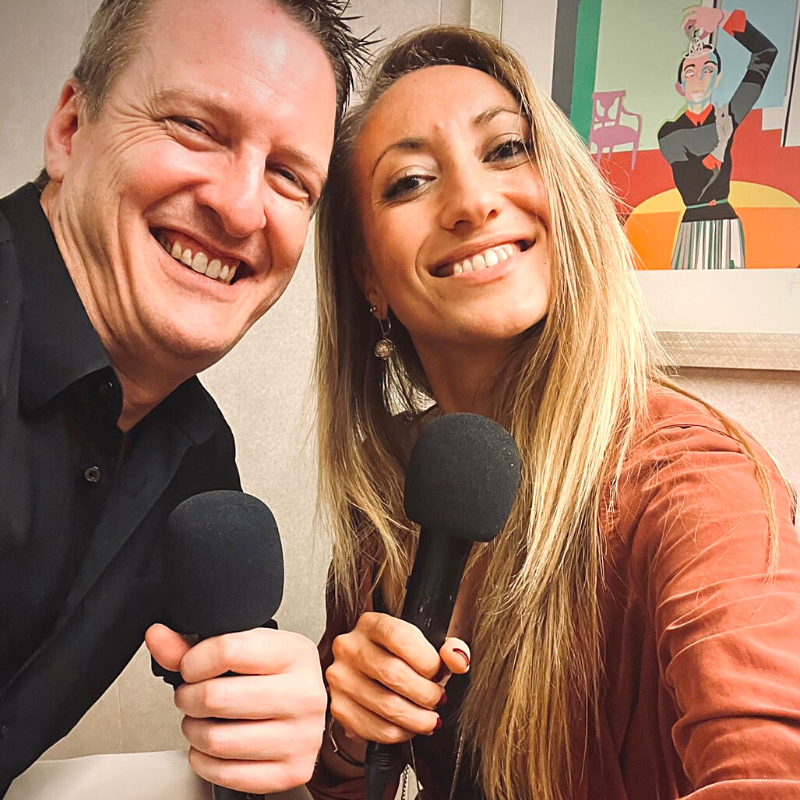
Matt Bowles: My guest today is Delia Colantuono. She has been a full-time digital nomad since 2016. She’s a solo female minimalist traveler working as a professional Freelance translator in the medical field as well as a travel content creator. She speaks six languages; she works professionally in four of them and she has explored almost 60 countries on six continents. She now coaches’ women on finding the skills and confidence they need to embark on a solo travel journey. She believes in the healing power and self-growth potential of traveling and is organizing retreats for women in the Canary Islands.
Delia, welcome to the show.
Delia Colantuono: Thank you so much, Matt, for having me here. You have no idea what a privilege it is for me.
Matt Bowles: I am so excited to have you here. We just need to start off by setting the scene and letting folks know where we are and the fact that we have just opened an incredible bottle of Italian red wine. And it’s very fitting because you, of course, are Italian from Italy. So, we are sort of celebrating your heritage, your homeland, which is also one of my favorite countries, and drinking through an incredible bottle of wine tonight. So, it’s wonderful to have you here.
Delia Colantuono: Yeah, you’re not even telling us where we are.
Matt Bowles: Oh, yes, that’s true. We haven’t told them where we are tonight. We’ve only told them what we’re drinking, which is the important part. We are on the Nomad Cruise somewhere in the middle of the Atlantic Ocean en route to Salvador de Bahia in Brazil.
Delia Colantuono: Exactly.
Matt Bowles: And we should also tell them how we met because this is your first Nomad Cruise.
So, can you share a little bit about your decision to come on the Nomad Cruise? And what you were expecting and then how did you and I connect?
Delia Colantuono: I’ve been a nomad for the past eight years, but I was avoiding intentionally spending time with other nomads because I prefer to immerse myself in the local culture and local populations of the countries that I visit.
But after eight years, I felt professionally stuck because I want to be surrounded by women in business because I’m launching new projects and I wanted to go to Brazil. And now I’m based in Tenerife, and I find out that this crew starts in Tenerife and goes to Brazil and is for digital entrepreneurs.
So, it was like it was made for me and I couldn’t say no. So, I hopped on this cruise, and I started attending the conferences and then I saw Matt’s talk about five lessons I learned as a full-time traveler. I’m like, okay, let me see if these guys are going to say anything I haven’t learned. Probably not. Cause it’s always the same stuff, right?
And he’s an American and they feel entitled everywhere they go. And I was really skeptical. And then boom, your talk ends with like a standing ovation and people with goosebumps and almost crying. And I actually didn’t come to you on the first day to compliment you because everyone was around you and I wanted to give you the space on the first day.
So, I manifest the moment at some point during the cruise to come and talk to you and shake your hand.
Matt Bowles: But what was the talk about just for folks that haven’t heard it? Like, what was the part of the talk that compelled you to come talk to me?
Delia Colantuono: The whole talk was so good that I would want the video to end up as like a TED talk or whatever on YouTube.
It’s really saying everything you as a full-time traveler, want people to know before they travel or after they travel. It was mind blowing to see that we have so much in common after experiencing the world. No matter if we never met before, we came to the same conclusion. So, you had already gained all my respect and admiration.
And then at the end of the talk, you have a speech on humanity, on the importance of feeling human. and standing for humanity, especially in this particular historical moment where we’re seeing a violation of human rights right in front of our eyes. So not only you start explaining the situation in Palestine right now, but you also explain that you have, you know, a master’s degree in this topic.
So, your opinion and your experience and your visiting Gaza twice is so valuable right now that in that moment I felt I am exactly where I need to be. I am not here because I want to make money online. I’m here because I want to find my tribe and find you and the people applauding you, I feel like I am where I belong.
So, I wanted to tell you and the next morning I go for breakfast, and I see you there, sit next to you, it’s free. I sat there and that’s how our friendship started.
Matt Bowles: Well, it made my entire day when you came up to me and that led to us having probably a couple hour hour-long discussion later that day over coffee, sitting on the deck of the boat.
And I was reciprocally impressed with you and your story and your journey and your politics and your outlook on the world and how you engage with people and what you pay attention to and what you stand for as a person. And when I connected with you on that value, alignment, I was like, we have got to record a podcast episode.
So here we are recording the podcast episode, and we are on our way to Brazil, which is a country that we both dearly love. Can you share a little bit for folks who have never been to Brazil? What do you love? about Brazil? Why is it so special?
Delia Colantuono: I am super happy to be back in Brazil in a couple of days, because there’s no other place like Brazil in terms of energy, in terms of people, culture, and you feel welcome.
Even though it is a country with contradictions and crime or whatever, you need to experience Brazil to understand what it means to be in Brazil. I’ve never felt so welcome. And I always tell the story of you booking an Airbnb in Brazil and you get adopted by a family, like everywhere you go, they don’t just leave you the keys or some information about the Airbnb.
They just pick you up. They cook for you and they leave your food in the fridge, they bring you wherever you want to go, and then they follow up for a few months on WhatsApp to ask how you’re doing. It is a once-in-a-lifetime experience for travelers and the friends you make there and even the friends you make in other countries, they invite you there.
And even if they’re not there, they invite you to their family’s places. And I love Brazilian people. And this time I’m going to stay for a month, I’m going to travel everywhere.
Matt Bowles: Well, when we were talking, one of the things that I also asked you in the same way that you asked me, you said, how did you as an American develop the politics and a worldview that you had?
And then I reciprocally asked you, how did you develop the politics and the worldview that you have? Can you share a little bit now about your family history, where you grew up, where you’re from and how your worldview developed?
Delia Colantuono: I grew up in Central Italy near Rome on the coast with a German mother, Italian father, very open-minded liberal parents with solid views and very experienced traveler, backpackers.
So of course, I grew up interested in the world and its cultures and they were always very mindful and respectful of the diversity of the cultures around us that we were exploring and also where we were living. I was seeing how my, my father and also my grandfather were treating people around us, immigrants around us.
I was really inspired by how they could treat everyone the same, no matter the job, no matter the skin color. It was clear to me that every human being has to exact the same rights, exact same needs and feelings. I’m even ashamed of having to talk about this in 2023. Why are you so empathetic with minorities?
Like, why would it not be? And why are the minorities in the first place? So, if I tell you about my travels, we start with the I don’t know, me being a teenager and my dad taking us to Cuba, planning the trip so that we only hang out with local people, local families hosting us so that we play with local kids and we give them our toys and we practice Spanish.
And even if we don’t understand, we just stay there. outside the bubble of tourists and outside the bubble of Western all-inclusive resorts. And this is shaping the mind of a teenager. Actually, my brother was like, uh, just, I don’t know, five years old, six years old, as he was playing with his kids in the street.
These people were poor. These people were darker than us. And they were our hosts. So actually, we were thanking them and they we’re giving us the best time. And this is the reason why we traveled in the first place.
Matt Bowles: Well, I know another impactful trip that you took as a kid was to Costa Rica. And that’s had a lasting impact on your life.
Can you talk a little bit about that first trip to Costa Rica in the context and what impact that had on you?
Delia Colantuono: Yeah. Costa Rica came even before I was 13 years old. Her brother was three. Yeah, I guess I was. My dad took us to Costa Rica for one month, meaning we skipped school for two weeks. And he didn’t care about that because travel came before everything else.
And I thank him for this. We spent a month in the jungle. And back then in 2003. What you see now in Costa Rica is not the situation back then, with no roads and taking forever in the mud with the Jeep. It was really wild, and it was the first time I was spending December in a warm place, barefoot for a month with literally monkeys eating our breakfast.
And animals we had never seen before. Huge spiders in my room. And I used to be scared of spiders, but after that, not anymore. And then I went snorkeling alone and I saw a snake, like a marine snake. It was wild and, in that moment, there was a specific moment, I think it was a day after Christmas. I was swimming in the Pacific Ocean and around me there was nothing and no one.
And I thought, okay, this is the life I want to live. There’s no way I can see myself living in a city, in an urban jungle. I want the real jungle. I want the ocean around me. And there is no way I can live without this. Okay. I’m going to go back. I might study, go to university, whatever, but this is the beginning, and this will be the rest of my life.
Matt Bowles: That’s amazing. So, let’s talk a little bit about how your solo travel journey started because obviously, it’s different as a kid traveling with family. And then when you became an adult, can you talk about how your solo travel journey began?
Delia Colantuono: You might think after hearing the story of my childhood that it was a pretty obvious decision, right?
After my studies, I will become a nomad traveler, but no, this lifestyle is a consequence of a failed relationship. Because after six, almost seven years with my ex, where I thought we would end up getting married and having kids and living in Italy in this small town, I found myself with a job that I could do completely location-independent and remotely with my little laptop. At age 26, unmarried, had no kids, free for the first time because I had no more college obligations or anything, I had total freedom. My dad was jealous of this freedom, um, that I said, you know what, I’ve been a told for the past years that a woman needs to be provided for, needs to be protected, and is not safe alone out there in the world.
I’m going to prove to myself and everyone else that we are more than enough. We have in ourselves, and if we don’t have, we can get these skills, to be safe everywhere we go. And if not, then I’m going to learn from my mistakes, but this is a journey I need to embark on. right now, right here. So, the relationship ends in spring and summer.
And from that moment, I just took my laptop with me, and I invented a lifestyle that I had never seen before. I had no idea, didn’t know anyone doing that. I was the only one working from an airplane, from a hostel, from a station. And, people around me thought I was probably studying. This is a different approach than Nomad starting now because they already look for a co living, they look for a co working space.
I did it by myself and this isolation is actually what helped me heal from my heartbreak, from my insecurities and shaped me as a woman. So, I’m thankful for that. And to everyone who’s starting now, I would say take a moment for you because growth happens in hard times. And if you want to avoid all the difficulties and also all the solitude, you’re skipping part of the growth potential.
So, I want to challenge myself going to places like South Africa, Morocco, and I realized that also women alone, they can stay out of trouble if they are street smart, have some common sense and study a little bit before and learn to observe around them. Who wants to help you? Who wants to take advantage of you?
There is body language. You can read the energy around you, and I think I became really skilled at this and this is why I want to help women now.
Matt Bowles: Can you talk about some of the travel experiences that you have had? I think I want to start by asking you about your solo trip to Asia in 2018. Can you talk a little bit about that one?
Delia Colantuono: Yeah, because it was my first big trip with just a one-way ticket to another continent, and I made all the typical mistakes that a solo traveler makes and I’m happy about these mistakes. Um, I think you had the same problem when you started out with packing too much. After that, I became minimalistic as in, I just travel with hand luggage and I don’t ever use more than, I don’t know, 10 kilos for my trips, even if it’s six months.
But yeah, my one-way trip to Asia starts with me arriving in Chiang Mai, Thailand ordering my first meal and realizing that none of my cards worked abroad. Big mistake. I had no cash, no card, and I already had food. Super embarrassing moment. And then I think I asked my parents to send me money with Western Union or something, and I said, figure out something.
So, the typical mistakes I made in these first days and never again. But then I started exploring like nine or 10 countries around Southeast Asia, Vietnam, Cambodia, Philippines, Laos, Indonesia, Japan, a lot, all of them. And obviously I had incredible experiences in all these places.
I became a scuba diver. I did my open water and my advanced certifications in Thailand and the Philippines. And I tried surfing for the first time, almost dying. I was rescued by a local Indonesian guy in a kayak. I went to the hospital in a few countries for different reasons. So, I had all of these incredible experiences, and they helped me become a better traveler.
And they showed me life of so many different Asian cultures and the life of so many backpackers. And I made friends that I still see nowadays around the world. And it made me realize that I would never stop being a traveler because the more you see, the more you realize you want to see. So, I was in the addict circle.
Matt Bowles: All right. So, you and I have so many things in common that we have discovered, one of which is minimalist packing. We both started our nomad journeys with an enormous amount of luggage, and we both began studying minimalist packing to learn how we could travel the world long-term with carry-on luggage only.
Can you give some tips for women in particular about how to travel the world with carry-on luggage?
Delia Colantuono: This is probably the number one hack and tip for travelers, even just for people who go on vacation once a year. I would say, given the prices of, uh, luggage days and how many items get lost. And sometimes to get somewhere and you have five flights of stairs, and you have 25 kilos.
No. We don’t want all of that. We’re better than this. Especially because we can bring a few outfits with us, we can wash them, and the next week we have it again, all available. For women, they think they want something just in case for every occasion. But if I go somewhere and it starts being cold for no reason in a place that is usually warm, I can buy something there in case.
We’re never go somewhere where we can’t buy anything. So instead of having a super huge suitcase to bring your shampoo, you know, you can buy shampoo in a destination for a few cents and just leave it there, for example. And we think as women, we always need to look different, but if we have some basic item like jeans or leggings or dress, we can look colorful, just using a different scarf or different jewels or something we buy there.
That’s the secret. Leave some space in your backpack. And most destinations have amazing markets where you can buy local handcrafted accessories. And then you style yourself there and you also have a souvenir. So, this is what I do. And everyone thinks that I have someone carrying my bags or like a huge travel closet.
No, I only travel with hand luggage. I always look different in my pictures. Even if I don’t, I don’t care. Freedom of movement is everything. And trust me, you can be stylish. And you told me that there is someone who created a super successful business giving these sorts of tips, I should say.
Matt Bowles: Yes, shout out to Alexandra Jimenez, Travel Fashion Girl is her Instagram handle. A good friend of mine just hung out with her recently, interviewed her on The Maverick Show. And yeah, she built a seven-figure business teaching women how to do stylish, minimalist packing. So, if you haven’t heard that episode, definitely check it out. I know that another trip that you took that was really impactful for you is when you went around the world in 2019. Can you talk a little bit about that trip and the impact of that trip?
Delia Colantuono: The background story behind it is that for a few months, I decided to stay in Italy with my family because my father got a cancer diagnosis and he passed just after three, or four months. Those were obviously the hardest, the darkest pages of our lives for my whole family.
And especially for my younger brother, because he was only 18. And I knew that I would start traveling again because that is, my therapy. That is what I need to do in life. And that is also what I learned from my father. He told me how to travel. He told me about the passion for traveling. There was no other way for me to imagine my life.
So, it was obvious to me, I would continue traveling. But my brother, he would go from school to university with this huge void inside of him. And I wanted to avoid this. So, I said, take a sabbatical year, take a year off, come with me. We traveled the world. And it ended up being the last year before the world shut for three years before COVID.
So, it’s good timing. We started in Portugal, and we decided to do all continents. Then coming back to Portugal, like really around the world and like Morocco and Singapore, Indonesia, Australia, New Zealand, United States, back to Portugal. And so many things happened in between, of course, like getting lost in Morocco and the huge wildfires in Australia.
The pandemic started when we were in New Zealand. We arrived in the U. S. and Trump closes the borders and we risked getting stuck there. In the end, we managed to go back to Portugal. We’re stuck there for a few days, but because I have friends everywhere. Someone hosted us, an angel hosted us for a week. And then we got back to Italy.
Funny story. Everyone freaks out because of the lockdown where you couldn’t leave your house. And my brother and I were like, we made it. And now the holiday begins because the war trip was so intense. We’d been changing host like every night, for, I don’t know how many weeks, like doing all the U.S., Australian, East coast from North, South, all of New Zealand, both islands in 15 days, and then the madness in the U.S. during early COVID times that we were so happy. The first lockdown was the most productive month of my life.
Matt Bowles: Well, you mentioned that on the 2018 trip, you got your scuba diving certification, and I want to ask you a little bit about your scuba diving journey. Can you share a little bit about that experience, maybe your initial experience with scuba diving, how that made you feel what you love about scuba diving, and then where that led you to some of your best dive experiences.
Delia Colantuono: You know, my face lights up when you ask me about this because it’s my number one passion. Many people when they scuba diving certification courses. They know they want to do it, but it can be a challenge. You have to overcome some fears, and they get into the water. And the first exercises like removing the mask under water, or the first moments can be tricky.
Some people decide to leave the course. For me, it was the most natural thing ever, and realized there, okay, I found my dimension. So, it was finding home. I can’t even explain to you how natural it all felt. And it was in Thailand. So, the first thing you see is like living coral reefs and huge tropical fish, and then you get licensed and then you move to the next country.
And then you dive into shipwrecks from the second world war, Japanese ships and bombed by American airplanes and then you’re 40 meters down and it’s totally bright, you don’t even need a torch. I am inside a shipwreck and it’s still bright and lionfish is swimming next to me, and everything is so surreal and quiet, and I know I can breathe because I have a regulator to breathe and I don’t even want to breathe because it’s just a moment to stop your breath it’s just you have to experience it.
Then you move to the next country, and then I basically kept diving in every destination around the world. Even when they say the water here is cold, there’s nothing to see, I just go everywhere. And if you ask me my favorite scuba diving experience is when I was surrounded by like 40, 50 sharks in Australia, that if you see the pictures, you think, oh my God, they’re going to eat her in at any moment because they look so scary, but they are just the nicest, quietest animals.
They were all pregnant females, the huge shepherds. But they don’t do any harm to anyone. You feel like you want to hug them, because they’re so sweet. But if they see the pictures, they’re the most intimidating, huge predators. That ruined my life a little bit, because I want that same emotion every time I go scuba diving, but you don’t always do it with 50 sharks. But this is what I want to do now. I want to just follow sharks around the world.
Matt Bowles: Well, I know that after you were scuba diving for a while, you eventually got into free diving. Can you talk about that transition? What initially got you into free diving and what that feels like for you and what do you love about free diving.
Delia Colantuono: Yeah, this is also a super important topic for me. When I was in Asia doing my scuba diving certificates, I would read a free diving course in two days, teach you how to dive 20 meters on a single breath. And I didn’t believe it. I thought it was like a marketing thing. Like, how can I learn to free dive 20 meters in two days?
Then a few years later, I am in the Canary Islands and my siblings are getting certified in scuba diving. And this school offers a free diving course. I’m like, okay, let’s see if it’s true what they say that in two days you can learn how to hold your breath for three minutes and blah, blah, blah. And it’s actually true.
Actually, on the first day, two, three breathing exercises, boom, I almost do three minutes breath hold. And I, on the first day I went like 15 meters easy, and I realized, wow, we can be mermaids here with no effort. Imagine if we train. The thing is I’m quite lazy. So, in these two years, I didn’t train as much as I should have.
So, because I saw friends like improving so much, I’m so proud of them, but I do it as a way to connect with the ocean and not to compete or, you know, to break some records. I just love freediving more than scuba diving now. Because it’s like a moving meditation in scuba diving. It’s like you walk in a beautiful museum, you breathe, and you walk, and you observe nature around you.
Free diving is something you do with yourself. It’s like surfing or rock climbing. You have to be fully present, fully calm. And for someone a bit like all over the place, like me, that’s the moment where you either relax or you don’t succeed. You don’t go down. So free diving is. For me, the door to calmness, stillness, and wonder.
Matt Bowles: One of the things that you and I have connected on and that I have really appreciated about you is how thoughtful and conscious you are about the way that you travel and how sustainable you are when you travel and the things that you think about when you travel. Can you share some tips on how folks can be more thoughtful, sustainable world travelers.
Delia Colantuono: Thanks for this question. It’s a really important topic for me. And I know that as a full-time traveler, I probably fly too much, but there’s so much we can do or everyone should do to travel in a conscious way, respecting the environment, respecting local cultures, respecting the ocean. There are so many tips that maybe some people just don’t think about.
So as an experienced traveler, it is good practice for me to sometimes just give lists depending on the destination or general advice. For example, starting with packing, we can, for example, pack things that are reusable, that are made of bamboo or wood instead of plastic, or instead of single use, or soap that are in bars instead of plastic.
There’s just nowadays so many alternatives. No excuse. You just research, try out, find products that work for you. Boom. And you produce less waste, and you use less plastic. Then getting somewhere. What is mean of transportation that has less impact than another one? And then on the spot, which are the tours that are more eco-friendly that, for example, are less harmful for the animals or for the ecosystem there?
Or if I see that our countries use a lot of plastic to wrap things. I don’t do delivery. I just, you know, small decisions, but my daily life there have an impact on my consumption and on my production of waste there, you know, you think you’re just one person, but we’re billions of people. And no matter if we’re traveling or living somewhere, I’m always mindful of these things and the availability of water in a place, drinkable water and, or the situation that a specific place has, uh, with, uh, waste.
Like I, I’m now kind of based in Tenerife, which is an island and, uh, islands have a different use and of the resources. So that makes me be even more conscious when I’m on islands and, uh, even in a room in a hotel room, we just tend to, you know, not switch the light off or we want everything to be washed and cleaned every day.
We can do so much. And imagine if everyone makes the same decisions all the time at all these levels, we could protect our world much better with small gestures.
Matt Bowles: What are your thoughts about the macroeconomic dynamics of things like over touristification or the expat nomad gentrification of certain places?
Obviously, there’s certain places in Italy. Like Venice, you know, where there’s a real serious over touristification thing that’s been happening for many years now, you know, so I’m sure you’re familiar with your own country. And then there’s plenty of these nomad hubs around the world and stuff that I’m sure you’ve been to many of them that are having an impact locally in terms of gentrification dynamics and other things that are happening.
What are your thoughts or tips for how we can make thoughtful travel decisions in that regard to do less harm to local places when we travel?
Delia Colantuono: This is super important because the nomad scene has been growing super-fast. And if it was cool to be a nomad a few years ago, now people look at you, okay, another one contributing to this problem.
And I’m not always proud to be part of this community because of these reasons. So, I also isolated myself from other nomads because I didn’t even want to be in this category anymore because I see the impact that we’re having in many places. And because nowadays every other country is becoming a hotspot for nomads.
And I understand that someone who can work remotely wants to live and travel, but we need to stay mindful because the rest of the world is not our playground. It is a place where people are living and are being impacted by our behavior because we’re the privileged ones that can pick where to go. But then people cannot afford to rent in their own city anymore because the rich westerns are coming with their Airbnbs or prices are rising everywhere. I’ve seen it also in Tenerife, like the housing prices are going crazy because of all these remote workers that can’t afford these prices over the winter and everything is moving in this direction. So, what we could do if I had a solution, I would win a Nobel Prize.
But the thing is to think locally, how can I give back to the community that is hosting me? Is there any way that I can be involved with them or invest in them or involve them in what I am doing instead of just using everything I need to have my perfect lifestyle there? What is it that I have that could help them or a way to have like symbiosis with them and not be the parasite in their environment?
Matt Bowles: I also want to ask you about how you think about allyship when you are traveling around the world. And being an ally to marginalized groups and oppressed groups, whether that might mean locally in the particular vicinity in terms of understanding, the power dynamics and how you know, which groups are marginalized in the places where you’re visiting. And how to be an ally to those struggles, or whether it may mean to other travelers who might be marginalized in a particular environment, and how you can be an ally to them.
How do you think about that and what tips do you have on that?
Delia Colantuono: In this regard, you do a great job, fantastic job giving voice to all these minorities. This is super inspiring for me because it shows me that sometimes even just raising awareness about this is already helping them a lot. And then if you want to get more involved and more engaged, you can do activism the way you do it, or even more creating podcasts and raising even more awareness.
But what I do in my small life here when I travel is get informed about what’s around you, what you see, what you don’t see. What is the history of a place? Who are the most vulnerable people in that place? Where can I get in touch with them? And traveling to remote countries meant to me finding out stories that the main narrative excludes most of the time.
Like I was in Panama and my road to the airport was blocked because of the indigenous protests. And I didn’t even know that there were indigenous people that were oppressed in Panama. Like I didn’t know. And then I talked to them in the street and then I talked about this on my Instagram and I maybe didn’t help them directly, but everyone who follows me is now aware that there is this situation in Panama.
So, it’s just a drop in the ocean. But if we start giving some attention to these people, they feel seen. And especially these minorities, they feel isolated because nobody knows about them. How can you care about something you don’t know? So a small thing we could do is to show them, make them feel seen.
And for me, it was always super interesting to hear from people who are different than me. This is why I didn’t want to be part of the nomad tribe that much because I come from Italy. I don’t see a big value in connecting with Italians or I’m also half German. Being friends with Germans, if I’m on the other side of the world, like, yeah, I can feel home with them, but I want to step out of my comfort zone and connect with people who are different than me.
So, what is the most different person in the room? I want to become different. I want to talk to them. This is the purpose of traveling and meeting other cultures. Otherwise, we will stay in an all-inclusive hotel. Actually, I’ve seen this in all-inclusive resorts because I was working in a photography project in the Maldives and tourists, they weren’t even saying good morning to the staff.
And I’m like, wow, I’m surrounded by people from Maldives and Sri Lanka. I can learn so much from them because usually, I don’t know where I live. I don’t see people from these countries. So, I was bombarding them with questions and they were extremely welcoming and they were revealing so much about their, their cultures in their country, giving me all the insider tips.
And the best thing about the Maldives that I experienced before even telling you about the snorkeling was the people that I met, when you connect with them, what you receive is so much more than what you’re giving them. But giving them your attention already means so much to them because they’re not used to it.
Matt Bowles: How do you think that all of this travel has impacted you as a person?
Delia Colantuono: Tremendously. And this is the reason why I’m urging everyone to travel and or become a better traveler because most people would tell you, oh, I love to travel. But what they mean is they love going on vacation and not leaving their comfort zone.
They bring everything they own home with them. They want to be surrounded by what is familiar to them and they want to go home staying exactly the same, but with a 10. And this is not traveling. Traveling is going somewhere and coming back as a different person as a more evolved human. Otherwise, that that’s just been a holiday. This is what I think. And sometimes it’s good to take a holiday, but becoming a traveler means becoming a better human. And this is what people learn during your talk, because to start all your trip, you were ready like an enlightened man. But after all your traveling, you showed what it means to be an enlightened man.
And you were bringing exactly this to the people that you met around the world. And this is the exchange that we want to have as humans. If you ask me the impact of traveling for a young girl traveling alone, this is her occasion to understand the power in her. And to learn how to not tolerate any form of restriction.
If you are taught by society that as a woman you are not safe out there on your own. And then the world proves to you that there is so much more acceptance and safety and beauty and help around you and support than you ever imagined. It gives you faith in humanity. And this is what I learned while traveling.
People always ask me safety questions. Ah, and you go to hostels. Ah, and you take this train alone, or you hitchhike. The level of humanity and interconnectedness that I experience is so much deeper when I travel than when I’m in a place that is for us our safe zone, where actually we’re not always safe in our cities.
But when we’re out there, even surrounded by poverty, this is when we experience the nicest people and nicest encounters. And this is humbling. And this fills me every time. And the nicest people I met around the world were in the countries that are considered the most dangerous ones like Guatemala, El Salvador, Brazil, South Africa. So, I encourage everyone to travel to these places.
Matt Bowles: Well, one of the things that you are very passionate about is coaching and mentoring women to launch their solo travel journeys, and you’re also organizing retreats for women. Can you talk a little bit about that and what your offerings are for female travelers?
Delia Colantuono: I want to use all this experience now to give skills and confidence and advice to women who want to embark on a solo trip. They don’t need to become full-time nomads because it’s good to have a base and it’s, it’s good to have a partner, a flat, a dog, and everything you want. But when you have three weeks, one week, a sabbatical month, whatever, try to go alone because it’s not the same experience as even if you just go with your best friend, you’re in your bubble, you’re in your safe space, and then you tend to isolate.
If you go alone, you’ll never be alone. This is when you make your best friends. Everyone is jealous of my network of friends, but nobody wants to travel. If you go alone, you meet the most incredible people effortlessly. And then I have all my tips on how to meet people because someone is more introverted, and they need tips to practically make friends.
We will go through all the mental aspects and the organizational aspects and the planning of the trip. And then I help during the trip. And afterward, I’ve done this already. And I know that it works if you can rely on a virtual travel body like I will not be there, but it’s almost like I’m there, you realize that you, don’t even need that.
That’s just knowing that there is someone is already enough. But then something inside of you wants you there. One wants to prove yourself to show yourself that you are enough, that you can make it on your own. And this is the most empowering experience, especially for a woman. And when you come back, every other small problem doesn’t even appear as a problem anymore.
Cause you know, you faced that time where you almost died in Vietnam and you fix a problem explaining with your hands, what a problem, every other thing, when you come back to your safe space feels easier.
Matt Bowles: Can you also talk about your upcoming retreats that women can attend? What will those be like and who are they for?
Delia Colantuono: The Canary Islands are the perfect base. Thanks to the climate, it is perfect all year long. I can organize multiple retreats throughout the year. And people who are in North America or in Europe or somewhere where it’s cold can come. Even in the winter and have sunshine, beaches and mountains there’s everything.
And in this experiential week where we’re going to try activities like free diving, surfing, rock climbing, meditations, and all the things that I usually do on this island, I want to share with them, teach them or bring teachers to show them. We will have workshops on how to become this type of traveler.
I decided to do it in a form of a retreat, staying in one place, because if we, and this is also something I want to do with women, if we go on a group trip somewhere, like a road trip, first of all, we’re more focused on the place than having this transformation. And secondly, it’s not a solo trip that I want my guest to need me only once. I want her to go on her own after this, to be able to organize her for solo trip on her own.
Matt Bowles: Delia, let me ask you one more question and then we’ll wrap this up and move into the lightning round. You have now been to 60 countries. You’ve been doing this for so long. You’ve had all of these transformative experiences. Why do you continue to travel? What does travel mean to you today?
Delia Colantuono: There’s no going back. I don’t even call it an addiction because an addiction is something negative. It’s just a state of mind. When people ask me, okay, but at some point, you will settle down. You cannot be a traveler forever. Mistake.
You can be a traveler forever. It is a way of seeing life. When I’m stuck somewhere, for any reason, I still have the feeling that I’m traveling because I am exposing myself to new experiences. I’m trying to learn a new thing. I’m going to a place I’ve never been. I try to learn and challenge myself all the time.
So, I don’t have to take all the countries in the world. This is not about competing with other travelers. It is a way of life as in we start to die when we stop learning, we stop being curious, right? So, the reason why we travel is that we want to know what is out there that we can still discover. We want adventure to feel alive, and there’s nothing wrong with this.
And it’s not something childish that at some point we have to stop because we’re not Peter Pan. And we should never forget the privilege we have that we can be travelers. This is something I realize every time I look at my passport, like this is the most valuable object that I own. And I was lucky enough to be born on this side of the world where this piece of paper is in my hands and opens the door to every destination in the world.
We would be foolish if we didn’t use this. This is the key to life for us. So, everyone who has a passport, even if it allows you to visit 20 countries, visit them. And if it allows you to go to every country, well, try to visit as much as you can, not in terms of numbers, but in terms of diversity. In terms of confronting what you know and what you’re familiar with, with what you don’t know and what is new to you.
Matt Bowles: Delia, I think that is an amazing place to end the main portion of this interview. And at this point, are you ready to move in? To the lightning round.
Delia Colantuono: Of course.
Matt Bowles: Let’s do it.
All right. What is one book maybe that has significantly impacted you over the years you’d most recommend that people should read?
Delia Colantuono: The Surrender Experiment. I’ve been reading in the last few years, lots of books about self-growth, spirituality and, uh, human optimization, obviously all of that. But this book is just, uh, not about efficiency. It’s about surrendering. It’s about letting go of what we expect from life and what we think life should be.
And I don’t want to say too much about it, but it helped me shape my perception. And it really helps you in your daily life. Thinking that all forces work together in creating reality without us having to actively be in tension all the time, but just see what is meant to happen to us will find us and what is meant to be attracted to us will find us.
Matt Bowles: If you could go back in time knowing everything that you know now and give one piece of advice to your 18-year-old self. What would you say to 18-year-old Dahlia?
Delia Colantuono: This is actually something I am asking myself every day. Growth always comes with some sort of discomfort and I’m feeling discomfort probably because I’m growing.
Like I feel that the egg is cracking, and I would tell my younger self what I’m telling myself now. Be less critical of yourself and treat yourself with the same level of empathy, respect, and compassion that you have for everyone around you. So, love other stars with self-love, and I should repeat it to myself.
When I see my 18-year-old self, I would also, when I think of her, I would also tell her to be open to greatness because the plans that we make for ourselves are just conditioned by what society shapes us. But we deserve so much more, and we can achieve so much more. So, keep all doors and opportunities open and believe that you deserve them.
Matt Bowles: Great advice. All right, Delia, what is one travel hack that you would recommend? that you use that you can recommend to people?
Delia Colantuono: Something very simple would be, don’t over plan. Even if you have a limited time and you want to do so many things and you have already day trips and activities planned, leave some space open because, in the unexpected, that’s when the magic unfolds.
So, when the magic happens in moments that are not packed, and if you fill your days with standard activities, you expose yourself to disappointment. Because of everything you’ve seen already on websites or pictures Instagram sometimes doesn’t even match reality. Whereas if you leave space for some local experience that a random person you met in the street can invite you to this will be your favorite memory of your vacation.
Matt Bowles: All right, Dahlia, of all the places that you have now traveled, what are three of your favorite destinations you would most recommend people should definitely check out?
Delia Colantuono: I would say Guatemala because it is very underrated. It is super, super beautiful country with an insane history, the Mayan ruins and the forest and the lake surrounded by an active volcano.
It is just a place that gave me so much and I can’t wait to be back to in the African continent. I would say Morocco because I’ve been there a few times and it’s super easy to get around and it is so different than Europe while being so close to Europe like in terms of architecture, culture, and food. It is an easy adventure to plan, and it is just unbelievably beautiful.
And Asia, I would say I loved every country, but Vietnam is one really interesting destination if you’re also into history and into a culture with a strong local identity. So yeah, these are my top three.
Matt Bowles: Totally agree. Those are amazing picks. I have been to Vietnam for more than a month and Morocco for more than a month.
So those are awesome picks. Guatemala, I have not yet been to, so I will be consulting you when I prepare to plan that trip. I want to also ask you for your top three bucket list destinations. These are places you have not yet been highest on your list you would most love to see.
Delia Colantuono: I’m happy to tell you that three of my top destinations on my bucket list, I will see in the next weeks after this cruise, um, which are the Galapagos Islands in Ecuador.
Um, Bolivia and India. So, I’m not going to mention these three. Other places that are on my bucket list are countries in Central Africa or Western Africa. I’m dying to go there, and you have tips. Maybe organize something together. Then Patagonia, hiking in the mountains between Chile and Argentina. And then obviously some diving paradise like Polynesia or Fiji or there where there’s still all the corals and all the nice sharks that’s still on my list.
Matt Bowles: Amazing. Well, I want to close this out with giving some love to your homeland of Italy and letting you make any recommendations you want in terms of folks that are interested in experiencing Italy, as you know, it is one of my favorite countries. I try to go there as frequently as possible. And for folks that haven’t spent much time in Italy, though, what would you recommend?
Delia Colantuono: I could talk so much about Italy, and everyone asks me, why are you not living there? It’s such a beautiful country. It is. probably the most beautiful, the most diverse in such a small little country. You have the Dolomites and the beaches of Sardinia and everything in between. But my recommendation is not to stick to the most famous places because they tend to be crowded.
If you go to Florence or Venice, you’re going to be surrounded by masses of tourists. But if you want to experience what Italy is, you don’t even need to go to the center of these specific cities. You just go to any town, just pick one that you’ve never heard of, go to the main square, order anything at any restaurant, and it will not be disappointing, I promise you. There will be more history and culture than anywhere else you’ve been. You will eat better than anywhere else. And you will be surrounded by local people that are going to be much more welcoming than anyone in the center of Rome or Venice. And although I recommend visiting this incredible art town, art cities in Italy, this small country offers like a network of trains or local transportation.
You just hire a car for two weeks and just get lost in the countryside. Small town, super picturesque. Just enjoy the slow life in local places and don’t just take tourist attractions off your list.
Matt Bowles: Awesome tips. All right, Delia, I want you to let folks know how they can find you, follow you on social media, and connect with you. How do you want people to come into your world so that they can learn more about your upcoming retreats? And if they’re interested maybe in working with you, how do you want folks to connect with you?
Delia Colantuono: The easiest thing is to follow me on Instagram, Delia_co. That’s the beginning of my surname. It’s not my company. From there, we can, you can shoot me a DM and we can talk about my retreats if you’re interested in joining or my coaching programs for aspiring travelers and nomads.
And you can follow my trip around South America. That’s going to be really adventurous in the next weeks. And I’m happy to connect with any one of you.
Matt Bowles: We’re going to link all of that up in the show notes. So, folks can just go to one place at themaverickshow.com and go to the show notes for this episode there.
We are going to have Delia’s Instagram handle as well as links to her books that she recommended and everything else that we have discussed. On this episode, Delia, this was amazing. Thank you so much for coming on the show.
Delia Colantuono: Thank you so much for having me on your podcast. It’s been my honor and privilege, not only to be part of this incredible show but to have met you in person. In this experience, looking forward to spending more time with you throughout this journey and hopefully in the future as well.
Matt Bowles: The pleasure was all mine and good night, everybody.