Matt Bowles: My guest today is Orest Zub. He is a location independent entrepreneur, blogger and digital nomad with a total audience of over 130,000 people. Originally from Lviv, Ukraine, Orest has been a Digital Nomad since 2012 and has been to 129 countries. In the lead up to the Russian invasion of Ukraine in 2022, he decided to return home and report on the war from inside Ukraine. He is also now traveling the world to speak about life in Ukraine during the war, raise awareness and mobilize grassroots solidarity to end the war and restore peace to the region.
Orest, welcome to the show.
Orest Zub: Hello. Thanks for having me.
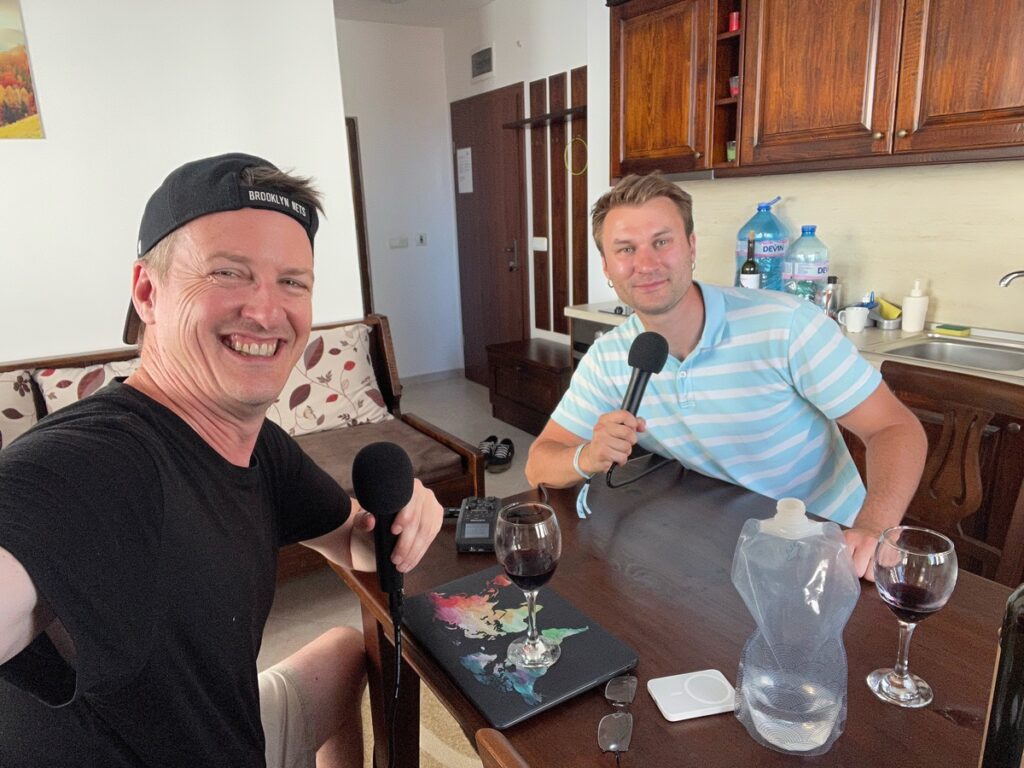
Matt Bowles: So good to have you here, brother. We got to set the context. First of all, you and I have known each other for about four years now. The first time we met, I think was on the Nomad cruise. We were going from Spain to Brazil in 2018 and we have seen each other at a number of events since then. Right now, we are at the Bansko Nomad Fest in Bulgaria and we have just opened a bottle of Bulgarian wine. It’s a Cabernet Sauvignon, one of the better wines that I could find. So, cheers to you, brother. We’ll be drinking through this during the interview.
Orest Zub: In Ukraine, we tell Budmo! Instead of cheers. This is the calling that you do when you know, sharing a drink with somebody.
Matt Bowles: Budmo!
Orest Zub: Yeah, Budmo!
Matt Bowles: Amazing. Well, let’s start off just talking a little bit about where we are right now. We are in Bulgaria. You spoke at the Bansko Nomad Fest about the situation in Ukraine. You have also been meeting with political figures and other people in this part of Bulgaria. Can you share a little bit overall about how your experience in Bulgaria has been this time and what you’ve been up to?
Orest Zub: I’m based in Ukraine. And this is like One of the stops I’m doing on the humanitarian trip around a few Balkan countries, where I meet local organizations, meet local politicians, where I speak on the media to do what you just told in the intro. Basically everything, I do at the moment is to provide support for Ukraine, to raise the awareness and to be the voice of Ukraine in many medias as much as I can.
So, this includes participating in events like Nomad Fest in Bansko, where I applied as a speaker and was admitted. I’m very grateful to Matthias, the organizer, who decided to put this rather uncomfortable topic. Yes. In the middle of regular things, what Nomads are talking about, like business, travel, freedom, and so on. However, we realized that the war in Ukraine has a major significance for the future. How we will be working, how we’ll be traveling. It directly makes an impact on the geopolitics of our world. That’s why I believe it’s important to be concerned and to stay aware of what’s happening in Ukraine.
Matt Bowles: Well, I thought your talk was absolutely fantastic. Everybody else that was there was captivated every minute. People were crying, people were emotional. It was incredibly powerful. Powerful in terms of how personal you went with that and how you delivered that. One of the things also that I really appreciated about your talk is that you talked about your experience in other conflict regions as well, and spending time with other oppressed people as well, in terms of your trip to Palestine, in terms of your trip to Kashmir and seeing the impact of the Indian occupation, your time in Kosovo and the Balkans and things like that. And you mentioned that during the talk, in terms of the importance of understanding the universality of oppression and military aggression and things of that nature. And for me, that really was really important in terms of framing and contextualizing the whole thing. So, I really, really just wanted to tell you that I appreciated that, man.
Orest Zub: Yep. That’s something that we cannot forget, obviously, because the world is very turbulent at the moment. And actually nowadays, at this very moment, there are happening a lot of military conflicts all around the world. And depending on how the war in Ukraine will be resolved, many areas of the world also depend on.
Matt Bowles: Absolutely, man. Well, I want to start by going all the way back and giving folks a little bit of background on you. Can you share a little bit about your upbringing where you grew up, and just tell us a little bit about how Ukraine was back then. Like, describe your childhood a little bit. I know you got very into tennis. That was a major part of your life as well. Maybe share a little bit about that, too.
Orest Zub: I’m 34 now, which means that I was born in 1987. Yes, which was still a part of Soviet Union. However, I don’t remember that time because I mean, let’s say I enrolled into the secondary school in 1994. So, I became conscious already during the 90s when Ukraine was independent country. It was a time of economic struggle in the entire Eastern Europe because the economies had to be reorganized and Ukraine actually was hit probably the worst out of all Eastern European countries. You can even see this according to these charts, how the GDP is growing of each country. So, Ukraine was kind of very slow in this development. But still, I cannot complain.
Most people who got rich during the time were those who got access to some political stuff or they were the director of the governmental factory and then privatized this and so on. I was lucky still to be born in my family because my mother was studying journalism and she were one of a few who knew English language all the way in the beginning of the 90s. So, they started a travel company actually like in 1991 when the borders just became open and my parents started to service Ukrainian diaspora people who were coming to Ukraine to see the country. Yes. So, like from early childhood I had the chance to speak with foreigners also understanding the importance of seeing the world, knowing English language.
My parents even enrolled me into the special school where I could study English like since the time, I was 6. And in my early teenage time I was even sent to some international camps to hang out with other children from Slovakia, Poland, Hungary, where our major, major focus was studying English. And you know, to have this kind of international exchange experience which definitely affected all other things that I’m doing now. Yeah. So, I’m very grateful them for that. And you know, there is also like very important psychology in the developing countries. So once people start to make some kind of money, they want to impress somebody, you know, buy expensive car or make the like build a huge house. And those things are not assets because they just suck money from you. Yeah.
So, my parents, they were like very conscious in the way that the best investment is investment into development. That’s why my father was never buying a new car. For example, my mother just bought her first car two years ago and she were using public transport for all of her life. They are living in pretty modest apartment. But at the same time, I was fortunate to be able to travel since early childhood. They travel by themselves at least couple of times per year, which directly affects what kind of person are you. So that’s one. And as you mentioned, tennis sport is an integral Part of human development. And after trying all types of sports in my childhood, I found tennis to be the most fascinating one and I still practice it.
Matt Bowles: Well, you are not just a tennis player, you are a semi pro tennis player that now competes in the ITF Senior league. Can you talk a little bit about the impact of tennis in your life and what you’ve sort of learned and taken from your experience of getting to that level in tennis?
Orest Zub: I was participating in a regular sport group for children and there you don’t have a choice; you have to take it very seriously or you’re out. So basically, I was on the court for five days per week since 12, all the way until 18 years old. And then you have to decide or you can pursue the sports career or you do something else. Yeah. So, in my case I enrolled into the law faculty and since then tennis was overshadowed by the other activities I’ve been doing. However, even though I had a rather long break in tennis a couple of years ago, I got back to it. I still realized I have the skills that I don’t. Didn’t forget. I can say I kind of reached my level when I was 18 years old, still feeling fine. I use this to travel. Even so, ITF Seniors is the same league as other leagues. You just search in the platform and you see tennis championships happening every single day all around the world. So, this can be the guide to your travel destinations.
Actually, what I’m doing. And secondly, tennis, it’s very interesting. So, I really rely on this when I travel to some areas and I want to meet local people. For example, I was nomading in Colombia, so in Medellin I deliberately booked an Airbnb next to the tennis club. So, the first thing I did once I checked in, I went to the local tennis club. And you start making friends like this very fast, you know, because you are in the same sect in the same tribe actually. Also, it gives you access to some good connections and you know, this is the way how tennis player who likes traveling can immerse into the local atmosphere. One of the most interesting experiences of my tennis game was in Togo in West Africa.
So, I was simply walking on the street and I see a tennis court behind the bush, relatively well maintained. I jump over the fence and ask like okay, who is here? And some guy is like, okay, I’m the chief of the tennis court. So, it appeared to be that he’s one of the best Togo tennis players. So, we set up a game with him to play next day and half of the street gathered. They were cheering for him; we had all these guys who are picking up balls in every corner. That was simply amazing experience. And yeah, I’m grateful that tennis is for life. You will never get rid of it. And I really happy to use this in my travels.
Matt Bowles: That’s amazing. Can you talk a little bit about how your initial interest in travel developed? You started alluding to it when you were growing up and you had some opportunities to travel a little bit. Can you talk about what those were, the impact of those early trips on you, and how your passion for traveling the world sort of evolved?
Orest Zub: So, as I told first was initiative of my parents, in the early teens, I was simply sent to international English language camps. And then during the university times, when I was studying law, probably on the third year of law faculty, I noticed Elsa, it’s like European Law Student Organization, which had a department in my faculty. And these guys were doing something. They were organizing some conferences, some trips together. So, I became interested. And then I realized that this Elsa has departments all around Europe in different universities.
And there are many events happenings, there are festivals happening for this niche of students. And also, it’s possible to apply to some conference, let’s say, prepare an essay or prepare a speech. And part of your travel costs will be reimbursed by the organization. Yes. So, I thought, like, that’s really interesting. And I started to pursue this academic way in order to fund my travels during being a student. That’s how by the end I graduated, I was that around 30 European countries and actually having friends all around Europe just by doing this. So that’s how it developed.
And when I graduated university, I thought, like, okay, I want to do something more. I want to see the world more and the same. Relying on law expertise. I did internship in Poland, then Croatia, and eventually the highlight of all of that was my internship in India, where I was assisting a local lawyer in New Delhi, where I spent five months. This was the first experience of going outside of Europe and being exposed to absolutely different culture, which of course enriches you as a person.
Matt Bowles: And then from there, that’s the trip in which you got to go to Kashmir and you get to see the occupation and the resistance going on in Kashmir and all of that kind of stuff. And then after that trip and the five months there in India, what impact do you think that had on you overall? And what was sort of the trajectory from there to deciding you wanted to just be a digital nomad and keep going?
Orest Zub: It has a very important impact. And the way I see it, what was the initial one, what was your initial hunger or your initial calling? For me it was the desire to travel and to see the world. That’s why I actually used the legal career to be able to go somewhere else. So, this was the ultimate goal. And while staying in India for so much long time, five months, I’ve seen people who were like wearing flip flops, sitting in their hotels somewhere up in the Himalayan mountains and doing something from their laptop. I had no idea what they were doing, but I thought like, okay, I want to be like those people. Like, I want to be that free spirited, going somewhere in flip flops or without, but simply being my own boss, right? Because I was still kind of doing this weekly job as a lawyer’s assistant.
So, I came back from India with a single goal, to find a way how to be able freely travel the world and to be sustainable financially in this. And my initial vision, how could I pursue this, was applying to United Nation jobs, to apply to some international organizations also that are present all around the world because I could rely on my English language skills and my legal background. However, I’ve seen that it’s not that easy. You need some experience. Those are huge organizations, bureaucracy and so on. So eventually I started to work as the assistant of ombudsman in Western Ukraine, in Lviv. And the reality of this work I faced there completely disappointed me. And parallelly I started to look for other things. What can I do in order to pursue my dream of seeing the world?
And I found the way that I started to run a website about travel in Ukraine in English language. The name of it is Ukraine travelsecrets.com so basically, I combined English, knowing English language, my desire to travel and the love of my country. The thing which I didn’t have back then are technical skills. So that was the hardest one because I’m a humanitarian guy. So, I completely didn’t know even how to set up a webpage back then. And in 2011, I’m talking about this year already it was way more difficult than it is now with WordPress and other things. So, it took me five months to figure things out. I started to understand what is traffic, how online marketing works.
And also, I was kind of lucky in timing because in 2012 Ukraine was hosting European Football championship. So basically, there was a huge demand of this kind of information and it was a good time. And eventually after like half a year, I stopped my previous legal guild career and completely started to do the online stuff combined with the regular travel services.
Matt Bowles: That’s amazing. Well, I know that you have Also been married for about a decade. And you and your wife traveled the world together, which is completely amazing. Can you share a little bit about how that relationship began and how your travel lifestyle together began?
Orest Zub: Yeah. So even though Lviv is a relatively large city, it’s around 1 million people population, still peers of the same age kind of hang out at the same parties, you know each other. So probably we crossed over with my wife at a few different parties, but she had a boyfriend. I was into some other stuff, so we just kind of knew each other on a distance with some common friends in between. And in late 2010, 2011, when Facebook already kind of picking up, I was one of few young people in my city who was actively traveling the world. I’m talking about European experience and then India, which was completely, like, shocking to many people. So, they were following me, liking my pictures online.
And Marta was one of a few people who also thought, like, how this guy can travel India. You are like 21 years old, so people comment and so on. And obviously you interact with a few. So, we just arranged with Marta with my present wife that once I’m back from India, we will meet and I’ll explain her. I tell her stories from India. So basically 2010, we started dating, and at the same time, I was pursuing this digital nomad career. Yes. I told in 2012, I reached the point that I was already able to work and travel at the same time, and we started traveling together. So actually, the Palestine, the trip together with Israel and Egypt and Middle East. It was our first trip together outside of Europe in 2012.
Matt Bowles: And then how did you decide that you wanted to marry her and how did you propose?
Orest Zub: Some people tell that before buying a car, you would rather test it just to be sure. So, our first true digital nomad winter was 2012, 2013. We went as many other backpackers. That’s how people usually start nomading. Yeah. We went to Southeast Asia, where we spent five months is like Thailand, Bali, Singapore, Malaysia, all that area. So, on the way back, I realized, okay, we are five months together. And when you’re traveling in the couple, you are 24, seven together, right?
Matt Bowles: Yeah. It’s like five years together. Yeah.
Orest Zub: Yeah. So that’s definitely a good way to understand the person and to feel how you’re getting along. And that was a proof that I can get along much more until many years with her. And in order to catch the moment and in order so she cannot run away, I used the chance while we were on the plane to propose her. And yeah, there was no other way.
Matt Bowles: That’s such an unbelievable digital nomad story proposes on the plane after a five-month trip through Southeast Asia. That’s incredible. I love that man. And then from there, the two of you continued nomading together. You’ve been traveling the world together now for a decade. Can you talk about what happened in Ukraine a little bit after that in 2014 and how that impacted you?
Orest Zub: So, Ukraine experienced a lot of turbulence since the recent independence. Yes, since 1991. In 2004, our country was going through the revolution. I was 17 years old. I participated in this. But that was the revolution against faking the presidential vote. Yeah. So, let’s say one pro government president faked the votes, but people wanted to go west to the European integration. People then went on the street and eventually there was re voting and we proved that we want to go to the West. So, since 2004, Ukraine officially written in constitution was going towards European Union. And believe it or not, but two weeks before the scheduled date of ratifying the association of Ukraine within European Union, which is like one of the initial steps to, to continue the process. In late 2013, our back then president who became a puppet of Putin in Russia, he just told okay, you know what, we are going to sign the economic union with Russia and Kazakhstan.
So, people went on the street and we had this Ramadan revolution with already some shootings on the street. Sorry for me, I was already nomading actively, but I was back then in Mexico, so I was in Puerto Escondido. Many nomads know this place. And actually I was witnessing the revolution that my country was going through and my friends participating from a distance that felt very bad. But that was just simply one of these milestones that our country lived through. And since then, Russia invaded Donbass, they annexed Crimea. And actually the entire story of a present war started completely with a straight line back in 2014. But I mean historically it’s a much bigger conflict. But that’s how you can put the dots together. So, the present war in Ukraine is, let’s say much more active phase of the war which is happening in Donbass since 2014.
As for me, I was a nomad back then. Yeah, I had this travel business that I told you so. Workflow was the following. In summer I was providing travel services to my clients. And for the winter season, approximately from October all the way until Easter, I was somewhere in exotic warm destinations, which is amazing lifestyle. You work half of the day doing what you really love and then since it’s a low season, you just travel another place places. However, because of events in 2014, my tourism business went completely to zero down because obviously no tourists would like to go to the place which is a war zone, even though not the entire country is at war. So, starting from that period, I already understood, well, the online marketing stuff, how to develop any kind of idea or any kind of business venture with the help of different online tools. And I started their lifestyle blog, openmind.com.ua which is a Ukrainian language blog about travel, lifestyle, self-help and business. Within years grew it to like one of the largest lifestyle online resources in Ukraine.
Matt Bowles: And you and your wife have been traveling to so many countries and seeing so many parts of the world. Since then, you and I met and hung out in Brazil in 2018 and other places since then and all of that. And then when 2022 came about, can you take us through your journey and your experiences as stuff started to escalate and you started to see what was about to happen in Ukraine?
Orest Zub: Yeah, so I had this amazing life and I still feel I’m having amazing life traveling the world, doing the Nomad Cruise, meeting all the amazing people like you all around the world. However, it was for me learning the history, understanding a little bit of gel politics and being the insider. Being in Ukraine, I understood that this is simply a matter of time when the full scale war will break out in Ukraine. And when starting from the end of 2021, when the entire world was witnessing accumulation of military force along the borders of Ukraine. It was very clear that we just need one spark and it will start. That’s how all the wars actually start. So, I was continuing traveling, continuing doing my regular business and the situation became like really, really hot in February.
Most of my expat friends in Ukraine were ordered by their embassies to evacuate. I had some plans that I did before. So, I went to Budapest for a tennis tournament actually together with my wife. This is like middle of February, two weeks before the war there. I already realized that there is extra caution to me as a guy with Ukrainian passport in the airport. So, they were doing some more checks. But from Budapest, I mean, I did the tournament. My wife flew back to Ukraine and I flew to Karabakh. Karabakh is the conflict area in the Caucasus Mountain region, which is like for centuries disputed between Armenia and Azerbaijan. Many bloody wars happened there. And the recent war started in 1991 with the very fierce fighting and then they also had some ceasefire and then escalation again.
So basically, I visited the area and I’ve seen destroyed cities with the, let’s say prior the conflict with the population of 100,000 people, but completely destroyed, like abandoned buildings, parts of the neighborhoods flattened, bushes growing everywhere and so on. And I thought like, wow, like this is really crazy. I’ve never seen something like this before out of many other conflict zones I visited before. And I was really afraid that this could happen in Ukraine. And I’m talking like one week before the actual invasion. But still when you are in this area and you are like a guest, you don’t understand it fully. Yeah, it’s like the war is not coming to your home.
And in Azerbaijan everybody was talking about the war already and so on all around the world. So, I thought like, okay, this is about to start. I didn’t realize what is about to happen, but I knew exactly that. I don’t want to be the same guy sitting in Puerto escondido as in 2014, watching this online. I want to be with my people, I want to be part of it. And yeah, I simply flew back from Baku to Kyiv. None of our group actually board the plane. And all my friends who were there, they told me like, don’t go to Ukraine now, even though of them who were traveling to Western Europe through Kyiv, because Kyiv is logical transfer point, they simply didn’t board the plane and bought another ticket through Istanbul. Yeah, but I still came back. And on the onward flight from Kyiv to Lviv, I already seen so much politicians. You could feel this in the air, in the, in Kyiv airport already. And on the plane, I’ve seen people from the TV sitting next to me, talking between each other, calling. Yeah, and then like four days and it started.
Matt Bowles: And then. Can you talk about what the start of the invasion was like? You were there, was your family there with you? And what do you remember when it started and how did you respond in those early days?
Orest Zub: So, you know, humans are such creatures that in many cases they don’t believe in something unless it happens. This is like a classic example of a black swan. This actually the book I would like anybody to recommend to read. So, I clearly remember the evening of February 23rd. I was sitting in the beautiful cafe with my friend. He is a crypto investor. I’m like the online guy, Modern Normal Cafe. Lviv is an amazing city. Think of standard of Prague, Budapest, Krakow, like Central Europe and so on. And we were talking about our future plans, our business ventures. Also touching the topic, what will happen in Ukraine in the nearest time and so on. We went home and at 6am I receive a call from my friend and he tells like, Orest, it has started. I was like, what has started? It’s still dark, you know, it’s February. Like the war started, you don’t realize it. What war?
So, I opened some news portal and I see bombs, attacks. This city has been hit. This city. You’re scrolling like, is there like anything around you? But the truth is that within a couple of hours, let’s say between 3 and 7am Russian forces made over 70 long range missile attacks all around the country. And Ukraine is the second largest European state. So even Lviv, which is the city at least thousand kilometers from the Russian border, you know, some region of Lviv have been hit. Like some military units around. And we didn’t realize it’s possible. How would you beat the geography? How can you shoot thousand kilometers and in such many locations? So definitely this provoked a massive panic within the population. As soon as the missiles attacked different, let’s say railway stations, refineries, military units and so on, the land invasion followed. Yes. And they started to invade from the east and from the north.
So basically, millions of people who were living in the eastern areas of Ukraine started to drive west. Infrastructure of the country was not ready for that. So, we are talking about massive traffic jams, shortage of fuel everywhere. All the possible accommodation in the central Ukraine is booked. And obviously people from the west, they start to go to European Union, to European countries, which means massive traffic at the border checkpoints 30 kilometers in each direction. This is winter. So, cars are running out of gas, the phone lines are overloaded because everybody’s calling each other. You cannot call to somebody from my window. I have the ATM next to my window. Just there’s a bank office. Yes. And I remember that my friend called me and I thought, like, okay, like now I will go, probably need some cash.
So, I just went to see what’s happening near the atm. They were quiet. I thought, okay, I just go brush my teeth and then I take the clothes just to get a couple of hundred bucks just to have cash. And then I just go and I see like huge line of people. And every ATM around the city is flooded with people. Banks close their offices so people cannot crash in and ask for money. And supermarkets became overloaded. People start buying food. Obviously, all the petrol stations also very crowded. So, this was for the next couple of days like this. And the entire country was completely paralyzed. It’s hard to explain.
Matt Bowles: And once you got your mind around, okay, this is actually happening, this is real, it’s happening here, it’s happening now, and you’re in the middle of it. Your family is also there. What then, once that sunk in, did you start to do okay?
Orest Zub: So, it took like a couple of days to start thinking rationally, because in such circumstances, when the entire country is in panic, just for you to understand how bad it was, my wife put water into the bathtub just in case, to have access to water. And we are living in a modern city. So, once you have all of this happening, you have the urgent feel that you may die very soon because the next rocket can land in your building, and so on. And basically, you function only on the instant lifesaving mode, meaning get food, get petrol, get access to money, make sure that your family are safe. However, in addition to that, in the very first day of the war, I have a professional blogger’s instinct. I took the camera and went live streaming on the street. Obviously, like hundreds and thousands of people watched my first live stream and they thought, like, okay, since I know how to do this and I can actually start producing material telling from the local perspective what is happening.
Because since I’m a nomad and we meet so many people on the cruise and events, you can imagine how many messages I received from my friends all around the world. How are you? Obviously, I could not respond to anybody, so I just started documenting and reporting what’s happening to me from my local perspective. This is Lviv. Look at this. People run away, the bank is full of people, petrol is out of stock, and so on. Yeah. And then the story developed. For example, I visited refugee center because people were coming from east to west. I made some documentaries, like short clips from people all around Ukraine to tell what is happening in their area. Because you don’t have full access to information back then. And that’s like the way how I put all the things together and thought like, okay, this is probably the time that I can rely on my background, on my skills and my team, which I managed to gather in touch. Yes. And we will speak to the world about what happens here.
Matt Bowles: And then can you talk about then your sort of business decision to sort of understand what assets you had on the marketing side and the media blogging side and then what you did ultimately with those assets to support Ukraine.
Orest Zub: This is definitely not the business decision. It’s rather, let’s say, my participation in the resistance decision. And it feels like actually you told that you’ve seen another podcast with George Buhnici as a Romanian podcaster, and somebody in the comments wrote there, like, Orest, it feels like all what you’ve done in your life before was made in order for you to prepare to do this right now. And I’m very glad that we started with my background. It does really feel like it. It feels like everything I accumulated, you know, I had an amazing life. And everything I accumulated before, I can now use to do my best in these circumstances to help Ukraine, to help my people and in general to contribute to make the world a better place. At the same time feeling myself to be in the right shoes, you know, because people start making very bad decisions when there is panic and there is war and I feel I’m in the right place. That’s also very important in terms of dedication and self-motivation. I mean, I had some savings, so I continued paying my team. Even though we were not conducting any regular business activity.
Our team was well organized. Even though some of them had to flee. Still all their work is online. So, designers continue working, video editors continue working. My tech guy is continue working. Even though now at least 30% of their time they focus on our media work and the rest they are doing volunteering in their own cities. But still we continue this and we managed to actually without interruptions since the first day of the war, all the way until now. And we are already on the fourth month of the war to produce English language content from the local perspective about what’s really happening in Ukraine. Not competing with the global media because it’s a different story, but we establish more connections with the audience and just showing the things from our own eyes.
Matt Bowles: Can you talk about also what was going through your mind with regard to safety for your family in terms of how you thought about staying versus leaving and where you sort of landed on that and how your family is doing?
Orest Zub: So, as I told you, it was my intention to come back before the invasion. But you still don’t realize like once it happens, you like scared a lot. Yeah. So, the natural reaction of every person is simply to run. Many of my friends, many people I know, they evacuated. My friend called me at 6, he told okay, Orest, I’m out at 7. He sat on the road from Lviv. It took him 40 minutes to reach the border, but then he could not cross because the martial law was introduced and all the men had to stay within the country. So, he simply had to put his wife with a dog to other car with other females to be able to cross the border and he turned back. You can imagine how tough the situation was back then. I was definitely not going to run somewhere, but understanding that Lviv is geographically far from the active land combat, we realized that most probably tanks are not going to roll in two days in your own city.
We had a few plans. Plan number one is to stay and to do what you do. Secondly, since the cities are like more become targets of these long-range missiles, we have a countryside home, half an hour drive. So, our family moved there to stay there. And after a couple of days, all the females from my family, apart from my wife, mother, two sisters and my nephew, they decided to leave Ukraine because that was the situation of uncertainty. You don’t know what was about to happen and so on. So once my ladies, I call them once they left the country and it was like another drama. It took them three days to beat the traffic, go through the mountains and to cross. The final housekeeping project was to make my granny safe because she lives in the apartment next to the airport and airport is a prospect target. So, let’s say God forbid something happens there, the entire neighborhood gets locked in and you cannot get to your granny who cannot leave the house.
So together, my father, we put her into the nursing home, which was also very dramatic because Ukrainians don’t send their elders members to the nursing homes. You know, they usually stay all together. And once we were done with that, I felt like a big relief. Like it felt like, okay, you’re mobile, have all your belongings, necessities in this bag. If anything happens, you can quickly go somewhere or even just ride on the bike, go to the border, which is 70 km. But since then, I felt very much better. And also, it was emotional climax because this situation, the Russia forced you to do those things. They forced your family to evacuate and suffer. Yeah, they forced you to put your granny in the nursing home. And it was the climax emotionally and also the climax of anger to react. And since then, I started to work harder in my media work.
Matt Bowles: Can you talk also about some of the international solidarity that you’ve been cultivating because you’ve now been traveling around the world outside of Ukraine, and you’ve been speaking publicly, mobilizing grassroots support, but you’ve also been meeting with political officials and other people. Can you share a little bit about how that aspect of it came in?
Orest Zub: Yeah. So, one of the assets I already had was a lot of international friends. So, number first, what really helped is like, people call me like Orest, what do you need? Like 50 of them offered a place to stay, but they told, thank you very much, I am staying in Ukraine. They thought I’m crazy, but they’re like okay, so what else do you need? Like money? Do you need money? I told like, well, me personally, I’m doing fine. But if you can send here is the account sent. Like we will definitely need it. So, I use this to pay my team members. Also, I use it for bunch of different stuff. Like people in the west don’t realize how every member, like how every Ukrainian is involved that we have a such a strong volunteer movement not any single country had before. Because let’s say when I was traveling to Croatia, I bought entire stock of tactical fingerless gloves in all of Zagreb. All the shops they knew me, I just bought hundreds of those simply to send it to the guys on the front line. I am hosting once a week a guy from Sweden, Jonas, because he’s buying four-wheel drive truck in Sweden, painted dark green and drives personally to the east of Ukraine, drops is there and continues the cycle.
I have friends who lead different organizations that they were doing public statements in the support of Ukraine. So, all type of different support came from the regular people. Also, we’ve seen how big was support on Ukraine from other governments. And this is the unique situation when all European countries united behind one country, when NATO states consolidated. Like because before they having different views, going different directions. Now it’s like one. So that was very unique. And in terms of this activity that I’m doing now, it started maybe on the second month after invasion because as I told the first week it was lifesaving mode. Then first month I was more about western Ukraine documenting things. And on the second month, starting from the early April, I visited the occupied areas because in the north, Kyiv, the capital, was almost encircled. It was besieged. And once Ukrainian forces pushed back the Russians from the north, I already accumulated enough, let’s say visibility. So, I traveled there and I visited Bucha, I visited Irpin, I still remember when I was driving there, it was like second or third day after the occupation.
So, I was among the first journalists, bloggers who were able actually to visit those places. I still felt heated from the buildings that were burned down. I witnessed dead bodies who were extracted from, from the ground and so on. So, once I started doing this, this really draw attention of organizations around the world. And one organization from Italy, from Udine, they told me like Orest, we found you on Instagram. You are doing great things. It really stands out. You’re not like a regular news reporter. You, you put some personal story, you try to stay more positive and so on. Just for you to know when you will be in this area, come visit us we’re going to provide humanitarian aid to Ukraine.
So that put a nice perspective to me that like, oh, okay, I can now travel and do representation to establish connections around. At the same time, the nomad-based event was about to happen in Croatia. So, I wrote to Yohannes and to like Johannes, I want to come. He’s like, yes, sure, it will be our pleasure to invite you as the speaker and to talk about Ukraine. So, I started to look for different events in one area and group them for my single trip. To talk here, to make meeting here to establish connection here. Yes. At the same time, on the way back in Zagreb, I met a local NGO which is made of former military fighters who were fighting for Ukraine for Croatian independence 30 years ago and established connections with them. They sent me some medical supplies that I had to send to their fighters in the Foreign Legion, bunch of things.
So that was like a one trip and for example, here. And one of those events was like conference in Dubrovnik where I met city mayor, deputy. And on that event was a politician from Bulgaria who is working on lobbying digital nomad visas in Bulgaria. And he was about to speak on the event here, but he didn’t make it. Yes. Because their government was dissolved a couple of days ago. So, he invited me to Bulgaria. And knowing that I might go to Bulgaria, I also knew about Bansko Fest. You know, things started to put together. I started to put these dots. Obviously, this is a lot of organizational work to do. But I thought like, okay, if I can speak to people, I have this kind of credibility. I can also leverage on this in order to, to provide more help to Ukraine.
Matt Bowles: You and I have both spent extended time in West Africa. And you and I both have a lot of love for West African culture and the West African people. And one of the meetings that you recently had was with the Nigerian founder of Diaspora Solidarity Group, which is specifically helping African people in Ukraine. Can you talk a little bit about what that group is up to?
Orest Zub: Absolutely. So, this is like a pure examples of media presence. So, once I was done with my first trip to Italy and Croatia, I did a large report. What actually I did? The case here is that men are not allowed like of certain age between 18 and 60 to leave the country because it’s a martial law. They have to fight or do anything else in relation to military stuff. Yeah. So, in order to be able to do these international projects, I applied to the Ministry of Defense. They checked my background; they see who am I. And I mean, I’m not the guy who is running away from the war. Yes, I contribute. So, I didn’t post anything about my activity during the first trip, but once I got back to Ukraine and stepped on our land, I made this like huge report where I’ve been, who am I met taking all the organizations making a report which kind of assistance and aid was provided thanks to what I was doing.
And of course, there were like many comments. And one of the comments was from a woman from Romania, from Bucharest. And she told like Orest, it’s great to see you. Next time you visit us in Bucharest we have this organization, Diaspora Solidarity Group. We’ll be happy to show you around to introduce you to our volunteer centers and we’ll establish cooperation. So, this also supplemented to my grand plan on this trip that I’m doing. And I connected Bucharest with Bansko, with Sofia and with other things along the way. So, when I met them in Bucharest only two weeks ago, it appeared to be that there is a guy from Nigeria who is living and working Bucharest and he’s married on the local woman from Romania. So, during the initial phase of the invasion in Ukraine, since he’s Nigerian, they were assisting different African people who are living and study in Ukraine. Usually those are students and they provide all type of assistance.
Usually, it’s a logistics and communication. So basically, think of a group of students being in Sumy in northeast of Ukraine, next to the Russian border. The city is under siege and they need to evacuate somehow. So definitely you have a lot of organization to do. You have to push on the embassy in your town, then you have to arrange some transportation within Ukraine. You need to make sure use the time span which is like safe for them to evacuate. And this is what this NGO was doing, focusing on actually African people.
Matt Bowles: Awesome. I think that’s super, super important. And we’re going to link that organization up in the show notes so people can go check it out and learn more about them. Orest, I want you to now be able to talk a little bit about what folks can do from anywhere in the world to support and maybe even before you talk about specific action items, can you give a little more political historical context so that people can really understand what’s going on, what’s at stake, what are the implications here of this particular conflict right now and then what can people do to support?
Orest Zub: So, we are facing the roll back to 30 years ago. We actually falling down back to the times of the Iron Curtain. From the geopolitical point of view, Ukraine is very important asset for Russia because access to the Black Sea, the Grain, the coal and so on. But Ukrainians who were oppressed by Russian dominance for centuries. I mean free spirited people, it’s the normal way of, of large group of people, a nation to live prosperous. So basically, now we are facing the situation when Ukrainians are dying because of their wish to be absolutely free. So, at stake, what we have is that if Ukraine will fall, the question is which country will be next? And the next can be Romania, Baltic countries, Poland and so on. So, I’m glad that most governments understand that Ukraine is, is effectively serves as the shield and it’s super important to support us.
And this is in the interest of everybody to keep the war within Ukraine, not to let it grow and to let us do the dirty job, which is only possible with additional resources because Ukraine is incomparable with the assets and resources to Russia, for example. This is at stake, it’s very serious. Like this is the single most important war actually after the World War II. And the scale is massive. Like the front line is stretching for 1000 km. We are reaching the death toll of over 50,000 people just within four months. Just want to remind you that the previous large war in Europe was the Balkan wars that took 10 years and the death toll was 130,000. Like we risk to reach that level in one year, which is terrifying, of course. And what are the ways to support. Well, I don’t want everybody to sacrifice all their life to throw everything they have into Ukraine. But if everybody will contribute part of their main activity and their focus Ukrainian question, this will make a big difference. What does it mean? War is not only about bullets and tanks. Yes. There are so many other parallel things happening. My work is an example of that. You can do media, you can speak about the topic, you can get interested, you can invite me on the podcast, please. I hope all the details how to reach me will be provided below; Orest Zub, very easy to find.
If you think that children relate to you, and this is very important. Look for children organization, donate to them, work with local orphanages, you can host people and so on. Yes. If you are in the real estate, and I know Matt is in the real estate heavily. On this podcast, dedicate 10% of your square area what you have to host people from Ukraine. Or you can donate like 10% of this side project to housing projects within Ukraine. Or if you’re in the construction, think of how you’re going to rebuild those cities that are in Ukraine. Yeah, just important to stand. It’s not only about tanks and bullets. There Are many, many parallel things are happening below the audio. We’re going to provide the link with exhaustive resources how you can help Ukraine within your means. As I told I don’t ask you to sacrifice is enough just to attach like 10% of your activity within your main focus to Ukrainian question and this will already make a difference.
Matt Bowles: Awesome. Yeah, we are going to link all of that up in the show notes. So, folks can just go to one place at themaverickshow.com and there you are going to find the links of all different organizations that you can support in Ukraine. You can support the Diaspora Solidarity Group, support the Africans in Ukraine, you can support children in Ukraine. You can contribute all these different ways. So Orest is going to provide some fantastic resources and they’re all going to be in one place at themaverickshow.com and just go to the show notes for this episode.
Orest Zub: And I also want to add that when you’ll be choosing the way how you want to contribute, think of the most direct way the better. If you have the option like to donate to Red Cross or exact medical facility in the city of Zhytomyr or Kramatorsk, better like send medical equipment or money directly to those people on the spot, not to the bigger organization. Because the time here really matters. And these meta platforms, they are more bureaucratic. They are doing great job as well. It also counts. Yes, but the best way is to go directly all the time.
Matt Bowles: All right, Orest, at this point, are you ready to move in to The Lightning Round?
Orest Zub: Let’s try.
Matt Bowles: Let’s do it. All right. What is one book that has significantly impacted you over the years you’d most recommend people check out?
Orest Zub: Today I mentioned one book already, it is called the Black Swan. I cannot tell that it affected me the most. But reading the theory and seeing the practice, you start reconsidering things much more. So, I recommend you to read the Black Swan. But in terms of books also understanding that all these things are happening now in the historical perspective tiny piece of the universe. I recommend the book Sapiens to people. This will be very helpful for you and it will make you more calm when you react on such huge events that are happening at the moment.
Matt Bowles: Awesome. All right, what is one travel hack that you use that you can recommend to people?
Orest Zub: I believe the best hack is if you really want to go somewhere, you just buy the plane ticket. Why? It’s important. Many people are looking for the best time to go somewhere to travel. They need to finish all the projects and get the best deal and so on. But always was doing this travel hack because once you buy your plane ticket, magically, all other projects you didn’t finish will be finished by the time you board the plane. Magically, even you will have some funds appear in your bank account to make this trip possible. And this is kind of like the point of no return, right? So, this will serve as an extra motivation for you to go and to shape your life to make it happen.
Matt Bowles: All right, if you could have dinner with any one person who’s currently alive today that you’ve never met for an evening of dinner and conversation, who would you choose?
Orest Zub: I could tell Zelensky. That would be like very pragmatic. Zelenskyy really serves as the true inspiration. Maybe by the end of the year he’ll be recognized as the person of the year. I must say that I was flying with him in one plane when he was just a regular comedian. And we work on this bus that takes you from the plane to the arrival hall. And I see a guy like, he’s pretty short, normal person, just doing some jokes between the people. But definitely it’s absolutely different person now. And I would be fortunate to have a dinner with him.
Matt Bowles: All right, if you could go back in time, knowing everything that you know now, and give one piece of advice to your 18-year-old self, what would you say to 18-year-old Orest?
Orest Zub: I would tell Orest to relax. Just relax and let it go with the flow. Because young people who might be listening to the podcast, podcast, they think that if they missed the opportunity or they did this mistake, this is like the end of their life. This is like ruining everything but the truth is that there are so many things that really matter. Like one disadvantage can completely grow into something else. Yeah. Just relax, just do your stuff and it will work the way out. Absolutely.
Matt Bowles: All right. You have been to 129 countries, my friends. What are your top three favorite travel destinations you would most recommend other people should check out?
Orest Zub: Asking a traveler about favorite destinations is like asking a painter about favorite pictures. So they really differ because I like to appreciate the place at the constant state when I visit this. So, for example, now I realize how huge and how beautiful is Bansko. It has the medieval central part. We are in this magnificent valley surrounded by peaks reaching to 3,000 meters. This is a good place. But if you want me to really like point out a few, I would say number one is Turkey. Turkey is the great example of a continent within one country. It is washed by three different seas, has modern Metropolis. It has ancient villages, it has desert, Rocky Mountains, sandy beaches. It has it all like history. And so, Turkey is amazing. And it’s one of the most open countries because it was very liberal for everyone.
Second, I would say I really appreciate United States. And most people don’t realize, but I am from Europe. Most people in Europe think like, okay, United States. This is New York, California, Los Angeles, where you are from Miami, Chicago and Texas. Somewhere in the middle. And that’s it. It. But I visited at least 15 states within the U.S. and I can truly say that each state is a destination on itself. Variety of culture is also tremendous. Good point. Are that people speaking the same language, not like in Europe, but it’s very diverse. And it’s amazing for road trips that I also really like.
Matt Bowles: Yeah, you told me that the city where I went to college, Cleveland, Ohio, is actually one of your favorite places in the United States. Can you share a little bit about why?
Orest Zub: Yes. So, I am fascinated with history, as you could understand from, from this podcast already. And Midwest is my favorite region, favorite cultural area of the U.S. because the way I travel is not only visiting states. I love exploring the Deep south, for example. Then I was exploring the Appalachian culture on itself and this one. So, Midwest is very interesting from the historical and economic significance of American dominance in the recent century for me. And Cleveland is one of those examples that the city grew out of nowhere. Actually, it was at some point. It was the fourth largest city in the U.S. in the early 20th century. The architecture is fascinating of the old town, early 20th century, but the towers, this art deco architecture was unseen of in London or Paris back then. Yeah, I remember this huge lamp in one of the central streets which was serving as the center of entertainment in that part of area. Also, I understand that Cleveland was not living through the good times in the middle of 20th century, but the development I experienced in recent, like in last year when I visited Cleveland is simply amazing. How you can see that the city, it was on the rise, then it kind of fell down and now it’s getting back to life again. This is very inspirational. And this is the success story we also need to have in Ukraine very soon.
Matt Bowles: Yeah, that’s amazing. All right, so you’ve got Turkey, you’ve got the United States. What is your third favorite place you’d recommend people check out?
Orest Zub: I will definitely recommend you my home country, Ukraine. Ukraine was a peaceful, nice, relatively prosperous country, up and coming with many investments, good people developing infrastructure, amazing food and so on. And now, just four months ago, it still doesn’t come to my head, but we became the number one most dangerous place in the world. I really hope that the peace will come back to Ukraine and many people are doing a lot for this to happen. So, I feel like once we are done with the war, once it will be finished, Ukraine will be the new El Dorado of the world. I hope a lot of investments to come. It already becomes fashionable to visit Ukraine. Angelina Jolie visits Ukraine. All the politicians do the pilgrimage to Ukraine. Many of your American Hollywood stars visit Ukraine with different missions. So, this is the place where the history of our generation being made in and I look forward this to prosper very soon. And the same it will be amazing travel destination for you guys.
Matt Bowles: All right, last question, Orest, what are your top three bucket list destinations? These are places you’ve never been highest on your list you’d most love to see.
Orest Zub: My goal is to visit every country in the world. That’s why it was mentioned so specific. I visited 129 countries. I want you to specify 129 United Nation countries because there are a few other countries that are not in the UN but they are still great destinations and worth to go. So, my bucket list is all 193 UN countries and a few others. However, at the moment my top priority is to continue doing what I do. So basically, I would say I’m not travel focused at the moment. I’m more focused on delivering the impact I’m doing when I work. So, I will keep that for later. And that’s also normal stuff. You know there is a time to travel and there is time to do something else.
Matt Bowles: Awesome. All right Orest, I want you to let folks know how they can find you, follow you. Definitely check out your reporting that you’re doing on Ukraine and how people can contact you if they want to invite you on a podcast or a show or give you a greater platform. How do you want people to come into your world?
Orest Zub: So, it’s easy, very easy to find me. It’s Orest Zub which like Orest like FOREST without F. You can find me easily on Facebook, Instagram and YouTube. Those are English language channels. If you write to me, I answer any question. So don’t simply just follow but also write to me. And my email is orest@openmind.com.ua.
Matt Bowles: Amazing. We are going to link all of that up in one place. So just go to the show notes at themaverickshow.com go to the show notes for this episode. There you’re going to see all of Orest’s social media handles, how to email him, how to contact him, how to follow his reporting from Ukraine, how to donate and contribute to all the organizations that we have talked about here today. Orest, this was amazing brother. Thank you for coming on the show.
Orest Zub: I’m very grateful that you paid attention to my talk on Bansko Nomad Fest and for the fact that you shared your platform to speak about Ukraine. This really important and it also tells a lot.
Matt Bowles: Amazing. All right, thanks for coming on the show, brother and good night, everybody.