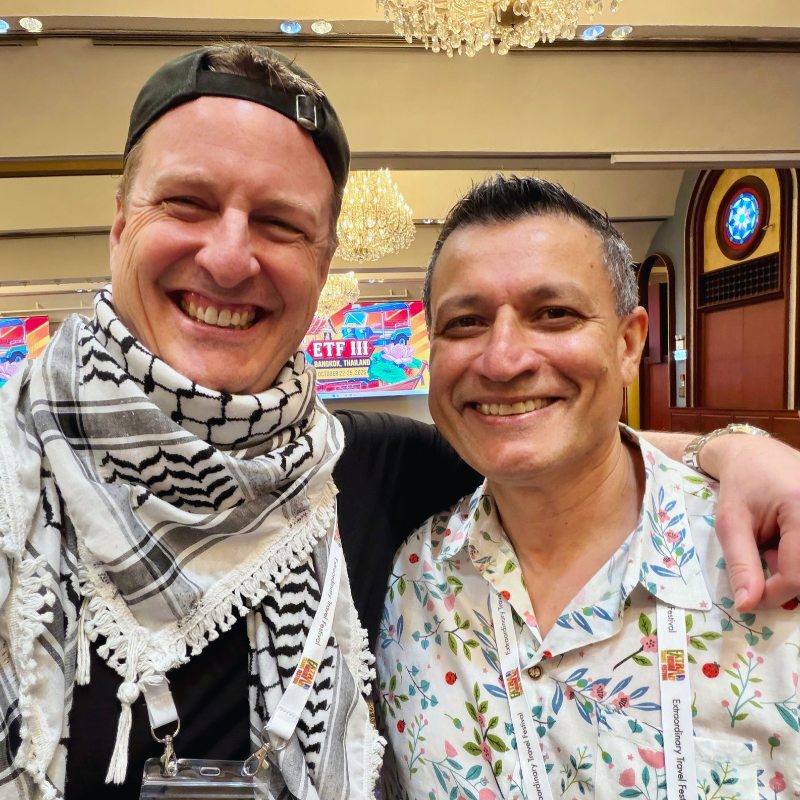
Matt Bowles: My guest today is Nabil Kazi. He is a global marketing and entertainment executive, world traveler, and the current Executive Vice President of Marketing and Brand Development at Watermelon Pictures, a film company dedicated to amplifying Palestinian and other underrepresented voices. Born in Kuwait to Pakistani parents, Nabil grew up mostly in the United States and went on to build an extraordinary career at Disney, Pixar, 20th Century Fox and Illumination, helping to bring iconic films and franchises like Toy Story, The Incredibles, The Simpsons and Despicable Me to global audiences. He is also a marathon runner, Ironman finisher, and a passionate world traveler who has visited 153 countries on his quest to visit every country in the world. He is also one of my favorite people to hang out with. Nabil, welcome to the show.
Nabil Kazi: Thank you so much. Wow, what an intro.
Matt Bowles: Man, I am so excited to have this conversation with you and I’m super excited that we are doing this in person in Bangkok, Thailand. We were both just speaking at The Extraordinary Travel Fest put on by our good friend Ric Gazarian, who Maverick show listeners know because he has been on the podcast. But you gave a presentation at The Extraordinary Travel Fest about storytelling for travelers. And I would love to start off with that, for people that did not hear your presentation. What was the central message that you wanted an audience of world travelers to take away?
Nabil Kazi: I wanted them to know that your iPhone is more than something to just click that we are blessed to be able to go to most of the world where most people around the world are not able to do and it is our asset. And so, when you are able to take your phone, properly frame it, and then create a story around what you are experiencing, it should be that personal story that you’re telling instead of sitting in your car with your guide pulling your window down and then just kind of clicking the camel that’s on the side of the road. But really get out of the car, experience the local life, frame your photo properly and tell what you are actually capturing.
Matt Bowles: Well, you’ve spent your career helping to tell stories through film and television. What do you think most travelers misunderstand about telling compelling stories from their experiences?
Nabil Kazi: I think there’s a mixed bag of travelers that we have right now. When we look at what we are doing going to every country in the world, it’s become sort of very trendy. And so, there is a group of travelers who just feel like they need to check off a country or countries and very quickly get this mission done. And then there are slow travelers like myself who really want to experience each country, the localization and showcase the positivity of every country. We know every government in the world has problems, including the United States and most of the Western world, but we are not the government. And when we go and experience these countries, 99% of the people that we encounter are actually really beautiful and humankind people. And that is what we should be storytelling.
Matt Bowles: What’s the difference between a travel story that’s merely a description of where someone went and one that actually moves an audience?
Nabil Kazi: Well, it’s very easy. Where someone went is just a click and a reel about, hey, I’m here and this is country number 135. And you do a couple of reels and you’re done with it. Someone who moves you, sits in that coffee shop and finds that story that nobody else can find. It’s the hardship of a Bedouin family of 12 that live together in the mountains in Morocco. Or it is going to Afghanistan and having a five-year-old kid chase your car for a bottle of water and you stop and spend some time with the kid and go back and have a meal with their family. So, there is a difference of the experiment versus the check-off.
Matt Bowles: So, if you were coaching someone who just returned from an extraordinary trip, how would you help them identify the strongest story to tell?
Nabil Kazi: I would kind of compare it to how we create films. When we create films, we have pulse beats that showcase each segment of a film or a TV show, whether it’s three pulses or 10 pulses. And when you are sitting on that plane to your next destination, you should really think about what were those pulse moments that really moved you? It could be laughter, it could be heartfelt, it could be that adventure. And those moments are the ones that you need to stitch together to tell about that particular country.
Matt Bowles: What have you learned about building tension, developing characters and creating emotional resonance that travelers can apply to their own storytelling?
Nabil Kazi: It’s intuition and it’s instincts. A lot of times I’m in a city center, and it’s the smells, it’s the movements of people. It’s the mother with her three kids that is trying to just get enough money to feed them in the evening. But then it’s also that guy who owns the coffee shop and the smiles that he brings to everyone, sitting there with a cup of espresso. And it’s the guy who makes the kunafa, or it’s the guy who makes the shawarma. It’s walking around the streets of Damascus. And I think for us, when we’re traveling, we take ourselves out of being a tourist. And the difference between a tourist and a traveler is the connection that you have to the local people. It’s not about visiting a tourist site or a UNESCO World Heritage Site, but it’s embracing yourself and localizing yourself and having that experience, and that in itself, you learn to become a better storyteller.
Matt Bowles: How do you think social media has changed travel storytelling? Has the pressure to produce visually impressive content come at the expense of substance?
Nabil Kazi: Yeah, I will say, with no names mentioned. I remember being in Libya and going to that hotel. I forgot the name of it. It’s the vacant hotel. And travelers are not allowed to go there because there was an influencer who went there and took photos and videos that he wasn’t supposed to, and they had told him. And I think in that instance, when you are trying to get views of something that somebody can’t obtain is disrespectful to that country, that culture or the religion. And so, there is that balance between tell the story and the narrative, but also respecting where you are. Afghanistan is a really good example. When you land in Kabul, they tell you, please, no photographs of women. Be mindful of any sort of military sites. You get that a lot in some of these countries. And there is a small group of influencers that abuse that privilege, that kind of ruin it for the rest of us.
Matt Bowles: I want to go a little bit deeper on that, broadly speaking, when telling stories about communities and cultures that are not your own, what ethical responsibilities do you think travelers have?
Nabil Kazi: A lot. Whether it be religion or culture, you really have to be able to respect what that is. I remember in Algeria, down in the desert, and there are these women who are covered, and you can tell if they’re married or not by them having either one eye or two. And they wear white veils. And you’re told not to take photographs of them. And I can’t tell you how many people that were with me that I’ve seen take photographs. And I think it’s just sometimes you yourself, in that experience you have just enjoy the moment and the experience that you’re having. Not everything needs to be captured. When you’re in the Sahara Desert on the iron ore train, of course you’re going to capture the beautiful sunset that nobody else can. But when you are with local tribes or with religious groups that are opening up their homes and their villages for you to experience, but they’re asking you to respect what you are seeing. And that means doesn’t capture it. You should be doing that.
Matt Bowles: Can you give an example of one of your own travel experiences and show how you would turn it from a collection of interesting events into a compelling story?
Nabil Kazi: I actually would say Everest Base Camp is a good example because as someone who climbs mountains and I think the perception of people who are thinking even of just doing the trek to Everest Base Camp, you think, oh, when you climb a mountain, you’re just going up and then you come down. And with Everest Base Camp, it’s a few days of rolling up and down to the camp and then up and down back and it’s the same route. And what you see is different every day. And what you experience through the local cultures of tea houses, the Nepalese people, and the different types of Nepalese people that are living in the mountain down in the city, farmers and also just trekkers. And then you combine all of that with the hikers and tourists that are there to experience that. It’s a narrative, really beautiful because those roads are not just used to trek to go to Everest Base Camp, but those are day-to-day roads that are used to move families. You see people with beds on their heads, there are no cars, there are no horses, there are no anything going to Everest Base Camp, there are no roads. So, it’s the humans that have to move everything back and forth. And it’s a really cool experience to have. And so many different colorful experiences that you have.
Matt Bowles: Well, I’d love to give folks at this point a little context on your background. I know you were born in Kuwait, but before we even talk about your story and upbringing, can you share a little bit about your family history, your grandparents and your parents experience during the partition of India and Pakistan and what your parents’ life was like growing up?
Nabil Kazi: Having grown up in the United States, it’s been fascinating for me because both my parents were born in India. My dad was born in Mumbai. My mom was born in Ahmedabad, which is about two hours north in Gujarat. And the one thing that my parents always made sure while growing up in Orange County, California, was that my mom would always speak to us in the local language and would always make sure that was Indian food in the house that was served. And also, that we always felt the culture. And so, for them growing up in India, in 1947, when the partition happened, as Muslims, their families had to move over to what is today present-day Pakistan. My mom’s side of the family were somewhat connected to the government. We’ve always had that connection moving over into Pakistan. And my parents came from very different worlds. My mom came from probably an upper middle-class world, and my dad came from pretty much a poor family. And so even the fact that they met and my dad saw a photo of my mom or whatever and they got married, and that lasted for more than 50 years is just a miracle. And yeah, my dad has six brothers, and my mom had a big family as well. And so, in general, typical desi family, there’s just tons and tons of people everywhere. And I was born in Kuwait. Both my brother and sister were born in Pakistan. And so, I have this relationship more with the subcontinent, with both India and Pakistan, because we have relatives on both sides, whereas I think my sister and brother probably are heavily more connected to just Pakistan.
Matt Bowles: Well, by the time you were six years old, you had already lived in three different countries. What brought your family to those different places?
Nabil Kazi: Well, we left Kuwait when I was about two and a half, all for my dad’s job. And we moved to Beirut, Lebanon. And we were in Lebanon, Beirut, until the civil war started. It’s so unfortunate. Such a beautiful country. And even present day still continues to have conflict. And my dad had a brother in Florida. And so, my dad felt, let’s just move the family to a safe place and have a better education for the kids. And so, we first moved to Texas for about three months and then ended up in Florida, I think for about six months. My dad got a job in Southern California, and so we ended up there.
Matt Bowles: So, paint the picture of your life growing up in Southern California. How connected were you with the desi diaspora communities there? And what role did Bollywood films and music and desi culture play in your upbringing?
Nabil Kazi: Well, I had two sets of friends when we first arrived in Southern California. My dad basically opened up then what is. We didn’t have Google then, so he had to open up the Yellow Pages. And he was just looking for Muslim families. And he actually found another family by the last name of Qazi that was in the vicinity and so called him up. And we went to their house and to this day, their sons and my brother and myself are childhood friends who have grown up. So, from there we started to meet more people. And so, I had my brown friends on the weekend and then my school friends during the week. And the beautiful thing about that was that our families opened and raised enough money to open the first mosque in Orange County and really built that community of Muslims and vases, what now exists in Orange County. And it’s obviously, we don’t know everybody now, but at that time, pretty much everybody knew everyone. And it was really nice because during the summers we would all go to each other’s house and spend 3–4 weeks at each other’s house and play football. And it was really nice. But the cultural difference of how I went to school with primarily a white Orange County schooling system versus weekends with my desi friends, it was really night and day difference. But it was great because I felt like I had the best of both worlds.
Matt Bowles: So how did you navigate your identity as you came of age with those different worlds that you were living in.
Nabil Kazi: Today, I now appreciate it. When I was growing up, I probably didn’t as much, but I appreciated that my mom spoke to us in Urdu, that we fasted, we went to the mosque on Fridays when we could. And that there was this very wholesome upbringing of what is right and wrong. And then I also learned a lot from just my friends in the neighborhood. So, my friends and I, we would walk to school. It’s Southern California, so you just walk to school instead of taking a bus. And even Orange County, it’s very diverse in terms of Asians and Hispanics. And I had friends of sort of all backgrounds. And I think it was a little easier, probably in Southern California than other parts of the country.
Matt Bowles: When did you first become conscious of how differently people from various backgrounds were represented or not represented in American movies and television?
Nabil Kazi: Oh, that’s a good question. I don’t think I really recognized it until I probably high school. And I was a projectionist in high school. So, when I actually started playing the films, I probably was a little more understanding of more independent cultural type of films versus your big blockbusters. And so, I think at that point, I think Cinema Paradiso was probably the first movie where I started to be a little more cultured in films.
Matt Bowles: So how did the immersion in LA and the cultural diversity and the people from all over the world, did that help to generate your interest in traveling the world and seeing more places outside of LA?
Nabil Kazi: My dad always traveled and took the family. So, growing up, we always traveled. I always give this example of, like, my friends would go to Palm Springs for spring break and my dad would take us to London, so his job required him too always be overseas. And in some ways, we were probably just brought up by my mom because my dad was never home. Both my brother and sister and myself, we all have that traveling bug. And I didn’t really think about that. I wanted to see the world until I would say I graduated from high school.
Matt Bowles: When was your first trip back to Pakistan with the family and how did that feel to be there for the first time?
Nabil Kazi: The first trip was probably when my sister got married. And for me, it was a little bit of a culture shock because I knew and heard and saw pictures, but I had never experienced what it’s like to be in, let’s just be honest, a third world country like India and Pakistan at the time. And my sister’s wedding was a little bit of a show. And so, there were, I will just say, a lot of VIPs there. So, I saw this, which I didn’t like, which you see in many countries, which is this very 1% who live very well, and then the rest of the country that basically live in poverty. And I was experiencing that, and I didn’t really know how to react to it because coming from LA and then going to Karachi for this wedding, it was just one event after another and just really private parties and this and that. And it was a very different experience. And I wish I knew what I know now today. I would have experienced it differently and probably questioned some of the things.
Matt Bowles: Well, I know another early trip that you did was to visit your sister in London. What happened on that trip that made you want to keep exploring?
Nabil Kazi: Yeah, my sister was, after she got married, her and her husband were living in London. And after high school, I spent a good amount of the summer with them. And it was just really cool because I was able to, for the first time, explore London and its vicinities. Going to Wimbledon and going to a U2 concert and just having fun and making some local friends and experimenting different types of food. And so, it did kind of give me the bug at that point of I would love to be able to backpack through Europe and see a little more of the world.
Matt Bowles: So, having spent so much of your life between cultures, did you ever feel pressure to define where you belonged or did you just become comfortable belonging in multiple places.
Nabil Kazi: I think we always do. In terms of identity, I think any immigrant in the United States has that identity crisis sometimes of where do I belong? When I’m in the United States, I’m seen as a brown person, even though I’m very American. When I will go back to India or Pakistan, I’m not seen as an Indian or Pakistani. I’m seen as an American. And so even though I could speak to them in their language and enjoy the music and the culture and everything else, there is that identity crisis of who exactly are you? Are you American? Are you Desi? Are you a combination? Are you Muslim? Whereabouts do you sit? I think you get more comfortable as you get older.
Matt Bowles: Well, I know you always had a very strong affinity for Disney growing up, as a lot of kids do, but you retained that love as an adult and ended up working for the company for many years. When you think all the way back, what captivated you so much about Disney as a kid, that never faded when you became an adult?
Nabil Kazi: Our house was about 15 minutes away from Disneyland. So, growing up, we had a lot of visitors that would come to our house, and I would end up being that person from the house that would go with whoever visited to Disneyland. And it’s the happiest place on earth. And I was obsessed with the characters and just going on the rides and being there. And from a very young age, I’ve just loved the brand itself. And it was always my intention to work for the company.
Matt Bowles: Well, I know you went to Ohio State for college, and you and I were both DJs in college. We actually both went to a college in Ohio. I went to college in Cleveland. So, I would love for you to take us back to that era of your life. What did you love about being a DJ and what are some of the moments or the memories, memories from that period that still stick with you?
Nabil Kazi: Well, I will first say I initially was not. My parents had moved the family to Ohio when I was in high school. So, I was a little depressed leaving Southern California, knowing everyone, being one of the cool kids, to moving to this in the middle of winter to this depressing town just outside of Columbus, and not knowing anyone and trying to rebuild friendships and be so far away. And so, I always kind of told myself, oh, when I graduate high school, I’m moving back to LA. And I got into UCLA, but I ended up wanting to stay back at Ohio State. They had a really good international business program for undergrad, and it also allowed me to stay with my family. And so, it was like the best decision I made because I didn’t know what to expect of Ohio State. And it was probably some of my best years. And obviously we have a great sports program, football team, so forth. But what really made it fun were these extracurricular activities. I was a projectionist. I worked in a theater, an independent theater, which I started as a projectionist, but also made popcorn and sold tickets. So did everything. And at the same time, I love, love, love music. And the independent theater also next door had opened up a nightclub and they asked if I wanted to because I knew I loved music. And spinning vinyl is like nothing else. Like how they do it today is just so ridiculous in terms of everything. It’s electronic and the real talent is to be able to spin records and have the best time. I remember the latest Madonna album or Mariah Carey or hip-hop stuff or country music or whatever. And I did everything from sorority fraternity parties to just open nights for anybody to come in, to birthdays and anniversaries. And you just kind of learn to play the music that people want to hear that are there in the moment.
Matt Bowles: Man, I thought that was such a cultural experience doing that. We’re talking about the same era. So, I as well was carrying milk crates. Full of vinyl records.
Nabil Kazi: Exactly.
Matt Bowles: Or paying a friend of mine to carry them to my gigs and then take requests and stuff like that. But I started initially getting into DJing through love of hip-hop music and the DJ culture as part of hip hop culture. But then I very quickly parlayed that into a mobile DJ business and started doing proms and weddings and parties and DJing at bars and various different things. And when you start getting hired to play weddings, all of a sudden now you have this massive cross cultural, diverse, international range of people that you’re playing all different types of music for. And I found that to be such an enriching learning environment and cultural experience at a young age.
Nabil Kazi: Yeah, it’s awesome. And just to see people, the joy, I would say that’s the word joy that people have when you put on a song that they love. It used to just always make me so happy.
Matt Bowles: So great. So, after college, how did you land your first job with Disney and what was your role?
Nabil Kazi: I came back from Ohio State. I moved in with my roommate who was my childhood friend that my dad looked up in the Yellow Pages. He was living in West LA and he had a roommate and I was sleeping on their couch. I was really looking to backpack. That was the first time where I was like, hey, I’m going to take a year off and just kind of backpack across the world and kind of chill. Didn’t want to work or anything, but my resume ended up somehow on the desk of the CFO of The Walt Disney Company in Asia Pacific in Hong Kong. And I got this call, hey, I’m in town, can you come to Burbank to meet with me? And I had absolutely no idea what that was about. And I was like, yeah, sure. And a resume of someone who just graduated college is like nothing. There’s nothing on there, except for the languages you speak and being a DJ working as a projectionist. And I had very low expectations. I was like, I have no idea what this guy once and I went over and we spoke for 20 minutes and I think he was just feeling me out in my vibe. And he said, hey, I got a job in Hong Kong, if you’d like to move. And I was shell shocked. I was like, what? And he goes, listen, I need someone who speaks Hindi, Urdu, and we’re looking to open up our first office in India. And I need someone to just be in Mumbai 10, 15 days out of the month and just listen in and also be our point person there. I got my degree in economics and international business. I never thought in my wildest dreams that I would be able to get a job overseas right away. And I had gone to Hong Kong a year prior with my dad during spring break. So, I knew what Hong Kong was about and I was excited. I was like, yes, please sign me up. And three weeks later I was in Hong Kong and they put me up for a month. I didn’t go on an expat package. They put me up for a month in a hotel and I was in India four weeks later and started working. And then having to put a five-year strap plan together and having absolutely no idea what I was doing and asking people around the office, what am I supposed to do? And really just learning on the job. And it was incredible because I was the youngest country manager ever at The Walt Disney Company. I was managing India, Pakistan, Sri Lanka and The Maldives. Small other markets, but India, obviously everybody in the media world saw the potential there with Bollywood, but also knowing that disposable income was rising. And so, there was an opportunity for Western media companies to make money. And the first thing we did were just kind of clean up trademarks and copyrights, build a licensing business. I used to go to these U.S. Ambassador get togethers where they were just these 50- and 60-year-old men that represented big U.S. brands. And there I was, like in my 20s, that I just even know what to say. But you learn on the job. I always tell people that was my MBA, just to be in Hong Kong and be able to have this opportunity. And that was given by this guy named Cedric Astor, who was the CFO.
Matt Bowles: So, can you describe Hong Kong in the 90s? What was it like there? And then what was your life like working for Disney?
Nabil Kazi: Hong Kong in the 90s was probably the most exciting place, I think, on earth. It was still a colony of the British. I always say when I landed, there were kids in our 20s, all of us, like Australians and Brits and Germans. And it was just this crossroads of investment banking and international business and economics, and then this whole media sector that was building. And I had landed just before The Lion King was coming out. So, it was the most incredible time coming off of Aladdin and Little Mermaid. But for Disney, for me to get into the business and start to understand what it was like to work for a media company and then to localize a global film like The Lion King, was extraordinary. And initially we had a fairly small team. I was part of the country manager, so I wasn’t part of the marketing team at the time, but all of my friends were in that central marketing team, and Americans and Australians that were working in that group. So, we would work during the day, like, we would have so much fun. And then your apartments are so small in Hong Kong. And so, at night, we would all end up in Lan Kwai Fong on the island side, and people would just be at the bars and the cafes and hanging out. And your work friends became your family. Thanksgiving became your friends in Hong Kong, that became your family. And then weekends, you would travel to Bangkok or Vietnam or long weekends in Bali. And we had our off sites at Disney, our marketing off sites in Bali and in Malaysia. And so, a very, very different experience for three years. And I still think about it, it was some of the best times of my life.
Matt Bowles: So, in terms of your work in India and Pakistan at that time, what did you learn about the challenges of bringing a global American entertainment brand into a market with its own extraordinarily rich storytelling traditions?
Nabil Kazi: It’s interesting because it’s not so much the difference between Bollywood and Hollywood. India, even today is a local market. Bollywood will always be king in terms of revenue, box office and so forth. Local content is still king. And now you’re seeing streamers like Netflix and Amazon really build out their portfolio of Bollywood films, not only in Hindi, but Tamil. And I Think three or four other languages. And what’s interesting is Western films don’t always do well. And that is because the price tag to go to see a movie is so low, it doesn’t cost that much to go see a movie in India. And so, your box office revenue is never going to be the equivalent of paying $20 to go see a movie in the Western world. It’s harder to make money. And also, it’s still a pirated world. So, people still have access to pirated content, pirated merchandise, and they believe even buying licensed merchandise in the country is not the same as going to London and buying it or the U.S., so there’s a perceived value of if I’m going to buy something that’s real, I’m going to go outside of India to buy it versus buy it in India. And that still exists today. And even Disney, who had a joint venture, then had a partnership, has had different types of business models to try to succeed in India. They still struggle in the sense of actually making real money. Even if you look at just middle class, even if you look at the population, 300 million people of 1.3 billion, they still struggle to captivate that audience, to spend money.
Matt Bowles: Well, I know you also traveled to Vietnam as Disney prepared to enter that market. Can you describe the political backdrop of that historical moment and then take us through that assignment? What did you discover about how Disney was perceived there?
Nabil Kazi: Yeah. Oh, wow. God, that takes me back. This was a special project that I got pulled into by Burbank. It was a project for, at the time, the president Frank Wells, who died in a helicopter crash actually a few months after, I think this project. It was Bill Clinton was president and the Embargo was being lifted in Vietnam. And we had this brilliant idea of taking Mickey Mouse and we wanted to be on the cover of The Wall Street Journal and Time Magazine in Hanoi. And so being a very young executive, I worked with our director of communications and we took Mickey Mouse to Vietnam for a photo shoot a couple of months before. And it was really interesting because it was, you can imagine the walk around characters are very sacred to The Walt Disney Company. Nothing can happen to them. And so even flying with Mickey Mouse, I couldn’t put him as checked baggage. I had to buy a seat for him. And so, his Mickey Mouse head would be next to me. So, I had to buy two seats to go to Hanoi. And at that time, it was the old Vietnam Airlines, the Russian plane. And so, as it is, I was like, oh my God, I’m going to die. Getting here because the plane was so old, but it was fine. And at that time, I had a VHS tape of how Mickey Mouse moves from the theme parks. And we had to find somebody locally who was the size of Mickey Mouse, which was a ballet dancer that we found. She spoke zero words of English, as you would expect, but we were able to show her the movements of Mickey Mouse, and she watched it. And then we were able to take her out into schools and in front of the Opera House and do an entire photo shoot with Mickey Mouse. And I would say, 300 kids. It was amazing. And so, we had these incredible photos. And then we knew the Embargo was being lifted, and we had press kits and everything all set up. And the night before the Embargo was being lifted, we got a call and said, don’t do it. We don’t want to feel like an American company is coming and dominating in this way. We feel like we need to do something more on the grassroots that gives back as coming back into Vietnam, knowing what the history was from the Vietnam War. And so, we then, over the next three months, created a comic in Vietnamese and English. And then four of us from Disney Asia Pacific went and we hand delivered them to 15,000 kindergarten kids in Hanoi. And that was a real magical and special moment.
Matt Bowles: What was that like? Which comic did you choose? And how was it received by the kids?
Nabil Kazi: It was a Donald Duck comic. Kids love the character, so kids were dancing, trying to learn English. There were a couple of moments where you saw debris of American, I would just say military stuff that was like seeing the playgrounds and stuff. That was a little disturbing, but outside of that, just a really beautiful moment. They didn’t have this, “you’re American and what you did and came to our country”, but it was more starting a new chapter of friendship, and that was really beautiful.
Matt Bowles: So, what eventually brought you back to Los Angeles?
Nabil Kazi: I got homesick to be honest. I was in Hong Kong for three years. The handover was coming up I knew, and I just, I think, in some ways being an overachiever, I felt like I had a good grasp of Disney experience in Asia Pacific. If I was going to move up in the company, I needed to be back in Burbank. And so, my cubicle was outside of the president of Disney Asia Pacific, and I’d always try to get in before he did and leave after he did and make an impression. And one day when he walked by me in the morning, I went in and said, Can I have a couple minutes? And asked him if he wouldn’t mind making a phone call or two to try to get me back to Burbank. And he embraced it and was so cool about it and said, you’ve done a great job here. I would obviously love to keep you here, but he got it and made a couple of calls, and the next thing I knew, a couple months later, I was back in Burbank working in the Consumer Products Group.
Matt Bowles: So, what was your next major project that you were done after you were back in LA?
Nabil Kazi: When I got back to L.A., I was put on basically a new relationship with the company, and that relationship was Pixar, and the movie was Toy Story. And everyone had great vibes of the film but didn’t necessarily know what to expect. And it was, at that time Disney did not own Pixar. It was a partnership. It was a ten-year five-movie deal. And Pixar really wanted to keep the door open and really build themselves up as a studio to be independent of Disney, I think. But it was fascinating because for me, I’ve now gone from being so remote in one region of the world, working on this incredible success we had with The Lion King, to coming back and being put on this new project and this relationship that not that many people knew about, and yet we were a small group of executives that were there to help build the Pixar brand. So, yeah, I was blessed to be in this position.
Matt Bowles: So, what was the creative culture like? Can you take us back to that time, in that moment? And what did you learn from people like Steve Jobs and John Lasseter and being in that milieu?
Nabil Kazi: I don’t know if I knew at the time what I was learning. So yeah, so Steve Jobs, John Lasseter, who was the head creative, Ed Catmull, who was the head of technology, they were the brains behind Pixar. And Ed won an Academy Award for a technical award for some of the achievements that Pixar had created. And Toy Story was John’s idea. And it was interesting because there were times where we would have Steve Jobs come and sit in our meetings, and we would have to be on our best behavior because we really weren’t allowed to ask him questions or look at him. He could obviously ask us. And it was just a really different dynamic because he was sponging and understanding how we built out marketing plans. And it was a small group that used to come up from Disney between the studio, consumer products, and international that would sit there and have meetings and build out what the next films would look like. And Toy Story being incredibly successful, for A Bug’s Life they asked for equal billing. So, if you go back and look at the poster art for Toy Story, it says Walt Disney Pictures presents Toy Story. And then when you look at the poster art for A Bug’s Life, it says Disney-Pixar, which is the branding that our team created in consumer products along with the logo for the film. And till today, if you look at Toy Story 5, they’re still using the same branding of Disney-Pixar.
Matt Bowles: Well, you’ve worked on a number of amazing films that have come out of Pixar. Can you share a particularly memorable behind the scenes story from a major film launch? Maybe something that went wrong or needed a creative solution from Pixar?
Nabil Kazi: I would say the technology kept evolving. And so, if you go and look at the first Toy Story and Then Toy Story 5 today, it’s night and day in terms of what that animation looks like. And they were always at the forefront of really being able to push the envelope of the creativeness of it. The way the creative worked at, at Pixar is they have what they call the brain trust. And the brain trust is a collective of creatives who look at storyboards from upcoming films and then they decide which is the strongest story that could become a movie. And that goes through a whole process. And I think that’s the most fascinating part of how they developed feature films from really unique ideas of toys coming to life, bugs and the world that they’re in. Superheroes in The Incredibles, Cars and a lot of that came from John Lasseter, who has a passion for toys. And so, whether he played with Hot Wheels and that’s the inspiration for Cars, or he had a Mr. Potato Head and suddenly there’s this idea of, let me bring all these toys to life when the humans are out of the room. Those were the ideas that through the brilliance of some of those storytellers, Andrew Stanton, Pete Docter, who are still there at from Pixar and are the senior creatives there, they continue to really push the envelope with some really solid films.
Matt Bowles: Well, you’ve marketed everything from The Simpsons to Avatar to Despicable Me. What have you learned about the elements of a story that can connect with audiences across radically different cultures?
Nabil Kazi: I think what you have to do and in animation, it’s the characters that are the most important, it’s not necessarily the storyline. So, the storyline can be a 7 out of 10, but the characters, if kids and parents alike, or even if you’re out for a date night, one thing that Pixar really did well, starting with Toy Story, is that they made a film that kids loved, parents loved. But you could take your date out too, and still love it because the humor was both child friendly and adult friendly. And I think that’s what is the most critical part about the marketing, is if you have really strong characters, how you utilize those characters and then execute a marketing plan that grabs a much larger audience. The Minionsare a really good example where the one word we use for Minions in all of the marketing that we did for Despicable Me is joy. And whatever you saw in terms of the marketing, whether it be the trailer or a reel or a billboard, out is the expressions, the execution of it always should bring out joy. And that’s what I really try to do with all the films, is to really try to connect audiences and with what feels like they can humanize it in some ways. Tangled is a really good example where we were coming off of a film called The Princess and the Frog, where 6% boy box office and the movie did not do too well, even with girls. And so, coming into Tangled, when we looked at all of the insights, we really wanted to find a way to bring in larger boy audience. But knowing that it’s a princess movie about Rapunzel, and at the end of the day, we ended up bringing in, I think it was 21 or 23% boys into that film. But a lot of our marketing was adventure driven between Flynn and the horse and the music choices that we chose. And then for girls, we really obviously leaned very heavy into Rapunzel and her hair and some of the princess elements that you would obviously expect.
Matt Bowles: So, when you’re marketing a film internationally, how do you adapt the marketing for different cultural audiences without fundamentally changing the story?
Nabil Kazi: You have to be respectful. There are parts of Europe that lean more into animals than humans. And so, the poster art and the trailers and so forth on an animated movie will highlight animals more so than the humans. You have to be respectful in places. I’ll just use Muslim countries where you’re not going to showcase. A pig is a good example where there’s a pig character. And in Muslim countries, we didn’t really highlight him, we highlighted other characters. And so, you want to be able to make sure that you understand what the cultural sensitivities are, but still keep the essence of the branding of the title of the film and also the color palette, but change out and localize it in a sense that makes sense for that, that region or that country.
Matt Bowles: Well, you also worked on the show Modern Family. And I understand your personal relationship with Kobe Bryant is what contributed to his appearance on season one of that show. And you met Kobe before he even started with the Lakers. Can you talk about the history of your relationship with Kobe and how that Modern Family appearance came about?
Nabil Kazi: Yeah. So, at Disney Consumer Products, we had a house in Beverly Hills that we took over for a weekend, and we had a celebrity take over each room. And we created basically a stunt marketing, highlighting some of the products from different franchises. The gym we didn’t have anybody for. And I remember our PR team was like, oh, we’ve got this new hotshot kid who’s coming onto the Lakers, and he and his sister are going to come over and they’re going to represent the gym so they’ll be our celebrities. And I put that in quotes because he wasn’t really a celebrity at the time. And they knew that I was a big sports fan and I loved the Lakers. And so, I got assigned the gym. I had just known Kobe. I just knew the headlines of this high school hotshot has signed on to the Lakers. And it was the start of a really beautiful friendship. And he came with his sister. We hung out, I want to say, for six or eight hours. And I got to know everything about him. And we took a photo in the end, and he said, don’t forget me. I’m number eight. I’m going to be somebody. And I was like, yeah, dude, see you at a game. I could never really think about who the superstars are going to be, but there was something special about him. And a couple of years later, I was working on a movie called Scream, which was released by Miramax, which was owned by The Walt Disney Company. And I was working with Wes Craven. And Wes had called me and said, Kobe Bryant‘s a huge fan of this film, and can you please go down to Staples Center and give him a swag bag of stuff? And I was like, sure. I was like, can I just send it to him? And he’s like, no, go down and personally give it and tell him it’s coming from me and so forth. And I was like, okay, sure. And I went down and I arranged it. And we were in the locker room and I gave him all this screen product. And at that time, he was very curious about animation and started asking me a bunch of questions about Pixar and how animated movies are made. And just very curious all along. I would see him at events and stuff. It wasn’t like he was on speed dial, but we obviously would hang out and see each other at events. And then I was at ABC in the entertainment marketing group, and we had just launched the first season of Modern Family, which obviously did very well. We knew the pilot was super strong and the show did very well. And ABC has the rights to the NBA playoffs and finals. And so, at that time, David Stern had called our president and said, why don’t you guys ever cross promote between the NBA playoffs and finals and one of your scripted shows? And so, knowing that we were on a real hot streak with Modern Family early in, I would say, the fourth or fifth episode of the season, we were looking at, how do we take that final episode of Modern Family and create something special with the NBA playoffs and finals? And so, we said, hey, let’s get an NBA player into the episode. Because I was also responsible for synergy within the company. I was the key contact at ESPN. So, I called ESPN and said, hey, we want to do this cross promotion, bLAh, bLAh. And they really didn’t want to reach out to any NBA player. ESPN really likes to stay separate from the entertainment elements of the Disney company and more as a sports network. So, I went to my bosses and I was like, hey, do you guys’ mind? I know Kobe. Can I just reach out to him and see if he’s interested? And they kind of laughed and they were like, do it. And then I was like, okay. And I reached out to a person that works for Kobe, who’s a good friend of mine, and I just floated the idea and said, hey, do you think Kobe would be interested? Is he a fan of the show? So, she checked with him, and he was like, I love the show. And I said, all right. So, then I had the writers put something together. We called the episode the Black Mamba, and he was in it for the first 15 seconds. But the whole episode was shot at a Lakers game. And it was incredible. And really, it was the first time that I knew that he took a helicopter from his house in Orange County to Staples Center every day. And they told us when we were shooting that scene, they were like, you’ve got two minutes to do this scene. Cause its helicopter waiting. And we were like, okay. And he nailed it on the first go. And that’s how we got him into Modern Family. And that episode ended up being the highest rated of that season. So it was really cool.
Matt Bowles: Wow. Well, I know you also worked very closely with Tom Hanks on Toy Story. He has a reputation, I feel, of being one of the nicest guys in Hollywood. Was that your experience.
Nabil Kazi: Yeah, I would say probably the nicest person in Hollywood and the most gracious anytime. If he or his wife, Rita Wilson, had a request from Toy Story, whether it be for merchandise or anything, the next day, I would have a personal note of just a thank you for getting his kids toys or whatever it was. And you just don’t necessarily get that from other talent.
Matt Bowles: Well, you have worked with and interacted with all sorts of people over your career. Did I hear that you ended up babysitting Michael Jackson‘s kids soon after he died?
Nabil Kazi: I did. It’s a little bit of a freak story. I was at ABC, and it was summertime when it was June 25th when he died. We were planning for the fall, and we were in a strategy meeting. It was like the President and the senior team at ABC. And I get this knock on the conference door, and it’s my assistant, and she pulls me out and she’s like, it’s ABC NEWS, and they need to talk to you. And I was like, well, tell them I’m calling back. I’m in a strategy meeting, right? She’s like, no, I’m here to pull you out. They need you. And I was like, okay. And I went back to my office, and they were like, are you watching the news? And I’m like, I have the TV on, but I’m not watching the news. And they said, well, Michael Jackson is dead. And I was like, what? And obviously we were all shocked. And they said, we’re doing a 2020 special tonight. We need all this footage from Disneyland. And I was very shocked and surprised and went through that process of getting them what they needed. And the special happened. And then a few days later, I got a call from somebody I worked with and said, I don’t know if you know, but I’m related to the Jacksons, and the kids are not doing well, and we need to get them out of the house because the media is just outside and they won’t leave and so forth, and what can we do? And so, I arranged an afternoon for the kids to come over and set up tour of Walt Disney Animation Studios with some animators. Only three people in the company knew about it, and we brought them over. So, it was a little surreal, because if you know where Walt Disney Animation Studios, it’s on in LA. It’s on the 134 freeway, and on one side is the ABC building and Walt Disney Animation Studios. On the other side of the freeway is Forest Lawn, where Michael Jackson is buried. Really surreal that the kids were on one side of the freeway, so close to where they had just buried their dad. And we spent four or five hours with them, just entertaining them and walking them around with the animators and stuff. I will say Paris was probably the most creative in terms of wanting to learn, but obviously they were still very much in shock and disturbed.
Matt Bowles: Well, the other thing that I want to ask you about, you are a triathlete who has now run 18 marathons. And when you were at Disney, you led the Disney triathlon team for eight years. And you won eight consecutive Malibu Triathlon victories and raised over $2 million for Children’s Hospital in Los Angeles. The story I want to hear, though, is how you were able to bring on Disney CEO Bob Iger as the team captain.
Nabil Kazi: So, the Disney triathlon team was started by the president of International, this guy by the name of Michael Johnson. And he had basically started the triathlon team. And then I would say a month later, he called me into his office and I was like, hey, I’m going to be announcing I’m leaving to take another job and I want you to run the team. And so, I was like, what? Why me? I don’t know why you think it. He was like, well, you came to every practice and you have the most passion for this. And I was like, okay. So, I literally walked out of his office, which was on the sixth floor of the team Disney building, and went over to the other door. I was working in a group called Corporate Alliances, and our group reported into Bob Iger. I just asked his assistant if I could get a couple of minutes. And then I asked him. I was like, hey, do you mind being our team captain and I can create a relay team for you? And it didn’t even take him two seconds. And he was like, yes, absolutely. So, we had Bob Iger as our team captain, and 300 plus cast members would race every year. It was also part of what we created as our healthy initiatives at Disney to get people motivated, inspired to do something they’ve never done before, and then raise money for Children’s Hospital LA. And then we started what we called the Entertainment Challenge. So, we challenged the other studios in entertainment to build their own teams and also raise money for Children’s Hospital LA. It’s a lot of fun.
Matt Bowles: And did I hear that you also trained Teri Hatcher to do her first triathlon while she was on Desperate Housewives?
Nabil Kazi: Yes, I was at ABC working on Desperate Housewives, and she reached out to me. First of all, she is an incredible shape, and. And I think she reached out to me a month and a half before the race. And she’s like, hey, I have an idea. I want to do the Malibu Triathlon. And I was like, people have been training for a few months. Are you sure? Do you want to be on a relay team? And I can get like a swimmer and a biker for you and you can run or something like that. And she’s like, no, I want to do the whole thing. And I was like, okay. And then she’s like, well, can you just tell me a little bit about it? She knew, she had an obviously researched and knew what she was doing. But we got her a bike. We got her out into open water swims at Zuma Beach in Malibu to get herself comfortable and she did great. I ran with her on the last leg just to make sure she would finish. And she was a trooper. She did really well.
Matt Bowles: So, I have to ask you about this Ironman that you did in Brazil. For people that are not familiar with exactly what an Ironman is. Can you describe what it was, where it was, and then take us through. What was it like?
Nabil Kazi: Having done the Malibu Triathlon? There were a few of us who started to build our endurance to go from a sprint triathlon, which is what Malibu is, to an Olympic distance, to a half Ironman. And once you get to the half-Ironman and your body has built the endurance, you obviously want to be able to train for a full Ironman. A full Ironman is 2.4-mile swimming followed by a 120-mile bike ride, followed by a full marathon, just 26.2 miles, all at one time through changing in the transition area from your wetsuit, putting on your clip-ons onto the bike and then you’re running shoes for the running component of it. I did it twice, both times in Brazil in this beautiful seaside resort in Florianopolis. It’s beautiful, but incredibly strong headwinds for the bike ride. So, everyone ends up getting a backache because you are struggling at times to just get through that bike ride. I had actually trained for my first Ironman to be in Taupō, New Zealand the year prior to doing Brazil. But I actually caught a virus on the plane going to New Zealand and I had to drop out of it. So, I was determined that I was going to do an Ironman and I did it twice.
Matt Bowles: So, what did it feel like the first time you finished the Ironman?
Nabil Kazi: Surreal. First of all, I thought I would be a lot more tired because you’re pretty tired and drained when you do a marathon and it’s physically, I think your body more muscles are used in doing an Ironman. Therefore, your recovery is a lot easier than actually doing a marathon. Which I still don’t understand. But I remember the first Ironman. I had three pre-race massages in Brazil and then I had four post-race massages. So, I think all of that also really helped in the overall recovery of the race. But it is an incredible moment. Just when you think about what a small percentage of people do in Ironman race, it’s becoming obviously more popular now and there are more Ironman races around the world. But at the time, it was just starting to become a thing after marathons. And it really is not your physical endurance of building, but it’s a mental and nutritional game of making sure you’re feeding your body at the right time throughout the entire 12 to 15 hours of nonstop endurance. And then also a mental game of I can do this. Because when you get off that bike and you realize you started when the sun was rising and you are now starting to run while the sun is setting and having to now run a full marathon, it can really play a lot of tricks with your head. And so, you have to stay positive. You have to think of it in increments. You have to do whatever is necessary along with the nutrition to get yourself to the finish line.
Matt Bowles: Well, you also do hiking and mountaineering. You and I both summited Mount Kilimanjaro in Tanzania. And I know that experience inspired you to set your sights on completing the seven summits. What did it feel like to summit Kili and why was that such a special experience for you?
Nabil Kazi: I think there’s always this curiosity about being on the top of the world. And I think for everyone, you hear the horror stories of Everest, but also, we want to do it. And I’ve always felt like I needed to have a goal. So, if I did a marathon, then it was an Ironman. It’s going to every country in the world. And I love being up in higher altitude and the peace and serenity that you get up in the mountain is like nothing else. It’s just a completely different experience. And I remember Kilimanjaro was so special. One, I climbed it with three guys from Oregon who owned a cannabis company who brought a lot of cannabis with them so at night they would be smoking it. So, I felt like I climbed Kili half baked. But outside of that, it was just this challenge of can I really do it? And when you get to the top and you see the sunrise, I did it on a full moon. So, we had a full moon. We had the sun rising and this blanket of snow and clouds. And you get there, and then you just realize you did something that you never thought you could push your body to do and feel good about it. I think the surprising thing about Kilimanjaro is actually coming down because it’s like quicksand, and you’re not prepared for that. And then after Kilimanjaro, I’ve set this goal of climbing the Seven Summits, but I have a compressed nerve, and so I’m trying to figure out how to kind of heal that. And so, I do climb and hike and try to get stronger, but my goal is to do Elbrus and Aconcagua over in 2027 and 2028. See how I feel for the rest of them.
Matt Bowles: Well, you have done the trek to Everest Base Camp, which I have not yet done. What was that experience like for you?
Nabil Kazi: Everest Base Camp is so awesome. Just being in Kathmandu, first of all, this, the mysteriousness of the smells and just the feeling of being in Kathmandu, but then the Himalayas all around you that surround it, which is really cool. My experience of Everest Base Camp was probably not what I thought it would be. It rained every single day. My phone was stolen on the fourth day, which I later found out was stolen by my guide, because when I went back to Kathmandu and did find my phone, it was sitting at his sister’s place that we had dropped his backpack off. But outside of that, I think when my phone was lost, my guide was like, oh, we can go back. And I was like, no. I made this commitment to get to that rock. I’m going to get to that rock. And for me, it was the first step of if I’m going to climb the Seven Summits, if I’m thinking remotely about climbing Everest, I want to see what it feels like at Base Camp. And I have to say, you get to Base Camp and you hear the avalanches coming down every two minutes. Climate change. And how when you’re getting to the rock and the ground is moving as you’re stepping to the stone, because it’s all just ice that is melting. And you start to realize this is very different than Kilimanjaro or something else, this is something you have to really prepare. And it’s more advanced than anything else. And unlike climbing a mountain where you are getting higher every day, getting to Everest Base Camp, it’s rolling hills, it’s up and down, but you’re climbing altitude, and then it’s the same up and down, coming back. So, it’s really heavy on your knees and your feet because it’s constant climbing stairs and dodging big boulders and slippery at times. And because it rained every single day, I push myself coming back instead of. Usually, people will spread it out over three days. Since I lost my phone or it was stolen, I just wanted to get back home and I did it in two days. I did longer days to get back. And even getting to starting Everest Base Camp, we had such bad weather that we couldn’t take the plane. And we were sitting in Kathmandu for a couple of days before starting. And then there was a small window where we could take a helicopter and be dropped off below where the starting point was and then hike two hours to get to the starting point. So, we did that. Even that was kind of scary because the helicopter pilot missed where he was supposed to land. And then we were stuck in between mountains and all of us were sitting in there going, holy crap, what’s going to happen now? And he could barely see in front of him.
Matt Bowles: So, you had this extraordinarily successful career working for some of the world’s biggest entertainment franchises. What motivated you to step away from that and start traveling the world full time?
Nabil Kazi: It was 2019 and I don’t know, I think I was burnt out after a while. With anything we do, we sometimes as you start to move through the chapters of your life, you kind of want to find a new way of living and finding life. And I was just in that dark space in my life where I just wanted something different and I didn’t know what to do, to be honest. I started to do a little bit into non-profit and wasn’t really loving it, even though it’s meaningful, but it just wasn’t me. And when Covid started, my dad and I were planning a trip to South Africa. And early on in Covid, he fell and got a blood clot and he passed away. And so, I had basically packed my stuff in Santa Monica and put it in storage and moved up to my sister’s place just to be close to family. And when we got vaccinated, I found this community of, oh, who are these people who are trying to go to every country in the world? And I was like, well, maybe I should start to travel and see what it’s like. And the first country I went to was Portugal. And I really loved it. And I just liked being out and away from the anxiety and the stress of just a job. And I decided, you know what, I’m just going to live off my savings and start traveling and I can do Europe and so I just started taking buses and I’m too old to be in a hostel, so anything but a hostel and started traveling and I loved it and started meeting some really cool people and the community that we have. And that was the start of just living out of the U.S. for two, three years and traveling the world and building more courage to go to riskier countries and have those experiences and feeling more comfortable. And at some point, I decided, hey, I’m going to go to every country in the world.
Matt Bowles: All right, we’re going to pause here and call that the end of part one. For direct links to everything we have discussed in this episode, including all the ways to find, follow and connect with Nabil, just go to TheMaverickShow.com and go to the show notes for this episode and be sure to tune in to the next episode to hear the conclusion of my interview with Nabil Kazi.