
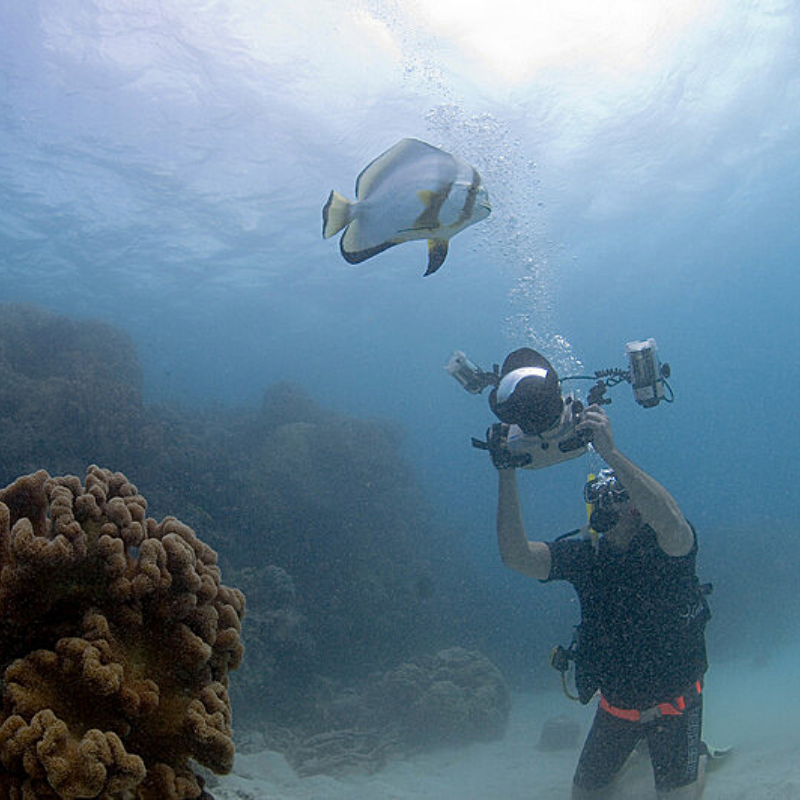
Matt Bowles: My guest today is Gary Arndt. He is one of the top digital travel influencers of the last decade. He’s one of the most awarded travel photographers in the world, and his travel blog, Everything Everywhere, was named one of the top 25 blogs in the world by Time magazine. Originally from Wisconsin, Gary was one of the top competitive speakers and debaters in the United States for both high school and college. He then built and sold a seven-figure business and eventually began traveling the world. Since 2007, Gary has been to over 130 countries on all seven continents and has done nine years of full-time travel with no base. He has visited over 400 UNESCO World Heritage Sites and nearly every national park in the United States and Canada. Since 2009, he has been the co-host of This Week in Travel, an award-winning weekly podcast that covers travel industry news. And Gary now writes and produces a daily podcast called Everything Everywhere Daily, a history podcast that features unique and interesting stories about people, places, and things from around the world. And, oh, by the way, he grew that to over 100,000 monthly downloads in the first year. Gary, welcome to the show.
Gary Arndt: Thanks for having me.
Matt Bowles: So good to have you here. And we should just start off by setting the scene and the fact that you and I have agreed to do this interview as a wine night. So I am in Asheville, North Carolina, this evening in the Blue Ridge Mountains, and I have just opened a bottle of Barbaresco, which is an Italian red wine from the Piedmont region in Northern Italy, made from the Nebbiolo grape, and was actually one of the first four DOCG-designated wines in Italy about 40 years ago. So, it’s tasting pretty good. I’m going to be drinking through that throughout the episode. Where are you tonight, Gary, and what are you drinking?
Gary Arndt: I am in northeastern Wisconsin, and I am drinking a bottle of 2016 Cherry Blossom Pinot Noir from Napa, California. And I had a big box of wine because I’d always get these free bottles from everywhere I would travel, and they just kind of piled up. And I’m drinking this because it had a twist-off cap, and I couldn’t find a bottle opener.
Matt Bowles: I love it, man. Well, let me just start off out of the gate. Since we opened this up with wine, what is your best travel wine experience? Either a vineyard or some type of experience you’ve had in a wine country around the world. What comes to mind?
Gary Arndt: Oh, there’s a couple. As far as vineyards, believe it or not, there are some actually really good vineyards in the south of Switzerland. It’s probably not well known as a wine region, but if you’re on the north side of the lake, it gets the sun because it’s in the south. It’s actually really good, and there’s a whole wine region around there. They actually have a wine festival that they hold only once every 20 years. And they just held it—well, they were supposed to hold it last year, but I don’t know what happened with that. That’s a really interesting area. The best wines I’ve ever had would probably be either in Margaret River. I visited a winery there, and they let me taste a Chardonnay they had. It was like a $100 bottle of wine. It was their high-end thing. It was really good. And then there’s also a varietal that you can only find in the Basque region of Spain called Txakoli. And you can’t really find it anywhere because they don’t export it. It’s only consumed within that region. And it’s what I use every time I have a sommelier at a restaurant and I want to stump them. I see if they’re even aware of it. I know they won’t have it. Now, I remember when I started traveling full-time, I went to Las Vegas with one of my friends, and we had dinner at Picasso’s at the Bellagio. And it was the most expensive meal I have ever had before or since. It was 500 bucks for two people. The menu consisted of the right-hand side or the left-hand side. That was the kind of sommelier, I mean, they had a wine list that was the size of a phone book. I mean, it was crazy. Their wine cellar would be amazing to look at.
Matt Bowles: Well, those are some great regions. The Basque Country is one of my favorite places. I lived in Bilbao for about a month, and probably the most expensive meal I have ever had—which was actually the only three-Michelin-star restaurant I’ve ever been to—was in Donostia, which the Spanish refer to as San Sebastián, in the Basque Country. I believe it has the highest concentration of Michelin stars per square meter of any place in the world outside of, like, Kyoto or something like that. And the culinary scene and the wine scene are just amazing.
Gary Arndt: San Sebastián might be the best food city in the world. When I was there, they had these little dining clubs. They’re primarily for men, and they have these storefronts. One club will usually get it one night a week, and they’ll share it with other clubs. And what they do is they just cook, play cards, and drink. I got invited to one, which is a rare thing, and they made a rabbit and lobster stew, which was really good. And I got to hang out with them. One of the other things I should say I really like, probably even better than wine, is the cider from the Basque Country, where I visited a Sidrería in the Basque Country and really all of northern Spain, but the Basque region in particular. The ciders there are fantastic. And I remember really going out of my way to hunt them down back in the U.S. because they’re very hard to find, but well worth it.
Matt Bowles: Yeah, absolutely. Well, Gary, I want to give our listeners a little bit of context on you and kind of go all the way back and get a little bit of your origin story. Can you talk a little bit about where you grew up? And as you were coming up, I’m curious both about how your interest in travel developed, and I’m also curious about your debating experience because you were such a high-level debater. What were sort of the core skills that you developed for that, and how did those skills end up serving you and providing value later in life?
Gary Arndt: I grew up in Wisconsin, in a very middle-class, blue-collar family. I learned to read very early, basically. And this sounds weird, but I taught myself how to read, basically watching Sesame Street. And I remember the first day of kindergarten, I went there, and they phoned my mom and said, “Mrs. Arndt, we have a problem.” She goes, “What?” They said, “Gary can read.” She goes, “Yeah.” They said, “None of the other kids can read. He’s the only one who can read.” And so, they tried putting me in first grade for a while, but my parents thought it would be a big thing if I was a year younger than everyone else. And so, I was always a little bit different from the rest of my family. I read a lot. You know, there were no books growing up. The only books in the house were the ones I read. And in high school, I discovered the debate team, and I was doing track. And when I discovered debate, I was like, “Screw that. This is my thing. I can be really good at this.” And I was pretty good at it. And most people aren’t familiar with academic debate. If you actually go see some YouTube videos of the finals of the national debate tournament in college, it’s something that you probably won’t understand, mainly because they’re talking so fast. But I also did an event in high school called Extemporaneous Speech. I was one of the top 10 in the country. What that is, you pull a question randomly, and you have 30 minutes to prepare a seven-minute speech. And I did Foreign Extemp, which meant that it was always questions about foreign policy, foreign relations, what was happening in other countries, things like that. There are two different types, foreign and domestic, and foreign is kind of considered the more superior one, in the same way that the Senate is kind of superior to the House. I was recruited to do debate in college. I went to Macalester College, which had won the national tournament the two years prior to me arriving. My coach was the first national champion, actually, back in 1946, when he got back from the war. I had a pretty successful career. And when that was done, I coached for a few years back in high school. Then I had a friend call me up, and he said, “Hey, there’s this thing you should check out. It’s called the World Wide Web.” I remember seeing my first webpage on a 9,600-baud dial-up modem. And he slowly pulled up this webpage from the Library of Congress, and it had pictures, a formatted background, and fonts, which was not what you were used to seeing at the time, right? It was just all kind of block text and stuff like that. I ended up moving up to the Twin Cities. We had an apartment. And while we were doing this, he built a product to easily tie together a database and a website because it was really hard to do in the very early days of the internet. Today, everything’s done that way. But back then, it required Perl scripting. There was no PHP, there was no MySQL, there was no Linux, there was none of this stuff. And so, it was an expensive proposition. You had to get a copy of Oracle if you wanted to use a database, which was like 20 grand. And Microsoft was coming up with this new thing called Windows NT, which would be a low-cost server. You could put it on a normal computer. You could get a cheap database like Microsoft Access. It really changed everything. And this product was called ColdFusion. It still exists today. It’s owned by Adobe. And as he was building this, he had companies coming to him saying, “We would like to have our website running this.” But he didn’t want to get into the business of actually doing websites. He wanted to focus on the product. So, he asked me, “Do you want to do this?” So, I’m like, “Sure.” So, I started building these data-driven websites, and the next thing you know, we had another and another. And I had a friend, so I hired him, and he had a friend, and I hired him. Fast-forward four years later, we’re doing these big data-driven websites for newspapers and financial institutions. I had 50 people working for me. I was 28 years old, and I sold the business to a big international company. And they didn’t have me run the business that I created. They put me in a different office with no one above or below me in the org chart, with really nothing to do. And they were paying me six figures to do this. So, I would show up at around 10 a.m. every day, made it very obvious that I was there, said hello to everyone, you know, be kind of loud. I would surf the internet for two hours. I would then go to lunch and not return. Some of the easiest money I ever made, that’s for sure. And after that, I started a couple of other companies. It was a horrible time because of the dot-com bubble burst. I decided to go back to school for a few years, study geology and geophysics, and decided I did not want to pursue a career in academia. I didn’t really like the environment. I enjoyed learning, but I wasn’t really a great researcher. And then I hit upon the idea of traveling around the world, and I thought, “Yeah, I could do this. I got money saved up, I don’t have a wife or kids, there’s no reason why I can’t.” So that’s what I did.
Matt Bowles: And I know that you started off spending a lot of time in the Pacific Islands, and I would love to hear a little bit about that experience, both in terms of it being your initial region of your world travel and also tips that you have for folks traveling those areas. Because I know you’ve been to a lot of places out there that not that many travelers go to. So, I’d love your reflections on it for you personally, and then also your tips for people who want to travel that region.
Gary Arndt: Yeah, basically my plan was to go west. That was the plan. So, I started in Minneapolis, rented a car, drove to Dallas, took a train to LA, flew to Hawaii, spent two weeks there, learned how to scuba dive in Maui, then ended up going to Tahiti, Easter Island, the Cook Islands, New Zealand, Fiji, Samoa, Tonga, and American Samoa. And I was the kind of guy who would read the encyclopedia growing up or an almanac. I always read about these places. I knew their names, but I didn’t know anything about them. They were just specks on a map. So, I wanted to go see that stuff myself. Also, it can be one of the more difficult parts of the world to travel in simply because flights can get changed. For example, the only time I ever bought a guidebook in my life was for this stage of the trip, and most of the information regarding flights was all wrong. No fault of the author. The airlines just went out of business, and they stopped doing stuff. So that was a little bit challenging. And yeah, not a lot of people go there simply because of the distances involved. You know, they think of all islands with white sand beaches as being kind of the same. So, if they can go to the Caribbean or they can just go to Hawaii, why do they need to go to Samoa? And a lot of these places also don’t—or at least at the time, and I’d still say it’s the case, especially in the Micronesia region—they don’t have the infrastructure for tourists. They don’t get a lot of people who come. I think Micronesia gets maybe 10,000 visitors a year. And the vast majority of those, I think, are coming from Guam, and they’re there on business for military or government stuffs, not tourism. So, it’s definitely a worthwhile place to go. It’s definitely not overcrowded unless you’re going to Tahiti. And it can be kind of expensive to get around, but it can be done affordably as well, if you’re willing not to go to Bora Bora.
Matt Bowles: Well, one of the experiences that you have had that I want to hear about is that you swam in Jellyfish Lake in Palau. And I should also just sort of preface this by saying, for folks, some days I feel like I’m reasonably well-traveled because I’ve been traveling full-time for eight years. And then I go to your blog, Gary, and I don’t feel like I’m well-traveled at all. Although your blog has helped me to identify a number of bucket-list items that I would like to put on my list and start to plan how I’m going to do them. One of which is to swim with the jellyfish in Palau. Can you explain a little bit about what that experience was like and how someone would go about doing that?
Gary Arndt: Surreal. Palau is a very small country, probably the best scuba diving I’ve seen anywhere in the world. And they go out of their way to protect their marine environment more than any other country, by a wide margin, because that’s their economy. Its tourism based on diving. Some of the islands in Palau have lakes in the middle of the island, and these lakes are fed with seawater that filters through the cracks in the limestone. What happened is, a long time ago, jellyfish either came in through the cracks or were deposited somehow. And once they got into these lakes, they were basically protected from predators, and so they basically evolved away their stingers. They’re about the size of your fist, from the size of your thumb to the size of your fist, and there are tens of thousands of them. They basically just hang out in this lake all day, following the sun. And you don’t scuba dive. It’s just snorkeling. You can just see them all pretty much close to the surface. And I grew up in Wisconsin. I never saw saltwater until I was 21, so I don’t know any better. I just jumped in and started swimming around. Most of the people with me were from Australia, and they grew up terrified of jellyfish because they get box jellyfish and stuff in Australia, and those things can be really nasty. So, they’re all showing trepidation and getting into the water, and I’m just swimming around like the dumb American who doesn’t know any better. Turns out I was right. There’s no danger from them. But it’s a very surreal experience. And there are a lot of videos you can see on YouTube taken from Jellyfish Lake. I think there are actually some in Indonesia as well that don’t get as much publicity as the ones in Palau. But it’s definitely something that you should do. And if you do scuba dive, Palau has to be on your list. It’s not cheap. It’s one of the more expensive places to scuba dive, but well worth it.
Matt Bowles: What other scuba dives would you tell people to put on that list? Because I got certified, and I have intentionally tried to go to really epic places. So, I’ve done scuba diving with whale sharks in Thailand, and I’ve done scuba diving in the Galápagos Islands, but I haven’t really done it extensively around the world. I’d love to hear what have been your top dives that you’d put on people’s radar.
Gary Arndt: Palau would have to be at the top of the list. I did it off the shore of Lanai in Hawaii. They have some pretty neat caves that are well worth it. I did a couple of dives in Fiji in the Yasawa Islands, and the coral there is exceptionally bright and colorful. A lot of that you don’t need to dive to see, though. You can experience it just snorkeling. Papua New Guinea: I went to the island of New Britain, and I stayed at a dive resort. We went out several times and did the deepest dive I ever did. We went down to 45 meters, which is a little below where you want to go for recreational diving. The limit is usually about 40 meters, but they had some pygmy seahorses down there. We also saw a Japanese Zero that was in the water from the war, and you could actually see right into the cockpit and everything. The other really cool thing was in Alexandria, Egypt, where I was able to dive at the lighthouse. The Lighthouse of Alexandria was one of the Seven Wonders of the Ancient World, and parts of it are still there underwater. It collapsed around the year 1500 from an earthquake. The parts of it that were on land were reused to build a fort, which is still there, called Fort Qaitbay. The rest of it is all in the water.
Matt Bowles: That’s amazing. Well, I also want to ask you about some of your really cold-weather travel, let’s call it that. You have actually hung out with and photographed polar bears. Now, I’ve been on some safaris and I’ve seen some cool animals, but I’ve never seen polar bears in the wild. Can you talk about what that experience was like for you, where that was, and where people could go if they wanted to see polar bears?
Gary Arndt: Okay. The best place to see polar bears in the world, bar none, is Churchill, Manitoba. If you look at a map of Hudson Bay, there’s this little part that juts out, and that’s the town of Churchill, located on the Churchill River. The reason it’s the best place is that the freshwater coming in from the Churchill River and the currents of Hudson Bay, which go counterclockwise, meet at that point. And so, it decreases the salinity of the water. You have cold water coming in from the north, so that’s the first part that freezes. The polar bears—I’ve done two trips up to Churchill, and I’ve seen other polar bears, but basically, they don’t really do much during the summer. They just live off the fat they accumulated. So, they’re waiting to go out and hunt seals, which are their primary and pretty much only food source. But they can’t do that until the ice comes in. So, at Churchill, that’s where they sit and wait for the ice to come in, and you can go out. They have these things called tundra buggies, which are a cross between a monster truck and a school bus. So, the bears can come right up. They can stand on their hind legs and not reach any of the people inside. And one day, we saw 43 polar bears, which was an enormous number.
Matt Bowles: Wow. You’ve also been dog sledding in the Canadian Yukon, and you’ve crossed the Arctic Circle. Can you talk about some of those experiences and how that was for you?
Gary Arndt: Yeah, I got to go dog sledding a couple of times. I was up in Whitehorse to photograph the Yukon Quest. The Yukon Quest is like the Iditarod, except it’s harder and it’s a longer race. It’s a lot more mountainous, and there are fewer checkpoints where you can get supplies. It’s kind of the mushers’ race. And it was very interesting because these people who do sled dogs don’t make a lot of money. You know, if you’re the greatest sled dog racer in the world, you might make enough to cover dog food costs and things like that. So, it’s not a very lucrative profession to be in. So, we went up there and did that. And dog sledding is really a blast. The dogs love to run. There’s a brake, but there’s no gas pedal. There’s no need for one. And if you fall off the sled, the dogs won’t stop. They will just keep running. So that was a great experience. Also, when we were up there, we were in Whitehorse for the start of the race, and every year it’s from Whitehorse to Fairbanks. They’ll reverse it every year. So, one year it starts in one city, and the next year it ends there. But the midpoint is Dawson City in northern Yukon. I’d been up there previously in the summer, so we were up in the winter. And there’s a mandatory 48-hour layover that all the teams have to have. So, when they check in, that’s when the clock starts. Forty-eight hours. It’s an opportunity for the mushers to sleep and for the dogs to rest and get fed. They get checked out and everything. And one of the guys I saw was there—I got to talk to him briefly in Whitehorse—was Lance Mackey. Lance Mackey was a four-time winner of the Yukon Quest and a four-time winner of the Iditarod. And he’s the only person to have ever won both races in the same year. He did it twice. Some people thought it was impossible. Well, the year I was there, he had to drop out because his dogs got injured. And I have never seen anyone so depressed in my life, at the bar, just getting hammered and shit-faced because he felt so bad about having to drop out. And also, you know, these people, their only friends a lot of the time, year-round, are these dogs. They live in the middle of nowhere in Alaska or up in northern Canada, and it’s the dogs that are their companions. So, if something happens to them, they really take it personally.
Matt Bowles: Wow. Well, another thing that you have done that is amazing is you’ve visited over 400 UNESCO World Heritage sites. Can you explain, I guess, first of all, what a UNESCO World Heritage Site is, and then talk about that experience and why you started structuring a lot of your travel around seeing those sites?
Gary Arndt: Officially, they are cultural or natural places recognized by UNESCO as outstanding contributions to humanity. Unofficially, the way I describe it is it’s the Hall of Fame for national parks and historic sites. So, there are 426 or 427 sites in the national park system right now, and there are 22 World Heritage Sites in the US, to put that into perspective. Early on, when I started my travels, I went to Volcanoes National Park in Hawaii, and I saw a sign that said it was a UNESCO World Heritage Site. I didn’t know what that was. So, I got home that evening, went on my computer, and looked it up. I thought, “Huh, well, I’m going to be going to Easter Island. That’s a World Heritage Site.” And then I was in New Zealand, and I said, “Well, they have two World Heritage Sites, so maybe I’ll stop and see them.” So, along the way, I stopped at one, Tongariro National Park, and then I went to Milford Sound, which was another. And then the next one on my list, I was like, “Well, I’m going to go to the Solomon Islands. East Rennel was a World Heritage Site.” To this day, it’s probably the least-visited one I’ve ever been to. I really had to go out of my way to get there. It was difficult, you know? It’s an outer island. I asked them, “How many visitors do you get a year?” They said, “Ten.”
Matt Bowles: Wow.
Gary Arndt: I landed on one. It’s a raised coral atoll, one of the largest in the world. It has a cliff about a hundred meters tall that surrounds most of the island, and on one-third of the island is this big lake. It’s a brackish-water lake. So, you land on one end of the island on a grass strip, and then they had these pickup trucks that took us to the other end. We had, I shit you not, eight flat tires on this 20-mile trip from one end of the island to the other, and they had no spare.
Matt Bowles: Wow.
Gary Arndt: And they fixed it every time. The tire damage happened because it was going over coral, basically raised coral. So, it was… And they had loaded this with so many people who had come back from Honiara to the island. We’re all on this truck. It was this tiny little Japanese pickup truck that had way too many people and too much stuff in it. And it was an incredible experience. It was the most isolated I think I had ever really felt traveling, because it wasn’t just that I was on a remote island in the middle of the Pacific Ocean. But if anything happened, if I wanted to get back to civilization, the act of doing so would have been really, really hard because it was in the middle of nowhere. I had one of the best meals of my life, followed by one of the worst meals of my life in quick succession. The first night I was there, they had fresh coconut crab and tilapia that they caught in the lake. And then the next morning, it was a package of ramen noodles with no flavoring and white bread that got smushed during the trip there.
Matt Bowles: That’s amazing. What are some of the other highlights of the UNESCO World Heritage Sites? Obviously, some are incredibly famous, they’re big tourist destinations, and people know them. But some of them— which ones would you say were really epic and amazing, that maybe you’d put on people’s radar, places they might not have heard of or that might not be at the top of their list?
Gary Arndt: Nahanni National Park is one of the best national parks in the world. Almost no one knows about it because it’s in northern Canada, in the Northwest Territories. Most Canadians don’t know about it, but to give you an idea of its significance, in 1978, when they created the first World Heritage Sites, there were 12 of them. They included the Galápagos, they included Yellowstone, and they included Nahanni. It’s really up there, right? But the thing is, there are no roads connecting it to the rest of the world, so you have to fly in by float plane. And Nahanni gets 800 visitors a year. That’s it. But it really is one of the most incredible places on Earth. I drove all the way up to Fort Simpson, Northwest Territories, which is a hell of a drive, to fly in. And I also visited Wood Buffalo National Park along the way, which is mostly in Alberta, but also in the Northwest Territories. To give you an idea, you can drive there, but it only gets 1,500 visitors a year. Most of those are people who live in the city of Fort Smith. It’s the second-largest national park in the world by area, second only to a site in Greenland. And when I was talking to the people at the tourism board in Alberta, I was the first journalist who ever wanted to go there. Even though this is one of the largest national parks in the world, no one cared to go.
Matt Bowles: Wow.
Gary Arndt: Yeah. And a lot of my travels, I end up going to a lot of these places that are kind of out of the way. And I’d say 90% of the time, it’s a pleasant experience. I discover something that I didn’t know about just by going there because it’s a UNESCO site. There are some duds, but for the most part, it’s brought me to places that I probably never would have known to visit before.
Matt Bowles: So, Nahanni National Park—we’re definitely going to link all these up in the show notes, by the way, so folks can just go to one place and check out your recommendations. Gary, are there any other UNESCO World Heritage Sites that we can put on that list as well that you’d encourage? Maybe they’re less famous or less well known, but you’d say people should definitely see them.
Gary Arndt: Sukhothai is one. A lot of people go to Thailand. They go to Bangkok, maybe they go to Chiang Mai, they go to Phuket. But between Chiang Mai and Bangkok is Sukhothai, which is the former imperial capital of the Kingdom of Siam. Everyone skips it over, and it’s great. I would say it’s like if you’ve ever been to Angkor in Cambodia, it’s smaller, but it’s nicer. They keep it up, they mow the lawn, and you can rent a bike. It’s a very pleasant experience, with lots of temples all over the grounds for you to see. So many people never bother to go there. The town of Padua in Italy is a 20-minute train ride from Venice. Everybody goes to Venice. Nobody goes to Padua. It has the oldest botanical garden in the world. It has the largest public square in Europe. It has a huge cathedral with the remains of St. Anthony, and it has the Scrovegni Chapel, which is one of the greatest works of art in Europe. And no one bothers to go, and no one knows about it. And I’ve always said that the problem with over tourism is not that there are too many tourists; it’s that everyone is visiting the same place. I think it’s mostly ignorance, some of it willful and some of it not, because they don’t know anywhere else. They have it so fixed in their mind. They grew up with images of being on a gondola in Venice or being in the presence of the Eiffel Tower in Paris because that’s what they see. It’s been hammered into their heads in movies and television and everything else. They don’t know anything else. I mean, I’ve had discussions with people who are going into the Pacific, and I’ve been to a lot of the Pacific, and they have seen the overwater bungalows in Bora Bora and they just must go there. Nowhere else. They must go there because that’s what they saw. I tried telling them, “Well, you know, there are some great places you could go to. Pohnpei, for example.” Nope, there has to be that because that’s all they know. And the weird thing is, I probably have more places I want to visit now, after having spent a decade and a half traveling around the world extensively, than I did when I started, because I’m aware of more places. Having been to a lot of places kind of opens up more. A good example of this: I started this podcast. It’s a daily podcast, and one of the first questions people have asked is, “Are you going to run out of ideas?” Today, I’ll be recording show number 352. The list of show ideas just hit 400, and so I’m adding far more ideas as I come across stuff that I think would make for good shows. So, it just keeps growing. And the same is true with places to visit. The more you visit, the more places you learn about that you want to visit.
Matt Bowles: So, let me ask you this, Gary, what is your approach to learning when you travel? How do you structure your experiences, including trip preparation, historical research, and that kind of stuff, to optimize your learning experiences as you travel to new places?
Gary Arndt: For your typical “you’re visiting a cathedral” type of place, if it’s possible, I try to get a guide for the place you’re visiting. It’s not always possible. Sometimes they do free tours. Sometimes you can follow another group. That’s kind of where there’s someone describing things, and you can just sort of stay on the outer edge and pay attention to what they’re saying. But the reason is that if you don’t have someone to put everything in context and explain it, you run into a problem a lot of people have. They go somewhere, and it’s just old stuff. Basically, it’s, “Oh, here’s some old stuff. There’s some old stuff. There’s a cathedral here, a cathedral there. It’s all the same.” And the only way you can avoid that approach is if you get the history and the backstory behind it. Why was this cathedral built? Who built it? What was the impetus for building it? How long did it take to build? What’s special? What relics do they have? Because every cathedral has different relics. That was the whole drawing card, right? There’s something architecturally significant, probably, about the building. It seems like there are a lot of cathedrals in Europe, and their kind of are, but not a ton. And so, you know, the building process is going to be different. To understand that backstory, you realize that every cathedral is not the same, that there’s something different about it, and that there’s a story behind it. And the city and the bishop who was arrogant enough to want to get this done, to make it his legacy, or the king or the prince or whoever raised the funds for it, and then it stopped for 100 years because there was a war, and then they started it back up, whatever it might be, understanding that story is important. Too often, I go to these places and I see people, and they just walk around. It’s like, “Oh, old stuff.” We’re supposed to be here to get the cultural experience. It’s the same in a museum. They just walk around, “Oh, this is art, and I’m supposed to have a profound experience, but I don’t understand it.” Having someone, if you’re not familiar with these sorts of things, point it out to you helps. I’ve done a lot of reading and research on Roman history, to the point where I could probably go to a given Roman ruin and understand what a lot of it is there for on my own. But even still, I would want to have someone with me who knows the specifics of that place, who can point things out or even just say, “Oh, check out this thing over here. You might have missed it.” Like, if you’ve ever been to Pompeii in Italy, you can see, on the corners of some of the buildings, signs pointing to the brothel. And it’s really just a phallus carved in the stone. And it’s very easy to miss. You’ll notice that in the streets there are these stepping stones to get across. That’s because the streets were completely filled with filthy mud and human waste. The carts would go through it, but you would never want to walk in that stuff. And that’s something you don’t see in the movies. There are all sorts of these little things and things they keep discovering and finding to give you an idea of how they lived. There’s a great villa in Pompeii where there’s a mosaic on the ground that says, in Latin, “Beware of dog,” which is very similar to the kind of sign you’d see today. So, all of that stuff, I think, brings it meaning, and it always helps if you have someone who can do that. In fact, one of the things I’m going to be doing, probably next year, is running tours for my followers. I’ve run tours in the past, and I’m going to be running some more next year. I was thinking through this, like, well, how can I do something different? Because normally you have a group tour, and what you do is you fly into city A, stay there for a few days, then you go to B, to C, to D, and then you end up in some city and everyone leaves. That’s kind of the way it works. And I was thinking, well, what if you could do something for people who are really geeky and nerdy? Let’s say you go to Rome. You’re going to go to the Colosseum, throw a coin in the Trevi Fountain, sit in line at the Vatican, and that’s probably your Rome experience. That’s fine. But there’s a lot of stuff in Rome that no one ever sees that’s really cool. If you go to Ostia Antica, which was the port city of Rome, it’s 45 minutes away. It’s an easy, quick train ride, and hardly anyone goes there. That’s about as good as Pompeii. You can go up into the hills just outside of Rome, 45 minutes away in Tivoli, and there’s Hadrian’s Villa up there. I was there, and I basically had the whole place to myself. Nero’s palace was the largest building ever in the ancient world, and it was one of the reasons why people hated him so much. There’s part of it that’s still there. It got buried, and you have to get a special tour to go see it. The Vatican and St. Peter’s Basilica were built where they were because of the tomb of Peter. And if you go underneath, it’s under the main altar. They discovered this in an excavation after World War II. There’s a Roman cemetery under the altar in the necropolis. It’s not the grotto where a lot of the popes are buried, but the necropolis. And they only let about eight people in at a time, and it’s very hard to get a ticket. So, there’s more of this stuff all over Rome that people never see. It’s like, what if we just did a tour? You drop your bags in one room, and you do not leave that room for the duration of the tour. We go to the restaurant where Caesar was killed in Pompey’s Theater, and we can actually see all this stuff. We can get guides who are PhDs in history or art history to really have this explained. So that’s what I think I’m going to be doing going forward, leading those kinds of tours.
Matt Bowles: That is awesome, man. So, Gary, when you reflect back on all your travels since 2007, what would you say are the main ways your travel experiences have impacted you over the years?
Gary Arndt: You know, before I started traveling, I had a 3,000-square-foot house on a lake. It was very nice. I don’t ever see myself doing something like that again. You know, I lived out of a bag for a very long time. I’m very happy now. I simplified my wardrobe. I buy some gray T-shirts off Amazon. I have some socks and underwear I get from Amazon, and when they get old, I throw them out. Then I order the exact same thing on Amazon. It’s kind of the Steve Jobs, Mark Zuckerberg approach to a wardrobe. You just wear the same thing every day. It’s something you never need to worry about. So that’s been simplified. I have a greater appreciation for the role that culture plays. You know, when you grow up in a certain place, you grow up in that culture, and you don’t know anything else. It’s like a fish in water, right? You don’t know if the fish knows about anything else other than that it’s in water. And when you get away from it, you realize how powerful it can be. It’s not things like the food or the dancing or the way people dress. Those are trappings of culture. The real culture is in people’s heads. It’s a way of thinking or a set of assumptions that you go by, and that can differ radically. I remember I was in Samoa, on the island of Savai’i, which is kind of the second island. We were driving around, and I noticed there wasn’t really any commerce. There was no evidence of any stores, shops, businesses, nothing. It was village. Each village had maybe a little kiosk where people could buy things, and that was it. There was no evidence that there was anything else. And we asked a guy who was a cab driver, “What’s the deal? There’s nothing here.” He explained, “Well, you know, I have to give 90% of what I make to my village and my family. That’s just what you do.” That’s not law. It’s just the cultural norm. And it’s a system that probably worked great in the 19th century and before. So, it’s very hard to get ahead. It’s very hard to start a business. So, what most Samoans do—I shouldn’t say most, but a lot—they’ll go to New Zealand or somewhere else and find jobs, and then they send money back home. And this is actually true in a lot of the world. You know, I’m talking to people in India, and one of the things is that Indians who leave India tend to be quite successful, more so than they are in India. And one of the reasons, apart from government corruption and everything else being a problem, is that if you start a business and it starts doing well, your mother or your aunt will come to you and say, “Well, your cousin could really use a job. Could you do that?” And suddenly everyone starts asking you, “We could really use the money. We could use this.” And those are all things that aren’t laws, but they’re cultural drains on growing a business. But if you leave, you don’t have any of those constraints, right? You’re in America or Britain or whatever. You have a kind of freedom, and you can still send money back and support your family, but it’s not in the form of constant asking, giving people jobs, or things like that. So, here’s the other story. I told you the story about the guy in Samoa. I was in Hong Kong. This was in 2007. I was walking around one night, and I walked past a Burger King. Okay, fine, they have fast food. The difference was that the front window of this Burger King was filled with flowers, like it was a funeral. And I was like, “Why are there flowers in a Burger King?” I didn’t understand this. So, I went into the Burger King to check it out, and I started looking at the flowers. They were mostly in Chinese, with cards attached to them. Eventually, I found one that was in English, and it said, “Congratulations on your grand opening.” It was a celebration. Starting a new business in this culture was a reason for celebration. It was something you would send flowers for. And it’s a very different attitude from what you have in other parts of the world. Again, it’s not a law. It’s a cultural thing. It’s just the set of assumptions and beliefs that we all work under. And it’s very hard to get yourself out of a cultural bubble. Even in the US and other developed nations, it’s not just that we’re all under the same bubble, but we may all have separate little bubbles. There are entire parts of the country that don’t talk to each other, and they live under their own set of beliefs and don’t communicate with other people. Getting out of that can be really difficult. And I think that’s one of the biggest advantages of traveling.
Matt Bowles: Now, Gary, you have spent time in a lot of very different and diverse cultures over the years. What tips do you have for travelers on the ethics of traveling to other cultures and how to be a more thoughtful and respectful traveler?
Gary Arndt: I practice something that I call travel conservatism. It’s not political conservatism. It’s just a way of behaving. Never wear anything with writing on it. Don’t wear a sweatshirt or a T-shirt that has anything. Just wear a solid color or a button-up shirt, whatever it is. All right? Don’t do anything to make you stand out. Don’t get into petty arguments. I was at an internet café in Bali once, and this woman gets into this big fight with the woman at the counter over what I learned was the equivalent of 10 cents. It wasn’t worth it at all. And the woman who was fighting was Australian. I think maybe they don’t come from a tipping culture, but I don’t think 10 cents is worth getting into a fight. It’s just not worth your trouble. If you go to a restaurant and you order beef and they give you chicken, most of the time I’ll just have the chicken, unless it was very clearly some sort of scam and a bait-and-switch type of thing. And those things do happen. I’m going to let it slide if it’s an issue of communication. Just don’t get worked up about things. Things are going to be late; your flight is going to be late, and you may have to stand in a line. Those things are going to happen. There are a lot of people who just get worked up about things, and they demand to see the manager, or they’re a Karen or something like that. You just have to kind of go with it, and stuff will work itself out. Don’t get uptight about everything. And I think the longer you travel, if you’re on a two-week trip, I can understand why people think, “I’m taking time off from work, this cost me a lot of money, I don’t want to waste my time.” But you still need to accept the fact that things are going to work a little bit differently and maybe a little bit less efficiently when you travel abroad.
Matt Bowles: That’s really good advice. I agree. Gary, at this point in your life, after all your travels, in what ways do you see the world differently than you did before you started traveling?
Gary Arndt: I’m less concerned about material stuff, and I see the importance of culture more. I’m more willing to just, you know, live and let live. I don’t think it’s radical. I think if someone met me before or knew me before I started traveling and knew me now, I’d fundamentally be the same person. I’ve just had more experiences and seen more things. One of the things I always have to watch out for when I’m talking with people is that I don’t want to turn into that guy. You know, you’re having a conversation about something, and it’s like, “Well, actually, when I was in Botswana…” and you come off like a pretentious douchebag. And I found myself doing that a lot because, at one point, when I came back, that was all I had done for a decade. So, the only things I had to talk about were these things. And I realized, well, I’d be talking to someone, they had no idea, and constantly bringing this stuff up was a little bit annoying. So, I actually learned to shut my mouth in a lot of cases as well. And a shocking number of people just don’t care. So, I learned that as well.
Matt Bowles: Well, I definitely want to talk to you about the podcast as well as the blog and the photography. So, let’s jump into that, and maybe let’s start just a little bit back with the blog and the photography, and then your new venture with this particular podcast. Can you talk a little bit about your tips for building a great travel blog? And if you feel that, post-pandemic, it’s still a good opportunity for people to start a travel blog and if there’s meaningful opportunity to build and monetize it, or if you think there are alternative things that would be better to do than a travel blog at this point.
Gary Arndt: I would not start a travel blog right now. The end. It’s a very different thing from when I started. Facebook, social media, and Google have basically killed travel blogging. All travel blogging is now is SEO. That’s it. You don’t have to travel. In fact, one of the most successful travel websites out there right now is nothing more than machine-generated keywords, with “15 things to do in X,” “15 things to do in Y,” “15 things to do in Z.” If you go to the front page, that’s all it is. Every article is exactly the same. The photos are from Photobucket. They just research it by doing searches online, and it gets tens of millions of page views a month. I don’t even want to mention the name of it. I used to follow about a hundred travel blogs via RSS to see what everyone else was doing, and eventually that’s all anyone was doing. Everyone was writing the same article. That’s all it is. It’s all crabs in a bucket trying to rank for SEO, and your travels, your stories, your opinions, your expertise—none of those matters. None of it matters. And that’s if you go to any of these travel blog groups on Facebook or anything. I was in a Clubhouse room where people were talking about it, and there were a bunch of these newer bloggers who had no clue who I was, and I didn’t know who they were. They were just giving the same advice people were giving seven or eight years ago. That’s all it is. You get search traffic, you get enough to get on Mediavine, and then you can do some affiliate ads, and that’s it. If you want to do that, go for it. I’m very disillusioned with the whole thing at this point. Podcasting is far closer to what blogging was when I started. My blog was my social media. I’d write an article, write a clever headline. It wasn’t SEO-keyword-driven. I’d use a lyric from a song or something just to be clever, and then I’d write my thoughts about wherever I was. People would leave comments because they came to my site every day. And that’s what it was. Social media killed that aspect of it. But with podcasting, there’s no company that runs podcasting, right? Spotify and Apple may have large market shares, but there’s not one algorithm that controls podcasting because audio is a very difficult thing to control. Even with video on YouTube, you still have one company that runs everything, and every week or so, there’s always some YouTuber who gets banned by accident for something innocuous, where they can take it all away. And if you look at the effective CPM rates you’re getting on YouTube, it’s horrible. It’s absolutely horrible. You can make an equivalent amount of money with podcasting for a far smaller audience and create far deeper connections than you certainly can through blogging. And just look at the competition. The number of travel podcasts is several orders of magnitude smaller than the number of websites because there’s a higher barrier to entry. Doing an audio show and editing it is just harder than sitting down and writing and regurgitating whatever. Everyone has a smartphone in their pocket now where they can take photos, but very few people want to get into podcasting. And I’m sure you’ve seen the stats. There were a ton of podcasts launched in 2020 because everybody was at home. Eighty percent of them were dead before the year was out. Most podcasts don’t make it to the seventh episode. When I decided to launch a new show, you start a new venture, and it’s very easy to get caught up in the dream of success. You envision what it’s going to be like when you’re successful. I didn’t think of that. What I envisioned myself doing was sitting at my computer every day for several years, which is not the sexy part of doing it, but it’s exactly what you have to do if you want to be successful. But, yeah, I think I created a business plan when I started. I knew exactly how I was going to do it, and right now, I’m just executing on it.
Matt Bowles: Can you talk a little bit, Gary, about the biggest leverage points you’ve used to grow your audience? I know you’re doing a daily show, so you’re obviously putting out a lot more episodes. And for people who subscribe to your show, they’re listening to seven episodes a week instead of one episode a week for a weekly show. So, frequency is one aspect of it. But in addition to that, can you talk about what you’re doing to build the audience for your show and what your business strategy has been to grow your audience at the speed that you’ve done? Because in less than a year of this podcast, you’re getting over 100,000 monthly downloads, which is really impressive. Can you talk a little bit about how you did that?
Gary Arndt: So, I’ve built a blog that’s been pretty successful. I’ve grown audiences on Twitter, Facebook, and Instagram, six-figure audiences. I’ve got verified accounts and everything. One thing I’ve learned is that you build an audience on a platform from within that platform, meaning if you want to grow a podcast, you need to find people who listen to podcasts. That sounds like a tautology, and it kind of is. But putting a link on your website is really not going to do much. Even social media promotion is really not going to do much. What will do something is appearing on other people’s podcasts, like yours. That’s why I have a standing policy: I will never say no to an interview request, ever. I don’t care how small your podcast is. I don’t care if it’s brand new. I’ll take the time. If you thought enough of me to ask me to be on your show, then sure, I will take the time to do that. Maybe that’ll change in the future, but as of right now, I’m happy to do that. I promote my show on… I’ve been buying advertising on podcast apps like Podcast Addict, Podcast Republic, Overcast, and places like that, where I know 100% of the people who are going to see it are podcast listeners. Flat out, that has been fairly successful. And what you do is you just calculate the value of a subscriber. So, if your primary revenue model is advertising, it’s very simple to calculate. All you do is calculate the RPM for a podcast episode, which is just adding up all the CPMs for all your ads. So, for my show, I figured $40 for a $25 main spot, and then I could always throw on a $15 post-roll or something else. I know I can get more because I’ve already talked to people who said that once my traffic gets to a high enough threshold, they would have me in their network at a $50 CPM. Plus, I could do stuff on top of that as well. So, I could conceivably get $60 to $75. But, okay, take that. Then you take the number of episodes you produce per year, and then you want to divide it by 1,000. So basically, if you’re doing a weekly show, that’s going to be about 5% of your RPM as the value per subscriber. I’m using 5% to make the math easy. Assume 50 episodes a year. You take Christmas off or whatever. So, let’s say you had a $50 RPM. Your value per subscriber would be about $2.50. So, for me, because I’m doing a daily show, that value is around $14. I saw Jordan Harbinger, and this is the other thing I’ve seen people talk about when it comes to growing your podcast. I just figured this out, and all the people who talk about podcasting—no one, I’ve never heard anyone mention this yet. It’s the people who actually have big podcasts. When I’ve heard them do interviews, they all know the number. That’s the value of their subscriber. I just saw something where Jordan Harbinger said, “Yeah, it’s $20,” because he has a longer show. He does two or three a week, and $20 makes about sense. So, when you’re buying advertising, you want to be able to convert. I can get new subscribers somewhere between 50 cents and $2. So, I can get a $14 subscriber for two bucks. Well, I can do that all day. There is a period when you’re first starting out, however, where you’re in kind of a no-man’s-land, where no one wants to sell you advertising until you get to a certain threshold. So, there is an investment where you’re not going to see a return immediately, and that’s fine. It’s just like any other business, right? You start a restaurant; you have to buy tables and a kitchen and all this stuff before you open the doors. And it’s not an enormous amount of money. You could probably get to that escape velocity of about 5,000 listeners per show, spending about $5,000, maybe in promotion. I’m also experimenting with Reddit ads. I’m going to start experimenting with Quora. Who knows what Facebook’s going to be doing? They just launched some stuff. But basically, I’m searching for people who I know are podcast listeners. Going forward, I may end up buying ads on other shows where I think there’s going to be a similar audience, either putting an ad for my show in the ad slot or maybe doing a full feed drop where they put an episode of my show in their feed for a few days before they delete it. That’s the secret. And if you look at what the major networks do, like Wondery and iHeartRadio and stuff like that, they launch a new show by promoting it on their other shows. They promote their podcasts on podcasts, and it works incredibly well. They’re able to launch new shows out of the gate with many thousands, if not tens of thousands, of new listeners by doing it off the backs of their other shows. And if you’re an independent podcaster, you just need to work with other independent podcasters to do that promotion.
Matt Bowles: That is awesome advice, Gary. I appreciate you breaking all of that down. Let me ask you one more question, and then we’ll move into The Lightning Round and wrap this up. Can you talk about the significance of personal brand building? Because one of the things that strikes me is that you’ve been incredibly successful at building a personal brand and have been able to transition from a social media platform to a blog, to a podcast, and all these different things. Can you talk about any tips you have for building an effective personal brand?
Gary Arndt: Yeah, I guess if you’re going to have a brand, it’s just, everyone talks about authenticity, yet so many people who talk about authenticity are just fucking fake. You really have to be yourself. If you’re seeing what other people are doing, and that’s successful, and you try to do what they’re doing because it’s successful, you will not be successful because you’re just doing what everyone else is doing. You cannot separate yourself from the crowd by emulating the crowd. And that is exactly what most people are trying to do. I see it all the time on Instagram, where they see a photo that does really well, and so they try to recreate that photo. Oh, the internally lit dome tent under the Milky Way photo, the “my feet sticking out over the beach” photo. They’re all kind of the same, and there are certain tropes that work very well. They just repeat these types of things because they see everyone else doing it, and they want the likes and the adulation. But I don’t think they’re necessarily beginning to get the respect. And we confuse popularity with authority and expertise.
Matt Bowles: That is an awesome place to bring this portion of the interview to a close. And Gary, at this point, are you ready to move into The Lightning Round?
Gary Arndt: Let’s go for it.
Matt Bowles: Let’s do it. All right. What is one book that has significantly impacted you over the years that you’d most recommend people check out?
Gary Arndt: Dune. And read it before the movie comes out if you haven’t seen it.
Matt Bowles: What is one travel hack that you use that you can recommend to people?
Gary Arndt: This is going to sound dumb, but I’ve been burned by it many times. Always carry a pen with you when you fly. I can’t tell you the number of times I’ve landed somewhere and you have to fill out some sort of immigration card, and they don’t have any pens, and they don’t have any on the flight, and then you’re stuck there, the last person to go through, waiting for some sort of pen or something to fill everything out. Just have a fricking pen somewhere on your person. It’ll save you a lot of problems.
Matt Bowles: I agree with that. That’s a really good one. Gary, who is one person currently alive today that you’ve never met whom you would most love to have dinner with? Just you and that person for an evening of dinner and conversation?
Gary Arndt: Philip Glass, the composer.
Matt Bowles: Awesome.
Gary Arndt: He’s in his 80s now. He had a fascinating life. He traveled the Silk Road. I’m a big fan of his work. I don’t know if I’d actually want to meet him. I think you never want to meet the people you look up to because they’re almost always going to be disappointing. But I think I would like to meet him sometime. I think that’d be great.
Matt Bowles: Awesome. Knowing everything that you know now, if you were able to go back in time and give one piece of advice to your 18-year-old self, what would you say to 18-year-old Gary?
Gary Arndt: Travel sooner. Don’t wait so long.
Matt Bowles: That’s awesome advice, man. I love it.
Gary Arndt: If I had started traveling right after I sold my business, I’d have been doing this way before everyone else. I think you’d be in a very different situation today. I probably waited too long to start doing it.
Matt Bowles: Awesome. All right, Gary, of all the places that you’ve been to, what are your top three favorite travel destinations you’d most recommend people check out?
Gary Arndt: South Georgia Island has to be number one. You can’t fly there. You have to take a ship. Usually, it’s on the way to Antarctica, but South Georgia is usually the highlight of the season for the Antarctica cruise. It’s far better than Antarctica, even though Antarctica is kind of the sexy destination because it’s a continent. South Georgia is actually… Everyone I know who’s been there has kind of said the same thing. I’ll go with number two, Torngat Mountains National Park, because I already mentioned Nahanni. Torngat Mountains is at the northern tip of Labrador. Again, it only gets about 800 visitors a year. It’s a national park that’s run jointly by Parks Canada and the local Inuit community. There are fjords in the park. You can see polar bears. It’s just an absolutely amazing place. They have a base camp you can stay at, with these little geodesic dome huts. That’s absolutely fantastic. I’ve been told they actually have cell service out there now, so you can actually use your phone. Oh, boy. For the next one, let’s go with northern Ethiopia. The Tigray region has been suffering through a conflict for the last year. Everything I’ve heard about it has been very bad, with lots of killings and murders, but it’s a fantastic place to visit. In Axum, the Danakil Depression is one of the lowest points on Earth, in the East African Rift, and one of the hottest and lowest places in the world. I almost died when I was there. But now that I know what I’m getting myself into, I could go back in a heartbeat, now that I know what it entails. And Ethiopia is an up-and-coming country. I think it’s probably a little bit better off than a lot of parts of Africa. And I think with the new dam they’re going to be building, there’s going to be a lot of growth in Ethiopia over the next 10 years. So, I think it’s definitely an up-and-coming country. So, I’ll go with those.
Matt Bowles: Awesome. All right, Gary, last question. What are your top three bucket-list destinations, places you’ve never been that are currently the highest on your list and that you’d most like to see?
Gary Arndt: I will go with the Faroe Islands. I have never been to Peru, so going up into the Andes and seeing Machu Picchu is one of the big holes on my list. And I have technically been to the People’s Republic of China, but I’ve been to Hainan Island, and I haven’t seen most of the country. So, I’ve never been to Beijing. I’ve never been to the Great Wall. I’ve never been to anything really in China. So, there’s a whole lot to see in China. And Russia as well. I’ve been to St. Petersburg, but I’ve not gone really anywhere inland. And the issue with Russia is just that the visa is such a pain in the ass that I keep waiting for some sort of future change that could make that easier, but that never seems to happen.
Matt Bowles: Well, I got a 30-day Russian visa in 2019. I got it in the U.S., went into the embassy, got the 30-day visa, and it was just an unbelievable experience spending 30 days in Russia. I split the first two weeks between St. Petersburg and Moscow. You know what St. Petersburg is like. Moscow is also unbelievable. And then, for the final two weeks, I took the Trans-Siberian Railway from Moscow across Siberia, went to Lake Baikal, visited the different Siberian towns, and then went down over the border to Ulaanbaatar in Mongolia. And then from there, we went across the Gobi Desert and all of that stuff. And there’s so much amazing stuff to see in Russia. So, the 30-day visa for Americans, anyway, is definitely the way to go. Other people can get longer visas, but it was completely amazing on every level. So, all right, Gary, I want you to let people know at this point how they can find you, follow you on social media, connect with you, and check out all of your amazing content. First of all, your photography is completely epic and insane. I want everybody to go check out your photographs from around the world, check out your blog, and also, for sure, listen to your new daily podcast, which I have really been enjoying. First of all, it covers super interesting topics, and they’re all completely different. So, every day, I never know what it’s going to be. And it’s always super fascinating and unique, and it’s short, so it’s maybe 10 minutes of your time, and you learn a really substantive bit of history about something that’s super interesting. So, I definitely want folks to be able to come over and subscribe to your podcast as well. So how should people find you and come into your world?
Gary Arndt: Wherever you are listening to this podcast, you can also listen to Everything Everywhere Daily, and that’s really what I’m promoting. Other than that, you can find me wherever. I think I’ve posted two photos to Instagram in the last six months. I don’t really do a whole lot on Twitter anymore. Everything’s really kind of on the podcast right now. But, yeah, as soon as I’m done talking to you, I’m finishing up the next episode, which is about the assassination of William McKinley. Yesterday’s show was on the history of video games, and before that, it was the voyages of the Chinese explorer Zheng He, who assembled a fleet of ships that were far larger than anything Europe ever produced, 100 years before the Age of Exploration. So, these are parts of history that a lot of people don’t know about or have forgotten.
Matt Bowles: Yeah, and they’re super interesting, too. When I started listening to your show, I just kind of scrolled through the episodes and started clicking on them. I was like, “Ooh, I want to hear that one!” I saw your episode on Salvador Dalí. I was like, “Ooh, I’ve seen a lot of Dalí’s work around the world. I want to hear about this,” right? And it’s just 10 minutes of really substantive and interesting history about Dalí. Or you do an episode on, like, “Why is Citizen Kane considered the best movie of all time?” And you do a really interesting history of Orson Welles and the whole making of that film and everything else. So, it’s all super substantive, super interesting, and super short. It’s 10 minutes or less of your day. So, I’m really enjoying the podcast. We’re going to link it up in the show notes so that everybody can check it out there and subscribe. We’ll also put your social media handles and your blog URL so people can check out your amazing photography, because I definitely want people to see that as well. So, folks, you can find all of that in one place. Just go to TheMaverickShow.com, go to the show notes for this episode, and there we’ll have all the ways for you to connect with Gary and check out his podcast. Gary, this was amazing, man. Thank you so much for coming on the show.
Gary Arndt: Thanks for having me. Always glad to talk.
Matt Bowles: All right, good night, everybody.