
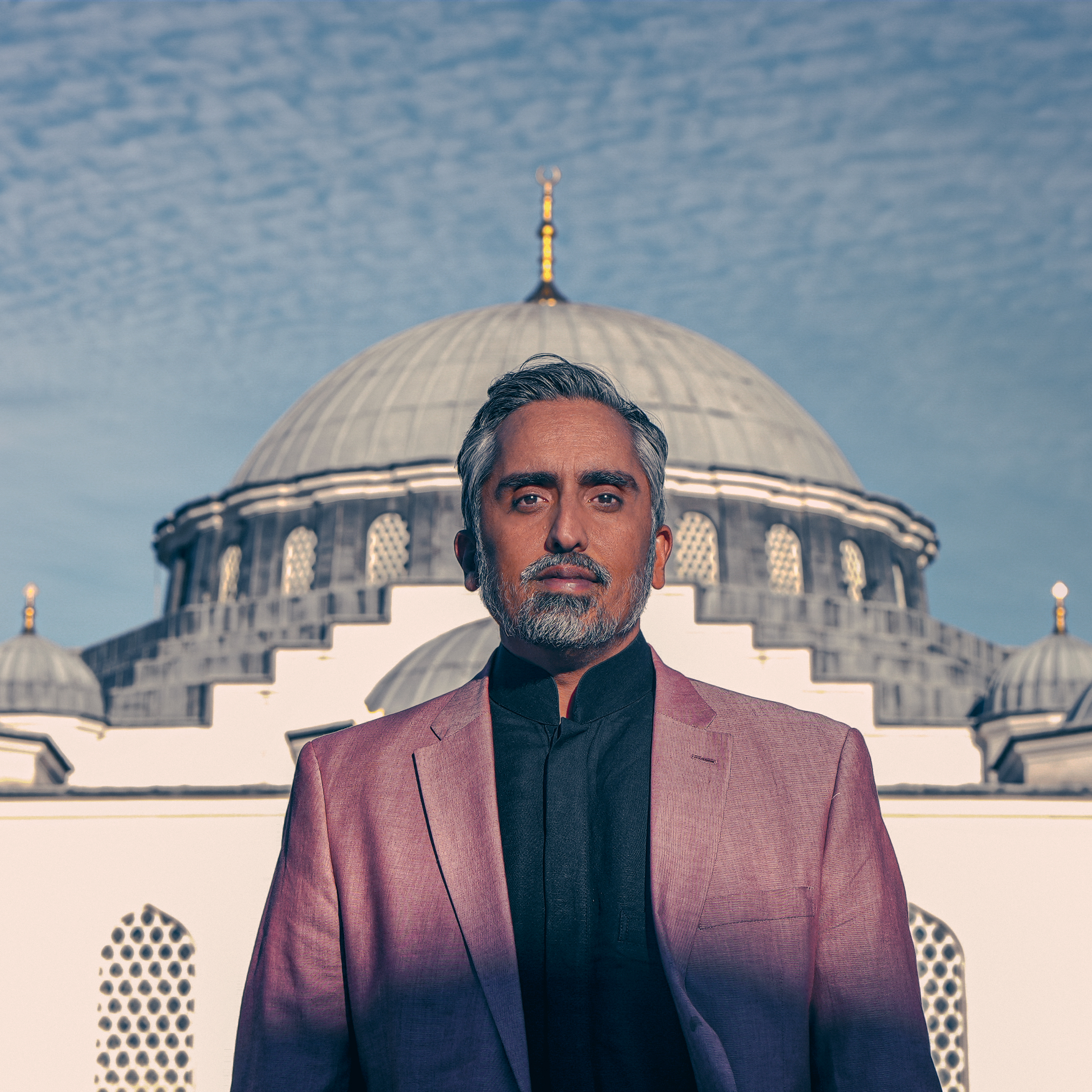
Matt Bowles: My guest today is Arsalan Iftikhar. He is an international human rights lawyer, global media commentator, and author of the new book Fear of a Muslim Planet: Global Islamophobia in the New World Order. Arsalan has been a faculty member at Georgetown University, a senior research fellow at the Bridge Initiative, an adjunct professor of religious studies at DePaul University, and he is a proud member of the Asian American Journalists Association and Reporters Without Borders. Born in Chicago to a Pakistani immigrant family, he became an international human rights lawyer nearly 20 years ago and has traveled the world extensively as a scholar, activist, and journalist. He’s a longtime on-air commentator for National Public Radio and is regularly featured on CNN, BBC, World News, Al Jazeera English, MSNBC, and many other outlets. His work has appeared in USA Today, The Washington Post, The New York Times, Rolling Stone, Time Magazine, The Economist, and the list goes on. Oh, and by the way, he’s been a very tight homie of mine for about 20 years. Arsalan, welcome to the show, brother.
Arsalan Iftikhar: Thank you so much for having me.
Matt Bowles: Matt, I am so excited to have you here, my man. I just want to set the scene first of all and talk about where we are recording this today. Unfortunately, we’re not in person. I am actually in the Blue Ridge Mountains of Asheville, North Carolina. And where are you today?
Arsalan Iftikhar: I am outside of Washington D.C.
Matt Bowles: Well, that is where you and I met quite some time ago, and I feel like we got to start this off with a story because I talk about, on the regular, whenever I am asked, “Well, a number of reasons.” But one of the reasons that I talk about you on a recurring basis is when I am asked about the greatest sporting event that I have ever attended in my entire life.
Arsalan Iftikhar: I tell the exact same story because it was that unique of a sporting event. So go on.
Matt Bowles: Well, I want you to go ahead and tell the story of how it came about, too.
Arsalan Iftikhar: So, March Madness here in the United States. The NCAA Division I Men’s Basketball annual tournament features 64, now 68 teams. Back then, it was still 64 who play in a, you know, winner, knockout tournament to declare a national champion. And teams are ranked from 1 to 16 in four different regions. And so, number one teams normally go to the Final Four. And in the year 2006, a small commuter college in Fairfax, Virginia, by the name of George Mason University was the Number 11 seed in the 2006 NCAA tournament. And for any sports fan in America, you remember when George Mason got to the Final Four, when Number 11 George Mason beat number one, University of Connecticut. And Matt Bowles and I were both at the game. I had two tickets to the game for the Elite Eight and for the Sweet Sixteen and Elite Eight that featured George Mason. And I remember thinking, I’m like, you know, I got this extra ticket. I’m not going to take anybody’s money, but I have to decide on who I want to spend my entire weekend with watching basketball, right? And never did I think, obviously, that it would be one of those historic moments in sports history here in America. But to be able to share that with you, Matt. I tell the same story to everyone also, because that was definitely the greatest sporting event that I’ve ever been to in my life.
Matt Bowles: And it was incredibly remarkable on so many levels because when you buy a ticket to the Sweet 16, you don’t know what teams are going to be playing at the time that you buy the tickets. So, you just say, “Okay, I’m going to see whatever teams play in this region and make it to this round,” have no idea who they’re going to be. I’m just going to go to the games. And so it happened that George Mason, who was expected to lose in the first round, upset and won their first two games and got into the Sweet 16. Then it happened that they wound up playing in the Washington, D.C. arena.
Arsalan Iftikhar: Own crowd, right? So, the University of Connecticut was the number one seed. They were favored to win that region, right? And so, the UConn fans were all dressed in white and blue, right? That’s the colors of the University of Connecticut. First of all, George Mason is a commuter school. And what I mean by commuter school is that nobody really moves to George Mason from out of state to attend college in the dormitories. It’s mainly the kids who live here in the Northern Virginia area of Washington, D.C., and then go home after their 7 o’clock class at night to their homes. And so half the crowd was in the green and yellow of George Mason, including Matt and myself. And the amazing thing, I’ll never forget this, you know, one of the things about March Madness, this notion of Cinderella teams, right? These underdog Cinderella teams, and everybody, the whole country, roots for them, and everybody was rooting for George Mason. And Matt, you will remember this because you were sitting right next to me. I’ll never forget this, that during the UConn-George Mason game, which ended up being a two-point game that went into overtime and George Mason ended up winning, by the end of the game, the entire stadium of both fans wearing white and blue and green and yellow were cheering for George Mason. Like, I remember the UConn players, you could see the whites of their eyes because they’re like, “Why the hell are our own fans rooting for the other team?” Like, they knew that destiny was happening. They knew that that was a night of destiny. I tell people it was the Verizon Center in downtown D.C., near Gallery Place, Chinatown. And I’ve been to sporting events, man. I’ve actually been to—and we can talk about this—I’ve actually been to a game where the NBA championship was won. I was at Game 6 of the 1996 NBA Finals between the Chicago Bulls and the Seattle SuperSonics in Chicago. We can talk about that later. But this game, the George Mason game, I’ve never seen so much electricity from 20, 30—it felt like the entire stadium was literally the roof was going to pop. I couldn’t speak for three days after that. After I dropped you off that night.
Matt Bowles: Yeah, me as well. And it was so incredible because, as you said, George Mason is a commuter school. It’s a Division I school, but it’s in a mid-major conference, right? And that means that it’s mostly local kids that are from the area that were high school all-stars, but they didn’t get the big-time Division I school offers. So, they’re playing at George Mason. And so, they’re from the local area, and they have the local fans. And then what happened was, after the first round of the Sweet 16, the two teams that lost, right, George Mason and UConn were remaining, the two teams that lost. Most of those fans sold their tickets, went home, and everybody that bought those tickets were local fans that came to root for George Mason. So, it was just packed.
Arsalan Iftikhar: Okay. Some more context. Thank you for that. Okay. When you get Super Bowl tickets, you get tickets to one game, right? Matt, what people don’t understand about these is that when you get tickets to a regional, you actually get tickets to three games on two different days. You actually get two games on Friday night, the two Sweet Sixteen games, and then you wait a whole day in between on Saturday, and then you come back Sunday evening for the Elite Eight game to decide who goes to the Final Four. So just imagine you literally, if each game is about three hours, you get virtually 10 hours of basketball over an entire weekend with your homie 18 rows behind the basket for a historic event that people are still talking about 15 years later.
Matt Bowles: Yeah, it was remarkable. And UConn was the number one overall seed of the entire tournament, expected to win the whole thing. They started two players that were over 7ft tall. George Mason did not have a player on their team over 6ft, 7. I mean, it was like the most extraordinary sort of David-and-Goliath setup you’ve ever seen. And then they knocked them out. It was unbelievable.
Arsalan Iftikhar: It was fantastic.
Matt Bowles: All right, so I want to go now back a little bit because I want to get a little bit of your backstory. You and I were actually both born in the suburbs of Chicago right around the same time as well, but we didn’t know each other, obviously, until we met many years later in D.C. So, I’d love to hear a little bit about your background and maybe just give a little bit of your sort of cultural family background and growing up in Chicago at that time and what that was like for you.
Arsalan Iftikhar: Yeah. So, I am the child of South Asian immigrants from Pakistan who came to the United States exactly 50 years ago. My father and my mother came to this country after my father finished medical school in Pakistan, and he came to the United States to do his residency in orthopedic surgery. And now he is celebrating his 50th year as an orthopedic surgeon, still operating today at the age of 75 in the suburbs of Chicago. Now, it’s important for your listeners to understand a little bit about sort of the context of the immigration that was happening at that time, especially from the Middle East and many parts of Asia in what was known as the brain drain, right? So, American immigration laws historically actually have been very strict. We are very strict compared to European countries that have guest worker programs and even Canada over the years. And so, because we historically had restrictive immigration laws on our books, I mean, we had the Chinese Exclusion Act of 1882, which was the first time an ethnicity was banned, even before the Muslim ban of Trump. So again, you know, we have a pretty racist history as a country. And so, because of that, we wanted to ensure that only the best and brightest were coming in, right? So, the brain drains. So basically, in the ’60s and ’70s, when you look at immigration to this country in the United States from the Middle East, South Asia, and many parts of East Asia, it was always the intelligentsia that was coming. It was the medical school graduates, it was the doctors and the engineers and the lawyers, sort of the cream of the crop that came to the United States. And so that’s why when you look at Asian diasporas here in the United States that came, there were sort of the Boomer generation, my parents and our parents’ generation. They were affluent, they were well-educated, they made a lot of money. And that’s sort of where the model minority myth came from for a lot of Asians and something that we all grew up with. I mean, the model minority, again. I graduated from a top 20 college and a top 20 law school. And I remember that on my graduation day from law school, I’m literally standing on the grass of the quad at Washington University School of Law in St. Louis, where I went, in my cap and gown, and I handed my mom my diploma, and without missing a beat, she said, “Are you going to surprise me now and go to medical school?” Right? So that’s sort of, I think, what will resonate with many of your Asian and ethnic listeners in terms of, you know, how diasporic parents could be. But I also grew up in the greatest city in America, which is Chicago, right? I tell people we’re not New York, we’re not Los Angeles. We are literally the equilibrium of America. We are, as one famous American author said, the most American of American cities. And I got to grow up there, you know, during the Michael Jordan era, the Last Dance era, which was pretty amazing. And so, anything that I’ve done in my life as a human rights lawyer, or as an author, as a journalist, as an anti-racism scholar, is because it is an appreciation of the wonderful life that I had growing up. And I wanted to do something worthwhile, you know, with my life. My parents had instilled public service in me from an early age. My father, I remember in the mid-1990s, in ’94 actually, during the Bosnian genocide in the former Yugoslavia, he had volunteered to do pro bono surgeries on amputees who had lost their limbs in landmine accidents. And so, I remember that these two Bosnian Muslim soldiers were brought from Sarajevo to Chicago for these surgeries that my father performed on them in terms of their amputations. And I remember a few months after they had landed, you know, the mayor of Chicago, Richard Daley, honored my dad. And so, it was a big thing. It was in the Tribune, like, it was a thing. It was Americans trying to help what was going on in the former Yugoslavia. But it really sorts of helped shape my life because a few months after they had left, my parents had actually received a letter in the mail from one of the soldiers. And inside the letter was a photograph of one of their newborn babies. And on the back of the photograph, they had written, “Dear Dr. Iftikhar, this is a photograph of our newborn son. And we just wanted you to know that we named him after you.” And when I heard that, like, I decided at that moment that I wanted to spend the rest of my life helping others. And so I became a human rights lawyer because of that story. And since that time, you know, my dad has gone on missions with Doctors Without Borders to earthquake-ravaged areas in South Asia, in Kashmir and Pakistan and Afghanistan, on several occasions. And so, everything that I do, obviously, is meant to honor that legacy, but also, obviously, the strong Islamic Muslim ethos that I have and sort of live that purpose-driven life where I am trying to help other people. And so, it’s been quite a ride, as you’ve seen, but it’s been the most fulfilling thing in the world to sort of be a part of that global conversation.
Matt Bowles: That’s awesome, man. Well, first of all, big shout-out to your dad. I’ve had the privilege of meeting him and hanging out with him, and what an incredibly special guy. I hope he listens to this episode, and I just want to give him lots of love and a big shout-out. Can you talk a little bit more about, kind of, as you grew up with the Pakistani immigrant experience in particular, and then going back to Pakistan and reconnecting with it, and particularly the Punjabi culture, which I have not yet been to Lahore in Pakistan. I was supposed to go in 2020, and then COVID happened. I have been to Punjab on the Indian side, actually spent Diwali and Amritsar and got to go to the Golden Temple, which is the primary Sikh pilgrimage site. And just absolutely incredible. So, I’m a huge appreciation, as you know, for Punjabi culture and food and bhangra music and everything else. But can you just sort of contextualize the Punjabi culture that you grew up in, as well as then your reconnection with Pakistan, you know, as an adult now?
Arsalan Iftikhar: So, a few things. First of all, there’s never been a reconnection because I’ve always been connected. And that’s really important, that I grew up bilingual. Not only bilingual, but my mother, she wouldn’t let us speak English in the house. If she asked a question, we answered yes, she’d be like—she would respond in Urdu, saying, “I don’t speak English.” And so, then we’d have to respond. And so, because of that, I grew up bilingual, which actually allowed me to appreciate the world so much more. I actually studied five languages now. You know, I’ve traveled more countries than I have states. So being a dual-culture kid in the 1980s was really interesting. And the first thing I have to sort of flesh out for your listeners here, especially as a civil rights lawyer, is that racial identity politics in America before very recently was pretty much Black and white, right? And so, for those of us who lived in brown America during the 1980s, we were conflated with Latinos, we were conflated with Hindus. Nobody knew about anybody other than sort of white America, Black America, and Latinos, which were a growing population in America, and all the other brown and grayish-looking folks’ kind of, you know, we’re all kind of lumped in together with other folks. And the perfect example that I have is I remember one of the first experiences of overt racism that I can remember was actually when my mom and I were in McDonald’s one Saturday afternoon at actually a very fancy upscale mall. We were waiting in line for our fish filet, which we loved. And my mom wears a traditional shalwar kameez, which is typical attire of South Asian women. And I remember this group of three white kids were sitting in the line next to us, teenagers, and they were just kind of laughing and snickering at my mom’s ethnic dress. And I remember they looked over and they called her a fucking dot head, which really fascinated me because I looked at her head and I did not see a dot, right? And so that was sort of not only my first sort of experience with overt racism, but misguided racism, ignorant, like, not even racism that had adequately identified us as human beings. And so, from that moment, I was very fascinated. I was baffled, right? You’re called something, but there’s nothing there that the person is actually referencing because that showed how little they knew about anything. And really how little we as human beings know about each other. If you look at global racism today, xenophobia, the rise of white supremacist movements across all parts of the Western world, it all stems from the otherization of people who do not look like you or believe in what you believe. And so, growing up in Chicago was great because I was exposed to diversity from a very early age. And in a great city with the best food and great sports, I wouldn’t have grown up in any other city in America. It’s funny, I’ve lived here in D.C. for 20 years, man, and I still have to make it a point to let people know that I’m from Chicago. I was like, “I don’t want you to think that I’m from here.”
Matt Bowles: So, can you talk about travel in Pakistan and the time that you spend there and some of your involvement there? And I’d also love for you to give any tips to folks that want to visit Pakistan as well.
Arsalan Iftikhar: I would focus on the main cities, and the reason is because each of the major cities offers really unique things. So, the capital of Islamabad is actually—it was the first planned city in Pakistan. It’s actually their version of Washington, D.C. or Brussels, right? It’s where the Parliament is. It’s where the Prime Minister is. It’s clean and it’s very organized into nice sections. All the expatriates go there for anything. You have to go there for your passports. All the international delegations that come always come to Islamabad, right? That’s the Washington, D.C., the Brussels, or the parliamentary center of the country, which is also nearer to, closer to, the mountainous areas, right? If you want to go hiking and things like that. But you’re also on the border with Afghanistan, near Peshawar. You’re also near Kashmir, which has obviously been a flashpoint between India and Pakistan for 50 years. But it’s a fascinating region. If you visit Islamabad, if you want to go to, like, the New York City, you go to Karachi, right? But that’s on the southern tip of Pakistan. That’s probably like a 24-hour train ride all the way down there, and Karachi is, I think, like, I can’t even keep track. I think it’s like the sixth or eighth largest city in the world. It’s on the realm of the Rios of the world where it’s like they stopped counting after 13 million people, right? It’s Rio. It’s like New York City. It’s dirty, it’s grimy, but it’s also the biggest city and it’s right on the ocean, right? So that’s the only beach that you’ll have any opportunity to see in Pakistan is in Karachi. So, if you want beach, if water is important to you, go to Karachi. But I will warn you, it’s not going to be the beaches that you’re accustomed to. It’s not going to be Bali where you can kind of lounge out there, right? You can walk on the sandy beaches, but there might be shit going on right there. You know, there might be a rooster walking next to you. You just kind of have to roll with that. If you want sort of the cultural center, the heart of Pakistan is its second-largest city, Lahore. And I always say that Lahore is the Chicago of Pakistan, the second-largest city, the second city, like Chicago is. And like Chicago, it’s the cultural heartbeat. It’s where the food scene comes from, the movie scene comes from, the literary scene comes from, the music scene comes from. And most importantly, it’s situated like Islamabad in the heart of Punjab and Punjabi culture. Whether you’re looking at the political makeup of the country, if you look at the food, the cuisine, it’s all Punjabi-centered. I call Lahore the heartbeat of Pakistan. But those are three very different cities. Like, pick your scene, right? Do you want the capital scene with Islamabad, do you want the big grimy, New York City scene with Karachi, or do you sort of want the pure ethnic, like gangster-ness of, you know, Punjabi Lahore and go from there?
Matt Bowles: We have a lot of hip-hop fans that listen to this show, and one of the things that you and I bonded over initially was our love for hip-hop music. And I feel like a lot of people’s entrees into Bhangra music was Punjabi MC and the collab that he did with Jay-Z with that “Beware of the Boys” track. And I want to just ask, if folks that are into that song, for example, that I know that reference, if you have any other Bhangra artists or Punjabi cultural music that you would put people onto.
Arsalan Iftikhar: The godfather of modern Bhangra is a man named Daler Mehndi. First name Daler, D-A-L-E-R. Last name Mehndi, M-E-H-N-D-I. I came up in the mid-90s, and it was funny because, obviously, Bhangra music has been a part of Punjabi culture for thousands of years, but Daler Mehndi in the mid-90s was sort of that first mainstream Bhangra guy that was being sourced into Bollywood movies, right? And so basically you had sort of this confluence of Bhangra music into Bollywood culture, which obviously didn’t metastasize worldwide. People got more into it, and then Punjabi MC never would have happened if it weren’t for Daler Mehndi. So Daler Mehndi is the OG of Bhangra. If you want real Bhangra, sort of, and sort of understand its essence, go to him. Go to him.
Matt Bowles: That’s awesome, man. Well, I want to ask you about some of your other travels as well. I Remember for your 40th birthday you went to South Africa and you reached out to me before you went on that trip and I was so excited that you were going. And I want to hear how that trip was for you.
Arsalan Iftikhar: Well, I mean, it was a bucket-list trip. Like I said, I’ve been to more countries than I have states, and there really was nowhere else on earth that I had not already visited that I said, if God gives me life, I have to go there as a bucket-list item, except for Cape Town, South Africa. I’m a human rights lawyer. Nelson Mandela is my spirit animal. Because of that, obviously, I could not leave this earth until I stood in front of the place, the 6-by-8 concrete cell on Robben Island that he spent 20 years, seven years of his life. That’s the path. Like, people think, “Oh, Mandela this, Ubuntu that.” No, no. Let me paint the picture for you. So, first of all, Cape Town, South Africa, as you all know, is very far from everywhere else on the face of the earth. To give you an example, to fly from Washington, D.C., to Cape Town, I had to fly 12 hours from D.C. to Dubai and then another 10 hours from Dubai straight down to Cape Town. We had met some folks when we were there from Australia. They had flown 24 hours from Australia to get to Cape Town. I tell people who’ve never been there, Cape Town, the only land that is to the south of you is Antarctica. It is literally where the Indian Ocean meets the Atlantic Ocean at the Cape of Good Hope, where you can actually see the tides of both oceans in front of your face flowing in different directions. It is also the only country on earth where both lions and penguins reside. You can actually go to the beach in Cape Town, and it’s the cutest thing ever. It’s called Penguin Beach. And you see these amazing penguins wash up from the water onto the sand, literally into a walking motion. And these motherfuckers will come right up to your feet and look up at you and give you the gangster because you’re standing on their beach. You see the people of South Africa, the legacy of apartheid still, obviously, is there. One of the most harrowing, again, as a human rights lawyer, you’re driving down the street in Cape Town, you literally look to your right and you will see an entire enclave of million-dollar homes. And you will literally then turn to your left and see an entire shanty town where houses are built four and five high with aluminum foil. I was marveled at how do the people on the fourth level of the shanties, how do they even get up to their shanty, literally across the street from each other? But it was fascinating as a brown man, right? So, in South Africa, people like me, the brown folks, are actually called colored. We’re colored. In South Africa, there’s whites, blacks, and colored, and brown folks, people who have Malay backgrounds who actually came from India as slaves to Malaysia. Basically, brown folks like me, South Asian-looking dudes and dudettes, are called colored. And it’s just fascinating to see the different cultures there and how they live together. And what I love the most was that I loved seeing empowered Black people. And, like, even though the Black people, like, they were poorer there, they were, but they had internalized contentment. I’ve never seen more strength in Black people than I have in Africa. And honestly, if there’s any place that I would live outside of the United States, it would be Cape Town, South Africa. And it was the greatest trip of my life. It was sort of a perfect microcosm of the entire world.
Matt Bowles: That’s amazing, man. Well, I want to know kind of go back a little bit to your career trajectory, which obviously intertwines with your values and passion and life mission that you’ve been talking about here and where you and I initially met in the context in which we met, which was basically the post-911 era in Washington, D.C., during, I mean, just an absolutely extraordinary and crazy time. And you and I were both in the nonprofit advocacy space trying to push back against the draconian legislation and government repression that was coming down hot and heavy, disproportionately targeting Arabs, Muslims, South Asians, and just sweeping across the country. And you and I met in that context and, for many years, organized and struggled and worked together in that context. But I want to see if you can just take us back there and even go a little bit further before then, if you want. And just how did you get on that trajectory? How did your life take that course? And just give folks a little bit of context for that era.
Arsalan Iftikhar: I actually, I was in law school. Right upon graduating, I actually became the national legal director of the largest American Muslim civil rights organization in America. It’s called the Council on American-Islamic Relations, CAIR. And that position was actually created for me. It was after 9/11, so basically no Muslim civil rights organization in the country had any full-time lawyers on staff yet. I was the first paid full-time attorney in any Muslim organization in American history. Like, we hadn’t had the resources yet, and then we had this catastrophic—I mean, 9/11 was the worst thing ever, right? It changed the world. And imagine now you have thousands of brown Muslims, Arab, South Asian men being summarily rounded up days, weeks, months after 9/11, being thrown into jail, hate crimes, drive-by shootings, and mosques, and you don’t have any lawyers on staff. So, I was a 26-year-old general counsel for the American Muslim community. We were getting over 900 reports of hate crimes in the first six months alone. I had a staff of maybe like six social workers and case intake officers, like just people taking these cases and then corresponding with the FBI, district attorney’s offices, you know, on these hate crimes and things that are going on. Employment people are getting fired from their jobs simply because they’re Muslim. So, I’m flying to Austin, Texas, to meet with the general counsel of Dell Computers and, you know, other Fortune 500 companies, trying to negotiate the rehiring of 56 Somali Muslim factory workers at a plant in Omaha, Nebraska. I’m 43 now, with the white hairs of an 86-year-old on my face. That was what was going on in the world then. Shit was real, you know, at the time. And this is the historical context that obviously I know you will appreciate. But people forget that we had a president here in the United States whose name was George W. Bush. And during that time, every American who did not vote for him was like, “We could never have a worse president than George W. Bush.” And everybody would agree with you, like, “Yeah, there’s nothing that could be worse than him.” And, of course, Donald J. Trump proved us all wrong. And so, when we look at what’s happening in the world today, and even a year or two ago when Trump was still in power, let’s not forget that 15 or 20 years before that, this same kind of stuff was going on. And we, as a human race, continue to repeat the mistakes of our past. And that’s why we are having to have conversations about the rise of white supremacy all over the world, or the rise of anti-Semitism and Islamophobia all over the world. And so that’s why I do what I do, is because we need to be able to have this global conversation in a way, hopefully, that doesn’t repeat the same mistakes that we’ve been repeating not only for 20 years, but for 50 years since time immemorial.
Matt Bowles: Well, I want to go deeper into that and I want to mention that your new book, which is now out, that I just read this past week, which to be honest, I’ve been following your work very closely for 20 years and I actually think that this is your best work yet, the new book.
Arsalan Iftikhar: That’s very kind of you to say. This is my masterpiece. This is my Mona Lisa. I’m throwing up deuces after this. So, first of all, the book title itself, I had to tell the story behind, and, you know, it harkens back to the hip-hop conversation that we had and that we are going to have because we haven’t given our top five yet. So, the book itself, the title is Fear of a Muslim Planet. You can find it at TheMuslimPlanet.com. That’s the website there. But the title of Fear of a Muslim Planet is not only a double entendre, it’s like another kind of triple entendre because it’s actually paying homage, first and foremost, to the legendary 1990 hip-hop album Fear of a Black Planet from Public Enemy. Chuck D is one of my spirit animals, and I wanted to honor that in the title. But it actually has a secondary meaning because Fear of a Muslim Planet is exactly the mentality that is fueling Islamophobia today, right? Is that Muslims are brown, Muslim folks are coming to take over blank society. What I mean by blank society, it could be American society, it could be European society, it could be Indian society, it could be Burmese society, it could be Chinese society. It’s all the societies that I talk about in my book in terms of this global otherization, this global scapegoating. My second book was actually called Scapegoats, actually very deliberately also because scapegoats is a biblical term, right? Scapegoats is from the Book of Leviticus. It represented the goat that was released to the wilderness by the high priest on Yom Kippur and had all of society’s ills placed on its undeserving head. And since that time, we’ve had scapegoats since time immemorial, right? Whether it was, you know, the 400-year slavery of Africans here in the United States, the Holocaust, Japanese internment, you know, what have you. And global racism is part of this otherization that led me to writing this book, mainly actually to tie anti-Semitism together with Islamophobia, with anti-Black racism, with anti-Latino racism, to show that they’re all perpetuated by this white supremacist conspiracy theory known as the Great Replacement conspiracy theory that we can talk about a little bit more. But it’s sort of my contribution to the global conversation on anti-racism that, again, I hope people will see is not only metastasizing all over the world, but again, it’s tied into anti-Semitism and also tied into anti-Latino hate crimes that we’ve seen. And then we can talk a little bit more about that as well.
Matt Bowles: Yeah, well, I think we definitely should. I want to dive into that now. And first of all, as soon as I saw the book title, my heart warmed because, of course, I knew the reference, because Fear of a Black Planet by Public Enemy was, for me, the single most influential hip-hop album. It was the album that I credit not only with developing my love for hip-hop music, but, as a white kid growing up in the suburbs, with piquing my political consciousness and having me start to ask questions about, “What are these guys talking about? Who are these people they’re referring to? Why have I not learned this? Why have I not heard of this?” And I really credit Public Enemy and that album in particular with putting me on a trajectory to start being intentional about asking questions, learning about things, and then raising my political consciousness. And so, I greatly appreciated that you used that in the title.
Arsalan Iftikhar: Nice. That’s fantastic.
Matt Bowles: Yeah. And I also, as I was going through the book, the other thing that I really liked, because your work for 20 years obviously has centered around anti-racist work, particularly struggling against Islamophobia. But one of the things that struck me, and this was the case back when you were, you know, 26 years old, when we initially met in our 20s, that struck me about you is that you were not only conscious and aware and struggling for the civil rights and the human rights of your own community, but you were very well aware, even at that time, of the interconnections and the intersectionality of all of these different types of oppressions and struggles. And you were standing in solidarity with all of these other groups. And I think this book, when I was reading through it, I was smiling because you were connecting all of these different types of struggles, and anybody that has paid any attention at all during the Trump era, we have, of course, seen all of these different groups get targeted. We’ve seen the anti-Muslim Islamophobia; we’ve seen the anti-Semitism and the attacks on synagogues and the rise of that. We’ve seen East Asian and Pacific Islanders get violently attacked by vigilantes throughout the COVID-19 era. We have seen all of these different things. And one of the things that your book does that I think is just amazing is it really puts them all together and shows the connection there, and how, in order to understand white supremacy and to challenge it, you really need to understand the intersectionality and the interconnection between a lot of these different things.
Arsalan Iftikhar: Yeah, totally. And I actually prove how anti-Muslim acts of terror, anti-Semitic acts of terror, and anti-Latino acts of terrorism were all tied together with this thing called the Great Replacement. So, I actually, if you read the book, it centers mainly on the March 2019 Christchurch, New Zealand, mosque massacre, where a white supremacist walked into two mosque locations in Christchurch, New Zealand, and proceeded to murder 51 people in the worst act of Islamophobic terrorism anywhere in the world in modern history, and the worst act of terrorism in all of New Zealand’s history. Now, this white supremacist, he was actually live-streaming the massacre. He actually wore a webcam and he broadcast it live to the world. And I saw it. I’ll never forget it because I had to go on TV to comment about it. I had seen it before, the videos. It was basically a live-action version of those first-person shooters like Call of Duty that you see. And he left behind a manifesto where he cited this conspiracy theory known as the Great Replacement conspiracy theory. But he basically thought that brown Muslim folks were going to replace white Christian folks in New Zealand. And the Great Replacement conspiracy theory is actually used by white supremacists of all stripes. So actually, a few months before the Christchurch massacre in New Zealand, 11 Jewish worshipers were killed at the Tree of Life Synagogue in Pittsburgh, Pennsylvania, in an act of anti-Semitic terrorism. And that white supremacist actually had left behind a manifesto whose first line was, “Open your eyes. It’s the filthy evil Jews bringing the filthy evil Muslims into this country.” And the words “open your eyes” were the first words of his manifesto. It’s the title of my Chapter One, Open Your Eyes, because I highlight that. So basically, this guy went into a synagogue and killed 11 innocent Jewish people as a roundabout way of stopping Muslim immigration into America. Now what’s really interesting is that a few months after Christchurch, in the southern Texas city of El Paso on the U.S.-Mexico border, a white supremacist went into a Walmart superstore and proceeded to kill 22 Latinos in an act of anti-Latino terrorism. And he left behind a manifesto saying, guess what? The Christchurch Mosque shooter was my inspiration. And that he believed that Latinos were coming as a Great Replacement in the United States and that his act of terrorism was a response to, quote, “the Hispanic invasion of the United States.” So, in 90 seconds, I have connected you with an Islamophobic act of terrorism, an anti-Semitic act of terrorism, and an anti-Latino act of terrorism, all with the same singular common thread, which is the Great Replacement theory. And that’s why I wrote this book, because the Fear of a Muslim Planet is really just a fear of anybody else, right? It’s a grand unification theory of hate. It’s not just about Islamophobia. It’s also about anti-Semitism, it’s also about anti-Black racism, anti-Latino racism. It’s anti any minority otherization that is being used by Western and Eastern societies to help lead to genocidal campaigns, ethnic cleansing, second-class citizenry, you know, and that’s why all of us have to be aware of this as allies, hopefully, to understand that this is happening all over the world. It’s brown people doing it to brown people also. It’s happening. It doesn’t have anything to do with your skin color. It has really nothing to do with your religion. It can happen even in Muslim-majority countries that I talk about. So again, it’s understanding these sorts of things and how this otherization can lead to genocide, ethnic cleansing, and really just the worst aspects of sort of the human condition.
Matt Bowles: Well, I want to jump into a bunch of the case studies here and some of the different areas in the world where there are different manifestations of this, which I think are really important that you highlight in the book when talking about Muslims.
Arsalan Iftikhar: You know, the first thing that I have to do is I have to demystify a lot of misconceptions that people have. A lot of people say that they don’t really know Muslims, and so they have these preconceived notions. For example, number one is that all Muslims are Arabs and that all Arabs, on the flip, would be Muslims, right? And neither of those is true. You know, there are currently 1.8 billion, almost 2 billion Muslims on the face of the earth. One out of every four people on earth on this planet is a Muslim. The largest Muslim-majority country on the face of the earth is Indonesia, with nearly a billion Muslims of their own. On the Arab side of things, there are a great number of Arabs, particularly here in the United States. Some people say close to 50% of Arabs are Christians. They have believed in Jesus since Jesus lived in their hood. You know, when you look at the American Muslim community, you know, we are literally every color in the rainbow. So, 2 billion Muslims on the face of the earth. The American Muslim community is around 7 to 10 million, give or take. And the reason that there’s not an accurate number for any religious minority in America is that what most people don’t know is that the U.S. Census, which happens every 10 years, actually forbids the asking of the question of religious affiliation. So, any sort of statistics on religious minorities in the United States is not done by the Census. It all has been done by other studies and things like that. So, that’s why there’s never been like a really sort of solid number. But generally speaking, 7 to 10 million American Muslims live in the United States today. Almost a number of Jewish Americans. Of those 7 to 10 million, 25%, if not more, are from the African American community who have been here since the slave ships arrived 400 years ago. Many historians estimate that probably between 20 and 30% of the slaves that were brought to this country were Muslims. Muslims have fought in every war that the United States has ever fought in, including the Revolutionary War. There are records of soldiers named Bampett Muhamed and Yusuf ben Ali and others that showed that we are and have been on this soil since its founding. You know, that’s one of the main misconceptions that people have about Islamic Muslims, is that we’re new here. There were others who were immigrants, right? So, again, and I’d like to sort of illustrate that the African American Muslim community, which has grown from the legacy of slavery over the years and centuries after the Emancipation Proclamation and Reconstruction, tended to gravitate to major northern urban centers like Chicago, like Detroit, like New York City, where the Nation of Islam, Malcolm X, the inner-city Black Muslim community has thrived for generations. That’s 25%. That’s like one-fourth of the American Muslim community. Another one-third, about 33% of the Muslim community, comes from greater South Asia. So, India, Pakistan, Bangladesh, Sri Lanka. A lot of these folks are, like, for my parents’ generation, again, part of that brain drain that came in the 1960s and ’70s. But then in the 1990s and into the 2000s, when we relaxed our immigration laws, that’s when we started to see more of the working-class folks from South Asia also start to come in. Then we have another 25% that are Arab Americans, right? So, Arabs of Muslim descent. So again, sort of striking at the notion that all Arabs are Muslims and all Muslims are Arabs. Only one-fourth of Arabs in America are Muslims. Only 20% of Muslims worldwide are Arab. So, only one-fifth of the entire global Muslim population of 2 billion are of Arab descent. And then 17% are white, Latino, and European Muslims, meaning that Muslims look like every single person that you know, including you, Matt, including me, right? And so, the reason that I illustrate this point is that’s why it has made the notion of racial profiling of Muslims so laughable in the last 20 years, is because we are not of one race. And so, again, it’s sort of perpetuating the anti-Arab, anti-bearded, anti-olive-skin racism that we saw. So, that’s sort of the landscape of the global Muslim community, but then also the American Muslim community and European Muslim communities are their own diasporas, right? And they’re distinct even from one another, right? So, the British Muslim population is primarily South Asian, from India, Pakistan. But when you go to France, the Muslim population, which is 10% of the population, is primarily from North Africa, the Maghreb, right? Algeria, Morocco, Libya, Tunisia. You go to Germany, then you have a huge Turkish population that is really the majority of the Muslim population, along with a lot of Syrian refugees that have come. You go to normal. It’s interesting because people talk about Muslims in the world, Muslim communities, there’s millions of Muslim communities. And so, there’s not a one-size-fits-all approach to anything. And in order to obviously be an expert on this, you have to spend your entire life, like me, trying to explain those distinctions to white people who don’t want to hear it a lot of the time.
Matt Bowles: Can you go a little bit further into the European situation and talk a little bit about some of the ways, and perhaps some of the distinct ways, that Islamophobia is manifesting itself in Europe with regard to some of the hijab bans and other types of things, and some of the ways that Islamophobia in Europe may actually be a little bit different from Islamophobia in the United States?
Arsalan Iftikhar: It’s a lot different. Islamophobia anywhere, just like anything anywhere, is different depending on the societal context that you live in, right? So, Europe, even European Islamophobia, is different country to country, you know, kind of like what I mentioned. So, the first distinction that I would make between any sort of European xenophobia and American is that at least European racism actually is much more overt, in-your-face, because they don’t have sort of the social grace of political correctness, if you want to use that as a shorthand. Whereas American racism is sort of much more insidious. It’s more systemic. People will say, “Bless your heart,” and then stab you in the back, whereas in Europe, they’ll just stab you in the front.
Matt Bowles: Do you think that’s still the case with including the Donald Trump era and the way that Trump’s rhetoric went?
Arsalan Iftikhar: It’s a good question. And I think obviously we are chipping away at that veneer. Again, I’m talking at the macro level, right? If you’re studying things from a sort of anthropological expert level, you have to make that distinction, right? You can’t say that European racism manifests the same way as American racism, because that’s just not true. And in many ways, actually, to sort of piggyback off what you just said, Matt, because of Donald Trump, European racism has actually gotten even worse than it was before because those motherfuckers like, “Oh, shit, now they got their Trump. Now we can actually show our real true colors,” which is even worse than what we had before. So, it’s just made shit bad everywhere, let’s be honest. So that’s from the jump, but, for example, France. So French racism is centered around this concept called Laïcité. Laïcité is defined as secularism. It’s actually a form of hyper-secularism. It’s anti-religion. And historically, it was started in 1905 because of the Catholic influence on French society. But now today, Laïcité purely centers on Islam and centers around Islamic identity. And that has manifested in the hijab bans that we’ve seen for now 17 years, since 2004, when then-President Jacques Chirac banned Muslim women and girls from wearing headscarves and hijabs in public places like public schools, government offices. Since that time, we’ve seen dozens of iterations of that same ban during Nicolas Sarkozy’s time to now Emmanuel Macron’s time. But what that’s done is now it’s centered Muslim life centrally in French politics, kind of like it is in America. And because of that, right-wing fringe people, candidates like Marine Le Pen from Front National, the National Front, have gone from gadflies to potentially becoming prime minister one day. Macron is in an existential electoral battle with her April 2022. In about nine months, they’re coming up with their next election, and Macron’s going to try to stay in office. And the fact that Marine Le Pen, whose father, Jean-Marie Le Pen, is probably the most famous anti-Semite in the last 50 years, you know, in Europe, after Adolf Hitler, the fact that his daughter could become president of France is astonishing. But it’s shown the right-wing lurch that we’ve seen not only in France, but in places like Holland with Geert Wilders, or in Hungary with Viktor Orbán, or with a multitude of other right-wing populist ethno-nationalists who are now gaining parliamentary power. And they’re all centering Muslim identity in their electoral politics. I’ll give you the example of Poland. Poland has 0.1% Muslims, 0.1% Muslims in their population, but they talk about Islamic Muslims in their national political elections all the time, right? So that’s a problem. And that’s a problem regardless of the majority-minority context, right? In the European case, it’s with Muslims. But, you know, you see this in many parts of the world. You know, we saw this in Rwanda with the Hutus and the Tutsis, and we’ve seen this in the former Yugoslavia where you pick one group to otherize, and then that can lead to genocidal ends, right? That can lead to internment camps. In France, there have been pieces of legislation that have been floated by right-wing allies of Marine Le Pen which call for internment camps. They call them regroupment camps for suspected Islamists, people who are suspected of Islamism. What the hell does Islamism mean? If they pray five times a day, can they be put in these camps? If they fast during Ramadan, can they be put in these camps? If they wear a hijab or if they go to Friday prayers, can they be put in these camps? And, you know, for those people who think in the year 2021 that we can’t have internment camps, look at China, where there are 1 million Muslim Uyghur Chinese people currently in internment camps. And the Chinese central Communist government of Xi Jinping doesn’t give a fuck. They’re literally going around the world with a one trillion dollar infrastructure project known as the Belt and Road Initiative, literally buying off the leaders of Muslim-majority countries like Pakistan and Saudi Arabia and Turkey, all who have rubber-stamped and whitewashed Beijing’s ethnic cleansing of 1 million Uyghur Muslims who are currently in concentration camps right now, who are being raped, tortured, who are being forced to renounce their Islamic beliefs, forced to eat pork, forced to drink alcohol, things that observant Muslims don’t do. Muslim women—there are Han Chinese men who are being brought in from the mainland to reside in the homes of Muslim Uyghur women whose husbands have been removed to internment camps, as literally the same sort of ethnic and sexual violence, and sleep in the same beds with them, which was used by the Serbians and Slobodan Milošević in the mid-1990s during the Balkan genocide to ethnically cleanse, to dilute the population of its Muslim identity. This is all going on, on our watch. That’s why I write this book. That’s why I have to be a human rights lawyer. Because sadly, ethnic cleansing and genocide and racism and xenophobia are things that will exist until the end of time. And there need to be people that give a voice to the voiceless and try to stem the tide in the other direction.
Matt Bowles: One of the things that I think is also incredibly important about the book that I really appreciated is, first of all, you of course talk about white supremacy, and you talk about the rise of the neo-fascist movement in the United States and elsewhere, and sort of the white supremacist stuff and the centrality of Islamophobia to a lot of that. But then you also talk about other societies. So, for example, India, which I’d like you to go into a little bit deeper right now. Maybe you can just give a little context, a little background on the history of the Hindutva movement and the rise of the BJP party, the rise of Modi, and the rise of neo-fascism in India, and the role of Islamophobia in that narrative.
Arsalan Iftikhar: It’s jingoism, pure and simple, right? We’re seeing a rise in jingoism around the world. We’re seeing a rise in right-wing ethno-nationalism all over the world, whether it’s Narendra Modi in India, whether it’s the Burmese junta in Myanmar, whether it’s Trump that we saw in America again, all the people that I rattled off in Europe. And what’s especially disconcerting about the current rightward authoritarian lurch in India is that it’s the land of Mahatma Gandhi, right? Mahatma Gandhi, who was a human rights lawyer himself and literally gave up his life. He was assassinated in 1948 by a right-wing Hindutva ideologue. Because Gandhi not only wanted to break the shackles of colonialism from the mothership of Great Britain, but also create a secular, multi-ethnic, multi-religious, pluralistic India for its nearly billion inhabitants, the vast majority of whom, about 80%, follow the Hindu religion. But then there’s also 20% of the Indian population that are Muslims, that are Sikhs, that are Christians, that are Dalits, who’ve always sort of historically been pejoratively known as the untouchables, right? The caste system is very strong still in India today. And obviously I know the region well because my parents are from South Asia. I speak Hindi fluently. I’m a student of political science. And what we’re seeing today with Narendra Modi as prime minister actually began 20 years ago when he was actually the chief minister, which is the de facto political leader of the Indian state of Gujarat. Now, in the early 2000s in the Indian state of Gujarat, basically Narendra Modi was the governor of Gujarat, right? And so, during his watch as governor of Gujarat, there was an anti-Muslim pogrom massacre where over 1,000 Muslims were slaughtered by literal pitchfork-wielding vigilante mobs who were hunting down Muslims and macheting them in the streets, raping women, ripping fetuses out of wombs. Narendra Modi is a lifelong member of a right-wing organization called the RSS, the Rashtriya Swayamsevak Sangh. The RSS, whose founding member has historically praised Adolf Hitler and Nazi Germany. And so, what we’re seeing in terms of the right-wing fascism in India today is historical. You know, Mahatma Gandhi was assassinated in 1948 by a right-wing ideologue because Gandhi promoted pluralistic, democratic, secular India. A lot of folks who agree with Narendra Modi’s political ideology seek to create what’s known as a Hindu Rashtra, right? A Hindu-centric state where all minorities, if you’re Muslim, if you’re Sikh, if you’re Christian, if you’re a Dalit, if you’re of a lower caste, are relegated to second-class citizenry. And now it’s gotten to the point, even in the COVID pandemic, where Islamophobia has metastasized to the point where the New York Times has reported, and I wrote this in my book, that there have been Hindu temples in India who have been broadcasting on their loudspeakers for Indians not to buy milk from Muslim dairy farmers because it contains COVID. Indian hospitals have admitted to segregating Muslim patients from Hindu patients. Narendra Modi’s home minister, which is basically the interior minister, the minister of the interior, has referred to Muslims as termites and has used other genocidal terms against Muslims. And we’re seeing hate crimes and murders happen across India. And we see this next door in Myanmar as well with the Rohingya Muslims, where 1 million Rohingya Muslims have been not only ethnically cleansed by the Burmese military junta into neighboring Bangladesh, but this was all done under the watch of 1991 Nobel Peace Prize winner Aung San Suu Kyi, who has had probably the most precipitous fall from grace, where seven other Nobel Peace Prize winners, including 2014 Nobel Peace Prize winner Malala Yousafzai and six others, have called for Aung San Suu Kyi to stop the genocide of Rohingya Muslims. And she hasn’t. And then she most recently got toppled again by the military junta, because with friends like that, who needs enemies? And so, again, we continue on this cyclical pattern, and it’s going to continue until we’re able to sort of look within ourselves and sort of be able to hopefully summon our better angels for better tomorrows for all people.
Matt Bowles: Well, I want to see if you can take us behind the scenes a little bit of your life, because you are talking about these issues all day long. You’re advocating about these issues all day long. You’re on all of these different news channels and stuff. I remember, I just want to give folks an example of, for people that haven’t seen you yet or heard you on the news, I can remember this must be, I don’t know, five or six years ago now.
Arsalan Iftikhar: If you haven’t seen me yet, you’re not missing much. That’s the key takeaway.
Matt Bowles: This must have been, like five or six years ago now. And I turn on CNN, and it’s the Don Lemon show. And something had just happened, like ISIS had just committed some attack or something had gone on.
Arsalan Iftikhar: Not just some attack. It’s important. It was the night of the Charlie Hebdo attacks in Paris, like in 2015. At the magazine, I could. This was the number one global news in the world that day.
Matt Bowles: Okay, so that had just happened. I turn on CNN that night. It’s the Don Lemon show, who’s a primetime news anchor on CNN, and they’re going to have Arsalan on. They introduce him as an international human rights lawyer who had just published a book on Islamic pacifism. And they introduce him. He comes on. I was like, “Oh, you know, Arsalan is on.” Turn the volume up. Don Lemon, he comes on, he says, “So, do you support ISIS?” And your response was amazing, because I remember this distinctly. I was shocked that he…
Arsalan Iftikhar: He said that.
Matt Bowles: And then you look at him, you’re like, “Wait, did you just ask me if I support ISIS?” And then I think he just retreated and just went on a totally another line of questioning. But what was that experience like for you? And what is your, I mean, just give us a sense of what was going on that night and also, like, what these types of experiences are like for you.
Arsalan Iftikhar: Yeah. So that was not only the most surreal media moment of my life, and I’ll tell you why it actually made me more famous than all my thousands of interviews combined. I’ll explain why in a second, too. So, to give context, it was January 2015. It was the night of the Charlie Hebdo attacks on a magazine in Paris, France. It was CNN prime time. It was millions of people watching all over the world. And I went on CNN tonight to discuss the Charlie Hebdo attacks with Don Lemon. And we actually spent the first four minutes out of six minutes fine. The conversation was going fine. And he proceeded to ask me a question about a poll. It was a public opinion poll that had taken place in France of French Muslims. I gave my answer, and as a follow-up, he said, “So, do you support ISIS?” Now, I’ll be honest with you, Matt, I’m not going to lie to you. I’m sitting in the CNN studio. I have the microphone in my ear. So, again, to give you some context, when you’re doing TV hits, you’re in a tiny closet. It’s pitch-black except for blinding fluorescent lights. A robotic, huge—I’m six foot four like you—there’s like a six-foot-four camera on wheels that’s remotely controlled, and a chair with one earplug in it and one microphone that you’re going to tie to your lapel. And it’s freezing. It’s like 45 degrees in there because the lights are so hot that it has to counteract it. So that is all you’re getting. And you put your earpiece in, and all you can see is this six-foot-tall robotic camera in front of you. And you hear in your earpiece the question, “Do you support ISIS?” Now, I’m not going to lie to you. At that moment, things went slow motion. And in slow motion, I remember live when he asked me that question, first thing I thought to myself is, “I know good and well that Don Lemon did not just ask me if I supported ISIS.” And in that same slow-motion thought process right after that, I thought to myself, “This motherfucker just asked me if I support ISIS.” And as you saw, my only response, which you can find on YouTube—it went viral. And I’ll explain why it went viral in a second. My response was, I raised my eyebrows, which are quite prominent because I’m a brown man, and I said, “Wait, did you just ask me if I support ISIS?” And as you said, I continued on with that conversation. In the next 24 hours, Matt, there were 5,000 articles that were written about it all over the world. It was in the Hollywood Reporter, it was in USA Today, it was on BBC World News. It was in Agence France-Presse with the headline, “CNN anchor Don Lemon asks Muslim human rights lawyer, ‘Do you support ISIS?'” I was getting DMs from Hollywood actors that I know because that shit went viral. But it also personified, and it personifies, how Islamophobia is not only a right-wing phenomenon, it’s also a liberal phenomenon as well. There’s plenty of liberal Islamophobia from what I call limousine liberals, and it’s real. And that was a perfect example of that. And I’ll be honest with you, even now, five years, six years later, I’m still recognized by people at the airport. Sometimes they’ll come up to me and, like, “Hey, are you the dude that Don Lemon asked?” I had stand-up comedians ask me, like, “Hey, can I use that in a set of mine?” Like, prominent, famous comics. And the irony was that the guy who went on CNN right after me was waiting in the green room. And I actually knew him. He’s actually a follower of mine. And so, he, after my hit, I got off, I went into the green room. He got in, and when they miked him up before his hit, he asked Don Lemon, he said, “Hey, Don, why didn’t you just ask Arsalan if he supported ISIS?” And Don Lemon admitted to my friend, he said, “Man, my producer just whispered the question into my ear.” So, he was just literally just spitting out what his white producer was feeding him from New York.
Matt Bowles: Wow.
Arsalan Iftikhar: Or DC, wherever the producer was.
Matt Bowles: So, let me ask you this. What can people do? How can folks be better allies? How can they support the struggles that you have so cogently articulated here on the show today and that you do more extensively in your book? What can people do?
Arsalan Iftikhar: What people can do is be a voice of an ally. And what I mean by that, Matt, is that your friends and family, Matt, are going to believe anything that you say more than what they see me saying on TV. Because they know and love you and trust you, right? So, if they see a brown Muslim guy like me on television talking about Islamophobia, which everybody expects me to do, that is not going to resonate with them in a way that you telling them that Islamophobia is a problem will resonate with them. And so, when I say be allies, I mean actually do the work. Roll up your sleeves. Meaning, like, when you hear your friends and families and social networks say dumb and racist shit, call them out on it, because they’re more likely to take a moment of pause. They are more likely to consider what they have done, the actions of what they have done. If it’s coming from somebody that they love and trust and respect, as opposed to a pundit that they might see on television, right? My job is to run with the lines, right? And that’s what I do. I tussle. I’m a banger. That’s what I do. And that needs to be done. But at the local levels, right? Your sphere of influence, you know, even if I tell people, even if you have 112 Facebook friends, you still have a sphere of influence, and it’s that 112 people. The famous political adage here in the United States that all politics is local. And that’s true. That means families are local, too. The families and social networks are as local as you can get. And we all have friends and family that say dumb racist shit. And it’s our job as allies. If we really want to use the term allies, you have to call out your own friends and family for saying dumb racist shit, right? When they say it, so that they stop saying it. That’s like, if you really want to make impactful change, that is the way to do it. And that’s why I say, like, social media can be the great equalizer. It can be used for good; it can be used for evil. It brings us all together. It’s a unifying force. It’s also a great equalizer, but it can be used for bad as well, right? So again, making sure that we use our sphere of influence in ways that will help to promote inclusion, that will promote tolerance. And I mean tolerance in the most big capital T, big ten version. Because let’s be honest, at the end of the day, if we are lucky, we will be on this Earth for 70, 80, maybe 90 years. And many of us are already in our 30s, 40s, and 50s, and we don’t know if we’re going to live tomorrow. And so, live each day with meaning. Live meaningful lives of purpose. You know, obviously, you’re all digital nomads, so you kind of all have this carpe diem mentality to begin with. But again, even more so, right? Let’s widen our aperture more, understand even more how little we know as human beings, right? Science has actually found that at any given moment in time, right now our brains are actually being exposed to over 11 million pieces of information, but we can only really process about five to seven pieces of that information, right? And the meaning of that is that we’re always missing a lot. That not only do we not know everything, we pretty much don’t know anything. And only when we have that self-reflective humility to admit that we don’t know everything will we be able to really fully see and embrace and appreciate different perspectives and backgrounds and understanding that, for the vast majority of things on this planet, that there’s not a universal truth, that there’s two sides to every coin, that there can be different perspectives for things. And that just because we happen to live in a certain country or look a certain way or believe in a certain way, that that makes us no more supreme over another human being than anything else. That literally, there are currently 7.8 billion people on the face of the earth. That there is an intrinsic value to each one of those 7.8 billion people. That we don’t lose that culture of humanity. That we value that human life. And not only value that human life when a person looks like us or believes like us or is one of our friends, but actually understanding that human life is sacred and that it should be protected anywhere in the world.
Matt Bowles: I love that, brother. And I want to recommend your new book for folks in part also because I think, you know, as people travel the world, I think it’s really important for them to have international context of a lot of these power dynamics and, you know, different aspects, whether it’s Islamophobia or other forms of discrimination, right? Of course, a lot of the places that we’ve talked about today, obviously Muslims aren’t the only folks that are being discriminated against in India or in Europe or in all these other places. And also, that any of these societies, whether it’s a Buddhist-majority society like Myanmar, or a Hindu-majority society like India, or a Christian-majority society or any other type of society, that all of these things can manifest there. And that as you’re traveling and spending time in other countries, it’s always very important to understand who really is the dominant group here, who are the minority groups that are being targeted or being discriminated against, and really to understand that context as you’re traveling and spending time in other cultures and other places. And I think your book really provides an incredible context for people to get a real global understanding of a lot of these dynamics. So, before we move into The Lightning Round and wrap this up, can you tell folks one more time how they can get a copy of your book if they want to read that and go deeper on these issues?
Arsalan Iftikhar: Absolutely. My book, Fear of a Muslim Planet: Global Islamophobia in the New World Order is available on Amazon or at the website, TheMuslimPlanet.com. You can also please feel free to connect with me on social media, on Twitter, at TheMuslimGuy, and I look forward to connecting with you all.
Matt Bowles: Awesome. All right, Arsalan, at this point, are you ready to move in to The Lightning Round?
Arsalan Iftikhar: Bring it on, homie.
Matt Bowles: All right, where is the best daisy food in Chicago?
Arsalan Iftikhar: It is a place called Khan Barbeque on Devon and Western Avenue.
Matt Bowles: What is the best Chicago style pizza?
Arsalan Iftikhar: There are two camps and I would say that the best Chicago style pizza is at Lou Malnati. That is one of the camps. The other camp is Gino’s East. You can’t go wrong with either one. Lou Malnati is a little more special because their crust happens to be made with a cornbread base.
Matt Bowles: All right, what is one book other than your own that you would most recommend people check out? This influenced you significantly.
Arsalan Iftikhar: I mean, it has to be. The Odyssey by Homer. It was the first epic that I ever read and I never saw the universe in the same way.
Matt Bowles: That’s amazing.
Arsalan Iftikhar: And especially when I learned that that like 400-page book was written in Greek and it rhymed in like iambic pentameter. That was the most gangster shit I’ve ever seen my life.
Matt Bowles: All right, Arslan, who is one person currently alive today that you’ve never met that you would most like to have dinner with just you and that person for an evening of dinner and conversation?
Arsalan Iftikhar: George Clooney. It would have been Anthony Bourdain until he left. Bourdain was my spirit.
Matt Bowles: Now, what is one piece of advice that you would give to your 18-year-old self? If you could go back in time knowing everything that you know now, what would you say to 18-year-old Arsalan?
Arsalan Iftikhar: Always be kind. That’s three words. I would remind it both for internal self-use and external use as well.
Matt Bowles: All right, of all the places that you have traveled to now in the world, what are your top three favorite travel destinations you’d most recommend people check out?
Arsalan Iftikhar: Cape Town, South Africa. Obviously, because of my entire story, I love Waikiki beach in Honolulu, Hawaii. It’s the one place where the entire planet comes. What I love about Hawaii is that it’s actually more Asian than American. That’s what I love about it’s actually more Japanese than it is American. And it’s just like you’re 4,000 miles from American mainland and you’re 4,000 miles from Japan and you know, so you’re literally like in the middle of the blue. That’s something that’s sort of always resonated with me. And then Paris, France, I sort of see myself as a, like you, like a globalist. Right. And to me, there is nothing more globalist than walking down the Champs Elysees at night on a summer, beautiful summer night that’s packed and lit up and you see the whole world there. I can envision it. Like, I can. I can literally picture having my Air Pods in listening to Enya. Walking down the Champs Elysees at night on a beautiful night. That’s my urban sort of dream.
Matt Bowles: That’s amazing. All right, what are your top three bucket list destinations, places you’ve never been that are the highest on your list you’d most like to see?
Arsalan Iftikhar: So, number one, I actually only have one now, and that’s Christchurch in New Zealand. It wasn’t just writing the book; it was actually researching the 51 stories of the people that died. If you read the book, I actually write about each one of the 51 victims in one or two paragraph vignettes about their life. I wanted to honor their life. Right. I didn’t want them to be statistics. I wanted. I wanted their name to at least be written in posterity. So, Christchurch, New Zealand. I have to go there. Like I have to pray in the same mosque where it happened. I just, I feel that’s kind of like an intrinsic thing which actually ties in the second one. I’ve always wanted to go to Australia and I’ve never been. Right. And so, I would kind of do a two for there. The third place I would say would be. I’ve never been to Morocco. I’ve always wanted to go to Morocco. I’ve heard millions of things about it. Everybody’s been there. I have never been there. I’ve always wanted to go to Morocco. So, I guess that would be my third.
Matt Bowles: Awesome. All right, Arsalan, we have now arrived at the final and most important question of this interview.
Arsalan Iftikhar: I’ve been waiting all day for this question.
Matt Bowles: I am about to ask you to name your top five favorite hip-hop emcees of all time. But before you name the five, I want to just ask a bit of a preface question. The first one I would like to ask is if you can just share a little bit about the influence of Islam in hip-hop. Just for folks that aren’t familiar with that.
Arsalan Iftikhar: In order to understand the influence of Islam in hip-hop culture, we have to understand the influence of Islam in Black culture, right? In Black American culture. And obviously, in recent history, that cannot be spoken about without speaking of two people: Malcolm X and Muhammad Ali. And Malcolm and Muhammad, they were parallel lions. There were lions in different spheres, but obviously with, you know, sort of the unifying factor of their Islamic Muslim identity. And obviously Malcolm, with his sort of lifelong commitment to Black empowerment, self-empowerment, and Muhammad Ali, not only being, number one, the greatest athlete, but, like, he gave everything. He was Colin Kaepernick before Kaepernick, like, he—seven years of his life, he lost seven years of sponsorships. He hated, man. In America, he was as hated as Malcolm X was, right? They’re both honored and revered today. And so, you have to be brave. Like Colin Kaepernick says in his Nike ad, you have to stand for something, right? Even if it means giving up everything. And that’s what makes Cap too, right? Like, due to the top of his game, Colin Kaepernick, people forget, was five minutes from winning the Super Bowl. He was winning the Super Bowl in the fourth quarter of the game. That’s how good he was. Like, 26 at the time. And that’s how good he was. People are like, “Oh, you know, you were, like, five minutes from winning the Super Bowl.” And he had his livelihood taken away from him because he stood up for what he believed in. And like I said, you know, if we can all do that to some degree in our life, then I think that we will have lived a successful life. So, like, Islam in Black culture, Islam in hip-hop. Q-Tip from A Tribe Called Quest is Muslim. Mos Def is Muslim. Ice Cube and others. And you talk—every era of hip-hop, from the ’80s until today, Islamic themes, Muslim identity, has weaved in and will continue to weave in without even people knowing, right? Black Thought from The Roots is Muslim, right? He’s the band leader for Jimmy Fallon. Ice Cube is a Muslim, even though he’s gone off the rails and says dumb shit now. But like I said, like, it’s just part of the culture and intrinsically intertwined.
Matt Bowles: So, I also, the other thing I want to ask you before you name your five is just, for you personally, can you talk about how you got into hip-hop, what hip-hop means to you personally, why you love hip-hop?
Arsalan Iftikhar: Yeah, I mean, it’s because of the social justice element. I mean, it was Public Enemy, right? It was Fear of a Black Planet. Not only Fear of a Black Planet. You know, there’s a very—there’s a great song called Burn Hollywood Burn, which is my favorite song. Then, if you ask somebody, “Hey, what’s your track?” It’s Burn Hollywood Burn from Fear of a Black Planet. And as a brown man, as a brown human being, because I knew that from birth, from the jump, I knew I wasn’t white. I knew I was never part of the dominant society. And so, I would gravitate towards my fellow minorities, people of color, because I was a person of color too. I was a person of a lot of color. It was just a natural fit in terms of, you know, being from the Global South.
Matt Bowles: All right, Arsalan, we have come to this moment. Now let me ask you this. Do your followers know your top five emcees? Is this public information, or will this be like a Maverick Show exclusive? We might need to send out a press release. Like, this is a reveal here.
Arsalan Iftikhar: So, keep in mind, I’ve been a commentator for National Public Radio for over 15 years. I’ve been on NPR over 300 times, and I’ve been asked the question of my top five on NPR in the past. But let’s be honest, any top five is really, if we’re being intellectually honest as hip-hop heads, really only three through five, right? Because we know number one is Rakim, and if Rakim is not number one on your top five, you shouldn’t be given a top five. So really, it’s two to five. And two now is a no-brainer in Nas because of *Illmatic*, which is still the gold standard of albums. So, top five, really, for me, Arsalan Iftikhar, is really only three through five. That’s where the, “Oh my God, what am I going to do?” So, because you are a lifelong homie of mine, I’ve not only brought you my one to five, I’ve gotten you six to ten also. So, number one is Rakim because he’s Rakim. Number two is Nas because he’s Nas and *Illmatic*. And I’m going to tell you why on each one. I’m just going to rattle shit off and, like, pretend like I know. Number three is Biggie. So, I’m Team Biggie. And I’m Team Biggie for a multitude of reasons. Number one, Biggie was fatter, uglier, and blacker than Tupac was, meaning that it was purely his voice. That was his thing. Tupac had six-pack abs. He was a good-looking dude, right? So, when you are aesthetically pleasing to look at, when the package is nice, the substance doesn’t have to be pure. Biggie didn’t have any of that shit. He had that and a lazy eye, and it was that voice. Biggie had fat in his voice. He had fat in his voice, you know what I mean? Like, you could hear the mucus, like, and it was just Biggie’s number three to me. Because one of those two have to be. And so that’s my spot. Number four is Lauryn Hill because not enough people honor the greatest female rapper of all time. Not only the greatest female rapper, graceful singer, she went to Columbia, an Ivy League school. That voice, man. I wish she never picked up Rohan Marley’s phone call because we would have had 20 more years of peak Ms. Lauryn Hill. My first hip-hop concert of all time was 1996. You’ll appreciate this. In a small club, in a tiny club in Madison, Wisconsin, March 1996, a week after The Score, the Fugees’ album, came out. It was the Fugees, Goodie Mob, The Roots, and Bahamadia.
Matt Bowles: Wow.
Arsalan Iftikhar: I got to hang out with the Fugees after the show because there were only, like, 30 people in the club. What? So, number one, Rakim. Number two, Nas. Number three, Biggie. Number four, Lauryn Hill and number five, Eminem, because Marshall Mathers changed the game. I would take him in a freestyle battle over virtually anyone except Black Thought during that 10-minute Hot 97 viral freestyle that he did. But six through ten is where—so that’s my, so it goes, my top five again: Rakim, Nas, Biggie, Lauryn Hill, Eminem. Number six, Tupac. Number seven, Jay-Z. Number eight, Method Man. Number nine, André 3000 from Outkast. And number ten, Chuck D.
Matt Bowles: Amazing. That’s awesome that Chuck D made the top 10, brother. Love that. Got to put him in.
Arsalan Iftikhar: Yeah, I got to put him in. The man wrote Burn. Hollywood burn.
Matt Bowles: That’s amazing. Arsalan, this has been absolutely amazing, brother. I want you to let folks know one more time how people can find you, follow you on social media, check out your content and connect with you.
Arsalan Iftikhar: Yeah, you can visit TheMuslimPlanet.com to buy my book, Fear of a Muslim Planet and you can visit my website TheMuslimGuy.com to connect with me on social media.
Matt Bowles: Awesome. Arsalan, this was amazing to have you on the show, brother. Thank you so much for coming on.
Arsalan Iftikhar: I want to thank you for your time. It’s funny, people—nobody will understand this other than those who know us—but all my family who have met you and my friends who’ve met you basically have said that you remind them of a white version of me. Even my dad. I remember he met you once at a convention in Chicago for the Islamic Society of North America. And he meets a lot of my friends, right? And I remember he met you in, like, the little lobby area, talking to you for a while. He didn’t know you from Adam. I remember after you left, I told him nothing about you, right? I gave him no heads-up. I wanted to see, and you had left. And I remember we were standing there, like, five minutes later. He just kind of looks at me and he goes, “You know, he’s kind of like you.” And for my dad, that means a lot.
Matt Bowles: Well, your dad is amazing. I remember that meeting so vividly. What an incredible guy. And I saw all of a sudden exactly where you got a lot of your qualities from. Brothers, that was a really special night and I appreciate it so much. So please extend my love to the family and thank you again for coming on the show, man.
Arsalan Iftikhar: I will certainly do that. I look forward to seeing your face again soon, man. Take care of yourself.
Matt Bowles: All right, good night, everybody.