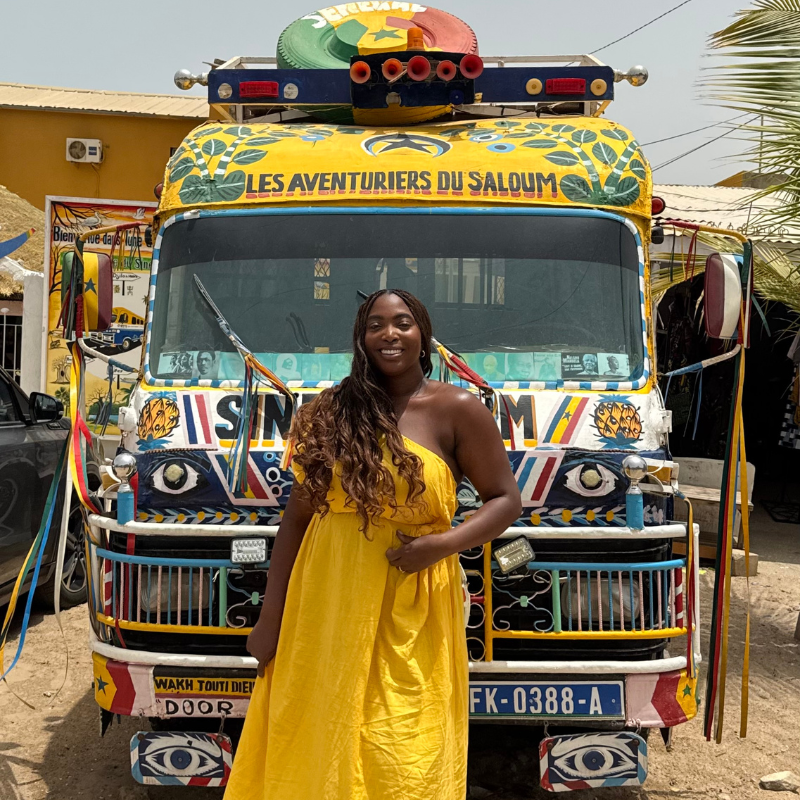
Matt Bowles: My guest today is Alexa Moore. She is an award-winning travel content creator and freelance travel writer for publications such as Matador Network and Lonely Planet.
Born and raised in Washington D.C. metro area, she quit her full-time job in the environmental sector in 2022 to pursue her dream of becoming a full-time travel creator.
Today she can be found at the handle @lilmsawkward where she has over 250,000 followers on social media. Her content centers on solo travel, cultural exploration and her goal is to encourage people to wiggle out of their comfort zones and explore the world.
Alexa, welcome to the show.
Alexa Moore: Thank you for having me. I’m excited to be here.
Matt Bowles: I am so excited to have you here. You and I have been in the same place around the world on multiple continents for many years now and I have been wanting to do this interview for quite some time. So, I’m super excited we were able to put it together today.
But let’s just start off by setting the scene and talking about where we are recording from and the fact that we have agreed to make this a wine night. So, let’s also talk about what we are drinking.
I am actually in the Blue Ridge Mountains of Asheville, North Carolina on the east coast of the United States today and I have just opened a bottle of Carmenere from Chile. So, I’m going to be drinking through that tonight.
But where are you, Alexa, and what are you drinking?
Alexa Moore: I am in Alexandria, Virginia, right outside of D.C. and I am drinking Prosecco. From where? I couldn’t tell you. It’s been opened on my counter for the past two days and I figured it was time to finish it.
Matt Bowles: Well, that sounds absolutely perfect. And big up to the DMV. I lived in D.C. myself for about seven years, have huge love for the district, and I lived in the district the entire time I was there. But I came up to Northern Virginia a good bit.
And I will be honest, the reason that I kept coming up there was because I feel you have some of the best South Asian food in the country in Northern Virginia.
Alexa Moore: Yes, hands down. I feel like Annandale, which is probably 10 minutes from me, is known for its Korean food. The Vietnamese food in Arlington and Northern Virginia in general is just bomb.
I feel like we have so many interesting immigrant communities that come here, and they throw down so well.
Matt Bowles: It is amazing.
Well, I feel like I should start this off by asking you about your social media handle, @lilmsawkward. Where does that come from and does it still accurately describe you today?
Alexa Moore: Yeah, there was a site back in the day called Tumblr, and when I was in middle school, I was really into it and the Little Miss phase was really big. Like Little Miss Anxious, Little Miss.
So, I just named my Tumblr blog Little Miss Awkward and it stuck. And then of course, my Instagram started as a personal one, and so everything was a Little Miss Awkward.
I had to delete my Tumblr because when you used to type in Little Miss Awkward travel, my old Tumblr post would pop up. I’m like, oh, my gosh, brands cannot see that. So, I deleted my Tumblr.
But at the time, yes, in middle school, I was extremely awkward. I was odd. I was a theater kid. I was a little nerdy, and I think I’ve grown out of it a bit, but I can be awkward in the moments and every so often.
Matt Bowles: Well, I would definitely love to go on your journey. And even before we talk about your experience growing up in the DMV, I know your mother was born in Jamaica.
I would love to hear a little bit about her experience there and her journey immigrating to the United States and what that was like.
Alexa Moore: So, my mom is from Jamaica. Big up. Let it’s in St. Elizabeth. It is tiny. St. Elizabeth’s known as the breadbasket of Jamaica because it’s very country. I love St. Elizabeth. It’s so beautiful. But my mom was born and raised in Jamaica. She grew up there, I think, until she was 9 or 10.
Her father was living in Miami, but he was able to send for my mom over to the U.S. So, she came out as a kid. She was one of seven who was able to come to the U.S., and so she did her teens in Miami. She didn’t really get to explore a lot growing up.
So, I think when she decided to have kids, she was like, okay, we’re going to go everywhere. We’re going to see everything, because she’s such a curious individual.
And same with my dad, who was born and raised in Florida, but similarly, always loved this idea of exploring the world. And they really made sure that we, as kids, had those same traits, loved exploring and loved getting out there.
Matt Bowles: Amazing. So, first of all, what role did Jamaican culture play in your life in the home growing up? And how did you sort of navigate that Jamaican and American identity as you were coming up?
Alexa Moore: I call it Jamerican. I think one way you see it, and I think it affected my taste buds tremendously, is the food. I always tell people I had the best Thanksgiving.
Imagine curry goat turkey, yams, or sweet potato souffle with the rice and peas all together. It’s just a marriage of two. Insanely talented culture, soul food, and then Jamaican food. It was perfect.
I feel like my mom really instilled in me. I don’t want to say the immigrant mindset, but just this mindset of working really hard to get what you want. I think when you come to this country, you just have to work very hard.
My mom works probably too hard. She is retired. I think she’s probably just getting off work now. She still works as a pharmacist. She’s the most hardworking person I know. So, I think those aspects really came into the house.
But then my dad is the black American. Embracing of music, of art, of writing. And then the importance for both cultures is just our love for elders. Black Americans and Jamaicans love our old people. That’s something I’m really grateful that my parents instilled in me, because I love my grandma. I miss my grandparents. I think that’s really important as a young kid.
Matt Bowles: Do you still have family in Jamaica? And what was your experience like coming up as a kid with regard to travel to Jamaica and building your own relationship with the homeland?
Alexa Moore: The first time I ever went to Jamaica was when I was an adult. You have to ask my mom about that. I don’t know. She might be able to tell you more on why that is, but I would always have family that visits.
There was probably not a time in my childhood where I didn’t have an auntie there, a cousin coming for the summer. My grandma lived with us, so when I was born, my grandma was living with us. And throughout my childhood, she would come and take care of us.
That’s why I’m so much more connected in the culinary aspect of Jamaican culture because my grandmother is an incredible cook. My aunties cook, my cousins cook down. So that was my very strong connection.
But now, as an adult with some money, I’m able to travel to Jamaica more, and I just get to learn more about my culture. I actually did my ancestry and, of course, connecting me right to the island.
And I’m able to trace to the 1800s, maybe the 1700s of my ancestors in Jamaica, which I think is fascinating. And as I have the flexibility to travel a little bit more, and I’m not so obsessed with that.
I need to go to every country and I start revisiting places. I want to dive more into Jamaica because there’s just so much that I haven’t even touched. I’ve honestly just been to Kingston and then visited my family, which is St. Elizabeth, and then Montego Bay. Of course, like all the other Americans, you have to go to the resorts.
Matt Bowles: So, what type of travel did your parents prioritize for you as a kid as you were coming up? What were some of those experiences like, and how did they impact you as a child?
Alexa Moore: You know, this theme of spontaneous travel where people are like, I wake up one day and I’m like, I’m going to go to Spain. That was my mom.
My mom is a spontaneous traveler, and it used to drive me crazy as a child because she would wake us up at 6am tells us to all hop in the car, my dad included, who was driving, and she’s like, we’re going to go somewhere. “Mommy, is there a hotel booked?” “No”. “What’s our plan?” “I have no idea”.
And this is not in the age of, like, chatGPT or you could just Google and get a full itinerary. We would just drive two hours south and check out and explore.
So that local curiosity I definitely get from my mom, because she’d be like, oh, we’re just going to go to D.C. for the day, or we’re just going to go to Baltimore, or we’ll just maybe drive up to New York for three hours, get some Jamaican food, see grandma, and come back.
So that definitely made me anxious as a kid.
But in my early 20s, I really rejected this idea of spontaneity, and now I really embrace it because I’m like, you know what? I should just go to Spain today. Why not go to China? That makes sense to me.
Matt Bowles: So, you mentioned how diverse Northern Virginia is and how many different types of communities are there. How did that impact you growing up and what was your personal experience, like, what was the demographic like in the school that you went to and your exposure to other colleges?
And did that get you interested in the world?
Alexa Moore: Definitely. I always like to tell people my little fun fact is one, I got to meet President Obama on my first day of freshman year. And that’s because that year he was making a speech at my high school, Shadow Wakefield High School.
He wanted to do a back-to-school speech. And he picked Wakefield because it’s one of the most diverse schools in Northern Virginia. We had people from over a hundred countries. It was that diverse.
And it definitely gave me exposure to how beautiful it is and how similar we are as people. Even though we can come from different places in the world, we share so many similarities in our music, in our dance and our cultures. And having friends from everywhere, of course they’re telling me about their homes.
My best friend growing up was from Bolivia, so I’m getting exposure to Bolivian cuisine and then seeing all the salt flats. I have to go there still. It’s still on my list. But having friends from Peru or having friends from Mongolia, I was like, wow, these are places that I need to visit.
So, yes, definitely sparked that curiosity.
Matt Bowles: And D.C. is also a very Black city, and it’s a very diverse Black city. For people that don’t know, the historical nickname of D.C. is Chocolate City.
For many years, it had one of the highest concentrations of African Americans of any city in the country. But you also have a huge amount of immigrants. It has the largest Ethiopian immigrant community in the United States.
Obviously, a lot of folks, like your mother, from the Caribbean and so on and so forth.
What was that like, particularly in terms of coming up in D.C. and navigating that diverse milieu of Blackness in the U.S.?
Alexa Moore: I love my, shout-out my,Habesha community. There’s so many Ethiopians and Eritreans in the DMV. I went to high school with them. They’re incredible.
But for me, it was how cool it is to see Black people from different places. I actually went to a predominantly white elementary school, and so going to middle school and high school was that exposure for me.
And I was like, “Wait, you’re Black, but you’re from a different place?”
And just the, again, those similarities, okay, you cook like this, and then we kind of cook like that, or you dance like this, and we kind of dance like that.
And so just getting that exposure made me also very motivated to start traveling around the continent of Africa as well, because I’m seeing similarities from my Nigerian or Ghanaian friends on how they do things.
And I’m like, “Wait a second, we could be cousins.”
And I need to discover more on why we have so many similarities.
Matt Bowles: All right, so let’s jump to college.
You decide to go to the University of Pittsburgh. Can you talk about that choice? And also, let’s give some love to the ‘Berg. I think a lot of people sleep on the city of Pittsburgh.
I went to college in Cleveland, and a lot of my best friends from college were from Pittsburgh. And so, I tend to go through Pittsburgh a good bit.
But for you, talk about that decision to go there, and then what was your experience like in…
Alexa Moore: Well, funny enough, you said Cleveland, because when my dad was taking me around for my college tours and going to visit the campuses I was accepted at, I got a really big scholarship to go to Case Western in Cleveland, actually. Did you go to Case Western?
Matt Bowles: No, I went to John Carroll University, but very close to Case.
Alexa Moore: Well, I was going to say something mean, so I wanted to make sure that you did not go to Case Western.
I was really interested in environmental science, and I got a very big scholarship to go to Case Western, which I’m pretty sure is a private institution, very expensive to go to.
We get to Cleveland, I’m like, “Oh, this is interesting.” Did an overnight tour there. I got to meet people. It was a little too nerdy for me. They were doing medieval LARPing. It threw me off. I was like, “Wait a second, I don’t know where I fit here.”
And then there was a heavy emphasis on Greek life, but not the Greek life like the Divine Nine that I’m used to. It was more so academic Greek life.
And I was like, “I’ve never heard of an engineering fraternity, but I don’t think I want to join one.”
My dad was like, “Okay, we’ll consider it, but there is a college we are going to pass that you got into. I think we should just go see.” And I’m like, “Oh, my gosh, what place?” And he’s like, “Oh, Pitt.” I was like, “Is that even a good school?”
And he was like, “No, that’s a great school. You should look at it.” So, I drove past, and I tell people it was the most beautiful day in Pittsburgh. That is very important to say.
I visited on the most gorgeous, glorious day in Pittsburgh. The Cathedral of Learning, Cathy, was shining, people were friendly, and I was like, “Wow, I really like it here.”
If I had gone in the winter on an awful day in Pittsburgh, I don’t think I would have made that decision. But I did. Three and a half years later, I got my degree. It was wonderful.
But Pittsburgh has a really cool, I would say, art scene, music. There’s a lot of beautiful theaters, lots of history there, lots of great Polish food. I did not know what I was expecting when I got to Pittsburgh, and I was pleasantly surprised after my three and a half years there.
Matt Bowles: Well, I love your Pittsburgh-to-Cleveland story, because mine is actually reversed.
I actually applied and got into Duquesne, and so I went to Pittsburgh to visit Duquesne, and then I went to Cleveland, visited John Carroll.
And it was the same thing as, “Oh, my God, the sun is out.” Like, the day is beautiful. The same thing, like, “I’m going here. This is crazy.”
But, yeah, shout-out to the art scene in Pittsburgh. Listen, a lot of people do not know, and I will tell you this, I talk about Pittsburgh, I can remember very distinctly.
I was in Prague in the Czech Republic, and I was there with some traveler friends of mine, and we go to this art exhibit in Prague, and it’s an Andy Warhol exhibit. And I’m there, and I’m like, “Guys, first of all, do you know that Andy Warhol is from Pittsburgh?”
I’m pulling out this trivia, and I was like, “You’ve never been to Pittsburgh, because let me tell you something. Pittsburgh has the largest art museum in North America dedicated to a single artist, which is the Andy Warhol Museum, because he’s from Pittsburgh.” It’s unbelievable.
And people are like, “Oh, I didn’t know. Oh, Pittsburgh has that.”
And so, Pittsburgh has—I mean, shout-out to the art scene in Pittsburgh. It’s legitimate.
Alexa Moore: It is, for sure. August Wilson is from Pittsburgh. He’s one of the most incredible playwrights. Fences, the movie that came out, Viola Davis, Denzel Washington. It’s an incredible play.
Pittsburgh has so much. It’s definitely one of those spots that I don’t want to say up and coming, because it already is popping and everyone knows it for sports. But there’s so much more to Pittsburgh than sports. It’s also the city of Bridges.
Matt Bowles: Absolutely. For sure. And you and I also made a similar decision in college, which was to study abroad. I am very curious, though, because you landed on an India for your study abroad.
Tell me, first of all, how did that decision come about of all the places that you could pick? How did you land on India?
Alexa Moore: Well, it was quite easy because with the environmental studies program, I had three choices: Wyoming, Ecuador, or India.
Wyoming was already off the table because I’m not going to spend money to go to Wyoming, though Wyoming is gorgeous. I wanted to go abroad.
Ecuador—I talked to a girl, and she told me that they kept seeing tarantulas on their last study abroad. And I was like, “Absolutely not. Has to be India.”
So, I decided on India. It was a very easy choice, an incredible experience, but also very challenging. I was nervous at first because the way my anxiety works is that I’m going to research way, way too much.
And so, I was hearing so much positives, wonderful things about India.
But then, of course, I typed in “India, Black person traveling,” and I’m hearing horror stories.
So now I’m scared out of my mind, but still willing to go because I know you have to take people’s experiences with a grain of salt. I’m still so grateful that I made the decision to go because it really did change the way I travel.
Matt Bowles: Let’s dive into that. How long were you there for? How long was the program? What city were you based in and what was your first impression arriving in India, getting off the plane, first day, what was it like?
Alexa Moore: I was only there for, I think, six weeks. It was one of those short summer programs, and I was primarily based in Uttarakhand, Mussoorie, which is a resort town.
But they also have this American, or an English-based school, called the Woodstock School. It’s in the foothills of the Himalayas. It’s beautiful.
And when I got off the plane in New Delhi, I don’t know what I was expecting. I don’t want to say night and day, but it was just so busy. I knew I had landed.
It was like you open the doors of the airport, and then you’re just met with taxis honking and, like, so much, so much going on. I was like, “I’m in for a treat.”
I remember I landed late in the night, like 11 o’clock at night, got dropped off at my hotel, and I was like, “Oh, my gosh, where am I? What have I gotten myself into?” But so eager to get my trip started.
Matt Bowles: That’s amazing.
And I totally relate to that because I did a number of study abroad things in college. I, like, stretched my study abroad out, went on different programs at different places.
And I can remember in undergrad going to Cairo, Egypt, for the first time and having a very similar first response to what you’re describing.
Because I feel like if you’ve never been to a city like Cairo or, like, Delhi, it’s just so fundamentally different. You get there, you’re just like, “What is even happening in my life right now?”
But then the more time you spend there, the more you then start to understand and figure out how to navigate the city.
And then the next time you go to a city like that, where there’s no functioning traffic lights and the motorcycles are driving on the sidewalk and everything seems completely overwhelming in all these different sensory overload types of ways, you’re like, “Oh, I’ve seen this before. This is kind of similar to this,” and so forth.
But the first time you experience a city like that, it is intense.
So how did those six weeks unfold for you? What were some of the moments that still stick with you that really impacted you at that age?
Alexa Moore: For me, it was—this is so embarrassing.
So, I am not a big, outdoorsy person, which is funny, because my degree was in the environment. I did a lot of outdoorsy stuff in that degree. But it was the first time I ever had to go backpacking.
We had this trip. It was a part I already knew, so I was mentally preparing myself, but you could tell I was not prepared because I packed makeup for my four- or five-days backpacking.
I did not need makeup for that. I don’t know why. It only made my pack heavier.
And they told me that. I was like, “Oh, it’s going to be fine.”
There’s a pilgrimage that people do in Uttarakhand along the Ganges River, and it’s to this glacier, and it’s like a very holy site that people go to. I saw people walking barefoot. It was a very beautiful experience to witness.
But we backpacked it until we were sleeping overnight. I didn’t know that’s what backpacking was until I got there, and we had to carry our own pack.
So, everyone is very outdoorsy, and I am just so miserable.
And when I tell you, everyone is probably a mile ahead of me, and I’m just back there going my own pace. We walked for, like, six or seven hours a day. No technology, no cell service, just me listening to my own thoughts.
The most embarrassing part, though, was just people passing by me because obviously I’m a foreigner.
And they’d be like, “Your group says, ‘You got this, Alexa,'” like, passing messages from people would be like, “Yeah.”
And then, on the other hand, it’s like, I’m struggling so bad, but I’m also this Black woman in India with a long twist.
So, people are stopping me for photos, and I’m so exhausted, covered in sweat, and they’re like, “Hold my baby.” And I’m like, “I wish I could have taken a photo of them taking a photo of me.” I was like, “Oh, my gosh. I do not want to do this, but I’m going to.”
But I learned a lot about myself. I will never go on another backpacking trip personally, but that was still a highlight for me. Long-term memory sealed. Like, that’s just something that was so incredible.
And I think being able to experience the different religions in India as well. We went to, like, a Sikh temple, Buddhist, Hindu, Muslim. There were so many different faiths represented.
I think we also went to Catholic church. I thought that was really interesting.
And then the experience of also being the first to be somewhere or the first time someone is experiencing you, that was something I struggled with a bit. Kids, they don’t mean it at all, but sometimes they would laugh and point at me.
That was a little bit jarring. And I know it’s not purely out of malice. It’s more so like, “Oh my gosh, who is this person and why does she look like that?”
But that was very tough for me to deal with because it wasn’t constant, but it would happen probably every single day.
And then you got your funny moments, like you would walk into a restaurant and then they would put on hip-hop music.
So, there’s always balance.
Matt Bowles: Did you have some exposure in Northern Virginia to Indian culture, Indian food, Indian community? Did you have any friends in school or that kind of stuff? Did you have any context prior to going there?
Alexa Moore: Honestly, with the food, yes. But there’s a lot of people from Bangladesh that are in the DMV, so that was more so my exposure.
I had some friends from Bangladesh, but I don’t think I had any friends from India that I could really talk to about my experience more. But definitely Indian food. I love Indian food.
And then of course, what we see on like Bollywood and all those other things.
Matt Bowles: So, over the course of those six weeks in India, when you think about who you were when you arrived and who you were when you left, how would you describe the impact that that experience had on you as a person?
Alexa Moore: I went in a little green, which is okay, and open, and I left very brave. Just because I was put into a society completely different from where I’ve been in Northern Virginia.
And I was able to thrive. I made friends. People were amazing. Brave also because we had to do a little bit of a hike to get to our school every morning.
And there are a lot of monkeys in that part of India, very mischievous ones that were frightening. So, I overcame my fear of monkeys.
Actually, I can’t find the blog post, but I dedicated an entire blog post to the monkeys and conquering my fear of them because they’re frightening. Because I smile a lot naturally, and showing your teeth is a sign of aggression.
I learned the hard way. I survived.
So, I would say definitely brave. And I felt like that was the experience that really showed me that I think I can travel to most places.
I was able to overcome. I was able to learn so much. I got out of my comfort zone, truly. So that’s where I’m like, “I think I can do this.”
Matt Bowles: So, there were some pretty uncomfortable moments on that trip, but by the end of it was your general feeling “I would like to do more travel, including to places that may be uncomfortable”, like this one was at certain moments?
Alexa Moore: Yeah, definitely. I realized that sometimes I do need to be out of my comfort zone, and especially because this is not going to be a single experience.
When I was 10, my parents took us on a trip to Europe, which was insane. We, like, saved up for the year so we could go, and it was just like our little Black family in a minivan just driving across.
I think we went to seven or eight different European countries.
So that was honestly my first time truly traveling and being somewhere where I’m othered a little bit. I mean, people would point, stare.
We had a really scary experience in Munich. It was a little bit traumatic for me as a kid, but taught me these are things that you might have to overcome at some point in your life. These are things that might happen.
Unfortunately, there’s awful people no matter where you go in the world. But you know what outweighs that?
Incredible people around the world. Incredible people who are helpful, who are kind.
And I saw that traveling in Europe. We were in the Czech Republic, and I remember my mom got stung by a bee, and we were so scared because pharmacies and finding EpiPens or medical.
But this woman, who I don’t even know if she spoke English, just jumped in and helped. And so, I saw that. I was like, “Okay, there are terrible people.”
But I did not let that ruin my experience and definitely wouldn’t let it stop me from traveling and seeing the world.
Matt Bowles: Was there a moment in India that you can think back to and remember where you had a really nice warm interaction with a local person there that impacted you?
Alexa Moore: I actually learned how to haggle in India. There was a little trinket store that was a little bit of a walk from where we were staying in Mussoorie.
And I had walked in, and we had built a relationship because I wanted to order some sarees for my mom.
So, when I went in there, I talked to him. They were really interested in getting to know me.
But then everyone’s like, “You have to learn how to haggle. You have to haggle.” I’m not a big fan of haggling personally, especially if it’s over a dollar or five. I hate those videos where people are like, “Oh my gosh, you have to haggle down.” I’m not haggling over cents, especially coming from a place where I’m so privileged.
So I was in India, and it was based on not a set price. It was 5,000 or something, rupees or whatever. And I was like, “Four.” And he was like, “No, no, no, ask for three.”
This is the shopkeeper who’s, like, telling me, like, “Go lower, go lower.” And I’m like, “3,000?” He’s like, “No, 35.” He’s like, “Go lower, go up.”
And that was, like, one of my favorite memories. Because they’re not supposed to tell you the secrets, but I learned them anyways.
Matt Bowles: So I find that as well, that the haggling process at the market can be such a nice, warm bonding experience. Because I’ll do it in a way where I’ll make them laugh, or I’ll say a joke or something about it, and then we’ll be doing it, we’re both smiling, and they know that I’m eventually going to buy it.
And so, then they eventually get the sale. I eventually buy it. And because we went through that process together, we made each other laugh a couple times and all of that kind of stuff, it creates a nice connection.
And so, I really enjoy that as well. I feel like that’s a great way to connect with local people, is through a good-faith, warm-hearted market negotiation.
Alexa Moore: Yes, I agree wholeheartedly.
Matt Bowles: So, after you graduate from Pitt, you decide to apply for an internship in Namibia. Can you talk about what the internship was? And of all the places you could do an internship, how did you decide you wanted to go to Namibia?
Alexa Moore: So I was one of those people that graduated and told people I wanted to do something, but I had no idea what I wanted to. I told people I wanted to go to law school because I wanted people to stop asking me what I wanted to do.
Law school is way easier to explain than, “I don’t know. I just want to explore the world, maybe pick up an odd job.” Right then, people were like, “Oh, when’s your LSAT? What law schools are you applying for?”
So, people are really excited about law school. And in the back of my mind, I’m like, “I don’t think I want to do that.”
So, in trying to explore what I wanted to do, I know I just came back from India, and I knew that I really wanted to travel.
And then my dad’s fraternity brothers, who I call my uncles, two of them have a very fond relationship to the country of Namibia. They did work there. One of them found love there.
So, like, I grew up kind of learning about Namibia, and I think it was one of them who was like, “Look at some internships in Namibia. Namibia is such a cool place.”
And so, I looked, and I found this internship. It’s with OYO Namibia.
They’re a foundation that helps communicate very important public health concerns, whether it’s sexually transmitted disease, or talking about alcoholism, or talking about things that are affecting society.
But Namibia has so many languages. They have a lot of different tribes represented in Namibia.
So, they kind of created this troupe to be able to communicate through dance and art these very important issues, without having to do a play in multiple different languages, if that makes sense.
So, it’s, how do we communicate the dangers of alcoholism? I think that was what our summer internship was about. Our dance piece was about alcoholism. How do we communicate that without words?
And it was so beautiful. We danced primarily with a Namibian troupe.
And there were these four interns, I think: one from Germany, one from Norway, one from England, and then little old me. I think I was the second U.S. intern, because not a lot of Americans are going to Namibia.
Matt Bowles: So, think back all the way to the day you landed in Namibia for that internship, your very first-time stepping foot on the continent of Africa. What were you anticipating that that would be like? And then what did it feel like, your very first time on the continent?
Alexa Moore: I was anticipating just feeling so at home. I knew that from my ancestry. I’m like 96% African, majority West African, but I was like, “I feel at home.” I’m in this place where I see people who look like me, and that’s incredible.
And I felt really embraced by Namibia.
I actually loved when I landed. I had so much fun that I forgot to tell my dad I landed.
So somehow, he found the hostel I was staying at and called the owner and was like, “You need to tell my daughter to call me right now.”
I think this was before the days of Find My Friends. Maybe Find My Friends was just coming out, so they could not figure out where I was.
So, I had the time of my life. It was incredible.
Matt Bowles: How long were you there for? And was this in Windhoek or was this in a more rural area? Where were you based?
Alexa Moore: I was primarily in Windhoek. And I was there for about four weeks, and we spent some time traveling around the country, but I was broke. I had very little money.
There’s Etosha National Park, which is in the north, that is supposed to be great for safari. Could not afford to go there.
We actually, we had to pick one excursion, and what we ended up doing is going to Sossusvlei and Big Daddy Dune, Dune 45. When you think Namibia, you think Mars landscapes. That’s where you see that at.
So, we did an overnight camping experience there. It was unreal. We woke up at 4 AM, hiked up a dune. And no one says this, but hiking on dunes is insanely hard because the sand, it’s like resistance training difficult.
And when it’s hot, yeah, absolutely not. So, I did it. And I was met by the most beautiful sunrise. I was so happy I did it.
And then I think it was Dune 45 or Big Daddy Dune. And you can actually run down it to Sossusvlei, which is this salt pan that sometimes floods every once in a blue moon. But they are known for their dead trees.
They’re these trees that come out, and it’s surrounded by desert, and we’ve just rolled down a dune to get to it. It was prime memory. That was so fun.
Matt Bowles: So, when you think about leaving Namibia, how would you describe the impact that experience had on you living on the continent and being so immersed in the culture for an extended period like that?
Alexa Moore: I’m like, “What did I just sign myself up for?” Because now I’m going to be chasing this moment all over the continent. I was so excited, especially because after I did Namibia, a friend, Ellie, and I decided to take the bus from Windhoek to Cape Town.
I think that’s 24, 25 hours. I don’t know why we did that.
The flight was an hour, but we were 21, so. And going to Cape Town opened me up to so much in South Africa.
And I was like, “Okay, I just need to figure out when I am going to get back here.” Because I just felt so welcomed and loved. I learned so much about a new culture that I would not get exposure to.
Even honestly, living in the DMV, you see so many people, but there aren’t a ton of Namibians and there aren’t a ton of South Africans. So that was my first time really experiencing that.
And yeah, I was like, “Big mistake,” because now I’m just going to want to travel everywhere.
Matt Bowles: So, I feel exactly the same thing every time I spend time on the continent. I’m like, I don’t want to leave, and how quickly can I come back? And I want to go back to the same places. And I also want to see different places at the same time. I have the hardest decision about, do I go back to these places I love? Do I go to a new place?
So, for you, you have now been back to South Africa. What are your favorite places and your favorite things about South Africa?
Alexa Moore: I just went back. I was actually on a trip with an ultimate break. And this was my first time doing a group trip ever. And I loved it because I was like, wow, I don’t have to think about my itinerary. But then I did because then I got to Cape Town. I was like, wait, there’s this black-owned wine cocktail bar that I have to experience. Oh my gosh. I actually need to go to V&A Waterfront again to go shop all of these different things with South Africa.
The new things I did this time around, I went to Soweto in Johannesburg. Such an important township, home of Nelson Mandela and Bishop Desmond Tutu. And going to the Apartheid Museum. I was so sad because we only had two hours to explore. But that is a museum. You need half a day. There’s so much to learn in that museum. I love it.
You’re not allowed to take photos or videos. And I love that because it really made me disconnect because I’m not focused on, okay, I need to record this. I was reading every single placard. I wanted to see every exhibit. To think that apartheid is so recent as well, in 1994. This is recent history, and I just need to read more about it. Nelson Mandela’s Long Walk to Freedom is on my reading list. I need to read it.
And then for Cape Town, I always go to Table Mountain. I think it’s one of the most beautiful places. And I hiked it my first time around. But my second time, I was like, absolutely not. I’m not doing that again. And I love that cable car. It rotates, so you get really beautiful views as you go up.
Cape Town is the most beautiful city in the world. It goes neck and neck with Rio. Both of them have similar vibes. Two of the most beautiful places I’ve ever been.
Matt Bowles: Totally agree on the beauty of those two cities. Have you been to the Rand’s party in Khayelitsha Township on Sunday in Cape Town?
Alexa Moore: Do I need to do that? That sounds amazing.
Matt Bowles: Listen.
Alexa Moore: Okay.
Matt Bowles: The best nightlife in Cape Town is in Khayelitsha Township. And on Sundays, they do what they call the Rands party, which is a day party that’s like a Braai barbecue, DJ, and then it’s all like, I’m a piano, music, all this stuff. And then at night, it turns into a night party, and it is the best party in Cape Town.
So, on a Sunday, and you want to go on Sunday, that’s where you can find me when I’m in Cape Town.
Now, I am curious, though. Joburg is very different from Cape Town in terms of the vibe. And I’m curious for you, when you got to Joburg after having been to Cape Town, what was the experience in the city of Joburg, and which one did you resonate with more?
Alexa Moore: I honestly, I feel like I didn’t give Joburg a fair shot because I didn’t get to go out. I have a friend in Joburg, and we were supposed to link up, and I wasn’t able to. So, I wasn’t really able to experience the nightlife, the more local culture in Joburg. So, I need to go back and do that.
But for right now, Cape Town has my heart. I went to this, it’s a South African-owned speakeasy cocktail and wine bar, and their whole mission is called Nkula. Their whole mission is to amplify Black and colored winemakers and lesser-known winemakers. Oh my gosh. When I tell you what I walked in, I was like, wow, this is a dream. It’s a vibe.
They were playing jazz, but was mixed a little bit with the Amapiano. Everyone’s dancing. You walk in, and people are like, hey. Like, yes. I loved it.
And so, I think this time around, I was really intentional in the places that I was visiting in Cape Town. I was supposed to go and do a street food tour. I’m really bummed I wasn’t able to go do it to try to get a little bit more of that local life in Cape Town and not that, oh my gosh, Table Mountain, penguins in Robben Island.
So, for now, I would say Cape Town. But maybe when I go back, I’m probably going to go back either this year or next year. I will get more of a feel of Joburg, and I can give you a better answer to that question.
Matt Bowles: Listen, I’m going to tell you right now, the nightlife in Joburg is on a different level. It is significantly better than Cape Town. Truly spectacular.
So, if you get a chance to stay in the city and just do the urban Joburg experience with the nightlife, it is really amazing. And as you mentioned, I’m glad you got to do some of the political tours. I totally agree. The Apartheid Museum in Johannesburg is really powerful, and it’s really important for people to see.
I’m curious, when you did your tour of Soweto, was your tour group mostly a Black group, or was it mostly a White group?
Alexa Moore: Majority white.
Matt Bowles: Okay, yeah. So, what’s really interesting about that, I feel like there are slightly different narratives, shall we say, when it’s a majority White group versus a majority Black group.
And I feel like this begs the question about the political economy of the tourism industry for things like the history of apartheid. Because when you have a white customer base who is looking to pay you to tell them about this history, there sort of becomes this financial incentive, subtle as it may be, to not make those white customers that are paying you feel too uncomfortable about the information that you’re giving them because they are your paying customers.
And so, I feel like some of the dynamics there when you’re going into those historical tours can be different depending on if you’re going with a majority black crowd versus a majority white crowd.
Alexa Moore: I really wish I could have experienced it to compare, but I will say that when we did Soweto, our tour guide, her name was Mama Queen. She was incredible. She was born and raised in Soweto, lived there ever since, and was so knowledgeable on all of the happenings, like the student protests and whatnot. She was there, she experienced them, and she did not sugarcoat anything. And I’m really appreciative of her for that.
We had literally that morning gotten off a plane, so some of us were definitely tired. But I’m over here, ears perked up, and so many other people were too, because she was just very passionate, and she was giving us her perspective. I think that was extremely important.
But I can definitely see that, that it’s a hard history to swallow, but it’s the truth, unfortunately. And it’s really important for people to be exposed to it and not have a sugar-coated or like a muted version just because it makes people uncomfortable, you know?
Matt Bowles: Totally. Yeah. And there’s multiple dynamics going on there.
Like, South Africa is a very complicated country because not only is there this tendency to sugarcoat, coat some of the history, but there’s also the tendency to sugarcoat the present and being like, oh yeah, apartheid was in the past, and now we’re a rainbow nation and all this kind of stuff.
Whereas now, if you pay attention when you go to South Africa, there’s a lot of different dynamics going on, including, for example, a lot of vigilante violence against African immigrants from other African countries that have come to South Africa.
I can remember when I was in Joburg, one of the things I was doing is I was kind of attentive to this dynamic, you know? So, I’m looking up, like, tour companies. I’m trying to go see different things in different neighborhoods. And for me, like, when I travel, number one, I want to see things like street art. So, I’m going to look for what is the best street art tour that’s going to really show me the street art, including the social and political commentary in the street art in a certain way and that kind of stuff.
And then I’m also looking for, like, how can I really try to understand that some of these social, political dynamics that are going on today in addition to historically.
And I can remember I found this one company, and I have been sending them people ever since, for years now. I’m still in touch with dude on the WhatsApp, and I sent him stuff, but it was literally called something like Honest Tours or something like that. Like, this is literally like the name of the company.
But I’m reading, like, how they’re describing it, and I’m like, okay, the language that they’re using to describe what they do and just sort of breaking down exactly what I was just talking about. And I’m like, okay. And then the types of tours that they offer.
So, yeah, they go to Soweto, and they go to these places. They do this historical stuff. But they also did a tour in this neighborhood called Hillbrow.
And Hillbrow is a neighborhood in Johannesburg that I could not get an Uber to drive me into. No Uber would take me there. And this is a neighborhood where over 90% of the residents are African immigrants from other countries.
And the tour was like, we will go in, and we’ll do a walking tour through this neighborhood, and you’ll be able to learn about the experience of African immigrants from these other countries that are living in Johannesburg. And we’ll patronize their shops and their bodegas and their stuff and buy some stuff from them, but we’ll be able to chat with them and learn about their experience.
I was thinking, like, wow, there’s a tour like that. I mean, that is really getting at the core of some of the stuff that is going on present day and allowing you to really understand contemporarily in this however many years post-apartheid we are.
There are all of these different manifestations that are happening in South Africa that are important to understand, not just what happened historically, but what is going on right now. Who are the marginalized communities that are in struggle today?
So, of course, you still have the overarching infrastructure of white supremacy and all the colonial dynamics, which are pretty visibly obvious, especially in places like Cape Town. But then you have all of these other layers, right, of the xenophobia against the immigrants and all this other stuff.
So, to really go in and try to understand that stuff. So, I feel like the longer you spend and the slower you’re able to travel, and the more intentional you are able to be about seeking out some of these things, the deeper you can understand places.
And for me, also, like, one of the tips that I’ll give people is it can be as simple as literally starting a conversation with your Uber driver, almost all of whom are African immigrants from countries outside South Africa, and literally just allowing them to talk, like, letting them know, how has it been? How long have you been here?
You know, I’ve heard some of the immigrants are getting a hard time here. How’s it been for you and your family? And just letting them know that you’re willing to listen and allowing them to talk and share their experiences is one of the best ways you can understand a place like South Africa.
Alexa Moore: I 100% agree. I had the most incredible conversations in my Ubers. I’m one of those people who ask my Uber drivers probably too many questions, but same thing. Where are you from? How long have you been here for? I’ve been hearing this in the news. How have you felt about it? And getting that perspective was so important to me.
I will also say I have some family in South Africa. And just getting to also talk to them about it as well, I realized maybe there’s a little bit of an age divide too, on, like, how people are feeling about the situation and talking to some of my cousins or some of the young. Younger, as young people, I say young, I’m 30.
But in South Africa, they have a lot of openness towards migrants. They’re very against all this violence that is happening as well. And I hate to also be that American is like, oh, my gosh, this is insane. But also, I live in the United States of America, for sure.
Matt Bowles: Absolutely. But it’s also like, you know, you find similar dynamics, right, where there’s immigrants. And this is the same in both places. Literally.
I have found in DC when I lived in there, there were some African immigrants who would have espoused racist views against Black Americans. Because prior to coming to the United States, they were socialized into the mainstream media representations about Black Americans being whatever, prone to violence or lazy or whatever the stereotypes are.
And they were going to come in and be the hard-working immigrant and this and that. And they were trying to distinguish themselves from Black Americans. So, you literally get the other side too. It’s not just xenophobia against immigrants.
And so similarly in South Africa, you’ll find some immigrants will have perceptions about folks in the township, right?
Alexa Moore: Yes.
Matt Bowles: So, what I always try to do, like when I’m in South Africa, is I’ll talk with township folks about the immigrants, I’ll talk with immigrant folks about the township.
And because there is this dynamic that’s going on, and of course, this is the whole thing, you get people divided for political reasons, getting low-income folks that are struggling, which is what you see everywhere, to start blaming the immigrants for their taking your social services or your jobs or your this or your that. And you should direct your animus towards them.
And it just repeats everywhere.
Alexa Moore: It does. I remember I was in Senegal, and there is this Belgian guy. I will never forgive him; he was really mean to me. But I decided to take a tour in French, even though I do not speak French, because it was the only tour available.
And he was really appalled by this. He was like, oh my God. Gosh, God, these Americans. You don’t even speak French, and you’re in Seneca. I was like, I’m so sorry I don’t learn the language of every country I visit.
And so, then he, of course, starts talking to us about America and how we’re awful and all of this anti-migrant stuff and our president and all this other stuff. And I was like, there’s also been like such an insane rise of xenophobia and anti-migrant sentiment as well in Western Europe, in places like Belgium.
And then he was silent, no longer wanted to talk to me. And I’m like, this is not, not a U.S. issue. This is something that is globally happening. There’s a rise of xenophobia around the world, unfortunately.
Matt Bowles: Yeah, 100% as we’re attentive to that as we travel. And then you go and you see that in other places and then you’re like, oh, I’ve seen this before. You know, what’s going on?
Alexa Moore: Wait, love thy neighbor. Like what’s going on? Please everyone, let’s get along.
Matt Bowles: So, I also want to talk to you about some of your additional trips back to the continent. You have been back a number of times now. You’ve, you’ve been to a lot of places on the continent.
And I know Senegal, despite your interaction with that one dude, is a place that you’ve spent a lot of time now. And I want to ask you about your overall impression of Dakar, because for me, this is one of my very favorite cities on the continent.
I have been back three times, one month each. I’ve spent three months in Dakar, and I’ve just, I’m so enamored. Every time I go, I want to go back again.
But you have traveled around Senegal and actually probably more than I have. So, I’m curious for you, what have been some of the highlights of your experiences in Senegal?
Alexa Moore: Oh, my gosh, I love Senegal down. I think that’s very apparent in how much content I have about that place.
So, when I went to the Year of Return in Ghana, I realized, wow, West Africa, even though it’s expensive, we can get into that later. Expensive to hop around from country to country. Way more expensive than we probably think.
Air Senegal had just launched a route from Accra to Dakar. So, I was like, oh, my gosh, I have to go to Senegal. I land, no plans, just really embraced. Was invited to a baby shower on the street, got lost. Taxis found us, spoke absolutely no French, still do not speak French. It’s not improved at all.
And I just feel so embraced. Senegal’s people, like the Taronga, that hospital. This is a word that I’m pretty sure shorts Wolof. It means like hospitality that, like, welcome. And it’s felt Senegal’s people are so nice. Drivers literally will drive somewhere, run down their window, and ask on the street, hey, where am I? How do I get there? And people will stop automatically, let you know everything.
I love the car. I think my highlights. Angor Island. I haven’t gone surfing yet. I’ve never been there overnight either. It’s about a 10-minute water taxi. I say water taxi, it’s like a boat that you catch to get to this tiny little island that’s known for its surfing. And it has these beautiful little hotels and beaches.
Goree Island, of course, for its history and the slave trade. I think it’s so important for everyone to visit there. But then the car has the food, the energy, the nightlife. It’s so fun.
And then Senegal in general, the Lompoul desert. There’s this beautiful hotel out there called Hotel. Okay. And you can stay in, like, bungalows or tents, and you can go sandboarding. I get excited because I want to go back.
And then, of course, the Sine-Saloum, which is these waterways that branch off into the ocean, but you have mangroves and again, boutique hotels that are gorgeous, but just interesting experiences. And old baobab trees. Oh, my gosh.
And then the food. Senegalese. I’m saying it. I can get canceled. Best food in West Africa. To me, Senegambian food. Senegal and the Gambia, incredibly good cuisine.
Matt Bowles: Okay, I told you I was going to do this, and I was going to put you on the spot, and I was going to have you weigh in on the jollof wars. Which country? I want to get it on the record. Which country in West Africa has the best jollof?
Alexa Moore: Well, first, I want to apologize for what I’m about to say, because I did do my ancestry, and I am 56% Nigerian. That was so exciting for me to find out. I have cousins in Nigeria. Sorry to my Nigerians, Senegal makes the best jollof rice.
Not only does it just taste way better, but they are the originators. People say that jollof, which the Jollof or the Wolof Empire, is modern day, like Senegal, the Gambia, and Mauritania. So, that is definitely where it stems from.
But also, it’s just perfect. You get vegetables, you get fish. It’s a little saucy. Sometimes it comes with a little tamarind sauce, the eggplant, the carrots. A celebration on a plate. And the Senegalese have perfected. Is next level.
After Senegal, I would say maybe, I don’t know, Ghana. I’m not a huge fan of Nigerian jollof. I’m sorry, but I haven’t been in Nigeria yet, so I haven’t had any it to, like, directly compare it to.
Because I’m sure the Nigerian jollof I’ve had in the U.S. can’t compare to the one I would have in Nigeria. But for now, until someone proves me wrong, it is Senegal.
Matt Bowles: Yeah, Senegal is a strong pick. I feel also like the Senegalese are just a little bit more. I don’t know if it’s confident or humble, but I feel like they let the Ghanaians and the Nigerians be the loudest about the jollof wars.
Alexa Moore: Yeah.
Matt Bowles: So, we also have to talk about Ghana. You and I were both there in 2019, albeit at different times, and then we both went back. You were there in 2021, I was there in 2022.
And what I love about this is that we both got a chance to experience Detty December, and we both got a chance to experience Ghana when it is absolutely not Detty December, which is a different vibe.
So maybe just talk about the Year of Return for people that might not be familiar with what that was in 2019. Explain. Explain what it was. What brought you to Ghana initially, and what Detty December was like that year, because I didn’t go until 2022 to Detty December.
2019 I was there for a month in June, and I didn’t go back till later. So, for you, what was that first experience like in 2019, and what was the context?
Alexa Moore: Oh, my gosh. It was magic.
So, I was working at the EPA, and a new girl had just joined, and we got to talking. She also liked to travel, and she was like, hey, do you want to go to Ghana in December? And I was like, yeah, why not? There’s this Year of Return happening. They’re like calling people who have West African heritage to come back to Ghana. And I was like, yeah, sure.
We had no connection. I think at the time, there was a guy that I befriended who was from Ghana. That was the most connection that I had. And so, we were like, okay, we’re going to book our hotel and our flights, and we’re just going to go and go to Afrochella because we’re having these big celebrations.
Because in 2019 was a Year of Return, and it was so epic. And of course, then everyone wanted to come, but they couldn’t because the pandemic. So, the next really big one was probably 2021 or 2022.
So, I loved Ghana down. Funniest story ever, when we landed, and this is very uniquely Ghanaian. When we landed, we got to our hotel, and the receptionist was like, ma’am, you don’t have a reservation.
Mind you, this is like the first Year of Return. All the hotels are sold out because everyone is coming back. People who are already coming to Ghana were there if they’re visiting family. But now you have a flood of Americans that are coming, people from the UK that are coming to experience this. Everything was sold out.
And so, I’m like, what do you mean? I booked this months ago. And they’re like, yeah, we sent you an email and said your booking was canceled. I was like, what are you talking about?
And so now we’re just standing there at this hotel reception, like, what are we going to do, girls?
Luckily, I had a friend. His name is Kwamena. He was there. And so, I immediately messaged him. I was like, oh, my God, dude. We just landed. And they said, there’s no hotel room.
He was on it. When I tell you that man had connections to a realtor. The realtor had a spare apartment. It was probably 40 minutes outside of Accra where we ended up staying. But we had our own Airbnb. We were in the neighborhood with other people. It was not a touristy area at all, but that was the best experience because we had the best food, and it was spectacular.
But you realize Detty December is amazing, but those Detty December prices are crazy. When I tell you they double the price of water, they double the price of street food, everything is more expensive. The taxis are more expensive, the Ubers are more.
The Ubers in Ghana are notorious. You’ll call an Uber, and then they’ll message you and say, please, where are you going? And it’s because there are parts of the city they may not want to go to.
You’ll be like, oh, please, I’m going to the near airport or East Lagon. There, and they’re like, no, ma’am, cancel chaos.
So, then we went again, same me and Krista. She’s one of my best friends. We ended up going again in June. We realized how much slower pace it is. The traffic in Accra is still awful, but a little less awful than in December.
Prices again slashed, hotels way less expensive, and you get just more of a feel. And that trip, we really explored.
Our first trip to Accra, we did the waterfalls, the Aburi. This time, we went all the way to the north. We went to Mole. There are elephants in Ghana. A lot of people don’t know that.
We got to go all the way west. There’s this beautiful little surfing lodge called Ahanta Waves. So, we were past Takoradi in the surfing town and just relaxed there for a few days.
The Volta region, which is I think the most beautiful place in Ghana. Wili. I think it’s the tallest waterfall in West Africa or Ghana. Beautiful. Insanely beautiful.
If anyone is planning to go to Ghana, make sure you explore outside of Accra. Not that Accra is an amazing. It is, but there’s so much beauty to Ghana, as you know as well.
Matt Bowles: So how would you describe the difference between going for Detty December, other than the prices, going for Detty December versus going in the complete off season when you’re mostly just hanging out with local Ghanaians because it’s not primarily tourists there,.
Alexa Moore: It’s just way more chill. You can get into the clubs that you want to. There’s no covers. I keep saying prices because pricing is a big one, but it’s just a little bit more slow-paced.
A hard lesson I learned in Ghana is that it’s not as fast as D.C., it’s not in New York, it’s not Miami. We have to, like, get out of our thought that everything has to be rapid. Food takes time, service takes time. And that drove me a little crazy at first.
It does really force you to slow down and just take in that you’re in Accra, or you’re in this place in Ghana. It’s a little bit slower pace. You get to talk to people, you get to relax. Like, nothing is too serious. And so, I really enjoyed my June trip.
Also, the weather is completely different. People forget that December is Harmattan season for West Africa. That’s when the Saharan winds come in, and there’s a lot of dust. So, I had a friend, their asthma was flaring while they were there.
Junes totally different. It’s hot, but different weather, and then less tourists. So, I could do anything that I wanted. Just call up a tour guide and be like, hey, I want to go this place. And they were not trying to charge me any insane amount.
But also, less traffic. And we had some tourist sites completely to ourselves.
Matt Bowles: Did you by chance go to the Sunday party on Labadi Beach in Accra when you were there?
Alexa Moore: Yeah.
Matt Bowles: Is that ridiculous? Okay, so remember the first time I went to Accra was not Detty December. It was in June. I am there in June, and I’m with some Ghanaian friends, and we are on Labadi Beach on Sunday.
I’m there in the afternoon, and all of a sudden, the DJs start setting up. They’re lining the beach with DJs, and people just start gradually filtering in, and more people and more people.
And by the time the sun sets, there must be 5,000 people on that beach with DJs lining the beach. And it’s all local Ghanaian folks. And it’s one of the most unbelievable parties I’ve ever seen.
And I’m standing there, and people are like, you got to come back in December. See Detty December? I was like, how could it possibly be more lit than this? This is unbelievable.
Alexa Moore: Yeah. Ghanaians know enjoyment. They know party, they know enjoyment. It is such a vibe. That’s why I get it when people are like, I’m going to Ghana and they have it on their list. I’m like, I get it because it is so much fun.
But also, people ask me all the time, would you do Detty December again? And I don’t know that I would. I think just because I had that experience. Like you were just saying, you went not during that time, and you had such a fun experience.
I hate crowds. I loved my June experience. So, for those who are like, oh my gosh, I want to go to Ghana, but I don’t know if I have the 15 to $2,000 to spend for those December dates, don’t worry, you’re still going to have enjoyment.
You’re going to still have fun. No matter what time of the year you go to Ghana, because there’s always going to be something going on.
Matt Bowles: Yeah, I feel like Detty December was very interesting because it was the whole African diaspora from around the world descending on Accra.
And so, when you go to one of the parties during that, we’re talking about the week between Christmas and New Year’s, including the New Year’s Eve party, which is insane. And it was unbelievable, though, because the DJs knew exactly who was in the crowd.
So, they would play a song from Atlanta, and they would shout out Atlanta, and then they would play a song from Nigeria. They shout out Lagos, and then they play a song from South Africa. They shout out South Africa, and then they’d play a song from New York, and they’d shout out New York, and then they’d shout out Black fraternities and sororities.
I mean, they really knew who was there. And it was kind of amazing just to see such a diverse collection of the global diaspora all in one place and how the DJs were playing the music and bringing everyone together and stuff.
So, I felt that was a really culturally unique moment. But as you mentioned, that’s largely because most of those folks are from outside of Ghana.
If you want a Ghanaian experience, go in June and just go to Labadi Beach on Sunday and just immerse in it all because it’s incredible.
Alexa Moore: Ghanaians are so friendly, similar to Senegal. They have a quaaba that welcome, and just you’ll meet the coolest people.
I still have friends in Ghana. When I go back, I’ll definitely see them and hang out with them. They’re just the coolest people ever. They’re so sweet and so kind.
And yeah, I just, I love that place. I love a lot of places, but Ghana has a very special place in my heart just because I got to spend so much time there.
Matt Bowles: It’s amazing. So, my very first time in West Africa, I went for three months, and I did a month in Lagos, Nigeria, first. Then I did a month in Accra, then I did a quick trip through the Ivory Coast, and I did a month in Dakar in Senegal. So that was my first three months in West Africa.
And to be honest, what brought me to West Africa, one of the things that really inspired me to go was spending time in East Africa and hearing all these Afrobeats and Shazaming all these Afrobeats and looking up where all these artists are from. And it was just like, I have got to go to Nigeria. This must happen.
And so, I went there with a couple friends of mine, both who have been on the podcast, actually Tiffany Green, who’s African American, and Agnes Nyamwange, who’s Kenyan. And we went there for a month together to Lagos. And then Agnes and I went on to Accra and to Dakar.
And what was amazing, if you’re into Afrobeats, just moving through the continent, and if you can move slowly, it’s even more amazing. But I spent a month in Lagos, and you must go. First of all, you must go.
But I spent a month there, and I am literally Shazamming every song in the Uber, at the mall, at the restaurant. By the time I leave Lagos after a month, I have the playlist of the up to the minute Nigerian Afrobeat bangers.
So, I’m like, I’m going to go to Accra, and I’m going to go to the club, and I’m going to know every single song. And then I’m asking them, what are the best clubs in Accra, like the local spots.
So, then I go to the club in Accra, and it is absolutely lit, and I don’t know any of the songs. And the reason is because all the Ghanaian Afrobeat artists is what they’re playing in Accra.
And I. I’m like, what? And so, then I learned all the Ghanaian Afrobeat artists. And then when I went to Senegal, that opened the door to the French language Afrobeats, which are, of course, the continent of Africa.
Half of the countries on the continent have French as an official language, 50%. And so, whether you’re from Mali or you’re from whichever francophone country, your songs are getting played all over, over francophone Africa.
But that’s very different from what they’re playing in Nigeria and Ghana, which are British colonies that speak English as one of the official languages, right? And so, all of a sudden, now that opens the door to all these French language Afrobeats. And I’m like, whoa.
And so now I have my whole French language Afrobeat playlist and all this different kind of stuff.
And so, I feel like as you move around, just the cultural nuances of these amazing things, like you’re talking about, how is the Jollof different. When you go from Nigeria to Ghana to Senegal, how is the music different?
It’s amazing everywhere. Let’s be clear. It’s amazing everywhere. But you get these nuances and these differences, and you learn to appreciate those cultures, I think, at a deeper level.
And it’s just so special. And every time I leave, I’m like, I don’t want to leave, and I need to start planning my trip back.
Alexa Moore: Yeah, it’ll be like, one thing that you’ll see our song that you’ll hear, and you’re like, I need to go back. I need to go back. Need to party harder.
Matt Bowles: All right, we’re going to pause here and call that the end of part one.
For direct links to everything we have discussed in this episode, including how to follow Alexa on social media, connect with her, come into her world. All of that is going to be linked up in one place in the show notes.
So just go to themaverickshow.com, go to the show notes for this episode, and there you will find it.
And be sure to tune in to the next episode to hear the conclusion of my interview with Alexa Moore.
Good night, everybody.