INTRO: This is part three of my interview with Priyanka Surio. If you did not yet listen to parts one and two, I highly recommend you go back and do that first because they provide some really important context for this episode. If you have already heard parts one and two, then please enjoy the conclusion of my interview with Priyanka Surio.
Matt Bowles: Well, I want to ask you about one of your recent trips that was specifically designed as a regenerative trip, which was the travel caravan in South India that you did. Can you share the premise and the context for that trip? And then take us on that journey, what was that like?
Priyanka Surio: Yes. So, I joined a regenerative travel caravan. It was hosted by GEN Bharat Ecovillage, and it was organized by a couple of community builders and leaders across different parts of India. One from the north in the Punjab region, one from Bangalore, and another who was also living in Bangalore at the time, but from different parts of India as well, had lived in different parts. And so, we had a trio team, quite a team, to organize this for us. But before I go into the caravan, I actually had not planned to be part of this. I didn’t even know it existed. I was revisiting India for the second time and it was at the beginning of the year and I remember wanting to start my new year in India and looking up at the universe and saying, if it’s meant to be, I want to have an avenue to come back to India. I know I will have family here. I know it’s been too long since I visited, since the first time was study abroad and now this was my second time. I was like, I want to come back more. I want to be able to build community here. I want to build my own family here.
And that was my call to the universe. And then two days later, someone that I had met at a Climate Week told me, oh, you’re in India. I know about this person who’s building a regenerative travel caravan. It sounds right up your alley. I need to put you guys in contact. And they were in Bangalore at the time, this person organizing the caravan. And I was not in Bangalore, I was in Hyderabad at the time. And, and I thought, okay, well Bengal was not on my card for this visit to India. But I’m going to go fly to Bangalore right now and I’m going to meet with this person. I’m going to see what this is about. After meeting with Yogesh in Bangalore, Creative Circus, which is a place for creatives and change makers. And it was such a cool setting. It was plant-based menu, all recycled upcycled items. I was like, oh, I like this place. I’m liking the energy; I’m liking where this is going.
After we had a conversation, I was like, how can I come back to India? Or how can I extend my story? I was already thinking, how can I do this? Because this regenerative travel caravan sounds exactly up my alley. I get to travel with other travelers. We’re literally going to be in a caravan, AKA a bus, going all around India. We’re going to visit all these places. We’re going to be building connection and community with locals. And that’s exactly what we did. And so, I joined for the South India leg and we were in Mangalore, deep in the jungles of Mangalore at Varanashi Organic Farms. And we learned a lot about how they harvest different plants, how they grow in organic food forest where basically you can pick from the forest and eat food. And our food was from the food forest. And it was so cool to see this deeply organic process of I saw my food, I helped harvest my food and now I’m eating my food in this place.
And then we went to Bangalore and also to Indiranagar, which is a little bit above and some of the other surrounding townships in Bangalore as well. And we got to be part of this regenerative travel festival that was happening at Bangalore Creative Circus that was inviting the community, the larger Bangalore community, Indians, to come talk with us as the caravanners’. And then we ended in Tamil Nadu, and we were in Palm area. And also, Auroville, which is a very unique concept that was created by a French woman and an Indian guru together, envisioning this place where everyone all over the world can coexist and live. It’s very fascinating to see that play out. I think there are tensions with that, but there are also really cool permutations and mixings of cultures and integrations. And everyone is very communal in that space. There are a lot of different festivals that emulate something like that. So, it was cool to see that on the ground.
And the caravanners themselves were also from all over the world. And some of them were from Thailand, some of them were from America, from Europe. And then there was equally, probably about half, if not maybe even a little bit more of the group was from India. And so, we’re traveling together with Indians who are local, who are there, who are thinking about how do I take these practices from these different eco villages or these different sustainability or regenerative projects and bring it back to my hometown. And then you’re also traveling with people globally, and there’s that intermixing of cultures. In a way, it’s not dissimilar to the diasporic experience that I saw in Ghana. So, it was really cool to witness that.
And what happened is now I have this community, both globally, but also especially in India. I literally can go back at any time, and I can go to different parts of India, whether that’s the north or the south or the west or the east. And I have someone there. And so, my whoosh basically came to fruition. And that’s what made that experience not just regenerative for India, because we were supporting and helping and harvesting and communicating and sharing our skills, but it was also regenerative for the caravan, connecting with like minds, and then personally regenerative, especially for me, creating that sense of community to where now I can go back. And I actually have this sense of being invited, and these people feel like family.
Matt Bowles: That is so amazing. I need to spend so much more time in India. I’ve been only twice, and I’ve been to Delhi, I’ve been to Agra, I’ve been to Mumbai, and then I’ve been to the south, to Kerala, and I’ve been to the north, to Punjab. And as I mentioned earlier, I spent Diwali and Amritsar and went to the Golden Temple and all of that kind of stuff. But India is so enormously massive for people that haven’t been to India, I feel like some people don’t understand, like, saying you’ve been to India is like saying, I’ve been to Europe. Where in Europe have you been? Like, every country speaks a different language. They all have a different history. They all have a different culture. Europe is a massive. So is India. I mean, it’s just, like, enormous. I mean, it’s almost, what, 20% of the human beings on earth live in India, right? Like 18%. It’s absolutely massive. And so, I feel like India just deserves so much of my time. I just need to go spend enormous amounts of time in India, in each of the States and just going through. And it’s so special when I’m there. And I feel like I need to spend so much more time there.
Priyanka Surio: And I love that you said that where it’s so different. And that clearly indicates that you have spent time in different parts of India and you realize that, or you’ve at least spent time around different Indians and you realize that it is so different. It varies based on what you said language, culture, even food is different. Even the dress and the outfits are different. Some religions are more concentrated in some areas. And so, yes, absolutely. I think sometimes people just have one picture of a place without doing more digging to see that it’s much more nuanced. And it’s much more of this tapestry of different cultures coming together that make up even within India. There’s a diaspora, I would say, in some sense of the word. And that you have different types of Indians who have gone through different types of experiences. And over the years, it’s unfolded in the ways that it has.
And so, I love that you said that. Even about Europe, I mean, people think about Eastern Europe, they’re like, oh, it must be the same. And then I’m like, actually, I feel that when I’ve traveled through Europe, it’s very different than some places. Maybe some places have some similarities, but when you venture out into some of the lesser known, you realize that there’s some Arab influences in parts of Europe that I would not have even expected in the places that I visited, like Albania, like Montenegro, and there’s a huge Arab community there. And I was like, wow, I did not expect this. And so, part of that is when you’re finding the truth, you’re dismantling those preconceived notions. And now I just try to go in without any kinds of expectations, without any kinds of judgments, without any kinds of preconceived thoughts about a place. I’m like, I’m going to be open to what I’m going to experience.
Matt Bowles: Yeah, I think that’s totally important. I mean, I can remember going to Serbia for the first time and spending the summer in Belgrade and just being super interested about, like, oh, why are there so many hookah spots? Because I’ve spent a ton of time in North Africa and the Middle east and stuff. I mentioned I lived for Cairo for a year. And so, every night in Cairo, you’re out smoking hookah and people are out till 4 in the morning. And it’s just all the outdoor cafes, and it’s just like, part of the culture. Then I go to Serbia and I’m like, why are there so many hookah cafes in Serbia? And I’m looking up, oh, the Ottoman Empire, and some of this stuff coming from Turkey, and how far did the Ottoman Empire reach? And what lingering cultural influence from some of the stuff. And then that all goes back to the history that we’re talking about, right. Or you go to the south of Spain and you go to Granada and you’re in the Albion Quarter and you’re like, holy cow, this looks exactly like North Africa. And then there’s this whole Moorish history there, and the Alhambra is there, which is one of the most spectacular pieces of Islamic architecture in the world. And there’s this whole history that is still there. And so, you just learn about all these different periods of history and how all this stuff evolved. Then it’s why we travel, right?
Priyanka Surio: Yeah. And I mean, to your point, about things converging and coming together, I think a lot about to bring it back to nomads. I think a lot about the nomads who traveled The Silk Road or who had certain nomad routes like those in the Sahara. And they would do a lot of trade across the different regions of Africa and even bleeding into parts of the Arab world or parts of Portugal or Spain. And they had to be open, and they had to be very diplomatic, and they had to build rapport with people who they had no idea about their culture or anything, because it was all in the spirit of trading their goods, their skills, their knowledge. And so, I learned a lot about some of those pieces when I have traveled, particularly in Mongolia, when I met the nomads there. And then as I’ve traveled throughout different parts, about that original sentiment. And I think part of this journey of being nomadic and part of the journey of being sustainable and regenerative is it’s not this new thing. It’s things we’ve done for thousands of years. It’s almost a remembering of how we used to be as humans.
Matt Bowles: Yeah, a hundred percent. Okay, Priyanka, at this point, I have got to ask you about your trip to Antarctica, the seventh continent somewhere. I have not yet, been. I am curious to hear about the journey, getting there, what your experience was when you were there, and then what lessons and knowledge and impact that had on your sustainability work.
Priyanka Surio: I did not expect to go to Antarctica in this way. I had always envisioned going either as a researcher or on some kind of scholarship with Nat Geo or some other kind of meaningful sponsored program. Because it’s Antarctica, it’s really hard to get there. Sometimes it’s very expensive, it’s out of the way, and there’s a lot of logistics and planning. And I also understand that it’s a very pristine environment and it has retained that pristineness over the years. And yet in many ways, tourism may disrupt that fragile ecosystem. So, there was a lot of things going in my mind when I was invited to go. And Nomad Cruise actually reached out to me about joining this trip and bringing together a very unique group of people who were going to go that were made up of freelancers, entrepreneurs and nomads. And I had not gone on a group nomad trip organized by a company that was focused on nomad life.
The ReGENerative Travel caravan was certainly its own kind of form of that, but it wasn’t necessarily focused on just nomads. So, this was intriguing to me for that reason. I would get to be around other people who chose a similar lifestyle path to mine. But I was still unsure about going. And then I learned about who their partner was and how they were designing the trip. And I asked all the questions. I asked, is this going to be sustainable or how is it being designed to be more sustainable? And I learned that their partner at the time, Oceanwide Expeditions, was very focused on sustainability as one of their core values. They were also going to have an A representative. This is the International Antarctic Tour Operators. It’s essentially a group that ensures that tours that go there are responsible, are sustainable, are not disruptive. There’s a leave no trace behind ethos within that. And the leave no trace behind is essentially whatever you take in, you bring out, you do not leave anything but footprints. It’s something that I’ve often seen in the outdoor industry as well.
So that made me feel a little bit better about going and just doing some due diligence on who the crew might be and learning that a lot of them had done research or were these just very amazing individuals who were very much big shots in their own countries, some of them from Europe, some of them from Australia, New Zealand. So, it was really cool to start getting to know about this. And ultimately, I decided to take the leap and go. And I wasn’t completely new to polar environments. I had spent a summer in Alaska and also had been there in the winter. And I had visited the Arctic and I knew a little bit about the ecosystems and the fragility and about some of the life up there. I had met some people who identify as Eskimo and talked about that. But Antarctica is completely different because the people who live there are creatures, they’re animals, that’s their ecosystem. And so, what’s that like?
So, I was very curious to see how sustainability would play out on this trip. I was also told we would have access to Wi-Fi, we would be on the ship, we’d have access to food, we would have certain amenities. So, the full logistics and planning and preparation that I found in my mind, oh, I’m going to have to really learn how to live in this polar environment. Those were kind of assuaged as I got on the ship. And then we got on there and we heard about these 9-meter waves that you may experience. And I couldn’t even conceptualize that. I was thinking of like a tsunami that we might experience when we cross the Drake Passage. So, anyone who’s gone to Antarctica knows about this. If they’ve gone by ship, they know about the Drake Passage, all the stories about it, the horror stories of how people get seasick or if they were in smaller boats, how sometimes that can overflood or even capsized, particularly for the explorers that went there. So, I was a little nervous about that. Our expedition ship was on the smaller side. We were a more intimate group. So, the route along with Nomad Cruise was about 24 people. And then the entire cruise ship had a hundred, including the guests and the staff and the researchers. And there were different groups of people that came from all over as well.
And so, it was interesting to be in a bit more of a smaller group of people. And I say that because when you go to Ushuaia and which is the tip of Argentina, and you set port to cross the Drake Passage, there are a bunch of cruise ships that are. There are other boats and a lot of them are really big. And I remember looking for Marne and not finding it at first. And it was like all the way in the back kind of hidden. So, it was a much smaller ship. So, you do feel those waves. I was a little worried because I’ve had seasickness before, but I was just very proactive and hydrating while and making sure I was not below deck, but not at the top of the deck in this median middle range. So, I didn’t get that sick, but some of my shipmates did. The woes didn’t get that high. I actually heard we got more of a Drake rocking versus a Drake sulk and I tried to lean into the rocking, but it was definitely something that when you get off the ship after being on it for a couple days, your body is still. When you’re in bed or when you’re walking, you’re still kind of feeling the rocking a little bit, or you’re waiting for it to happen. So, it’s something that definitely stays with you physically, at least for a little bit.
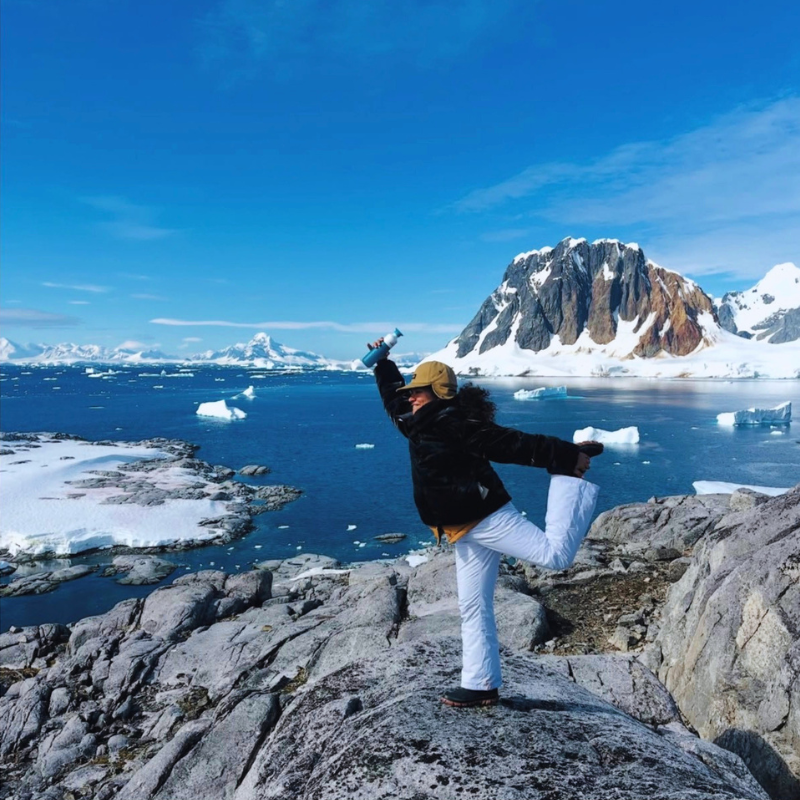
But we eventually made it to the continent and I remember they told us, well, we were going to have our first sighting probably at 4 in the morning, 5 in the morning. And I was like, I’m going to wake up for this. I want to see it emerge from the horizon. Because when you’re out there in the ocean, you’re crossing that Southern Ocean, the Antarctic Ocean, you don’t see anything for a really long time after you leave Argentina. It’s just awesome water, which is also a little bit intimidating. So, there was a lot of resilience, overcoming of fears that had to happen. But I wanted to see it emerge and it was just unreal. First you don’t see anything and all of a sudden you see like a light peak of white and black, because the black is essentially the mountains. And then it gets bigger and bigger and then you just see icebergs. You start seeing icebergs all along the path. Sometimes you’re hitting iceberg with the ship, but the captain’s like, oh, that’s normal, it’s okay. But you’re a little bit thinking about Titanic in that moment, but you’re passing and hitting ice icebergs. And then eventually it starts getting bigger and bigger. And it’s just this very surreal feeling.
And it feels like you’re basically arriving to a new planet as well, because it’s got such this pristineness about it. It’s very raw, it’s very preserved in that way. It feels bigger than life. And for me, in that moment, it was a very emotional moment to see it, to visit the seventh continent in that way. And I was with a couple of other nomads who also woke up really early to see it. And we were hugging each other and just kind of silence taking it all in. And at that moment I knew this is a very special place. And I always knew about protecting the earth, but this makes me even more so want to protect the earth and to protect the creatures. And in many ways, I almost feel very conflicted about telling people about the story or even advising people to visit Antarctica, because I know that it’s so fragile and I know that it’s such a special place. And I think unless you’re really going with a tour operator or with a ship cruise expedition that cares about this. I’ve heard stories about how people are just doing whatever they want when they’re there. They want a certain experience. For them it’s about adrenaline or thrill or about a bucket list experience.
And that’s not what this place is for. The extractive mentality. So there was a lot of like playing into my mind as we were basically going on to the different islands and the different parts of the peninsula and then on the mainland of Antarctica. And one thing that I will say that was unique about our trip is we had extensive biosecurity protocol. So every time we left the ship, we would be cleaning our boots very extensively, even including with certain picks of the boot to make sure there was nothing we was bringing on to the land. And then same when we would come back, same we would have to go through this cleaning protocol. There are these big buckets and like a car wash for your boots that you would stick your boots in and your pants in, your lower leg, pants in.
And part of the reason we were doing that is because apparently avian flu had made its way to the continent and other kinds of bacterium. And if we brought bacterium door, it would create a disruption. And if we brought it back to our home countries, it would create disruption. And so that was something that we had to be really mindful of. We even saw some examples of where birds had died. That’s where the avian flu is. That’s the area for it. Our guides would always scope that out and mark them off in advance. And they would tell us about that process every day. We would have lectures and we would learn about ways to safely engage with the animals too. So, one thing I also learned is you don’t crouch, you don’t bend, you don’t sit on the ground when you’re around animals. And maybe this was because of avian flu or not, but that made me be a lot more mindful of when I was taking a picture of a penguin or a seal to be much more respectful of their space. And sometimes when we’d be trying to see a seal, it would like seals, and then it would go away, and we’re like, okay, let’s not bother that seal. It clearly doesn’t feel comfortable with us.
And it’s interesting because as I’ve seen other people go to Antarctica or other posts about it, people are definitely sitting on the ground, people are talking about chasing penguins. And I’m like, I don’t think that’s how you’re supposed to do it. At least that’s now how I learned about it. So, I was grateful for that experience, but it also showed me how much some of that has already been tarnished by people who are going and just chasing a certain experience or bucket list item. And I think at the end of it, one of the most important things that I took away is that there’s actually a lot more I can do and be mindful of in terms of my own footprint. What I bring to a place, what I’m physically bringing, including my trash, including even my items, what am I exposing this new place to, especially if I’m in a pristine environment like that. Whether it’s the polar regions, it could be a jungle, it could be a natural habitat. It’s made me a lot more mindful of that. And in many ways, the India experience for me was a blueprint for regeneration. But Antarctica for me was a blueprint in sustainable travel. And I think it made me a lot more serious about how there’s much more nuance to it. And there are already organizations that are trying to be mindful of that. And I could be doing the research to find them.
Matt Bowles: I also wanted to ask you a little bit more, you mentioned the Costa Rica trip and you mentioned connecting with indigenous folks there, and I’m curious if you can talk a little bit more about that and how important that has been for you to center them in terms of thinking about sustainability and regeneration.
Priyanka Surio: So, you can’t do sustainable regenerative travel without at least at some point running across some indigenous tribe. It’s just inevitable. They are the OG when it comes to living that way, traveling that way, being that way. It’s part of their ethos and their culture. And so, it was only a matter of time before I was able to have an experience that would be centered and led by someone indigenous. I’d had some previous exposures in Alaska. I’d also been able to go to Havasupai, which is in the depth of the Grand Canyon in Arizona, and be there. But in both of those experiences, it wasn’t like steeped or necessarily guided by those people. It was more like I got exposed to them, I ran across them in Havasupai. Even though they run those experiences to get people to go there, the people who live there don’t actually interact with the tourists, and they don’t want to.
And so, I think the most important lesson that I learned from those early experiences is to be invited and to respect the boundary. And I think a lot of that has to do with the way the world has gone and the way that colonization in particular played a very nefarious role in indigenous way of living and being where they forced displacement. There was a lot of diseases that were brought to them. Again, we think about that pristine environment. What are you bringing over and how are you impacting? And this even means people and how they were taken advantage of. Because anytime I’ve come across someone who’s indigenous, they’re very welcoming and open and they’re sharing. But I think about, in the wrong hands, how that can be abused and mistaken, that can be taken for granted. And so many now keep to their own circle and community and don’t want to engage because of that long history. And I think it’s really important to understand that every police have some kind of indigeneity to it. That was the other thing I learned as I got deeper into this work and even got deeper into just indigenous communities, is that there was an indigenous community. You may just not see it, and there’s probably a reason for that.
So, after India, I knew that I wanted to practice more ways to be regenerative as a traveler. For me, that was the evolution of sustainable travel. It meant that beyond just minimizing my negative impact, I was also maximizing positive impact. And I thought the best way to do that was to talk not only to locals, but people who know that best. And that was the indigenous tribes. And there were other people who have followed me, who have befriended me, who also wanted to experiment in that way and see how they could be regenerative. And when I was living in Costa Rica and also visiting other parts of Central America, there was a young woman, her name is Mira. She also wanted to come and experience this with me. She hears deeply about this work. And we were talking a lot about indigeneity and indigenous people and how they Steward the land and being in right relationship with the land as well. And we often are not, whether we are being part of gentrification or whether we are being extractive of resources, or whether we are displacing people or pushing people out.
So, part of this was understanding people who do this work and who are literally there to steward and to protect land. And we knew that we would need to start having the conversations. We knew there likely has to be some indigenous tribes in Costa Rica. And we started just having conversations with different people around and asking about this. And eventually through different stewards of other projects, whether they were eco based around farming, regenerative agriculture and farming, or whether they were protecting animals, they give us some leads. And we ended up following one of those leads who was a leader within the Bribri tribe. And that tribe is very unique in that they straddle the border between Costa Rica and Panama. And so, we had some vetting conversations. So that’s the other thing that I’ve learned in working with indigenous tribes, is that they’ll vet you, they’ll have some conversations with you before they even invite you to their place or take you to the place where they’re just talking to you about what your intention is, what do you care about? What do you do?
And eventually we all ended up right at the riverbank where we were going to then take the canoe to their place where they lived off the river into this more jungle ecosystem where their community was. And the fact that we were invited and that we got to go through this vetting, it’s not something that happens, is what we learned is that the person who invited us doesn’t invite everyone and clearly felt that we would be responsible, that we could be trustworthy. And we didn’t want to take that trust for granted. And so, I remember us continuing to have the dialogue, be very respectful, let our guide lead, not infringe or bring our own things. We were very curious. We always asked as well, is it okay if we ask you questions? Are you okay? You don’t have to answer any questions that we ask you because also it could come across as prying or again, that trust has been broken. And so, we also wanted to be mindful of how we were asking questions and if we were asking, asking too much and just listening sometimes. Like, I remember at one point, the guy was like, you’ll see, you’ll see, just wait, just sit tight and you’ll see. The answers to your questions will emerge and unfold. And that was true. And we just had to listen and slow down and stop being so eager to find the answer and just let it happen to us naturally.
And so, we were able to build trust with that person. I’m still in touch with that Bribri tribe member. At the same time, I think when I talk about this experience, it’s not like I want to share with people where to go or how to be part of this experience. You have to be invited. And I think that’s key to this. And I think that’s key to working with any indigenous tribes. I will say that’s certainly the case for an upcoming travel that I have where I’ve been invited by the Waorani tribe in the Amazon in Brazil. I’ve never been, but they invited me and we had many conversations before they disclosed more information about where they were or how I would even get there. And even then, I have no idea where I’m going actually. Like the physical GPS coordinates, I don’t know. I just know where I’m meeting them and where someone’s going to take me in. And oftentimes it’s like that you’re not going to be given the exact coordinates and things like that. You’re going to be taken and guided by someone who’s from there.
Matt Bowles: Well, I would also love to hear a little bit about just your personal lifestyle design and structuring. I know you’ve been doing the itinerant nomad thing for over five years now and you’ve been to dozens and dozens of countries. You mentioned that you hadn’t done an organized thing by a nomad company or jumped into some of those types of organized communities. So, I’m curious if you can just share a little bit about how you’ve chosen to structure that lifestyle of itinerant world travel in terms of building community, connecting with people and how you’ve done that.
Priyanka Surio: When I think about my own nomadic journey, it started with the calling. Knowing from my Hungarian side that there were those nomadic roots. And so, I honestly felt like I was stepping into a certain calling, that I was living my ancestors’ wildest dreams, as has been quoted by BMike Odums, who came up with that term. And so, for me, that was what this was about. I wasn’t just trying some kind of lifestyle at the same time I was working and I needed to sustain my lifestyle financially. So, I was going to keep my job and I was remote working, so I was going to take my job with me on the road.
What that did though is two things; one, it’s kind of centered life above work, which was very opposite of how I had been building my career, which is very much about climbing some kind of ladder and working hard and advancing. This flipped that on its head, and I appreciated that because you can’t really work extra hours and be all about work when you’re a nomad. You have to be present to your place, you have to be mindful, you have to plan, or you’re going to fall flat on your face. So, the first thing is I learned that my nomadic life is a job. Putting it together, doing the logistics. It is a lot of work. And I think that’s where a lot of these companies that have sprung up over the years, they give that ease where they do some of that logistics and planning for. But in my experience, I found that those itineraries didn’t always go deeply into place or integrate. And I think in the experiences that I’ve had since then, sometimes it still feels in its bubble too much. I’ll be around other people like me, but I won’t be around locals, per se. And that feels just like another brand of tourists.
Again, it’s not a knock. These are people who are experimenting with working and living and traveling. But I think as someone who had traveled before already, I wanted a deeper experience. I think that’s why I tended to go at it a little bit more solo and more individual. And I have met nomads like that, too, on the road who have crafted their own way, trailblazed their own way. And then those people became friends, and maybe those people I also traveled with. And so, it was a bit more of a hodgepodge, maybe even to draw on some of my Romani roots, a gypsy type of feeling of being nomadic, where your kind of hacking a low audit in your own way. Based on where you may be invited, where you might feel comfortable, where it makes sense for me. When I first started, and I was in the U.S. at the time, and we didn’t yet have the restrictions lifted to go international. And I also didn’t feel comfortable going international. I worked in public. I still work in public health, but I just didn’t feel personally like I could go do that because of my colleagues who were working on the front lines, because I was working on the front lines.
So, I only decided to be in the U.S. and I took a lot of protocol to be socially distant and to be safe and to get vaccinated and to do checkups to make sure I didn’t have Covid when I would be interacting with new people. But I basically put this call out to my community in the U.S. that I was going to do this thing. I was going to be a nomad. I was going to adventure. I was going to drive across the U.S. Everywhere. And who can I meet up with? Are people open to showing me their hometown, their place, where they live, maybe even inviting me? And for some of my friends staying with them as well. And so that’s how my journey started. It started off very comfortable. Where do I already have connections? Where do I have people, I can go to? And then when I went abroad, I also did the family thing. So, I would go visit family in Dubai or in Hungary. And that allowed that to be also a little bit more grounded and familiar. And then because again, I had traveled before, I started thinking about places I’d want to revisit.
So that makes me unique as a traveler as well, is there are many places I’ve literally been back to four or five times instead of visit new places. And I did that because now I was going to be traveling in a very different way. I was going to bring work in the mix. I was going to need to kind of live there, find a sublet, go to the grocery store, make my food, have responsibilities. It was going to be very different from just traveling. And there were certain places I really wanted to experience that in. Morocco was one of those, because I’d only gone as a traveler. So, I thought, let me go to the origin of nomad life here and see what it’s like to be a modern nomad. And so that was some of how I was able to do that as well. Again, starting off comfortable, and then I was able to grow into going to places that were a bit more uncomfortable. And when I was able to do that successfully, it allowed me to extend that reach even more to where sometimes I’m in very remote places in the mountains or in the jungles. But I have a strong WI-FI connection, so I’m still able to do it there. And I think the key to this is that you have to have a checklist of what you need if you’re going to remote work.
And for me, I never wanted to abuse the privilege of being able to remote work. I wanted to keep doing it. So, I didn’t want my employer to be concerned or worried or thinking that my work product or productivity would be less than so, honestly, probably all of my employers have no idea of how extensively I’ve traveled. They all knew I was a remote worker and that I would say stay remote. They knew that I would travel around often. I would use family as an excuse. Like I have family everywhere. I kind of need to bop around. But they all knew this. I negotiated that up front. But honestly, they wouldn’t know if I would be in Morocco one day and then Ghana the next, and then now I’m in Cyprus in the Mediterranean. They wouldn’t know these things unless they asked. Then I would be forthcoming. But I wouldn’t offer these things because I’m dealing with this lifestyle, not them. So, they might get concerned or worried. But I know how to do it at this point. And again, it makes sure that my work is not suffering. I have strong Wi-Fi; I can be present when I’m on those meetings or phone calls because it’s allowing me to then travel and to see the world. So, I’m not going to just abuse that privilege.
Matt Bowles: So logistically, that’s how you do it for your work and all that kind of stuff. But for you personally, when you’re going to places that you don’t have family and you don’t have those connections, how do you make friends, build community, find your squad, get hugs, all the personal stuff that you need to sustain a life of doing this for years. What is your technique or approach to that?
Priyanka Surio: I immediately think of Ghana a lot with this one, because Ghana has become like a second home to me. It is a stop on my nomadic route. And I do have a nomadic route that’s pretty consistent where I visit places over and over again. And so, for me, when I went to Ghana, it was about being in those creative spaces. And you mentioned something earlier about going to cafes. So, cafes are actually a really good place to learn about what’s going on. People post things on the wall or there’s like little pamphlets and flyers. And I’m the one who pays attention to those pamphlets and flyers. And oh, what’s happening? Oh, there’s a spoken word night. Oh, there’s this exhibit here at this museum.
And so, I pay attention to those things because that’s where you’re going to meet people, interesting people, people who might be more open to getting to know you. And so that’s kind of how I do it more organically. And then what we talked about before, just having an openness to walking around, having a vendor that you stop to and build rapport with. I literally talk to anybody and everybody. Anyone in that country is a source of information, is a resource for you. They could become a friend; they could become a help for finding other opportunities or other people. I always ask people this, what is your favorite thing to do that you like to do with friends, or what’s your favorite kickback moments, or where do you hang out on the weekend or on a Friday night, or what’s the most fun thing that you do here? How do you have fun here? And that will introduce me to the fun moments where you meet people and then you’re having that shared experience.
And once you do that, then you’ll be surprised at how open people are and how quickly you can make those connections to where you can keep coming back or where you can have that more integrated experience and you can have a bit of that more community. And that, I will tell you, helps you feel much more comfortable. And it helps with remote working or figuring out groceries or figuring out how to get around. Because now you have these local friends, or at least people who are going to look out for you. And the last thing I’ll say is, if you want to deepen that, go back, revisit the place. It gets stronger and stronger each time.
Matt Bowles: Priyanka, the way that you worded that is so important. And I want to emphasize this and share with you how I learned the lesson that you just gave. So, you and I have talked a lot about our shared love for West Africa. And I told you that I’ve spent a month in Lagos, Nigeria. And Lagos I found a little bit more difficult if you don’t know anyone, it’s a little bit more difficult to figure out than Accra is. It takes more effort to figure out. And I didn’t know that going there. I mean, how do I know? I’ve never been to either one. I didn’t know which would be easier, which would be more difficult.
But one of the lessons I learned in Lagos was this. And I was there with a friend of mine, also, Agnes, who’s Kenyan and she’d never been to West Africa, and she’s a digital nomad. So, she and I were traveling together. But I would ask people, oh, where do you recommend that I should go out to a nightclub? And so that’s how I phrased the question. And so, people looking at me would give me a genuine answer. But in their mind, they’re saying people that look like you are what they’re thinking, would usually go to this place. So, they’re giving me a recommendation that they think that I would like. And then we would go there and it would just be absolutely not the place. Like, we literally went to Lagos, Nigeria, for the Afro beats, for the most lit local spots.
Priyanka Surio: Yeah.
Matt Bowles: And then here I am in some places somebody recommended me. And it’s just white expats that are working for oil companies that are getting bottle service. It’s some bougie fricking thing. And I’m just like, get me out of here as fast as humanly possible. But the person didn’t do it on purpose. They’re like, oh, most people like you that look like you that ask me this question. This is where the type of place they want to go. So, I flipped the question and asked them exactly what you just said, which is, we started asking the Uber drivers, where do you go out when you go to a club? And they’ll be like, well, I certainly don’t go around here. And we’re like, perfect. Can you literally just drive us to the club where you would go if you were going out on a Friday night? He’s like, are you sure? And we’re like, we are sure. It’s just a language switch, right? And it’s exactly what you just said. Where do you go? What do you do? Drive us to the place where you would go.
And then all of a sudden, we found exactly what we were looking for. And Lagos opened up. And three weeks into the Lagos trip, our Airbnb host ended up taking us out with a whole bunch of local folks that were friends. And so, we were like, 12 people deep. Hop into all the different spots. And Lagos also was more complex because it’s really specific on the hour that you go. They’re like, oh, we’re going to go to this spot, and then this spot and then that spot. And I was like, I went there last week, and there was literally nobody there. And they’re like, what time did you go? And I was like, I went at midnight. He goes, bro, nobody gets there before one. You’d never want to go there at midnight. You go there at one, at midnight. You want to be at this place, because this place bangs at midnight, this place at one, this place at. You know, and so they knew exactly how to do it.
And then three weeks into the trip, we’re 12 deep with local folks, and we’re going to this in every single place that we hit is. Is banging at the minute that we hit it. And so, you just have to sort of figure it out. But it all starts with the question of asking people where they go and what they do not. What do you recommend that I should do? Because that’s going to get you a whole different type of answer. So, I appreciate the way that you phrased that. And it definitely comes from experience and I definitely appreciate it.
Priyanka Surio: I actually appreciate that you dismantle stereotypes, too, by putting yourself in those situations, but also showing people. No, I like the local flavor. I like to be here. I like to be integrated. I think that’s a very big distinction where you actually go outside of what you know, and you want to experience a place as it is instead of what you’re familiar with or what you’ve grown up with or what you know. So, props to you for traveling that way. I find that when I do that in places where people did not expect it, they actually give me props as well. They’re like, oh, look at you. You’re holding your own here. Or you’re really living, like, local. And they appreciate that I took that effort and that I had the resilience to hang with them.
Matt Bowles: Yeah, for sure. And you and I have bonded over our shared love of the continent in general and music in particular. I’m a piano party in South Africa and Afrobeat parties in Ghana. I’m curious if you can share a little bit more, though, because I know for you, music is a really good, big part of your life and your travels and your ability to connect with different people in different cultures and different parts of the world through music. Can you share a little bit about the role of music in your life and your travels and your cultural connections?
Priyanka Surio: Yes. So, I think back to when I grew up in Florida and how some of my earliest memories of inclusion and of community were over that shared love of hip-hop, R&B, even reggaeton within those black and brown communities, and how we would just hang with that music playing, or we would roll blade with the music playing on a boombox. For people who may not know what that is, it’s basically like a portable stereo, if you will. It’s very big, though. Not like the small things we have now. But those were experiences that I had that brought so much joy and communal experience and just made me feel included.
So, when I first started traveling, especially when I was meeting my Hungarian family for the first time, or when I would be meeting new people from a different culture, I would always ask them, what are your favorite musical genres? Or who are your favorite artists? Can I listen to them? Can you pray some of them? And I would immediately see people loosen up, especially for my Hungarian family. They weren’t sure how to interact with me. And as soon as I asked that question or asked them to play a song, I could see them relax. I could see them start to lighten up a little bit, have a bit of that movement and that joy. And I think that’s so important. Music is just universal like that. And so, I realized, oh, that’s the key. I got to ask people about their music choices or their favorite songs. And some people don’t like music. And then it’s a little bit awkward, like, okay, are you sure you don’t like music? Let me introduce some music to you. And so, it becomes a bit more of an exchange.
And I found it to be not only a great icebreaker, but also you build your pluralists. And to your point, I love discovering new music. Music is an expression of personality, of soul, of activism even. And so oftentimes when I have been in these different places, I remember hearing Mongolian rap and it was all about activism against the Soviet Union. And then I remember, to your point, carrying those Amapiano songs, that it was the first time I was hearing it on the continent, in Johannesburg, in kid town. And then I would hear it mainstream two or three years later. So, you’ll definitely be on the cutting edge of the music scene if you’re out here asking people for their music, if you’re in these musical spaces, because that’s where the people are creating. They’re formulating the kind of the heartbeat of what’s going on and what’s popping at the time. And so, I’ve always appreciated that as just a way for connection and even as a way to be in the know. That musical, I would say vibrancy. It’s very much like a, in the know. It’s the heartbeat of a place in a way, 100%.
Matt Bowles: And it’s so amazing as well, just traveling around the continent and hearing the different music from the different countries. So South Africa, and you get all the Amapiano. And then you go up to West Africa, Nigeria and Ghana. And you and I have talked about how different the afro beats are from the Ghanaian artists to the Nigerian artists. Yes, are making their own afro beats. And then you, you go to Senegal, which I know you and I both dearly love. And all of a sudden now you’re into francophone Afro beats and all this French language music, which 50% of the countries on the continent of Africa have French as an official language. And so now there’s this whole French language afro beats, which I had never experienced until I went to Senegal. And all of a sudden, I’m shazaming all of these songs and I’m getting all these people like Aya Nakamura and all of these unbelievable artists that I had never heard before. I went to these places. And so, traveling is just such an amazing way, I think to be immersed in, to find that music.
Priyanka Surio: And you mentioned this really unique. We talked about it even with Colombia. But this unique intersection of different cultures coming together. In Colombia, you mentioned hip-hop in Comuna 13 and there’s this Afro Latin type of mixing happening. And it’s hip-hop, it’s Latin. And so same when you’re in Senegal, it’s French speaking. They’re all speaking French. But then it’s very much like a bit of Afro beats and a bit of their Wolof. I’ve come to learn about Wolof music as well, which is the original tribe in Senegal. And it’s interesting to see these intersections sometimes with colonization particularly. That’s why there are people in Africa who speak French or who speak Portuguese or who speak other languages or English. It’s because of colonization coming. But sometimes you see this, this rebelliousness of, okay, we’re going to take that and we’re going to make it something else. We’re going to make it some art.
And that’s how hip-hop started. It was very much this activist movement of we’re going to take these sounds and we’re going to flip it on its head and we’re going to be a little. A bit improper and we’re going to bring other language and we’re going to make up our own words in here. And that’s what I’d also learned about some of the nuances of these languages in Afro beats. For Nigeria, they speak pigeon. Ghana has their own pigeon. It’s not like Nigeria pigeon is a little bit more English, but then that’s for them to understand. And their own unique twist on Afro beats as well. So, I love that you bring those things up about these different cultures because in a way, it’s how we’ve taken something that’s negative and how we’ve been able to turn it into something positive.
Matt Bowles: A 100%, and I love that as well. There’s a hip hop group based out of Dakar in Senegal called Positive Black Soul. And they intersperse Wolof, French and English. And it’s just like a multilingual and it’s socially and politically conscious lyrics. And then they’re playing at the club and people are going wild. And then you’re like, what is that? And then you actually look up the group and you’re like, wow, this is amazing. And so, it’s just such a fun way to start going down these rabbit holes. And then just understanding. And then you’re curious about what are these people talking about, what are the social and political critiques of their own society that they’re making in the history of French colonial in this country or whatever it is. And then you’re down these rabbit holes and you’re understanding all of this stuff and it’s just such a cool cultural and artistic entree into some of that stuff if you want to go down those rabbit holes and learn it. So, I love that you and I share such a passion for that.
Priyanka, let me ask you this. If you think back on all of your travels that you have now done up to this point in your life, what, what do you think has been the impact of all of that travel on you as a person?
Priyanka Surio: Traveling was something I only dreamed of as a child. And so, I think about that young girl and how if she looked at me today and met me today, she would be mind blown and proud and happy and excited. So, this is also for that younger version of me, that inner child. And I’m so incredibly grateful for being able to travel. I never take any trip for granted and I’m always deeply grateful for both the bad and the good experience. This is part of the tapestry of traveling. And now that I’ve traveled to so many different places, I think that I’ve been able to assess how my relationship with travel has changed. I used to travel for the novelty of it, for being able to expose myself to new cultures, for also building my own agency and empowerment as a woman, as a solo female traveler, as an individual. And then it morphed into being able to go to places that maybe not a lot of people had gone to. I’ve always embraced being different.
And so, I would go to places like Mongolia when no one was going to Mongolia, or Ethiopia when no one had gone to Ethiopia within my friend group or circle other than the Ethiopians. And so, I think for me it evolved then into something that was a bit more intentional and mindful, which is when I started integrating sustainable and regenerative travel principles into it. And then I became nomadic and that’s been of the last five and a half years. But it’s certainly not my whole time being a traveler where that’s very different. That’s now travel as a lifestyle. My relationship with place is different because I’m having to figure out certain things that probably someone who’s an immigrant would have to figure out or someone who’s living there will have to figure out and navigate, whether that’s healthcare or groceries or just how to get around. And so those things have all evolved with me.
And I think two things emerge from this one. Traveling will always be a part of who I am. I think it was always when I was writing stories about it, but now that I’m living it, I realize this has always been part of my soul and my spirit and my personality. It’s like travel is my personality in a way. But it’s deeper than just travel because I think about my parent’s story of coming here, I think about their parents’ stories, the nomadic connection, and I think it’s always been there. So, it feels very much like a coming of my own, of an ancestral calling. I think the other thing is that there’s this term, actually, I don’t know if you’ve heard it, it’s Igbo. It’s called Ikenga and it’s a Nigerian Igbo term for strength of movement. And it essentially indicates that you are able to move very strongly, swiftly, with ease. Your movements, your ability to move is a strength of yours. And I actually think that that’s very true with me being nomadic. Just how easily it’s been able to come to me, even not knowing too much, and also how I’m able to embrace it.
The fact that I’ve been able to do it for five and a half years, balancing full time work, going to different places where maybe that Wi-Fi connection or remote work setup is not necessarily there. I think I’ve had to lean into Ikenga and I realized, oh yeah, this is a strength of mine. This is a skill of mine. I can easily move and adapt. And I think it’s also allowed me to be relatable in the sense that I can find pieces of relatability with different people. And I think that’s a strength in the world. I think that’s a strength in the workplace. I think that’s a strength personally, when you’re empathizing and connecting and being inclusive of other people. And so that movement has allowed me to do that, has expanded that and that opportunity. But yeah, Ikenga and ancestry would be the two things I would leave you with.
Matt Bowles: Well, I think that is the perfect place to end the main portion of this interview. And at this point. Priyanka, are you ready to move in to The Lightning Round?
Priyanka Surio: Let’s do. I’m ready. Bring the heat.
Matt Bowles: Let’s do it. All right, what is one book that you would recommend that people should read?
Priyanka Surio: The Shooting Star by Shivya Nath. It’s a travel memoir of hers and it talks a lot about sustainable travel. And she’s even created a whole company out of it. So, it’s a very meaningful travel novel. And she’s of Indian origin and descent. She lives in India and she’s done a lot for the Indian travel community.
Matt Bowles: Awesome. Who is one person currently alive today that you’ve never met that you’d most love to have dinner with? Just you and that person for an evening of dinner and conversation?
Priyanka Surio: I would be honored to be invited to dinner with John Francis. He is known as the Planetwalker, and he is an African American environmentalist who walked the world. Essentially, he also kept a vow of silence for I think, 17 years as he walked the world. And he was observing. And now he’s broken that vow of silence to share about what he’s learned and to share some of the practices that are there to protect people, planet, creatures. So, he is someone I would definitely want to have dinner with. And I wonder whether he would be sharing or whether he would be listening. He must have been very much an observer and a listener with his vow of sounds for 17 years. But John Francis, everyone.
Matt Bowles: All right, knowing everything you know now, if you could go back in time and give one piece of advice to your 18-year-old self, what would you say to 18-year-old Priyanka?
Priyanka Surio: That was my second year of college. So, what I would say to 18-year-old Priyanka is to trust yourself and your intuition, that gut feeling, and dig into that a little bit more in your experiences and the people that you meet. But just remember to trust yourself.
Matt Bowles: All right, what are the three best places in the world for desi food outside of the subcontinent?
Priyanka Surio: I would say in the Shinjuku, Prefecture in Tokyo, there is an alley, it’s called Piss Alley or Drunkards Alley, because a lot of people will drink until they’re drunk. But they have some really good Japanese Indian fusion and the spice is on point. The second place I would say is Malaysia, and there is actually a huge Indian community there as well. And a lot of Indians used to travel through the Bay of Bengal and cross there to work there. So, there is a huge influence. And it feels like it’s almost all coming from India because of the types of cuisine they have. And yet they put a twist on it too. So, I like that they did something quite unique with their Indian food or Indian food offerings. And they call it Malay food. And so, I would definitely say Malaysia. And then the third place that I would say has really good Indian food is the South Billy San Jose, Sunnyvale area of California. And I say that because you have a huge South Indian community there. You also have all other Indians too. But because I’m South Indian, I’m always looking for the South Indian food. It is the spiciest food, by the way, on the continent, particularly the one in Andhra Pradesh, where my family is from. And so, you don’t get good Andro food anywhere in California except there. And there’s a huge community. So, yeah, Sunnyvale, California is where you’re going to find some good Indian food.
Matt Bowles: Amazing. I love those recommendations. This is the type of thing that I travel for. So, I have lived in Kuala Lumpur in Malaysia for about four months. And I agree, the culture culinary scene there is elite also, I would say mostly South Indian. The city is about one third Indian and a lot of them are Kerala, Tamil Nadu, from those types of places. And the food is just ridiculous. So, yeah, I love those recommendations. All right, of all of the places that you have now traveled, what are three of your favorite places you would most recommend? Other people should definitely check out the first one.
Priyanka Surio: And this one surprised me as well as Ireland. When I visited Ireland. I visited three times now, but every single time people have been so friendly, they are poisoning me in the street, telling me how beautiful I am. Can I help you? Giving me recommendations of what to see, buying me a beer, playing me a song. Never have I experienced such a welcome that’s so loud and rambunctious and fun. Then in Ireland, and this is not just Dublin, this is when I visited other parts of the place using train or public transit. And people were just so friendly and giving me recommendations and buying me a beard. The second place that I would recommend because it’s so unique is Svalbard, which is part of Norway, but it is in the Arctic. It is the northernmost settlement in the world. And it is the only place you can actually go to that I’m aware of. At least where you can go visa free and you can live there, you can move there. And part of the reason is because they want people to move there. They want to build an international scene, they want to attract workers, they want to attract people to build their economy. And so, it’s very interesting that you don’t need a visa. You can literally hop on a plane, go there and decide to live. And I think because people do that, you have quite a creative and entrepreneurial scene too, where if you have an idea, if you want to test out being an entrepreneur, you literally can do it there. You might be like the one of one with your own idea, your unique twist, because it’s sparsely populated, but it still has enough of that sense of community and of different people because different people are coming. It’s international in that way. And it’s the Arctic and it’s just gorgeous. And the northern lights in the wintertime are an everyday thing. And I had never seen the northern lights before, so I got to see them for the first time and every night that I was there, that’s second. And then, let’s see for my third one. Honestly, I’d be remiss if I didn’t recommend India. And I’m going to keep going back to India. But India is full of so many flavors and experiences. You could visit one place multiple times and have different experiences. It is such a deeply personal and spiritual place that you will feel moved just by being there. You’ll be transformed just by having stepped foot on the subcontinent. And the food is amazing and the people are so warm. Yeah, I think it’s full of so much vibrancy that it will truly be such a different place and a different experience that will stay with you for a lifetime.
Matt Bowles: I love those picks. And as an Irish American, I am completely flattered that you picked Ireland. I had a similar experience to you in that my college years I studied abroad in Ireland and that was my first time going there and reconnecting with Irish heritage and all of that. And so, I’ve been back many times as well since then, also in political activist capacities. Did you get up to the north of Ireland when you were there? Have you been to West Belfast and some of those places?
Priyanka Surio: No, I haven’t. That means I have to go back.
Matt Bowles: We should definitely go back because I think you would really appreciate the anti-colonial politics and the activist solidarity with other international struggles that you will see visibly displayed on the walls of West Belfast. Because Ireland, as you probably know, was Britain, Britain’s very first colony. So, they colonized my people before they even colonized your people in India. And the north of Ireland, the northeastern six counties, remains to this day. Britain’s last colony is still militarily occupied by the British. And so, Ireland was partitioned in 1920 and the six counties remain occupied to this day. And so, the anti-colonial struggle for Irish independence against the British has been going on for centuries. And in the north is where it is most profound because of course, the north is still occupied.
And so, if you go to a place like West Belfast, you will see more overt solidarity, for example, with the Palestinian liberation struggle than you will see anywhere on the Planet of Earth. There are more Palestinian flags flying in West Belfast than there are Irish flags flying in West Belfast. I mean, I mean it is walls of. But this stuff also extends to other struggles. So, the struggle against South African apartheid back in the day or other types of anti-colonial struggles, you will see the Irish connecting with those because they very much feel a kindred struggle and historical connection with that in terms of the anti-colonial politics. And so, for you in particular, I think you would really, really appreciate it. I think you would feel super welcome there. And I think you would really appreciate the political dynamics in general of that struggle, but also the way that they globalize their solidarity. I think you would really enjoy that.
Priyanka Surio: You’re making me want to book my flight to Ireland right now.
Matt Bowles: All right, Priyanka, last question. What are your top three, and I know you don’t exactly do bucket lists anymore, but top three places in the world that you would most love to visit that you have not yet been?
Priyanka Surio: The first one would be Brazil and, in the Amazon, specifically, and I’ve been invited, so I haven’t seen it yet. I’m very excited to go, but definitely want to experience that place. I think the second one would be Burma, Myanmar. Kind of goes by both names depending on which side of history you’re looking at. But because I learned recently the last time I was in India that my grandfather had been born there, I am really intrigued to learn a little bit more about where he was, was born and go on a bit of an ancestral side quest. And I’ve never been. And then the third place, I would say any of the ‘Stans’ really, but maybe it was Uzbekistan because I know that that tended to be a central stopping point for a lot of people on the Silk Road route. And I haven’t spent much time in the stands at all. And so that’s definitely on my list. And I would love to do so in a way where I’m guided by someone whose family did The Silk Road, someone who has ancestral roots or heritage connected to The Silk Road. So, Uzbekistan and its neighboring stands would be a dream.
Matt Bowles: Amazing. All right, Priyanka, at this point, I want you to let folks know how they can find you, how they can follow you on social media. And I also want you to share a little bit about your two books and what people can expect from each of them and how people can pick those up to read more and go deeper on some of the topics we discussed here.
Priyanka Surio: So, I’m sure we’ll share the links after. But you can follow me on my link tree at https://linktr.ee/pstravelstories. Most of my platforms also have @pstravelstories there. And then you can also find my books on most of the major platforms, whether that’s Kindle, Amazon, Apple Books, Barnes and Noble. Bookshop.org is actually an independent bookstore site, so I highly plug that one because you’ll be supporting, supporting a lot of indie bookstores and indie book sellers. And then also if you want to ask your local library, favorite bookstore to order my book for you, that is another way that you can support. It also gives me a pathway to work with that bookstore in the future. And so, I’ve had several people actually order my book through their bookstores. And my book is now in like 60 different bookstores around the world just based on me pitching these different bookstores too. So that is a really good way to find my books. And my first book is called Third Culture Kids of the World: Exploring Sustainable Travel Mindsets. It essentially explores what sustainable travel is. It introduces the formula; it gives you tips and tricks. What’s nice about the first book is that it also includes a lot of interviews and stories from other travelers, particularly Third Culture Kids, who represent this, this mix of culture. And it’s not just my own story. So, it kind of gives a nice tapestry of the experience.
Fun fact, I wrote this book during COVID 19 when we were not traveling. So, a lot of it was reflection and piecing together my travel stories from before. And I also wrote it before I was nomadic. So, the second book, Sustainable Nomad: Field Guide, is when I was nomadic. And it has a very different lens on travel as more of my lifestyle and how I navigate place. And so, it has much more depth and more practical tips on how you plan, how you prepare, how you budget, how you connect when certain things go wrong, how you navigate through that and build the resilience to move past those things. And I’ve had some bad things happen where I have lost my phone, I have not had power or Wi-Fi, and I literally had to leave the country so that I could work remotely. And so, things like that, I like to weave in the things that go wrong, the shit shows that happen, so that people know that it’s not just all glamour and this beautiful lifestyle, but real life happens in the nomadic journey. And the special thing about that book is again, I like to weave in more than just my own narrative and story here.
So, I actually interviewed a bunch of nomads, like over 30 nomads for this book and then I included a curated list for my nomad class. And these are all people who practice the nomadic life in very different ways, different from my own. Some of them have been nomadic their entire lives. Some of them just did it for a season and had a very intentioned focus for it. That’s kind of the difference between the two. And I will say, with Sustainable Nomad, I also got to put my formula into practice. Obviously, COVID I couldn’t travel and I didn’t. But with Sustainable Nomad, I was traveling and I was taking my formula on the road. And so, this gives you a sense of how I did that too.
Matt Bowles: We are going to link all of that up in the show notes. So, you can just go to one place at themaverickshow.com, go to the show notes. For this episode, we’re going to have direct links to both of Priyanka’s books as well as all the ways you can find and follow her on social media. Check out her link tree, read her Substack, all of the good things. You definitely want to come into her world.
Priyanka, this was such a special conversation. Thank you so much watching for, for coming on the show.
Priyanka Surio: Thank you for having me and thank you for doing the show. Honestly, I’ve heard several of your episodes and the way that you invite people, the things that you feature, it’s not just your regular travel show at all. You go really deep and I genuinely appreciate that.
Matt Bowles: Thank you so much for saying that. I appreciate it. All right, good night, everybody.