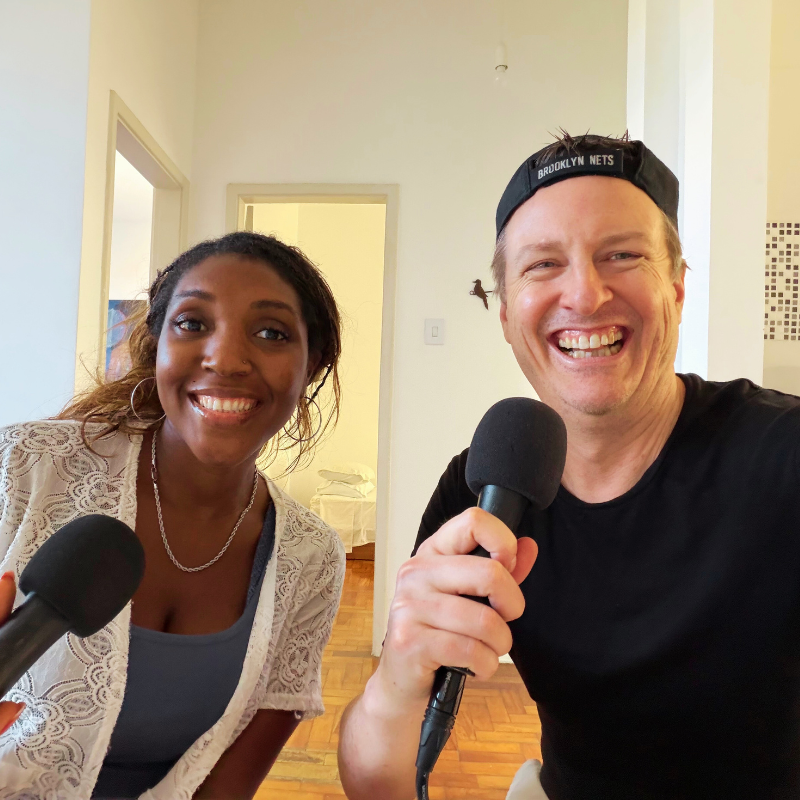
INTRO: This is part two of my interview with Courtney Orgias. If you have not yet listened to part one, I highly recommend you go back and do that first because it provides some really important context for this episode. If you have already heard part one, then please enjoy the conclusion of my interview with Courtney Orgias.
Matt Bowles: One of the things that has been so heartwarming to me about your platform is how you speak out for Palestine. I remember one day I was just scrolling through Instagram and I came across a post that you made, and it said something to the effect of, we are a pro Palestine family. If you have a problem with that, this is probably not the account for you to be following. And it just warmed my heart for the rest of the day. I think I sent you a message in response to that, but it was so amazing. And I’m wondering if you can just share a little bit about your journey getting to this point of political commitment in support of Palestinian liberation and what that journey was like for you.
Courtney Orgias: Every now and then I feel like I just have to remind people. I’m like, hey, just in case you’re wondering what’s going on here, this is what’s going on here. It’s free Palestine. If you had asked me prior to October 7th, and I remember saying this to someone not too long ago, I was like, I don’t know what’s going. But from the best of my understanding, there were brown people there, and then white people came in and they took their land and that doesn’t sit right with me. We’ve all been trained to have this heightened sense of caution due to not wanting to be or appear anti-Semitic when we talk about this. And I think that that’s been one of the almost like, great unraveling that people have had to have.
And I’ll also say this, on September 11th, my father picked me up from school. He brought me home. He said, hey, you’re going to start hearing a lot of things lately after there’s a big event today. We’re going to talk about it. You’re going to hear a lot about it before you hear what other people have to say. I have a story to tell you. And he went back to, like, the Ottoman Empire, and he walked me through what’s going on in the Middle East and how they’re just carving and slicing things up. And mind you, I’m eight. But he’s always had this, and I try to bring this to my kids. I’m going to talk to you like you’re a person and like you can understand me. We’re going to make this age appropriate. I’m not going to use words that are too big. I’m going to explain all the concepts. But you and I are going to be two people having a conversation, because I have to impart this information. And this is the best way to do it.
I sit my kids down and talk about it. My son knows why we don’t eat McDonald’s. And he’ll say things like, I wish they would stop genociding so I could have a McFlurry. And I’m like, yeah, baby, it doesn’t really work that way. But I’m glad you know, why we’re not eating there. You know, he misses Starbucks cake pops. But when I think about what my dad did for me, and then I think about some of my peers who I know, they went home and they heard very different language around their dinner table. I think that when October 7th happened in Gaza, some of us, because of other things in our life, like being black, having a radical dad, were already primed for what this looked like and the reason behind it. We didn’t need a whole lot of explanation. It was obvious to me why someone would do that. Why? Whether it was Hamas or anyone else, I think learning more about the actual horrors that were going on, learning more about what the IOF was doing, and getting deeper into the horrors of Israel was all new information. But I didn’t have a far leap to go.
Matt Bowles: How do you talk to your kids who are very young about these types of issues? Genocide you mentioned, I mean, really heavy issues, and your kids are really young. How do you navigate that?
Courtney Orgias: As a parent, I do my best to use really. Intentional language, and I also try to explain concepts in a way that’s broad but not nonspecific. One thing that gives me pause is that I don’t want my kids to parrot exactly what I say in front of someone who is not our friend, not our ally. And now we are potentially in a dangerous or uncomfortable position. So, I try to say things like, the people who have power in this country took it away, and now they’re being really harmful and really unkind to the people that were there before them so that they’re not running around like, Israel is bad. And then all of a sudden, people are staring at me at the park or something. And I try also to make sure that they’re primed to understand when we have to talk about something serious.
So, I try to really make sure that I’m setting containers. So, I’m like, hey, Zavi, do you have a second to focus for a second so that mommy can talk to you about something? And he’ll say yes. Or sometimes he’ll be like, actually, I’m building a pillow fort. And I’m like, cool. I will circle back. That’s not a thank you for being candid with me. But then we can sit down. And I’m like, hi, we talked about this with the flotilla. I was like, so something’s happening today. Do you want to see? Do you want to look at the news? And we pull it up and we’re engaging together, and I try to find videos that are appropriate to show him and tell him people’s names. Like, this is Greta Thunberg. Is he this man? He’s the Amazon, you know? This is Chris Smalls. I’m trying to make it almost like a story. He likes stories. So, find ways to engage him so that he knows and understands what’s going on.
And I’m like, they’re trying to bring food to babies and medicine to people, and they have to have so many boats because the people that think they control this part of the. You know, it’s language like that. And it’s not difficult. And I am always looking for resources. I think it’s more difficult with Whitley. I was talking to Xavier about police the other day because the police presence on the ground in Rio is very heavy. And all of a sudden Whitley looks at me and she’s like, mommy, do we not like the police? And I’m like, shh. First of all, we’re outside. Why are you yelling? We just walked by a police officer. But it’s also just like, oh, no. Because then sometimes it’s like, have you picked up the wrong? The right? And so now I’m trying to explain. We try to keep a healthy distance from police because sometimes they engage in activities that are dangerous and we don’t want to be a part of it. If we have to interact with police, we’re probably having a bad day. So, let’s just stay away from them. Don’t have to talk to them or go near them.
And I’m trying to scale it back, but I’m also like, ah, they know they can’t watch Paw Patrol because there’s no copaganda in my house. And if you ask my 6-year-old what copaganda is, he’s going to tell you. He’s going to explain to you what copaganda is. I take it very seriously. Part of it is probably because I don’t want them to be blindsided by the sociopolitical realities of the world. The same way that I feel like I hit adulthood and there’s Charlottesville and there’s all this stuff happening, and I felt so blindsided. And again, I have my dad, I called him because I know that whatever it is, I can’t work through whatever I’m suffering with from this sociopolitical standpoint. I know that my dad can help me with that. He’s always been there for that. And I want my kids to have that in me as well. And I also, though, don’t want them to get to a point where they’re like, oh, my God, I thought the world was utopia. And now I’m realizing it’s not utopia, because that’s heartbreaking.
Matt Bowles: How have you experienced anti-blackness globally? What similarities or differences have there been compared with your experience in the United States and in experiencing it globally? What types of intersectional dynamics as well have you encountered and observed?
Courtney Orgias: Fascinating question. You know, I didn’t really realize that I was American until I left the U.S. and you’re nodding. I feel like the people that get that, get that. But especially as a black American, there’s really like a capital A on the American. When you leave the U.S. for better or worse. And I know a few times we’ve gone over to Europe, it seems like when we’re traveling in Europe and people realize that we’re not African, all of a sudden, they’re nicer or they hear our English and it’s like, oh, all of a sudden, we exist or something. And I’ve talked to Justin about that too, because it’s always interesting to me. We share content and it’s like countries I felt comfortable in as a black traveler. And I think that content is important. And also, I don’t think that content is nuanced enough because I know that when we out we look like a heteronormative family. We are American. There are children involved. We’re going to have a very different experience than if you have two black men that are out holding hands in a lot of places. That nuance is incredibly important. Or a single mom or someone who maybe has darker skin or phenotypically presents a little bit more like they’re right off of the African continent, you’re going to have a different experience.
I don’t think we do a good enough job of talking about that nuance. I’ll also say that if people have been super anti-black to me, they’ve done it in a language that I don’t speak because I haven’t really noticed any of it. I think when we were in Rome, the way that people were looking at us, I’ve never been so uncomfortable in my life. I’m like, do I have to fight this woman in the full leather pantsuit over there? Why is she staring at me? And I remember I said to Justin, I don’t know if it’s because we’re off the plane, we’re in athleisure and they’re all just dressed. Or if it’s because we’re black or am I loud? I really tried to cycle through what reason could there be that people are just staring at me and giving me what I perceive to be unkind, if not maliciously curious looks right now?
Because I never want to jump to the cougar. It’s because I’m black. But like, sometimes it is. But also, is it because I’m in leggings and a hoodie and they’re in full pantsuits and Italian leather? I don’t know. So, I think that as long as the nuance is on the forefront and top of mind, the other thing is I feel like sometimes people will not speak back to me in Spanish, which is weird because my Spanish is very good and sometimes their English is not. But I feel like that’s also pretty common. A lot of Latina just has like an anti-blackness thing anyway, so it’s kind of like, eh, we can do this. I’ll just talk to you in Spanish and you’ll speak to me broken English and I’ll talk to you in broken Spanish. And if you want to do that, we can do that.
Matt Bowles: Can you talk about the importance of becoming politically aware of the local struggles of marginalized groups in the cities that we choose to spend time as digital nomads? Because another thing about your content is I feel like you do make a very intentional effort to do that and to talk about things. And I’m wondering if you can share your reflections on why that’s important.
Courtney Orgias: I think awareness is the first thing that we oftentimes have when it comes to addressing issues and even putting things in a larger context of what’s happening within one country or within the world. I think that understanding what’s going on locally with marginalized groups also gives you a much clearer understanding and a better picture of what’s going on with the society at large. And especially when you’re doing something like trying to decide where the world do you want to live, which comes along with things like where do you want to spend your money, what economies do you want to invest in, what communities do you want to pour into? You also want to make sure that you have all of the information that you can to make a good decision there.
So, the same way that we’ve talked about this notion of Gaza and Sudan and what that means for traveling to Israel or being able to go to the UAE and this sort of thing, you’ve got to understand what’s going on. I even remember was it in the UAE too when they were building that football stadium and it was the whole slave labor thing and they’re taking people’s passports. And so, it gets to a point where you also have to be able to connect the dots and do your one plus one is two and say something like, yeah, that’s just never a country I need to set foot in. Because you have to start somewhere. Because even look at me, I forgot about it just now. I knew about it, I forgot about it. I was like, oh, it’s Sudan. It’s actually a bunch of other things. They’re habitual offenders and you don’t know if they’re a habitual offender, if you don’t start somewhere, and that’s in small and local communities.
Also, you may have the opportunity to positively impact a local community. You may have the opportunity to help a vulnerable demographic. You may be able to share someone’s story or highlight an issue. And especially being in a space of Internet and content creation, there’s a lot of power in that. If you can highlight certain communities or certain causes, certain charities, certain people’s struggles, you never know who else is going to pick that up or maybe make another piece of content or an article gets written like it has to start somewhere. And I believe that places awareness.
Matt Bowles: Yeah, I think that’s really important. And I really appreciate as well what you said about the intersectional nuances and the dynamics as we move from different places and the various levels of privilege that exist there. Because in Brazil, obviously, as you well know, anti-blackness and class repression and state violence are quite profound and quite interlinked. We just recently saw the most violent favela massacre, I think, in the history of Rio. And those things I think are really important to pay attention to. And it’s really important to pay attention to the intersectional dynamics of the people that are being targeted with that type of repression as we move through the world.
And that that type of repression is targeted at very particular segments of society. And then other people can just be on the beach in Copacabana and doing their thing and not subjected to the same things because of a lot of these privileges and power dynamics that you mentioned. So, I think that’s really important as we travel the world to pay attention to how these different intersections manifest. And is there a lot of anti-blackness and a lot of police violence and a lot of that stuff in Brazil? Sure is. But is it also possible to be a black traveler from the United States and go to Copacabana and not experience any of those things? That is certainly possible as well.
Courtney Orgias: The duality of those things is absolutely mind boggling. And it’s interesting. I’m glad you used the appropriate word massacre, because the word that they were using here is just police operations. It’s a very violent police operation, a very serious police operation. The police ran up in that favela and killed 130 people. And then the police officer got on television and he was like, the only victims today were the four of our officers that got shot. And heavy sigh, because you want to be careful when you’re somewhere and you don’t speak the language or know the culture. And there’s part of it where it’s like oh, is it really my place to comment? And then there are things like this where it is so obvious and disgusting that it feels insulting for anyone to say anything other than massacre, which is what it was.
Matt Bowles: I’m curious about your experience connecting with the African diaspora in these various different places that you go. Connecting with Afro Brazilians in Brazil who are from here, connecting with Afro Colombians in Colombia who are from there, and so on as you move around the world. How has that experience been for you?
Courtney Orgias: You know what? It’s beautiful and it’s really healing. I have Caribbean heritage as well, through the Dominican Republic and Martinique. And then Justin’s family is from Grenada by way of Toronto. But I also just have black American heritage. And one of the interesting things about having black American heritage is that a lot of people struggle with the whole, like, I have no history, I have no culture. Where am I from? Where am I from? I say a lot. Some. It’s gotten so much better. The kids have pride these days, and I love that for them. But back in my day, it was a little different. And not feeling like you had a flag to put in your bio or a country to point back to was a big deal for many kids.
And one of the things that I actually started to do before I even started traveling, I think, you know, in high school and through college, was going back and looking at actual African American history, like ethnically African American people, people that were brought to the U.S. through chattel slavery. And that’s where heritage and roots are. And one of the things that I discovered early on through reading books and doing research was that we are so much more connected than we think we are through our ring shout and the way we worship, how we hide our hoodoo and our African ancestral traditions and religions beneath Mary’s skirts and all these other things. And whether it’s through Vadun or Christianity, the way that we use our Bibles and how we’ve set up our Bovedas, even though we don’t call them that, we’re so linked.
And I think that one thing that’s been really beautiful and exciting and gratifying about traveling and getting to touch down and see and hug and smell and feel my other cousins in the Diaspora has been the validation that that’s correct. It’s not just something that I read in a book like the Obeah women here have more in common with the AME that African American Episcopal women that are baptizing people in the river in Florida than they even know. And it’s really incredible. And I know that as we talk a lot about the Diaspora being connected and our cousins in Scotland on TikTok this and that and the third. But I think there’s something really beautiful about having heritage in a specific part of the Diaspora where you’ve heard your whole life.
Your history just started with slavery and you don’t even know where you’re from and what are you, and you have no ancestral surname, and then you get to really see with your own eyes. No, I’m super connected. It’s in my bones and it’s in my blood just as much as anyone else. And it’s so beautiful and celebratory. So, yeah, it’s been really exciting. And it’s also been really exciting to feel like I’m setting my kids up to be able to have a more global, diasporic appreciation. There are some countries and some places that they can point to and they’re like, that’s me, and that’s where I’m from, and that’s great. But them being global citizens, they also have the capacity to look at the whole world and know that wherever they point in it, there’s a part of them there. And I think that’s gorgeous.
Matt Bowles: That’s so amazing. Well, I also want to ask you about your intentional seeking out of other cultures that are very different from your own and looking to immerse and learn about those cultures. I know you recently did a trip to Istanbul, Turkey, during Ramadan. Can you talk about what that was like?
Courtney Orgias: That was amazing. So, on our way back from Italy, we decided to stop in Istanbul and I actually did Ramadan fasting this year. I just felt called to. I think Islam is beautiful. And this year I was like, you know what? I can do it. No food, no water. I got this and it was really neat. And I, shockingly, I think I, like, almost drank something once, which I feel like is a canon event for anyone doing it for the first time. But on the way back, we stopped in Istanbul and that was my first time being in just a completely different culture, having a completely different holiday that I’d never really experienced before. But it was really special because I was almost at that frequency a little bit, because this was towards the end of Ramadan, so getting to hear, like the call to prayer in the airport. And there was a whole little. It was like the Ramadan village set up in the airport for the kids. So the same way you would think about a Christmas market or a Christmas village or something, they were giving out balloons and the kids got to see It And I’d been talking to them about the Ramadan fasting and things, and so then they were excited and we got to have this whole experience. And I’d love to do it again. I’d love the chance to immerse a little bit more in that, just because I think it’s gorgeous and powerful.
Matt Bowles: Well, I also want to ask you about your project, the Village Abroad. You mentioned at the beginning that you just won a contest and got some funding. You also mentioned that Justin has heritage from Grenada. And I know you have an upcoming event in Grenada, but can you just start maybe from the beginning and talk about the concept? What is the Village Abroad and how did it come about? What was the motive for founding it?
Courtney Orgias: We are hosting the inaugural Village Abroad. I love the word, so fancy. Inaugural Village Abroad retreat in St. George’s Grenada, in June of next year, 2026. And what we’re doing is taking two weeks to have activities, to have a summer camp. We have some excursions and fun things planned, along with workshops to make sure that we’re giving families some resources about life abroad, Digital nomadism, remote work, all that kind of kind of stuff. So, you can join us for the full two weeks or for just one, either on the front end or back end. We know schedules are tight, but we’ve built it in to make it an all-inclusive experience. So, we have cottages one and two bedrooms, and we have full day, Monday through Friday summer camp for the kids. So, they’re going to be at a local Grenadian summer camp for the older kids. We have some local Grenadian nannies that have activities and a program planned for the younger kids.
And this way we get to have a family experience, a village experience. The adults get their own thing. You can work, you can do whatever you want. You know what I mean? The kids will be entertained. And we wanted to do something like this for a while now. And actually, some friends that we just met. Hello, Destiny in Rio, she asked us as soon as we got here because we’ve been talking on Instagram. Then we finally met up and got the kids together. And she’s like, when are y’ all going to do something like put on an event? The people are waiting. The people are waiting. And I think that was kind of the push that, that we needed because it can be hard when you’re out here and it’s just you and your kids or, you know, you and your partner, your kids or whatever your family configuration looks like. You get burnt out; you get tired.
And so, we want to create a space and especially a space where black families and families of color, queer, marginalized families, where they feel like they may not be reflected in other programs or in other people’s content. We want to create something where it’s like your safe life here. If you have concerns that they’re going to be weird over there, we’re not going to be weird over here. That’s sort of the vibe too. So, I’m really excited about it and it’s also really nerve wracking because it’s just new and different. But I think it’s going to be a great time and I’m super excited because the same way that we want to build community for ourselves and our kids, we know that there are other people out there who are desirous of the same thing. So why not bring them all together?
Matt Bowles: Can you talk about what the day-to-day experience would be like on a two-week retreat like this?
Courtney Orgias: So, touchdown on a weekend we have a welcome dinner and then Monday through Friday we have childcare lined up for the children. So that’s looking something like I think we talked about like 8 to 3 or 9 to 4. Still working out those hours, but that’s a full day. So, if you want to work during that time. Sure. We’re including at least one adult only excursion during the week while childcare is lined up. And then we also have a bunch of other things curated. So, if you want to go get some you time, we have vendors and recommendations for that. I’m actually putting together a scavenger hunt just because I think it’s cute as a little couple. And Justin was teasing me yesterday, he was like a scavenger hunt. And I’m like, a scavenger hunt is such a good day. But then we also have camp activities for the kids that are aligned with Grenadian culture and also providing local impact. So, we’ll have a community impact day where you can go and do some volunteering, some other options like that.
And then the older kids will also have an opportunity to pick up some skills. So right now, we’re looking into what the difference between something like sailing or like archery would look like. That kind of vibe, we’ll do that for both weeks. And then the first week has a theme of spice grenade is the spice island and the second week has the theme of soul. So, it’s fun. There’s a lot of stuff to do. There’s an underwater sculpture park and cocoa farm. We picked a property that’s within walking distance to the beach. You can just be a beach bum if you want to, but that’s what it looks like. We’ll make sure that we have time for the community and then we also want to make sure again that the adults have time to relax. You have to be able to relax.
Matt Bowles: So where can folks get more information about this, see all the details and sign up to join?
Courtney Orgias: So the easiest thing to do right now is to head over to the link in our bio. I think that’s across the, across all our channels, Facebook, Instagram, YouTube, all the things. And there is a summer retreat there where you can sign up for the interest form and once we actually have the full offering launched, you will be the first to know. We are only opening this up with 10 family slots and the interest form already has like 30 people on it. So, I’m like a little, a little nervous. I want everyone to be able to get their spot. But yeah, we plan to launch within the next few weeks. So, make sure that you’re signed up for the interest form and you’ll be the first to know when everything goes live so that you can reserve your spot.
Matt Bowles: All right, we’re going to link that up in the show notes. You can just go to themverickshow.com and go to the show notes for this episode and there’ll be a direct link right there for you. Courtney, I want to ask you know about some reflections on this lifestyle since you have been doing it for so many years. How do you think, think that mobility affects your children’s sense of belonging and culture and identity?
Courtney Orgias: We’re watching it unfold in real time. They’re almost like a little science experiment because they’re still so young. But I was thinking about it the other day because I made grits. If I don’t tow anything else all over this globe, it’s going to be a 10-pound bag of Jim Dandy grits. I have to have it. And if you ever come visit me from the States and you’re like, what’s something you want? That’s the one thing. Please bring me grits. No Quaker Instant. Thank you. And it was like a gloomy day. It rained a lot. I think the week before you got in, I made some grits. And Whitley’s like, mommy, I love grits. And Z’s like, yeah, we’re going to have to get more from the store soon. And I’m explaining to him that they don’t have them here. And he’s looking at me confused. So, I’m like, well, grits are cultural. It’s like a regional thing. And he’s basically like, well, what is our culture? And so, then I’m talking to him like, well, you know, daddy’s people are from here, and mine are here, but we’re from here, and you were born here. And I realized I’m making it really complicated.
But as I’m saying it, I’m like, he thinks of the world as his. He still remembers parks and Mexico and things he did in Portugal. And he’s really forming an identity of all of this is mine. Cue the Scarface, the world is yours type of thing. And what I realized that instead of being excited or happy as he was saying it, I almost got a little sad, because my thought was, that’s too broad. And then also I feel erased. What do you mean, you’re not Southern? I’m Southern. We have the grits. We do our fish and spaghetti. Like, what do you mean you’re not Southern? I say y’all. He doesn’t even say y’. All. I didn’t realize that till he was four that I never heard him say it. And anyway, I yap about all that to say. I think we have the opportunity to be really intentional about what parts of our culture we pass down to our kids. And in a way, I think that’s also a really beautiful opportunity to break generational curses, because there are a few things that I’m going to give them on accident. I’m going to make sure they love grits, especially cheese grits.
And they may not have the same childhood experiences of running around outside barefoot and climbing trees like me, just because they tend to be in more city environments. When we’re not in the city, we’re at the beach. We get to instill that. And there are even certain things I think we’ve adapted from spending so much time in Latin America is this slower, more casual pace of life. My kids have that too. They’re not rushing to get out the door. They’re not rushing to school. They don’t have a sense of rushing being a part of what we do and how we live, except for sometimes when we have to get to the airport, you know, And I appreciate that, too. So, I think he gets to intentionally build his culture since he’s exposed to so much. And I’m excited to be his collaborator in that. Well, both of them and Whitley, I’m excited to be their collaborators in that.
Matt Bowles: And as they grow older, what values do you hope that this lifestyle will instill in them?
Courtney Orgias: I pray my children have empathy. I want them to have pure, deep, meaningful empathy. The kind of empathy that inspires action. The kind of empathy that makes them itch if they aren’t finding opportunities to be of service to other people. And I want them to have compassion. I want them to have understanding. I want their perspective to just be broad. I want them to live in the nuance and I want them to be able to actually also just see things for what they are. I like to think that not being in one place too long or getting to experience life in so many different ways will give them the capacity to not fall victim to the veil of one perspective. We talk about rose colored glasses. Those glasses could be any color. Regardless, I don’t want them on my kids face. But first, just empathy. I feel like we need so much more empathy in the world.
Matt Bowles: And how has all of this travel impacted you as a person and as a mother?
Courtney Orgias: I’m a type B mom now, which is so nice. Being a type A mom was exhausting. Packing up the diaper bag and putting it in the car. And I had this whole like Montessori setup in the playroom for Xavier with the pickler triangle. And the books needed to be arranged in a certain way so that he could walk over independently. I was nuts. Guy may seem a little high strung these days. I was nuts. So, this has made me more type B. And again, when you’re in situations where the abuelas are coming over and touching your newborn and your kind of can’t do anything but be like, ah, okay, I’ll put socks on her. It forces you into a place of maybe I need to relax and maybe things aren’t that serious. And I feel like that’s one of the gifts that this lifestyle has given me is nothing I’m doing today equates to heart surgery. No one’s going to die. Everything’s going to be okay. I can take a breath, which makes me show up better for my kids and for Justin, for everyone else in my life.
And I think that as far as me, like, just as a human person, as an individual, which, as I’m saying that I’m like, wow. I don’t think about myself as an individual as much as I probably should. I’m usually a mom or a wife, but I think the more I see, the more I want to see and the more I learn, the more I want to learn. So, I think that traveling has just expanded my wanderlust. It’s expanded my perspective and my desire to experience more and to gain new information. And it’s also shown me that. That I can be so many different people. When you’re in a different environment, a different situation, you have a different configuration. You’re in a different country, you’re in a different culture, you adapt to that. And once you’ve seen yourself adapt and change so many times, it opens your eyes to the fact that you are an expansive, incredible individual, and you can be and do so many things that you didn’t think you could do or be before. And I think that’s really cool.
Matt Bowles: And how has this lifestyle impacted your marriage and your relationship with Justin?
Courtney Orgias: We spend so much time together. We spend so much time together, and fortunately, we really like each other. I think that’s the good news. I could see people that don’t like each other as much maybe struggling. I’m sure there were some digital nomad couples that took off in 2020, and the relationship didn’t make it past two countries. But I think that in spending a lot of time together, we’ve gotten to know different versions and different iterations of each other. There are iterations of Justin that I never would have been able to meet had we just stayed in our house in the suburbs. And when you’re able to. See someone in different circumstances showing up as a different iteration of yourself, and you get to know them that way and you love them that way, I think it creates a whole different type of intimacy. It’s really neat. It’s like they say you don’t really know someone until you’ve seen them. What is it like grieving, angry and depressed? They’re just different states.
Traveling this way forces you into different states, and then you just have to sit there and look at the person and be raw and vulnerable. When we missed our flight to Morocco because we were in Spain and the laundry people had kidnapped our luggage and we couldn’t leave without it, and it was high stress, and we’ve got the two kids, and we had to look at each other and say, aha, are we going to figure this out together? And when you come to that agreement of it’s really us, through whatever circumstances, whatever good, bad is going on, we’ve made this commitment to really be locked in. And then it gets tested, and then you weather that storm. I think it’s incredible. I could gush about him for a long time. I won’t.
But I will say also, I think that it has caused us to realize that we have to invest in ourselves as individuals, because, like I said, you’re spending a lot of time with each other spending a lot of time with the kids. And even though we keep up with community, like when we go like day to day, it’s still us staring at each other for extensive periods of time. So being able to get to a place were finding new hobbies, like, Justin was like, I’m going to go take a surf lesson the other day. And I’m like, yeah, rah. You know, I’m like, I might do a samba class, even though I’m super pigeon toed and I look silly every time I try to do it in the mirror, you know, And I think that that push too is also really, really necessary.
Matt Bowles: How do you currently think about the concept of home?
Courtney Orgias: Home is where my people are. You know, I used to get on my mom a lot when I was younger for never picking up her phone. Like we would be in the kitchen and it would just be off somewhere ringing or buzzing or it’s upstairs or she doesn’t know what it is. And I get on her about it and I remember one day she was like; you and your sister are right here with me. Like that can’t be important. And I was like, oh, cheesy, corny, weird, you know what I mean? But now I’m sitting on the couch, Justin’s next to me, and I’m watching Xavier and Whitley play and it’s like, yeah, that’s really all that matters. Like, nothing outside of this bubble has any impact on what’s actually going on for what’s important. So, I genuinely do think it’s wherever my people are. And whether that’s in Guatemala City or Hong Kong or right here in Rio, that’s always what it’s going to be. As long as I know that they’re safe and right within reach, I’m at home.
Matt Bowles: What lessons or tips would you share with families that are considering embarking on this lifestyle? Any advice for people at the early part of their journey?
Courtney Orgias: Please take a scouting trip. And on that scouting trip, I want you to document the scouting trip like you are the most insufferable content creator. You know, I need you taking videos and pictures of everything where you’re planning to go. I need you to be boots on ground, walking around, talk to the camera, record your impressions of things. And I say this to say because what I have noticed is that when we get to somewhere new, it really takes a while for the full perspective of that place to settle in. You don’t want to get somewhere. And it’s a sunny beauty, beautiful day, and you’re out walking around and you’re like, oh, my goodness, I can live here. And that’s what sticks in your head. And that’s what you think when you go home. And then you come back during rainy season and now you’re miserable. I also think that when you’re making decisions about where to move or where to be, it’s important to have objective data to look back on.
Please fill up your camera roll with videos of the streets and what the houses look like and everything else so that you can be sure. I’ll also say I’m a big fan of obviously from what I just said, but documenting your impressions. I would make a very simple spreadsheet with some criteria. Just jot some things down. There are resources about things like cost of living from Numbeo. If you plan on walking around, there are walkability scores you can look at, check out where are the schools? What neighborhoods would you want to live? You have to document all that stuff down to see if it’s even feasible for you to be in a certain place. We’re not in Medellin because the areas that we like are too hilly for us to walk around. We’re not going to drive. It just doesn’t work for us. But somewhere here, like Rio, has wonderful public transit and we can walk.
And then the other thing that I’ll say is you can talk yourself out of something 10 times over. So, if you’ve already talked yourself into doing the thing, just do the thing. And for your worst-case scenario, just make sure you can get back to wherever you currently are or wherever is safe. Again, it’s not heart surgery and you have the capacity to shape your life. And if you’re even considering of going out and taking creative control over your reality, I personally support you in doing that and I will even enable you. Feel free to shoot me a dm. I’m going to tell you to do it.
Matt Bowles: And do you have any tips or advice for Black travelers in particular that might be at the earlier stage of their world travel journey?
Courtney Orgias: Get out and see the world. See everything. You can absorb it all, soak it all in. Don’t let anyone scare you off, off or intimidate you out of it. This world is just as much yours as it is anyone else’s. And I know that many of us have been programmed to believe that that’s not true. And it can be difficult to conceive of when you don’t see yourself in certain spaces or in certain content. But you have as much of a right as anyone else to be there. I promise you that that’s part of the reason why I’m raising my kids this way, because I. I do not want them to grow up in a world and intrinsically feel, even if they don’t have the conscious thought, less of it belongs to them just because of who they are or the color of their skin.
Matt Bowles: Courtney, let me ask you one more question, and then we’ll wrap this up and move into the lightning round. Why are you so passionate about continuing to travel and experience new places? What does travel mean to you today?
Courtney Orgias: There’s an anecdote in the beginning of Post Traumatic Slave Syndrome by Dr. Joy DeGruy. And in this anecdote, she’s describing two children who are in line at the bank with their moms, and there’s a white child who’s running around and touching stuff and exploring and doing things, and God’s hand in the lollipop jar. And then there’s a black child who knows that if he steps too far away from his mom, he’s going to be reprimanded and pulled back and made to stand in line. So, he’s very still. And she goes on to explain how the difference in how children are brought up impacts them going out into the world and what they think they can do and what’s possible for them, right. Having this expansive notion of everything’s mine and I can experiment, I’m safe to explore, I can go do whatever, versus this thing of I need to be very still right here because I’m scared about what happens if I go over there. And now I’ve never been over there, so I don’t even know if it’s safe over there. I’m just going to stay here.
And I think for me, I was privileged enough to be raised in a space where I knew I could do things and certain things were a given, right. I was raised with a good smidgen of audacity. But I think that in continuing to travel, that’s the continuation of I was safe to explore then and I’m safe to explore now. And it’s important that I continue to do that. I have to keep pushing boundaries and seeing new things and learning about different cultures and winding up in situations that make me uncomfortable because I believe that’s how I’m going to grow and self-actualize and meet new parts of myself. And then, of course, in tandem, because I am a mom, I’m bringing my kids along for it so they can be raised with much audacity and a belief that the world is theirs.
Matt Bowles: Well, I think that is the perfect place to end the main portion of this interview. And at this point, Courtney, are you ready to move in to The Lightning Round?
Courtney Orgias: I’m as ready as I’m ever going to be.
Matt Bowles: Let’s do it. All right. What is one book that you would recommend that people should read?
Courtney Orgias: You know, I read Parable of the Sower earlier this year when it was trending by Octavia E. Butler. And I went on to consume everything that she’d ever written after that. So, I would say that the Earthseed series, Parable of the Sower is very poignant in the sociopolitical climate.
Matt Bowles: All right, if you could have dinner with one person currently alive today that you’ve never met, just you and that person for an evening of dinner and conversation, who would you choose?
Courtney Orgias: Imani Bashir.
Matt Bowles: She was just on the podcast. I interviewed her in person in Washington D.C.
Courtney Orgias: I’m jealous in my bones.
Matt Bowles: I just had that very conversation. We will actually link that up in the show notes in case anybody has not heard that episode yet. All right, Courtney, what is one piece of advice? Knowing everything that you know now that you would give to your 18-year-old self. If you could go back in time, what would you say to 18-year-old Courtney?
Courtney Orgias: I would tell her to continue to seek the truth and the light. Push as hard as you can and continue to seek the truth and the light.
Matt Bowles: All right. Of all of the places you have now traveled, what are three of your favorite destinations you’d most recommend other people should definitely check out.
Courtney Orgias: Rio de Janeiro at number one, Madrid, Spain at number two. And probably Marrakesh, Morocco, number three.
Matt Bowles: All right, what are your top three bucket list destinations? Places you have not yet been, highest on your list, you’d most love to see.
Courtney Orgias: Dakar, Senegal, easy. I just need to eat. I need some of that Senegambian Jollof. It changed my life the first time I had it. I haven’t been the same since. After that, hot air balloon safaris out in Kenya. I want to do that. Loves me a hot air balloon and I really want to get over to Tokyo. I love anime and I love noodles. So that just feels like a solo trip that I need to start planning soon.
Matt Bowles: All right, you and I got to talk offline because those are three of my very favorite places. I have spent three months in Dakar. I have been back three separate times for a month each. It is one of my favorite cities on the planet. Kenya and Tanzania. I have spent multiple months there. I have done the hot air balloon ride over the Serengeti and it is magic call. So, we will talk about that. And then Tokyo is mind blowing. It is its own planet. People like, oh, what’s Tokyo like? I’m like, it’s not like anything else on this planet. You just have to go to experience it. I have been back there multiple times as well. One of my all-time favorite cities. Those are amazing picks.
All right, Courtney, we’ve now come to the most important question of this interview. I’m about to ask you to name your time, top five hip hop Emcees of all time. But before we get into that and before you name your five, I just want to ask if you can share a little bit about what hip hop music means to you and maybe just contextualize because we have listeners from around the world that are not necessarily going to be familiar with hip hop culture in Atlanta. Can you just share a little bit about hip hop culture in Atlanta, growing up there in the middle of all of that and what hip hop music means to you?
Courtney Orgias: Hip-hop was always meant to be the voice of the people. It was always meant to be the voice of the people. And that’s part of why early hip-hop has such a radical tone to it that I think we oftentimes don’t see in hip hop today because it’s been commercialized and consumerism, but we can still enjoy it, right? I think as a genre, what hip hop means to me in particular has a lot to do with freedom expression and self-acceptance. I’m someone too where I understand the concepts of internal colonization and there’s positive and negative in everything. And I think that those are very interesting conversations. And also, when I listen to music, I’m listening to music to enjoy the music and or for a specific purpose. So, I think hip hop means a lot of different things to a lot of different people. And even what some people categorize, hip hop, we have our purists and then, you know, we have some people that are going to count things I would never ever count in a million years. But I think overall the voice of the people, especially when you take away some of the more commercialized fluff that’s out there these days.
Matt Bowles: Well, I was just in Atlanta a couple months ago because I had realized that I had not spent quality time in Atlanta. I passed through for like a day or two here or there, but I hadn’t actually been intentional about experiencing Atlanta. And so, I just did for my first time a couple months ago, one of my very dear friends who I’ve traveled the world with for a year on a remote year program, he went to Morehouse, that currently is based there and really knows Atlanta. And so, he was like, yeah, come through for a week. And so, I did, and it was spectacular. We went to the Trap Museum in the Swartz, southwest Atlanta. Yeah, it was really incredible.
And it is currently, I believe, the only hip-hop museum in the entire United States. They’re about to launch one in New York City, supposedly 2026 that is opening. There is in theory, one in DC, but each time I’ve tried to figure out exactly where it is. How do I get there? Is it open? Is it like a private event space? It’s only open sometimes. How can I get in there? There’s like a gift shop. I found this out because I’m staying with a friend of mine in D.C. and I lived in D.C. back in the day for like seven years. So, I love D.C. and I go through and I was staying with a friend of mine and I’m wandering through. I don’t know if you know dc, but I’m wandering through Adams Morgan and I noticed this shop, the entire shop is all hip-hop stuff. Like legit hip hop stuff, like from back in the day. Like, really? I’m like looking. I go in, I’m looking through all this stuff. I’m like, this story is amazing. I’m like, what is this?
They’re like, oh, we used to be the gift shop of the Hip-Hop Museum. And then when the pandemic happened, everything kind of shut down. We had to separate physically from the museum. And now we just exist here as the shop and the museum is separate. I was like, where is the museum? How can I find it? So, they give me the thing. And I’ve been. So, I’ve been trying. If anybody knows how to get inside of the Hip Hop Museum in dc, send me a dm. I follow them online. They have an online presence, so I know that they’re doing something. Is there a physical space that I can walk in and actually see things? I am attempting to find that out. So, until I actually get inside of it, I’m saying the Trap Museum in the SWATS is the only hip hop museum I’ve actually been able to get inside of. And it is spectacular.
So, with that, Courtney, and without further ado: Who are your top five?
Courtney Orgias: Is this dead or alive?
Matt Bowles: Dead or alive?
Courtney Orgias: Oh, my God.
Matt Bowles: All time.
Courtney Orgias: I was, okay, all right, I’m going to do this in no particular order because it wouldn’t sit right with my soul if I did any other way. I’m putting Drake in there and I’m going to stand behind it and anyone who wants to fight, they can fight me. You can rip my OVO hoodie out of my cold dead hands. I’m also going to put Lil Wayne in there. I think he was an important transitional bridge. And then also, personally, no Ceilings got me through some rough times. I’m also going to throw in Common. I feel like Common is where a lot of it started for me. And I’m also going to throw him Big K.R.I.T. I feel like he slept one and he’s been putting out amazing projects. And then I would be dishonest if I didn’t put Kevin Gates in there. And I can hear the crowd booing and sighing. I feel like that’s a lot of judgment. This is me. This is who I am.
Matt Bowles: This is a no judgment zone. Courtney, we want to know you for who you are. And speaking of knowing you for who you are, I want to ask how people can find you and follow you and connect on social media and what people can expect from your content.
Courtney Orgias: So, you can find me and my husband and our two kids again. I could gush about them all day; how sweet and cute and adorable they are if you want to see them. Our handles everywhere @o.family.adventures. We put out videos, some informative, some vlogs over on YouTube. Occasionally we do a yap session podcast episode we are posting on Instagram. Again, that’s going to be a mix of aspirational and informative content and those are our two main platforms. Occasionally you’ll catch me over on TikTok answering questions that people have on TikTok, but that’s once in a bloom moon.
Matt Bowles: Well, your platform, as I said, is one of my very favorites to follow because it is a combination of your amazing family where there’s clearly so much love and your kids, as you said, are absolutely adorable. So, I love seeing them experiencing the world. And it’s also a really politically substantive and thoughtful platform, which I deeply appreciate as well. So, we’re going to link that up in the show notes as well and tell folks one more time if they’re interested in the Village Abroad and learning about the upcoming retreat in Grenada. How can they get more info on that?
Courtney Orgias: If you are interested in joining us in Grenada June of 2026 for the Village Abroad, feel free to head to the link in our bio. Sign up either for the newsletter or the interest form, and if anything’s confusing or you have any questions about the offering or launch or anything like that, also, you can shoot me a dm. I’m really responsive.
Matt Bowles: All right, once again, everything that we have discussed in this episode, including all the ways to find, follow and connect with Courtney and learn more about the Village Abroad, it’s all going to be in one place. Just go to themaverickshow.com and go to the show notes for this episode. Courtney, this was such a special conversation. Thank you so much for coming on the show.
Courtney Orgias: Thank you for having me.
Matt Bowles: All right, good night, everybody.