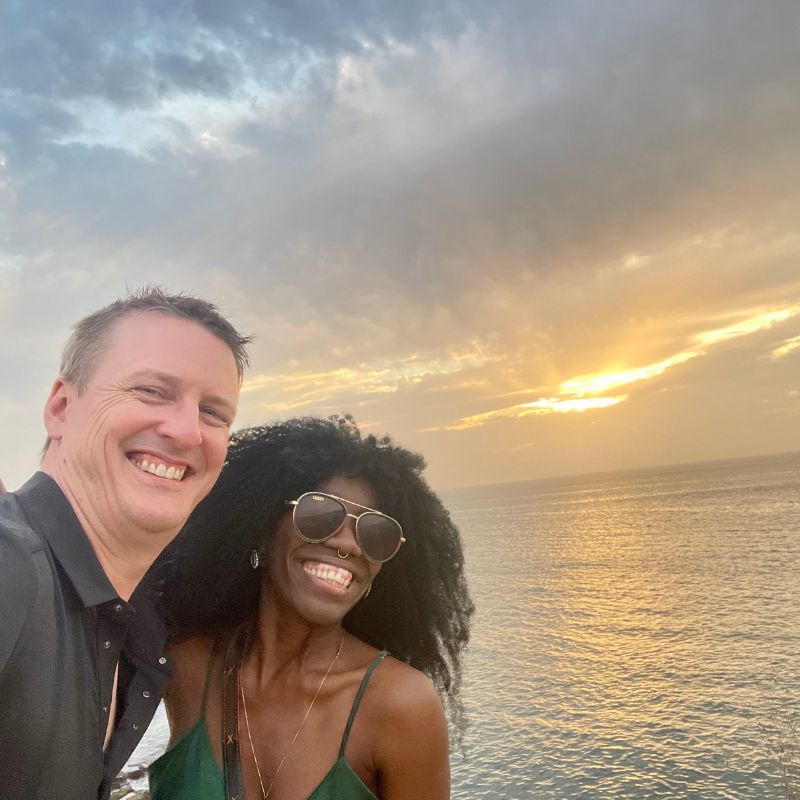
Matt Bowles: My guest today is Youmie Jean Francois. She is a location independent business owner, corporate wellness consultant, transformational speaker, and the founder and CEO of Flex and Fly, a travel wellness company that provides stretching, yoga, and relaxation classes to travelers before their flights at airports. Youmie also created and designed Flex and Fly’s best-selling minimalist travel products, the Flex bag and the Flex mats. Originally from Haiti, she grew up primarily in New York City and has now run her business completely remotely while traveling the world for the past five years. She speaks four languages, and she travels the world with carry-on luggage only without sacrificing fashion and style.
Youmie, welcome to the show.
Youmie Francois: Matt, I’m so happy to be here. I’m so excited to chat with you. You know, I’m a huge fan, so I’m super excited to be here.
Matt Bowles: The feeling is mutual. I’m a huge fan of yours. I’m super excited for this conversation. And we just need to begin by setting the scene and talking about where we are doing this interview from today. You and I are on the west coast of Africa in Dakar. Senegal.
Youmie Francois: Yes. It’s so beautiful here, right?
Matt Bowles: It’s your first time in Dakar?
Youmie Francois: It is my first time.
Matt Bowles: For folks that have never been to Dakar, what is it like? What has your experience been like so far?
Youmie Francois: For me, it feels like home because I’m originally from Haiti, and so I feel very familiar with Dakar. But also, it feels very different because I’m a New Yorker. Like, I live in New York City. So, coming from New York City to Dakar, which is an emergency, there’s a lot going on here. It’s very young. I’ve been partying a little more than I should. I haven’t partied in forever, so you can imagine I’m like, I am too old for this, but this is the best. The food. But I think my favorite part thus far about Dakar is the people. The people are really kind. It’s really safe here. And every day that I go out, I just feel more and more like its home. I’m just making my way through it. I’m loving it.
Matt Bowles: It’s so amazing. I came here for the first time in 2019 for a month, and it just won my heart entirely. And I have been talking about Dakar since 2019, when people ask me for my short list of favorite places in the world. Dakar has been on that list since I came here in 2019. And remember, you and I met on the very first day that you were here, and you were like, yo, show me something really dope in this city. And I said, okay, I’m going to take you to one of my favorite spots to see one of my favorite things.
Youmie Francois: Yes. We literally spent the day together. And honestly, I keep telling everyone here about it. You made it feel so easy for me. The transition to really get to know Senegal and walk around the car. You made it really amazing for me. I mean, you made me walk a little more than I wanted to, but you made it really easy.
Matt Bowles: You did literally ask me to take you on a walk. And you’re from New York, so I have expectations for the extent to which New Yorkers can walk. But when we were walking, though, what did we see? What did you think?
Youmie Francois: Oh, my God, it was beautiful. I mean, we went specifically to see the sunset. I really wanted to see the sunset. And you knew the best place to see the sunset. And while we were walking, we saw the outdoor workout gym that Dakar people created and made themselves. It was amazing. They were beautiful. It was like, men, women, everybody was doing something different. And it was just like a long spread. We just kept going, and they just kept walking, working out, and it was right next to the beach. It was just beautiful.
Matt Bowles: It’s so amazing. It’s one of my favorite places in Dakar. Right on the Corniche. They have probably about 2km of exercise equipment, workout equipment, basketball courts, soccer fields, all sorts of exercise equipment, running paths. And there are just hundreds of people out there, especially right at that after work to sunset hour. So, you’ve got the sunset over the ocean. You’re right on the Corniche, on the waterfront. And then you just have all of these people exercising. It’s such a beautiful thing. So, I was like, I got to take you there. Day one. You’re going to fall in love with Senegal the same way that I did.
Youmie Francois: I really did enjoy it. And I also love the fact that you were so comfortable walking around and like, you were like, nah, this way, that way. Nah, nah, let’s get in this cab. I was just like, oh, okay. It made me way more confident after taking that walk with you. I was like, okay, I can take this. I can take this.
Matt Bowles: Well, you and I connected immediately from day one. And then we’ve been collaborating on all kinds of cool stuff since then. You and I just co facilitated a workshop for the remote year group that is currently in Dakar, Senegal, on minimalist packing. What you and I call stylish minimalism. Right? How to travel the world carry-on luggage only, but without sacrificing the fashion and the style. And I immediately noticed your fashion game is on 10 on the daily. And I was like, wow, she’s really well dressed. And then you told me you travel with carry-on luggage only. I was like, we have got to collaborate on this workshop. And so, we did and it was amazing. But what were some of your top tips, especially for women in particular, for traveling the world for a long period of time? Not checking a bag, team carry on. But maintaining the fashion and style.
Youmie Francois: I just want you to know, less is more. When in doubt, less is more. A good sweater or a hoodie? It can’t be both. You have got to pick one. Okay. So, for me coming to the car, I made the decision to bring a sweater rather than a hoodie or satin dresses. Get them in every color you’d like. But I would say bring about two and then just use them. Because you can wear it like you’re going to the beach, or you can wear it dressed up or you can add a sweater to it. You could do a lot with a nice satin dress, and it does not take up a lot of space. Those sling dresses they’re amazing. One pair of jeans is all you need if it’s long.
One pair of shorts is all you need. And a nice button-down shirt is really nice because you can tie it up or you could dress it down. And one anti-theft minimalist travel bag is a must. An anti-theft bag will save your life. Just so many different times I’ve traveled, and people have stolen from me, and I don’t know where I misplaced my bags, et cetera, et cetera. And an anti-theft bag that is minimal does not look like a regular bag, first of all. And it’s super easy to casual, super stylish, and you’re able to keep all your stuff safe in there. You know that I have one with them at theflexbags.com if you guys want to check that out. But an anti-theft bag, whether it’s from us or anywhere else, is definitely necessary for the ladies. And no matter what, do not bring a blow dryer. You don’t need it. You can just go to a fancy hotel and use one of them or ask somebody to use it. And one of the things that I learned from you that I feel is the best thing, rent it and then sell it or donate it where you are. I love that.
Matt Bowles: Yeah. I mean, full endorsement for the Flex bag, because I have seen this in action. First of all, I know that you designed it from experience, and I have traveled with a lot of women as well and a lot of different groups, and I have seen people get robbed. I’ve heard about people getting robbed. People snatch the purse right off, they cut the purse, they take the thing, all that kind of stuff. And I know that after having gone through those experiences, you used all that to design this. And you did it with your normal fashion and style and flair that you do everything in your life.
And what was amazing for me, though, to see was you bring a giant stash of these things with you to Dakar, Senegal, and sell out of them in the first week. And you sold them to both experienced travelers, people that are here on the remote year program, people that have been traveling the world, and they’re like, yo, I need that. As soon as they saw it, because it solved this incredible problem. And it’s stylish. It solves the safety problem. It’s also stylish. So, all of the travelers were buying this up, and then local Senegalese people also, which, by the way, we got to give love. Dakar, Senegal, is the fashion capital of this entire region.
Youmie Francois: The ladies don’t play over here.
Matt Bowles: No.
Youmie Francois: They look good.
Matt Bowles: Yes.
Youmie Francois: They dress up. And I knew I fit in because I had to show them. I had to show them what I could do. I had to show them what I could do. That’s why I bought the Flex bags here. And I’m so happy. Everywhere I went, every coffee shop, anywhere I walked, I was getting complimented on the Flex bag. And they were asking me what it does, and I told them and they bought it.
Matt Bowles: Yeah, it’s amazing. So, we’re going to link it up in the show notes. Go to themaverickshow.com go to the show notes. For this episode, we’re going to have a link so you can check out the flex bags there. But super important piece, I think of a travel wardrobe. Any other tips in terms of travel conducive materials, any specific brands you want to point people towards, any specific gadgets or accessories or other things that you travel with?
Youmie Francois: There’s a company called Zawadi Collection. It’s actually African owned and black woman owned. Zawadi Sport is the new name, and she makes the best workout slash swimming clothes. You can buy one outfit and it’s a workout clothes, but you also can swim in it. Part of the ways that I travel that makes it so minimal, especially with just carry-on, is that my clothes can do more than one thing. So, I can rock something that for working out that’s also fashionable, but also, I can go swimming in it in a place like the car if it’s perfect. Zawadi Sport is a company that I would highly suggest to another company would be Athleta. If you’re in America, you probably have heard of Athleta. They make really amazing, soft, beautiful clothing that doesn’t take that much space and you can do two or more things with it as well. So, I would say those two are my favorite.
Matt Bowles: We’re going to link all that up in the show notes too. Along with everything else we talk about in this episode. I’ll throw in some of mine as well, some of the gears that I use, some of the brands and all that kind of stuff. You can check out all of this at one place at themaverickshow.com and go to the show notes for this episode.
Youmie, at this point, I want to give folks a little bit of your backstory and your trajectory for how you got to this life that you live in today. Let’s go all the way back.
Youmie Francois: You think they ready for that?
Matt Bowles: I think they’re ready. We give it to us. Let’s go all the way back to Haiti. Can you talk about the very early years, what you remember in Haiti and then what that transition was like for you at a very young age to New York City?
Youmie Francois: Yeah. So, here’s the thing about Matt, guys. I feel like he gets me very vulnerable, and I don’t know why because I’m actually a very private person. But he knows the type of questions to ask that’s going to make me talk a little more than I want to talk. And I already feel vulnerable because Haiti is my home. So, I feel like a child when I think of it. I went to America when I was about six years old and from what I remembered when I was in Haiti, I remember the village that my grandma took care of me, my mom, the city. I remember the animals. I remember the water. That’s what I remember the most, just being in the water, being on a motorcycle a lot. My dad used to have a motorcycle. And I just remember the food.
So, the transition to come from Haiti to America, I believe we entered around January and, you know, New York, and we went to New York. So, you can imagine, oh, my God, the shock that I had, because I’ve never experienced cold weather the way that I experienced cold weather. When I came to America, it was freezing in January and I had, I think, shorts on and a top just like tropical weather clothing. And I remember the plane ride from Haiti to New York. Of course, American Airlines at the time, that was the main. I just remember the first food was so awful to me, and I was like, what is this? There’s no flavor. And I just remembered how long it was. And it was so foreign. I mean, I had my mom, so it felt safe, but I just remember how foreign it felt. And I remember feeling like this is not home, but I have to get to know this place very quickly. That’s what I remember, being that young.
Matt Bowles: So, you did not just move to New York City. We have got to give some love to your borough. You moved to the Boogie Down Bronx.
Youmie Francois: The BX, baby. Don’t be fooled by the rocks that I got. I’m still. I’m still you, me from the block.
Matt Bowles: And you moved to the Bronx in the golden era of hip-hop.
Youmie Francois: Oh, 100%.
Matt Bowles: Can you talk about coming up to New York City in the Boogie down in particular in the 90s?
Youmie Francois: So. So, it’s crazy because I’m such a hip-hop head. People that know me know how much I love hip hop. And a lot of the mess that’s out there right now, I just. I’m just so disappointed. So, I am spoiled. I come from a generation where people actually rap, and they would go against each other in the street. I mean, it’s art. Rap is art. It’s poetry. So, I have a deep love of fear for it, and I have a high level of respect for it. So, I remember listening to the hunger, the desire to let people know they’re the best, and just listening to beats all the time and just loving it. I couldn’t rap, but I loved music. And so, what I would do is I would dance.
And that was natural for me. So, a lot of friends that were also rappers loved the music and that would go to concerts with me. Take me everywhere. And anywhere there was a rapper or some star, I was there, okay? So, I loved it. To this day, I love hip hop very differently than I feel like many of my friends do. You know, when they fell in love with R&B, I was still like, where’s the rap? I need some hardcore stuff. I need some real stuff, you know what I mean? So, I loved it. And, you know, being in the Bronx, you know, people really lived what they wrote. I can’t relate to a lot of things now where people are just talking about things. I call them authors. They’re not rappers. They’re authors because they’re writing things from watching someone else, not actually living it.
Matt Bowles: Can you talk about the progression of the role of dance in your life? You initially fell in love with hip-hop. You started dancing, which obviously was a central part of hip-hop culture, of course. And then, where did that take you professionally? Can you talk about that trajectory?
Youmie Francois: I just remember getting into junior high school, I made a friend, and that was when music videos were popping. Listen, MTV, BET, 106 and park, all of that. We were watching TV all the time, waiting for the new hot music video all the time. And I remember just watching those people on screen and being like, oh, my God, I could do that. That’s so easy. Because of the way I felt about music, if I wasn’t doing what I was doing now, I would probably be a producer of some sort. Because I love the whole creation of music, putting it together. I appreciate the writers. I appreciate the beat, like, everything.
And while I was in junior high school, entering high school, I started dancing. I got into this program that was actually specifically for modern, to learn how to dance properly. And I auditioned, and everyone auditioned, every school auditioned. And I got to be one of those kids that was able to do it for the summer. And I learned every style of dance. Hip hop wasn’t. They didn’t teach that. That was raw. That was all me. But I learned jazz. I learned modern. It was my first time where I went to the theater, so that was shocking for me. I was like, wait, people do this for a living? And I was surrounded by a multicultural group of people from all over the world that love to dance.
And I realized that I was really good at picking up dance. I knew I had my own flavor, because your girl got flavor. Just check me out, guys. And I really wanted to add hip-hop and dance hall and reggae, because that was just in my blood. But that wasn’t provided at that program. And so, after I finished that program in high school, a lot of my friends were like, you’re really a good dancer. You should audition. I could see you on these music videos. I’m like, okay. So, I started auditioning with some friends, and I started backup dancing unprofessionally right before I went to college because I finished high school early. I was the valedictorian of my high school. I finished early and I had time, and so I just chilled the rest of the summer and auditioned.
Matt Bowles: And then where did that lead you eventually?
Youmie Francois: Oh, eventually I became a professional backup dancer. So, I started dancing for celebrities. And, you know, people that’s listening to this, please don’t get hyped. Dancers are the bottom of the bat world. So, it’s a lot of auditioning for people, a lot of NDAs, a lot of hoping the management and the people will pay you on time so you could pay your rent. So, it wasn’t glamorous in any sort, but I loved it. I wanted to choreograph. Eventually, what I wanted to really do was teach choreography to the dancer so I could see my work, like, because I really love Paula Abdul. You know, every dancer loves Janet Jackson, Paula Abdul. The people that really was dancing, really heavy. Michael Jackson, the people that did it in the video. While I was growing up, there was a singer named Aaliyah. And at that time, she was everything to everyone. Brandi, Monica. The R&B game was so crazy growing up.
So, I was just like, oh, this is what I need to do. I can choreograph for these people. And I remember when Aaliyah died, and that was life changing in my community because her choreographer, Fatima Robinson, who also gave me a great shot, along with Lorianne Gibson, they were pioneers in that game. So, it changed a lot in me. I remember when she passed because I was so confused because I think that was my first time realizing deaf was real because it was a celebrity that we looked forward to watching perform. And I just was like, this is odd. This is weird. So, yes, I started professional backup dancing. I went to college, but I left because I started dancing for Alicia Keys. I danced for Ne-Yo. I danced for Gwen Stefani. And I kind of put my whole life. I started going into that world a little more, but I didn’t like it. I didn’t like that world. You see, the thing is, Matt, I’m a star in my own right. That’s what I believe. You know what I mean?
Matt Bowles: You are indeed.
Youmie Francois: I think there’s a lot of people that don’t know that. Some people don’t want fame. You’re a star because you know yourself very well. You’re not going to walk around confused or play small to make other people feel comfortable. And you’re okay with letting other people know they’re great. That’s what makes me a big star. And I’m able to do a lot of good things. I’m able to act, I’m able to dance. I pick things up rather quickly. So that world was easy for me, but that world, the way it worked, wasn’t easy for me, if that makes any sense. I didn’t like all the things one had to do to be part of that world. It was very basic for me. The industry didn’t pay me enough. I like money. I didn’t want to struggle. I don’t like the idea of struggle.
That’s not the role of God for my life. It doesn’t work out. I’m not interested in living a life of struggle, especially knowing my history. So being the person that enjoy a life of peace, a life of consistency. The industry wasn’t going to cut it for me. I didn’t care for fame. I cared about being able to take care of myself. I cared about traveling. I cared about making money, taking care of my family, not having to count coins to see if I had enough money to pay at a restaurant. Like real stuff. I came from real lack, so I didn’t want to continue that lifestyle. And that industry was going to prolong that lifestyle for me.
Matt Bowles: One of the experiences that I know you started getting from that was the opportunity to travel the world.
Youmie Francois: Yeah.
Matt Bowles: Can you talk about how that impacted you, what some of those early experiences were like, and how you fell in love with travel?
Youmie Francois: Oh, yeah. So, the first time I really traveled knowingly I liked a guy and it wasn’t working out. And this is where my tradition came from. I decided that I wanted to see the world. I told him I wanted to see the world. I was like, hey, I want to kind of see the world. And he was a little wealthy at the time, and he was a bit older than me, not too big, but like, he was a little bit older than me. And so, he had some experiences, and he just didn’t love it the way that I loved it. I needed to see the world because I feel that traveling is my favorite teacher. It’s my favorite way to learn. And I knew that I had to get out of New York. I love New York, but I had to get out.
So, I remember he said we were supposed to go somewhere, and I was like, no, I want to go to Montreal. I want to check it out. It’s right there. It was my first time solo traveling. It’s right there from New York. And it was easy to get to. And I remember not having that much money. And he was like, okay, well, just try it out. You let me know how it goes. And I didn’t like that he didn’t want to go with me the way I wanted to go. And I remember going on Craigslist looking for a ride share. And I was like, I’m going to go to Montreal. I’ve never been there. I want to go. And that was my first solo trip. I met someone on Craigslist. And the guy, thank God, was a genuine, kind guy. He was riding back from New York to Montreal. And so, he was like, yeah, if you could just help pay for gas or drive also. I was like, at that time, I didn’t have my license. I’m a New Yorker. I was like, I don’t drive, but I’ll pay for gas. And he was like, okay, sure. Literally drove me into Montreal.
That was my first time getting my American passport because I had a Haitian passport for a long time, so visas and. Which costs way too much. And we went through the border on the car. So, my first time traveling out of the country wasn’t even on a plane outside of Haiti in a car, solo traveling. And that really changed the way I saw the world. I just remember the food because I’m a foodie, so obviously that’s important. And I was like, oh, this is really good. And at that time where I was in Montreal, I can’t remember where he was from, but I just remember it was like either turkey or something. It was my first time having Turkish food in Montreal and this neighborhood. And I just was like. And it was cold, but they spoke French, so I was okay.
Matt Bowles: Yes, exactly. Montreal is a spectacular city. I only went there for my very first time, like two or three years ago. It was very recently, yeah, because I went to high school in Buffalo, New York, right on the Canadian border. So, I was all the time going over to Niagara Falls, going up to Toronto. I was super familiar with Toronto, but I’d never been to Montreal. Wow. Is it different than Toronto?
Youmie Francois: Very different.
Matt Bowles: And wow. Is it completely amazing?
Youmie Francois: Yeah, it’s really beautiful.
Matt Bowles: Spectacular.
Youmie Francois: Really beautiful. Really cold. It was my first time snowboarding and doing all the cold stuff. I was like, oh, this is crazy. I can’t live this life for too long. But it was an amazing experience, Montreal. And after that, I started auditioning crazy and I started booking jobs. And that’s when I started getting on planes to travel. And I was like, oh, this is it. This is it. I love the smell of the airport, the lights, the glory, the waiting, the desire to get on the plane and get to the next destination. Oh, my God. I fell in love with knowing that someone could take me across the world, and I could be there and I could meet new people and learn their culture and speak their language. Man, I got bitten. And I’ve. I’ve been in love since. I have yet to fall out of love with traveling.
Matt Bowles: Well, I know one of your all-time favorite countries in the world is Colombia.
Youmie Francois: I love Colombia. Yeah.
Matt Bowles: Can you share a little bit about your experiences in Colombia, why it’s so special and really stands out for you and what some of the most amazing things for you are about Colombia? Maybe for folks that have never even been there.
Youmie Francois: Colombia is just a big country. First of all, it’s not a small country. There are so many places you can go to find your people. I specifically like Colombia because it’s so black woman friendly. Black women are safe there. In my experience, I can’t speak for everyone. There are always things that happen. I can only speak for my experience. I speak Spanish, so it made it even easier for me. A lot of them just think I’m an Afro Latina when I’m there, I’m not. I’m a black Haitian woman. But it’s really beautiful. The people are really kind. The food is great. I live in Santa Marta, so every time I go, and I travel around the world, you won’t see me in the city unless I’m just going for a week to just check it out really quick. I like to live like the locals.
So, I live in Santa Marta. I’m at the beach 99% of the time. I’m at the local restaurants that I like to visit all the time. I go, I dance, I play, I hang out with them. The people are just the kindest. I have a habit of picking the best country with the kindest people consistently. I think that’s a big gift of mine. Colombia, I think is really special. I mean, obviously there’s a big expat community there and Medellin, so a lot of people are loving it. Medellin is massive, so it’s a lot.
But if you want quiet and silence. I love going to Colombia because once you get to Santa Marta, which is where I’m at, you get all the water and then just half hour More. You go to Minka, you get all the trees and everything. Yoga, wellness, friendly. You keep going. You get to Palomino, which is, like, indigenous. All the people are there, all the artists are there. And the water, honestly, is just. I love diving in Colombia. I learned how to dive really well there. I have a large fear of large body of water, and so Colombia consistently helped me get rid of that fear. So, I just love it. I could talk about Columbia all day.
Matt Bowles: I agree. It is amazing. I continue to find myself going back there. Last year, I was there for about two months.
Youmie Francois: Really?
Matt Bowles: Yeah. I keep going to different places. So, I’ve been to Medellin, I’ve been to Bogota, I’ve been to Cartagena this past year, I went to Cali for the first time. So amazing. I mean, a little bit, but Salsa Colonia is on that next level. I mean, that’s a whole different sport.
Youmie Francois: It’s a whole different level. I’ll be watching. I’m a dancer and I watch. I’m like, oh, no, no, no. You please go.
Matt Bowles: There is an incredible stage show there that we went to the level of salsa and Cali is amazing. But what is a spectacular city, though? I mean, it’s just a really incredible place. So, each place that I go into Colombia is quite different. You know, Bogota is quite different from Medellin, which is quite different from K, which is quite different from Cartagena. And I have not been to your favorite city of Santa Martha yet. Next on the list. Gotta go, got to come visit.
Youmie Francois: When you go, let me know. I’ll tell the Queen of Santa Marta, Paola, Paola Sands, to hook you up. She’s the best. She’s the Queen of Santa Marta.
Matt Bowles: I will indeed. Well, one of the other things that I know that you have gotten very deep into personally and professionally, is mental health and wellness. Can you talk a little bit about your journey in there? And I know you do both corporate consulting for companies like Spotify and WeWork. They hire you to do corporate wellness consulting, but you also do a lot of travel, wellness and all of that around the travel space, which I think is super important. But can you just share a little bit about how you got into that space?
Youmie Francois: Yeah, being a dancer, wellness was really important. And being in the industry, my wellness, I had to take charge of it very early because what happens is with your mental health, when you are in an industry like dancing, acting, whatever it is, in America, you find yourself constantly in rooms where you have to make believers out of people. You’re also always having to compete with other people. Jealousy is a big thing. Feelings of like, you’re not enough self-doubt, those things creep in. Judging your body, judging your face, judging your look, judging your skin color, all of that starts to be consistent because when you’re not chosen or when you’re rejected, you’re constantly thinking of trying to find a reason why.
So, my mental health was really important to me because I realized that I was learning to be insecure in the industry and I couldn’t have that because naturally I’m a confident person. I think actually most of us are. We learn to be insecure in this world. I think originally, if you watch children, how they go about in the world, their confidence, their fearlessness, I think that is within all of us. We learn as we grow that we’re not enough. We learn as we grow to self-sabotage. And I didn’t want to participate in my suffering. I didn’t want to participate in my discomfort. I wanted to take control of it. And so, my mental health, I knew, was the first and most important thing that I had to do. So, I started talking to myself, affirming myself. I started dancing. No matter what. I dance for 10 minutes a day. That’s really important to me. It raises my vibration.
So, I’ll be in my room dancing every single day. I do yoga, meditate, I pray. Okay, I’ll be praying on my knees. Lord, please get it together. And I found that I started listening to my voice and God’s voice way stronger. It became louder than everyone else’s after that. And I realized that I didn’t want to participate in that. You know what I mean? And the minute that I made the decision, because, you know, I’m a Taurus, I’m a decision maker, the minute I was like, oh, this doesn’t work for who I want to be in the long run, I walked away from it. I think a big part of our mental health is making the decision to walk away from things. Not necessarily that doesn’t serve us, but things that break us.
Your security, your confidence, your self-confidence is an important thing to have. Your ability to be able to look at others and say, you know what, you’re great and you deserve that, and I don’t need to hate on that, is an important thing to have. It’s a skill, it’s important. And if you’re surrounded by people and things that constantly contradict that, you’re going to become someone else. And I love who I am. I worked damn hard to be her. It took a long time to get to this version of me and I didn’t want anyone else messing with it.
Matt Bowles: Can you talk specifically for digital nomads, world travelers, people that are living a location independent life and choosing to be itinerant and move around from place to place? What specific wellness considerations or priorities should folks be focusing on so that they can sustain that lifelong term in a way that’s joyful and exciting and fulfilling?
Youmie Francois: I think it’s important. This may not be popular, but I think it’s okay if you have to go back home, whatever home is for you, you’re not afraid to start over. When you’re traveling and you’re going from country to country to country, obviously you’re someone that’ll pick up and go, but there are times when you have to go back. And if you judge that and if you start saying things to yourself about that, like, oh, I’m a failure, I didn’t work, I didn’t have enough money. Like, you know, then you are doing yourself a disservice. It is absolutely okay to go back and pick yourself back up again. When you’re traveling digitally, things happen. Really amazing things happen. And for some people, really bad things happen, and they end up looking at traveling as a very different thing. Or for some people, they don’t have enough money to continue that lifestyle. They realize that this is more expensive.
So, you have got to go back home, work a bit more pivot, start looking at places that best fit your needs as a digital nomad. Stop looking at social media as to where you need to be around the world. You know yourself; I’m a black woman. I need the sun. I can go to Iceland all day. I can go to all the cold places and visit them, but I will not live their long term because I need the sun. I thrive in the sun. So, I am always looking for spaces that offer me the water and the sun. I thrive. I’m successful there. So, you want to go places that mentally and emotionally and physically you thrive. There are spaces in this world that many of you guys have got caught up into going and visiting because social media tells you that’s where you should go. There are so many people in Bali, and I’m like, why are you there? You go to one spot with a whole bunch of people that look and thinks and believe like you. I mean, why are you in Bali? You’re going there and it’s people that look like you, think like you, act like you. A lot of that. And you think because you saw such beautiful pictures and you heard that it’s affordable, that’s where you should be. It may be a little lighter and calmer. You may be an adventurous person. You may not need to be in Bali. Find your place around the world and be kind to yourself while you discover it. I think remote workers, remote living period, can get incredibly lonely at times.
And some of us aren’t honest about that. Yeah, you get to meet new people all the time and all that type of stuff, but sometimes you’re not making the connection that you’re seeking, and at times it feels off. So then go back to yourself, revisit yourself, center yourself. It doesn’t have to look like anyone else but your story. And if you’re committed to your story versus creating a story to sell or share with someone around the world, then you’re going to have a better life living remotely. So, for your mental health, I would say go back home, check it with yourself. Don’t be ashamed if you have to go back and save, if you have to pick up extra jobs, if you have to work where you are. So what? This is the life you choose. It’s going to require different things from you. Yeah, it’s not 9 to 5 at an office, but you may have to do certain things you weren’t ready to do, because when you want a different life, it requires you to live differently.
Matt Bowles: One of the areas that I know you’re especially passionate about and you do a lot of work around is black wellness in particular. Can you talk about some of these things? Travel considerations, wellness priorities specifically for black folks.
Youmie Francois: Yeah. You know, traveling while black is a real thing. Traveling while being a black woman is also a very real thing. There are certain things that I have to look at certain countries, certain spaces, certain laws that I have to search for before I go to certain countries where you, Matt, may not even have to think about, not even once or twice or anyone else. And black women in particular have been taught to always put themselves last. That is why their wellness is first for me. I’m going to be speaking at south by Southwest in March on a panel that I was invited to speak. And we’re going to speak about how wellness shouldn’t imply whiteness because that’s the truth.
The reality is at least heavily around the world, but in the Americas, where I live, in New York City, any form of wellness, it is a white woman telling me what to eat, what is health, what is wellness, what is best for me. And I’m just confused because you don’t know me. You don’t know my health habits. Black women in particular experience depression very differently. We experience lack differently. We experience health issues very differently. There’s so many statistics. My sister was just pregnant less than a year ago. She’s a first-time new mom. She lives in New Jersey. The statistics in her area in New Jersey about black women dying and having issues while being new moms is insane.
Doctors do not believe us when we say we have pain. Doctors do not believe us when we say, hey, something doesn’t feel right. Having to get other people to advocate for us in order for us to be believed. The health and wellness space does not prioritize us. So, we have had to suffer through a lot of things because of it. And one of the reasons why I created Flex and Fly, my company, is because I want to prioritize the health and wellness of individuals when they travel. But particularly I want people to know that your wellness shouldn’t be a privilege. Everyone should have access to take better care of themselves. Good food and healthy options in our neighborhoods shouldn’t be a trillion dollars. Migraines shouldn’t be crossing what they cost. I shouldn’t have filthy leftover food, and I have to make a way out of it.
Yet white women, specifically because they’re the leaders of this space, are telling people, you need to have this arugula salad. You need to have this and these cranberries and this and this and that and that in your food. And yeah, eating organic is best, but eating organic isn’t feasible for many people in America that are minorities for lack of better Words. So, you’re telling people this stuff, but honestly, being a Caribbean black woman, we know that already. We know that eating your greens, you don’t have to be a vegan or vegetarian to make that a priority. You should be having some sort of greens with every meal.
And you have to be able to go to a doctor that actually listens to you to say, hey, I want to try the holistic version of this and not have them push any drugs on you and tell you you’re going to be okay, you’re fight, you’re strong so that you could get over it. That’s what we deal with all the time. And that’s why you hear, honestly, it’s a pandemic of black women saying, you know what? I’m tired of you calling me strong. I have no desire to be strong. I’m tired, I’m exhausted. I haven’t slept because I’m depressed. But your version of depression is not being able to get out of bed and cry all day. And although that may be true, I’m unable to sleep because I have to get up and work again. I have to find a way again. I have to make a way again.
Can you imagine having to always live in survival mode? Because that’s what black women and Black people are in all the time. So, the idea of prioritizing our wellness is a huge privilege that is unheard of. Self-care is a thing now. Right. But who is selling it? Those that are privileged to have it. And so, I really want black women to know that they are deserving of that as well. But I understand why they feel like it doesn’t come easy because it doesn’t. They don’t have the privilege of being able to do that. For example, black women suffer a lot of fibroids more than any other women in this world. They have yet to find a reason why we have so many fibroids in our body.
You have black women unable to have children, and they want to have children, but they never knew why. Their body is just not allowing them to have that. So, you have doctors telling them, oh, you have PCOS or endo. Like, they’re telling them all this stuff, but they’re not telling them what could solve it. We actually have issues that need to be solved in our body, and a lot of it has to do with the trauma that we dealt with as well. But doctors aren’t interested in finding answers to heal black women specifically. But there’s been a lot of changes. If there was a pandemic of white women Dealing with certain things in their body. And there have been. There’s been ways where doctors have found ways to help them way faster. And we’re all still waiting, struggling.
So, I prioritize us, because I know us, and I know that we’re constantly dealing with this, and it’s in every area of our lives. It’s not in just one area. So that’s why it’s so important for me to tell them, like, it’s not about you taking a bath. Are you okay? Are you that scared to take off for work? Even though it’s your right, legally you’re allowed to have a day off without having to say why you’re allowed to have a mental health day. Do you know how many black women didn’t know that? Because when you’re in survivor mode, the idea of having a day off would cost you.
Matt Bowles: Well, you have combined, I think, your passion for wellness with your passion for travel. In finding your company that you mentioned, Flex and Fly, can you talk about how that came about, the origin story of it, and explain to folks, what exactly is it? What are the products and services offered by Flex and Fly?
Youmie Francois: Yeah, Flex and Fly is a travel wellness company. We’re bridging the gap between travel and wellness. That’s essentially what we’re doing. When you’re traveling, whether it’s by air, by car, whatever it is, however you like to travel, we want to take care of your mental and emotional health because there’s a lot of anxiety when it comes to traveling, especially at the airport. I know so many people, I don’t know about you, Matt, that’s never flown because they are afraid something bad is going to happen.
So, I wanted to provide an oasis in the midst of chaos. So, we provide stretching, yoga, we created a program, meditation classes where people can come in, pop in and prepare for their flight or after their flight. I wanted to take care of travelers, but I also wanted to take care of the employees that work at the airport, the people that take care of us, the flight attendants, you know what I mean? The pilots. I don’t know if, you know, the FAA had to put a whole bunch of stuff out because, you know, during the pandemic, there’s so many airlines in America specifically, that were abusing a lot of their pilots, overworking. You want people to fly when they haven’t slept in 12 hours. That’s not okay. They need space. And, you know, I realized that the health and wellness industry has gotten into, like, a really trendy thing because it makes so much it’s a trillion dollar industry for some people, not for all. For me, I just wanted to take care of people.
And I was like, you, if I could just teach you this breath work when you get on the plane right before it goes up, that will help relax you. And you don’t need to take any sort of pills or drugs or alcohol to knock you out because it’s not good to have alcohol, all that sugar when you’re on the plane. It’s not good. I mean, it’s fun, right? But it’s not good. A lot of things happen to your body because you’re elevated. You’re all the way up in the sky. So, a lot of people need to drink a lot of water when they’re on the plane. You need to be getting up, walking, you need to have some compression socks. There’s just so many healthy things you can do while you’re traveling. Some people aren’t travelling for just three to five hours, they’re travelling on 10, 12, 14-hour plane. You need to take care of yourself. So Flex and Fly provides 10-minute, 20-minute, 30-minute classes while you are at the airport waiting.
When you have all those canceled flights, when you have all those flight delays, come take care of your mental health. Take a yoga class. I don’t want you to be alone. I wanted to build a community at the airport. That’s why they are classes. I’m not letting you be by yourself, just taking headphones and go on a computer. You’re already on the computer all day, every day. Come be with community. You never know who you’ll meet. I’m just saying. I plan on making some love matches at Flex and Fly so you can catch us opening this summer at JFK in New York. But my goal is to be around the world. So if you want us at your airports, get me in there, send a message.
Matt Bowles: Well, you also have designed a couple products that you sell which are in very high demand. We talked at the beginning of this interview about the number of people that have been lined up trying to buy the bags. You got down to only a couple left. There was literally people trying to.
Youmie Francois: I have none left.
Matt Bowles: Yeah, they were trying to compete for like the last wedding. Like. No, I had that one. No, I want that one. So, can you talk a little bit about the Flex bag? And then the other product that you have is the Flex mat which I hear you’re running into celebrities in Thakar, Senegal that are buying and using your Flex mats. All this kind of stuff. I just roll around with you and things just happen. I mean, people just roll up. People know you. It’s a wild thing. But talk about these two products.
Youmie Francois: No, the thing is, I created the Flex Bags because of the Pandemic. My business came out in 2019. We started with the Flex mats, eco-friendly, machine washable travel yoga mats, because I created the mats already. Just branding purposes, because we were at the airport and I was like, you know what? I don’t want them bringing their own yoga mats. Let me have my own yoga mats there, and they can buy it if they want. And we did really well with that. Then the Pandemic happened before we launched at jfk and my investors dropped out. And every product Flex and Fly makes is going to be under the category of travel or wellness.
So, the Flex Mats fall under the wellness category because that’s what we use for people to do their yoga, meditation, and all that stuff around the world. But the Flex Bags fall under the travel category because that’s what we used to travel. And we’re bridging the gap between travel and wellness. So I made the Flex Bags because, first of all, if you beat me, you know, I’m into fashion and I like to look good. And I just felt like I could make a better fatty bag. And I knew what it was like to be stolen from while I travel. And I knew I wanted to make something better. And I know the girls that when they travel or people that travel, they just want to have fun and meet someone, and they don’t want to have to think about having multiple outfits and all that stuff.
So, I made the belt bag. I made it where they could have their phone, a pocket for their phone. They didn’t have to bring wallets so they could have a side pocket for their buddy, their credit cards, and then a part for their passport, their lip gloss, whatever they wanted to do. And then men, women, children, everybody, rocket. And you can wear it three different ways. It comes in five different colors. It’s 100% leather, but we also have a vegan leather line. They’re handmade in Colombia, and I absolutely love that. But we’re going to be in stores soon.
Matt Bowles: All right, so I have to ask you now for some entrepreneurial tips, because your business building game, your sales game, all of these different pieces, I mean, it’s on another level. I mean, I have seen salespeople, and then I met you, and I was like, wow. I mean, I’m just like, observing. I’m taking notes. I’m just seeing everything. You bring all your products flying off the shelves, people lined up to buy them. It’s pretty amazing. But the business building that you’ve done, the brand building that you’ve done, all of this stuff, incredibly impressive. Location independent entrepreneurs that are listening or aspiring entrepreneurs that are at the earlier stage. What are some of the main tips that you have for effectively building an independent business location?
Youmie Francois: If you are a business owner, you should be having two things right now. Everyone needs to have some sort of product, like a physical product, okay? Not just digital, a physical product. And this day and age, you can sell anything. Find out what it is that fits you best and that you actually believe in and that you wouldn’t mind selling and that you wouldn’t mind scaling with and use it. You need a physical product. You know why I say that? And this is coming from me, right? Because I don’t plan on working for the rest of my life. I plan on having everything work for me. So, products, a good way of making that happen, even if you’re a service. Because Flex and Fly itself is a service-based business. We teach classes at the airport.
So, the product part of our business, the flex bags of the flex pads, is part of the branding and the full thing of our business. I created the products just in case anything happens. We could still make money. 2020 taught me a lot as a business owner. It taught me that I knew how to pivot well and that I was a great leader. Pivoting is really important with your business because you need to know that you’re not the business. What happens if you get sick?
If you’re an entrepreneur and your business is strictly you, even those that are influencers, etc. What happens when you’re not well? How do you still make money? How do you still create generational wealth? That’s the question you need to ask yourself. And that’s what you need to find what will still work for you and automate it. What could you automate? You know what I mean? Things that you can create that you don’t have to think about or double check or see if it works or not. You need to do that. I’m a big advocate of entrepreneurs or anyone that wants to make extra money having a product that they love that they believe it and that they could sell.
Matt Bowles: Can you also talk about wellness and mental health for entrepreneurs? Because that is a space where I feel like a lot of people have a tendency to run themselves into the groundwork all the time, depleting themselves and all that. Can you share a little bit about how you navigated that and what tips you would have for other people, both in terms of the work that’s required to start up a business and scale a business, but also in terms of just the emotional, the rest of what we call the entrepreneurial roller coaster and all the things that can be thrown at you and what happens when that roller coaster does a big downswing and how you handle that emotionally and mentally and everything else.
Youmie Francois: Entrepreneurship is an incredibly lonely thing. Anyone that runs their own business knows that your mind is constantly on. So, you have to teach your mind to turn off. Because when you’re used to being everything, the sales rep, the social media person, the brand, the email, like, everything, the founder, the CEO, when you’re everything, you don’t know how to turn off. So, my biggest advice is to know that you don’t have to do everything forever. Delegation is really important. Find things to delegate. I have a good friend. Her name is Angie. Shout out to Afro Yoga by Angie. She is an incredible yoga teacher and soft entrepreneurship leader. She is about soft entrepreneurship, not the type of entrepreneurship where you struggle and you hustle and you die and you’re just like, well, that’s the name of the game.
You have got to hustle forever. I’ll die when I sleep, or I’ll sleep without that, you know, whatever the term is. She’s not about that and neither am I. So, we create the lifestyle that we want. I am not in this business in any form of way to just work. I don’t want a life where it’s just work. I like money a lot, but I love my life. Like, I love living. I love meeting new people, and dancing. Like, there’s just so much joy in my life that comes outside of work. So, for a lot of entrepreneurs, what is it that you’re prioritizing? That’s where you got to start. What is my priority? And be honest with it. Go in the mirror, ask yourself, what am I going to prioritize here? Because there’s time for everything.
There’s a time where it’s just, you know what? Put my head down and I got to work. And then there’s a time where you’re like, I’ve been working for too long. I’ve missed so much. What is your priority? How do you learn to not necessarily have a balanced life? Because I don’t believe in balance, but I do believe in harmony. How do we create a harmonized way of living where you’re satisfied, where you’re like, you know what? I’m working and I feel good here. But you know what? After this time, I’m not working anymore. For me, I don’t work in January that much. The first month of the year is mine. It doesn’t belong to anyone else. It is 12 months to a year. And most of that time, for the 11 months, somebody is taking something from me, asking me for something, giving me an opportunity that I feel like I can’t say no to.
For 11 months out of the year, I am at everyone else’s service. What do you want? What do you need? How can I help? What do I do? January is mine. That’s when I get to pray. I disappeared. I have a tradition where I wake up in a different country every new year. I go, I dance, I eat, I sleep, I pray, I cry, I deal with myself, I prepare for what I pray for. And then I offer myself to the world in February. So, my year starts in February, Black History month, my favorite month. And so, I’m ready and prepared. The instances got me together in January and I’m like, okay guys, let’s do this from February to December again.
Matt Bowles: One of the things that you are also really passionate about, that you talk a lot about and encourage other people to do a lot, is patronizing other black-owned businesses.
Youmie Francois: Yeah.
Matt Bowles: Do you have any tips or resources or suggestions for folks that would like to be more conscious about patronizing a higher percentage of black owned businesses, how they can start going about doing that?
Youmie Francois: Oh, yeah, absolutely. First of all, if you want to support black owned businesses, there are millions around the world. I’m not just talking about in America, black founders, Black leaders, Black CEOs. You have to be intentional. It’s not about feeling bad or doing your thing once a month, a year, you have to be intentional. If you want to support a group or community, you have to be intentional. It’s like anything else in life. When you want a better body, you’re in the gym. You know what you do, you find the gym, you search for it up, you ask people about it until you find it. It’s like anything else in life. This isn’t hard.
And honestly, there are so many people in this world, whoever’s listening right now, that’s like, yeah, you know, I wouldn’t mind doing that to do it. It’s like anything else. Do it and be consistent about it. I’ll give you my top three places to shop. If you want to support black women like myself, which you should, you will go to buyfromablackwoman.org. It is a nonprofit organization that supports and help black women business owners scale grow, educate the founder, Nikki Porche is a god set. She is a godsend. She has a directory, and you literally can find whatever it is that you’re looking for. Soap, table clothes, coloring books, yoga mats, bags, shea butter, I don’t know, whatever. Skincare, whatever you’re looking for, whatever you use in your daily lives.
There is a black woman that created a business for it that you can go support at buyfromablackwoman.org Second, if you want to support women owned business owners, go to we are women owned. We are out here. Women, specifically black women business owners. We’re not getting any venture capital. Everyone knows that. If you’re a venture capitalist and you’re an investor in your listening, call me. Invest in Flex and Fly. Invest in buyfromablackwoman.org. There are people here that are doing amazing things and we’re not in the tech space. So, I gave you two main ones and there’s also Brain Trust Studios. Kendra Perkinson, she’s leading and the beauty and wellness space, Black and brown people that are killing it in the beauty and wellness space.
There are so many businesses that’s trying to get into Sephora at JCPenney, et cetera. I have a colleague, Lamik Beauty. She was the first black woman clean beauty products that was on ultra.com. Why are we still in the spot where we’re the first? When I go to Target, there’s a hundred y’all. There’s the 15% pledge where retailers need to be going and offering black businesses a space or their retail. Because we all know you guys overprice us. Target, let’s go do better. If you’re in the space where you want to actually support black women business owners and black businesses don’t just do it in February because we exist outside of that. You have to be intentional.
Matt Bowles: We are definitely going to link up all of those resources in the show notes so folks can go find them at themaverickshow.com. Go to the show notes for this episode and you’re going to find all three resources that you may just dropped. Super important stuff.
Youmie, you have now traveled to a lot of the world. You’ve been traveling for many years. Can you talk about the impact that that has had on you, and why you continue to travel? What does travel mean to you today?
Youmie Francois: Traveling is my favorite teacher. I love to learn and there’s no better way to learn than to leave where you’re from and what you know and go discover another place and surrender and humble yourself into another person’s home. It happens to me every single time. Every time I feel like I’m good, nope. I go into a different place, and I’m humbled and honored, and I’m just like, oh, my God. You learn so much about other people’s culture. There’s just a lot of judgment that leaves you. When you travel around the world, you learn to respect so many people so quickly. You know what I mean? You just offer it, you give it. I think traveling has helped me see God’s glory. Every time me and God is going through it, I’m just like, let me just get on a plane and just look at your world that you created. Let me just go. I’ll remember who you are then.
Matt Bowles: That’s so amazing. That is a perfect place to end the main portion of this interview. And at this point, Youmie, are you ready to move in to the lightning round?
Youmie Francois: Yes, I am.
Matt Bowles: Let’s do it.
All right. What is one book that has significantly impacted you that you would most recommend people check out?
Youmie Francois: So, The Bible. I really think even if you’re not whatever, you should read that book. Read The Bible. It’s taught me a lot, lots of wisdom in there, and I’ve learned a lot. So, I like The Bible and the second book. This is really hard because I read a lot. I’m a nerd with books. I’m not anything else. I don’t know nothing about that tech life. Okay. Don’t ask me for anything about techie world, but I think The Body Keeps the Score is a really great book, especially when we’re talking about mental health and wellness. I also think that Anger by Thich Nhat Hanh. I could never say his name. He’s a Buddhist. Taught me a lot about how to control my anger. I used to have a lot of anger issues, a lot of rage. And if you’re someone that’s dealing with anger, just rediscovering yourself and you want to change, that’s a good book to read. Anger by Thich Nhat Hanh, The Body Keeps the Score and The Bible. I gave you three, even though you asked for one. I like to give more than four. I am an abundance queen. I give more than enough. Okay.
Matt Bowles: All right, Youmie, what is one travel hack that you use that you can recommend to people?
Youmie Francois: I think one good travel hack that I have is just a soap dress. I swear, ladies, a silk dress will change your life. Get yourself some silk or satin dresses, and you’ll see the difference. You can just them up, you can just them down, and they always make you look good. So, if you gain a little weight, you’re fine. If you lose a little weight, you’re fine. Just get yourself some silk dresses. And preferably in color, not just black. Stop hiding. Show out.
Matt Bowles: All right, Youmie, if you could have dinner with any one person who’s currently alive today that you’ve never met, just you and that person. For an evening of dinner and conversation, who would you pick?
Youmie Francois: Most likely someone when I’m traveling. Some stranger. When I’m traveling, I don’t have any celebrity. Someone well known I want to meet and have a conversation with badly. I like people like you. You were special to meet in Senegal. You’re kind, you’re consistent. You’ve traveled so much, and you taught me a lot. And I love being in your company. So, I like meeting strangers all the time. I don’t have someone that I want to meet that’s big. I don’t have that. Probably because I’ve been around them. Also, I’m a little turned off.
Matt Bowles: That’s an awesome answer and that’s very kind of you to say about me. I feel the same about you. Let me ask you this, Youmie. If you were able to go back in time, knowing everything you know now, and give one piece of advice to your 18-year-old self, what would you say to 18-year-old Youmie?
Youmie Francois: Leap and the net will appear.
Matt Bowles: Nice. All right. Of all the places you’ve now been, what are your top three favorite travel destinations you would most recommend that other people should check out?
Youmie Francois: I would say Colombia, number one. You should go there. It’s a big country. You’ll find something that’ll make you happy there. I promise you. The second place is Canada. Actually, it. There’s a lot of amazing places in Canada. Canada’s big too. But Montreal is really special. It’s really pretty. I would say go check out Montreal, Toronto, Vancouver. Just go to Canada. Pick a city in Canada. And the third place that I would say is Jamaica. Go to Jamaica. You hear me? Go to Jamaica. And go to Jamaica again because my favorite food is there. And also, for special, because I’m the abundance queen. Here’s your fourth. You know, Thailand is special.
Matt Bowles: All right, Youmie, what are your top three bucket list destinations? Places you’ve not yet been highest on your list you would most love to see.
Youmie Francois: As you know, these are really hard for me because I just kind of twirl my globe and I find places that I go. I would like to go to India. I haven’t been to India, and I know you have, and I’ve seen your pictures that I hate that I haven’t been there. India is a great place that I would like to go to. I’d like to visit the Middle east more so any country in the Middle East. And I want to continue to explore Africa. So, I would really like to go to the Ivory Coast.
Matt Bowles: All right, Youmie, we have now come to the most important question of this interview. I’m about to ask you to name your top 5 hip-hop emcees of all time.
Youmie Francois: I don’t want this because I feel like somebody’s going to hear this and I’m going to meet them and they going to feel a certain way and you’re going to get me in trouble, Matt.
Matt Bowles: Let me clarify this question. Okay, Maverick Show listeners know I ask this to all my hip-hop fans. And just to clarify, you are not naming who are the objectively best MCs, who are the most commercially successful, who are the most influential. You’re not naming any of that. You’re naming for you personally who were the most meaningful, significant, emotionally impactful hip-hop emcees in your personal life. It’s a personal question.
Youmie Francois: Number one is Jay-Z. Number two is Kendrick Lamar. Number three is Nicki Minaj. Number four, J. Cole. And number five would probably be Biggie.
Matt Bowles: Amazing. That makes me so happy. That’s incredible. All right, Youmie, as the last question of this interview, we are on the continent of Africa. You and I have bonded significantly around Afrobeats. I have been putting my audience onto Afrobeats for a number of years now when I have guests that are really into the genre. You are incredibly passionate about the genre of Afrobeat. So, I want to close this out by asking you to name your top five favorite Afrobeat artists as well.
Youmie Francois: Oh, my goodness, I love this question. Number one, Burna Boy. Y’all know I love that man, and I’m never going to stop. He’s just too good. Number two, I love this girl. She’s young and she is special. Ayra Starr, she is special. She’s going to make it big. Number three is Black Sheriff. Honestly, he’s number two. Ayra Starr number three. He’s number two. It’s between him and Burn a Boy all the time with me. But Black Sheriff is number two. Ayra Starr is number three. Tems is number four. She’s going to be around for a long time too. I love her. And number five, just because I think he’s an incredible producer, is Wizkidd. Wizkidd is an Incredible producer. I love the way he makes music. I don’t always have to listen to his music like him singing, but the way he makes music is incredible. So was kidding.
Matt Bowles: Those are amazing picks. We are going to link all of this up in the show notes folks. So, all of the resources that Youmie dropped, all of her top five picks and her book recommendations and everything else that we’ve discussed, it’s all going to be in one place. You can go to themaverickshow.com go to the show notes for this episode. There you’re going to find it.
Youmie, where can people find you? Follow you on social media. Learn more about Flex and Fly by your amazing products and everything else. How do you want people to come into your world?
Youmie Francois: Well Matt, first of all thank you so much for having me here. I really appreciate it. This was really easy. As usual, talking to you is like talking to a friend and you just make it so easy. So, thank you for having me at your show. If you want to connect with me, you could go to flexnfly.com follow me on Instagram at Flex and Fly Official TikTok, Flex and Fly. And if you want to shop with us just check out the flexbags.com or macies.com and sign up for our email list. That’s really what I want. Show me it’s real by signing up for my email list at flexnfly.com.
Matt Bowles: Awesome. Youmie is one of my all-time favorite people to follow on social media already. I mean it hasn’t been long that I’ve been following her but she is a star. Her stories are amazing, her posts are amazing. She’s definitely somebody that you want to follow and definitely somebody whose products and companies you want to check out. Follow her. Get into her universe. It has been amazing since I have been in your universe.
Youmie, I think you are amazing, and I thank you so much for coming on the show.
Youmie Francois: Thank you so much Matt. You’re amazing and you guys please make sure you like subscribe and share this podcast episode.
Matt Bowles: Thank you Youmie. All the stuff in the show notes folks, themaverickshow.com, go to the show notes for this episode. Youmie, thank you for coming to the show and good night everybody.
Youmie Francois: Bye everybody.