INTRO: This is part two of my interview with Etelle Higonnet. If you have not yet listened to part one, I highly recommend you go back and do that first because it provides some really important context for this episode. If you have already heard part one, then please enjoy the conclusion of my interview with Etelle Higonnet.
Matt Bowles: Etelle, I now want to transition us and, basically, going along the trajectory of your life when you transitioned from a human rights-centric professional focus to an environmental activist professional focus. And I think the way that I want to make this transition and the first question I want to ask you about it is just simply to talk about the interconnectedness and the inextricable link between human rights abuses and environmental destruction and how those two things are directly connected and then your transition into the environmental activist space.
Etelle Higonnet: If you’re a fan of breathing air and drinking water and you want to live in a habitable planet, then actually environmental protection is a bedrock on which human rights stand. There are no human rights on a dead planet. You can bet your bottom dollar that as soon as we have water wars and immense water scarcity, there will be violence like never before. These experts have calculated that we are probably going to have a billion climate refugees on the planet. What is that going to do to human rights? It’s going to be a fucking disaster. That’s what it’s going to be. So actually, if you care about human rights, get off your butt, change your car, change your energy, change the food that you consume. Because we are in an emergency. Stop. This is like, don’t look up. The comet is coming.
Matt Bowles: For people that may be relatively new to this topic, can you give a high Level 101 introductory overview of the main environmental problems and the primary industries that are responsible for causing them just as a foundation.
Etelle Higonnet: So, fossil fuels and of course the transportation industry that uses fossil fuels, as well as heavy industry and all these other industries that use fossil fuels. These are cooking our planet and making it uninhabitable. And by the way, Harvard scientists have found that PM2.5 that people breathe from fossil fuels. It kills about 8 million people a year. That makes the Nazis look like amateurs. Eight million people a year. Every year with an 8 million. The fossil fuel industry is a lethal industry. But it’s not just fossil fuels and transport. That’s like the first thing that comes to most people’s mind right when they think about climate change, agriculture is also one third of climate change.
And not only that, but agriculture is driving 80% of biodiversity loss. For people who are not yet aware, this age of the Anthropocene that we’re in is characterized by a mass extinction. Things are vanishing at a rate that we haven’t seen since the dinosaurs were wiped out. We are a meteor hitting the earth. We’re at the New York Times has called it the insect apocalypse, right. That underpins the mass extinctions. The terrific change of disaster spreads upwards. So, we are in a mass extinction that is largely fueled by agriculture, which also is a major contributor to climate change. So basically, you should care about fossil fuels and you should care about agriculture.
Matt Bowles: Within agriculture, can you talk about the different sectors and the main products that are driving this?
Etelle Higonnet: There are seven commodities that I think of as the seven deadly sins of agriculture. Cattle, soy. Most soy actually goes to feed animals. So, cattle, soy, palm oil, pulp and paper, those are the four titans. And then close on their heels are cocoa, coffee and rubber. This is both good news and bad news. It’s bad news that you have seven commodities that are raping our forests. The main reason why agriculture is driving a third of climate change and 8% of mass extinction. But the good news is there’s only seven. So, if we can kick the seven deadly sins to the curb and transform how those commodities operate so that they’re deforestation free and they curb their chemical use and go towards organic, and we will have really done a huge amount of what’s needed to save Mother Earth. And really, it’s not about saving Mother Earth, is it? It’s about saving our future on Mother Earth. She’s going to trundle along. We’re the ones that are going to get wiped off the face of the earth. So, I think these seven commodities, they are what we really have to get a handle on. And most people just do not know about this stuff at all.
Matt Bowles: Okay, so let’s go now a layer deeper. Can you explain, again for people that are very new to this and interested in learning, can you explain what exactly is going on in the agricultural industry around those seven commodities that is adversely affecting the environment? How is that happening? What is going on there? And then what is your proposed solution to that that we need to be advocating for?
Etelle Higonnet: So, let’s say that Matt is a cattle rancher in Brazil. You may be a totally nice, normal cattle rancher, where you have your cows on land that you’ve bought fair and square that was not a forest. But there’s also a not insignificant chance that Matt, the average Brazilian cattle rancher, is on land that was recently deforested or is literally driving deforestation. What does that mean? That means not might collude with a logging company to go cut all the best trees that are most high value and then maybe burn what’s left, the little shrubby things that are left behind, and then roll out your cows. And next thing you know, what used to be a thriving ecosystem of an ancient rainforest, the Amazon, or this beautiful alder forest it’s called the Chaco, or the Cerrado, is gone and it’s turned into cattle. And often the land will get really exhausted, and then you just move further and further and further into the forest.
Now, not all cattle ranchers are like that. Some are ethical and some are not. But we currently just have not got a handle on this industry. And there are enough bad apples in there that when they do what they do, it’s planetary destruction at scale with total impunity for the most part. Some of these cattle companies are very powerful. There’s a lot of cattle laundering. So, let’s say Matt is that guy who’s cutting down the Amazon on the forest frontier, and it’s just one stack removed. Matt could launder his cattle into my operation. I don’t have deforestation, my nice farm. I just take Matt’s cows and get them off your hands, and then, poof, I send them on to someone else. So, there’s these cattle laundering that happens, and that’s how you have so many bad cattle that wind up in the supply chains of a lot of mainstream cattle and beef Companies and leather companies, and these are some of the most powerful companies in the world.
And because they have this profit system, they’re profiting from the system. They tend to just turn a blind eye and they embrace impunity and prevent lawmakers from making better laws and stop law enforcement from properly enforcing. So, what I just told you, that story about cattle, you could say that same kind of story for soy. Soy which mostly goes to feed chickens and baby piggies, but it’s not so dissimilar from what you see for palm oil, pulp and paper, which is more in Asia, although soy and cattle in Latin America, palm oil and pulp and paper are really destructive in Southeast Asia. Cocoa and coffee are more global. A lot of cocoa in West Africa, but they’ve been trashing forests all over the place.
Matt Bowles: So, can you share a little bit about the vision for the solution to these problems, what that would look like, and maybe talk a little bit about some of the campaigns that you have worked on over the years, some of the activist techniques that you’ve used to try to move us closer to those solutions.
Etelle Higonnet: We do not have to do it the bad way. Not at all. We could do it the right way. We can do all those commodities that I just mentioned without any deforestation. Literally none. And we can also grow most of them, rubber, palm oil, cocoa and coffee, in beautiful agroforestry systems that have trees mixed in and around and under and above the cocoa and the coffee and for palm oil and rubber under the canopy. So, we know how to do earth friendly, regenerative agroforestry with no deforestation and also living income and no slaves and no kids and no rape and no forced labor. We absolutely can do that. And there’s lots of companies that do that. The problem is not that we don’t know how, it’s that we don’t have the will to do it at scale.
But let me talk about some of the beautiful successes that give me so much hope and that are why I wake up in the morning saying, I’m in it to win it. And I think we can win this. The palm oil industry used to be terrible. They would grab indigenous lands, abuse people who resisted, burn forests, drain peatlands. It was so bad, deforestation for palm oil has gone down. It is fantastic. Is by no means a perfect industry. They still don’t do agroforestry, by and large. Just a few small niche pilots, really. But the deforestation problem has gotten so much more under control. The fires are so much more under control than they used to be. The forced labor is so much more under control than it used to be. And this is not an accident. This is not an accident. This is because of amazing campaigns that civil society ran.
And not just Greenpeace, but lots of other NGOs, especially some indigenous groups like AMAN and this local NGO Walhi. Fantastic groups all over Southeast Asia and in the consumer countries in the US and Europe really stood up and said, like, no, this is not okay. We cannot do this. They ran amazing campaigns. They transformed the industry. It’s night and day to what it used to be. And this proves if we can change palm oil like that, we can absolutely change coffee. And it’s not just palm oil. There’s this amazing, gorgeous thing that happened in the Brazilian Amazon where the soy industry created this soy moratorium with the Grupo de Treviglio de Soja, that basically deforestation for Soy went from 30% to around 1%.
Admittedly, it’s not all of Brazil and it doesn’t cover the non-Brazilian Amazon. So, we can sob our hearts out that it’s not like, spread far enough yet. But that is so fab that the soy industry in the Brazilian Amazon stopped deforestation. That’s like a treasure. And it’s the North Star that keeps people going in the movement to change soy, that they can extend the soy moratorium to cover other geographies. It’s so cool. You have almost no attention in the mainstream media, but it is so fucking cool. And that is exactly what we should be doing all the time, everywhere. And we can, we can choose. We have that power.
Matt Bowles: I want to ask you about one specific campaign that you were involved with in Gabon, in West Africa. Maybe just first start setting this up and just contextualize the campaign against the company Olam, what the problem was and what the goals of the campaign were that you were working on there.
Etelle Higonnet: So, this kind of brings me back to the stuff I was just talking about in the last question you asked, where we’re talking about hope and solutions and we’re saying deforestation for palm oil had gone, down. It was night and day. These amazing campaigns had transformed so much of the palm oil industry. So, when I moved from Greenpeace to Mighty Earth, we were really hipped on trying to get the last bad apples at the bottom of the barrel that hadn’t gotten with that no deforestation program. Because often you’ll have like a first mover and then some other folks. And its a domino, but then change slows down a little bit and then there’s these guys at the dregs, you know, so you have to really hone in on them to make happened.
Olam was one of the last big palm oil companies, probably like 2% of global palm oil, more or less, give or take. But they were one of the last palm oil companies at the time that did not disclose where they were buying from. They just had a kind of black box. And we suspected that they were buying from some of the worst suppliers. So, you remember what I say about cattle laundering and how one bad batch, you can send all your dirty little deforestation cattle into lots of places. So, you can kind of do that with palm oil too, right? If you have a bad supplier, a coup supplier, and you buy from them, then your whole supply is contaminated with deforestation, indigenous land grabbing. So, this like laundering thing is a problem, not just the cattle bales and palm oil.
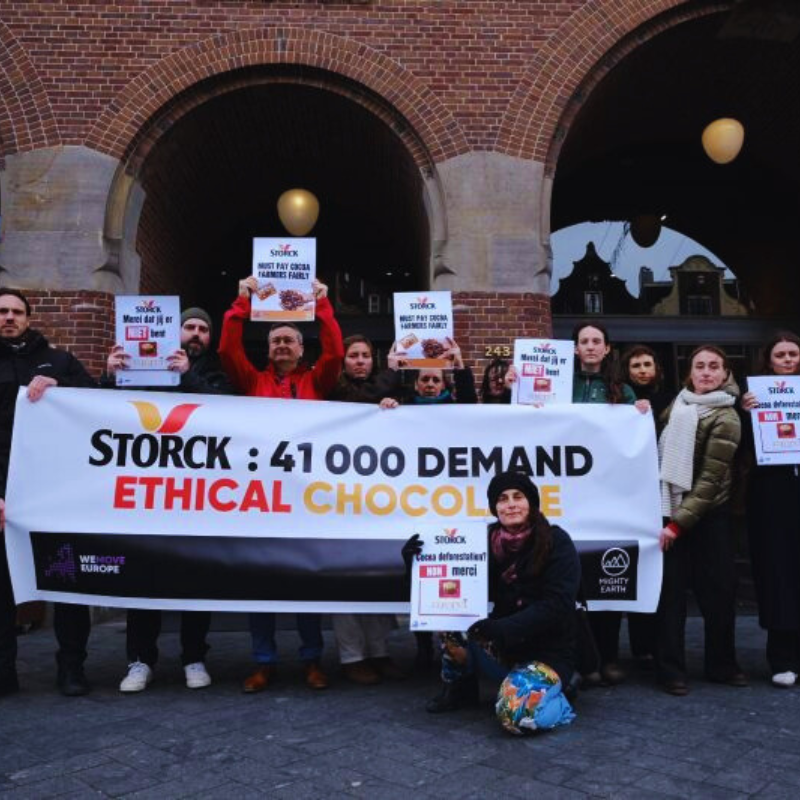
So, we were really worried about Olam’s palm oil supply chain all over the world. This black box problem, lack of transparency, the fact that they hadn’t really gotten behind no peat, no deforestation, no exploitation like so many other palm oil companies had. And then we found out that in Gabon they had these big plantations for palm oil that were deforesting ancient, beautiful rainforests. And then we realized, oh, also rubber. And then we realized, oh, also other problems. And it turns out Olam is quote, the world’s biggest farmer. It’s this huge cross commodity behemoth. It’s not just 2% of Guerrero Palm oil. It’s actually also one of the tops for cocoa traders, it’s one of the top 10 coffee traders. It’s just got a huge amount of many different agricultural commodities. So, it’s quote, unquote, the world’s biggest farmer. And we decided to do a big campaign to change that.
And you know what? It worked. And a lot of other things. I’ve just tried to support wonderful people to do the best and shine like stars that they can do. But this one is something that I dreamt up and executed and I feel so proud. A lot of other wonderful people helped me with it. But I read it and I feel so proud. Proud of that. That was one of the best things I’ve ever done in my whole life.
Matt Bowles: Well, I want to ask you about your experience on the ground during the campaign. Can you share a little bit about the powerful interests who tried to resist the campaign and tell the story of what happened when they put a hit out on you personally and what happened when you encountered the hitmen that were sent after you?
Etelle Higonnet: Yeah. In Gabon, which is a ruthless, close dictatorship that has been run by a corrupt family for some time. Often, I would say, with the help of the French, unfortunately. Well, now, no longer. But at the time, that’s what it was. That government had done a joint venture with Olam for agricultural commodities. And I was out in the middle of absolutely nowhere. I came out of this little hotel and my driver was gone. Just gone. Astronaut. And all these people were like, nope, he’s gone. He left. He had an emergency. So that’s weird. He did not message me. Messaging him. Then finally I get a message saying I can’t talk. And I wrote him, and I was like, are you okay? What is going on? Can I come find you? Can I help you? He’s like, I’m fine, just can’t talk. Sorry. He just ghosted me. So, I didn’t know what I were.
And then I start trying to figure out how to get myself to the capitol, which is where I was supposed to take a plane. And these guys come to the front desk, and in a very authoritative way, they say, oh, are you the one that needs a driver? And I’m like, yes, I am. They’re like, oh, your friend sent us. And at first, I thought, oh, my driver sent them. Amazing. I’m so grateful to him. Wow. And they just seemed so confident, and they knew who I was and all this stuff. So, I was like, okay. My driver must have told them lots of things about me, which is not good, and he shouldn’t have done that. But fine. Fair enough. So, I got in the car with them, and at first it was very quiet. By the way, I should say, these are like super big, burly, sort of Superman type guys. Then they were driving along. I’m a very chatty person. So, I started chatting with them and asked them what do they think about there’s been this contamination problem in the community? And they’re like, oh, yeah, it’s bad. One of my cousins got really sick. I was like, yeah, well, that’s what I’m working on. I think we shouldn’t have any poison in our agriculture. And I think that what people ban in Europe should be banned here as well. It’s not right that you’ve just decided that people in Africa should be exposed to horribly highly hazardous pesticides(HHPs).
So suddenly one of them kind of unblocked, and we started chatting. Then we started really chatting. Then I got all these fruits and also got some cigarettes for the guys that stand on the side of the road, and next thing I know, they were like, holding up a little towel so I could pee on the side of the road. And we got back in the car and then we stopped again and had a picnic. And they were just nicer and nicer. And then they started telling me about their time in a military academy. And I was like, that’s weird, both of you. Slowly it dawned on me. They were not sent by my driver. These guys are some sort of special forces. And then I was like, okay, this is my last day. What’s going on? And then finally, we are almost at the Capitol. The mind looks at each other. We, at this point, we’ve chatted, we’ve bonded. We talked about Touissant and Subcomandante Marcos.
And I think I also ended up saying something about how I thought it was such a shame that this country has all these riches and the government is so rich and people are so poor, and I think it’s very unjust. And all of a sudden, the driver snapped and he’s like: “Motherfucking dictator, I hate him. You know, this country is…He’s running it to the dogs!” And I was like, okay, does this mean you’re not going to kill me? And they sped up, put a flashing police thing on the roof of the car and hightailed to the airport, but super-fast. And I did notice that we changed, when the guy flipped a switch and was like, “this dictator is running the country to the dogs”, that’s when he turned the car and put the thing on the roof and went the other direction. And the guys dropped me at the airport, gave me this enormous hug, gave me their number on a written piece of paper, and said, never come back here through the airport. Next time you come, you come through the border, you call this number, you tell me, I’ll come pick you up.
Matt Bowles: That is incredible. Can you then, as a conclusion to this story, share the ultimate results of that campaign and the reforms that you were able to win?
Etelle Higonnet: Night and day, Olam published their palm oil supply chain and transformed so much of their palm oil procurement and started across commodity reform and started changing not just their environmental policy, but their social stuff as well. It’s definitely so much better than it used to be.
Matt Bowles: Well, I now want to talk about narrowing your focus to coffee and the coffee industry in particular. Can you just start off talking a little bit about, personally as a consumer, your love of coffee? I know we share our love of coffee shop culture around the world. We both drink coffee every day. Can you just share a little bit about your personal connection and love for coffee?
Etelle Higonnet: Not only do I love it; I literally can’t start my day until I can go coffee. My husband, bless his heart, makes me a little mug of oat milk latte every morning and I call him my coffee angel. And I do love coffee shops. It’s just there’s something about hanging out the coffee shop that’s just wonderful.
Matt Bowles: So, let’s talk about the main problems with the coffee industry today, both human rights and environmental issues. And maybe just start off by explaining what we as coffee drinkers probably don’t even know about the coffee that we’re drinking every day.
Etelle Higonnet: Most people do not know that if they drink coffee every day, they’re almost certainly drinking slavery, child labor, deforestation. I think if they knew, they would not agree. I’m a very glass, half full mug, half full cup, half full person. I believe that most of humanity is beautiful. And actually, my time in war zones on post conflict areas has only reinforced this belief because I’ve seen so much heroism and courage and kindness, resilience in the face of the worst things that the world has to offer. I think most people are amazing and most people, if they knew they would spit their coffee out, they would not agree.
Matt Bowles: So, with all of your environmental activist work in all of these different industries, can you talk about what led up to your choice now at this point to found Coffee Watch and to focus so intently on the coffee industry specifically?
Etelle Higonnet: So actually, for a long time I’ve been thinking about these seven deadly sins that we talked about, right? Those seven commodities that are driving deforestation in the world and that are also driving our mass extinction crisis and that are a third of climate change. And so, I’d worked a lot on cattle and soy and palm oil and cocoa and rubber, and I’d never gotten to work on coffee. And it irked me so much, it’s been nibbling at me for a long time. I wanted to work on it at Greenpeace, I couldn’t. I wanted to work on it at Mighty Earth, I couldn’t. I just decided, you know what? This is what I should do. I should work on coffee. We wanted to do it for a long time. People don’t want to do this. Just do it. You do it, go for it, start it. And then once I made up my mind to start Coffee Watch because of this deforestation problem, now I set myself this goal for our team to really try to turn the industry around on several things, on human rights and environmental performance.
Matt Bowles: Okay, can you expand on that a little bit? Because there’s plenty of people, I’m sure that are listening that are not familiar with those dynamics in the coffee industry. So can you lay out the landscape today in terms of human rights abuses and environmental destruction that’s currently going on and just sort of set up the scope of the problem for people that are not aware of that. And then let’s talk about the steps that you’re working on for the solution.
Etelle Higonnet: Okay, so let’s start with slavery. Brazil is the top coffee producing country in the world. It makes up somewhere between 31 and 38, 39% of global coffee, depending on who you listen to. It’s the unquestioned number one of coffee production. Brazil has a lot of coffee slavery problems. And when I say a lot, I mean a lot. In 2023, the coffee industry was the number one source of governmental slave rescues in Brazil. Let us just pause on that for a minute. That’s like the top thing people were rescuing slaves from was coffee. It made up 11.4% of the total rescues from 2013 to 2023. So, it’s not like 2023 was just an anomaly. This is a pattern and a practice. And this is true even though the labor inspectors in Brazil have only inspected around 0.1% of coffee farms in Brazil to date. 0.1. So even so, they found 3,700 workers in slave like conditions on coffee plantations that are supplying allegedly Starbucks and other major brands. So that’s really messed up. Do you think most people know that there’s slavery in their coffee? I don’t think they do.
Matt Bowles: So, let’s talk about and maybe unpack the complexity of all of this and distill down what are the steps and the advocacy demands and so forth to move from the present reality of human rights abuses and environmental destruction that are going on in the coffee industry today towards your vision. If you can maybe explain what that vision is for an ethical coffee industry. And how do we get from here to there?
Etelle Higonnet: It would be wrong for me to just only explain that there’s slavery in your coffee. I hope that has shaken people up a little bit and made them care a bit more. But we also know that coffee is awash with child labor and extreme poverty. We know that most coffee farmers are in poverty and many are in extreme poverty, which the World bank sets at $2.15 a day. And that there are almost no coffee farmers earning a living income. A living income is exactly what it sounds like. It is an Income that you can live on. It’s not a Sauvignon Blanc income. It’s not dignity development. It’s just a living income. So, coffee farmers are not earning a living. Like not almost none. That’s really messed up. And the poverty is why we have so many kids in coffee, probably millions. Like 91% we think of Ethiopian coffee farming families use child labor. 74% of the Colombian coffee farming families are thought to use child labor. 64% in Honduras, I will stop there.
You don’t need to hear like this insane, depressing laundry list of numbers. But that’s a lot of kids. And the parents do not send their kids out to do backbreaking, dangerous, difficult work with heavy loads and sharp objects like machetes and hazardous chemicals because they hate their kids. They do it because its workers starve. You have to come out of school and do this horrible work so that we can feed the family. That is why we have child labor in poverty. It is not okay. We should have a living income. We should have a living income price for the smallholder of farmers and a living wage for the farm workers. There are 25 million farmers and 100 million farm workers. And these people all have dependents. They have kids. That’s crazy. All these people in poverty, they can’t make ends meet. They’re hungry, they’re food insecure.
Most people would be happy to pay one or two extra cents per cup. And that’s literally what it will cost to have ethical, sustainable coffee. We’ve made this choice to have coffee with gender inequality and sexual violence and exploitation. Why have we decided we should have raped coffee? It’s a weird thing that society has decided that that’s okay. We can have gender empowerment coffee. We can have equality coffee. We can have equality coffee. We can have coffee that’s equal pay for equal. Like what? Why are we not doing the right thing? This is not a big ask. I mean, it is a big ask. It should not be a big ask. We should be doing coffee. That is no deforestation. A living income. That’s regenerative agroforestry. That’s what we should do. And we know how. There’s lots of coffee models out there. Most of them are small and medium companies, not the really big ones, but the models are there, so we know how to do it right.
Matt Bowles: So, based on that, can you talk about some of the specific campaigns that Coffee Watch is undertaking today to try to bring about these changes?
Etelle Higonnet: Yeah. So, we worked with these amazing groups and really tried to be the wind under their wings. Our first investigation that we did with another organization was about China. Human rights abuses in coffee supply chains in China, or particularly in supply chains of Starbucks and Nestle. Almost all the Chinese coffee farmers are in Yunnan. They’re almost all indigenous or part indigenous. They’re very, very badly treated. We found many really serious human rights violations. Then we did our next report on Mexico with these fantastic local organizations there, pro Dusk and Empower report called Exploitation and Opacity. And it is like the title center says it all. And back to Chiapas, you and I have been there. Chiapas is the top coffee producing region in Mexico and it’s largely indigenous.
It’s not an accident that all these indigenous people are locked into so much poverty and such an exploitative, problematic industry, is it? You know, then after China, Mexico, we did a report on Brazil on human trafficking and slavery and coffee, and then report in Colombia on labor abuses in Colombian coffee. And the reason we’re moving from place to place is because it’s not a Chinese problem or a Mexican problem or a Brazilian problem or a Colombian problem as much as it is a coffee problem. If you have the same problems in all these countries, what does it tell us? It tells us the industry has to change its whole business model, right?
Matt Bowles: So, based on your experience with other sectors in agriculture, that you have successfully won meaningful reforms in these areas. How can that apply to coffee? What are the main levers, shall we say, of influence that can push the industry or major companies in the industry to make meaningful changes in this regard?
Etelle Higonnet: So, you can think of Coffee Watch as being like Greenpeace and Amnesty International got together and had a baby, and that baby just wants to work on coffee. I’ve worked at Greenpeace and Amnesty, Human Rights Watch and Mighty Earth. I’ve seen what works. Just tools in the toolbox, basically, right? For human rights and environmental work, I’m just fusing them and pouring them into coffee. We know that undercover investigations to find crimes in supply chains are very important. We know that you have to go during the harvest season to see with your own eyes, boots on the ground, what’s happening to workers. We know that you can use satellite mapping to see deforestation and forest degradation, work with journalists. Since we’ve started Coffee Watch, we’ve done stuff with The New York Times, Washington Post, Wall Street Journal, Le Monde, Piqua, El País, The Guardian, Danlot Espresso. Lots and lots of different media and different languages. And that’s very important to get media to cover these issues.
We went from zero to about a million views on social media in just eight months that we’ve been up and running. And I think that’s ever more important in the world that we live in today. How do you get the word out in social media? So, it’s not just the research that you do and the work with media to get that covered and to get journalists to go themselves and go even further and better than what you’ve done. It’s social media and raising awareness and getting influencers in coffee and sustainable lifestyle to realize. Oh shit. So yeah, changing awareness and changing how people communicate in this world of foodie influencers and coffee influencers. And we’ve just started to scratch the surface. But there’s so much more that we’re hoping to do.
We’re going to try to put out a scorecard that ranks and grades all the major coffee companies like 90% of global coffee, hopefully so that consumers and journalists and investors and banks, they can all see. Oh well, how is Matt doing? How is its end doing? Oh, and how can I dig a little deeper? How is Matt doing on living income? Oh, he’s doing pretty good on deforestation, but on living income he totally sucks. Oh, what about its head? Well, she kind of sucks. That’s way ahead of her. Why is that? And then you sort of like start having lower ranking companies that get a little bit of a jolt of reality check and you start to try to do better just to catch up.
Matt Bowles: Well, one of the things I want to do for sure here in this conversation is to draw out very specific concrete action items and ways that everyone listening today can contribute in some way to this initiative of helping to pressure to make the coffee industry more ethical. I think I would like to start by asking you for the people who are listening who are coffee lovers who drink coffee every day. What can we, that’s certainly me included, do in terms of our consumer choices when deciding what coffee to drink versus what coffee to not drink and directing our money in the right way.
Etelle Higonnet: Oh, my goodness, I’m so glad you asked this, Matt, because you have this incredible power to vote with your wallet every day. Isn’t that kind of amazing and cool? You can only go vote for politicians depending on where you live. France, U.S. like every four years or seven years or two years or whatever. But your coffee, you can vote every single day. So even if you have a bad day where you’re hungover, just like whenever you kind of hit the airport and you’re desperate for a cup of coffee before you get on plan to visit your aging, ailing parents or whatever, it’s fine to do it wrong one day because you have so many chances to do it right.
And the funny thing is, you don’t have to kill yourself. And do an hour of research every time you have a cup of coffee. You just do an hour of research, find the companies that are ethical, that are sustainable, that are close to you, and start ordering from them. Figure out which ones are the tastiest that you love the most, and then just order them on the regular. You have a steady stream of coffee. You just know the bag is coming once a month or a couple times a month. And an hour does not seem like too much to ask.
Matt Bowles: So, let’s talk about what to do with that hour. How do people find these particular companies? And I would be curious as well. Just for people, let’s say, like me in particular, I order whole bean coffee by the pound in a bag. I grind it myself; I travel with a portable espresso maker; I make my own espresso. And I would love to ensure that I am buying bags of whole bean coffee that are as ethically produced as possible. So, if you want to shout out any specific brands or companies that are really doing this right and setting a model that we want to definitely patronize them to reward them for that, and I can order a bag of beans from them and they’ll deliver it to me. Feel free to shout out those specific companies. But also, how can people do this research? What should they be looking for? How should they spend that hour?
Etelle Higonnet: Yeah, okay, so you have one hour. You love coffee. You’re going to order a whole bunch of ethical coffees and taste them and share them with everybody and then figure out which are your favorites and then start ordering them the regular. You can even order them as presents and gift them to the favorite people in your life as Christmas stocking stuffers or birthday presents. Or when somebody invites you over for a brunch with a little note saying like, oh, I love coming over to your house for brunch, and I’m giving you this coffee because you’re amazing, and this coffee seeds the planet. I’m sure you’re going to love it too. So, you cannot just change your own coffee, but all around you. You can change your family, your friends, your university, your office, your whatever institution your part of, your church, your mosque, that one hour. I think it’s time very well spent.
The most ethical coffee companies tend to be a bit smaller. And so, they tend to be region or country specific. So, for example, if you’re in the UK, you can get Cafe Direct coffee. That’s like a living income. And it was all set up. The whole purpose of it is to pay a living income. That’s literally how the company got set up. It does other great stuff too. But if you’re in Germany, I don’t know if you can buy that. But if you’re in Holland, Moyee Coffee is really famous for being quite ethical and sustainable. If you’re living in London, there’s Kiss the Hippo. If you’re in Denmark, there’s Slow Forest Coffee, which is amazing. They’re literally regenerating degraded soils. They purposefully go and find soils that are super screwed up and then plant coffee there with forests to regenerate the soil. So anyways, they’re awesome. They pay a living income price.
In the U.S. There’s Equal Exchange. If you’re in the U.S., pretty much any coffee that you get that is Smithsonian Bird Friendly certified, that means it’s organic, so it’s not poisoning people. It means that it has really good agroforestry standards, like best in class. It means that it’s got no deforestation, and it’s not exactly a living income price for short because they’re not committed to that and they haven’t completely worked it out. But in general, it brings more. So, it kind of works out in practice to being almost a living income, I think. So Smithsonian Bird Friendly certified, there’s a bunch of them. But then, yeah, there’s some more famous ones, like Equal Exchange. And I would say also, here’s the other message. You’ve loved coffee, you have a particular brand. You are not going to change that brand. Fine. Fair enough.
If you just take a picture of yourself with your cup of coffee and you send it to that company and you say: “Hey, Illy, McDonalds, Duncan, Lavazza, whatever, I am your loyal customer. I have drunk your coffee for 15 years. But I just found out on this podcast that you don’t pay a living income price. What? Why not? Please change.” You know, and you just start posting on their social media every week. That’s also hugely powerful. That’s a different way of voting. You’re not voting with your wallet necessarily, but you’re voting with your voice to change your favorite company. And I would say if you can try to experiment with more ethical copies sometimes, because whatever you drink, whether it’s instant or pods or roasted or beans that you roast yourself and grind yourself, there’s always better, more ethical alternatives. Like if there’s pods. You can get compostable pods. They don’t wind up in a turtle’s tummy or something, you know, And I think you can buy from the heart, but you can also communicate on social media with companies. They’re very brand sensitive and reputation sensitive in coffee, much more than palm oil, for example. And so that makes a huge difference.
And on Coffee Watch, we put every single petition that’s like a good, serious petition to make coffee more ethical. They’re not ours. We didn’t make them, but we just curated them for you. So, if you only want to spend five minutes, you don’t even have one hour to dedicate to the proposition of drinking ethical coffee and making the world better with every cup. Just go on the website and click all those petitions. It’ll take you five minutes.
Matt Bowles: Okay, that was going to be my next question. And we are going to link all of this up in the show notes, by the way, folks. So, if you just go to themaverickshow.com, go to the show notes for this episode, we’re going to list out the specific brands that Etelle just mentioned, if you want to click through and see which ones deliver to you. And we are also going to link up, of course, the Coffee Watch website. So, this, I think just in terms of coffee and advocacy and what we can do, just final thoughts. In addition to these intentional consumer decisions that we can make in terms of what coffee we buy versus what we don’t and voting with our wallet, we can also go to the Coffee Watch website and sign these petitions. So, we’re going to link that up in the show notes as well. Is there anything else that you want to leave folks with or empower folks with or ask of folks in terms of what we as individuals can do as soon as we finish listening to this podcast to help affect positive change in the coffee space.
Etelle Higonnet: If you have a lawmaker who’s even remotely okay, write to your lawmaker, call them, send them a postcard, maybe send them a pack of ethical coffee, go to a town hall and offer to bring coffee to the town hall. Because in a democracy, laws can be changed. And we have laws that have been proposed right now for the EU, for the UK, for the U.S., for New York, for Illinois, for California, all of which would transform coffee. So, if you listen to this and you thought, okay, I do not like it that my coffee has all these horrible crimes in it and I would like to be able to just guilt free, go drink my effing coffee without having to worry about this crap. Call your elected representative, write them a letter, write them an email, write on their social. That might be worth two years of buying ethical coffee in terms of the change that it can effectuate in the planet.
But, you know, the sky is the limit. If you really care about this, if you’re a coffee lover and you heard this and you thought, this is messed up and I want to be part of the change, please come volunteer at Coffee Watch. We will orient you to whatever it is that you want to do. There’s lots of great groups all over the world, from Indonesia to Brazil to Colombia to Mexico. We can connect you to them. If you want to volunteer for them, it doesn’t even really matter. Are you a filmmaker? You can make a film. Are you an investment banker? You could create a little special facility for a microfinance bank that’s specially targeted to bringing some of these coffee farmers out of the ranks of the unbanked. There’s something for everybody, and together we are strong because, you know, these companies that are doing terrible things, they have many, many millions of dollars, but we are many, many millions of people. And that’s awesome and better. So, power to the people.
Matt Bowles: One of the questions that I get asked a lot have been over the last couple years. I think you’re in a better position than me to comment on, and I want to just get your take on it, is when people are doing advocacy. Let’s just say, for example, as you know, I’ve been doing a lot of advocacy work to try to stop the genocide that’s happening in Palestine. And a lot of people that listen to this podcast as well. One of the questions that I get is about how mentally and emotionally intense and devastating it is to see images of that every single day. I mean, we are watching that every day. And it seems on the one hand that it’s important to pay attention to what’s going on. And when we see those images, we become morally aghast and outraged and compelled to do something. And at the same time, seeing those images every day can have a depressing effect and can drive one potentially to despair and so forth. And so, I’m curious for you, since you’ve been doing this kind of work for so long, many decades, how do you balance being immersed in these issues and remaining aware of them and staying on top of them and what’s going on, and also creating and finding joy in your own life on a daily basis and not allowing your mental and emotional state to fall into depression and despair?
Etelle Higonnet: My husband, my friends, my colleagues. I feel so loved and so supported. Almost every day someone does something so unbelievably kind. And you know, Matt, I count you as a friend now too. Just exchanging messages while we were getting ready for this podcast. I felt that you’re such a kindred spirit. We’ve gone to so many of the same places. You know, the way that you lean into all these good causes, it just speaks to my heart and wow, it just cheered me up so much. Of course, that same day that I got these nice messages from Matt saying, oh, let’s do this podcast and messages that kind of brighten everything up. Also, that same day, I did have to look at a lot of data about child labor and coffee, which is very grim as a mom. But you know, the same days that I try to figure out how we could have legal accountability for sleeping coffee, the sauce of the day. So, my husband kisses me and makes me that wonderful little morning latte. My coffee angel, my little oat milk latte. And every encouragement that I get from my friends and family, every kiss my baby gives me when I wake him up and get him out of his crib. I think love, love is what carries us through, isn’t it?
Matt Bowles: That’s a great answer. All right, Etelle, I think that is actually the perfect place to end the main portion of this interview. And at this point, are you ready to move in to The Lightning Round?
Etelle Higonnet: Lightning round? We’re ready.
Matt Bowles: Let’s do it. All right. What is one book that you would recommend that people should read?
Etelle Higonnet: King Leopold’s Ghost.
Matt Bowles: That is a good recommendation. Really good recommendation. All right, who is one person currently alive today that you’ve never met that you’d most love to have dinner with? Just you and that person for an evening of dinner and conversation?
Etelle Higonnet: Greta Thunberg.
Matt Bowles: Nice. All right, knowing everything you know now, if you could go back in time and give one piece of advice to your 18-year-old self, what would you say to 18-year-old Etelle?
Etelle Higonnet: I think I would say work on the environment starting now.
Matt Bowles: All right, of all the places in the world that you have now traveled, what are three of your favorite destinations you would most recommend, other people should definitely visit?
Etelle Higonnet: Siem Reap in Cambodia, which is where Angkor Wat is. It’s literally one of the best places in the whole world. Santa Fe, so gorgeous, my favorite place in the United States. And the Canal Saint-Martin in Paris.
Matt Bowles: Amazing. All right, what are your top three bucket list destinations? These are places you have not yet been highest on Your list you would most love to visit and see.
Etelle Higonnet: I want to go to Svalbard. I want to go hiking in Bhutan and I dream of sailing around to Galapagos.
Matt Bowles: Amazing. I have been to the Galapagos Islands. Really incredible. You in particular must get there asap. It is an incredibly special experience. That is a great pick.
Etelle Higonnet: Oh, I just dream of hopping on and off and snorkeling and getting back on the boat and snorkeling again.
Matt Bowles: It is really, really special and amazing. So, love that.
Alright, Etelle, we have now come to the most important question of this interview. I am about to ask you to name your top hip-hop emcees of all time. But before you name your five, I would love to just ask you if you can share a little bit about what hip hop music means to you and what you love about hip-hop.
Etelle Higonnet: It feels like infectiously, fantastically energizing and somehow irresistible. I love a lot of different kinds of music, but hip-hop is what will make me stay at a party long past the time I wanted to go to bed and just dance my heart out. Okay. I would be lying if I didn’t say Nas. I am old school. So, MC Solaar, of course, I think probably Nicki Minaj, she’s just so amazing. But Lauryn Hill also. How many more do I have left?
Matt Bowles: That’s four.
Etelle Higonnet: There’s a Brazilian rapper and hip-hop guy that my husband introduced me to. My husband is a Brazilian. And this guy, Racionais MC. He is just like awesome.
Matt Bowles: Racionais MCs. There is an amazing, if you haven’t seen it yet, documentary about them on Netflix. Have you seen it?
Etelle Higonnet: No. I haven’t.
Matt Bowles: Oh my gosh. It is so good and it is so important and it is so politically significant. You of all people will really appreciate it. You need to like go watch it like immediately. That’s like this weekend top priority for you, Etelle. Okay, so let me put the audience onto this as well. I’m going to link it up in the show notes and I’ll link up the name of the group. You can go listen to them on Spotify or wherever you listen to your music. But I’m going to link up the Netflix documentary about them. I’ve seen it multiple times. I mean, it is spectacular.
Etelle Higonnet: Matt, how did I miss that, what a great tip. Okay, this is like 100% this weekend!
Matt Bowles: We just need to do a two-and-a-half-hour podcast wine night more often, Etelle. We’ll probably teach each other about all sorts of fun and interesting things. That is amazing. So, all of that stuff will be in the show notes. I want you to let people know, though, at this point how they can find you, how they can follow you on social media. Again, please give out the website, let people know how they can learn more about Coffee Watch, sign the petitions and any other way you want people to come into your world.
Etelle Higonnet: Yeah. So coffeewatch.org it’s so simple. We have this little button where you can take actions. A lot of it is not really for us, it’s just like petitions that other groups created that we curated and actions people can take. And then if you want to follow us, all of our social is at the bottom of our website. So, we’re on Bluesky, we’re on Insta, we’re on LinkedIn, we’re on everything. And you can follow us in any platform that you prefer. And we just started TikTok.
Matt Bowles: We are going to link all of that up in one place. So again, you can just go to the show notes. themaverickshow.com, go to the show notes. For this episode, we’re going to have all the social media handles there as well as direct links to everything else we have discussed on this episode. Etelle, this has been such a special conversation. Thank you so much for coming on the show.
Etelle Higonnet: Thank you, thank you. It’s wonderful. Thank you so much.
Matt Bowles: All right, good night, everybody.