
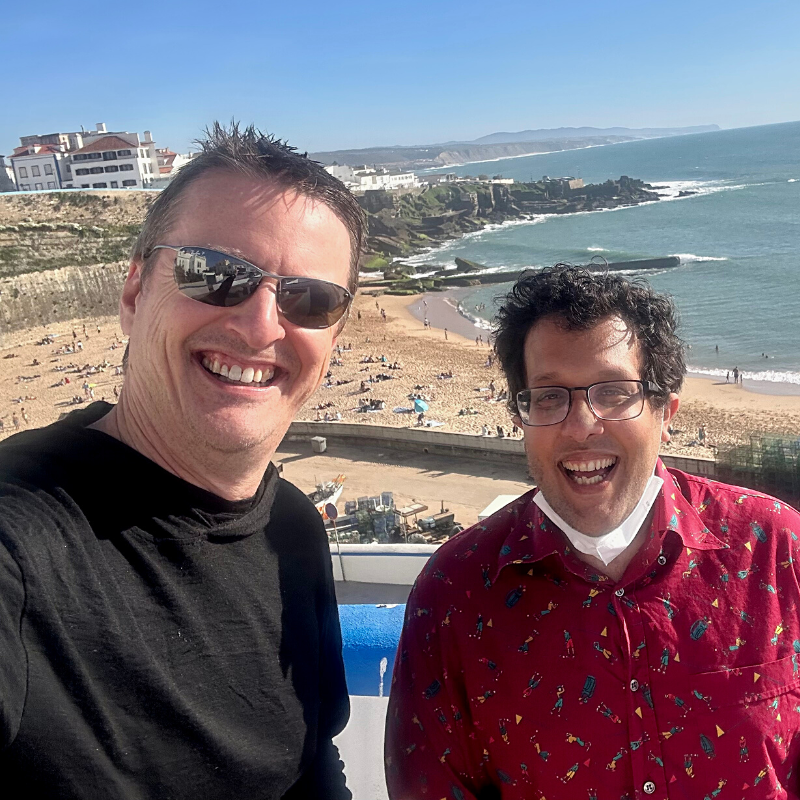
Matt Bowles: My guest today is Andres Ramos. He is a musical composer, software developer, and full-time digital nomad. He regularly performs and records music around the world in collaboration with local artists. Originally from Florida, he has traveled the world with no permanent base for the last seven years and has now been to over 60 countries.
Andres, welcome to the show.
Andres Ramos: Well, thank you. And I’d like to welcome the show to my house.
Matt Bowles: We are currently recording this in your place in Lisbon, Portugal. We have spent a couple incredible days together. I actually got to see you perform last night at a local venue, which was super fun. And then we hung out at the beach today, watched the sunset and had a blast.
Andres Ramos: Yeah, my girlfriend was very jealous.
Matt Bowles: She is not here, unfortunately. Give her a shout out. I hope I get to meet her and hang out somewhere else in the world. But let’s just start off, how did your initial interest in travel start to develop?
Andres Ramos: As a child, I traveled quite a bit around South America, I guess, and Central America with my family. My father kind of spearheaded that, or he was at the helm of our travel itineraries back in the day. He had traveled through South America on his honeymoon with my mother, and he’d become smitten by the cultures of South America. He really imported that into the house. He brought over, amongst other strange artifacts, he brought over a charango, but from far less conservation minded era in the eighties.
So, nowadays the triangles look like ukuleles with the strings tuned in pairs. Nowadays they’re made out of wood. In those days, they were brutally made from an armadillo, literally just kill an armadillo, gut it and strap some strings over it. And there you had an instrument. So, I remember he brought quite a few of those. So, we have this musical armadillo cemetery in the house, basically. And some of them were so fresh that the hair would actually grow on them.
Matt Bowles: Were your parents musicians? Or where did your musical inclinations and interests originally come from?
Andres Ramos: Talk about the apple not falling far from the tree. So, my father is a software engineer who loves to play a variety of instruments. So shocking that his kids grew up to be software engineers who love to play instruments.
Matt Bowles: So, talk a little bit about your musical journey, how young were you when you connected with music and how did that journey proceed as you were growing up?
Andres Ramos: As with any child, you connect with sound first, more than anything that anyone would consider musical and delusions of music as a child. I was like three or four, I was making noises. I remember being asked to stop making those noises. So, I guess in that sense, it wasn’t fully fledged music. It was like that proto music that kids do. And maybe in an attempt to curb the amount of noise in the house. My parents, eventually when I was six or seven, I guess they got me into piano.
And it’s funny, I remember they bribed me into doing that, or they tricked me into playing piano because I was, I was into accordion actually. My grandmother had an accordion, and I loved the sound of the accordion. An accordion sounds like a lot of instruments where in the right hands, it can be really dulcet and forceful in the wrong hands and certainly in the hands of a child. That’s a lot of things that are not very pleasant at a very high volume.
So, my parents had a little bit more forethought and they realized they wanted something that had better volume control than an accordion. So, they told me, hey, if you learn how to play piano, you can teach yourself accordion. I can give myself credit for one thing in life. I am really good at it; I’m like a dog with a bone. I do not let things go. So, I took them up on it, but I got the last laugh because I think five years into playing piano, I was like, look, I’ve been playing piano, play some classical tunes, now give me an accordion. And they lived up to the end of the bargain.
They got me an accordion. So, I started playing accordion around middle school, the predilections of a pirate, basically pet parrot. I mean, this is true. I had a parrot. I had an accordion. I lived in Florida, so I had a boat. It’s actually a shock. I didn’t go into piracy, to be frank. I played accordion for a bit. Thank God.
I continued all the meanwhile, obviously, to continue studying piano. I got more seriously into it. I got deeper into my teens. I started playing accordion to make ends meet while I was in undergrad in Miami. I played accordion on Spanish television of all strange things. And somewhere around my early twenties, I wanted to increase the musicality of one of my girlfriends.
So, I bought her a ukulele because I figured it was like an instrument that I would be simultaneously impressed if she learned how to play but also would not be too hard for her to learn how to play. So, it was kind of like in that liminal space. And she asked me, she’s like, how am I supposed to learn how to play this? So, I borrowed the ukulele from her, started learning how to play it in the hope that I would just stay one step ahead of her to be able to teach her. And in that process, I accidentally tricked myself into learning ukulele. And it’s been something that’s stuck with me for 15 years.
Matt Bowles: How did your path towards the more professional side of music develop? Because it was not your initial professional career path. So, can you talk about what that path was and then how it transitioned towards music?
Andres Ramos: After spending a lot of time out in the Miami nightlife scene, I kind of felt like I wanted to do something where I was a little bit more generative. I wanted to be able to say, hey, I’ve made things. So that got me into writing music. Basically, I want to be able to say, hey, my time is resulting in something tangible, something that wouldn’t have occurred if I hadn’t been around. I wanted to feel like at least I was giving it a shot, the idea of making something, of creating, of contributing to some sort of like cultural lineage.
Matt Bowles: You have been able to merge music and travel, and over the course of your life, I feel like you’ve done that in different ways. So, you have initially, for example, started touring the world, under the pretext of playing musical gigs in different places and doing that professionally and then flip the script and started traveling for the sake of traveling and then being inspired by the places that you chose to travel to, then write and compose and perform music. Can you talk a little bit about the way that travel, and music have merged for you in that transition or evolution over time?
Andres Ramos: At my core, I’ve always wanted primarily to travel, to experience new things, and to be able to distill those experiences or capture them and preserve them in some amber of music. I think I wanted to do that from the get-go. Unfortunately, I grew up believing that like, well, to get to do these things, you have to demonstrate something that you’re doing that makes you worthy of these types of experiences. So, the thing that made me worthy of going out to these different places was that I had music to bring to them, I had something to give. But as I got to do that more and more, I realized really at the end of the day, it was no different than being kind of like a door-to-door pillow salesman. You’re going to different places and trying to get them to accept something that they didn’t necessarily solicit.
And that felt more disingenuous experience than what I do now, which is I go to places. I try to interpret the experience that I’ve had through the lens that I best understand, which is music, and I keep it to myself. And in a sense, that makes for a more truthful expression because I’m not really concerned with trying to produce something that other people, that’s moderated in any way by the expectations of others. Rather, it’s just a very honest dialogue with myself. In a way that best makes ideas clear to me.
Matt Bowles: Can you talk a little bit about at this point in your life, how you compose your music? What are the types of inspirations that inspire your music? And then, would you be down to play one of your pieces for The Maverick Show?
Andres Ramos: Yeah, absolutely. I’d be honored. So as far as I compose, there’s a variety of different ways to start off. Sometimes I will try to just carve out a main motif for like a melody or something like that. And then what I’ll do is I will start off maybe harmonic foundation underneath it. And then I’ll start altering that harmonic foundation and changing a note or two here and there.
And then finding things that are almost parallel to what I started off to begin with. And then I think that’s where you get a more interesting texture. And so, I’ll do something like that or sometimes I will do it inversely where I will start off. I’ll find like a series of changes that I think sound interesting and then I come up with a melody over them. And other times sometimes I don’t even use instruments. Sometimes I use programming languages such as Sonic Pi that are used to essentially code music and that’s a completely different manner of composition. It’s usually more aleatoric though. It doesn’t have to be you could specify everything down, down to the note, the octave, the timing, the envelopes that you set, everything can be specified, but I like to take advantage of the aleatoric capabilities of software and programming languages.
Essentially, by the way, Sonic Pi for any developers listening, it’s essentially Ruby with some methods built into it, kind of like a framework for Ruby that allows you to make music. A lot of times I’ll sit in a pretty place. I’ve been very blessed. A lot of places I get to hang out at are very beautiful. I’ll just sit there and try and come up with soundscape for what I’m experiencing. And then later on I’ll force myself to write words. I’m not always the biggest fan of writing lyrics, but I do it because I guess it probably actually narrows down the palatability of the music in a sense, right? Because they say music is supposed to be a universal language. And then I narrow it down until something is spoken and it makes it more accessible to the people who I’ll probably be showing it to.
Matt Bowles: And you have captured a lot of this music on your website. Instead of writing a blog post or something like a lot of travelers might do, instead what you’ll do is you’ll compose a song and then you’ll oftentimes partner with a local artist from that country. And then you’ll perform it and you’ll record it and you’ll put it on your website and you have this incredible music travel log to document your journey. Can you talk a little bit about that?
Andres Ramos: I think it all kind of relates to that idea of freeing myself from the expectations of an audience. And when I got to this point where I decided that I was no longer going to try to do that, that instead I wanted to create music for the sake of enjoying what music releases in me, I decided to write music that was honest. That was kind of truthful to what I was feeling. I had no real concern about what its reception would be.
And in that same vein, that’s what this collection of video postcards to the future are. They’re meant to be very personal snapshots of where I was at a specific moment in time that I can look back later on and be like, oh, I remember exactly what that meant. It’s almost like a series of inside jokes with myself to remind me of what I was thinking and what exact frame of mind I was in when I was in all these different places in the world, different points in my life. I’ll go ahead and give it to you; I always like this one.
And this one was written on a rooftop. I was staying in this hotel called the Marino Beach Hotel in Colombo, Sri Lanka. Had the most fantastic blend of sunsets and Russian narcissism that you could ever imagine. I mean, it was like literally just like sunsets and like Russian wannabe Instagram influencers taking pictures of their butts. And anyways, I would go up there and I would spend a few hours just writing music while watching the sunset. So, this was a song that I wrote. It addresses what I was doing at that moment. Right? Well, I mean, this was like hot on the heels of the pandemic. For me, I’d say the pandemic is a bit of a transformative time in the sense that I was fortunate enough to not have experienced any personal loss in my direct or immediate family.
I did experience the loss of a certain amount of trust in humanity. It seemed to me it was a relatively straightforward problem that we just blundered colossally, and it brought out the very worst in a lot of people. And that thing, that’s kind of a Pandora’s box. You can’t really close. You can’t unsee what you’ve experienced or seen. You can’t look at people the same way when you’ve seen the way that they react to something as minimal as saying like, hey, maybe you should try and take basic precautions. So, so as not to kill the person with an autoimmune disease next to you, uh, getting to see just how militant people became about not having to demonstrate compassion. It really changed my perspective on humanity. I won’t lie.
Anyways, this song deals with that for a second, you just kind of enjoy the process of music making and it distracts you from whatever other thoughts you might be having. And that’s how this came to be basically.
‘How can this ring truer than a death knell. Heard over the hustle, the war cries. To convince what’s behind the ears, the ears not curse, oh. And we could fill a mine, With the silver from the clouds, but would it shine, compel the shadows? They say the pens mightier than the sword, the arrows of time pierce reasons from the rhymes.
So, sing not to heal, only to taste the honey left after the sting. We bring notes for the knots. That word in our throats when we remember what we’ve gained or what we’ve lost. Sometimes they’re both the one. La da da da da dum Da da da da da da da da Da da da pa pa pa pa pa pa pum Da da da da da da da da
So, sing now to you, only to taste the honey left after we bring loads for the nuts. That form in our throats when we remember what we’ve gained or what we’ve lost. Sometimes they’re both a lie La da da da da da da da da da da da’
Matt Bowles: That was awesome, man. Thank you for doing that. I appreciate it.
Well, I definitely want to get into some of your actual travel experiences, and then folks can definitely go to your website and check out some of the different songs that you’ve composed that correspond with some of your travel experiences.
I just came to Portugal after spending seven months in Africa. And one of the many things that I did while I was there was I went on a safari. It was my second safari on the continent, but I have never seen a tiger in my life. I have never been on a safari in India. You have been, which I understand was a lot less expensive than the one that I went on, but can you share a little bit about in general, some of your experiences in India, but maybe starting with that one.
Andres Ramos: As far as the safari goes, so my parents had come to visit me. I’d been living in India for about a year. So, I think that made it clear to my folks that I was serious about this. And at that point in time, I was subsisting off of patchwork of different odd cyber jobs in a sense. I could not afford to travel back and forth between India and the United States, so my parents came to India to visit me, and I wanted to give them an experience that would either last them a lifetime or end their lifetime.
So, I told them, hey, let’s go out to the jungle and let’s go see some tigers. And if I’ve ever been really lucky with one thing in particular, it’s that I seem to have some sort of animal magnetism or I’m delicious. I’m not sure which one, but when it comes to seeing large predators, I never had a hard time with that, even in Florida. And I was always the first to be able to spot an alligator or crocodile or some sort of snake. So, I decided to see if the skills would transfer over in the Indian jungle. And we get to this national park called Nagara Hole National Park, and I think it will be like 20 bucks. We were able to book a guide, and this guy was seriously the most in tune guide I’ve ever seen.
I mean, this guy, he could read the earth like it was a book. He basically led us in a jeep. This guy could spot a piece of tiger dandruff from 10 feet above the ground at about 15 miles an hour is spectacular. I mean, honestly, that was almost more impressive than the tiger itself. But anyways, the most impressive part to me was when we entered the jungle, everyone had warned me, you’re not going to get to see. Anything, you get to see some monkeys, which in India, see a monkey is like saying, you’re going to see a squirrel in America. We already see monkeys out the window on a regular basis in Mumbai. So that wasn’t anything impressive.
So, they promised me just monkeys. Within 10 minutes of entering the jungle, we see this bizarre Kumbaya session where I remember there were elephants, tigers, and a wild boar. And they’re all just sitting with each other. It’s something out of the children’s book. And we keep pressing on for about two hours in, uh, this guy detects that a tiger is nearby, has the vehicle turn on to what I would describe like a forest lane. I mean, it’s literally just a narrow pathway between bushes and in between those bushes, there was a thing that looked like an orange bear. I mean, I’ll never forget it.
And the orange bear ended up being a tiger and we followed her for five minutes at one point she, he told us it was a tigress. I believe him. He’s clearly good at seeing things. And she turned around at one point, just like bares her teeth and then slinks off into the brush, and it’s funny that you come to see just how full of shit these classical British poets were. William Blake, for example, tiger, tiger, burning bright in the forest of the night or something like that. It’s the total opposite. They don’t burn brightly at all. They are the most incredibly camouflaged creatures. I mean, this thing is nine thousand pounds, and it will literally hide behind it’s like those old Looney Tunes cartoons where a very fat bear will hide behind a very skinny tree and he completely disappears.
It’s like you go from having this menacing predator Right in front of you in full view. They jump over a blade of grass and suddenly they vanish, and it is fucking terrifying honestly when you realize at that moment like wow at any other point that I’m in this jungle I can be six feet from a tiger, a hungry tiger at that, and not be aware of it.
Matt Bowles: Well, you have been to a number of other places on the subcontinent that I have not been. I want to ask you, first of all, about your experience in Nepal. Yeah. Where you were and what that was like.
Andres Ramos: What I really liked about Nepal was, Nepal is a fantastic place for Indians to experience India. And what I mean by that is, I remember, and this is maybe a sign that my girlfriend and I are meant to be with each other, right? But I remember walking, through Nepal, and after having spent two years in India, you do become calloused to the chaos and to the assault on the senses that is India, right? And honestly at this point in my life, you put me in Mumbai and I feel like I’m almost home essentially and there will be people whipping themselves on a corner and somebody painting a cow, it might be a monkey, jumping off a nearby tree, and people driving on the sidewalk, and I’ll be looking down at my phone, trying to check out an Instagram post.
It no longer really phases me. And then I went to Nepal, and I felt that feeling that I had first felt when I had gone to Mumbai, of just like a total overwhelming assault on the senses. And I thought to myself, to see my girlfriend kind of having the same reaction. I thought to myself, wow, now she knows how I felt like when I went to India. And incidentally, a few hours later, she’s like, this is probably what you felt like when you first went to Mumbai. Who would have thought? That’s exactly what I was thinking.
I want to make it clear to anyone listening, when I say it’s an assault on the senses, I mean, it’s an assault in the sense that there’s just so much happening simultaneously. But in my opinion, it’s a very welcome assault. They’re just being intricate, beautiful wood carvings on these historic buildings everywhere. To slices of Kathmandu, for example, that just seems to like to descend into like a completely different time. There are these cross sections that are still preserved in whatever fashion they were in originally. And it’s just such an explosion of life everywhere.
There has not been as much of an influence on Western culture. It just took me aback how kaleidoscopic the whole place was. There was just like a new cultural element just appearing in every direction, basically. And then when you couple that human element with the nature of the Himalayan mountains, the jungles that also had tigers and the rhinos that we got to see, the gharials, which are the world’s most pathetic crocodile. It was an absolutely fantastic experience, and I can’t wait to do it again, honestly.
Matt Bowles: Another place you’ve been on the subcontinent that I have not yet been is Kashmir. Can you share a little bit about your experience in Kashmir, including your experience leaving Kashmir?
Andres Ramos: Kashmir was a place I went to because a friend of mine came to visit me in India. We head out to Srinagar, where we stayed in a floating houseboat community. Imagine this constellation of colorful floating houseboats, complete with floating convenience stores. If it could float and is necessary to a society, it was floating on that lake. It’s like this reef of floating domiciles nestled in between Himalayan mountains, about like 6, 000 feet in altitude.
The initial plan was to take motorcycles and ride through the Himalayas and go through the saffron fields that were in between the mountains. And it’s like this incredible explosion of yellow amongst, it can only be described as Alps on steroids. But instead, we rented the motorcycles and tried to get out of town and the 10 blocks to get out onto the main highway were just so difficult to navigate because of the cashmere traffic that we had a collective panic attack and return with like our motorcycles tucked in between our legs, returned the motorcycles.
And just conceded that yes, we would need a driver, and we went to the saffron fields and the fields themselves are protected by what I would describe as the world’s truly scariest scarecrows. Cause it’s these guys that have bandanas on their faces and they’re using AK 47s, and they’re positioned roughly every hundred yards from one another. And you’re just like, man, how determined are the birds in this area?
But at one point I remember we went on a road like about an hour before a guy had attacked local defense forces with an Ak 47 or some sort of machine gun and had been taken out by them. It was an incredible eye-opening experience at the same time. I remember reading somewhere that war more than anything else, more than the moments when it’s dangerous, primarily more than anything else, it is boring. Tension is boring. Conflict is boring. There’s a lot of just waiting around for something to happen. And that’s kind of what I felt like in Kashmir, despite the beautiful scenery and the jaw dropping landscapes, a lot of it was because of the conflict and the tensions.
A lot of it just consisted of trying to figure out ways to make do with basic conveniences that you’re used to. For example, India had cut off the internet to Kashmir at one point during our travels. So, we had to walk around asking people who did not speak English. Where the house we were trying to get to was, you can imagine what a recipe for miscommunication that was at another point in the absence of anything else to do, because businesses don’t build anything there. I mean, it’s literally, it’s just nature and nothing but nature and everyone wants to get in touch with nature, but nature is not necessarily the friendliest element.
We decided to go hiking in the Himalayas. So, I have a horrific allergy to horses and camels. So, I wasn’t actually able to use any of the animals that they suggested as like your beast of burden. And within two hours of our hike, I ended up getting this involuntary Himalayan mud bath. I stepped into what looked like grass and it was just like this quicksand pit of mud, frozen. I mean, we’re talking like hypothermic caliber mud. It’s like this tundric permafrost thing. And I step into it, and it sucks me up to my knees.
And presumably now everything from the knees down is perfectly exfoliated. I was freezing. I’m covered in this frozen mud and it’s like, well, you have to remove it with water. The only water nearby to remove it with was this glacial lake. So, I am trying to remove this cold mud off of me by dousing it with even colder water. So. it’s truly getting not just the hair of the dog that bit you, but I think the entire pelt. It was a series of just kind of like misadventures for the most part. And it all culminates in the final night that we were there, my then boss, they said that he wanted to experience Kashmiri opium. I don’t do opium myself, but he was my boss. So, I tried to help him procure it.
So, I called up my Airbnb host and I asked him, hey, do you know where we can get opium? And he goes, yeah, I have a guy. So, it’s about one 30 in the morning. And a canoe floats up to our house. And from the canoe comes this little, small gentleman with a sort of cloth covering his head. And it’s a good thing he didn’t get pulled over by what I can only imagine would be like canoe cops or something floating around the lake. And he pulls out a little metal aluminum foil packet. And inside of it there is this tarry brown substance. Which I was told was opium. I certainly did not trust it enough to protect myself, but I was happy to let my boss be a guinea pig.
So, him and the drug dealer sat there and they had this late night opium and tea session in this houseboat. So, after taking the opium and kind of just falling off an opium induced fever dream or something, we wake up the next morning and it’s our time to fly back to Mumbai. And I had just packed everything that was in the living room, just hastily, and put it in my backpack and gone off to the airport.
And I’m not sure exactly who these security guards are, but basically somebody who was in charge of ensuring that militants don’t make their way in from Kashmir into the rest of India. These people stopped us, and they asked to see the contents of our bags. So, I gave them my backpack, I had mistakenly put into it the opium from the night before that was inside of what looked like a candy package. It was like a candy foil or something like that. And the security guard, when he sees it, asks me, what’s that? And I look at him, I’m like, it’s candy. Would you like some? Fortunately, this guy did not have a sweet tooth or else he would have gotten to take a bite out of crime, I suppose, but managed to successfully and accidentally import opium into India, unless Indian authorities are listening, in which case I did not.
Matt Bowles: Didn’t you also have another accidental close call with drugs and guns when you were in Brazil?
Andres Ramos: I did. The world seems to be out to try and turn me into a drug user.
Matt Bowles: Because you were in Brazil for eight months and you hung out in Brazil with our mutual friend, Flora Mendoza. Who Maverick show listeners know because she’s been interviewed on The Maverick Show. So, shout out to Flora. But yeah, share a little bit about your experience in Brazil and what happened there.
Andres Ramos: In Brazil, I was nearly assassinated by Google. Google seems to have a perverse sense of humor in terms of the routes that it gives you in Brazil. So instead of telling me that I had made a wrong turn and that I could simply make a U turn and claw my way back to safety, Google decided instead to route me through one of the most dangerous favelas in Rio de Janeiro. The favelas, they were kind of categorized as either like pacified favelas, favelas that have not been pacified, but are not necessarily dangerous or the ones that you just do not go to. This was in that latter camp.
So, I find myself going uphill and I had been told as a rule of thumb, if you see that you’re going uphill, you’re probably going towards a favela. So, I was hoping against hope that eventually the road would start going downhill. And I remember one thing that stood out to me was the demeanor of the people passing by me starting to look progressively less and less happy. I’ll never forget. I had a moment when I was so nervous that this child ran in front of me, and I slammed on the brakes. And somebody just gave me a look and I was like, oh my God, this is exactly how I do not ingratiate myself. So, these people just like come into their favela and I run over their children. This is how you end up with a pile of tires around you set ablaze. And by the way, this is not just me being reckless with stereotypes.
This had happened, that precise manner of execution had happened two weeks prior in round about the same area where I was. So anyhow, I kept pressing on thinking, okay, I have to reach the end of this place soon enough. You know, just calm down. These people are just people in slightly worse economic circumstances, and you know, you don’t have to be alarmed. They’re normal, humble. And as I’m thinking that three people. Pull me over at gunpoint. And I thought this was the end. I thought Flora wouldn’t know why I never showed up to pick her up. I thought my family would never hear from me. My girlfriend wouldn’t know what came of me. You know, I mean, I was just going to die in this unknown favela.
In pretty much as off the grid and as ceremonious of a death as possible. And I just prayed like, God, please do not let these people kill me. And thank God, they didn’t kill me. They just started trying to sell me things. They asked me to roll down the window. And despite the guns being put to my head, everything was fully consensual. Like they asked me, would you like to buy marijuana? And I declined it. And they were like, what about cocaine? And I was like, no, I honestly, I was like, I just. Be happy to pay you for directions out of here. I’m just lost and I’m trying to get somewhere within the next hour. And they were like, well, what about speed and ecstasy? And I was like, no, the exit would be great. And they looked at each other at that moment, and I thought that that’s when they were going to give each other, like, the signal he’s useless to us, or he’s more useful dead, right? Easier to rob a dead guy. But they were going to take everything I had, which I would have been happy to give them at that moment.
But they just looked at each other and smiled, and then gave me, like, a hand gesture, waving me through. And after waiting, I just kept thinking about what’s it going to be like to die, like, what’s it going to be like to be shot as I’m driving? And I drove for a little bit. And after about 30 seconds of remaining as unriddled with bullets as I had been when I had started the entire ordeal, I realized it wasn’t going to happen. And I’m just so grateful. It’s like, thank God, I made it through this. I went to inform a friend of mine of what had just happened, and I noticed that my left leg on the clutch was shaking uncontrollably from the adrenaline dump that happened. But it was a heroin experience to say the least.
Matt Bowles: Now in all of your travels in the seven years, there was only one time when you actually got mugged and had things taken from you. Is that right?
Andres Ramos: Correct, yeah. I’ve only dealt with the vicious criminal underbelly in one city, and that’s York.
Matt Bowles: And what happened with that?
Andres Ramos: So, my girlfriend and I went to an ATM, and in the time that we were at the ATM, she had mistakenly set down her purse on a bench that was adjacent to it, and in that time, this relic from the punk era, I mean, this guy must have been like in his 60s, had a very prominent facial tattoo. He had a green mohawk, the Sid Vicious leather vest. I mean, the whole kid in Caboodle, he was being accompanied by, I mean, I suppose she was a disabled woman. She had some crutching system going on. So, he kind of comes back and she notices that. Her wallet is missing from her purse and when she realizes that she walks straight up to this guy.
I mean, she asks him, hey, did you steal my wallet? And he goes, no. And she goes, yeah, you did. She was not buying it. She goes, let me see the bag. She’s like, I had a bag on him. And she goes, let me see what’s inside of your bag. He goes; I don’t have to show you that. And she’s like, I’m calling the police. So, he starts trying to walk away, but he’s got a person. I can’t walk very fast with him. So, it’s a very slow escape, a glacial escape. And Sukanya and I start going behind him. Having a very easy time keeping up, honestly. Like I appreciate that this guy, if nothing else, at least he didn’t win us. So, in a panic, he decides to dump the wallet. He throws it out of the bag and jumps it onto the floor.
But again, the guy’s moving at a tortoise-like pace. So, like it, it took us like two seconds to pick up the wallet and then just like a quick saunter over to where he was. So, I call him the police and I’m like, hey, this is going to be the easiest case for you to like blow the lid on, given that your suspect has painted his face with a tattoo. I mean, somehow this guy decided to mix like being into crime and being conspicuous, which seems like a horribly orthogonal set of options. So. We chase him down the main drag in Center York, and the York police, to their credit, they arrived in about, like, two minutes, which is fine, because I mean, honestly, like, we had gone there intending to, like, kind of just casually stroll through York, and the speed at which they were moving at was about, like, a strolling speed, so it was kind of, like, a mixture of slow speed criminal chase mixed with like, just like casual tourism. It’s like, oh, look at that. A beautiful antique building for the 1500s. Don’t let him get away. Doing this mixture of like criminal apprehension and tourism at the same time. Uh, but they show up. And they catch the two perpetrators immediately, the woman tries to sell out the guy, which I loved that part.
She was like, it was all him, because like, no, no honor amongst thieves, as they say, right? She tries to sell him out, but his street value is not very high. And the police come over and apologize to us mainly for like the reputational harm to York telling us this just isn’t what York is. And anyways, they arrest the guy. We thought that had been the end of the episode, but about like a month later, Sue Kanye receives a letter in the mail from the York police. And I thought this was hysterical and just like such a fantastically British ending to like the incident. They sent her a letter in the mail, wholeheartedly apologizing again for the incident and letting her know that as a victim of crime, she was now entitled to access counseling to get over this.
Matt Bowles: That’s amazing. I want to ask you about one more trip that you did. You went to Palestine and you, and I have chatted a lot about Palestine. But I’m curious about that trip when you actually went there. Can you share a little bit about the political context that you had going on that trip, and then what you saw and learned when you were there. And what your reflections were coming out of that trip.
Andres Ramos: So, the political context coming in, I think was one that reflected the most common narrative that you hear in America regarding the Israeli-Palestine conflict. So essentially like the idea was Israelis, their claims to the land or to the territory is not seen as valid by the Palestinians. And the Palestinians also have some sort of anti-Semitic undercurrent to their culture. And as a result, they have attacked Israelis, they do not respect the Israeli right to live and consequently Israel has been forced to take some lamentable but harsh actions to ensure their existential safety and their continued right to persist.
And I think I had been kind of sold the same story as a lot of people and I come in with that understanding and the understanding that whatever happens is to the Palestinian people is not necessarily deserved, but really just an unfortunate by product of the necessary action that Israel had to take because of this terrorist threat that unfortunately is harbored by the Palestinian community. So that’s the context in which I came in. That was the background, rather, that I had the context in which I came out. I was coming to visit a friend, and I was open to the idea that Palestine might be a different place than what I’d been told. I mean, I’d already experienced enough places that were different than what the media had promised.
I mean, for example, for that trip I had just come from Beirut. And Beirut was another place that I had marketed to me as a hotbed of Middle Eastern terrorism. And when I showed up, it felt more like being in Bourbon Street in the Middle East. So, I will go in with that understanding. And when I got to Israel itself, the first thing that struck me immediately was the rabid knee jerk anti Arabic sentiment that I experienced.
By the way, for those of you who are listening and do not know how non-Arabic I am, I, I mean, I’m a Hispanic. I have no ties to the Middle East. I happened to have a Middle Eastern name and just at the mere mention of a Middle Eastern name, I was nearly prevented from entering the country. I was harassed time and again. I was forced to sit in a detention room. This almost hair trigger response to just an allusion to some sort of Middle Eastern or Arabic connection. It was certainly disconcerting to see a place where the reaction went from zero to 100 so quickly without really any detectable impetus, or certainly not a detectable one that was unique to that situation.
It was just this blanket idea of if it’s Middle Eastern, it must automatically require the nuclear option almost, it felt like. That was the first part that stood out to me. The second part that stood out to me was there was a bit of a uniformity in the way that people on the Israeli side would recall or describe the nature of the conflict. It felt very surface level, very hyperbolic and not concerned with nuance or detail. It was essentially this hair-raising soundbite about how like the Palestinians don’t respect our right to live. They want to kill us. And the second that they get it; it’s almost like a rabid dog. It trapped inside of a kennel. The second time that the gate opens, it’s going to come out and attack you.
That was the response I got overwhelmingly from pretty much everybody there. And I don’t think you typically get that uniformity in narrative, in organic conclusion that’s reached by a lot of different people. You get that uniformity in narrative when it’s the result of some sort of indoctrination effort. Which I want to specify, I don’t blame the Israeli people for this necessarily. I mean, I don’t think I’d be any different if I had been inducted into the IDF at like age 17 or 18 and been forced to spend two years in military service and grown up with a media that informed me constantly that I was in dire existential peril.
So, I certainly don’t see myself as being immune to the same elements that molded their worldview and their cosmology. I don’t think that they came to these points from like a point of malice. I think the people that got them there. Got them there from a point of malice. But like I said, it’s not something that I think is the fault necessarily of the Israeli people to a contrary, a lot of the Israeli people, despite having politics that were orthogonal to my own, were fantastic in the way that they treated me and the interactions that I had with them and displayed some really exceptional qualities, right.
And real bits of like true human kindness. But anyways, so that was what I noticed on the Israeli side. On the Palestinian side, I came to meet a lot of people who were victims of what I can only describe as just truly horrendous and grotesque brutality at the hands of Israeli forces. I met people who live a life that, as seems to be the case with most places in conflict, is a life that does have brutality. It’s a life that has these flashes in the pan, so to speak, of violence, of pain, of torture. But a lot of it is just encumbrance caused by Israeli malice.
For example, the thing that stood out to me the most was having to wait three hours to drive around a certain checkpoint when we had just taking the most optimal route. It would have taken about 15 minutes to cross the road. It would have been a matter of covering a traffic circle. So, I came out of it, seeing a group of people who have had their autonomy taken from them, and they are truly what you would call stateless people. They’re people who don’t have autonomy. They don’t have control over their own resources, over the area in which they live. But they don’t have the benefits of being part of the colonizer’s territory either.
This is not ancient Rome where those who became part of the empire became citizens of the empire. So, there was a carrot as an alternative to the stick, right? Or like how the Portuguese empire used to grant automatic citizenship to Goans or people from Mozambique. It’s not that same inclusion into the empire. And I came out with a lot of sadness, obviously, both for Palestinian people and even to an extent to the Israeli people, because I met quite a few Israeli people. I was there for a while; I actually lost my passport in the process. So, I was forced to stay there for a few months. And every single one of them, if they had one thing in common, it was that not a single one of them had been allowed to go to Palestine.
So even if they wanted to do the due diligence, which I’m sure many of them would have liked to, and even if they had wanted to confirm the claims of their government, they can’t, they’re prevented from doing that due diligence. And like I said, I honestly think if they saw how the Israeli government was treating others on their behalf, that would be absolutely at odds with their personal morality. And I don’t think what the Israeli government is doing in Palestine, that apartheid state truly represents the morality of its people. Instead, its people have been hoodwinked into, verdantly playing along with a system that they have no way of affirming the veracity of the claims that supposedly justify it.
Matt Bowles: You know, a lot of my mentors on the conflict are progressive anti-Zionist Israeli Jews who grew up there and served in the military and all that kind of stuff and then eventually started to realize a lot of the things that you just talked about and started to take a stand for a just solution in the same way that dominant groups all over the world can do that.
So, I think you definitely find that there as you find it everywhere else. But I think those are really important observations and I think the stuff that you were saying to the. Day to day reality of the occupation, even if it’s not shooting and beating, it is the daily intentional making people stand at a checkpoint for three hours before they can get through for no particular reason. Creating these bypass roads that only Israeli settlers can drive on and the Palestinians can’t drive on them. And just creating this entire matrix of control, this entire bantustanization of the Palestinian territories, and then ruling over it with military rule where they don’t control their own borders, they don’t control their own airspace, but they also don’t have the democratic participation to impact the policies that are governing that military occupation.
Andres Ramos: Yeah. Their anger is cultivated and is harvested when it does spill over into violent attack or what it spills over into some sort of manifestation that the Israeli government can go and take a video of and then use as justification on the global stage as to why they need additional weapons funds, as to why they need assistance from the West, primarily from the United States, why they need this continued support net.
So, when you then take a system that is designed to disempower, to remove agency, to strip away identity and to create second class citizens out of a group of people, when you take that system and you submit an entire population to it, the tragic reality is you will get people who will retaliate in ways that are incondonable and are certainly unjustifiable, but it will happen. And again, I feel the Israeli government takes that anger, it takes those gruesome acts, and it caches them in for assistance from the United States. And in that sense, it both harvests the anger of the Palestinian people, and it profits off the blood of the Israeli victims. And it’s just disgusting across the board for all people involved, again, for both and for the innocent Israelis.
Matt Bowles: Let me ask you one more question and then we’ll wrap this up and move into the lightning round when you think back now about all of the travel that you’ve done and the places you’ve been and the experiences that you’ve had, how has all of that impacted you as a person and why are you so passionate about continuing to travel? What does travel mean to you?
Andres Ramos: I mean, if you really think about it like we’re already sandboxed in such a tiny, tiny little speck of the universe, really kind of maddening how little the universe will actually get to see. And if I’m already going to be sandboxed in a grain of sand on the beach, well, I want to see the entirety of that grain, at the very least, how it’s changed me.
It’s changed me for the better and it’s changed me for the worse. I mean, it certainly made me a lot more adaptive. I mean, when you have to start a new life over every month and a half in a new culture, in a new place with new elements, with new rules, restrictions, customs, languages, you become very, learning to adapt and learning to integrate yourself into a new place. And you also become a lot less dependent on routine, on customs and tradition, I guess. So those things are good. The more you travel, the more you see the commonalities and humanity. And the more you realize that there’s certainly any amount of like prejudice or bigotry or chauvinism towards any particular culture or group of people.
It’s just the most absurd thing you can have. But, the one thing I have noticed also is unfortunately, the more you travel, the more you see that the failings that you noticed in one group or in one country, there tend to be universal. I mean, if traveling has taught me anything, there cannot be one superior group of people because man, do all people just kind of seem to exhibit. The same failings, the same bigotry, the same supremacy issues, the same hatred towards one another, the same infighting, the same willingness to harm themselves simply despite their perceived enemies who tend to have a lot more in common with them than they are willing to admit to. It’s the same human pettiness.
All of these things are everywhere and maybe before travel, you would have thought maybe it’s something that is culture specific, right? Or that is relegated to just one group of people. And then the more you travel, the more you see that none of us have gotten it right. I guess there’s something a little depressing about that.
Matt Bowles: That is a really thoughtful insight, man. I appreciate you sharing that.
All right, Andres, at this point, are you ready to move in to the lightning round?
Andres Ramos: Let’s do it.
Matt Bowles: Let’s do it. All right, what is one book that has impacted you over the years? You’d most recommend people check out.
Andres Ramos: I would recommend Debt: The First 5, 000 Years, it’s a fantastic book that deals with the nature of debt, how it came to be, and most importantly, where money gets its value from. Why austerity policies are essentially bullshit. And why so much of the somewhat superficial explanation of economics that people tend to use, it is just not relevant in macro global situations. It’s a really interesting book, and it’s certainly a lot of food for thought regarding economics and the fables that surround it.
Matt Bowles: Alright, if you could have dinner with any person who’s currently alive today that you’ve never met, just you and that person for an evening of dinner and conversation. Who would you pick?
Andres Ramos: Probably Hasan Minhaj or John Stewart. I’d say it would be high up on my list.
Matt Bowles: Those would both be incredible dinners. All right, of all the places that you have now traveled to, what are your top three favorite destinations you’d most recommend other people check out?
Andres Ramos: Top three would be probably the Whitsunday Islands in Australia. I think those are absolute paradise on earth. One of the most untainted and only virginal places I’ve ever visited. The Rajasthani region of India. Huge fan. And I might be biased, but Lisbon, Portugal, or just Portugal in general, it’s just a fantastic country with a lot of beauty, elegance, history, music, and this poignant, mournful spirit that, being sometimes beleaguered, manages to persevere and creating something of beauty in the face of adversity and march of time that they seem to have an issue with
Matt Bowles: All right What are your top three bucket list destinations place you have not yet been highest on your list. You’d most love to see
Andres Ramos: Mogadishu would be one. Iran would be the next one. And Socotra Island is somewhere I do intend on going. I don’t think that’s a bucket list item as such. I mean, I will go, but as far as maybe a place that I am not certain that I can go, perhaps, I guess, Myanmar for right now. It doesn’t necessarily seem visitable, but I would like to go there.
Matt Bowles: Awesome. Yes, Socotra is a Yemeni island, which the last time I looked, you could fly there direct.
Andres Ramos: From the UAE.
Matt Bowles: Can you fly from the UAE?
Andres Ramos: Yeah.
Matt Bowles: They used to have flights from Cairo that went out there, so you can kind of fly just to the island and then back without having to go through mainland Yemen.
All right, Andres, last question. Knowing everything that you know now, if you could go back in time and give one piece of advice to your 18-year-old self, what would you say it to18-year-old Andres.
Andres Ramos: I guess I’d tell 18-year-old self to get into computer science right away. Work on becoming remote. And rather than trying to concern themselves with becoming something bigger within the community that he was part of, instead, do it the opposite way around. Go out into the world and embrace how small you really are, if that makes any sense.
Instead of trying to become bigger and one city in America. And instead of trying to establish yourself and grow within one city in America, embrace your smallness and just experience all that there is to experience in so many places throughout the world. I think that’s a lot more enjoyable.
Matt Bowles: All right, Andres, I want you to let folks know how they can find you, connect with you, follow you on social media, how they can check out your website, your music, and just learn more about what you’re up to.
Andres Ramos: So as far as my music you can find some of my recorded albums at heyuhaiku.bandcamp.com. Some of the videos I’ve shot can be found on my YouTube channel, which is Andres Ramos. And they can follow me, I actually have an Instagram. The handle is at atlasobscurashrugged.
Matt Bowles: Awesome. We’re going to link all of that up in the show notes. So, folks can just go to one place at themaverickshow.com. Go to the show notes for this episode. There you will find links to everything we discussed in this episode and all the ways to connect with Andres.
This was amazing, brother. Thank you so much for coming to the show.
Andres Ramos: Thank you for coming to my house.
Matt Bowles: I appreciate it, man. All right. Good night, everybody.