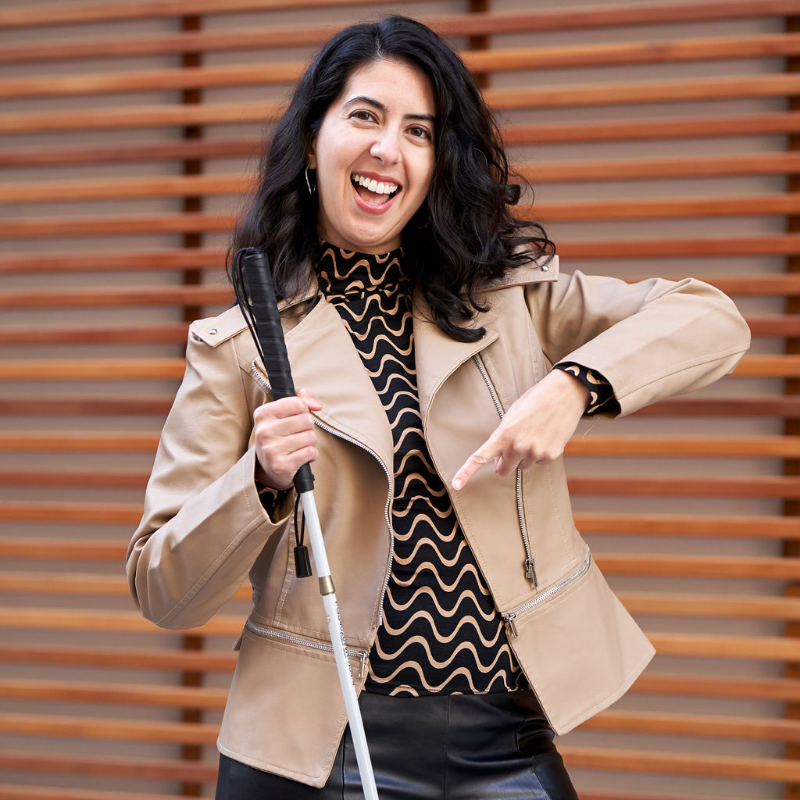
Matt Bowles: My guest today is Catarina Rivera. She is a deafblind world traveler, location- independent entrepreneur, international keynote speaker, award winning content creator and the founder of Blindish Latina, a platform smashing disability stigmas through storytelling, advocacy and education. She has worn hearing aids from a young age and was diagnosed with a progressive vision disability at 17 years old. She is a TEDx speaker, social justice advocate and a diversity, equity, inclusion and accessibility consultant who holds two master’s degrees in education and public health and has 14 years’ experience in the nonprofit and education sector. Today she owns a fully remote business, travels the world full time and has been to nearly 40 countries. She was named one of LinkedIn’s Top Voices in Disability Advocacy. She won the Trailblazer Award at the Bessie Awards and was named one of the 17 most inspiring women to follow on LinkedIn in 2025.
Catarina, welcome to the show.
Catarina Rivera: Thank you. I’m so excited to be here.
Matt Bowles: I am so excited to have you here. I am such a fan of you and your work and everything that you stand for. I feel like we should start this off though, just setting the scene and talking about where we are recording from today. I am actually in the Blue Ridge Mountains of Asheville, North Carolina on the east coast of the United States. And where are you?
Catarina Rivera: I am also on the east coast today. I’m in my home state of Maryland.
Matt Bowles: Well, I feel like we should also talk about where we initially connected. You and I were just both at the WITS Travel Summit in New York City. And we were both at the WITS Summit last year in 2024 in Utah. I was there at the Red-Carpet Bessie Awards Gala. I saw you win the Trailblazer Award. And I feel like it would be a great place to start just by asking you to share a little bit about your connection with the wonderful community. Maybe for people that this is their very first-time hearing about it. We of course got to give a shout out to Beth Santos, the amazing founder. She’s been on The Maverick Show twice but for people that maybe are not familiar with the community and with the WITS Summit, or can you talk about your connection and what the wonderful community means to you?
Catarina Rivera: The wonderful community is something that I’m so glad to be a part of now. I have known someone in the travel industry who was telling me about it for years, but I never really plugged in. For people who don’t know, the WITS Travel Creator Summit is an annual conference, but it’s organized by Wanderful, which has programming year-round, all focused on supporting women in travel. So, I went to the WITS Puerto Rico conference. That was my first wine, my first exposure to the community. I really was struck by how authentic everyone was, how welcoming they were, how many resources were being shared. And I really love the mix of traveling and getting to do experiences in the destination, but also doing workshops and learning and then getting to dance and make friends and talk to people. So, after I had that experience in Puerto Rico, I’ve been back every year since. It’s really also a valuable conference for me.
One of my goals at the time as a creator was to get travel brand partnerships. And I’ve been able to build my portfolio from wonderful connections because I actually attended which virtually the year before Puerto Rico, now I’m remembering. And I got in connection with one of the sponsors through the meetings that you can have with the brands. It ended up working out that I was in Greece at the right time because the sponsor was a cruise company based in Greece and they were able to put me and my partner on a cruise. And that was my first travel partnership that I can think of. So, I’ve spoken at WITS now three times in Puerto Rico. I spoke on the main stage. Beth gave me time to be in front of everyone to talk about my story with accessible travel. And I treated it like a TEDx talk. I was like, this is a big moment. I want to make sure I show up. And the audience response was so fulfilling because I envision. Okay, I want everyone, if they’re able to stand up. Like, I want it to be that kind of moment after. And it was. And everyone was really moved by my talk, so I felt like that was super validating. So, I love coming back and being a speaker, continuing to make sure that accessible travel is talked about and making new connections, strengthening old ones, and getting to know destinations.
Matt Bowles: Well, I know Puerto Rico is also an important part of your heritage. Can you share a little bit about your family background, where your parents and grandparents are from, and a little bit about their immigration journey coming to the U.S.
Catarina Rivera: My grandparents on my dad’s side are from Puerto Rico, and they moved to New York City. So, my father was born in the South Bronx, like a lot of other Puerto Ricans at that time. It was definitely a big Puerto Rican area. And on my mom’s side, she was born in Cuba, or I will say Cuba. So, she was born in Cuba, and so we had a whole family branch there. She came to the United States when she was 8 years old. So, both sides of the family came to the U.S. for a better life, better for economic opportunity, for stability for their families.
I think in my Cuban side, the story was told that everything was changing when Fidel Castro came into power, that someone in the family, a young child, got sick, and the only thing that cured them or made them better was medicine that a relative mailed from the U.S. So, I think that’s what I have been told is the moment where everything changed. And they said, okay, we have to live here. We want to make sure our kids are going to be safe and well. So that’s the immigration story. I think it’s really important for me personally to have connections to Puerto Rico and Cuba, because I think being able to go, I’ve gone multiple times as a young person, as an adult, to both. You get exposed to the idea that there’s something bigger than the U.S.
It’s not all about the U.S. you have a whole world out here with different cultures that have their own values, their own insights. And it helped me understand what diversity was all about. Before I even had the language for it. I was like, oh, this is cool. This is different. I really like this aspect of this culture. Like, for example, I love the warmth of Puerto Rico, of Cuba, with how people greet each other, how people talk to each other and are more present just sitting around and talking. It’s not about, let’s have a meal quickly and leave. No, we’re going to sit around, we’re going to joke, we’re going to spend time together. So that’s just an aspect that I observed as a young person.
Another thing that I’ll point out is my parents taught me Spanish as my first language, even though I was born here in the U.S. and that has been something amazing for me. I’ve used it in my career, whether I was a bilingual teacher back in the Bronx, that’s actually where I went to go teach in the Bronx, or working in community organizing, community engagement, being able to communicate with Dominican populations that I was working with. I’ve been able to use it in that way then also socially, also in travel, just to connect with people. I’m really proud of my heritage and my family history.
Matt Bowles: I also want to ask you about your disability journey. I know you started wearing hearing aids from a very young age, but can you sort of take us on that journey up through your diagnosis with Usher syndrome for people that maybe have never heard of that?
Catarina Rivera: So, for people who are not familiar, Usher syndrome is the most common genetic cause of deaf blindness worldwide. And when I was a young person and my family found out that I had a hearing disability, Usher syndrome, we didn’t know about it at the time. We didn’t know that anything was going on with my eyes. So, I grew up my whole childhood with deafness and wearing hearing aids. And that was my experience up till the time that I was 17 years old. My brother also wore hearing aids. So, I had a buddy in my disability experience because I was basically born with it. I was born with. Wasn’t like I knew any other experience. So, I think the acceptance part of it as a kid was pretty simple for me. Like, this is how I am, okay? And I don’t think I even notice the challenges or the obstacles related to disability or inaccessibility that I was experiencing, because oftentimes the obstacles come from inaccessibility, not from being disabled.
But now looking back, I can see, oh, there are times in school that I probably didn’t hear the teacher well, or I was always sitting in the front. Now I use captions all the time. I don’t know how I went through a whole school day without captions. I must have been lip reading all day and really sitting in the front. But one thing about my childhood is that I was not exposed to the deaf community or American Sign Language. And that was very common for the time that the medical community really didn’t talk about that with parents or advise that. And that’s quite a shame, because now that I’ve connected with the disability community, it’s so empowering, and it makes you feel not alone, and it makes you learn about rich history and culture. So, I really love it. But I didn’t really get to do that until later in life.
When I was 17 is when I was diagnosed with Usher syndrome. And the reason that diagnosis happened is because I had gone away to karate camp with all my friends, and my brother was there as well. There was a time that all of us were hanging out at night, and they wanted to play a prank on one of our instructors. So, all my friends lined up to go outside. They bounded outside, went down some steps, ran down a hill, and I was ready to go. When I stepped outside, I froze completely because I couldn’t see anything at all. It felt like it was pitch black. But the comparison between my experience and all my friends being able to run around super easily was striking. I started in that moment, like, what is going on? There’s obviously something going on, but I didn’t even know. I had no idea until that moment. And that’s what led my family and I to look for answers. I was very quickly diagnosed with Usher syndrome. That first kind of clue is night blindness. And that happens when you are a teenager. But what was interesting for us was that we didn’t know why I had hearing disabilities.
And then all of a sudden, with Usher syndrome, that explained my hearing disability as well, because it is a combination of a hearing and vision disability, although the vision disability is the only part that is progressive. So that means my vision has changed. I have about 5% of my vision remaining now, and that is central vision. So, kind of like seeing through a ball window. That’s a very simple way of putting it, because when I look far away, my window gets wider from the power of perspective. So, I think it’s really kind of hard for anyone who’s not in my body to understand what I’m actually seeing. But that’s a quick way to kind of get at it.
So, when I was 17 and I found out about Usher syndrome, I started a new disability journey for me because I thought I was all set. I had my hearing disability adjusted to, but now I had something new to contend with. And it was quite scary because there’s a lot of negative narratives about blindness. Most people actually fear blindness. They think it’s one of the worst things that can happen to them. And it’s so sad that people feel that way, that sight is so important, that your life is not good without it, and they don’t really think about what else can give life meaning and value. But I think when I was diagnosed, I really had nothing to go on. I didn’t have exposure to positive narratives about blindness. The doctors who diagnosed me didn’t talk to me about what I could do in my future or connecting to other blind people. They didn’t give me any message of positivity of perspective that I could hold. So, I had to figure it out myself. My family had to figure it out ourselves. And that took quite a long time.
But finally, here today, I’m in a place where I can say, I totally love myself. I’m confident in who I am, and that includes my disability. And I embrace the concept of disability pride, which is really just being proud of who you are. And that includes all the parts of you, including disability. I’ve learned a lot from my disability experience. I’ve become someone who has a lot of power and a strong voice because of all the self-advocacy I’ve done. I think it strengthened my communication skills as well, my sense of boundaries with myself and understanding of my needs. And it’s been quite an amazing journey. It’s also led to me starting my business and really clarifying that I want my life to be meaningful. And toning into that.
Matt Bowles: What are some of the main misconceptions that people have about deafblind people and how can non disabled people be better allies to disabled travelers?
Catarina Rivera: The main misconception about deafblind people is that we’re leading horrible lives and we need to be pitied and that we can’t enjoy life. It’s really weird that people think this, but I think that there are a lot of things that you think people wouldn’t believe. But floating around social media, for example, there’s a trend about doubting the existence of Helen Keller. People saying, oh, Helen Keller wasn’t real. She couldn’t write books, she couldn’t fly a plane, she couldn’t do everything that she did. It’s all fake. And you think that would be ludicrous, but it’s out there. It’s kind of similar, I think with disability, that there’s a lot of really damaging narratives out there.
I’ve posted about my travels many, many times and how I’m deafblind and I’m enjoying my life. And that seems to rattle people’s worlds. I’ve gotten comments like, why do you even go anywhere? What can you even do? Or saying that people should spin me around in the driveway and tell me I’m somewhere else. Like this idea that I don’t even have awareness or tools to know where I am. That travel’s not worth it or what are you going to do is smell the air and people have a lot of time on their hands that they should spend working on themselves. But I think what I’m hoping to do with my content is show people that I’m a vibrant person who is living an exciting life and that my disability is something that informs my experience, it informs how I live, but it doesn’t mean that I’m having a bad life or a life that’s not valuable, that my life is worthy just like anyone else’s.
So, in terms of non-disabled people, what they can do to be better allies, I think it’s really about if you’re in the travel space, using your voice to impact accessibility, to make an investment in it and look for any little way that you can make things inclusive. If you’re posting on social media, there are a lot of best practices for digital accessibility that you could be implementing. If you are someone who is organizing a group trip, can you look for ways to make your trip wheelchair friendly? For example, the hotel that you’re picking, are there accessible rooms? Can you look for those small things that can help you be an ally, that can help you include disabled people. And when you don’t know what to do, just be a conversation starter. Ask have we considered accessibility? Have we considered disability?
Matt Bowles: Well, I definitely also want to talk about your travel experiences and maybe a good place to start would be just thinking all the way back, how did your initial interest in world travel start to develop? You mentioned the trips back to Puerto Rico and Cuba and then from there, can you take us on the that journey and what got you so interested and inspired to see more of the world?
Catarina Rivera: When I was going to Puerto Rico and going to Cuba and visiting my family, that was very interesting to me. I think it opened my eyes to diversity and culture from a travel perspective. I think the biggest spark came from a trip that my family took to Spain and high school because we do have some relatives in Spain. But the main activity and purpose of the trip was to see Spain. So, I really felt like a traveler. I didn’t feel like a family visit. I think we were there for maybe two weeks. So, it was also a long time. I saw flamenco performances; I was eating well. Spain is just amazing. And we went to a lot of different cities. My mom booked us bus tours, which we had never done before, and we stayed in Madrid and Barcelona for a longer time and that was really cool too. So, we had like a mix of tour time and our time. I think one thing that I really enjoyed about going to Spain, and I was 16 at the time of this trip, is that I saw how well developed it was and like they had public transportation and we went on the train and I went all around the sidewalks and saw the architecture.
And I think that trip really piqued my interest in seeing the world and seeing what else was going on beyond the U.S. I also really enjoyed speaking Spanish and being able to communicate in a totally different place and have deeper conversations with people. But I think as a young person, just having this idea that you can travel and you can get around because people who are fully non disabled. I’ve met people who have never left the country. And I think a lot of it because, you know, their family didn’t take them out of a country, they kind of lack that sense of understanding of how do you even do this? Like, how do I even go somewhere new and figure it out? And it seemed very intimidating. But I don’t think I’m intimidated because I did it with my family and it didn’t seem like a big deal. We just went somewhere and we did the same things we would do here. When we got directions, we went on the train, we ate in restaurants, and we had a lot of fun. So, to me, I think it made travel less intimidating and super exciting to do more on.
Matt Bowles: And then can you talk about some of your early travel experiences as an adult? I know in college, for example, you went to Argentina, you went to South Korea. Can you share what the impact of some of those trips was on you?
Catarina Rivera: The travel I did in college was definitely life changing because it wasn’t just traveling to places as a tourist. I was traveling in a deeper way. I was part of a scholarship program that just set up some travel experiences for us. Where, for example, my first summer I went to Kentucky, to rural Kentucky, to a town that had about 3,000 people and population. And I appreciated that too. Getting to see a completely different area of the United States. And I’d never lived in such a small area, but there was so much to do. There were arts organizations and we were engaging in music and dancing and it was just expansive also to go there.
My second summer went to Argentina and we had family homestays. So, I did a homestay in Buenos Aires and one in Salta, which is in the northwest of Argentina. And that was super cool as a young person to live with a family, to eat with a family, to talk to them. You get to learn about daily life in a way that you would not get to if you are Just even making a local friend on a trip. So that was really deep in terms of travel and exciting. And I also volunteered with the government agency for the prevention of substance abuse and addiction. So, I was going to community centers and meeting young people as well. And I think I did a salsa dance class for them at one time and then traveling with other classmates, so also forming bonds with my friends. I think I really loved the connections that I made on that style of travel. And so that’s probably what has made me a fan of sustainable travel, slow travel, supporting locally owned businesses, looking for those ways to really connect more deeply in destinations and be aware of your privilege and be aware of your power and how you can leave a better impact rather than being like a taker.
And then South Korea was the first time I had gone somewhere where I did not know the language and I was 19. So, the good thing for me is that my friend also went there. We were not staying together, but she was Korean. So, when I was with her then I had experiences where she was translating for me. And it also challenged me to figure it out when I was with my host family because I also stayed with a family there. I just had to figure it out. I don’t think Google Translate was out at that time. I made friends with the littlest child in the family because we could just play and have fun and I just stretched myself. I feel like that really stretched me and gave me even more confidence to travel. Going somewhere where I didn’t understand the language, but being able to experience it and realize that I can do this too. And that offers me something different, to be in a culture that I didn’t have any previous exposure to. So, I really enjoyed learning about Korean culture and being there.
Matt Bowles: Yeah, Korea is an amazing place. I was based in Seoul for about five weeks back in 2018. As you know, I travel the world full time too and I’m also into the slow travel just like you are. And it’s so amazing when you can immerse into these places. Argentina as well has such a special place in my travel journey. When I left the U.S. completely got rid of all my stuff and just decided to do the full-time digital nomad thing. Argentina was my very first destination and I went to Buenos Aires for three months and I’ve been back multiple times to Cordoba and Buenos Aires again and other places. So, love those two countries. Just last week though, Catarina, I was in Montreal, Canada and I know Montreal has a significant place in your travel journey as well. And I want to ask you if you can share a little bit about your trip to Montreal, which I understand was your first solo trip with the white cane, and maybe just contextualize that in sort of your journey leading up to deciding to use the white cane and then what the Montreal trip was like for you and the impact that it had.
Catarina Rivera: That’s so cool. I didn’t know you have these connections with South Korea and Argentina, so I love that, we could talk more about that offline. So, yeah, let’s talk about the white cane. Not everyone uses a white cane. It’s actually a very small percentage of blind people that do. An estimated 2 to 8% of blind people use a white cane, and then the percentage is also pretty small for guide dog users. What are the rest of blind people doing? Well, the fact that blindness is a spectrum gives you a clue that a lot of people have some usable sight and they are relying on that. And that’s what I was doing for a long time. I was living in New York City. I knew I had a progressive vision disability. But no one tells you it’s time to use a cane now, or at least no one in my life did.
There wasn’t a benchmark that my doctors are watching for exactly, but I knew that my vision was changing. And about four years before I started using a white cane, a trainer that I was working with from the Helen Keller National Center for the Blind brought a cane to one of our sessions, and I was in my neighborhood. She had come to my home. She wanted me to try using the cane. However, I was not ready. She had not prepared me ahead of time for this. I didn’t know this was happening. I didn’t want to open a cane and go out in my neighborhood where people knew me and start walking with it. So, I felt very pressured, and I think it created more resistance for me to actually start using one. So, after that day, I was like, I do not like that. And a lot of blind people resist using a cane. It can feel scary. It can feel like everyone’s going to look at you. And I think there’s a lot of concern about, like, other people’s perceptions and how they are going to think about it and feel about you. So that was a blocker for me for a long time.
However, when I got a new job that required me to work in midtown in a very busy area after one winter, because the sun set so early in the winter and I had to navigate in the dark, leaving from work, that was so stressful, I did not enjoy it. I felt I was making it Harder on myself by not using a cane when it could help me. So, I made the choice. I said, okay, I’m going to get cane training. I’m going to learn how to use it, and then next winter, I won’t have to be so stressed or feel like at any time I could bump into something I didn’t want to injure myself. So that’s when I got the cane training. I had just turned 30. I think at that time that I was getting the training, and it was just a time of shifting, of trying something new. It was really scary to use a cane. Yes, people did stare at me. Yes, they were confused because I wear glasses. So now they see me with glasses, and I’m using a cane, and they have questions.
But that’s because people really don’t understand blindness. And there’s a group of people that will accuse blind people of faking their blindness. You would see this happen a lot to Stevie Wonder. Anytime Stevie Wonder does something that people think, oh, blind people shouldn’t be able to do that because they’re not educated. They don’t know they’re accusing him of faking his blindness. It’s been happening for years. So that’s just a famous person example. So, I was scared of what people were going to say to me on the subway or in the street. But guess what? I got over it, because I’m not living my life for them. I’m living my life for me. So that was an exercise in confidence, for sure, to go out, open the cane, and say, okay, I’m not concerning myself with anybody else but my own experience. I’m doing this to be safe and get around. Okay. So, when I got to that point, that kind of supercharged my confidence in a general way, like my general confidence as a human.
And when I decided to do a solo trip to Montreal, that was something that came out of that feeling confident in this journey, like, stage of my life where I wanted to have adventures, I wanted to do new things. And I had never really done a solo trip that was for fun. Not to go to a conference, not to visit a friend. I didn’t really count it as a solo trip if I was just on a plane and then I met someone at the place, like, visiting a friend. So, I decided on Montreal because it was a short flight away from New York. I knew the public transit was good, and I thought there would be a lot to do. And I felt like it was going to be safe. And I looked up things to do. I had the best time in Montreal it was the first time that I had traveled with my cane in this way as well. So, I practiced using it all the time. I wasn’t using it all the time in New York. I was being kind of selective.
But when you’re in a new environment, it really is helpful because I don’t know anything around me. It also helps people know to give me some extra space, and they don’t make assumptions that I’m rude or bumping into them. They give me positive assumptions, oh, she probably doesn’t see me. So that was really a wonderful experience. And, yeah, I did a few things with this trip. I booked a room inside an apartment where my host was a woman, and she lived there, too. So that made me feel safe. My goal was really to push myself, to grow, to take chances, and to see what it was like to solo travel. I contacted some salsa groups to find out about salsa dancing, and I ended up attending an outdoor salsa dancing party in Olympic Park by myself and had so much fun. I figured out my way around navigating public transit, and I actually made a travel friend. I was crossing the street in the middle of the street because the crosswalk was so far away.
So, I crossed a really big street when no cars were coming. And on the other side, there was a gentleman standing on the street, and he started talking to me. He was like, whoa, how’d you do that? Because in his view, I’m just fully blind. But I explained to him, yeah, I have some remaining sight. So, I looked left and right, and I went for it. And I found out that he wasn’t just a guy hanging out on the street. He actually owned the business behind him. And it’s called Waxman House. And Waxman House, they do men’s suits. They tailor and make suits. They also have a barber shop. And I think he has an espresso counter now formal wear. So, they’ve been around since 1927. And he gave me a tour of his business, and we were just chatting away. So, after that, he offered his son to take me to the local market. So, I got a tour guide for a little bit, and he also took me to a jazz venue that I wouldn’t have known about, this really cool jazz show and got the best bagels as well. So, I had a lot of fun. And I really just learned that solo travel was not scary, that you actually make connections while you’re traveling solo. You meet people, and that traveling with Mike Hayne was something I would be comfortable with and that it enhanced my travel.
Matt Bowles: Well, I know that salsa dancing is one of your core passions and something that you do all over the world. Can you share a little bit about that and about the differences in salsa dancing culture around the world? For example, I just a few years ago, went to Cali in Colombia for the first time, and the Salsa Caleña that they do there is a whole different type of sport. So, I’m curious, just your experience as your salsa dance around the world, what some of those experiences have been like for you and what salsa dancing in general means to you.
Catarina Rivera: I guess the most important thing that I would say about salsa dancing is that I really think it’s about joy. It’s about passion and having fun. And so, I’m not really a proponent of the ballroom style of salsa because I find it to be more stiff and more about performance. When you’re on the dance floor and you’re in community with other people and community with the music, it’s not really about performance. You’re not performing for others. You are tapping into freedom and joy and feeling really present in the moment. And that’s what I love about salsa dancing. I am not thinking about anything else. And when I’m dancing, especially with someone who is a good leader, then I am expressing myself so fully and so joyfully. So, I really love that. And if I feel like someone is spinning me too much or, you know, just like, not really in the joy aspect of it, that I don’t enjoy it as much.
So that’s one thing about salsa dancing that I hope people kind of take to heart, because I think there are people who could have a great time that keep themselves off the dance floor. Dancing is a huge part of Latino culture, and there are so many different styles of dance, and it’s so important to acknowledge the drum and the instruments that came from Africa that then influenced the culture and, in some ways, don’t get proper credit for how the roots of salsa came from and other dances. So, growing up, I danced socially with my family at family parties and things or New Year’s parties. But I didn’t really get to go deep into salsa until I went to college and I went to Duke in North Carolina. And there are a lot of Latinos in the area. So, there were some parties that were happening that I started going to. And I was trying desperately every year to get into the salsa dancing performance club at Duke, which was called Sabrosura.
And every year I try out, and they wouldn’t take me. And then finally I made it my junior year, and I was so excited to be a member. They practice Rueda de Casino. And Rueda de Casino is a dance where you switch partners. It’s salsa, but it’s a Cuban style where there’s actually one person in the circle who’s a caller, and they call out different moves, and everyone does the same move at the same time. So, it looks very synchronized. One of the moves is to switch partners, and they’ll say, dame. And so, you switch. But I think what is so interesting to me now that I was doing this, this is actually not something I can do now because I never hear what the person saying, the color in there. There are hand signs, but usually I’m spinning and I’m not going to catch the sign. And I also just find it difficult spatially to make sure I’m in the right place. So, I prefer now to dance just one on one.
But in college, I was doing that well at the casino, I was in there. So that was a lot of fun. I think that with salsa dancing, with travel, one thing I’ve learned is that it’s kind of hard sometimes to find the right information for where to go, because you’re just dropping into a place, you don’t know the local scene. If you’re local, you know, oh, no one goes to that spot-on Tuesdays. Everyone goes to this other spot. So, one of the best things you can do is if you can find out about the local WhatsApp group for the salsa dancers. That’s where they send all the event flyers, and you can start to find out about the local event. And my friend has done this, but I don’t know how she got in there. Maybe through Facebook. I think sometimes Facebook events are advertised, and then they say, oh, join the WhatsApp group. So that’s one thing.
But there are different styles of salsa. As you were saying, Cuba has a different basic step. Then you have a different step in Puerto Rico, in Colombia. But when you really know how to dance, that doesn’t matter as much. I don’t want to make light of it, but it’s kind of like a recipe variation, but you know the fundamentals. So, if you can keep the beat, then you can adjust to a different step. There’s also, with ballroom, a lot of salsas taught on a different beat, and that’s called on two regular salsas on the one, and it just means that your front foot is in front of you on the first beat of the eight count otherwise. And on two, your front foot is in front of you on the second beat. So, it kind of shifts everything forward. I don’t know who came up with this. Some people say, oh, it’s smoother, it’s more elegant. I don’t subscribe to that. I really like Cuban style salsa. I like the music a lot. I like dancing on one. And I think everyone should dance and express themselves in the way that they have the most fun with it.
Now I have different visual field than I used to. Well, dancing is very interesting. Sometimes my partner goes out and finds me dance partners. He brings them over. The best thing is to go to a party that’s not actually at a club. That’s for dancers. You want to go to a social, and that’s where people switch partners and you’re usually very friendly and interact with you. But when you’re someone new and you’re coming into a social where people know each other, sometimes you don’t get asked to dance. So, I find that challenging. But a lot of places I’ve gone to have been very welcoming. And the thing that I try to do is just kind of smile and dance on the side. And then when someone asks me to dance, I tell them quickly if I have enough time. I say I have limited vision. And there’s a move that a lot of people do where they put a hand up and you’re supposed to grab it. But there’s no tactile cue or way to know that the hand is up. So, I tell them, don’t do that, or I’m going to miss that. If they do that.
Sometimes I can catch it because I can kind of feel, oh, they might have a hand up. But oftentimes I can’t catch it. So, I’ve been doing that lately. And I’ve also been asking them to, after we finish the dance, bring me back to the same place where I was standing. Bring me back there, because I’ll get lost. I’ll be turned around and I won’t know where I am. And then the next dance starts. And once people are moving, it is harder to get off the dance floor. I don’t want to catch an elbow to my face.
Matt Bowles: Well, I also want to ask you about another country that I know you and I both love and appreciate, which is Japan. I have been back to Japan now three times. I spent my first month in Japan in Tokyo. Literally didn’t leave the city because I was like, how can anything be more amazing than Tokyo? But then I went back to for another month and I was based in Osaka. And then I went back for a third month and I was based in Kyoto and started traveling around to some of the other places like Miyajima and Naoshima and Hiroshima. Japan has a super important place in my heart. And I want to ask you about your trip to Japan. I know you are a lover of tea and I would love to hear about your tea experience in Japan, but I also saw that you tried soup sumo wrestling in Japan. So, we’d love to just hear the overall experience and highlights from your Japan trip.
Catarina Rivera: You are very well researched, by the way. I love that you are digging into all these trips and that you have pulled together all this information about what I’ve done without me telling you. So, you’re amazing for that.
Matt Bowles: Thank you.
Catarina Rivera: Yeah, for Japan. I have a whole series on my YouTube channel right now where I am dropping, I think, 12 videos about my experience in Japan. So, if you want to really go deep to my experience, that’s the place to go BlindishLatina or my name, Catarina Rivera on YouTube, but okay. And I love tea in an extreme way. Let’s say I plan my day around it. So right now, I have eaten lunch at a specific time so that I will digest my lunch, that I like to leave two hours after I eat to have teas. I’m going to have a matcha latte right after this Japan. I spent one month and one of the things that I love about Japan and I was so excited was to experience Japanese green tea, because from a flavor profile perspective, that’s my favorite green tea. I love Japanese sencha, especially in matcha. So, I’ve already been doing that.
But when I went to Japan, I went for one month and. And I worked with a travel advisor named Sequoia. Her company is called Puebla York because she focuses on sustainable travel and also slow travel in Japan and Mexico. So, I met her at wits. When I met her at the WITS conference, I said, oh, I’m going to work with you one day. I kind of kept her in mind. When I actually decided to go, what she did was help us select the cities we were going to and the order and how to avoid the crowds. So, one city she selected was Toyama. Toyama is on the opposite coast from Tokyo. I would never have picked that city on my own. It ended up being one of our favorites. So, I’m really glad that we worked with her.
She also recommended us to go to Hakuba in Nagano Prefecture. My partner wanted to snowboard, and when we went there, it was actually still snowing. It was March, but we still got the winter experience and Hakuba and she recommended a great hotel too. So, we were able to do so much in our trip. We went to Tokyo, we went to Hakuba, we went to Toyama, Kanazawa on a day trip. We went to the Gifu Prefecture. That was all me because I saw the experience, I wanted to do there and I ended up just booking around that went to Kyoto, Osaka, and it was incredible. And I just recorded a video today about the tea experiences. So, I had tea all the time. I’ll never get over just sitting in a restaurant and having someone bring you green tea as a default drink and just refilling it. I was in heaven. I’ve never been somewhere where tea is the default like that. And I just loved it.
Some of the things that were really, really exciting about tea there. I went to matcha farm outside of Kyoto in Wazuka called D Matcha. They are running an incredible business and experience. Their matcha is grown without pesticides, without insecticides. They are direct to consumer, so they’re able to make a living a lot easier than other farmers who are selling to distributors who unfortunately they’re not getting paid enough. And then they have a bunch of programs going on. They have internships that are super competitive. Hundreds of people are applying for internships there for just 20 spots. They have tourism, you can stay there. They have accommodations. They also are running tours all the time. And that’s what we did, a day tour where they picked us up from the train station. They had a branded bus; it was very comfortable. We got to tour the farm, walk in the fields with the tea, pick tea leaves which they fried for us and we ate them and that was delicious.
We went up to a temple and Dimatra is actually financially maintaining the temple. They talked a little bit also about their impact on the town. It’s one of those areas in Japan that the population is decreasing because it’s an older population. So, they’re working to revitalize that their full-time employees have to live there. They’re bringing people to there through their business, which is really cool. They also had tastings. We tasted three different senchas, three different matchas. We grinded matcha. We also had lunch where it was everything was tea infused. So, I had matcha Tan Tan noodles and they had dessert and a store. So, I got packs and packs of matcha. Loved it.
Also, I looked for a few women owned tea businesses. I visited a tea shop in Toyama that is over 130 years old and they have a proprietary blend that only they make of tea. And I tried that and it was women owned as well. It just didn’t even taste like tea to me. It was the most complex sour multi layered flavor. I have it in the cabinet now and I’m looking forward to getting surprised by it again. I haven’t had it since Japan. Also went to a woman owned tea place in Osaka that I had the best matcha latte that I’ve ever had in my life there. It was so creamy and so well blended and so perfectly balanced with the matcha. And she was kind of like a big personality to tell the owner. That place is called Mizu Tekiteki. So, I have my spots that I was able to really enjoy.
And I did a tea ceremony in Hakuba with also a woman owned business. She was wearing a kimono. She teaches the history how to properly make it. She goes through all the steps and it’s very regimented. It’s really interesting to see the history and I think pay proper respect to the history of Natcha. So that was really, really cool. And I got to try on a kimono coat. All the kimonos that she had in the space belonged to her mother, she said. So, she’s giving them like new life by wearing them through her business. And I hope more people go to her Hakuba tea ceremonies because she really knows her stuff and it was very enlightening. And she was so organized. Like there was a handout with all the information and that’s the kind of stuff that helps with accessibility that people might not even realize they’re doing that is accessible.
But when you have everything written out, in addition to saying it verbally, you are supporting people with accessibility, with understanding of information and working with different brains. Like you’re giving that support. So, I loved Japan so much. I met the founder of Accessible Japan while I was there. He’s a wheelchair user who’s Canadian, but he’s been there for a really long time. And so, he’s been doing work to influence and really provide information to travelers about what’s accessible and what the experience is like. Their wheelchair accessibility is pretty good in Japan. But he said one problem that really remains is bathrooms. You can get into a place but it doesn’t mean you’re going to be able to use the bathroom. A lot of businesses.
So, I think just like any place in the world there’s more to do. But I really was impressed from accessibility perspective. Also, just how in restaurants the default is to have bright lighting and no music on. That’s something that I can count on around the world. And people were speaking pretty quietly most places. So, I felt like very relaxed from a hearing perspective, because noise people don’t really realize, I think until you are out of having daily noise around you all the time, you don’t really realize the impact. But as a person with a hearing disability, I definitely notice and I have listening fatigue and sometimes I just want silence. I need a break. So, Japan was amazing for that.
Matt Bowles: I totally agree about the traditional Japanese tea ceremony and how incredibly special it is to do one of those. So, I have been recommending that to everyone as well. But you tried sumo wrestling while you were in Japan. What was that experience like because I did not do that.
Catarina Rivera: So, in Tokyo, there’s actually a lot of opportunities. The one that I did, the sumo wrestling was one opportunity, but there’s many of them. What it is, it’s basically like a dinner show. It’s providing a job opportunity for retired sumo wrestlers. So, there were two in our show that were actually doing the sumo. So, we were at a restaurant. It was organized around a sumo ring. There were two wrestlers there, and there was an announcer. And the announcer explained the rules of sumo wrestling. They demonstrated the rules, the things not to do, the things to do. And then they fought each other in three demonstration matches.
And then after that, the whole rest of the experience was everyone who was there who wanted to put on a sumo suit and a little hat with it’s like a rubber cap that had a top knot on it, and you could get in the ring and they would assign you one of the wrestlers. One of them was bigger than the other one. They gave my partner the bigger one. I got the smaller guy, and he was so funny. And they really just decided based on the person whether they were kind of fight you for real or whether they were just going to play around and be funny. So, with me, he didn’t really have to defend super hard. I’m not as strong as him. So, I was just like pushing and pushing. And then he let me win for fun. But then my partner, they saw that he was serious. He wrestled in high school. So, he approached the ring like ready to go. So, he was. But he thought he was going to win. The sumo wrestler, this is what he did, my partner came in with so much energy that the sumo wrestler simply backed up. And when it was like the edge of the ring, he lifted his foot up and just turned. And then my partner stepped out first. So, he was out of bounds. And that’s how you lose.
But he, until he saw the video, didn’t even realize what happened because it was really quick. But for these wrestlers, they’ve been doing this for years and years and years. So, this is like a really simple move for them. But yeah, he was a little. My partner is a little disappointed that he didn’t have a better showing. But the whole point is to have fun. You’re not going to win against a professional. But they were so great with the audience. They were so funny. And it’s really for the experience. I did look at actual sumo wrestling competitions and I saw they run three times a year, but the schedule didn’t align. We would have to go out of our way with our itinerary. But there was like, we were almost able to make it. So, if you really want to see the real thing, there is that opportunity three times a year with the official tournaments.
Matt Bowles: Yeah. And I have been as a spectator to a sumo match, which is super special. And definitely, if you can see one, you should definitely try to do it. Another country that is one of my very favorites is Portugal, and I try to go through about every year. I was just there in May of this year. I know that you led a trip to Portugal for disabled travelers. Can you share a little bit about that trip and the impact that that trip had on you and the other travelers that participated?
Catarina Rivera: This trip was a few years ago and it was an accessible trip to Portugal that I co-hosted with Portugal 4all Senses, which is a women owned accessible travel company in Portugal. I actually found them when I went to Lisbon with a sprained ankle and I had limited mobility. I went on Google and I was looking for what’s accessible in Lisbon and they had written an article about basically the flat areas and areas they recommended for people with mobility disabilities or wheelchair users. And so, I just read their article, took their advice, and I went to this big plaza based on their advice. And that’s how I started to get in touch with them. I said, well, I want to talk to them. They’re doing accessible travel. Let’s link up.
I had a phone call with one of the founders and it was just such a synergy. It was so easy to partner with them. I don’t think I’ve had an easier partnership where it’s just like, hey, yeah, let’s do something. Okay, you’ll do this, I’ll do this. All right. And we just did it. We ended up launching this trip and it was about a week long. I was the one responsible for marketing it and I gave them advice on the actual itinerary and they did all the logistics and everything. There was a real partnership there. We had so many different disabilities represented on the trip. I think we had eight to 10 travelers and everything from like chronic illnesses to blind people, we had deaf people, autistic travelers, learning disabilities, and a lot of people had like multiple disabilities. Wheelchair user as well.
We actually had a deaf blind traveler who got injured and then had a temporary physical disability as well. So, because the trip was already accessible and Portugal Falls had an equipment partner, all we did was we got her a scooter, an electric scooter that she wouldn’t have to walk. So, I was thinking about that. How beautiful is it that she doesn’t have to cancel her trip. If this had not been an accessible trip, then she would have not been able to go anymore due to her injury. So, it’s just showing the power of accessibility.
So, I really loved just the community that was built. I think that was a thing that people might have signed up thinking, oh, I’m going to see Portugal, I’m going to experience Portugal. But they were so impacted by being in a group of cross disability group people with different disabilities, all validating each other, affirming each other, existing exactly as they were. No one having to feel weird or like a burden if they have an excess need or people being super understanding of breaks, of just supporting each other and feeling fully seen and able to exist exactly as you are is not something that everyone has felt in their daily life. So, I think that was really beautiful. And some people really had not been on a flight even by themselves. So, them taking those moments of courage to participate, I’m super proud of them.
We did a lot of activities that aren’t that different than what a non-disabled group would do, but it was just adjusted or thought about, thoughtfully designed. So, for example, we did a tile painting activity at the tile museum and there were tactile elements of that museum. You could touch the tiles. So that was really working for a lot of people. And at our hotel in a private room, we had a fado experience. And fado is a traditional music in Portugal with singers and guitarists. I don’t know if there’s another instrument, but we had them come to this room. So, it was just for us that was really, really fun. We got to ask questions and we got to engage with them. But also, it was more comfortable because we didn’t have to go anywhere. It was right at our hotel. And we had wine and we had little snacks and we got to touch the instruments and stuff. So that was just an example of a way that we made it accessible and the selection of hotel as well. Being in a flat area near the water, we were able to get around that area independently for our free time.
And so that was really cool for me too because I had been doing this work for a while. But when I was actually on the trip, just observing other people’s experiences, hearing from them, I learned so much that I can now talk about and share in my trainings on accessible travel and disability for the travel industry. I have so many examples that I witnessed on this trip and recently actually co-hosted a disability empowerment retreat in Utah at the National Ability center with a participant from this Portugal trip who she’s also a speaker and author. And we joined up to co-host over there a retreat that combined adaptive outdoor recreation, community building and self-advocacy. And we talked all about internalized ableism with that group and it was a big success as well. So, I love those moments to really connect to community and be on the ground, be in it with people because it’s one nice break from me doing my travel.
Matt Bowles: Well, I also want to talk to you a bit about your activism journey. When you think all the way back, can you talk about how your politics and your worldview and your passion and commitment to social justice evolved into supporting the various intersectional struggles against oppression that you are so committed to today?
Catarina Rivera: The biggest thing for me was when I was in high school, I was working in the summer at a nonprofit that was focused on Latino youth in my area. They were doing all these programs, youth development programs, and I was on an advisory board for them along with program participants. I was the only one who is not a program participant. Getting to know these other young people who we shared the experience of being Latin A in the United States, but we had very different experiences. Our economic background and our privilege were an eye opener for me of how much privilege honestly, I’ve had in my day-to-day life. Both of my parents have graduate degrees, I grew up in a house and I’ve lived in this my whole childhood in the same place with good schools.
And I think that from that kind of moment, working with that non-profit and having that experience, I knew that I wanted to do something with my privilege. Like why do I have all this privilege? For me it wasn’t worth it to have all this privilege or I wasn’t going to do something with it. And I was trying to figure out what that would be. So that’s when I in college I started Working in education and taking education classes. So that was my first idea, was like, okay, I’ll go into the school system. And I became a bilingual elementary school teacher in this Bronx. I was working with Spanish speakers, and so all of my students were Latino. That felt like I’m really giving back to my community. But it all started as a young person, recognizing that I had opportunities, I had access, I had a certain level of security and safety that allowed me to succeed and allowed me to dream big. And not everyone had that.
Matt Bowles: Can you talk a little bit more then about your professional journey and then on into your entrepreneurial journey and the remote company that you built and run today and how you’ve integrated a lot of your advocacy and your passion into that.
Catarina Rivera: So, when I started my career, I was a teacher and I learned a lot from that experience. I also got my master’s degree in education. At that time, I was constantly looking for what I was passionate about and where I could make a real impact. After four years in the classroom, I felt that that was not it for me. The only way to grow in education was to grow out of the classroom into administration, and that wasn’t motivating me. So, I decided to quit my job at 25 years old. And I started a community health program in Washington Heights, where I was living. That’s in uptown Manhattan in New York City. I started this program called Healthy Kids in the Heights. It was free fitness classes for kids. Then I turned it into a parent education program. I was fundraising, I was doing social media, I was making connections, getting donations from local businesses. That taught me so much. I also gained a lot of belief in myself because there was an idea. And then it became a reality and I did that. So just having that experience, I think, gave me so much more confidence in being an entrepreneur and thinking that way.
Although it wasn’t a way to make money, it was not a business, it was a non-profit startup. So that, you know, I couldn’t do it forever. And I learned a lot too, because I was working at the problem from an education lens, thinking, okay, we have to educate people. But as I was doing the work, I learned that there’s actually systems at work here. There’s oppression, there’s things that are not in people’s everyday choices, not in their control, that have to be changed. So that sparked me to go into public health and work in the non-profit sector and see how organizations were trying to make systemic change. How are they trying to do that? So that’s what I spent the next nine years doing. And I got my master’s in public health. At the same time, I worked in a non-profit in Harlem and after school education. Then I was working on asthma prevention and support.
And then I switched into food security work at a large non-profit in New York called City Harvest. And when I worked for them, what was very cool about that job is I was a community engagement person for my neighborhood, for Washington Heights and Inwood. So, all the connections that I built with healthy kids in the Heights, I was able to tap into that and use it again. I was out in the community where I lived using Spanish, talking to people. And one of the things that I did there was start a group called the Washington Heights/Inwood Food Council. And the food council was focused on food justice. It was something that didn’t exist before, and we created it. It wasn’t me making it happen. I had community members on a steering committee and we did it together. And that was a really meaningful and valuable experience for me to learn how to try to create a leadership structure that brings everyone in with shared power as an organizer. And how do you build a vision when people have different opinions? So that was super interesting.
I worked on that for four years and then I exited the organization so that I could travel the world. But I am super proud that they are fully sustainable. We worked really hard so that they will be able to continue and expand beyond. And they have. They have expanded beyond what they were doing with me. They’ve made new programs, new initiatives. They’re still around. They still have a community garden. Now they’re doing food distribution. They’re doing so many cool things. So, I’ve always loved starting things. And whether that was for making money or not was I never really found the way to start something that I could also make my living until I did Blindish Latina. And even before Blindish Latina, I did try. I started a sustainable travel company and we did one trip to Puerto Rico. That’s a whole other story. Very cool. But with the pandemic, it was not viable to work on that more. So Blindish Latina ended up being my first business that really was a business and it enabled me to leave my job and I started it as an Instagram page.
It was fun to talk about my disability journey now that I was super confident and using my cane and I wanted other people to learn about blindness. I wanted to address these stigmas and smash them. I talk a lot about stigma smashing and my community of stigma smashers. So, I was just having fun sharing my story. Then I realized wait, I can do something with this. This can be a business. And I positioned myself as a public speaker in the disability space. I worked to set that up, making a speaker reel, putting a lot of content on LinkedIn, creating a big launch moment where I collaborated with lots of other people. I launched officially in 2021. I left my full-time job in 2022 and I’ve been doing full time public speaking, consulting, working with organizations, and even brand partnerships with social media.
So, I don’t just do travel partnerships. I also work in the disability and accessibility side of things. So, at the beginning of the year, I did a partnership with all laundry because they came out with a laundry detergent that has a QR code for blind people on their label now that encodes important information and that’s called Navi lens. So, I worked with them to announce that new feature. That’s just an example, but I love what I do and I’ve always followed the next right thing for myself. There’s no way I could have guessed that I’d be doing this today when I started my career. So that’s always my advice for other people. Be open. Be expansive. Keep learning. Because each thing that you learn, if you take that to heart, then you will open yourself up in a new direction as you adjust to what you’re learning. You don’t know what’s around the corner.
Matt Bowles: Well, I have now watched your TEDx talk twice. I want to encourage everyone else to watch it as well. We’re going to link it up in the show notes along with all of the other ways to finding content. Can you talk a little bit about the way that you currently design your lifestyle? You’ve mentioned your relationship partner who you travel together, and I’m wondering if you have any tips on traveling with a relationship partner as well as the concept of slow travel and immersive travel and why you choose that and then any other tips in there that you might give specifically to disabled folks that might be at the earlier stage of their travel journey.
Catarina Rivera: If you’re just starting your travel journey and you want to travel, I highly recommend the book the One-Way Ticket Plan by Alexa West. She’s another Bessie Award winner and I found the book to be really informative on the different pathways for travel. Getting people to think about teaching English abroad, for example, or getting creative about how you can travel now instead of waiting around. So, you don’t need a romantic partner to travel, you don’t need the perfect conditions or you can still pay down debt. If you’re traveling, you have to travel to places where it fits your budget, for example. But yes, I think for me, the ways that I’ve been traveling now, I’ve tried different things. I didn’t have it all perfect in the beginning. I tried some trips that were stressful because we were changing locations too many times.
So now I slow down even more whenever possible. We rent a lot of apartments, so we do use Airbnb, even though I would love to support another platform or rent from locals, because then we have a place to cook, to work, to do laundry. Laundry is something that I think people also don’t always recognize that when you’re traveling, you’re not on vacation. Just because I travel the world doesn’t mean that every day I’m out sightseeing and I’m doing laundry. We’re going grocery shopping. We’re going to the dentist in Chile. Yeah, I just went to the dentist in Chile. I have a team member who helps me research because every place that I go that’s new, that I need a haircut, I need a new person to do my haircut, for example, or my dentist or whatever. She works in my business.
One of the things that she does is researches things for us with travel. And I’ve even had her plan full trips for us just because I have other things that I need to do. So that’s really fun when we go on vacation and she’s planned the whole experience, and I give, you know, I give advice, I look it over. But because you’re constantly planning. So anytime that I can get support with the planning, I do get that support. I make decisions a lot quicker now as well. When you’re not planning a vacation that’s months away, a vacation that’s months away, you can spend so much time planning it. But if you’re traveling all the time, you’re just like, okay, I need a hotel. This one’s fine. You know, you just. You just go. I have a lot of shortcuts, and I have procedures. One procedure that is really helpful for me is how we set up in new accommodations. Like, what do we do first? What do we actually do? I have that as a YouTube video, my whole process. And I’m in Budapest in the video, actually newly in a new apartment. And we’re going around the apartment and showing you how we get acclimated.
It’s a mix of things related to my disability, like finding the light switches, finding the outlets. But I think anyone has to do those kinds of things in a new space. Figuring out what this light switch Does. Where are you going to put your things? Just understanding obstacles. So that’s something that I think is good because when you travel you use a lot of your brain power. And so, anytime you can save brain power, it’s helpful so that you can actually enjoy where you are traveling. With my partner, we have found the way that works for us and we try to check in before transitions and communicate about what we need to try to avoid problems.
And then everyone also has to be self-aware and do the best you can for yourself. I have anxiety when I take flights and that’s very common even for people who travel often a lot of them do have anxiety. So don’t feel like someone who travels all the time doesn’t have anxiety. I download entertainment, I’ll download a mix of things. So, if I’m feeling like reality, I have something. If I’m feeling a romantic comedy, I have something. I just give myself a whole mix. And I have books ready to go and all these things to make sure that I can deal with the actual flight snacks or another thing. So, understanding and prepping is really helpful as well. When you’re traveling with a partner as well, don’t feel like you can’t take alone time or separate. That’s really good when you do different things, just like you would do in everyday life, like you would go out with a friend. So, I’ve done things where I reached out to people, even people I don’t know well, or that was an introduction from somewhere else. But if we have something in common, I might go for a tea with them and meet up and just have my own social life even in the travel space. So yeah, I think in terms of travel, we just. I’m looking at slow travel, how you design how long we stay places.
Most of the travel is based on where we want to go. So, we’re always fighting with ourselves. When we went to Chile this year, it’s like we want to go everywhere. Chile, so long, let’s do it. And then we ended up cutting like half of it because we had to get real. We have to work, we’re not on vacation. So, we ended up doing Santiago. We went to Viña del Mar, we went to the Atacama Desert and we actually went to Argentina to visit a friend that I have from when I was 19 years old in Argentina. We’re still friends. So, we went there for two weeks and we stayed in his building. And it’s a lot of trying to anticipate what your future self will be happy with. Like will I be happy with this schedule when I’m actually doing it, or will I be mad that I set myself up for this? That’s what I’m trying to do all the time. Figure out what does future Catarina want and you get better at it as you go.
Matt Bowles: Well, I agree that Chile is an amazing place. I was based in Santiago for about a month and went out to Valparaiso. But also, I think it’s a really important point that sometimes, sometimes it’s not about trying to go and see the whole country. The first time I went to Japan, I did not leave Tokyo. The first time I went to Brazil, I did not leave Rio. But if you’re a full-time world traveler, you can always go back and go to another place and spend time in another city. So, I think that’s great advice. Catarina, let me ask you one more question and then we’ll wrap this up and move into the lightning round. When you think back about all of the travel that you’ve done up to this point, how do you think it has all impacted you as a person? And why are you so passionate about continuing to travel? What does travel mean to you today?
Catarina Rivera: I think it goes back to how I want to live my life. I want to have meaningful experiences and adventures. Travel is a way that I can do that. And I love making connections, I love learning. So being somewhere immersive, a new country or even a place I’ve been before, but going somewhere different is very exciting to me. That makes me feel alive, it makes me feel engaged. It makes me feel like time slows down. I think when you are really in a new environment, I feel like I’ve also grown and my ability to adapt. Because I’ve done so much travel, I can tolerate uncertainty better than I used to be able to do that. I can embrace not knowing, you know, and trust myself more that if something doesn’t work out, it’s not the end of the world. We can adjust, we can make changes. In terms of how travel has impacted me as a person, I think it’s part of why I’ve become confident in who I am. And I think also directly links to starting my business.
When I first moved abroad, it opened something up in me because I had been dreaming for years about moving abroad, about leaving the U.S. and I couldn’t believe that I had done it, but I really had done it. You have a dream and you’re on the other side of it. And so now life doesn’t feel real, it feels so surreal. So, when I was in that moment and kind of that energy, I was like, what else can I do? What’s next? What other limit can I shatter? What else? And I had so much energy for pursuing my ideas. And that’s the energy that my business was started out of where, okay, let me go for it. And I constantly surprised myself with what was happening in my business getting a TEDx talk. I got that before I was planning to. I was not planning to do a TEDx talk.
It was the year after I started my business that I applied. It was like seven months after the official launch and I didn’t even know what I was going to talk about. But my application said I had to submit a script and so I had to have my full talk written. And when I sat down and said, okay, I’m going to try and write it, I really didn’t believe that I could. But when I sat down and wrote it, the talk flew out of me. I typed and typed and typed and typed and couldn’t believe it that it was in there. So, I think travel has been just such a big dream for me. And so now it’s become something that I think has supercharged my passion for everything that I want to do, for how I want to show up. I think it’s something that has been part of my soul.
Matt Bowles: Well, I think that is the perfect place to end the main portion of this interview. And at this point. Catarina, are you ready to move in to The Lightning Round?
Catarina Rivera: Yeah, let’s go.
Matt Bowles: Let’s do it. All right. What is one book that you would recommend that people should read?
Catarina Rivera: I wanted to go with fiction for this. Okay. I recommend Pachinko by Min Jin Lee because it sheds light on Korean and Japanese history and it is gripping. You will not put this down.
Matt Bowles: What is one travel hack that you use that you can recommend?
Catarina Rivera: I use Google Maps saved maps all the time. So, I make maps for each destination that I’m going to. And for example, if I know where I’m staying, then I will look for walkable restaurants or walkable coffee shops nearby. And I’ll save them all to the map beforehand so that when I’m super hungry, I already have like five restaurants pre-selected that I can go to. It really helps, especially on travel days.
Matt Bowles: Who is one person currently alive today that you’ve never met that you’d most love to have dinner with? Just you and that person for an evening of dinner and conversation?
Catarina Rivera: This one’s really hard. Maybe I would go with Oprah, but I’m Also very intrigued by Glennon Doyle. She’s an amazing activist and author. And, you know, I think what I like about both of them is they feel like they’ve achieved a level of authenticity and their lives.
Matt Bowles: All right, knowing everything you know. Now, if you could go back in time and give one piece of advice to your 18-year-old self, what would you say to 18-year-old Catarina?
Catarina Rivera: I would tell my 18-year-old self to connect to the cross-disability community. Then don’t just meet blind people, don’t just meet deaf people. Connect to that broader community and learn about disability history and the culture. I think it really would have helped me.
Matt Bowles: All right, of all the places that you’ve now traveled, what are three of your favorite destinations you would most recommend? Other people should definitely check out.
Catarina Rivera: This question is not fair for true travelers because they all offer something different and all those experiences are worthwhile. So, I just want to say that as a caveat, but if I had to pick, I’m going to go with Italy, Japan, and I’m going to go with Slovenia.
Matt Bowles: Okay, last question. What are your Top 3 Bucket List Destinations? Places you have not yet been highest on your list you’d most love to, see?
Catarina Rivera: Okay, I want to put Iceland, Oaxaca and Mexico and New Zealand.
Matt Bowles: Amazing. All right, Catarina, at this point, I want you to let folks know how they can find you, how they can follow you on social media and check out your content and also the services that you offer in case folks might want to work with you in some capacity.
Catarina Rivera: Yes, thank you. I love to stay connected. My YouTube channel is all about accessible travel. You can find it with BlindishLatina or my name, Catarina Rivera. And I’m also posting all the time on Instagram threads, TikTok, BlindishLatina and on LinkedIn using my name.
Matt Bowles: We are going to link all of that up in the show notes so folks can just go to one place at themaverickshow.com go to the show notes for this episode. There you’re going to find direct links to everything we have discussed as well as all the ways to find and follow Catarina, watch her TEDx talk and come into her world. Catarina, this was such a wonderful conversation. Thank you so much for coming on the show.
Catarina Rivera: Thank you so much for having me. I appreciate it. I really enjoyed the depth of conversation here.
Matt Bowles: All right, good night, everybody.