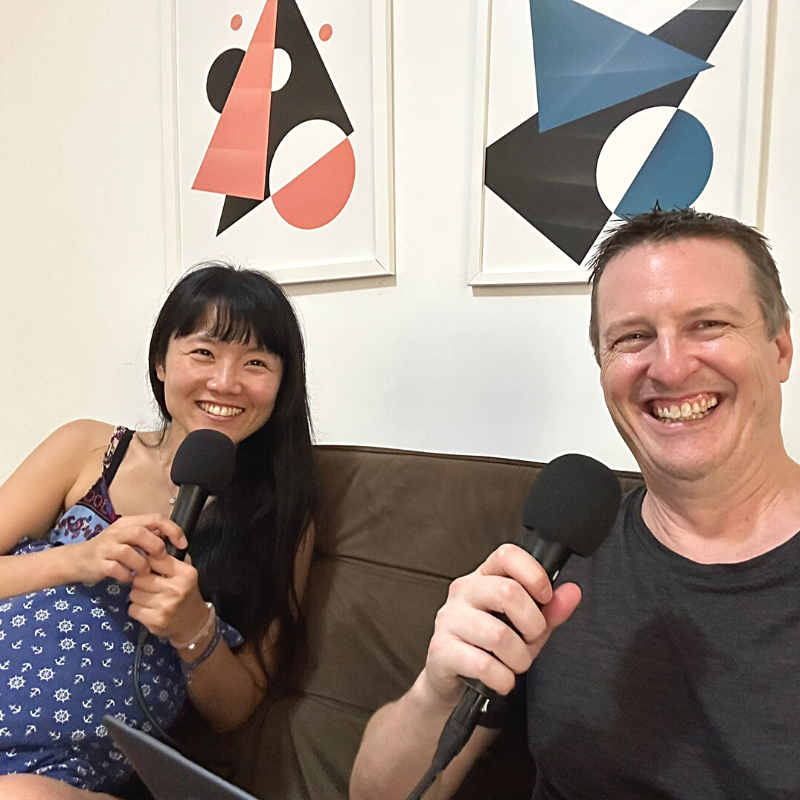
Matt Bowles: My guest today is Juky Lee. She is a travel writer and photographer, a translator, and a freelancer in the AI space who has been a full-time digital nomad since 2018 originally from Korea. She has now been to over 60 countries, and she is fluent in Korean, Spanish, and her third language, English, in which we will be conducting this interview today. Juky, welcome to the show.
Juky Lee: Hey, hello, Matt. Thank you.
Matt Bowles: I am so excited to have you here today. We need to just set the scene and talk about where we are recording this from today.
We are in person in Salvador de Bahia, right on the beach in Brazil, you have spent more time than I have here in Salvador. This is not your first time, but we’ve been hanging out this entire week and you are about to leave to go to Rio de Janeiro, which I’m super jealous of because Rio is one of my favorite cities in the world. But I want to ask you, what do you love about Rio de Janeiro for people that have never been? What’s it like?
Juky Lee: So, my ex used to tell me that Rio is the most beautiful city, and I actually didn’t believe it before coming to Rio. And then when I saw it, I realized it is really one of the most beautiful cities. Rio’s amazing because you will see the sea and mountains together in one go. And there are so many hiking spots. And if you are into Instagram, that’s like a lot of amazing photos you can take and really highly recommend Rio. Come to Rio.
Matt Bowles: I totally agree. I have traveled a lot. I as well, like you, have been to over 60 countries and I tell people it is the single most beautiful city I have ever seen in my life. And your kind of just have to go there to experience it. So totally agree with that. Juky, I want to ask a little bit about your background though, and give folks a little bit of context for you and your story.
You grew up in Korea, which is also one of my favorite countries. I spent about five weeks in Seoul, and I went to Busan and I went up to the DMZ as well. And I just had the most wonderful time. I’ve been telling everyone about it, but I want to hear a little bit about your story. Can you talk about where you grew up in Korea and what your experience was like and then how your interest in other cultures started to develop.
Juky Lee: So, I was born in Seoul, but I grew up in Ulsan. That’s like one hour from Busan, the second biggest city. Ulsan is a really industrial city. That’s where your Hyundai cars are produced and the city is a pretty industrial. So, growing up, I didn’t meet any foreigners, but even if so, I was really always curious about meeting different cultures, and different people from different countries.
Matt Bowles: Well, I want you to put people on to some of the things that you love about Korea. So, I have been telling people all sorts of stuff that I love about Korea ever since I went, for me, the food is, uh, unbelievable. It is some of the best food in the world and they have some of these restaurants where they only serve one dish like they have a restaurant and they only serve beef bulgogi or they only serve something else and so you go there and there’s no menu and you just go and you sit and they just serve you the beef bulgogi with the kimchi because that’s all that they have.
There is no choice, and it is amazing. It’s very inexpensive. It is remarkable and I would just go and have beef bulgogi at the same place every single day for like 30 straight days, my entire month there. And it was so delightful. Or I would know where I could go at like three in the morning when I came out of the club to get my octopus bibimbap and it would be, they would make it spicy for me and it would be so beautiful and lovely.
And I have the most wonderful culinary memories from Korea, but I also, the other thing that really won my heart culturally about staying in Seoul, in particular, was that Korea is really the Mecca of Asian hip-hop culture. And I sort of knew that going in, but when I was there, it was just so profound.
I mean, for people that don’t know break dancing in Korea is unbelievable. Like the Korean B-boy and B-girl teams. I think they’ve won international competitions like every year for like over a decade now. So that’s amazing. All of these hip hop clubs, hip hop shows. So, for me, I was a hip-hop DJ back in the 90s. And so that’s a big part of my heart and soul. And then to go to Korea and just to see how hip hop manifests itself in Korea and how much love people have there. And to be able to find all these hip hop spots that really won my heart. And then there was just, I mean, there were so many things. It was like one after another.
And so, I have been telling everybody do not sleep in Korea. You’ve got to spend time there. But I’m curious for you, Juky, what are some of the things growing up there, being from there that you would put people onto or that you really love about Korea?
Juky Lee: As you say, Korean food is really amazing. Like they never charge you tip. That’s really cool. And then they give you water for free and then you can ask a side dish that we feel for free. I think Korean food is a really amazing thing. And what I like about Korea is it’s really one of the most dynamic country. Whenever I come back after one year, or two years, I can see the changes.
The country is changing really fast and then the trend is going really fast. And so, I think it’s really fascinating to see the change and witness it. And I think it would be really cool if you visit now. And if you visit five years later, you might see something different. And I think it’s really cool.
It’s really nice. And the nature is also really amazing, 70 percent of the country is mountain. So, like in the autumn time, if you go to the mountains, you will see a lot of autumn trees, like the leaves are really beautiful. And people are actually also like nice that they’re hospitable. They always want to feed you. I like that about Korean people. So, yeah, welcome to Korea.
Matt Bowles: I have been telling everybody to go. Well, I also want to talk a little bit about your travel journey. And can you talk about what inspired you to travel? You mentioned where you grew up. You didn’t interact with a lot of foreigners. There wasn’t a lot of tourism and a lot of interaction with other international folks.
So, can you talk a little bit about what inspired you to travel? And then what was your first major international travel experience outside Korea?
Juky Lee: I think I’m simply a very curious person. Like since young, I was really curious about outside Korea. And in high school, I had a friend, she has a Pen pal friend in Ireland, and I remember that she actually went to university in Ireland.
And that was really, for me, because I didn’t really know how to speak English or anything, so I couldn’t be there. I think she was really inspiring for me. After a little while, I decided to go to travel to Latin America. I think back then, most of the people, Koreans, were traveling to mostly Europe or other Asian countries, but I wanted to go somewhere new. And I took Spanish one on one in the university. So, I was like, okay, I need to use a little bit of Spanish. So, like my first like big major trip was to Peru, Argentina, Bolivia and Chile. But the funny thing is when I arrived, I didn’t even remember how to say thank you in Spanish.
Matt Bowles: So, what impact would you say that that trip had on you?
Cause I’ve been to all four of those countries. They are truly spectacular. I tell people that Lima, Peru has some of the best food on the continent that you will eat. It’s amazing. Bolivia, I think this day has some of the most stunning landscapes and some of the most unique natural landscapes and the salt flats and the rainbow-colored mountains. It has all of this stuff.
And then Chile and Argentina are both completely amazing. I’ve spent probably six months in Argentina and spent about a month in Chile. These are all very magical places to me that have a big place in my heart. So, I’m curious when you did that extended trip and you spent all that time in very different cultures from Korea, what was the impact that that had on you at that age?
Juky Lee: Back then, there were no Korean travelers in Latin America, so I really needed to force myself to speak English and Spanish. Normally, I’m very talkative, so at first it was really difficult because I wanted to express myself, but I couldn’t because I was speaking, I mean, I was able to speak only Korean back then.
But after like three months, I was able to speak some Spanish, I was able to speak some English and I made a lot of friends. So, like my three months initial travel became seven months. From Buenos Aires, I flew to Spain, and I was spending like in European countries for a full month sleeping in like my new friend’s place.
I think before I could have never imagined that kind of thing because I don’t know, growing up only in Korea, surrounded by all these people. Only Koreans that was really something super different, super new experience. I really loved it. Peru and Bolivia, the nature is amazing. And in Argentina, I learned Tango.
That was also really cool. Yeah, I loved all the experiences. Like Uyuni was amazing in Bolivia, and Machu Picchu, all that. I walked for five days to get to Machu Picchu. The whole experience was really something that like, I can never forget. And after that, I think I decided not to live in Korea, kind of, because like, I already tasted something good. So, I kind of was like, Oh yeah, I’m going to live like this forever.
Matt Bowles: And I know that the following year you ended up going back. Can you talk about the next experience that you had? And it started with a road trip, right? From California down through Central America. I have never driven that route, so, I lived in California for about seven years, but I never crossed the border by car. So, can you talk about how that experience was?
Juky Lee: Yeah. So, I was volunteering for an NGO in California, like Northern California, and educate volunteers. And then like you do fundraise in the U.S. And then you go all the way to Belize, but then like, we were five people and they were driving from California and then crossing the border to Mexico.
And after that, Guatemala, El Salvador and Honduras, all these countries, like we’re traveling in one month, like visiting small cities and all that. And they ended up in Belize and actually did it four times because we were driving back from Belize to the U. S. And next year I did it again. So, I drove to all the way to Belize again, but that time was from Michigan.
So, I did that actually several times. It wasn’t the easiest to travel, but it was really fun. It was really cool. I mean, you’re traveling with your friends and then sometimes you need to give some money to be able to cross the border. So, it was like a lot of adventure.
Matt Bowles: And then that year in 2008, you ended up staying in Belize and living with a Mayan community there for like five months, right? Can you talk about that experience, what you did there and what it was like?
Juky Lee: Yeah, I was living in a place in the Mayan community, so I didn’t have electricity nor water. And it was all the house. One day when I entered the house, the snake fell from the ceiling. It was really, I don’t know, there’s so many, so many cockroaches everywhere, but the experience was really cool and fun because we were basically helping people to become aware of HIV AIDS.
And also, back then they didn’t have computers. So, I actually drew the shape of a keyboard, and I was teaching the kids how to type with keyboards. Also, we’re teaching how to make compost and organic farming and all that because mainly people eat iguana and like tortillas. So, they were not actually eating any vegetables, so we were also teaching how to grow vegetables and eat all, all that.
Matt Bowles: Well, I know that after you did that in 2008, you continued traveling and you started couch surfing. For people who have not heard about couch surfing, can you explain what that is, how it works, and maybe some of your most memorable couch surfing experiences that you had?
Juky Lee: Well, actually, couch surfing experiences started already on that trip.
So, we were five of us together. We didn’t have so much money. So, like we needed to find places. So, like one day in Las Vegas, we were sleeping, couch surfing place. And then like, we didn’t really care about sleeping on the floor. So, I was just like sending messages, “Hey, it’s okay. Can you please let me sleep anywhere? The floor is fine”. That’s how we actually traveled all the way from the States to Belize. And after that, I have really amazing experiences, like one day I was in Japan. And then I needed to fly out to like 9 a.m. and the host, he prepared really proper Japanese breakfast with miso soup and then grilled fish and everything. I could never forget it.
And also in Mexico, I mean, I arrived at 7 a.m. They come for me to the bus terminal, and then they pick me up and then they bring me to their house. And after that they go to work and then they leave me some money, like with a note, “Hey, I went to buy milk, but I couldn’t buy it because the shop was closed with this money. You can buy your milk and then there is cereal. You can have your breakfast with the car serving”. I really had wonderful experiences. And I actually have hosted some people as well. Once I hosted five people, they were a musical band, and they were all kind of like assisting the band for like a big band. And then he invited me, they invited me like their concert. So that was really amazing to like, I really love Couchsurfing.
Matt Bowles: That’s really cool. I have not done it myself, but it seems like a really cool sort of cultural exchange, right? So, it’s a website that you go to and people offer you a place to stay on there.
Couch or their floor or a spare bedroom or whatever they have. And then you can also offer yours, right? And then a lot of people I have heard enjoy just having travelers come and stay at their place because they get to have all of these international experiences and meet people from all over the world without even traveling because they just come to their house. And then when you’re out there traveling, it’s a very inexpensive way to get accommodations all over the world.
So, I think that’s a really cool thing. And I think it’s a really cool hack and travel budget strategy, if people are interested in that. I do want to ask you more about your experience in Mexico.
Cause I know that was a big part of your journey. You spent a lot of time there. You have a lot of love there. Can you talk about what brought you to Mexico and where you spent time and how much time you spent in Mexico?
Juky Lee: Oh yeah. So, the funny thing was I was working for this NGO in the States and then they fired me.
So, I’m like, okay, I don’t want to go back to Korea. But then, like, I don’t have so much money. Where am I going to go? Do I’m going to go to Mexico or Canada? Like, that’s where I can afford flight ticket wise. But then I actually chose Mexico because I used to, I mean, before I leave them. Belize, I was, I already had experience with Mayan community.
So, I was like, okay, I’m going to go to Yucatan area and probably I could find an NGO work there. So that’s how I ended up in Mexico. And then also I was speaking a little bit of Spanish, and I was like, okay, I could probably learn a little bit more Spanish as well. During six years, I lived three years and then I took one year break and another three years.
And during this time, I also lived in different parts of Mexico; like Cancun and that’s like the Caribbean side, Puerto Vallarta, that’s the Pacific side. And also, I lived in Guanajuato in Mexico City. Those are all beautiful. I really love Mexico. It’s because you go to different cities, like different countries.
Matt Bowles: Well, I know you had one experience there that I want to ask you about when you had a run-in with the Narco Trafficantes.
Juky Lee: Oh yeah.
Matt Bowles: Can you share that story?
Juky Lee: So, I had a lot of friends back then, so like one of my friends, he suggested, “Hey, let’s go to the seaside”. So, from Konohato, in the middle of the country, we drove six hours and we went to Puerto Vallarta. And on the way back, my friend who was driving didn’t want to pay for the toll fee. So, we were just taking, you know, the national road. So, we passed different villages after villages and after other villages. And when we entered one village, there was a car next to us, they were kind of like giving us a sign to follow them.
We were like, what is going on? We didn’t want to go so far from the city center because you know, like, you don’t really know what’s going to happen if we go somewhere where there is no one. We were like, we’re hesitant, we’re not actually like driving so far. But then these guys from the car, they were really yelling at us like, “Hey, you should drive a little bit more”. And then we drove like, I don’t know, probably like 10 minutes and then we got off because they told us to get off. There were like five of them and five of us and they had really huge weapons. It was really scary because also I was wearing shorts because we were just coming from the seaside.
They were actually checking the cars because they were actually suspecting us coming from a different family, narco family, because we were driving a pickup truck without the number plate. Anyone could probably suspect we’re like, I don’t know, from a different family or something. In the end, nothing happened because they checked in the car and everything, and then they saw us.
We’re kind of like two foreigners and three women. So, like they just let us go, but it was really scary because they were standing in front of us like with a whole like huge weapons. And then we’re just like. Standing there and then like the last thing that they told us was like, “Hey, if somebody else is tough, a little after, just tell them that you already checked”.
So like, I don’t know, we were still nervous. Afterwards, we were driving and I was like, “Oh my gosh, like we’re going to be stopped again”. And then we took the toll road right away. That was really scary.
Matt Bowles: That is the lesson. Stay on the toll road.
Juky Lee: Yes.
Matt Bowles: Juky, I want to also ask you about the time that you worked as a photographer for an extreme tour company and what that involved. Can you share about that?
Juky Lee: Yeah, that was in Mexico as well because I lived in Mexico for six years, so I have a lot of experience. I cannot actually say I’m a super professional photographer but that extreme tour photographer was really amazing because they actually gave me one year training. Some of them was kind of includes like free fall because we were like working in 20 meters high platform on the tree.
If there was just something happens like fire or anything, you need to get trained so that you can make your client escape not free fall way. So, like we were training like free fall from like rappelling 20 meters high and all that. And then my job was, there were six guys and one photographer and then 14 clients.
So, I took a picture of 14 people and I need to run like the zip lining. I need to go ahead of them again and then take a picture of them like in the 20 meters high platform, just like on my toes on the platform and then take a picture that my client’s going down. I mean, I actually didn’t know that I love height so much, but it was like so much adrenaline.
It was really fun experience, but I couldn’t continue because I was having some fungi in my waist because of the harness. It was really crazy because normally you have fungi in your feet. So, the creams for the medicine for this are normally small. But I was using actually one every day because I had fungi all over my waist. And it didn’t go away until I moved to Mexico City. There was a little cooler and not humid.
Matt Bowles: Wow. And then ultimately you ended up writing a guidebook for the Yucatan and you wrote it in Korean for Korean travelers, right?
Juky Lee: Yeah. So, like a part-time job, I was doing a little bit of like translation and interpretation work back in Cancun when I was living there.
The Korean tour company Employees or president, they came to Mexico to see how it is. And then, like, I gave them a tour, but it was kind of like an interpretation because they didn’t have anybody who can speak Korean. But one of them actually offered this. Hey, like, I’m going to our company. We also publish guidebooks. Like, do you want to write a guidebook about Yucatan? And then I was like, OK, yeah, sure. Why not?
But it actually took two years. And when the book was published, COVID happened. So, it was not the best timing, but it was a really good experience.
Matt Bowles: Well, I also want to ask you a little bit about your cryptocurrency investing journey and how you have used cryptocurrency as a way for creating social spaces and connecting with people around the world as you travel.
Juky Lee: In my crypto story, I think it’s really also fun. I built a house in Mexico in 2012. And when I sold it in 2015, Mexican pesos were really bad. So, I didn’t want to, but in Mexico back then I couldn’t open a dollar account. So, I don’t want to keep Mexican peso, so I changed it all to Bitcoin. That was 2015.
And I had a really good community in Cancun, like, I don’t know, like, they are Bit coiners, like Bitcoin and Cancuners. So, like, my community, like, they’re still my community, like, I love them. So, every week we gather together and then with them actually we did a lot of different project as well. We were making some cryptocurrency marketing project.
So, we’re actually getting funded by some cryptocurrency project. Everyone from our community, we traveled to Acapulco, and we did some like, you know, campaign for some cryptocurrency and we did also different campaigns in Guadalajara and then we did some YouTube and then we made a blog for Spanish speakers.
I don’t know, like, I kind of feel like these crypto guys are really my people. And then when I was traveling for some time, everywhere I go, I moved like every month or every two months, I was looking for these people, like. Crypto guys, I’m not everyone is my cup of tea, but I really enjoy sharing our passion about crypto and all that.
Matt Bowles: Well, I think it’s a really great thing to have something that has international relevance all over the world. And so anywhere in the world you go, you can look for people that are interested in the same thing. And then you have a commonality and a common connection, even if it’s somebody from a totally different culture. Or it speaks a totally different language or things like that. You have this commonality and it’s a way to connect. It’s a way to meet local people.
And for you, cryptocurrency being one of those things, I think is a really cool thing. I think people can apply that to whatever it is that they’re interested in, that they can then go and find in a foreign country and have that immediate connection with people. I think it’s a great way to meet locals.
The other thing that you do, which I think is really cool, is when you travel around the world, you will organize what you call skip the small talk meetups in different countries around the world. Can you explain what a skip the small talk meetup is and how you facilitate that and then how that works as you travel around the world in different countries?
Juky Lee: So, I’ve been traveling for a long time, and I kind of feel like I became a little bit cranky. So, I’m like, I don’t know, I’m really sick of this conversation. Hey, how many countries did you travel to? Where are you going to go? Or where are you from? Or what do you do? I was really tired of this kind of small talk. I mean, I kind of feel like you don’t really get to know people by asking these kinds of questions, right?
Like you go to language exchange, you meet like a hundred people. Every five minutes we’re actually talking the same thing. So, I wanted to do something different. And I am the kind of person that needs a little bit of. Deepness, but not probably super deep, a little bit of it. So, I make this kind of question card.
Hey, how were your parents when you were five years old? What is your like favorite memories of your university time? Or what did you do if you were a dictator of a small island? So, I prepared these small, cute questions that. To get to know people I post these in Facebook groups or meetup.com. So I gather people and then talk about it.
And often I ask people not even to ask the names. No nationality, no names. We just go right into, you know, what you think, what you were, you know, like we were values. And I think it’s really good cool. And sometimes I actually go by a little bit different identity as well. I think it’s really cool too. I don’t need to be Korean for everyone. I don’t need to be Juky for everyone. And it’s a really cool way to meet people and interact with people. You just take your mask away and Meet people in a different way.
Matt Bowles: I think that’s really cool and interesting. I really like that. You do that I also want to now ask you about your love of books and your love of libraries Especially Korean libraries. Can you talk about that?
Juky Lee: Yeah, I mean for me, I think personally I really like perspective changing experiences. I don’t know, a lot of times it is really fascinating for me that like, I don’t need to think like, I think. So, a lot of times books really help me to think a different way, giving me eye opening experiences. I think that’s why I really love books.
So sometimes I do like challenges with myself. Actually, some years ago, I started this challenge, 365 days, 365 books, but I actually couldn’t make it to a year, but I did a hundred days. And then this year I did it again. So like, I don’t know, sometimes, I mean, I have this time that I immerse myself in reading.
And that’s just giving me so much pleasure and so much knowledge and, yeah. And I mostly read books in Korean. That’s a little bit of a shame. Whenever I go to Korea, like I go crazy with the Korean libraries. I get 10, 20 books at a time and then I, like, pile up at home and I just read one after another. I don’t know. I just love it.
Matt Bowles: And that has also been a way for you to connect with people around the world. Can you talk about how you have organized book groups around the world in different places that you’ve gone? And how you structure those, like how you put it out there and how you structure the book groups in all the different countries that you go to.
Juky Lee: So, there are certain countries that I participate in because I’m there only for one or two months. So, it’s not so easy sometimes to gather enough people. But most of the time my aim is kind of like only five people because if it is more than five, it’s a little bit difficult for everyone to talk and everything.
So, like my book club is most of the time we read the same book in one week. Yeah, I’m a little bit hardcore, so I make people read one book a week and it lasts During my stay, it can be like four weeks, or it can be eight weeks. Every week we read the same books and I prepare 20 to 40 questions.
I don’t know, it’s just because so many questions pop up when I read books. We share these 20 to 40 questions during our meetups. That’s also another reason that I try to keep five people, because if you were 10, it’s going to be really difficult. And often I know the My book club lasts four or five hours, and it is actually a little hardcore, but people who love it, they really like it.
I think it’s a really nice way to meet people and connect, because we share common interests about, like, loving books or learning new things. And also, I really love book clubs, it’s because you read one book, the same book, but actually it is never the same book. Five people read five books. different perspective, like you learn different things from other people. So, I really love it.
Matt Bowles: That’s amazing. And I love the part about how it allows you to find your people, the people who want to read one book a week, the people who want to discuss it for five hours in one sitting. And then, you know, you really have your people. I mean, I think that’s such a lovely example. And there are other examples like that about things that people are passionate about. And you put out into the world, the things that you’re passionate about and you offer to organize and facilitate these things and you will attract other people that are passionate about those things. And then you will find as you travel the world, that there are people all over the world that are passionate about the same things that you are, whether it’s cryptocurrency or books or deep conversation meetups with really diverse people from different cultures or whatever it may be.
And so, I think that’s really inspiring that you have taken all those initiatives and have all of those examples. Another topic I want to ask you about Juky, you and I have been recently here in Salvador hanging out with some other digital nomads. We got into a conversation the other night about dating and relationships and finding love as nomads.
And you have been in this lifestyle for many, many years now. And I would love to ask if you’d be willing to share some of your thoughts and reflections about dating and relationships in the nomad life and how all of that works.
Juky Lee: A lot of people say that dating as a nomad is not very easy. But I don’t know, like my last relationship was just like, I arrived in Budapest, and I went to a digital nomad meetup and first meetup, I met my ex, and we were traveling together for more than four years. Recently broke up, so it’s a little bit, I’m having a little bit like difficult time, but traveling with my partner, like it was a really amazing experience. It’s because wherever you go, you know somebody. You go to a new city, a new home, but you don’t feel like it is a new city because you’re carrying somebody that you already know, and you immediately feel like the new house is your home. I mean, I really enjoy that feeling, like traveling with someone. And also like I was with that person during COVID, 24/7 together, like we had really wonderful time. I think if I was alone, it would have been really difficult to be like 24/7, like not going out because there was lockdown and all that.
Also, like when you’re traveling with people, your partner, decision making, I think it’s also become a little easier too. As you know, Matt, I think you have so many places to go. You want to go so many places, but when you are with someone, sometimes it gets a little easier to decide the next destination. And I think that really happens as well. And logistically also like things get cheaper because, you know, you went to one house. So, rent is cheaper, and also when you want to cook something, that’s always like, less work, and it’s cheaper.
Having a partner, as you know, Matt, I think is one of the best things. You can travel with someone. Yeah, it was a really nice experience. I actually want to travel with someone again soon.
Matt Bowles: Oh, I love the fact that you are from Korea. Your partner was from Brazil. The two of you met at a digital nomad meetup in Budapest, Hungary, and then fell in love and traveled the world together for four years.
I mean, I think that is fantastic. I think it’s amazing. I think it’s important that people know that, you know, there’s plenty of folks out there that are looking for a relationship and are looking for exactly what you just described and they’re there and you can meet them and somebody that has the similar values, similar lifestyle choices and stuff. And then you’re able to do that.
The beginning of my nomad journey began, I was in a relationship. I was living in LA and my partner, and I departed the U.S. together. And traveled the world together for three years before we ended up breaking up. So, it’s very similar to what you’re describing, right? Like I very much resonate with all of the things that you’re saying, because when you’re traveling with a partner, there are so many wonderful and delightful things about that. And there’s a lot of people now in the digital nomad world that are looking for exactly that. So, when you get out and you start interacting with those folks, there’s a lot of amazing people that you can meet.
Juky, when you think back about all of the travels that you’ve now done, 60 plus countries, what impact do you think all of that travel has had on you as a person?
Juky Lee: So, I don’t think it’s only Korea, but wherever you live, there’s some. cultural pressure or cultural expectations like from your people. And I kind of feel like I can be myself just because I’m traveling people don’t expect me to do certain things and all that. And I don’t seek for like sense of belonging anymore.
I kind of feel like I can’t belong anywhere. It’s just like it is really totally okay to be myself and be with myself and this whole year of traveling. I think it gave me really the sense of it is okay to be myself.
Matt Bowles: I love that. And I think that is actually a great place to end the main portion of this interview. And at this point, Juky, are you ready to move in to the lightning round.
Juky Lee: Yes.
Matt Bowles: Let’s do it. All right. What is one book? And I know you are a voracious reader, and you love so many books, but what is one book that you would recommend that people should definitely read?
Juky Lee: So last summer I organized a book club in Budapest and one of the books that we read was The Weirdest People in the World. It’s kind of like a history book. I could say it’s a similar to Sapiens, but it is like a more recent history, like 10 last centuries. For me, it was really interesting to be able to understand this part of history, how like Western people became certain way. And the rest of the world is actually following the Western way. So, It was really interesting book to be able to understand the word.
Matt Bowles: All right, Juky, if you could have dinner with any one person who’s currently alive today that you’ve never met, who would you choose?
Juky Lee: It is again, book related. It’s the author of a book like Sapiens. I think, yeah, I read Sapiens several years ago. I really loved it. And I would like to meet the author Ivar Harari. Like, yeah, he is going to be the one I would like to have dinner with.
Matt Bowles: All right, Juky, after all of this travel that you have done, what is one travel hack that you use that you can recommend to people?
Juky Lee: So, for me, affordable accommodation is really important. So, what I do is like, you know, like there are some cities in Europe. I think it’s specifically in Europe, there’s some cities there. It is like a student town, like Budapest. So, if you go to Budapest in summer, you can actually find like affordable accommodations because people go back to their countries or they go to go on a vacation somewhere else.
And then I go to, I don’t know, the beach town or a Spanish, like coast side. I go there in the winter because that’s a lot more like a lot cheaper, but also like, you don’t really have people around. I really loved the whole sea area is only for me. Like you’re walking and there’s really nobody bothering you. And then they’re all just a super peaceful. And I really liked that. And it’s also cheaper that way.
Matt Bowles: Absolutely. That is a good one. All right. Juky, knowing everything that you know now. If you could go back in time and give one piece of advice to your 18-year-old self, what would you say to 18-year-old Juky?
Juky Lee: So, I grew up in Korea, I mean, a really competitive society, right? When I was 18, I tried to sleep for three hours. Because in Korea, there was a saying, if you sleep for three hours, you can go to the university that you want to, but if you sleep four, you’re not going to go. So, I was like, I don’t know, most of the time I really tried not to sleep and then studying like for 20 hours.
And I want to really tell her that, hey, you can sleep, and it is okay. And that, like your future is going to be amazing and that you don’t need to worry about it. Everything’s going to be fine. You don’t need to be anxious and you’re going to be an amazing person as an adult.
Matt Bowles: Oh, I love that advice. All right, Juky, of all the places that you have now traveled to, what are three of your favorite destinations you would most recommend that other people should definitely visit?
Juky Lee: A lot of people actually ask me where is my favorite place often, right? And the answer normally that I give is where I am right now. I try to think that way. I don’t know, I try to not to miss anywhere. And then I think it’s kind of like a state of mind, where you are right now is the, your favorite place.
You just try to enjoy it. But still, I can actually give some more places, like, I love Budapest because that’s where I kind of feel like my community is. And also, I love Rio de Janeiro. That’s a really beautiful place. Penang, Malaysia, it’s also amazing. And actually, I cannot skip Mexico because Mexico is my second home. So sorry, it’s four, not three.
Matt Bowles: You’re allowed to have four. Those are great. Why do you feel like you have such a strong community in Budapest? Can you talk about your connection with that city?
Juky Lee: Oh, it’s because as I mentioned before, it is difficult for me to like this kind of language exchange meetups. In Budapest, there are some sort of self-development meetups.
It has been going on for seven years. So, like I’m going back to Budapest every summer actually. And then I know that there is this community. I know that they’re going to be talking about intuition this week. Or they’re going to be talking about productivity next week. So, I know that there’s going to be this community. So, I kind of feel like Budapest is open. My third home.
Matt Bowles: Awesome. All right. Last question, Juky, what are your top three bucket list destinations? These are places you have not yet been highest on your list. You would most love to see?
Juky Lee: Yeah, it’s changing a lot, but then like last month when I was in Tbilisi, Georgia, I hosted a car surfer from India. I really want to visit her. So, it’s going to be India.
And then, really funny thing, I was checking work away options in Jordan, and then I found out that there is a Korean Initiative some sort of movement going on in Jordan. So, it’s an NGO and I think I’m going to go to Jordan like very soon and I’m going to be volunteer in that organization it’s going to be really cool and Estonia.
I have one of my favorites, one of my best friends is in Estonia. So yeah, that’s going to be the three countries.
Matt Bowles: All right. Juky, I want you to let folks know at this point how they can find you, follow you on social media, learn about what you’re up to. How do you want people to come into your world?
Juky Lee: So, I’m actually not super present in social media, but I do have Instagram and that’s, it’s my name. It’s lee.jukyung. That’s how you can find it.
Matt Bowles: We are going to put it in the show notes. Everything that we discuss in this episode will be in one place. So, folks can just go to themaverickshow.com and then go to the show notes for this episode. There you’re going to find Juky’s Instagram handle. You’re going to find her recommendations that she’s made in this episode and everything else that we have discussed.
Juky, this was amazing. Thank you so much for coming to the show.
Juky Lee: Really? Thank you for having me. Thank you.
Matt Bowles: Oh, it was great to have you. Good night, everybody.